POPULATION
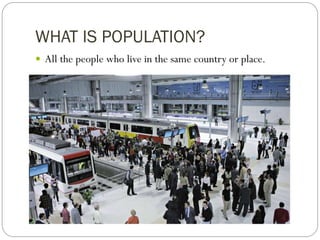
WHAT IS POPULATION? 
 All the people who live in the same country or place.
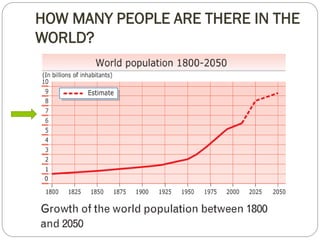
HOW MANY PEOPLE ARE THERE IN THE 
WORLD?
EVOLUTION OF THE POPULATION IN 
DEVELOPED COUNTRIES 
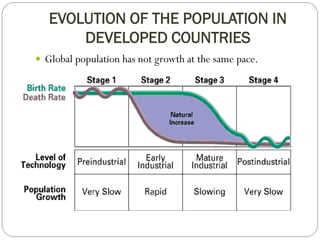
 Global population has not growth at the same pace.
EVOLUTION OF THE POPULATION IN 
DEVELOPED COUNTRIES 
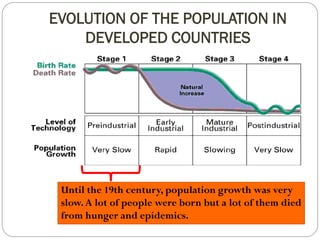
Until the 19th century, population growth was very 
slow. A lot of people were born but a lot of them died 
from hunger and epidemics.
EVOLUTION OF THE POPULATION IN 
DEVELOPED COUNTRIES 
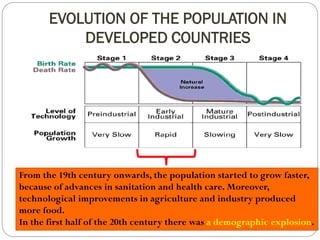
From the 19th century onwards, the population started to grow faster, 
because of advances in sanitation and health care. Moreover, 
technological improvements in agriculture and industry produced 
more food. 
In the first half of the 20th century there was a demographic explosion.
EVOLUTION OF THE POPULATION IN 
DEVELOPED COUNTRIES 
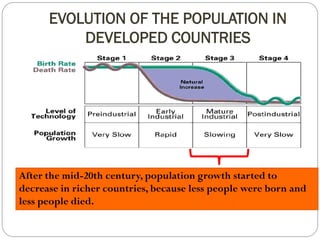
After the mid-20th century, population growth started to 
decrease in richer countries, because less people were born and 
less people died.
EVOLUTION OF THE POPULATION IN 
DEVELOPED COUNTRIES 
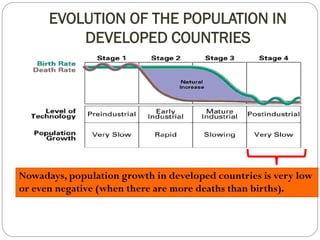
Nowadays, population growth in developed countries is very low 
or even negative (when there are more deaths than births).
EVOLUTION OF THE POPULATION IN 
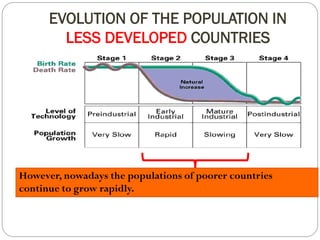
LESS DEVELOPED COUNTRIES 
However, nowadays the populations of poorer countries 
continue to grow rapidly.
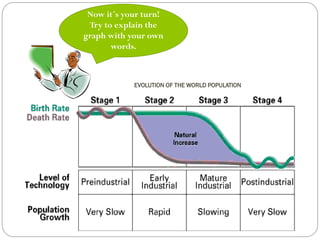
Now it´s your turn! 
Try to explain the 
graph with your own 
words. 
EVOLUTION OF THE WORLD POPULATION
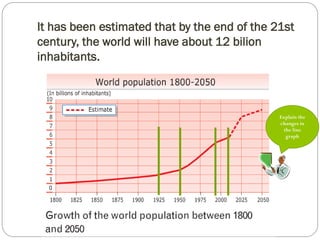
It has been estimated that by the end of the 21st 
century, the world will have about 12 bilion 
in habitants. 
Explain the 
changes in 
the line 
graph
 Page 47: 
 Ex. 1 and 4 
 Page 56 
 Ex, 1
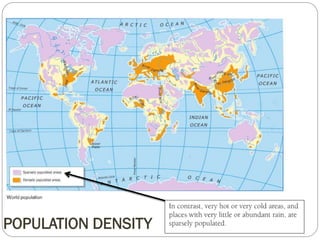
POPULATION DENSITY 
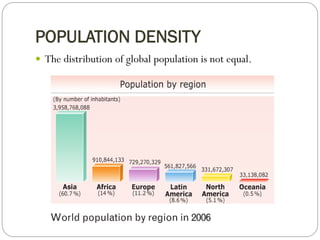
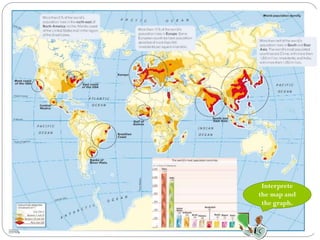
 The distribution of global population is not equal.
POPULATION DENSITY 
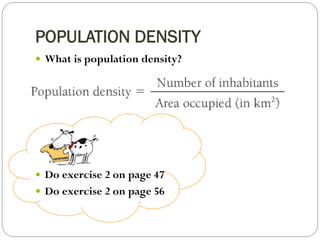
 What is population density? 
 Do exercise 2 on page 47 
 Do exercise 2 on page 56
POPULATION DENSITY 
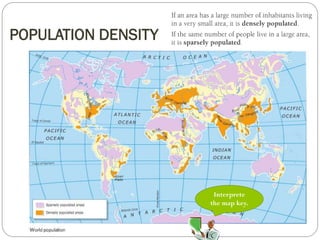
Interprete 
the map key.
POPULATION DENSITY
POPULATION DENSITY 
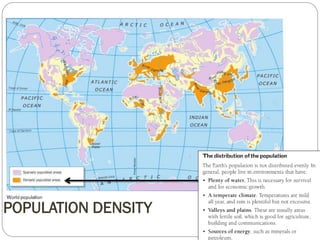
 The distribution of global population is not equal. 
Interprete 
the map and 
the graph.
POPULATION DENSITY
 Page 47: 
 Ex. 3, 4, 5 and 6

Population

  • 1.
  • 2.
    WHAT IS POPULATION?  All the people who live in the same country or place.
  • 3.
    HOW MANY PEOPLEARE THERE IN THE WORLD?
  • 4.
    EVOLUTION OF THEPOPULATION IN DEVELOPED COUNTRIES  Global population has not growth at the same pace.
  • 5.
    EVOLUTION OF THEPOPULATION IN DEVELOPED COUNTRIES Until the 19th century, population growth was very slow. A lot of people were born but a lot of them died from hunger and epidemics.
  • 6.
    EVOLUTION OF THEPOPULATION IN DEVELOPED COUNTRIES From the 19th century onwards, the population started to grow faster, because of advances in sanitation and health care. Moreover, technological improvements in agriculture and industry produced more food. In the first half of the 20th century there was a demographic explosion.
  • 7.
    EVOLUTION OF THEPOPULATION IN DEVELOPED COUNTRIES After the mid-20th century, population growth started to decrease in richer countries, because less people were born and less people died.
  • 8.
    EVOLUTION OF THEPOPULATION IN DEVELOPED COUNTRIES Nowadays, population growth in developed countries is very low or even negative (when there are more deaths than births).
  • 9.
    EVOLUTION OF THEPOPULATION IN LESS DEVELOPED COUNTRIES However, nowadays the populations of poorer countries continue to grow rapidly.
  • 10.
    Now it´s yourturn! Try to explain the graph with your own words. EVOLUTION OF THE WORLD POPULATION
  • 11.
    It has beenestimated that by the end of the 21st century, the world will have about 12 bilion in habitants. Explain the changes in the line graph
  • 12.
     Page 47:  Ex. 1 and 4  Page 56  Ex, 1
  • 13.
    POPULATION DENSITY The distribution of global population is not equal.
  • 14.
    POPULATION DENSITY What is population density?  Do exercise 2 on page 47  Do exercise 2 on page 56
  • 15.
  • 16.
  • 17.
    POPULATION DENSITY The distribution of global population is not equal. Interprete the map and the graph.
  • 18.
  • 19.
     Page 47:  Ex. 3, 4, 5 and 6