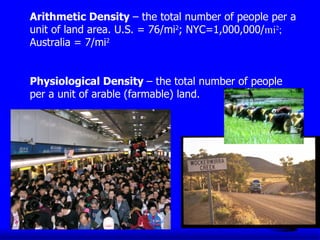
Arithmetic Density  – the total number of people per a unit of land area. U.S. = 76/mi 2 ; NYC=1,000,000/ mi 2 ;  Australia = 7/mi 2 Physiological Density  – the total number of people per a unit of arable (farmable) land.
 
 
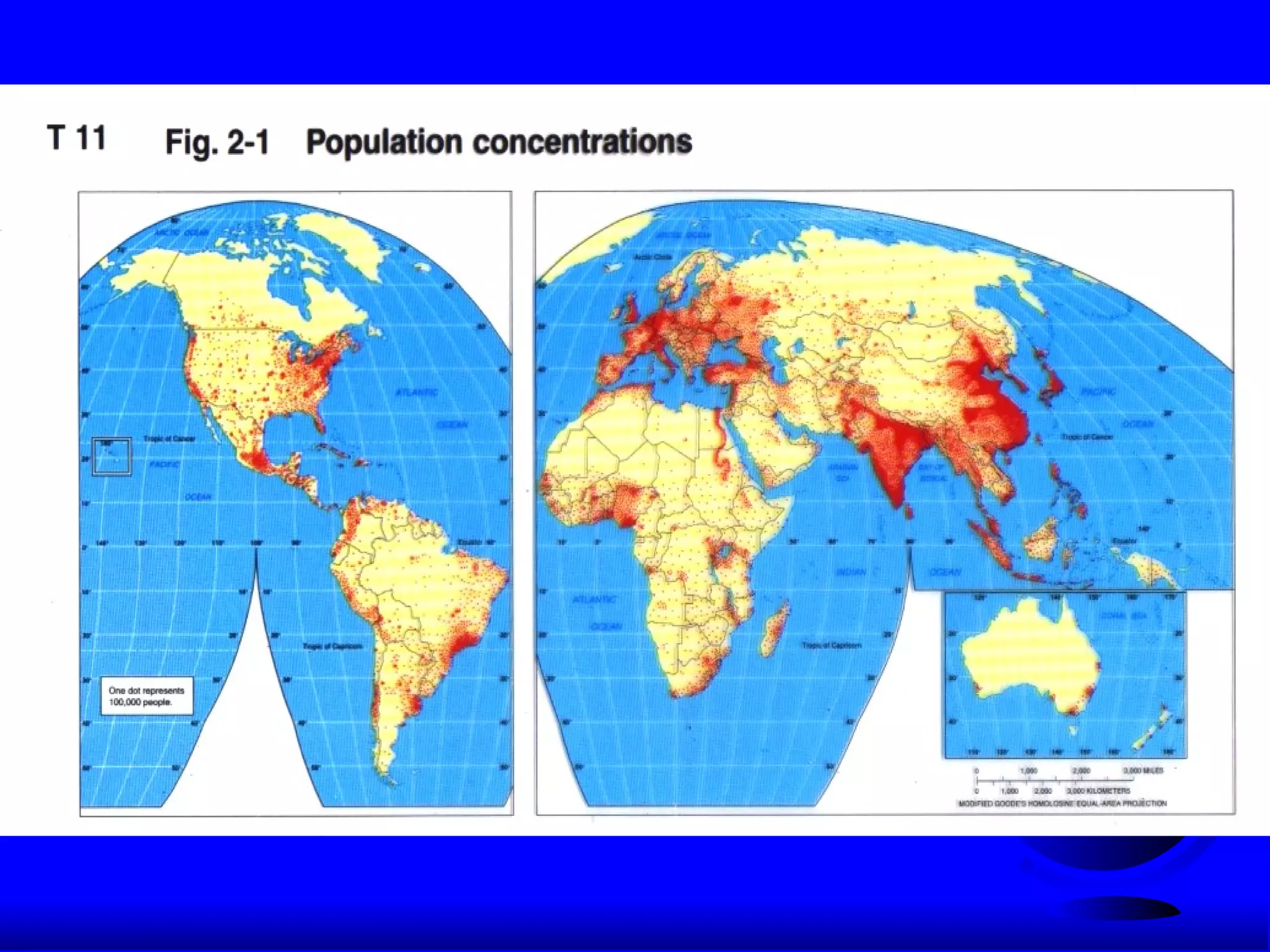
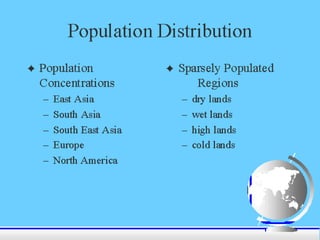
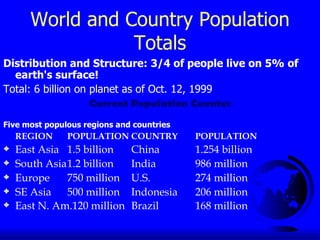
World and Country Population Totals Distribution and Structure: 3/4 of people live on 5% of earth's surface! Total: 6 billion on planet as of Oct. 12, 1999 Current Population Counter Five most populous regions and countries REGION POPULATION COUNTRY POPULATION East Asia 1.5 billion China 1.254 billion South Asia 1.2 billion India 986 million Europe 750 million U.S.  274 million SE Asia 500 million Indonesia 206 million East N. Am.120 million Brazil 168 million
 
 
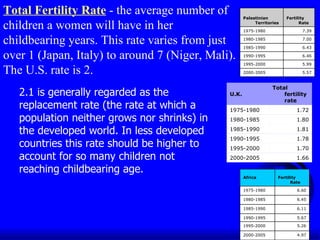
2.1 is generally regarded as the replacement rate (the rate at which a population neither grows nor shrinks) in the developed world. In less developed countries this rate should be higher to account for so many children not reaching childbearing age. Total Fertility Rate  - the average number of children a women will have in her childbearing years. This rate varies from just over 1 (Japan, Italy) to around 7 (Niger, Mali). The U.S. rate is 2. 5.57 2000-2005 5.99 1995-2000 6.46 1990-1995 6.43 1985-1990 7.00 1980-1985 7.39 1975-1980 Fertility Rate Palestinian Territories 4.97 2000-2005 5.26 1995-2000 5.67 1990-1995 6.11 1985-1990 6.45 1980-1985 6.60 1975-1980 Fertility Rate Africa 1.66 2000-2005 1.70 1995-2000 1.78 1990-1995 1.81 1985-1990 1.80 1980-1985 1.72 1975-1980 Total fertility rate U.K.
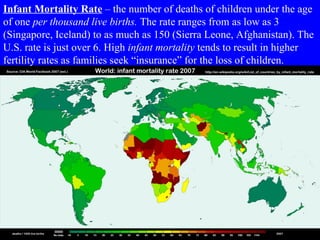
Infant Mortality Rate  – the number of deaths of children under the age of one  per thousand live births.  The rate ranges from as low as 3 (Singapore, Iceland) to as much as 150 (Sierra Leone, Afghanistan). The U.S. rate is just over 6. High  infant mortality  tends to result in higher fertility rates as families seek “insurance” for the loss of children.
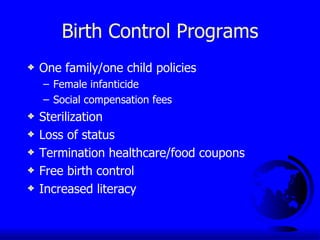
Birth Control Programs One family/one child policies Female infanticide Social compensation fees Sterilization Loss of status Termination healthcare/food coupons Free birth control Increased literacy
 
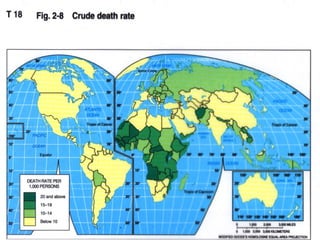
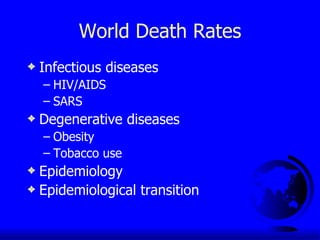
World Death Rates Infectious diseases HIV/AIDS SARS Degenerative diseases Obesity Tobacco use Epidemiology Epidemiological transition
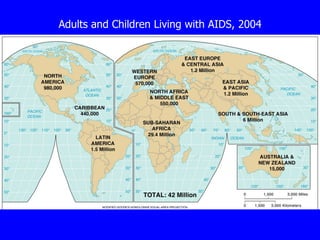
Adults and Children Living with AIDS, 2004
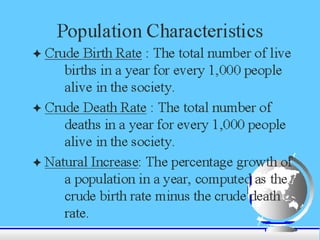
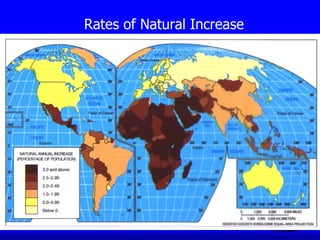
Rates of Natural Increase
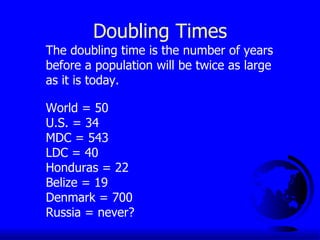
Doubling Times The doubling time is the number of years before a population will be twice as large as it is today. World = 50 U.S. = 34 MDC = 543 LDC = 40 Honduras = 22 Belize = 19 Denmark = 700 Russia = never?


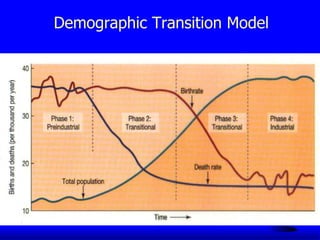
Demographic Transition Model
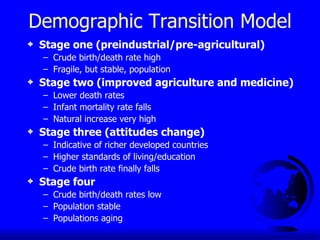
Demographic Transition Model Stage one (preindustrial/pre-agricultural) Crude birth/death rate high Fragile, but stable, population Stage two (improved agriculture and medicine) Lower death rates Infant mortality rate falls Natural increase very high Stage three (attitudes change) Indicative of richer developed countries Higher standards of living/education Crude birth rate finally falls Stage four  Crude birth/death rates low Population stable Populations aging
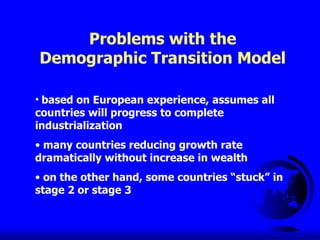
Problems with the Demographic Transition Model based on European experience, assumes all countries will progress to complete industrialization many countries reducing growth rate dramatically without increase in wealth on the other hand, some countries “stuck” in stage 2 or stage 3
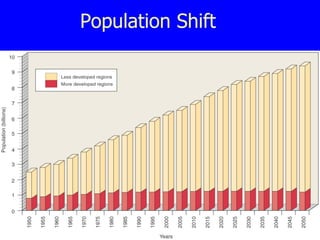
Population Shift
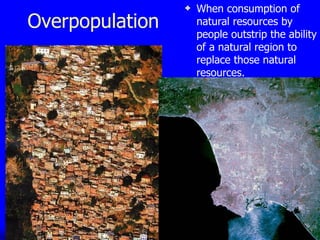
Overpopulation When consumption of natural resources by people outstrip the ability of a natural region to replace those natural resources.
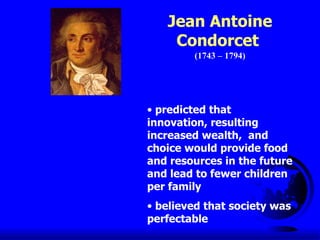
Jean Antoine Condorcet  (1743 – 1794) predicted that innovation, resulting increased wealth,  and choice would provide food and resources in the future and lead to fewer children per family believed that society was perfectable
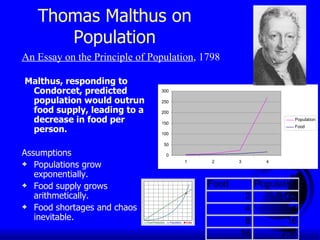
Thomas Malthus on Population Malthus, responding to Condorcet, predicted population would outrun food supply, leading to a decrease in food per person.   Assumptions Populations grow exponentially. Food supply grows arithmetically. Food shortages and chaos inevitable. An Essay on the Principle of Population , 1798
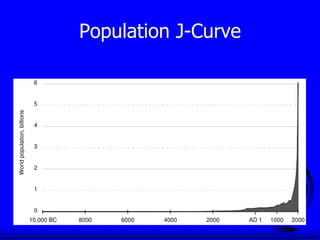
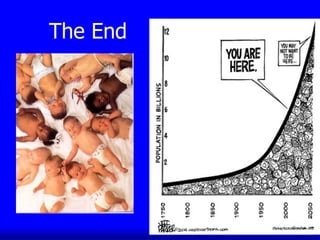
Population J-Curve
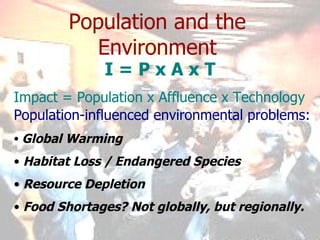
Population and the Environment I = P x A x T Impact = Population x Affluence x Technology Population-influenced environmental problems: Global Warming Habitat Loss / Endangered Species Resource Depletion Food Shortages? Not globally, but regionally.
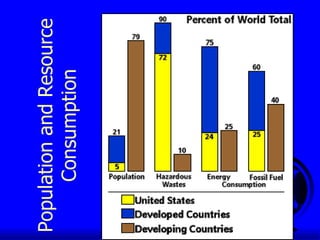
Population and Resource Consumption
The End

Population

  • 1.
  • 2.
    Arithmetic Density – the total number of people per a unit of land area. U.S. = 76/mi 2 ; NYC=1,000,000/ mi 2 ; Australia = 7/mi 2 Physiological Density – the total number of people per a unit of arable (farmable) land.
  • 3.
  • 4.
  • 5.
    World and CountryPopulation Totals Distribution and Structure: 3/4 of people live on 5% of earth's surface! Total: 6 billion on planet as of Oct. 12, 1999 Current Population Counter Five most populous regions and countries REGION POPULATION COUNTRY POPULATION East Asia 1.5 billion China 1.254 billion South Asia 1.2 billion India 986 million Europe 750 million U.S. 274 million SE Asia 500 million Indonesia 206 million East N. Am.120 million Brazil 168 million
  • 6.
  • 7.
  • 8.
    2.1 is generallyregarded as the replacement rate (the rate at which a population neither grows nor shrinks) in the developed world. In less developed countries this rate should be higher to account for so many children not reaching childbearing age. Total Fertility Rate - the average number of children a women will have in her childbearing years. This rate varies from just over 1 (Japan, Italy) to around 7 (Niger, Mali). The U.S. rate is 2. 5.57 2000-2005 5.99 1995-2000 6.46 1990-1995 6.43 1985-1990 7.00 1980-1985 7.39 1975-1980 Fertility Rate Palestinian Territories 4.97 2000-2005 5.26 1995-2000 5.67 1990-1995 6.11 1985-1990 6.45 1980-1985 6.60 1975-1980 Fertility Rate Africa 1.66 2000-2005 1.70 1995-2000 1.78 1990-1995 1.81 1985-1990 1.80 1980-1985 1.72 1975-1980 Total fertility rate U.K.
  • 9.
    Infant Mortality Rate – the number of deaths of children under the age of one per thousand live births. The rate ranges from as low as 3 (Singapore, Iceland) to as much as 150 (Sierra Leone, Afghanistan). The U.S. rate is just over 6. High infant mortality tends to result in higher fertility rates as families seek “insurance” for the loss of children.
  • 10.
    Birth Control ProgramsOne family/one child policies Female infanticide Social compensation fees Sterilization Loss of status Termination healthcare/food coupons Free birth control Increased literacy
  • 11.
  • 12.
    World Death RatesInfectious diseases HIV/AIDS SARS Degenerative diseases Obesity Tobacco use Epidemiology Epidemiological transition
  • 13.
    Adults and ChildrenLiving with AIDS, 2004
  • 14.
  • 15.
    Doubling Times Thedoubling time is the number of years before a population will be twice as large as it is today. World = 50 U.S. = 34 MDC = 543 LDC = 40 Honduras = 22 Belize = 19 Denmark = 700 Russia = never?
  • 16.
  • 17.
  • 18.
  • 19.
  • 20.
  • 21.
  • 22.
    Demographic Transition ModelStage one (preindustrial/pre-agricultural) Crude birth/death rate high Fragile, but stable, population Stage two (improved agriculture and medicine) Lower death rates Infant mortality rate falls Natural increase very high Stage three (attitudes change) Indicative of richer developed countries Higher standards of living/education Crude birth rate finally falls Stage four Crude birth/death rates low Population stable Populations aging
  • 23.
    Problems with theDemographic Transition Model based on European experience, assumes all countries will progress to complete industrialization many countries reducing growth rate dramatically without increase in wealth on the other hand, some countries “stuck” in stage 2 or stage 3
  • 24.
  • 25.
    Overpopulation When consumptionof natural resources by people outstrip the ability of a natural region to replace those natural resources.
  • 26.
    Jean Antoine Condorcet (1743 – 1794) predicted that innovation, resulting increased wealth, and choice would provide food and resources in the future and lead to fewer children per family believed that society was perfectable
  • 27.
    Thomas Malthus onPopulation Malthus, responding to Condorcet, predicted population would outrun food supply, leading to a decrease in food per person. Assumptions Populations grow exponentially. Food supply grows arithmetically. Food shortages and chaos inevitable. An Essay on the Principle of Population , 1798
  • 28.
  • 29.
    Population and theEnvironment I = P x A x T Impact = Population x Affluence x Technology Population-influenced environmental problems: Global Warming Habitat Loss / Endangered Species Resource Depletion Food Shortages? Not globally, but regionally.
  • 30.
  • 31.