Malrotation
Abhilash
11/09/2013
Introduction
• Malrotation –
• Group of congenital anomalies resulting from
aberrant intestinal rotation and fixation.
• Takes place during the first three months of
gestation.
• First reported by William Ladd in 1932.
Epidemiology
• Incidence : 1/6000 live births
• Most present < 1 month
• Incidence in general population – 0.2 to 0.5 %
• No sex/race predilection
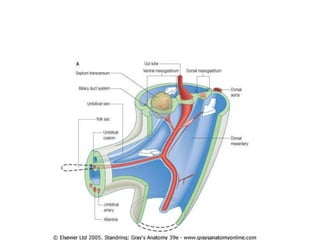
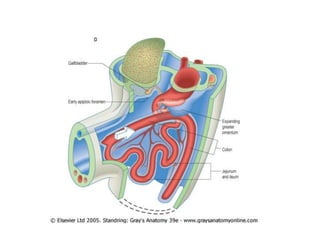
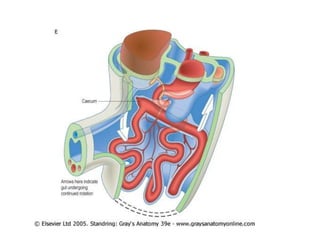
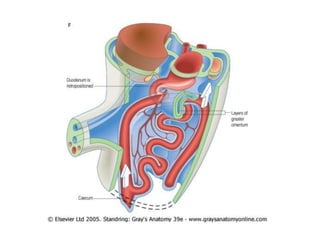
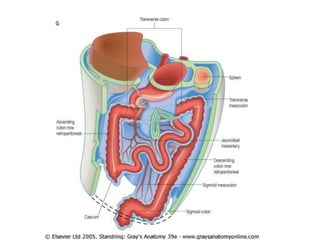
Embryology
• 1. Herniation
• 2. Return to the abdomen.
• 3. Fixation.
• mutations in the forkhead box transcription
factor FOX - familial malrotation
Key points in embryology
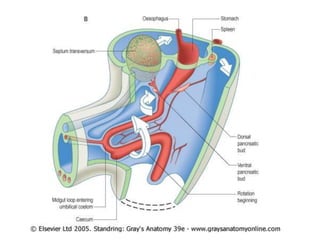
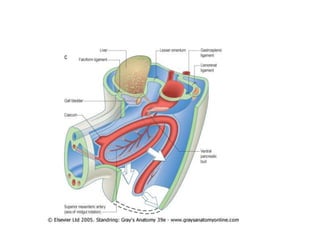
• Intestinal rotation starts at 5th week.
• Midgut – SMA
• Rotation takes place around SMA axis
• 270 degree counterclock wise rotation of
prearterial and post arterial limb.
• Ladds bands attach to the cecum irrespective
of its postion at the end of rotation from right
paracolic region.
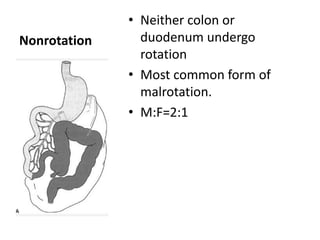
Nonrotation
• Neither colon or
duodenum undergo
rotation
• Most common form of
malrotation.
• M:F=2:1
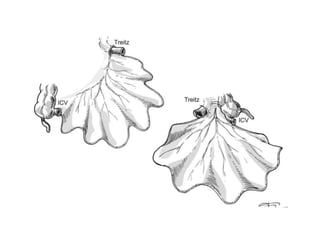
• Duodenum not posterior to SMA
• Ligament of Treitz fails to reach its normal
position is right upper quadrant.
• Midgut mesentry is narrow and highly mobile.
• May cause
• Duodenal obstruction abnormal peritoneal
bands.
• Acute midgut volvulus.
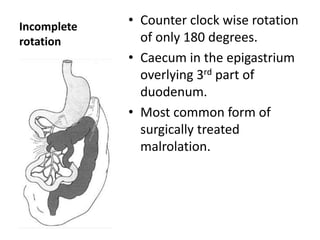
Incomplete
rotation
• Counter clock wise rotation
of only 180 degrees.
• Caecum in the epigastrium
overlying 3rd part of
duodenum.
• Most common form of
surgically treated
malrolation.
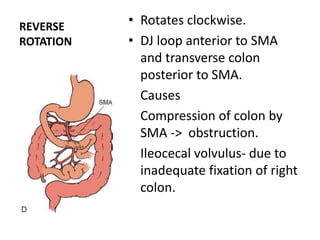
REVERSE
ROTATION
• Rotates clockwise.
• DJ loop anterior to SMA
and transverse colon
posterior to SMA.
• Causes
• Compression of colon by
SMA -> obstruction.
• Ileocecal volvulus- due to
inadequate fixation of right
colon.
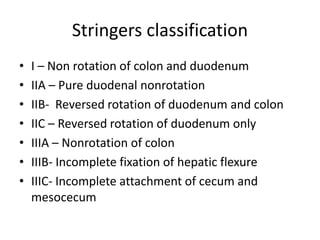
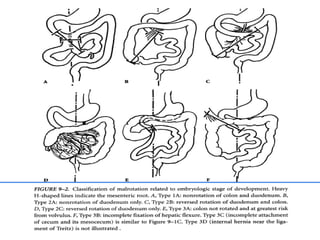
Stringers classification
• I – Non rotation of colon and duodenum
• IIA – Pure duodenal nonrotation
• IIB- Reversed rotation of duodenum and colon
• IIC – Reversed rotation of duodenum only
• IIIA – Nonrotation of colon
• IIIB- Incomplete fixation of hepatic flexure
• IIIC- Incomplete attachment of cecum and
mesocecum
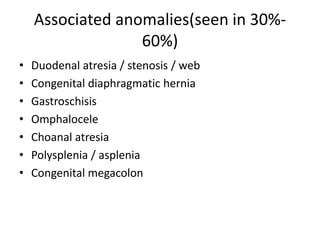
Associated anomalies(seen in 30%-
60%)
• Duodenal atresia / stenosis / web
• Congenital diaphragmatic hernia
• Gastroschisis
• Omphalocele
• Choanal atresia
• Polysplenia / asplenia
• Congenital megacolon
How does it present.
• Asymptomatic
• Midgut volvulus
• Mesocolic hernias.
• Duodenal and jejunal obstruction.
• Colonic obstruction.
Clinical features in adults
• Intermittent cramping or persistent aching pain.
• Severe abdominal cramping followed by diarrhea
- chronic volvulus.
• Vomiting - bilious /non bilious , variable in
duration and frequency.
• Malabsorption - diarrhea, nutritional deficiencies
• Rare - obstructive jaundice, chylous ascites and
superior mesenteric vein thrombosis
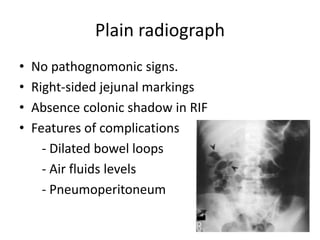
Plain radiograph
• No pathognomonic signs.
• Right-sided jejunal markings
• Absence colonic shadow in RIF
• Features of complications
- Dilated bowel loops
- Air fluids levels
- Pneumoperitoneum
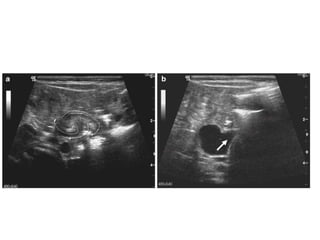
Ultrasound
• Reversal of the normal anatomic relationship
between the SMA and
• “whirlpool sign” - midgut volvulus.
• “bird beak” appearance – duodenal
obstruction.
• false-positive rates of up to 21%
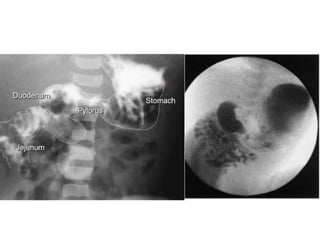
Upper GI contrast study
>incomplete duodenal obstruction, usually in
the third portion;
>ligament of Treitz not to the left of the midline
or at the level of the gastric antrum;
>abnormal position of the proximal jejunal loops
to the right of the midline; and
>deformity of the duodenum with a bird's beak,
corkscrew,•or coiled•configuration
CT Abdomen
• Anatomic location of small bowel on right and
colon on left
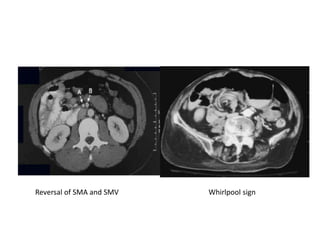
• Relationship of the superior mesenteric
vessels – “vertically placed or inverted sides”
• Aplasia of the uncinate process
• Features of volvulus / obstruction / gangrene
• Other associated anomalies
Reversal of SMA and SMV Whirlpool sign
Management
• Supportive management.
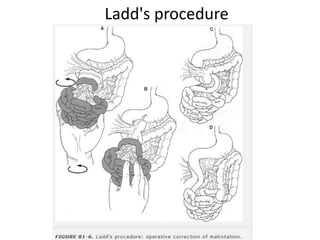
• Surgical management – Ladds procedure.
Ladd's procedure
Post operative care
• nasogastric decompression
• total parenteral nutrition until return of
bowel function.
• Mortality from midgut
• volvulus with severe bowel compromise may
exceed 30%.
• Long-term complications
1. adhesive small bowel obstruction (10%),
2. recurrent volvulus,
3. short gut syndrome.
References
• Ladd WE. Congenital obstruction of the
duodenum in children. N Engl J Med.
1932;206:277–83.
• Principles and Practice of Pediatric Surgery,
4th Edition. Keith T Oldam.
• Shackelford’s Surgery of the Alimentary tract
7th edition.
• Stringer Pediatric Gastrointestinal Imaging and
Intervention, 2nd edition

Malrotation

  • 1.
  • 2.
    Introduction • Malrotation – •Group of congenital anomalies resulting from aberrant intestinal rotation and fixation. • Takes place during the first three months of gestation. • First reported by William Ladd in 1932.
  • 3.
    Epidemiology • Incidence :1/6000 live births • Most present < 1 month • Incidence in general population – 0.2 to 0.5 % • No sex/race predilection
  • 4.
    Embryology • 1. Herniation •2. Return to the abdomen. • 3. Fixation. • mutations in the forkhead box transcription factor FOX - familial malrotation
  • 5.
    Key points inembryology • Intestinal rotation starts at 5th week. • Midgut – SMA • Rotation takes place around SMA axis • 270 degree counterclock wise rotation of prearterial and post arterial limb. • Ladds bands attach to the cecum irrespective of its postion at the end of rotation from right paracolic region.
  • 13.
    Nonrotation • Neither colonor duodenum undergo rotation • Most common form of malrotation. • M:F=2:1
  • 14.
    • Duodenum notposterior to SMA • Ligament of Treitz fails to reach its normal position is right upper quadrant. • Midgut mesentry is narrow and highly mobile. • May cause • Duodenal obstruction abnormal peritoneal bands. • Acute midgut volvulus.
  • 16.
    Incomplete rotation • Counter clockwise rotation of only 180 degrees. • Caecum in the epigastrium overlying 3rd part of duodenum. • Most common form of surgically treated malrolation.
  • 17.
    REVERSE ROTATION • Rotates clockwise. •DJ loop anterior to SMA and transverse colon posterior to SMA. • Causes • Compression of colon by SMA -> obstruction. • Ileocecal volvulus- due to inadequate fixation of right colon.
  • 18.
    Stringers classification • I– Non rotation of colon and duodenum • IIA – Pure duodenal nonrotation • IIB- Reversed rotation of duodenum and colon • IIC – Reversed rotation of duodenum only • IIIA – Nonrotation of colon • IIIB- Incomplete fixation of hepatic flexure • IIIC- Incomplete attachment of cecum and mesocecum
  • 20.
    Associated anomalies(seen in30%- 60%) • Duodenal atresia / stenosis / web • Congenital diaphragmatic hernia • Gastroschisis • Omphalocele • Choanal atresia • Polysplenia / asplenia • Congenital megacolon
  • 21.
    How does itpresent. • Asymptomatic • Midgut volvulus • Mesocolic hernias. • Duodenal and jejunal obstruction. • Colonic obstruction.
  • 22.
    Clinical features inadults • Intermittent cramping or persistent aching pain. • Severe abdominal cramping followed by diarrhea - chronic volvulus. • Vomiting - bilious /non bilious , variable in duration and frequency. • Malabsorption - diarrhea, nutritional deficiencies • Rare - obstructive jaundice, chylous ascites and superior mesenteric vein thrombosis
  • 23.
    Plain radiograph • Nopathognomonic signs. • Right-sided jejunal markings • Absence colonic shadow in RIF • Features of complications - Dilated bowel loops - Air fluids levels - Pneumoperitoneum
  • 24.
    Ultrasound • Reversal ofthe normal anatomic relationship between the SMA and • “whirlpool sign” - midgut volvulus. • “bird beak” appearance – duodenal obstruction. • false-positive rates of up to 21%
  • 26.
    Upper GI contraststudy >incomplete duodenal obstruction, usually in the third portion; >ligament of Treitz not to the left of the midline or at the level of the gastric antrum; >abnormal position of the proximal jejunal loops to the right of the midline; and >deformity of the duodenum with a bird's beak, corkscrew,•or coiled•configuration
  • 28.
    CT Abdomen • Anatomiclocation of small bowel on right and colon on left • Relationship of the superior mesenteric vessels – “vertically placed or inverted sides” • Aplasia of the uncinate process • Features of volvulus / obstruction / gangrene • Other associated anomalies
  • 29.
    Reversal of SMAand SMV Whirlpool sign
  • 30.
    Management • Supportive management. •Surgical management – Ladds procedure.
  • 31.
  • 32.
    Post operative care •nasogastric decompression • total parenteral nutrition until return of bowel function.
  • 33.
    • Mortality frommidgut • volvulus with severe bowel compromise may exceed 30%. • Long-term complications 1. adhesive small bowel obstruction (10%), 2. recurrent volvulus, 3. short gut syndrome.
  • 34.
    References • Ladd WE.Congenital obstruction of the duodenum in children. N Engl J Med. 1932;206:277–83. • Principles and Practice of Pediatric Surgery, 4th Edition. Keith T Oldam. • Shackelford’s Surgery of the Alimentary tract 7th edition. • Stringer Pediatric Gastrointestinal Imaging and Intervention, 2nd edition