SPINAL CORD &
TRACTS:
APPLIED
Presenter
Dr. ATM HASIBUL HASAN
MD Neurology Student(Final part)
Department of neurology, DMCH
TOPIC - AT A GLANCE
• Anatomical aspect
• Imaging in spinal cord disease
• Classification of spinal cord pathology
• Clinical approach to spinal cord pathology
• Localization in spinal cord disease
• Special pattern of spinal cord diseases
• Case scenarios
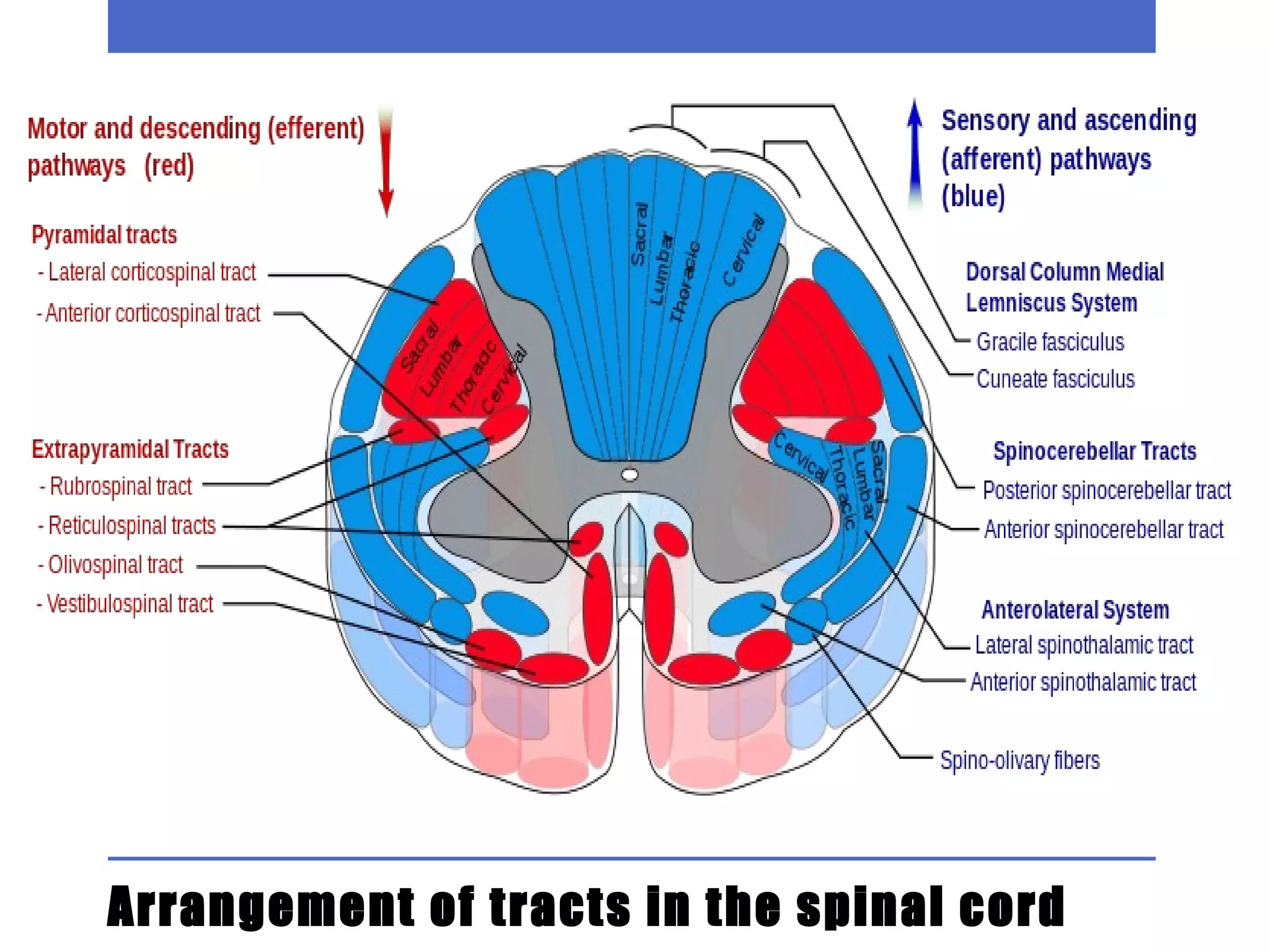
Arrangement of tracts in the spinal cord
Imaging of Spine and Spinal Cord
Plain X-Ray
Computed Tomography
o Traditional
o Reconstructed
o Myelo-CT
MRI
DSA
X-Ray
X-Ray
CT SPINE
Myelo-CT
MRI- Spine
Spinal Cord Pathology
I. Vertebral cause-
1) Trauma
2) Disc prolapse
3) Tumour- primary e.g. MM; secondary e.g. breast,
thyroid, prostate, bronchus
4) Spinal TB-(Pott’s disease)
II. Meningeal cause-
1) Epidural abscess
2) Tumor - meningioma, neurofibroma, lymphoma,
leukaemia
Spinal Cord Pathology
III) Spinal cord itself-
Developmental:
o Syringomyelia,
o Meningomyelocoele
o Tetherd cord syndrome
Degenerative:
o MND
o FA
o SCD
o HSP
Demyelinating/ Inflamatory:
o Transverse myelitis
o Multiple Sclerosis
o Neuromyelitis Optica
Spinal Cord Pathology
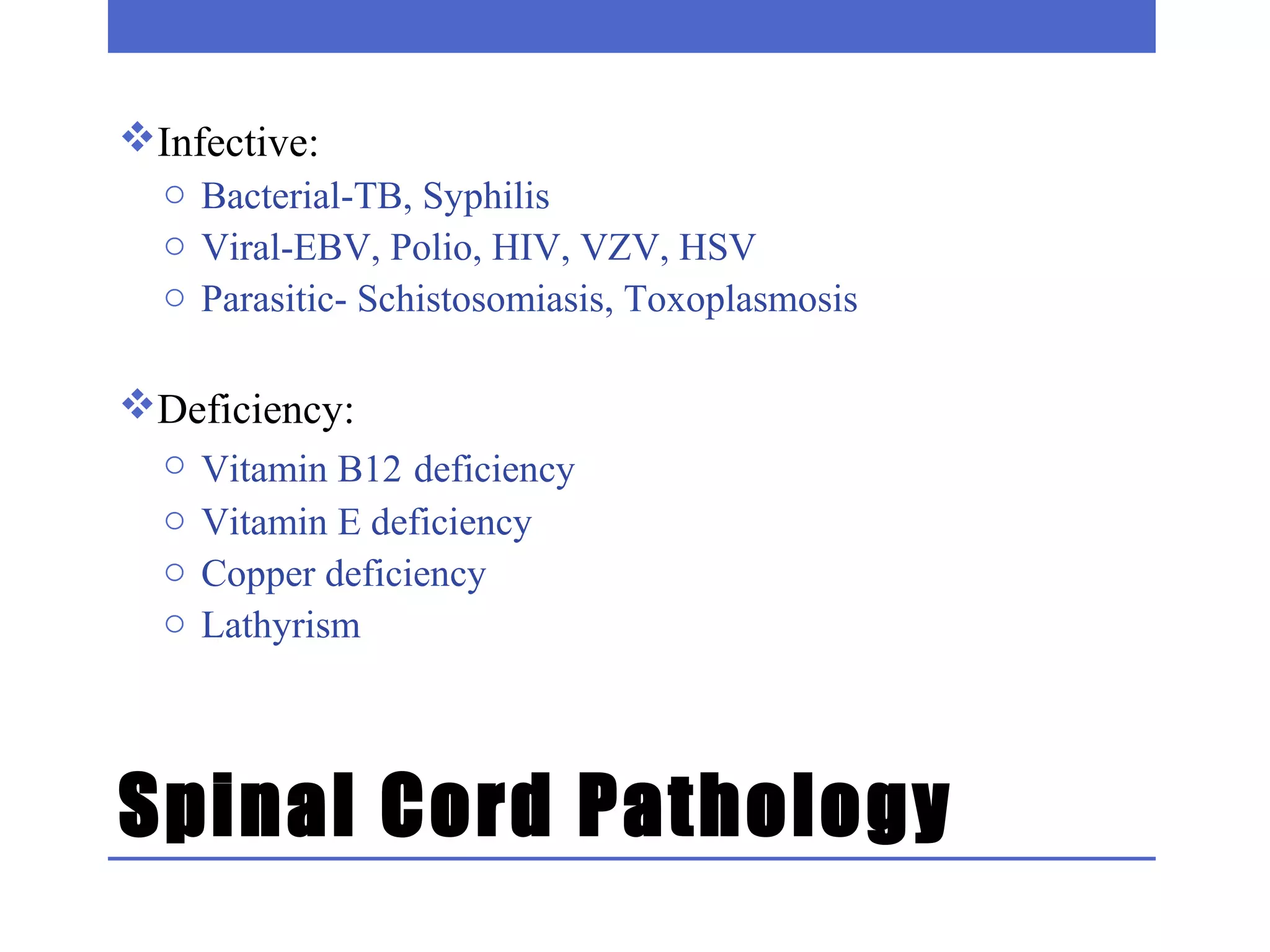
Infective:
o Bacterial-TB, Syphilis
o Viral-EBV, Polio, HIV, VZV, HSV
o Parasitic- Schistosomiasis, Toxoplasmosis
Deficiency:
o Vitamin B12 deficiency
o Vitamin E deficiency
o Copper deficiency
o Lathyrism
Spinal Cord Pathology
Vascular:
oVasculitis
oInfarction
oHaemorhage
oAVM
Physical agents:
oRadiation
oLightening injury
Paraneoplastic :
Localization in Spinal Cord
Disease
The Hallmark of spinal cord disease
Presence of horizontally defined level below
which there will be impairment of sensory, motor
and autonomic function.
Cervical Cord
Above C5: Spastic Quadriplegia and diaphragm weakness
C5-T1: Quadriplegia (LMN signs and segmental sensory
loss in the arms & UMN signs in the legs) and respiratory
(intercostal) muscle weakness
At C5-C6:Loss of power & reflex of biceps
 At C7: Weakness in finger and wrist extensors and
triceps.
 At C8: Finger & wrist flexion are impaired.
 Horner’s syndrome may accompany
Cervical Cord
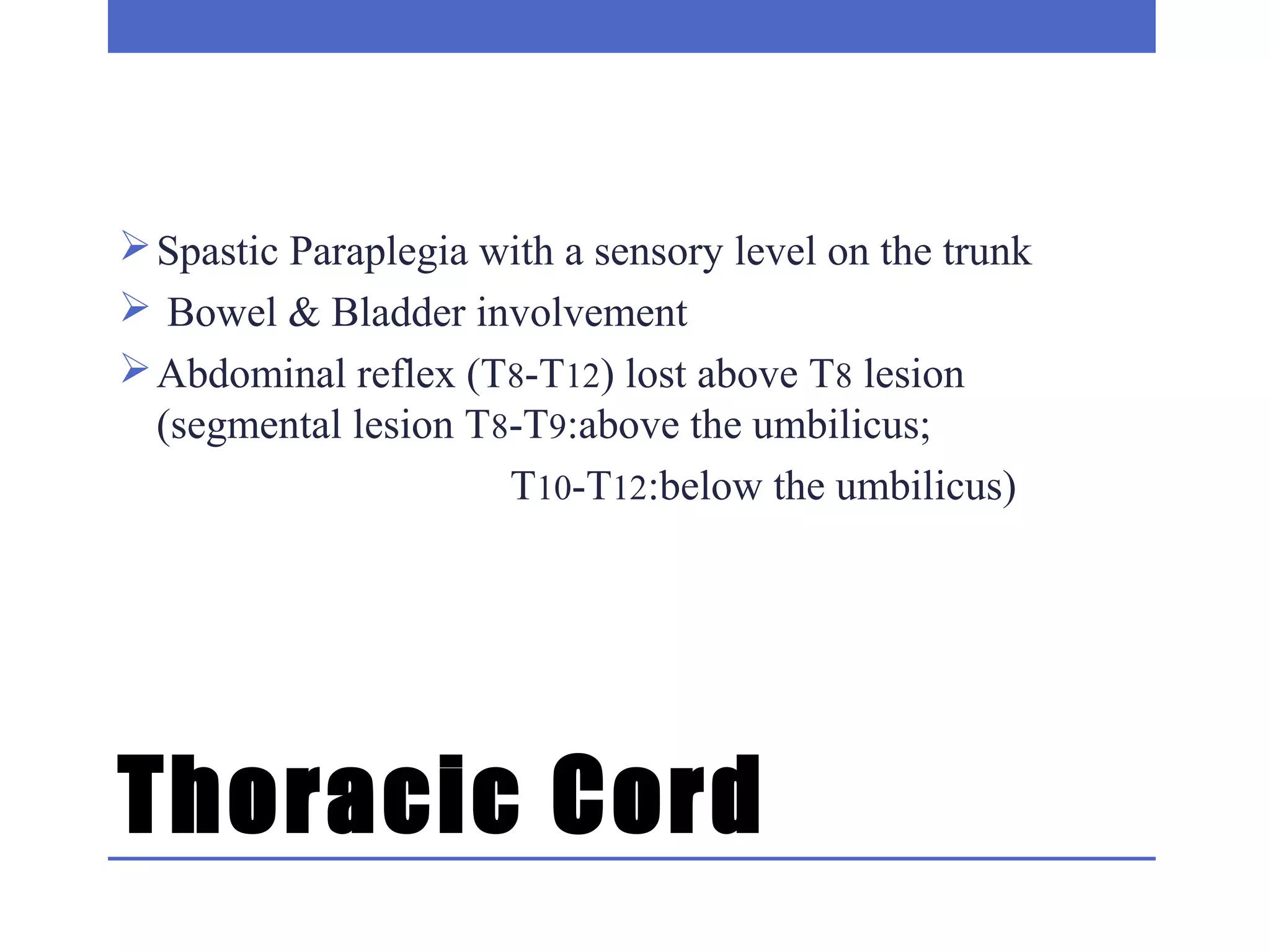
Thoracic Cord
Spastic Paraplegia with a sensory level on the trunk
 Bowel & Bladder involvement
Abdominal reflex (T8-T12) lost above T8 lesion
(segmental lesion T8-T9:above the umbilicus;
T10-T12:below the umbilicus)
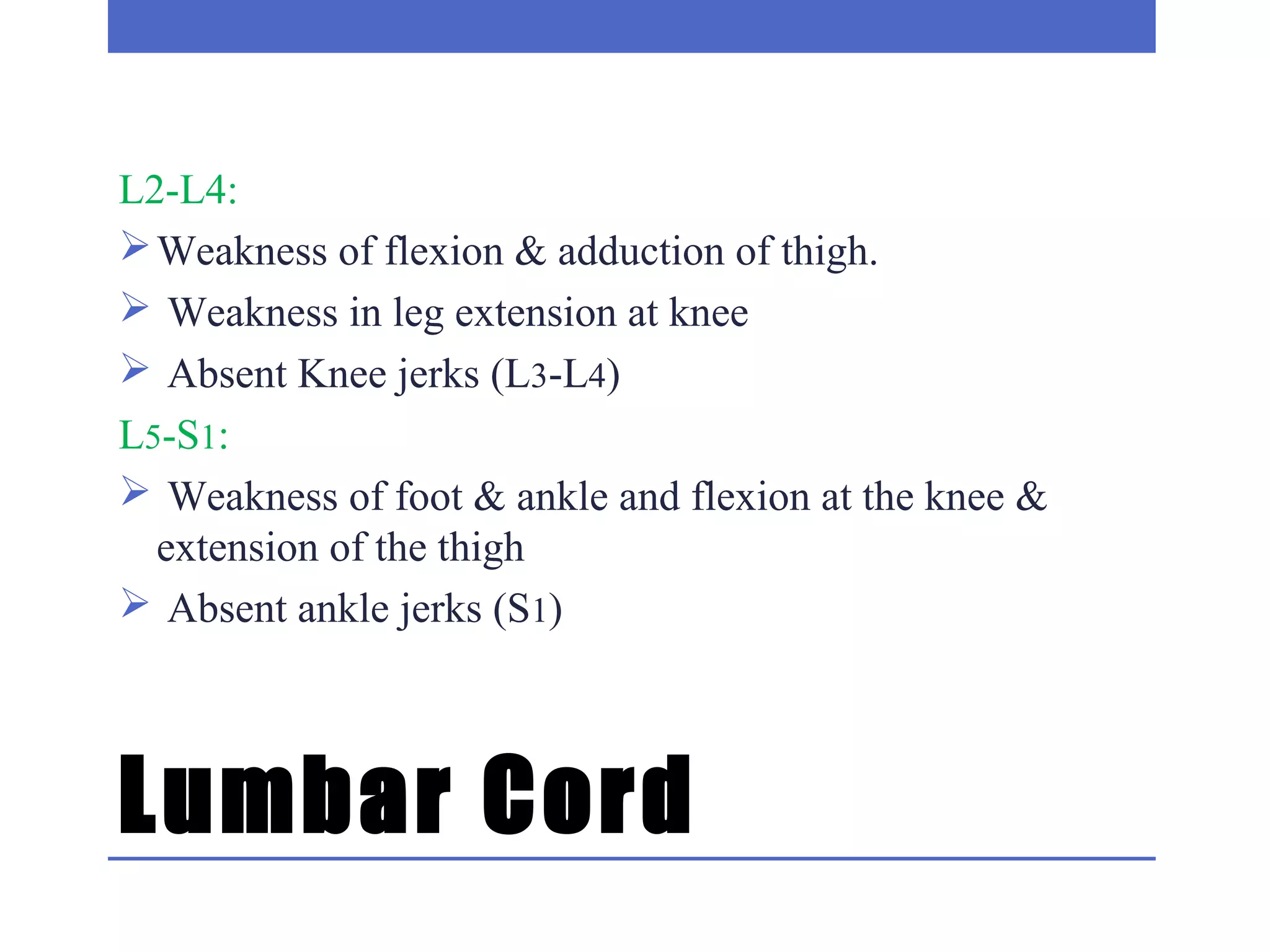
Lumbar Cord
L2-L4:
Weakness of flexion & adduction of thigh.
 Weakness in leg extension at knee
 Absent Knee jerks (L3-L4)
L5-S1:
 Weakness of foot & ankle and flexion at the knee &
extension of the thigh
 Absent ankle jerks (S1)
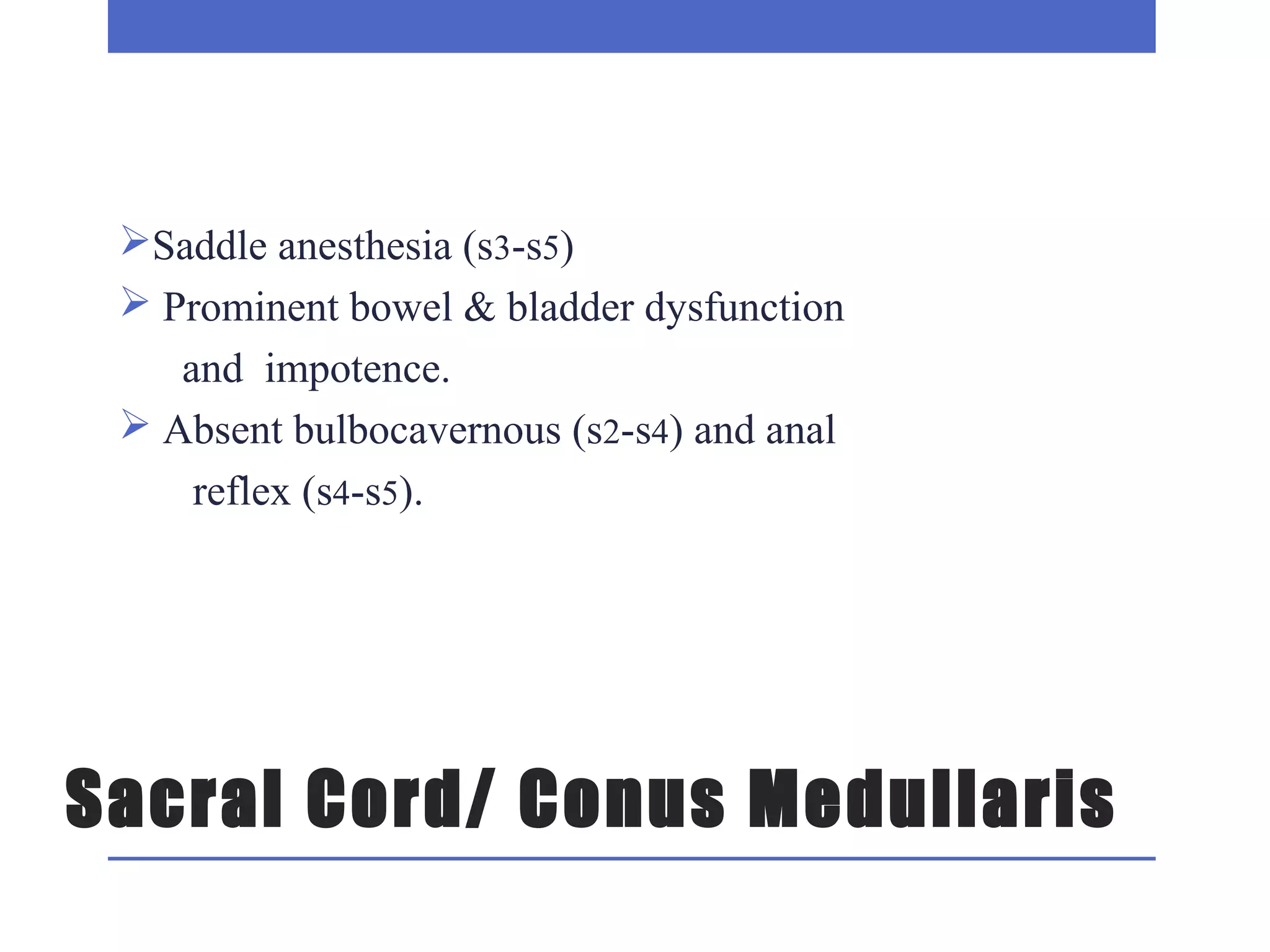
Sacral Cord/ Conus Medullaris
Saddle anesthesia (s3-s5)
 Prominent bowel & bladder dysfunction
and impotence.
 Absent bulbocavernous (s2-s4) and anal
reflex (s4-s5).
Myotomes :
•Important in determining level of lesion
•Upper limbs:
C5 - Deltoid
C6 - Wrist extensors
C7 - Elbow extensors
C8 - Long finger flexors
T 1 - Small hand muscles
• Lower Limbs :
L2 - Hip flexors
L3,4 - Knee extensors
L4,5 – S1 - Knee flexion
L5 - Ankle dorsiflexion
S1 - Ankle plantar flexion
Basic Features of Spinal Cord Disease
• UMN findings below the lesion (spasticity,
hyper-reflexia). May be flaccid in acute
presentation.
• Sensory and motor involvement that localizes to
a spinal cord level.
• Bowel and Bladder dysfunction.
Some terminology
Myelopathy Radiculopathy
Definition Any pathological process in the spinal
cord (intrinsic and extrinsic)
Pathological process in the exiting
nerve root
Feature • Hypertonia
• Pyramidal type weakness
• Brisk reflex
• Extensor plantar response
• Loss of sensation ( with a specific
level)
• Loss of sphincter control
• Autonomic dysfunction
• Hypotonia
• Muscle wasting
• Weakness
• Fasciculation
• Loss of reflex
• Loss of sensation
Compressive and non compressive
myelopathy
CM (surgical) NCM (Medical)
1. Pain - usual 1. Rare
2. Onset - sub acute (2-6 wks) 2. Acute or chronic (≥ 6 wks)
3. Paralysis - Asymmetrical 3. Symmetrical
4. Bowel bladder – Occasionally late involvement 4. May be involved early
5. Sensory limit - asymmetrical 5. Symmetrical or absent
6. Temporal profile - Progressive 6. Non progressive
Intramedullary and extra medullary
syndrome
Trait Intramedullary Extramedullary
1. Early symptoms Motor features Sensory features
2. Pain Poorly localized Prominent radicular
3. Sacral sensation Sacral sparing Early sacral sensory loss
4. Motor weakness Upper limb may be affected early Lower limb affected early
5. Sphincter disturbance Appears early Appears late
Extradural
Intramedullary
Intradural
Extramedullary
DuraCord
Epiconus and Conus Syndrome
Epiconus Conus
1. Lesion is between L4-S2 1. Lesion between S3-Co1
2. Motor deficit usually above the knee 2. Motor deficit in lower limb less likely
3. Weakness of hip extensor and knee
flexor
3. Not such type
4. Pain may not be present 4. Pain may be present
5. Bladder is involved late 5. Early bladder involvement
Conus and Cauda syndrome
Trait Conus Cauda
1. Onset Sudden and bilateral Gradual and unilateral
2. Pain Less common Severe, radicular
3. Location of pain Symmetric, perineum or thigh Asymmetric, perineum, thigh,
leg or back
4. Motor loss If occurs, Symmetric, less marked Asymmetric, more marked
5. Reflex Absent ankle Variable- Absent ankle and
knee
6. Sensory deficit Saddle distribution (S3-5), symmetric Saddle but asymmetric
7. Bowel and bladder
disturbance
Early and marked Late and less marked
8. Sexual dysfunction Occurs Less prominent
PARAPLEGIA IN FLEXION PARAPLEGIA IN EXTENSION
Following complete transection of
SC
Following incomplete transection
of SC
Muscle tone reappears in flexor
muscles first (reticulospinal tract)
Muscle tone reappears in extensor
muscles first (Intact vestibulospinal
tract)
Flexor reflexes are first to return
(eg, Planter response)
Extensor reflex returns first (eg,
crossed extensor reflex)
Occurs late Occurs early
Higher lesion Lower lesion
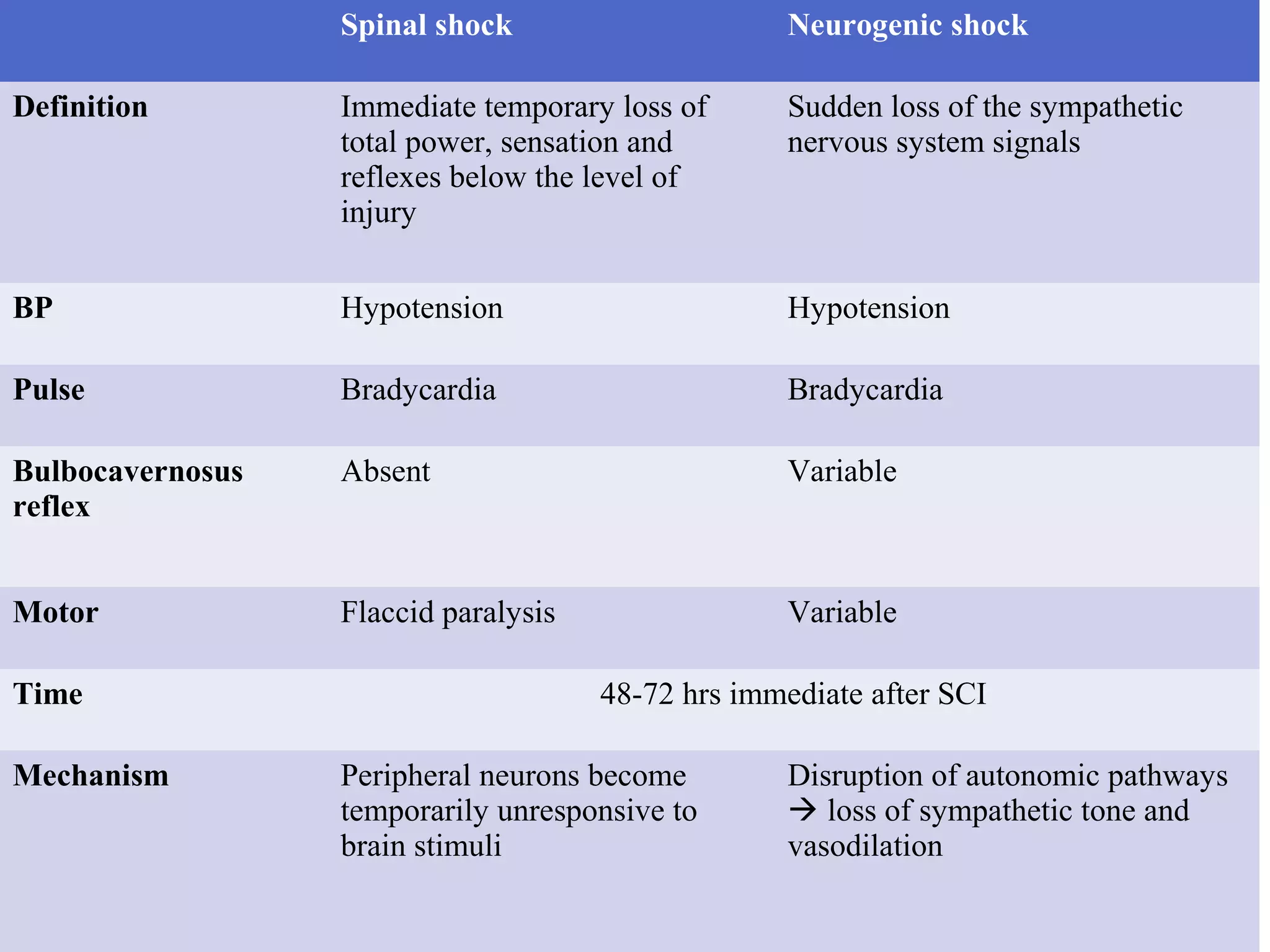
Spinal shock Neurogenic shock
Definition Immediate temporary loss of
total power, sensation and
reflexes below the level of
injury
Sudden loss of the sympathetic
nervous system signals
BP Hypotension Hypotension
Pulse Bradycardia Bradycardia
Bulbocavernosus
reflex
Absent Variable
Motor Flaccid paralysis Variable
Time 48-72 hrs immediate after SCI
Mechanism Peripheral neurons become
temporarily unresponsive to
brain stimuli
Disruption of autonomic pathways
 loss of sympathetic tone and
vasodilation
SPECIAL PATTERN OF
PRESENTATION IN
SPINAL CORD
DISEASES
Type of Spinal Cord lesion
Complete or transverse lesion
Incomplete lesion
a) Anterior cord syndrome
b) Posterior cord syndrome
c) Hemi cord syndrome
d) Central cord syndrome
e) Foramen magnum syndrome
f) Conus medullaris syndrome
g) Cauda equina syndrome
Complete cord transection
syndrome
• Bilateral spastic
paraparesis/ quadriparesis
• Bilateral loss of all
modalities of sensation.
• Bowel &bladder
dysfunction.
• LMN feature at the level
of lesion
• Cause :
o Trauma
o Vasculitis
o ATM
Brown-sequard syndrome (Hemi cord syndrome)
Motor-
• Ipsilateral spastic weakness
• LMN sign at the level of lesion
Sensory:
• Ipsilateral loss of proprioception.
• Contralateral loss of pain and
temperature sensation
Anterior cord syndrome
• All cord function are
lost below the level of
lesion with retained
position & vibration
sense.
• Cause :
o Disc prolapse
o Ant. Spinal artery
occlusion
Posterior cord syndrome
• Common in cervical region
• Both sided joint position and
vibration sense are lost sparing
the other sensory and motor tract
• Cause:
o DM
o Neurosyphilis
o Spondylosis
o Posterior spinal artery occlusion
Central cord syndrome (Schneider syndrome)
• Dissociated sensory loss in
a cape distribution.
• Symptoms depend on
extension of lesion around
the central canal.
• Weakness of muscles in
arms with atrophy and
hyporeflexia.
• Later - Spastic weakness
with brisk reflexes in the
legs
C/F
• Neck pain –radiating to shoulder
• Occipital H/A
• Variable sensory loss
• Weakness and wasting of hand and
neck muscles
• Quadriparesis-round the clock
(LA→LL→RL→RA)
Cause- Compressive lesion
(meningioma, neurofibroma) in the
region of foramen magnum
Foramen magnum syndrome:
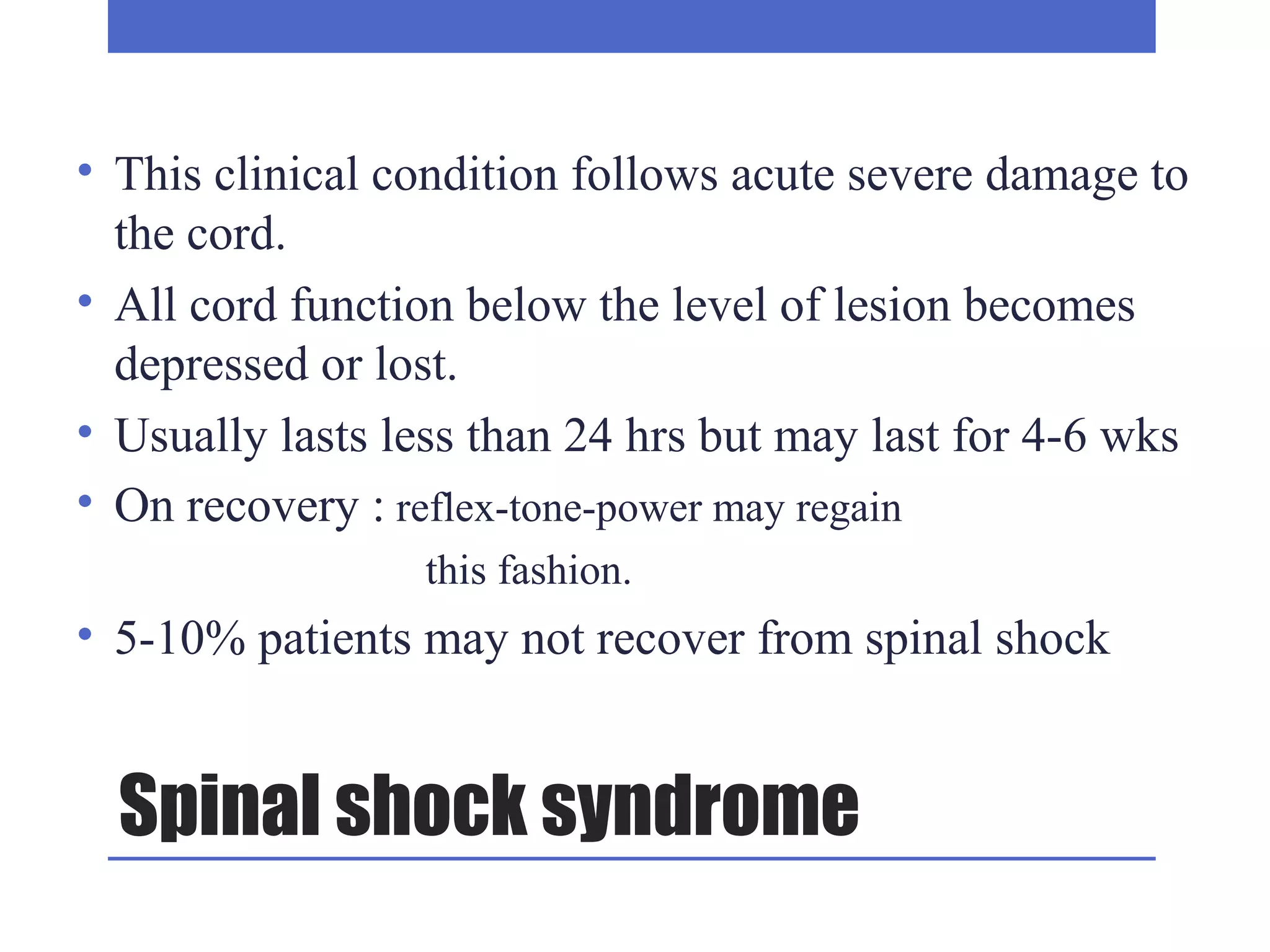
Spinal shock syndrome
• This clinical condition follows acute severe damage to
the cord.
• All cord function below the level of lesion becomes
depressed or lost.
• Usually lasts less than 24 hrs but may last for 4-6 wks
• On recovery : reflex-tone-power may regain
this fashion.
• 5-10% patients may not recover from spinal shock
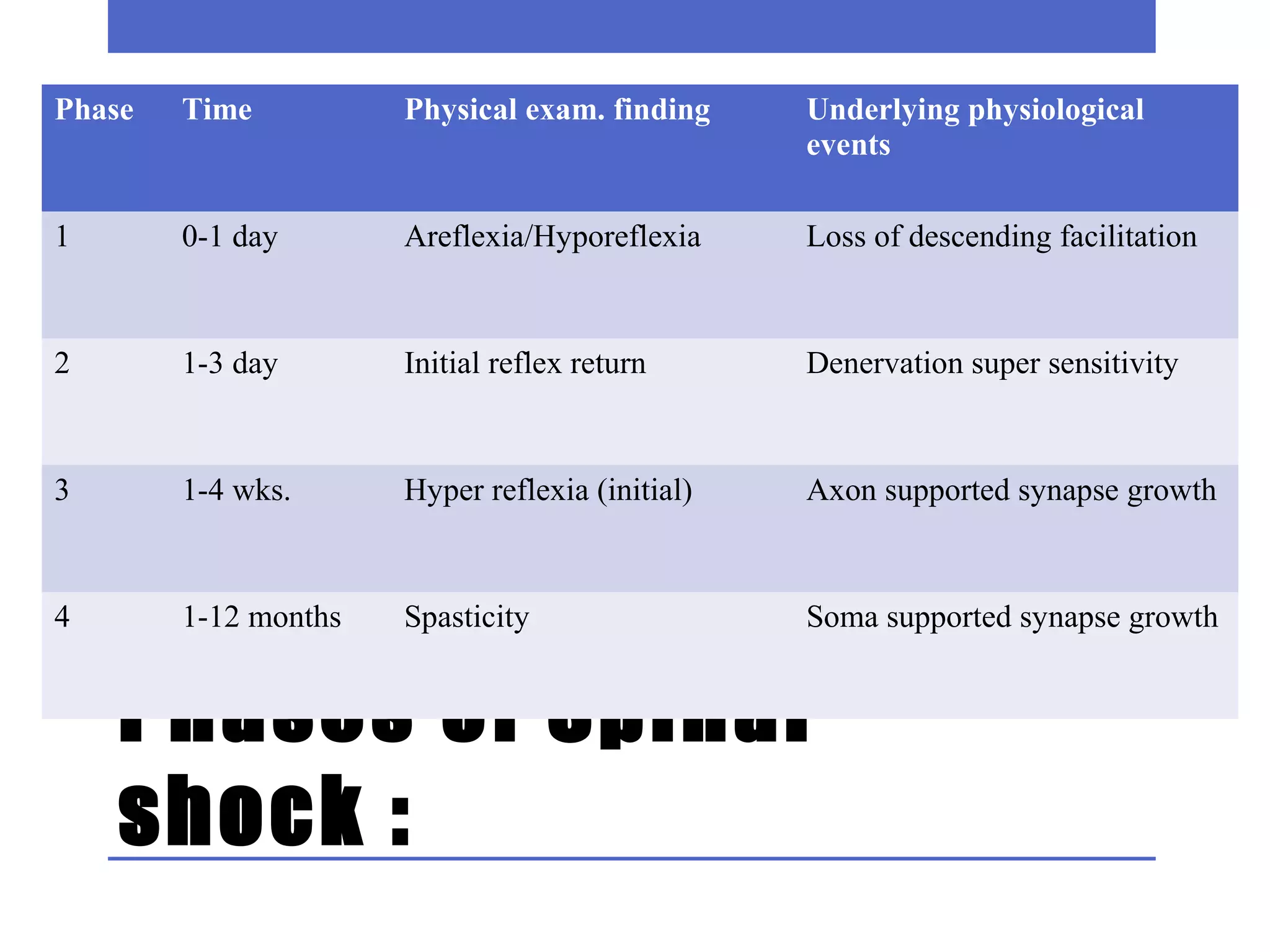
Phases of Spinal
shock :
Phase Time Physical exam. finding Underlying physiological
events
1 0-1 day Areflexia/Hyporeflexia Loss of descending facilitation
2 1-3 day Initial reflex return Denervation super sensitivity
3 1-4 wks. Hyper reflexia (initial) Axon supported synapse growth
4 1-12 months Spasticity Soma supported synapse growth
Conus medullaris syndrome
• Bilateral saddle anesthesia
• Prominent bowel & bladder
dysfunction (urinary retention
and anal incontinence)
• Impotence
• Absent anal reflex.
Cauda equina syndrome
• Radicular low back pain
• Asymmetrical lower limb
weakness & sensory loss
• Variable areflexia
• Relative sparing of bowel &
bladder.
• Planter may be flexor or absent.
• Cause :
o Disc prolapse
o Tumour
o Trauma
Combined posterior & lateral column
lesion:
Causes include-
 Vitamin B12 deficiency
 Copper deficiency
 Myelopathy with AIDS
 HTLV-1 associated myelopathy
Thoracic cord is most commonly affected
Combined posterior&lateral column
lesion:
C/F-
• Paresthesia in the feet
• Loss of position and vibration sense in the legs
• Sensory ataxia
• Positive Romberg sign
• Bladder function disturbance
• Spasticity, hyperreflexia and bilateral Babinski sign
CLINICAL APPROACH TO
SPINAL PATHOLOGY
CLINICAL APPROACH ...
POINTS TO BE CONSIDERED:
•Onset e.g. acute, subacute, chronic
•Progression e.g. static, improving, worsening
•Bladder involvement e.g. early, late, none
•Presence of pain e.g. mechanical pain, radicular pain, none
•Presence of fever e.g. abscess, Potts
•Flaccid/ Spastic
•Other systemic features e.g. weight loss, skin/lymph nodes/joints-
malignancy, vasculitic
CLINICAL APPROACH . . .
ONSET:
• Acute (minutes to hours):
 Traumatic
 Inflammatory
 Vascular lesion
•Subacute (days to weeks):
 Neoplastic (compressive)
 Pott’s
•Chronic (months to years):
 Neoplastic
 Degenerative
CLINICAL APPROACH . . .
PROGRESSION:
Static:
 TM
Improving :
 MS
 Vascular lesion
Worsening :
 Pott’s disease
 Compressive
 Neoplastic
 Degenerative
CLINICAL APPROACH . . .
BLADDER INVOLVEMENT:
 Early:
 TM
Late:
 Neoplastic
 Compressive
 Potts
No involvement:
 Degenerative e.g. HSP
 Nutritional e.g. SACD, lathyrism
CLINICAL APPROACH . . .
PAIN:
Mechanical:
o Vertebral cause
Radicular:
o Meningeal cause
o Inflammatory cause
No pain:
o Spinal cord cause
CLINICAL APPROACH . . .
NATURE OF PARAPLAGIA:
Flaccid-
•Spinal shock (up to 6 wks.)
•Cauda equina lesion
•Conus medullaris lesion
Spastic-
•Lesion usually in Cervical and Dorsal cord due to any
cause (after spinal shock is recovered)
EXAMINATION
A) Types of deficit -
 Motor deficit only
 Sensory deficit only
 Mixed deficit
B) Types of motor deficit - UMN, LMN
C) Pattern of sensory loss -
 Posterior column loss
 Spinothalamic loss
 Dissociative loss
D) Bladder involvement
 Involved : Tumor, TM, Demyelination.
 Not involved : Degenerative, Deficiency, Toxin
Clinical clues
A) Motor deficit
UMN LMN
B/B+ B/B- B/B+ B/B-
 Cortical
paraplegia
 Tumor
•MND
•HSP
•Lathyrism
•Tumor
•ATM with
Spinal shock
•Trauma
•Post vaccine
•Tumor
• Polio
• SMA
• GBS
• MMNCB
Clinical clues
B) Sensory deficit only C) Mixed deficit
• Posterior cord syndrome ● Tumour
• Foramen magnum syndrome ● Cauda equina syndrome
• Tabes ● Conus syndrome
• Paraneoplastic
• MS
Spinal cord disease
Acute Subacute Chronic
UMN
Motor
LMN
Sensory Mixed
B/B + B/B -
-Cortical lesion
-Tumour
-Tumour
-Vascular
B/B + B/B -
-Tumour
-Spinal shock
-GBS
-AHC eg Polio
-SMA
Posterior
column
Spinothalamic
-Trauma
-Tumour
-Spondylosis
-Partial cord syndrome
-Trauma
-Tumour
-Vascular
-ATM
-Infective
Approach to Spinal cord disease
Spinal cord disease
Subacute Chronic
UMN
Motor
LMN
Sensory Mixed
B/B + B/B -
-Tumour
-Chronic
infection
-MND
-Toxic eg
Lathyrism
-Tumour
B/B + B/B -
-Tumour
-Vascular
-CIDP
-MMNCB
-SMA
Posterior
column
Spinothalamic
-Trauma
-Tumour
-Spondylosis
-Partial cord syndrome
-Infection
-Tumour
-Degenerative
-Demyelinating
Approach to Spinal cord disease
Case scenarios
A 17 yr old boy presented with tingling, numbness and paresthesia in hand and
leg. Examination revealed dissociated and suspended sensory loss.
Syringomyelia
A 38 yr old man presented with chronic back pain, low grade fever and
progressive weakness of both the lower limbs. Examination revealed a gibbus at
D1 level.
Potts Disease
A 62 old man, known case of psoriasis, presented with new onset back pain and
high grade fever. Lower cervical and upper thoracic spine was tender on palpation.
Investigation revealed neutrophilic leucocytosis with high ESR and CRP.
Spinal Epidural Abscess
A 25 yr old man presented with progressive weakness of both the lower limb
along with a severe sensory loss up to mid chest and bladder problem for last 2
weeks following a H/O vaccination against Hepatitis B.
Acute Transverse Myelitis (Vaccine related)
A 35 yr old lady presented with progressive paraparesis with impaired
sensorium extending to D4 level. Two weeks later she developed dimness of
vision in both eyes.
Neuromyelitis Optica
A 17 yr old boy presented with sudden weakness of all 4 limbs along with
difficulty in speech and deglutition with impaired level of consciousness
following an episode of flu like illness.
ADEM
A 24 yr old lady presented with sensory disturbance of both the lower limbs.
She had a H/O visual disturbance in one eye and weakness of all four limbs a
couple of years back.
Multiple Sclerosis
Differentiating by MRI
Short segment:
o MS
Long segment:
o TM
o NMO
Differentiating by MRI
A 34 yr old man presented with
gait ataxia, tingling and
numbness in all four limbs, brisk
reflexes but absent ankle jerk
with extensor planter response.
He gave H/O illeal resection 10
years back. PBF showed
megalocyte and there was
decreased Vit B12 level.
Subacute combined degeneration of spinal cord
A 42 yr old woman noticed chronic pain in cervico-thoracic region followed by
progressive weakness of all four limbs and mild bladder disturbance for last 11
months.
Extradural Meningioma
A 28 yr old man presented with pain in neck and shoulder and numbness in
limbs followed by progressive weakness of all four limbs (Lt arm-Lt leg-Rt
leg-Rt arm).
Foramen magnum syndrome
Neurofibroma
A 3 yr old boy presented with
cervical pain and weakness of
all four limbs without any
bowel or bladder problem.
Astrocytoma
A 65 yr old woman presented with radicular pain and distal weakness of both
upper limb. She is a known case of apical lung tumour.
Multiple Metastasis to spine and spinal cord
Tumours of Spinal cord
A 22 yr old lady presented with progressive weakness of both lower limbs
along with retention of urine for last two years. Examination revealed spastic
paraplegia with ill defined sensory deficit up to umbilicus.
Spinal AVM
A 42 yr old man presented with radiating low back pain, progressive difficulty
in walking along with tingling and numbness in limbs, urinary retention and
erectile dysfunction for last two years.
Spinal DAVF
THANK
YOU

Diseases of Spinal Cord

  • 1.
    SPINAL CORD & TRACTS: APPLIED Presenter Dr.ATM HASIBUL HASAN MD Neurology Student(Final part) Department of neurology, DMCH
  • 2.
    TOPIC - ATA GLANCE • Anatomical aspect • Imaging in spinal cord disease • Classification of spinal cord pathology • Clinical approach to spinal cord pathology • Localization in spinal cord disease • Special pattern of spinal cord diseases • Case scenarios
  • 3.
    Arrangement of tractsin the spinal cord
  • 4.
    Imaging of Spineand Spinal Cord Plain X-Ray Computed Tomography o Traditional o Reconstructed o Myelo-CT MRI DSA
  • 5.
  • 6.
  • 7.
  • 8.
  • 9.
  • 10.
    Spinal Cord Pathology I.Vertebral cause- 1) Trauma 2) Disc prolapse 3) Tumour- primary e.g. MM; secondary e.g. breast, thyroid, prostate, bronchus 4) Spinal TB-(Pott’s disease) II. Meningeal cause- 1) Epidural abscess 2) Tumor - meningioma, neurofibroma, lymphoma, leukaemia
  • 11.
    Spinal Cord Pathology III)Spinal cord itself- Developmental: o Syringomyelia, o Meningomyelocoele o Tetherd cord syndrome Degenerative: o MND o FA o SCD o HSP Demyelinating/ Inflamatory: o Transverse myelitis o Multiple Sclerosis o Neuromyelitis Optica
  • 12.
    Spinal Cord Pathology Infective: oBacterial-TB, Syphilis o Viral-EBV, Polio, HIV, VZV, HSV o Parasitic- Schistosomiasis, Toxoplasmosis Deficiency: o Vitamin B12 deficiency o Vitamin E deficiency o Copper deficiency o Lathyrism
  • 13.
    Spinal Cord Pathology Vascular: oVasculitis oInfarction oHaemorhage oAVM Physicalagents: oRadiation oLightening injury Paraneoplastic :
  • 14.
  • 15.
    The Hallmark ofspinal cord disease Presence of horizontally defined level below which there will be impairment of sensory, motor and autonomic function.
  • 16.
    Cervical Cord Above C5:Spastic Quadriplegia and diaphragm weakness C5-T1: Quadriplegia (LMN signs and segmental sensory loss in the arms & UMN signs in the legs) and respiratory (intercostal) muscle weakness
  • 17.
    At C5-C6:Loss ofpower & reflex of biceps  At C7: Weakness in finger and wrist extensors and triceps.  At C8: Finger & wrist flexion are impaired.  Horner’s syndrome may accompany Cervical Cord
  • 18.
    Thoracic Cord Spastic Paraplegiawith a sensory level on the trunk  Bowel & Bladder involvement Abdominal reflex (T8-T12) lost above T8 lesion (segmental lesion T8-T9:above the umbilicus; T10-T12:below the umbilicus)
  • 19.
    Lumbar Cord L2-L4: Weakness offlexion & adduction of thigh.  Weakness in leg extension at knee  Absent Knee jerks (L3-L4) L5-S1:  Weakness of foot & ankle and flexion at the knee & extension of the thigh  Absent ankle jerks (S1)
  • 20.
    Sacral Cord/ ConusMedullaris Saddle anesthesia (s3-s5)  Prominent bowel & bladder dysfunction and impotence.  Absent bulbocavernous (s2-s4) and anal reflex (s4-s5).
  • 21.
    Myotomes : •Important indetermining level of lesion •Upper limbs: C5 - Deltoid C6 - Wrist extensors C7 - Elbow extensors C8 - Long finger flexors T 1 - Small hand muscles
  • 22.
    • Lower Limbs: L2 - Hip flexors L3,4 - Knee extensors L4,5 – S1 - Knee flexion L5 - Ankle dorsiflexion S1 - Ankle plantar flexion
  • 23.
    Basic Features ofSpinal Cord Disease • UMN findings below the lesion (spasticity, hyper-reflexia). May be flaccid in acute presentation. • Sensory and motor involvement that localizes to a spinal cord level. • Bowel and Bladder dysfunction.
  • 24.
    Some terminology Myelopathy Radiculopathy DefinitionAny pathological process in the spinal cord (intrinsic and extrinsic) Pathological process in the exiting nerve root Feature • Hypertonia • Pyramidal type weakness • Brisk reflex • Extensor plantar response • Loss of sensation ( with a specific level) • Loss of sphincter control • Autonomic dysfunction • Hypotonia • Muscle wasting • Weakness • Fasciculation • Loss of reflex • Loss of sensation
  • 25.
    Compressive and noncompressive myelopathy CM (surgical) NCM (Medical) 1. Pain - usual 1. Rare 2. Onset - sub acute (2-6 wks) 2. Acute or chronic (≥ 6 wks) 3. Paralysis - Asymmetrical 3. Symmetrical 4. Bowel bladder – Occasionally late involvement 4. May be involved early 5. Sensory limit - asymmetrical 5. Symmetrical or absent 6. Temporal profile - Progressive 6. Non progressive
  • 26.
    Intramedullary and extramedullary syndrome Trait Intramedullary Extramedullary 1. Early symptoms Motor features Sensory features 2. Pain Poorly localized Prominent radicular 3. Sacral sensation Sacral sparing Early sacral sensory loss 4. Motor weakness Upper limb may be affected early Lower limb affected early 5. Sphincter disturbance Appears early Appears late
  • 27.
  • 28.
    Epiconus and ConusSyndrome Epiconus Conus 1. Lesion is between L4-S2 1. Lesion between S3-Co1 2. Motor deficit usually above the knee 2. Motor deficit in lower limb less likely 3. Weakness of hip extensor and knee flexor 3. Not such type 4. Pain may not be present 4. Pain may be present 5. Bladder is involved late 5. Early bladder involvement
  • 29.
    Conus and Caudasyndrome Trait Conus Cauda 1. Onset Sudden and bilateral Gradual and unilateral 2. Pain Less common Severe, radicular 3. Location of pain Symmetric, perineum or thigh Asymmetric, perineum, thigh, leg or back 4. Motor loss If occurs, Symmetric, less marked Asymmetric, more marked 5. Reflex Absent ankle Variable- Absent ankle and knee 6. Sensory deficit Saddle distribution (S3-5), symmetric Saddle but asymmetric 7. Bowel and bladder disturbance Early and marked Late and less marked 8. Sexual dysfunction Occurs Less prominent
  • 30.
    PARAPLEGIA IN FLEXIONPARAPLEGIA IN EXTENSION Following complete transection of SC Following incomplete transection of SC Muscle tone reappears in flexor muscles first (reticulospinal tract) Muscle tone reappears in extensor muscles first (Intact vestibulospinal tract) Flexor reflexes are first to return (eg, Planter response) Extensor reflex returns first (eg, crossed extensor reflex) Occurs late Occurs early Higher lesion Lower lesion
  • 31.
    Spinal shock Neurogenicshock Definition Immediate temporary loss of total power, sensation and reflexes below the level of injury Sudden loss of the sympathetic nervous system signals BP Hypotension Hypotension Pulse Bradycardia Bradycardia Bulbocavernosus reflex Absent Variable Motor Flaccid paralysis Variable Time 48-72 hrs immediate after SCI Mechanism Peripheral neurons become temporarily unresponsive to brain stimuli Disruption of autonomic pathways  loss of sympathetic tone and vasodilation
  • 32.
    SPECIAL PATTERN OF PRESENTATIONIN SPINAL CORD DISEASES
  • 33.
    Type of SpinalCord lesion Complete or transverse lesion Incomplete lesion a) Anterior cord syndrome b) Posterior cord syndrome c) Hemi cord syndrome d) Central cord syndrome e) Foramen magnum syndrome f) Conus medullaris syndrome g) Cauda equina syndrome
  • 34.
    Complete cord transection syndrome •Bilateral spastic paraparesis/ quadriparesis • Bilateral loss of all modalities of sensation. • Bowel &bladder dysfunction. • LMN feature at the level of lesion • Cause : o Trauma o Vasculitis o ATM
  • 35.
    Brown-sequard syndrome (Hemicord syndrome) Motor- • Ipsilateral spastic weakness • LMN sign at the level of lesion Sensory: • Ipsilateral loss of proprioception. • Contralateral loss of pain and temperature sensation
  • 36.
    Anterior cord syndrome •All cord function are lost below the level of lesion with retained position & vibration sense. • Cause : o Disc prolapse o Ant. Spinal artery occlusion
  • 37.
    Posterior cord syndrome •Common in cervical region • Both sided joint position and vibration sense are lost sparing the other sensory and motor tract • Cause: o DM o Neurosyphilis o Spondylosis o Posterior spinal artery occlusion
  • 38.
    Central cord syndrome(Schneider syndrome) • Dissociated sensory loss in a cape distribution. • Symptoms depend on extension of lesion around the central canal. • Weakness of muscles in arms with atrophy and hyporeflexia. • Later - Spastic weakness with brisk reflexes in the legs
  • 39.
    C/F • Neck pain–radiating to shoulder • Occipital H/A • Variable sensory loss • Weakness and wasting of hand and neck muscles • Quadriparesis-round the clock (LA→LL→RL→RA) Cause- Compressive lesion (meningioma, neurofibroma) in the region of foramen magnum Foramen magnum syndrome:
  • 40.
    Spinal shock syndrome •This clinical condition follows acute severe damage to the cord. • All cord function below the level of lesion becomes depressed or lost. • Usually lasts less than 24 hrs but may last for 4-6 wks • On recovery : reflex-tone-power may regain this fashion. • 5-10% patients may not recover from spinal shock
  • 41.
    Phases of Spinal shock: Phase Time Physical exam. finding Underlying physiological events 1 0-1 day Areflexia/Hyporeflexia Loss of descending facilitation 2 1-3 day Initial reflex return Denervation super sensitivity 3 1-4 wks. Hyper reflexia (initial) Axon supported synapse growth 4 1-12 months Spasticity Soma supported synapse growth
  • 42.
    Conus medullaris syndrome •Bilateral saddle anesthesia • Prominent bowel & bladder dysfunction (urinary retention and anal incontinence) • Impotence • Absent anal reflex.
  • 43.
    Cauda equina syndrome •Radicular low back pain • Asymmetrical lower limb weakness & sensory loss • Variable areflexia • Relative sparing of bowel & bladder. • Planter may be flexor or absent. • Cause : o Disc prolapse o Tumour o Trauma
  • 44.
    Combined posterior &lateral column lesion: Causes include-  Vitamin B12 deficiency  Copper deficiency  Myelopathy with AIDS  HTLV-1 associated myelopathy Thoracic cord is most commonly affected
  • 45.
    Combined posterior&lateral column lesion: C/F- •Paresthesia in the feet • Loss of position and vibration sense in the legs • Sensory ataxia • Positive Romberg sign • Bladder function disturbance • Spasticity, hyperreflexia and bilateral Babinski sign
  • 46.
  • 47.
    CLINICAL APPROACH ... POINTSTO BE CONSIDERED: •Onset e.g. acute, subacute, chronic •Progression e.g. static, improving, worsening •Bladder involvement e.g. early, late, none •Presence of pain e.g. mechanical pain, radicular pain, none •Presence of fever e.g. abscess, Potts •Flaccid/ Spastic •Other systemic features e.g. weight loss, skin/lymph nodes/joints- malignancy, vasculitic
  • 48.
    CLINICAL APPROACH .. . ONSET: • Acute (minutes to hours):  Traumatic  Inflammatory  Vascular lesion •Subacute (days to weeks):  Neoplastic (compressive)  Pott’s •Chronic (months to years):  Neoplastic  Degenerative
  • 49.
    CLINICAL APPROACH .. . PROGRESSION: Static:  TM Improving :  MS  Vascular lesion Worsening :  Pott’s disease  Compressive  Neoplastic  Degenerative
  • 50.
    CLINICAL APPROACH .. . BLADDER INVOLVEMENT:  Early:  TM Late:  Neoplastic  Compressive  Potts No involvement:  Degenerative e.g. HSP  Nutritional e.g. SACD, lathyrism
  • 51.
    CLINICAL APPROACH .. . PAIN: Mechanical: o Vertebral cause Radicular: o Meningeal cause o Inflammatory cause No pain: o Spinal cord cause
  • 52.
    CLINICAL APPROACH .. . NATURE OF PARAPLAGIA: Flaccid- •Spinal shock (up to 6 wks.) •Cauda equina lesion •Conus medullaris lesion Spastic- •Lesion usually in Cervical and Dorsal cord due to any cause (after spinal shock is recovered)
  • 53.
    EXAMINATION A) Types ofdeficit -  Motor deficit only  Sensory deficit only  Mixed deficit B) Types of motor deficit - UMN, LMN C) Pattern of sensory loss -  Posterior column loss  Spinothalamic loss  Dissociative loss D) Bladder involvement  Involved : Tumor, TM, Demyelination.  Not involved : Degenerative, Deficiency, Toxin
  • 54.
    Clinical clues A) Motordeficit UMN LMN B/B+ B/B- B/B+ B/B-  Cortical paraplegia  Tumor •MND •HSP •Lathyrism •Tumor •ATM with Spinal shock •Trauma •Post vaccine •Tumor • Polio • SMA • GBS • MMNCB
  • 55.
    Clinical clues B) Sensorydeficit only C) Mixed deficit • Posterior cord syndrome ● Tumour • Foramen magnum syndrome ● Cauda equina syndrome • Tabes ● Conus syndrome • Paraneoplastic • MS
  • 56.
    Spinal cord disease AcuteSubacute Chronic UMN Motor LMN Sensory Mixed B/B + B/B - -Cortical lesion -Tumour -Tumour -Vascular B/B + B/B - -Tumour -Spinal shock -GBS -AHC eg Polio -SMA Posterior column Spinothalamic -Trauma -Tumour -Spondylosis -Partial cord syndrome -Trauma -Tumour -Vascular -ATM -Infective Approach to Spinal cord disease
  • 57.
    Spinal cord disease SubacuteChronic UMN Motor LMN Sensory Mixed B/B + B/B - -Tumour -Chronic infection -MND -Toxic eg Lathyrism -Tumour B/B + B/B - -Tumour -Vascular -CIDP -MMNCB -SMA Posterior column Spinothalamic -Trauma -Tumour -Spondylosis -Partial cord syndrome -Infection -Tumour -Degenerative -Demyelinating Approach to Spinal cord disease
  • 58.
  • 59.
    A 17 yrold boy presented with tingling, numbness and paresthesia in hand and leg. Examination revealed dissociated and suspended sensory loss. Syringomyelia
  • 60.
    A 38 yrold man presented with chronic back pain, low grade fever and progressive weakness of both the lower limbs. Examination revealed a gibbus at D1 level. Potts Disease
  • 61.
    A 62 oldman, known case of psoriasis, presented with new onset back pain and high grade fever. Lower cervical and upper thoracic spine was tender on palpation. Investigation revealed neutrophilic leucocytosis with high ESR and CRP. Spinal Epidural Abscess
  • 62.
    A 25 yrold man presented with progressive weakness of both the lower limb along with a severe sensory loss up to mid chest and bladder problem for last 2 weeks following a H/O vaccination against Hepatitis B. Acute Transverse Myelitis (Vaccine related)
  • 63.
    A 35 yrold lady presented with progressive paraparesis with impaired sensorium extending to D4 level. Two weeks later she developed dimness of vision in both eyes. Neuromyelitis Optica
  • 64.
    A 17 yrold boy presented with sudden weakness of all 4 limbs along with difficulty in speech and deglutition with impaired level of consciousness following an episode of flu like illness. ADEM
  • 65.
    A 24 yrold lady presented with sensory disturbance of both the lower limbs. She had a H/O visual disturbance in one eye and weakness of all four limbs a couple of years back. Multiple Sclerosis
  • 66.
  • 67.
    Differentiating by MRI Shortsegment: o MS Long segment: o TM o NMO
  • 68.
  • 69.
    A 34 yrold man presented with gait ataxia, tingling and numbness in all four limbs, brisk reflexes but absent ankle jerk with extensor planter response. He gave H/O illeal resection 10 years back. PBF showed megalocyte and there was decreased Vit B12 level. Subacute combined degeneration of spinal cord
  • 70.
    A 42 yrold woman noticed chronic pain in cervico-thoracic region followed by progressive weakness of all four limbs and mild bladder disturbance for last 11 months. Extradural Meningioma
  • 71.
    A 28 yrold man presented with pain in neck and shoulder and numbness in limbs followed by progressive weakness of all four limbs (Lt arm-Lt leg-Rt leg-Rt arm). Foramen magnum syndrome Neurofibroma
  • 72.
    A 3 yrold boy presented with cervical pain and weakness of all four limbs without any bowel or bladder problem. Astrocytoma
  • 73.
    A 65 yrold woman presented with radicular pain and distal weakness of both upper limb. She is a known case of apical lung tumour. Multiple Metastasis to spine and spinal cord
  • 74.
  • 75.
    A 22 yrold lady presented with progressive weakness of both lower limbs along with retention of urine for last two years. Examination revealed spastic paraplegia with ill defined sensory deficit up to umbilicus. Spinal AVM
  • 76.
    A 42 yrold man presented with radiating low back pain, progressive difficulty in walking along with tingling and numbness in limbs, urinary retention and erectile dysfunction for last two years. Spinal DAVF
  • 77.

Editor's Notes

  • #32 Hypotension and bradycardia in spinal shock  when the SCI at thoracic, area of sympathetic nerve origin