Nature of Intelligence
University Of
Phoenix
Michael Burnett
AET/500
November 17,
2014
Stacey Cowen,
Kasee Cuero,
April Jasso,
Marie Ruiz,
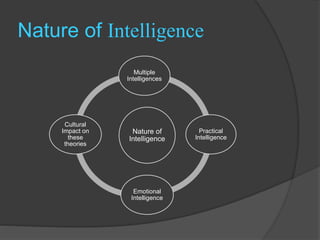
Nature of Intelligence
Nature of
Intelligence
Multiple
Intelligences
Practical
Intelligence
Emotional
Intelligence
Cultural
Impact on
these
theories
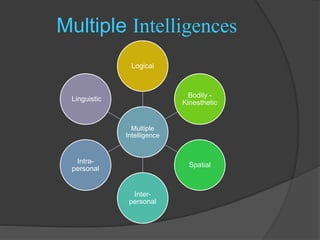
Multiple
Intelligence
Logical
Bodily -
Kinesthetic
Spatial
Inter-
personal
Intra-
personal
Linguistic
Multiple Intelligences
Howard Gardner later added more intelligences to this theory.
•Naturalist Intelligence
•Spiritual Intelligence
•Existential Intelligence
•Moral Intelligence
Linguistic intelligence
 Logical-mathematical
intelligence
 Musical intelligence
 Spatial intelligence
 Bodily-kinesthetic
intelligence
 Interpersonal intelligence
 Intrapersonal intelligence
Practical Intelligence
 What is practical knowledge?
 Applying knowledge to everyday life and finding the
best fit between themselves and the demand of the
environment.
 Adjusting to the demands of the environment by:
 Adapting to their environment
 Shaping their environment
 Selecting a favorable environment
 Overall Practical Knowledge is Tacit Knowledge.
 Knowledge that is difficult to transfer to another
person by means of writing it down or verbalizing it.
Emotional Intelligence
 Perceiving Emotions: The first step in understanding emotions is
to accurately perceive them. This involves identifying and
understanding nonverbal gestures.
 Reasoning With Emotions: The step requires the use of emotions
to encourage thinking and intellectual activity. Emotions aid in
how we prioritize and react.
 Understanding Emotions: This emotion carries a comprehensive
understanding of the situation. If anger is being expressed, it could
actually be related to something other than what one thinks.
 Managing Emotions: The skill of managing emotions effectively
is a fundamental part of emotional intelligence. Managing ones
emotions entails the correct response of emotions in any given
situation.
Cultural Impact on these
theories
 Intelligence is defined differently in each society, ethnicity and
culture.
 Many cultures are familiar with the importance of cognitive skills
when it comes to defining intelligence.
 For example, in Brazilian culture social class is also considered
along with culture when coming up with what is seen as intelligent.
They characterize people that are to create, build and work with
their hands as intelligent.
 In some cultures obedience and respect are seen as important
abilities for intelligence. Emotional intelligence is related to
cultural intelligence in that an individual is able to understand what
makes someone different from someone else. A cultural intelligent
person would be able to pick out features or characteristics in a
culture that may be different from their own.
Cultural Impact on these
theories
 Intelligence is practically cultural. As Sternberg said, “parts of the theory
are culturally universal, and parts are relative (1986, p.24)
 In practical sense of knowledge applying what was learned from
experiences to everyday life can be the same in every culture. The learners
experiences in the real world consist of universal components and the
learner will adjust or adapt accordingly.
 Gardner argues, “ there is persuasive evidence for the existence of several
relatively autonomous human intellectual competencies that can be
fashioned and combined in a multiplicity of adaptive ways by individuals
and cultures” (Gardner, 1993, pp. 8-9).
 In different cultures there are different abilities an individual may have
that is considered a form of intelligence in that culture. For example, an
individual may have the ability to heal and the ability to hunt. An
individual may have high intelligence in one area and average intelligence
in other exhibiting multiple intelligences.
Reference Page
 Cherry, K. (2014). . Retrieved from
http://psychology.about.com/od/personalitydevelopment/
a/emotionalintell.htm
 Fang-Mei, T. (2014). Exploring Multiple Intelligences. Journal
Of Human Resources & Adult Learning, 10(1), 11-21.
 Gardner, H. (1993). Multiple intelligences: The theory in
practice. New York:Basic Books.
 Merriam, S. B., Caffarella, R. S., & Baumgartner, L. M.
(2007). Learning in Adulthood (3rd ed.). Retrieved from The
University
of Phoenix eBook Collection database.
 Meunier, J. (2013). Practical Intelligence. Retrieved from
http://intelltheory.com/practicalintelligence.shtml
Reference Page
 Sternberg, R. J. (1986a). Intelligence applied: Understanding
and increasing your intellectual skills. San Diego: Harcourt Brace.

Nature of intelligence presentation

  • 1.
    Nature of Intelligence UniversityOf Phoenix Michael Burnett AET/500 November 17, 2014 Stacey Cowen, Kasee Cuero, April Jasso, Marie Ruiz,
  • 2.
    Nature of Intelligence Natureof Intelligence Multiple Intelligences Practical Intelligence Emotional Intelligence Cultural Impact on these theories
  • 3.
  • 4.
    Multiple Intelligences Howard Gardnerlater added more intelligences to this theory. •Naturalist Intelligence •Spiritual Intelligence •Existential Intelligence •Moral Intelligence Linguistic intelligence  Logical-mathematical intelligence  Musical intelligence  Spatial intelligence  Bodily-kinesthetic intelligence  Interpersonal intelligence  Intrapersonal intelligence
  • 5.
    Practical Intelligence  Whatis practical knowledge?  Applying knowledge to everyday life and finding the best fit between themselves and the demand of the environment.  Adjusting to the demands of the environment by:  Adapting to their environment  Shaping their environment  Selecting a favorable environment  Overall Practical Knowledge is Tacit Knowledge.  Knowledge that is difficult to transfer to another person by means of writing it down or verbalizing it.
  • 6.
    Emotional Intelligence  PerceivingEmotions: The first step in understanding emotions is to accurately perceive them. This involves identifying and understanding nonverbal gestures.  Reasoning With Emotions: The step requires the use of emotions to encourage thinking and intellectual activity. Emotions aid in how we prioritize and react.  Understanding Emotions: This emotion carries a comprehensive understanding of the situation. If anger is being expressed, it could actually be related to something other than what one thinks.  Managing Emotions: The skill of managing emotions effectively is a fundamental part of emotional intelligence. Managing ones emotions entails the correct response of emotions in any given situation.
  • 7.
    Cultural Impact onthese theories  Intelligence is defined differently in each society, ethnicity and culture.  Many cultures are familiar with the importance of cognitive skills when it comes to defining intelligence.  For example, in Brazilian culture social class is also considered along with culture when coming up with what is seen as intelligent. They characterize people that are to create, build and work with their hands as intelligent.  In some cultures obedience and respect are seen as important abilities for intelligence. Emotional intelligence is related to cultural intelligence in that an individual is able to understand what makes someone different from someone else. A cultural intelligent person would be able to pick out features or characteristics in a culture that may be different from their own.
  • 8.
    Cultural Impact onthese theories  Intelligence is practically cultural. As Sternberg said, “parts of the theory are culturally universal, and parts are relative (1986, p.24)  In practical sense of knowledge applying what was learned from experiences to everyday life can be the same in every culture. The learners experiences in the real world consist of universal components and the learner will adjust or adapt accordingly.  Gardner argues, “ there is persuasive evidence for the existence of several relatively autonomous human intellectual competencies that can be fashioned and combined in a multiplicity of adaptive ways by individuals and cultures” (Gardner, 1993, pp. 8-9).  In different cultures there are different abilities an individual may have that is considered a form of intelligence in that culture. For example, an individual may have the ability to heal and the ability to hunt. An individual may have high intelligence in one area and average intelligence in other exhibiting multiple intelligences.
  • 9.
    Reference Page  Cherry,K. (2014). . Retrieved from http://psychology.about.com/od/personalitydevelopment/ a/emotionalintell.htm  Fang-Mei, T. (2014). Exploring Multiple Intelligences. Journal Of Human Resources & Adult Learning, 10(1), 11-21.  Gardner, H. (1993). Multiple intelligences: The theory in practice. New York:Basic Books.  Merriam, S. B., Caffarella, R. S., & Baumgartner, L. M. (2007). Learning in Adulthood (3rd ed.). Retrieved from The University of Phoenix eBook Collection database.  Meunier, J. (2013). Practical Intelligence. Retrieved from http://intelltheory.com/practicalintelligence.shtml
  • 10.
    Reference Page  Sternberg,R. J. (1986a). Intelligence applied: Understanding and increasing your intellectual skills. San Diego: Harcourt Brace.

Editor's Notes

  • #4 Multiple intelligences is a theory developed by Howard Gardner, Ph.D., Professor of Education at Harvard University. His theory led to the development of the initial six intelligences (Fang-Mei (2014).
  • #5 Gardner initially listed seven intelligences. Two we can recognize from an academic view, three associated with the arts, and two that Gardner called personality intelligence. Linguistic intelligence involves the ability to learn language and the capacity to use it. Logical Mathematical intelligence consists of the capability to carry out mathematical problems and ability to detect patterns logically. Musical intelligence also involves the appreciation of patterns and the capacity to recognize tones and music rhythms. Bodily-kinesthetic intelligence involves the use of the body or body parts to solve problems. Spatial intelligence involves the ability to use patterns of confined spaces and wide areas. Interpersonal intelligence is the ability to understand the motivation and intentions of other people. Interpersonal intelligence is the ability to understand your feelings and yourself.(Fang-Mei (2014).
  • #6 According to Meunier (2013), practical knowledge is applying knowledge to everyday life and finding the best fit between themselves and the demand of the environment. “Thus, for Sternberg, a critical component of intelligence is how well an individual adapts, selects, a shapes real-world environments important in one's life” (Kretchmar, 2014). According to Kretchmar (2014), an example of adapting to their environment is “starting a new job, maintaining friendships, working with someone from another culture, and walking through an unfamiliar area”. An example of shaping their environment is “finding a new job, leaving a marriage or finding the nearest exit in a dangerous situation” (Kretchmar, 2014). Finally, an example of selecting a favorable environment is when an individual is dissatisfied with job but can’t leave so turning the job into something the individual would like it to be (Kretchmar, 2014). Sternberg relies on Tacit knowledge to measure practical knowledge (Meunier, 2013). Tacit Knowledge is knowledge that is difficult to transfer to another person by means of verbalizing it (Meunier, 2013). “Sternberg has argued that tacit knowledge tests are better predictors of career success than measures of g or at least the best secondary predictors of career success after taking g into account” Meunier, 2013).
  • #7 The ability to control, perceive, and evaluate emotions is in fact emotional intelligence. While some researchers dispute that emotional intelligence is instinctive, others believe that it can be a learned behavior and strengthened over time. Since 1990, Peter Salovey and John D. Mayer have been the leading researchers on emotional intelligence. In their influential article "Emotional Intelligence," they defined emotional intelligence as, the subset of social intelligence that involves the ability to monitor one's own and others' feelings and emotions, to discriminate among them and to use this information to guide one's thinking and actions (Cherry, 2014).
  • #8 In the each theory covered there is a cultural influence and cultural differences. In many cultures intelligence is defined by cognitive skills found in each individual. For example in Brazilian culture social class places impact in what is considered intelligence. Brazilian culture individuals who create or build or have hands on working skills are considered intelligent. In other cultures it has been discovered that obedience and respect are noticeably important abilities that define intelligence.
  • #9 As Sternberg said “parts of the theory are culturally universal and parts are relative” (1986, p.24) meaning intelligence is practically cultural. The learners experiences in the real work consist of universal components and the learner will adapt accordingly. However Gardner argues “ there is persuasive evidence for the existence of several autonomous human intellectual competencies that can be fashioned and combined in a multiplicity lf adaptive ways by individuals” (Gardner, 1993, pp. 8-9). This shows the influence of culture on the theory of multiple intelligences. For example an individual may have the knowledge and ability to heal and have the ability to hunt displaying multiple intelligences.