Nature of Intelligence
By: Dale Forbes, Chad Cardin, Jim
Caufield, Kevin Bidwell & Ryan
Guzman
Introduction
Much study has been done on the nature of
intelligence, especially as it relates to adult
learning and development. The following
concepts submit to the reader the different
existing theories on intelligence and adult
learning and development.
Multiple Intelligences
Howard Gardner
Multiple Intelligences
According to this theory, "we are all able to know the world through language,
logical-mathematical analysis, spatial representation, musical thinking, the use of
the body to solve problems or to make things, an understanding of other
individuals, and an understanding of ourselves. Where individuals differ is in the
strength of these intelligences - the so-called profile of intelligences -and in the
ways in which such intelligences are invoked and combined to carry out different
tasks, solve diverse problems, and progress in various domains."
Summaries of eight intelligences
• Visual/Spatial - Involves visual perception of the environment, the ability to create and
manipulate mental images, and the orientation of the body in space.
• Verbal/Linguistic - Involves reading, writing, speaking, and conversing in one's own or
foreign languages.
• Logical/Mathematical - Involves number and computing skills, recognizing patterns and
relationships, timeliness and order, and the ability to solve different kinds of problems
through logic.
• Bodily/Kinesthetic - Involves physical coordination and dexterity, using fine and gross motor
skills, and expressing oneself or learning through physical activities.
• Musical - Involves understanding and expressing oneself through music and rhythmic
movements or dance, or composing, playing, or conducting music.
• Interpersonal - Involves understanding how to communicate with and understand other
people and how to work collaboratively.
• Intrapersonal - Involves understanding one's inner world of emotions and thoughts, and
growing in the ability to control them and work with them consciously.
• Naturalist - Involves understanding the natural world of plants and animals, noticing their
characteristics, and categorizing them; it generally involves keen observation and the ability
to classify other things as well
Practical Intelligence
• Reaction to environment
• Adaptation
• Builds by experience
• Develops skills for everyday tasks
Practical Intelligence
• Is related to/known as:
– “Street Smarts”
– “Common Sense”
• Built over time
• Perfected by experience
Emotional Intelligence
Five Components of
Emotional Intelligence
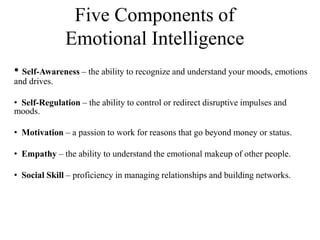
• Self-Awareness – the ability to recognize and understand your moods, emotions
and drives.
• Self-Regulation – the ability to control or redirect disruptive impulses and
moods.
• Motivation – a passion to work for reasons that go beyond money or status.
• Empathy – the ability to understand the emotional makeup of other people.
• Social Skill – proficiency in managing relationships and building networks.
Hallmarks
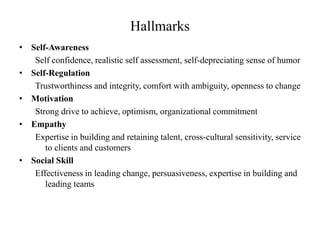
• Self-Awareness
Self confidence, realistic self assessment, self-depreciating sense of humor
• Self-Regulation
Trustworthiness and integrity, comfort with ambiguity, openness to change
• Motivation
Strong drive to achieve, optimism, organizational commitment
• Empathy
Expertise in building and retaining talent, cross-cultural sensitivity, service
to clients and customers
• Social Skill
Effectiveness in leading change, persuasiveness, expertise in building and
leading teams
Gender and Cultural Differences
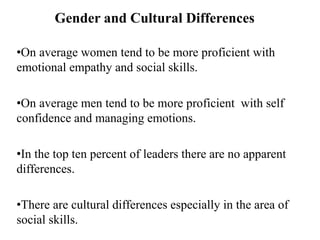
•On average women tend to be more proficient with
emotional empathy and social skills.
•On average men tend to be more proficient with self
confidence and managing emotions.
•In the top ten percent of leaders there are no apparent
differences.
•There are cultural differences especially in the area of
social skills.
Cultural Impact Multiple
Intelligences
• The makeup of intelligences changes over time with age and with
experience. According to Bruce Torff: "The intelligences develop as they
grow and change over time, which allows strengths to be exploited and
weaker areas remedied. You provide the right kinds of support for students,
they build the kinds of intellectual structures that enable them to do
things." (Torff, 1996, pg. 31.)
• Culture has a great impact, this can be good or bad depending if all cultures
are understood, what is intelligent in one part of the world may be
unintelligent in another part. Globalization will cause organizations to
better understand a vast amount of cultures as well as for who and how
schools educate with diverse backgrounds.
Cultural Impact on Practical
Intelligence
• Practical intelligence is the know how or common sense of ones intelligence and
provides people with the skills to solve everyday problems, it is an ability to
skillfully negotiate multiple communal and professional environments
• Practical intelligence can be similar or very different in all cultures. In "The
Geography of Thought" (Free Press, 2003), Richard Nisbett, argues that East Asian
and Western cultures have developed cognitive styles that differ in fundamental
ways, including in how intelligence is understood. People in Western cultures, he
suggests, tend to view intelligence as a means for individuals to devise categories
and to engage in rational debate, while people in Eastern cultures see it as a way for
members of a community to recognize contradiction and complexity and to play
their social roles successfully
Cultural Impact on Emotional
Intelligence
• Emotional Intelligence enhances personal growth and interpersonal relationships
and affects people in all aspects of life and determines quality of life. Every culture
is unique in itself, although there maybe similarities it is important to understand
both to make fair assumptions and judgements.
• Culture impacts the development of emotional intelligence, peoples responses and
expression vary accordingly to their culturally prescribed experiences and values,
therefore culture impacts the development of emotional intelligence. (Kitayama &
Markus, 1994, pg. 29)
Conclusion
Again, there are several theories on the nature
of intelligence. It is the job of the adult
educator to take all of these into account when
designing and facilitating an adult learning
experience. When this is accomplished, there
will be much success in the classroom not only
for the student, but the educator as well.
References
Goleman, D. (2010), Learning about Emotional Intelligence, Media Library
Goleman, D., What Makes a Leader, Harvard Business Review, pg.95,
November-December 1998
Kitayama,S.,&Markus,H.R.(Eds.).(1994).Emotion and culture: Empirical
studies of mutual influence. Washington,DC:
AmericanPsychologicalAssociation. Retrieved from
http://search.proquest.com/docview/304761881?accountid=458
Nisbett, Richard (2003). The Geography of Thought: How Asians and
Westerners Think Differently and Why. New York, NY Library Journal,
128(5), 2. Retrieved from http://search.proquest.com
docview/196781622?accountid=458
Roundy, L. (2015), Sternberg’s Triarchic Theory of Intelligence, Chapter 7,
Accessed from study.com website.
Study.com/academy/lesson/sternbergs-triarchic-theory-of-intelligence.html
Torff, B. (1996). How are you smart?: Multiple intelligences and classroom
practices. The NAMTA Journal, 21 (2), pg. 31.

Natrure of Intelligence

  • 1.
    Nature of Intelligence By:Dale Forbes, Chad Cardin, Jim Caufield, Kevin Bidwell & Ryan Guzman
  • 2.
    Introduction Much study hasbeen done on the nature of intelligence, especially as it relates to adult learning and development. The following concepts submit to the reader the different existing theories on intelligence and adult learning and development.
  • 3.
  • 4.
    Howard Gardner Multiple Intelligences Accordingto this theory, "we are all able to know the world through language, logical-mathematical analysis, spatial representation, musical thinking, the use of the body to solve problems or to make things, an understanding of other individuals, and an understanding of ourselves. Where individuals differ is in the strength of these intelligences - the so-called profile of intelligences -and in the ways in which such intelligences are invoked and combined to carry out different tasks, solve diverse problems, and progress in various domains."
  • 5.
    Summaries of eightintelligences • Visual/Spatial - Involves visual perception of the environment, the ability to create and manipulate mental images, and the orientation of the body in space. • Verbal/Linguistic - Involves reading, writing, speaking, and conversing in one's own or foreign languages. • Logical/Mathematical - Involves number and computing skills, recognizing patterns and relationships, timeliness and order, and the ability to solve different kinds of problems through logic. • Bodily/Kinesthetic - Involves physical coordination and dexterity, using fine and gross motor skills, and expressing oneself or learning through physical activities. • Musical - Involves understanding and expressing oneself through music and rhythmic movements or dance, or composing, playing, or conducting music. • Interpersonal - Involves understanding how to communicate with and understand other people and how to work collaboratively. • Intrapersonal - Involves understanding one's inner world of emotions and thoughts, and growing in the ability to control them and work with them consciously. • Naturalist - Involves understanding the natural world of plants and animals, noticing their characteristics, and categorizing them; it generally involves keen observation and the ability to classify other things as well
  • 6.
  • 7.
    Practical Intelligence • Reactionto environment • Adaptation • Builds by experience • Develops skills for everyday tasks
  • 8.
    Practical Intelligence • Isrelated to/known as: – “Street Smarts” – “Common Sense” • Built over time • Perfected by experience
  • 9.
  • 10.
    Five Components of EmotionalIntelligence • Self-Awareness – the ability to recognize and understand your moods, emotions and drives. • Self-Regulation – the ability to control or redirect disruptive impulses and moods. • Motivation – a passion to work for reasons that go beyond money or status. • Empathy – the ability to understand the emotional makeup of other people. • Social Skill – proficiency in managing relationships and building networks.
  • 11.
    Hallmarks • Self-Awareness Self confidence,realistic self assessment, self-depreciating sense of humor • Self-Regulation Trustworthiness and integrity, comfort with ambiguity, openness to change • Motivation Strong drive to achieve, optimism, organizational commitment • Empathy Expertise in building and retaining talent, cross-cultural sensitivity, service to clients and customers • Social Skill Effectiveness in leading change, persuasiveness, expertise in building and leading teams
  • 12.
    Gender and CulturalDifferences •On average women tend to be more proficient with emotional empathy and social skills. •On average men tend to be more proficient with self confidence and managing emotions. •In the top ten percent of leaders there are no apparent differences. •There are cultural differences especially in the area of social skills.
  • 13.
    Cultural Impact Multiple Intelligences •The makeup of intelligences changes over time with age and with experience. According to Bruce Torff: "The intelligences develop as they grow and change over time, which allows strengths to be exploited and weaker areas remedied. You provide the right kinds of support for students, they build the kinds of intellectual structures that enable them to do things." (Torff, 1996, pg. 31.) • Culture has a great impact, this can be good or bad depending if all cultures are understood, what is intelligent in one part of the world may be unintelligent in another part. Globalization will cause organizations to better understand a vast amount of cultures as well as for who and how schools educate with diverse backgrounds.
  • 14.
    Cultural Impact onPractical Intelligence • Practical intelligence is the know how or common sense of ones intelligence and provides people with the skills to solve everyday problems, it is an ability to skillfully negotiate multiple communal and professional environments • Practical intelligence can be similar or very different in all cultures. In "The Geography of Thought" (Free Press, 2003), Richard Nisbett, argues that East Asian and Western cultures have developed cognitive styles that differ in fundamental ways, including in how intelligence is understood. People in Western cultures, he suggests, tend to view intelligence as a means for individuals to devise categories and to engage in rational debate, while people in Eastern cultures see it as a way for members of a community to recognize contradiction and complexity and to play their social roles successfully
  • 15.
    Cultural Impact onEmotional Intelligence • Emotional Intelligence enhances personal growth and interpersonal relationships and affects people in all aspects of life and determines quality of life. Every culture is unique in itself, although there maybe similarities it is important to understand both to make fair assumptions and judgements. • Culture impacts the development of emotional intelligence, peoples responses and expression vary accordingly to their culturally prescribed experiences and values, therefore culture impacts the development of emotional intelligence. (Kitayama & Markus, 1994, pg. 29)
  • 16.
    Conclusion Again, there areseveral theories on the nature of intelligence. It is the job of the adult educator to take all of these into account when designing and facilitating an adult learning experience. When this is accomplished, there will be much success in the classroom not only for the student, but the educator as well.
  • 17.
    References Goleman, D. (2010),Learning about Emotional Intelligence, Media Library Goleman, D., What Makes a Leader, Harvard Business Review, pg.95, November-December 1998 Kitayama,S.,&Markus,H.R.(Eds.).(1994).Emotion and culture: Empirical studies of mutual influence. Washington,DC: AmericanPsychologicalAssociation. Retrieved from http://search.proquest.com/docview/304761881?accountid=458 Nisbett, Richard (2003). The Geography of Thought: How Asians and Westerners Think Differently and Why. New York, NY Library Journal, 128(5), 2. Retrieved from http://search.proquest.com docview/196781622?accountid=458 Roundy, L. (2015), Sternberg’s Triarchic Theory of Intelligence, Chapter 7, Accessed from study.com website. Study.com/academy/lesson/sternbergs-triarchic-theory-of-intelligence.html Torff, B. (1996). How are you smart?: Multiple intelligences and classroom practices. The NAMTA Journal, 21 (2), pg. 31.

Editor's Notes

  • #8 Practical Intelligence can be summed up as how one reacts to their environment and their ability to adapt to said environment. Practical intelligence builds on experience and allows a person to develop how they deal with everyday tasks.
  • #9 Practical intelligence is known by several other names. These names include “street smarts” and “common sense”. As the previous slide explained, these qualities are built over time and are perfected by experience.
  • #14 Torff, B. (1996). How are you smart?: Multiple intelligences and classroom practices. The NAMTA Journal, 21 (2), pg. 31.
  • #15 Nisbett, Richard (2003). The Geography of Thought: How Asians and Westerners Think Differently and Why. New York, NY Library Journal, 128(5), 2. Retrieved from http://search.proquest.com/docview/196781622?accountid=458
  • #16 Kitayama,S.,&Markus,H.R.(Eds.).(1994).Emotion and culture: Empirical studies of mutual influence. Washington,DC: AmericanPsychologicalAssociation. Retrieved from http://search.proquest.com/docview/304761881?accountid=458