Interpreting causality in the health sciences Federica Russo & Jon Williamson Philosophy, University of Kent
Causality and probability  in  the sciences An ongoing project at Kent www.kent.ac.uk/secl/philosophy/jw/2006/CausalityProbability.htm In  the sciences About probability We defend an  ObjectiveBayesian-cum-Frequency  interpretation About causality We defend an epistemic interpretation
Overview Two types of evidence Probabilistic Mechanistic Against causal monism Against causal pluralism The case for epistemic causality
Probabilistic evidence Observed dependencies  in a range of similar studies Coherent results Tests for stability  in structural models …
Mechanistic evidence Biomedical mechanisms Chemical reactions, electric signals,  alterations at the cellular level, … A plausible (physiological) link  from the cause to the effect
We need both types of evidence Semmelweis and puerperal fever He had statistics but the link wasn’t  accepted  till backed with the mechanism Helicobacter pylory The causal relation was hypothesised  based on probabilistic evidence and  accepted when backed with the mechanism
A classic: Bradford Hill’s criteria Strength of association Temporality Consistency Theoretical plausibility Coherence Specificity in the causes Dose response relationship Experimental evidence Analogy
Contemporary medicine: IARC IARC reviews published studies Assessment of causality depends on: Presence of a plausible mechanism Probabilistic evidence  (e.g. frequencies, risks)
Monistic accounts won’t do Mechanistic accounts Causal processes intersect with each other  in interactive forks Probabilistic accounts Causes make a difference  in the probability of the effect  (ceteris paribus) Problem: Neither can handle the dual aspect  of causal epistemology
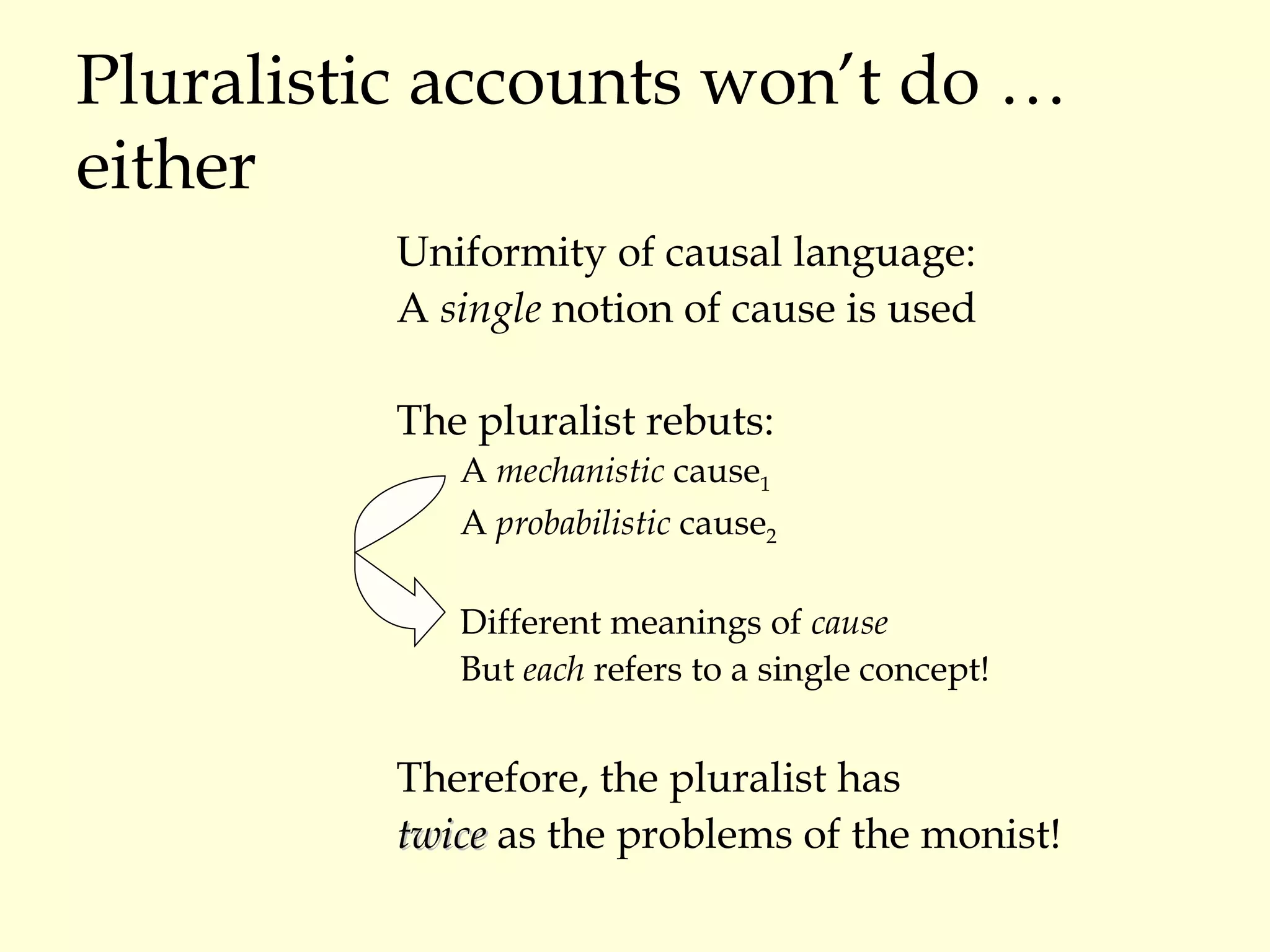
Pluralistic accounts won’t do … either Uniformity of causal language: A  single  notion of cause is used The pluralist rebuts: A  mechanistic  cause 1 A  probabilistic  cause 2 Different meanings of  cause But  each  refers to a single concept! Therefore, the pluralist has  twice  as the problems of the monist!
The way out: epistemic causality Rational causal beliefs: The agent’s evidence determines  which beliefs to adopt A causal relation is the set of causal beliefs that an agent with total evidence  should adopt
Constraints on causal beliefs The agent’s causal beliefs should account  for all known dependencies  that are not already accounted for  by non-causal dependencies The agent’s causal beliefs should be compatible with other knowledge The agent should not have causal beliefs that are not warranted by her evidence
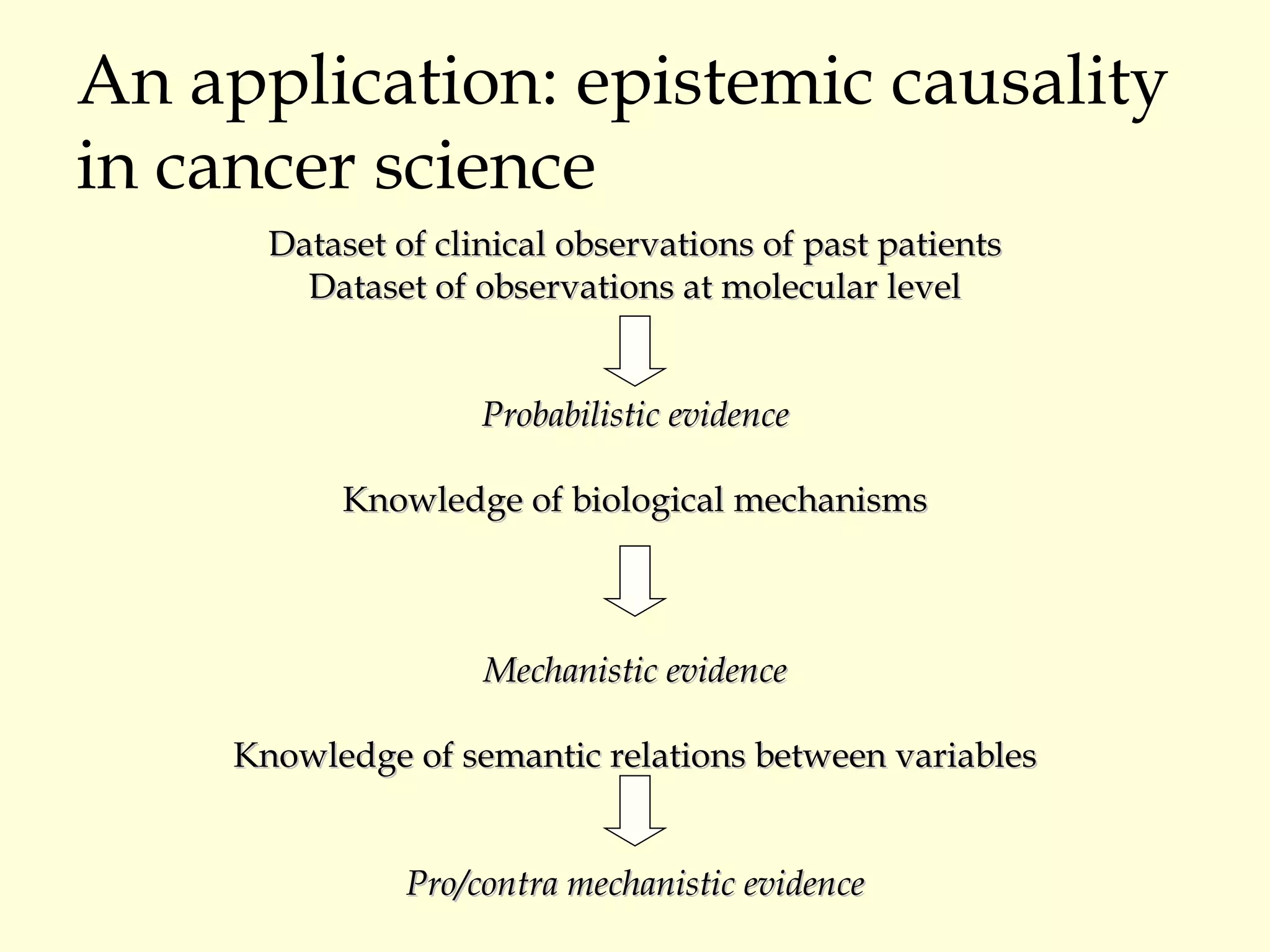
An application: epistemic causality in cancer science Dataset of clinical observations of past patients Dataset of observations at molecular level Probabilistic evidence Knowledge of biological mechanisms Mechanistic evidence Knowledge of semantic relations between variables Pro/contra mechanistic evidence
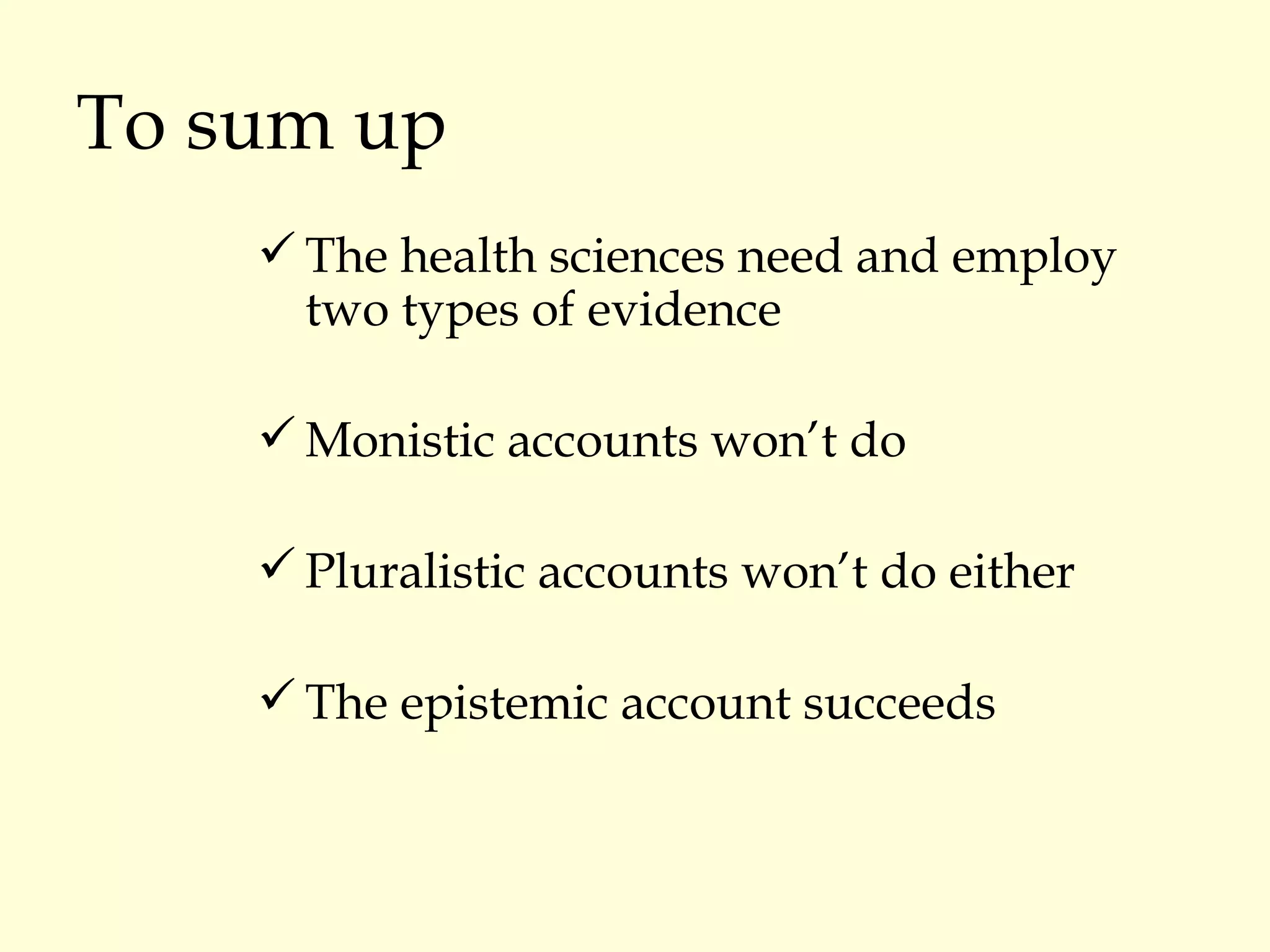
To sum up The health sciences need and employ two types of evidence Monistic accounts won’t do Pluralistic accounts won’t do either The epistemic account succeeds
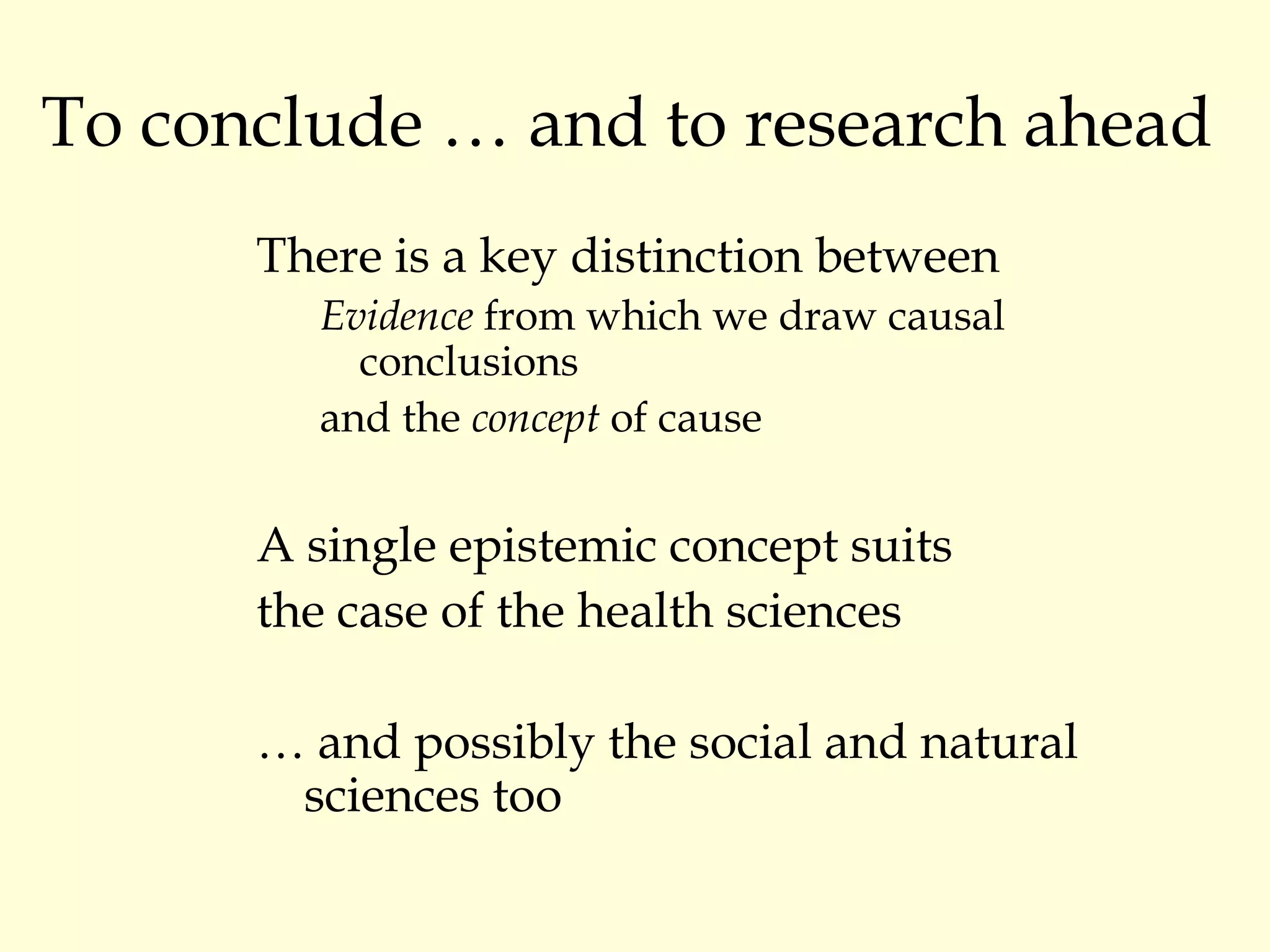
To conclude … and to research ahead There is a key distinction between Evidence  from which we draw causal conclusions and the  concept  of cause A single epistemic concept suits  the case of the health sciences …  and possibly the social and natural sciences too

Interpreting Causality

  • 1.
    Interpreting causality inthe health sciences Federica Russo & Jon Williamson Philosophy, University of Kent
  • 2.
    Causality and probability in the sciences An ongoing project at Kent www.kent.ac.uk/secl/philosophy/jw/2006/CausalityProbability.htm In the sciences About probability We defend an ObjectiveBayesian-cum-Frequency interpretation About causality We defend an epistemic interpretation
  • 3.
    Overview Two typesof evidence Probabilistic Mechanistic Against causal monism Against causal pluralism The case for epistemic causality
  • 4.
    Probabilistic evidence Observeddependencies in a range of similar studies Coherent results Tests for stability in structural models …
  • 5.
    Mechanistic evidence Biomedicalmechanisms Chemical reactions, electric signals, alterations at the cellular level, … A plausible (physiological) link from the cause to the effect
  • 6.
    We need bothtypes of evidence Semmelweis and puerperal fever He had statistics but the link wasn’t accepted till backed with the mechanism Helicobacter pylory The causal relation was hypothesised based on probabilistic evidence and accepted when backed with the mechanism
  • 7.
    A classic: BradfordHill’s criteria Strength of association Temporality Consistency Theoretical plausibility Coherence Specificity in the causes Dose response relationship Experimental evidence Analogy
  • 8.
    Contemporary medicine: IARCIARC reviews published studies Assessment of causality depends on: Presence of a plausible mechanism Probabilistic evidence (e.g. frequencies, risks)
  • 9.
    Monistic accounts won’tdo Mechanistic accounts Causal processes intersect with each other in interactive forks Probabilistic accounts Causes make a difference in the probability of the effect (ceteris paribus) Problem: Neither can handle the dual aspect of causal epistemology
  • 10.
    Pluralistic accounts won’tdo … either Uniformity of causal language: A single notion of cause is used The pluralist rebuts: A mechanistic cause 1 A probabilistic cause 2 Different meanings of cause But each refers to a single concept! Therefore, the pluralist has twice as the problems of the monist!
  • 11.
    The way out:epistemic causality Rational causal beliefs: The agent’s evidence determines which beliefs to adopt A causal relation is the set of causal beliefs that an agent with total evidence should adopt
  • 12.
    Constraints on causalbeliefs The agent’s causal beliefs should account for all known dependencies that are not already accounted for by non-causal dependencies The agent’s causal beliefs should be compatible with other knowledge The agent should not have causal beliefs that are not warranted by her evidence
  • 13.
    An application: epistemiccausality in cancer science Dataset of clinical observations of past patients Dataset of observations at molecular level Probabilistic evidence Knowledge of biological mechanisms Mechanistic evidence Knowledge of semantic relations between variables Pro/contra mechanistic evidence
  • 14.
    To sum upThe health sciences need and employ two types of evidence Monistic accounts won’t do Pluralistic accounts won’t do either The epistemic account succeeds
  • 15.
    To conclude …and to research ahead There is a key distinction between Evidence from which we draw causal conclusions and the concept of cause A single epistemic concept suits the case of the health sciences … and possibly the social and natural sciences too