Causation in Epidemiology
Presented by Dr Mehwish Iqbal IHM
(DUHS)
Instructor: Dr Aamir Hussain
General Models of Causation
• The most widely applied models are:
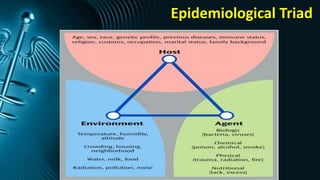
– The epidemiological triad (triangle),
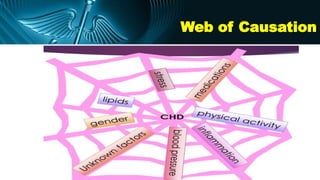
– The web
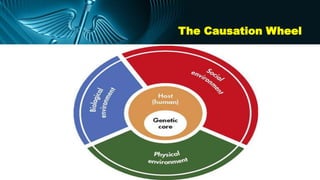
– The wheel and
– The sufficient cause and component causes models
(Rothman’s component causes model)
Epidemiological Triad
Web of Causation
The Causation Wheel
Evidence for causal Relationship
In 1840, Henle proposed postulates for causation that were expanded by Koch in the
1880s.The postulates for causation were as follows:
1. The organism is always found with the disease.
2. The organism is not found with any other disease.
3.The organism, isolated from one who has the disease, and cultured through several
generations, produces the disease (in experimental animals).
Koch added that “Even when an infectious disease cannot be transmitted to animals, the
‘regular’ and ‘exclusive’ presence of the organism [postulates 1 and 2] proves a causal
relationship.”
These postulates, though not perfect, proved very useful for infectious diseases. However,
as apparently non infectious diseases assumed increasing importance toward the middle of
the 20th century, the issue arose as to what would represent strong evidence of causation
in diseases that were generally not of infectious origin.
When we can say that this
association is likely to be
causation??
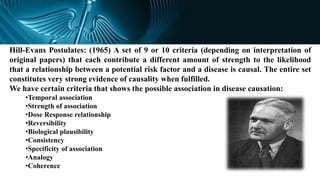
Hill-Evans Postulates: (1965) A set of 9 or 10 criteria (depending on interpretation of
original papers) that each contribute a different amount of strength to the likelihood
that a relationship between a potential risk factor and a disease is causal. The entire set
constitutes very strong evidence of causality when fulfilled.
We have certain criteria that shows the possible association in disease causation:
•Temporal association
•Strength of association
•Dose Response relationship
•Reversibility
•Biological plausibility
•Consistency
•Specificity of association
•Analogy
•Coherence
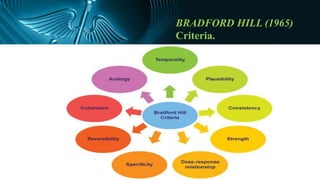
BRADFORD HILL (1965)
Criteria.
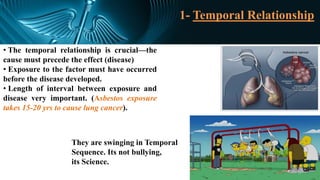
1- Temporal Relationship
• The temporal relationship is crucial—the
cause must precede the effect (disease)
• Exposure to the factor must have occurred
before the disease developed.
• Length of interval between exposure and
disease very important. (Asbestos exposure
takes 15-20 yrs to cause lung cancer).
They are swinging in Temporal
Sequence. Its not bullying,
its Science.
2. Strength of Association
• The Strength of the association is measured by the Relative
Risk (RR),the stronger the association the more likely it is that
the relation is causal. RR is direct measure of the strength of
association.
• Hill’s argument is that strong association between possible
cause and effect are more likely to be causal than weak
associations .
• The fact that an association is weak does not rule out a causal
connection. example would be passive smoking and lung cancer.
• The fact that an association is weak does not preclude it from
being causal
• For example, weak associations have been found between diet
and risk of coronary heart disease in observational studies
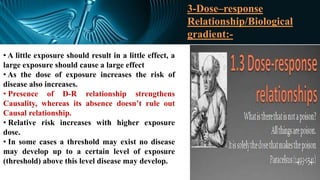
3-Dose–response
Relationship/Biological
gradient:-
• A little exposure should result in a little effect, a
large exposure should cause a large effect
• As the dose of exposure increases the risk of
disease also increases.
• Presence of D-R relationship strengthens
Causality, whereas its absence doesn’t rule out
Causal relationship.
• Relative risk increases with higher exposure
dose.
• In some cases a threshold may exist no disease
may develop up to a certain level of exposure
(threshold) above this level disease may develop.
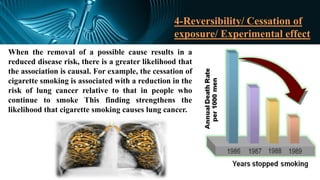
4-Reversibility/ Cessation of
exposure/ Experimental effect
When the removal of a possible cause results in a
reduced disease risk, there is a greater likelihood that
the association is causal. For example, the cessation of
cigarette smoking is associated with a reduction in the
risk of lung cancer relative to that in people who
continue to smoke This finding strengthens the
likelihood that cigarette smoking causes lung cancer.
5-Biologic Plausibility
Of The Association
• It refers to coherence with the current body of
biological knowledge.
• Sometimes the lack of plausibility may simply
be due to the lack of sufficient knowledge about
the pathogenesis of a disease, In other words,
there needs to be some theoretical basis for
positing an association between a vector and
disease, or one social phenomenon and another.
• A recent example of plausibility being the
main reason for a conclusion about causality is
variant Creutzfeldt–Jakob disease (vCJD).
6- Consistency/ Replication
of findings:-
• Refers to the repeated observation of an association in different
populations under different circumstances obtained from different
studies.
• This technique is called meta-analysis and is used to combine the
results of several trials, each of which may deal with a relatively
small sample, to obtain a better overall estimate of effect.
• Consistent findings observed by different persons in different
places with different samples strengthens the likelihood of an
effect
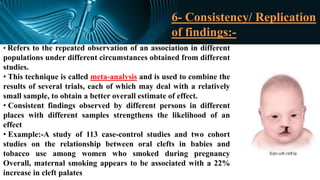
• Example:-A study of 113 case-control studies and two cohort
studies on the relationship between oral clefts in babies and
tobacco use among women who smoked during pregnancy
Overall, maternal smoking appears to be associated with a 22%
increase in cleft palates
7- Specificity Of The
Association
• Specific exposure is associated with only one
disease.
• Since diseases can have multiple etiologies and
therapies can have multiple effects, this is a
weaker criteria (should probably be eliminated)
• Cigarette manufacturers have pointed out that
the diseases attributed to cigarette smoking do not
meet the requirements of this guideline
8-Coherence/ consistency
with other knowledge
• If relationship is causal we would expect the findings
to be consistent with other data.
• Coherence between epidemiological and laboratory
findings increases the likelihood of an effect.
• In other words, it is necessary to evaluate claims of
causality within the context of the current state of
knowledge within a given field and in related fields.
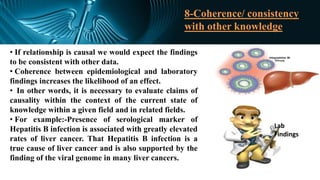
• For example:-Presence of serological marker of
Hepatitis B infection is associated with greatly elevated
rates of liver cancer. That Hepatitis B infection is a
true cause of liver cancer and is also supported by the
finding of the viral genome in many liver cancers.
Lab
Findings
9-Analogy/Consideration of
alternate explanation:-
• Provides a source of more elaborate hypotheses
about the associations under study.
• Absence of such analogies only reflects lack of
imagination, evidence or experience , not falsity of the
hypothesis.
• Analogy provides a source of more elaborate
hypothesis about the associations under study.
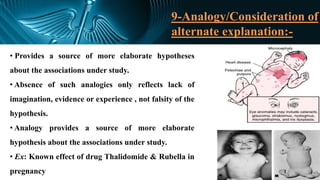
• Ex: Known effect of drug Thalidomide & Rubella in
pregnancy
CAUSAL INFERENCE
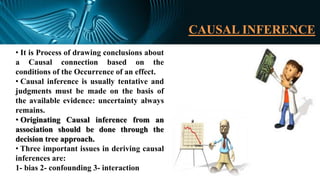
• It is Process of drawing conclusions about
a Causal connection based on the
conditions of the Occurrence of an effect.
• Causal inference is usually tentative and
judgments must be made on the basis of
the available evidence: uncertainty always
remains.
• Originating Causal inference from an
association should be done through the
decision tree approach.
• Three important issues in deriving causal
inferences are:
1- bias 2- confounding 3- interaction
Causation in epidemiology

Causation in epidemiology

  • 1.
    Causation in Epidemiology Presentedby Dr Mehwish Iqbal IHM (DUHS) Instructor: Dr Aamir Hussain
  • 2.
    General Models ofCausation • The most widely applied models are: – The epidemiological triad (triangle), – The web – The wheel and – The sufficient cause and component causes models (Rothman’s component causes model)
  • 3.
  • 4.
  • 5.
  • 6.
    Evidence for causalRelationship In 1840, Henle proposed postulates for causation that were expanded by Koch in the 1880s.The postulates for causation were as follows: 1. The organism is always found with the disease. 2. The organism is not found with any other disease. 3.The organism, isolated from one who has the disease, and cultured through several generations, produces the disease (in experimental animals). Koch added that “Even when an infectious disease cannot be transmitted to animals, the ‘regular’ and ‘exclusive’ presence of the organism [postulates 1 and 2] proves a causal relationship.” These postulates, though not perfect, proved very useful for infectious diseases. However, as apparently non infectious diseases assumed increasing importance toward the middle of the 20th century, the issue arose as to what would represent strong evidence of causation in diseases that were generally not of infectious origin.
  • 7.
    When we cansay that this association is likely to be causation??
  • 8.
    Hill-Evans Postulates: (1965)A set of 9 or 10 criteria (depending on interpretation of original papers) that each contribute a different amount of strength to the likelihood that a relationship between a potential risk factor and a disease is causal. The entire set constitutes very strong evidence of causality when fulfilled. We have certain criteria that shows the possible association in disease causation: •Temporal association •Strength of association •Dose Response relationship •Reversibility •Biological plausibility •Consistency •Specificity of association •Analogy •Coherence
  • 9.
  • 10.
    1- Temporal Relationship •The temporal relationship is crucial—the cause must precede the effect (disease) • Exposure to the factor must have occurred before the disease developed. • Length of interval between exposure and disease very important. (Asbestos exposure takes 15-20 yrs to cause lung cancer). They are swinging in Temporal Sequence. Its not bullying, its Science.
  • 11.
    2. Strength ofAssociation • The Strength of the association is measured by the Relative Risk (RR),the stronger the association the more likely it is that the relation is causal. RR is direct measure of the strength of association. • Hill’s argument is that strong association between possible cause and effect are more likely to be causal than weak associations . • The fact that an association is weak does not rule out a causal connection. example would be passive smoking and lung cancer. • The fact that an association is weak does not preclude it from being causal • For example, weak associations have been found between diet and risk of coronary heart disease in observational studies
  • 12.
    3-Dose–response Relationship/Biological gradient:- • A littleexposure should result in a little effect, a large exposure should cause a large effect • As the dose of exposure increases the risk of disease also increases. • Presence of D-R relationship strengthens Causality, whereas its absence doesn’t rule out Causal relationship. • Relative risk increases with higher exposure dose. • In some cases a threshold may exist no disease may develop up to a certain level of exposure (threshold) above this level disease may develop.
  • 13.
    4-Reversibility/ Cessation of exposure/Experimental effect When the removal of a possible cause results in a reduced disease risk, there is a greater likelihood that the association is causal. For example, the cessation of cigarette smoking is associated with a reduction in the risk of lung cancer relative to that in people who continue to smoke This finding strengthens the likelihood that cigarette smoking causes lung cancer.
  • 14.
    5-Biologic Plausibility Of TheAssociation • It refers to coherence with the current body of biological knowledge. • Sometimes the lack of plausibility may simply be due to the lack of sufficient knowledge about the pathogenesis of a disease, In other words, there needs to be some theoretical basis for positing an association between a vector and disease, or one social phenomenon and another. • A recent example of plausibility being the main reason for a conclusion about causality is variant Creutzfeldt–Jakob disease (vCJD).
  • 15.
    6- Consistency/ Replication offindings:- • Refers to the repeated observation of an association in different populations under different circumstances obtained from different studies. • This technique is called meta-analysis and is used to combine the results of several trials, each of which may deal with a relatively small sample, to obtain a better overall estimate of effect. • Consistent findings observed by different persons in different places with different samples strengthens the likelihood of an effect • Example:-A study of 113 case-control studies and two cohort studies on the relationship between oral clefts in babies and tobacco use among women who smoked during pregnancy Overall, maternal smoking appears to be associated with a 22% increase in cleft palates
  • 16.
    7- Specificity OfThe Association • Specific exposure is associated with only one disease. • Since diseases can have multiple etiologies and therapies can have multiple effects, this is a weaker criteria (should probably be eliminated) • Cigarette manufacturers have pointed out that the diseases attributed to cigarette smoking do not meet the requirements of this guideline
  • 17.
    8-Coherence/ consistency with otherknowledge • If relationship is causal we would expect the findings to be consistent with other data. • Coherence between epidemiological and laboratory findings increases the likelihood of an effect. • In other words, it is necessary to evaluate claims of causality within the context of the current state of knowledge within a given field and in related fields. • For example:-Presence of serological marker of Hepatitis B infection is associated with greatly elevated rates of liver cancer. That Hepatitis B infection is a true cause of liver cancer and is also supported by the finding of the viral genome in many liver cancers. Lab Findings
  • 18.
    9-Analogy/Consideration of alternate explanation:- •Provides a source of more elaborate hypotheses about the associations under study. • Absence of such analogies only reflects lack of imagination, evidence or experience , not falsity of the hypothesis. • Analogy provides a source of more elaborate hypothesis about the associations under study. • Ex: Known effect of drug Thalidomide & Rubella in pregnancy
  • 19.
    CAUSAL INFERENCE • Itis Process of drawing conclusions about a Causal connection based on the conditions of the Occurrence of an effect. • Causal inference is usually tentative and judgments must be made on the basis of the available evidence: uncertainty always remains. • Originating Causal inference from an association should be done through the decision tree approach. • Three important issues in deriving causal inferences are: 1- bias 2- confounding 3- interaction