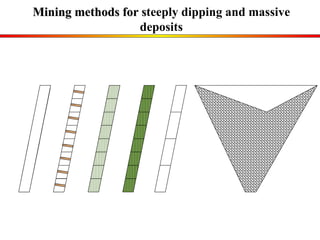
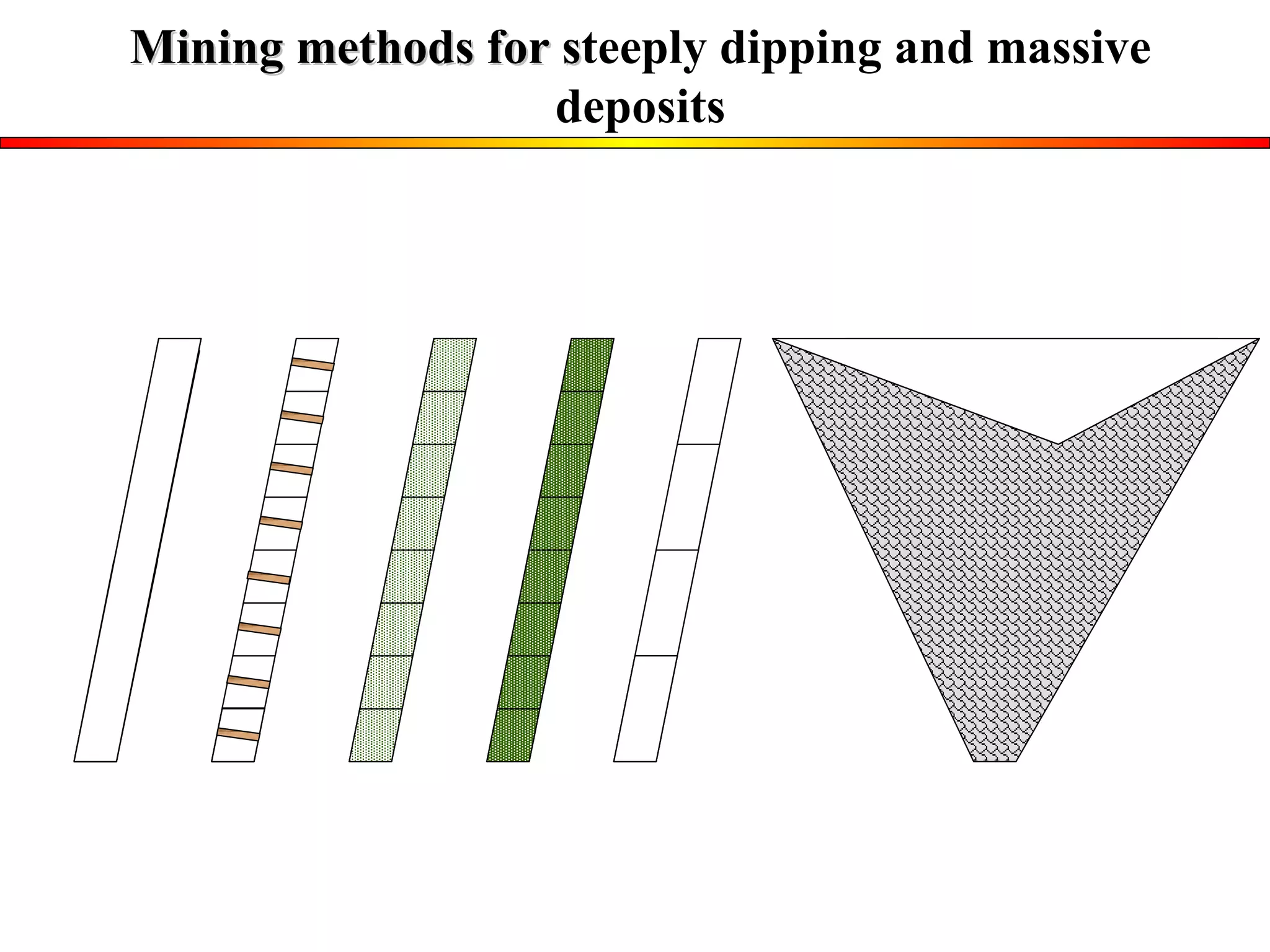
Mining methods for s teeply dipping and massive deposits
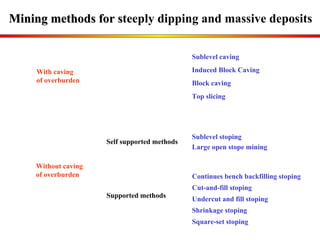
Mining methods for s teeply dipping and massive deposits Self supported methods Sublevel caving Block caving Induced Block Caving Sublevel stoping Undercut and fill stoping Square-set stoping Cut-and-fill stoping Shrinkage stoping With caving  of overburden Without caving  of overburden Supported methods Large open stope mining Top slicing Continues bench backfilling stoping
CAVING METHODES
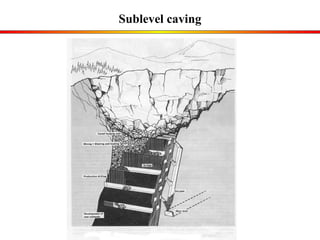
Sublevel caving
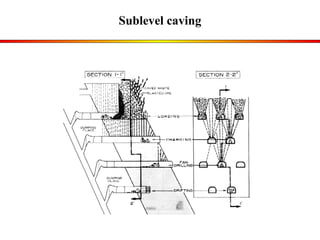
Sublevel caving
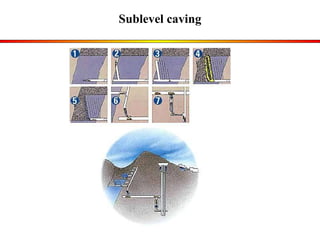
Sublevel caving
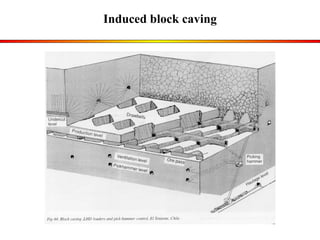
Induced block caving
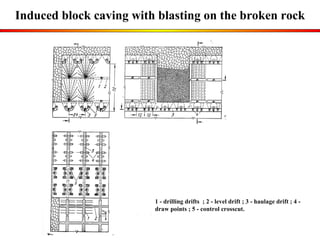
Induced block caving  with blasting on the broken rock 1 - drilling drifts  ; 2 - level drift ; 3 - haulage drift ; 4 - draw points ; 5 - control crosscut.
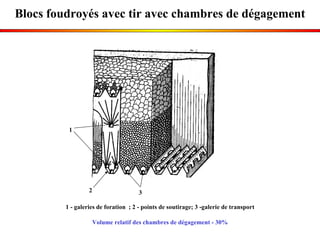
Blocs foudroyés avec tir avec chambres de dégagement 1 - galeries de foration  ; 2 - points de soutirage; 3 -galerie de transport 2 1 3 Volume relatif des chambres de dégagement - 30%
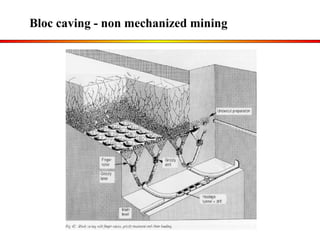
Bloc caving - non mechanized mining
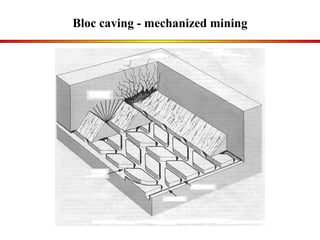
Bloc caving - mechanized mining
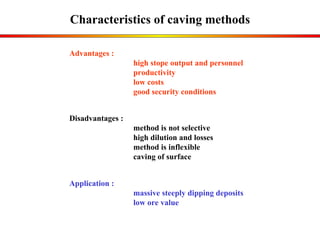
Characteristics of caving methods Application : massive steeply dipping deposits low ore value Advantages :  high stope output and personnel  productivity low costs  good security conditions Disadvantages : method is not selective  high dilution and losses method is inflexible caving of surface
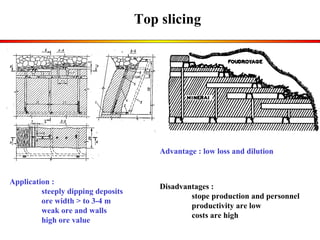
Top slicing Application : steeply dipping deposits  ore width > to 3-4 m weak ore and walls  high ore value Advantage : low loss and dilution Disadvantages : stope production and personnel  productivity are low costs are high
SELF SUPPORTED METHODS
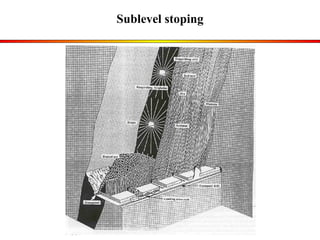
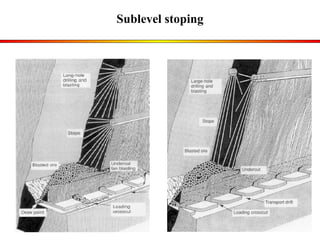
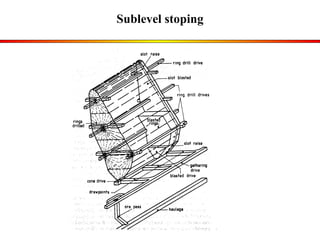
Sublevel stoping
Sublevel stoping
Sublevel stoping
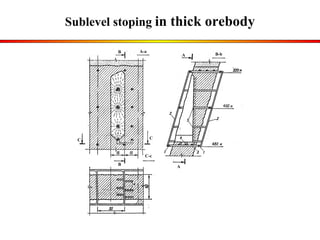
Sublevel stoping  in thick orebody A-a B-b C-c A A C C B B
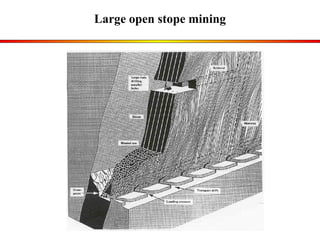
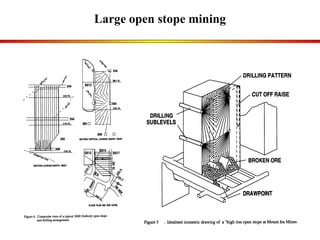
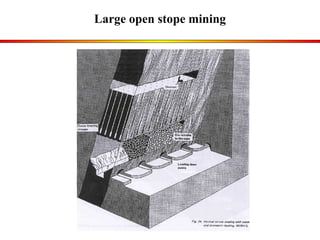
Large open stope mining
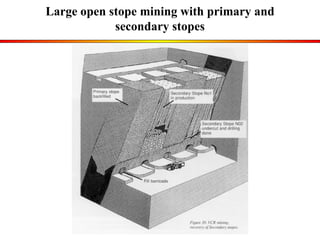
Large open stope mining  with primary and secondary stopes
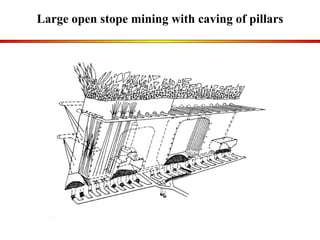
Large open stope mining  with caving of pillars
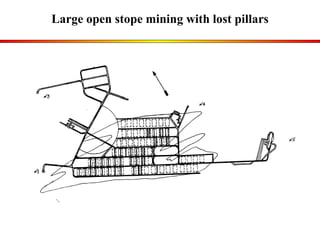
Large open stope mining  with lost pillars
Characteristics of self supported methods Application : massive steeply dipping deposits competent ore and host rocks low ore value with lost pillars high ore value with cemented fill Advantages :  high stope output and personnel  productivity low dilution low costs good security conditions Disadvantages : method is not selective  high losses in pillars or higher costs for backfilling method is inflexible
SUPPORTED METHODS
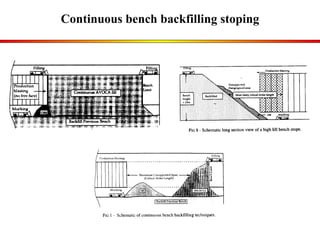
Continuous bench backfilling stoping
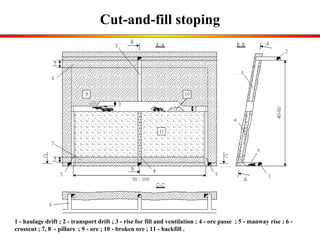
Cut-and-fill stoping 1 - haulage drift ; 2 - transport drift ; 3 - rise for fill and ventilation ; 4 - ore passe  ; 5 - manway rise ; 6 - crosscut ; 7, 8  - pillars  ; 9 - ore ; 10 - broken ore ; 11 - backfill .
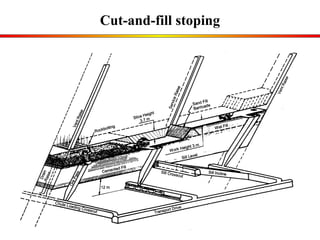
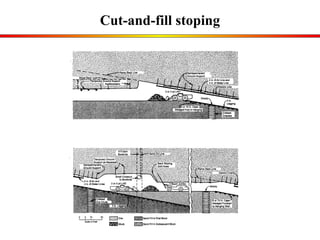
Cut-and-fill stoping
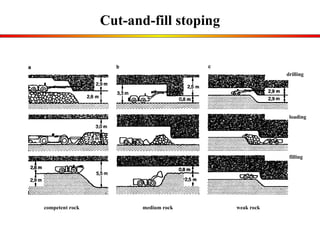
drilling loading filling competent rock weak rock medium rock Cut-and-fill stoping
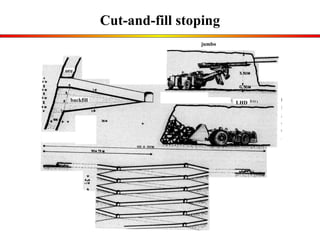
ore LHD jumbo backfill Cut-and-fill stoping
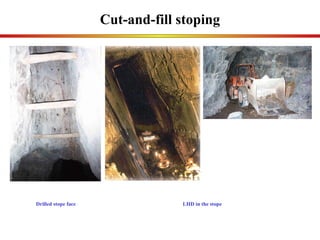
Cut-and-fill stoping Drilled stope face LHD in the stope
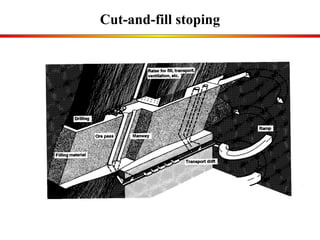
Cut-and-fill stoping
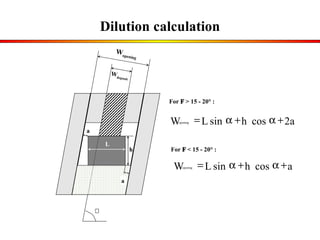
Dilution calculation  W deposit a a W opening a 2 cos h  sin  L W opening      a cos h  sin  L W opening      For    > 15 - 20° : For    < 15 - 20° : h L
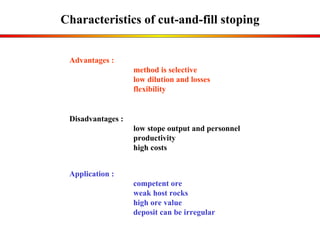
Characteristics of cut-and-fill stoping Application : competent ore weak host rocks high ore value deposit can be irregular Advantages :  method is selective low dilution and losses flexibility Disadvantages : low  stope output and personnel  productivity  high costs
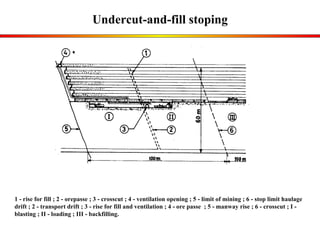
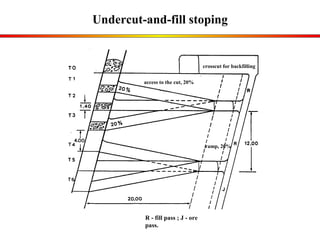
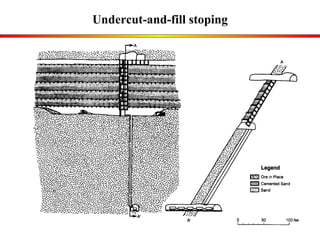
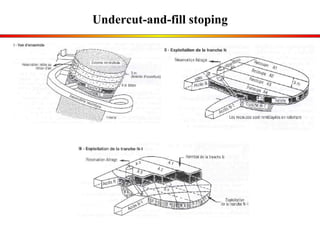
Undercut-and-fill stoping 1 - rise for fill ; 2 - orepasse ; 3 - crosscut ; 4 - ventilation opening ; 5 - limit of mining ; 6 - stop limit haulage drift ; 2 - transport drift ; 3 - rise for fill and ventilation ; 4 - ore passe  ; 5 - manway rise ; 6 - crosscut ; I - blasting ; II - loading ; III - backfilling.
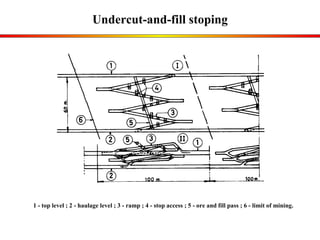
Undercut-and-fill stoping 1 - top level ; 2 - haulage level ; 3 - ramp ; 4 - stop access ; 5 - ore and fill pass ; 6 - limit of mining.
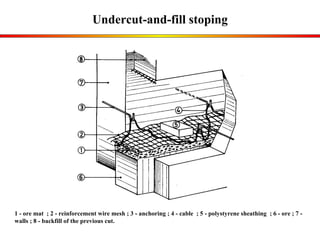
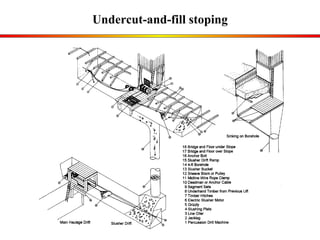
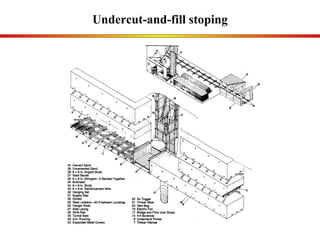
Undercut-and-fill stoping 1 - ore mat  ; 2 - reinforcement wire mesh ; 3 - anchoring ; 4 - cable  ; 5 - polystyrene sheathing  ; 6 - ore ; 7 - walls ; 8 - backfill of the previous cut.
Undercut-and-fill stoping ramp, 20% access to the cut, 20% R - fill pass ; J - ore pass.  crosscut for backfilling
Undercut-and-fill stoping
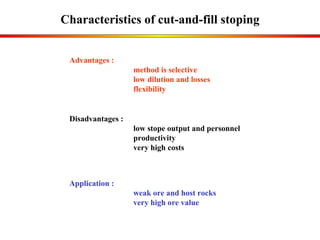
Characteristics of cut-and-fill stoping Application : weak ore and host rocks very high ore value Advantages :  method is selective low dilution and losses flexibility Disadvantages : low  stope output and personnel  productivity  very high costs
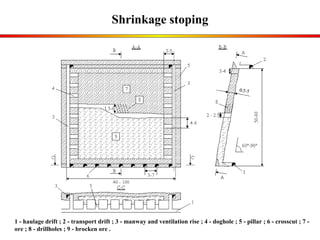
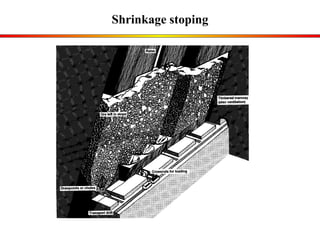
Shrinkage stoping 1 - haulage drift ; 2 - transport drift ; 3 - manway and ventilation rise ; 4 - doghole ; 5 - pillar ; 6 - crosscut ; 7 - ore ; 8 - drillholes ; 9 - brocken ore .
Shrinkage stoping
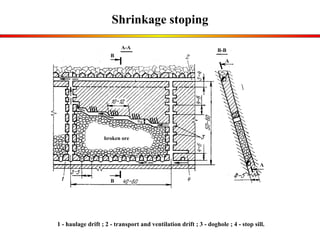
Shrinkage stoping 1 - haulage drift ; 2 - transport and ventilation drift ; 3 - doghole ; 4 - stop sill. broken ore A-A B-B A A B B
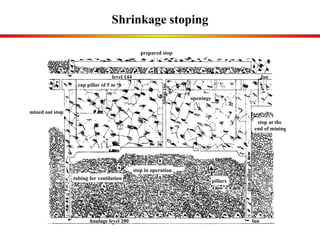
Shrinkage stoping stop in operation pillars tubing for ventilation prepared stop stop at the  end of mining thin pillar cap pillar of 5 m openings fan haulage level 200 fan mined out stop level 144 Alimac rise
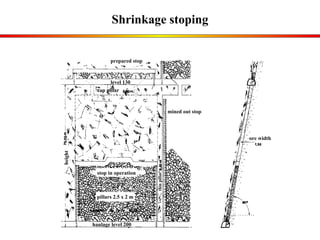
Shrinkage stoping mined out stop thin pillar level 130 prepared stop ore width haulage level 200 stop in operation pillars 2.5 x 2 m cap pillar  height
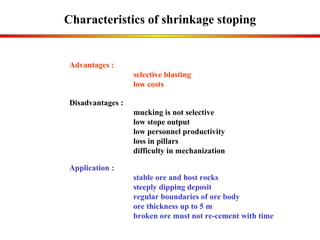
Characteristics of  shrinkage  stoping Application : stable ore and host rocks steeply dipping deposit regular boundaries of ore body ore thickness up to 5 m broken ore must not re-cement with time Advantages :  selective blasting low costs Disadvantages : mucking  is not selective  low  stope output  low personnel productivity  loss in pillars difficulty in mechanization
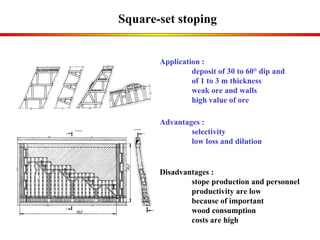
Square-set stoping Application : deposit of 30 to 60° dip and  of 1 to 3 m thickness weak ore and walls high value of ore Advantages : selectivity low loss and dilution Disadvantages : stope production and personnel  productivity are low because of important  wood consumption  costs are high
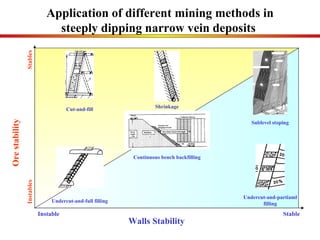
Application of different mining methods in steeply dipping narrow vein deposits  Walls Stability Instable Stable Ore stability Instables Stables Undercut-and-full filling Cut-and-fill Continuous bench backfilling Sublevel stoping Shrinkage Undercut-and-partiaml filling
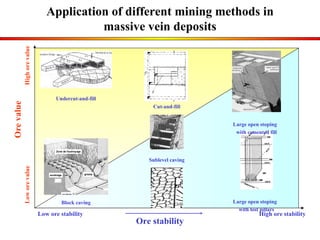
Application of different mining methods in massive vein deposits Ore stability Low ore stability High ore stability Ore value Low ore value High ore value Block caving Cut-and-fill Sublevel caving Large open stoping   with cemented fill Undercut-and-fill Large open stoping   with lost pillars

Mining methods

  • 1.
    Mining methods fors teeply dipping and massive deposits
  • 2.
    Mining methods fors teeply dipping and massive deposits Self supported methods Sublevel caving Block caving Induced Block Caving Sublevel stoping Undercut and fill stoping Square-set stoping Cut-and-fill stoping Shrinkage stoping With caving of overburden Without caving of overburden Supported methods Large open stope mining Top slicing Continues bench backfilling stoping
  • 3.
  • 4.
  • 5.
  • 6.
  • 7.
  • 8.
    Induced block caving with blasting on the broken rock 1 - drilling drifts ; 2 - level drift ; 3 - haulage drift ; 4 - draw points ; 5 - control crosscut.
  • 9.
    Blocs foudroyés avectir avec chambres de dégagement 1 - galeries de foration ; 2 - points de soutirage; 3 -galerie de transport 2 1 3 Volume relatif des chambres de dégagement - 30%
  • 10.
    Bloc caving -non mechanized mining
  • 11.
    Bloc caving -mechanized mining
  • 12.
    Characteristics of cavingmethods Application : massive steeply dipping deposits low ore value Advantages : high stope output and personnel productivity low costs good security conditions Disadvantages : method is not selective high dilution and losses method is inflexible caving of surface
  • 13.
    Top slicing Application: steeply dipping deposits ore width > to 3-4 m weak ore and walls high ore value Advantage : low loss and dilution Disadvantages : stope production and personnel productivity are low costs are high
  • 14.
  • 15.
  • 16.
  • 17.
  • 18.
    Sublevel stoping in thick orebody A-a B-b C-c A A C C B B
  • 19.
  • 20.
  • 21.
  • 22.
    Large open stopemining with primary and secondary stopes
  • 23.
    Large open stopemining with caving of pillars
  • 24.
    Large open stopemining with lost pillars
  • 25.
    Characteristics of selfsupported methods Application : massive steeply dipping deposits competent ore and host rocks low ore value with lost pillars high ore value with cemented fill Advantages : high stope output and personnel productivity low dilution low costs good security conditions Disadvantages : method is not selective high losses in pillars or higher costs for backfilling method is inflexible
  • 26.
  • 27.
  • 28.
    Cut-and-fill stoping 1- haulage drift ; 2 - transport drift ; 3 - rise for fill and ventilation ; 4 - ore passe ; 5 - manway rise ; 6 - crosscut ; 7, 8 - pillars ; 9 - ore ; 10 - broken ore ; 11 - backfill .
  • 29.
  • 30.
  • 31.
  • 32.
    drilling loading fillingcompetent rock weak rock medium rock Cut-and-fill stoping
  • 33.
    ore LHD jumbobackfill Cut-and-fill stoping
  • 34.
    Cut-and-fill stoping Drilledstope face LHD in the stope
  • 35.
  • 36.
  • 37.
    Dilution calculation W deposit a a W opening a 2 cos h sin L W opening      a cos h sin L W opening      For  > 15 - 20° : For  < 15 - 20° : h L
  • 38.
    Characteristics of cut-and-fillstoping Application : competent ore weak host rocks high ore value deposit can be irregular Advantages : method is selective low dilution and losses flexibility Disadvantages : low stope output and personnel productivity high costs
  • 39.
    Undercut-and-fill stoping 1- rise for fill ; 2 - orepasse ; 3 - crosscut ; 4 - ventilation opening ; 5 - limit of mining ; 6 - stop limit haulage drift ; 2 - transport drift ; 3 - rise for fill and ventilation ; 4 - ore passe ; 5 - manway rise ; 6 - crosscut ; I - blasting ; II - loading ; III - backfilling.
  • 40.
    Undercut-and-fill stoping 1- top level ; 2 - haulage level ; 3 - ramp ; 4 - stop access ; 5 - ore and fill pass ; 6 - limit of mining.
  • 41.
    Undercut-and-fill stoping 1- ore mat ; 2 - reinforcement wire mesh ; 3 - anchoring ; 4 - cable ; 5 - polystyrene sheathing ; 6 - ore ; 7 - walls ; 8 - backfill of the previous cut.
  • 42.
    Undercut-and-fill stoping ramp,20% access to the cut, 20% R - fill pass ; J - ore pass. crosscut for backfilling
  • 43.
  • 44.
  • 45.
  • 46.
  • 47.
  • 48.
    Characteristics of cut-and-fillstoping Application : weak ore and host rocks very high ore value Advantages : method is selective low dilution and losses flexibility Disadvantages : low stope output and personnel productivity very high costs
  • 49.
    Shrinkage stoping 1- haulage drift ; 2 - transport drift ; 3 - manway and ventilation rise ; 4 - doghole ; 5 - pillar ; 6 - crosscut ; 7 - ore ; 8 - drillholes ; 9 - brocken ore .
  • 50.
  • 51.
    Shrinkage stoping 1- haulage drift ; 2 - transport and ventilation drift ; 3 - doghole ; 4 - stop sill. broken ore A-A B-B A A B B
  • 52.
    Shrinkage stoping stopin operation pillars tubing for ventilation prepared stop stop at the end of mining thin pillar cap pillar of 5 m openings fan haulage level 200 fan mined out stop level 144 Alimac rise
  • 53.
    Shrinkage stoping minedout stop thin pillar level 130 prepared stop ore width haulage level 200 stop in operation pillars 2.5 x 2 m cap pillar height
  • 54.
    Characteristics of shrinkage stoping Application : stable ore and host rocks steeply dipping deposit regular boundaries of ore body ore thickness up to 5 m broken ore must not re-cement with time Advantages : selective blasting low costs Disadvantages : mucking is not selective low stope output low personnel productivity loss in pillars difficulty in mechanization
  • 55.
    Square-set stoping Application: deposit of 30 to 60° dip and of 1 to 3 m thickness weak ore and walls high value of ore Advantages : selectivity low loss and dilution Disadvantages : stope production and personnel productivity are low because of important wood consumption costs are high
  • 56.
    Application of differentmining methods in steeply dipping narrow vein deposits Walls Stability Instable Stable Ore stability Instables Stables Undercut-and-full filling Cut-and-fill Continuous bench backfilling Sublevel stoping Shrinkage Undercut-and-partiaml filling
  • 57.
    Application of differentmining methods in massive vein deposits Ore stability Low ore stability High ore stability Ore value Low ore value High ore value Block caving Cut-and-fill Sublevel caving Large open stoping with cemented fill Undercut-and-fill Large open stoping with lost pillars

Editor's Notes

  • #7 Large-scale sub-level caving, developed in Malmberget, is the predominant mining method. As at Kiruna, electric-powered, remote-controlled drilling and loading equipment is used, allowing very high labour productivity. Wassara water-hydraulic in-hole hammers and Atlas Copco Simba 469W production jumbos are used, the ore being handled by 25t-capacity Bison electric-drive wheel loaders. Broken ore is trammed to orepasses that run from the production sublevels to the haulage level, located since 1989 at 815m. Here, the ore is transported by 120t-capacity Sisu Mammut (mammoth) trucks to the underground crusher stations. Vehicle haulage is used in preference to a rail system to give better control over the blending of ore from each of the seven operating areas. After primary crushing underground, the ore is skip hoisted to surface for processing. Because of the abrasive nature of the ore, the Mammut truck bodies are constructed from SSAB Oxelosund’s special wear-resistant steel, Hardox 400. The Bison loader buckets are also made of Hardox 400, with Hardox 500 cutting edges.
  • #9 IMENITOV
  • #10 IMENITOV
  • #35 FINE Jacques et Mining Engineering December 2001 p.1
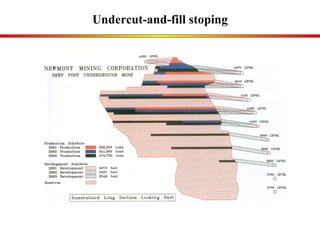
  • #48 Mining Engineering December 2001 p.28 - Mining at Deep Post - Newmont ’s newest underground mine pp.25-29. Stoping is done under engineered, cemented rock fill due to weak ground conditions and the nearly vertical orientation of the orebody. Ground support includes 1.8 m split set bolts, wire mesh, 2.4 to 3 m resin rebar bolts and shotcrete. The Deep Post deposit is mined by underhand cut-and-fill and long-hole stoping methods. The stopes are accessed by cross cuts from the access ramps at 26 m (64-ft) level intervals. Each level has five horizontal cuts. Each cut will be about 4-m (13-ft) in height. The top cut is driven under weak, virgin rock and will be maintained at a width of about 4-m. The intermediate and bottom cuts are mined under engineered, cemented backfill. This allows mining width to be increased to 4.9 m and drift rounds drilled up to 3.7 m. Single-boom jumbos prepare the mining face for blasting. A fleet of 2.7 and 4.6 m3 LHD load into 23.5-t haul trucks.