This document discusses collocation and five related pitfalls in translation:
1. The engrossing effect of source text patterning can lead translators to produce unnatural collocations in the target language.
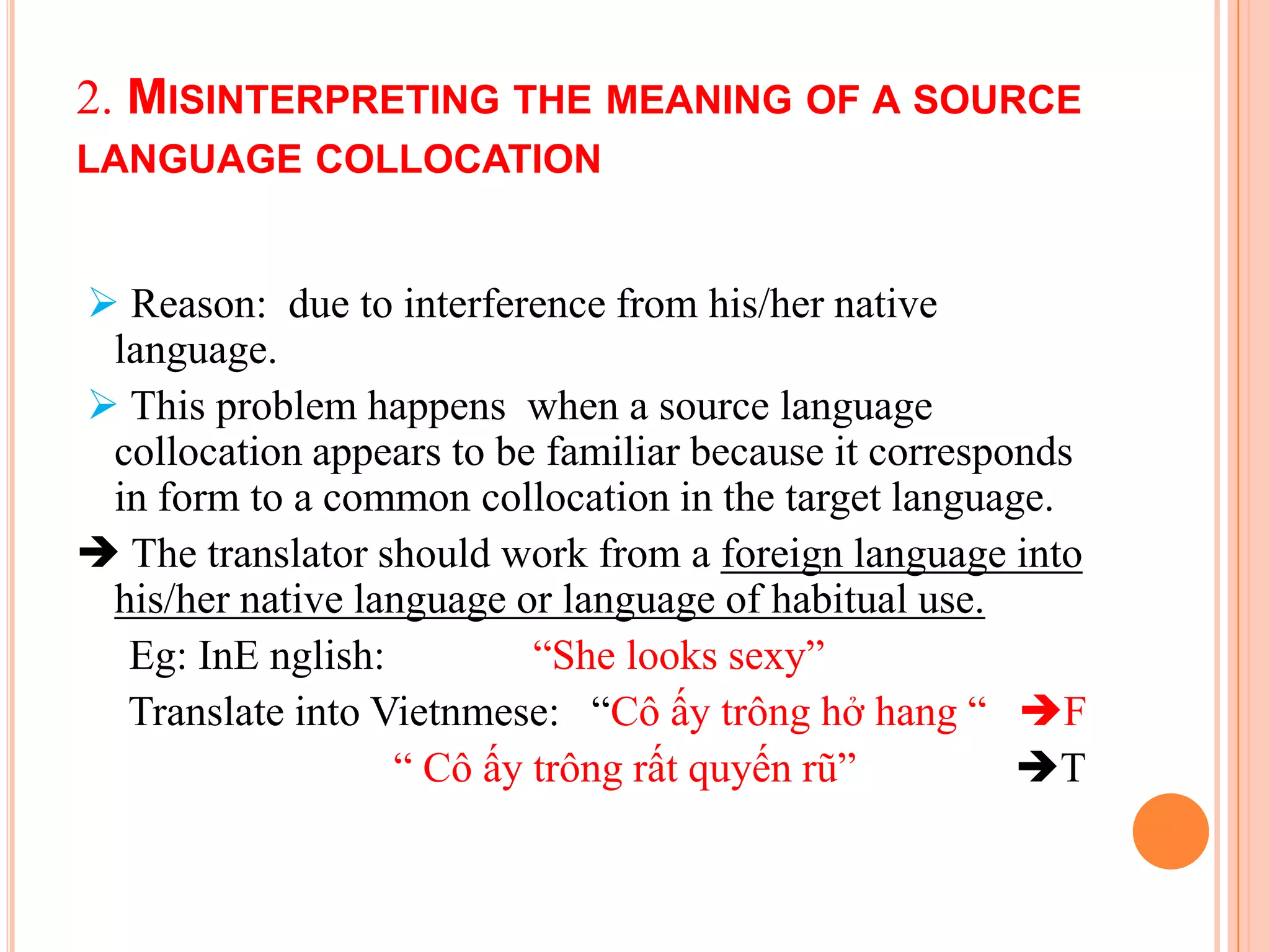
2. Misinterpreting the meaning of a source language collocation due to interference from the translator's native language.
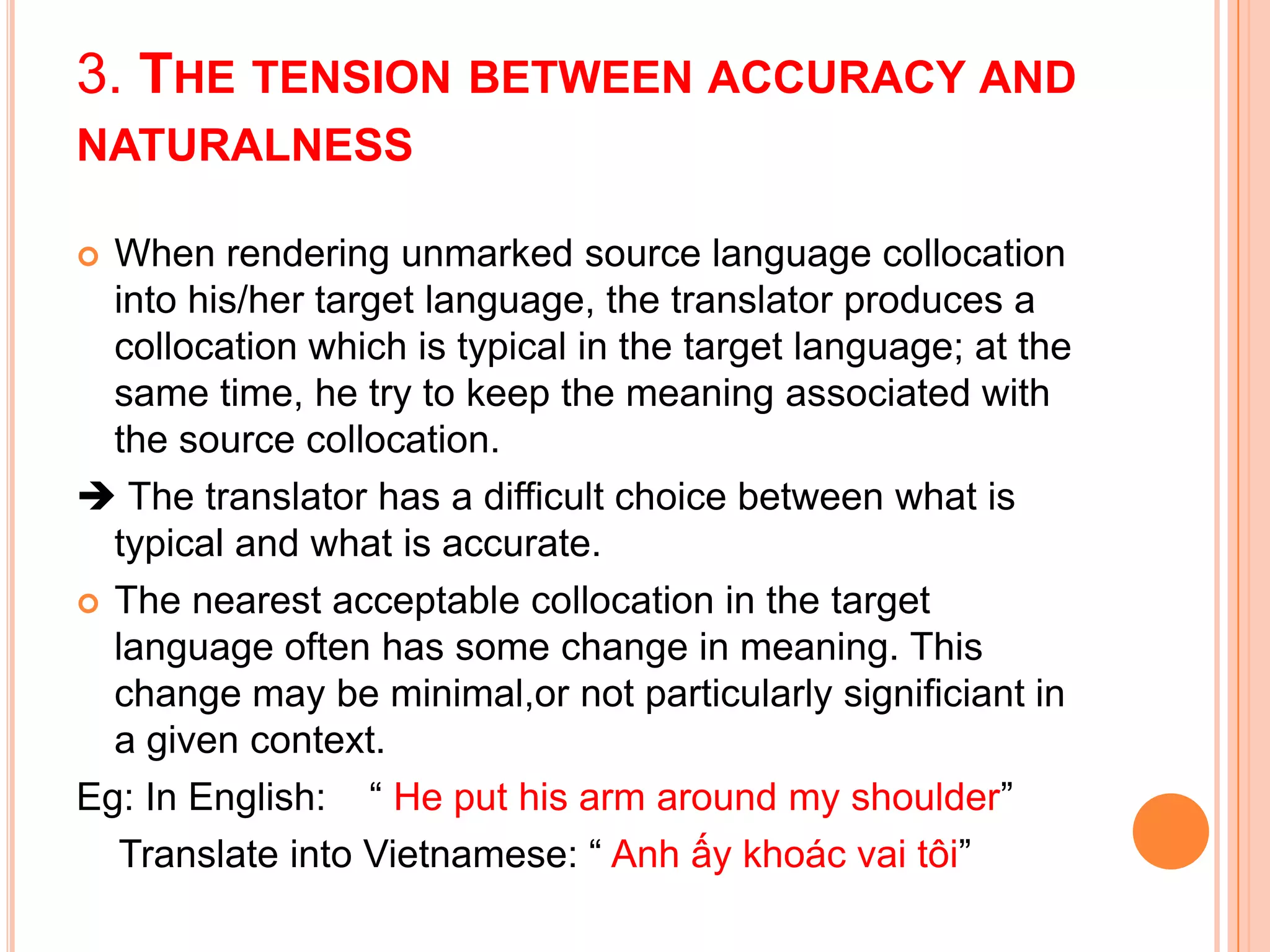
3. The tension between producing a collocation that is accurate versus natural in the target language.
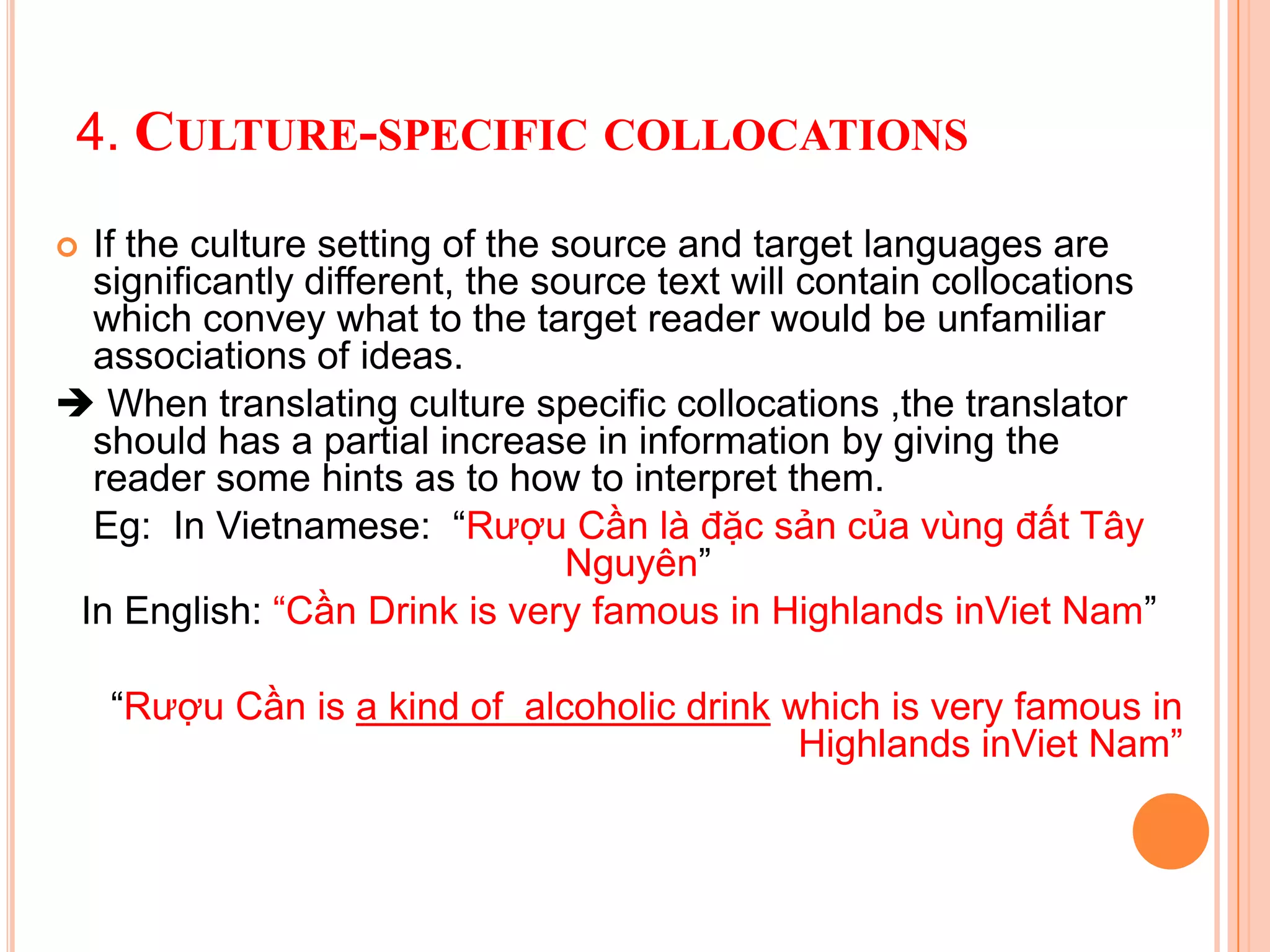
4. Translating culture-specific collocations requires providing additional context for target language readers.
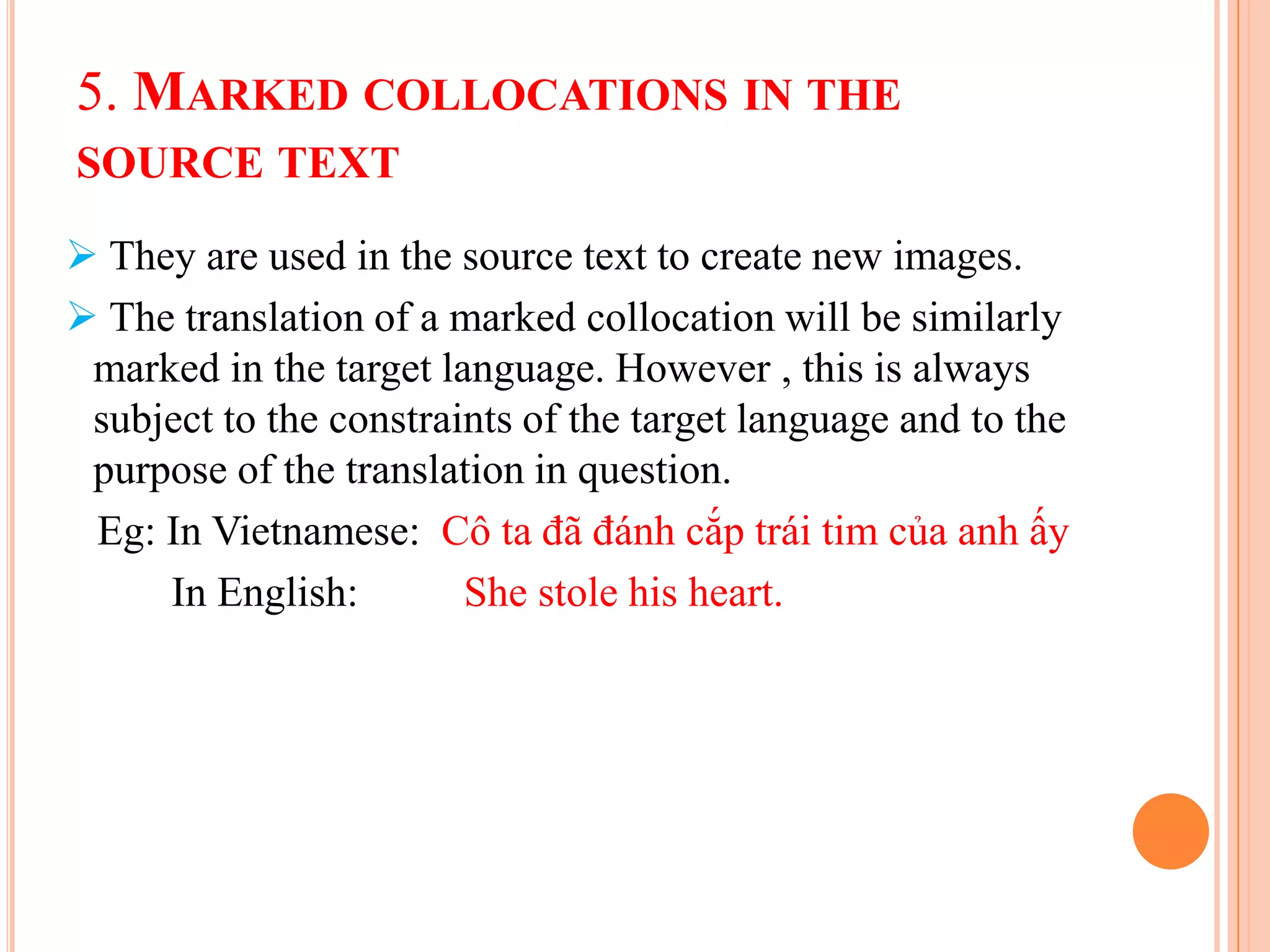
5. Marked collocations in the source text aimed to create new images should be translated similarly while respecting target language constraints.
Slides define collocation, illustrating associations of words. Examples in English and Vietnamese show how collocations form meaningful phrases.
This section discusses five main pitfalls: source text patterning, misinterpretation, accuracy vs. naturalness, culture-specific collocations, and marked collocations affecting translation quality.
Thank you for the attention, concluding the presentation.
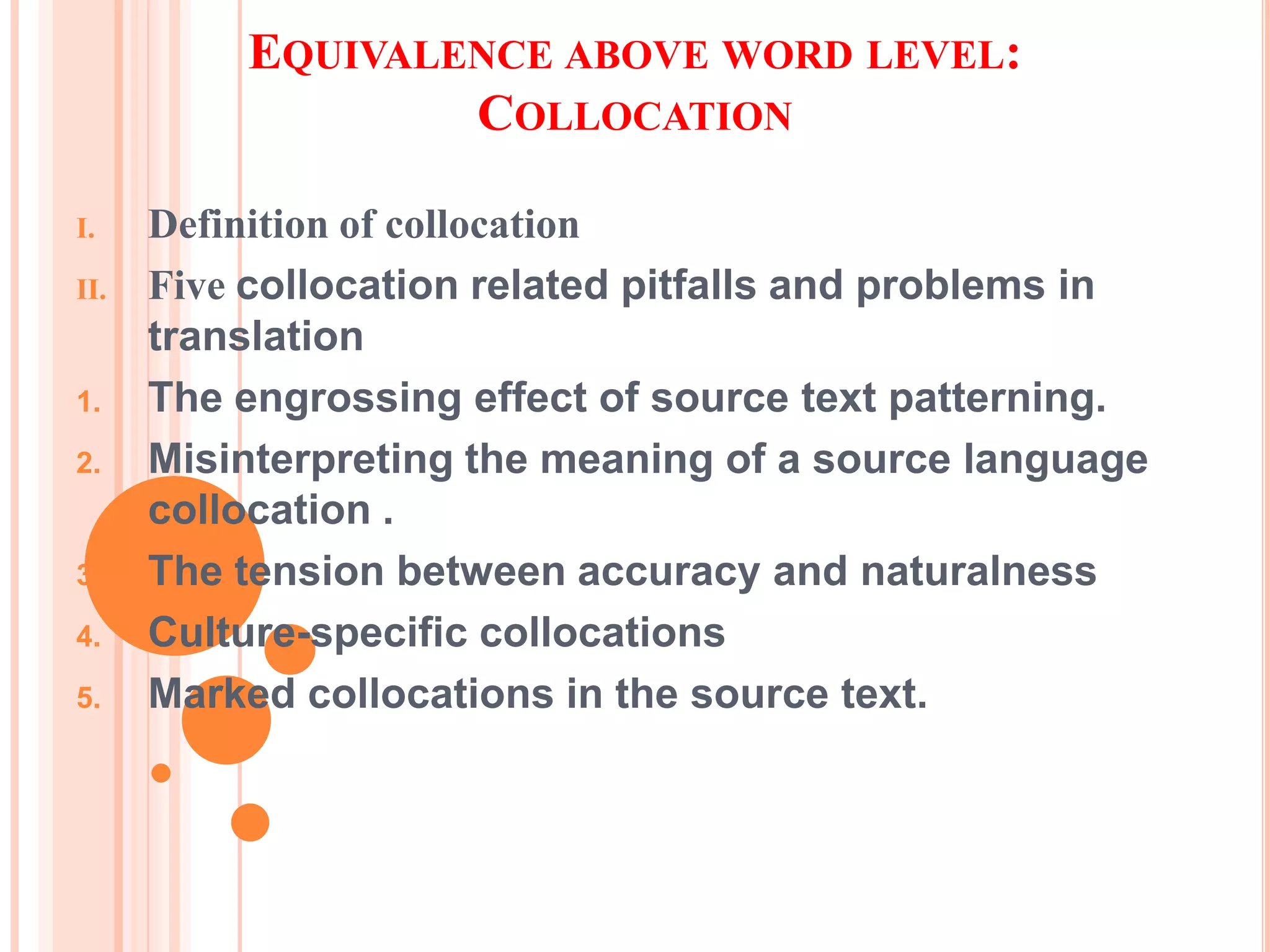
EQUIVALENCE ABOVE WORDLEVEL:
COLLOCATION
I. Definition of collocation
II. Five collocation related pitfalls and problems in
translation
1. The engrossing effect of source text patterning.
2. Misinterpreting the meaning of a source language
collocation .
3. The tension between accuracy and naturalness
4. Culture-specific collocations
5. Marked collocations in the source text.
2.
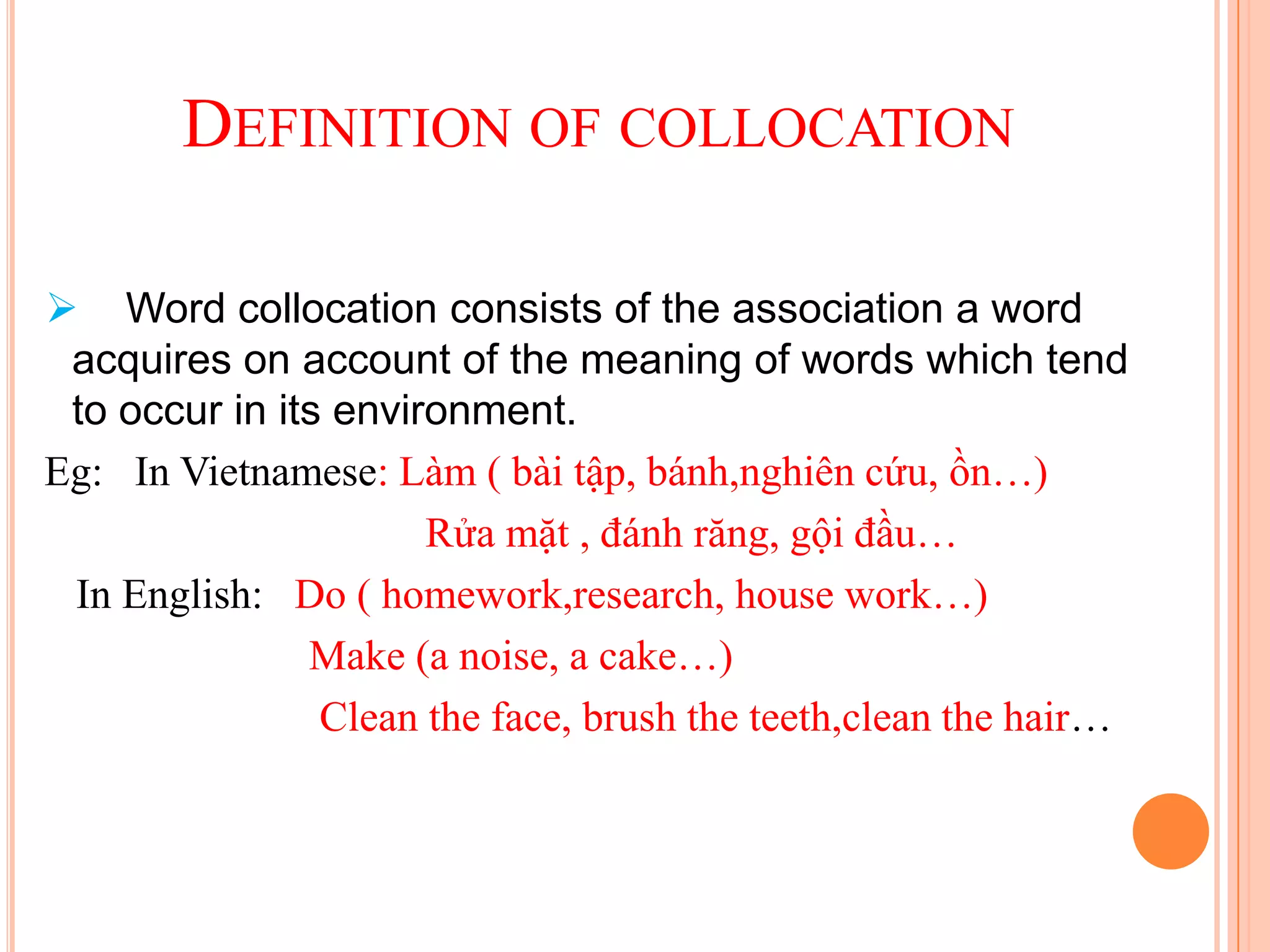
DEFINITION OF COLLOCATION
Word collocation consists of the association a word
acquires on account of the meaning of words which tend
to occur in its environment.
Eg: In Vietnamese: Làm ( bài tập, bánh,nghiên cứu, ồn…)
Rửa mặt , đánh răng, gội đầu…
In English: Do ( homework,research, house work…)
Make (a noise, a cake…)
Clean the face, brush the teeth,clean the hair…
3.
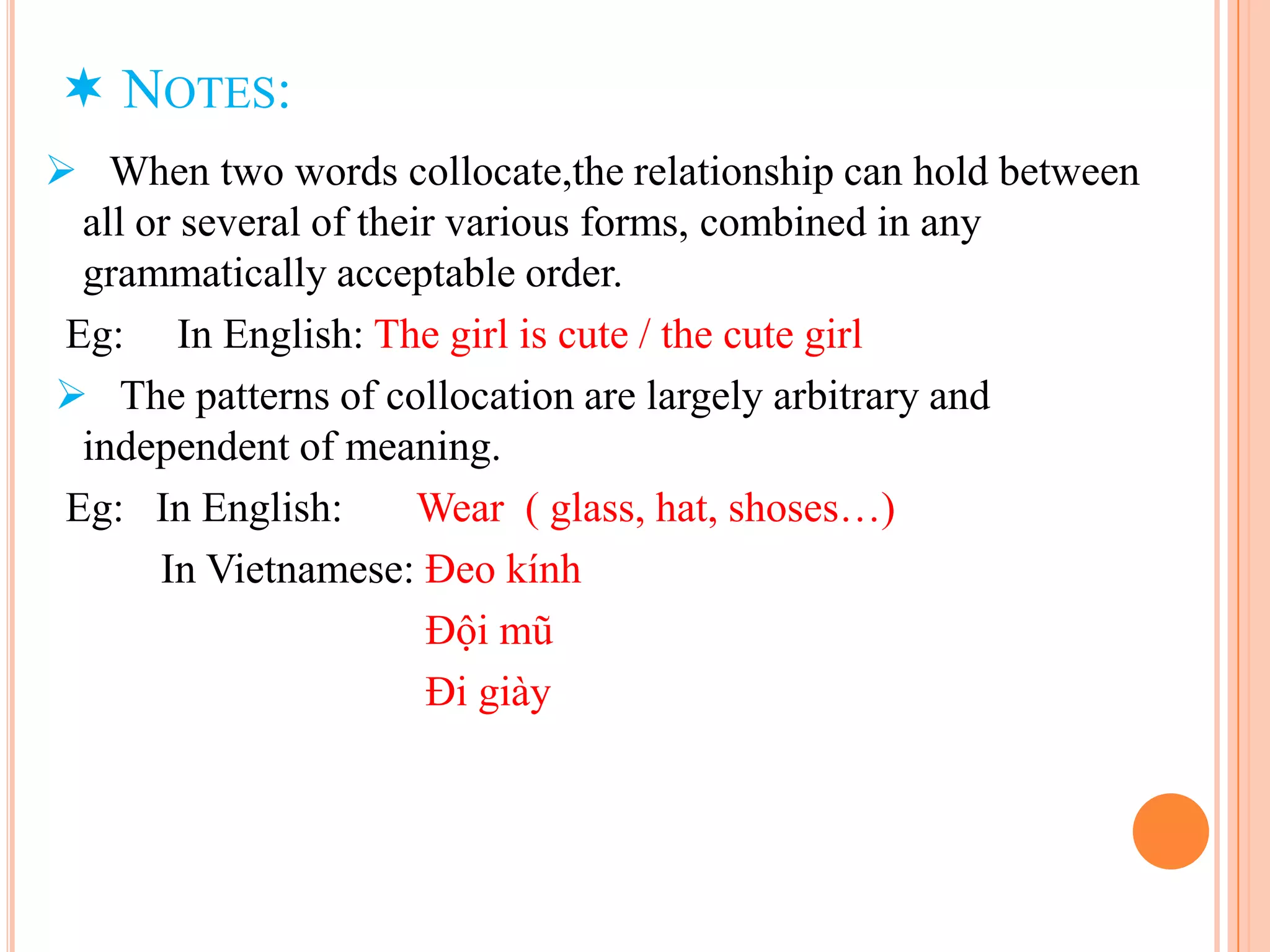
NOTES:
Whentwo words collocate,the relationship can hold between
all or several of their various forms, combined in any
grammatically acceptable order.
Eg: In English: The girl is cute / the cute girl
The patterns of collocation are largely arbitrary and
independent of meaning.
Eg: In English: Wear ( glass, hat, shoses…)
In Vietnamese: Đeo kính
Đội mũ
Đi giày
4.
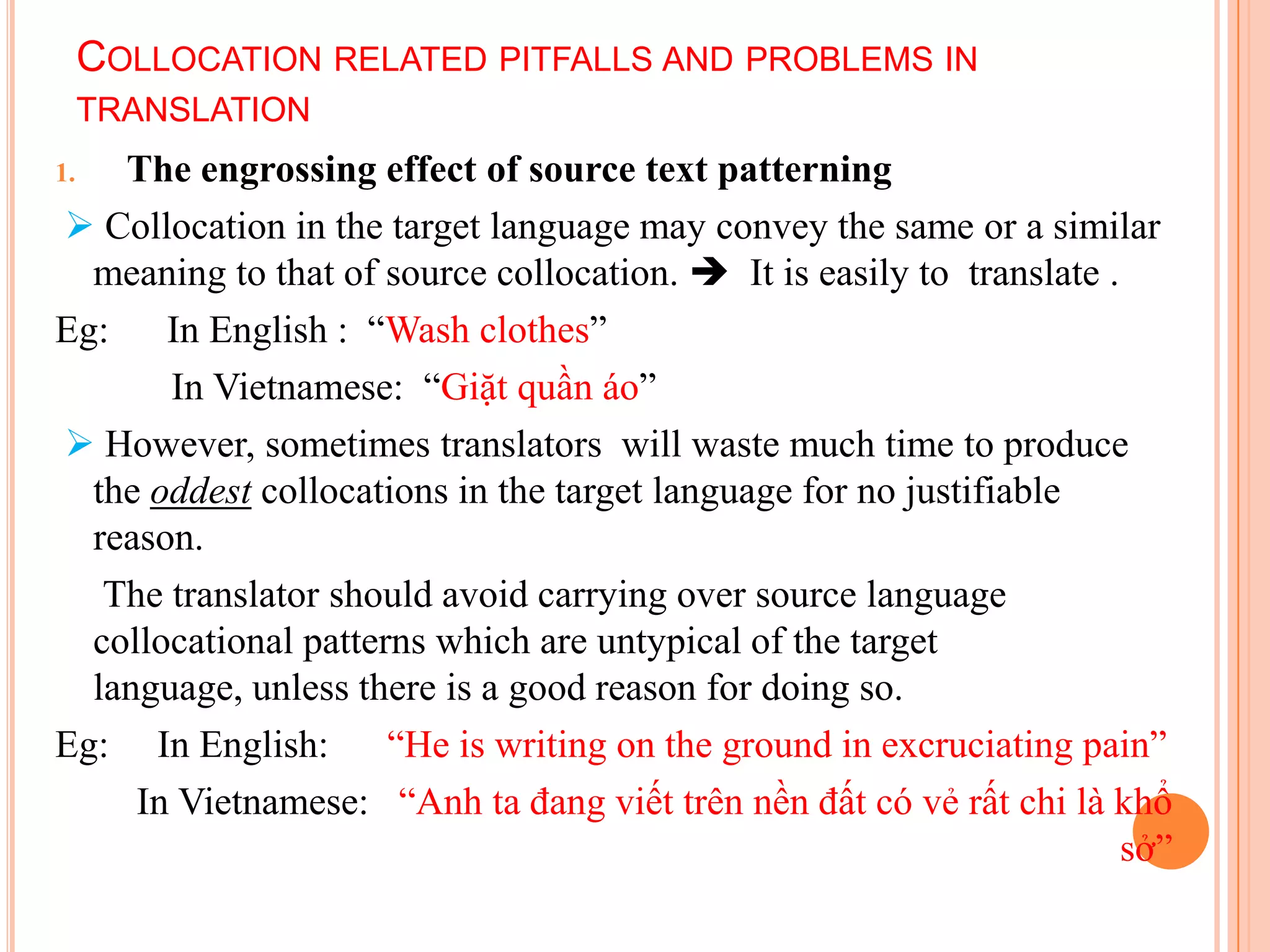
COLLOCATION RELATED PITFALLSAND PROBLEMS IN
TRANSLATION
1. The engrossing effect of source text patterning
Collocation in the target language may convey the same or a similar
meaning to that of source collocation. It is easily to translate .
Eg: In English : “Wash clothes”
In Vietnamese: “Giặt quần áo”
However, sometimes translators will waste much time to produce
the oddest collocations in the target language for no justifiable
reason.
The translator should avoid carrying over source language
collocational patterns which are untypical of the target
language, unless there is a good reason for doing so.
Eg: In English: “He is writing on the ground in excruciating pain”
In Vietnamese: “Anh ta đang viết trên nền đất có vẻ rất chi là khổ
sở”
5.
2. MISINTERPRETING THEMEANING OF A SOURCE
LANGUAGE COLLOCATION
Reason: due to interference from his/her native
language.
This problem happens when a source language
collocation appears to be familiar because it corresponds
in form to a common collocation in the target language.
The translator should work from a foreign language into
his/her native language or language of habitual use.
Eg: InE nglish: “She looks sexy”
Translate into Vietnmese: “Cô ấy trông hở hang “ F
“ Cô ấy trông rất quyến rũ” T
6.
3. THE TENSIONBETWEEN ACCURACY AND
NATURALNESS
When rendering unmarked source language collocation
into his/her target language, the translator produces a
collocation which is typical in the target language; at the
same time, he try to keep the meaning associated with
the source collocation.
The translator has a difficult choice between what is
typical and what is accurate.
The nearest acceptable collocation in the target
language often has some change in meaning. This
change may be minimal,or not particularly significiant in
a given context.
Eg: In English: “ He put his arm around my shoulder”
Translate into Vietnamese: “ Anh ấy khoác vai tôi”
7.
4. CULTURE-SPECIFIC COLLOCATIONS
If the culture setting of the source and target languages are
significantly different, the source text will contain collocations
which convey what to the target reader would be unfamiliar
associations of ideas.
When translating culture specific collocations ,the translator
should has a partial increase in information by giving the
reader some hints as to how to interpret them.
Eg: In Vietnamese: “Rượu Cần là đặc sản của vùng đất Tây
Nguyên”
In English: “Cần Drink is very famous in Highlands inViet Nam”
“Rượu Cần is a kind of alcoholic drink which is very famous in
Highlands inViet Nam”
8.
5. MARKED COLLOCATIONSIN THE
SOURCE TEXT
They are used in the source text to create new images.
The translation of a marked collocation will be similarly
marked in the target language. However , this is always
subject to the constraints of the target language and to the
purpose of the translation in question.
Eg: In Vietnamese: Cô ta đã đánh cắp trái tim của anh ấy
In English: She stole his heart.



![Vibe Coding vs. Spec-Driven Development [Free Meetup]](https://cdn.slidesharecdn.com/ss_thumbnails/vibecodingvsspecdrivendevelopment-251209105622-43f455e7-thumbnail.jpg?width=640&height=640&fit=bounds)


