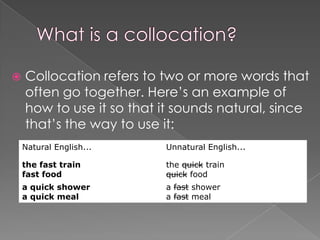
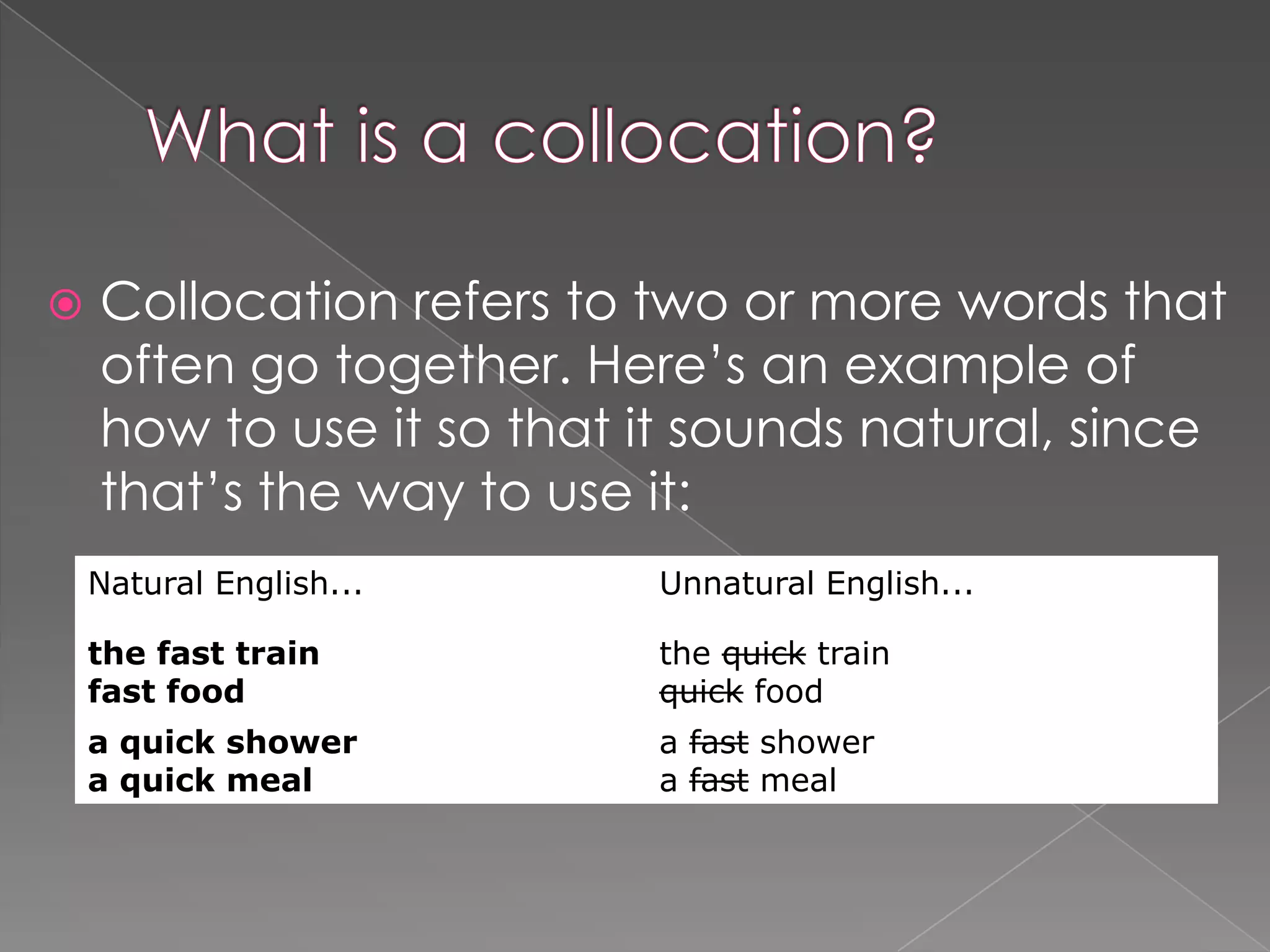
   Collocation refers to two or more words that
    often go together. Here’s an example of
    how to use it so that it sounds natural, since
    that’s the way to use it:
    Natural English...    Unnatural English...

    the fast train        the quick train
    fast food             quick food
    a quick shower        a fast shower
    a quick meal          a fast meal
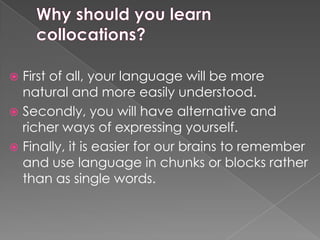
 First of all, your language will be more
  natural and more easily understood.
 Secondly, you will have alternative and
  richer ways of expressing yourself.
 Finally, it is easier for our brains to remember
  and use language in chunks or blocks rather
  than as single words.
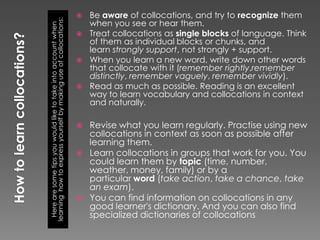
 Be aware of collocations, and try to recognize them


learning how to express yourself by making use of collocations:
                                                                    when you see or hear them.


  Here are some tips you would like to take into account when
                                                                   Treat collocations as single blocks of language. Think
                                                                    of them as individual blocks or chunks, and
                                                                    learn strongly support, not strongly + support.
                                                                   When you learn a new word, write down other words
                                                                    that collocate with it (remember rightly,remember
                                                                    distinctly, remember vaguely, remember vividly).
                                                                   Read as much as possible. Reading is an excellent
                                                                    way to learn vocabulary and collocations in context
                                                                    and naturally.

                                                                     Revise what you learn regularly. Practise using new
                                                                      collocations in context as soon as possible after
                                                                      learning them.
                                                                     Learn collocations in groups that work for you. You
                                                                      could learn them by topic (time, number,
                                                                      weather, money, family) or by a
                                                                      particular word (take action, take a chance, take
                                                                      an exam).
                                                                     You can find information on collocations in any
                                                                      good learner's dictionary. And you can also find
                                                                      specialized dictionaries of collocations
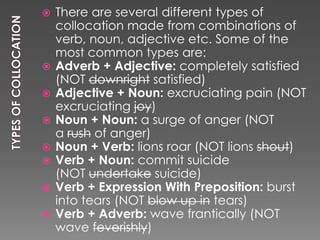
   There are several different types of
    collocation made from combinations of
    verb, noun, adjective etc. Some of the
    most common types are:
   Adverb + Adjective: completely satisfied
    (NOT downright satisfied)
   Adjective + Noun: excruciating pain (NOT
    excruciating joy)
   Noun + Noun: a surge of anger (NOT
    a rush of anger)
   Noun + Verb: lions roar (NOT lions shout)
   Verb + Noun: commit suicide
    (NOT undertake suicide)
   Verb + Expression With Preposition: burst
    into tears (NOT blow up in tears)
   Verb + Adverb: wave frantically (NOT
    wave feverishly)
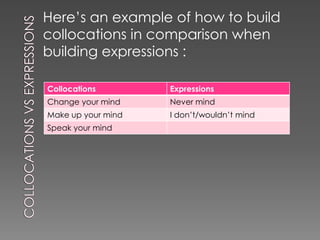
Here’s an example of how to build
collocations in comparison when
building expressions :

Collocations        Expressions
Change your mind    Never mind
Make up your mind   I don’t/wouldn’t mind
Speak your mind

Collocations presentation

  • 1.
    Collocation refers to two or more words that often go together. Here’s an example of how to use it so that it sounds natural, since that’s the way to use it: Natural English... Unnatural English... the fast train the quick train fast food quick food a quick shower a fast shower a quick meal a fast meal
  • 2.
     First ofall, your language will be more natural and more easily understood.  Secondly, you will have alternative and richer ways of expressing yourself.  Finally, it is easier for our brains to remember and use language in chunks or blocks rather than as single words.
  • 3.
     Be awareof collocations, and try to recognize them learning how to express yourself by making use of collocations: when you see or hear them. Here are some tips you would like to take into account when  Treat collocations as single blocks of language. Think of them as individual blocks or chunks, and learn strongly support, not strongly + support.  When you learn a new word, write down other words that collocate with it (remember rightly,remember distinctly, remember vaguely, remember vividly).  Read as much as possible. Reading is an excellent way to learn vocabulary and collocations in context and naturally.  Revise what you learn regularly. Practise using new collocations in context as soon as possible after learning them.  Learn collocations in groups that work for you. You could learn them by topic (time, number, weather, money, family) or by a particular word (take action, take a chance, take an exam).  You can find information on collocations in any good learner's dictionary. And you can also find specialized dictionaries of collocations
  • 4.
    There are several different types of collocation made from combinations of verb, noun, adjective etc. Some of the most common types are:  Adverb + Adjective: completely satisfied (NOT downright satisfied)  Adjective + Noun: excruciating pain (NOT excruciating joy)  Noun + Noun: a surge of anger (NOT a rush of anger)  Noun + Verb: lions roar (NOT lions shout)  Verb + Noun: commit suicide (NOT undertake suicide)  Verb + Expression With Preposition: burst into tears (NOT blow up in tears)  Verb + Adverb: wave frantically (NOT wave feverishly)
  • 5.
    Here’s an exampleof how to build collocations in comparison when building expressions : Collocations Expressions Change your mind Never mind Make up your mind I don’t/wouldn’t mind Speak your mind