Incorporation of Corpus and
Collocation in Language
Classrooms.

Professor: Milenia Reyes
Corpus

Collocation
Corpus


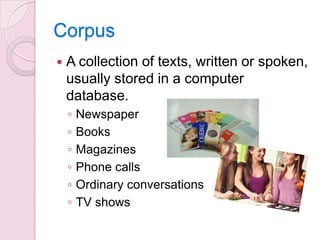
A collection of texts, written or spoken,
usually stored in a computer
database.
◦
◦
◦
◦
◦
◦

Newspaper
Books
Magazines
Phone calls
Ordinary conversations
TV shows
Purpose
The most frequent words and phrases
in English.
 Tense people use the most.
 Differences in speaking and writing.
 Contexts of use: Informal and
formal situations.
 Different words native speakers use in
conversations.
 Collocations

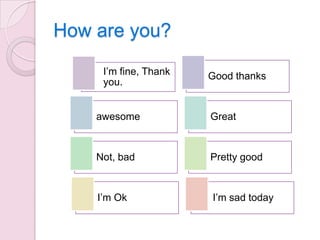
How are you?
I’m fine, Thank
you.

Good thanks

awesome

Great

Not, bad

Pretty good

I’m Ok

I’m sad today
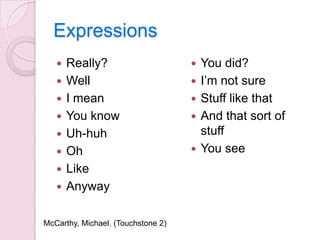
Expressions









Really?
Well
I mean
You know
Uh-huh
Oh
Like
Anyway

McCarthy, Michael. (Touchstone 2)







You did?
I’m not sure
Stuff like that
And that sort of
stuff
You see
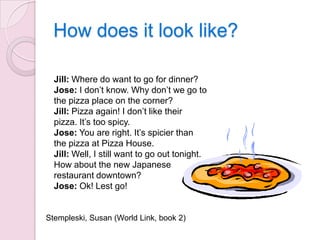
How does it look like?
Jill: Where do want to go for dinner?
Jose: I don’t know. Why don’t we go to
the pizza place on the corner?
Jill: Pizza again! I don’t like their
pizza. It’s too spicy.
Jose: You are right. It’s spicier than
the pizza at Pizza House.
Jill: Well, I still want to go out tonight.
How about the new Japanese
restaurant downtown?
Jose: Ok! Lest go!

Stempleski, Susan (World Link, book 2)
How does it look like?
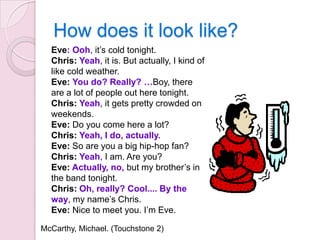
Eve: Ooh, it’s cold tonight.
Chris: Yeah, it is. But actually, I kind of
like cold weather.
Eve: You do? Really? …Boy, there
are a lot of people out here tonight.
Chris: Yeah, it gets pretty crowded on
weekends.
Eve: Do you come here a lot?
Chris: Yeah, I do, actually.
Eve: So are you a big hip-hop fan?
Chris: Yeah, I am. Are you?
Eve: Actually, no, but my brother’s in
the band tonight.
Chris: Oh, really? Cool.... By the
way, my name’s Chris.
Eve: Nice to meet you. I’m Eve.
McCarthy, Michael. (Touchstone 2)
Corpus for ESP


It is probably one of the most obvious
and pointed applications of Corpus
Linguistics.
◦ Academic purposes
◦ Nurses and health care
◦ Air traffic controllers
What is not a Corpus?
An archive is not a corpus.
 A collection of citations is not a
corpus.
 A text is not a corpus.

Collocations


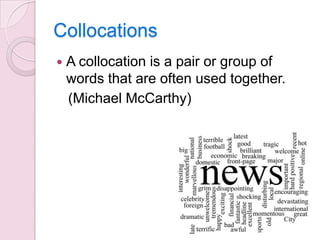
A collocation is a pair or group of
words that are often used together.
(Michael McCarthy)
Learning Collocations
It is good to learn collocations
because they will help you to speak
and write English in a more natural
and accurate way.
 It is accepted that choosing our words
carefully in certain situations is more
important than choosing grammatical
structures (Harmer 1991).

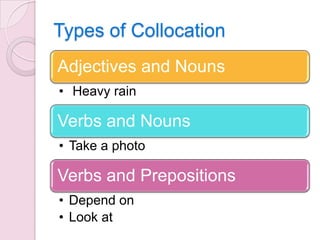
Types of Collocation
Adjectives and Nouns
• Heavy rain

Verbs and Nouns
• Take a photo

Verbs and Prepositions
• Depend on
• Look at
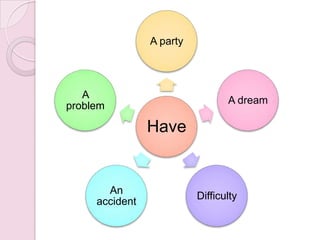
A party

A
problem

A dream

Have

An
accident

Difficulty
Collocation Activities


Gap texts.
◦ I’m sure you’ll ________fun on the school
trip.



Sentences that include collocation
errors.
◦ I cannot do [make] up my mind.
Collocation Activities
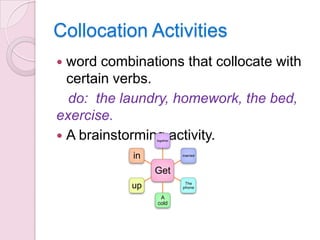
word combinations that collocate with
certain verbs.
do: the laundry, homework, the bed,
exercise.
 A brainstorming activity.


together

in

married

Get
The
phone

up
A
cold
Collocation Activities


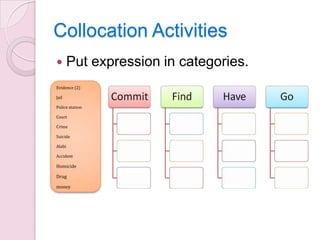
Put expression in categories.

Evidence (2)
Jail
Police station
Court
Crime

Suicide
Alabi
Accident

Homicide
Drug
money
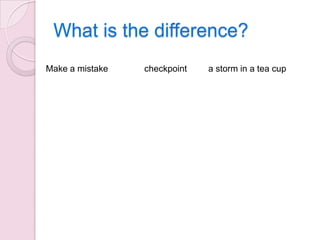
What is the difference?
Make a mistake

checkpoint

a storm in a tea cup
Corpus and collocations

Corpus and collocations

  • 1.
    Incorporation of Corpusand Collocation in Language Classrooms. Professor: Milenia Reyes
  • 2.
  • 3.
    Corpus  A collection oftexts, written or spoken, usually stored in a computer database. ◦ ◦ ◦ ◦ ◦ ◦ Newspaper Books Magazines Phone calls Ordinary conversations TV shows
  • 4.
    Purpose The most frequentwords and phrases in English.  Tense people use the most.  Differences in speaking and writing.  Contexts of use: Informal and formal situations.  Different words native speakers use in conversations.  Collocations 
  • 5.
    How are you? I’mfine, Thank you. Good thanks awesome Great Not, bad Pretty good I’m Ok I’m sad today
  • 6.
    Expressions         Really? Well I mean You know Uh-huh Oh Like Anyway McCarthy,Michael. (Touchstone 2)      You did? I’m not sure Stuff like that And that sort of stuff You see
  • 7.
    How does itlook like? Jill: Where do want to go for dinner? Jose: I don’t know. Why don’t we go to the pizza place on the corner? Jill: Pizza again! I don’t like their pizza. It’s too spicy. Jose: You are right. It’s spicier than the pizza at Pizza House. Jill: Well, I still want to go out tonight. How about the new Japanese restaurant downtown? Jose: Ok! Lest go! Stempleski, Susan (World Link, book 2)
  • 8.
    How does itlook like? Eve: Ooh, it’s cold tonight. Chris: Yeah, it is. But actually, I kind of like cold weather. Eve: You do? Really? …Boy, there are a lot of people out here tonight. Chris: Yeah, it gets pretty crowded on weekends. Eve: Do you come here a lot? Chris: Yeah, I do, actually. Eve: So are you a big hip-hop fan? Chris: Yeah, I am. Are you? Eve: Actually, no, but my brother’s in the band tonight. Chris: Oh, really? Cool.... By the way, my name’s Chris. Eve: Nice to meet you. I’m Eve. McCarthy, Michael. (Touchstone 2)
  • 9.
    Corpus for ESP  Itis probably one of the most obvious and pointed applications of Corpus Linguistics. ◦ Academic purposes ◦ Nurses and health care ◦ Air traffic controllers
  • 10.
    What is nota Corpus? An archive is not a corpus.  A collection of citations is not a corpus.  A text is not a corpus. 
  • 11.
    Collocations  A collocation isa pair or group of words that are often used together. (Michael McCarthy)
  • 12.
    Learning Collocations It isgood to learn collocations because they will help you to speak and write English in a more natural and accurate way.  It is accepted that choosing our words carefully in certain situations is more important than choosing grammatical structures (Harmer 1991). 
  • 13.
    Types of Collocation Adjectivesand Nouns • Heavy rain Verbs and Nouns • Take a photo Verbs and Prepositions • Depend on • Look at
  • 14.
  • 15.
    Collocation Activities  Gap texts. ◦I’m sure you’ll ________fun on the school trip.  Sentences that include collocation errors. ◦ I cannot do [make] up my mind.
  • 16.
    Collocation Activities word combinationsthat collocate with certain verbs. do: the laundry, homework, the bed, exercise.  A brainstorming activity.  together in married Get The phone up A cold
  • 17.
    Collocation Activities  Put expressionin categories. Evidence (2) Jail Police station Court Crime Suicide Alabi Accident Homicide Drug money
  • 18.
    What is thedifference? Make a mistake checkpoint a storm in a tea cup