1
COLLOCATION
Lecture 4
MODULE 2
Meaning and discourse in English
2
Why do you say deep water
and not profound water?
 “A word is known by the company it keeps”
(JR Firth)
- tremble with fear tremble with excitement*
- quiver with excitement quiver with fear*
There is no definable reason why we choose to say
“tremble with fear” but not “quiver with fear”. It is
simply a question of COLLOCATION.
3
What is collocation?
 COLLOCATION refers to a relationship between words that frequently occur
together
 The words together can mean more than the sum of their parts (The Times
of India, disk drive)
- other examples: hot dog, mother in law
 Examples of collocations
 noun phrases like strong tea and weapons of mass destruction
 phrasal verbs like to make up, and other phrases like the rich and
powerful.
 Valid or invalid?
 a stiff breeze but not a stiff wind (while either a strong breeze or a strong
wind is okay).
 Broad/bright daylight (but not narrow darkness).
4
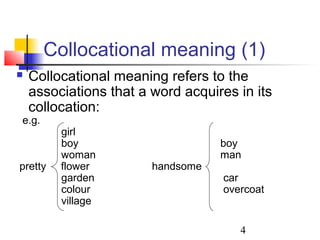
Collocational meaning (1)
 Collocational meaning refers to the
associations that a word acquires in its
collocation:
e.g.
girl
boy boy
woman man
pretty flower handsome
garden car
colour overcoat
village
5
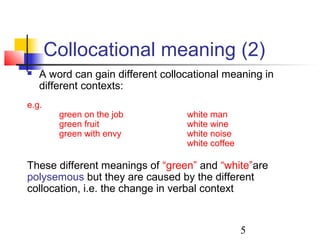
Collocational meaning (2)
 A word can gain different collocational meaning in
different contexts:
e.g.
green on the job white man
green fruit white wine
green with envy white noise
white coffee
These different meanings of “green” and “white”are
polysemous but they are caused by the different
collocation, i.e. the change in verbal context
6
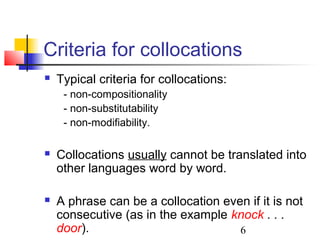
Criteria for collocations
 Typical criteria for collocations:
- non-compositionality
- non-substitutability
- non-modifiability.
 Collocations usually cannot be translated into
other languages word by word.
 A phrase can be a collocation even if it is not
consecutive (as in the example knock . . .
door).
7
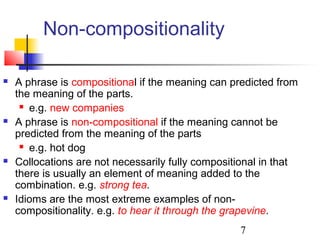
Non-compositionality
 A phrase is compositional if the meaning can predicted from
the meaning of the parts.
 e.g. new companies
 A phrase is non-compositional if the meaning cannot be
predicted from the meaning of the parts
 e.g. hot dog
 Collocations are not necessarily fully compositional in that
there is usually an element of meaning added to the
combination. e.g. strong tea.
 Idioms are the most extreme examples of non-
compositionality. e.g. to hear it through the grapevine.
8
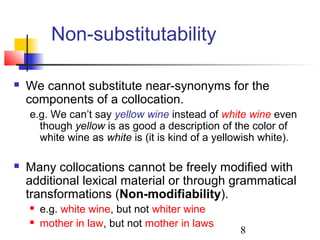
Non-substitutability
 We cannot substitute near-synonyms for the
components of a collocation.
e.g. We can’t say yellow wine instead of white wine even
though yellow is as good a description of the color of
white wine as white is (it is kind of a yellowish white).
 Many collocations cannot be freely modified with
additional lexical material or through grammatical
transformations (Non-modifiability).
 e.g. white wine, but not whiter wine
 mother in law, but not mother in laws
9
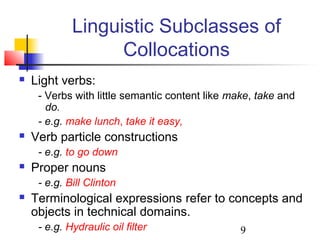
Linguistic Subclasses of
Collocations
 Light verbs:
- Verbs with little semantic content like make, take and
do.
- e.g. make lunch, take it easy,
 Verb particle constructions
- e.g. to go down
 Proper nouns
- e.g. Bill Clinton
 Terminological expressions refer to concepts and
objects in technical domains.
- e.g. Hydraulic oil filter
10
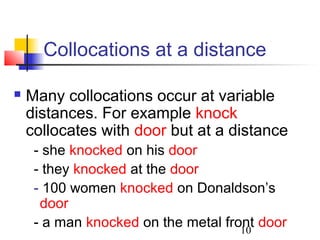
Collocations at a distance
 Many collocations occur at variable
distances. For example knock
collocates with door but at a distance
- she knocked on his door
- they knocked at the door
- 100 women knocked on Donaldson’s
door
- a man knocked on the metal front door
11
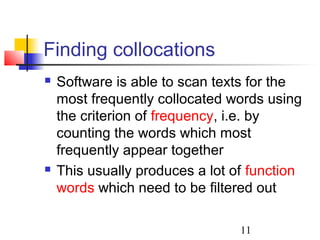
Finding collocations
 Software is able to scan texts for the
most frequently collocated words using
the criterion of frequency, i.e. by
counting the words which most
frequently appear together
 This usually produces a lot of function
words which need to be filtered out
12
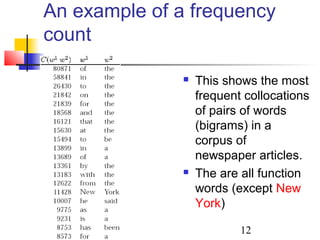
An example of a frequency
count
 This shows the most
frequent collocations
of pairs of words
(bigrams) in a
corpus of
newspaper articles.
 The are all function
words (except New
York)
13
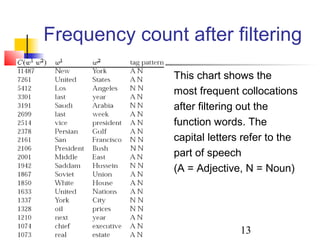
Frequency count after filtering
This chart shows the
most frequent collocations
after filtering out the
function words. The
capital letters refer to the
part of speech
(A = Adjective, N = Noun)
14
Idioms - characteristics (1)
 Idioms are strictly non-compositional
Although the word that make up the idiom have
Their own literal meanings, in the idiom they
have lost their individual identity. You canot
predict the meaning of an idiom from the sum of
its parts:
e.g. how do you do?
I’m under the weather
to wear your heart on your sleeve
red herring
15
Idioms - characteristics (2)
 Structural stability (syntactic frozenness)
1. Constituents cannot be replaced
e.g. as good as gold / as good as play ?
2. Constituents cannot be deleted or added to
e.g. out of the question / out of question ?
16
In which areas of language
learning is collocation useful?
Collocation is important at all levels for
 Writing
 Translation
You will only be able to write well if you
know which words go together.
17
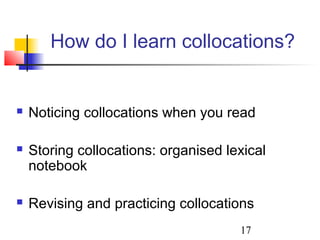
How do I learn collocations?
 Noticing collocations when you read
 Storing collocations: organised lexical
notebook
 Revising and practicing collocations
18
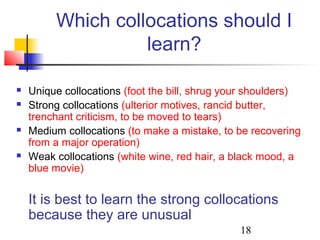
Which collocations should I
learn?
 Unique collocations (foot the bill, shrug your shoulders)
 Strong collocations (ulterior motives, rancid butter,
trenchant criticism, to be moved to tears)
 Medium collocations (to make a mistake, to be recovering
from a major operation)
 Weak collocations (white wine, red hair, a black mood, a
blue movie)
It is best to learn the strong collocations
because they are unusual
19
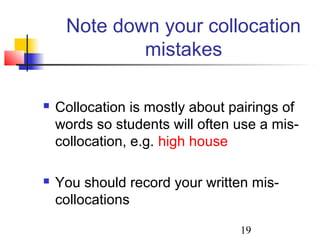
Note down your collocation
mistakes
 Collocation is mostly about pairings of
words so students will often use a mis-
collocation, e.g. high house
 You should record your written mis-
collocations
20
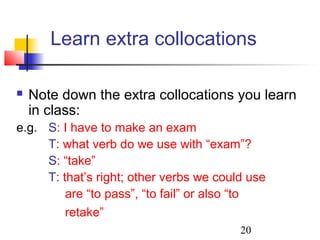
Learn extra collocations
 Note down the extra collocations you learn
in class:
e.g. S: I have to make an exam
T: what verb do we use with “exam”?
S: “take”
T: that’s right; other verbs we could use
are “to pass”, “to fail” or also “to
retake”
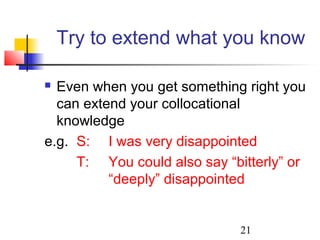
21
Try to extend what you know
 Even when you get something right you
can extend your collocational
knowledge
e.g. S: I was very disappointed
T: You could also say “bitterly” or
“deeply” disappointed
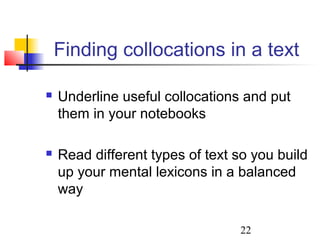
22
Finding collocations in a text
 Underline useful collocations and put
them in your notebooks
 Read different types of text so you build
up your mental lexicons in a balanced
way
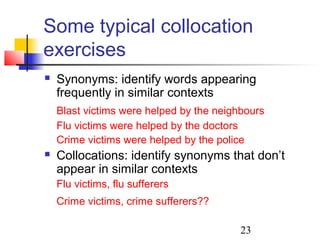
23
Some typical collocation
exercises
 Synonyms: identify words appearing
frequently in similar contexts
Blast victims were helped by the neighbours
Flu victims were helped by the doctors
Crime victims were helped by the police
 Collocations: identify synonyms that don’t
appear in similar contexts
Flu victims, flu sufferers
Crime victims, crime sufferers??
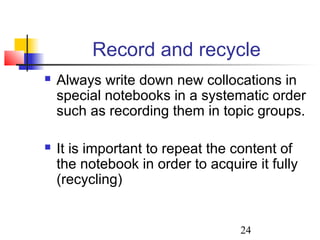
24
Record and recycle
 Always write down new collocations in
special notebooks in a systematic order
such as recording them in topic groups.
 It is important to repeat the content of
the notebook in order to acquire it fully
(recycling)
25
Use special notebooks for
collocation
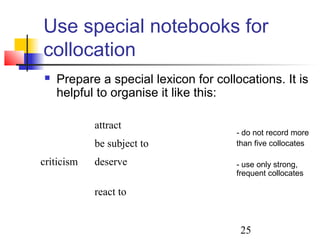
 Prepare a special lexicon for collocations. It is
helpful to organise it like this:
- do not record more
than five collocates
- use only strong,
frequent collocates
attract
be subject to
criticism deserve
react to
26
Learning idioms
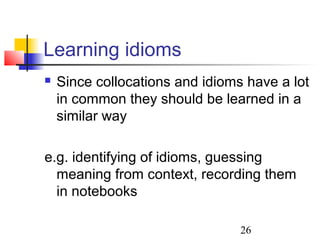
 Since collocations and idioms have a lot
in common they should be learned in a
similar way
e.g. identifying of idioms, guessing
meaning from context, recording them
in notebooks
27
Dictionaries
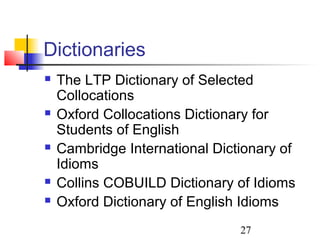
 The LTP Dictionary of Selected
Collocations
 Oxford Collocations Dictionary for
Students of English
 Cambridge International Dictionary of
Idioms
 Collins COBUILD Dictionary of Idioms
 Oxford Dictionary of English Idioms
28
Concordancing software
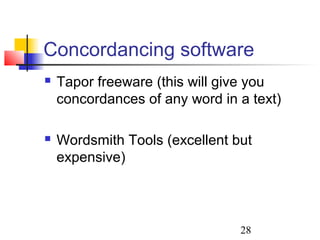
 Tapor freeware (this will give you
concordances of any word in a text)
 Wordsmith Tools (excellent but
expensive)

08 09.3.collocation

  • 1.
  • 2.
    2 Why do yousay deep water and not profound water?  “A word is known by the company it keeps” (JR Firth) - tremble with fear tremble with excitement* - quiver with excitement quiver with fear* There is no definable reason why we choose to say “tremble with fear” but not “quiver with fear”. It is simply a question of COLLOCATION.
  • 3.
    3 What is collocation? COLLOCATION refers to a relationship between words that frequently occur together  The words together can mean more than the sum of their parts (The Times of India, disk drive) - other examples: hot dog, mother in law  Examples of collocations  noun phrases like strong tea and weapons of mass destruction  phrasal verbs like to make up, and other phrases like the rich and powerful.  Valid or invalid?  a stiff breeze but not a stiff wind (while either a strong breeze or a strong wind is okay).  Broad/bright daylight (but not narrow darkness).
  • 4.
    4 Collocational meaning (1) Collocational meaning refers to the associations that a word acquires in its collocation: e.g. girl boy boy woman man pretty flower handsome garden car colour overcoat village
  • 5.
    5 Collocational meaning (2) A word can gain different collocational meaning in different contexts: e.g. green on the job white man green fruit white wine green with envy white noise white coffee These different meanings of “green” and “white”are polysemous but they are caused by the different collocation, i.e. the change in verbal context
  • 6.
    6 Criteria for collocations Typical criteria for collocations: - non-compositionality - non-substitutability - non-modifiability.  Collocations usually cannot be translated into other languages word by word.  A phrase can be a collocation even if it is not consecutive (as in the example knock . . . door).
  • 7.
    7 Non-compositionality  A phraseis compositional if the meaning can predicted from the meaning of the parts.  e.g. new companies  A phrase is non-compositional if the meaning cannot be predicted from the meaning of the parts  e.g. hot dog  Collocations are not necessarily fully compositional in that there is usually an element of meaning added to the combination. e.g. strong tea.  Idioms are the most extreme examples of non- compositionality. e.g. to hear it through the grapevine.
  • 8.
    8 Non-substitutability  We cannotsubstitute near-synonyms for the components of a collocation. e.g. We can’t say yellow wine instead of white wine even though yellow is as good a description of the color of white wine as white is (it is kind of a yellowish white).  Many collocations cannot be freely modified with additional lexical material or through grammatical transformations (Non-modifiability).  e.g. white wine, but not whiter wine  mother in law, but not mother in laws
  • 9.
    9 Linguistic Subclasses of Collocations Light verbs: - Verbs with little semantic content like make, take and do. - e.g. make lunch, take it easy,  Verb particle constructions - e.g. to go down  Proper nouns - e.g. Bill Clinton  Terminological expressions refer to concepts and objects in technical domains. - e.g. Hydraulic oil filter
  • 10.
    10 Collocations at adistance  Many collocations occur at variable distances. For example knock collocates with door but at a distance - she knocked on his door - they knocked at the door - 100 women knocked on Donaldson’s door - a man knocked on the metal front door
  • 11.
    11 Finding collocations  Softwareis able to scan texts for the most frequently collocated words using the criterion of frequency, i.e. by counting the words which most frequently appear together  This usually produces a lot of function words which need to be filtered out
  • 12.
    12 An example ofa frequency count  This shows the most frequent collocations of pairs of words (bigrams) in a corpus of newspaper articles.  The are all function words (except New York)
  • 13.
    13 Frequency count afterfiltering This chart shows the most frequent collocations after filtering out the function words. The capital letters refer to the part of speech (A = Adjective, N = Noun)
  • 14.
    14 Idioms - characteristics(1)  Idioms are strictly non-compositional Although the word that make up the idiom have Their own literal meanings, in the idiom they have lost their individual identity. You canot predict the meaning of an idiom from the sum of its parts: e.g. how do you do? I’m under the weather to wear your heart on your sleeve red herring
  • 15.
    15 Idioms - characteristics(2)  Structural stability (syntactic frozenness) 1. Constituents cannot be replaced e.g. as good as gold / as good as play ? 2. Constituents cannot be deleted or added to e.g. out of the question / out of question ?
  • 16.
    16 In which areasof language learning is collocation useful? Collocation is important at all levels for  Writing  Translation You will only be able to write well if you know which words go together.
  • 17.
    17 How do Ilearn collocations?  Noticing collocations when you read  Storing collocations: organised lexical notebook  Revising and practicing collocations
  • 18.
    18 Which collocations shouldI learn?  Unique collocations (foot the bill, shrug your shoulders)  Strong collocations (ulterior motives, rancid butter, trenchant criticism, to be moved to tears)  Medium collocations (to make a mistake, to be recovering from a major operation)  Weak collocations (white wine, red hair, a black mood, a blue movie) It is best to learn the strong collocations because they are unusual
  • 19.
    19 Note down yourcollocation mistakes  Collocation is mostly about pairings of words so students will often use a mis- collocation, e.g. high house  You should record your written mis- collocations
  • 20.
    20 Learn extra collocations Note down the extra collocations you learn in class: e.g. S: I have to make an exam T: what verb do we use with “exam”? S: “take” T: that’s right; other verbs we could use are “to pass”, “to fail” or also “to retake”
  • 21.
    21 Try to extendwhat you know  Even when you get something right you can extend your collocational knowledge e.g. S: I was very disappointed T: You could also say “bitterly” or “deeply” disappointed
  • 22.
    22 Finding collocations ina text  Underline useful collocations and put them in your notebooks  Read different types of text so you build up your mental lexicons in a balanced way
  • 23.
    23 Some typical collocation exercises Synonyms: identify words appearing frequently in similar contexts Blast victims were helped by the neighbours Flu victims were helped by the doctors Crime victims were helped by the police  Collocations: identify synonyms that don’t appear in similar contexts Flu victims, flu sufferers Crime victims, crime sufferers??
  • 24.
    24 Record and recycle Always write down new collocations in special notebooks in a systematic order such as recording them in topic groups.  It is important to repeat the content of the notebook in order to acquire it fully (recycling)
  • 25.
    25 Use special notebooksfor collocation  Prepare a special lexicon for collocations. It is helpful to organise it like this: - do not record more than five collocates - use only strong, frequent collocates attract be subject to criticism deserve react to
  • 26.
    26 Learning idioms  Sincecollocations and idioms have a lot in common they should be learned in a similar way e.g. identifying of idioms, guessing meaning from context, recording them in notebooks
  • 27.
    27 Dictionaries  The LTPDictionary of Selected Collocations  Oxford Collocations Dictionary for Students of English  Cambridge International Dictionary of Idioms  Collins COBUILD Dictionary of Idioms  Oxford Dictionary of English Idioms
  • 28.
    28 Concordancing software  Taporfreeware (this will give you concordances of any word in a text)  Wordsmith Tools (excellent but expensive)