Collocations  (in IT jargon and general English) Zoran Šaško [35857/07-R] Nikola Šapina [36087/07-R] Matija Šaško [36020/07-R] Sveučilište u Zagrebu Fakultet organizacije i informatike Varaždin U Varaždinu, 17. siječanj 2008.
What are collocations? Collocations are collections of words that "fit together"; i.e. they are predictable patterns and phrases or groups of words that we typically use together Idioms like "take a break", structures like "If I had the chance, I would ..." and word combinations like "get on a bus /get in a car" are all considered collocations.
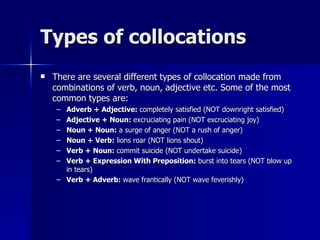
Types of collocations There are several different types of collocation made from combinations of verb, noun, adjective etc. Some of the most common types are:  Adverb + Adjective:  completely satisfied (NOT downright satisfied)  Adjective + Noun:  excruciating pain (NOT excruciating joy)  Noun + Noun:  a surge of anger (NOT a rush of anger)  Noun + Verb:  lions roar (NOT lions shout)  Verb + Noun:  commit suicide (NOT undertake suicide)  Verb + Expression With Preposition:  burst into tears (NOT blow up in tears)  Verb + Adverb:  wave frantically (NOT wave feverishly)
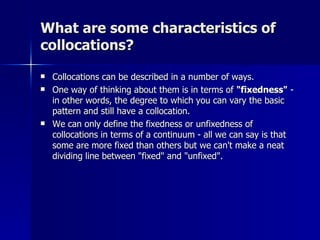
What are some characteristics of collocations?  Collocations can be described in a number of ways.  One way of thinking about them is in terms of  "fixedness"  - in other words, the degree to which you can vary the basic pattern and still have a collocation. We can only define the fixedness or unfixedness of collocations in terms of a continuum - all we can say is that some are more fixed than others but we can't make a neat dividing line between "fixed" and "unfixed".
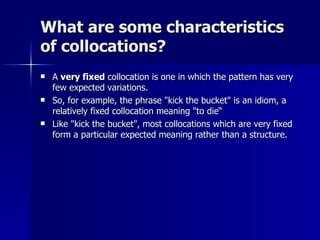
What are some characteristics of collocations? A  very fixed  collocation is one in which the pattern has very few expected variations.  So, for example, the phrase "kick the bucket" is an idiom, a relatively fixed collocation meaning "to die“ Like "kick the bucket", most collocations which are very fixed form a particular expected meaning rather than a structure.
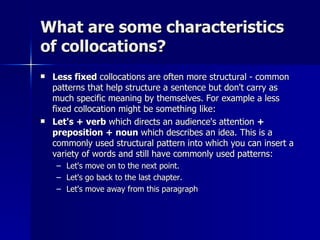
What are some characteristics of collocations? Less fixed  collocations are often more structural - common patterns that help structure a sentence but don't carry as much specific meaning by themselves. For example a less fixed collocation might be something like:  Let's + verb  which directs an audience's attention  + preposition + noun  which describes an idea. This is a commonly used structural pattern into which you can insert a variety of words and still have commonly used patterns:  Let's move on to the next point.  Let's go back to the last chapter.  Let's move away from this paragraph
What are some characteristics of collocations? However, there are still a limited number of words which will "fit" into this pattern. So, for example, we don't typically say "Let's go out of this paragraph".  Words that are commonly used with other words are examples of less fixed collocations which are not as structural in nature. So for example, we use "bus" and "car" with only certain sets of other words:  We say "Get on a bus"/"climb on a bus" but usually not "enter a bus" or "get in a bus". However, we say "get in a car".  We say "take the bus"/"ride the bus"/"go there on the bus" but usually not "We can drive there on the bus". However we say "We can drive there in her car."
What are some characteristics of collocations? It's not important to be able to classify collocations according to their exact degree of fixedness.  However, it probably is helpful to know that some collocations are more fixed than others: if you recognize a collocation as very fixed, you can learn it as one item; if you recognize it as less fixed, you understand that there's a pattern there that you can use to build a collection of useful related phrases.
Why should we learn collocations?  Our brain  tends to store language in chunks, rather than individual words  So, when we speak or write, it is more efficient for us to remember and use phrases as chunks rather than constructing them one word at a time. This increased efficiency promotes fluency. Familiarity with collocations and the resulting ability to make guesses about a speaker/writer's speech should  increase a non-native speaker's efficiency  as a listener or reader.
The End

Collocations

  • 1.
    Collocations (inIT jargon and general English) Zoran Šaško [35857/07-R] Nikola Šapina [36087/07-R] Matija Šaško [36020/07-R] Sveučilište u Zagrebu Fakultet organizacije i informatike Varaždin U Varaždinu, 17. siječanj 2008.
  • 2.
    What are collocations?Collocations are collections of words that "fit together"; i.e. they are predictable patterns and phrases or groups of words that we typically use together Idioms like "take a break", structures like "If I had the chance, I would ..." and word combinations like "get on a bus /get in a car" are all considered collocations.
  • 3.
    Types of collocationsThere are several different types of collocation made from combinations of verb, noun, adjective etc. Some of the most common types are: Adverb + Adjective: completely satisfied (NOT downright satisfied) Adjective + Noun: excruciating pain (NOT excruciating joy) Noun + Noun: a surge of anger (NOT a rush of anger) Noun + Verb: lions roar (NOT lions shout) Verb + Noun: commit suicide (NOT undertake suicide) Verb + Expression With Preposition: burst into tears (NOT blow up in tears) Verb + Adverb: wave frantically (NOT wave feverishly)
  • 4.
    What are somecharacteristics of collocations? Collocations can be described in a number of ways. One way of thinking about them is in terms of "fixedness" - in other words, the degree to which you can vary the basic pattern and still have a collocation. We can only define the fixedness or unfixedness of collocations in terms of a continuum - all we can say is that some are more fixed than others but we can't make a neat dividing line between "fixed" and "unfixed".
  • 5.
    What are somecharacteristics of collocations? A very fixed collocation is one in which the pattern has very few expected variations. So, for example, the phrase "kick the bucket" is an idiom, a relatively fixed collocation meaning "to die“ Like "kick the bucket", most collocations which are very fixed form a particular expected meaning rather than a structure.
  • 6.
    What are somecharacteristics of collocations? Less fixed collocations are often more structural - common patterns that help structure a sentence but don't carry as much specific meaning by themselves. For example a less fixed collocation might be something like: Let's + verb which directs an audience's attention + preposition + noun which describes an idea. This is a commonly used structural pattern into which you can insert a variety of words and still have commonly used patterns: Let's move on to the next point. Let's go back to the last chapter. Let's move away from this paragraph
  • 7.
    What are somecharacteristics of collocations? However, there are still a limited number of words which will "fit" into this pattern. So, for example, we don't typically say "Let's go out of this paragraph". Words that are commonly used with other words are examples of less fixed collocations which are not as structural in nature. So for example, we use "bus" and "car" with only certain sets of other words: We say "Get on a bus"/"climb on a bus" but usually not "enter a bus" or "get in a bus". However, we say "get in a car". We say "take the bus"/"ride the bus"/"go there on the bus" but usually not "We can drive there on the bus". However we say "We can drive there in her car."
  • 8.
    What are somecharacteristics of collocations? It's not important to be able to classify collocations according to their exact degree of fixedness. However, it probably is helpful to know that some collocations are more fixed than others: if you recognize a collocation as very fixed, you can learn it as one item; if you recognize it as less fixed, you understand that there's a pattern there that you can use to build a collection of useful related phrases.
  • 9.
    Why should welearn collocations? Our brain tends to store language in chunks, rather than individual words So, when we speak or write, it is more efficient for us to remember and use phrases as chunks rather than constructing them one word at a time. This increased efficiency promotes fluency. Familiarity with collocations and the resulting ability to make guesses about a speaker/writer's speech should increase a non-native speaker's efficiency as a listener or reader.
  • 10.