AVIATION  DISASTERS DUE  TO  MECHANICAL FAILURES Seminar by Cyril Sudip 1NT05ME017
INTRODUCTION No form of transportation is completely safe, no machine is completely foolproof 13% of commercial airplane accidents due to mechanical failures Failing to properly inspect, replace or maintain parts by ground crew McDonnell-Douglas’s DC-10 has a very high rate of crashes, due to cargo door problems, massive decompression due to metal fatigue, engine falling off the aircraft
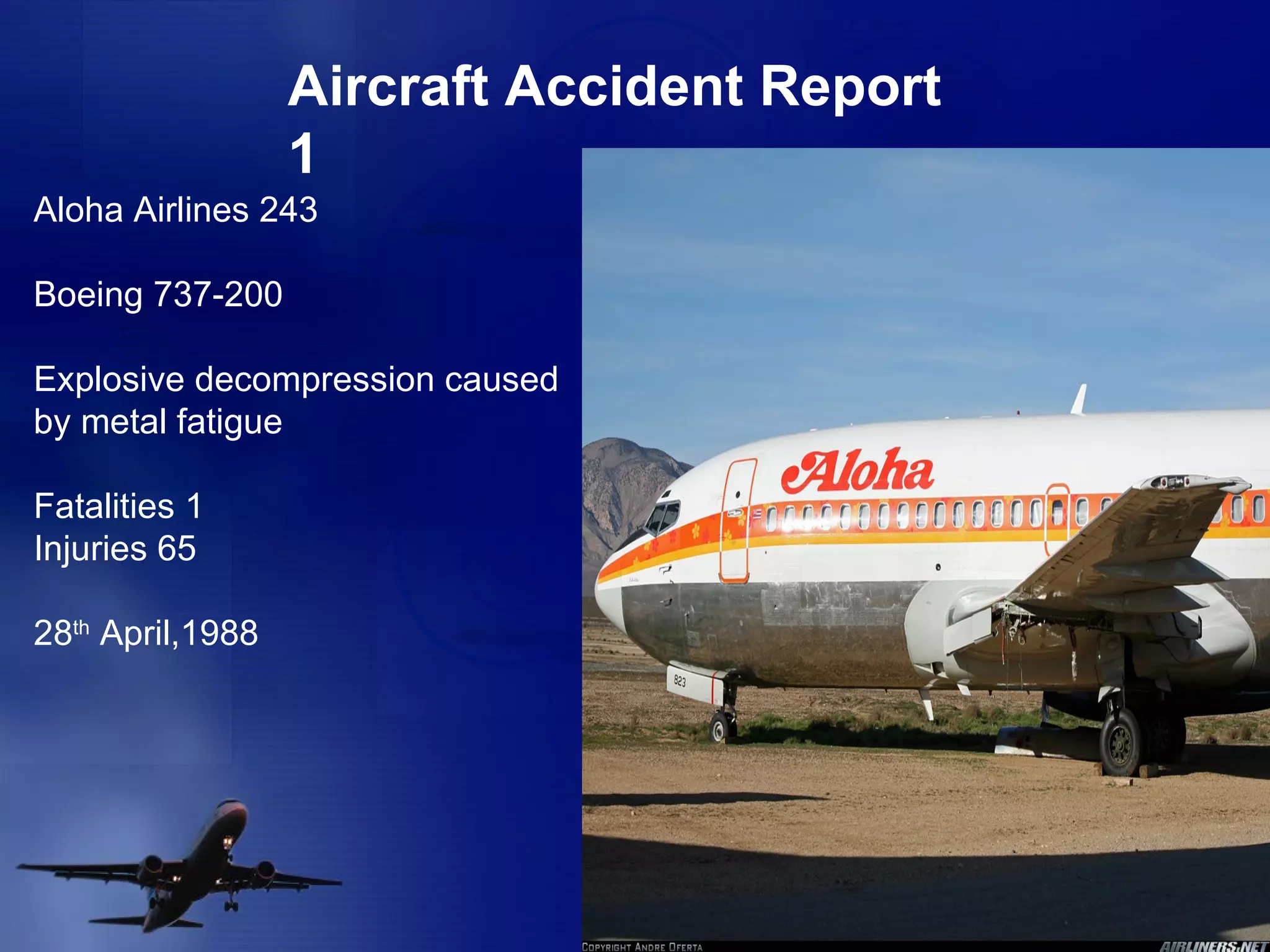
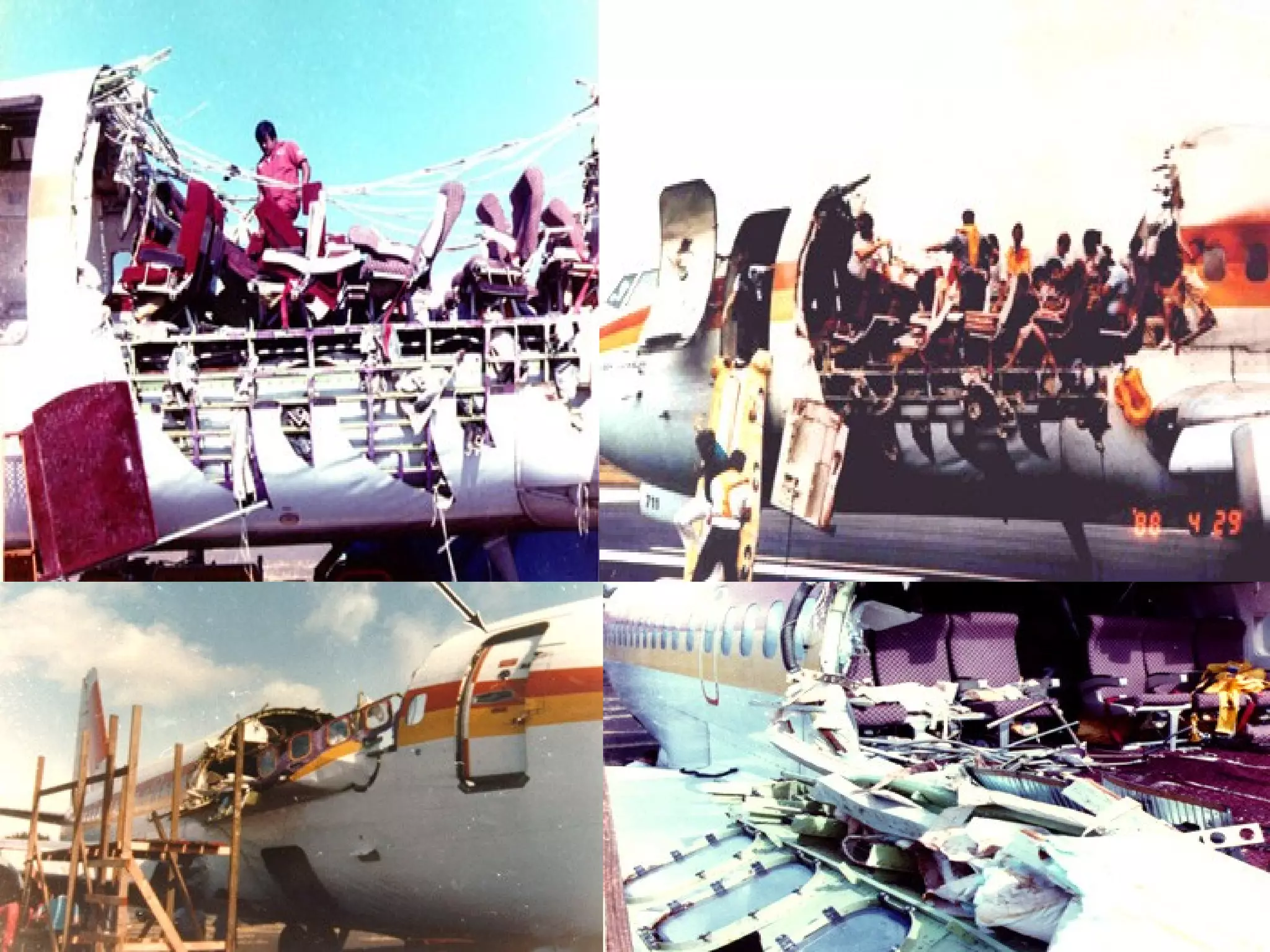
Aircraft Accident Report 1 Aloha Airlines 243 Boeing 737-200 Explosive decompression caused by metal fatigue Fatalities 1 Injuries 65 28 th  April,1988
No exterior visual inspection by crew as they were not required to do so. No unusual occurences were noted during departure and climbout On levelling at 24000 ft, pilots hear a clap followed by wind noise behind them.Pilots declare an emergency, the nature of emergency being decompression. Airplane lands immediately, a flight attendant being the only fatality Witness—a passenger noticed a crack in the upper row of rivets as  she was boarding the airplane near the cabin door. HOW THE EVENTS UNFOLDED……
 
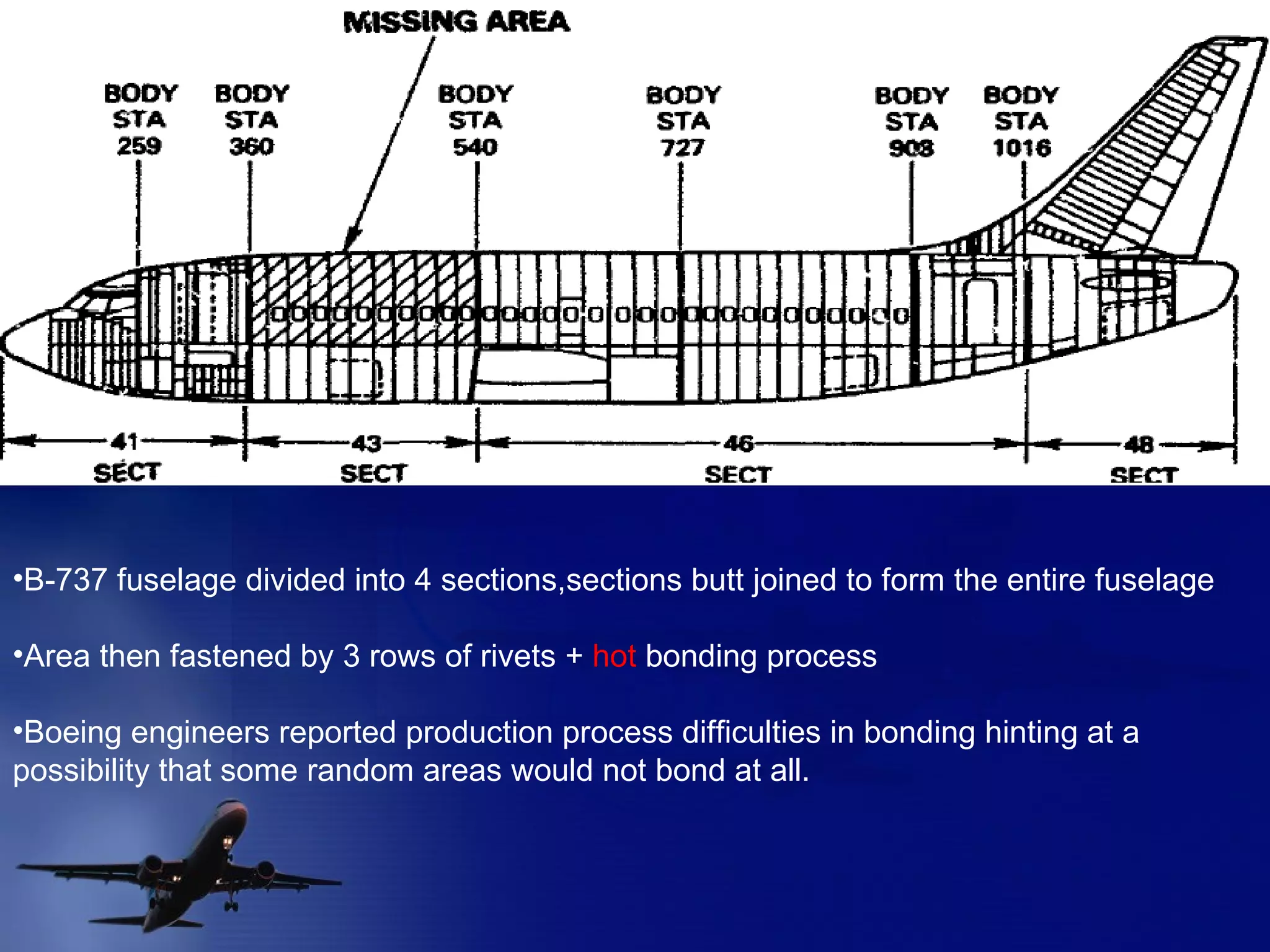
B-737 fuselage divided into 4 sections,sections butt joined to form the entire fuselage Area then fastened by 3 rows of rivets +  hot  bonding process Boeing engineers reported production process difficulties in bonding hinting at a possibility that some random areas would not bond at all.
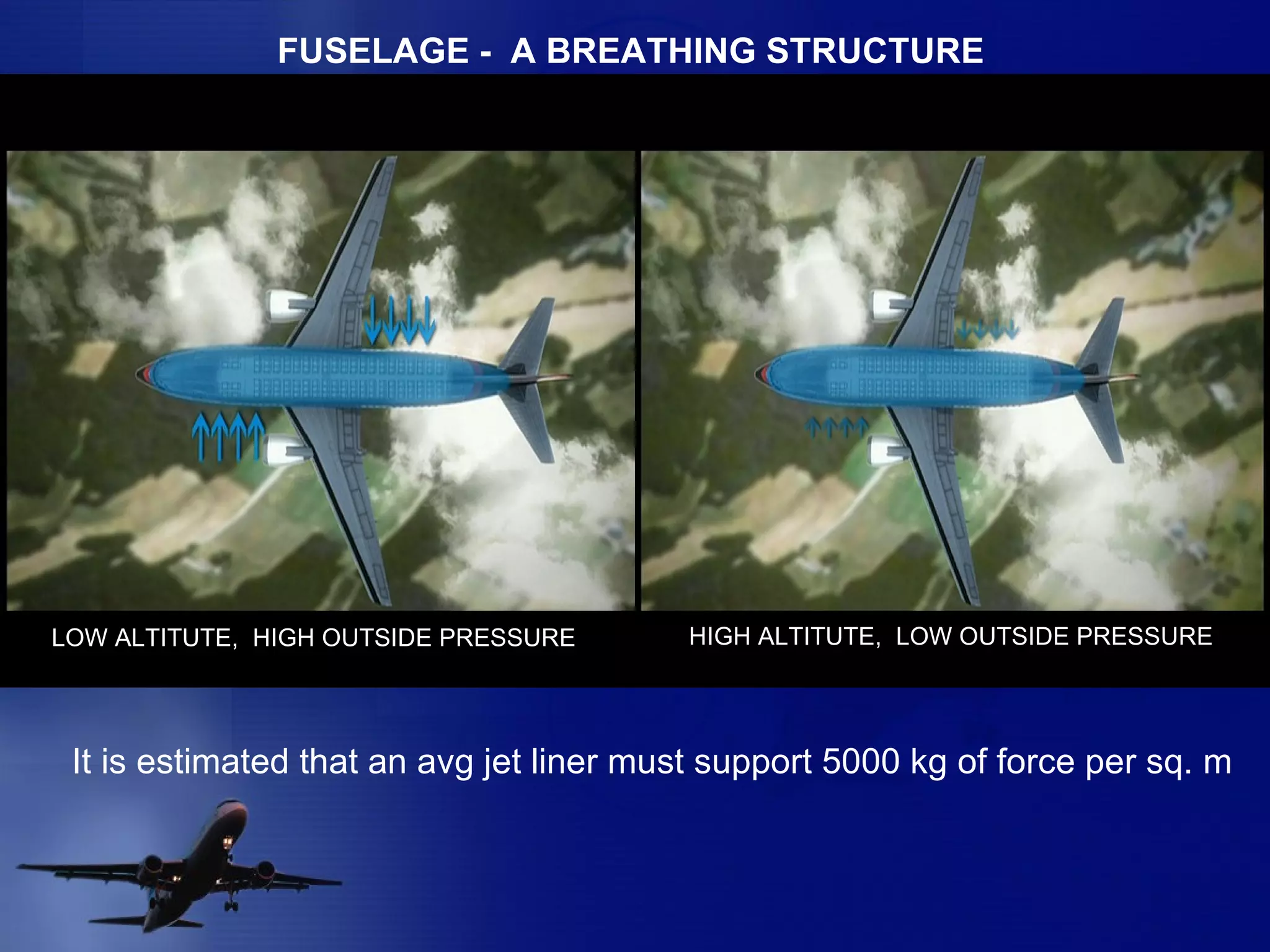
FUSELAGE -  A BREATHING STRUCTURE LOW ALTITUTE,  HIGH OUTSIDE PRESSURE HIGH ALTITUTE,  LOW OUTSIDE PRESSURE It is estimated that an avg jet liner must support 5000 kg of force per sq. m
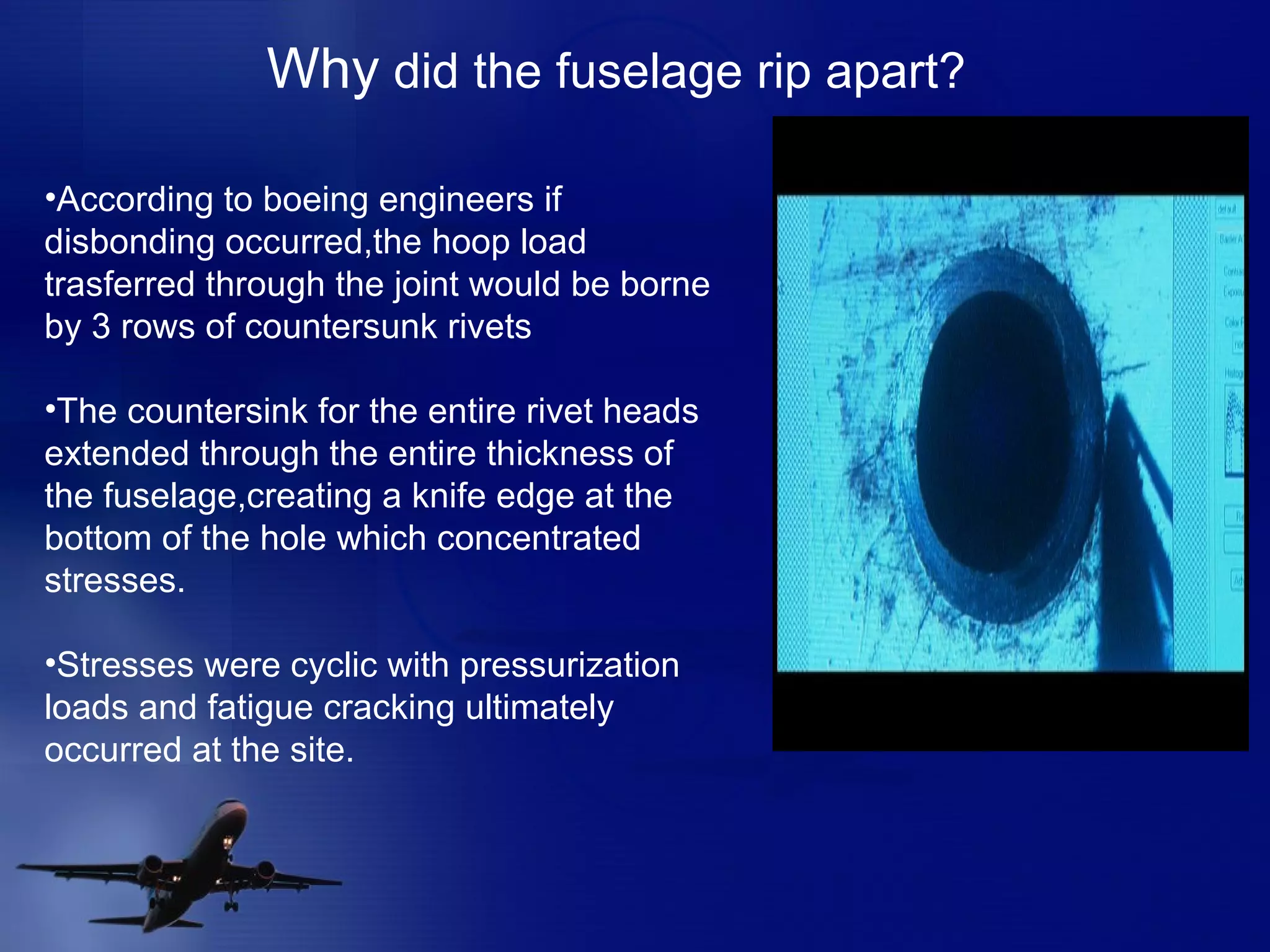
According to boeing engineers if disbonding occurred,the hoop load trasferred through the joint would be borne by 3 rows of countersunk rivets The countersink for the entire rivet heads extended through the entire thickness of the fuselage,creating a knife edge at the bottom of the hole which concentrated stresses. Stresses were cyclic with pressurization loads and fatigue cracking ultimately occurred at the site. Why  did the fuselage rip apart?
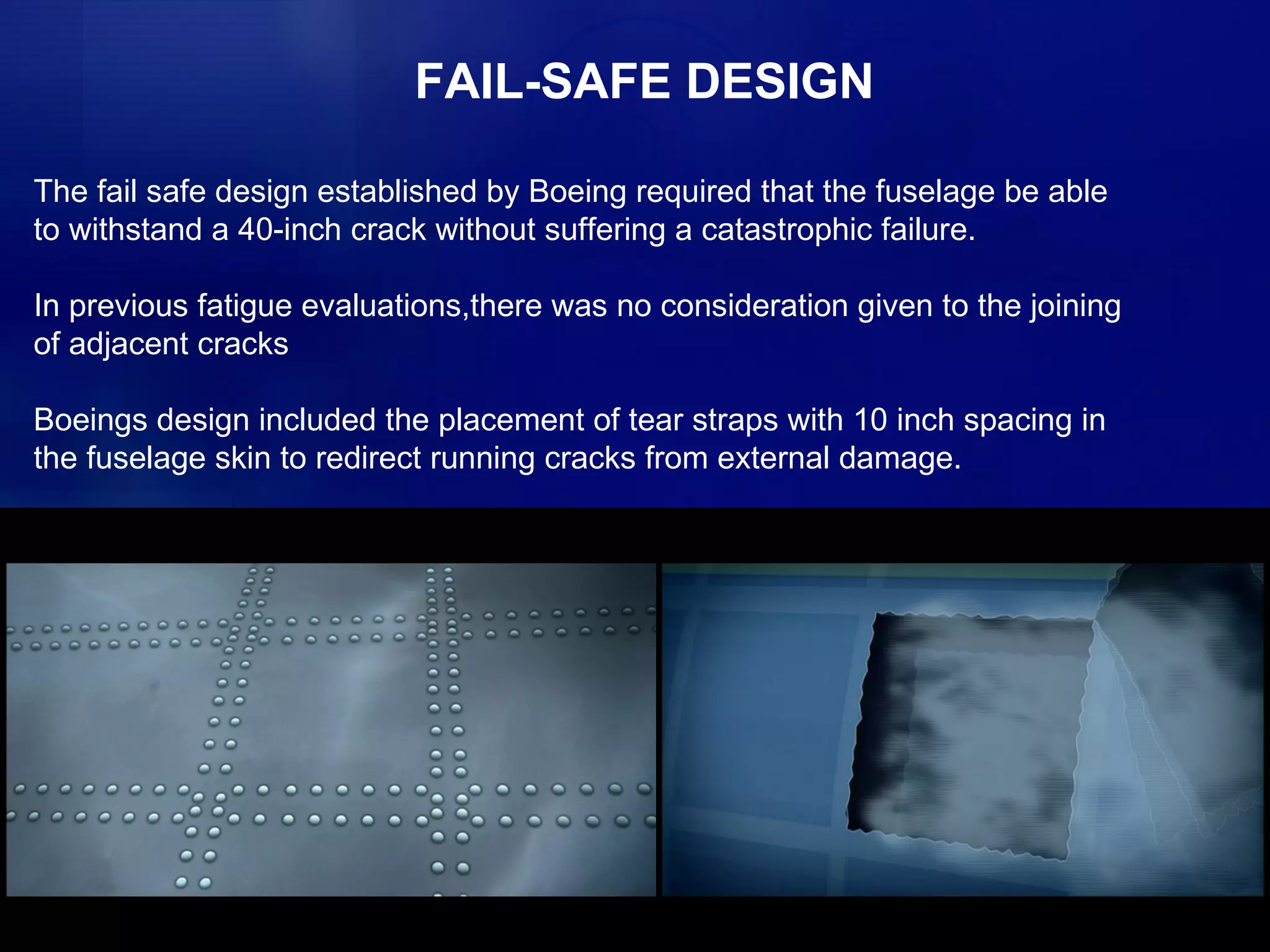
FAIL-SAFE DESIGN The fail safe design established by Boeing required that the fuselage be able to withstand a 40-inch crack without suffering a catastrophic failure. In previous fatigue evaluations,there was no consideration given to the joining of adjacent cracks Boeings design included the placement of tear straps with 10 inch spacing in the fuselage skin to redirect running cracks from external damage.
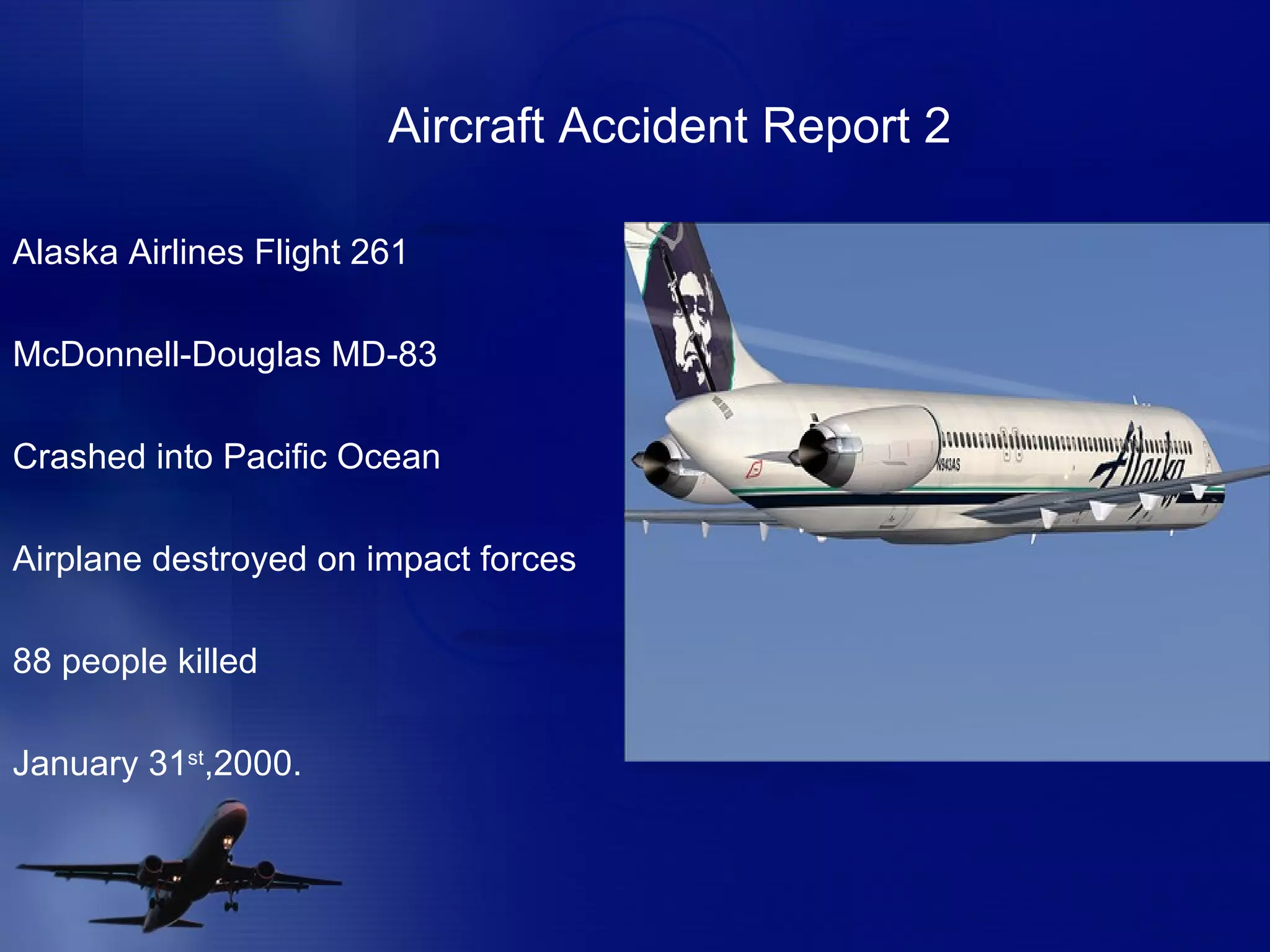
Aircraft Accident Report 2 Alaska Airlines Flight 261 McDonnell-Douglas MD-83 Crashed into Pacific Ocean Airplane destroyed on impact forces  88 people killed January 31 st ,2000.
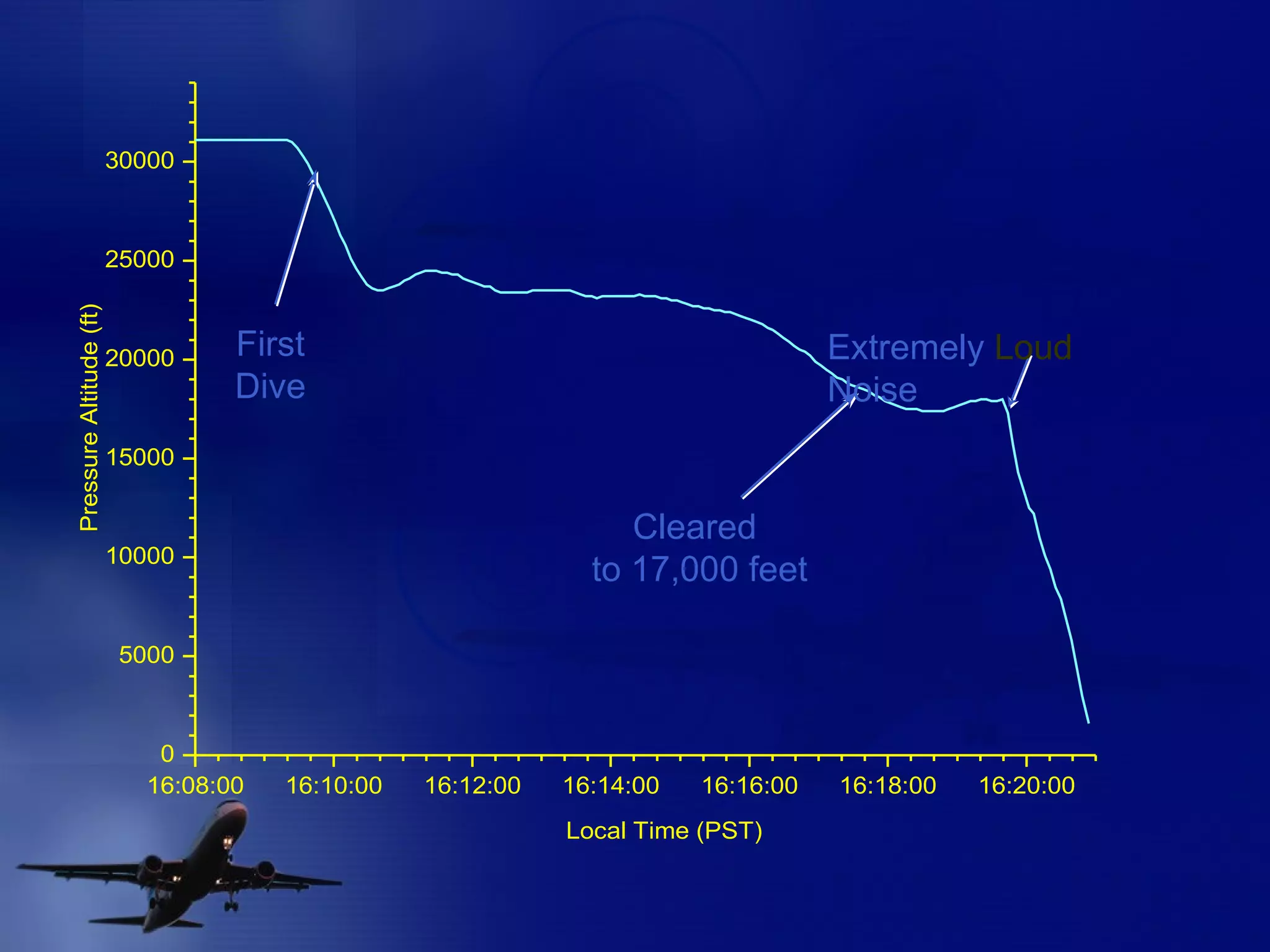
Flight 261 was operating from Mexico to Washington with a stopover at SF Captain had flown approximately 17000 flight hours and first officer over 8000 hours. Both had a good record of flying. Two hours after take off from Mexico, pilots discuss a jammed stabilizer and request diversion to LA international airport. Later, a mechanic at maintenance (LAX) contacts pilots, asks them status of the  alternate trim system  the pilots indicated that there was no appreciable change on engaging it. Pilots continue to fight the plane, they try disengaging and then re-engaging the autopilot. Later ,the CVR records a “loud noise". Airplane begins final  decent  and crashes into Pacific
First Dive Cleared  to 17,000 feet Extremely  Loud  Noise
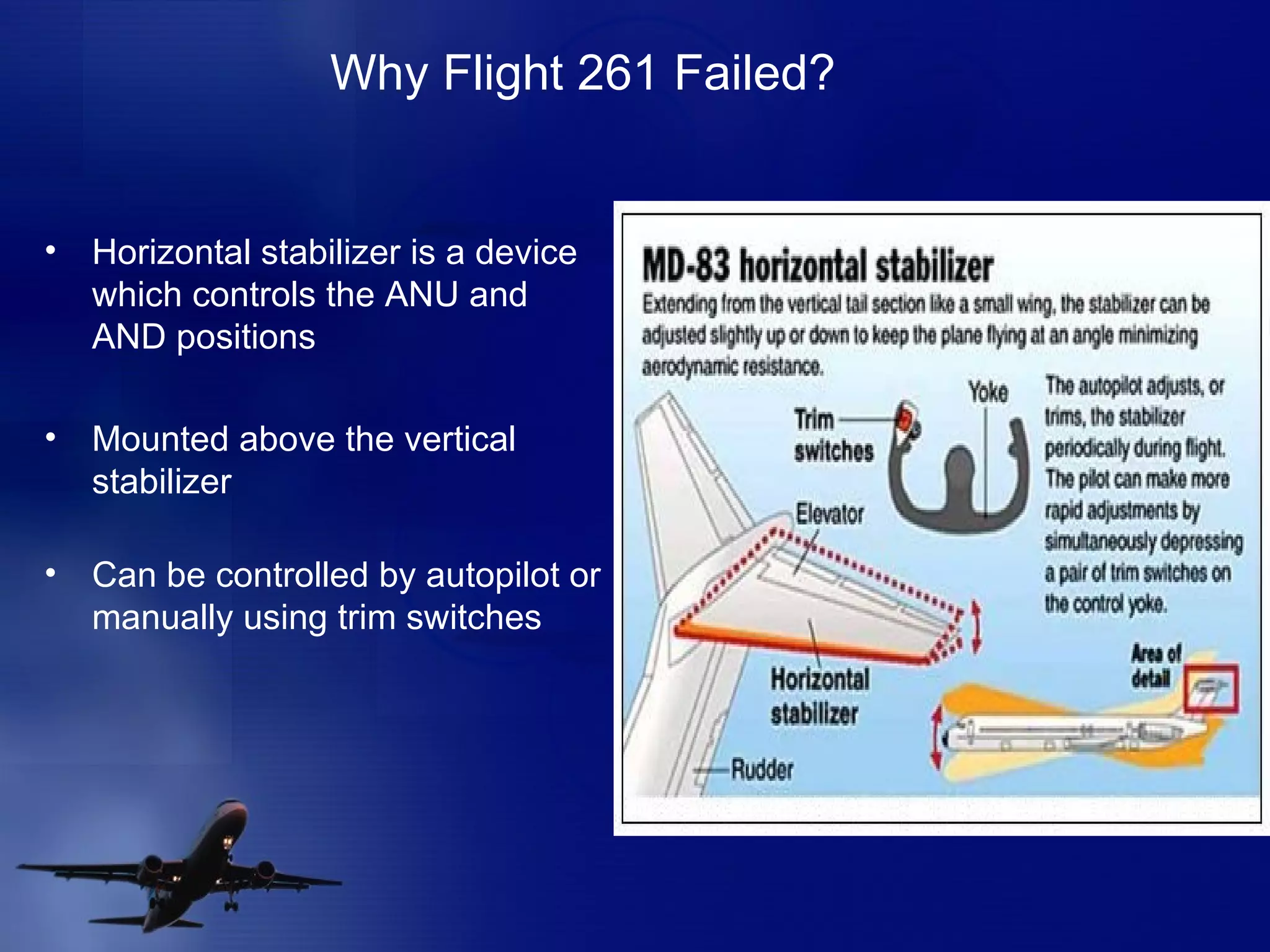
Why Flight 261 Failed? Horizontal stabilizer is a device which controls the ANU and AND positions Mounted above the vertical stabilizer Can be controlled by autopilot or manually using trim switches
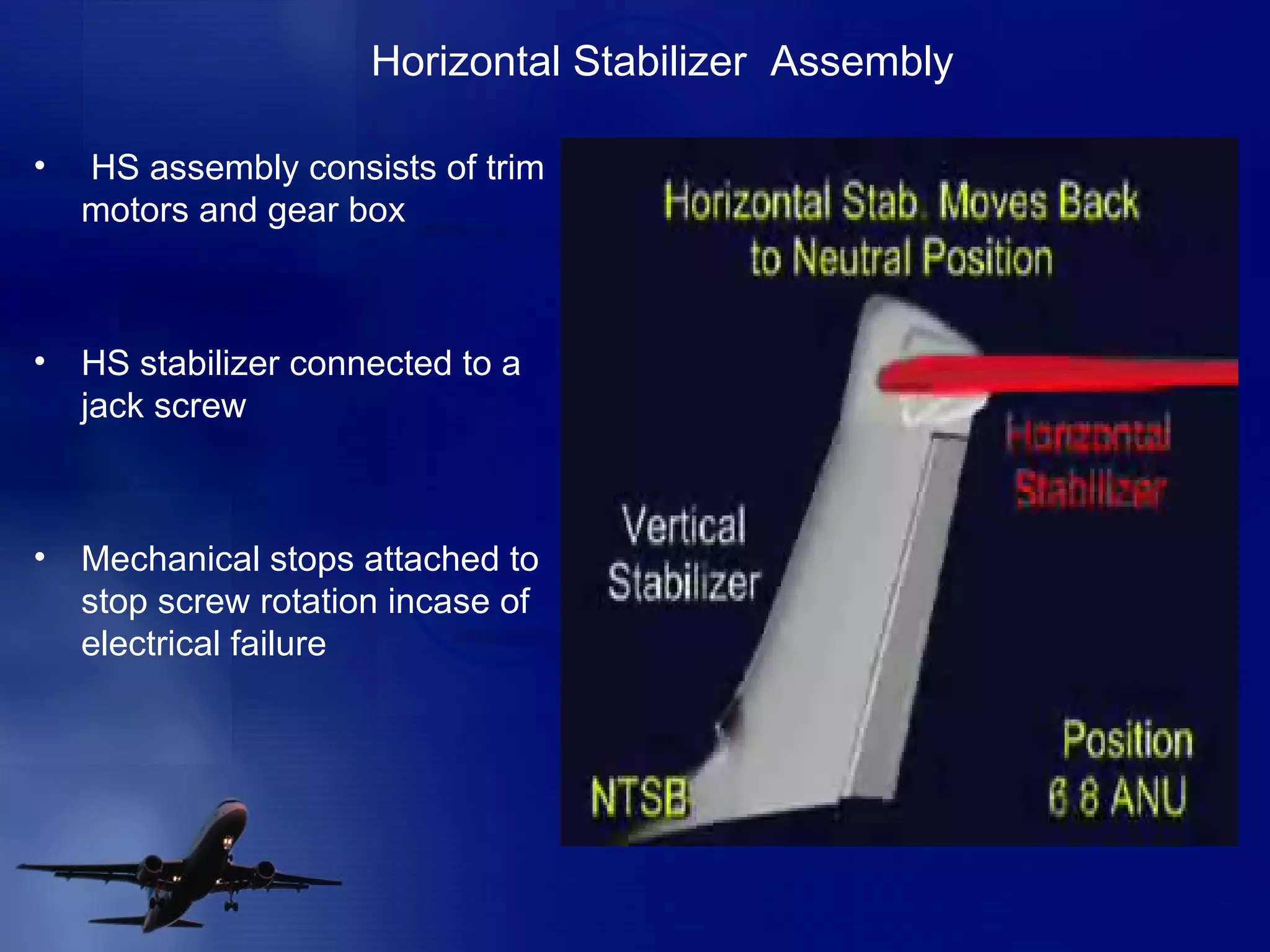
HS assembly consists of trim motors and gear box HS stabilizer connected to a jack screw Mechanical stops attached to stop screw rotation incase of electrical failure Horizontal Stabilizer  Assembly
 
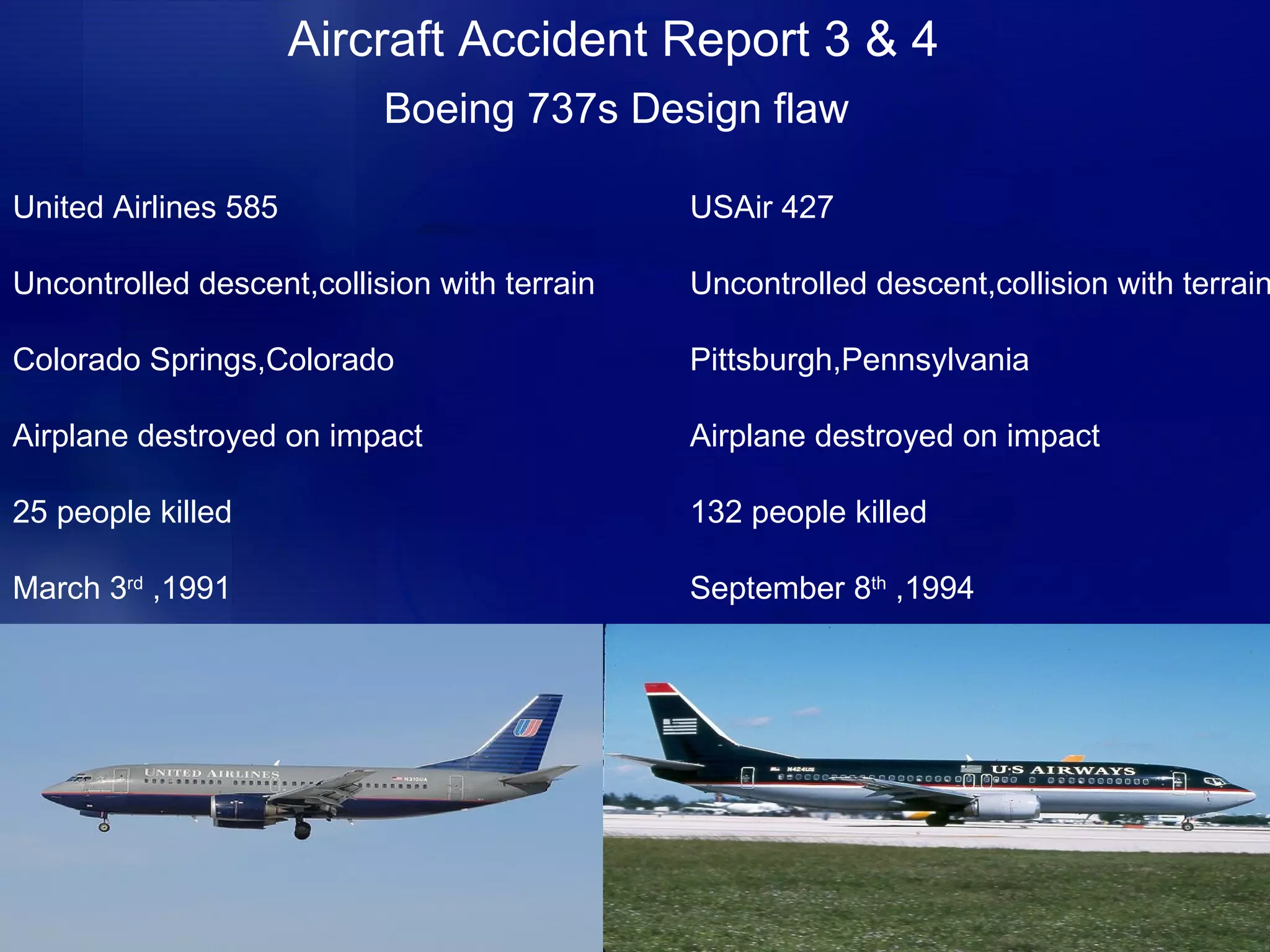
Aircraft Accident Report 3 & 4 Boeing 737s Design flaw United Airlines 585 Uncontrolled descent,collision with terrain Colorado Springs,Colorado Airplane destroyed on impact 25 people killed March 3 rd  ,1991 USAir 427 Uncontrolled descent,collision with terrain Pittsburgh,Pennsylvania Airplane destroyed on impact 132 people killed September 8 th  ,1994
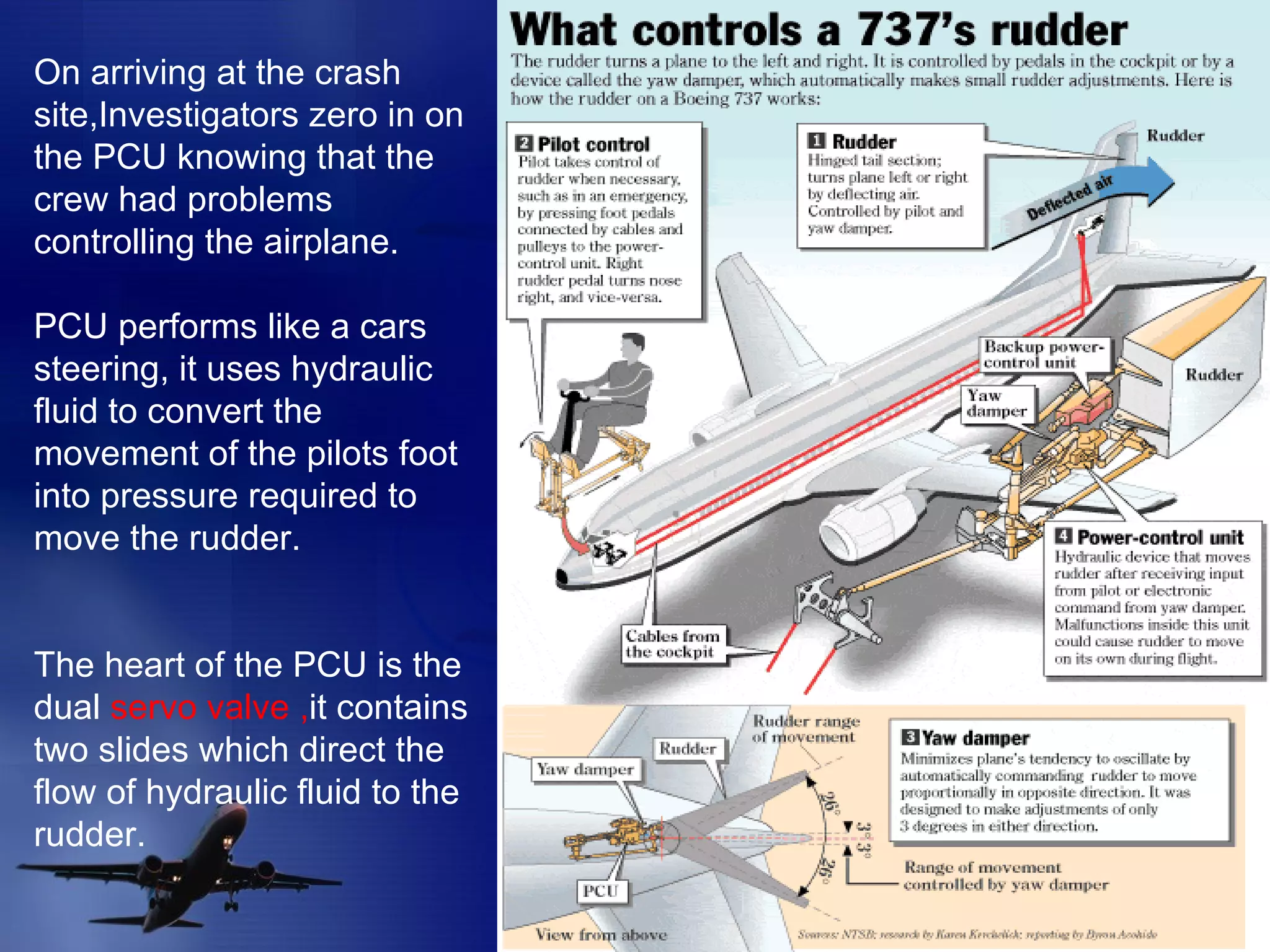
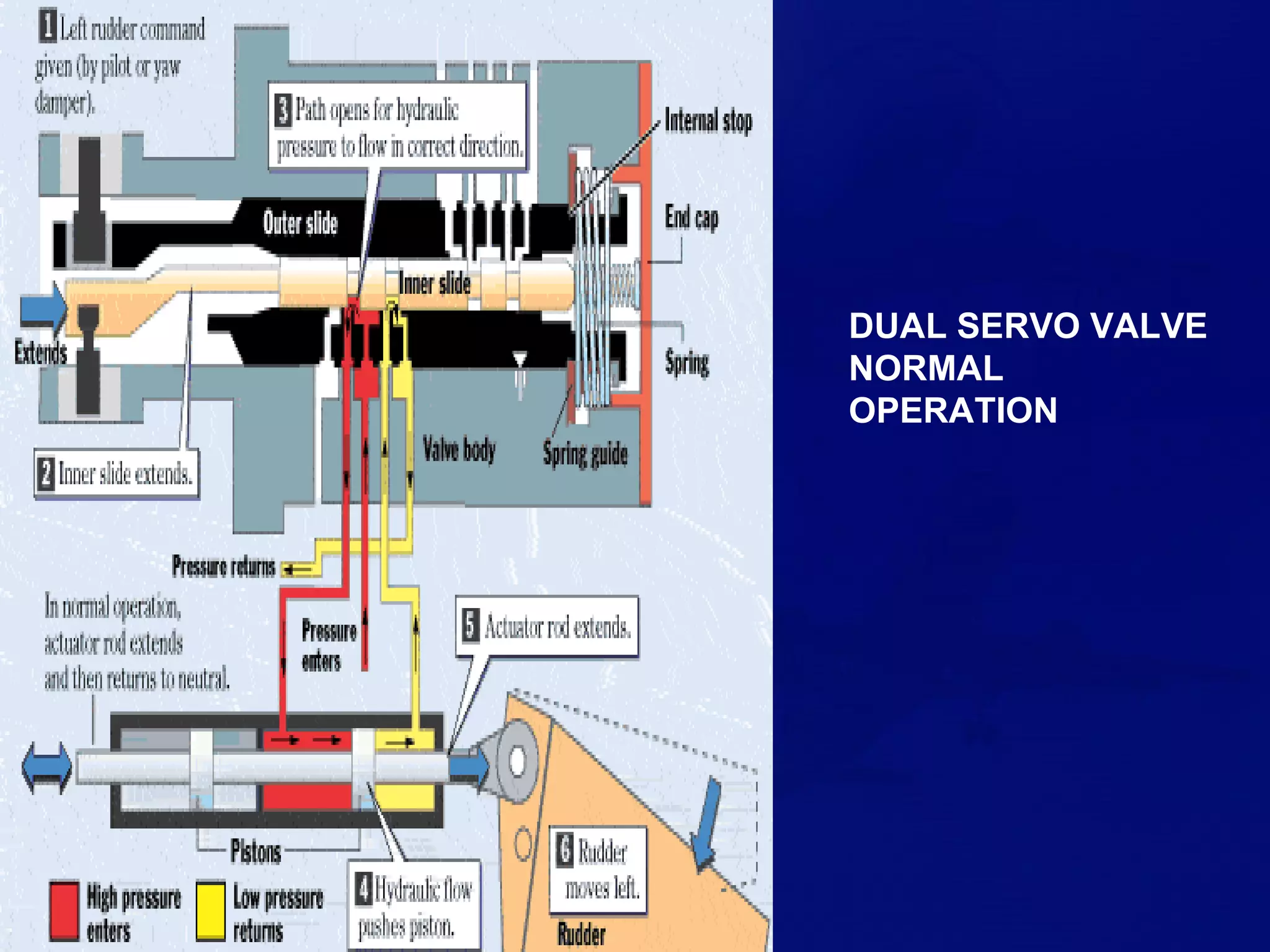
On arriving at the crash site,Investigators zero in on the PCU knowing that the crew had problems controlling the airplane. PCU performs like a cars steering, it uses hydraulic fluid to convert the movement of the pilots foot into pressure required to move the rudder. The heart of the PCU is the dual  servo valve , it contains two slides which direct the flow of hydraulic fluid to the rudder.
DUAL SERVO VALVE NORMAL OPERATION
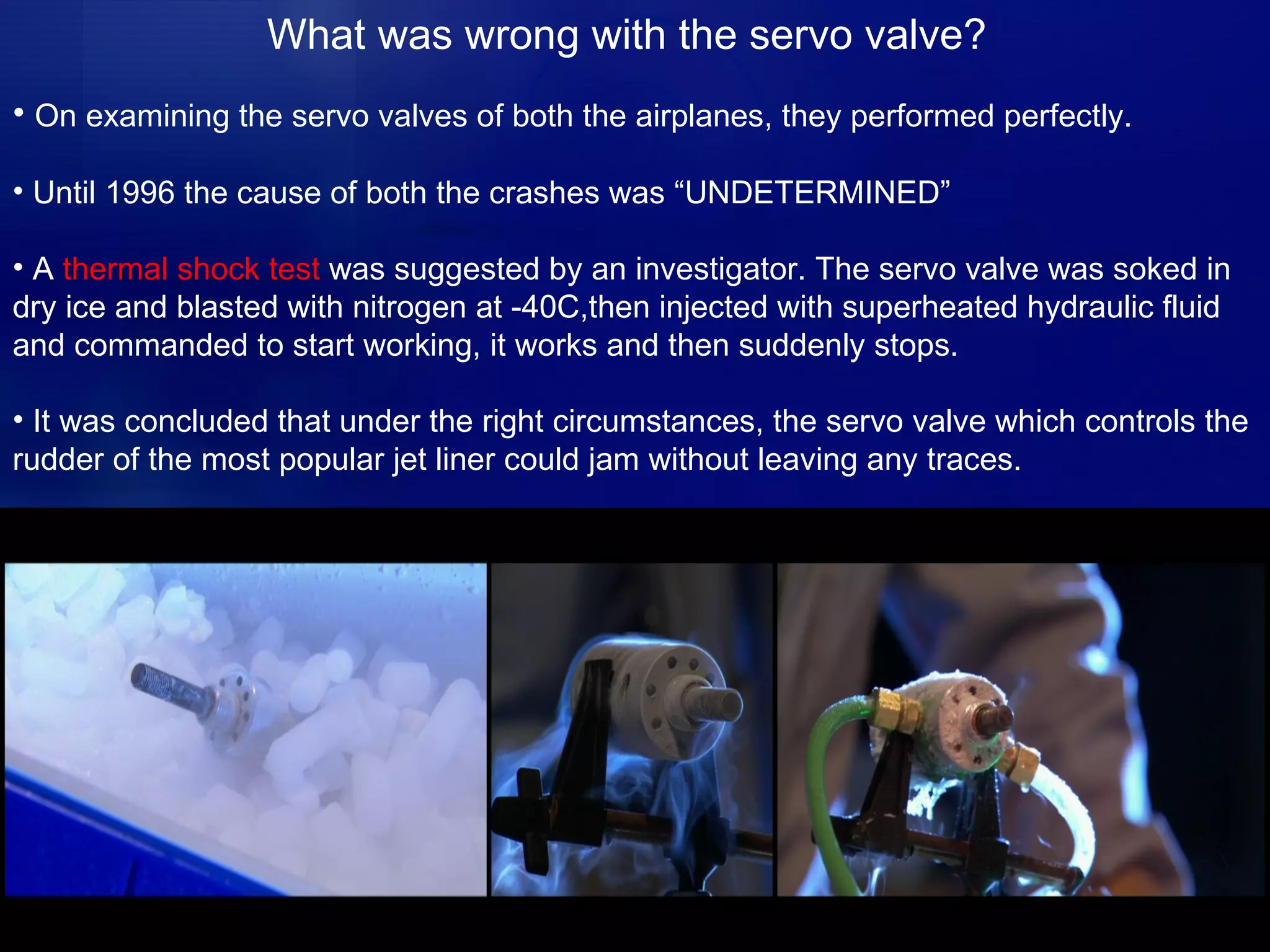
What was wrong with the servo valve? On examining the servo valves of both the airplanes, they performed perfectly. Until 1996 the cause of both the crashes was “UNDETERMINED”  A  thermal shock test  was suggested by an investigator. The servo valve was soked in dry ice and blasted with nitrogen at -40C,then injected with superheated hydraulic fluid and commanded to start working, it works and then suddenly stops. It was concluded that under the right circumstances, the servo valve which controls the rudder of the most popular jet liner could jam without leaving any traces.
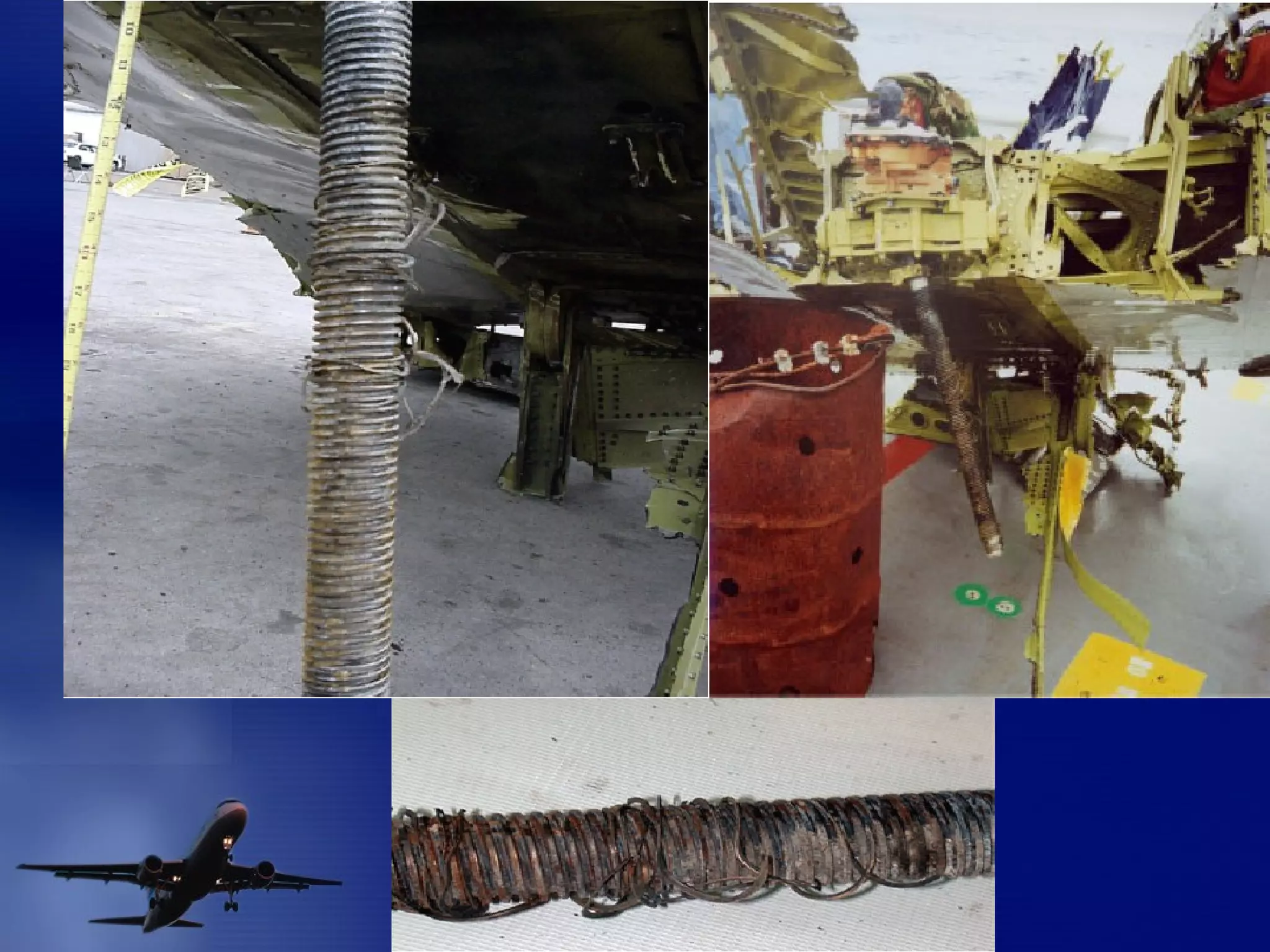
CONCLUSION The constant maintenance and repair of aircraft may seem like a trivial job but they can prove to be fatal if not done properly A missing screw can jeopardize the whole aircraft Lack of lubrication costed 88 lives, these are lessons the aviation industry learnt the hard way

Aviation disasters due to mechanical failures

  • 1.
    AVIATION DISASTERSDUE TO MECHANICAL FAILURES Seminar by Cyril Sudip 1NT05ME017
  • 2.
    INTRODUCTION No formof transportation is completely safe, no machine is completely foolproof 13% of commercial airplane accidents due to mechanical failures Failing to properly inspect, replace or maintain parts by ground crew McDonnell-Douglas’s DC-10 has a very high rate of crashes, due to cargo door problems, massive decompression due to metal fatigue, engine falling off the aircraft
  • 3.
    Aircraft Accident Report1 Aloha Airlines 243 Boeing 737-200 Explosive decompression caused by metal fatigue Fatalities 1 Injuries 65 28 th April,1988
  • 4.
    No exterior visualinspection by crew as they were not required to do so. No unusual occurences were noted during departure and climbout On levelling at 24000 ft, pilots hear a clap followed by wind noise behind them.Pilots declare an emergency, the nature of emergency being decompression. Airplane lands immediately, a flight attendant being the only fatality Witness—a passenger noticed a crack in the upper row of rivets as she was boarding the airplane near the cabin door. HOW THE EVENTS UNFOLDED……
  • 5.
  • 6.
    B-737 fuselage dividedinto 4 sections,sections butt joined to form the entire fuselage Area then fastened by 3 rows of rivets + hot bonding process Boeing engineers reported production process difficulties in bonding hinting at a possibility that some random areas would not bond at all.
  • 7.
    FUSELAGE - A BREATHING STRUCTURE LOW ALTITUTE, HIGH OUTSIDE PRESSURE HIGH ALTITUTE, LOW OUTSIDE PRESSURE It is estimated that an avg jet liner must support 5000 kg of force per sq. m
  • 8.
    According to boeingengineers if disbonding occurred,the hoop load trasferred through the joint would be borne by 3 rows of countersunk rivets The countersink for the entire rivet heads extended through the entire thickness of the fuselage,creating a knife edge at the bottom of the hole which concentrated stresses. Stresses were cyclic with pressurization loads and fatigue cracking ultimately occurred at the site. Why did the fuselage rip apart?
  • 9.
    FAIL-SAFE DESIGN Thefail safe design established by Boeing required that the fuselage be able to withstand a 40-inch crack without suffering a catastrophic failure. In previous fatigue evaluations,there was no consideration given to the joining of adjacent cracks Boeings design included the placement of tear straps with 10 inch spacing in the fuselage skin to redirect running cracks from external damage.
  • 10.
    Aircraft Accident Report2 Alaska Airlines Flight 261 McDonnell-Douglas MD-83 Crashed into Pacific Ocean Airplane destroyed on impact forces 88 people killed January 31 st ,2000.
  • 11.
    Flight 261 wasoperating from Mexico to Washington with a stopover at SF Captain had flown approximately 17000 flight hours and first officer over 8000 hours. Both had a good record of flying. Two hours after take off from Mexico, pilots discuss a jammed stabilizer and request diversion to LA international airport. Later, a mechanic at maintenance (LAX) contacts pilots, asks them status of the alternate trim system the pilots indicated that there was no appreciable change on engaging it. Pilots continue to fight the plane, they try disengaging and then re-engaging the autopilot. Later ,the CVR records a “loud noise". Airplane begins final decent and crashes into Pacific
  • 12.
    First Dive Cleared to 17,000 feet Extremely Loud Noise
  • 13.
    Why Flight 261Failed? Horizontal stabilizer is a device which controls the ANU and AND positions Mounted above the vertical stabilizer Can be controlled by autopilot or manually using trim switches
  • 14.
    HS assembly consistsof trim motors and gear box HS stabilizer connected to a jack screw Mechanical stops attached to stop screw rotation incase of electrical failure Horizontal Stabilizer Assembly
  • 15.
  • 16.
    Aircraft Accident Report3 & 4 Boeing 737s Design flaw United Airlines 585 Uncontrolled descent,collision with terrain Colorado Springs,Colorado Airplane destroyed on impact 25 people killed March 3 rd ,1991 USAir 427 Uncontrolled descent,collision with terrain Pittsburgh,Pennsylvania Airplane destroyed on impact 132 people killed September 8 th ,1994
  • 17.
    On arriving atthe crash site,Investigators zero in on the PCU knowing that the crew had problems controlling the airplane. PCU performs like a cars steering, it uses hydraulic fluid to convert the movement of the pilots foot into pressure required to move the rudder. The heart of the PCU is the dual servo valve , it contains two slides which direct the flow of hydraulic fluid to the rudder.
  • 18.
    DUAL SERVO VALVENORMAL OPERATION
  • 19.
    What was wrongwith the servo valve? On examining the servo valves of both the airplanes, they performed perfectly. Until 1996 the cause of both the crashes was “UNDETERMINED” A thermal shock test was suggested by an investigator. The servo valve was soked in dry ice and blasted with nitrogen at -40C,then injected with superheated hydraulic fluid and commanded to start working, it works and then suddenly stops. It was concluded that under the right circumstances, the servo valve which controls the rudder of the most popular jet liner could jam without leaving any traces.
  • 20.
    CONCLUSION The constantmaintenance and repair of aircraft may seem like a trivial job but they can prove to be fatal if not done properly A missing screw can jeopardize the whole aircraft Lack of lubrication costed 88 lives, these are lessons the aviation industry learnt the hard way