MASS & BALANCE


                 1
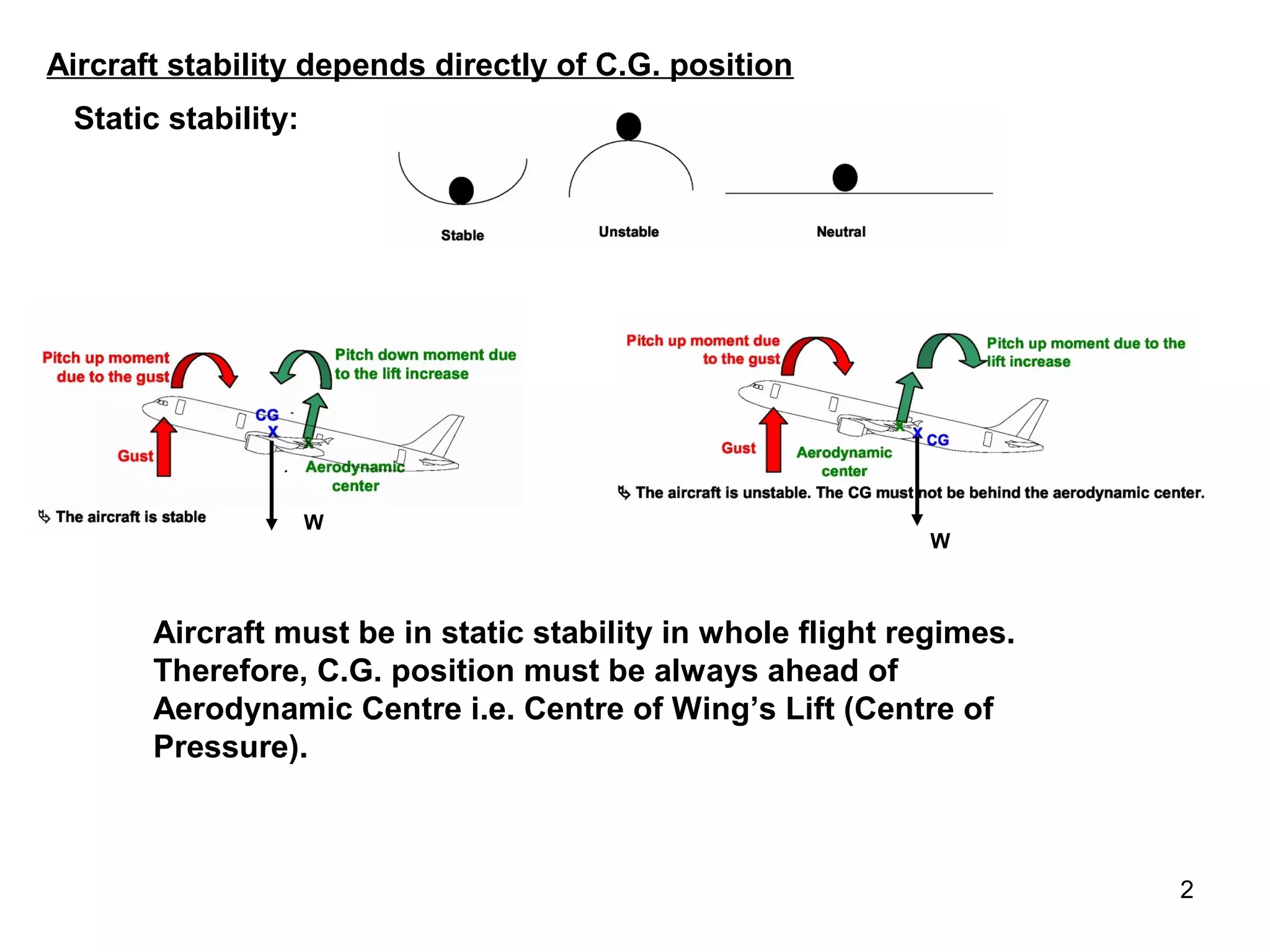
Aircraft stability depends directly of C.G. position
 Static stability:


                     W
                                                             W


       Aircraft must be in static stability in whole flight regimes.
       Therefore, C.G. position must be always ahead of
       Aerodynamic Centre i.e. Centre of Wing’s Lift (Centre of
       Pressure).


                                                                       2
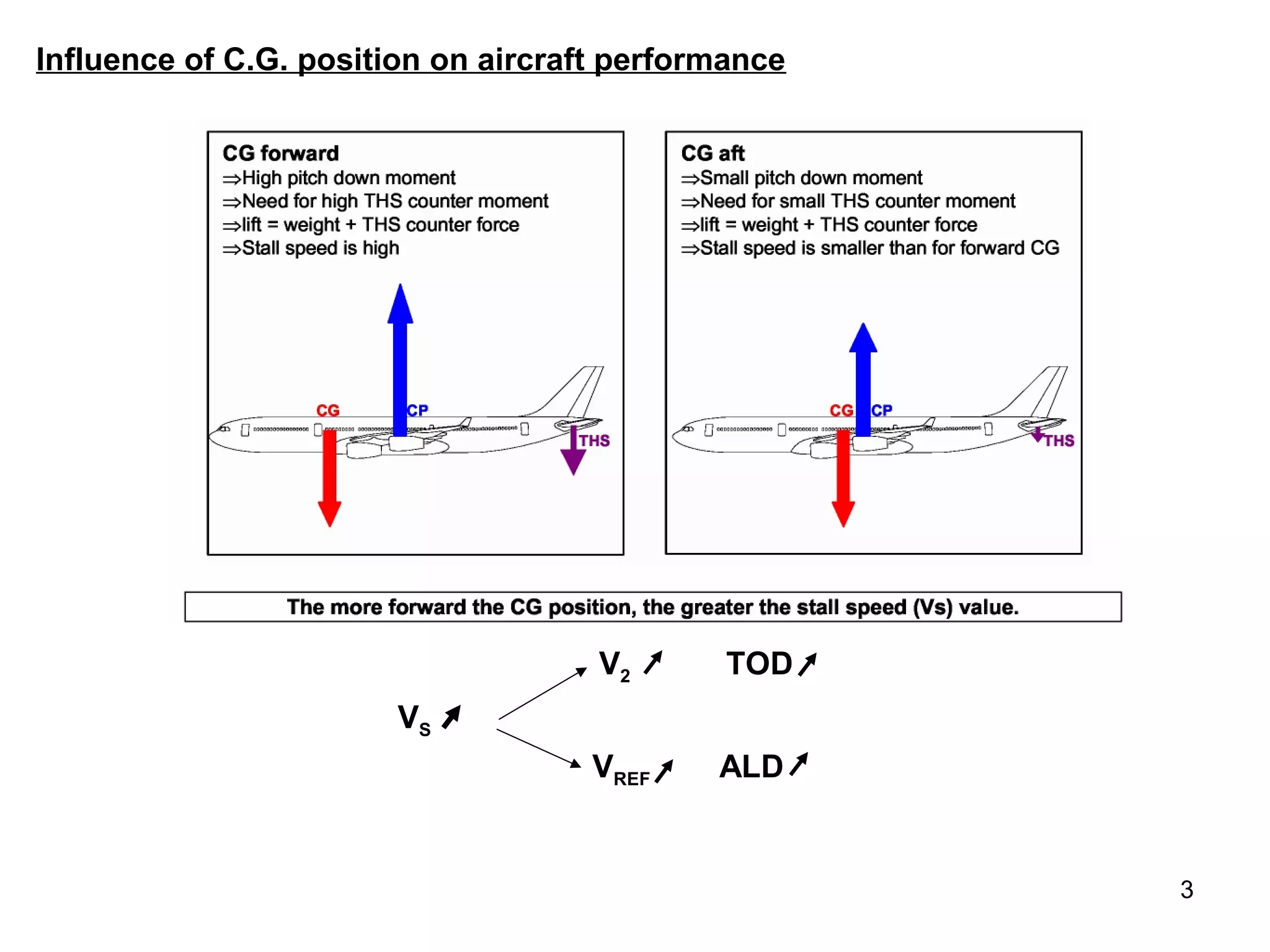
Influence of C.G. position on aircraft performance


                                     V2       TOD
                        VS
                                     VREF    ALD


                                                     3
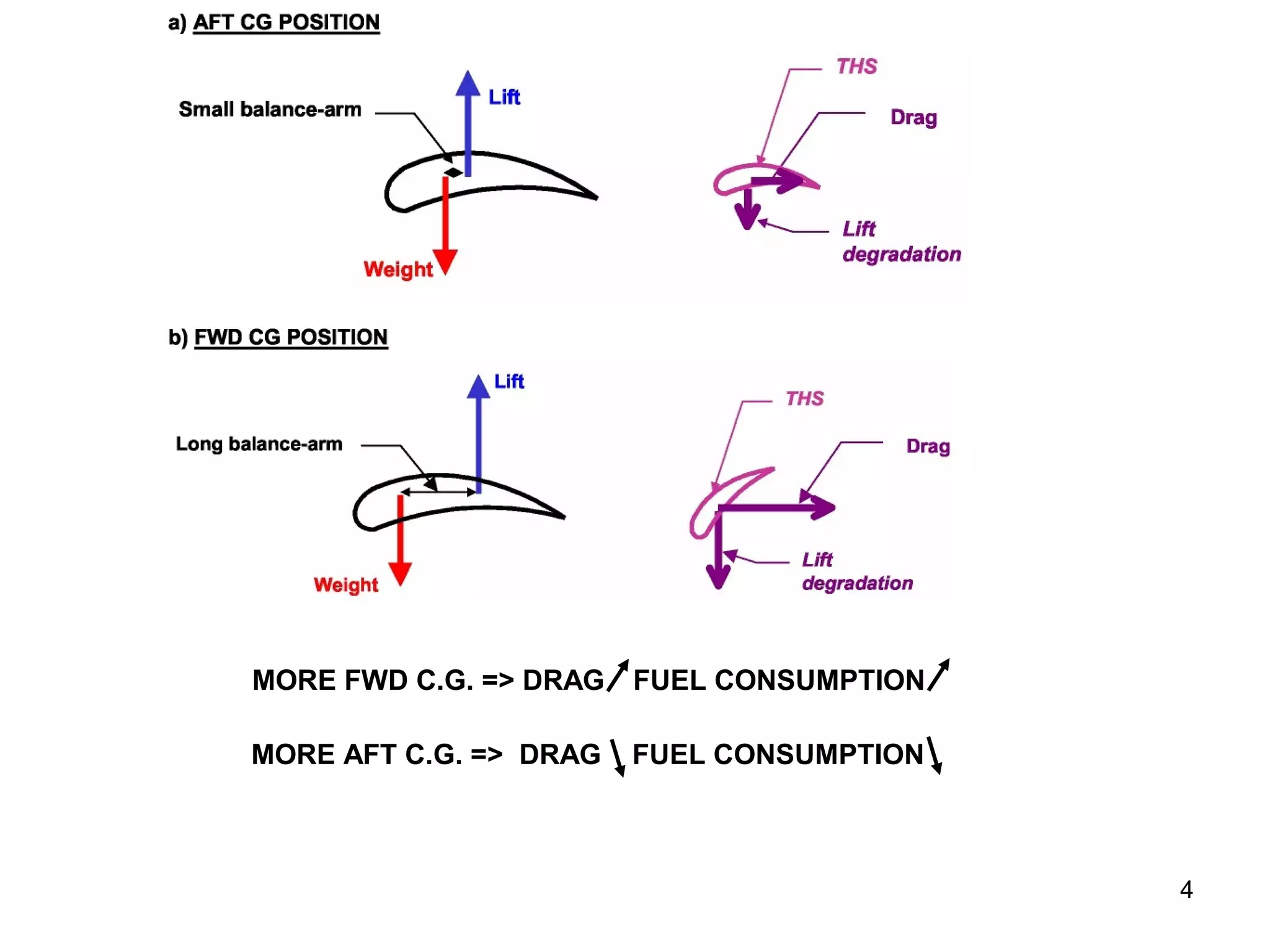
MORE FWD C.G. => DRAG   FUEL CONSUMPTION

MORE AFT C.G. => DRAG   FUEL CONSUMPTION


                                           4
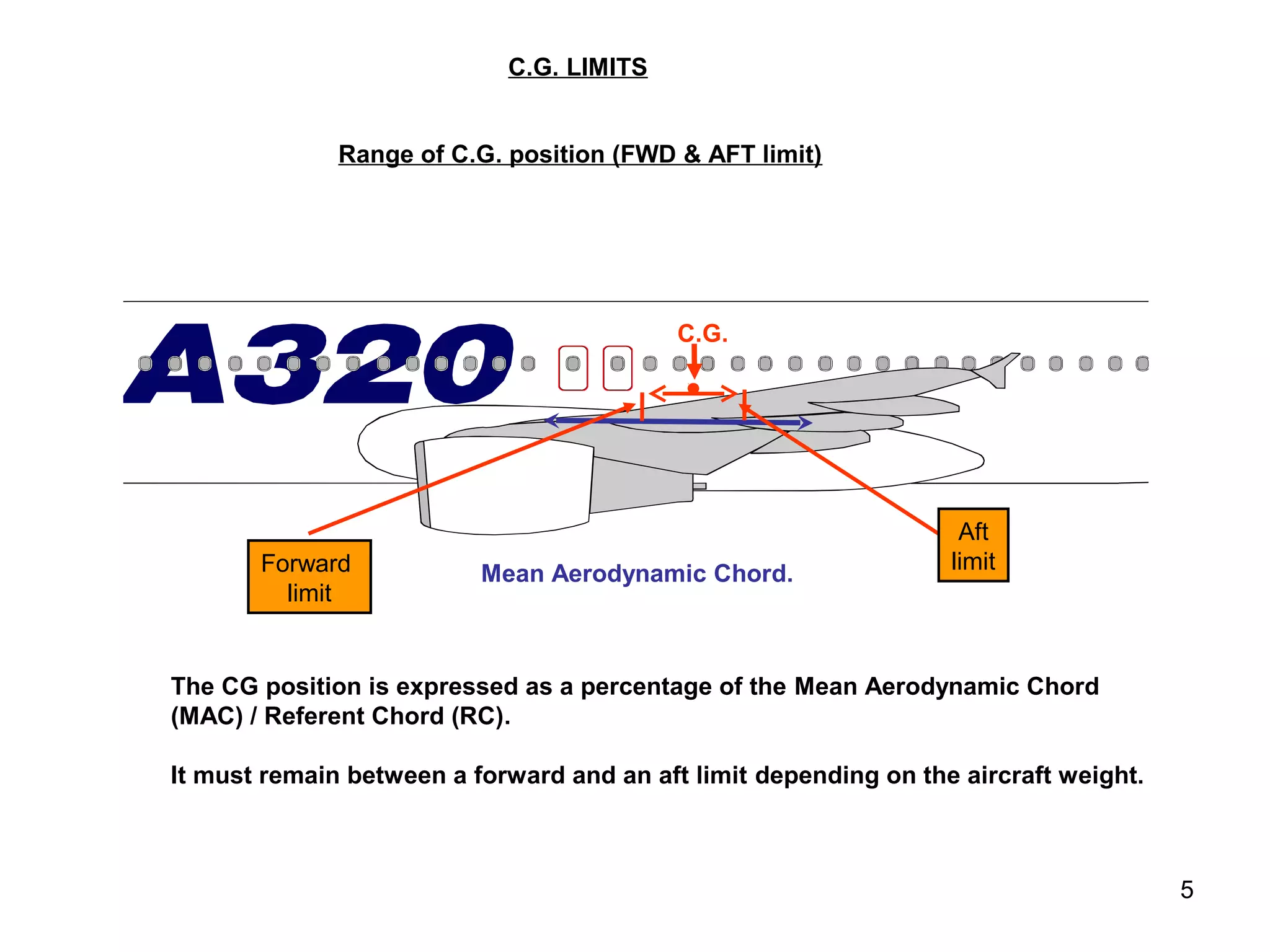
C.G. LIMITS


              Range of C.G. position (FWD & AFT limit)


                                           C.G.


                                                                   Aft
       Forward            Mean Aerodynamic Chord.                 limit
         limit


The CG position is expressed as a percentage of the Mean Aerodynamic Chord
(MAC) / Referent Chord (RC).

It must remain between a forward and an aft limit depending on the aircraft weight.


                                                                                      5
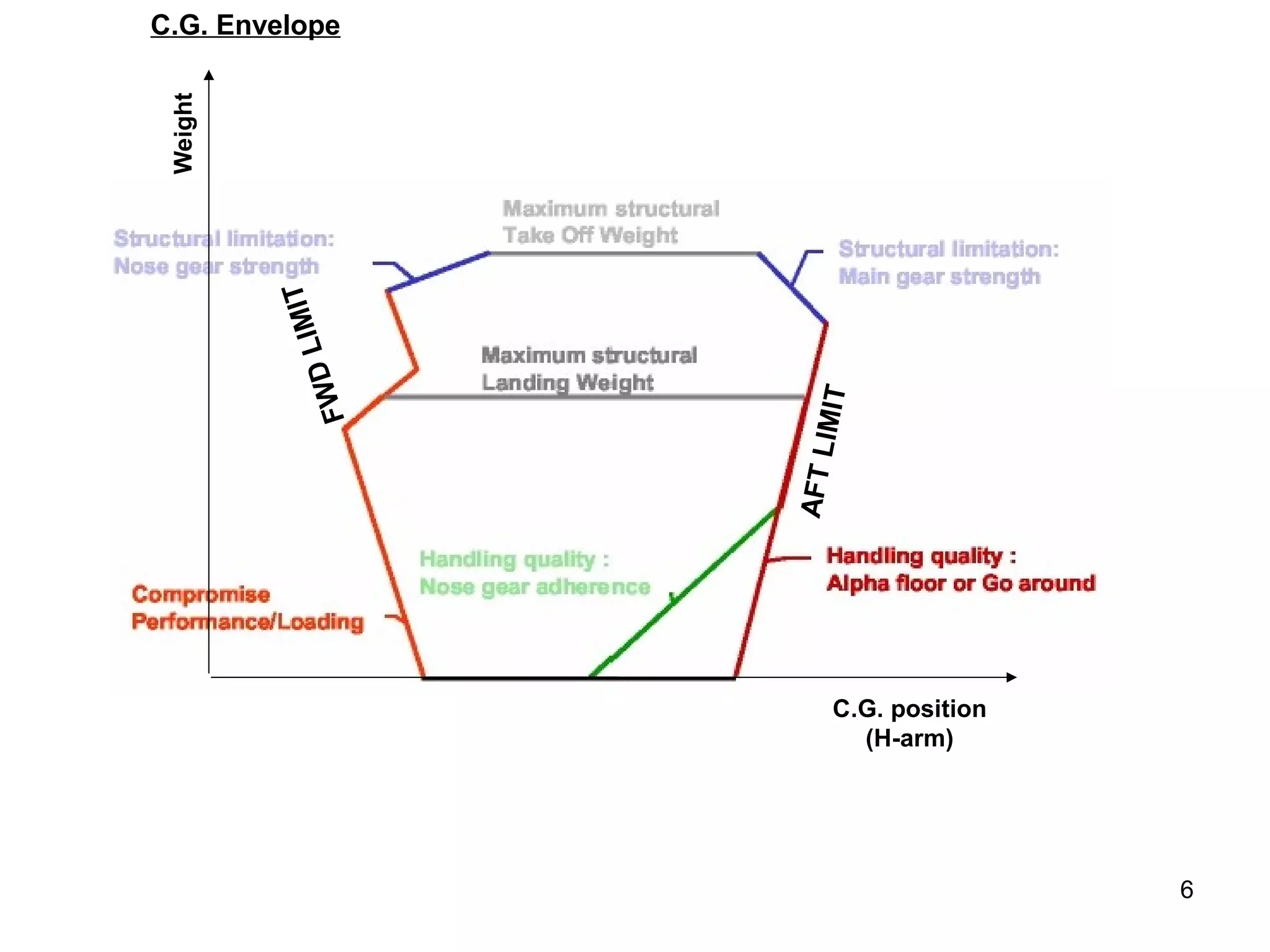
C.G. Envelope


 Weight


          MIT LI
          FWD


                         IMIT
                   AFT L
                          C.G. position
                            (H-arm)


                                          6
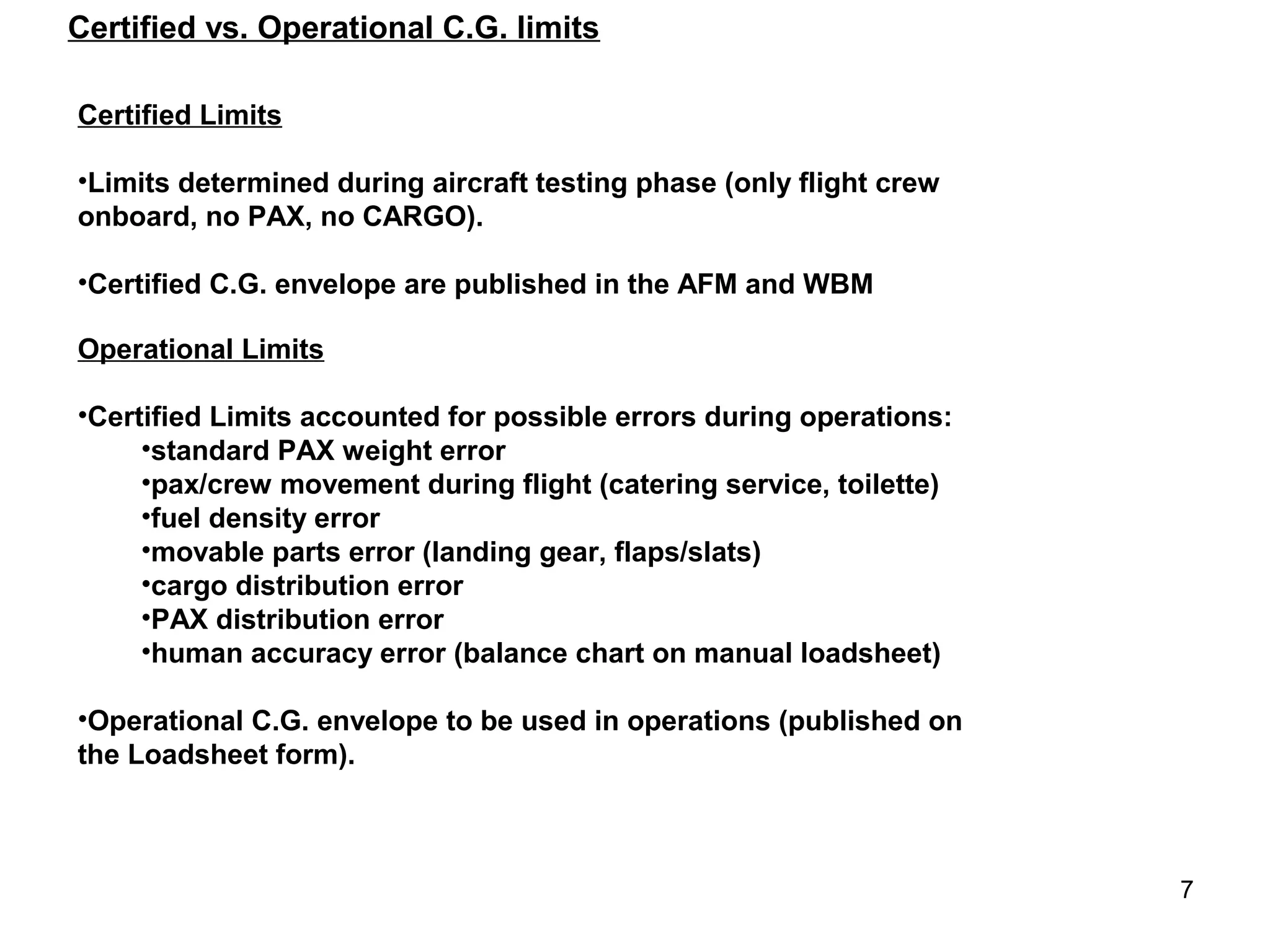
Certified vs. Operational C.G. limits

Certified Limits

•Limits determined during aircraft testing phase (only flight crew
onboard, no PAX, no CARGO).

•Certified C.G. envelope are published in the AFM and WBM

Operational Limits

•Certified Limits accounted for possible errors during operations:
     •standard PAX weight error
     •pax/crew movement during flight (catering service, toilette)
     •fuel density error
     •movable parts error (landing gear, flaps/slats)
     •cargo distribution error
     •PAX distribution error
     •human accuracy error (balance chart on manual loadsheet)

•Operational C.G. envelope to be used in operations (published on
the Loadsheet form).


                                                                     7
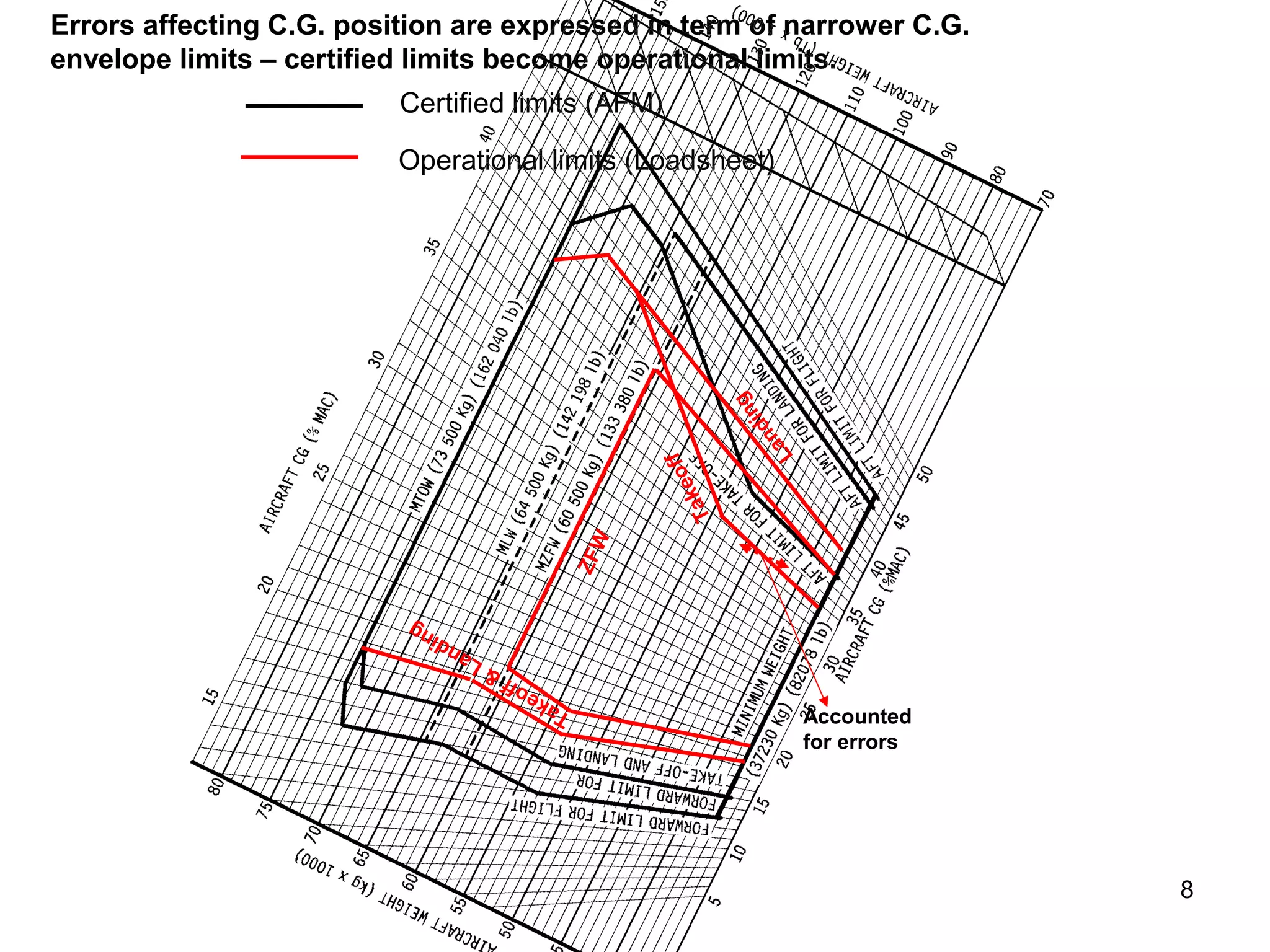
Errors affecting C.G. position are expressed in term of narrower C.G.
envelope limits – certified limits become operational limits.
                          Certified limits (AFM)

                          Operational limits (Loadsheet)


                                                                       ng
                                                                   n di
                                                                       La
                                                             ff
                                                          eo   k
                                                            Ta
                                                      W
                                                   ZF

                           ing
                                    nd
                                 La
                                                   &
                                               off
                                            ke
                                         Ta                                 Accounted
                                                                            for errors


                                                                                         8
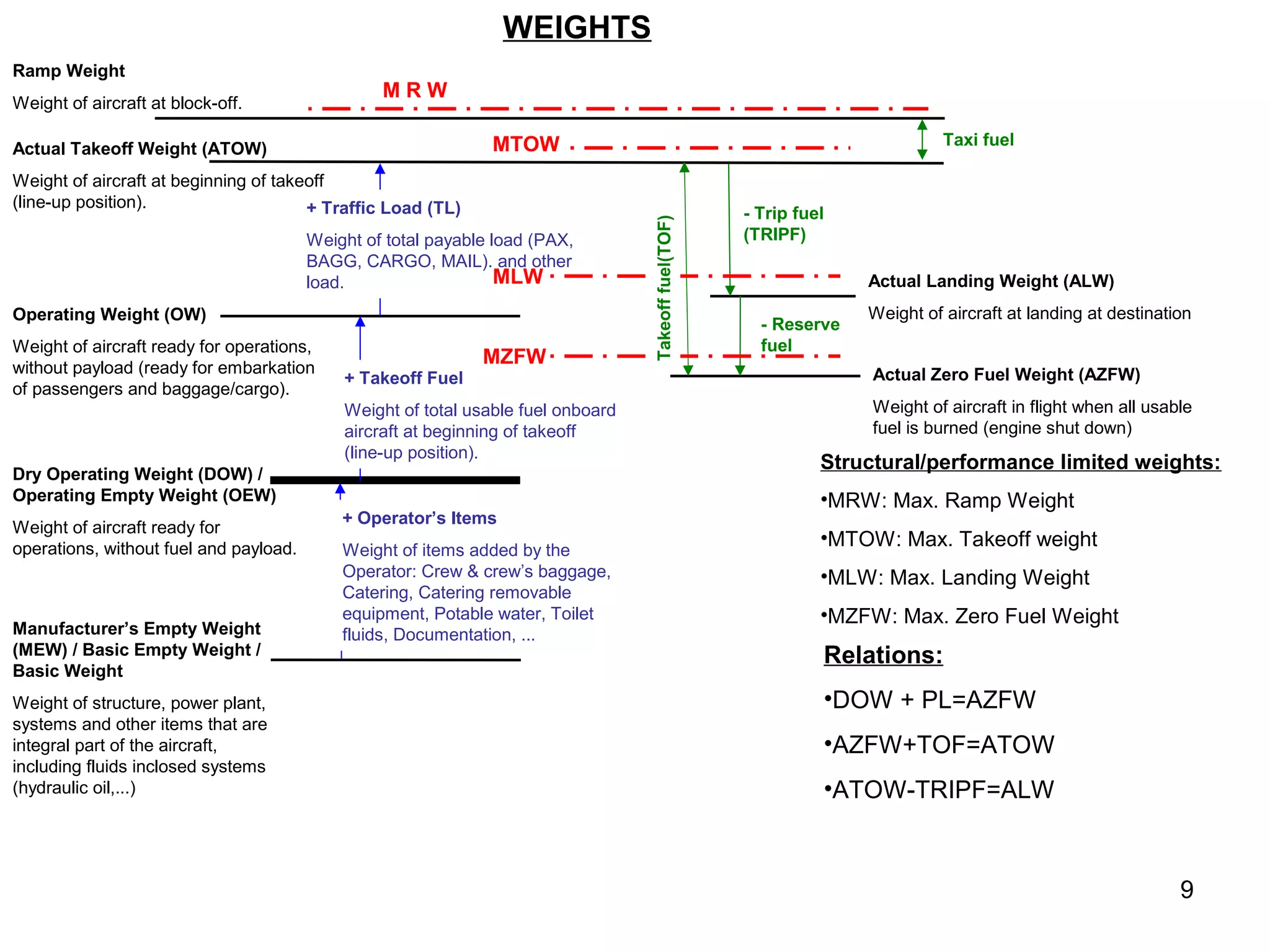
WEIGHTS
Ramp Weight
                                                 MRW
Weight of aircraft at block-off.

                                                               MTOW                                                           Taxi fuel
Actual Takeoff Weight (ATOW)
Weight of aircraft at beginning of takeoff
(line-up position).                    + Traffic Load (TL)                                            - Trip fuel


                                                                                  Takeoff fuel(TOF)
                                        Weight of total payable load (PAX,                            (TRIPF)
                                        BAGG, CARGO, MAIL). and other
                                        load.                    MLW                                                Actual Landing Weight (ALW)
Operating Weight (OW)                                                                                               Weight of aircraft at landing at destination
                                                                                                        - Reserve
Weight of aircraft ready for operations,                                                                fuel
without payload (ready for embarkation
                                                              MZFW
                                            + Takeoff Fuel                                                           Actual Zero Fuel Weight (AZFW)
of passengers and baggage/cargo).
                                            Weight of total usable fuel onboard                                      Weight of aircraft in flight when all usable
                                            aircraft at beginning of takeoff                                         fuel is burned (engine shut down)
                                            (line-up position).
                                                                                                                Structural/performance limited weights:
Dry Operating Weight (DOW) /
Operating Empty Weight (OEW)                                                                                    •MRW: Max. Ramp Weight
                                            + Operator’s Items
Weight of aircraft ready for
operations, without fuel and payload.
                                                                                                                •MTOW: Max. Takeoff weight
                                            Weight of items added by the
                                            Operator: Crew & crew’s baggage,                                    •MLW: Max. Landing Weight
                                            Catering, Catering removable
                                            equipment, Potable water, Toilet                                    •MZFW: Max. Zero Fuel Weight
Manufacturer’s Empty Weight                 fluids, Documentation, ...
(MEW) / Basic Empty Weight /                                                                                    Relations:
Basic Weight
Weight of structure, power plant,                                                                               •DOW + PL=AZFW
systems and other items that are
integral part of the aircraft,                                                                                  •AZFW+TOF=ATOW
including fluids inclosed systems
(hydraulic oil,...)                                                                                             •ATOW-TRIPF=ALW


                                                                                                                                                               9
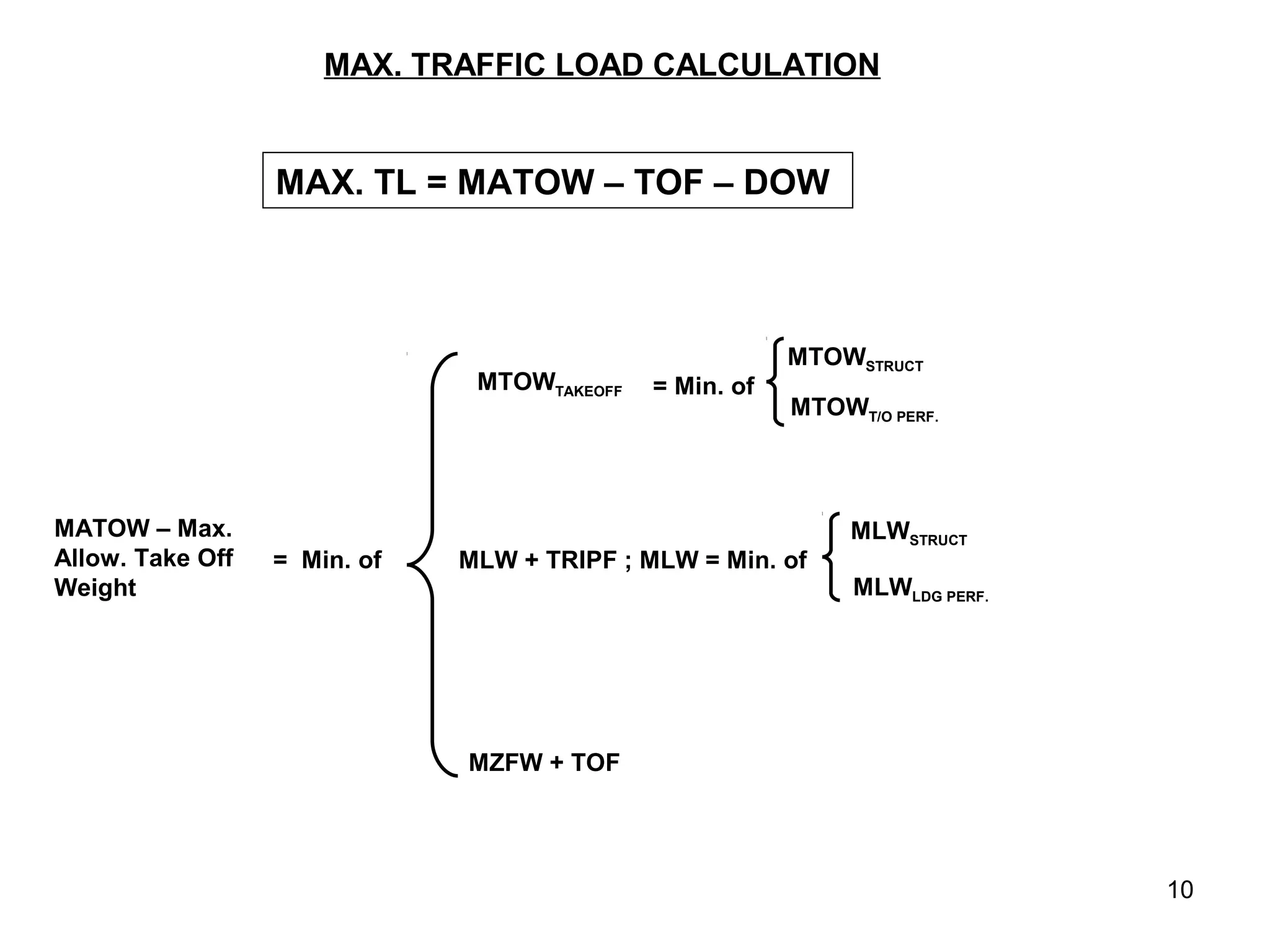
MAX. TRAFFIC LOAD CALCULATION


                  MAX. TL = MATOW – TOF – DOW


                                                         MTOWSTRUCT
                               MTOWTAKEOFF   = Min. of
                                                         MTOWT/O PERF.


MATOW – Max.                                                  MLWSTRUCT
Allow. Take Off   = Min. of   MLW + TRIPF ; MLW = Min. of
Weight                                                        MLWLDG PERF.


                              MZFW + TOF


                                                                             10
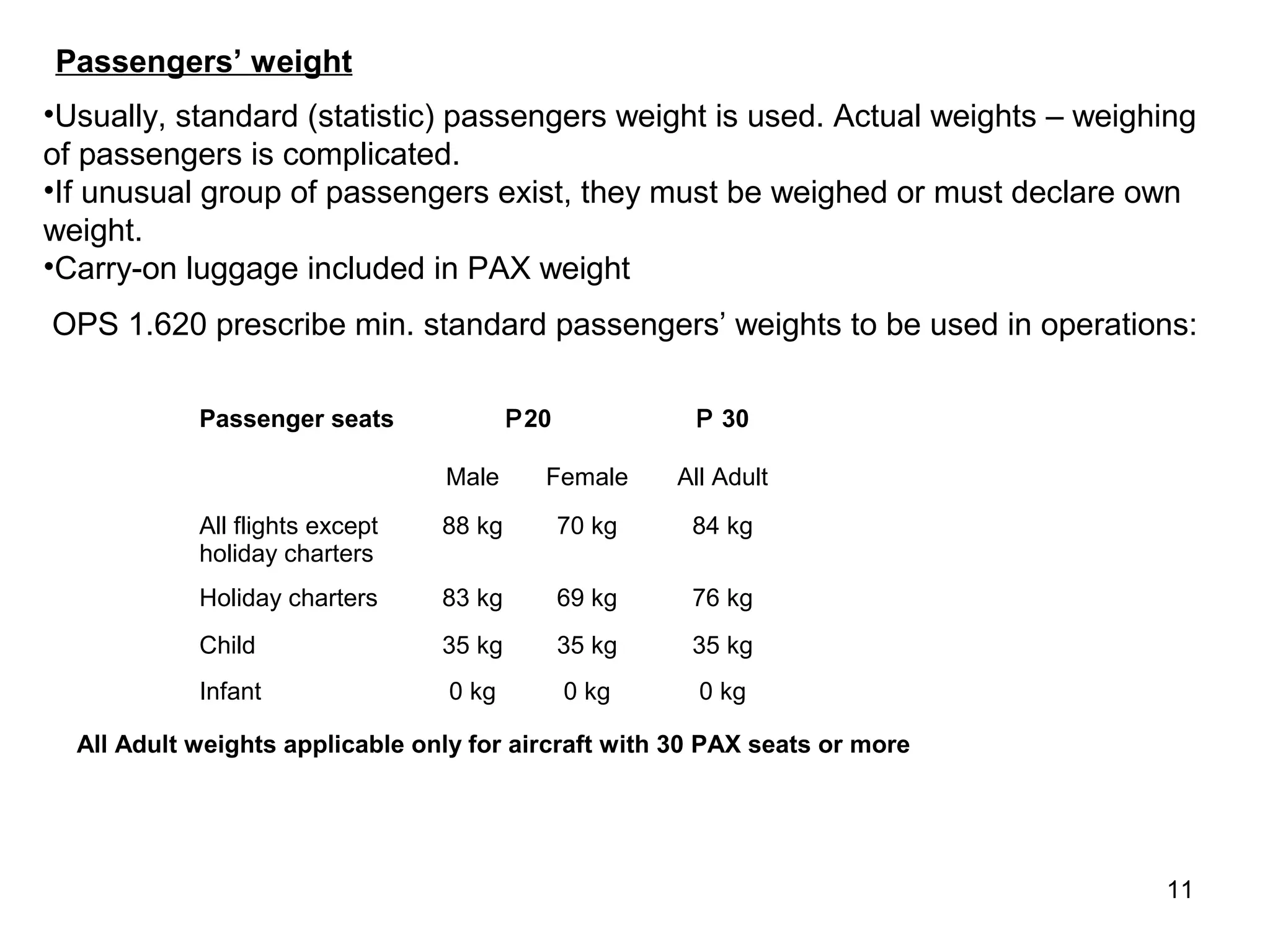
Passengers’ weight
•Usually, standard (statistic) passengers weight is used. Actual weights – weighing
of passengers is complicated.
•If unusual group of passengers exist, they must be weighed or must declare own
weight.
•Carry-on luggage included in PAX weight
OPS 1.620 prescribe min. standard passengers’ weights to be used in operations:

            Passenger seats              P20            P 30

                                 Male      Female      All Adult
            All flights except   88 kg         70 kg    84 kg
            holiday charters
            Holiday charters     83 kg         69 kg    76 kg
            Child                35 kg         35 kg    35 kg
            Infant                0 kg         0 kg      0 kg

  All Adult weights applicable only for aircraft with 30 PAX seats or more


                                                                                11
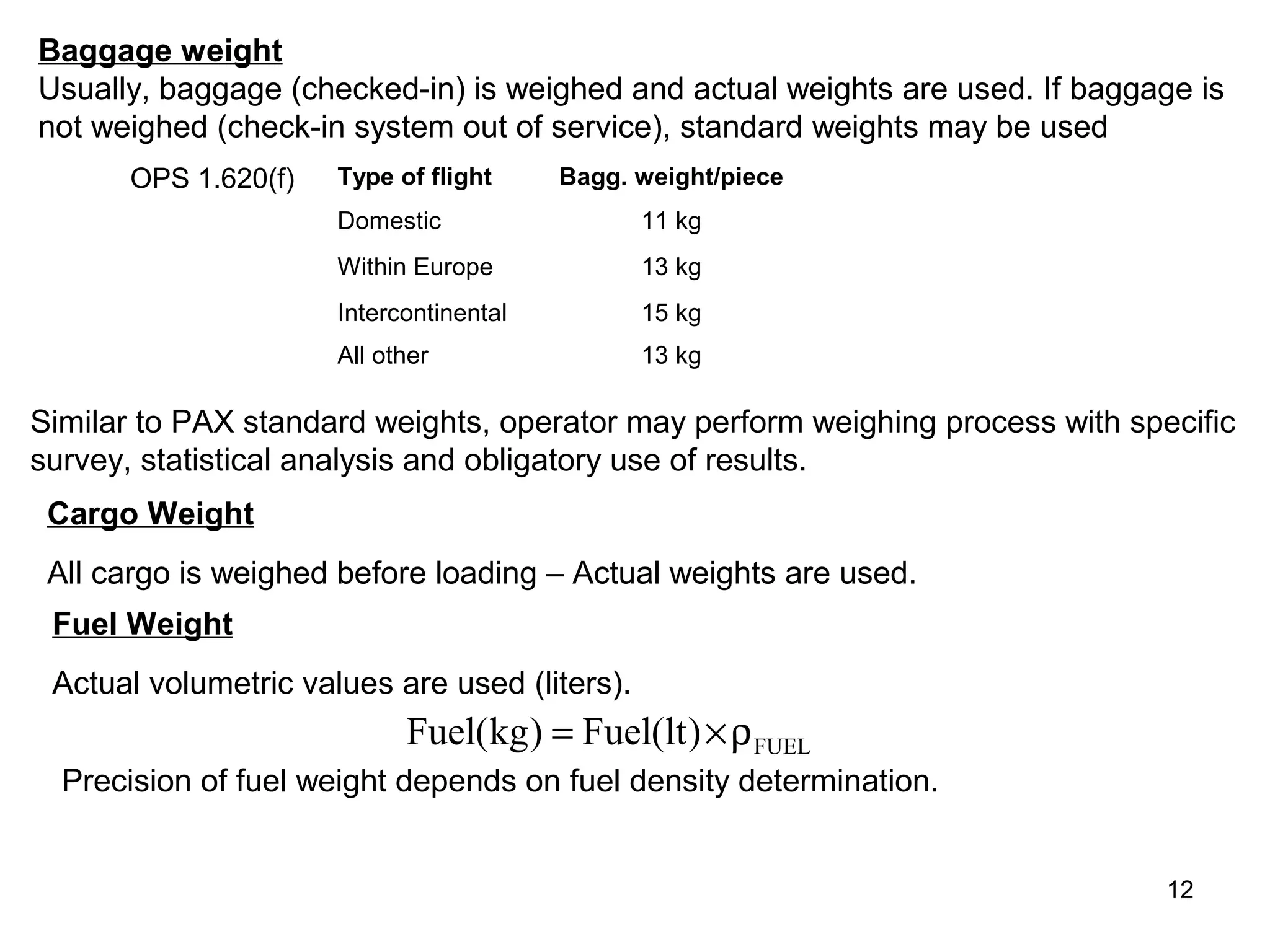
Baggage weight
Usually, baggage (checked-in) is weighed and actual weights are used. If baggage is
not weighed (check-in system out of service), standard weights may be used
      OPS 1.620(f)    Type of flight     Bagg. weight/piece
                      Domestic                 11 kg
                      Within Europe            13 kg
                      Intercontinental         15 kg
                      All other                13 kg

Similar to PAX standard weights, operator may perform weighing process with specific
survey, statistical analysis and obligatory use of results.
 Cargo Weight
 All cargo is weighed before loading – Actual weights are used.
 Fuel Weight
 Actual volumetric values are used (liters).
                            Fuel(kg) = Fuel(lt ) × ρ FUEL
  Precision of fuel weight depends on fuel density determination.


                                                                               12
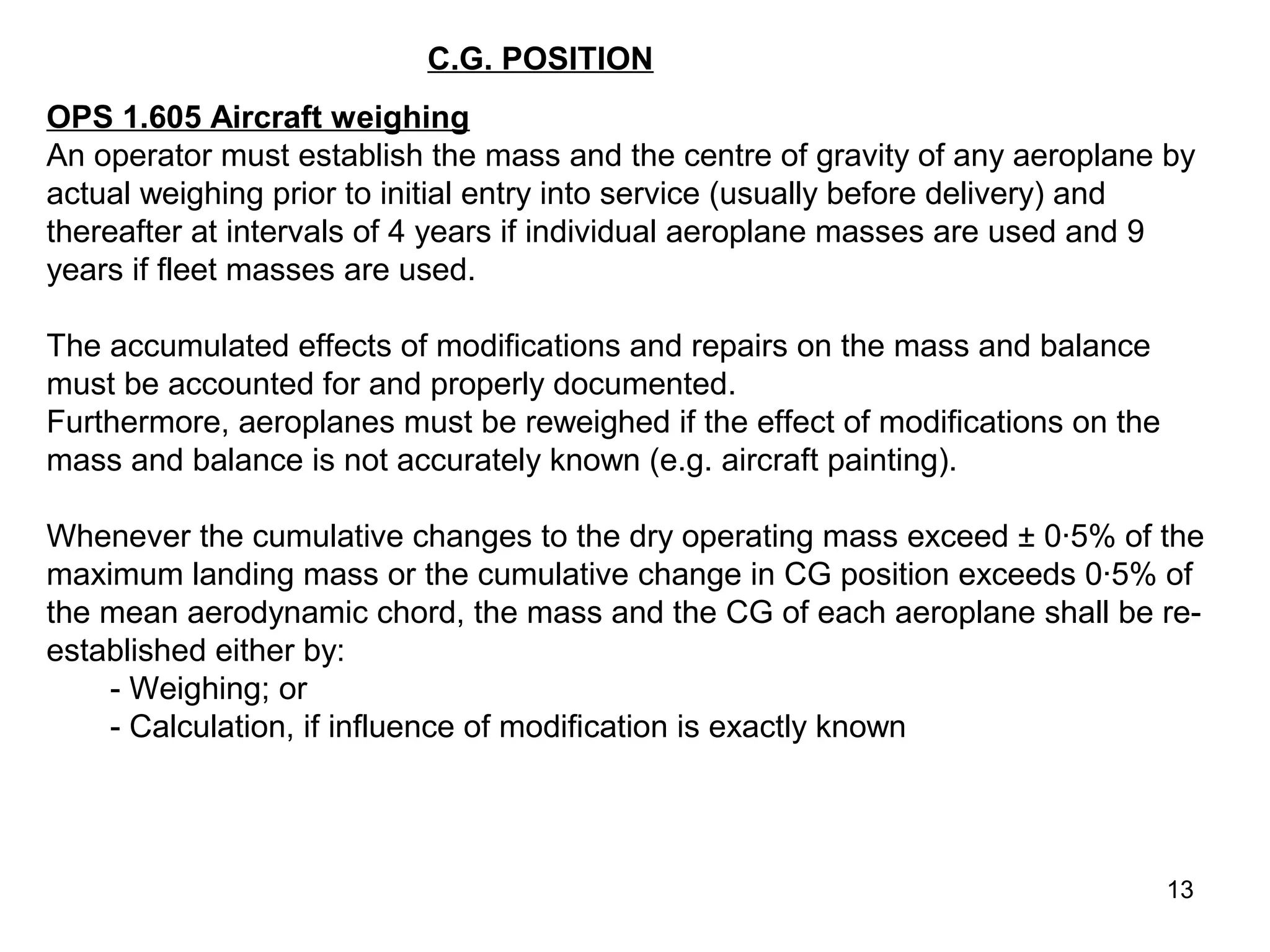
C.G. POSITION
OPS 1.605 Aircraft weighing
An operator must establish the mass and the centre of gravity of any aeroplane by
actual weighing prior to initial entry into service (usually before delivery) and
thereafter at intervals of 4 years if individual aeroplane masses are used and 9
years if fleet masses are used.

The accumulated effects of modifications and repairs on the mass and balance
must be accounted for and properly documented.
Furthermore, aeroplanes must be reweighed if the effect of modifications on the
mass and balance is not accurately known (e.g. aircraft painting).

Whenever the cumulative changes to the dry operating mass exceed ± 0·5% of the
maximum landing mass or the cumulative change in CG position exceeds 0·5% of
the mean aerodynamic chord, the mass and the CG of each aeroplane shall be re-
established either by:
    - Weighing; or
    - Calculation, if influence of modification is exactly known


                                                                                  13
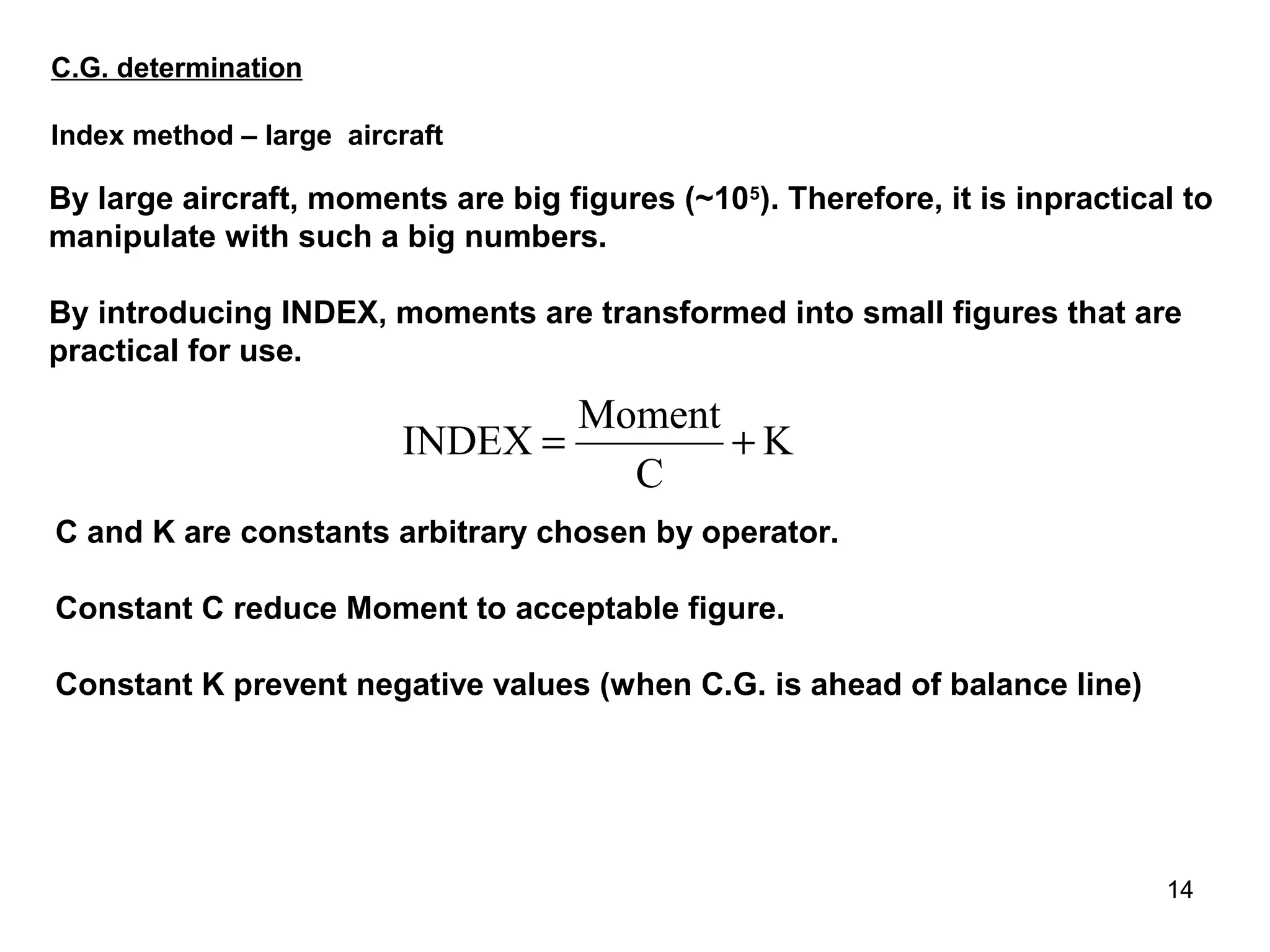
C.G. determination

Index method – large aircraft

By large aircraft, moments are big figures (~105). Therefore, it is inpractical to
manipulate with such a big numbers.

By introducing INDEX, moments are transformed into small figures that are
practical for use.

                                 Moment
                         INDEX =        +K
                                   C
C and K are constants arbitrary chosen by operator.

Constant C reduce Moment to acceptable figure.

Constant K prevent negative values (when C.G. is ahead of balance line)


                                                                              14
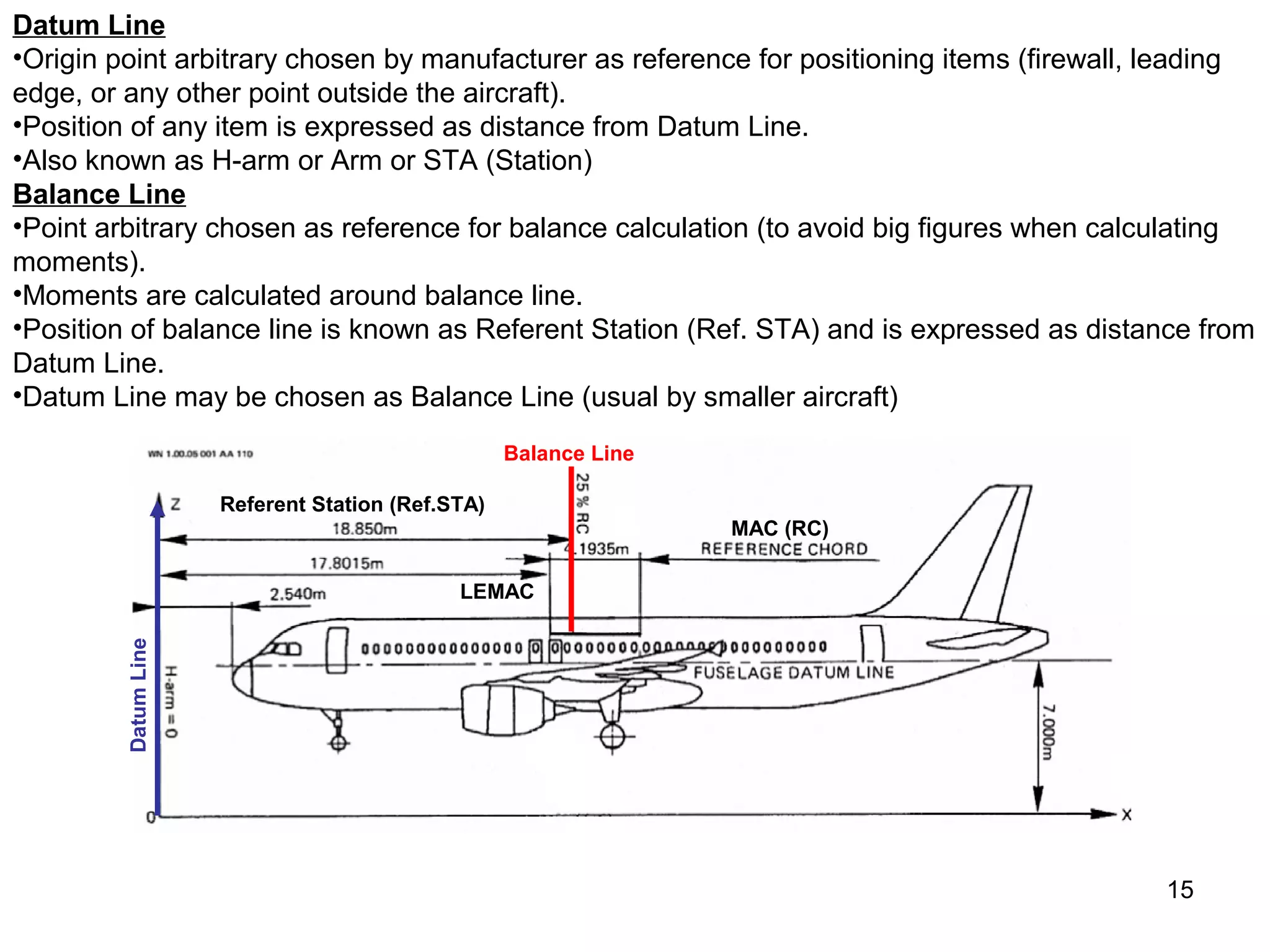
Datum Line
•Origin point arbitrary chosen by manufacturer as reference for positioning items (firewall, leading
edge, or any other point outside the aircraft).
•Position of any item is expressed as distance from Datum Line.
•Also known as H-arm or Arm or STA (Station)
Balance Line
•Point arbitrary chosen as reference for balance calculation (to avoid big figures when calculating
moments).
•Moments are calculated around balance line.
•Position of balance line is known as Referent Station (Ref. STA) and is expressed as distance from
Datum Line.
•Datum Line may be chosen as Balance Line (usual by smaller aircraft)
                                                   Balance Line

                      Referent Station (Ref.STA)
                                                                  MAC (RC)

                                             LEMAC
         Datum Line


                                                                                            15
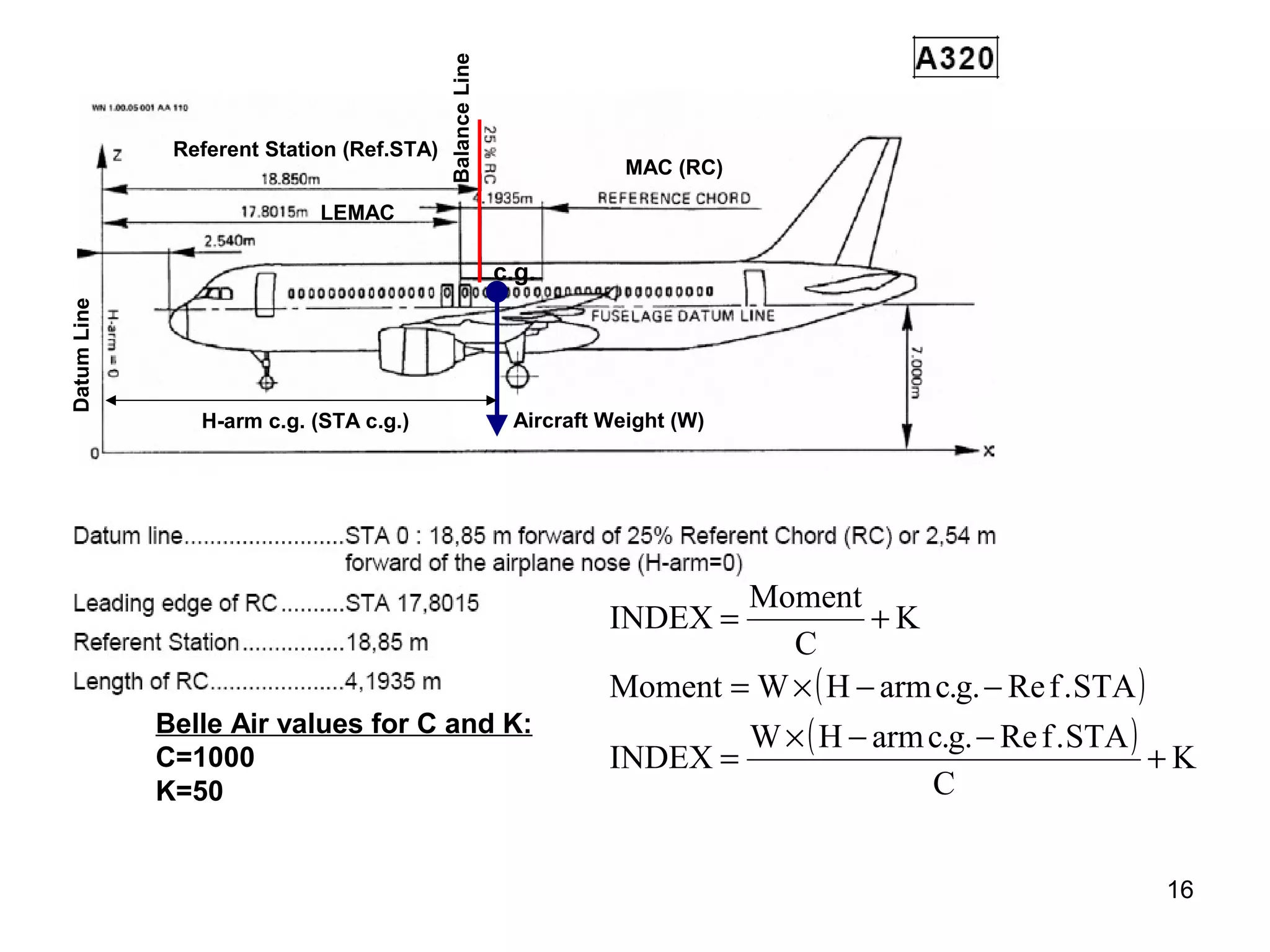
Balance Line
              Referent Station (Ref.STA)
                                                                      MAC (RC)

                            LEMAC

                                                          c.g.
Datum Line


                H-arm c.g. (STA c.g.)                      Aircraft Weight (W)


                                                                            Moment
                                                                    INDEX =           +K
                                                                               C
                                                                    Moment = W × ( H − arm c.g. − Re f . STA )
             Belle Air values for C and K:                                       W × ( H − arm c.g. − Re f . STA )
             C=1000                                                 INDEX =                                        +K
             K=50                                                                              C


                                                                                                                  16
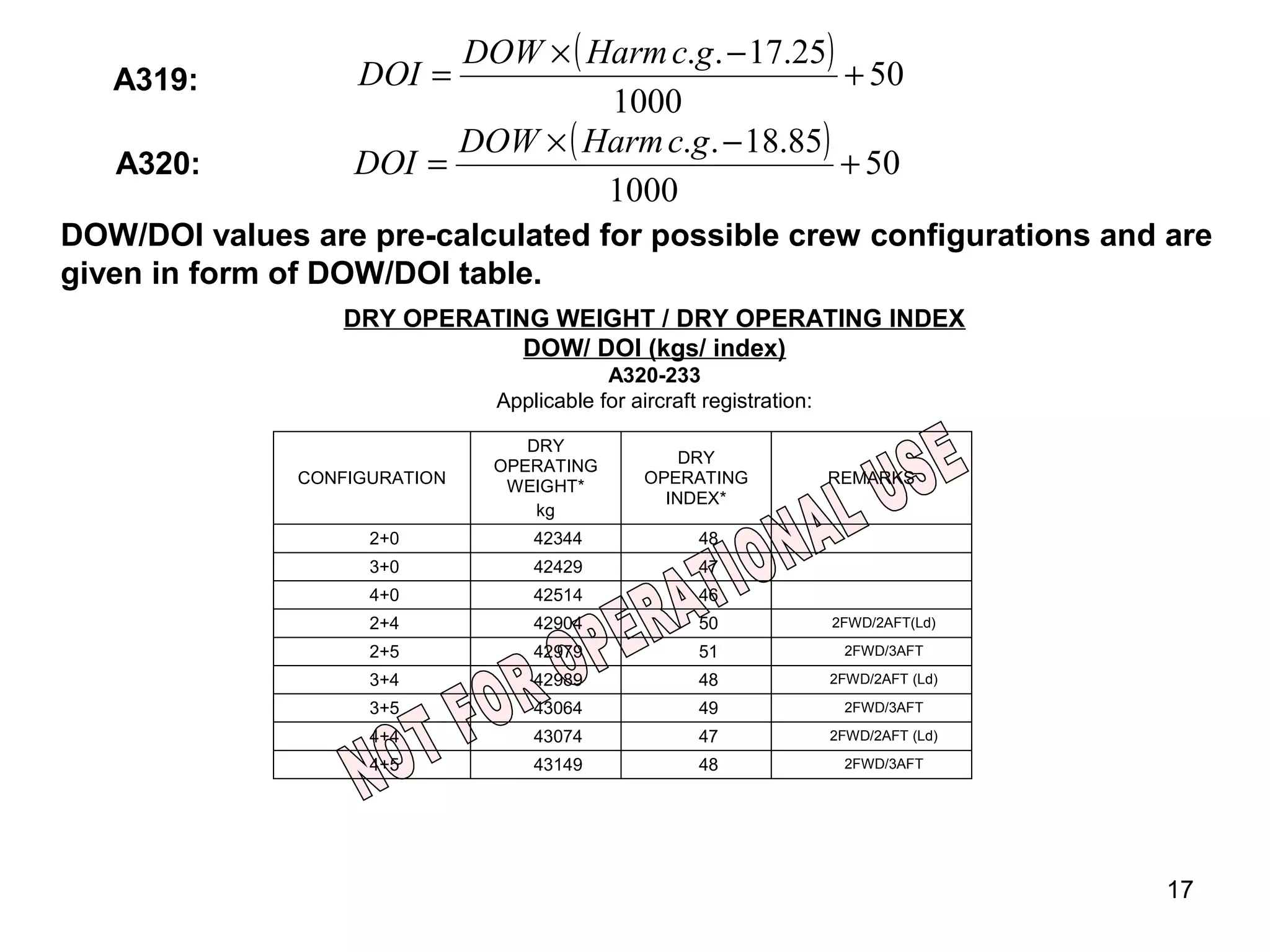
DOW × ( Harm c.g . − 17.25)
   A319:           DOI =                             + 50
                                  1000
                         DOW × ( Harm c.g . − 18.85)
   A320:           DOI =                             + 50
                                  1000
DOW/DOI values are pre-calculated for possible crew configurations and are
given in form of DOW/DOI table.
                   DRY OPERATING WEIGHT / DRY OPERATING INDEX
                               DOW/ DOI (kgs/ index)
                                           A320-233
                               Applicable for aircraft registration:

                                  DRY
                               OPERATING            DRY
               CONFIGURATION    WEIGHT*         OPERATING              REMARKS
                                                  INDEX*
                                   kg
                     2+0           42344              48
                     3+0           42429              47
                     4+0           42514              46
                     2+4           42904              50               2FWD/2AFT(Ld)

                     2+5           42979              51                2FWD/3AFT

                     3+4           42989              48               2FWD/2AFT (Ld)

                     3+5           43064              49                2FWD/3AFT

                     4+4           43074              47               2FWD/2AFT (Ld)

                     4+5           43149              48                2FWD/3AFT


                                                                                        17
Balance Line
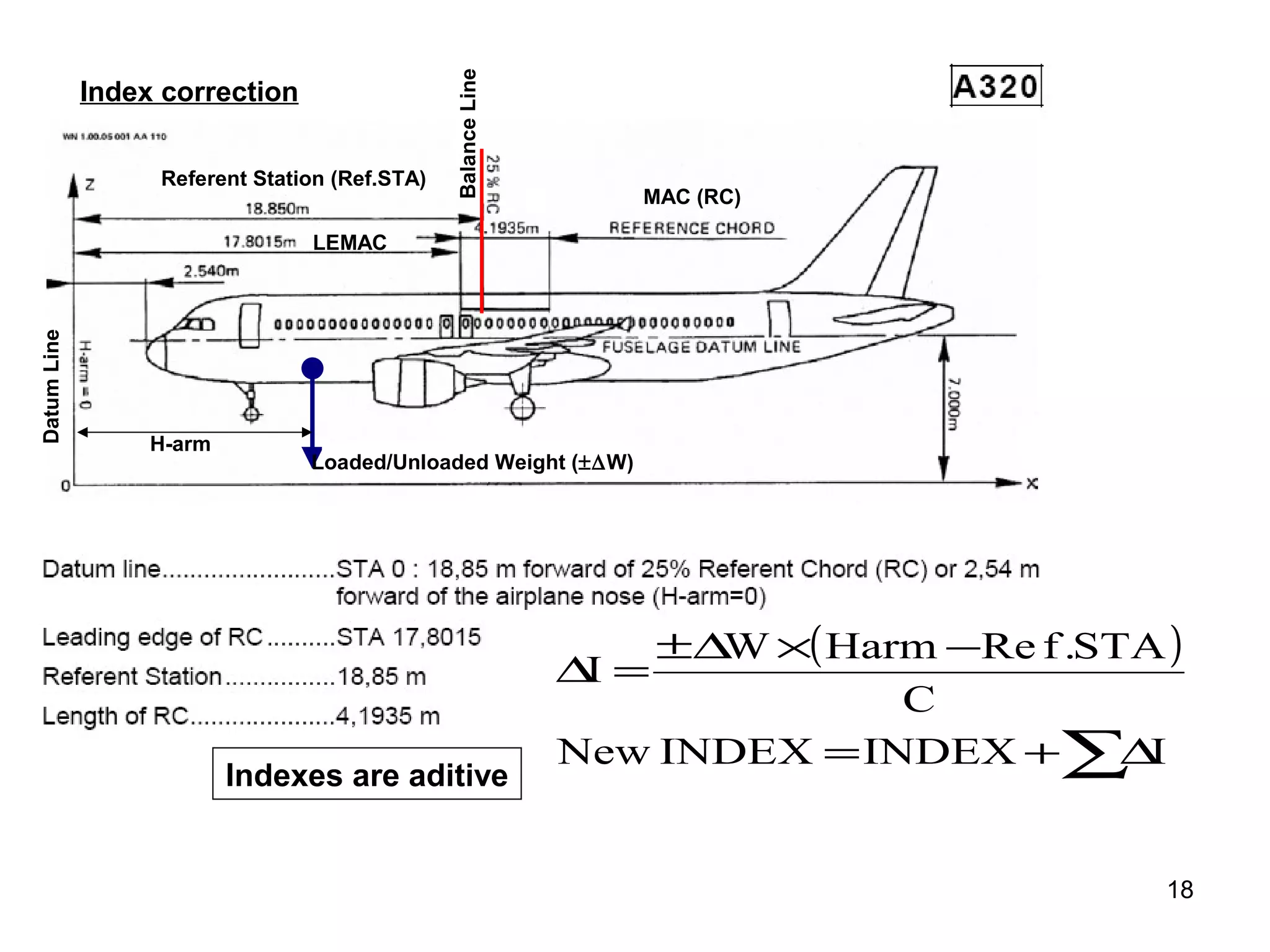
             Index correction

                  Referent Station (Ref.STA)
                                                                 MAC (RC)

                                LEMAC
Datum Line


                  H-arm
                                Loaded/Unloaded Weight (±∆W)


                                                                  ±∆ ×( Harm −Re f .STA )
                                                                    W
                                                              ∆ =
                                                               I
                                                                            C
                                                              New INDEX = INDEX +∑ I  ∆
                          Indexes are aditive


                                                                                        18
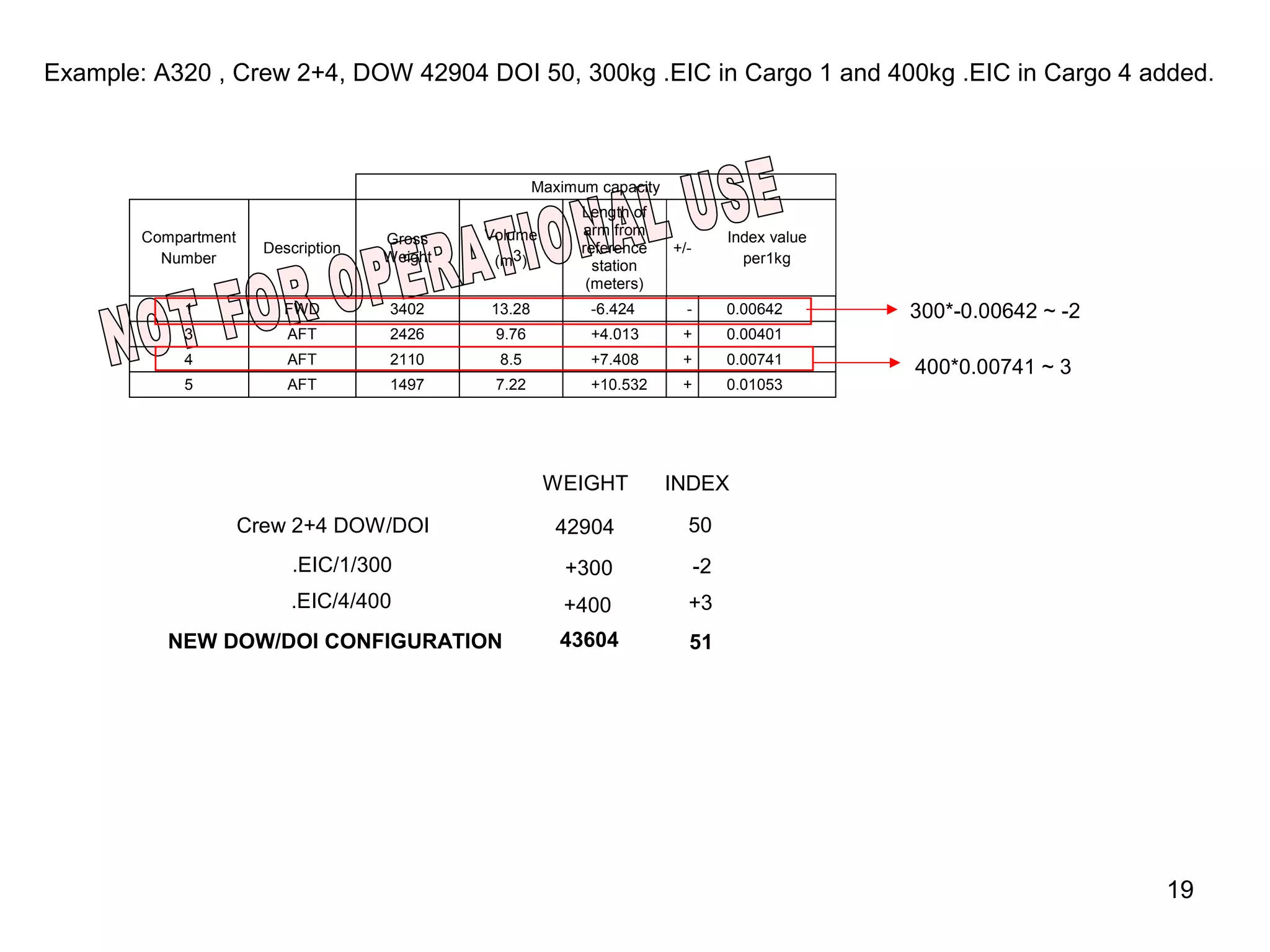
Example: A320 , Crew 2+4, DOW 42904 DOI 50, 300kg .EIC in Cargo 1 and 400kg .EIC in Cargo 4 added.


                                                       Maximum capacity
                                                             Length of
        Compartment                            Volume        arm from                Index value
                                      Gross
                        Description                          reference    +/-
          Number                      Weight    (m3)           station                 per1kg
                                                              (meters)
            1             FWD         3402     13.28          -6.424        -        0.00642       300*-0.00642 ~ -2
            3              AFT        2426      9.76          +4.013       +         0.00401
            4              AFT        2110      8.5           +7.408       +         0.00741
                                                                                                   400*0.00741 ~ 3
            5              AFT        1497      7.22          +10.532      +         0.01053


                                                        WEIGHT            INDEX
                      Crew 2+4 DOW/DOI                   42904              50
                            .EIC/1/300                     +300                 -2
                           .EIC/4/400                      +400             +3
           NEW DOW/DOI CONFIGURATION                      43604             51


                                                                                                                       19
Last Minute Changes (LMC)
  OPS 1.625:
  “An operator must specify procedures for Last Minute Changes to the load.”
  LMC Policy: ??


                                                                               20
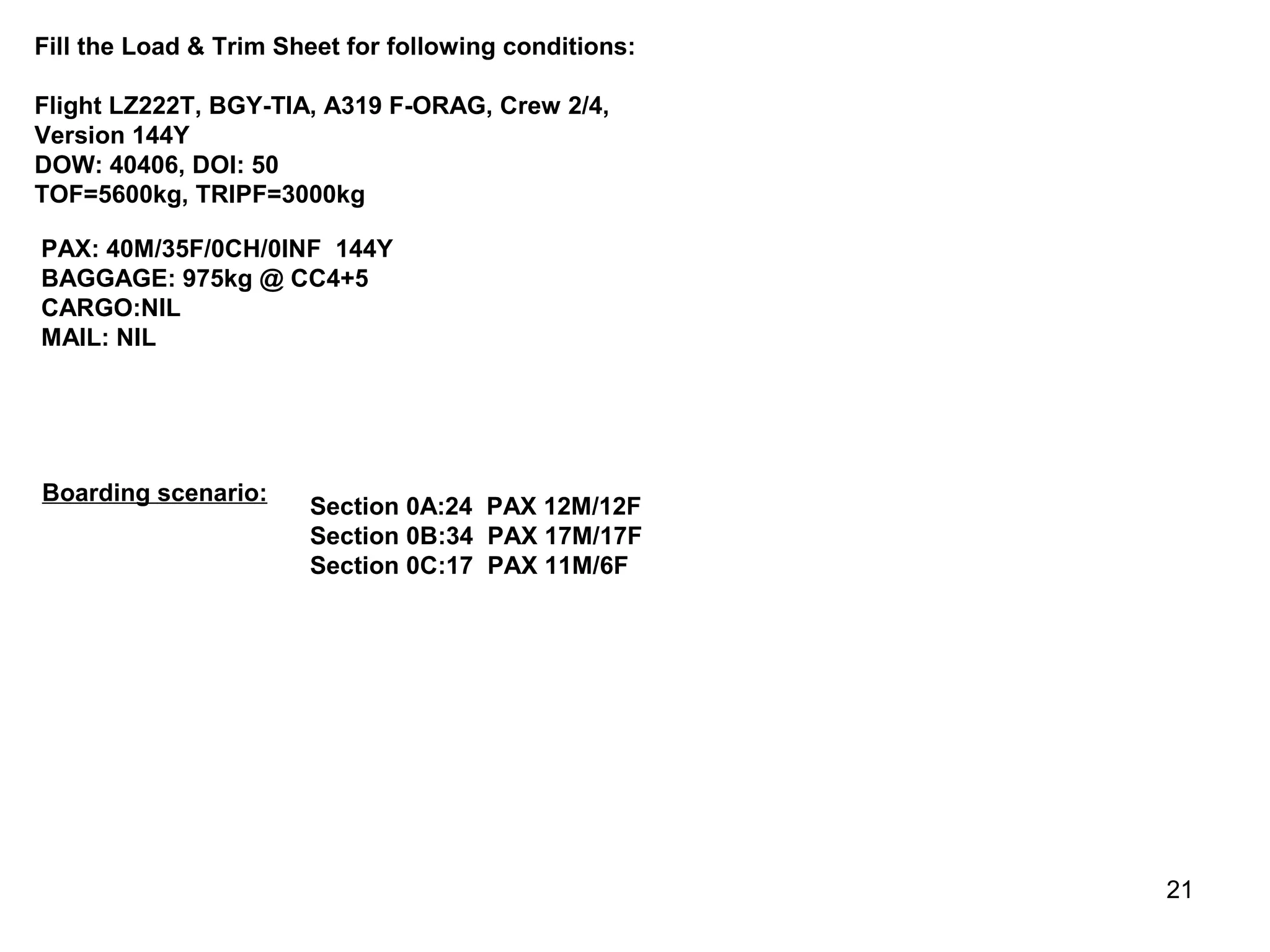
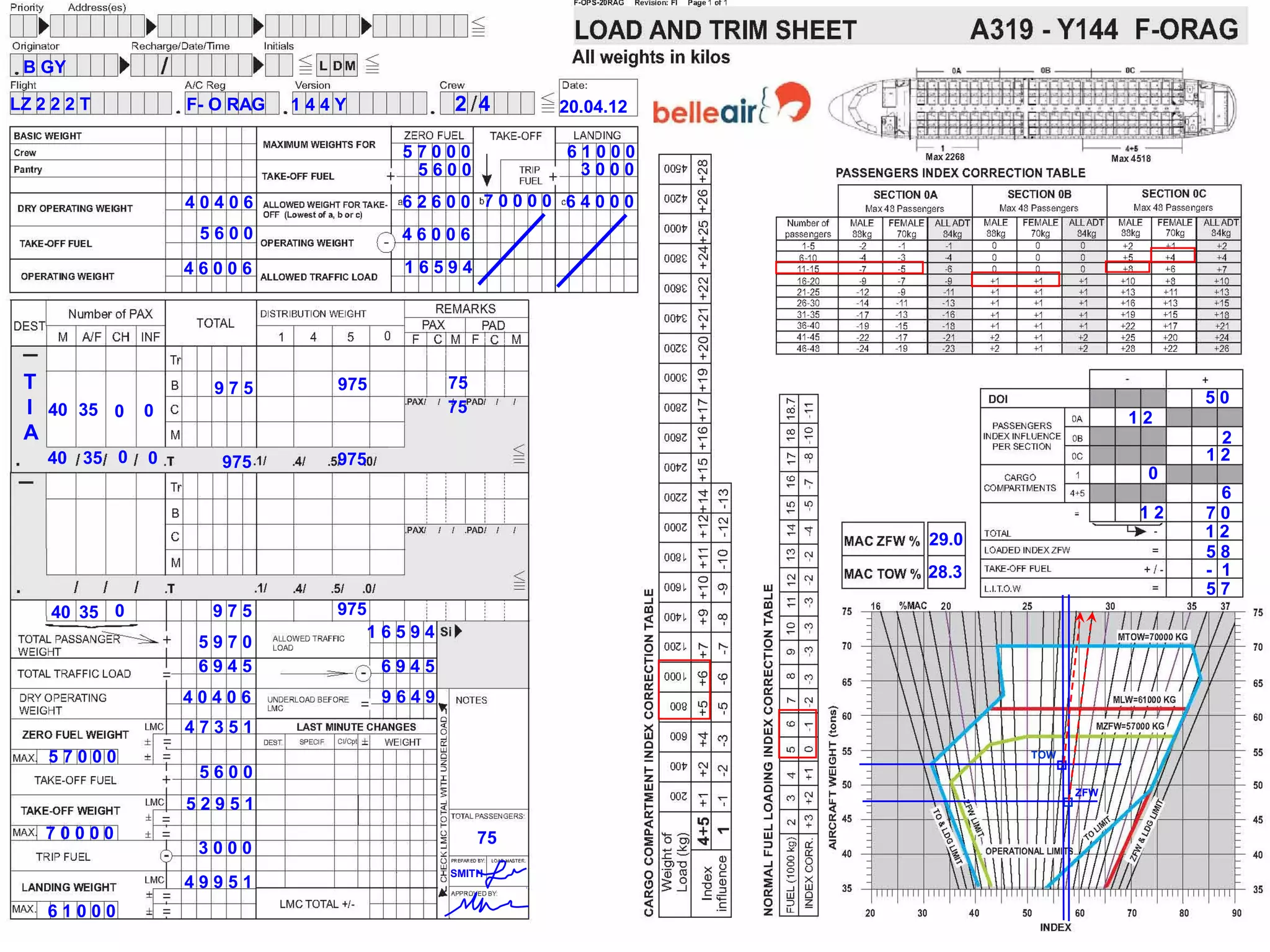
Fill the Load & Trim Sheet for following conditions:

Flight LZ222T, BGY-TIA, A319 F-ORAG, Crew 2/4,
Version 144Y
DOW: 40406, DOI: 50
TOF=5600kg, TRIPF=3000kg

PAX: 40M/35F/0CH/0INF 144Y
BAGGAGE: 975kg @ CC4+5
CARGO:NIL
MAIL: NIL


Boarding scenario:
                       Section 0A:24 PAX 12M/12F
                       Section 0B:34 PAX 17M/17F
                       Section 0C:17 PAX 11M/6F


                                                       21
B GY

LZ 2 2 2 T         F- O RAG   144Y            2 4       20.04.12

                                        57000           61000
                                         5600            3000
                   40406                62600 70000 64000
                    5600                46006
                   46006                16594


 T                   975         975          75
                                                                                                50
 I 40 35 0 0                                  75
                                                                                      12
 A                                                                                               2
    40 35 0    0      975        975                                                            12
                                                                                       0
                                                                                                  6
                                                                                      12        70
                                                                   29.0                         12
                                                                                                58
                                                                   28.3                         - 1
                                                                                                57
     40 35 0         975         975
                                    16594
                    5970
                    6945               6945
                   40406               9649
                   47351
    57000                                                                 TOW
                    5600                                                    
                                                                                ZFW
                   52951                                                        
    70000                                          75
                    3000
                                              SMITH
                   49951
                                                                                           22
    61000
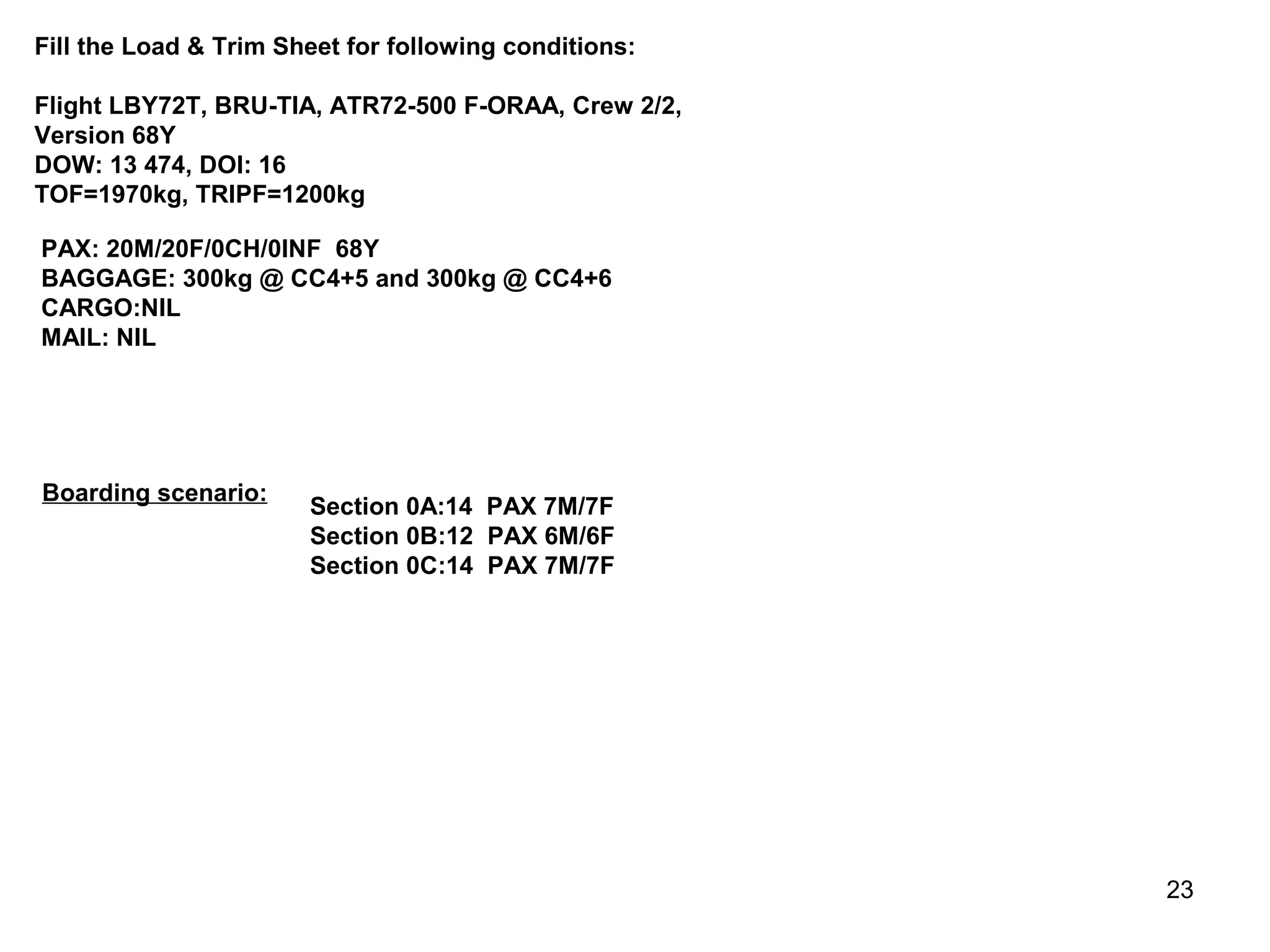
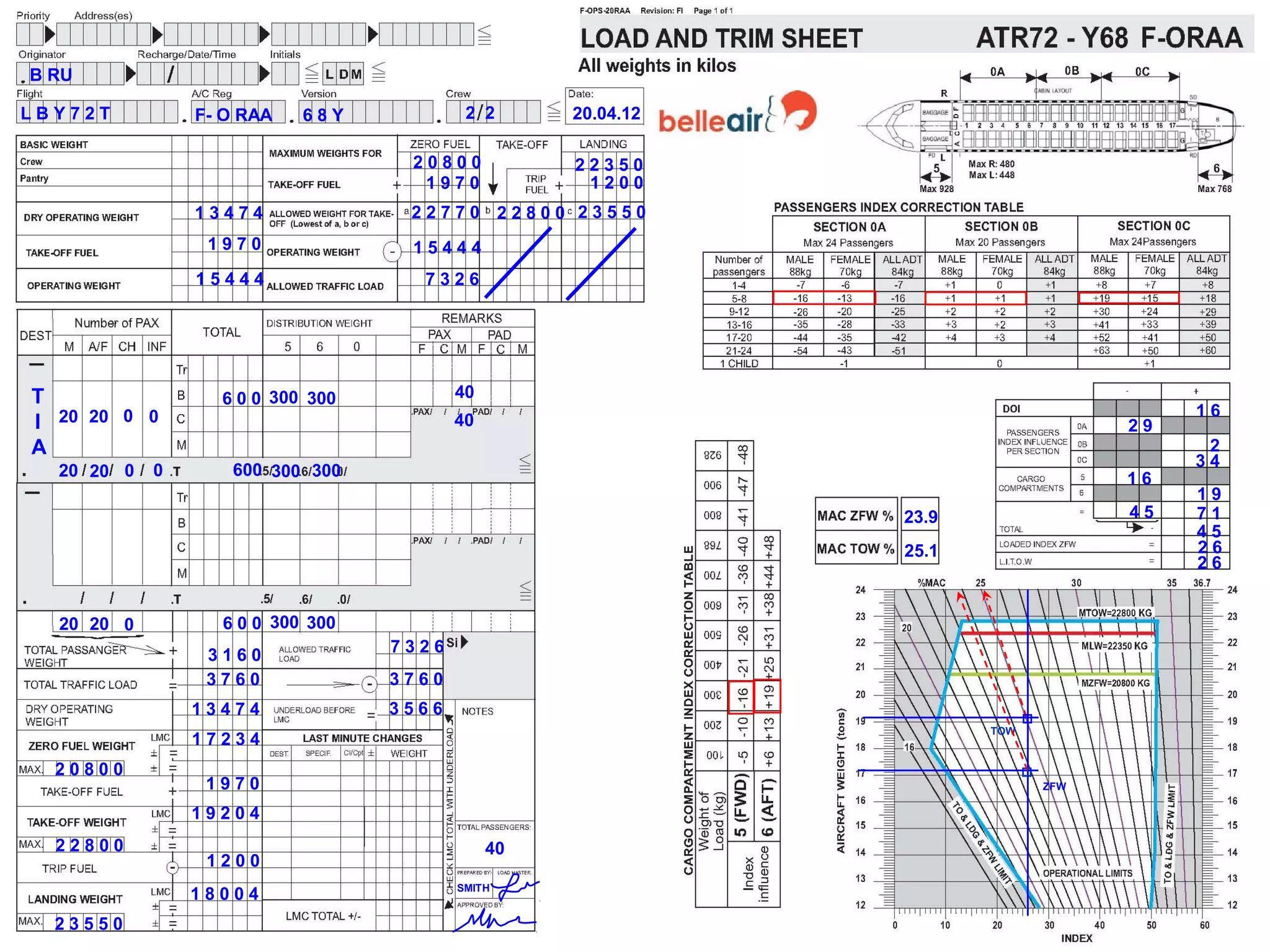
Fill the Load & Trim Sheet for following conditions:

Flight LBY72T, BRU-TIA, ATR72-500 F-ORAA, Crew 2/2,
Version 68Y
DOW: 13 474, DOI: 16
TOF=1970kg, TRIPF=1200kg

PAX: 20M/20F/0CH/0INF 68Y
BAGGAGE: 300kg @ CC4+5 and 300kg @ CC4+6
CARGO:NIL
MAIL: NIL


Boarding scenario:
                       Section 0A:14 PAX 7M/7F
                       Section 0B:12 PAX 6M/6F
                       Section 0C:14 PAX 7M/7F


                                                       23
B RU

LBY72T          F- O RAA   68Y            2 2      20.04.12

                                   20800           22350
                                    1970            1200
                13474              22770 22800 23550
                 1970              15444
                15444               7326


T                 6 0 0 300 300          40
                                                                                               16
I 20 20 0 0                              40                                          29
A                                                                                               2
                                                                                               34
  20 20 0   0      600 300 300                                                       16
                                                                                               19
                                                              23.9                   45        71
                                                                                               45
                                                              25.1                             26
                                                                                               26


  20 20 0         6 0 0 300 300
                 3160             7326
                 3760             3760
                13474             3566
                                                                           
                                                                     TOW
                17234
  20800                                                                    
                 1970                                                          ZFW

                19204
  22800                                       40
                 1200
                18004                    SMITH
                                                                                          24
  23550

Mass and Balance

  • 1.
  • 2.
    Aircraft stability dependsdirectly of C.G. position Static stability: W W Aircraft must be in static stability in whole flight regimes. Therefore, C.G. position must be always ahead of Aerodynamic Centre i.e. Centre of Wing’s Lift (Centre of Pressure). 2
  • 3.
    Influence of C.G.position on aircraft performance V2 TOD VS VREF ALD 3
  • 4.
    MORE FWD C.G.=> DRAG FUEL CONSUMPTION MORE AFT C.G. => DRAG FUEL CONSUMPTION 4
  • 5.
    C.G. LIMITS Range of C.G. position (FWD & AFT limit) C.G. Aft Forward Mean Aerodynamic Chord. limit limit The CG position is expressed as a percentage of the Mean Aerodynamic Chord (MAC) / Referent Chord (RC). It must remain between a forward and an aft limit depending on the aircraft weight. 5
  • 6.
    C.G. Envelope Weight MIT LI FWD IMIT AFT L C.G. position (H-arm) 6
  • 7.
    Certified vs. OperationalC.G. limits Certified Limits •Limits determined during aircraft testing phase (only flight crew onboard, no PAX, no CARGO). •Certified C.G. envelope are published in the AFM and WBM Operational Limits •Certified Limits accounted for possible errors during operations: •standard PAX weight error •pax/crew movement during flight (catering service, toilette) •fuel density error •movable parts error (landing gear, flaps/slats) •cargo distribution error •PAX distribution error •human accuracy error (balance chart on manual loadsheet) •Operational C.G. envelope to be used in operations (published on the Loadsheet form). 7
  • 8.
    Errors affecting C.G.position are expressed in term of narrower C.G. envelope limits – certified limits become operational limits. Certified limits (AFM) Operational limits (Loadsheet) ng n di La ff eo k Ta W ZF ing nd La & off ke Ta Accounted for errors 8
  • 9.
    WEIGHTS Ramp Weight MRW Weight of aircraft at block-off. MTOW Taxi fuel Actual Takeoff Weight (ATOW) Weight of aircraft at beginning of takeoff (line-up position). + Traffic Load (TL) - Trip fuel Takeoff fuel(TOF) Weight of total payable load (PAX, (TRIPF) BAGG, CARGO, MAIL). and other load. MLW Actual Landing Weight (ALW) Operating Weight (OW) Weight of aircraft at landing at destination - Reserve Weight of aircraft ready for operations, fuel without payload (ready for embarkation MZFW + Takeoff Fuel Actual Zero Fuel Weight (AZFW) of passengers and baggage/cargo). Weight of total usable fuel onboard Weight of aircraft in flight when all usable aircraft at beginning of takeoff fuel is burned (engine shut down) (line-up position). Structural/performance limited weights: Dry Operating Weight (DOW) / Operating Empty Weight (OEW) •MRW: Max. Ramp Weight + Operator’s Items Weight of aircraft ready for operations, without fuel and payload. •MTOW: Max. Takeoff weight Weight of items added by the Operator: Crew & crew’s baggage, •MLW: Max. Landing Weight Catering, Catering removable equipment, Potable water, Toilet •MZFW: Max. Zero Fuel Weight Manufacturer’s Empty Weight fluids, Documentation, ... (MEW) / Basic Empty Weight / Relations: Basic Weight Weight of structure, power plant, •DOW + PL=AZFW systems and other items that are integral part of the aircraft, •AZFW+TOF=ATOW including fluids inclosed systems (hydraulic oil,...) •ATOW-TRIPF=ALW 9
  • 10.
    MAX. TRAFFIC LOADCALCULATION MAX. TL = MATOW – TOF – DOW MTOWSTRUCT MTOWTAKEOFF = Min. of MTOWT/O PERF. MATOW – Max. MLWSTRUCT Allow. Take Off = Min. of MLW + TRIPF ; MLW = Min. of Weight MLWLDG PERF. MZFW + TOF 10
  • 11.
    Passengers’ weight •Usually, standard(statistic) passengers weight is used. Actual weights – weighing of passengers is complicated. •If unusual group of passengers exist, they must be weighed or must declare own weight. •Carry-on luggage included in PAX weight OPS 1.620 prescribe min. standard passengers’ weights to be used in operations: Passenger seats P20 P 30 Male Female All Adult All flights except 88 kg 70 kg 84 kg holiday charters Holiday charters 83 kg 69 kg 76 kg Child 35 kg 35 kg 35 kg Infant 0 kg 0 kg 0 kg All Adult weights applicable only for aircraft with 30 PAX seats or more 11
  • 12.
    Baggage weight Usually, baggage(checked-in) is weighed and actual weights are used. If baggage is not weighed (check-in system out of service), standard weights may be used OPS 1.620(f) Type of flight Bagg. weight/piece Domestic 11 kg Within Europe 13 kg Intercontinental 15 kg All other 13 kg Similar to PAX standard weights, operator may perform weighing process with specific survey, statistical analysis and obligatory use of results. Cargo Weight All cargo is weighed before loading – Actual weights are used. Fuel Weight Actual volumetric values are used (liters). Fuel(kg) = Fuel(lt ) × ρ FUEL Precision of fuel weight depends on fuel density determination. 12
  • 13.
    C.G. POSITION OPS 1.605Aircraft weighing An operator must establish the mass and the centre of gravity of any aeroplane by actual weighing prior to initial entry into service (usually before delivery) and thereafter at intervals of 4 years if individual aeroplane masses are used and 9 years if fleet masses are used. The accumulated effects of modifications and repairs on the mass and balance must be accounted for and properly documented. Furthermore, aeroplanes must be reweighed if the effect of modifications on the mass and balance is not accurately known (e.g. aircraft painting). Whenever the cumulative changes to the dry operating mass exceed ± 0·5% of the maximum landing mass or the cumulative change in CG position exceeds 0·5% of the mean aerodynamic chord, the mass and the CG of each aeroplane shall be re- established either by: - Weighing; or - Calculation, if influence of modification is exactly known 13
  • 14.
    C.G. determination Index method– large aircraft By large aircraft, moments are big figures (~105). Therefore, it is inpractical to manipulate with such a big numbers. By introducing INDEX, moments are transformed into small figures that are practical for use. Moment INDEX = +K C C and K are constants arbitrary chosen by operator. Constant C reduce Moment to acceptable figure. Constant K prevent negative values (when C.G. is ahead of balance line) 14
  • 15.
    Datum Line •Origin pointarbitrary chosen by manufacturer as reference for positioning items (firewall, leading edge, or any other point outside the aircraft). •Position of any item is expressed as distance from Datum Line. •Also known as H-arm or Arm or STA (Station) Balance Line •Point arbitrary chosen as reference for balance calculation (to avoid big figures when calculating moments). •Moments are calculated around balance line. •Position of balance line is known as Referent Station (Ref. STA) and is expressed as distance from Datum Line. •Datum Line may be chosen as Balance Line (usual by smaller aircraft) Balance Line Referent Station (Ref.STA) MAC (RC) LEMAC Datum Line 15
  • 16.
    Balance Line Referent Station (Ref.STA) MAC (RC) LEMAC c.g. Datum Line H-arm c.g. (STA c.g.) Aircraft Weight (W) Moment INDEX = +K C Moment = W × ( H − arm c.g. − Re f . STA ) Belle Air values for C and K: W × ( H − arm c.g. − Re f . STA ) C=1000 INDEX = +K K=50 C 16
  • 17.
    DOW × (Harm c.g . − 17.25) A319: DOI = + 50 1000 DOW × ( Harm c.g . − 18.85) A320: DOI = + 50 1000 DOW/DOI values are pre-calculated for possible crew configurations and are given in form of DOW/DOI table. DRY OPERATING WEIGHT / DRY OPERATING INDEX DOW/ DOI (kgs/ index) A320-233 Applicable for aircraft registration: DRY OPERATING DRY CONFIGURATION WEIGHT* OPERATING REMARKS INDEX* kg 2+0 42344 48 3+0 42429 47 4+0 42514 46 2+4 42904 50 2FWD/2AFT(Ld) 2+5 42979 51 2FWD/3AFT 3+4 42989 48 2FWD/2AFT (Ld) 3+5 43064 49 2FWD/3AFT 4+4 43074 47 2FWD/2AFT (Ld) 4+5 43149 48 2FWD/3AFT 17
  • 18.
    Balance Line Index correction Referent Station (Ref.STA) MAC (RC) LEMAC Datum Line H-arm Loaded/Unloaded Weight (±∆W) ±∆ ×( Harm −Re f .STA ) W ∆ = I C New INDEX = INDEX +∑ I ∆ Indexes are aditive 18
  • 19.
    Example: A320 ,Crew 2+4, DOW 42904 DOI 50, 300kg .EIC in Cargo 1 and 400kg .EIC in Cargo 4 added. Maximum capacity Length of Compartment Volume arm from Index value Gross Description reference +/- Number Weight (m3) station per1kg (meters) 1 FWD 3402 13.28 -6.424 - 0.00642 300*-0.00642 ~ -2 3 AFT 2426 9.76 +4.013 + 0.00401 4 AFT 2110 8.5 +7.408 + 0.00741 400*0.00741 ~ 3 5 AFT 1497 7.22 +10.532 + 0.01053 WEIGHT INDEX Crew 2+4 DOW/DOI 42904 50 .EIC/1/300 +300 -2 .EIC/4/400 +400 +3 NEW DOW/DOI CONFIGURATION 43604 51 19
  • 20.
    Last Minute Changes(LMC) OPS 1.625: “An operator must specify procedures for Last Minute Changes to the load.” LMC Policy: ?? 20
  • 21.
    Fill the Load& Trim Sheet for following conditions: Flight LZ222T, BGY-TIA, A319 F-ORAG, Crew 2/4, Version 144Y DOW: 40406, DOI: 50 TOF=5600kg, TRIPF=3000kg PAX: 40M/35F/0CH/0INF 144Y BAGGAGE: 975kg @ CC4+5 CARGO:NIL MAIL: NIL Boarding scenario: Section 0A:24 PAX 12M/12F Section 0B:34 PAX 17M/17F Section 0C:17 PAX 11M/6F 21
  • 22.
    B GY LZ 22 2 T F- O RAG 144Y 2 4 20.04.12 57000 61000 5600 3000 40406 62600 70000 64000 5600 46006 46006 16594 T 975 975 75 50 I 40 35 0 0 75 12 A 2 40 35 0 0 975 975 12 0 6 12 70 29.0 12 58 28.3 - 1 57 40 35 0 975 975 16594 5970 6945 6945 40406 9649 47351 57000 TOW 5600  ZFW 52951  70000 75 3000 SMITH 49951 22 61000
  • 23.
    Fill the Load& Trim Sheet for following conditions: Flight LBY72T, BRU-TIA, ATR72-500 F-ORAA, Crew 2/2, Version 68Y DOW: 13 474, DOI: 16 TOF=1970kg, TRIPF=1200kg PAX: 20M/20F/0CH/0INF 68Y BAGGAGE: 300kg @ CC4+5 and 300kg @ CC4+6 CARGO:NIL MAIL: NIL Boarding scenario: Section 0A:14 PAX 7M/7F Section 0B:12 PAX 6M/6F Section 0C:14 PAX 7M/7F 23
  • 24.
    B RU LBY72T F- O RAA 68Y 2 2 20.04.12 20800 22350 1970 1200 13474 22770 22800 23550 1970 15444 15444 7326 T 6 0 0 300 300 40 16 I 20 20 0 0 40 29 A 2 34 20 20 0 0 600 300 300 16 19 23.9 45 71 45 25.1 26 26 20 20 0 6 0 0 300 300 3160 7326 3760 3760 13474 3566  TOW 17234 20800  1970 ZFW 19204 22800 40 1200 18004 SMITH 24 23550