What is the
big deal about
ageing aircraft?
Submitted By:
KANHAIYA KUMAR
MECHANICAL 5TH SEM
IT-GURU GHASIDAS
UNIVERSITY,BILASPUR,(C.G)
What is age ?
1.Chronological
age.
• 25-30
Years
2.Flight Hours.
• 40000-60000
Hours
3.Flight cycles.
• 45000-50000
cycles
• There is no single criteria that defines an
aircraft as ‘old’ (Kizer, 1989).
• Determining the age of the aircraft is further
complicated by the fact that individual aircraft
components age differently depending on
variable factors.
• Parallels with human.
Areas common to airplanes that are
typically susceptible to ageing :
 • Engine
 • Fuel System
 • Propeller
 • Controls
 • Fuselage
 • Electrical Systems
 • Instruments
 • Empennage
 • Landing Gear
 • Wing
Three main aspects of ageing of aircraft:
Fatigue
Maintenance
Safety
Effects of
Ageing:
 Fatigue Damage
 Component failure
 Structural failure
 Corrosion
 Environmental
Degradation
 Wiring failure
 Fatigue: cyclic loading
 Environment exposed
 Extremes of Temperature
And Moisture
 Wear
 Deterioration
 corrosion
Ageing
Mechanisms:
An airplane spends far more time on the ground
than it does in the air.
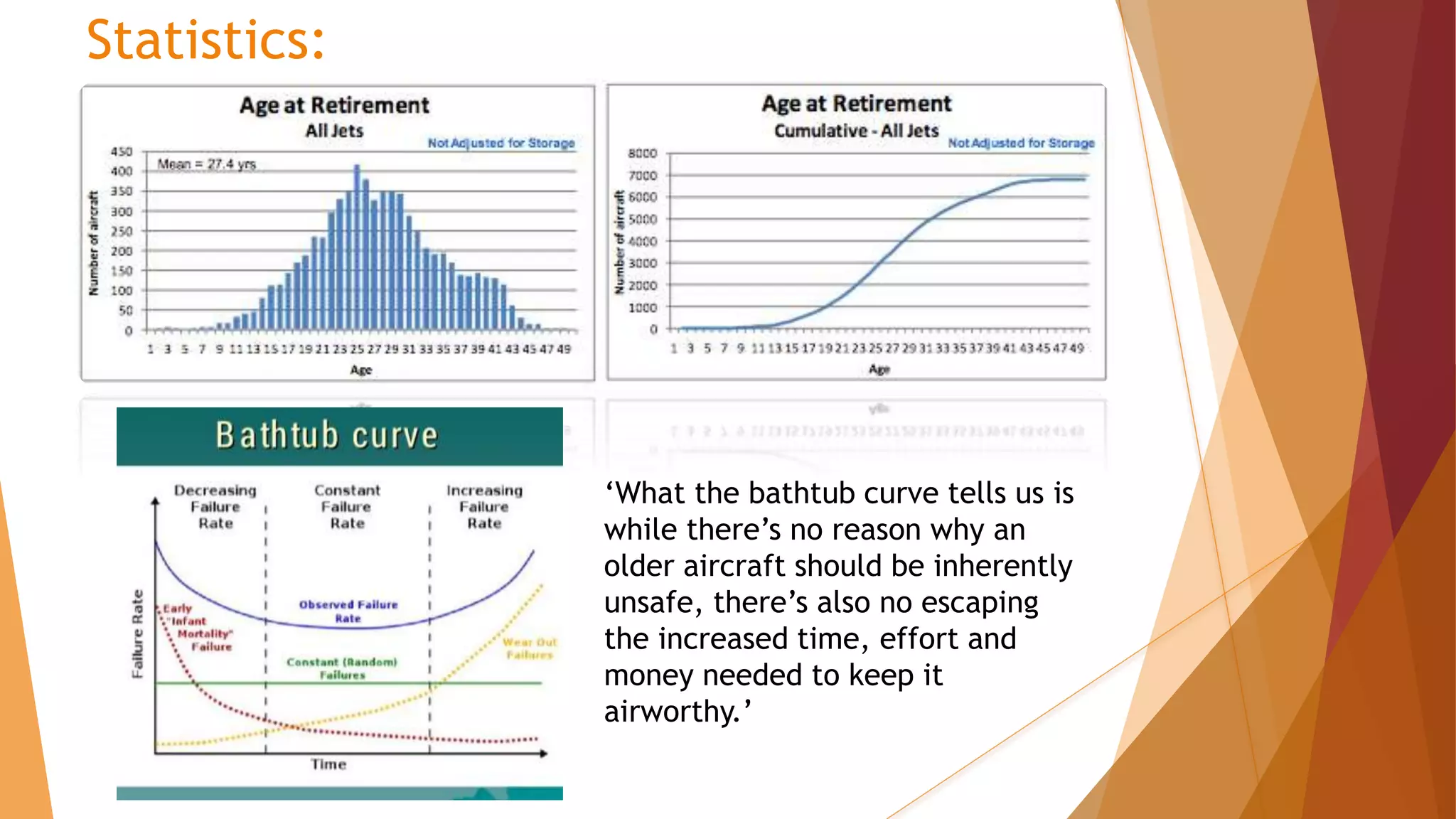
Statistics:
‘What the bathtub curve tells us is
while there’s no reason why an
older aircraft should be inherently
unsafe, there’s also no escaping
the increased time, effort and
money needed to keep it
airworthy.’
Aerospace Industry Worldwide
• Global Aerospace and Defense Projections
• Most aircraft(96%) have retirement age of 25.2436 years
• In Africa maintenance is not up to global standards and
environmental factor have result in early retirement of 20 years
Accidents statistics:
 Accidents were defined as events where the aircraft sustained
substantial damage, became missing or completely inaccessible as
well as events where fatal or serious injury resulted from being in
the airplane or direct contact with the airplane or its jet blast.
 Fatal accidents were defined as accidents which resulted in a fatal
injury.
52%
13%
35%
Accidents distribution
Fatal
accidents
Normal
others
Aloha Airlines flight 243 is an example of corrosion and fatigue
interacting to produce the failure of a structure.
Approximately 5.5 metres of the cabin skin and supporting structure
separated from the aircraft, leading to the decompression.
 Although the aircraft sustained extensive structural damage, it was
able to land safely.
 Aloha flight 243 crashed due to
ageing, due to high flight cycles,
ductile tearing.
Case Study: Corrosion and fatigue – Aloha flight
243, 1988
 At the time of the accident, the
aircraft was 19 years old and had
completed 89,680 take-offs and
landings, with an average flight time
of 25 minutes
Maintenance in ageing aircraft:
 In 7 out of14 recent major accidents, deficient
maintenance is the culprit.
 15% increased inspection time for 10 years of
age.(Robinson)
 Shortage of skilled maintenance staff and existing staff
over stressed.
 Staff spend around 25-40% time for documentation
 Sometimes diagnosis can be wrong due to human
judgement
 Modern aircraft have thousands of sensors, which stored
failure history on ground databases.
 Data stored remains stagnant due to large complexity.
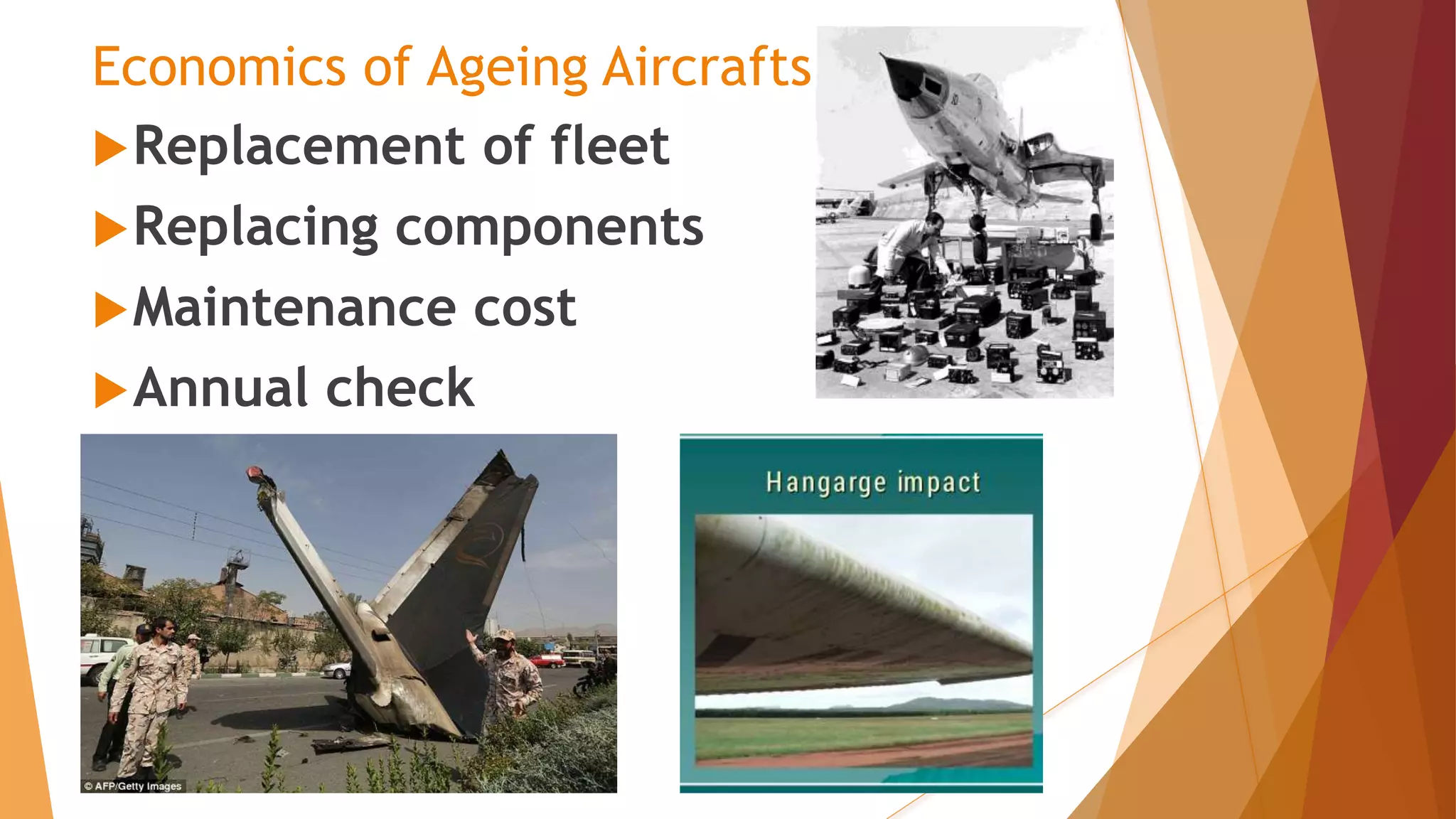
Economics of Ageing Aircrafts
Replacement of fleet
Replacing components
Maintenance cost
Annual check
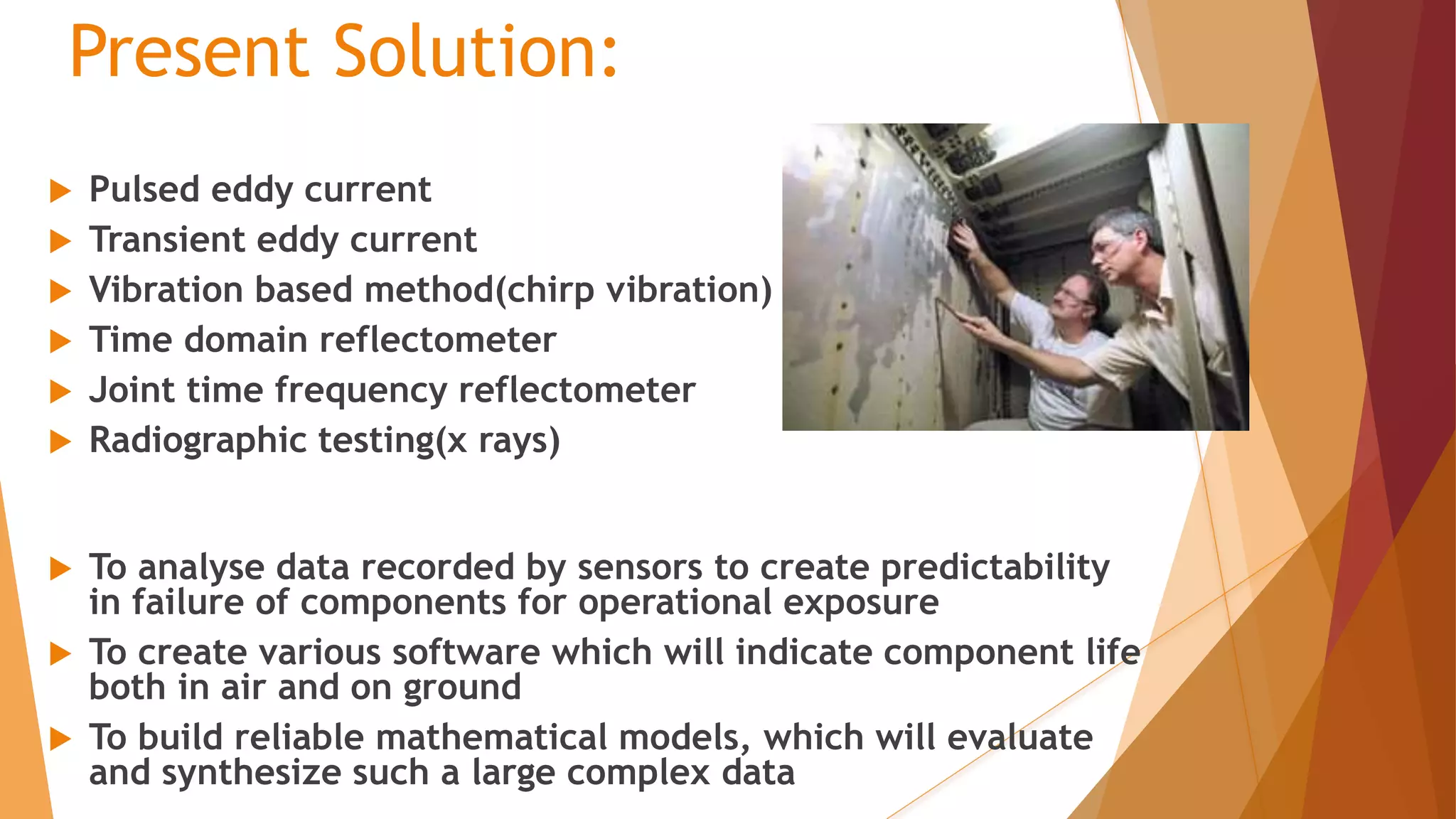
Present Solution:
 Pulsed eddy current
 Transient eddy current
 Vibration based method(chirp vibration)
 Time domain reflectometer
 Joint time frequency reflectometer
 Radiographic testing(x rays)
 To analyse data recorded by sensors to create predictability
in failure of components for operational exposure
 To create various software which will indicate component life
both in air and on ground
 To build reliable mathematical models, which will evaluate
and synthesize such a large complex data
Newly developed technique :
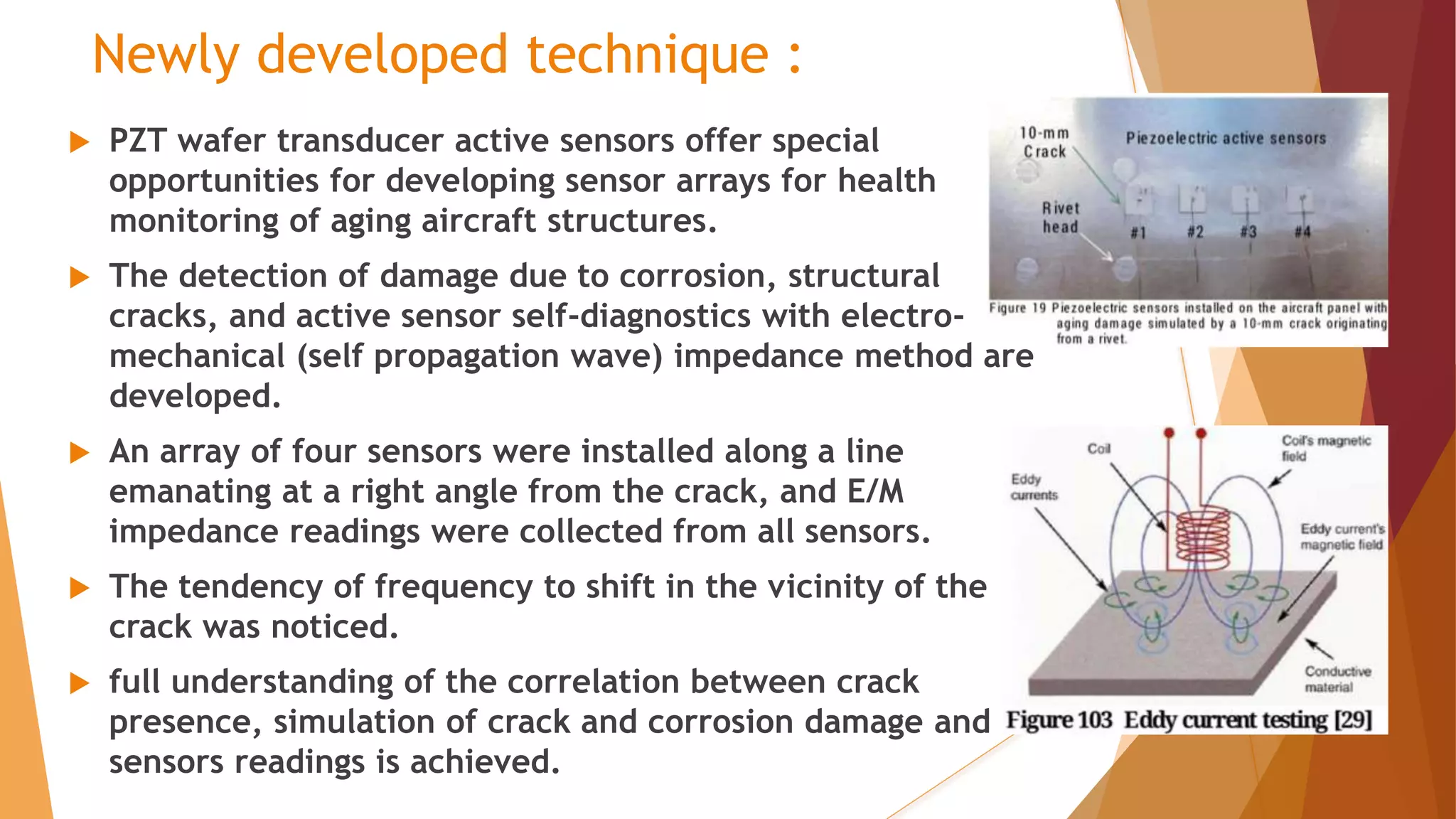
 PZT wafer transducer active sensors offer special
opportunities for developing sensor arrays for health
monitoring of aging aircraft structures.
 The detection of damage due to corrosion, structural
cracks, and active sensor self-diagnostics with electro-
mechanical (self propagation wave) impedance method are
developed.
 An array of four sensors were installed along a line
emanating at a right angle from the crack, and E/M
impedance readings were collected from all sensors.
 The tendency of frequency to shift in the vicinity of the
crack was noticed.
 full understanding of the correlation between crack
presence, simulation of crack and corrosion damage and
sensors readings is achieved.
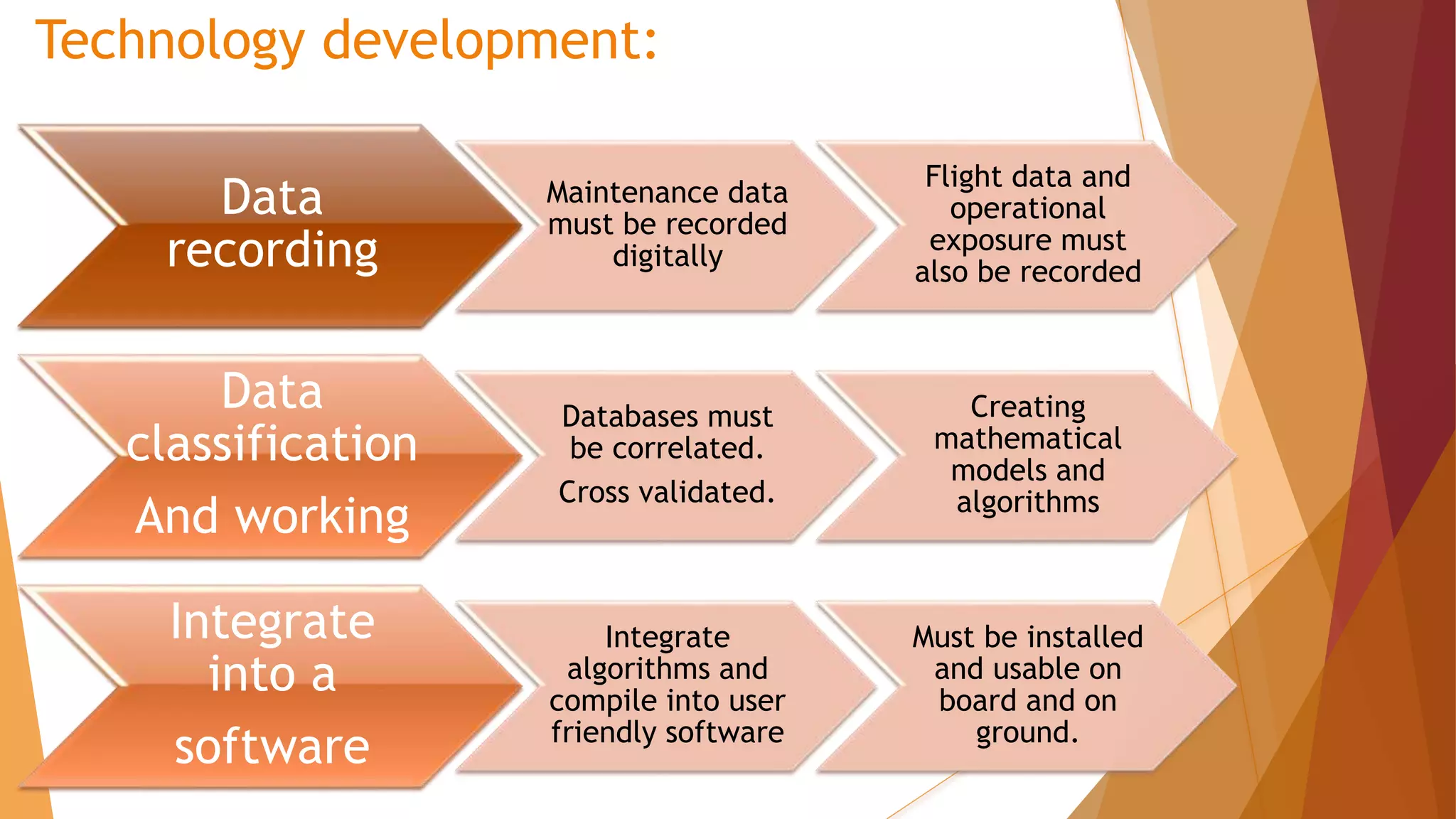
Technology development:
Data
recording
Maintenance data
must be recorded
digitally
Flight data and
operational
exposure must
also be recorded
Data
classification
And working
Databases must
be correlated.
Cross validated.
Creating
mathematical
models and
algorithms
Integrate
into a
software
Integrate
algorithms and
compile into user
friendly software
Must be installed
and usable on
board and on
ground.
Indian scenario :(as on sept 2015)
 Air India scare of its Kajuraho-Varanasi flight catching fire while
landing and plans to replace its ageing fleet of Airbus A 320 planes.
 The airline has a fleet of 64 A 320 planes and 14 of them are close
to 20 years old that need urgent replacement. In the next six
months, said a senior aviation ministry official, five new Airbus
planes will join the airline's fleet.
 The airline has also asked European plane manufacturer - Airbus -
to refurbish three existing planes and enhance their lifespan by
one and half years. Ministry say that the airline cannot replace all
its old aircraft in one go.
 The airline had planned to induct 19 new planes as a replacement
but the process has acquired a new impetus after 153 people on
board its Varanasi flight -- flown by a 21-year-old aircraft -- had a
narrow escape after the hydraulic system of the aircraft that
controls its movement malfunctioned.
Advantages and summary:
 This method will help us identify reliability in components , for
consideration in redesign
 Helps in taking feedback from maintenance , towards creating in design of
parts for better maintainability.
 Increase safety in ageing aircraft and reduce maintenance cost.
 The purpose of this report was to investigate the
relationship between ageing aircraft and flight
safety, as well as to examine current and future
methods for ensuring the safety of ageing aircraft.
This research examined the literature on aircraft
age in relation to safety and reliability, and
statistical data on the age of the aircraft fleet.

Ageing of aircraft

  • 1.
    What is the bigdeal about ageing aircraft? Submitted By: KANHAIYA KUMAR MECHANICAL 5TH SEM IT-GURU GHASIDAS UNIVERSITY,BILASPUR,(C.G)
  • 2.
    What is age? 1.Chronological age. • 25-30 Years 2.Flight Hours. • 40000-60000 Hours 3.Flight cycles. • 45000-50000 cycles • There is no single criteria that defines an aircraft as ‘old’ (Kizer, 1989). • Determining the age of the aircraft is further complicated by the fact that individual aircraft components age differently depending on variable factors. • Parallels with human.
  • 3.
    Areas common toairplanes that are typically susceptible to ageing :  • Engine  • Fuel System  • Propeller  • Controls  • Fuselage  • Electrical Systems  • Instruments  • Empennage  • Landing Gear  • Wing
  • 4.
    Three main aspectsof ageing of aircraft: Fatigue Maintenance Safety
  • 5.
    Effects of Ageing:  FatigueDamage  Component failure  Structural failure  Corrosion  Environmental Degradation  Wiring failure  Fatigue: cyclic loading  Environment exposed  Extremes of Temperature And Moisture  Wear  Deterioration  corrosion Ageing Mechanisms: An airplane spends far more time on the ground than it does in the air.
  • 6.
    Statistics: ‘What the bathtubcurve tells us is while there’s no reason why an older aircraft should be inherently unsafe, there’s also no escaping the increased time, effort and money needed to keep it airworthy.’
  • 7.
    Aerospace Industry Worldwide •Global Aerospace and Defense Projections • Most aircraft(96%) have retirement age of 25.2436 years • In Africa maintenance is not up to global standards and environmental factor have result in early retirement of 20 years
  • 8.
    Accidents statistics:  Accidentswere defined as events where the aircraft sustained substantial damage, became missing or completely inaccessible as well as events where fatal or serious injury resulted from being in the airplane or direct contact with the airplane or its jet blast.  Fatal accidents were defined as accidents which resulted in a fatal injury. 52% 13% 35% Accidents distribution Fatal accidents Normal others
  • 9.
    Aloha Airlines flight243 is an example of corrosion and fatigue interacting to produce the failure of a structure. Approximately 5.5 metres of the cabin skin and supporting structure separated from the aircraft, leading to the decompression.  Although the aircraft sustained extensive structural damage, it was able to land safely.  Aloha flight 243 crashed due to ageing, due to high flight cycles, ductile tearing. Case Study: Corrosion and fatigue – Aloha flight 243, 1988  At the time of the accident, the aircraft was 19 years old and had completed 89,680 take-offs and landings, with an average flight time of 25 minutes
  • 10.
    Maintenance in ageingaircraft:  In 7 out of14 recent major accidents, deficient maintenance is the culprit.  15% increased inspection time for 10 years of age.(Robinson)  Shortage of skilled maintenance staff and existing staff over stressed.  Staff spend around 25-40% time for documentation  Sometimes diagnosis can be wrong due to human judgement  Modern aircraft have thousands of sensors, which stored failure history on ground databases.  Data stored remains stagnant due to large complexity.
  • 11.
    Economics of AgeingAircrafts Replacement of fleet Replacing components Maintenance cost Annual check
  • 12.
    Present Solution:  Pulsededdy current  Transient eddy current  Vibration based method(chirp vibration)  Time domain reflectometer  Joint time frequency reflectometer  Radiographic testing(x rays)  To analyse data recorded by sensors to create predictability in failure of components for operational exposure  To create various software which will indicate component life both in air and on ground  To build reliable mathematical models, which will evaluate and synthesize such a large complex data
  • 13.
    Newly developed technique:  PZT wafer transducer active sensors offer special opportunities for developing sensor arrays for health monitoring of aging aircraft structures.  The detection of damage due to corrosion, structural cracks, and active sensor self-diagnostics with electro- mechanical (self propagation wave) impedance method are developed.  An array of four sensors were installed along a line emanating at a right angle from the crack, and E/M impedance readings were collected from all sensors.  The tendency of frequency to shift in the vicinity of the crack was noticed.  full understanding of the correlation between crack presence, simulation of crack and corrosion damage and sensors readings is achieved.
  • 14.
    Technology development: Data recording Maintenance data mustbe recorded digitally Flight data and operational exposure must also be recorded Data classification And working Databases must be correlated. Cross validated. Creating mathematical models and algorithms Integrate into a software Integrate algorithms and compile into user friendly software Must be installed and usable on board and on ground.
  • 15.
    Indian scenario :(ason sept 2015)  Air India scare of its Kajuraho-Varanasi flight catching fire while landing and plans to replace its ageing fleet of Airbus A 320 planes.  The airline has a fleet of 64 A 320 planes and 14 of them are close to 20 years old that need urgent replacement. In the next six months, said a senior aviation ministry official, five new Airbus planes will join the airline's fleet.  The airline has also asked European plane manufacturer - Airbus - to refurbish three existing planes and enhance their lifespan by one and half years. Ministry say that the airline cannot replace all its old aircraft in one go.  The airline had planned to induct 19 new planes as a replacement but the process has acquired a new impetus after 153 people on board its Varanasi flight -- flown by a 21-year-old aircraft -- had a narrow escape after the hydraulic system of the aircraft that controls its movement malfunctioned.
  • 16.
    Advantages and summary: This method will help us identify reliability in components , for consideration in redesign  Helps in taking feedback from maintenance , towards creating in design of parts for better maintainability.  Increase safety in ageing aircraft and reduce maintenance cost.  The purpose of this report was to investigate the relationship between ageing aircraft and flight safety, as well as to examine current and future methods for ensuring the safety of ageing aircraft. This research examined the literature on aircraft age in relation to safety and reliability, and statistical data on the age of the aircraft fleet.