Alaska Airlines Flight
261
JANUARY 31, 2000, NEAR ANACAPA ISLAND, CALIFORNIA
88 ONBOARD, ALL FATAL
Presented By: Rajjat K. Chanotra 703193
Manjot Kaur 718546
Executive Summary
 On January 31, 2000, about 1621 Pacific
standard time, Alaska Airlines, Inc.
 from Lic Gustavo Diaz Ordaz International
Airport, Puerto Vallarta, Mexico to
International Airport, Seattle, Washington,
 with an intermediate stop planned , San
Francisco, California.
 Flight 261, crashed into the Pacific Ocean
about 2.7 miles north of Anacapa Island,
California.
 The 2 pilots, 3 cabin crewmembers, and 83
passengers on board were killed,
 the airplane was destroyed by impact forces.
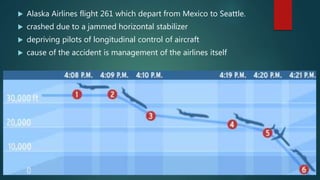
 Alaska Airlines flight 261 which depart from Mexico to Seattle.
 crashed due to a jammed horizontal stabilizer
 depriving pilots of longitudinal control of aircraft
 cause of the accident is management of the airlines itself
Investigation team
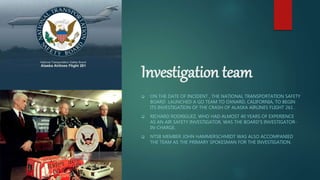
 ON THE DATE OF INCIDENT , THE NATIONAL TRANSPORTATION SAFETY
BOARD LAUNCHED A GO TEAM TO OXNARD, CALIFORNIA, TO BEGIN
ITS INVESTIGATION OF THE CRASH OF ALASKA AIRLINES FLIGHT 261 .
 RICHARD RODRIGUEZ, WHO HAD ALMOST 40 YEARS OF EXPERIENCE
AS AN AIR SAFETY INVESTIGATOR, WAS THE BOARD'S INVESTIGATOR-
IN-CHARGE.
 NTSB MEMBER JOHN HAMMERSCHMIDT WAS ALSO ACCOMPANIED
THE TEAM AS THE PRIMARY SPOKESMAN FOR THE INVESTIGATION.
Video clip
Wreckage recovery and analysis
 Using side-scan sonar, remotely operated vehicles, and
a commercial fishing trawler,
 workers recovered about 85% of the fuselage (including
the tail section) and a majority of the wing components.
 In addition, both engines,
 as well as the Flight Data Recorder (FDR) and CVR were
retrieved.
 All wreckage that was retrieved from the crash site was
unloaded at Port Hueneme, California for examination
and documentation by NTSB investigators.[1]
Recovered jackscrew – The spiral "wire"
wound around the threaded portion is the
remains of the acme nut internal screw
thread that was stripped from the nut.
Investigationprocess
1) Inspection Intervals
 To reduce the number of required aircraft inspections, Alaska Airlines tried to get a
comprehensive adjustment of service schedules.
 Lubrication of the jackscrew was every 600 flight-hours and the “end-play” check was every
3,600 flight-hours.
 Utilizing the MRB process and by obtaining FAA approval, the company gradually increased the
limits for each maintenance procedure.
 Alaska Airlines finally extended its limit up to 9,550 flight-hours for the “end-play” check.
Continued…..
2) Jackscrew Lubrication Grease
 They found that Alaska Airlines used numerous types of greases for lubrication.
 According to manufacturer, the jackscrew assembly be lubricated with MIL-G-81322 (e.g. Mobil
grease 28) grease, the company decided to use MIL-G-23827 (e.g. Aero shell 33) instead.
 The company’s apparent impatience with the manufacturer led to some subjective interpretations
of statements.
 The company began to use the new grease without properly routing the request through the
company executive chain for approval.
 Even, the FAA was not informed of the full extent of their practices with the greases.
Continued….
3) Tooling
 Alaska Airlines did not want to purchase tools to use during the “end-play” check of the horizontal
stabilizer.
 Boeing had manufactured a particular tool for this procedure .
 In early 2000, Alaska Airlines had only one such tool in its entire inventory.
 This tool had been manufactured by the company maintenance facility and did not meet Boeing’s
standard for completing the test correctly.
 Consequently, use of this equipment may actually have misled a technician using it into believing
that the established horizontal stabilizer “end-play” limits of 0.040 inches were being met.
Continued….
4) Inspection history of Alaska Airline 261
 The aircraft was brought into a required maintenance inspection on September 24, 1997.
 It was scheduled to receive a lubrication of the jackscrew assembly and “end-play” check.
 It was determined that the horizontal stabilizer had reached its maximum “end-play” limit of 0.040
inches.
 The technician further performed the test and recommended replacement of a part of the jackscrew
assembly.
 The part was not in stock and ordered.
 So, the aircraft remained in maintenance for two extra days longer than scheduled.
 Due to this, a shift supervisor eventually overrode the parts replacement recommendation.
Continued…..
5) System Safety Failures
 The last people in the procedural chain of errors that
led to accident, the pilots of Flight 261 can be faulted
for unnecessary in-flight troubleshooting while
adequate landing and maintenance facilities were
nearby
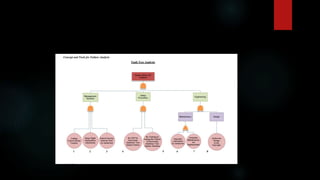
CAUSE 1). Management Decision
 In 1990, economic was decline at the time
 the top management of the Alaska Airline company starts making decision for
cutting cost to revise their fortune.
 At the same time the maintenance department had been pressed to keep flight
flying more intensively.
 This is all about money and profits due to coping with the economic situation on
that time.
1. The worst thing is, both of these matters caused the management change their
maintenance program without notifying FAA.
 (extend service interval time on jackscrew)
 They neglected about the important maintenance aspect that can ensure the
safety of their aircrafts and passengers.
CAUSE 2). Safety Procedure
 During the tragedy, the pilots did not know exactly what they
should do. They just struggle tried the best with their knowledge
and experienced to save the flight.
 There is no Safety/Standard Operation Procedure for horizontal
stabilizer trim system failure in their quick reference book in the
aircraft.
 The pilot also had contact the maintenance department asking
what they must do in the critical condition but the personnel in-
charge did not give good feedback and answer.
 No training was provided to their pilots for coping the failure of the
system.
 Even they did not receive any training to cope on that situation,
they still can save the flight if the SOP provided in the pilot quick
reference book to handle the aircraft during the failure of the
system.
CAUSE 3). Engineering CONTROLS
Engineering causes can be divided into two categories which is:
1) Maintenance
2) Design
A) Maintenance
 The failure of the Alaska Airline Flight 261 jackscrew assembly
 During the discovery of the aircraft’s wreckage after the crashed, there is like no
grease on the jackscrew.
 The investigation team conclude it is because improper lubrication on jackscrew.
 The other reason why the aircraft crashed is due to the schedule maintenance not
implemented as recommended by manufacturer of the jackscrew. Both of this
causes is related to the management decision where can concluded sequences as
below:
MAINTENANCE- Management Decision:
 Cutting cost to revise fortune
 keep flight flying more intensively make them
 extend service interval time on jackscrew.
 Extend service interval time on jackscrew creating situation which the
 schedule maintenance not implemented as recommended by manufacturer
and thereby creating possibilities the implementation of improper lubrication
on jackscrew.
 This is the reason why the aircraft had crashed. It is because that is the only
way to prevent the failure of the acme nut on jackscrew is with following the
schedule maintenance as recommended by manufacturer.
B) Design
 The jackscrew design is not fail-safe.
 There is no the features in the design on the jackscrew. It is because the manufacturer
producing the jackscrew including with the recommended maintenance schedule for their
customers such as service interval time for the jackscrew (inspection, lubrication and
replacement).
 Maintenance recommended by the manufacturer also stated the inspection must be performing
after 600 flight hours and replace every 2000 flight hours.
 The jackscrew will not fail if all the recommendations followed by them.
 Unfortunately, Alaska Airline extended the lubrication service interval time and also did not
follow the recommended inspection and replacement interval time on the jackscrew by the
manufacturer.
 This is the way for the acme nut jackscrew becoming to fail and when it had failed there is no
redundant/follower nuts to support it.
 Consequently, the Alaska Airline Flight 261 was lost of aircraft pitch control and then crashed.
Alaska Airlines Flight 261
 Certification Issues
Design assumptions not considered in
maintenance decisions
Need to monitor and analyze critical systems
Differential treatment of structures and
systems
Proof that this could have prevented…
 Alarming picture of the state of air safety
 The most staggering fact to emerge is that Alaska Airlines is
under criminal investigation for falsifying maintenance records
on MD-80s jets.
 NTSB has revealed that in September 1997,mechanics at the
Oakland facility discovered that the gimbal nut on the ill-fated
plane was badly worn and in need of replacement.
Continue…..
 Airline personnel on the ground were not helpful enough
when the crew radioed in with a problem and this shows
lack of teamwork.
 In another investigation it is found that Alaska Airlines
had fabricated tools to be used in the end play check that
did not meet the manufacturer's requirements..
Safety Recommendations
 Issue a flight standards information bulletin directing air
carriers to instruct pilots that in the event of an inoperative
or malfunctioning flight control system, if the airplane is
controllable they should complete only the applicable
checklist procedures and should not attempt any
corrective actions beyond those specified.
 Pilots should further be instructed that if checklist procedures
are not effective, they should land at the nearest suitable
airport
About lubrication
 Revise the lubrication procedure for the horizontal stabilizer trim system of
Douglas DC-9, McDonnell Douglas MD-80/90, and Boeing 717 series
airplanes to minimize the probability of inadequate lubrication.
 Require maintenance personnel who lubricate the horizontal stabilizer trim
system and familiarization with the selection, inspection, and proper use
of the tooling to perform the end play check.
Lubrication:
 Issue guidance to principal maintenance inspectors to
notify all operators about the potential hazards of using
inappropriate grease types and mixing incompatible grease
types.
 Remove degraded grease from the jackscrew assembly
acme screw and flush degraded grease and particulates from
the acme nut before applying fresh grease
 Increase the size of the access panels that are used to
accomplish the jackscrew assembly lubrication procedure.
Continue…..
 Establish the jackscrew assembly lubrication procedure as a required
inspection item that must have an inspector’s signoff before the task can
be considered complete.
 Modifications are taken into account assumptions made by the original
designers and are supported by adequate technical data and analysis
 Develop and implement a program to analyze these data to identify and
determine the cause of excessive or unexpected wear rates, trends,
or anomalies.
Maintenance of spare parts
 Require that maintenance facilities that overhaul jackscrew assemblies
record and inform customers of an overhauled jackscrew assembly’s
endplay measurement.
 Require operators to measure and record the on-wing end play
measurement whenever a jackscrew assembly is replaced
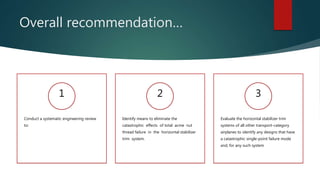
Overall recommendation…
Conduct a systematic engineering review
to:
1
Identify means to eliminate the
catastrophic effects of total acme nut
thread failure in the horizontal stabilizer
trim system.
2
Evaluate the horizontal stabilizer trim
systems of all other transport-category
airplanes to identify any designs that have
a catastrophic single-point failure mode
and, for any such system
3
Continue….
 Modify the certification regulations, policies, or procedures to
ensure that new horizontal stabilizer trim control system
designs are not certified if they have a single-point
catastrophic failure mode.
 Review and revise aircraft certification regulations and
associated guidance applicable.

alaska airlines flight 261 Crash

  • 1.
    Alaska Airlines Flight 261 JANUARY31, 2000, NEAR ANACAPA ISLAND, CALIFORNIA 88 ONBOARD, ALL FATAL Presented By: Rajjat K. Chanotra 703193 Manjot Kaur 718546
  • 2.
    Executive Summary  OnJanuary 31, 2000, about 1621 Pacific standard time, Alaska Airlines, Inc.  from Lic Gustavo Diaz Ordaz International Airport, Puerto Vallarta, Mexico to International Airport, Seattle, Washington,  with an intermediate stop planned , San Francisco, California.  Flight 261, crashed into the Pacific Ocean about 2.7 miles north of Anacapa Island, California.  The 2 pilots, 3 cabin crewmembers, and 83 passengers on board were killed,  the airplane was destroyed by impact forces.
  • 3.
     Alaska Airlinesflight 261 which depart from Mexico to Seattle.  crashed due to a jammed horizontal stabilizer  depriving pilots of longitudinal control of aircraft  cause of the accident is management of the airlines itself
  • 4.
    Investigation team  ONTHE DATE OF INCIDENT , THE NATIONAL TRANSPORTATION SAFETY BOARD LAUNCHED A GO TEAM TO OXNARD, CALIFORNIA, TO BEGIN ITS INVESTIGATION OF THE CRASH OF ALASKA AIRLINES FLIGHT 261 .  RICHARD RODRIGUEZ, WHO HAD ALMOST 40 YEARS OF EXPERIENCE AS AN AIR SAFETY INVESTIGATOR, WAS THE BOARD'S INVESTIGATOR- IN-CHARGE.  NTSB MEMBER JOHN HAMMERSCHMIDT WAS ALSO ACCOMPANIED THE TEAM AS THE PRIMARY SPOKESMAN FOR THE INVESTIGATION.
  • 5.
  • 6.
    Wreckage recovery andanalysis  Using side-scan sonar, remotely operated vehicles, and a commercial fishing trawler,  workers recovered about 85% of the fuselage (including the tail section) and a majority of the wing components.  In addition, both engines,  as well as the Flight Data Recorder (FDR) and CVR were retrieved.  All wreckage that was retrieved from the crash site was unloaded at Port Hueneme, California for examination and documentation by NTSB investigators.[1] Recovered jackscrew – The spiral "wire" wound around the threaded portion is the remains of the acme nut internal screw thread that was stripped from the nut.
  • 7.
    Investigationprocess 1) Inspection Intervals To reduce the number of required aircraft inspections, Alaska Airlines tried to get a comprehensive adjustment of service schedules.  Lubrication of the jackscrew was every 600 flight-hours and the “end-play” check was every 3,600 flight-hours.  Utilizing the MRB process and by obtaining FAA approval, the company gradually increased the limits for each maintenance procedure.  Alaska Airlines finally extended its limit up to 9,550 flight-hours for the “end-play” check.
  • 8.
    Continued….. 2) Jackscrew LubricationGrease  They found that Alaska Airlines used numerous types of greases for lubrication.  According to manufacturer, the jackscrew assembly be lubricated with MIL-G-81322 (e.g. Mobil grease 28) grease, the company decided to use MIL-G-23827 (e.g. Aero shell 33) instead.  The company’s apparent impatience with the manufacturer led to some subjective interpretations of statements.  The company began to use the new grease without properly routing the request through the company executive chain for approval.  Even, the FAA was not informed of the full extent of their practices with the greases.
  • 9.
    Continued…. 3) Tooling  AlaskaAirlines did not want to purchase tools to use during the “end-play” check of the horizontal stabilizer.  Boeing had manufactured a particular tool for this procedure .  In early 2000, Alaska Airlines had only one such tool in its entire inventory.  This tool had been manufactured by the company maintenance facility and did not meet Boeing’s standard for completing the test correctly.  Consequently, use of this equipment may actually have misled a technician using it into believing that the established horizontal stabilizer “end-play” limits of 0.040 inches were being met.
  • 10.
    Continued…. 4) Inspection historyof Alaska Airline 261  The aircraft was brought into a required maintenance inspection on September 24, 1997.  It was scheduled to receive a lubrication of the jackscrew assembly and “end-play” check.  It was determined that the horizontal stabilizer had reached its maximum “end-play” limit of 0.040 inches.  The technician further performed the test and recommended replacement of a part of the jackscrew assembly.  The part was not in stock and ordered.  So, the aircraft remained in maintenance for two extra days longer than scheduled.  Due to this, a shift supervisor eventually overrode the parts replacement recommendation.
  • 11.
    Continued….. 5) System SafetyFailures  The last people in the procedural chain of errors that led to accident, the pilots of Flight 261 can be faulted for unnecessary in-flight troubleshooting while adequate landing and maintenance facilities were nearby
  • 12.
    CAUSE 1). ManagementDecision  In 1990, economic was decline at the time  the top management of the Alaska Airline company starts making decision for cutting cost to revise their fortune.  At the same time the maintenance department had been pressed to keep flight flying more intensively.  This is all about money and profits due to coping with the economic situation on that time. 1. The worst thing is, both of these matters caused the management change their maintenance program without notifying FAA.  (extend service interval time on jackscrew)  They neglected about the important maintenance aspect that can ensure the safety of their aircrafts and passengers.
  • 13.
    CAUSE 2). SafetyProcedure  During the tragedy, the pilots did not know exactly what they should do. They just struggle tried the best with their knowledge and experienced to save the flight.  There is no Safety/Standard Operation Procedure for horizontal stabilizer trim system failure in their quick reference book in the aircraft.  The pilot also had contact the maintenance department asking what they must do in the critical condition but the personnel in- charge did not give good feedback and answer.  No training was provided to their pilots for coping the failure of the system.  Even they did not receive any training to cope on that situation, they still can save the flight if the SOP provided in the pilot quick reference book to handle the aircraft during the failure of the system.
  • 14.
    CAUSE 3). EngineeringCONTROLS Engineering causes can be divided into two categories which is: 1) Maintenance 2) Design
  • 15.
    A) Maintenance  Thefailure of the Alaska Airline Flight 261 jackscrew assembly  During the discovery of the aircraft’s wreckage after the crashed, there is like no grease on the jackscrew.  The investigation team conclude it is because improper lubrication on jackscrew.  The other reason why the aircraft crashed is due to the schedule maintenance not implemented as recommended by manufacturer of the jackscrew. Both of this causes is related to the management decision where can concluded sequences as below:
  • 16.
    MAINTENANCE- Management Decision: Cutting cost to revise fortune  keep flight flying more intensively make them  extend service interval time on jackscrew.  Extend service interval time on jackscrew creating situation which the  schedule maintenance not implemented as recommended by manufacturer and thereby creating possibilities the implementation of improper lubrication on jackscrew.  This is the reason why the aircraft had crashed. It is because that is the only way to prevent the failure of the acme nut on jackscrew is with following the schedule maintenance as recommended by manufacturer.
  • 17.
    B) Design  Thejackscrew design is not fail-safe.  There is no the features in the design on the jackscrew. It is because the manufacturer producing the jackscrew including with the recommended maintenance schedule for their customers such as service interval time for the jackscrew (inspection, lubrication and replacement).  Maintenance recommended by the manufacturer also stated the inspection must be performing after 600 flight hours and replace every 2000 flight hours.  The jackscrew will not fail if all the recommendations followed by them.  Unfortunately, Alaska Airline extended the lubrication service interval time and also did not follow the recommended inspection and replacement interval time on the jackscrew by the manufacturer.  This is the way for the acme nut jackscrew becoming to fail and when it had failed there is no redundant/follower nuts to support it.  Consequently, the Alaska Airline Flight 261 was lost of aircraft pitch control and then crashed.
  • 19.
    Alaska Airlines Flight261  Certification Issues Design assumptions not considered in maintenance decisions Need to monitor and analyze critical systems Differential treatment of structures and systems
  • 20.
    Proof that thiscould have prevented…  Alarming picture of the state of air safety  The most staggering fact to emerge is that Alaska Airlines is under criminal investigation for falsifying maintenance records on MD-80s jets.  NTSB has revealed that in September 1997,mechanics at the Oakland facility discovered that the gimbal nut on the ill-fated plane was badly worn and in need of replacement.
  • 21.
    Continue…..  Airline personnelon the ground were not helpful enough when the crew radioed in with a problem and this shows lack of teamwork.  In another investigation it is found that Alaska Airlines had fabricated tools to be used in the end play check that did not meet the manufacturer's requirements..
  • 22.
    Safety Recommendations  Issuea flight standards information bulletin directing air carriers to instruct pilots that in the event of an inoperative or malfunctioning flight control system, if the airplane is controllable they should complete only the applicable checklist procedures and should not attempt any corrective actions beyond those specified.  Pilots should further be instructed that if checklist procedures are not effective, they should land at the nearest suitable airport
  • 23.
    About lubrication  Revisethe lubrication procedure for the horizontal stabilizer trim system of Douglas DC-9, McDonnell Douglas MD-80/90, and Boeing 717 series airplanes to minimize the probability of inadequate lubrication.  Require maintenance personnel who lubricate the horizontal stabilizer trim system and familiarization with the selection, inspection, and proper use of the tooling to perform the end play check.
  • 24.
    Lubrication:  Issue guidanceto principal maintenance inspectors to notify all operators about the potential hazards of using inappropriate grease types and mixing incompatible grease types.  Remove degraded grease from the jackscrew assembly acme screw and flush degraded grease and particulates from the acme nut before applying fresh grease  Increase the size of the access panels that are used to accomplish the jackscrew assembly lubrication procedure.
  • 25.
    Continue…..  Establish thejackscrew assembly lubrication procedure as a required inspection item that must have an inspector’s signoff before the task can be considered complete.  Modifications are taken into account assumptions made by the original designers and are supported by adequate technical data and analysis  Develop and implement a program to analyze these data to identify and determine the cause of excessive or unexpected wear rates, trends, or anomalies.
  • 26.
    Maintenance of spareparts  Require that maintenance facilities that overhaul jackscrew assemblies record and inform customers of an overhauled jackscrew assembly’s endplay measurement.  Require operators to measure and record the on-wing end play measurement whenever a jackscrew assembly is replaced
  • 27.
    Overall recommendation… Conduct asystematic engineering review to: 1 Identify means to eliminate the catastrophic effects of total acme nut thread failure in the horizontal stabilizer trim system. 2 Evaluate the horizontal stabilizer trim systems of all other transport-category airplanes to identify any designs that have a catastrophic single-point failure mode and, for any such system 3
  • 28.
    Continue….  Modify thecertification regulations, policies, or procedures to ensure that new horizontal stabilizer trim control system designs are not certified if they have a single-point catastrophic failure mode.  Review and revise aircraft certification regulations and associated guidance applicable.