AIRCRAFT WHEEL AND BEARING 
1 
DEFECT
AIRCRAFT LANDING GEAR 
WHEEL ASSEMBLY 
Made of aluminum or magnesium alloy and undergo the 
process of forging and casting 
Aluminum alloy wheel are protected from corrosion by 
performing anodizing 
Magnesium alloy wheel are being protected from corrosion by 
performing chromating 
2
When process of protection is done, wheel is painted 
If the protective finish is damage, it must be restored 
immediately to prevent corrosion 
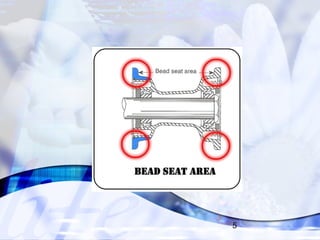
Bead seat area is the flat surface on the inside of the 
rims of an aircraft wheel on which the bead of the tire 
sits on 
3
Most critical part is the wheel because these 
area are under high tensile load due to air 
pressure in the tire and intensify by the landing 
effects 
It is rolled to pre-stressed the surfaces with a 
compressive stress 
4
5
6
MAIN TYPE OF WHEEL 
CONSTRUCTIONS 
Wheel Base Non Detachable Flange (Drop 
Center) 
Well Base Removable Flange (Drop Center & 
Flat Base) 
7 
Split Or Divided Wheel
Wheel Base Non Detachable Flange (Drop Center) 
Well base wheel are only fitted on light 
aircraft and normally used together with tube 
type tires 
Similar in construction of removable flange 
except the flange is fixed 
8
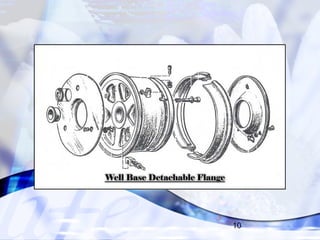
Well Base Removable Flange (Drop Center & Flat 
Base) 
Made out of one flange integral with hub and the 
other flange are removable and retain by a locking 
ring 
When tire is inflated the flange covers the ring and 
trapping it in the groove and preventing the flange 
from coming off from the wheel 
An ‘O’ ring seal is fitted to provide air tight so 
tubeless tire can be used with this type of wheel 
9
10
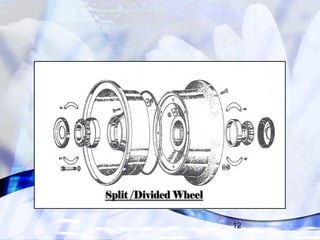
Split or Divided Wheel 
Made up of two mating halves 
Connected by bolts passing axially through two parts 
An ‘O’ ring is fitted between the two halves when used with 
tubeless tire 
As a safety precaution measure in case the bolts that hold the 
wheel halves together have been damaged or weakened, the 
tire have to be fully deflated before attempting to dismantle 
the unit to relieve the strain 
11
12
Beads seats area are usually rolled to pre-stress 
their surfaces to increase its strength against 
surface tension load 
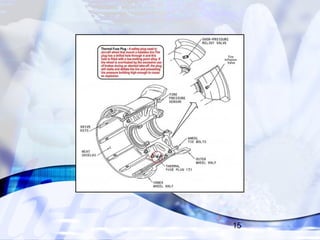
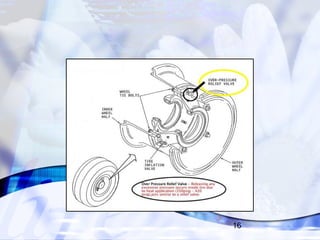
Inboard wheel half (towards the aircraft) is 
where the location of bearing cone house, brake 
drive blocks or keyways, fusible plug 
13
Outboard wheel half (away from the aircraft) is 
where the location of inflation valve housing, 
bearing cone, wheel cap with bracket to drove 
the wheel speed sensor of anti-skid system to 
cover the axle 
The bearing cup are usually shrink fitted into the 
hub of the wheel casting and provide the 
surfaces on which the bearing ride (cup is chilled 
prior to fit into the cone) 
14
15
16
Removal of the bearing cup required heating of 
the wheel in a boiling fluid (water) or in an oven 
with temperature not higher than 2250F for 30 
minutes 
Corrosion and loss of bearing lubrication are two 
major causes of failure or rejection of an aircraft 
wheel 
17
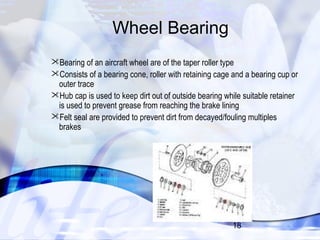
Bearing of an aircraft wheel are of the taper roller type 
Consists of a bearing cone, roller with retaining cage and a bearing cup or 
outer trace 
Hub cap is used to keep dirt out of outside bearing while suitable retainer 
is used to prevent grease from reaching the brake lining 
Felt seal are provided to prevent dirt from decayed/fouling multiples 
brakes 
18 
Wheel Bearing
Bearing should be cleaned and repacked 
with grease (high melting & low freezing type) 
The pressure methods (using grease gun for 
example) is recommended because it's easier 
and faster 
Bearing should be completely dry before 
packing them with grease 
19
Wheel bearing gets contaminated or breaks 
down from excessive heat and water 
All wheel bearing should be lubricated at every 
tire change and as per required by the applicable 
maintenance manual 
Wheel bearing, bearing cup, wheel bores and 
grease retainer should be clean by an 
appropriate solvent 
20
Performing a visual; inspection of bearing. Bearing 
cup, bearing retainer with 10X magnifying glass and 
replace all worn, dented, scored or pitted bearing 
cup 
21
22 
Wheel inspection 
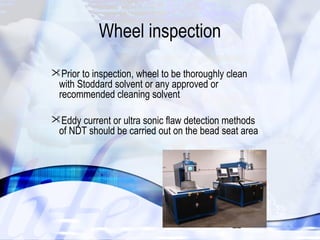
Prior to inspection, wheel to be thoroughly clean 
with Stoddard solvent or any approved or 
recommended cleaning solvent 
Eddy current or ultra sonic flaw detection methods 
of NDT should be carried out on the bead seat area
Magnetic particles inspection to be carried 
out on wheel attachment bolts, junction of 
head and shank and the end of threaded 
portion susceptible to crack and should be 
inspected carefully 
Dye penetrate inspection should be carried 
out on bolts holes 
23
BEARING DEFECTS && IINNDDIICCAATTIIOONN 
24 
• Galling 
• Spalling 
• Brinelling 
• Water Stains 
• Overheating 
• Rust
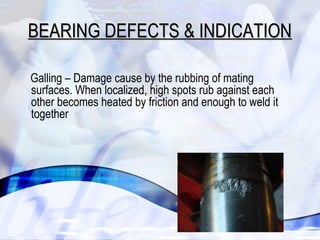
BEARING DDEEFFEECCTTSS && IINNDDIICCAATTIIOONN 
Galling – Damage cause by the rubbing of mating 
surfaces. When localized, high spots rub against each 
other becomes heated by friction and enough to weld it 
together 
25
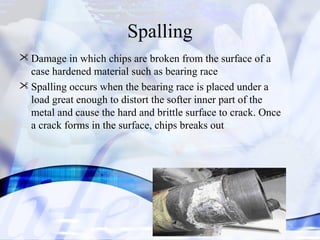
Damage in which chips are broken from the surface of a 
case hardened material such as bearing race 
Spalling occurs when the bearing race is placed under a 
load great enough to distort the softer inner part of the 
metal and cause the hard and brittle surface to crack. Once 
a crack forms in the surface, chips breaks out 
26 
Spalling
27 
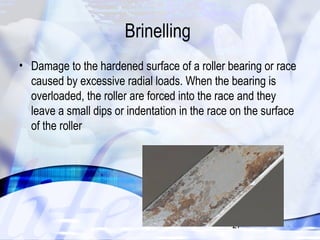
Brinelling 
• Damage to the hardened surface of a roller bearing or race 
caused by excessive radial loads. When the bearing is 
overloaded, the roller are forced into the race and they 
leave a small dips or indentation in the race on the surface 
of the roller
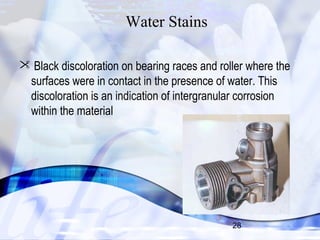
 Black discoloration on bearing races and roller where the 
surfaces were in contact in the presence of water. This 
discoloration is an indication of intergranular corrosion 
within the material 
28 
Water Stains
29 
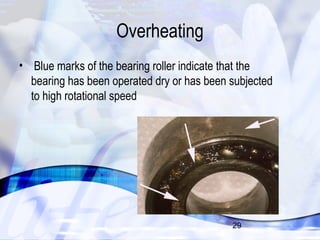
Overheating 
• Blue marks of the bearing roller indicate that the 
bearing has been operated dry or has been subjected 
to high rotational speed
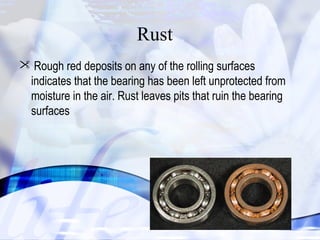
 Rough red deposits on any of the rolling surfaces 
indicates that the bearing has been left unprotected from 
moisture in the air. Rust leaves pits that ruin the bearing 
surfaces 
30 
Rust
AIRCRAFT BRAKE SYSTEM 
A mechanism to convert kinetic energy to heat energy by 
friction 
Brake system are designed to retard or stop the aircraft 
motion on the ground 
31
• They are also an aid in controlling the direction of 
aircraft while it is taxiing and application of brake 
while the landing gear wheels are being retracted 
into its wheel well in which provision exist for 
applying either one or both brakes 
32
Brakes can be applied by using the toe pedal 
attached to the rudder pedals or by a handbrake 
lever basically for the purpose of parking 
The greater the toe pedal applied, the greater 
will be the pressure transmitted to the brakes 
33
Composed of two subbsystem which is: 
1)Brake actuating Unit - A system and a 
components that slows down the aircraft 
movement and is located at the wheel and 
converts or changing kinetic energy from the 
motion of an aircraft into heat energy by 
means of friction 
34
2)Brake Actuating System – A hydraulic 
components in the aircraft that allows the pilot to 
control the amount of friction of a wheel unit 
produce 
35
BRAKE ACTUATING UNIT 
i. Energizing Brakes: 
1)A brake that uses the momentum of the aircraft 
to increase its effectiveness by wedging the 
shoe against the brake drum 
36 
2)Are also called ‘SERVO’ brakes 
3)There are 2 types of servo brakes and which is 
one way or single servo and two way or dual 
servo.
4)In single servo brake/one way servo brakes, 
the action is effective or energize only when 
moving in the forward direction of the wheel 
only 
5)In dual servo brake/two way servo brakes, the 
action is effective or energize may be adjusted 
to give servo action in either direction which 
is either forward or backward direction of the 
wheel 
37
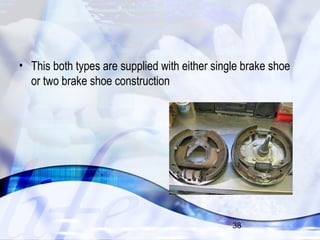
• This both types are supplied with either single brake shoe 
or two brake shoe construction 
38
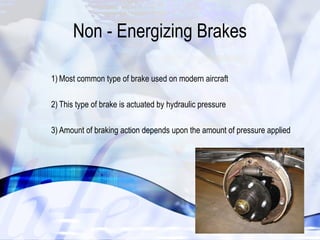
Non - Energizing Brakes 
39 
1) Most common type of brake used on modern aircraft 
2) This type of brake is actuated by hydraulic pressure 
3) Amount of braking action depends upon the amount of pressure applied
40 
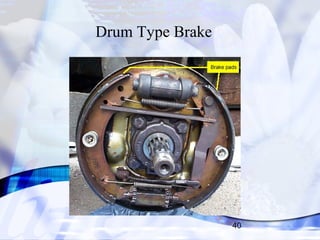
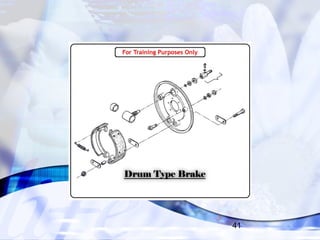
Drum Type Brake
41
TYPES OF NON - ENERGIZING 
42 
BRAKES 
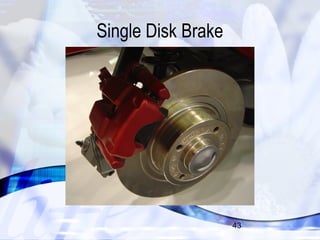
• Single Disk Brake 
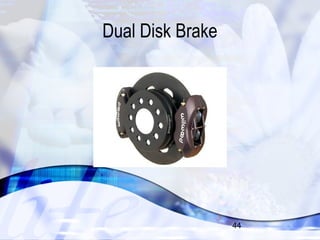
• Dual Disk Brake 
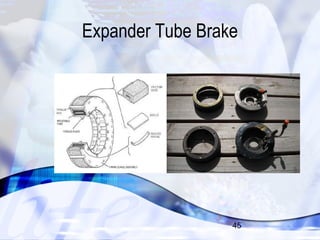
• Expander Tube Brake 
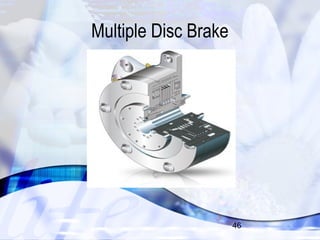
• Multiple Disc Brake
43 
Single Disk Brake
44 
Dual Disk Brake
Expander Tube Brake 
45
46 
Multiple Disc Brake
47 
~THANK YOU~

AIRCRAFT WHEEL AND BEARING DEFECT

  • 1.
    AIRCRAFT WHEEL ANDBEARING 1 DEFECT
  • 2.
    AIRCRAFT LANDING GEAR WHEEL ASSEMBLY Made of aluminum or magnesium alloy and undergo the process of forging and casting Aluminum alloy wheel are protected from corrosion by performing anodizing Magnesium alloy wheel are being protected from corrosion by performing chromating 2
  • 3.
    When process ofprotection is done, wheel is painted If the protective finish is damage, it must be restored immediately to prevent corrosion Bead seat area is the flat surface on the inside of the rims of an aircraft wheel on which the bead of the tire sits on 3
  • 4.
    Most critical partis the wheel because these area are under high tensile load due to air pressure in the tire and intensify by the landing effects It is rolled to pre-stressed the surfaces with a compressive stress 4
  • 5.
  • 6.
  • 7.
    MAIN TYPE OFWHEEL CONSTRUCTIONS Wheel Base Non Detachable Flange (Drop Center) Well Base Removable Flange (Drop Center & Flat Base) 7 Split Or Divided Wheel
  • 8.
    Wheel Base NonDetachable Flange (Drop Center) Well base wheel are only fitted on light aircraft and normally used together with tube type tires Similar in construction of removable flange except the flange is fixed 8
  • 9.
    Well Base RemovableFlange (Drop Center & Flat Base) Made out of one flange integral with hub and the other flange are removable and retain by a locking ring When tire is inflated the flange covers the ring and trapping it in the groove and preventing the flange from coming off from the wheel An ‘O’ ring seal is fitted to provide air tight so tubeless tire can be used with this type of wheel 9
  • 10.
  • 11.
    Split or DividedWheel Made up of two mating halves Connected by bolts passing axially through two parts An ‘O’ ring is fitted between the two halves when used with tubeless tire As a safety precaution measure in case the bolts that hold the wheel halves together have been damaged or weakened, the tire have to be fully deflated before attempting to dismantle the unit to relieve the strain 11
  • 12.
  • 13.
    Beads seats areaare usually rolled to pre-stress their surfaces to increase its strength against surface tension load Inboard wheel half (towards the aircraft) is where the location of bearing cone house, brake drive blocks or keyways, fusible plug 13
  • 14.
    Outboard wheel half(away from the aircraft) is where the location of inflation valve housing, bearing cone, wheel cap with bracket to drove the wheel speed sensor of anti-skid system to cover the axle The bearing cup are usually shrink fitted into the hub of the wheel casting and provide the surfaces on which the bearing ride (cup is chilled prior to fit into the cone) 14
  • 15.
  • 16.
  • 17.
    Removal of thebearing cup required heating of the wheel in a boiling fluid (water) or in an oven with temperature not higher than 2250F for 30 minutes Corrosion and loss of bearing lubrication are two major causes of failure or rejection of an aircraft wheel 17
  • 18.
    Bearing of anaircraft wheel are of the taper roller type Consists of a bearing cone, roller with retaining cage and a bearing cup or outer trace Hub cap is used to keep dirt out of outside bearing while suitable retainer is used to prevent grease from reaching the brake lining Felt seal are provided to prevent dirt from decayed/fouling multiples brakes 18 Wheel Bearing
  • 19.
    Bearing should becleaned and repacked with grease (high melting & low freezing type) The pressure methods (using grease gun for example) is recommended because it's easier and faster Bearing should be completely dry before packing them with grease 19
  • 20.
    Wheel bearing getscontaminated or breaks down from excessive heat and water All wheel bearing should be lubricated at every tire change and as per required by the applicable maintenance manual Wheel bearing, bearing cup, wheel bores and grease retainer should be clean by an appropriate solvent 20
  • 21.
    Performing a visual;inspection of bearing. Bearing cup, bearing retainer with 10X magnifying glass and replace all worn, dented, scored or pitted bearing cup 21
  • 22.
    22 Wheel inspection Prior to inspection, wheel to be thoroughly clean with Stoddard solvent or any approved or recommended cleaning solvent Eddy current or ultra sonic flaw detection methods of NDT should be carried out on the bead seat area
  • 23.
    Magnetic particles inspectionto be carried out on wheel attachment bolts, junction of head and shank and the end of threaded portion susceptible to crack and should be inspected carefully Dye penetrate inspection should be carried out on bolts holes 23
  • 24.
    BEARING DEFECTS &&IINNDDIICCAATTIIOONN 24 • Galling • Spalling • Brinelling • Water Stains • Overheating • Rust
  • 25.
    BEARING DDEEFFEECCTTSS &&IINNDDIICCAATTIIOONN Galling – Damage cause by the rubbing of mating surfaces. When localized, high spots rub against each other becomes heated by friction and enough to weld it together 25
  • 26.
    Damage in whichchips are broken from the surface of a case hardened material such as bearing race Spalling occurs when the bearing race is placed under a load great enough to distort the softer inner part of the metal and cause the hard and brittle surface to crack. Once a crack forms in the surface, chips breaks out 26 Spalling
  • 27.
    27 Brinelling •Damage to the hardened surface of a roller bearing or race caused by excessive radial loads. When the bearing is overloaded, the roller are forced into the race and they leave a small dips or indentation in the race on the surface of the roller
  • 28.
     Black discolorationon bearing races and roller where the surfaces were in contact in the presence of water. This discoloration is an indication of intergranular corrosion within the material 28 Water Stains
  • 29.
    29 Overheating •Blue marks of the bearing roller indicate that the bearing has been operated dry or has been subjected to high rotational speed
  • 30.
     Rough reddeposits on any of the rolling surfaces indicates that the bearing has been left unprotected from moisture in the air. Rust leaves pits that ruin the bearing surfaces 30 Rust
  • 31.
    AIRCRAFT BRAKE SYSTEM A mechanism to convert kinetic energy to heat energy by friction Brake system are designed to retard or stop the aircraft motion on the ground 31
  • 32.
    • They arealso an aid in controlling the direction of aircraft while it is taxiing and application of brake while the landing gear wheels are being retracted into its wheel well in which provision exist for applying either one or both brakes 32
  • 33.
    Brakes can beapplied by using the toe pedal attached to the rudder pedals or by a handbrake lever basically for the purpose of parking The greater the toe pedal applied, the greater will be the pressure transmitted to the brakes 33
  • 34.
    Composed of twosubbsystem which is: 1)Brake actuating Unit - A system and a components that slows down the aircraft movement and is located at the wheel and converts or changing kinetic energy from the motion of an aircraft into heat energy by means of friction 34
  • 35.
    2)Brake Actuating System– A hydraulic components in the aircraft that allows the pilot to control the amount of friction of a wheel unit produce 35
  • 36.
    BRAKE ACTUATING UNIT i. Energizing Brakes: 1)A brake that uses the momentum of the aircraft to increase its effectiveness by wedging the shoe against the brake drum 36 2)Are also called ‘SERVO’ brakes 3)There are 2 types of servo brakes and which is one way or single servo and two way or dual servo.
  • 37.
    4)In single servobrake/one way servo brakes, the action is effective or energize only when moving in the forward direction of the wheel only 5)In dual servo brake/two way servo brakes, the action is effective or energize may be adjusted to give servo action in either direction which is either forward or backward direction of the wheel 37
  • 38.
    • This bothtypes are supplied with either single brake shoe or two brake shoe construction 38
  • 39.
    Non - EnergizingBrakes 39 1) Most common type of brake used on modern aircraft 2) This type of brake is actuated by hydraulic pressure 3) Amount of braking action depends upon the amount of pressure applied
  • 40.
  • 41.
  • 42.
    TYPES OF NON- ENERGIZING 42 BRAKES • Single Disk Brake • Dual Disk Brake • Expander Tube Brake • Multiple Disc Brake
  • 43.
  • 44.
  • 45.
  • 46.
  • 47.