A Short History of  Mobile Learning  and some issues to consider Mike Sharples Learning Sciences Research Institute University of Nottingham www.nottingham.ac.uk/lsri
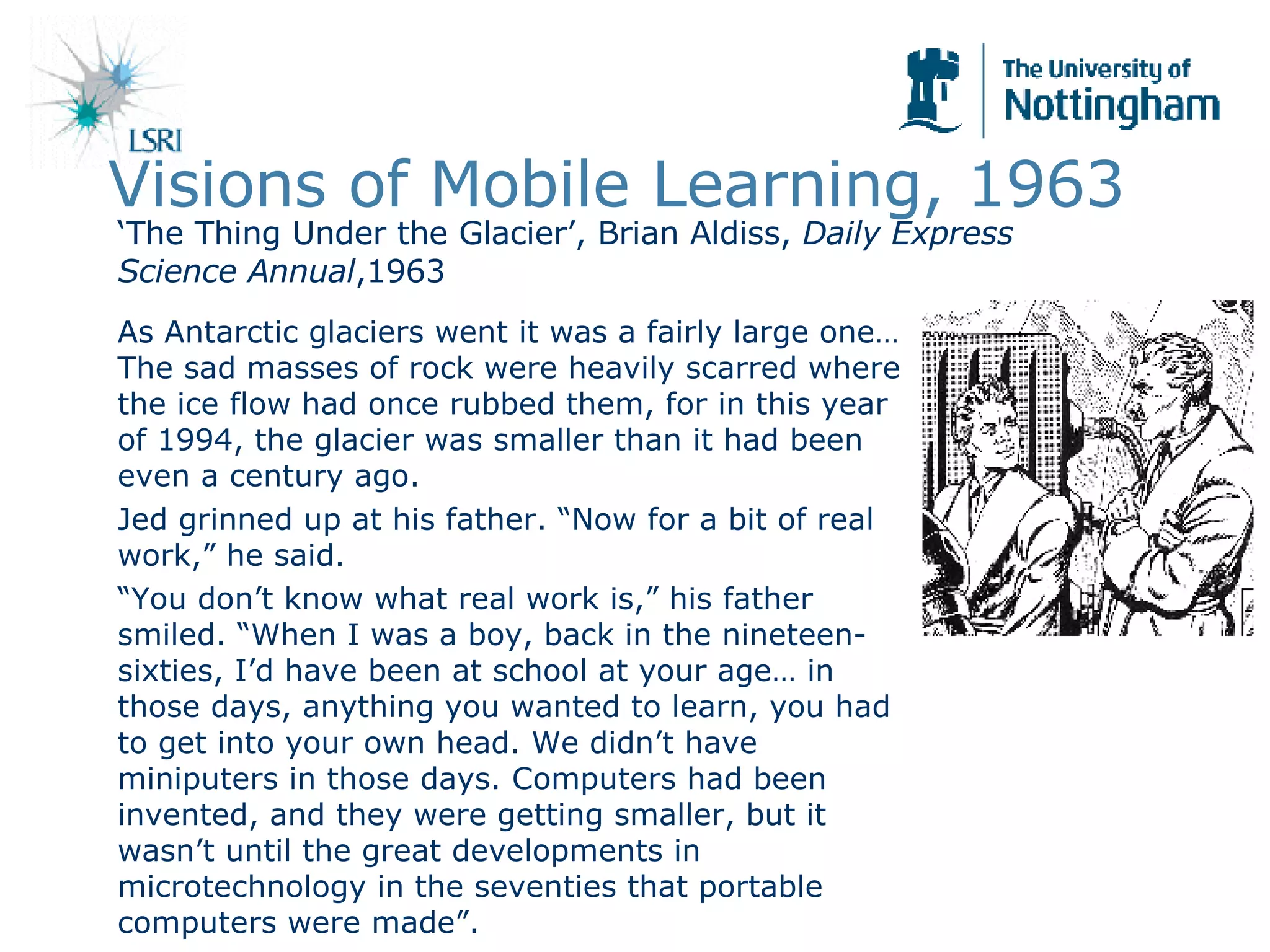
Visions of Mobile Learning, 1963 As Antarctic glaciers went it was a fairly large one…The sad masses of rock were heavily scarred where the ice flow had once rubbed them, for in this year of 1994, the glacier was smaller than it had been even a century ago.  Jed grinned up at his father. “Now for a bit of real work,” he said. “ You don’t know what real work is,” his father smiled. “When I was a boy, back in the nineteen-sixties, I’d have been at school at your age… in those days, anything you wanted to learn, you had to get into your own head. We didn’t have miniputers in those days. Computers had been invented, and they were getting smaller, but it wasn’t until the great developments in microtechnology in the seventies that portable computers were made”.  ‘ The Thing Under the Glacier’, Brian Aldiss,  Daily Express Science Annual ,1963
Visions of Mobile Learning, 1963 Instinctively [Jed] switched over to his miniputer to review the situation.  It was a simple thing to do. Many of the parts of the miniputer were synthetic bio-chemical units, their “controls” built into Jed’s aural cavity; he “switched on” by simple neural impulse. At once the mighty resources of the machine, equal to the libraries of the world, billowed like a curtain on the fringes of his brain…Its “voice” came into his mind, filling it with relevant words, figures, and pictures. “… Of all continents, the Antarctic has been hardest hit by ice.” As it spoke, it flashed one of its staggeringly vivid pictures into Jed’s mind. Howling through great forests, slicing through grasslands, came cold winds. The landscape grew darker, more barren; snow fell. The Thing Under the Glacier, Brian Aldiss, 1963
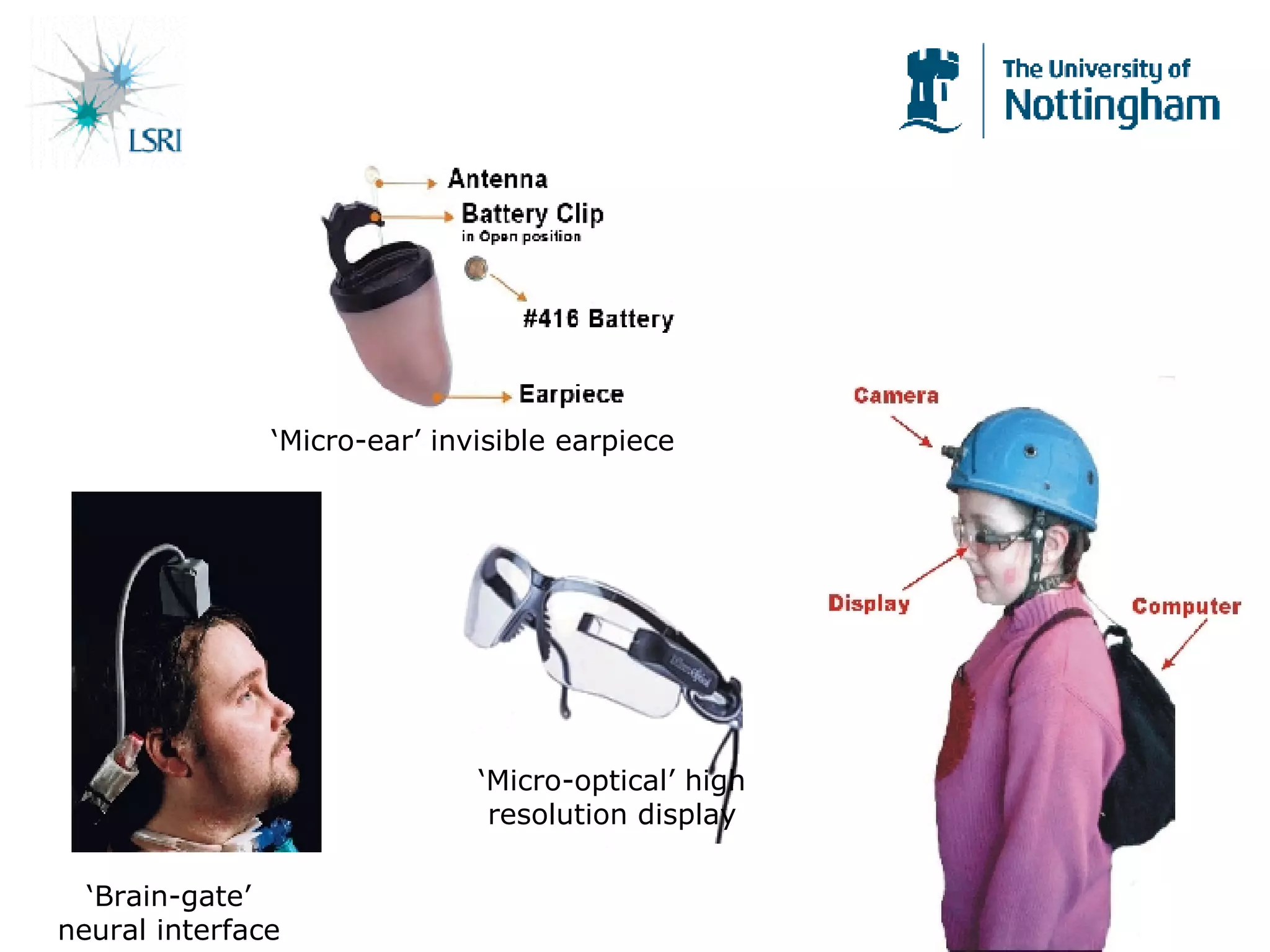
‘ Micro-ear’ invisible earpiece ‘ Micro-optical’ high resolution display ‘ Brain-gate’ neural interface
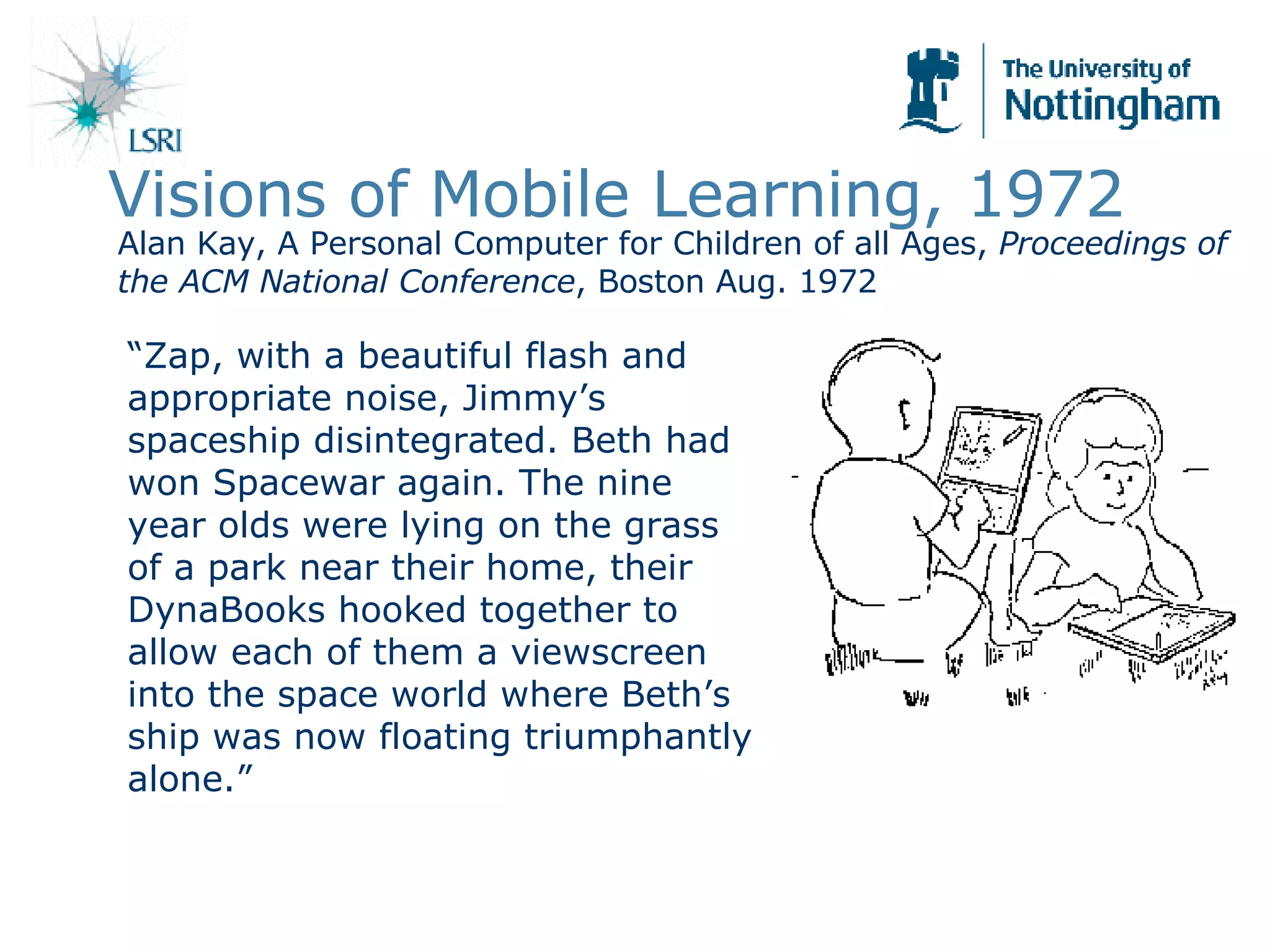
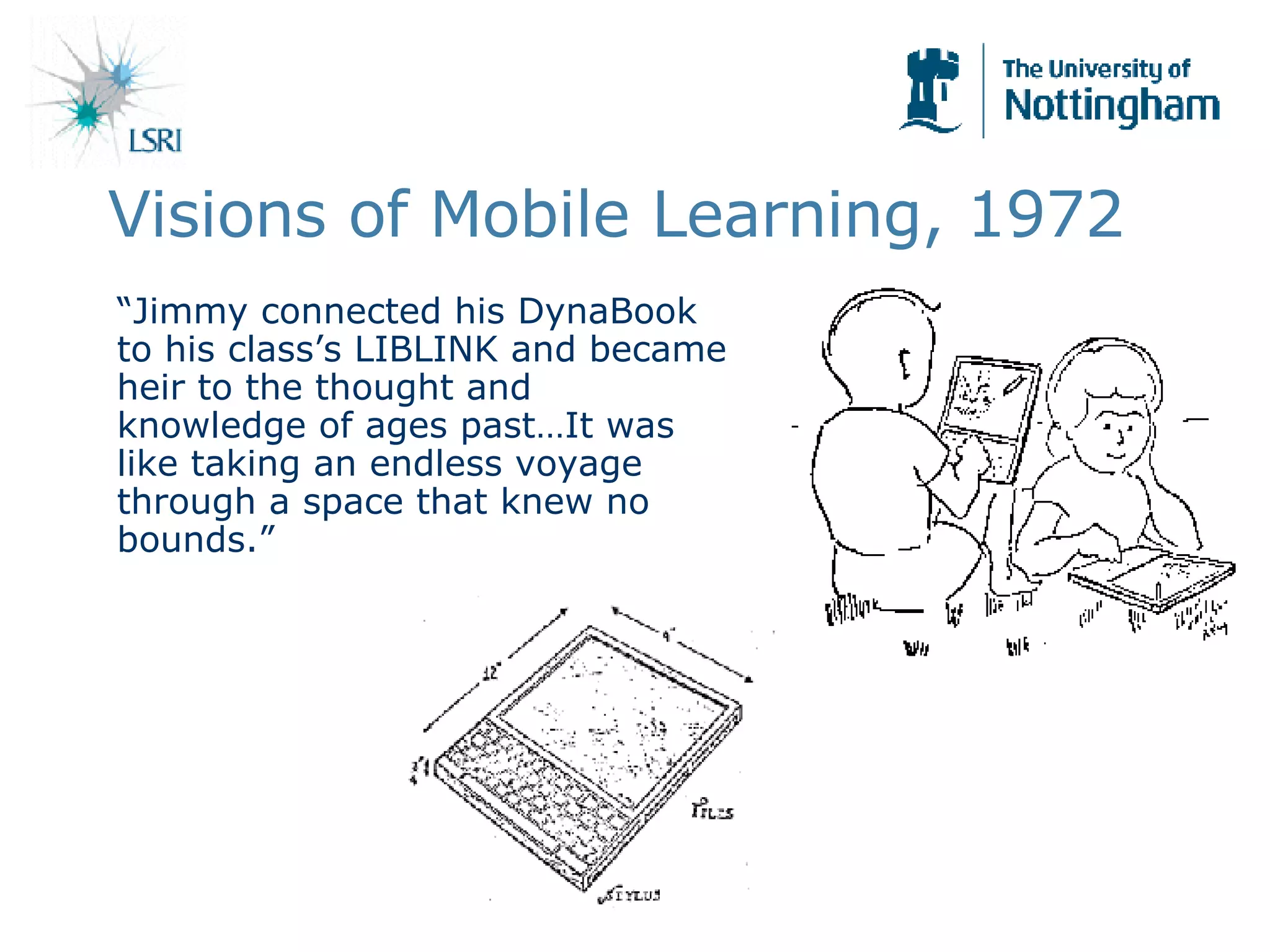
Visions of Mobile Learning, 1972 “ Zap, with a beautiful flash and appropriate noise, Jimmy’s spaceship disintegrated. Beth had won Spacewar again. The nine year olds were lying on the grass of a park near their home, their DynaBooks hooked together to allow each of them a viewscreen into the space world where Beth’s ship was now floating triumphantly alone.” Alan Kay, A Personal Computer for Children of all Ages,  Proceedings of the ACM National Conference , Boston Aug. 1972
Visions of Mobile Learning, 1972 “ Jimmy connected his DynaBook to his class’s LIBLINK and became heir to the thought and knowledge of ages past…It was like taking an endless voyage through a space that knew no bounds.”
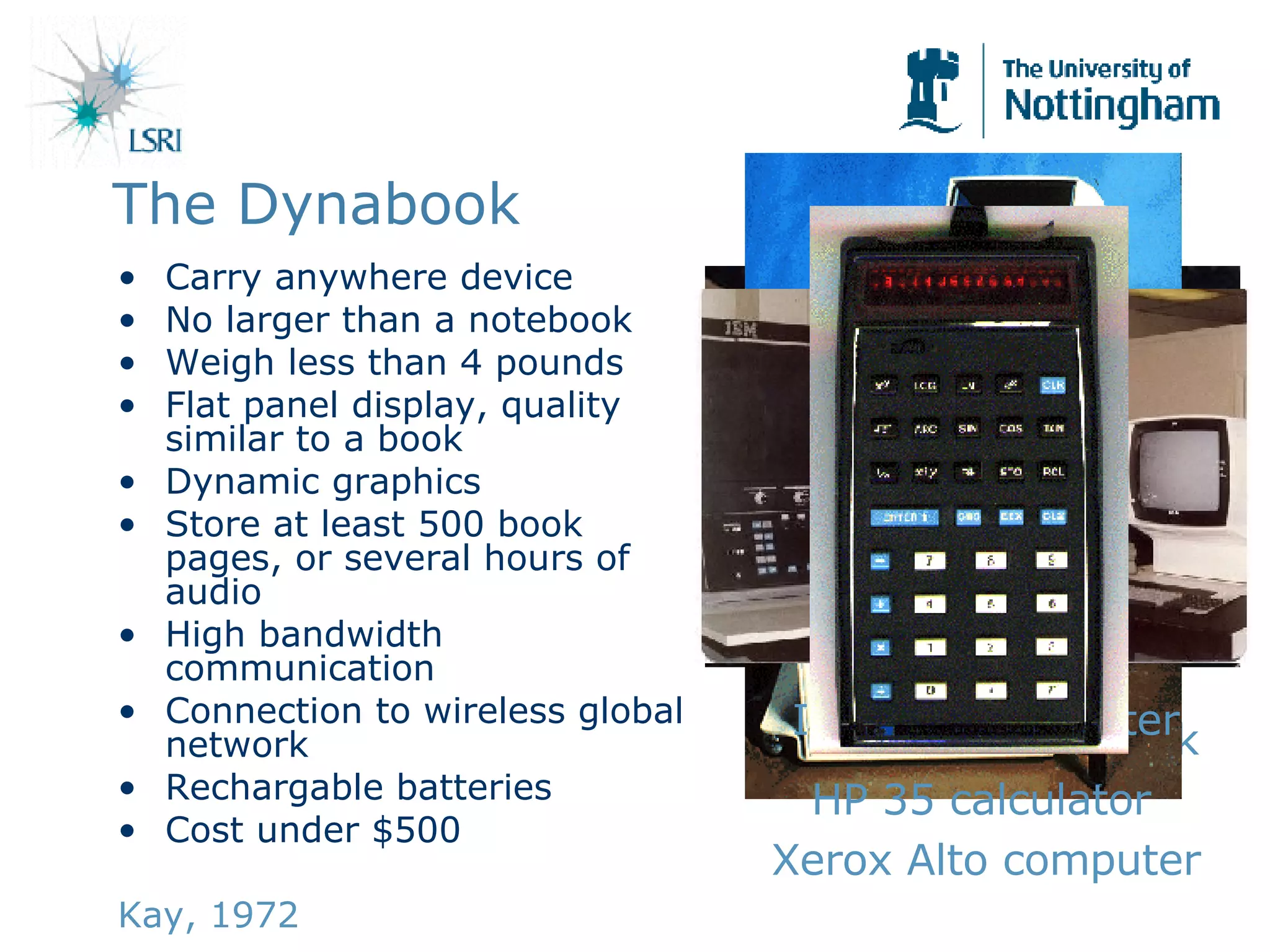
The Dynabook Carry anywhere device No larger than a notebook Weigh less than 4 pounds Flat panel display, quality similar to a book Dynamic graphics Store at least 500 book pages, or several hours of audio High bandwidth communication Connection to wireless global network Rechargable batteries Cost under $500 Kay, 1972 Mockup of Dynabook Xerox Alto computer IBM 370 computer HP 35 calculator
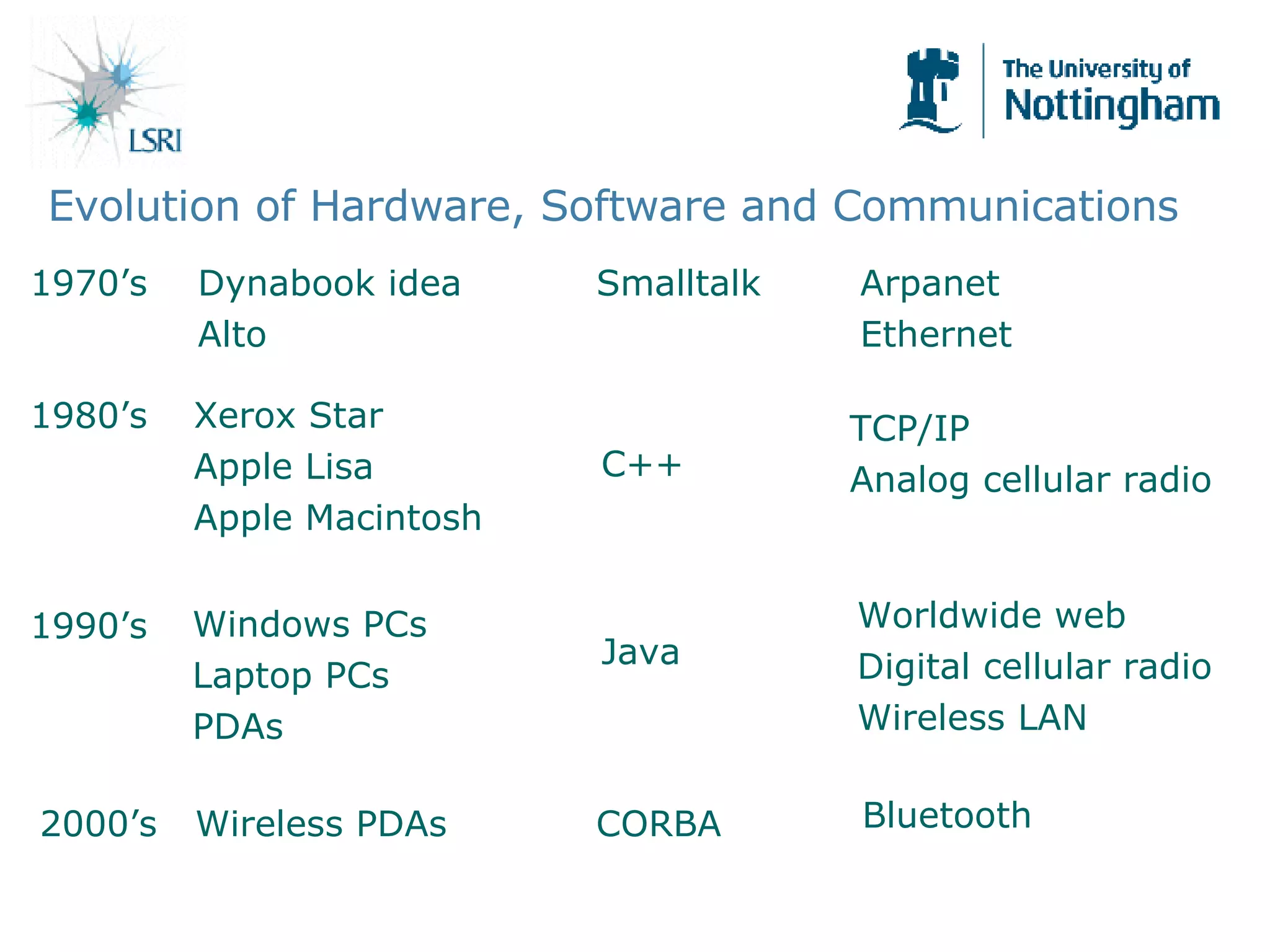
Evolution of Hardware, Software and Communications Dynabook idea Alto Smalltalk 1970’s 1980’s Xerox Star Apple Lisa Apple Macintosh C++ 1990’s Windows PCs Laptop PCs PDAs Java 2000’s Wireless PDAs Arpanet Ethernet TCP/IP Analog cellular radio Worldwide web Digital cellular radio Wireless LAN CORBA Bluetooth
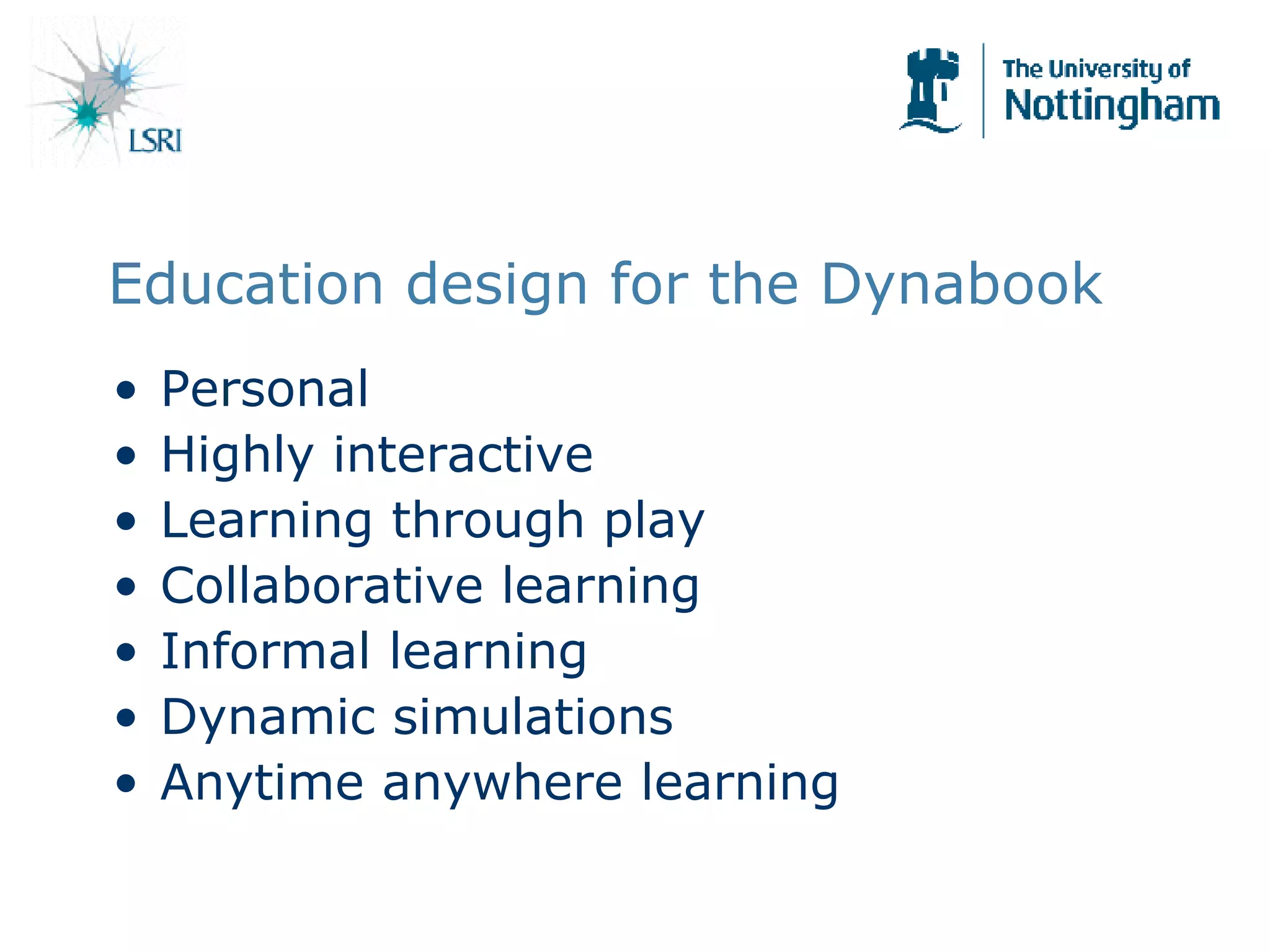
Education design for the Dynabook Personal Highly interactive Learning through play Collaborative learning Informal learning Dynamic simulations Anytime anywhere learning
Evolution of learner-centred education Discovery Learning 1970’s 1980’s Situated learning Constructivist learning Collaborative learning 1990’s Problem-based learning Lifelong learning Social-constructivist learning 2000’s Informal learning Contextual learning Ambient learning
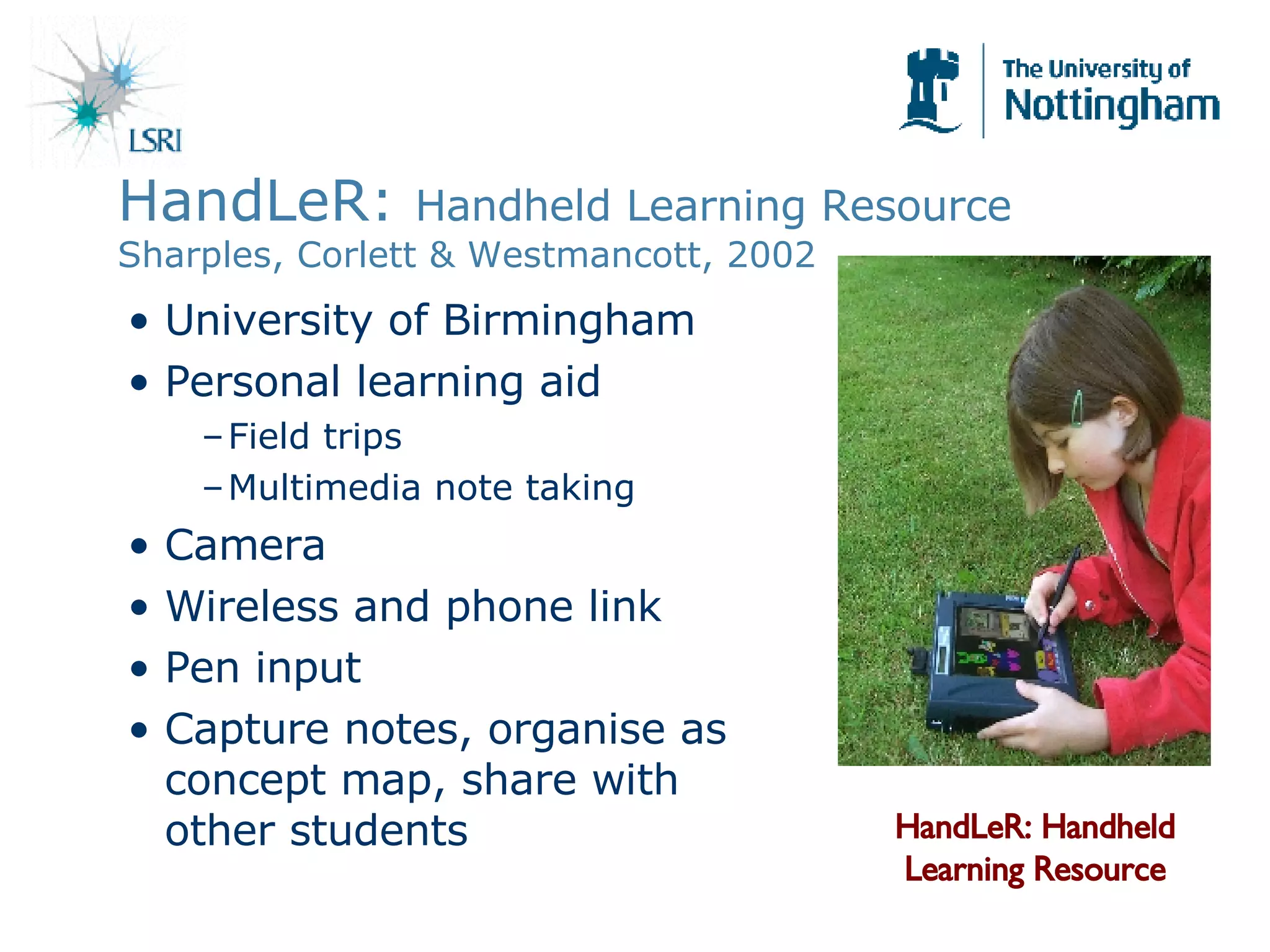
HandLeR:  Handheld Learning Resource Sharples, Corlett & Westmancott, 2002 University of Birmingham Personal learning aid Field trips Multimedia note taking Camera Wireless and phone link Pen input Capture notes, organise as concept map, share with other students HandLeR: Handheld Learning Resource
HandLeR project
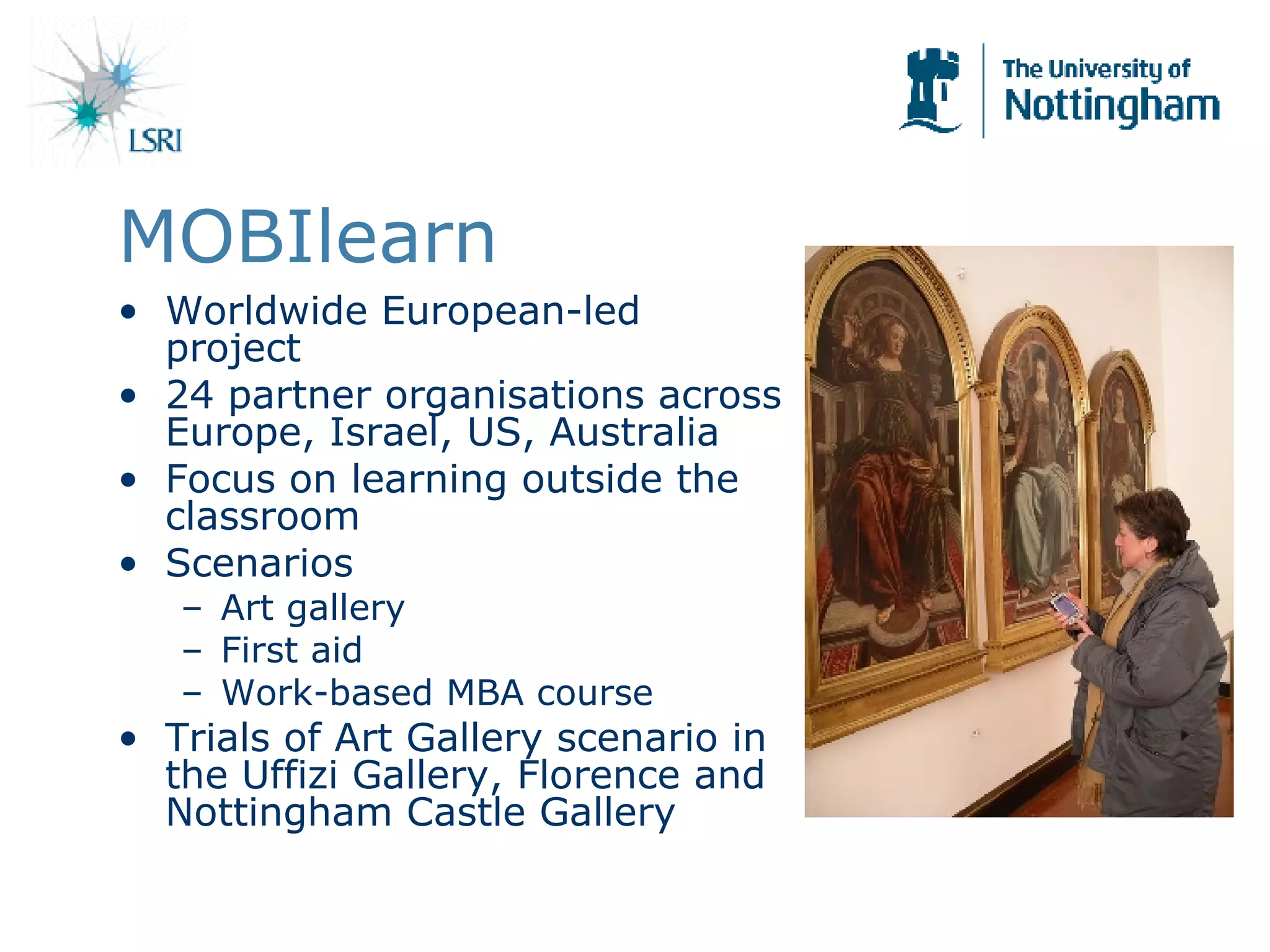
MOBIlearn Worldwide European-led project 24 partner organisations across Europe, Israel, US, Australia Focus on learning outside the classroom  Scenarios Art gallery First aid Work-based MBA course Trials of Art Gallery scenario in the Uffizi Gallery, Florence and Nottingham Castle Gallery
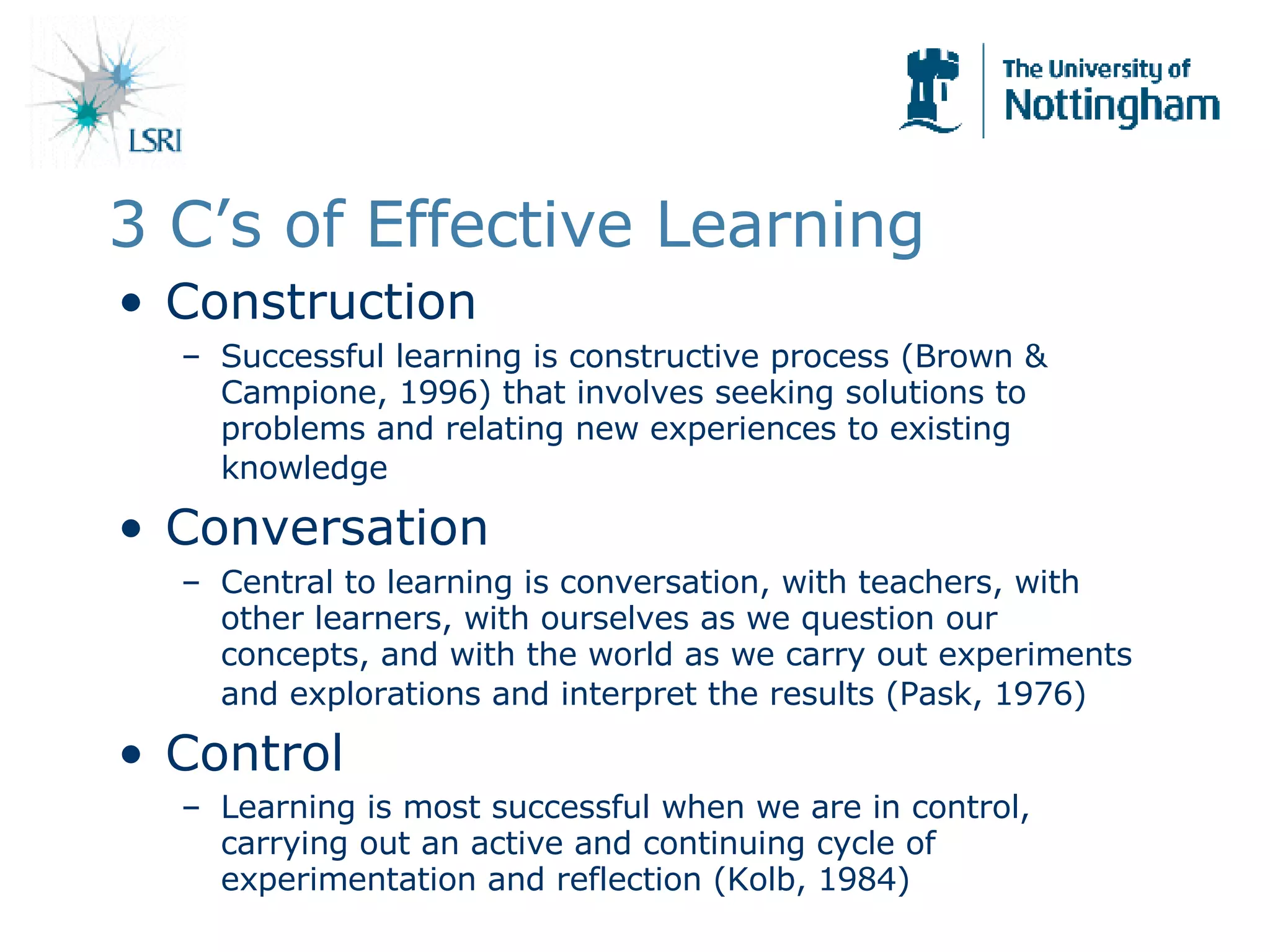
It’s the learner that’s mobile How learning is interwoven with everyday life Mobile learning can both complement and conflict with formal education The importance of context, constructed by learners through interaction Ethical issues: privacy, ownership MOBIlearn: what we know now that we didn’t at the start (Final project meeting informal discussion)
3 C’s of Effective Learning Construction Successful learning is constructive process (Brown & Campione, 1996) that involves seeking solutions to problems and relating new experiences to existing knowledge   Conversation Central to learning is conversation, with teachers, with other learners, with ourselves as we question our concepts, and with the world as we carry out experiments and explorations and interpret the results (Pask, 1976)   Control Learning is most successful when we are in control, carrying out an active and continuing cycle of experimentation and reflection (Kolb, 1984)
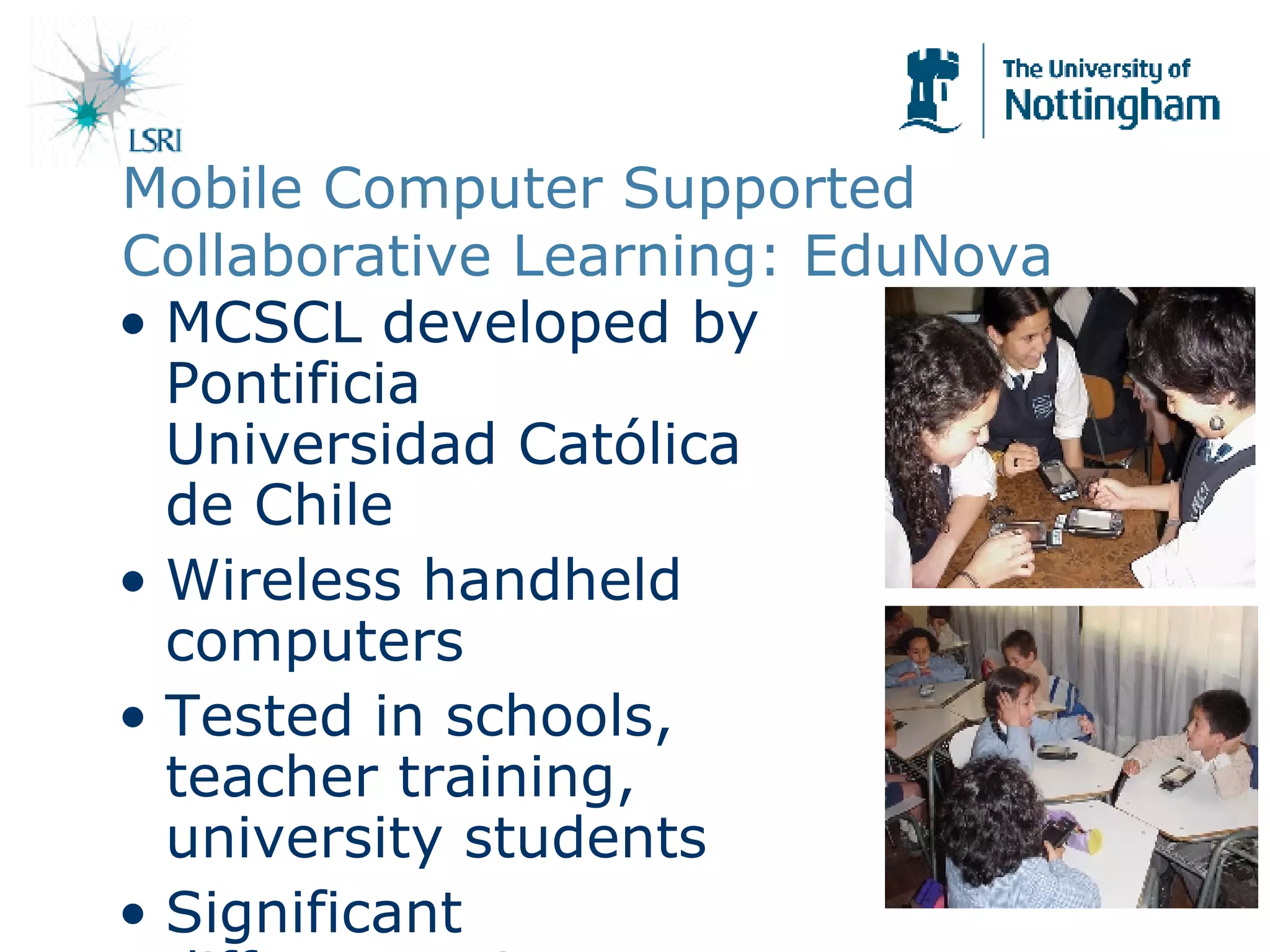
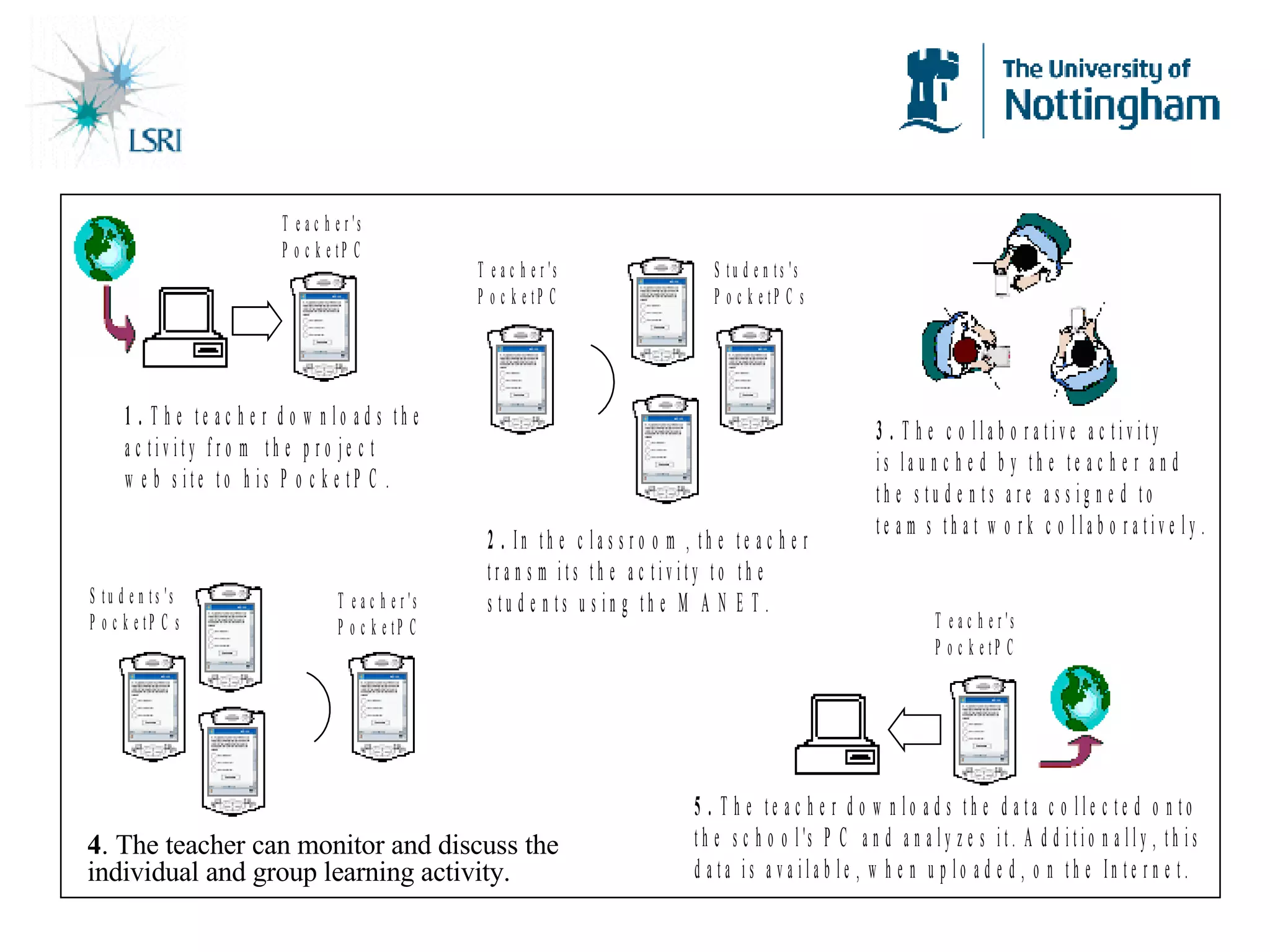
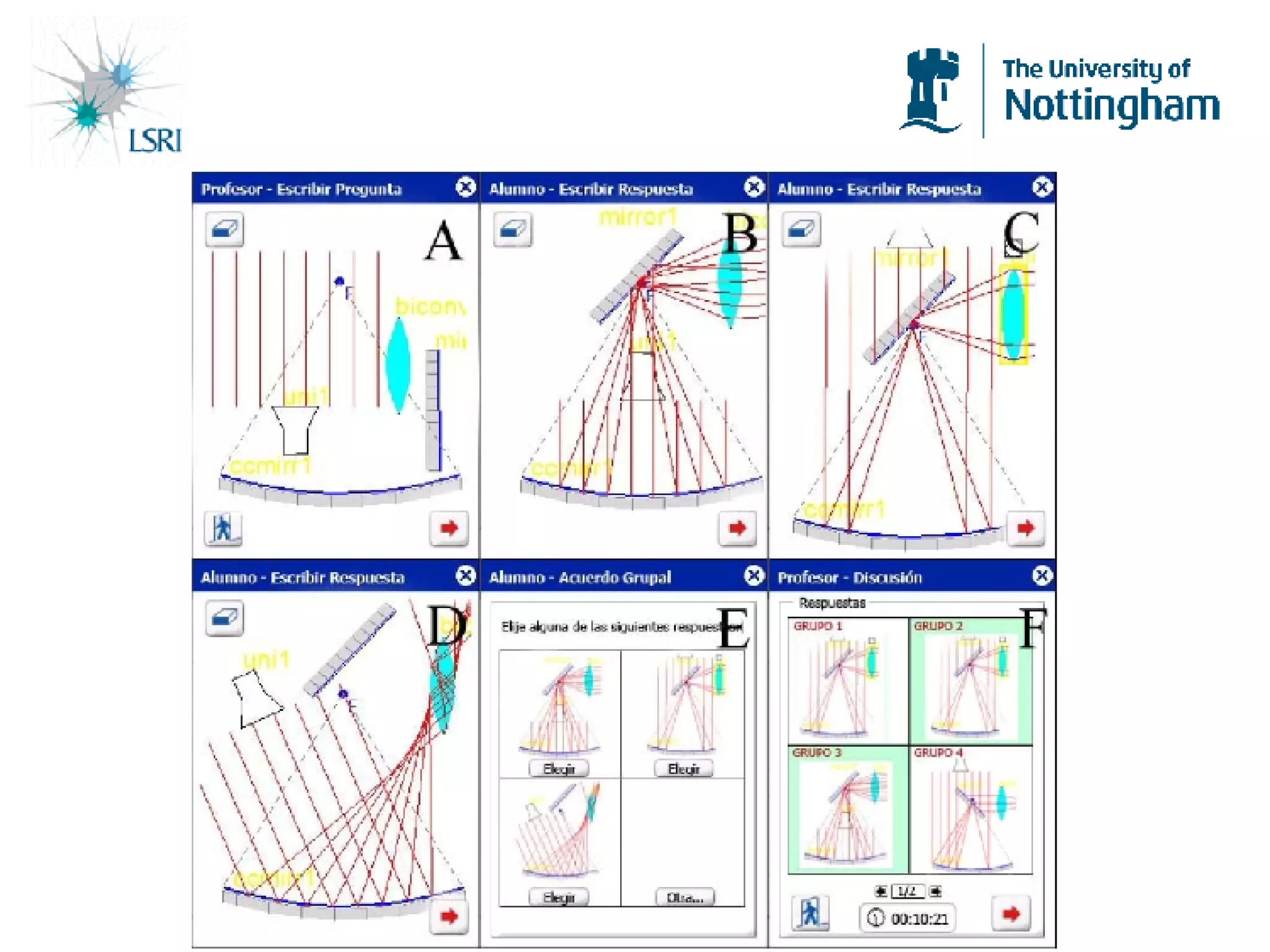
Mobile Computer Supported Collaborative Learning: EduNova MCSCL developed by Pontificia Universidad Cat ólica de Chile Wireless handheld computers Tested in schools, teacher training, university students Significant differences in learning outcomes Trials in other countries including UK (Wolverhampton)
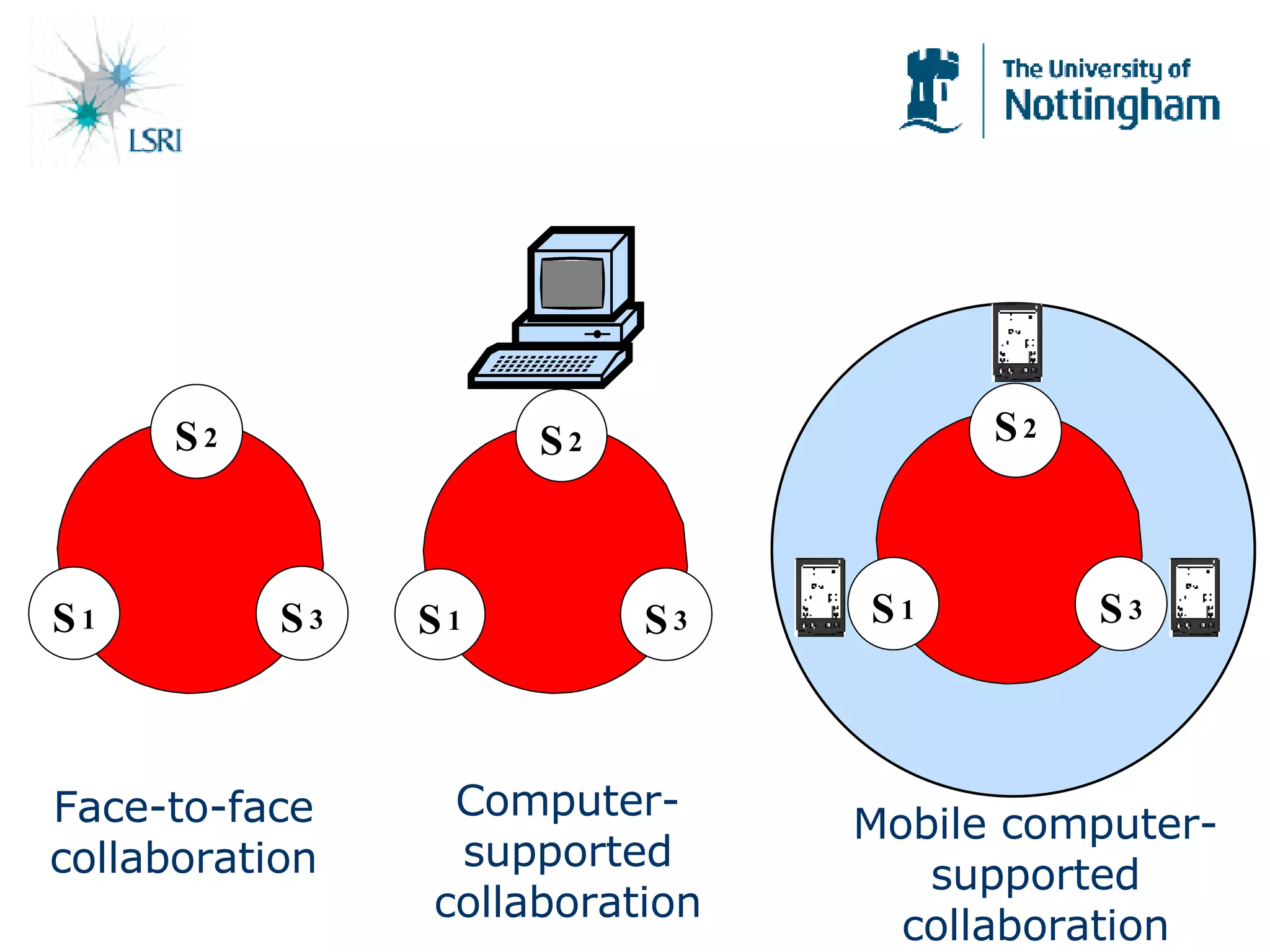
S 2 S 1 S 3 S 2 S 1 S 3 S 2 S 1 S 3 Computer-supported collaboration Mobile computer-supported collaboration Face-to-face collaboration
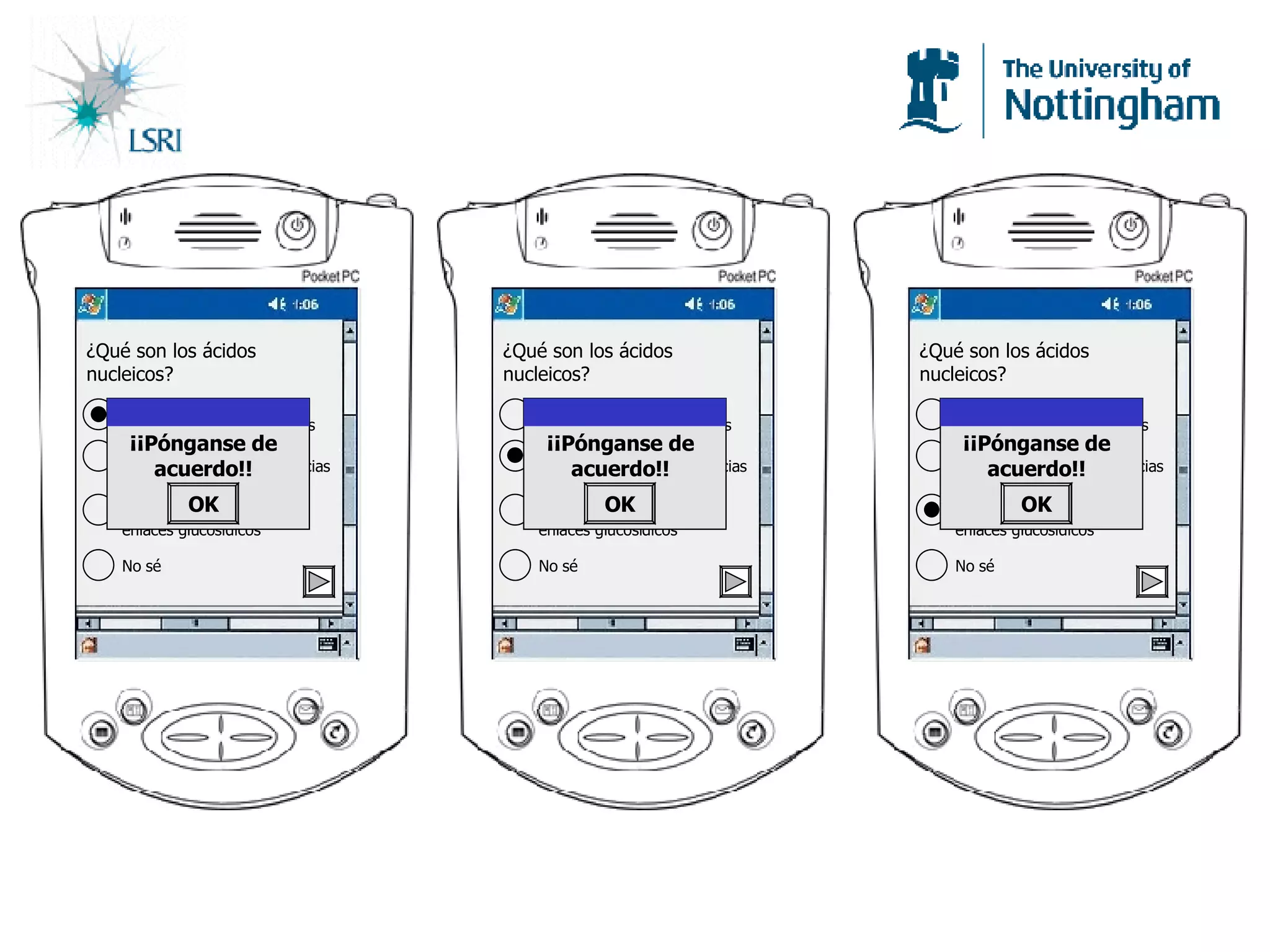
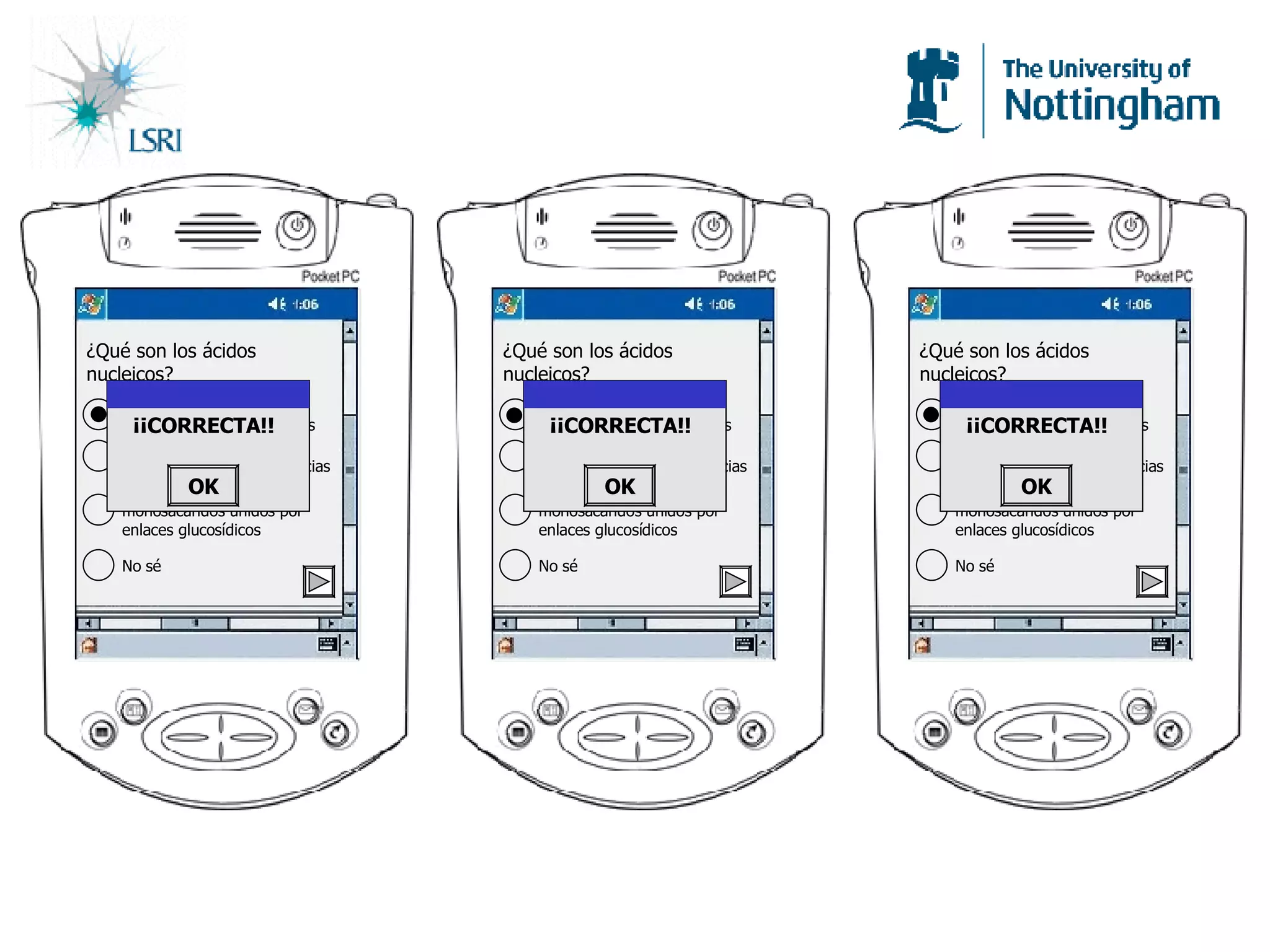
4 . The teacher can monitor and discuss the individual and group learning activity.
¿ Qué son los ácidos nucleicos? Cadenas de ADN y ARN formadas por 4  nucleótidos  Cadenas de aminoácidos unidos en distintas secuencias No sé Cadena de  monosacáridos unidos por enlaces glucosídicos ¿ Qué son los ácidos nucleicos? Cadenas de ADN y ARN formadas por 4  nucleótidos  Cadenas de aminoácidos unidos en distintas secuencias No sé Cadena de  monosacáridos unidos por enlaces glucosídicos ¿ Qué son los ácidos nucleicos? Cadenas de ADN y ARN formadas por 4  nucleótidos  Cadenas de aminoácidos unidos en distintas secuencias No sé Cadena de  monosacáridos unidos por enlaces glucosídicos ¡¡Pónganse de acuerdo!! OK ¡¡Pónganse de acuerdo!! OK ¡¡Pónganse de acuerdo!! OK
¿ Qué son los ácidos nucleicos? Cadenas de ADN y ARN formadas por 4  nucleótidos  Cadenas de aminoácidos unidos en distintas secuencias No sé Cadena de  monosacáridos unidos por enlaces glucosídicos ¿ Qué son los ácidos nucleicos? Cadenas de ADN y ARN formadas por 4  nucleótidos  Cadenas de aminoácidos unidos en distintas secuencias No sé Cadena de  monosacáridos unidos por enlaces glucosídicos ¿ Qué son los ácidos nucleicos? Cadenas de ADN y ARN formadas por 4  nucleótidos  Cadenas de aminoácidos unidos en distintas secuencias No sé Cadena de  monosacáridos unidos por enlaces glucosídicos ¡¡CORRECTA!! OK ¡¡CORRECTA!! OK ¡¡CORRECTA!! OK
 
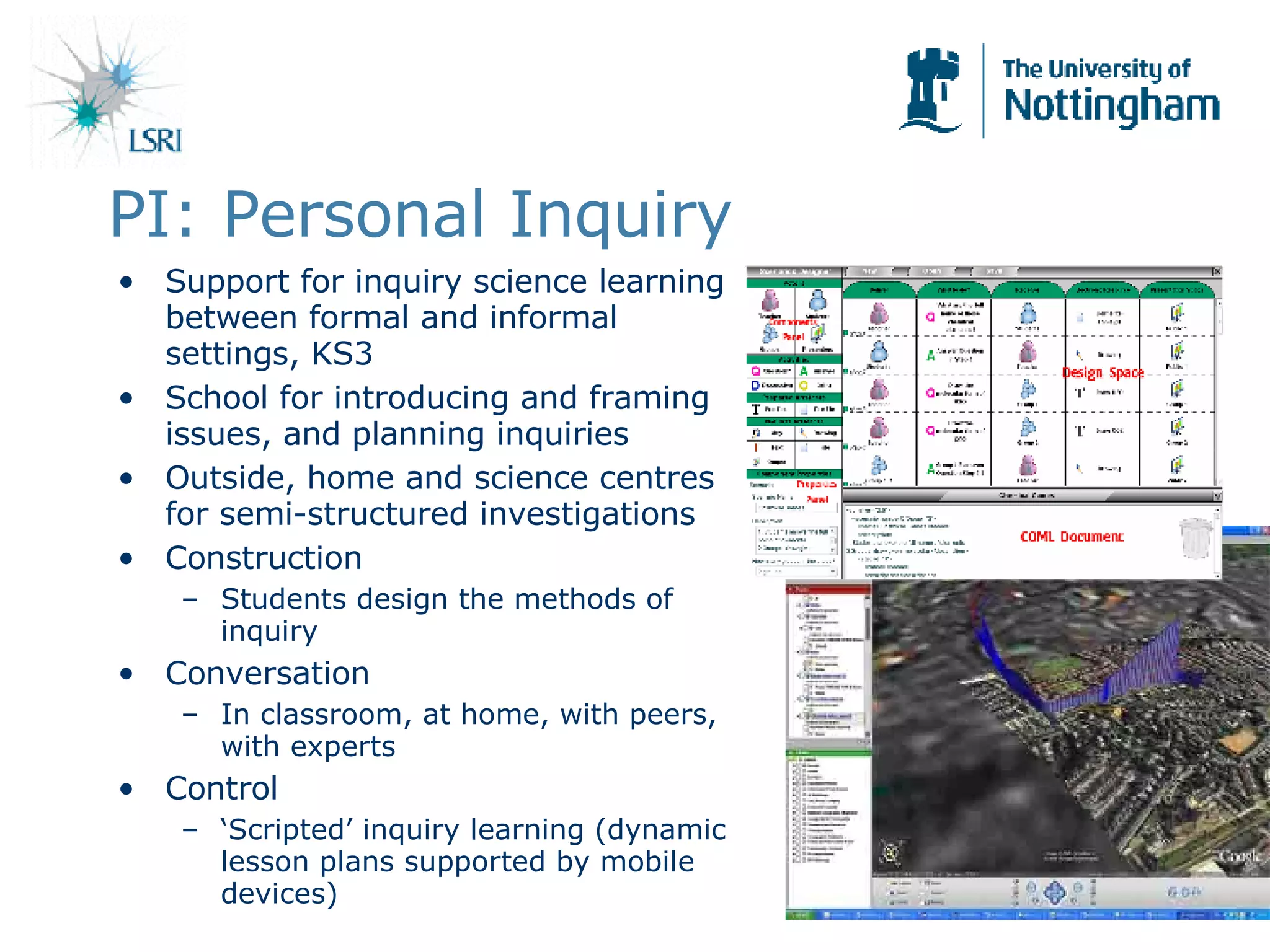
PI: Personal Inquiry Support for inquiry science learning between formal and informal settings, KS3 School for introducing and framing issues, and planning inquiries Outside, home and science centres for semi-structured investigations Construction Students design the methods of inquiry Conversation In classroom, at home, with peers, with experts Control ‘ Scripted’ inquiry learning (dynamic lesson plans supported by mobile devices)
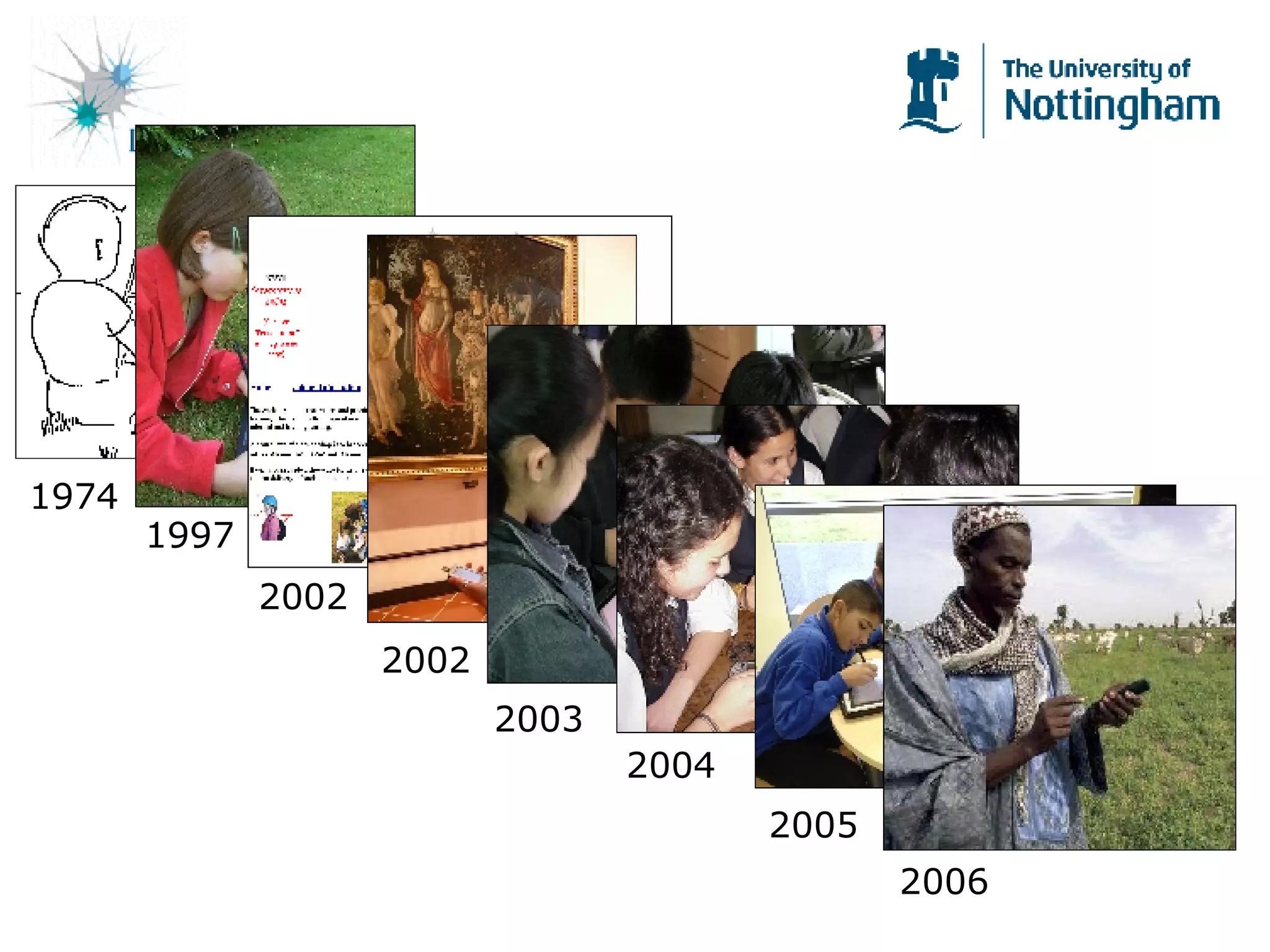
1974 1997 2002 2002 2003 2004 2005 2006
Big Issues in Mobile Learning Kaleidoscope European Workshop, Nottingham, June 2006   What is mobile learning? Does mobile learning work? How do you evaluate mobile learning? How do you resolve the tensions between informal mobile learning and formal school learning Who should own the technology, and the learning?

History Of Mobile Learning - mLearn 2007 doctoral consortium Oct 2007

  • 1.
    AShort History of Mobile Learning and some issues to consider Mike Sharples Learning Sciences Research Institute University of Nottingham www.nottingham.ac.uk/lsri
  • 2.
    Visions of MobileLearning, 1963 As Antarctic glaciers went it was a fairly large one…The sad masses of rock were heavily scarred where the ice flow had once rubbed them, for in this year of 1994, the glacier was smaller than it had been even a century ago. Jed grinned up at his father. “Now for a bit of real work,” he said. “ You don’t know what real work is,” his father smiled. “When I was a boy, back in the nineteen-sixties, I’d have been at school at your age… in those days, anything you wanted to learn, you had to get into your own head. We didn’t have miniputers in those days. Computers had been invented, and they were getting smaller, but it wasn’t until the great developments in microtechnology in the seventies that portable computers were made”. ‘ The Thing Under the Glacier’, Brian Aldiss, Daily Express Science Annual ,1963
  • 3.
    Visions of MobileLearning, 1963 Instinctively [Jed] switched over to his miniputer to review the situation. It was a simple thing to do. Many of the parts of the miniputer were synthetic bio-chemical units, their “controls” built into Jed’s aural cavity; he “switched on” by simple neural impulse. At once the mighty resources of the machine, equal to the libraries of the world, billowed like a curtain on the fringes of his brain…Its “voice” came into his mind, filling it with relevant words, figures, and pictures. “… Of all continents, the Antarctic has been hardest hit by ice.” As it spoke, it flashed one of its staggeringly vivid pictures into Jed’s mind. Howling through great forests, slicing through grasslands, came cold winds. The landscape grew darker, more barren; snow fell. The Thing Under the Glacier, Brian Aldiss, 1963
  • 4.
    ‘ Micro-ear’ invisibleearpiece ‘ Micro-optical’ high resolution display ‘ Brain-gate’ neural interface
  • 5.
    Visions of MobileLearning, 1972 “ Zap, with a beautiful flash and appropriate noise, Jimmy’s spaceship disintegrated. Beth had won Spacewar again. The nine year olds were lying on the grass of a park near their home, their DynaBooks hooked together to allow each of them a viewscreen into the space world where Beth’s ship was now floating triumphantly alone.” Alan Kay, A Personal Computer for Children of all Ages, Proceedings of the ACM National Conference , Boston Aug. 1972
  • 6.
    Visions of MobileLearning, 1972 “ Jimmy connected his DynaBook to his class’s LIBLINK and became heir to the thought and knowledge of ages past…It was like taking an endless voyage through a space that knew no bounds.”
  • 7.
    The Dynabook Carryanywhere device No larger than a notebook Weigh less than 4 pounds Flat panel display, quality similar to a book Dynamic graphics Store at least 500 book pages, or several hours of audio High bandwidth communication Connection to wireless global network Rechargable batteries Cost under $500 Kay, 1972 Mockup of Dynabook Xerox Alto computer IBM 370 computer HP 35 calculator
  • 8.
    Evolution of Hardware,Software and Communications Dynabook idea Alto Smalltalk 1970’s 1980’s Xerox Star Apple Lisa Apple Macintosh C++ 1990’s Windows PCs Laptop PCs PDAs Java 2000’s Wireless PDAs Arpanet Ethernet TCP/IP Analog cellular radio Worldwide web Digital cellular radio Wireless LAN CORBA Bluetooth
  • 9.
    Education design forthe Dynabook Personal Highly interactive Learning through play Collaborative learning Informal learning Dynamic simulations Anytime anywhere learning
  • 10.
    Evolution of learner-centrededucation Discovery Learning 1970’s 1980’s Situated learning Constructivist learning Collaborative learning 1990’s Problem-based learning Lifelong learning Social-constructivist learning 2000’s Informal learning Contextual learning Ambient learning
  • 11.
    HandLeR: HandheldLearning Resource Sharples, Corlett & Westmancott, 2002 University of Birmingham Personal learning aid Field trips Multimedia note taking Camera Wireless and phone link Pen input Capture notes, organise as concept map, share with other students HandLeR: Handheld Learning Resource
  • 12.
  • 13.
    MOBIlearn Worldwide European-ledproject 24 partner organisations across Europe, Israel, US, Australia Focus on learning outside the classroom Scenarios Art gallery First aid Work-based MBA course Trials of Art Gallery scenario in the Uffizi Gallery, Florence and Nottingham Castle Gallery
  • 14.
    It’s the learnerthat’s mobile How learning is interwoven with everyday life Mobile learning can both complement and conflict with formal education The importance of context, constructed by learners through interaction Ethical issues: privacy, ownership MOBIlearn: what we know now that we didn’t at the start (Final project meeting informal discussion)
  • 15.
    3 C’s ofEffective Learning Construction Successful learning is constructive process (Brown & Campione, 1996) that involves seeking solutions to problems and relating new experiences to existing knowledge Conversation Central to learning is conversation, with teachers, with other learners, with ourselves as we question our concepts, and with the world as we carry out experiments and explorations and interpret the results (Pask, 1976) Control Learning is most successful when we are in control, carrying out an active and continuing cycle of experimentation and reflection (Kolb, 1984)
  • 16.
    Mobile Computer SupportedCollaborative Learning: EduNova MCSCL developed by Pontificia Universidad Cat ólica de Chile Wireless handheld computers Tested in schools, teacher training, university students Significant differences in learning outcomes Trials in other countries including UK (Wolverhampton)
  • 17.
    S 2 S1 S 3 S 2 S 1 S 3 S 2 S 1 S 3 Computer-supported collaboration Mobile computer-supported collaboration Face-to-face collaboration
  • 18.
    4 . Theteacher can monitor and discuss the individual and group learning activity.
  • 19.
    ¿ Qué sonlos ácidos nucleicos? Cadenas de ADN y ARN formadas por 4 nucleótidos Cadenas de aminoácidos unidos en distintas secuencias No sé Cadena de monosacáridos unidos por enlaces glucosídicos ¿ Qué son los ácidos nucleicos? Cadenas de ADN y ARN formadas por 4 nucleótidos Cadenas de aminoácidos unidos en distintas secuencias No sé Cadena de monosacáridos unidos por enlaces glucosídicos ¿ Qué son los ácidos nucleicos? Cadenas de ADN y ARN formadas por 4 nucleótidos Cadenas de aminoácidos unidos en distintas secuencias No sé Cadena de monosacáridos unidos por enlaces glucosídicos ¡¡Pónganse de acuerdo!! OK ¡¡Pónganse de acuerdo!! OK ¡¡Pónganse de acuerdo!! OK
  • 20.
    ¿ Qué sonlos ácidos nucleicos? Cadenas de ADN y ARN formadas por 4 nucleótidos Cadenas de aminoácidos unidos en distintas secuencias No sé Cadena de monosacáridos unidos por enlaces glucosídicos ¿ Qué son los ácidos nucleicos? Cadenas de ADN y ARN formadas por 4 nucleótidos Cadenas de aminoácidos unidos en distintas secuencias No sé Cadena de monosacáridos unidos por enlaces glucosídicos ¿ Qué son los ácidos nucleicos? Cadenas de ADN y ARN formadas por 4 nucleótidos Cadenas de aminoácidos unidos en distintas secuencias No sé Cadena de monosacáridos unidos por enlaces glucosídicos ¡¡CORRECTA!! OK ¡¡CORRECTA!! OK ¡¡CORRECTA!! OK
  • 21.
  • 22.
    PI: Personal InquirySupport for inquiry science learning between formal and informal settings, KS3 School for introducing and framing issues, and planning inquiries Outside, home and science centres for semi-structured investigations Construction Students design the methods of inquiry Conversation In classroom, at home, with peers, with experts Control ‘ Scripted’ inquiry learning (dynamic lesson plans supported by mobile devices)
  • 23.
    1974 1997 20022002 2003 2004 2005 2006
  • 24.
    Big Issues inMobile Learning Kaleidoscope European Workshop, Nottingham, June 2006 What is mobile learning? Does mobile learning work? How do you evaluate mobile learning? How do you resolve the tensions between informal mobile learning and formal school learning Who should own the technology, and the learning?