DR SAKHER AL-KHADERI
CONSULTANT RADIOLOGIST AMC
BRAIN CT ANATOMY AND BASIC INTERPRETATION
PART II
VENTRICLES
OBJECTIVES
 Illustrate and describe the ventricles.
 Describe the structure of the ventricles.
 Illustrate and describe the cerebrospinal
fluid (CSF) formation, absorption and
circulation.
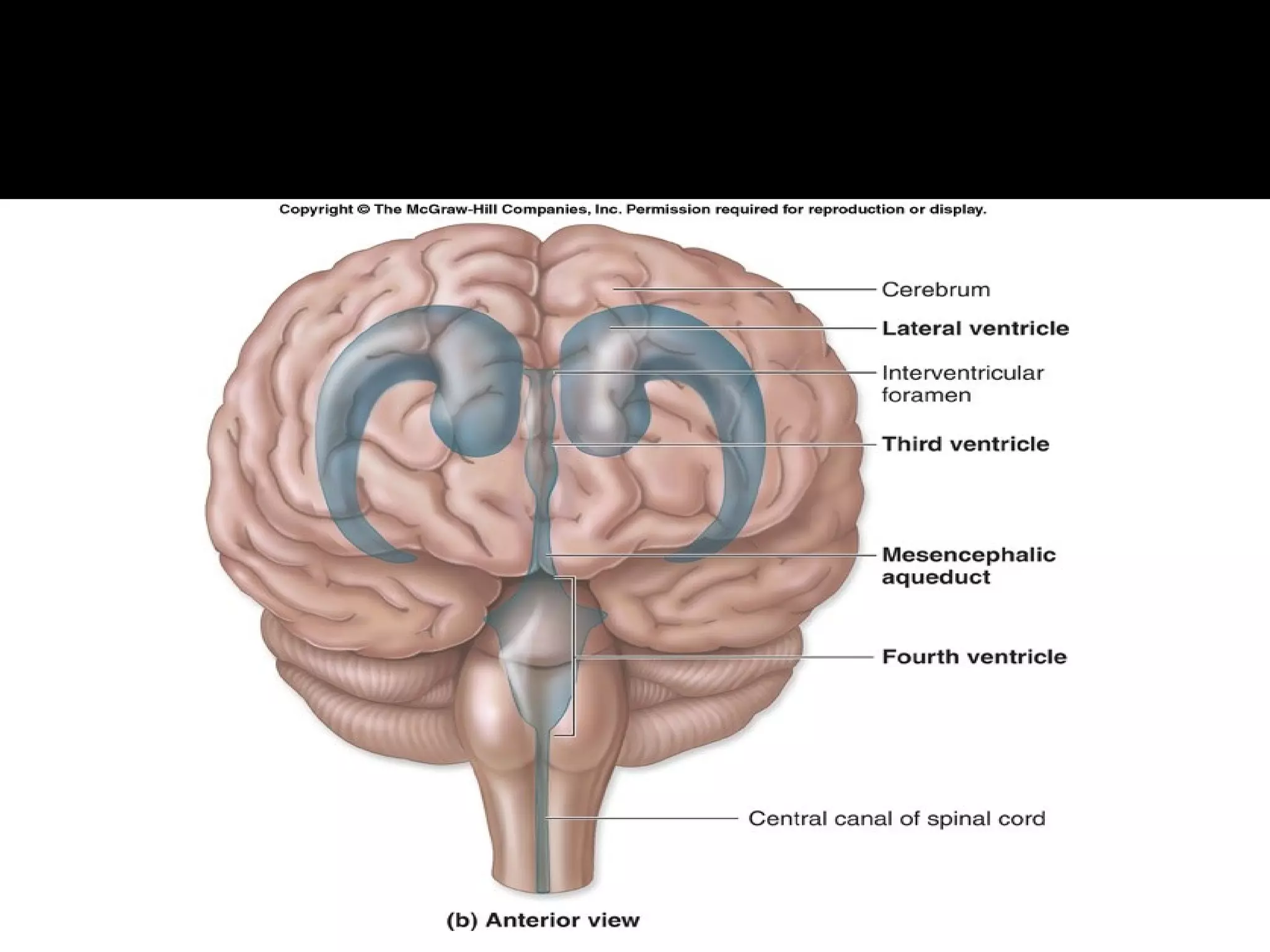
VENTRICLES(Ventricular System)
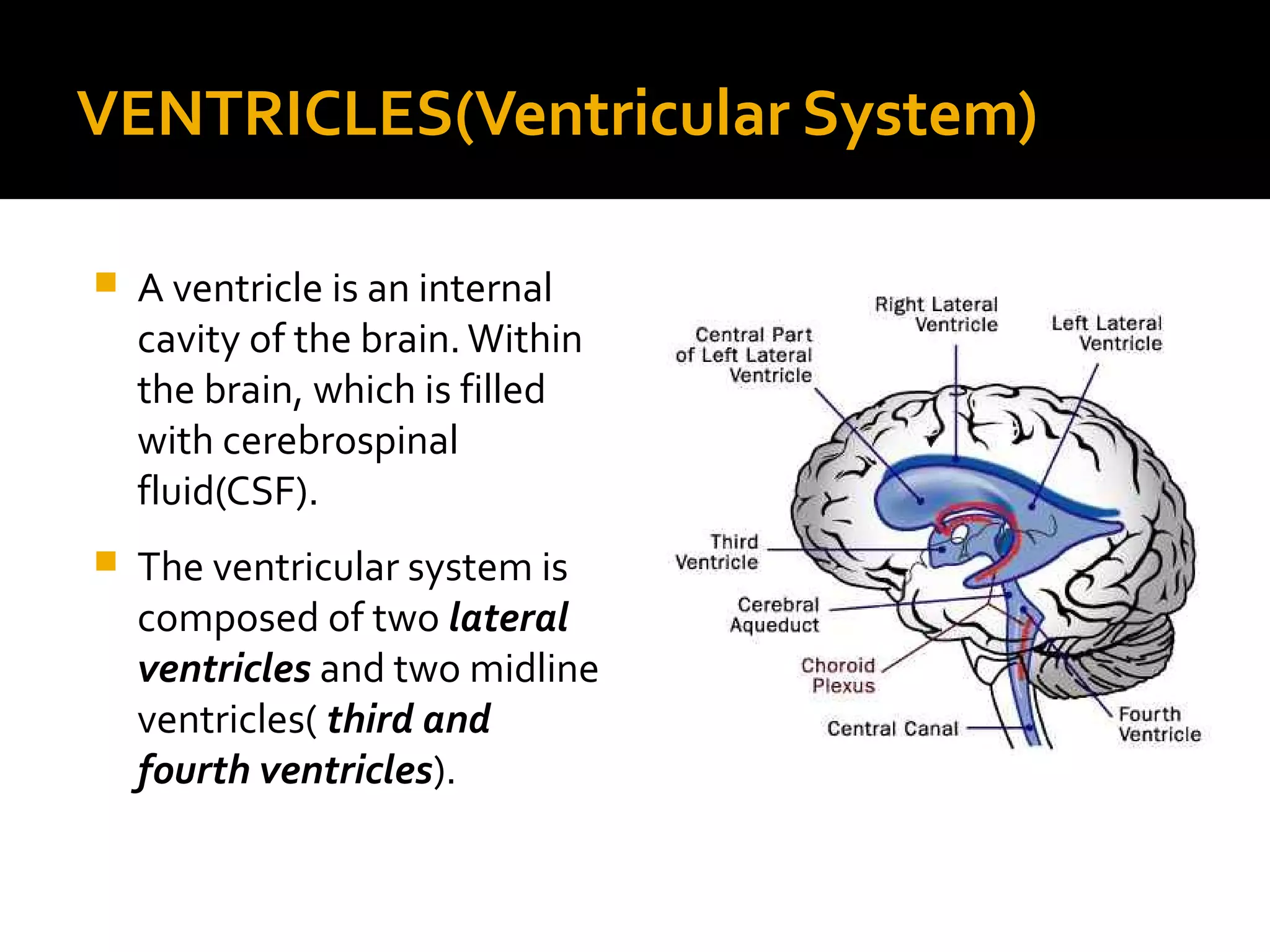
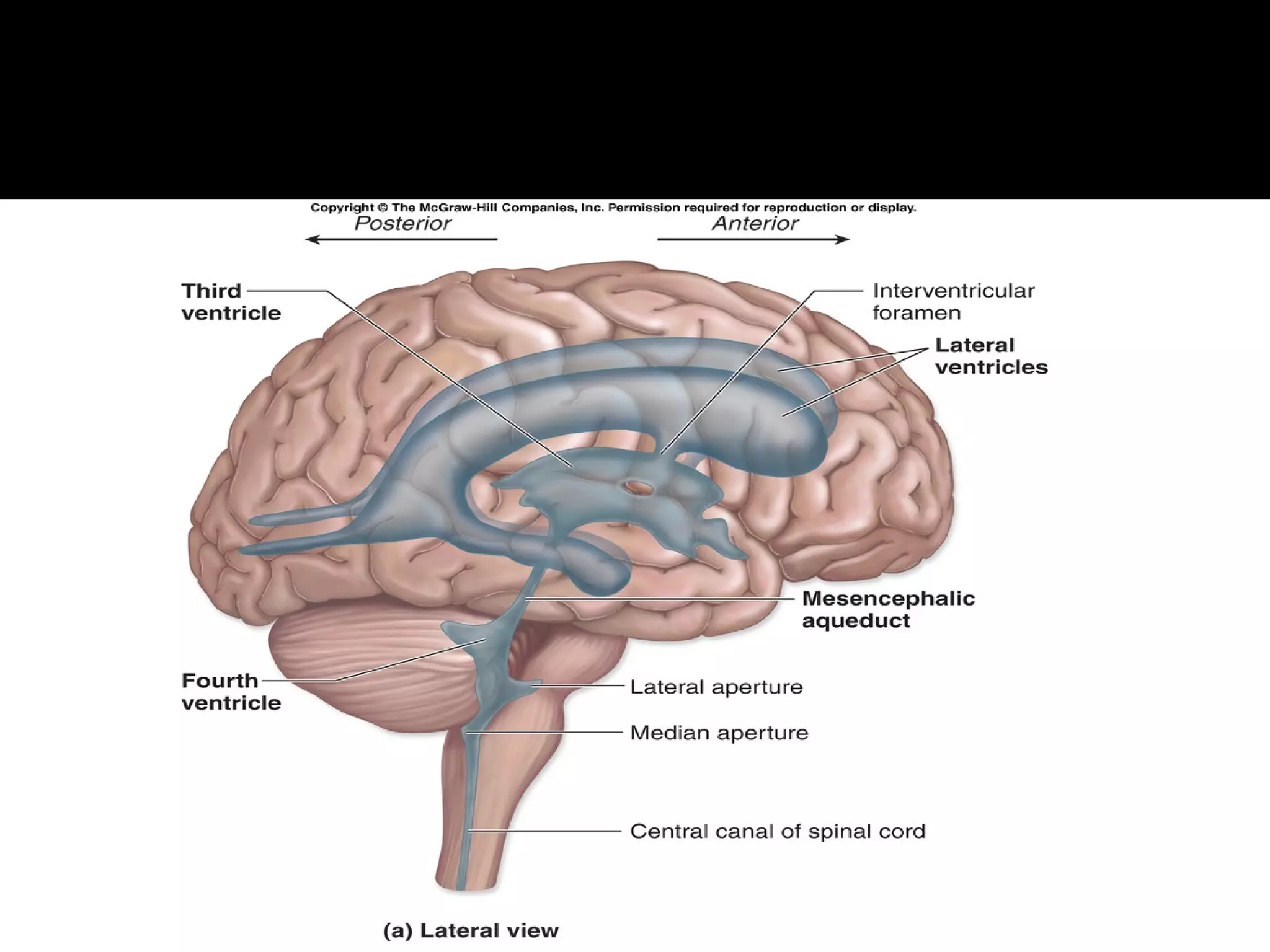
 A ventricle is an internal
cavity of the brain.Within
the brain, which is filled
with cerebrospinal
fluid(CSF).
 The ventricular system is
composed of two lateral
ventricles and two midline
ventricles( third and
fourth ventricles).
VENTRICLES(Ventricular System)
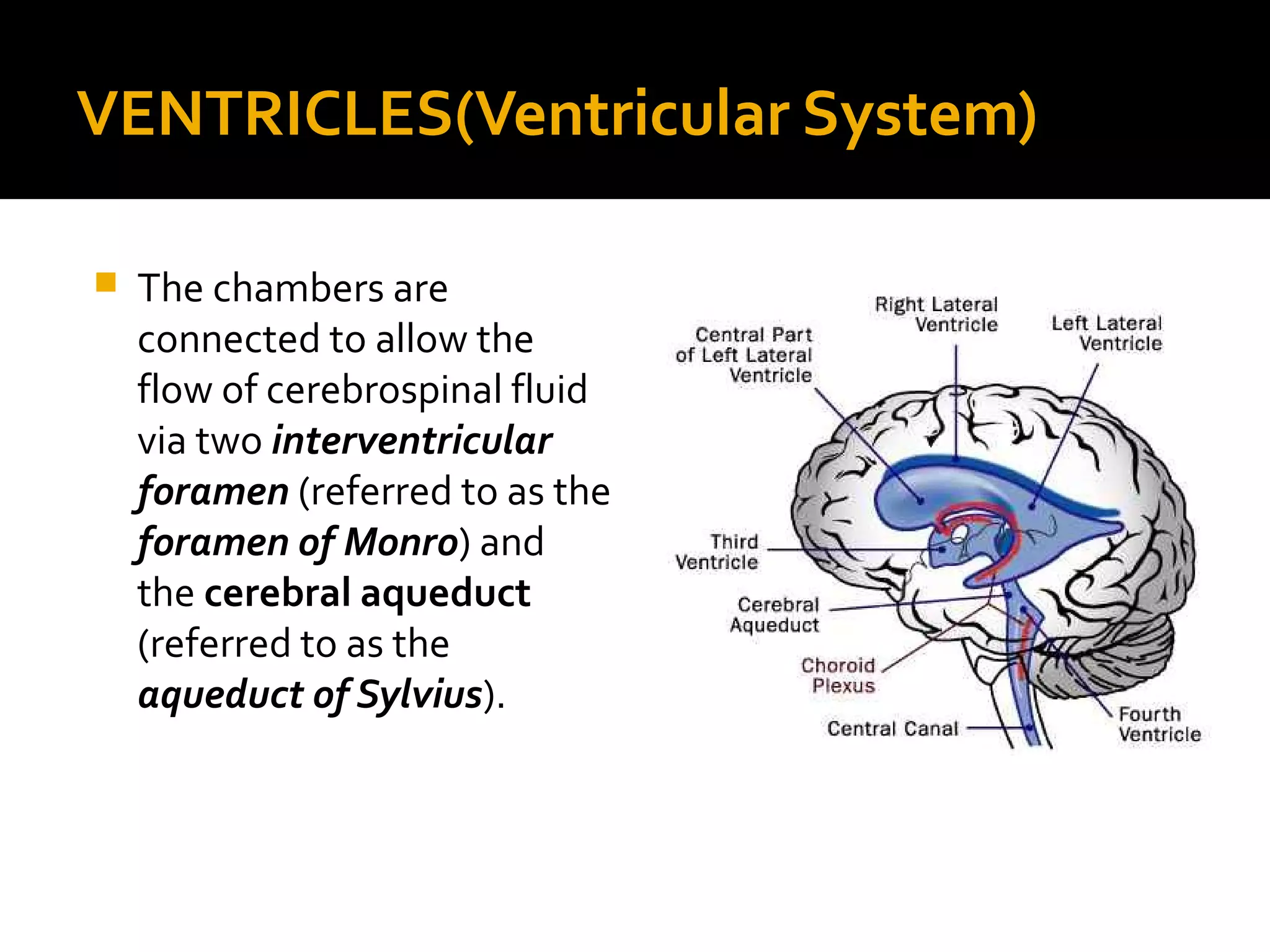
 The chambers are
connected to allow the
flow of cerebrospinal fluid
via two interventricular
foramen (referred to as the
foramen of Monro) and
the cerebral aqueduct
(referred to as the
aqueduct of Sylvius).
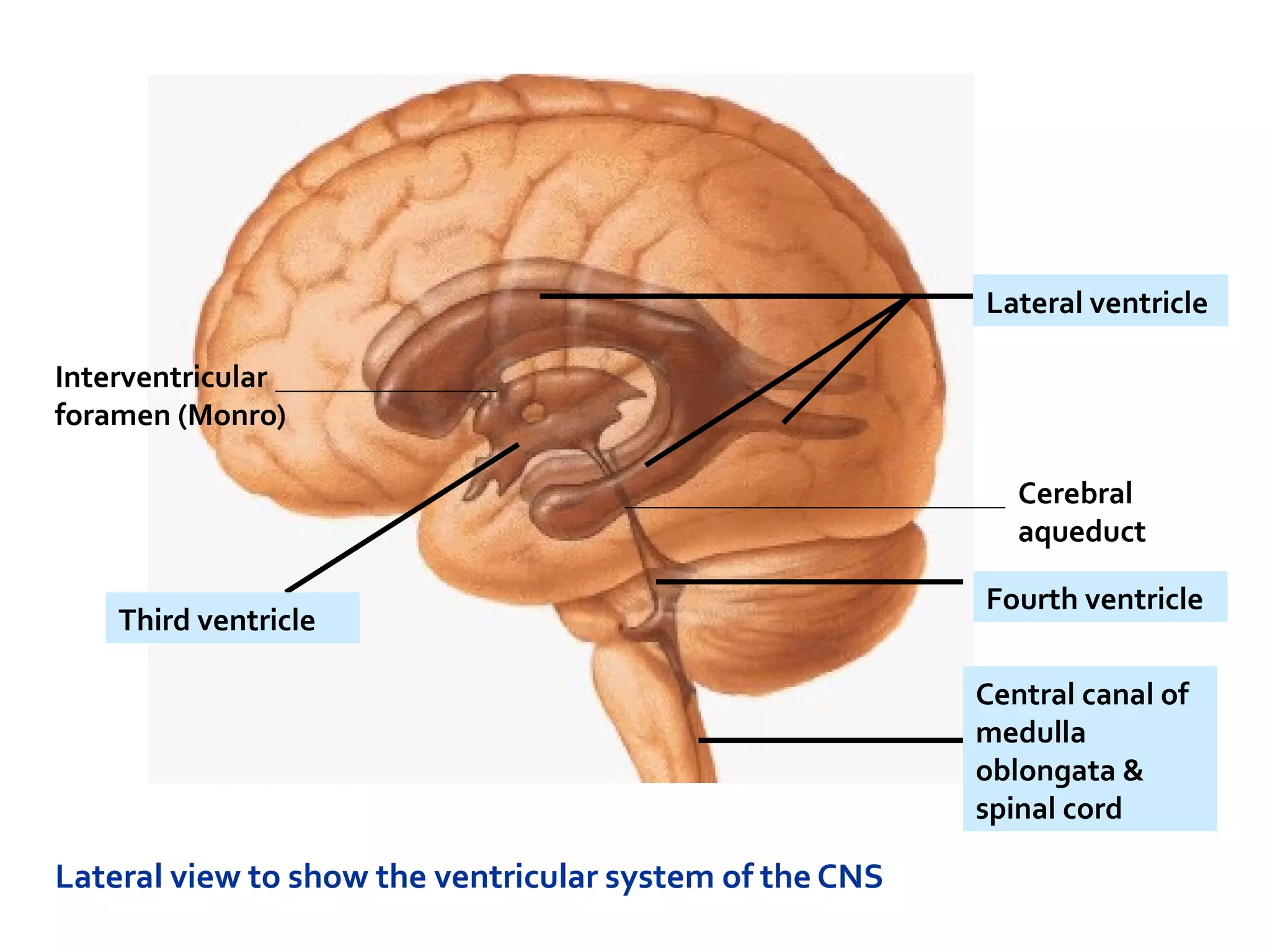
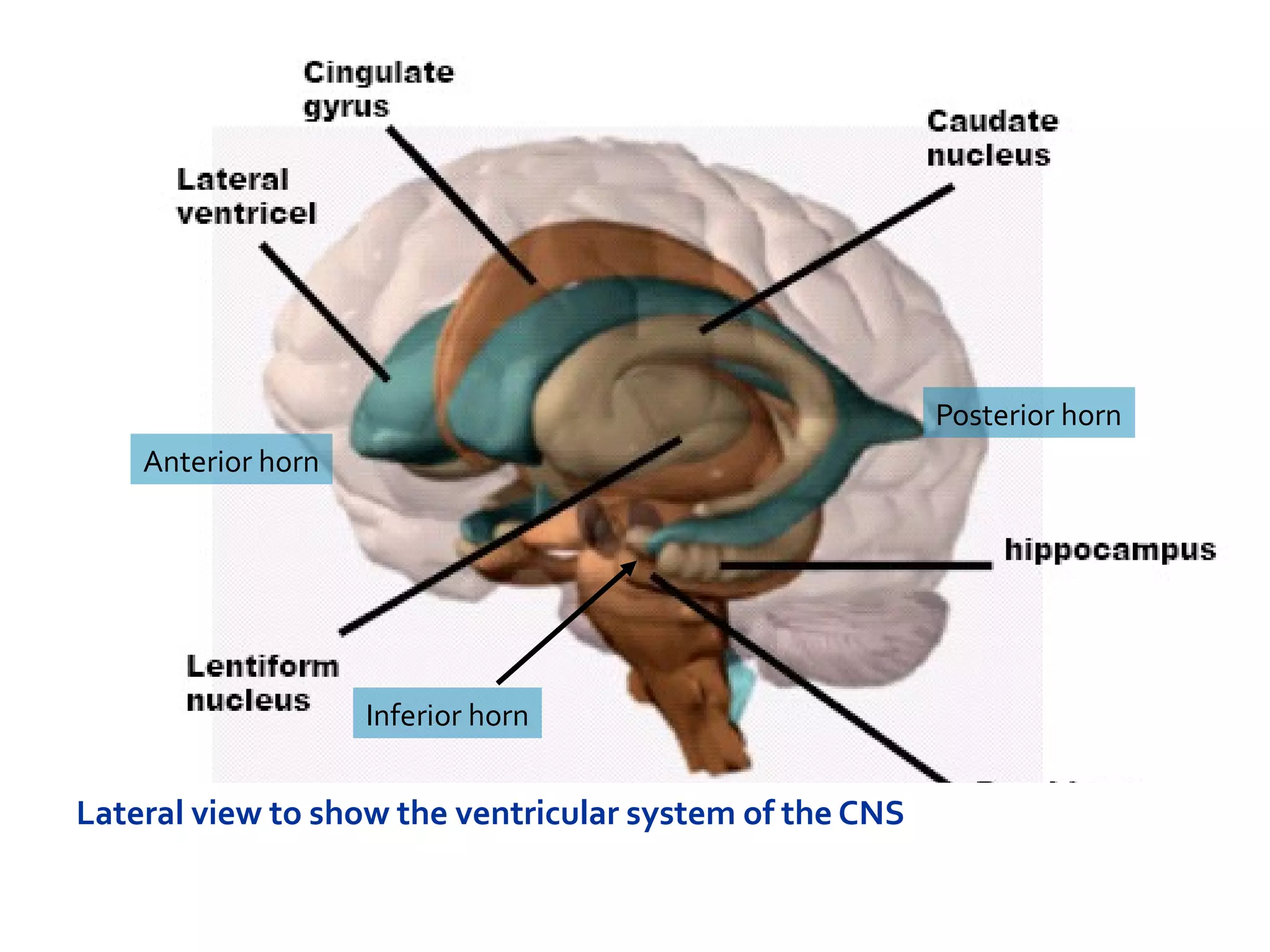
Lateral view to show the ventricular system of the CNS
Central canal of
medulla
oblongata &
spinal cord
Fourth ventricle
Lateral ventricle
Third ventricle
Interventricular
foramen (Monro)
Cerebral
aqueduct
VENTRICLES(Ventricular System)
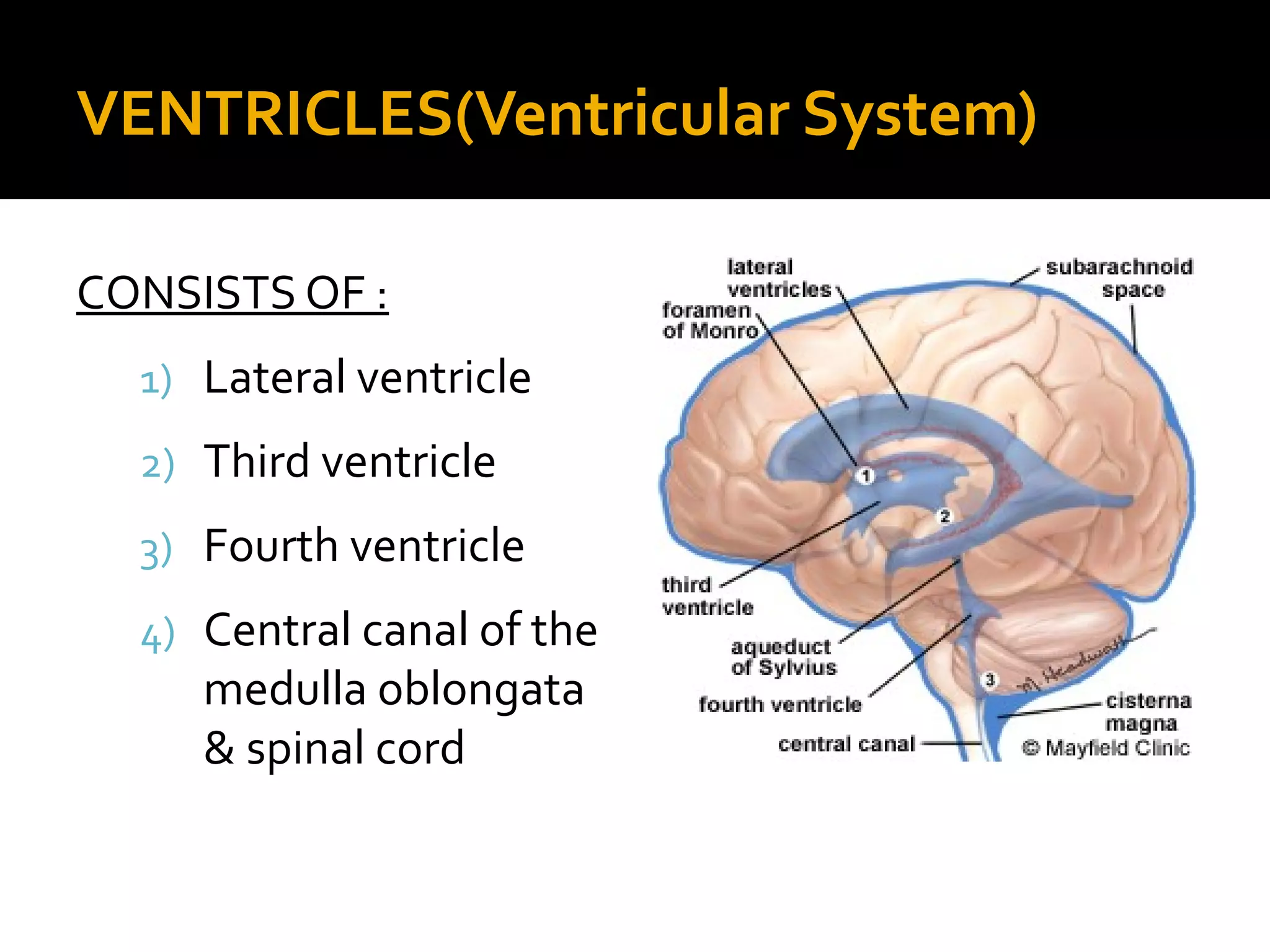
CONSISTS OF :
1) Lateral ventricle
2) Third ventricle
3) Fourth ventricle
4) Central canal of the
medulla oblongata
& spinal cord
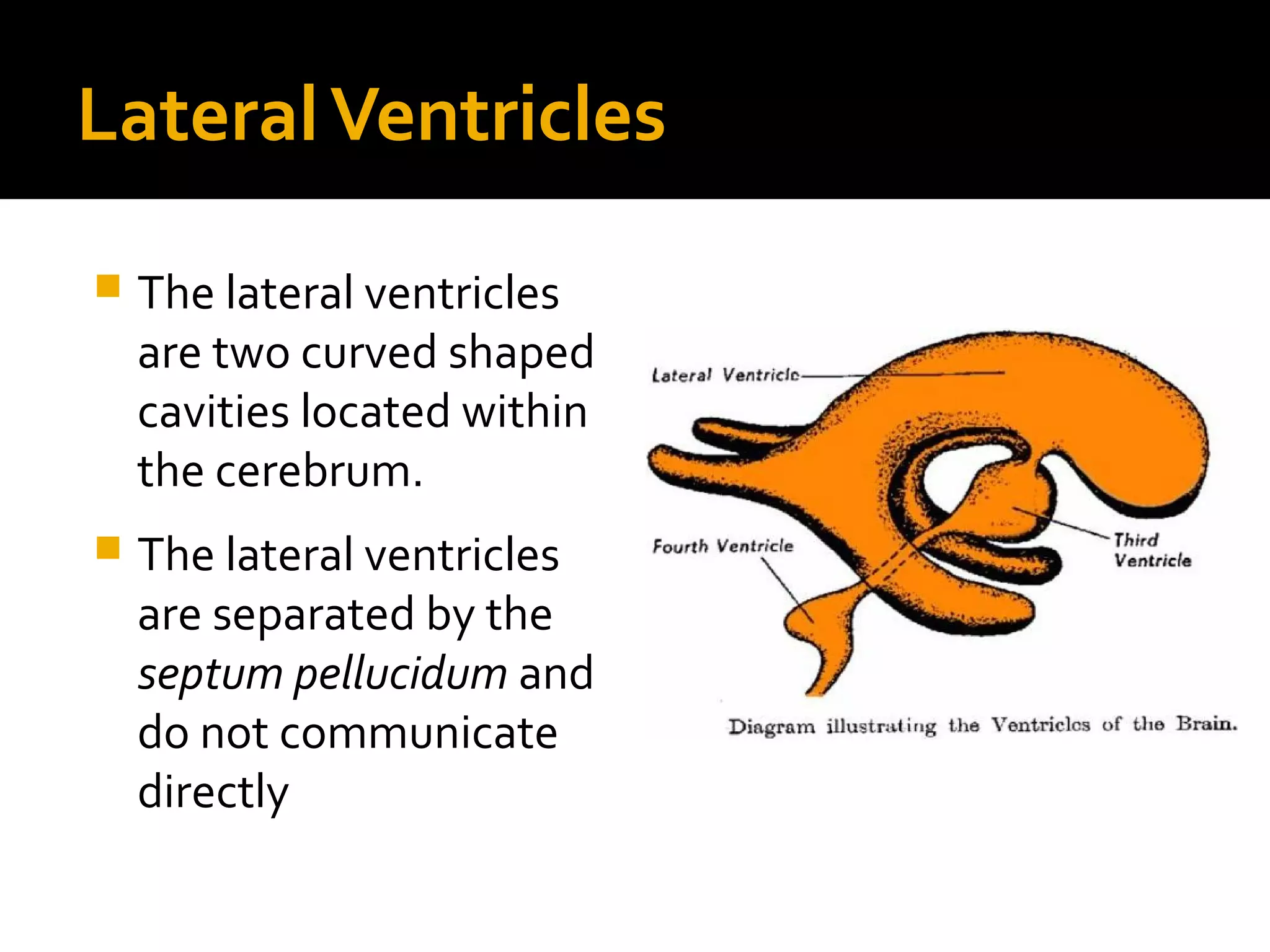
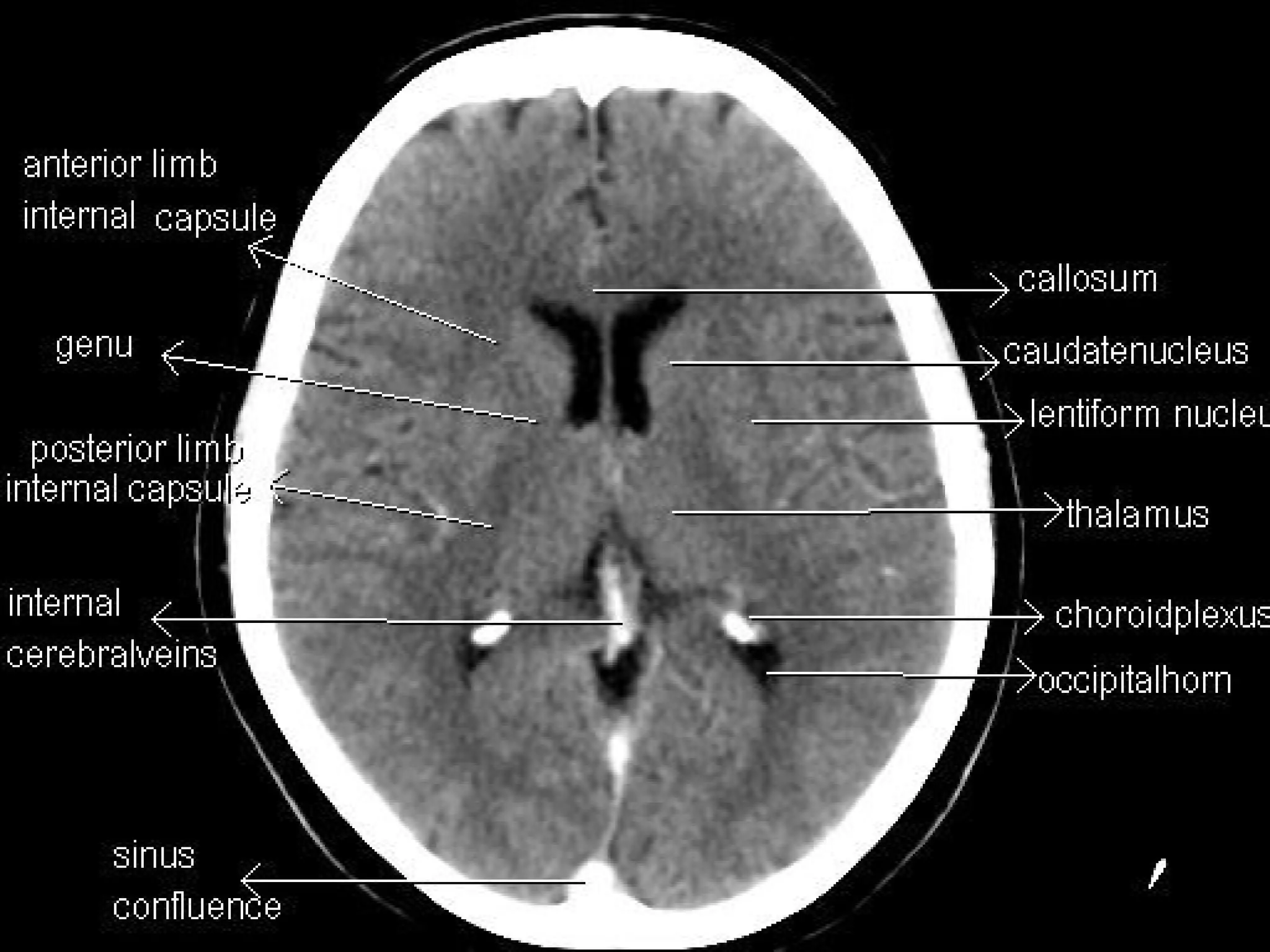
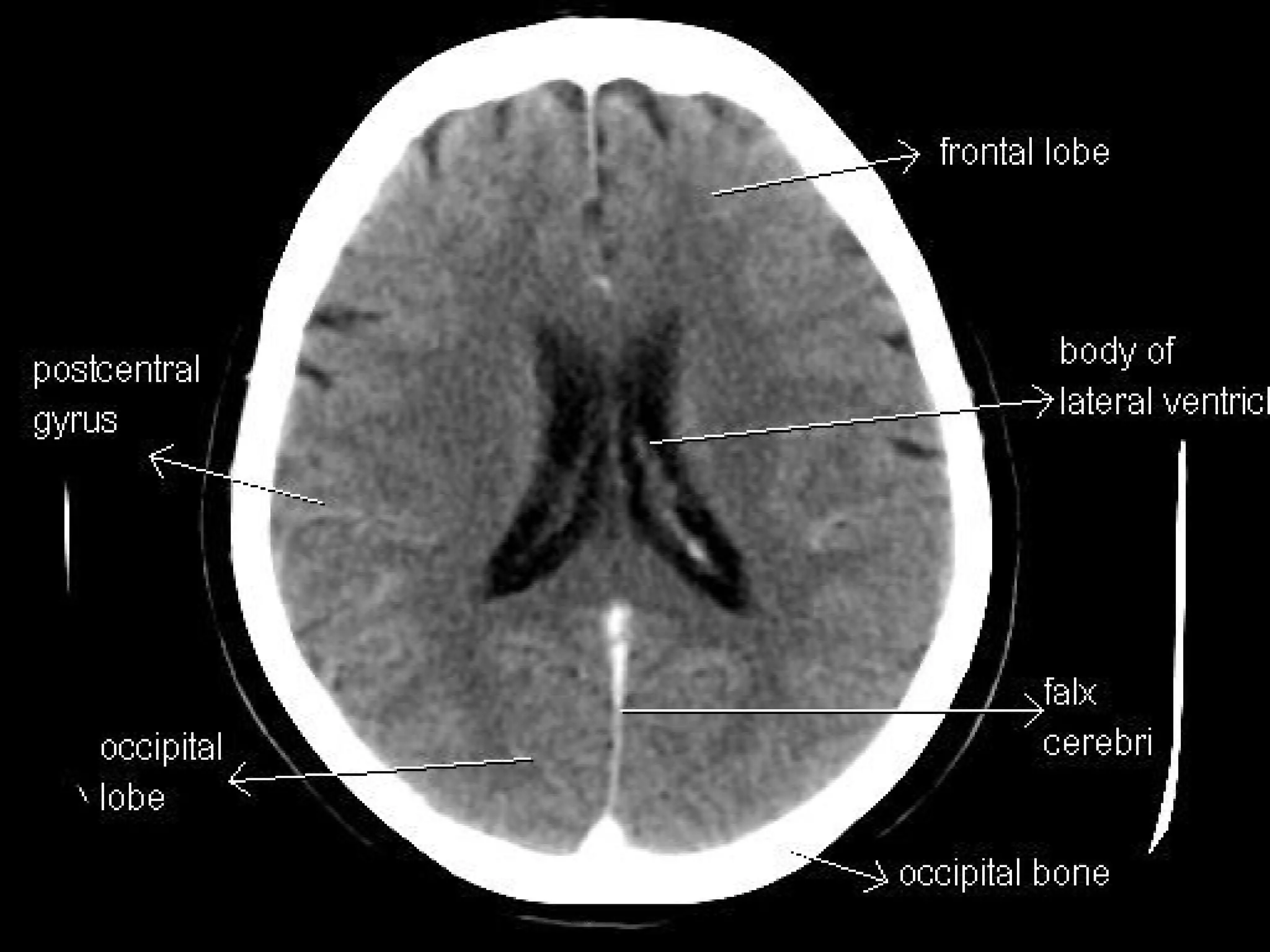
LateralVentricles
 The lateral ventricles
are two curved shaped
cavities located within
the cerebrum.
 The lateral ventricles
are separated by the
septum pellucidum and
do not communicate
directly
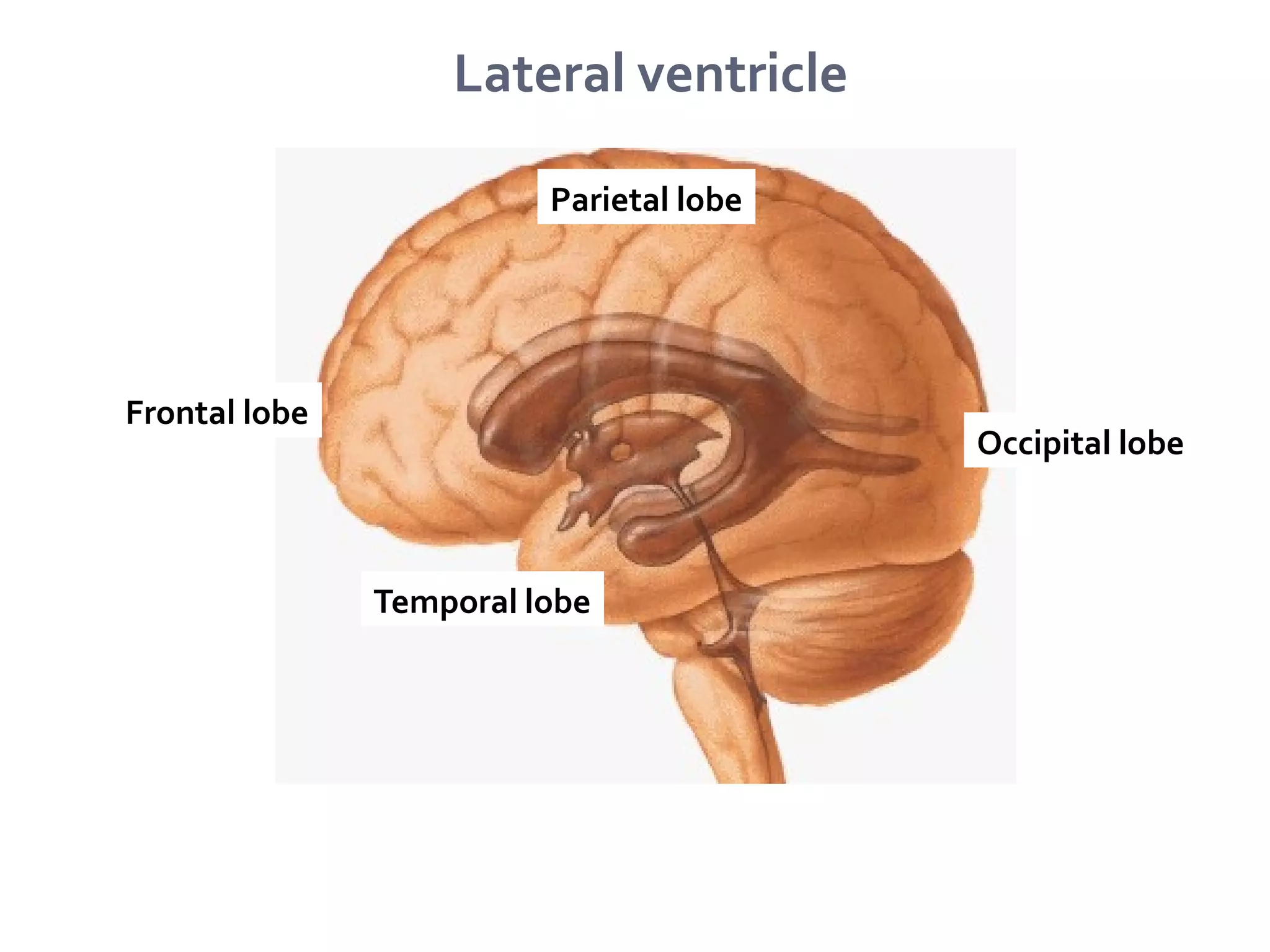
Lateral ventricle
Frontal lobe
Parietal lobe
Temporal lobe
Occipital lobe
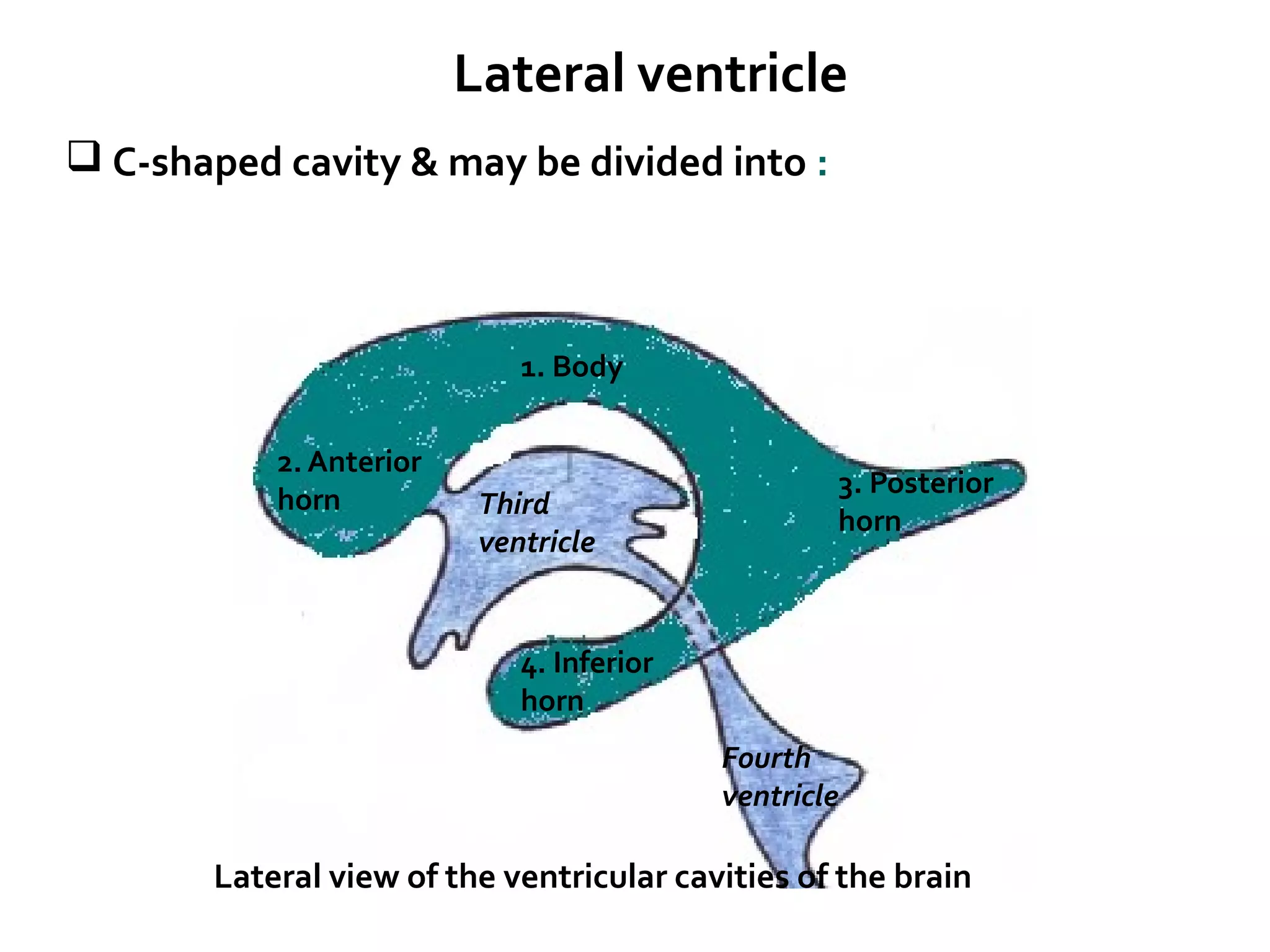
 C-shaped cavity & may be divided into :
2. Anterior
horn
1. Body
3. Posterior
horn
4. Inferior
horn
Third
ventricle
Fourth
ventricle
Lateral view of the ventricular cavities of the brain
Lateral ventricle
Anterior horn
Inferior horn
Posterior horn
Lateral view to show the ventricular system of the CNS
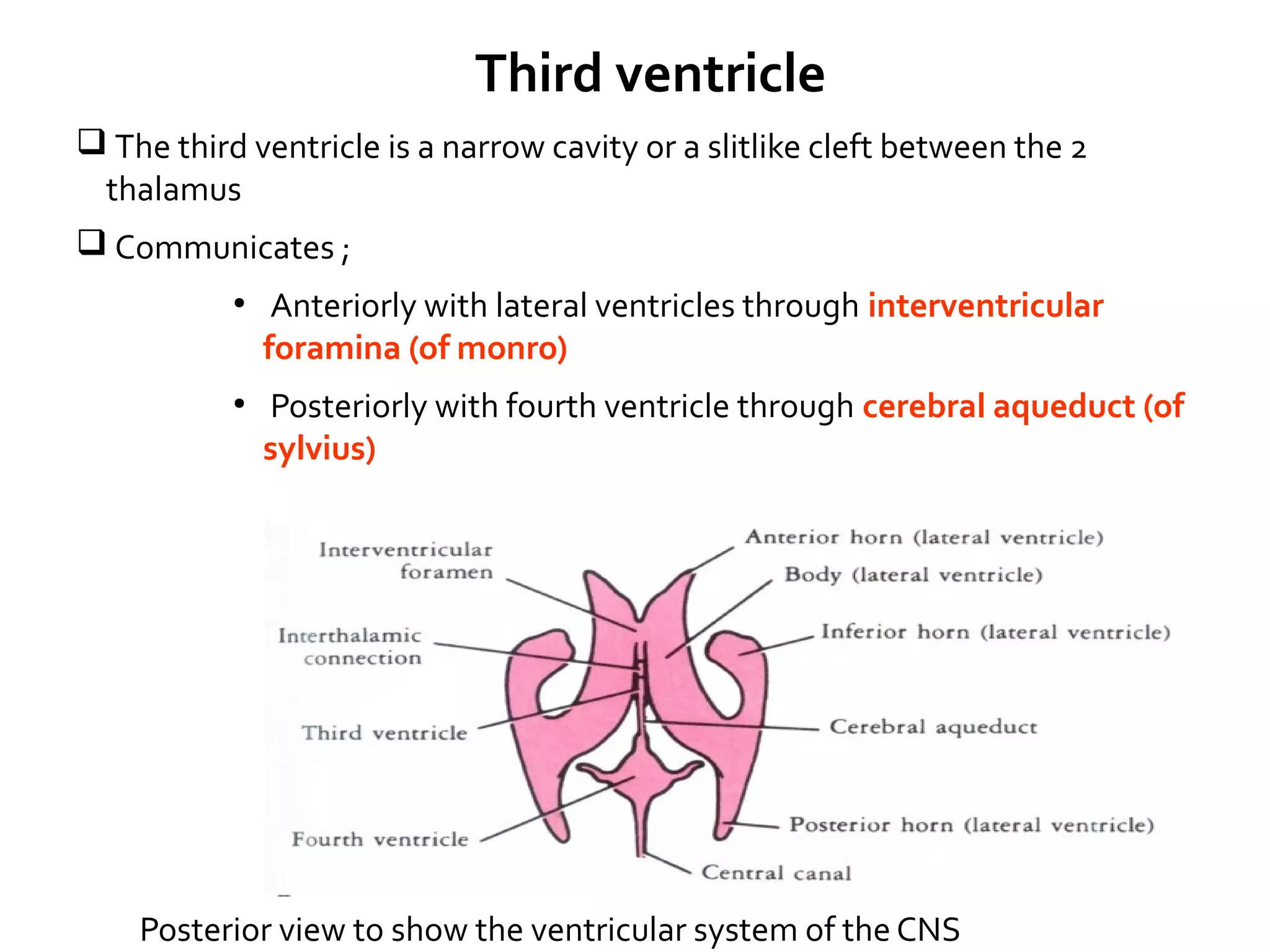
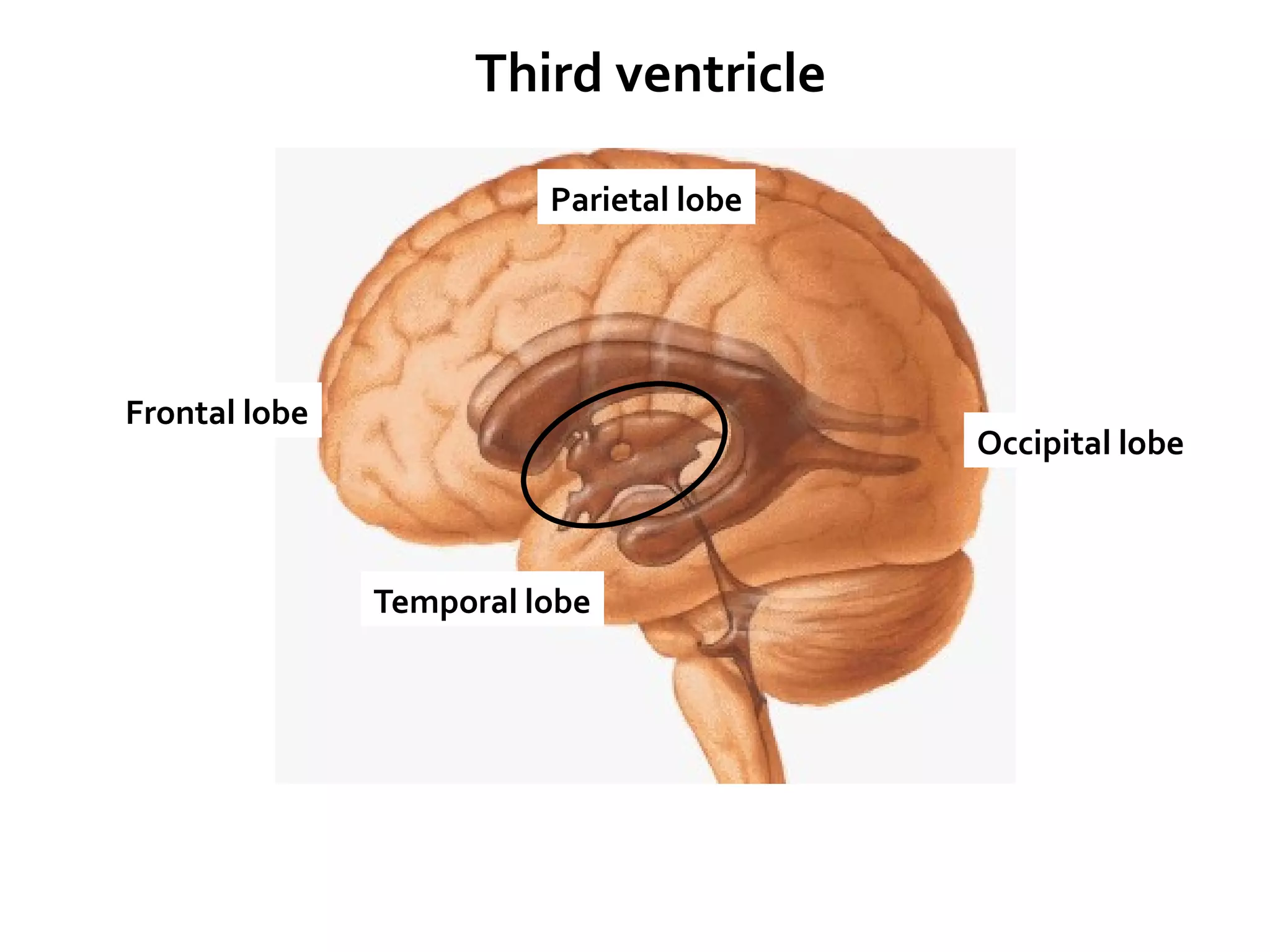
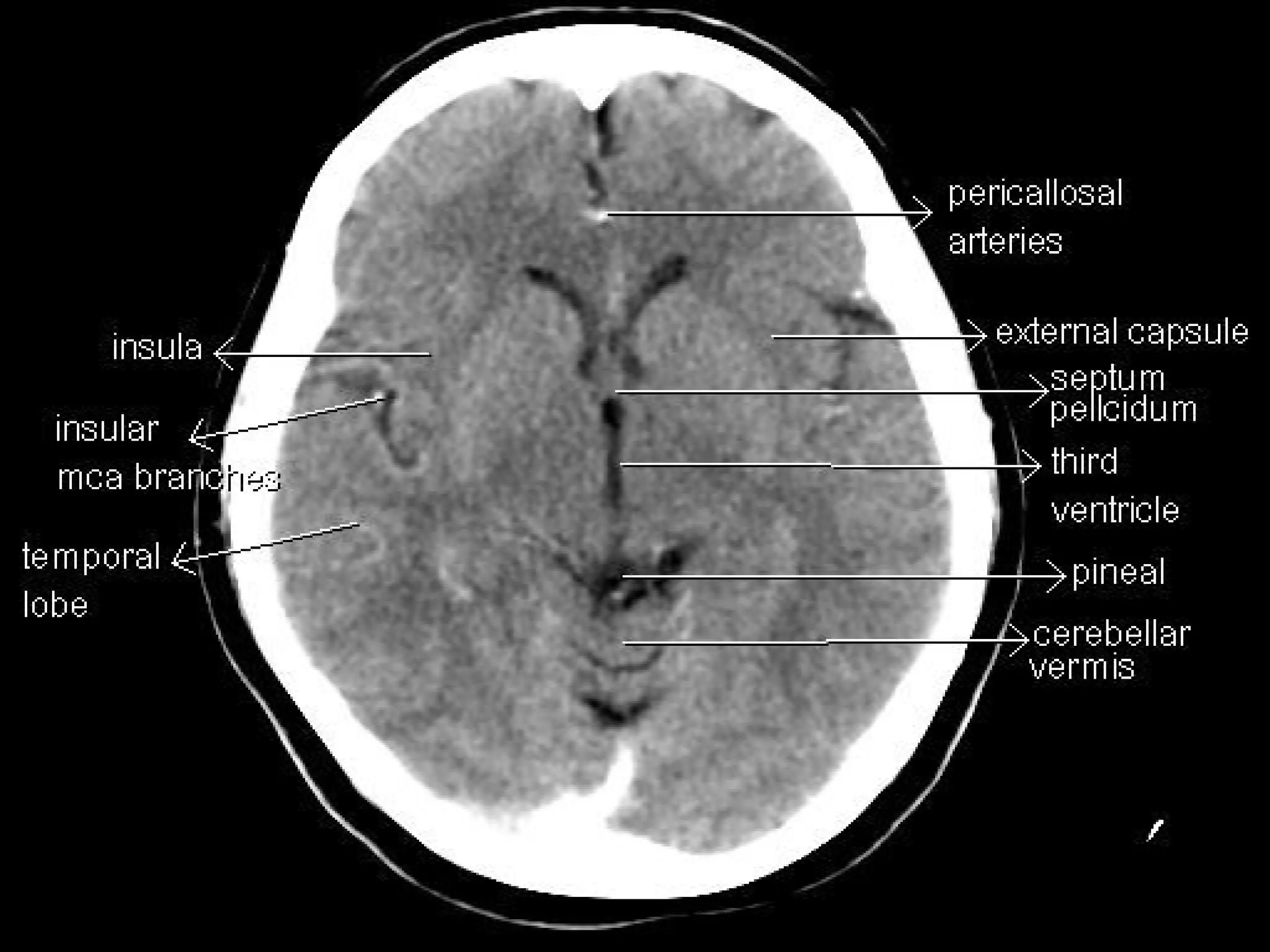
 The third ventricle is a narrow cavity or a slitlike cleft between the 2
thalamus
 Communicates ;
●
Anteriorly with lateral ventricles through interventricular
foramina (of monro)
●
Posteriorly with fourth ventricle through cerebral aqueduct (of
sylvius)
Posterior view to show the ventricular system of the CNS
Third ventricle
Frontal lobe
Parietal lobe
Temporal lobe
Occipital lobe
Third ventricle
Third
ventricle
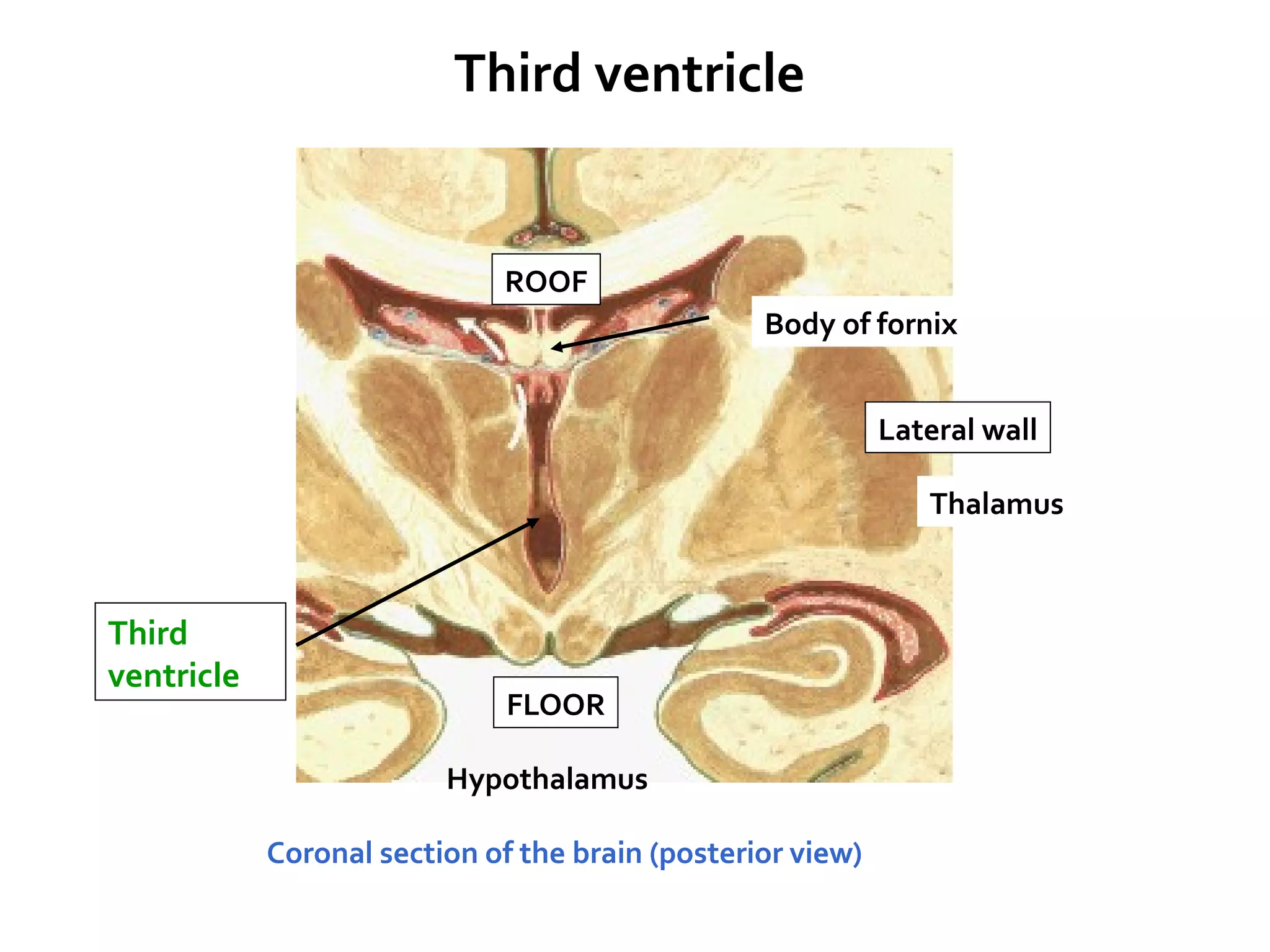
Hypothalamus
Coronal section of the brain (posterior view)
Third ventricle
Thalamus
ROOF
FLOOR
Lateral wall
Body of fornix
Fourth ventricle
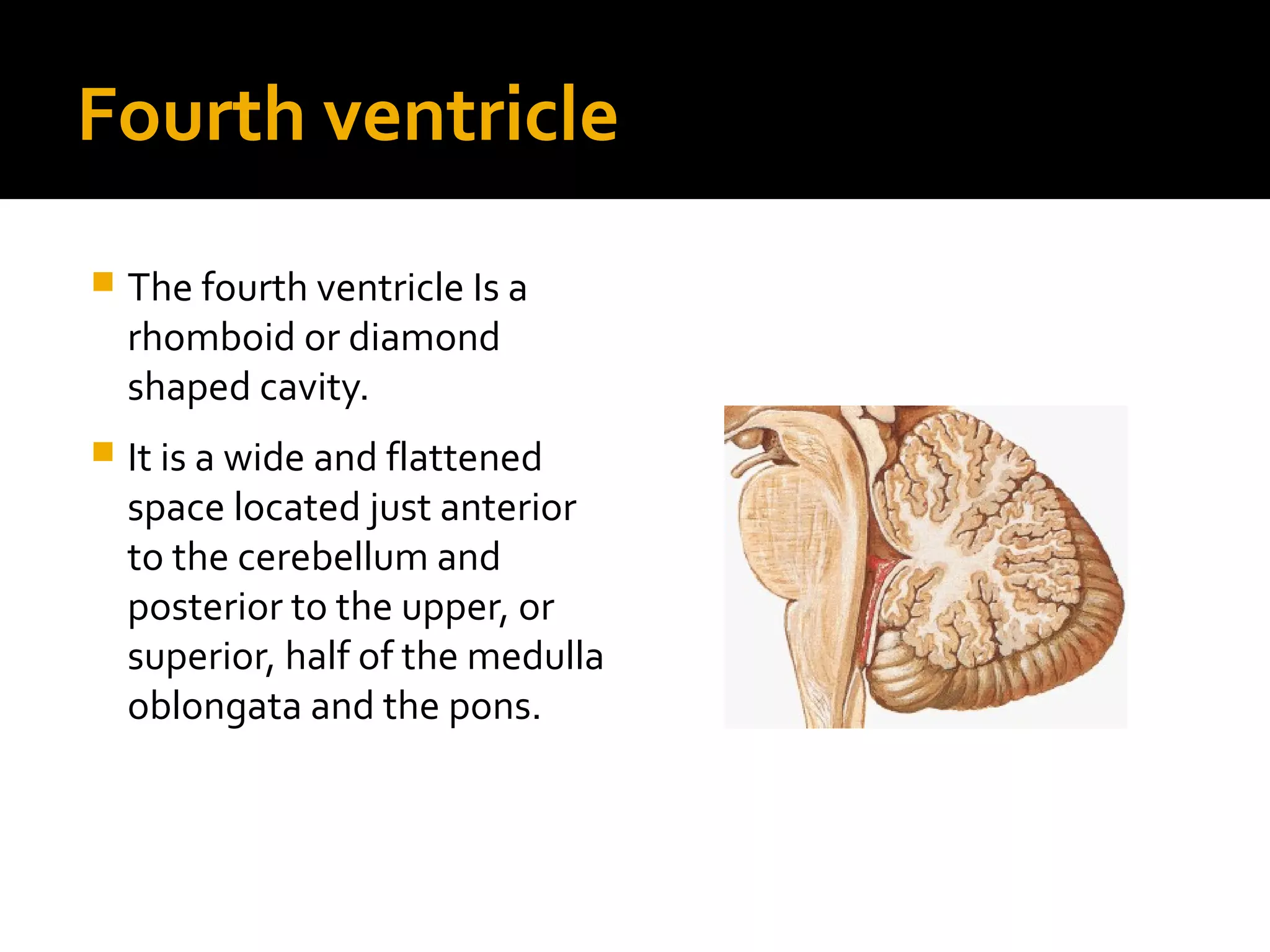
 The fourth ventricle Is a
rhomboid or diamond
shaped cavity.
 It is a wide and flattened
space located just anterior
to the cerebellum and
posterior to the upper, or
superior, half of the medulla
oblongata and the pons.
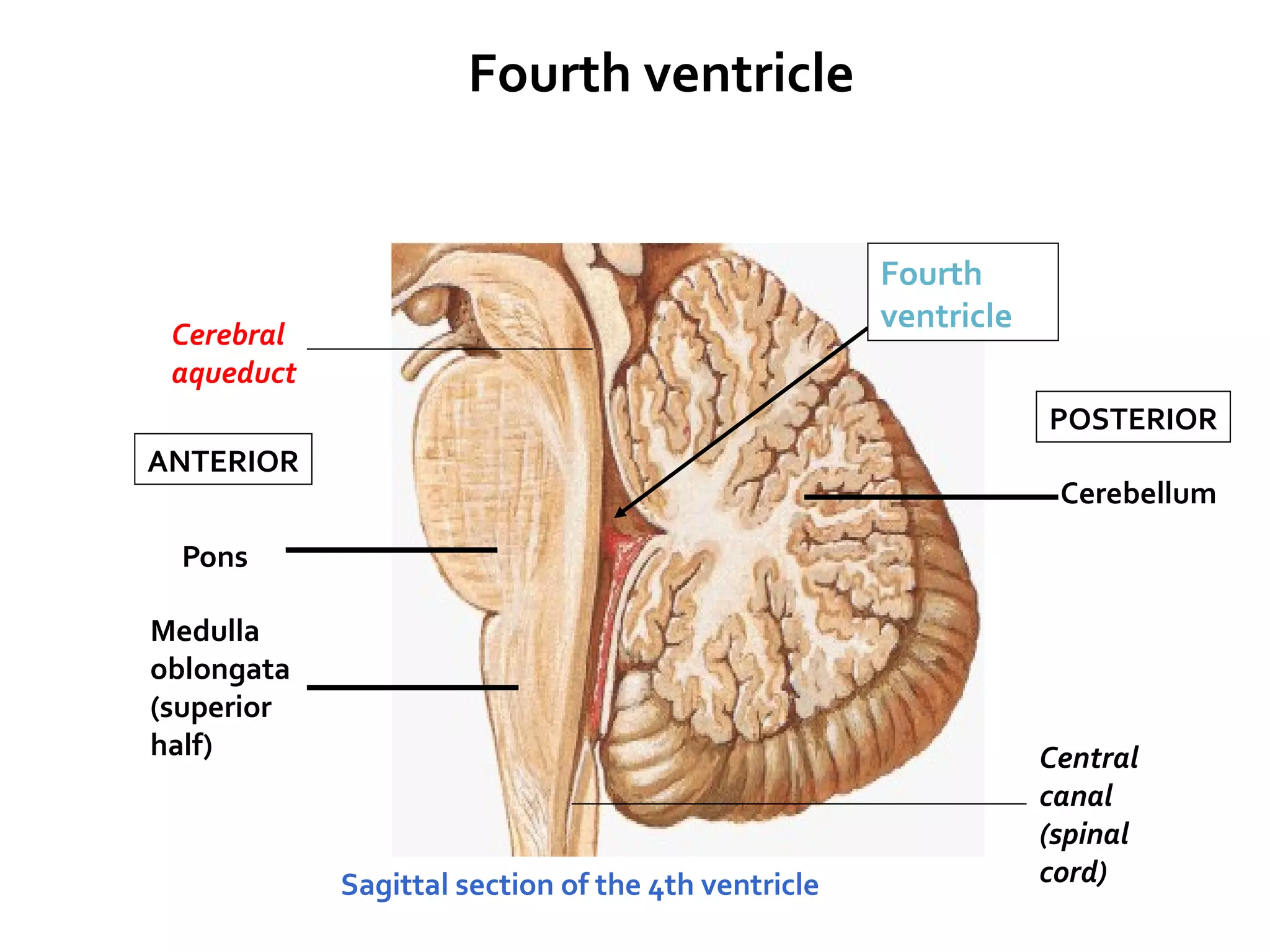
Cerebellum
Pons
Medulla
oblongata
(superior
half)
Sagittal section of the 4th ventricle
Cerebral
aqueduct
Central
canal
(spinal
cord)
Fourth ventricle
Fourth
ventricle
ANTERIOR
POSTERIOR
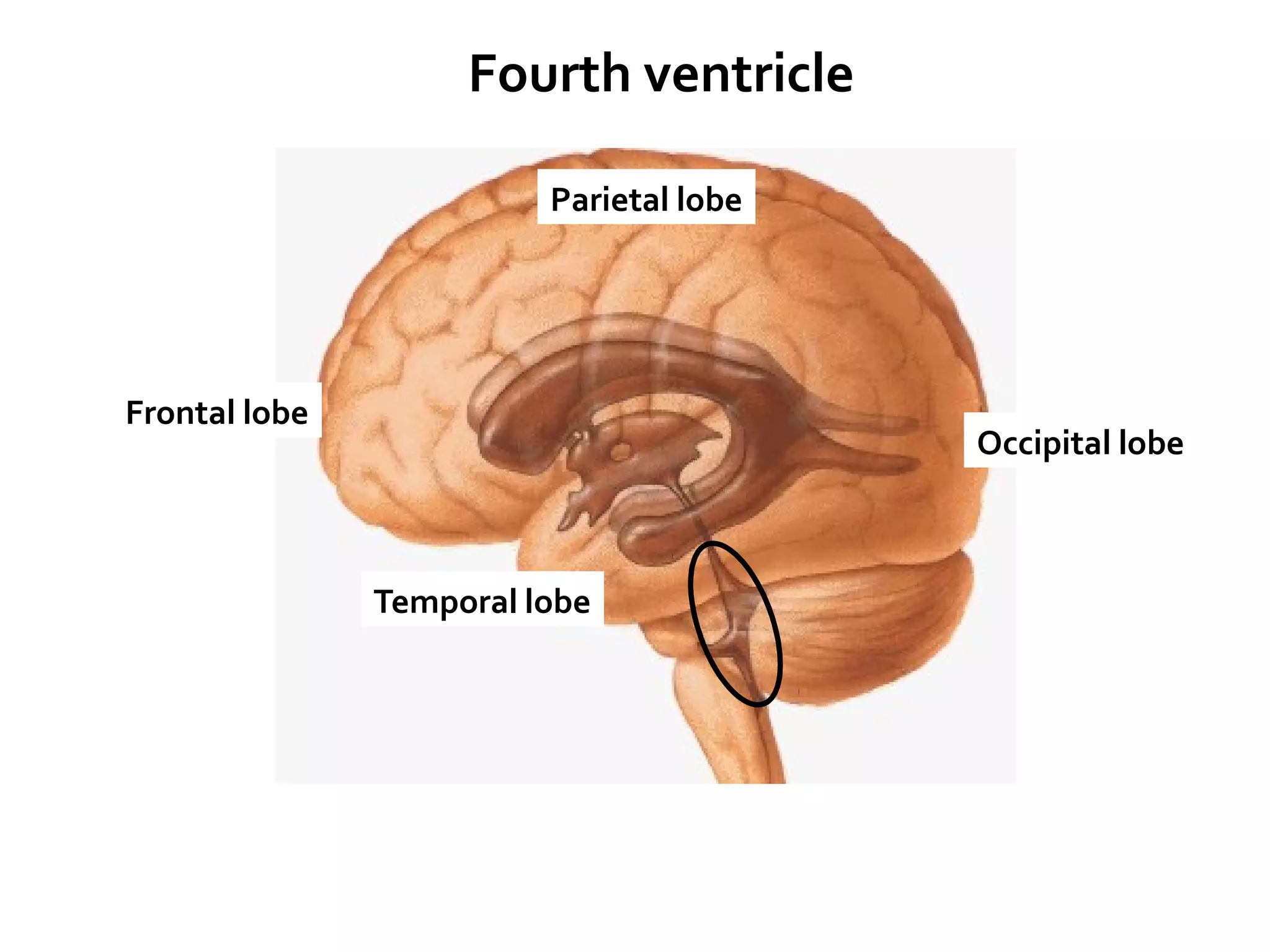
Frontal lobe
Parietal lobe
Temporal lobe
Occipital lobe
Fourth ventricle
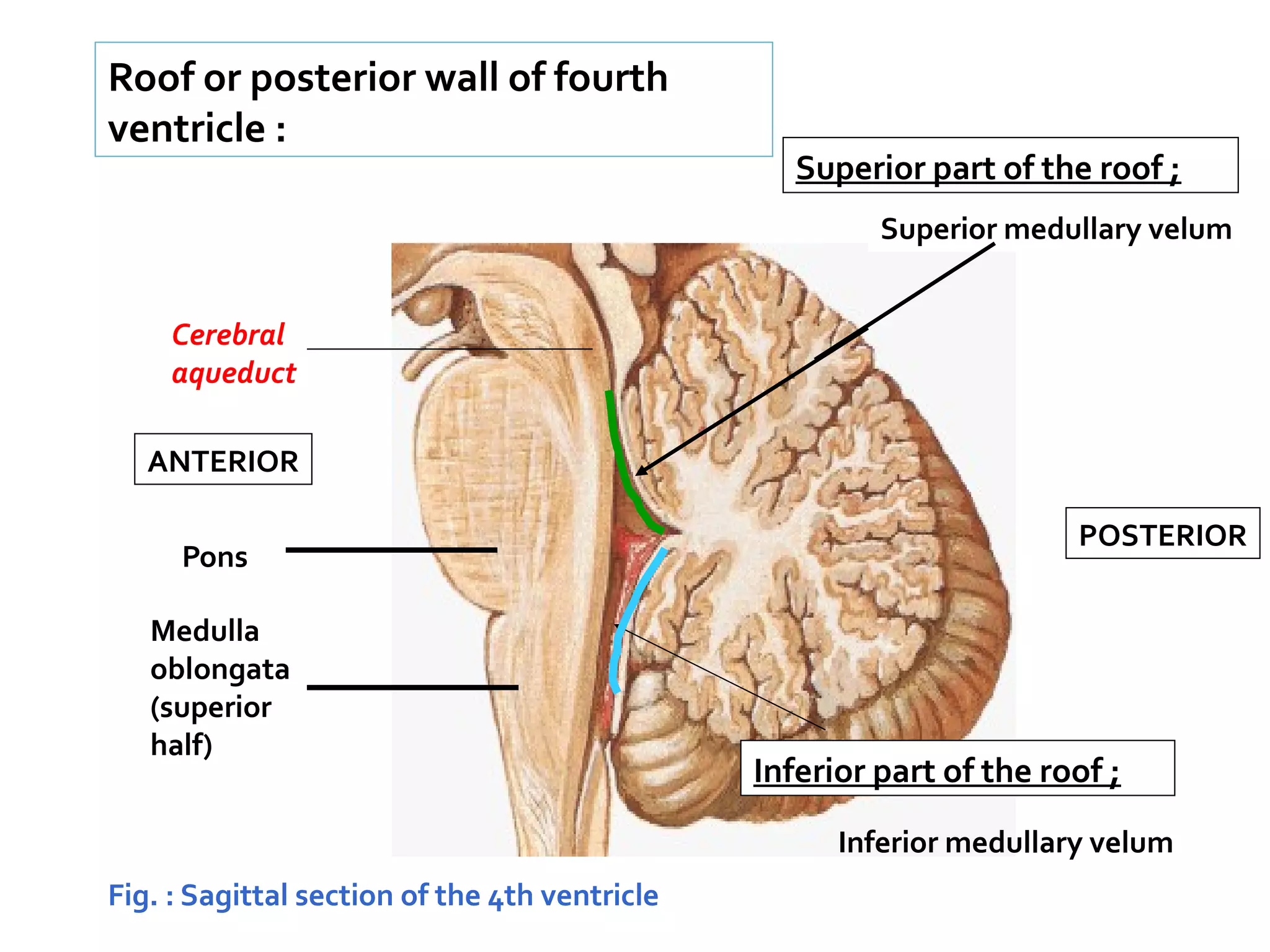
Pons
Medulla
oblongata
(superior
half)
Fig. : Sagittal section of the 4th ventricle
Cerebral
aqueduct
ANTERIOR
POSTERIOR
Superior part of the roof ;
Superior medullary velum
Inferior part of the roof ;
Inferior medullary velum
Roof or posterior wall of fourth
ventricle :
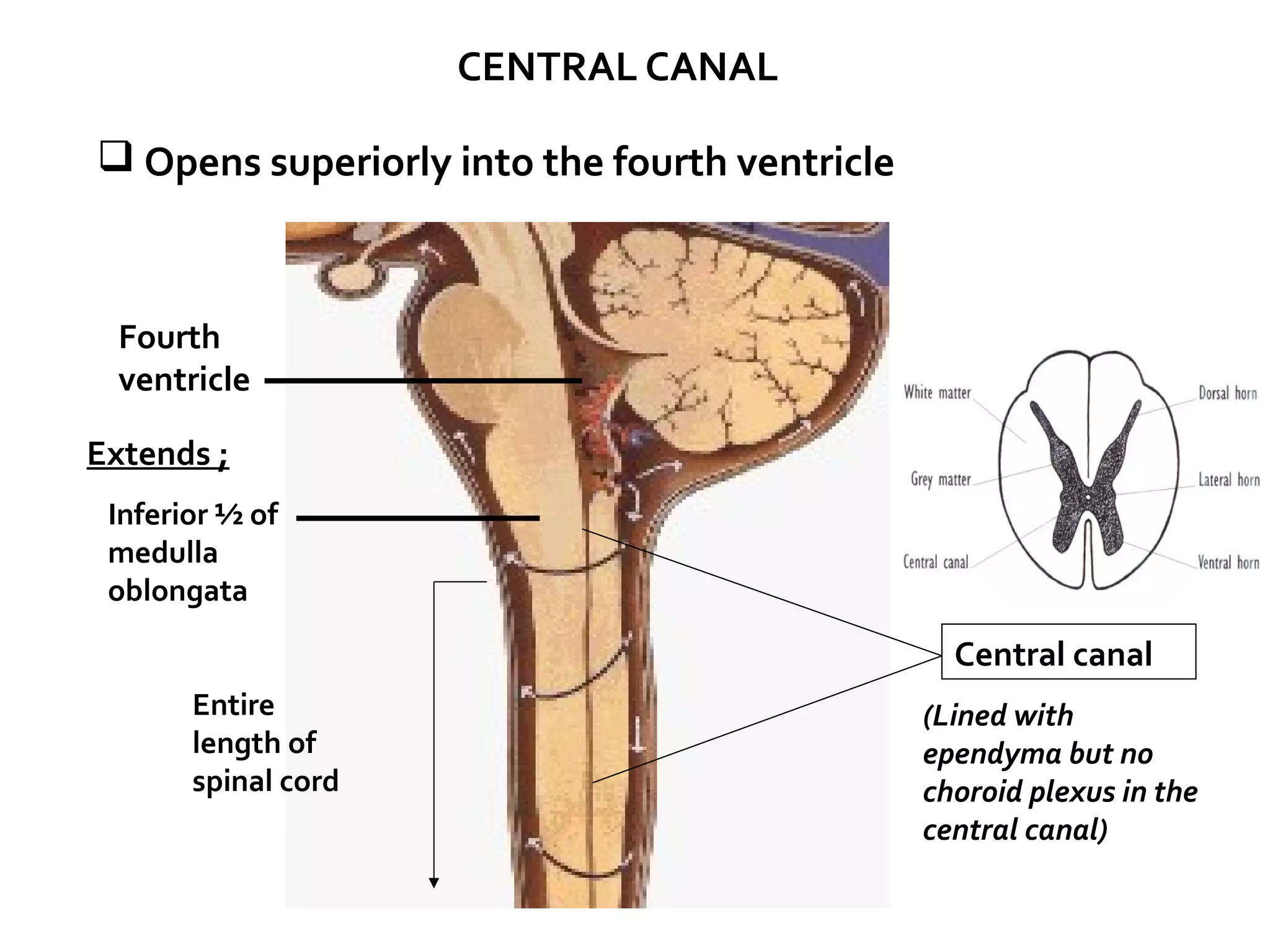
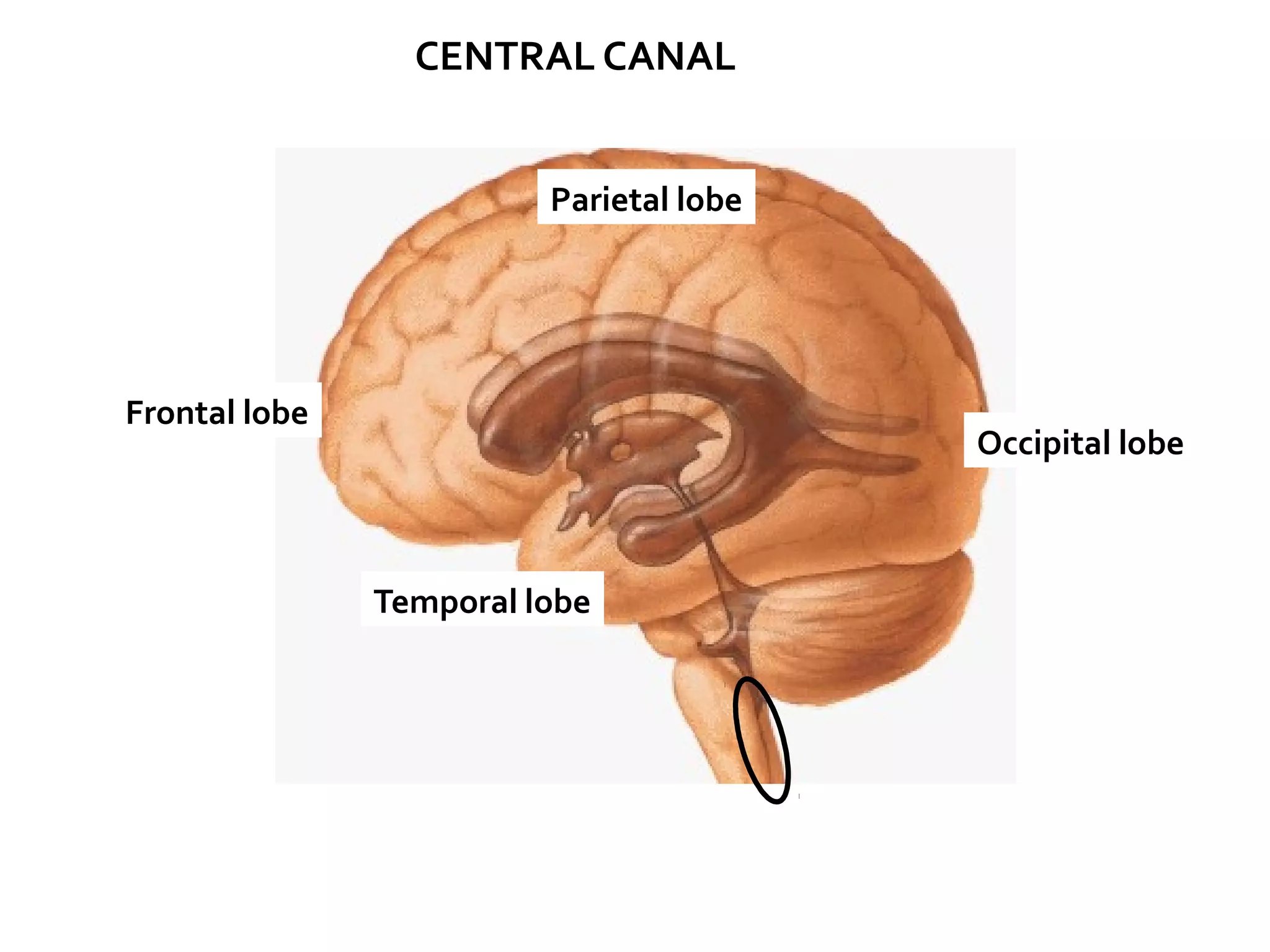
CENTRAL CANAL
 Opens superiorly into the fourth ventricle
Fourth
ventricle
Inferior ½ of
medulla
oblongata
Entire
length of
spinal cord
Central canal
(Lined with
ependyma but no
choroid plexus in the
central canal)
Extends ;
Frontal lobe
Parietal lobe
Temporal lobe
Occipital lobe
CENTRAL CANAL
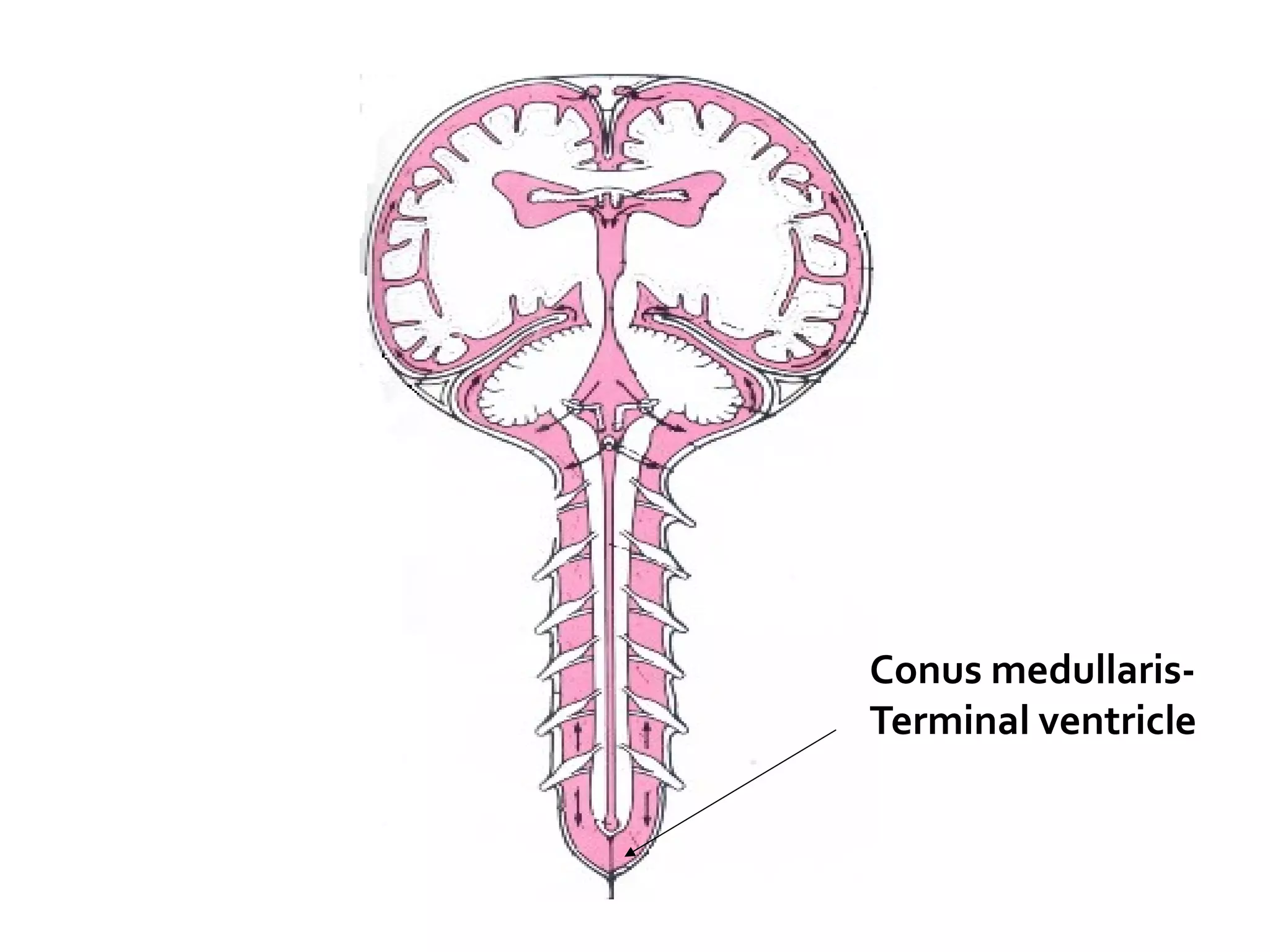
Conus medullaris-
Terminal ventricle
CEREBROSPINAL FLUID
CHOROID PLEXUS
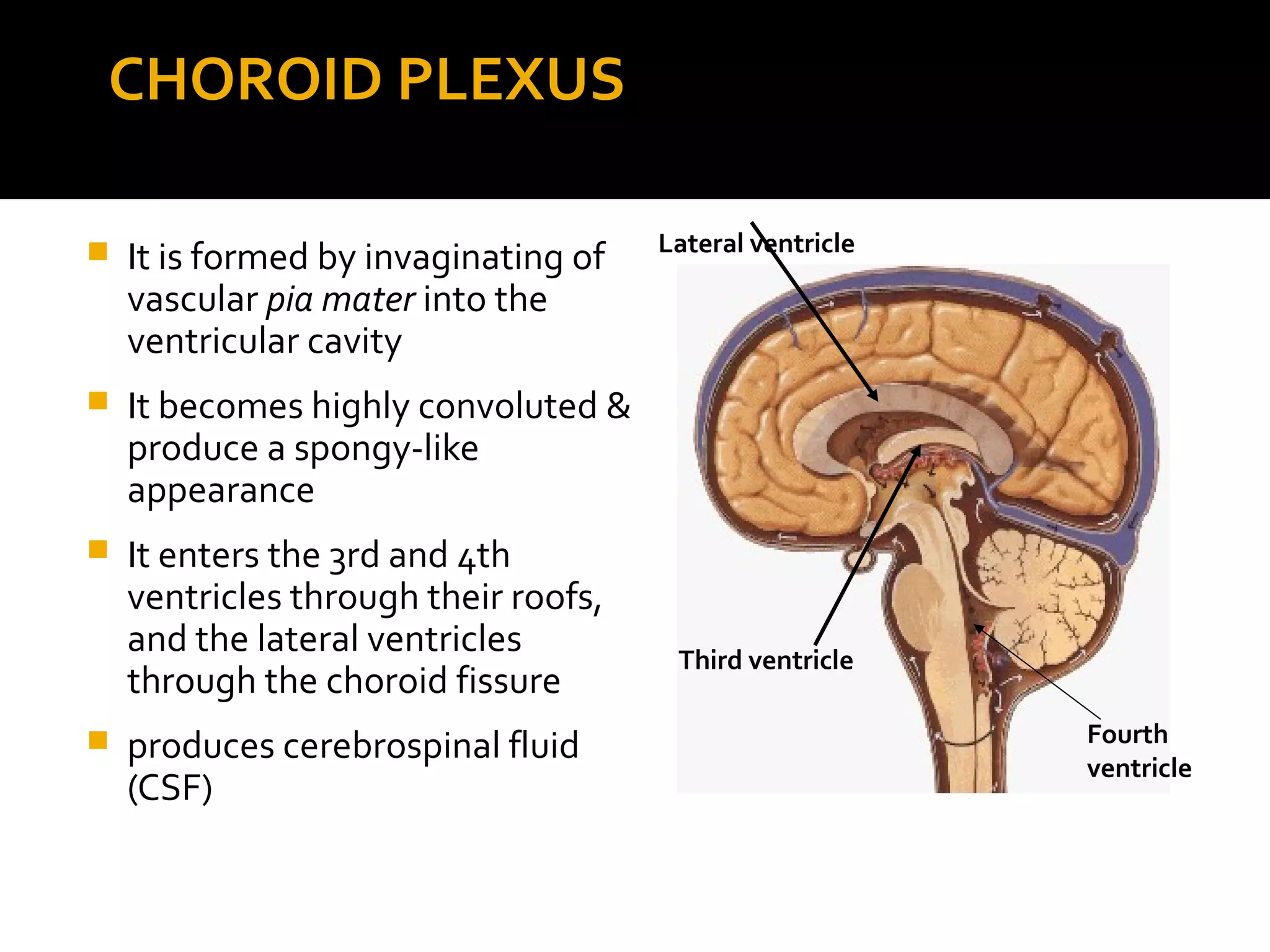
 It is formed by invaginating of
vascular pia mater into the
ventricular cavity
 It becomes highly convoluted &
produce a spongy-like
appearance
 It enters the 3rd and 4th
ventricles through their roofs,
and the lateral ventricles
through the choroid fissure
 produces cerebrospinal fluid
(CSF)
Lateral ventricle
Third ventricle
Fourth
ventricle
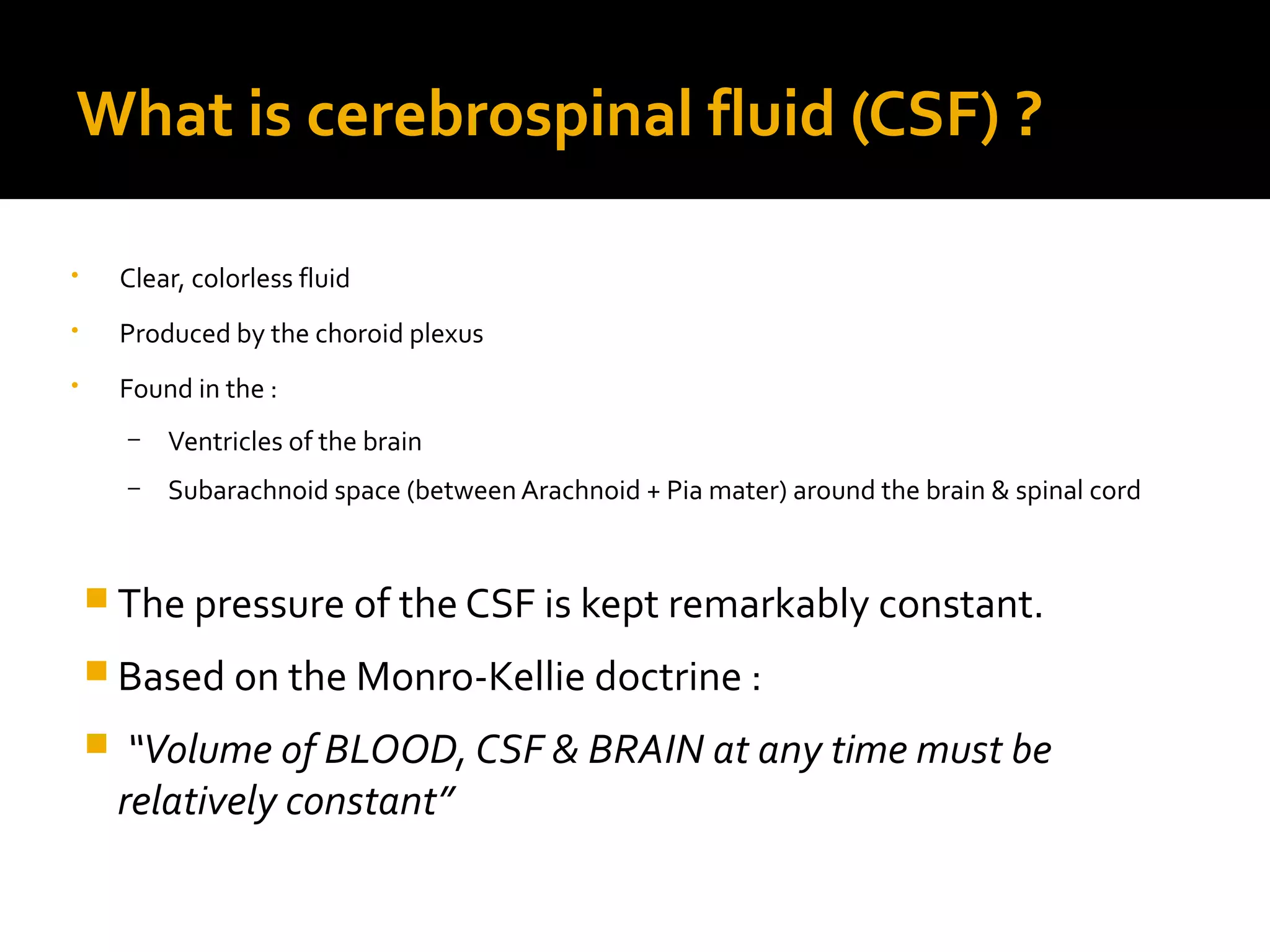
What is cerebrospinal fluid (CSF) ?
• Clear, colorless fluid
• Produced by the choroid plexus
• Found in the :
– Ventricles of the brain
– Subarachnoid space (between Arachnoid + Pia mater) around the brain & spinal cord
 The pressure of the CSF is kept remarkably constant.
 Based on the Monro-Kellie doctrine :
 “Volume of BLOOD, CSF & BRAIN at any time must be
relatively constant”
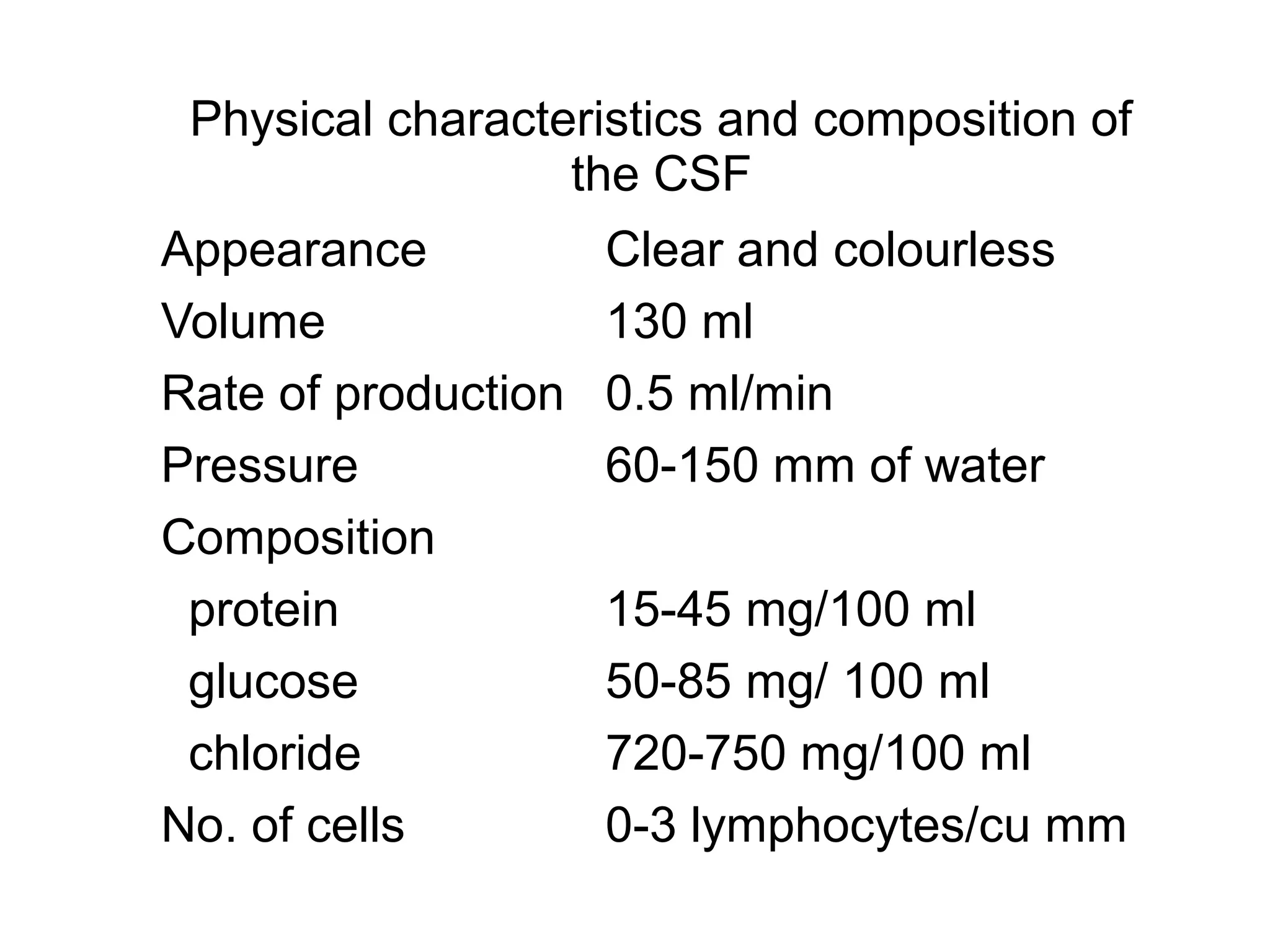
Physical characteristics and composition of
the CSF
Appearance Clear and colourless
Volume 130 ml
Rate of production 0.5 ml/min
Pressure 60-150 mm of water
Composition
protein 15-45 mg/100 ml
glucose 50-85 mg/ 100 ml
chloride 720-750 mg/100 ml
No. of cells 0-3 lymphocytes/cu mm
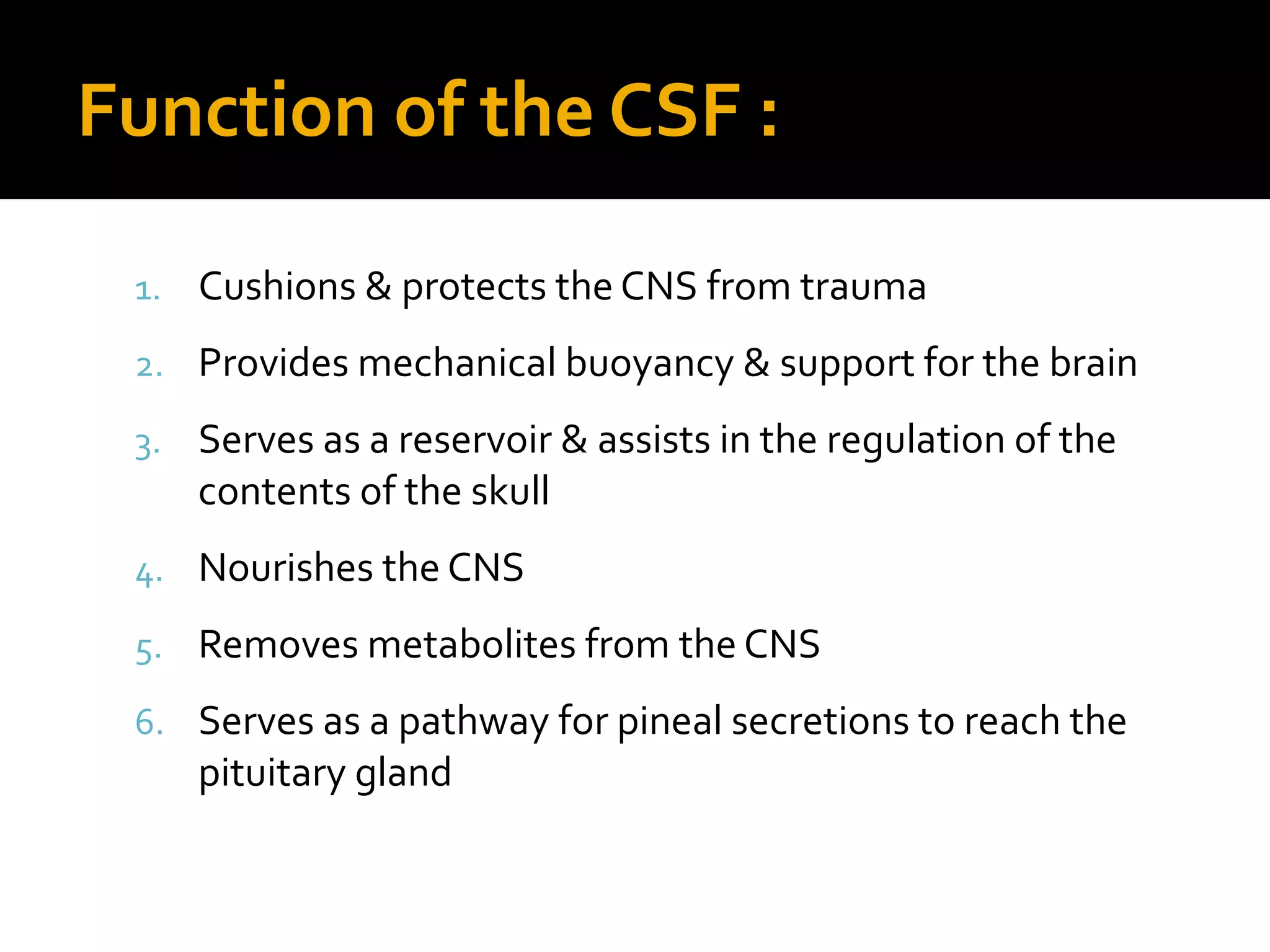
Function of the CSF :
1. Cushions & protects the CNS from trauma
2. Provides mechanical buoyancy & support for the brain
3. Serves as a reservoir & assists in the regulation of the
contents of the skull
4. Nourishes the CNS
5. Removes metabolites from the CNS
6. Serves as a pathway for pineal secretions to reach the
pituitary gland
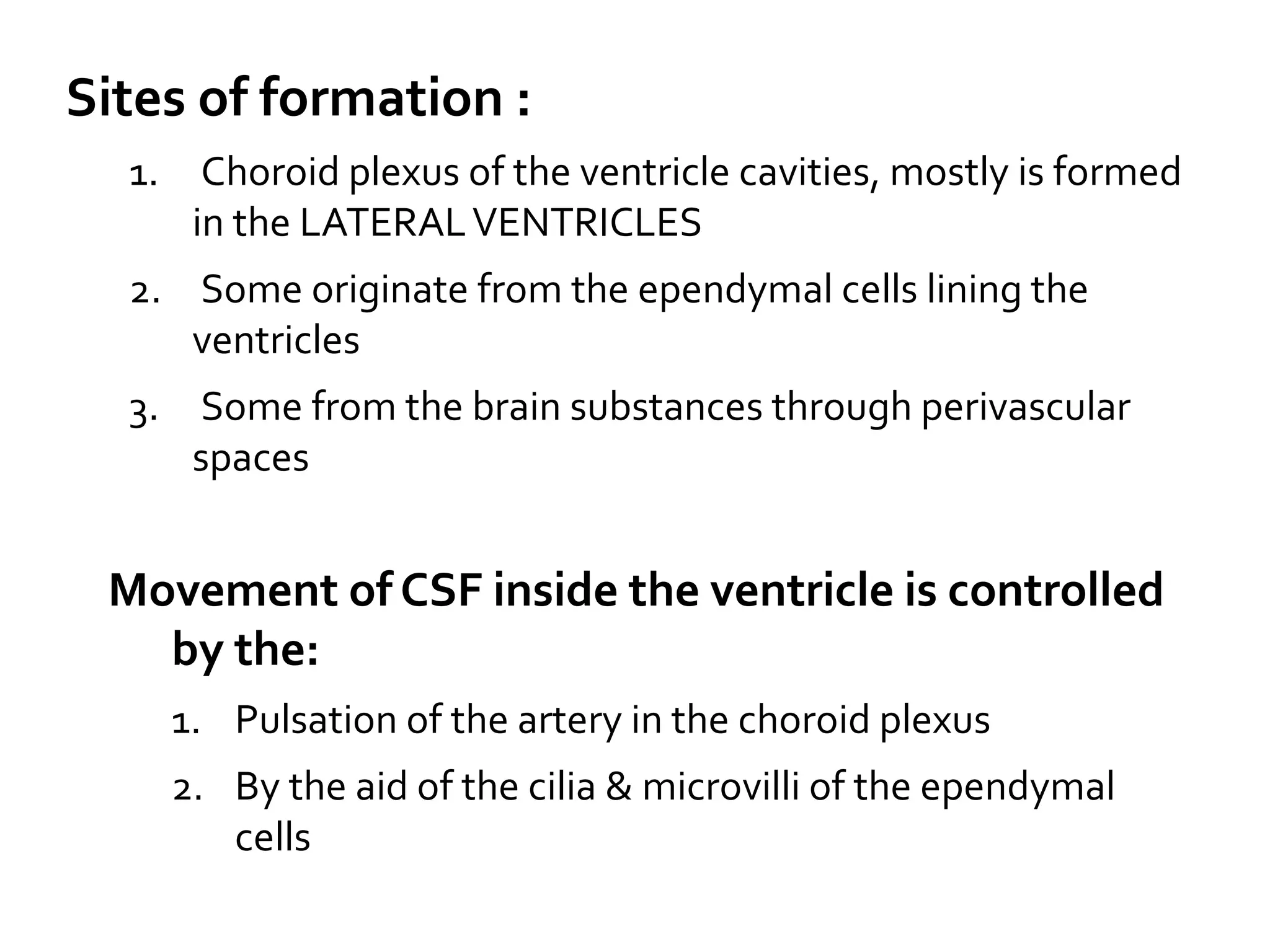
Sites of formation :
1. Choroid plexus of the ventricle cavities, mostly is formed
in the LATERALVENTRICLES
2. Some originate from the ependymal cells lining the
ventricles
3. Some from the brain substances through perivascular
spaces
Movement of CSF inside the ventricle is controlled
by the:
1. Pulsation of the artery in the choroid plexus
2. By the aid of the cilia & microvilli of the ependymal
cells
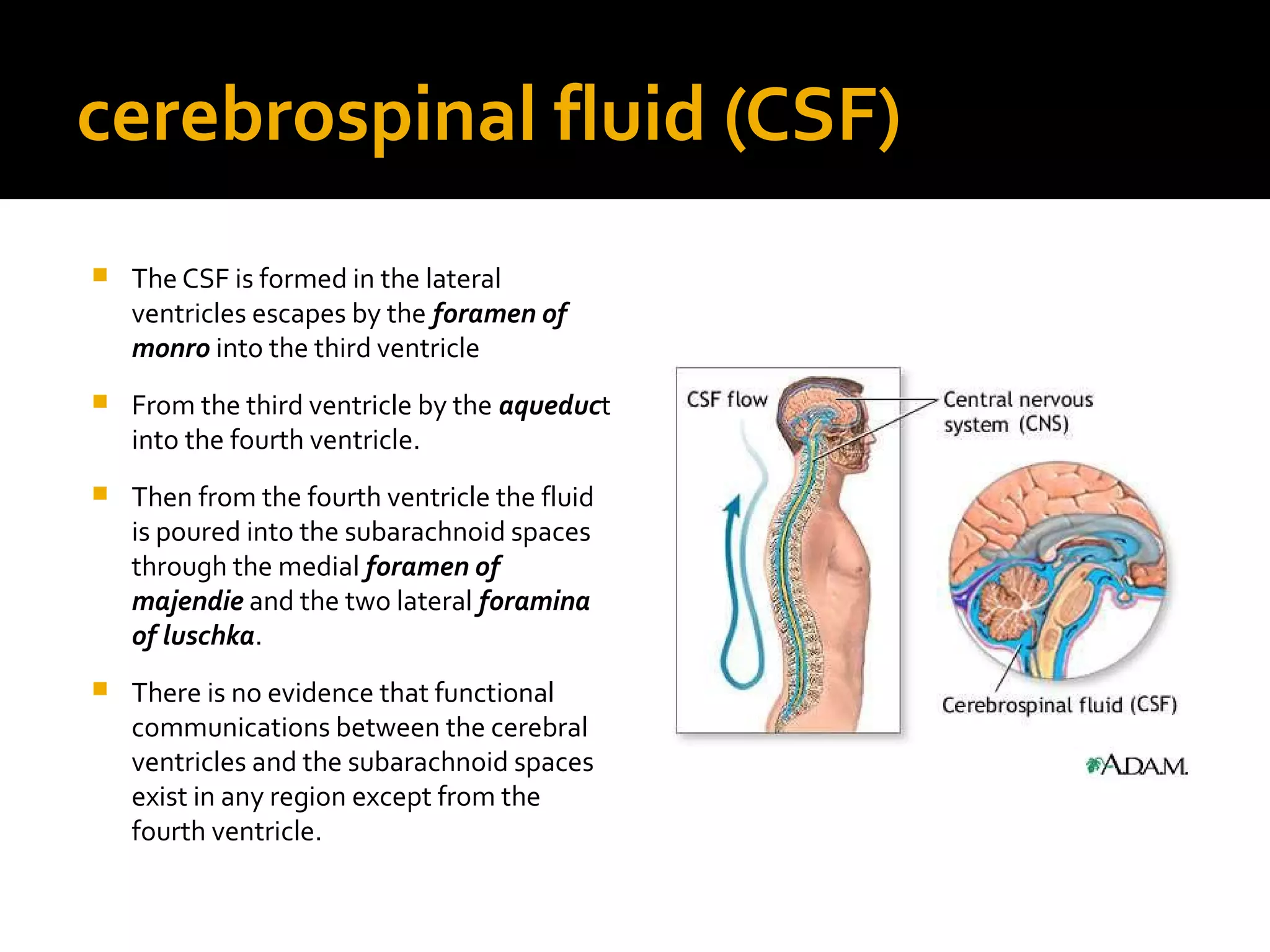
cerebrospinal fluid (CSF)
 The CSF is formed in the lateral
ventricles escapes by the foramen of
monro into the third ventricle
 From the third ventricle by the aqueduct
into the fourth ventricle.
 Then from the fourth ventricle the fluid
is poured into the subarachnoid spaces
through the medial foramen of
majendie and the two lateral foramina
of luschka.
 There is no evidence that functional
communications between the cerebral
ventricles and the subarachnoid spaces
exist in any region except from the
fourth ventricle.
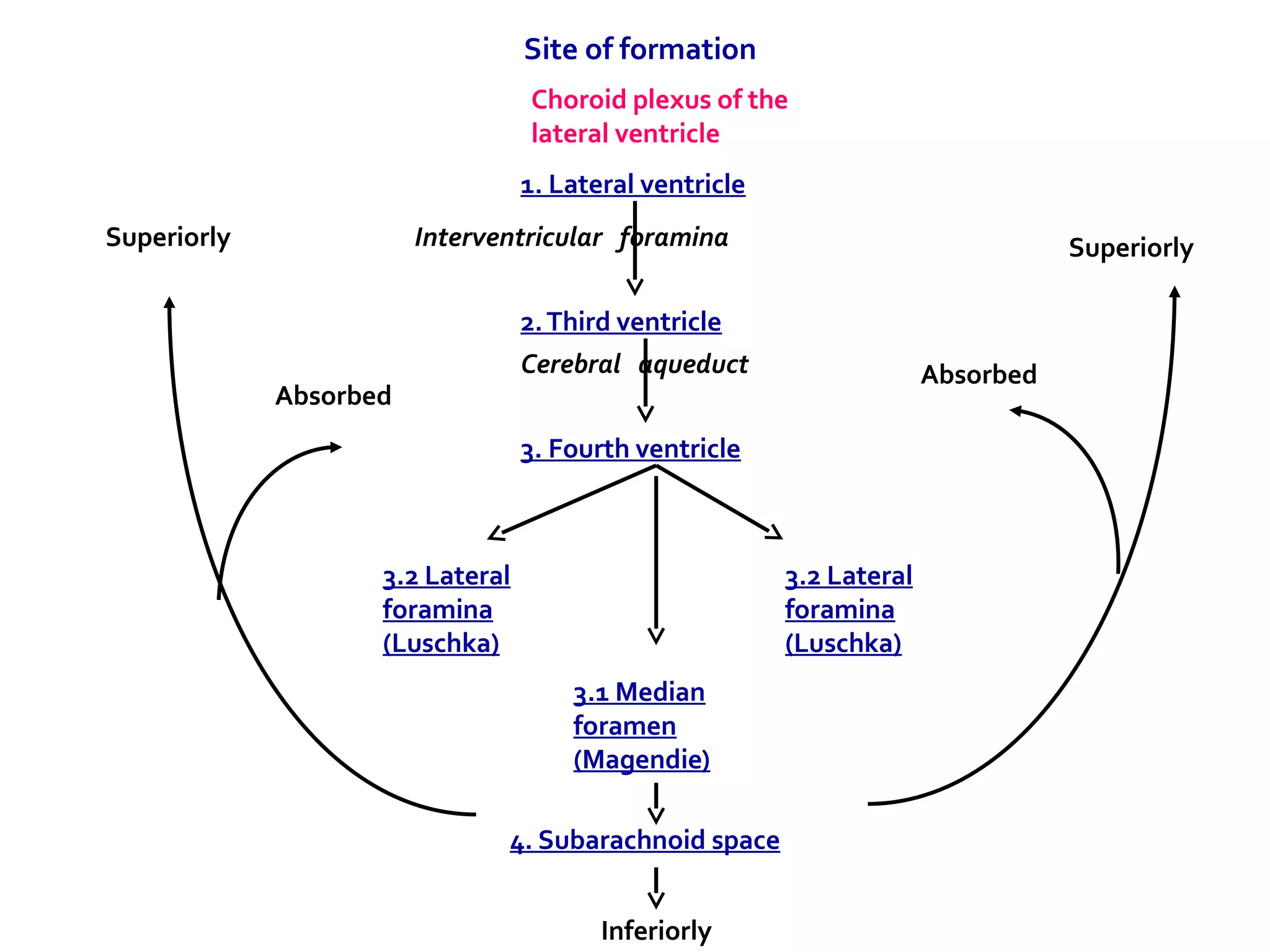
Choroid plexus of the
lateral ventricle
Site of formation
1. Lateral ventricle
2.Third ventricle
Interventricular foramina
3. Fourth ventricle
Cerebral aqueduct
3.2 Lateral
foramina
(Luschka)
3.1 Median
foramen
(Magendie)
3.2 Lateral
foramina
(Luschka)
4. Subarachnoid space
Inferiorly
Superiorly
Absorbed
Superiorly
Absorbed
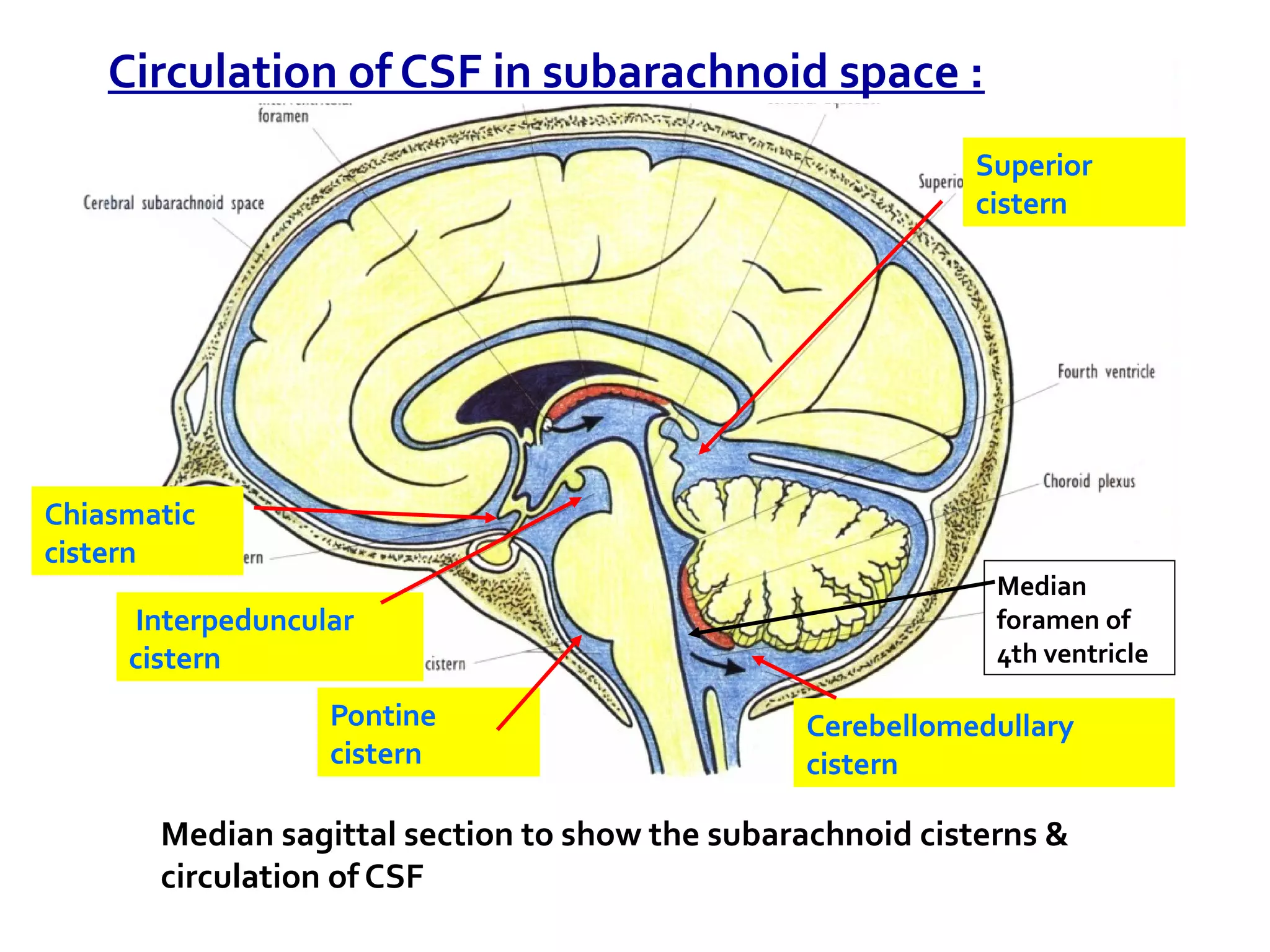
Median sagittal section to show the subarachnoid cisterns &
circulation of CSF
Superior
cistern
Interpeduncular
cistern
Cerebellomedullary
cistern
Chiasmatic
cistern
Pontine
cistern
Circulation of CSF in subarachnoid space :
Median
foramen of
4th ventricle
Factors that facilitate the flow of CSF in
subarachnoid space ;
– Pulsation of the cerebral & spinal arteries
– Movements of the vertebral column
– Respiration & coughing
– Changing of the positions
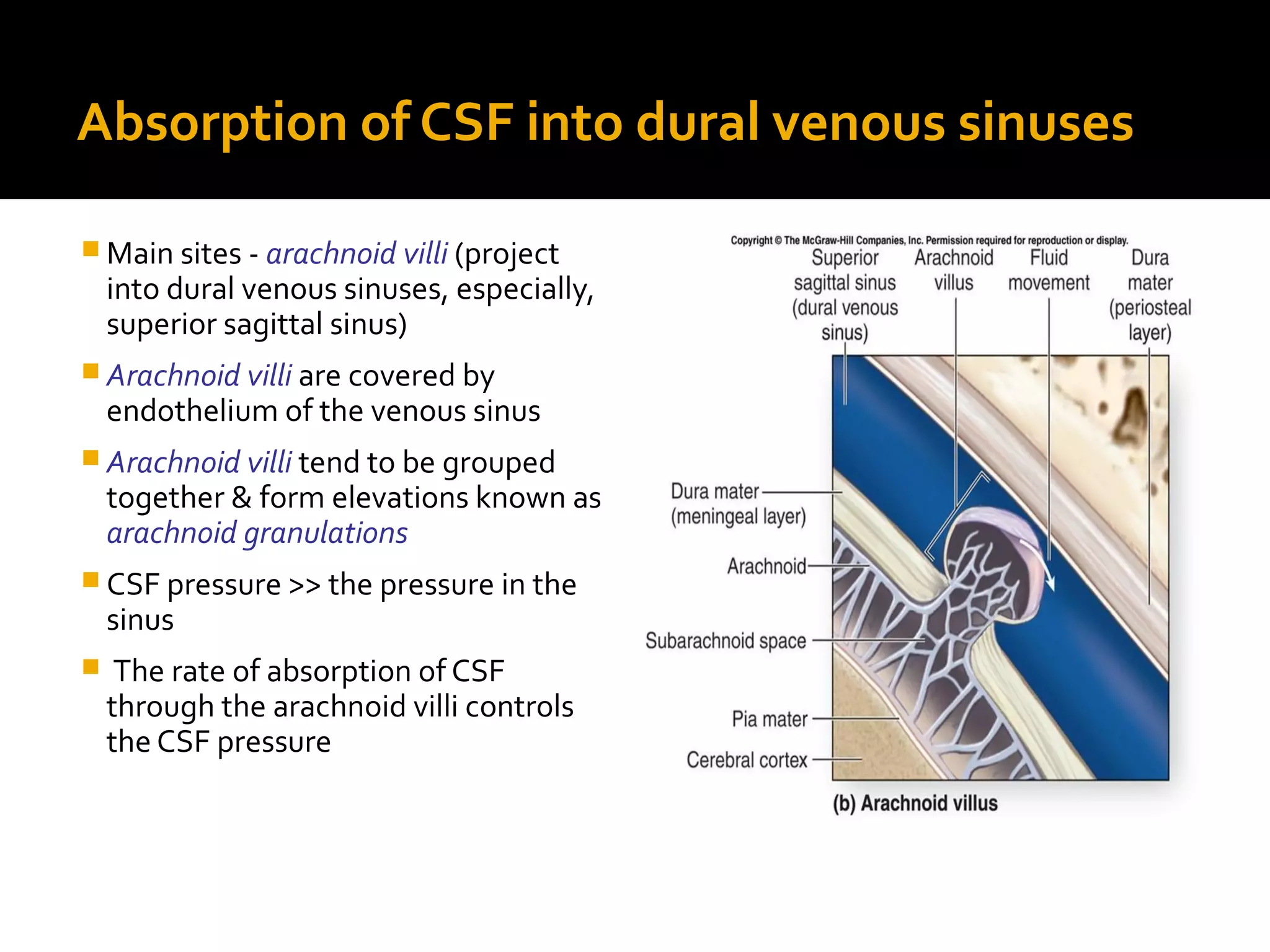
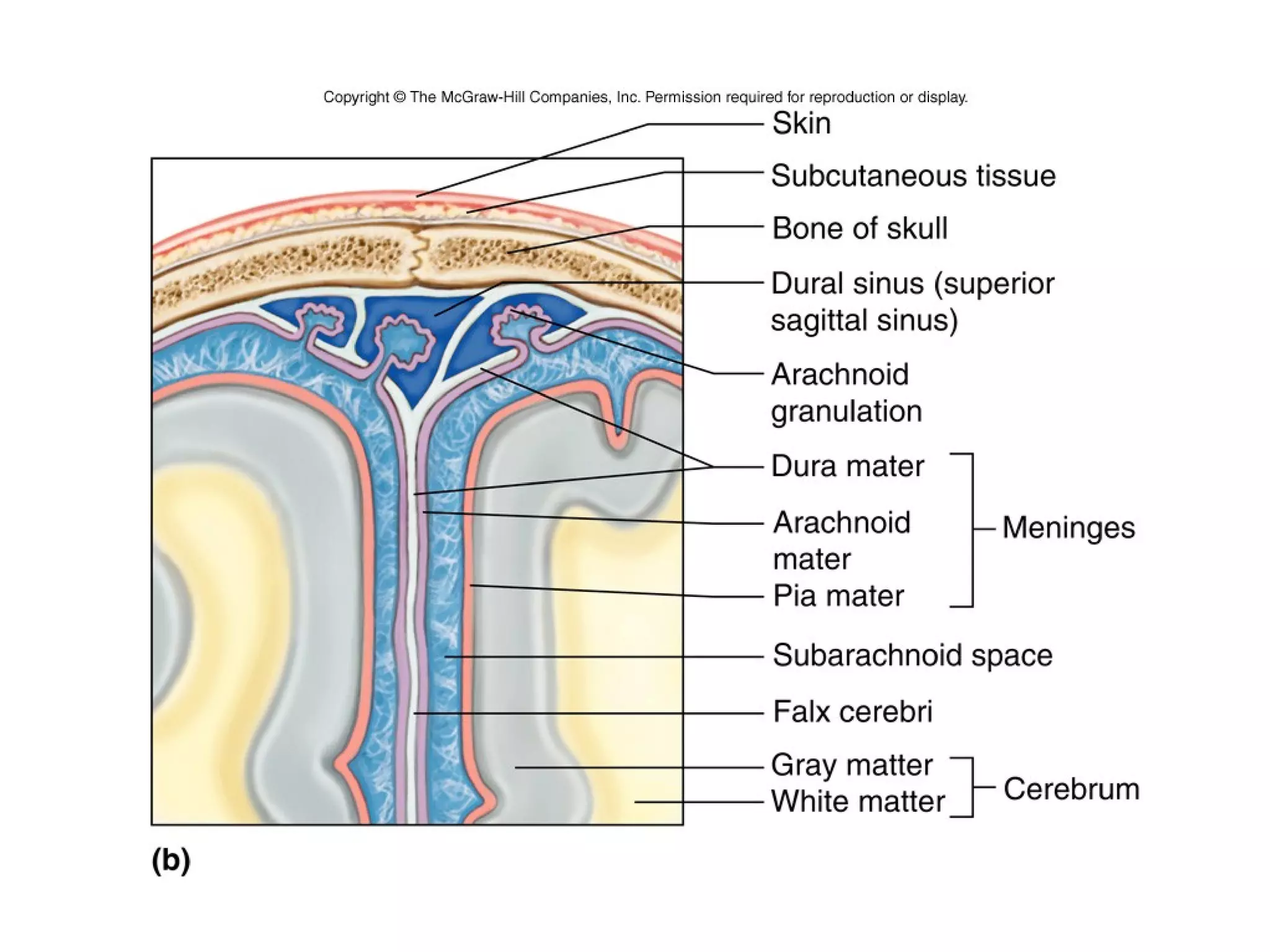
Absorption of CSF into dural venous sinuses
 Main sites - arachnoid villi (project
into dural venous sinuses, especially,
superior sagittal sinus)
 Arachnoid villi are covered by
endothelium of the venous sinus
 Arachnoid villi tend to be grouped
together & form elevations known as
arachnoid granulations
 CSF pressure >> the pressure in the
sinus
 The rate of absorption of CSF
through the arachnoid villi controls
the CSF pressure
BLOOD SUPPLY OFTHE
BRAIN
OBJECTIVES
 Illustrate and describe the formation of the
circle of willis
 Describe the blood supply of the brain
 Arterial supply
 Venous drainage
Blood Supply ofThe Brain
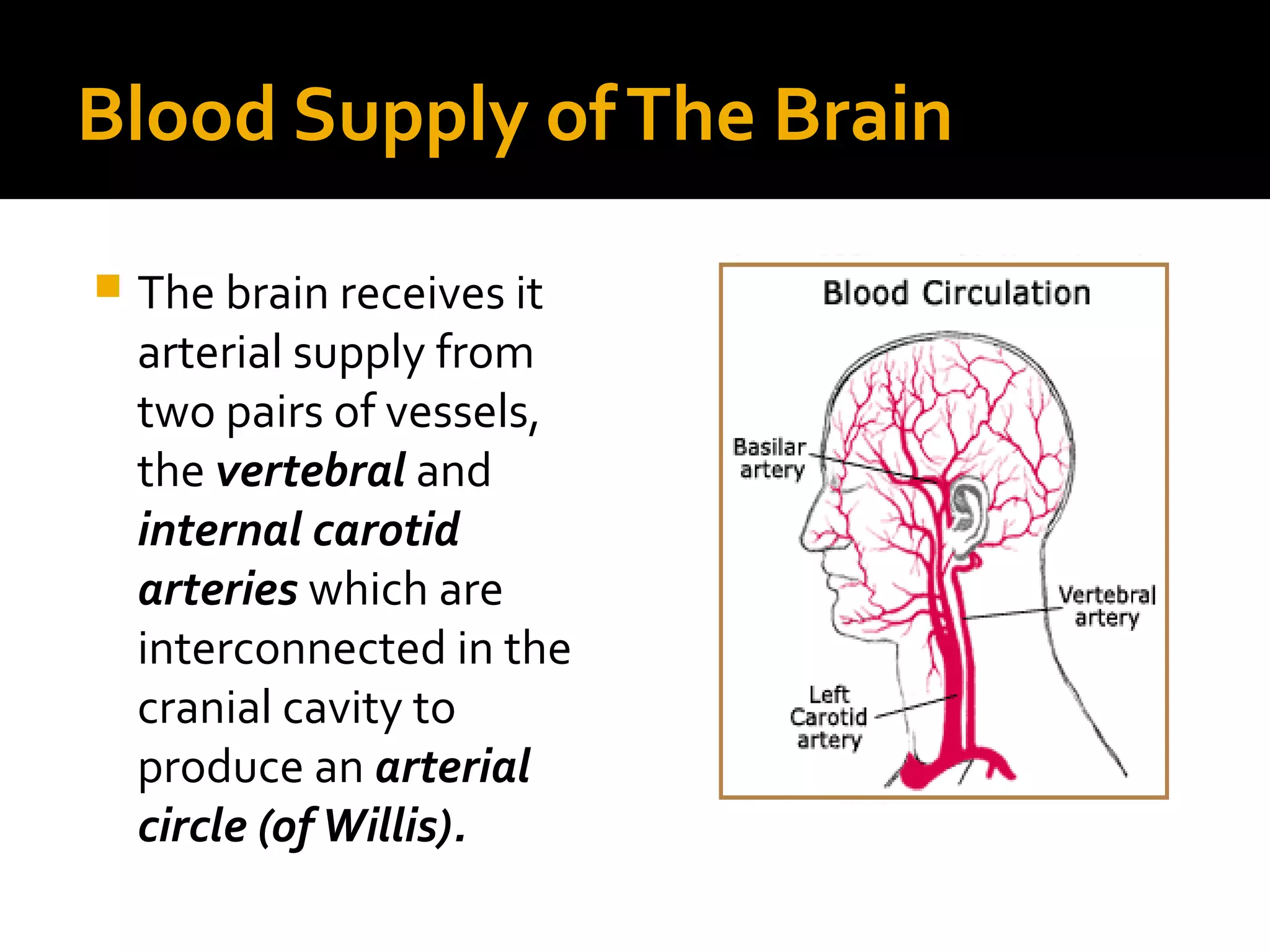
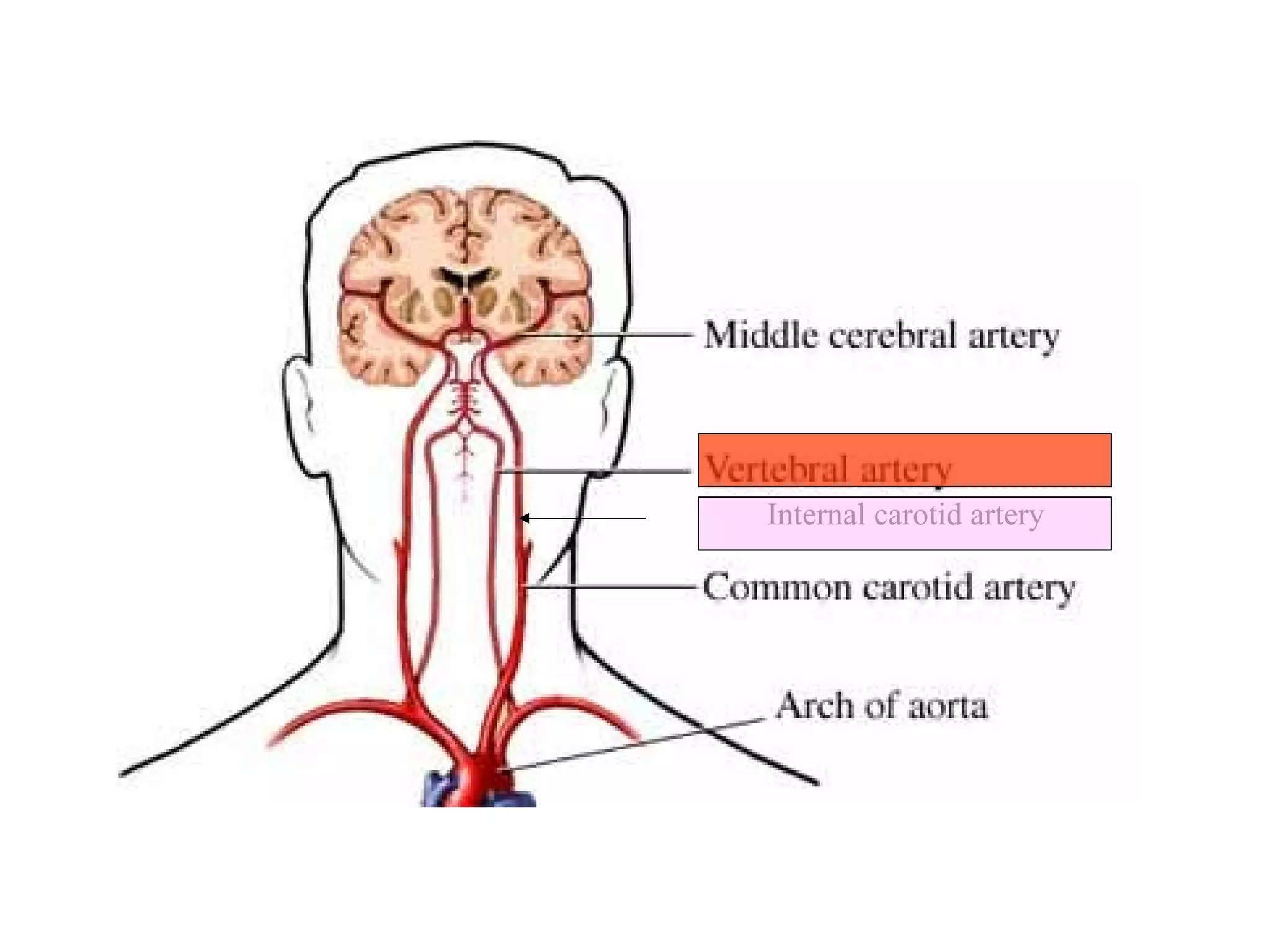
 The brain receives it
arterial supply from
two pairs of vessels,
the vertebral and
internal carotid
arteries which are
interconnected in the
cranial cavity to
produce an arterial
circle (ofWillis).
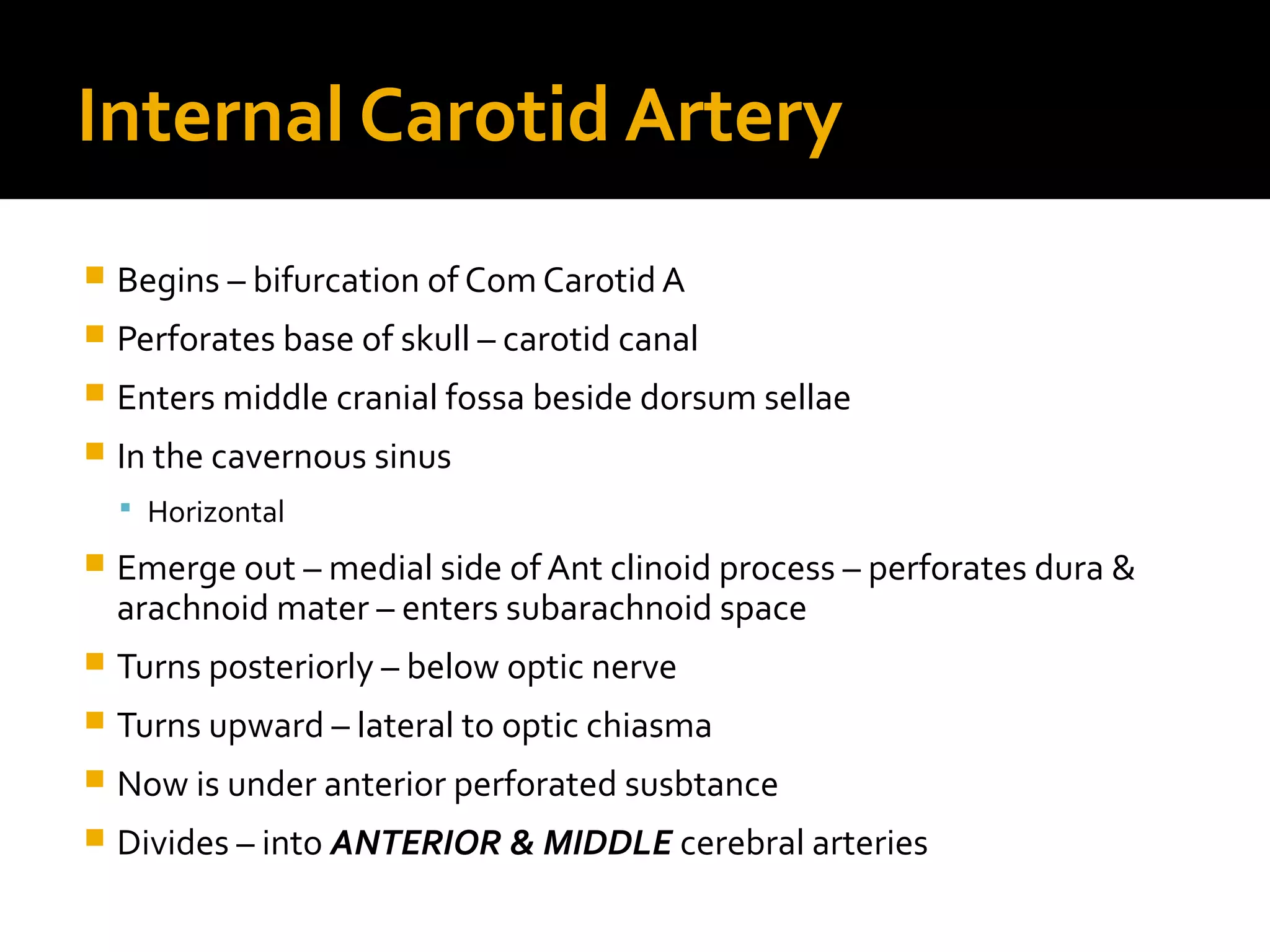
Internal carotid artery
Internal Carotid Artery
 Begins – bifurcation of Com Carotid A
 Perforates base of skull – carotid canal
 Enters middle cranial fossa beside dorsum sellae
 In the cavernous sinus
 Horizontal
 Emerge out – medial side of Ant clinoid process – perforates dura &
arachnoid mater – enters subarachnoid space
 Turns posteriorly – below optic nerve
 Turns upward – lateral to optic chiasma
 Now is under anterior perforated susbtance
 Divides – into ANTERIOR & MIDDLE cerebral arteries
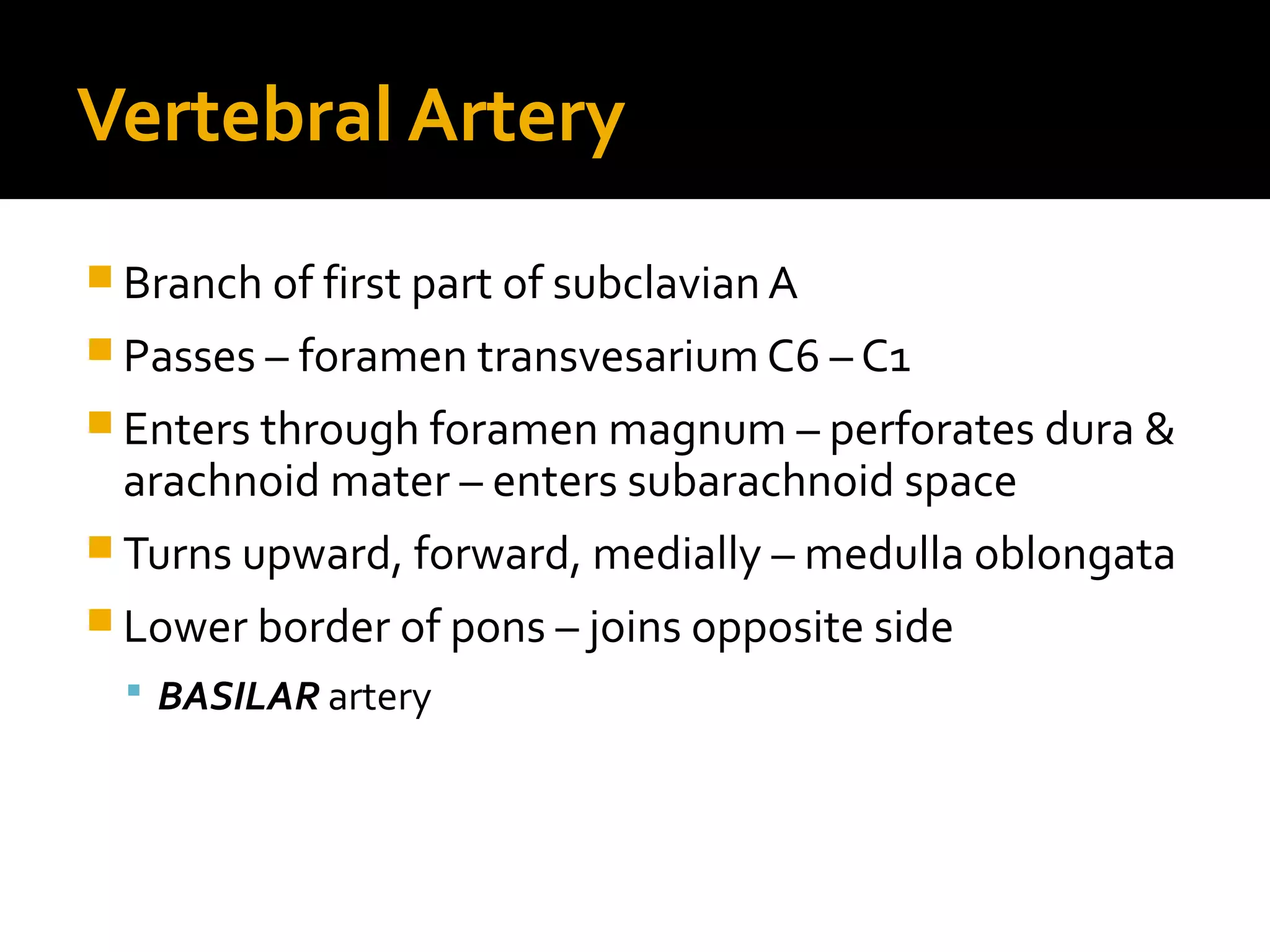
Vertebral Artery
 Branch of first part of subclavian A
 Passes – foramen transvesarium C6 – C1
 Enters through foramen magnum – perforates dura &
arachnoid mater – enters subarachnoid space
 Turns upward, forward, medially – medulla oblongata
 Lower border of pons – joins opposite side
 BASILAR artery
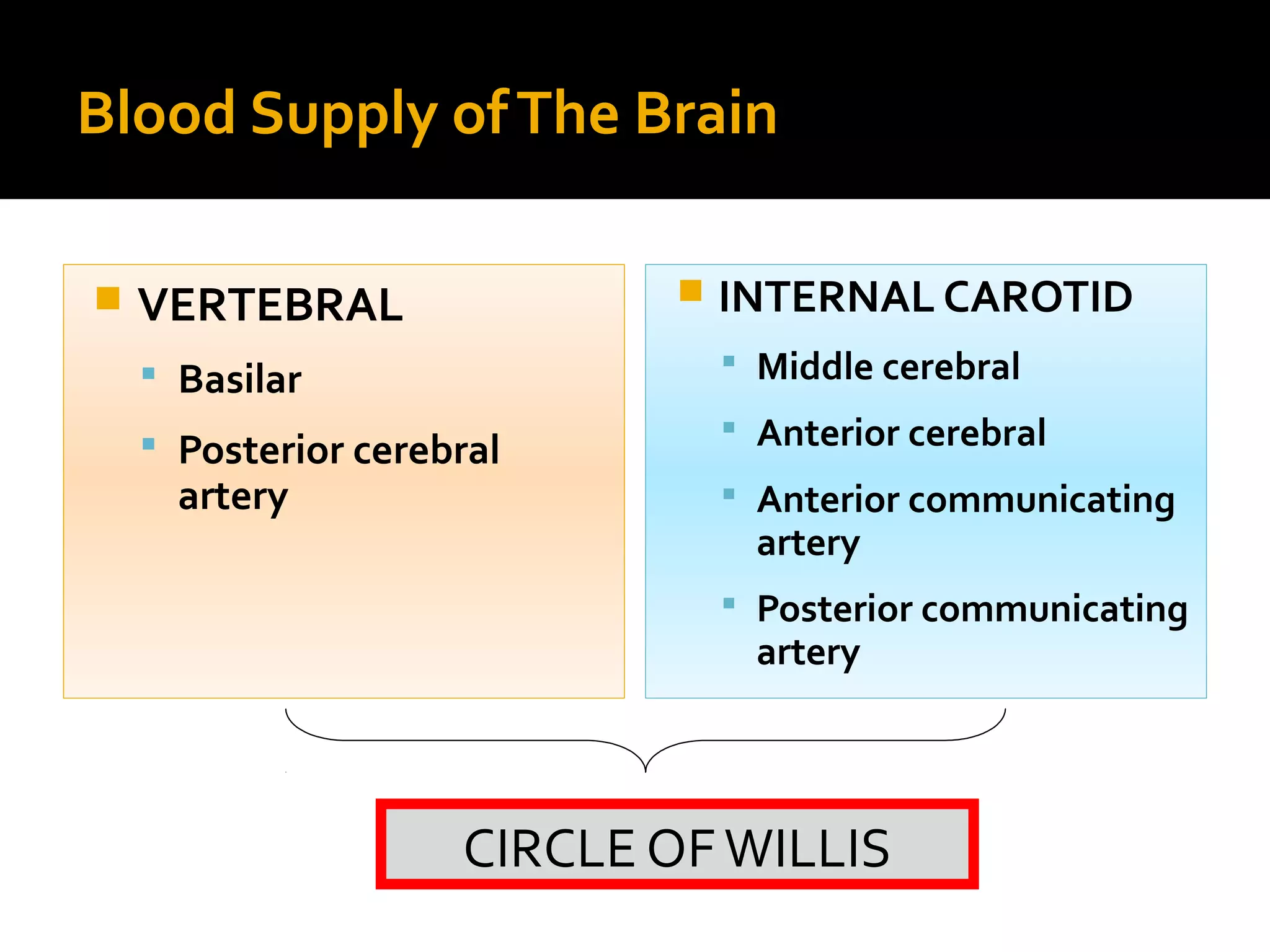
Blood Supply ofThe Brain
 VERTEBRAL
 Basilar
 Posterior cerebral
artery
 INTERNAL CAROTID
 Middle cerebral
 Anterior cerebral
 Anterior communicating
artery
 Posterior communicating
artery
CIRCLE OFWILLIS
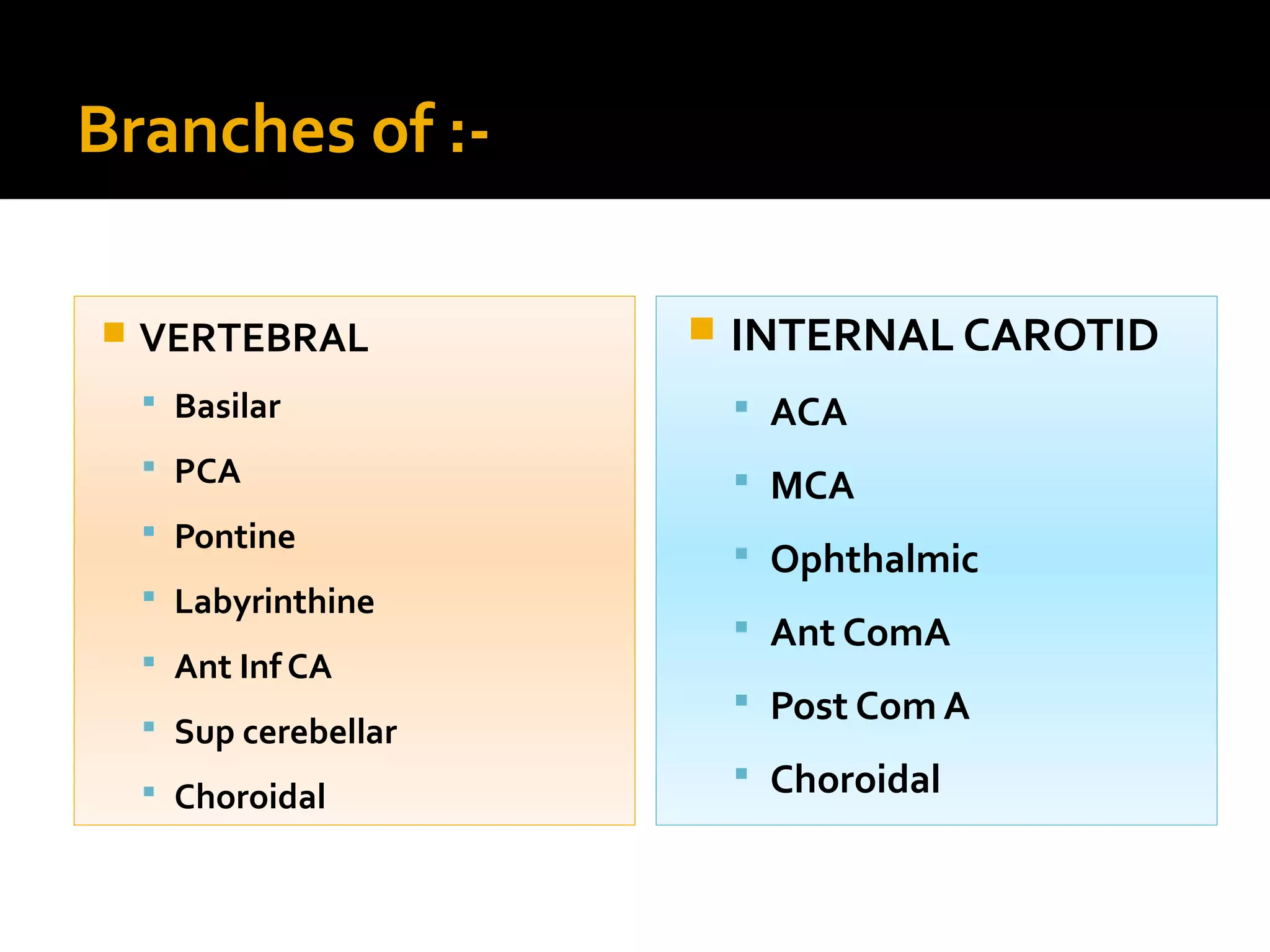
Branches of :-
 VERTEBRAL
 Basilar
 PCA
 Pontine
 Labyrinthine
 Ant Inf CA
 Sup cerebellar
 Choroidal
 INTERNAL CAROTID
 ACA
 MCA
 Ophthalmic
 Ant ComA
 Post Com A
 Choroidal
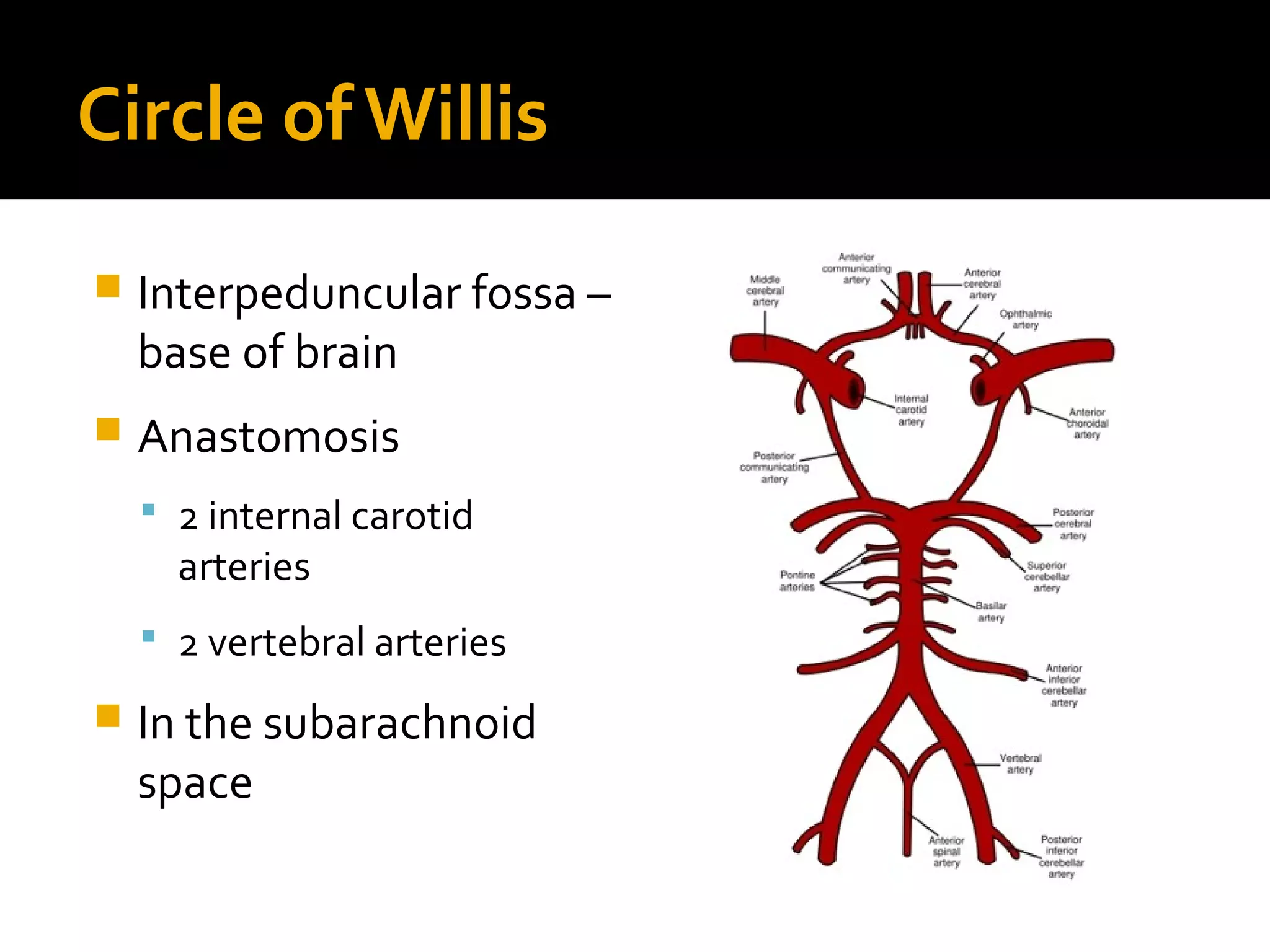
Circle of Willis
 Interpeduncular fossa –
base of brain
 Anastomosis
 2 internal carotid
arteries
 2 vertebral arteries
 In the subarachnoid
space
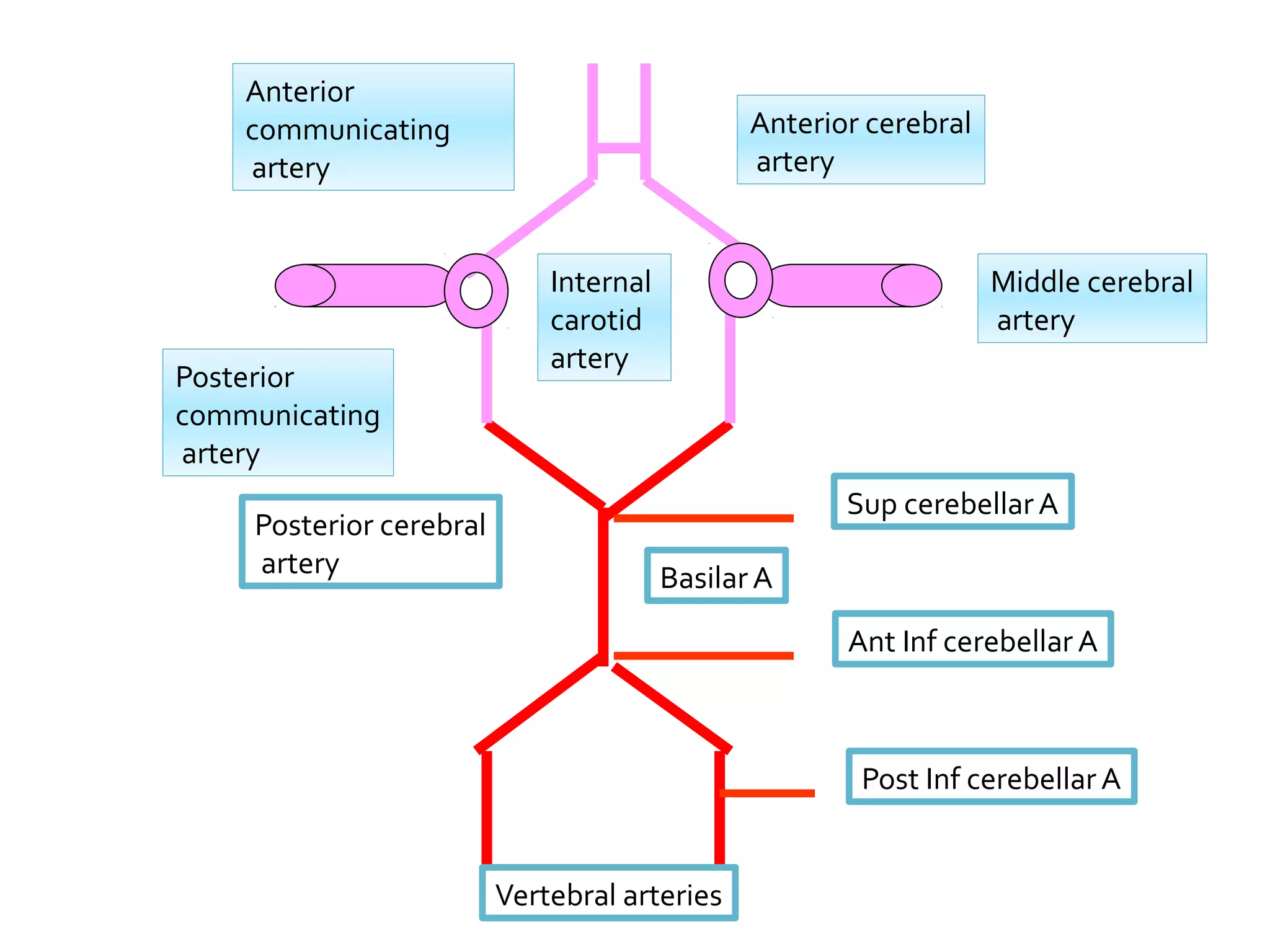
Vertebral arteries
BasilarA
Posterior cerebral
artery
Posterior
communicating
artery
Internal
carotid
artery
Middle cerebral
artery
Anterior cerebral
artery
Anterior
communicating
artery
Post Inf cerebellarA
Sup cerebellarA
Ant Inf cerebellar A
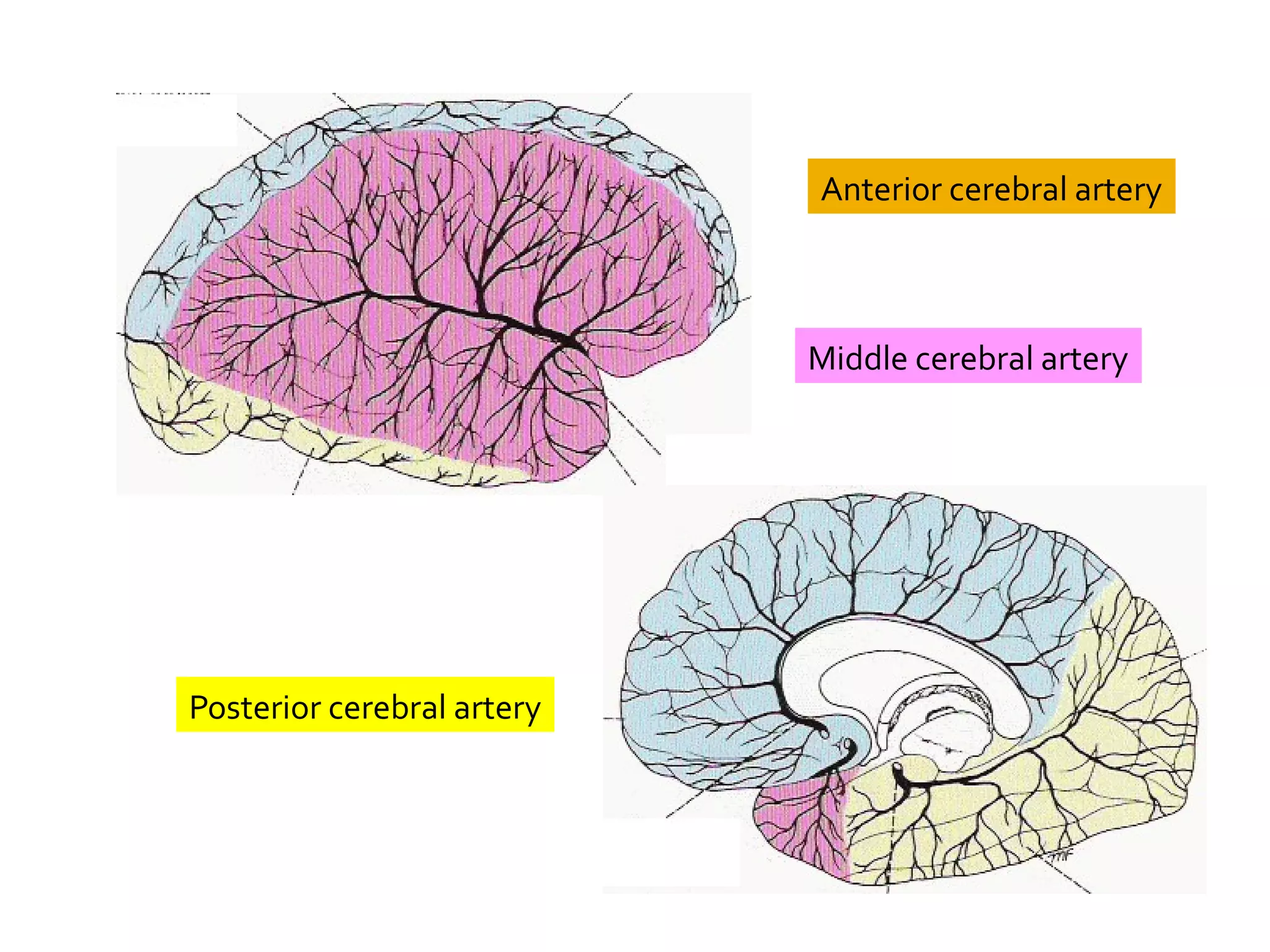
Middle cerebral artery
Anterior cerebral artery
Posterior cerebral artery
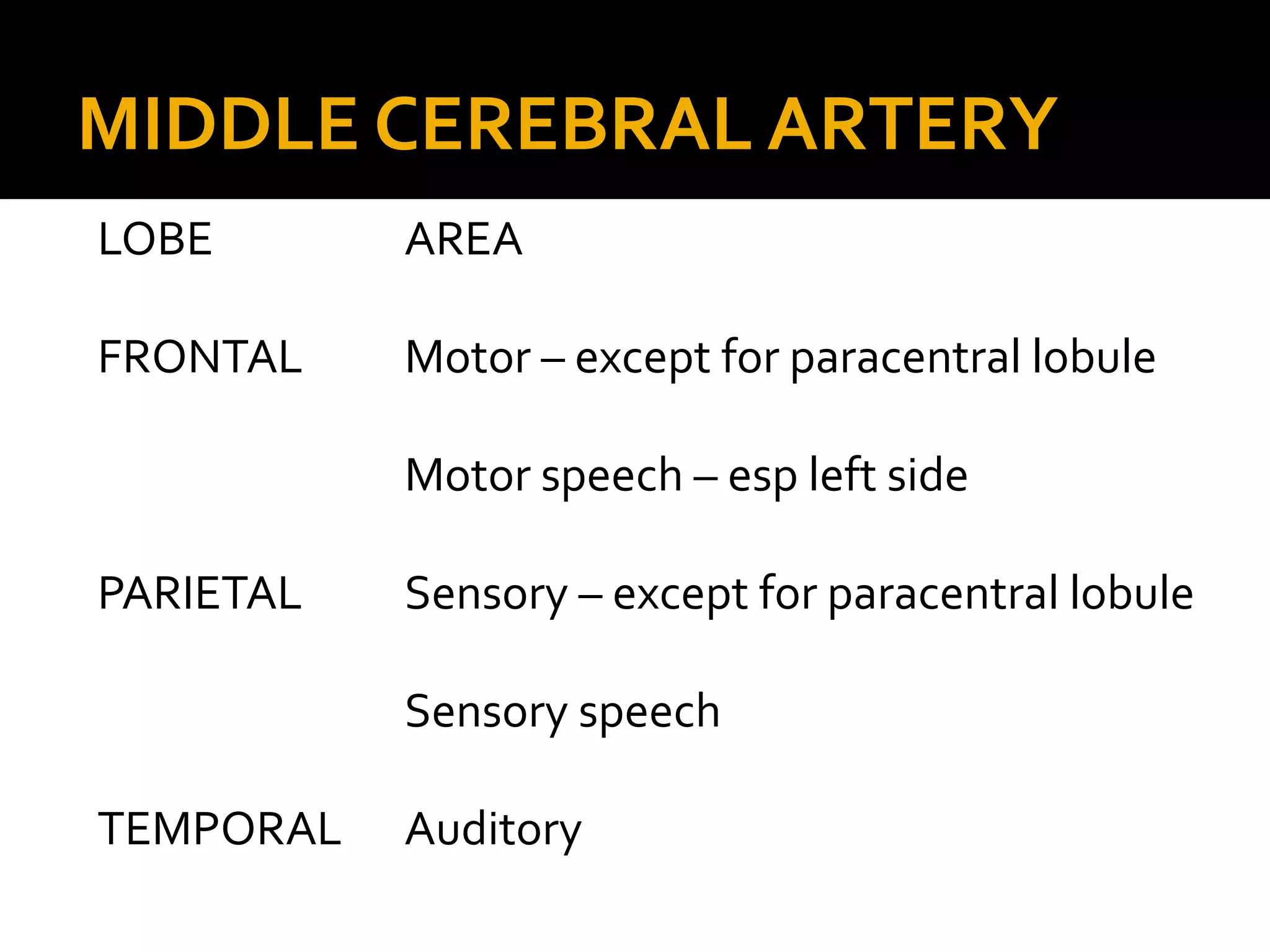
MIDDLE CEREBRAL ARTERY
LOBE AREA
FRONTAL Motor – except for paracentral lobule
Motor speech – esp left side
PARIETAL Sensory – except for paracentral lobule
Sensory speech
TEMPORAL Auditory
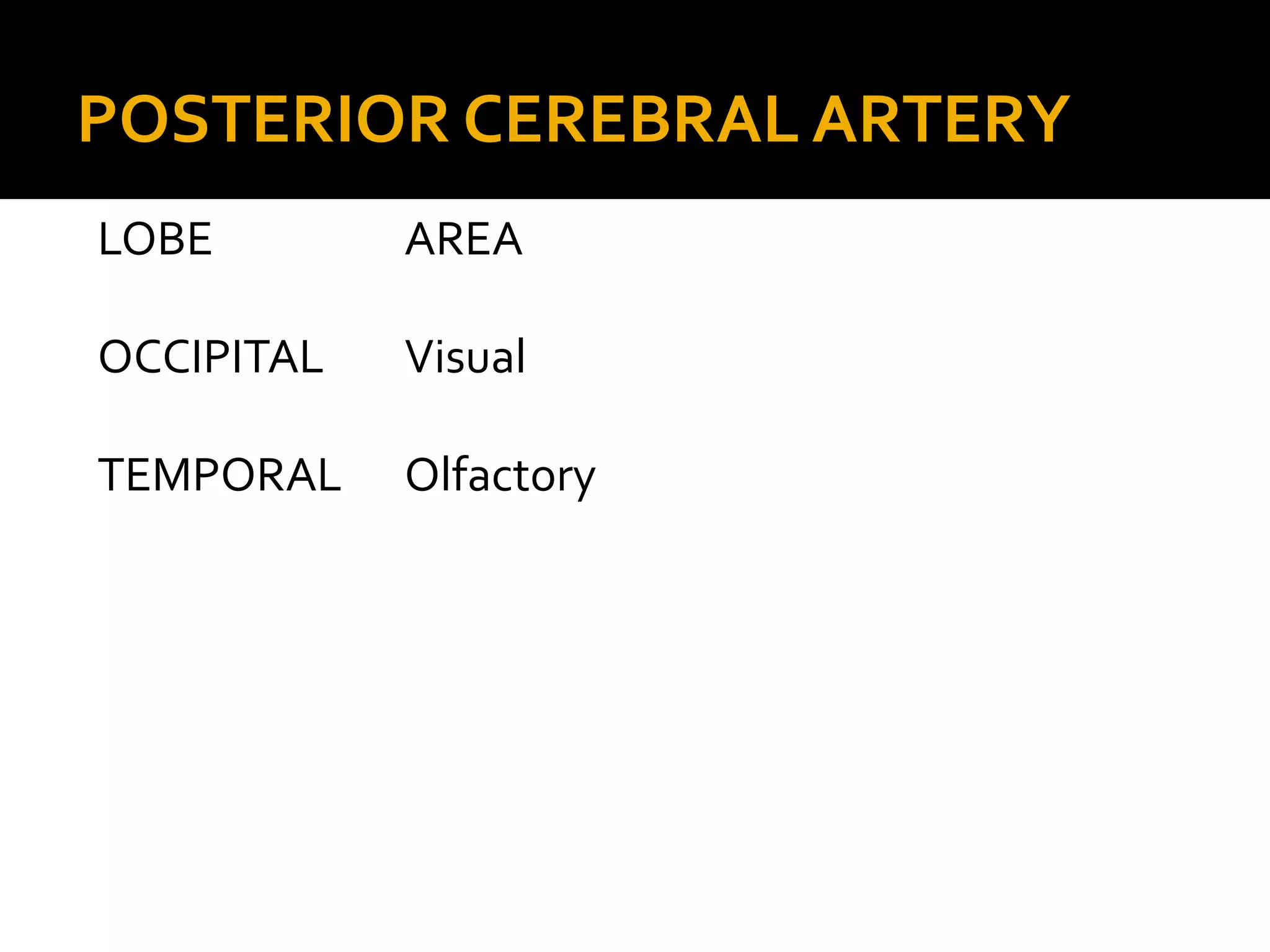
POSTERIOR CEREBRAL ARTERY
LOBE AREA
OCCIPITAL Visual
TEMPORAL Olfactory
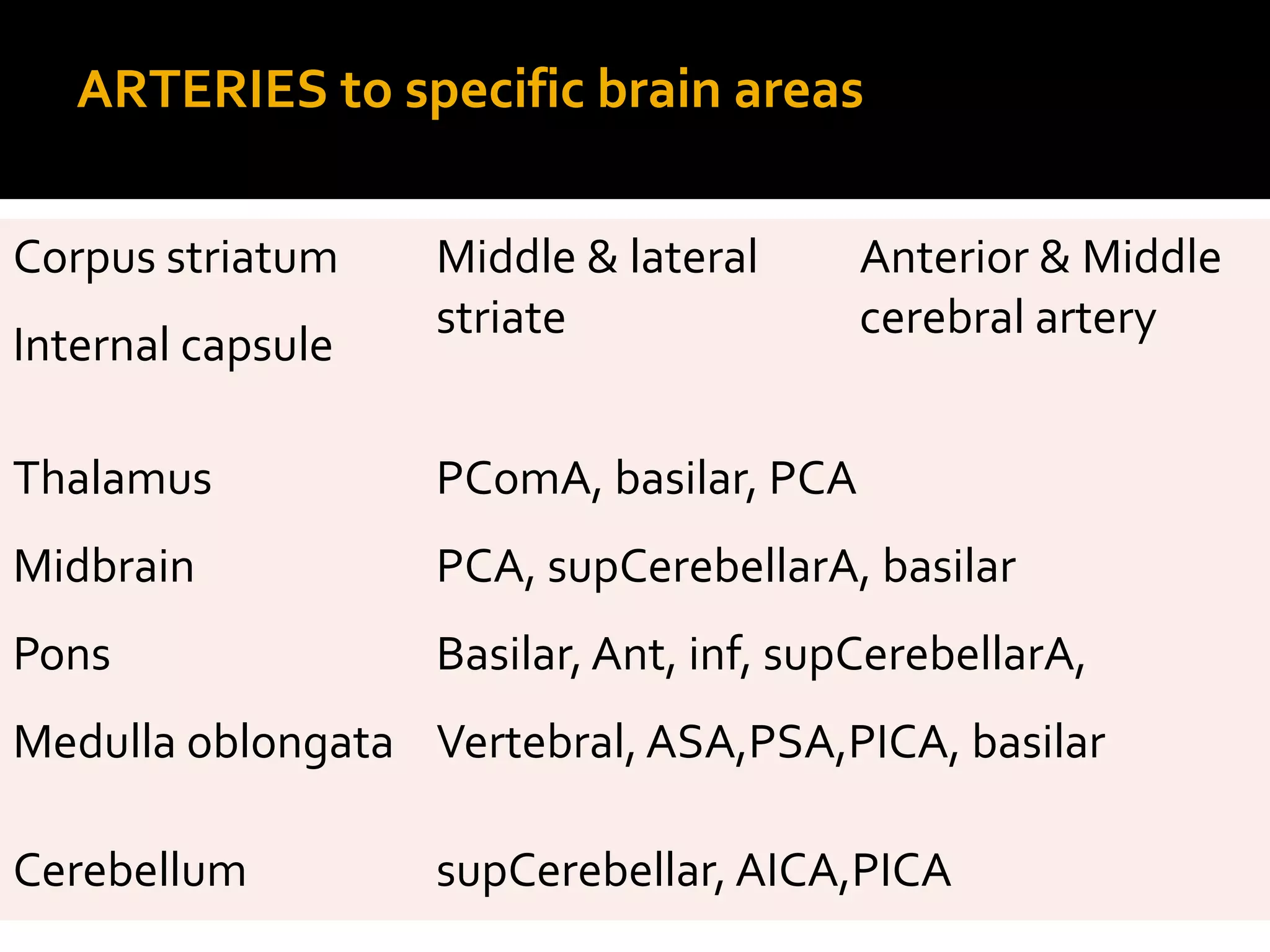
ARTERIES to specific brain areas
Corpus striatum Middle & lateral
striate
Anterior & Middle
cerebral artery
Internal capsule
Thalamus PComA, basilar, PCA
Midbrain PCA, supCerebellarA, basilar
Pons Basilar, Ant, inf, supCerebellarA,
Medulla oblongata Vertebral, ASA,PSA,PICA, basilar
Cerebellum supCerebellar, AICA,PICA
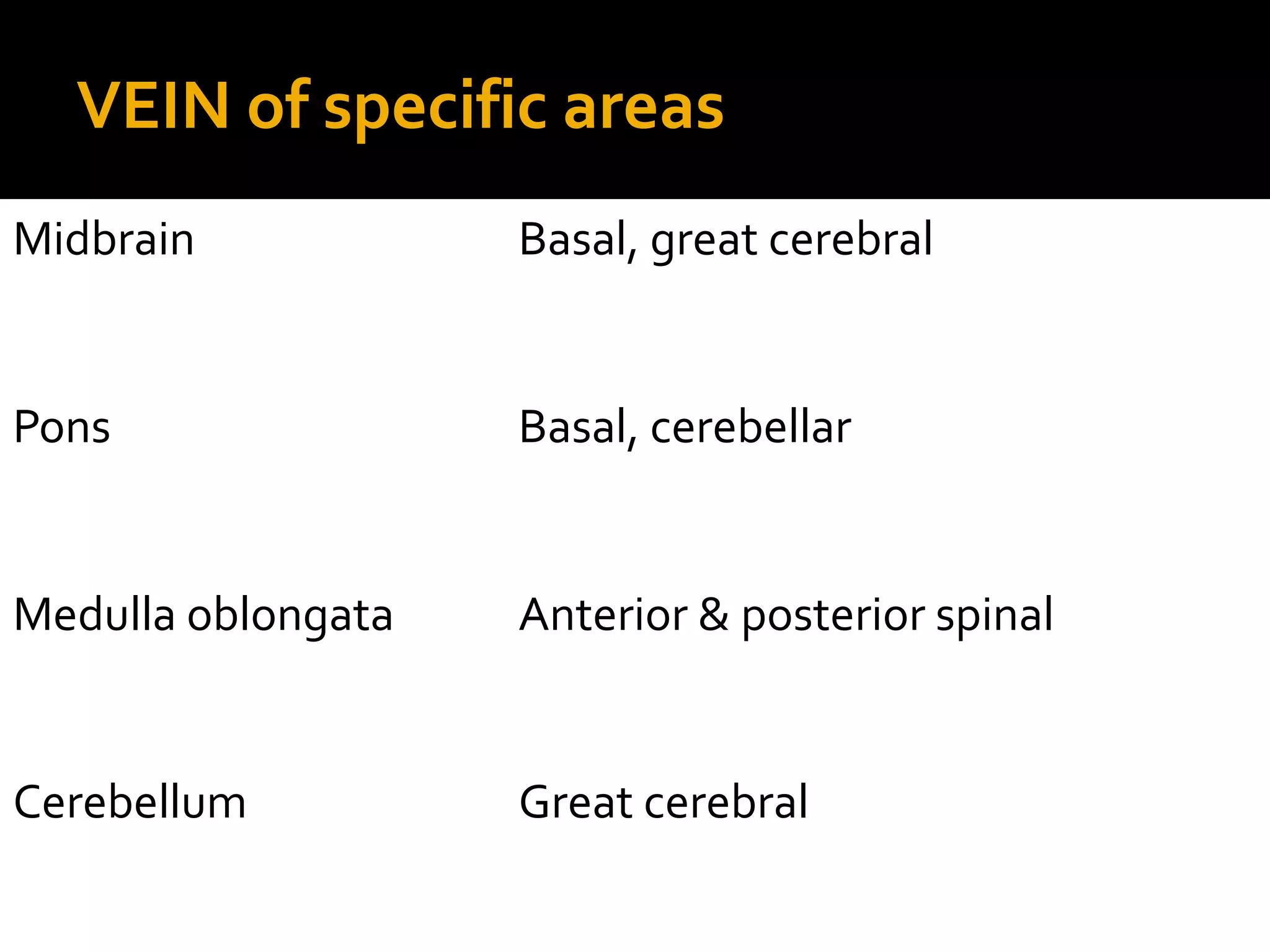
VEIN of specific areas
Midbrain Basal, great cerebral
Pons Basal, cerebellar
Medulla oblongata Anterior & posterior spinal
Cerebellum Great cerebral
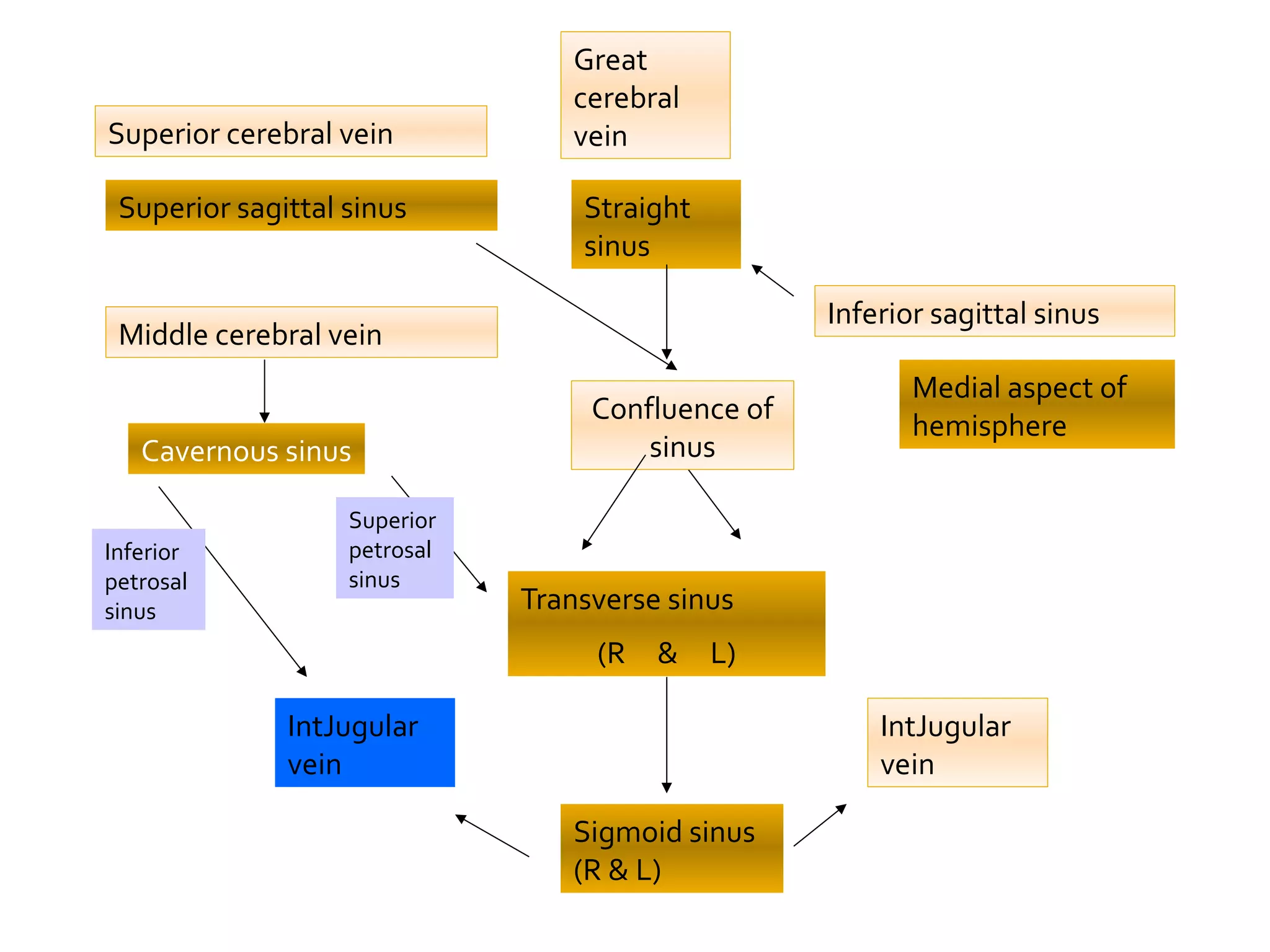
Superior sagittal sinus
Inferior sagittal sinus
Straight
sinus
Superior cerebral vein
Medial aspect of
hemisphere
Great
cerebral
vein
Transverse sinus
(R & L)
Sigmoid sinus
(R & L)
Confluence of
sinus
IntJugular
vein
IntJugular
vein
Cavernous sinus
Middle cerebral vein
Inferior
petrosal
sinus
Superior
petrosal
sinus
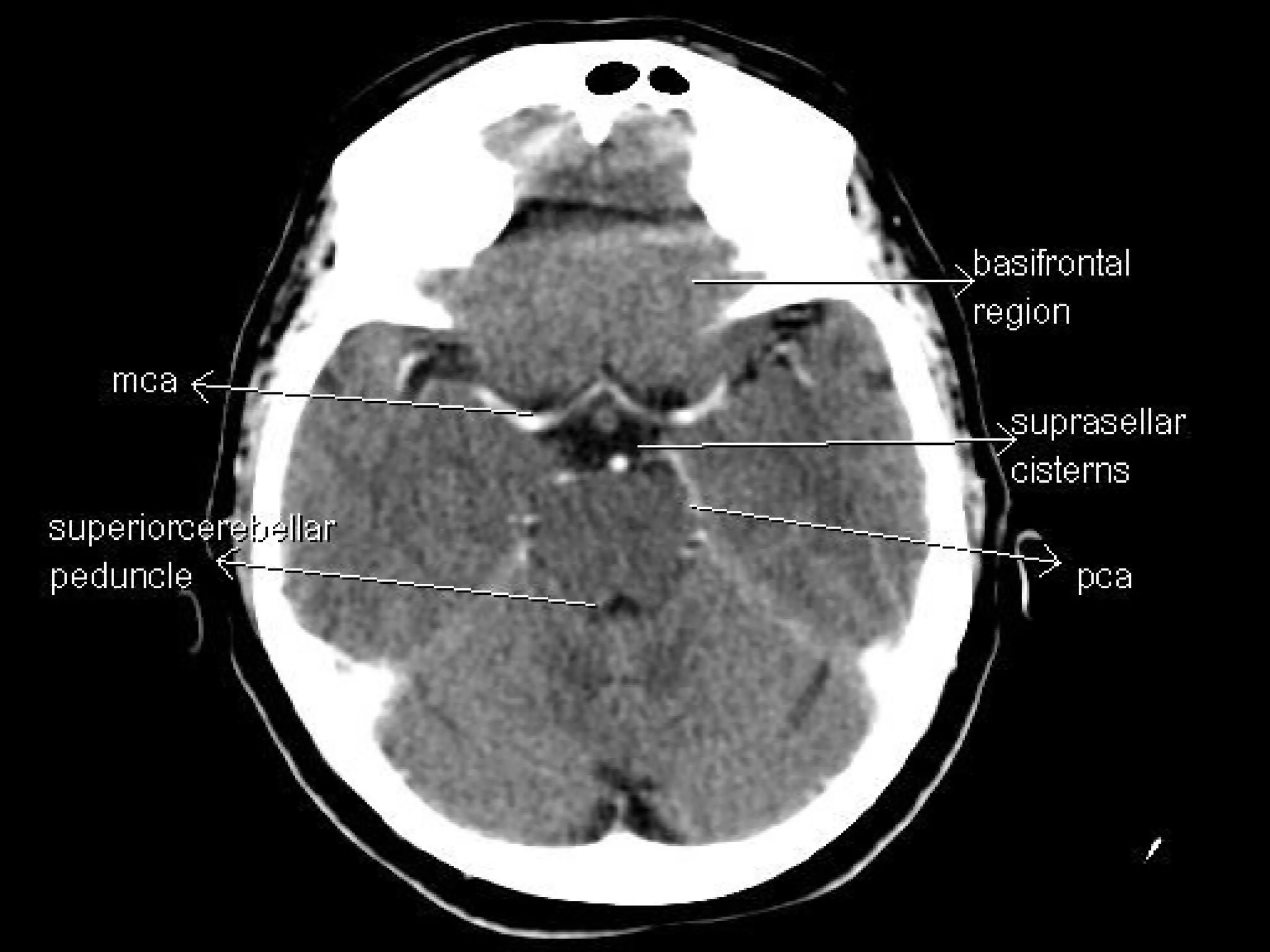
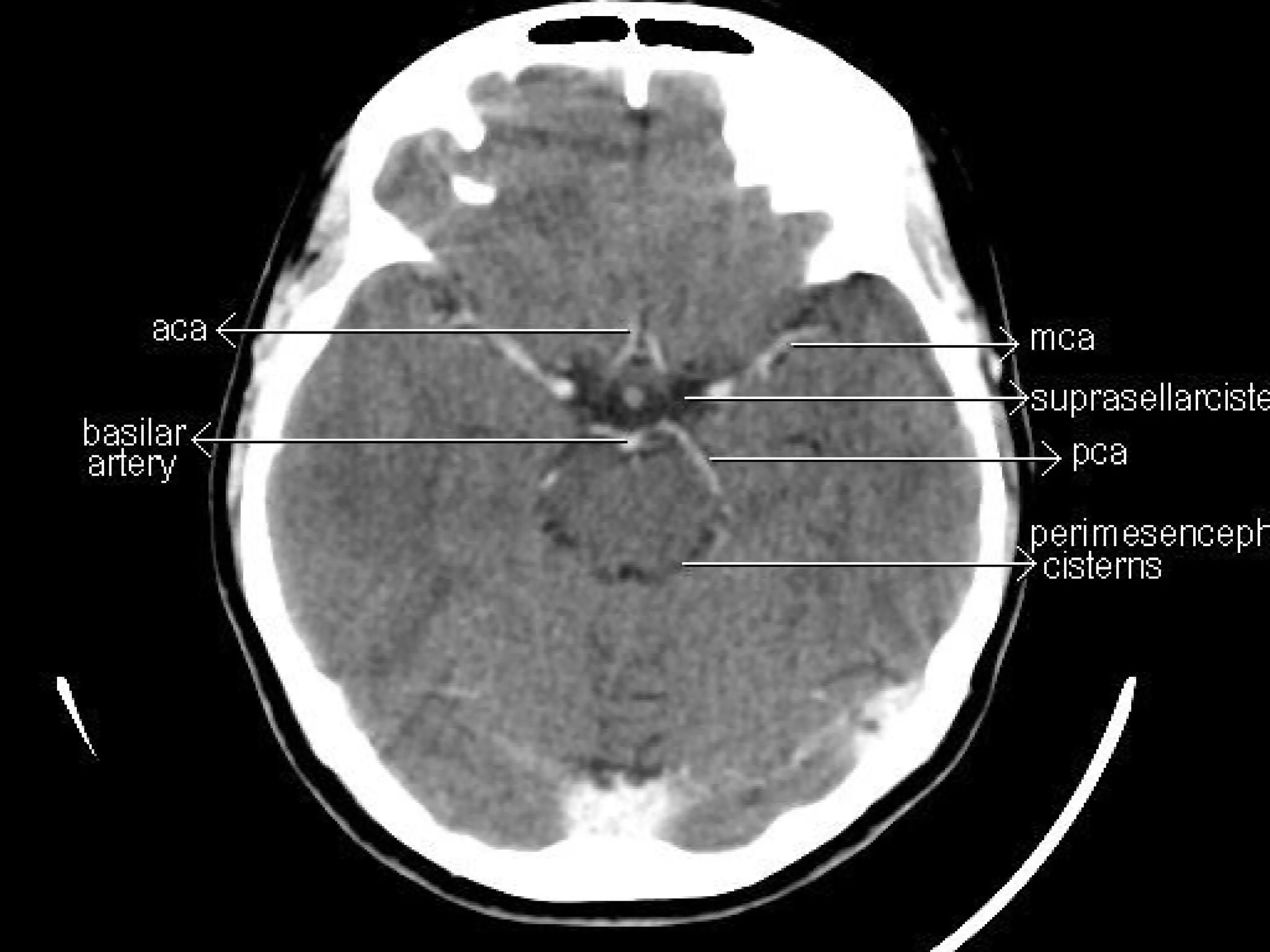
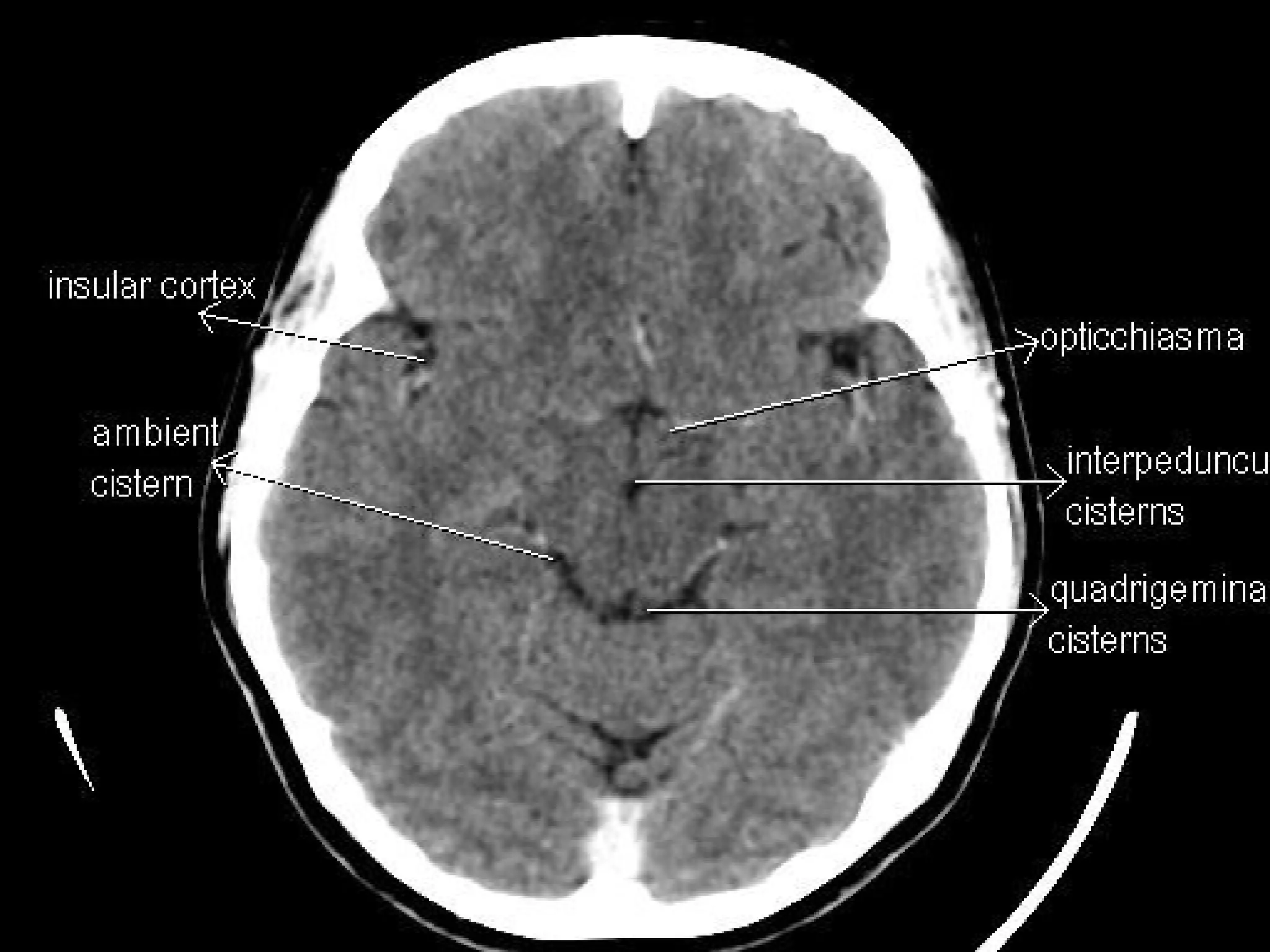
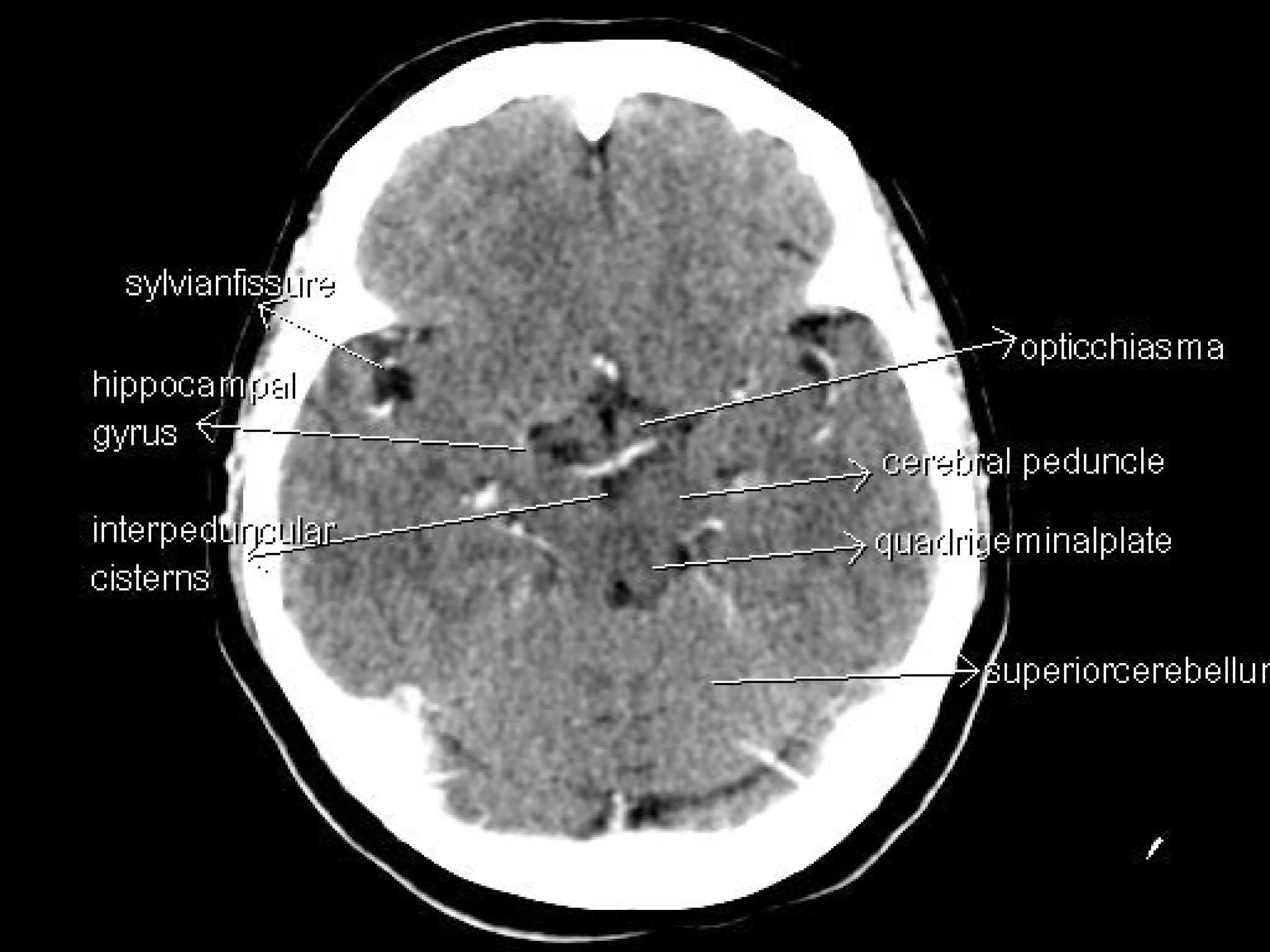
The subarachnoid cisterns are areas within the
subarachnoid space where the pia mater and
arachnoid membrane are not in close
approximation.The subarachnoid tissue is not as
abundant here as in the normal subarachnoid
space and cerebrospinal fluid (CSF) gathers to
form pools or cisterns (Latin: "box").
Some major subarachnoid cisterns:
cisterna magna (cerebellomedullary cistern): the
largest of the subarachnoid cisterns
pontine cistern
suprasellar cistern
interpeduncular cistern
quadrigeminal cistern (superior cistern or cistern
of the great cerebral vein)
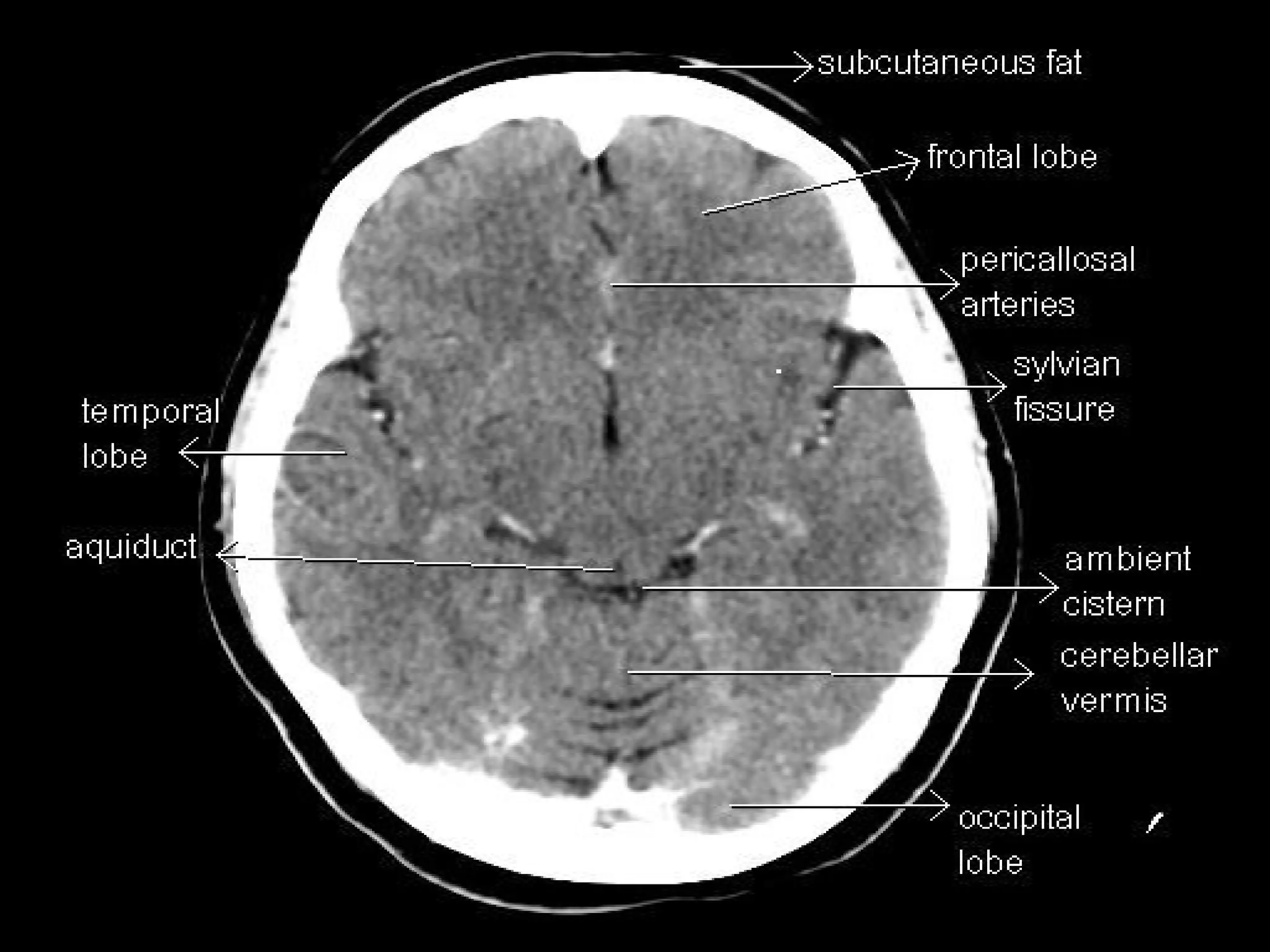
ambient cistern
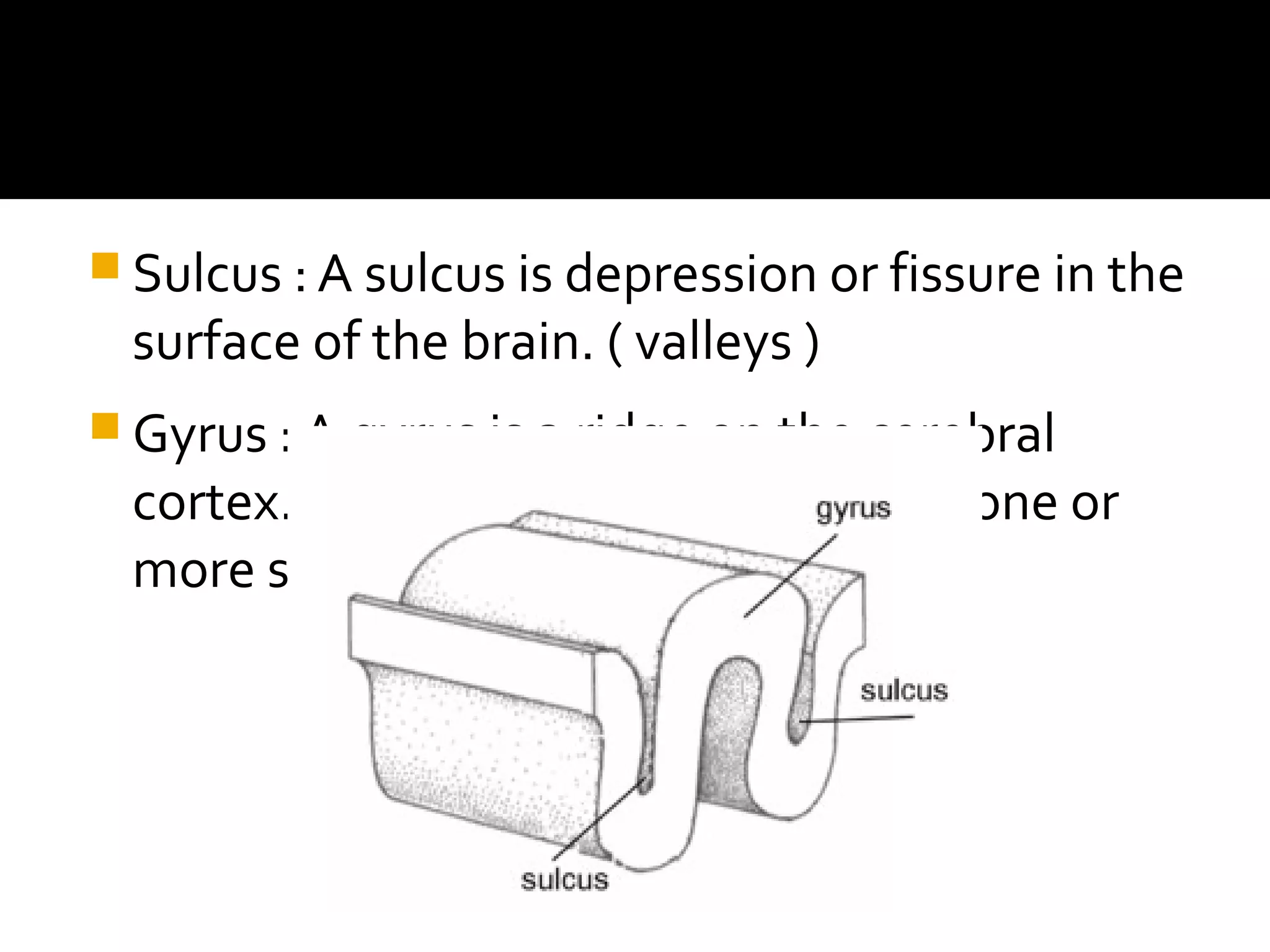
 Sulcus : A sulcus is depression or fissure in the
surface of the brain. ( valleys )
 Gyrus : A gyrus is a ridge on the cerebral
cortex. It is generally surrounded by one or
more sulci ( hills )
Typical continous fissure
Interhemispheric fissure
Sylvian fissure ( lateral sulcus )
Parieto-occipital fissure
Collateral sulcus
Central sulcus
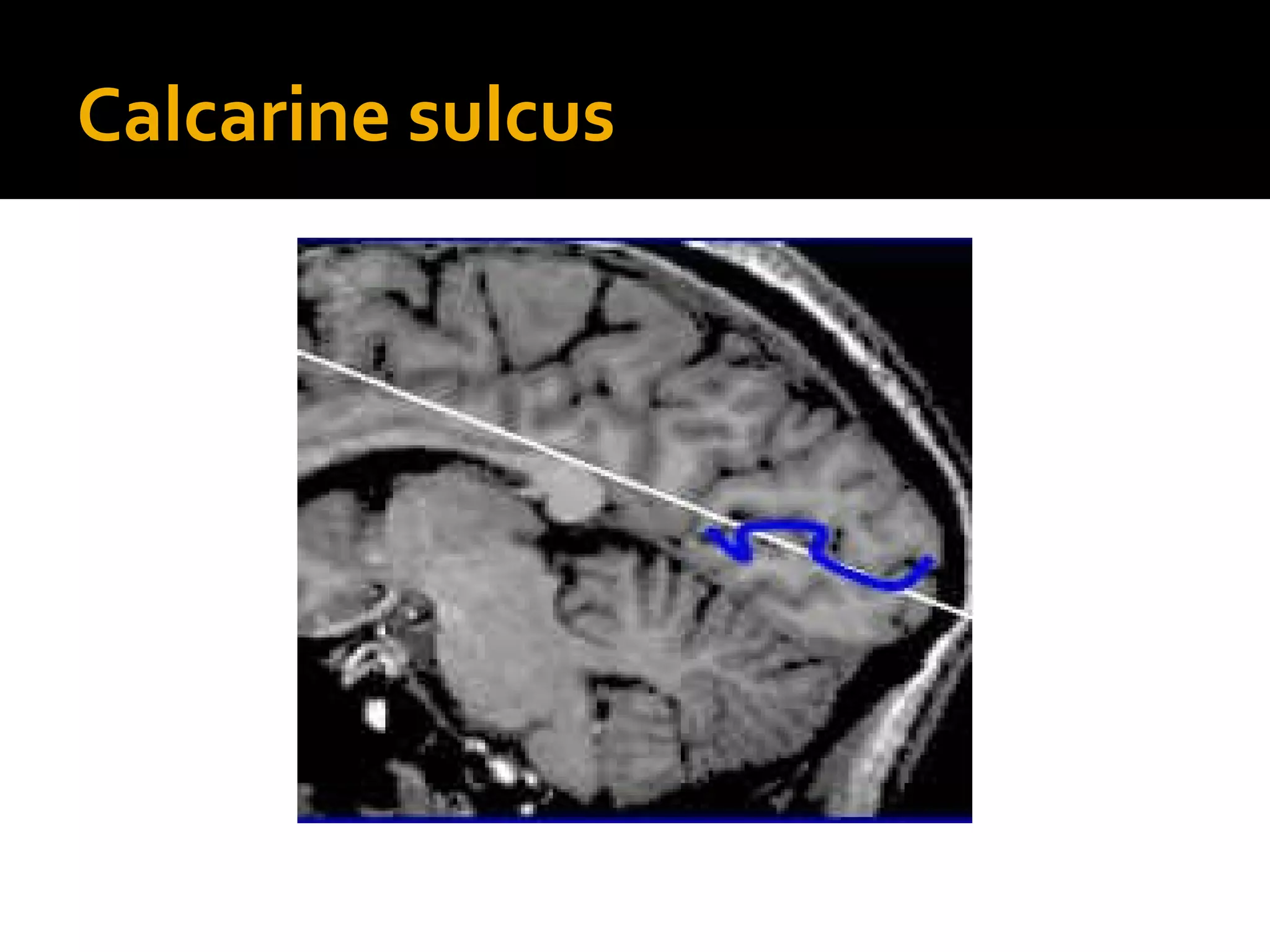
Calcarine Sulcus
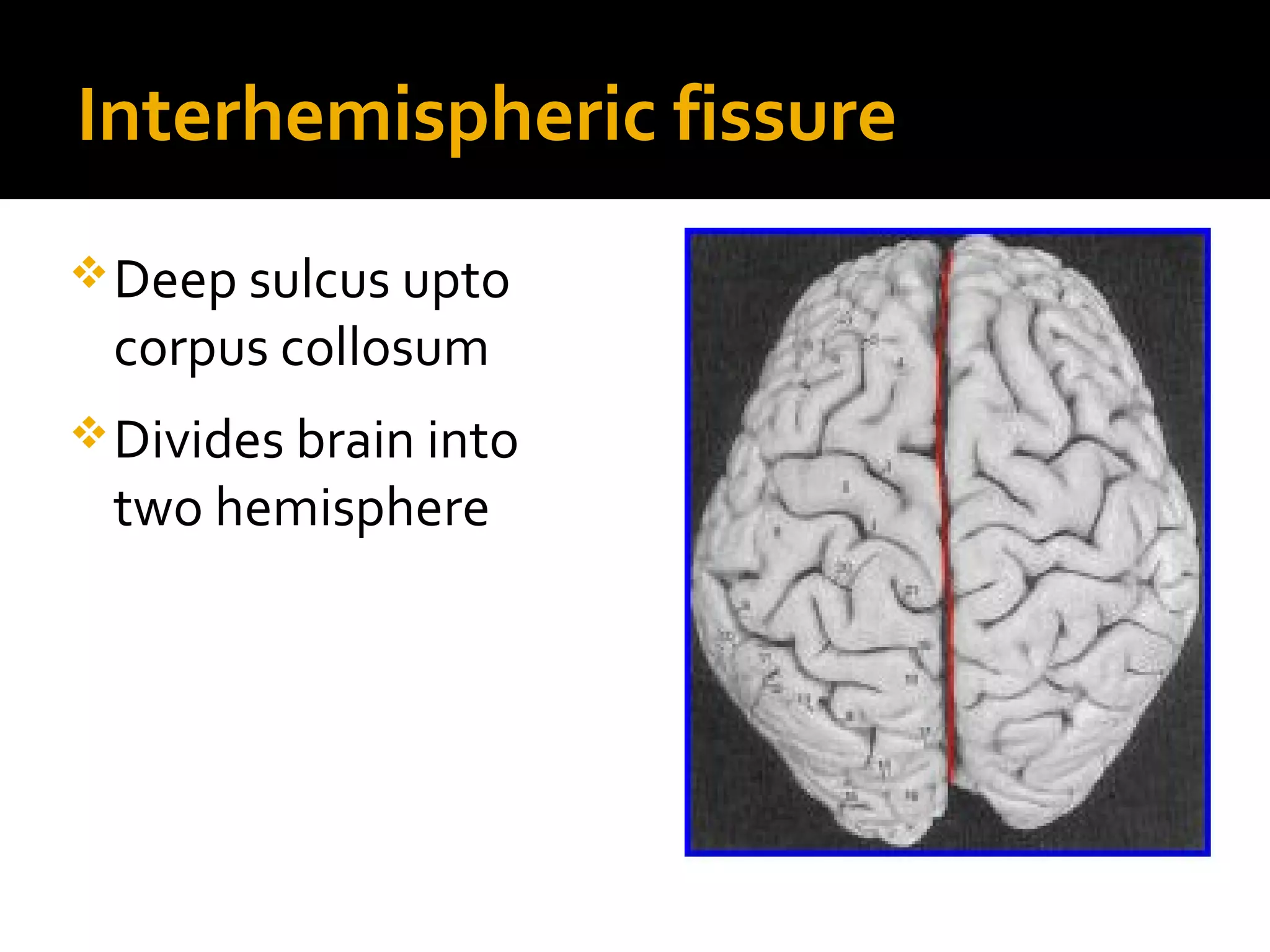
Interhemispheric fissure
Deep sulcus upto
corpus collosum
Divides brain into
two hemisphere
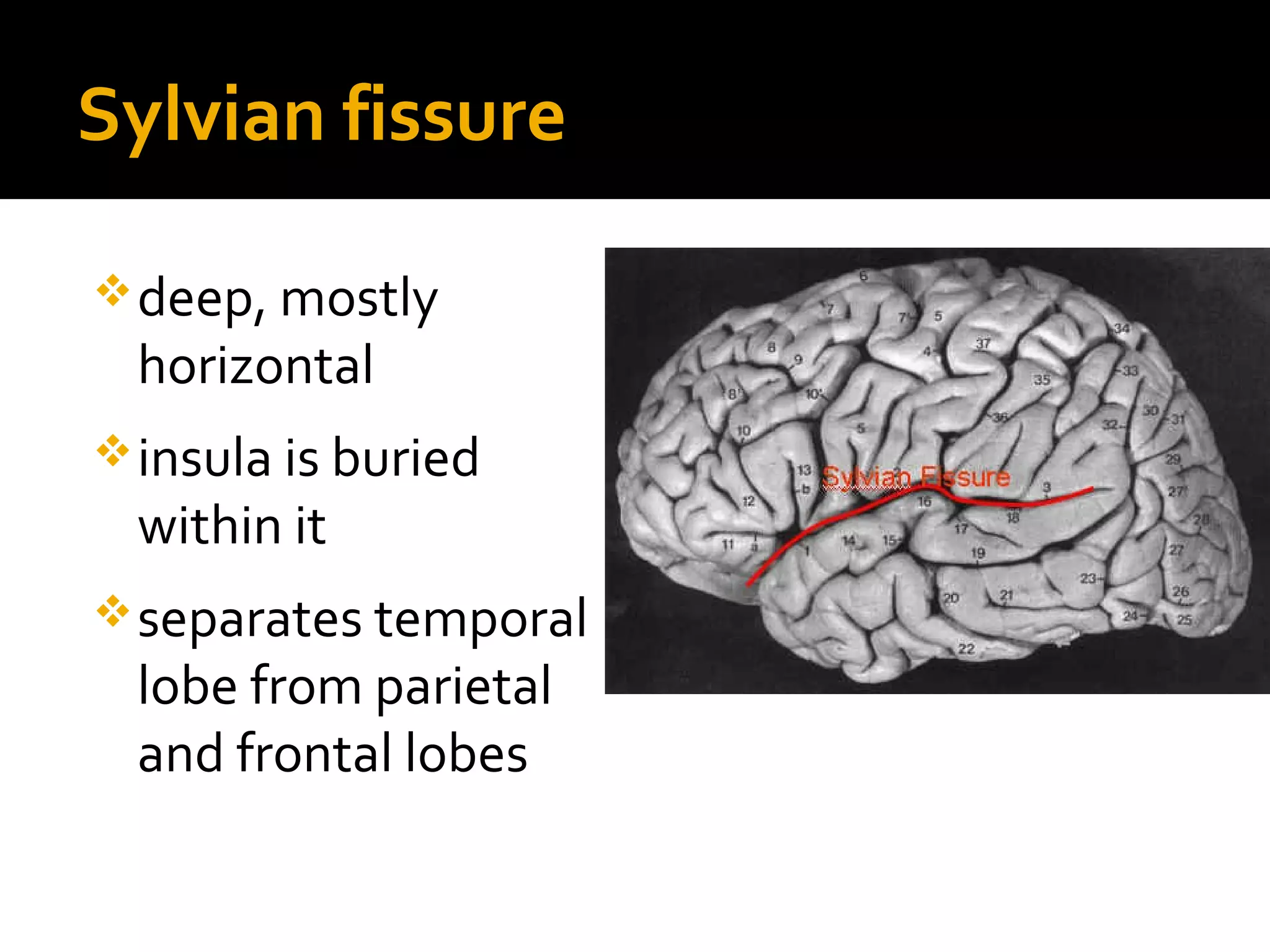
Sylvian fissure
deep, mostly
horizontal
insula is buried
within it
separates temporal
lobe from parietal
and frontal lobes
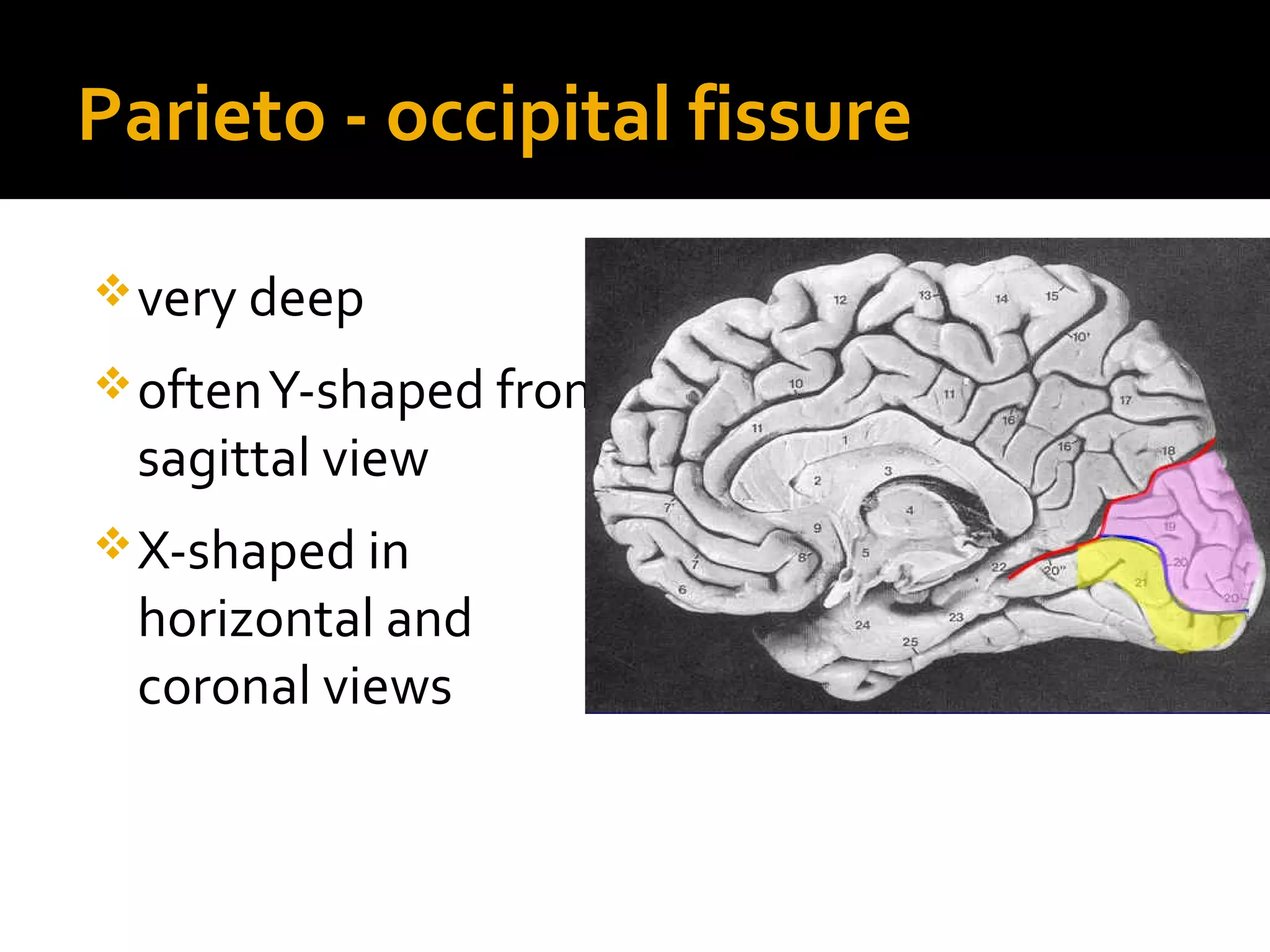
Parieto - occipital fissure
very deep
oftenY-shaped from
sagittal view
X-shaped in
horizontal and
coronal views
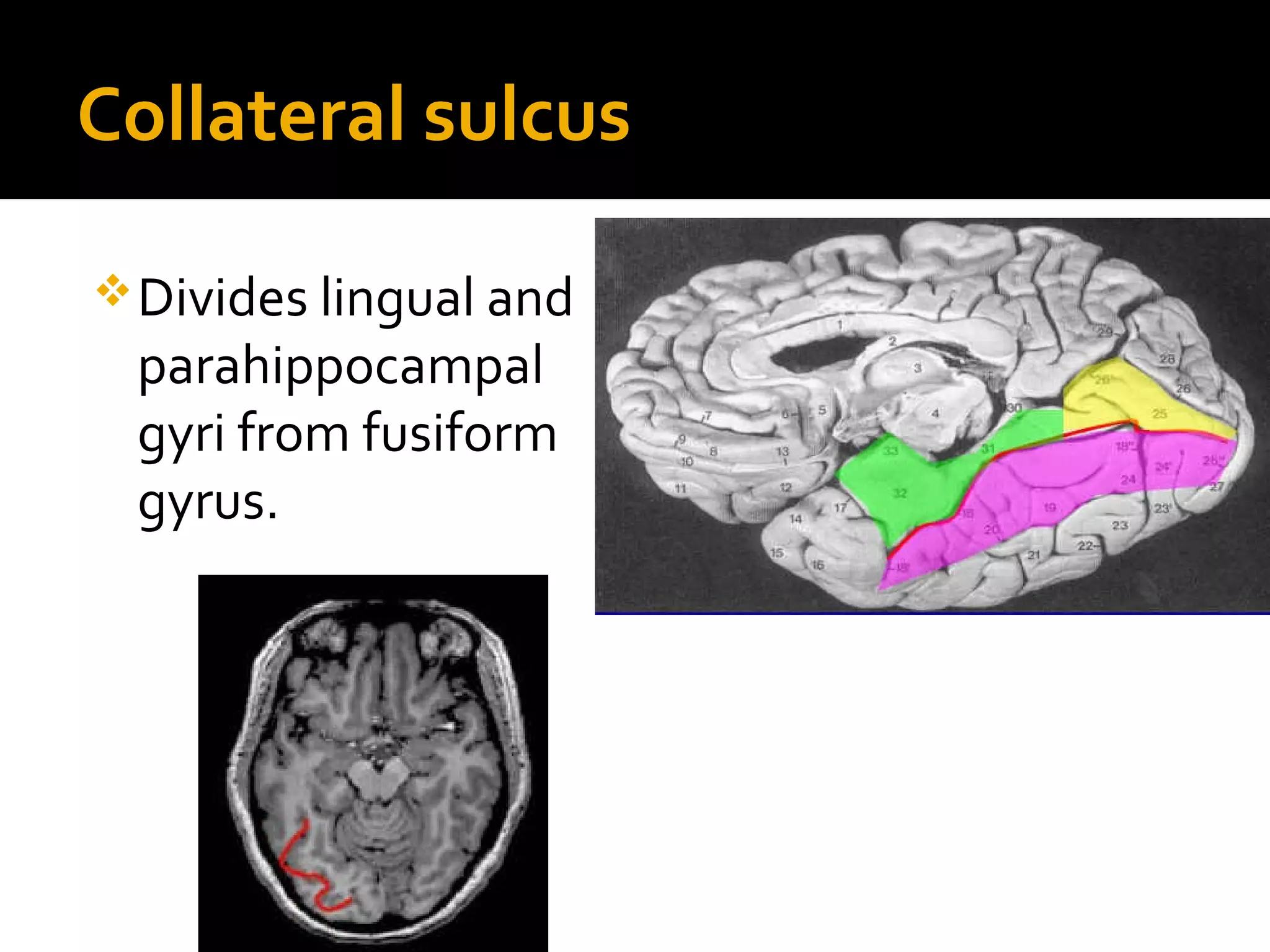
Collateral sulcus
Divides lingual and
parahippocampal
gyri from fusiform
gyrus.
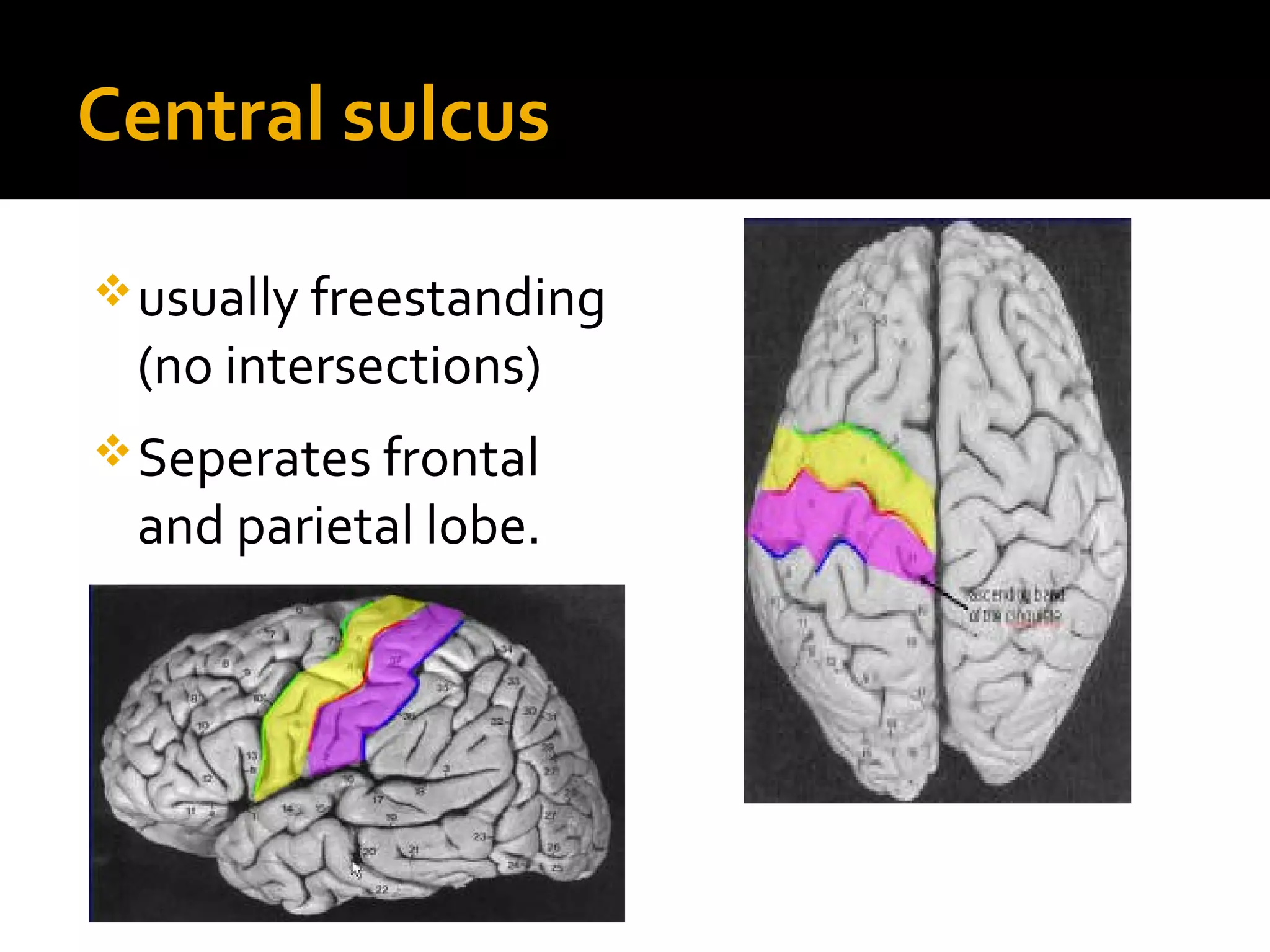
Central sulcus
usually freestanding
(no intersections)
Seperates frontal
and parietal lobe.
Calcarine sulcus
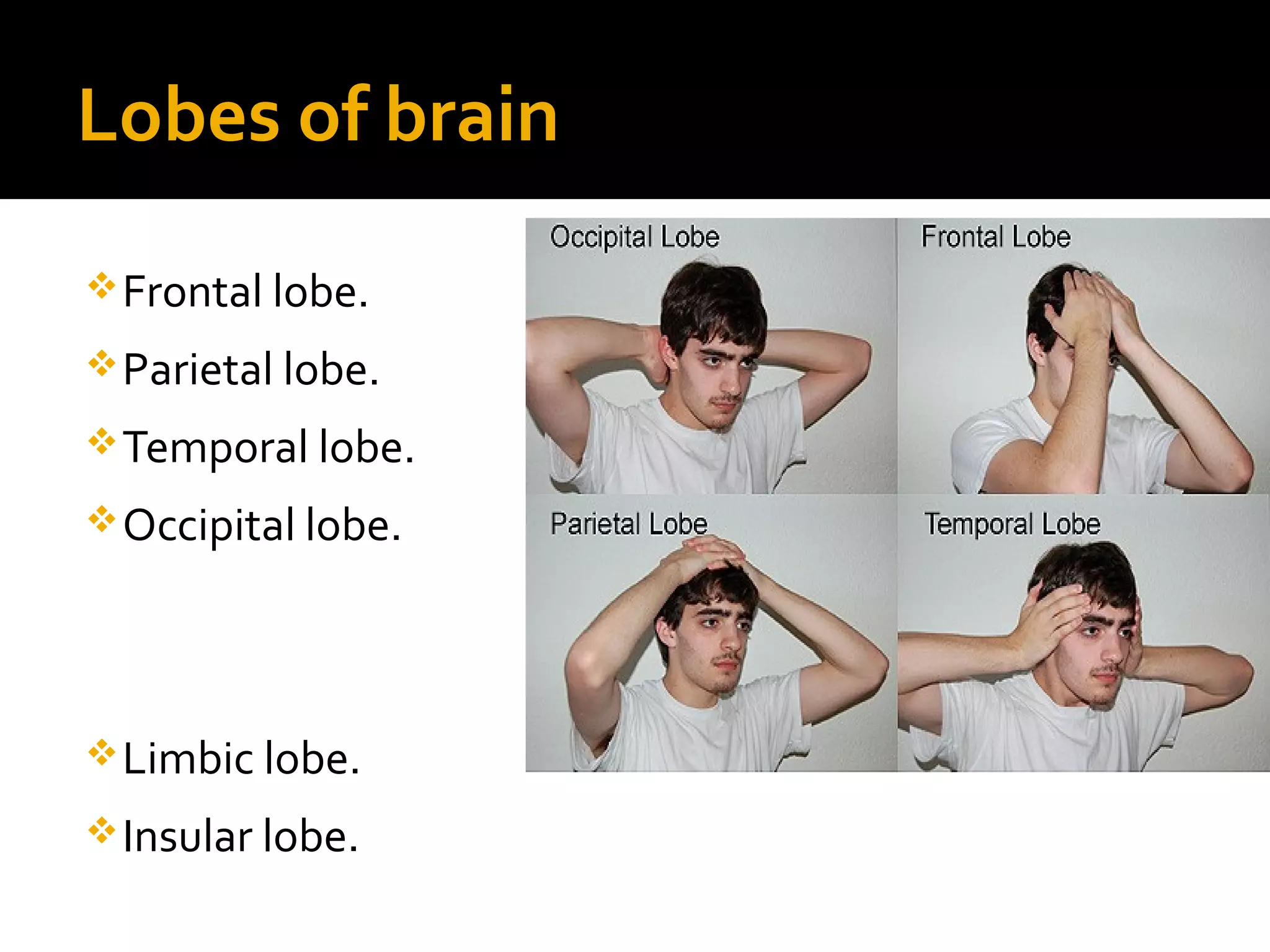
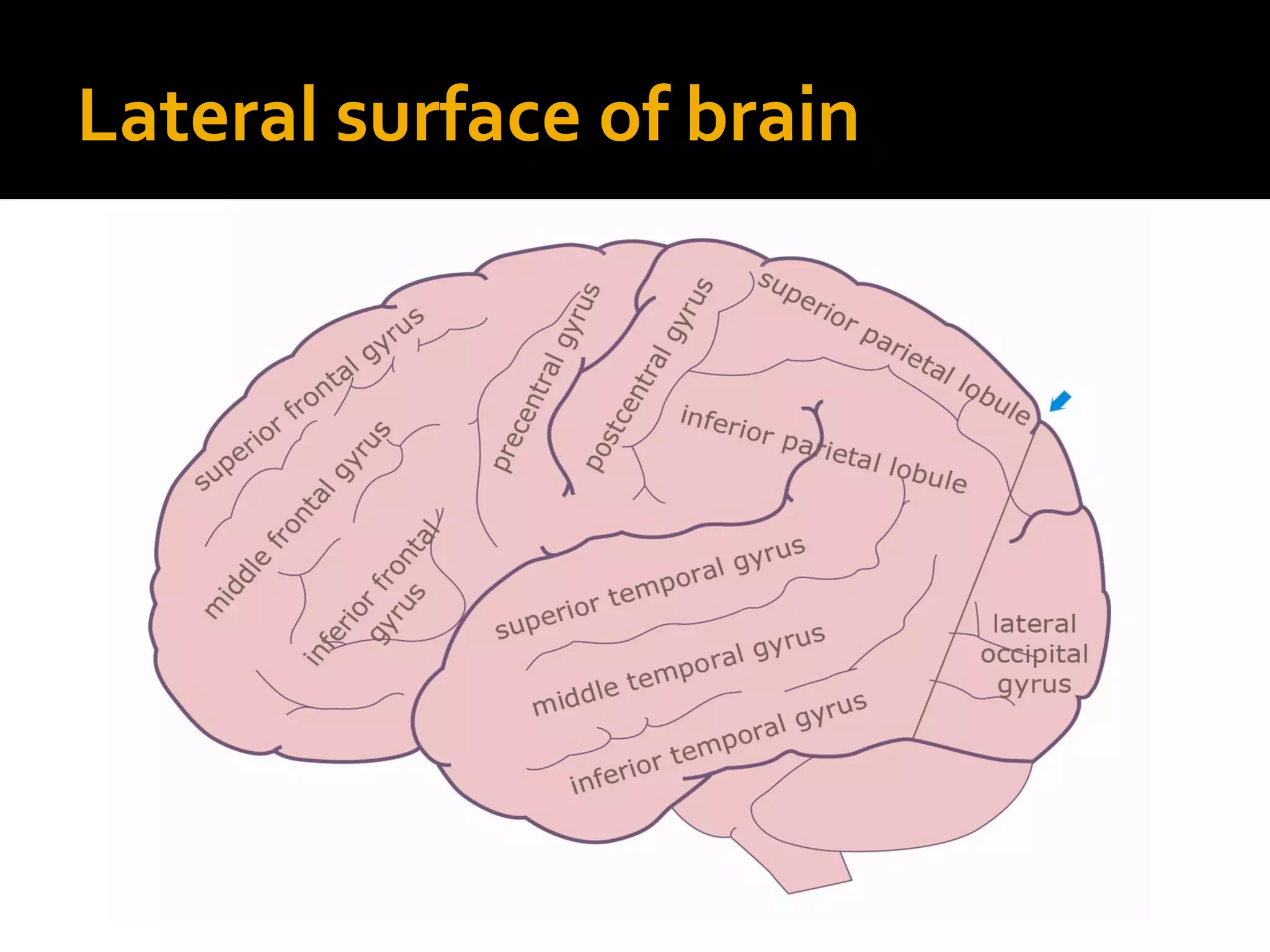
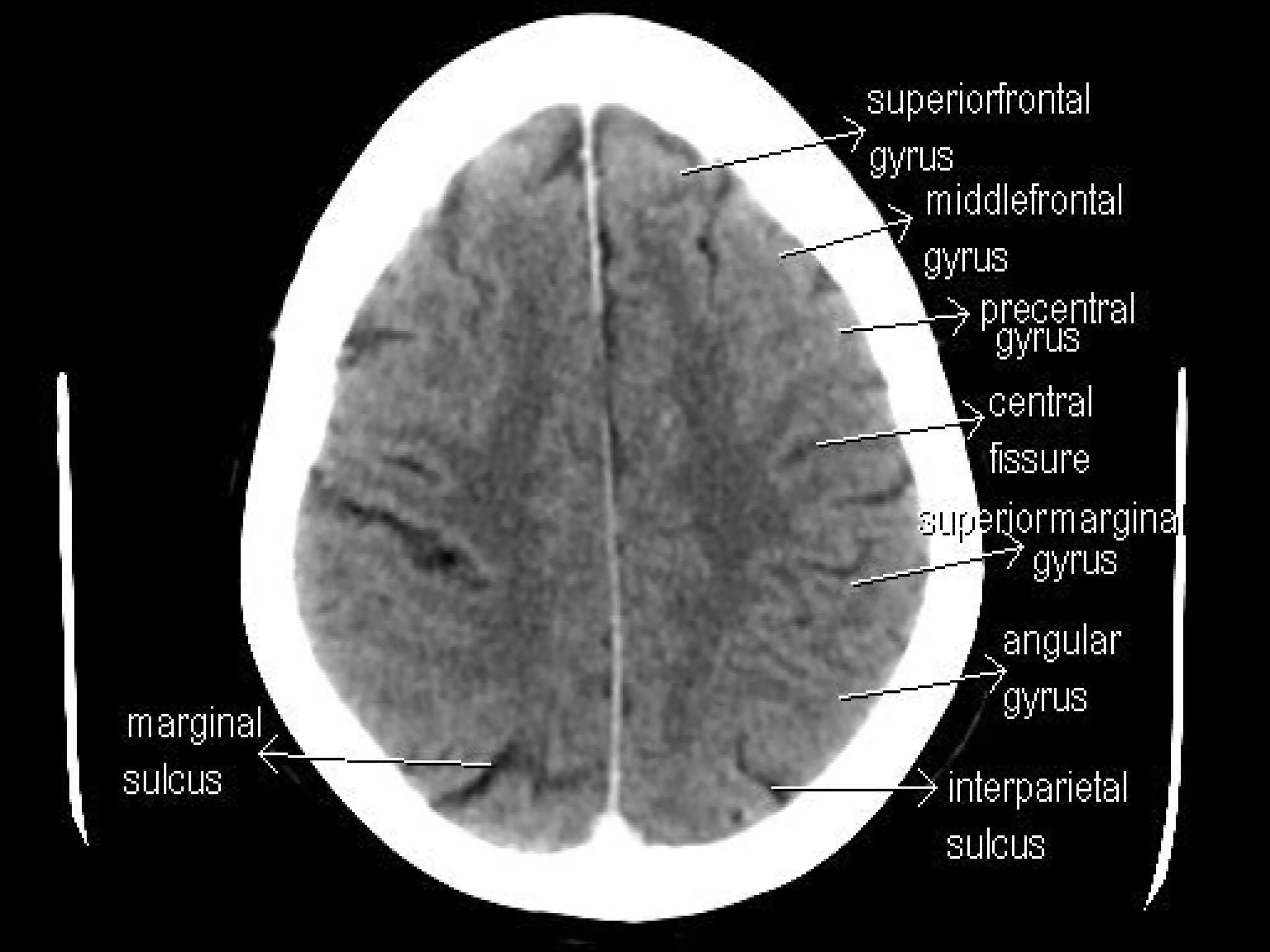
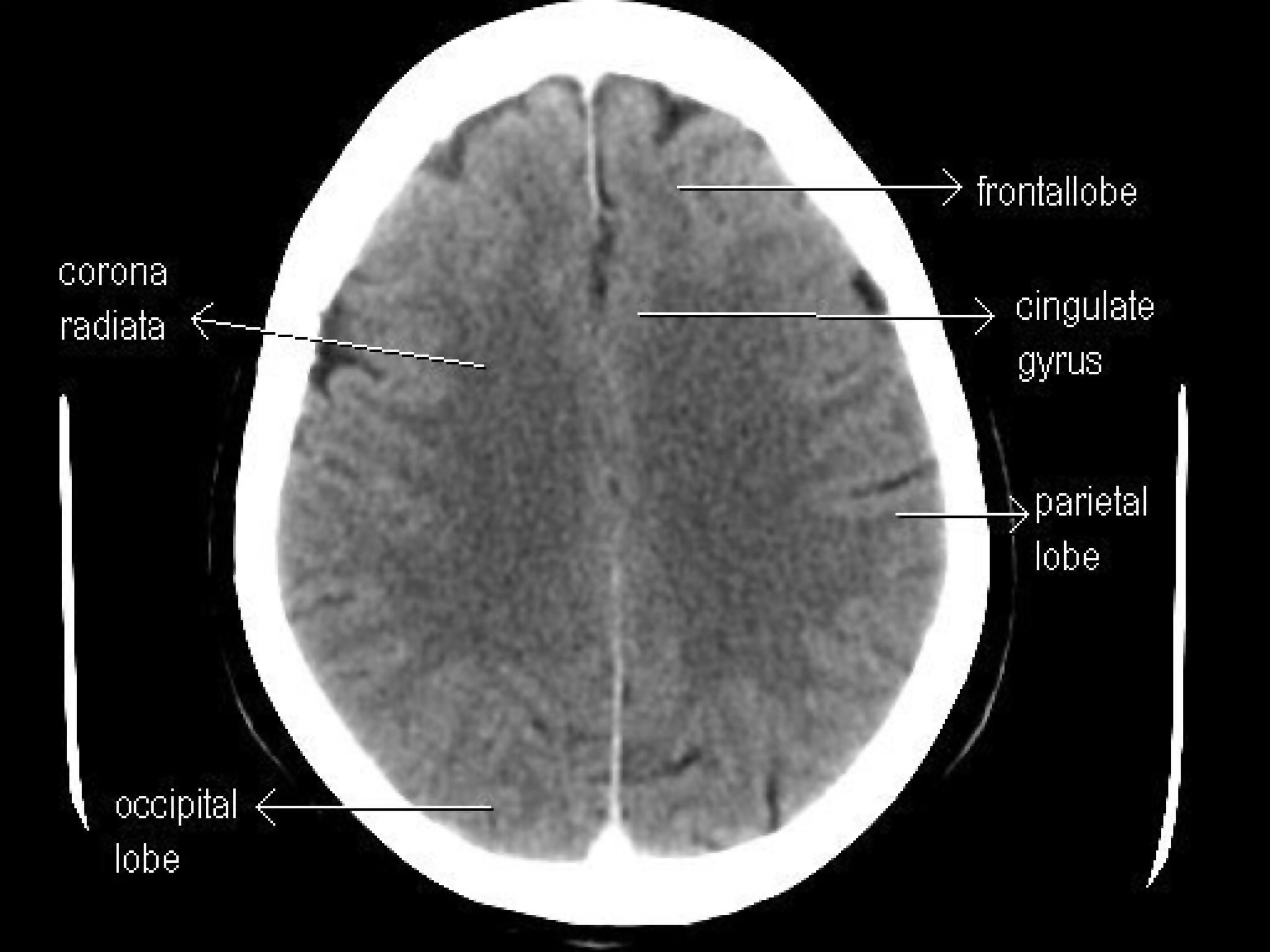
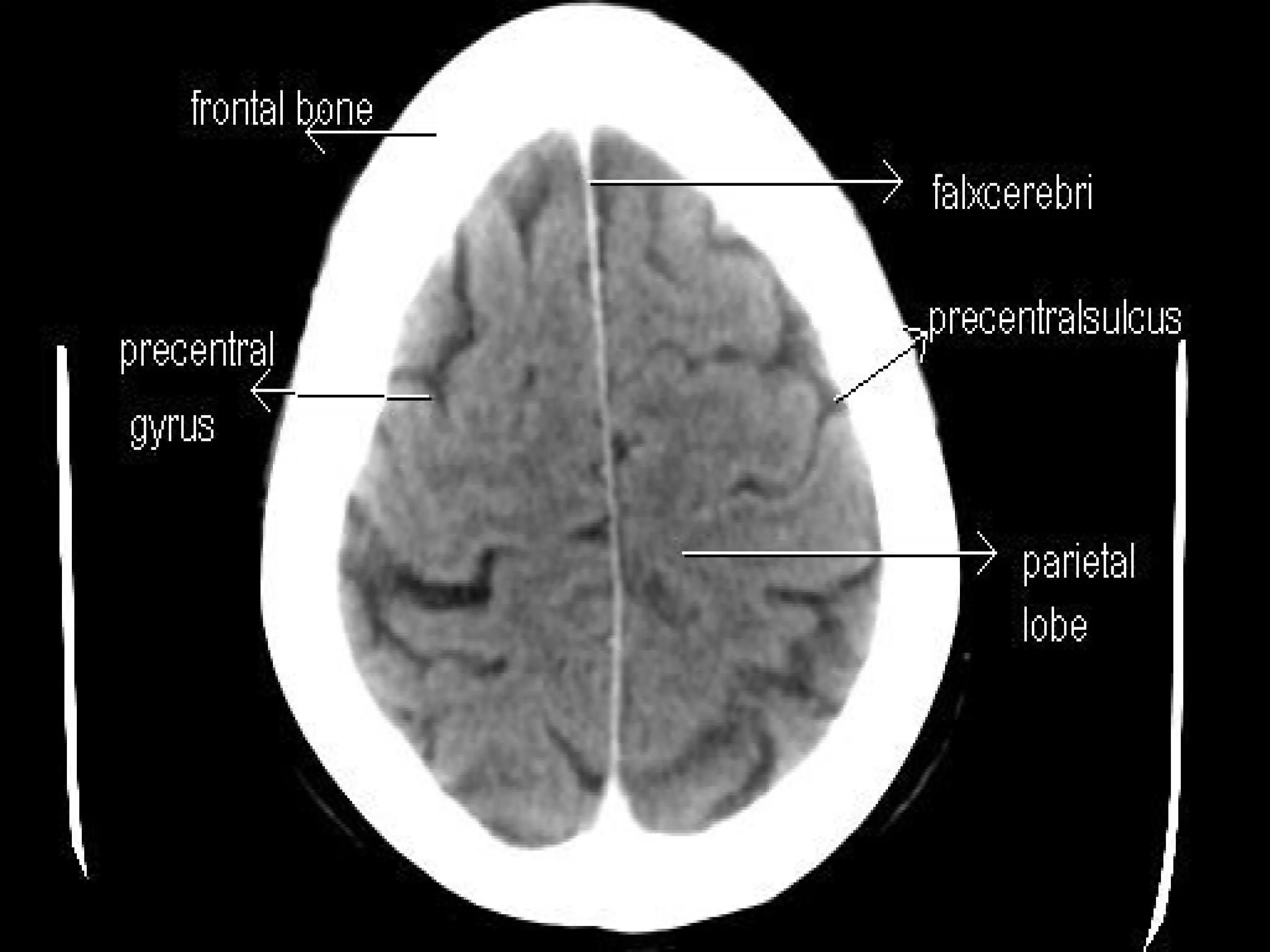
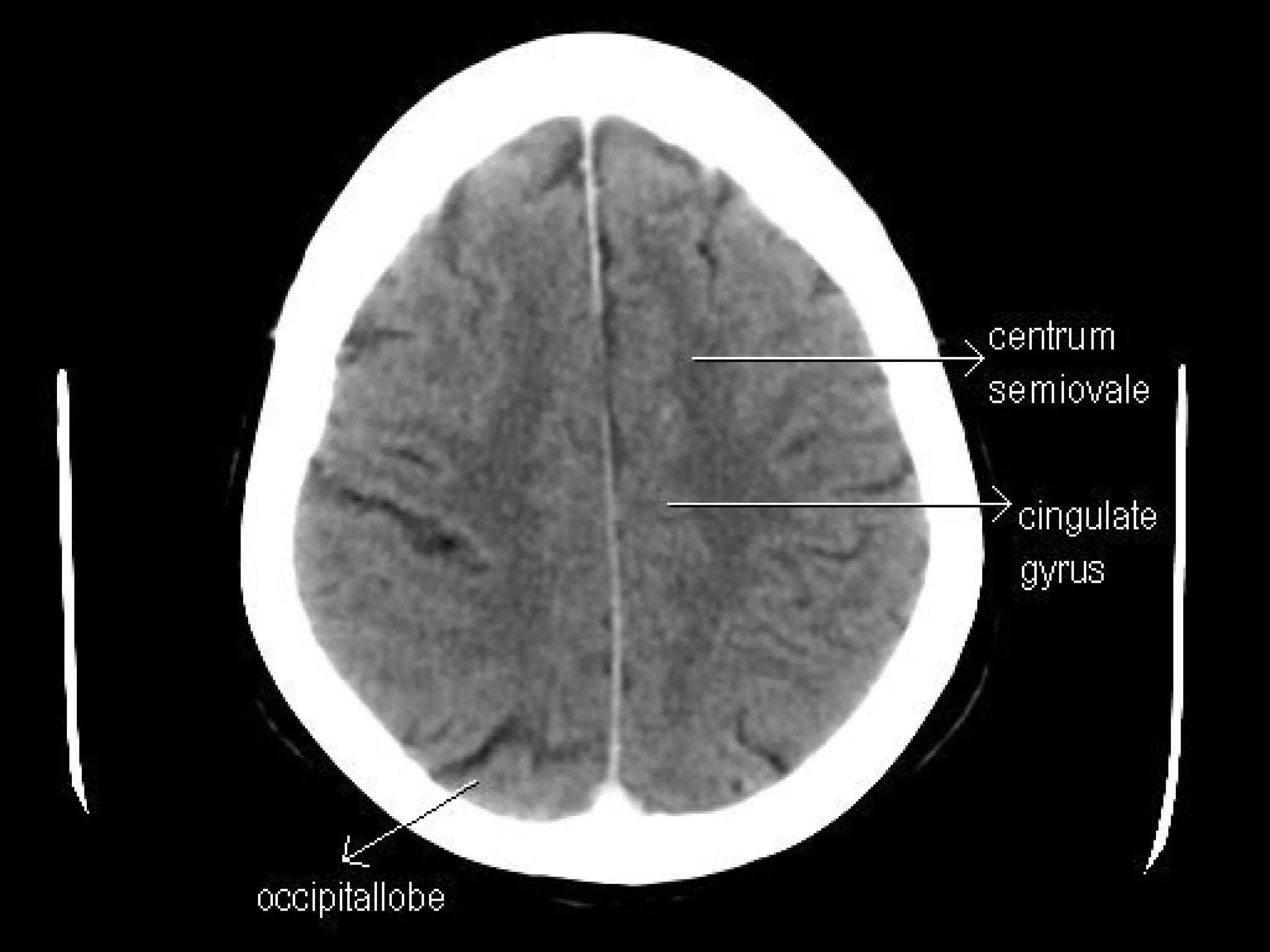
Lobes of brain
Frontal lobe.
Parietal lobe.
Temporal lobe.
Occipital lobe.
Limbic lobe.
Insular lobe.
• Frontal lobe:
Anterior region of hemisphere; anterior to central sulcus,
superior to sylvian fissure
• Parietal lobe:
Posterior region of hemisphere; posterior to central sulcus,
anterior to parietooccipital sulcus
• Occipital lobe:
Posterior to parietooccipital sulcus
• Temporal lobe:
Inferior to sylvian fissure, anterior to angular gyrus
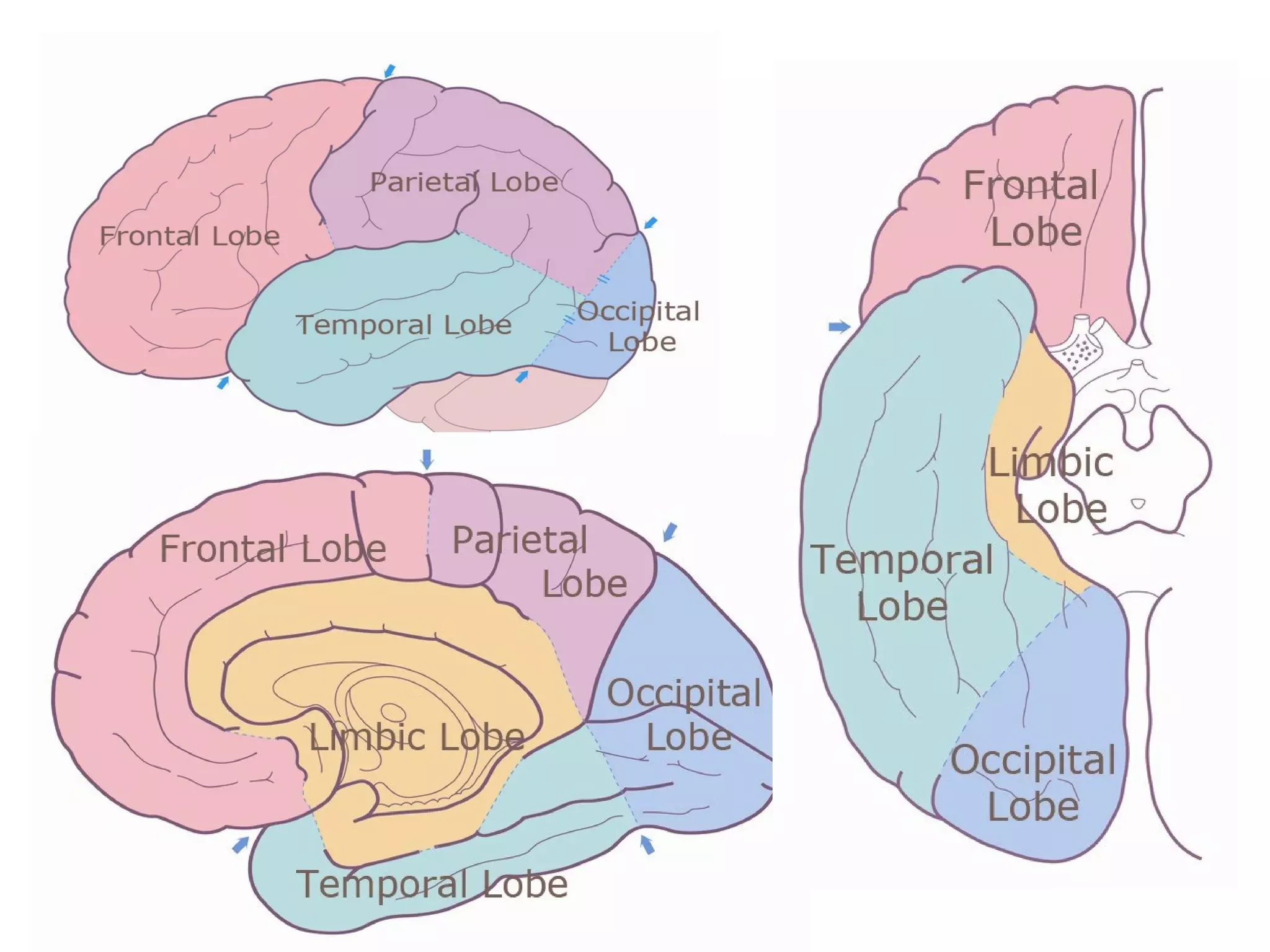
Lateral surface of brain
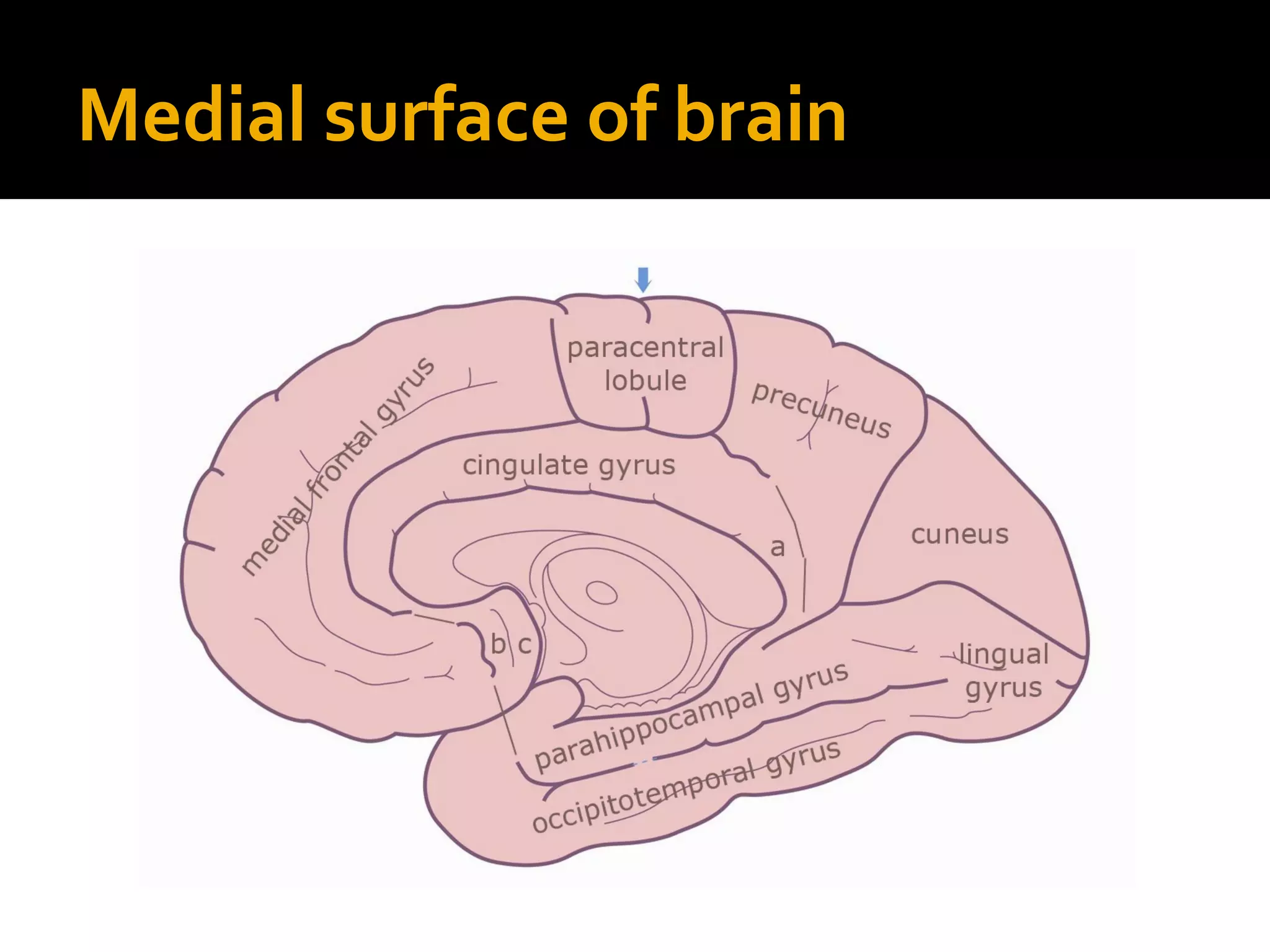
Medial surface of brain
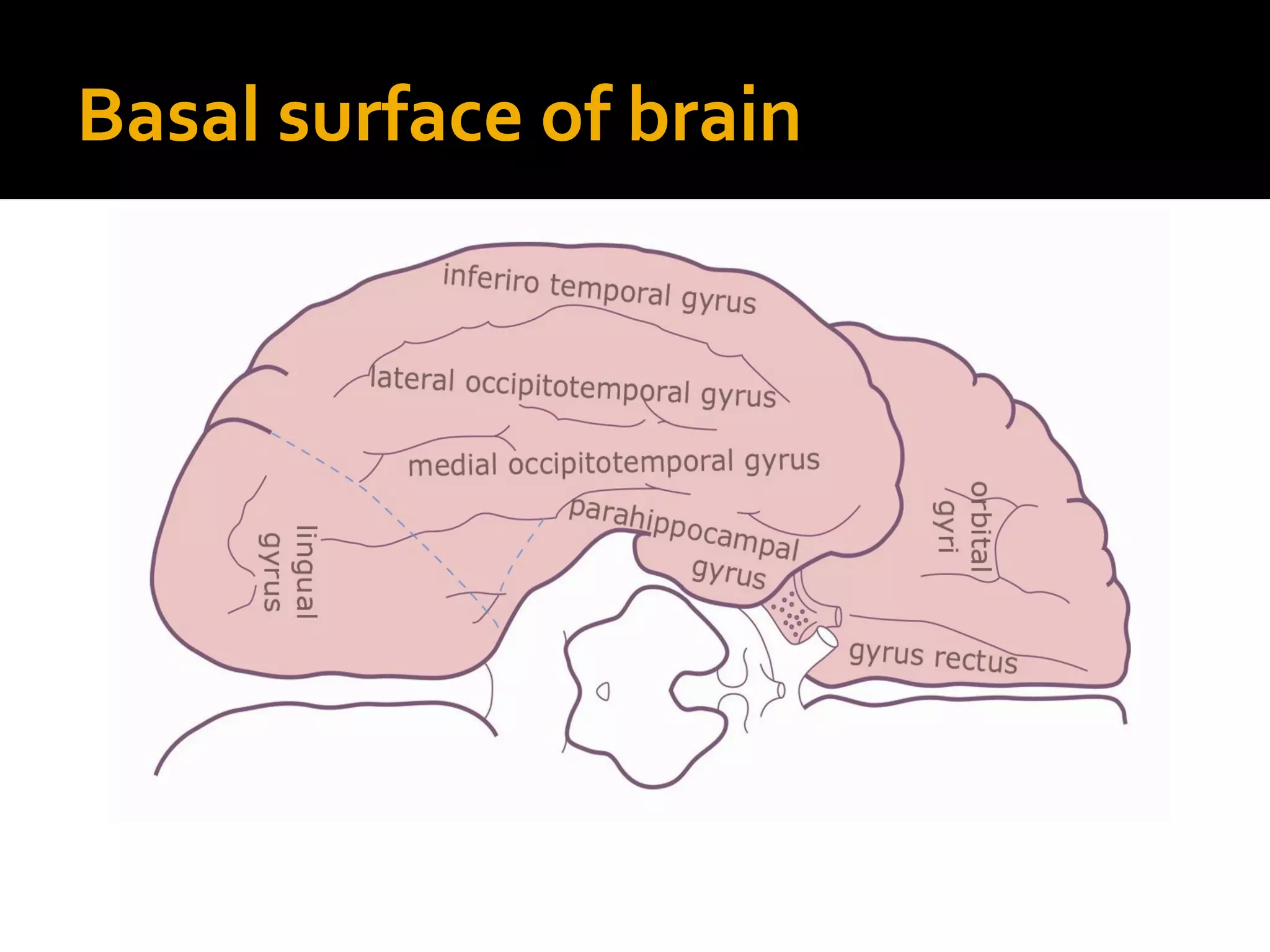
Basal surface of brain
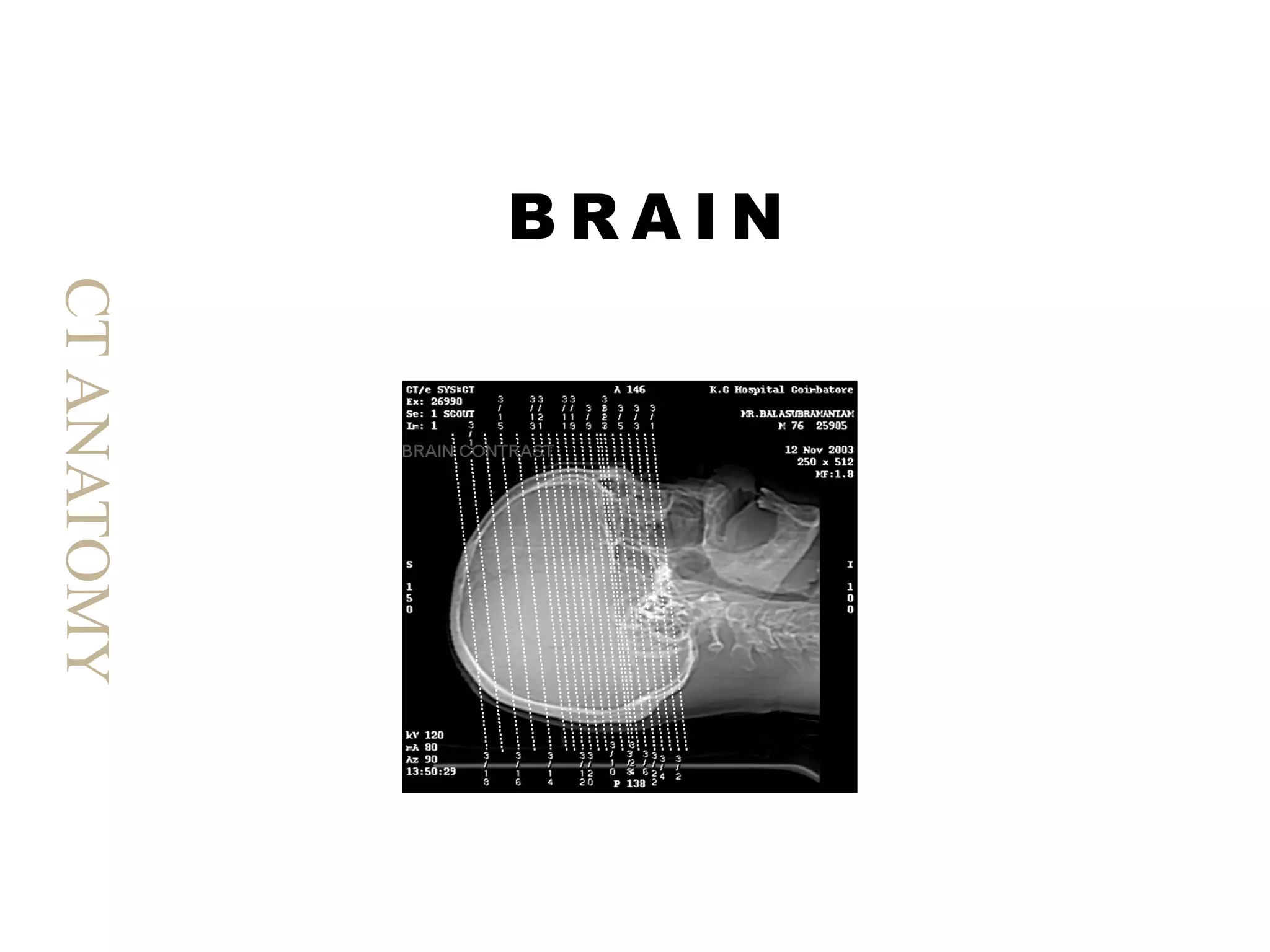
B R A I N
CTANATOMY
THE END

Brain CT Anatomy and Basic Interpretation Part II

  • 1.
    DR SAKHER AL-KHADERI CONSULTANTRADIOLOGIST AMC BRAIN CT ANATOMY AND BASIC INTERPRETATION PART II
  • 2.
  • 3.
    OBJECTIVES  Illustrate anddescribe the ventricles.  Describe the structure of the ventricles.  Illustrate and describe the cerebrospinal fluid (CSF) formation, absorption and circulation.
  • 4.
    VENTRICLES(Ventricular System)  Aventricle is an internal cavity of the brain.Within the brain, which is filled with cerebrospinal fluid(CSF).  The ventricular system is composed of two lateral ventricles and two midline ventricles( third and fourth ventricles).
  • 5.
    VENTRICLES(Ventricular System)  Thechambers are connected to allow the flow of cerebrospinal fluid via two interventricular foramen (referred to as the foramen of Monro) and the cerebral aqueduct (referred to as the aqueduct of Sylvius).
  • 6.
    Lateral view toshow the ventricular system of the CNS Central canal of medulla oblongata & spinal cord Fourth ventricle Lateral ventricle Third ventricle Interventricular foramen (Monro) Cerebral aqueduct
  • 7.
    VENTRICLES(Ventricular System) CONSISTS OF: 1) Lateral ventricle 2) Third ventricle 3) Fourth ventricle 4) Central canal of the medulla oblongata & spinal cord
  • 10.
    LateralVentricles  The lateralventricles are two curved shaped cavities located within the cerebrum.  The lateral ventricles are separated by the septum pellucidum and do not communicate directly
  • 11.
    Lateral ventricle Frontal lobe Parietallobe Temporal lobe Occipital lobe
  • 12.
     C-shaped cavity& may be divided into : 2. Anterior horn 1. Body 3. Posterior horn 4. Inferior horn Third ventricle Fourth ventricle Lateral view of the ventricular cavities of the brain Lateral ventricle
  • 13.
    Anterior horn Inferior horn Posteriorhorn Lateral view to show the ventricular system of the CNS
  • 14.
     The thirdventricle is a narrow cavity or a slitlike cleft between the 2 thalamus  Communicates ; ● Anteriorly with lateral ventricles through interventricular foramina (of monro) ● Posteriorly with fourth ventricle through cerebral aqueduct (of sylvius) Posterior view to show the ventricular system of the CNS Third ventricle
  • 15.
    Frontal lobe Parietal lobe Temporallobe Occipital lobe Third ventricle
  • 16.
    Third ventricle Hypothalamus Coronal section ofthe brain (posterior view) Third ventricle Thalamus ROOF FLOOR Lateral wall Body of fornix
  • 17.
    Fourth ventricle  Thefourth ventricle Is a rhomboid or diamond shaped cavity.  It is a wide and flattened space located just anterior to the cerebellum and posterior to the upper, or superior, half of the medulla oblongata and the pons.
  • 18.
    Cerebellum Pons Medulla oblongata (superior half) Sagittal section ofthe 4th ventricle Cerebral aqueduct Central canal (spinal cord) Fourth ventricle Fourth ventricle ANTERIOR POSTERIOR
  • 19.
    Frontal lobe Parietal lobe Temporallobe Occipital lobe Fourth ventricle
  • 20.
    Pons Medulla oblongata (superior half) Fig. : Sagittalsection of the 4th ventricle Cerebral aqueduct ANTERIOR POSTERIOR Superior part of the roof ; Superior medullary velum Inferior part of the roof ; Inferior medullary velum Roof or posterior wall of fourth ventricle :
  • 21.
    CENTRAL CANAL  Openssuperiorly into the fourth ventricle Fourth ventricle Inferior ½ of medulla oblongata Entire length of spinal cord Central canal (Lined with ependyma but no choroid plexus in the central canal) Extends ;
  • 22.
    Frontal lobe Parietal lobe Temporallobe Occipital lobe CENTRAL CANAL
  • 23.
  • 24.
  • 25.
    CHOROID PLEXUS  Itis formed by invaginating of vascular pia mater into the ventricular cavity  It becomes highly convoluted & produce a spongy-like appearance  It enters the 3rd and 4th ventricles through their roofs, and the lateral ventricles through the choroid fissure  produces cerebrospinal fluid (CSF) Lateral ventricle Third ventricle Fourth ventricle
  • 26.
    What is cerebrospinalfluid (CSF) ? • Clear, colorless fluid • Produced by the choroid plexus • Found in the : – Ventricles of the brain – Subarachnoid space (between Arachnoid + Pia mater) around the brain & spinal cord  The pressure of the CSF is kept remarkably constant.  Based on the Monro-Kellie doctrine :  “Volume of BLOOD, CSF & BRAIN at any time must be relatively constant”
  • 27.
    Physical characteristics andcomposition of the CSF Appearance Clear and colourless Volume 130 ml Rate of production 0.5 ml/min Pressure 60-150 mm of water Composition protein 15-45 mg/100 ml glucose 50-85 mg/ 100 ml chloride 720-750 mg/100 ml No. of cells 0-3 lymphocytes/cu mm
  • 28.
    Function of theCSF : 1. Cushions & protects the CNS from trauma 2. Provides mechanical buoyancy & support for the brain 3. Serves as a reservoir & assists in the regulation of the contents of the skull 4. Nourishes the CNS 5. Removes metabolites from the CNS 6. Serves as a pathway for pineal secretions to reach the pituitary gland
  • 29.
    Sites of formation: 1. Choroid plexus of the ventricle cavities, mostly is formed in the LATERALVENTRICLES 2. Some originate from the ependymal cells lining the ventricles 3. Some from the brain substances through perivascular spaces Movement of CSF inside the ventricle is controlled by the: 1. Pulsation of the artery in the choroid plexus 2. By the aid of the cilia & microvilli of the ependymal cells
  • 30.
    cerebrospinal fluid (CSF) The CSF is formed in the lateral ventricles escapes by the foramen of monro into the third ventricle  From the third ventricle by the aqueduct into the fourth ventricle.  Then from the fourth ventricle the fluid is poured into the subarachnoid spaces through the medial foramen of majendie and the two lateral foramina of luschka.  There is no evidence that functional communications between the cerebral ventricles and the subarachnoid spaces exist in any region except from the fourth ventricle.
  • 31.
    Choroid plexus ofthe lateral ventricle Site of formation 1. Lateral ventricle 2.Third ventricle Interventricular foramina 3. Fourth ventricle Cerebral aqueduct 3.2 Lateral foramina (Luschka) 3.1 Median foramen (Magendie) 3.2 Lateral foramina (Luschka) 4. Subarachnoid space Inferiorly Superiorly Absorbed Superiorly Absorbed
  • 32.
    Median sagittal sectionto show the subarachnoid cisterns & circulation of CSF Superior cistern Interpeduncular cistern Cerebellomedullary cistern Chiasmatic cistern Pontine cistern Circulation of CSF in subarachnoid space : Median foramen of 4th ventricle
  • 33.
    Factors that facilitatethe flow of CSF in subarachnoid space ; – Pulsation of the cerebral & spinal arteries – Movements of the vertebral column – Respiration & coughing – Changing of the positions
  • 34.
    Absorption of CSFinto dural venous sinuses  Main sites - arachnoid villi (project into dural venous sinuses, especially, superior sagittal sinus)  Arachnoid villi are covered by endothelium of the venous sinus  Arachnoid villi tend to be grouped together & form elevations known as arachnoid granulations  CSF pressure >> the pressure in the sinus  The rate of absorption of CSF through the arachnoid villi controls the CSF pressure
  • 36.
  • 37.
    OBJECTIVES  Illustrate anddescribe the formation of the circle of willis  Describe the blood supply of the brain  Arterial supply  Venous drainage
  • 38.
    Blood Supply ofTheBrain  The brain receives it arterial supply from two pairs of vessels, the vertebral and internal carotid arteries which are interconnected in the cranial cavity to produce an arterial circle (ofWillis).
  • 39.
  • 40.
    Internal Carotid Artery Begins – bifurcation of Com Carotid A  Perforates base of skull – carotid canal  Enters middle cranial fossa beside dorsum sellae  In the cavernous sinus  Horizontal  Emerge out – medial side of Ant clinoid process – perforates dura & arachnoid mater – enters subarachnoid space  Turns posteriorly – below optic nerve  Turns upward – lateral to optic chiasma  Now is under anterior perforated susbtance  Divides – into ANTERIOR & MIDDLE cerebral arteries
  • 41.
    Vertebral Artery  Branchof first part of subclavian A  Passes – foramen transvesarium C6 – C1  Enters through foramen magnum – perforates dura & arachnoid mater – enters subarachnoid space  Turns upward, forward, medially – medulla oblongata  Lower border of pons – joins opposite side  BASILAR artery
  • 42.
    Blood Supply ofTheBrain  VERTEBRAL  Basilar  Posterior cerebral artery  INTERNAL CAROTID  Middle cerebral  Anterior cerebral  Anterior communicating artery  Posterior communicating artery CIRCLE OFWILLIS
  • 43.
    Branches of :- VERTEBRAL  Basilar  PCA  Pontine  Labyrinthine  Ant Inf CA  Sup cerebellar  Choroidal  INTERNAL CAROTID  ACA  MCA  Ophthalmic  Ant ComA  Post Com A  Choroidal
  • 44.
    Circle of Willis Interpeduncular fossa – base of brain  Anastomosis  2 internal carotid arteries  2 vertebral arteries  In the subarachnoid space
  • 45.
    Vertebral arteries BasilarA Posterior cerebral artery Posterior communicating artery Internal carotid artery Middlecerebral artery Anterior cerebral artery Anterior communicating artery Post Inf cerebellarA Sup cerebellarA Ant Inf cerebellar A
  • 46.
    Middle cerebral artery Anteriorcerebral artery Posterior cerebral artery
  • 47.
    MIDDLE CEREBRAL ARTERY LOBEAREA FRONTAL Motor – except for paracentral lobule Motor speech – esp left side PARIETAL Sensory – except for paracentral lobule Sensory speech TEMPORAL Auditory
  • 48.
    POSTERIOR CEREBRAL ARTERY LOBEAREA OCCIPITAL Visual TEMPORAL Olfactory
  • 49.
    ARTERIES to specificbrain areas Corpus striatum Middle & lateral striate Anterior & Middle cerebral artery Internal capsule Thalamus PComA, basilar, PCA Midbrain PCA, supCerebellarA, basilar Pons Basilar, Ant, inf, supCerebellarA, Medulla oblongata Vertebral, ASA,PSA,PICA, basilar Cerebellum supCerebellar, AICA,PICA
  • 50.
    VEIN of specificareas Midbrain Basal, great cerebral Pons Basal, cerebellar Medulla oblongata Anterior & posterior spinal Cerebellum Great cerebral
  • 51.
    Superior sagittal sinus Inferiorsagittal sinus Straight sinus Superior cerebral vein Medial aspect of hemisphere Great cerebral vein Transverse sinus (R & L) Sigmoid sinus (R & L) Confluence of sinus IntJugular vein IntJugular vein Cavernous sinus Middle cerebral vein Inferior petrosal sinus Superior petrosal sinus
  • 52.
    The subarachnoid cisternsare areas within the subarachnoid space where the pia mater and arachnoid membrane are not in close approximation.The subarachnoid tissue is not as abundant here as in the normal subarachnoid space and cerebrospinal fluid (CSF) gathers to form pools or cisterns (Latin: "box"). Some major subarachnoid cisterns: cisterna magna (cerebellomedullary cistern): the largest of the subarachnoid cisterns pontine cistern suprasellar cistern interpeduncular cistern quadrigeminal cistern (superior cistern or cistern of the great cerebral vein) ambient cistern
  • 53.
     Sulcus :A sulcus is depression or fissure in the surface of the brain. ( valleys )  Gyrus : A gyrus is a ridge on the cerebral cortex. It is generally surrounded by one or more sulci ( hills )
  • 54.
    Typical continous fissure Interhemisphericfissure Sylvian fissure ( lateral sulcus ) Parieto-occipital fissure Collateral sulcus Central sulcus Calcarine Sulcus
  • 55.
    Interhemispheric fissure Deep sulcusupto corpus collosum Divides brain into two hemisphere
  • 56.
    Sylvian fissure deep, mostly horizontal insulais buried within it separates temporal lobe from parietal and frontal lobes
  • 57.
    Parieto - occipitalfissure very deep oftenY-shaped from sagittal view X-shaped in horizontal and coronal views
  • 58.
    Collateral sulcus Divides lingualand parahippocampal gyri from fusiform gyrus.
  • 59.
    Central sulcus usually freestanding (nointersections) Seperates frontal and parietal lobe.
  • 60.
  • 61.
    Lobes of brain Frontallobe. Parietal lobe. Temporal lobe. Occipital lobe. Limbic lobe. Insular lobe.
  • 62.
    • Frontal lobe: Anteriorregion of hemisphere; anterior to central sulcus, superior to sylvian fissure • Parietal lobe: Posterior region of hemisphere; posterior to central sulcus, anterior to parietooccipital sulcus • Occipital lobe: Posterior to parietooccipital sulcus • Temporal lobe: Inferior to sylvian fissure, anterior to angular gyrus
  • 64.
  • 65.
  • 66.
  • 67.
    B R AI N CTANATOMY
  • 85.

Editor's Notes

  • #3 <number>
  • #4 <number>
  • #5 <number>
  • #6 <number>
  • #7 <number>
  • #8 <number>
  • #9 <number>
  • #10 <number>
  • #11 <number>
  • #12 <number>
  • #13 <number>
  • #14 <number>
  • #15 <number>
  • #16 <number>
  • #17 <number>
  • #18 <number>
  • #19 <number>
  • #20 <number>
  • #21 <number>
  • #22 <number>
  • #23 <number>
  • #24 <number>
  • #25 <number>
  • #26 <number>
  • #27 <number>
  • #28 <number>
  • #29 <number>
  • #30 <number>
  • #31 <number>
  • #32 <number>
  • #33 <number>
  • #34 <number>
  • #35 <number>
  • #37 <number>
  • #38 <number>
  • #39 <number>
  • #40 <number>
  • #41 <number>
  • #42 <number>
  • #43 <number>
  • #44 <number>
  • #45 <number>
  • #46 <number>
  • #47 <number>
  • #48 <number>
  • #49 <number>
  • #50 <number>
  • #51 <number>
  • #52 <number>