‫الرحيم‬ ‫الرحمن‬ ‫هللا‬ ‫بسم‬,
‫هلل‬ ‫والحمد‬‫العالمين‬ ‫رب‬,
‫أشرف‬ ‫علي‬ ‫والسالم‬ ‫والصالة‬
‫و‬ ‫محمد‬ ‫سيدنا‬ ‫المرسلين‬
‫أجمعين‬ ‫صحبه‬ ‫و‬ ‫اله‬ ‫علي‬
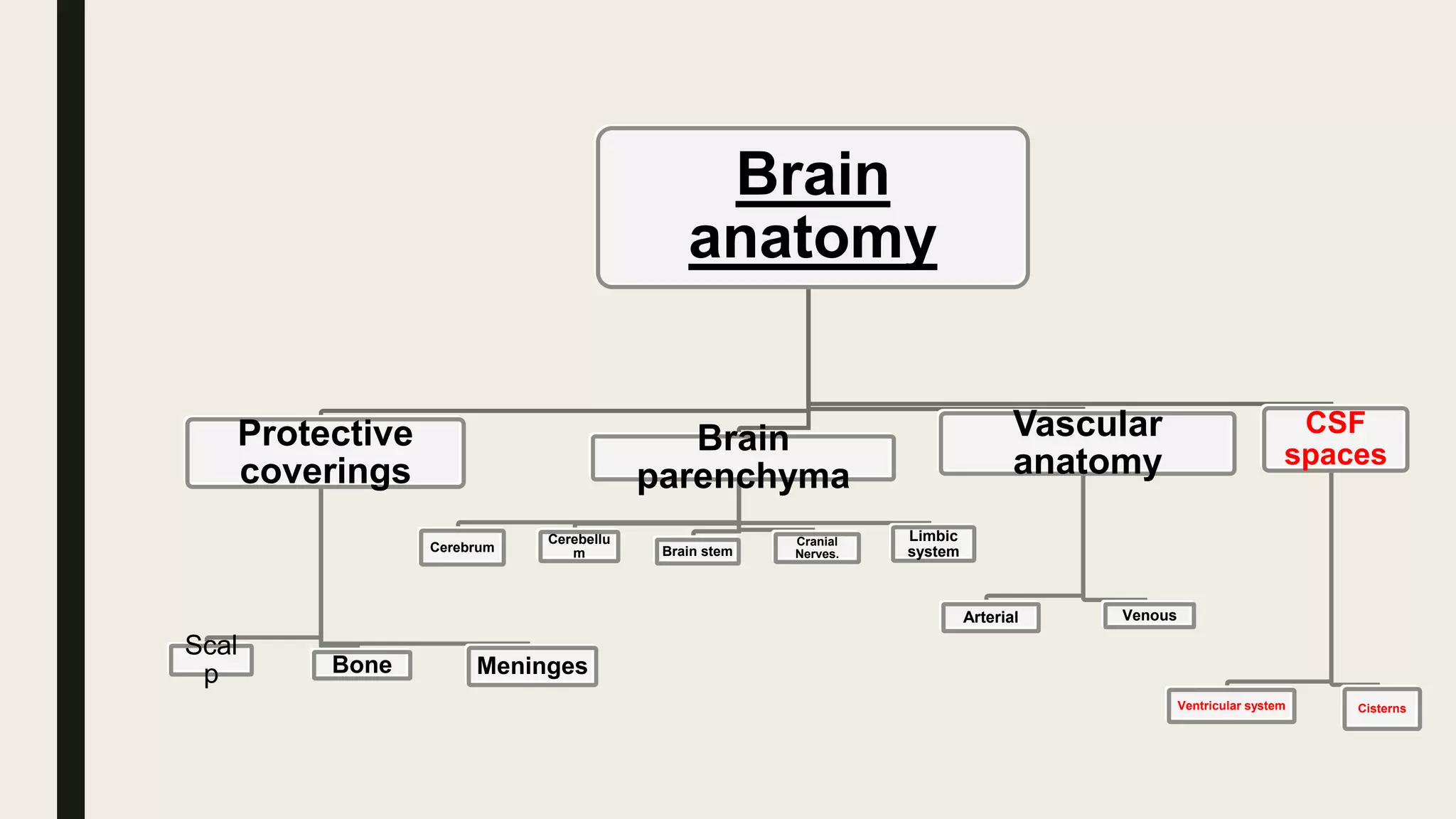
Brain
anatomy
Protective
coverings
Scal
p Bone Meninges
Brain
parenchyma
Cerebrum
Cerebellu
m Brain stem
Cranial
Nerves.
Limbic
system
Vascular
anatomy
Arterial Venous
CSF
spaces
Ventricular system Cisterns
Ventricular system
■ The ventricular system in the brain is composed
of CSF-filled ventricles and their connecting
foramina.
■ two lateral ventricles.
■ 3rd ventricle.
■ 4th ventricle.
Supratentorial
ventricular system
Infratentorial
ventricular system
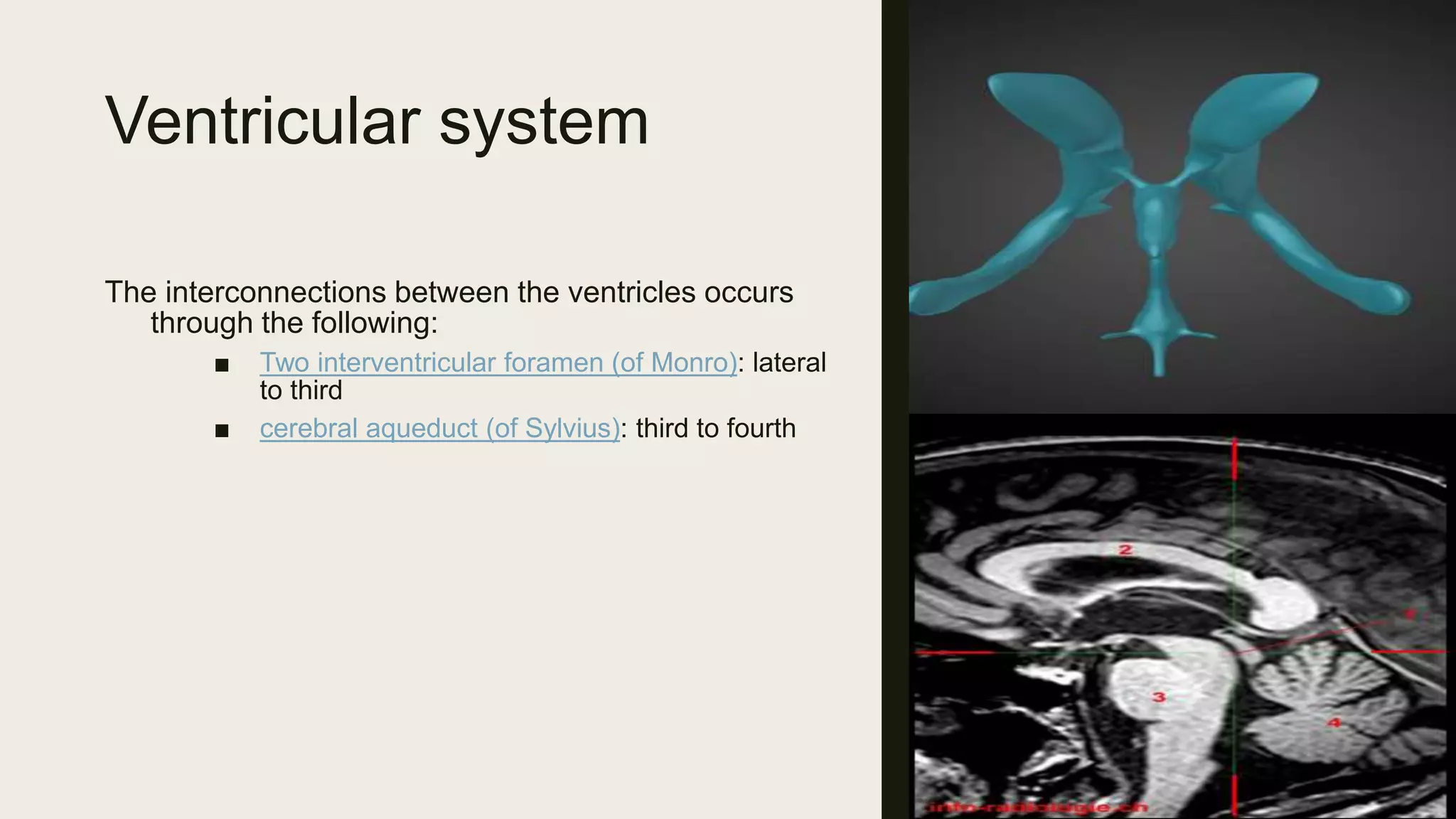
Ventricular system
The interconnections between the ventricles occurs
through the following:
■ Two interventricular foramen (of Monro): lateral
to third
■ cerebral aqueduct (of Sylvius): third to fourth
Lateral ventricle
■ Made of body and three horns, frontal
(ant), occipital (post) and temporal (inf)
horns.
■ The central part of the body of lateral
ventricle is called the cella media.
■ The junction between the body with the
occipital and temporal horn is called
atrium.
■ The two lateral ventricles are separated
by septum pellucidum which is made of
WM containing GM nuclei.
3rd ventricle
■ Slit shaped between the two thalami.
■ Its floor made from anterior to posterior
of:-
■ Optic chiasm.
■ Pituitary Stalk.
■ Tuber cenerium.
■ Mammillary bodies.
■ Roof of midbrain tegmentum
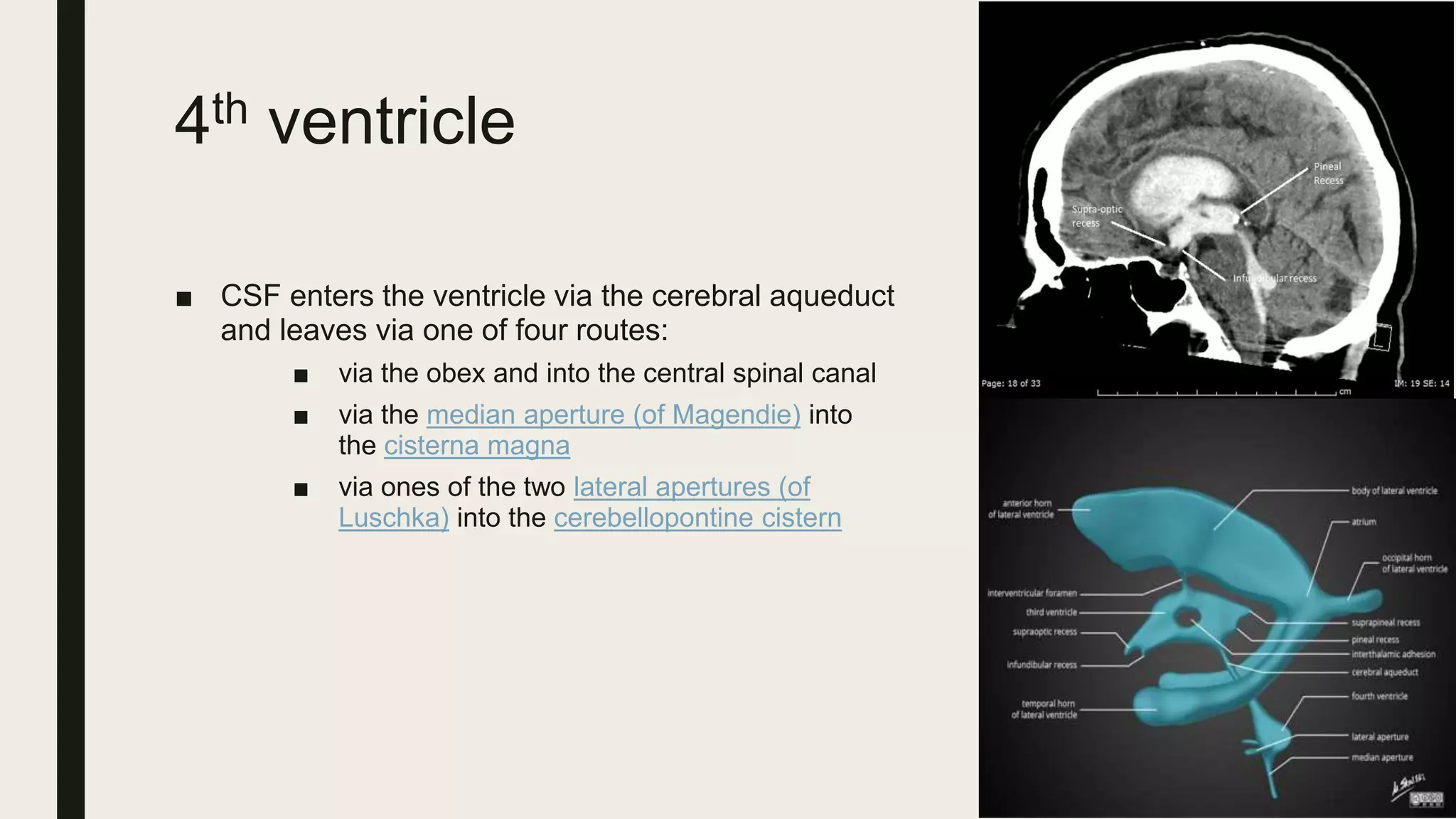
4th ventricle
■ CSF enters the ventricle via the cerebral aqueduct
and leaves via one of four routes:
■ via the obex and into the central spinal canal
■ via the median aperture (of Magendie) into
the cisterna magna
■ via ones of the two lateral apertures (of
Luschka) into the cerebellopontine cistern
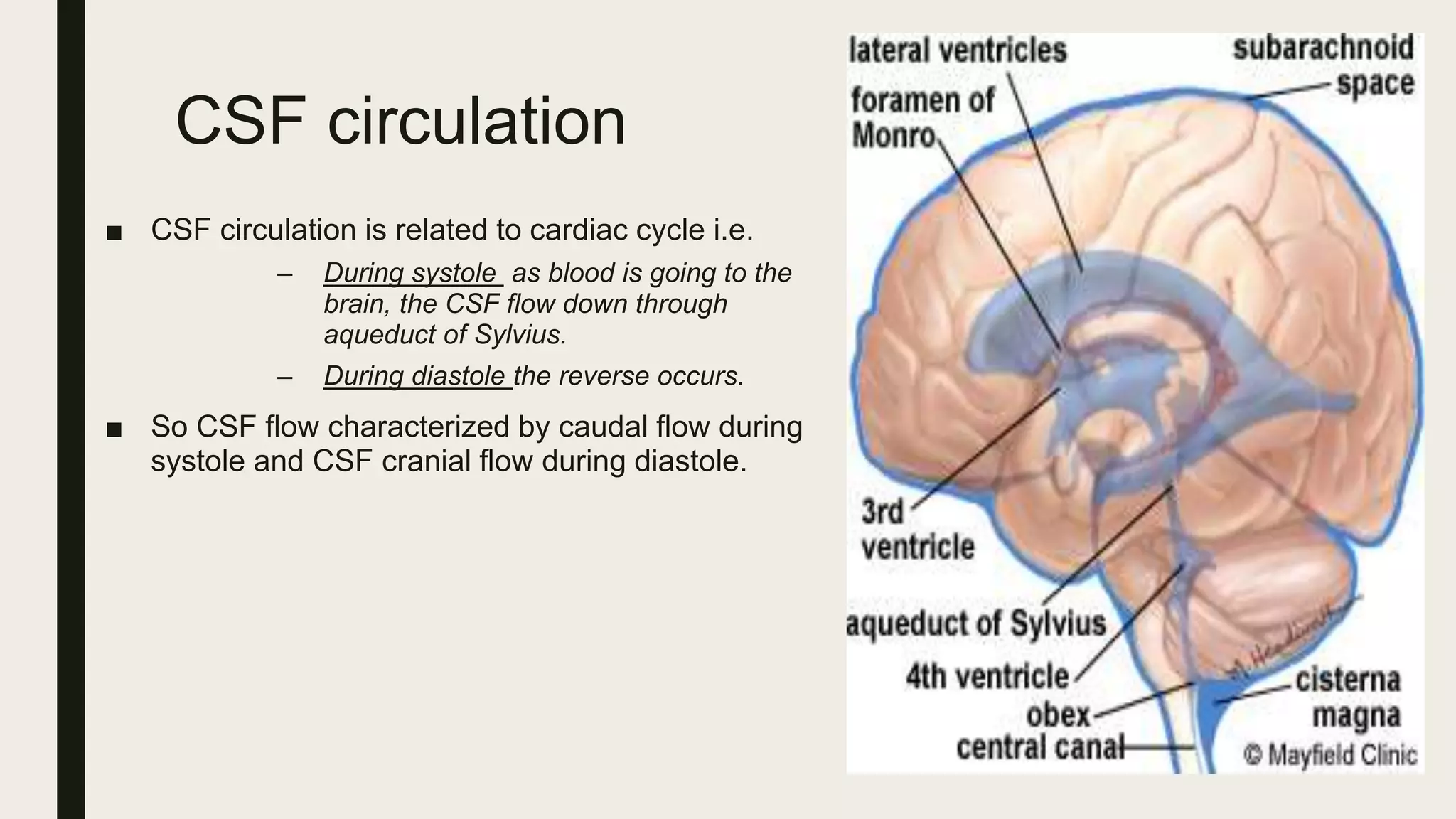
CSF circulation
■ CSF is produced by choroid plexus mainly within
lateral ventricle then passing through foramena of
Monro into 3rd ventricle from which CSF passes
through aqueduct od Sylvius to 4th ventricle.
■ From 4th ventricle through its two lateral foramina
and single median foramen passing to central
canal of spinal cord and subarachnoid space to
be absorbed by arachnoid villi into Dural venous
sinuses.
CSF circulation
■ CSF circulation is related to cardiac cycle i.e.
– During systole as blood is going to the
brain, the CSF flow down through
aqueduct of Sylvius.
– During diastole the reverse occurs.
■ So CSF flow characterized by caudal flow during
systole and CSF cranial flow during diastole.
CSF cisterns
Liliequist classification
of C.S.F cisterns
Ventral
Cisterns
Median
unpaired
Medullary
Pontine
Inter-
peduncular
Chiasmatic
Paramedian
paired
CP angle
Crural
Carotid
Sylvian
Dorsal
Cisterns
Median
unpaired
Peri-callosal
Quadrigemina
l
Supra-
cerebellar
Paramedian
paired
Ambient
Retro-
thalamic
Communicating
cisterns
Cisterna
magna
Lamina
terminalis
General
subarachnoid
space over the
convexities
CSF cisterns
Supra-tentorial
cisterns
Infra-tentoiral
cisterns
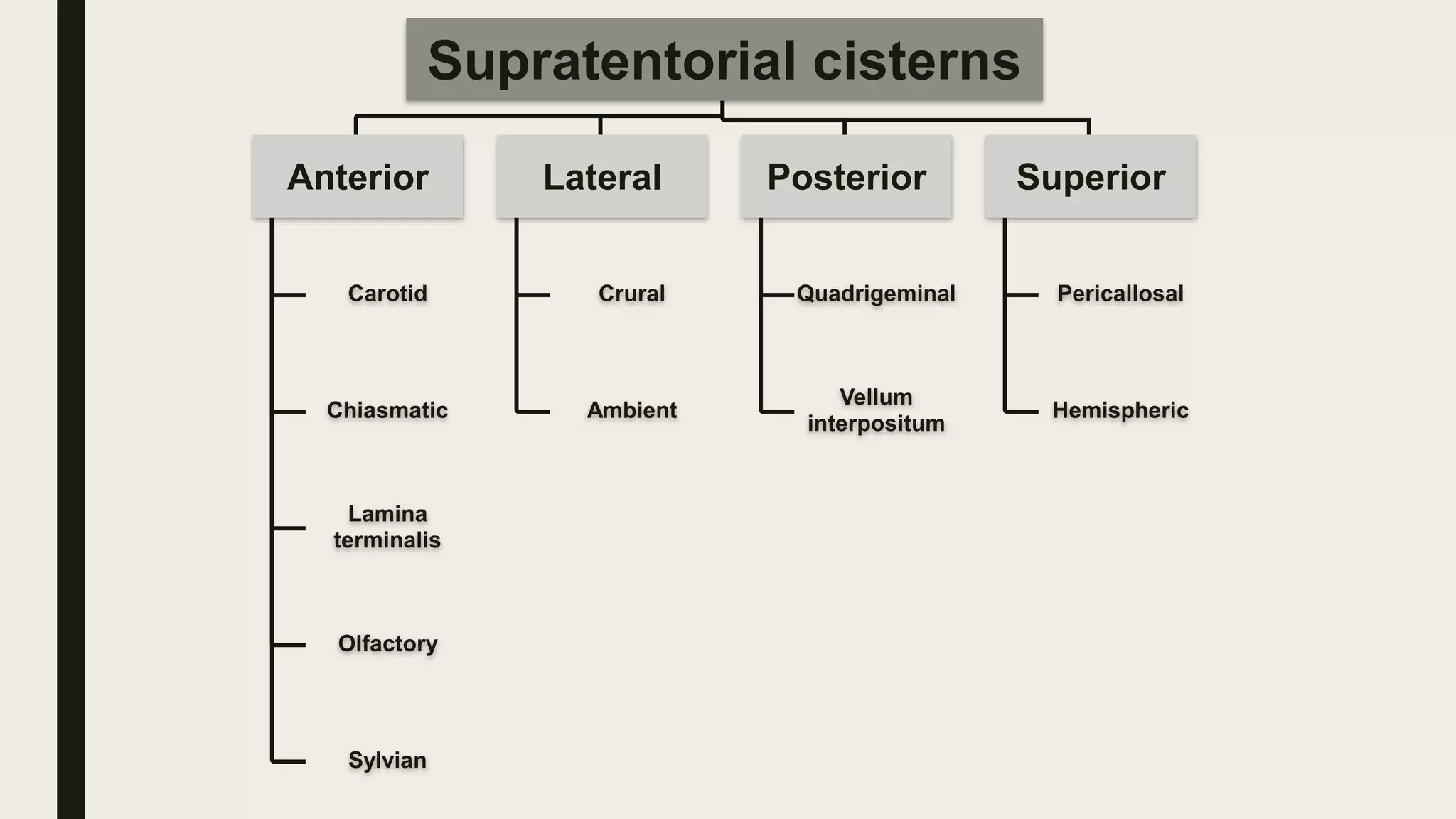
Supratentorial cisterns
Anterior
Carotid
Chiasmatic
Lamina
terminalis
Olfactory
Sylvian
Lateral
Crural
Ambient
Posterior
Quadrigeminal
Vellum
interpositum
Superior
Pericallosal
Hemispheric
Infratentorial cisterns
Anterior
Inter-peduncular
Pre-pontine
Premedullary
Lateral
Ambient
Superior CPA
Inferior CPA
Posterior
Cisterna magna
Superior
cerbellar
Superior
Vermian
Hemispheric
CSF cisterns
Median un-paired cisterns Para-median paired cisterns
1-Premedullary 12-Inferior CP angle
2-Prepontine 13-Superior CP angle
3-Interpeduncular 14-Crural
4-Chiasmatic 15-ambient
5-Lamina terminalis 16-Carotid
6-Pericallosal 17-sylvian
7-Quadrigeminal
8-Vellum interpositum
9-Superior cerebellar
10-Cisterna magna
11-Vallecula
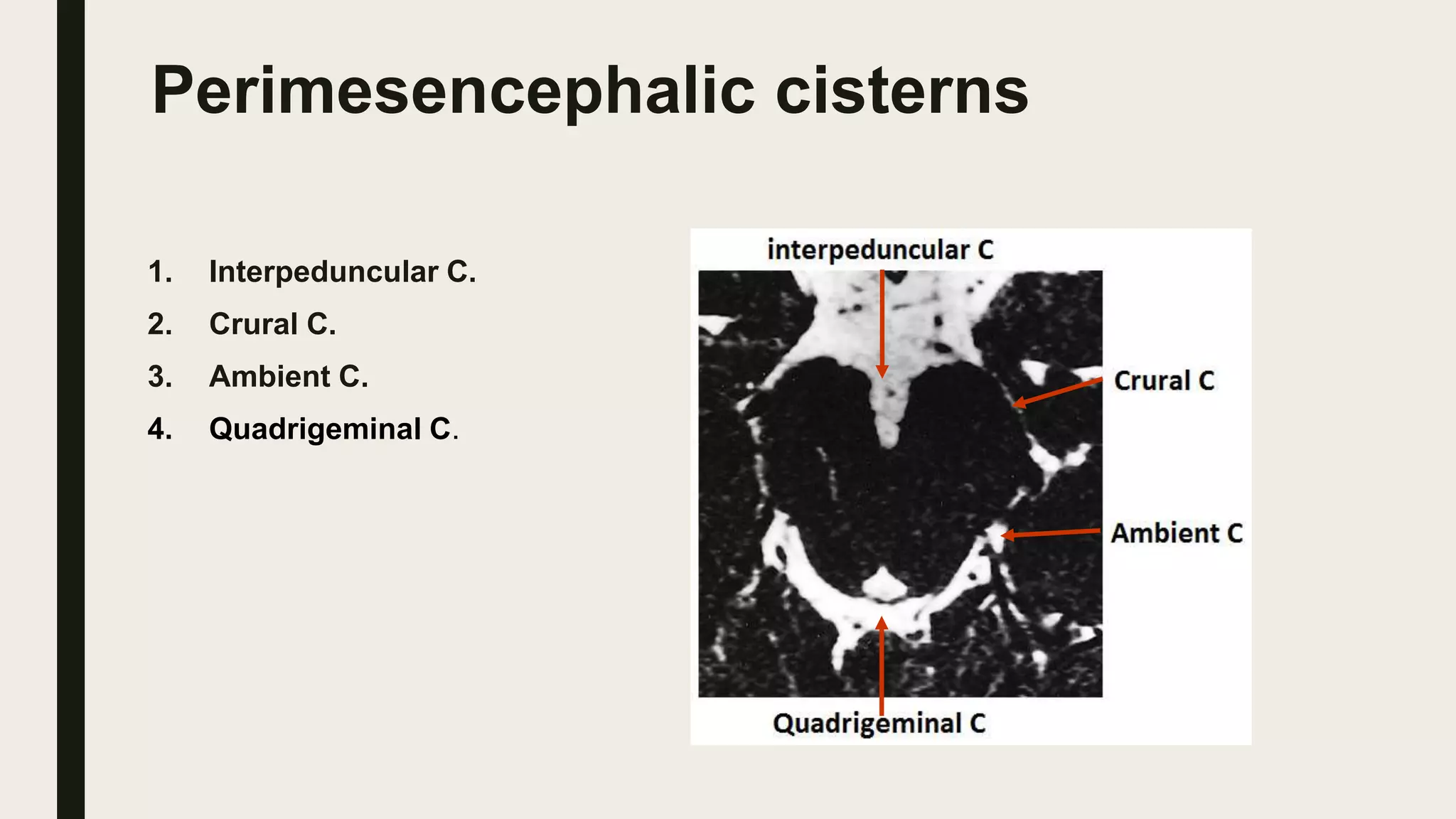
Perimesencephalic cisterns
1. Interpeduncular C.
2. Crural C.
3. Ambient C.
4. Quadrigeminal C.
Pentagonal
cistern
Lamina terminalis
cistern
Sylvian
cistern
Inter-peduncular
cistern
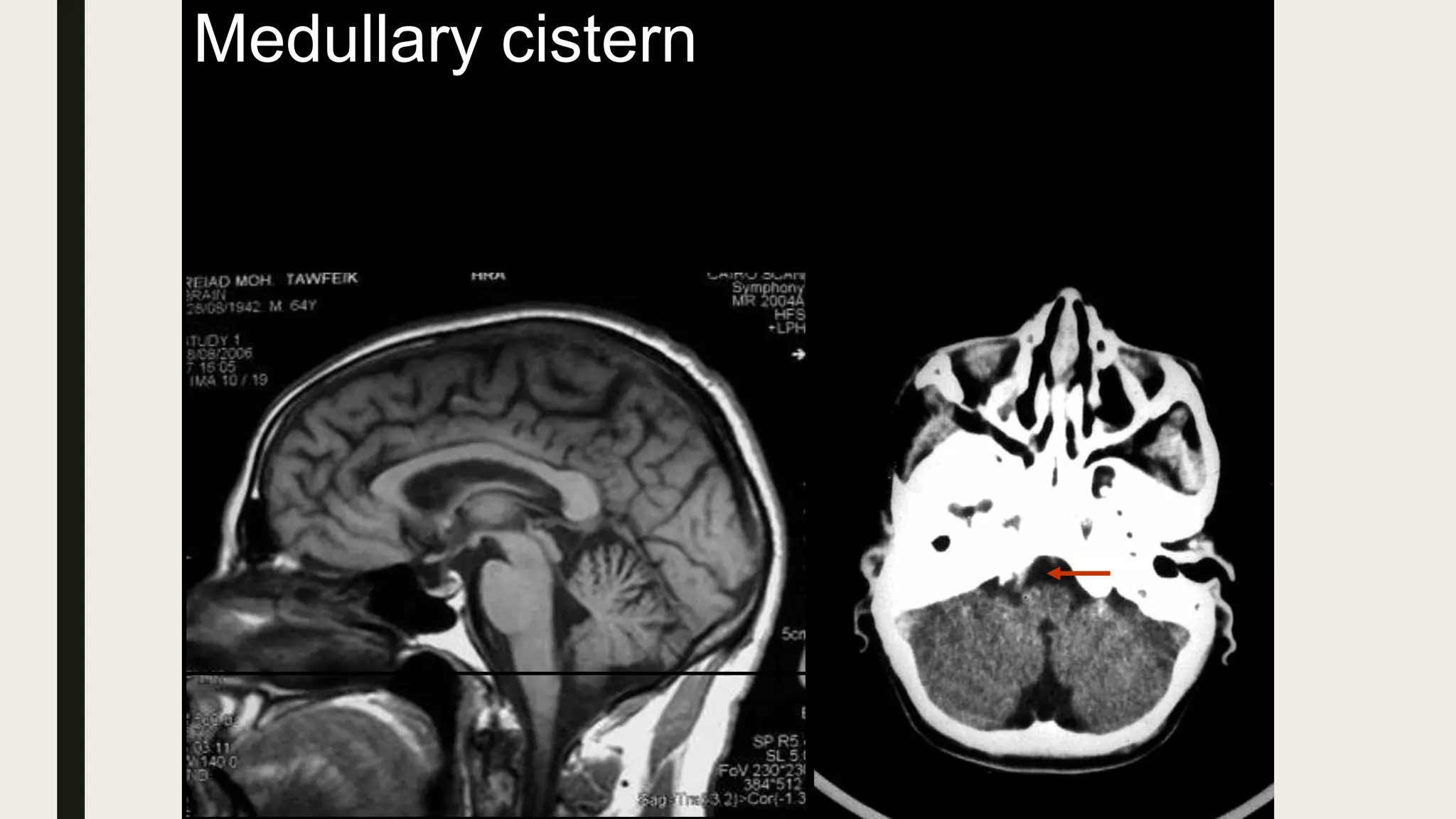
Premedullary (Medullary) cistern
• Anterior to the medulla.Location
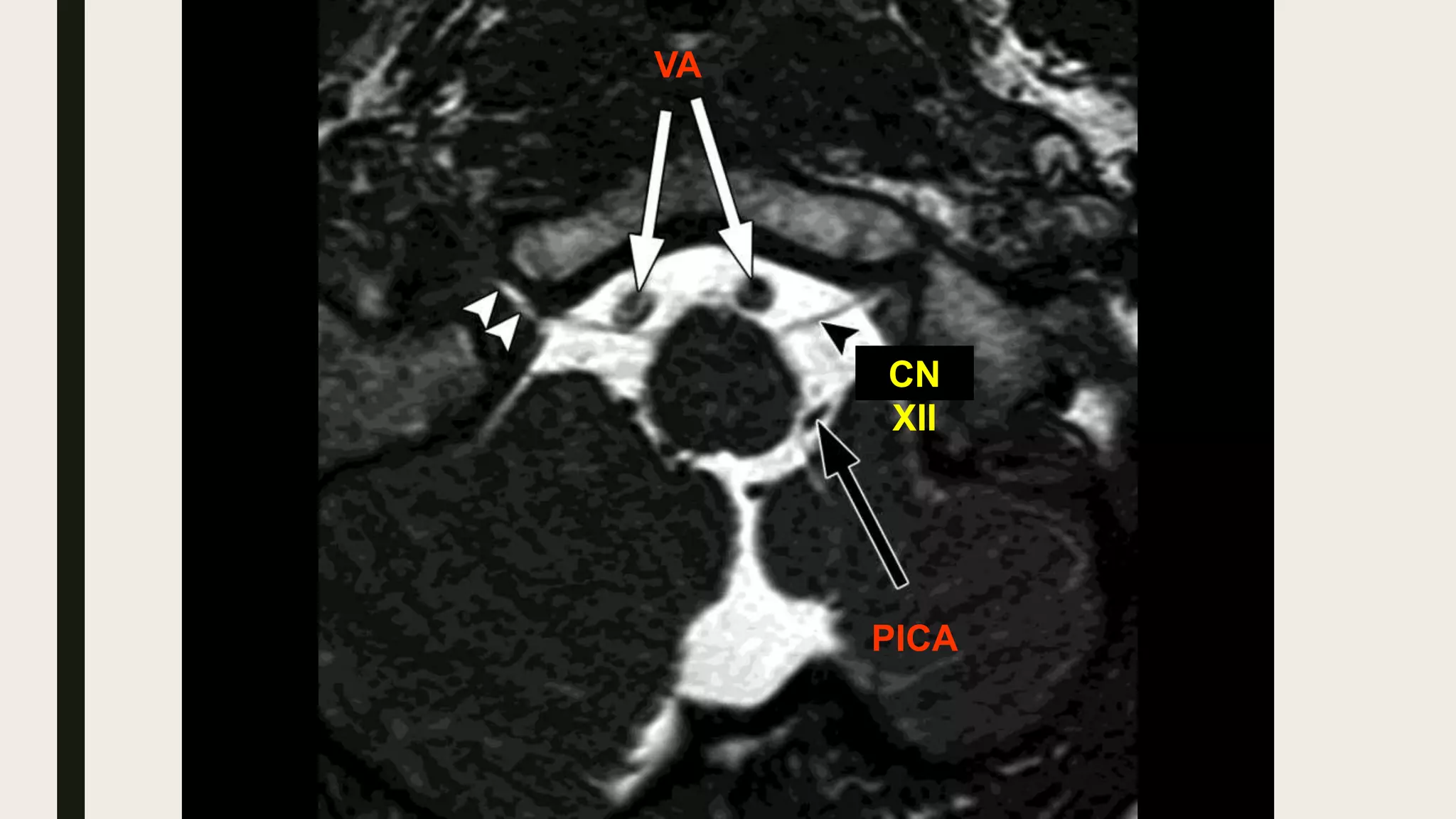
• Vertebral arteries.
• PICA.
• Anterior spinal artery.
• Posterior spinal arteries.
• Pre-medullary V.
• CN XII.
Contents
Medullary cistern
PICA
CN
XII
VA
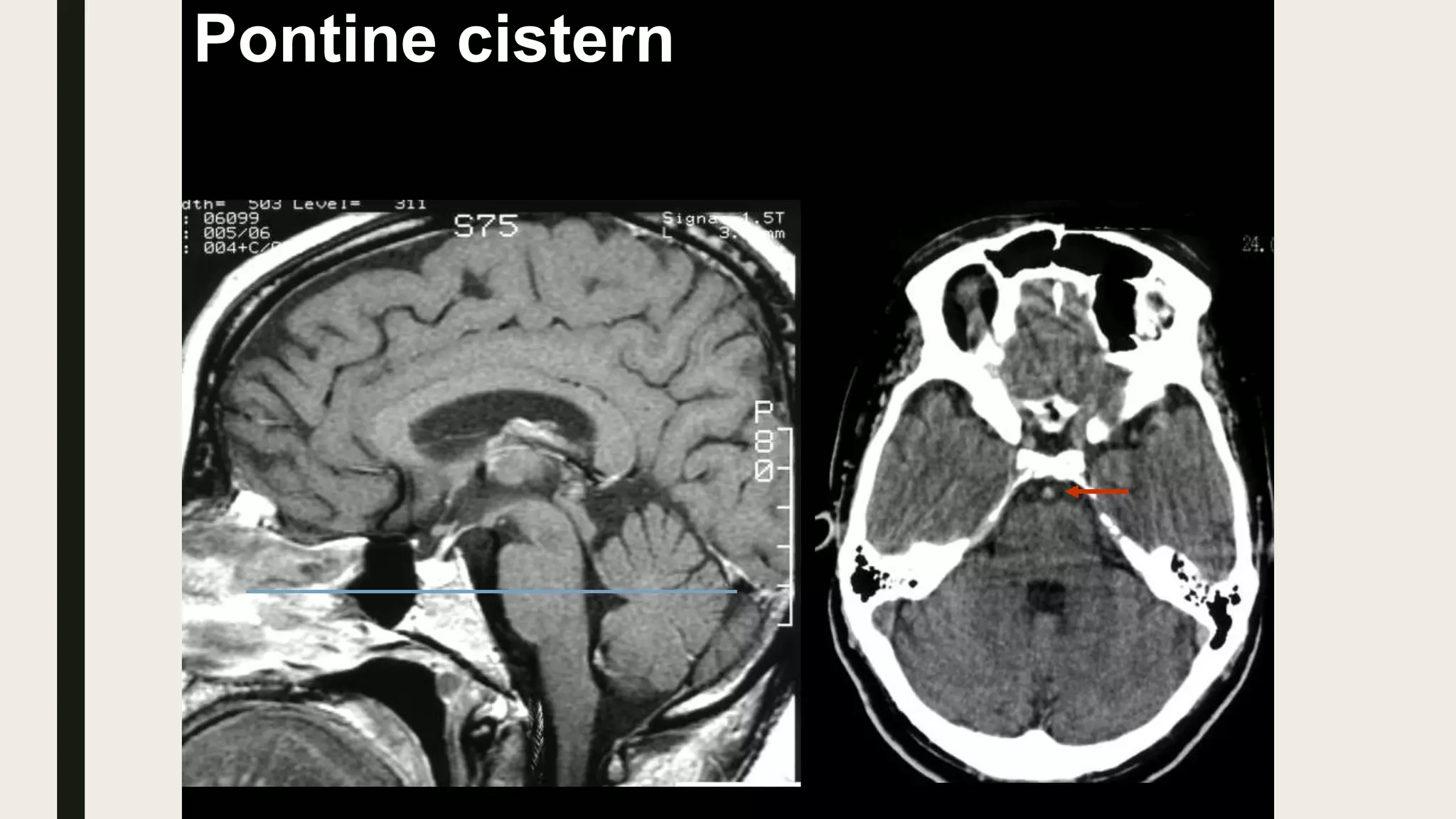
Pre-pontine (Pontine) cistern
• Anterior to the Pons.Location
• Basilar A.
• AICA.
• Ant. Pontomesencephalic V.
• CN V.
• CN VI.
Contents
Pontine cistern
Pontine cistern
Pontine cistern
AICA
BA
Cn6 Cn6
BA
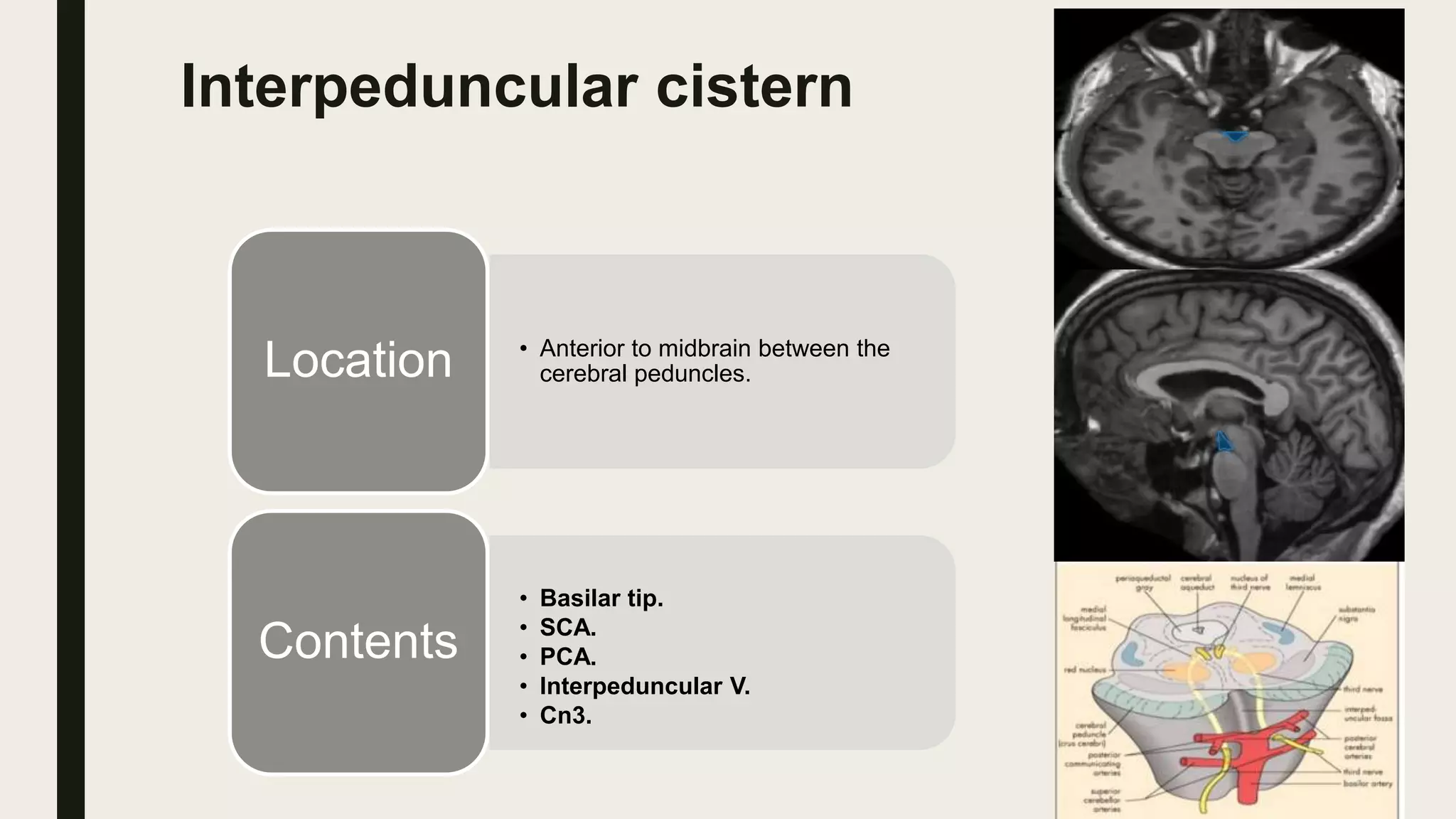
Interpeduncular cistern
• Anterior to midbrain between the
cerebral peduncles.Location
• Basilar tip.
• SCA.
• PCA.
• Interpeduncular V.
• Cn3.
Contents
Interpeduncular cistern
Cn 3
Interpeduncular
cistern
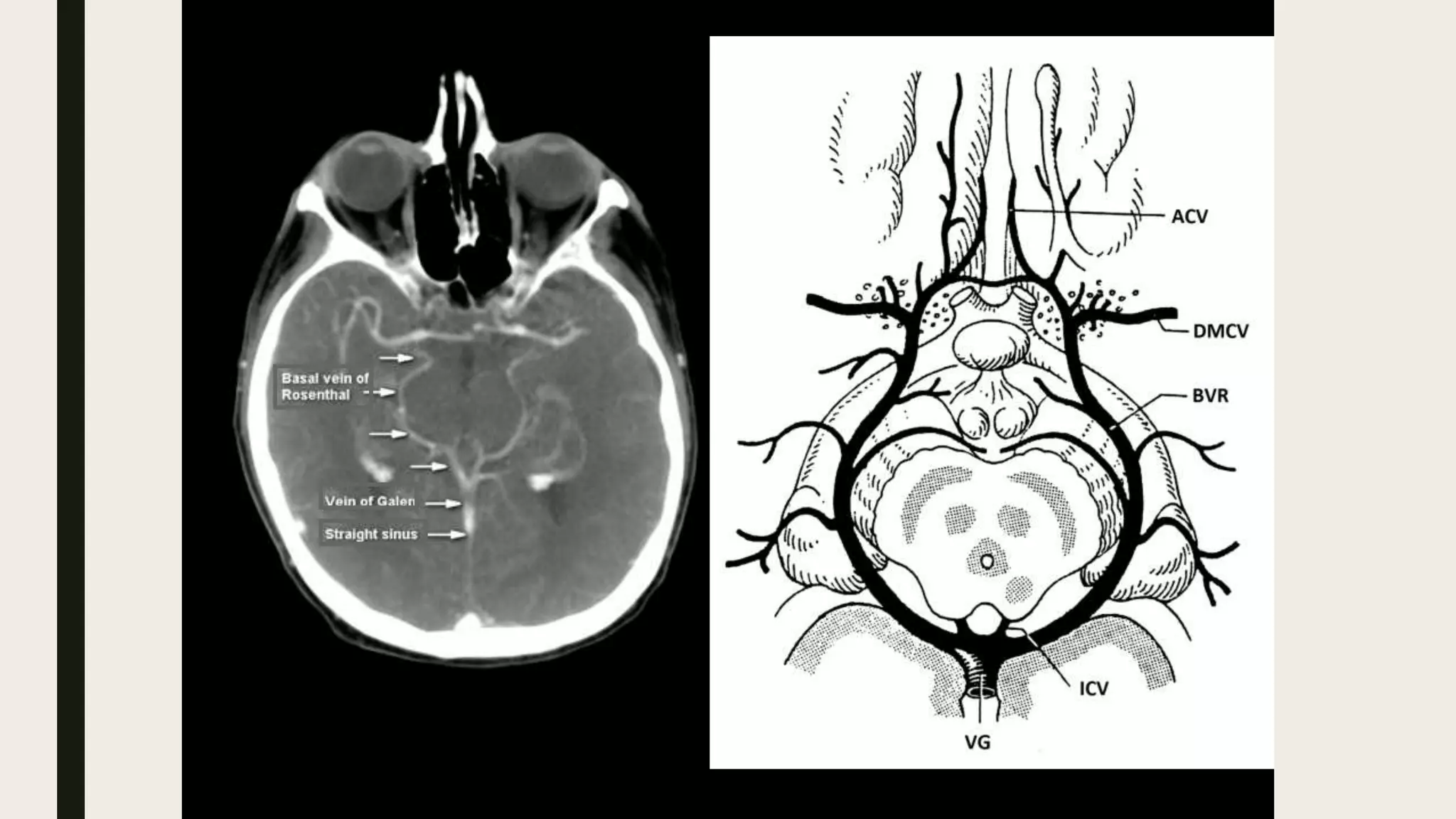
Basal v.
Interpeduncular V
DMCV Ponto-
mesencephalic V Basilar A.
Interpeduncular V
DMCV
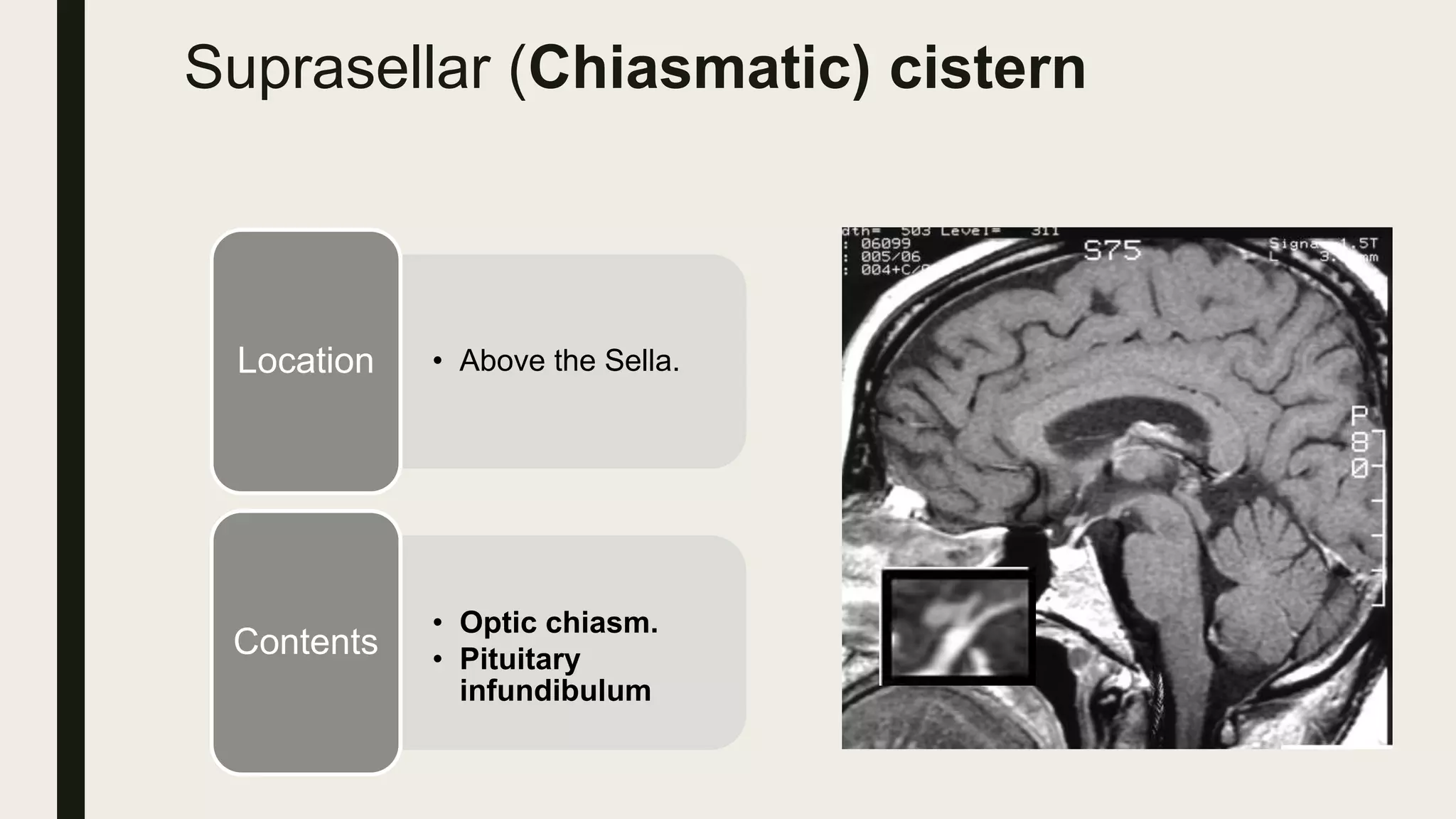
Suprasellar (Chiasmatic) cistern
• Above the Sella.Location
• Optic chiasm.
• Pituitary
infundibulum
Contents
Liliequist membrane
The Liliequist membrane is the arachnoid
membrane separating the Chiasmatic and
interpeduncular cisterns.
• Dorsum sellae.
Lower
attachment
• Mamillary body.
Upper
attachment
• Arachnoid sheath surrounding
the oculomotor nerve.
Lateral
attachment
CH
P
IP
Lamina terminalis cistern
• Anterior to the lamina
terminalis,
• Inferior to the rostrum of
corpus callosum &
• Superior to the optic chiasm.
Location
• ACA.
• ACOM.Contents
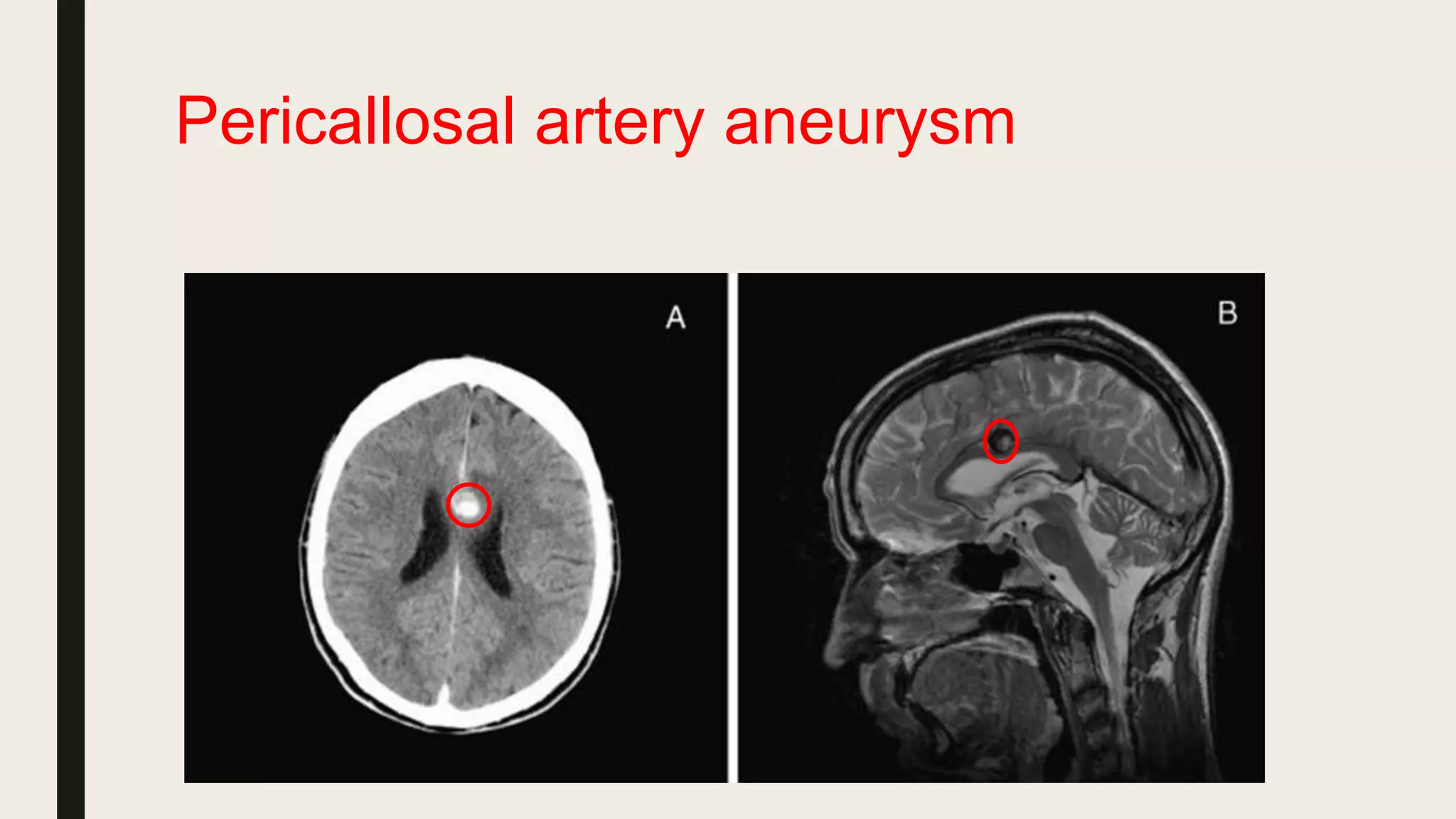
Pericallosal cistern
• Above the corpus callosum and
• Between the cingulate gyri.Location
• The Pericallosal artery.Contents
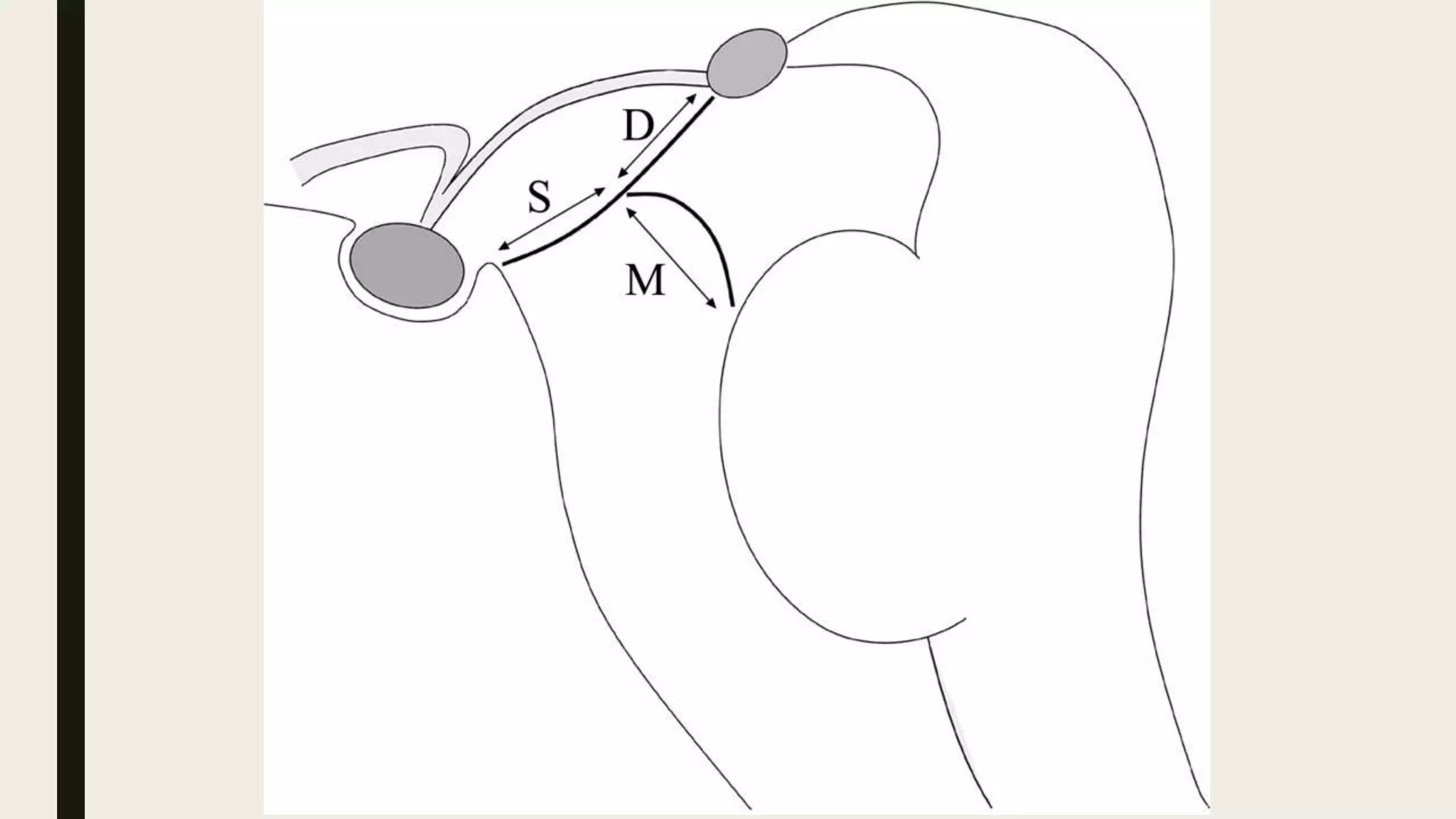
Pericallosal artery aneurysm
Subarachnoid
hemorrhage
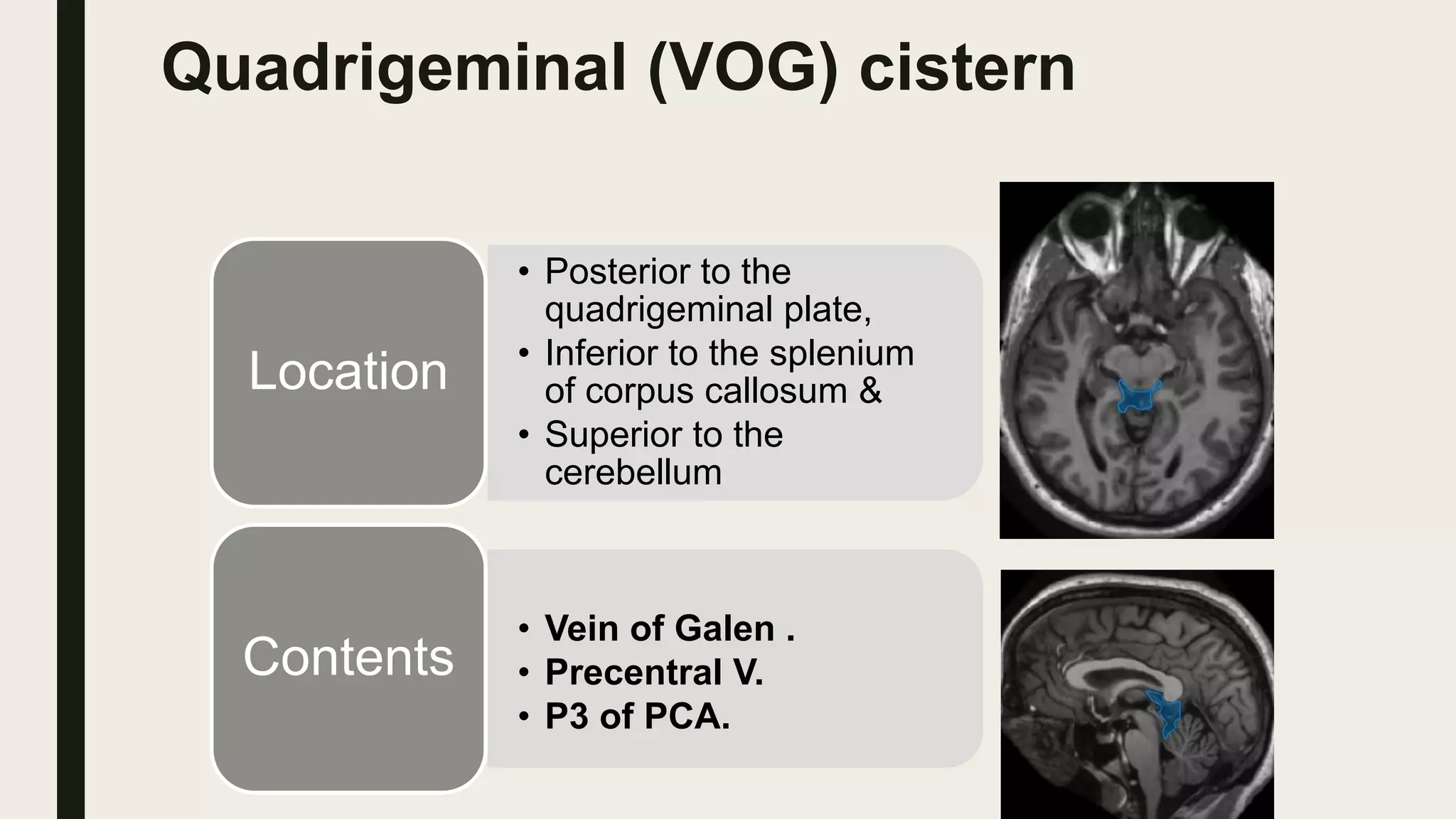
Quadrigeminal (VOG) cistern
• Posterior to the
quadrigeminal plate,
• Inferior to the splenium
of corpus callosum &
• Superior to the
cerebellum
Location
• Vein of Galen .
• Precentral V.
• P3 of PCA.
Contents
Precentral V
Precentral VPrecentral V
Precentral V
Superior cerebellar cistern
• Between the tentorium
cerebelli and superior
vermis.
Location
• Superior cerebellar artery.
• Superior vermian veins .Contents
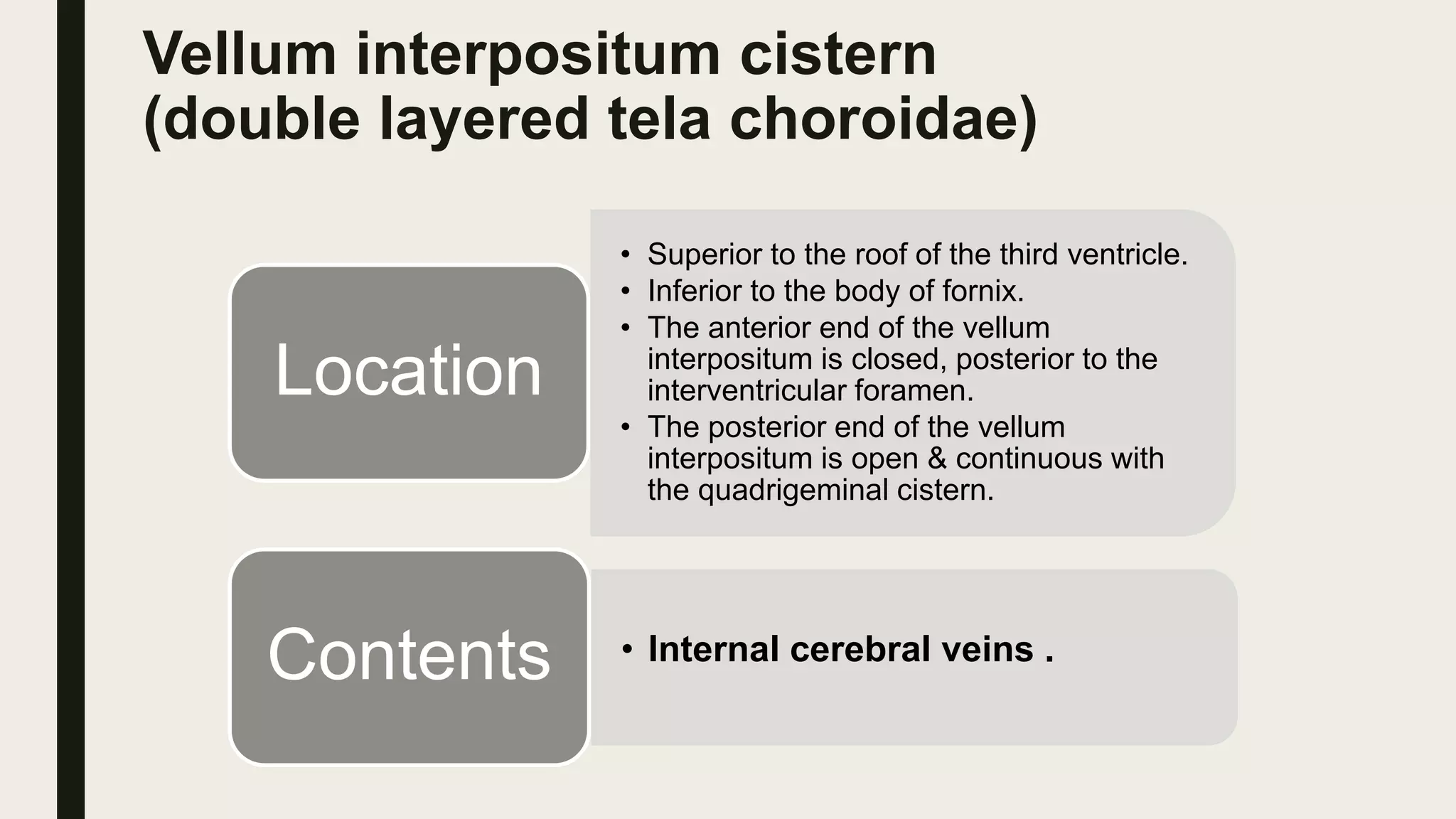
Vellum interpositum cistern
(double layered tela choroidae)
• Superior to the roof of the third ventricle.
• Inferior to the body of fornix.
• The anterior end of the vellum
interpositum is closed, posterior to the
interventricular foramen.
• The posterior end of the vellum
interpositum is open & continuous with
the quadrigeminal cistern.
Location
• Internal cerebral veins .Contents
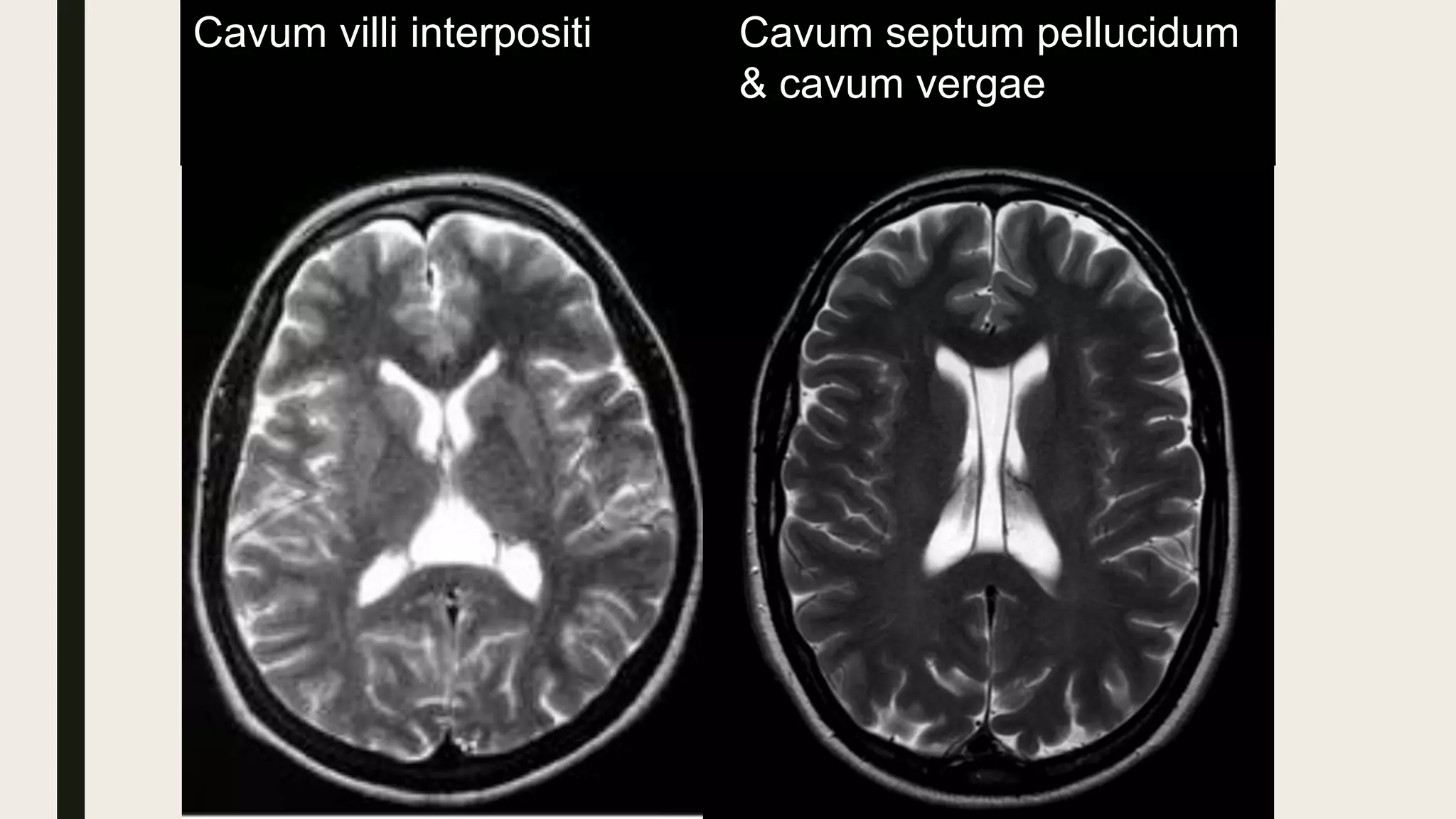
Vellum interpositum cistern
Cavum villi interpositi Cavum septum pellucidum
& cavum vergae
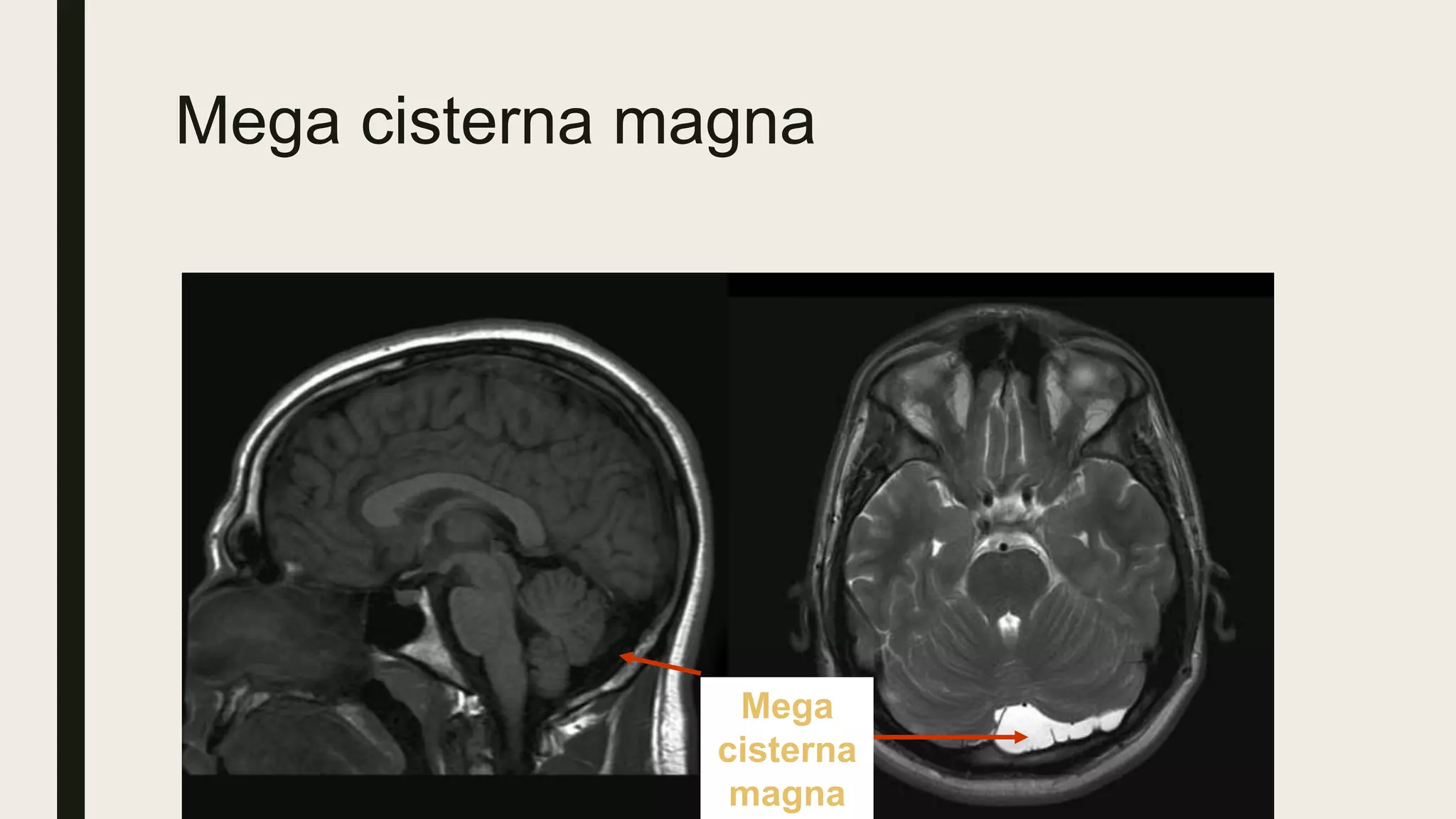
Cisterna magna (Cerebellomedullary) cistern
Mega cisterna magna
Mega
cisterna
magna
Vallecula cerebelli
• CSF cistern between
the cerebellar
tonsils.
• Connects the
foramen of Magendi
& cisterna magna.
Location
• PICA.Contents
Vallecula
CP angle cisterns
• Anterior to the CP angle.Location
• Superior CP angle cistern
• AICA.
• Cn 7.
• Cn 8.
• Inferior CP angle cistern
• (lateral cerebello-medullary cistern):
• Cn 9.
• Cn 10.
Contents
CP angle cistern
AICA
Superior CP angle cistern
AICA
AICA
AICA
AICA
Inferior CP angle cistern
Cn
9/10
Cn 10
Cn 9
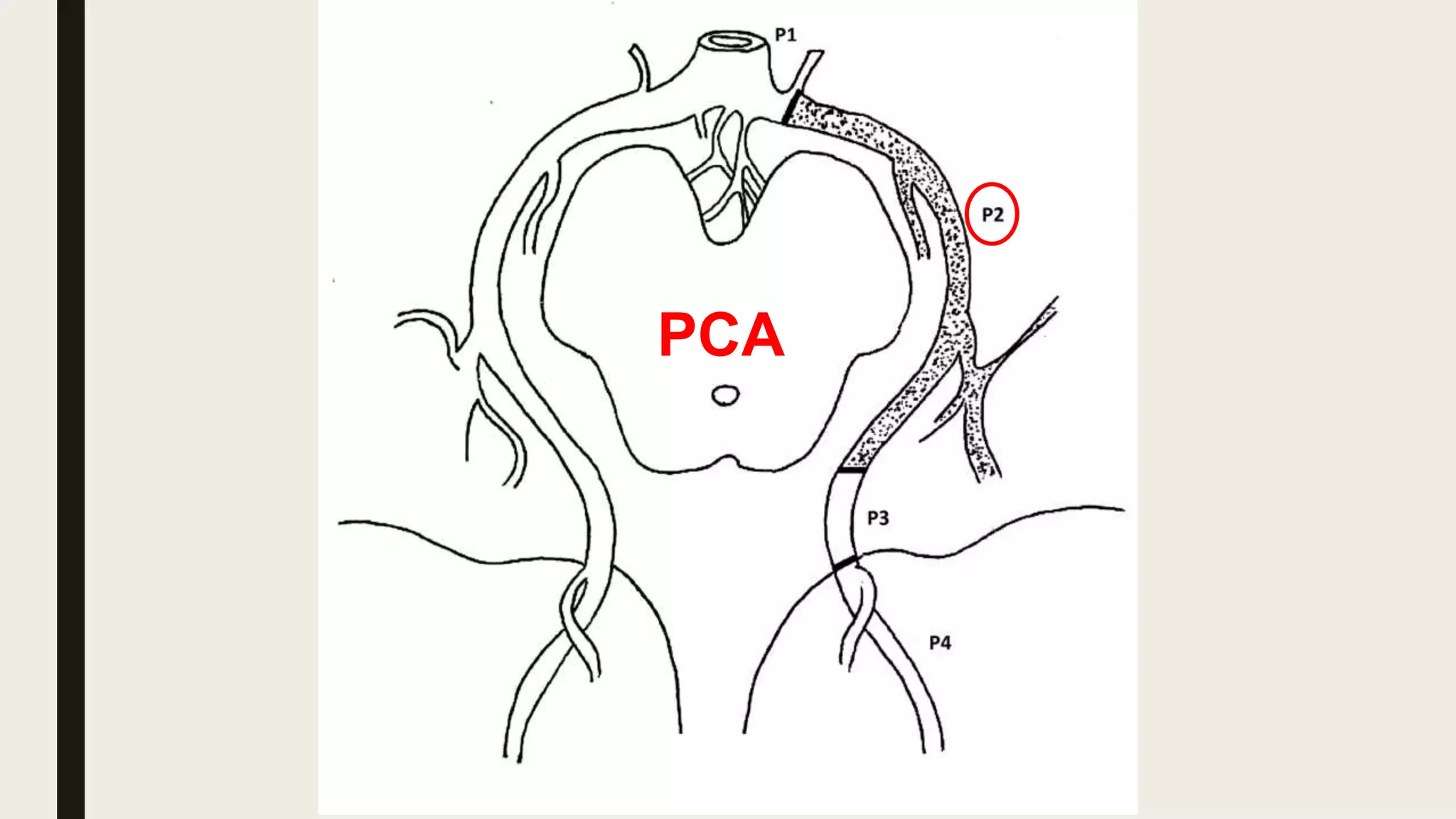
Crural cisterns
Location
• P2 segment of PCA.
• Superior cerebellar artery.
• Anterior choroidal artery.
• Basal vein of Rosenthal.
Contents
Between the
Crus cerebri
(cerebral
peduncles
Uncus of
temporal lobe
Medially Laterally
AchA AchAAchA
SCA
PCA
PCA
Carotid cisterns
• Lateral to the sella,
• inferior TO the anterior clinoid process
&
• Superior to the cavernous sinus.
Location
• Internal carotid artery
• Origin of ACA, MCA, AchA & PCOM.
Contents
Sylvian cisterns
• Between the carotid cistern & sylvian
fissure.
Location
• Middle cerebral artery.
• Superficial & deep sylvian veins.
Contents
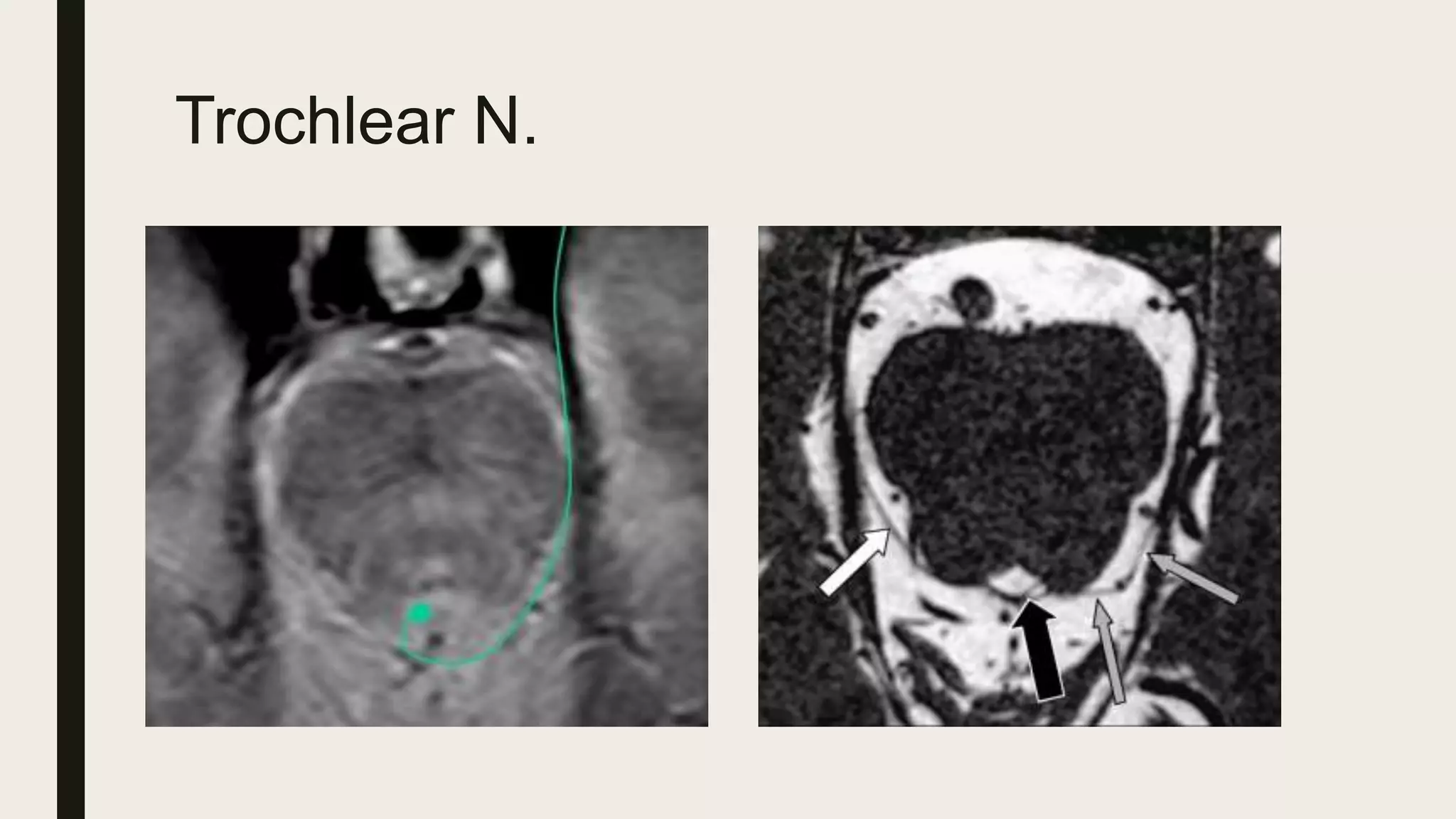
Ambient cisterns
• Ambient = surrounding.
• Extension of the quadrigeminal cistern
lateral to the midbrain.
Location
• P2 segment of PCA.
• SCA.
• AchA.
• Lateral mesencephalic V.
• Basal vein of Rosenthal .
• CV IV.
Contents
Trochlear N.
PCA
Retro-thalamic cisterns (wings of
ambient cisterns)
• Lateral extensions of the ambient
cisterns posterior to the thalamic
pulvinar.
Location
• Lateral posterior choroidal artery.Contents
Vellum interpositum
Retro-thalamic CisternRetro-thalamic Cistern
Sup.cerebellar Cistern
‫إله‬ ‫ال‬ ‫أن‬ ‫أشهد‬ ‫بحمدك‬ ‫و‬ ‫اللهم‬ ‫سيحانك‬
‫أليك‬ ‫أتوب‬ ‫و‬ ‫أستغفرك‬ ‫أنت‬ ‫إال‬

Brain anatomy (part 3)