SHEHZAD HUSSAIN
Definition
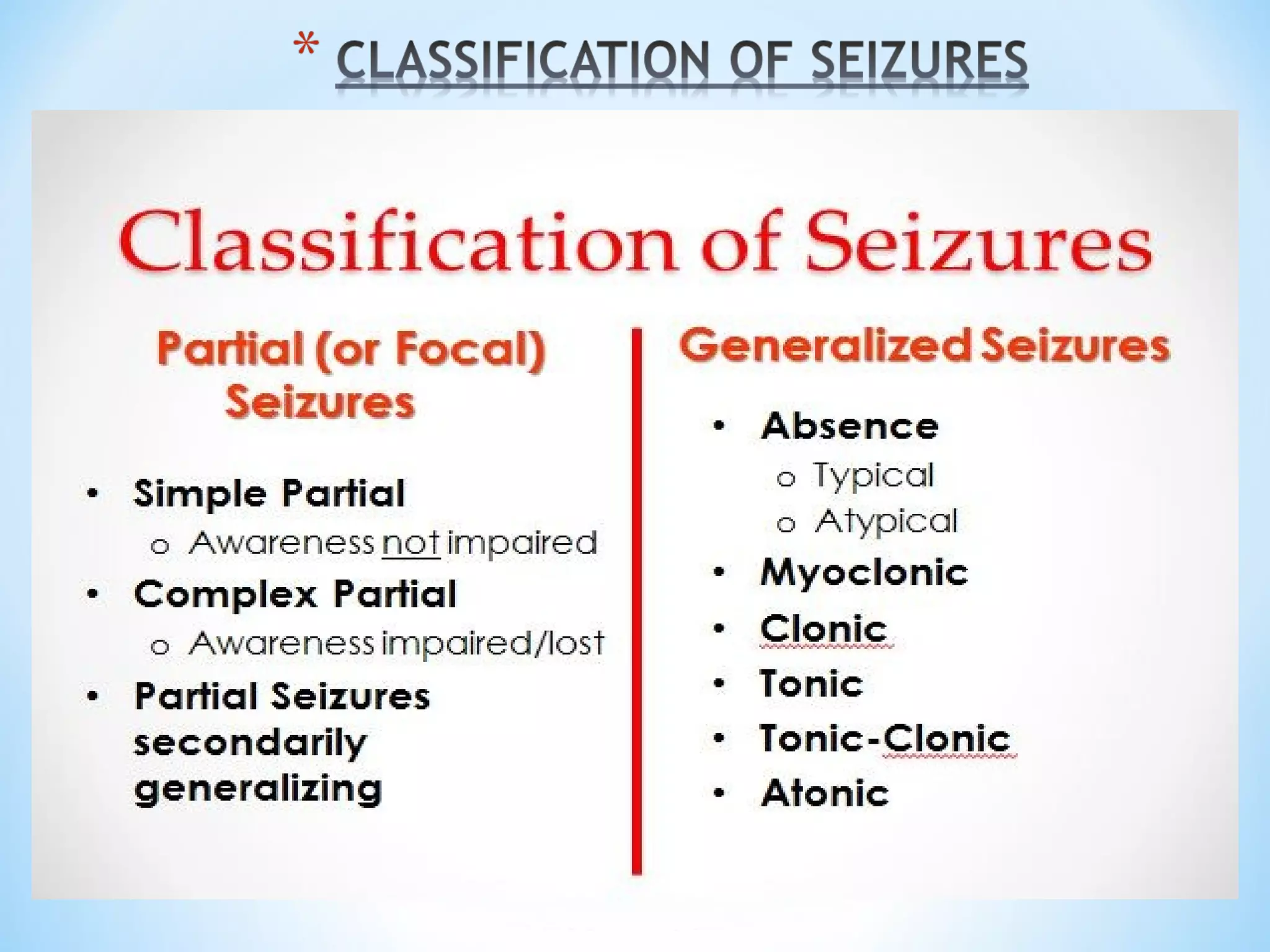
Classification of seizures
Partial seizures
Simple partial and complex partial seizures
Complex partial seizure to sec gen
Generalized seizures
Absence seizures (Typical, Atypical, eyelid myoclonia, Myoclonic absence)
Myoclonic
Clonic
Tonic
Tonic clonic
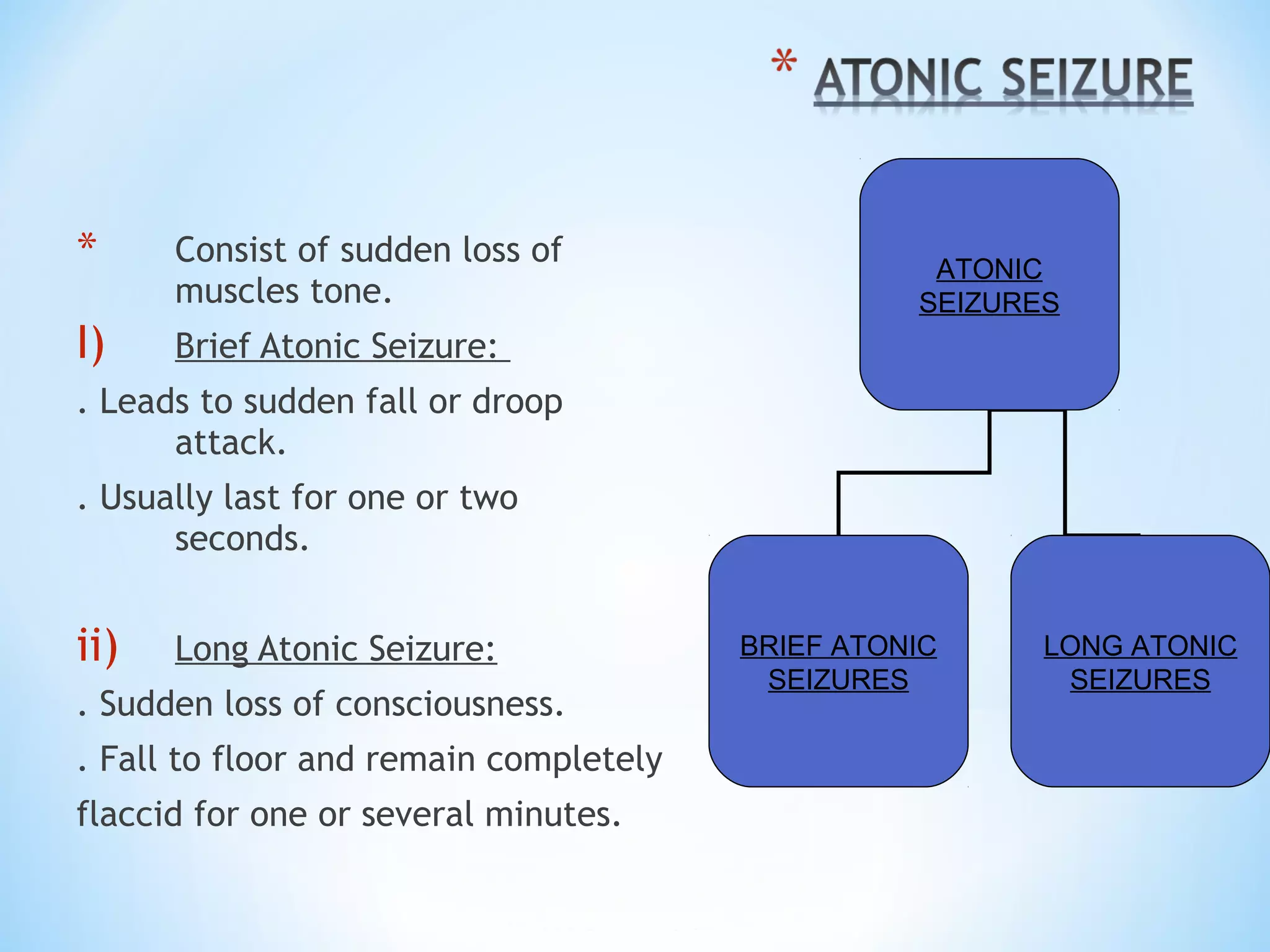
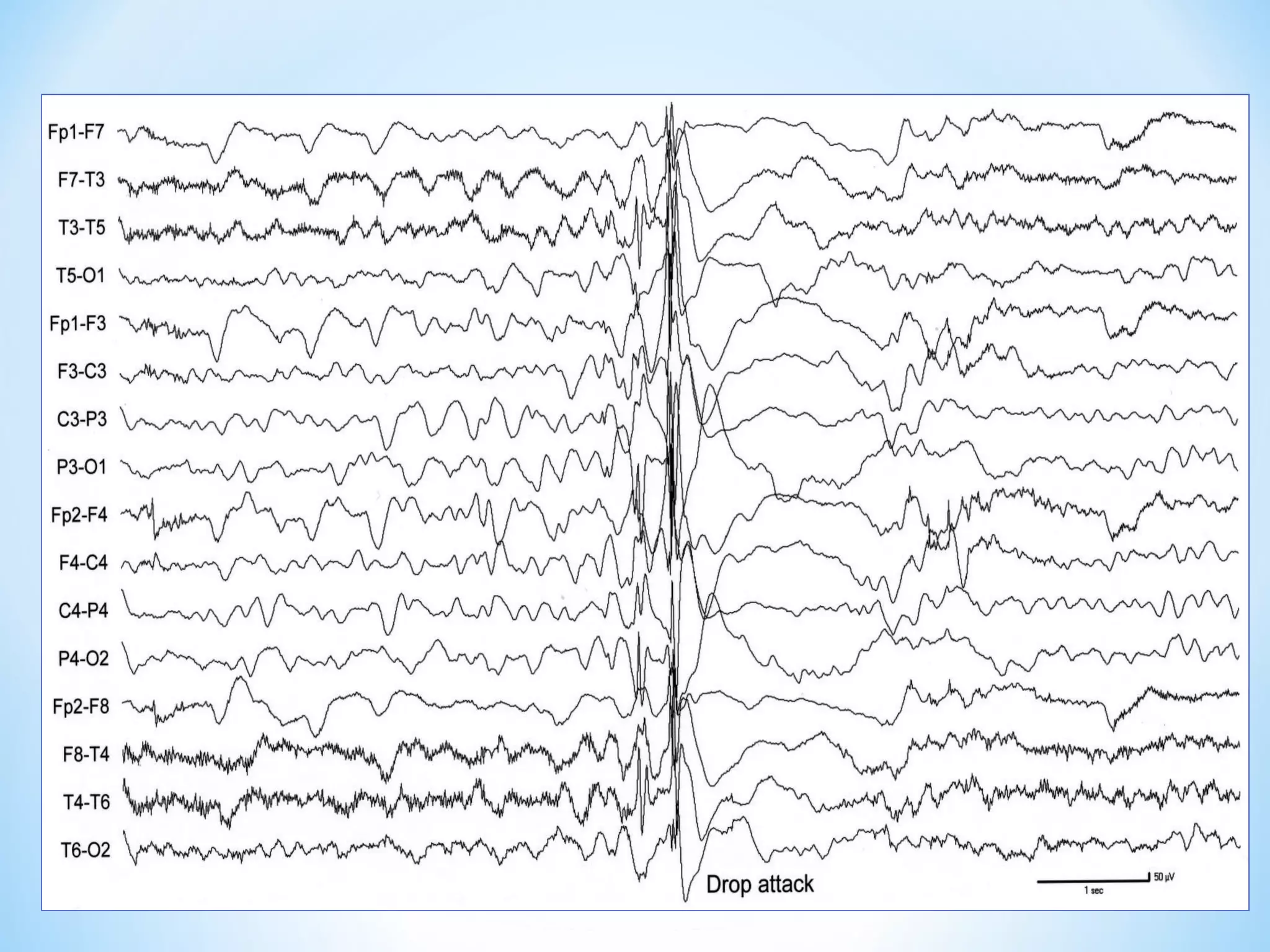
Atonic
Unclassified seizures
REFERENCES
SEIZURES
Seizures are episode of sudden disturbance of mental, motor, sensory or
autonomic activity caused by a paroxysmal cerebral malfunction.
CONVULSIONS
Convulsions are violent involuntary contractions of the body musculature. In
neurology, the term is usually limited to contractions produced by cerebral
seizure activity.
EPILEPSY
A chronic neurologic disorder manifesting by repeated epileptic seizures
(attacks or fits) which result from paroxysmal uncontrolled discharges of
neurons within the central nervous system.
Epileptic prodrome:-
Its change in mode or behavior before the seizure and
could be in hours or days before the seizure event.
AURA: It’s the initial event, signaling the beginning of seizures.
ICTAL or ICTUS: It’s a synonym word for seizure.
POST ICTAL: It’s a period after seizure, usually lasting longer than the
seizure itself.
Interictal period:-
It’s the time period between two
successive seizure events.  
Status Epilepticus:-
1. It is described as the recurrence of seizures by
intervals too short to allow recovery of the condition
that existed before the onset of the seizures.
2. *An episode of more than 05 minutes of continuous
seizure activity, or
3.*Two or more sequential seizures spanning this
period without full recovery between seizures.
(AES)
• The seizers classification being most widely used is proposed by the
Commission on classification and Terminology of the International
League Against Epilepsy(ILAE).
• Classification is necessary for;
 New terms & concepts with internationally accepted
terminology
 Standardization of the seizures types description
 New concepts regarding Focal and generalized
seizures
 Better adaptation of etiological terms
 Electro-clinical diagnosis for seizures etc
• HOW TO RECOGNIZE SEIZURES:-
•  Anatomical
(patient history help us to locate the origin of
discharge )
• Pathological
(infections or lesions help us to reorganization of Sz)
• Clinical
(by self observation during seizure)
• Electro diagnostically
(by the help of EEG+VEEG recording)
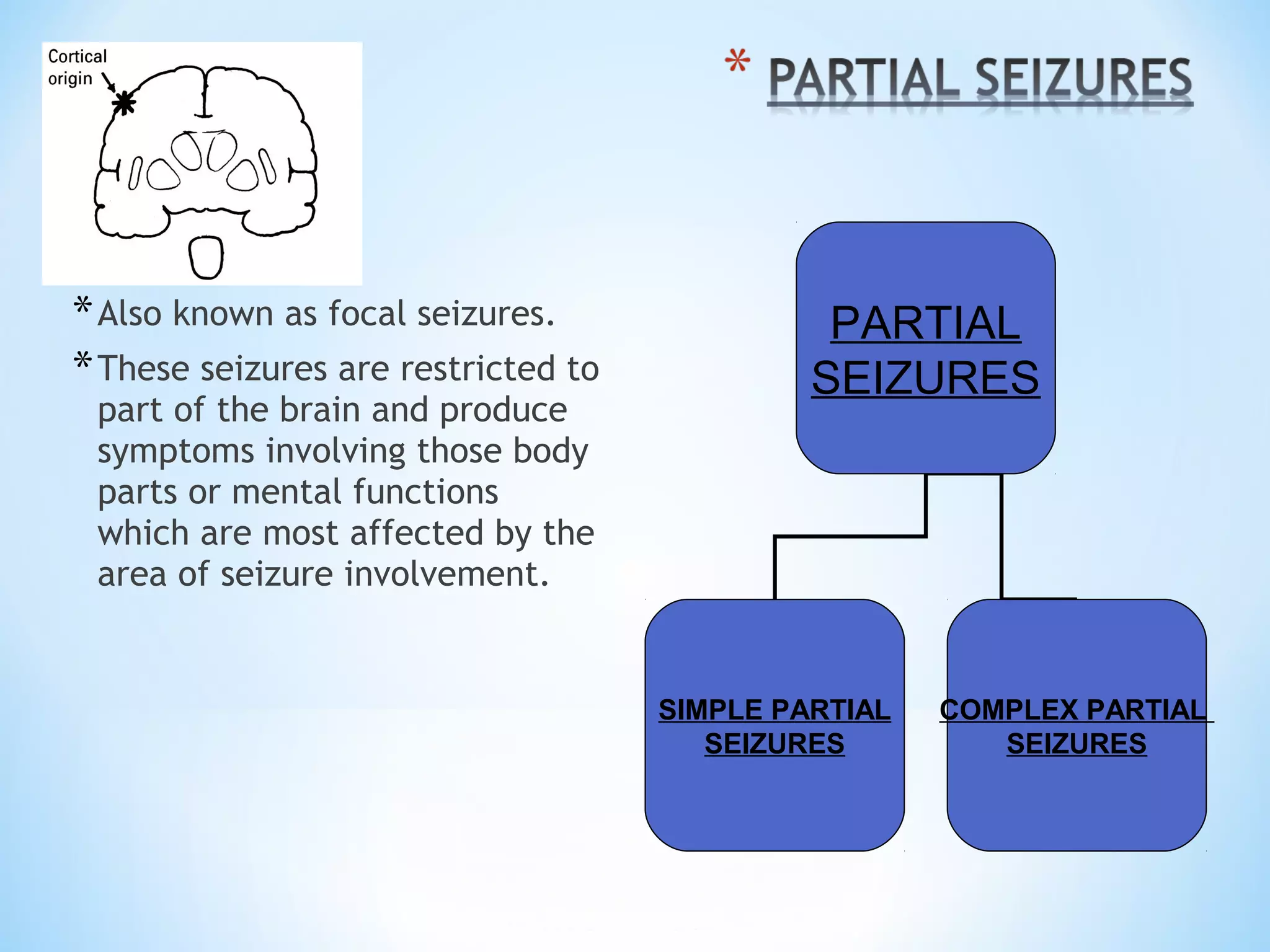
*Also known as focal seizures.
*These seizures are restricted to
part of the brain and produce
symptoms involving those body
parts or mental functions
which are most affected by the
area of seizure involvement.
PARTIAL
SEIZURES
SIMPLE PARTIAL
SEIZURES
COMPLEX PARTIAL
SEIZURES
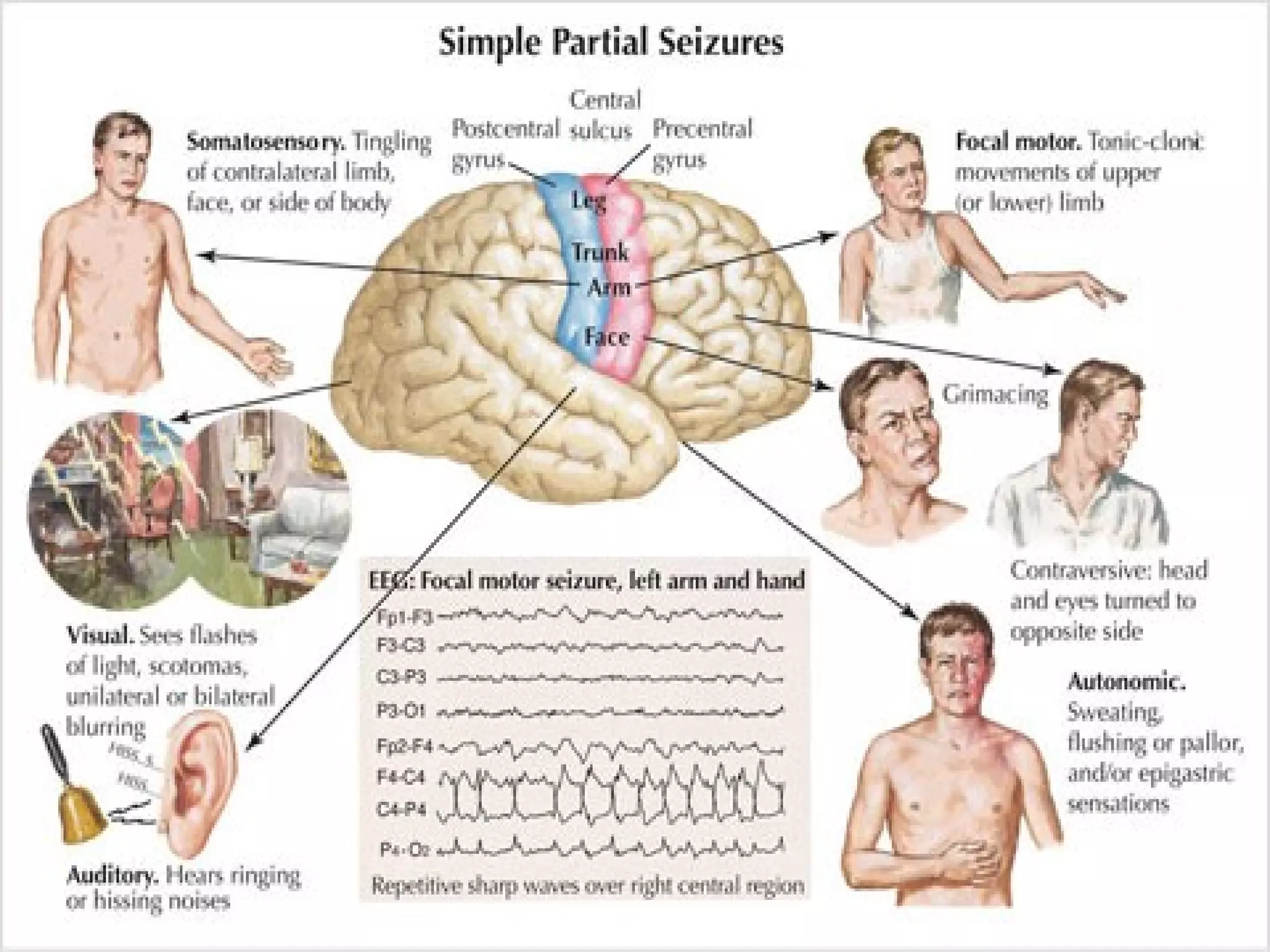
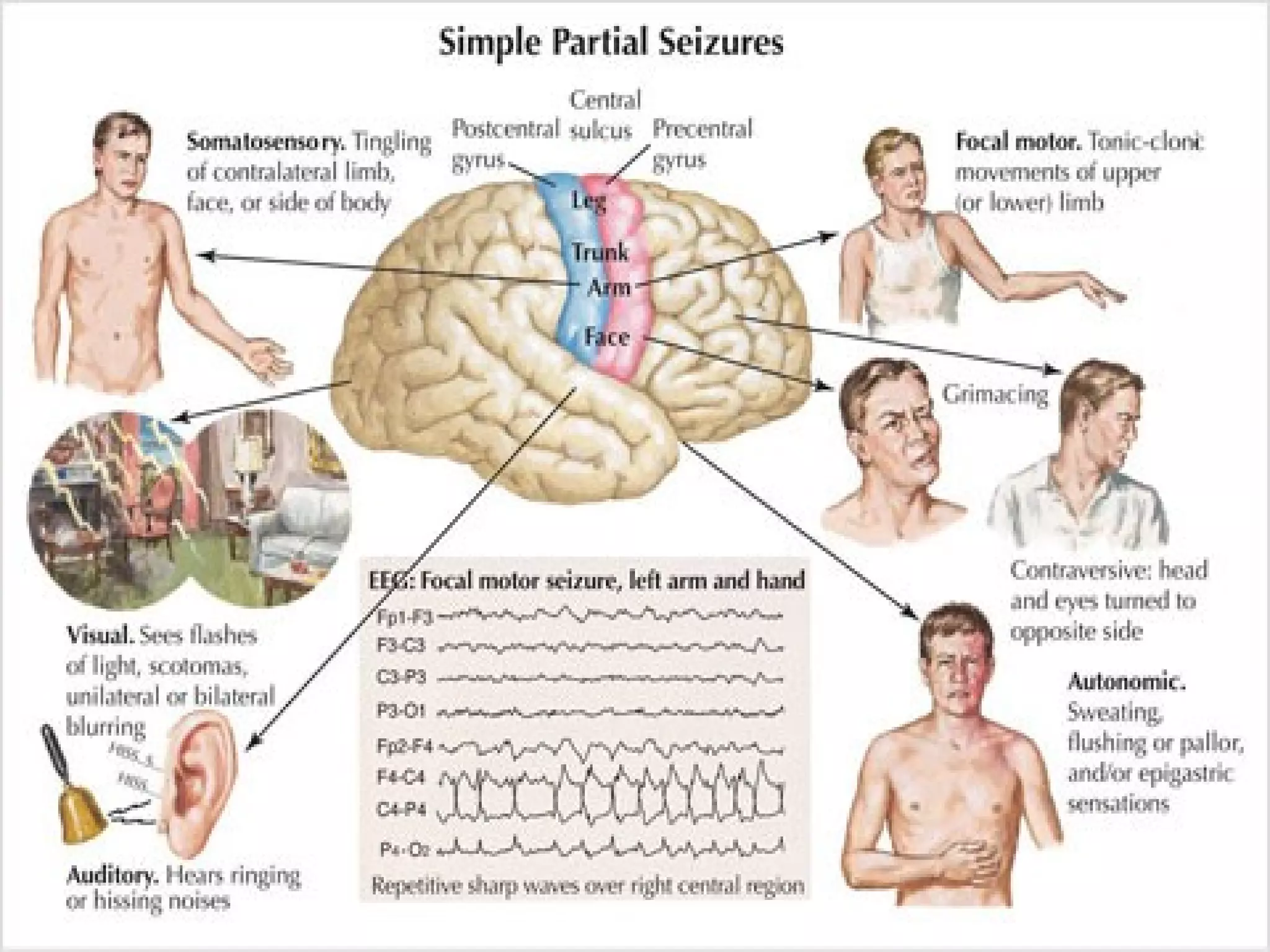
These seizures produce focal motor, sensory, autonomic,
mixed or psychic symptoms without change of
consciousness.
(a) Partial seizure with motor symptoms:
i. Focal motor seizures consist of sustained tonic
contractions or intermitent clonic contraction.
They involve the face, one part of the limb or half
of the body.
ii. Jacksonian seizures are focal motor seizures which
involve adjacent part on one side of the body
during seizure. This march is due to the spread of
seizure activity over adjacent parts of motor
cortex.
iii. Versive seizure cause turning of the body,
usually in a direction towards the side of the
seizure.
iv. Aphasic seizure are characterized by
expressive or global loss of language. They
result from seizure activity in language area.
simple partial.wmv
(b) Partial seizures with sensory symptoms:
i. Somatosensory seizure produce sudden sensation
such as tingling, heaviness, numbness or burning
which, like motor symptoms, either remain in one
part of the body or march over parts.
ii. Visual seizure produce hallucination of white or
coloured simple shapes, for instance stars and
flashes or alteration of visual perception.
iii. Auditory seizures cause hallucination of simple
sounds.
iv. Olfactory seizures produce hallucination of odors.
v. Gustatory seizure consist hallucination of taste.
(c) Partial seizure with autonomic symptoms:
are rarely seen in isolation. Symptoms consist
of salivation, perspiration, changes in pupillary
size, heart beat, respiration, urinary and
epigastric discomfort.
* Psychic auras often originate from the temporal lobe,
associated with simple partial seizures:
*Psychic Aura Definition
*Déjà vu: An illusion of a familiar memory
*Jamais vu: When what should be a familiar visual experience
becomes unfamiliar
*Déjà entendu: An auditory illusion of something familiar
*Jamais entendu: When what should be a familiar auditory
experience becomes unfamiliar Autoscopy: Seeing oneself in
external space, as if the mind has left the body
*Derealization: A feeling of unreality of the outside world; the world
seems strange and unreal.
*Depersonalization: A feeling of unreality in one’s sense of self;
feeling as if in a dream or watching oneself act
*Macro-/Micropsia: Objects appear larger or smaller than usual
*Macr-/Micracusia: Sounds are louder or softer than usual
*An epileptic disorder can be symptomatic, idiopathic, or
cryptogenic.
*Symptomatic is a term that means the etiology is known—
usually a structural lesion within the brain. Idiopathic is a
term that refers to an epilepsy of presumed genetic
etiology without a structural brain
*lesion or other neurological signs or symptoms. The term
has been replace by “genetic”
* Cryptogenic is a term that refers to an
*epilepsy that is presumed to be symptomatic but the
etiology is unknown (1989). The term
*cryptogenic has been replaced by “probably symptomatic”
*The observable manifestation of the seizures, is known
as semiology.
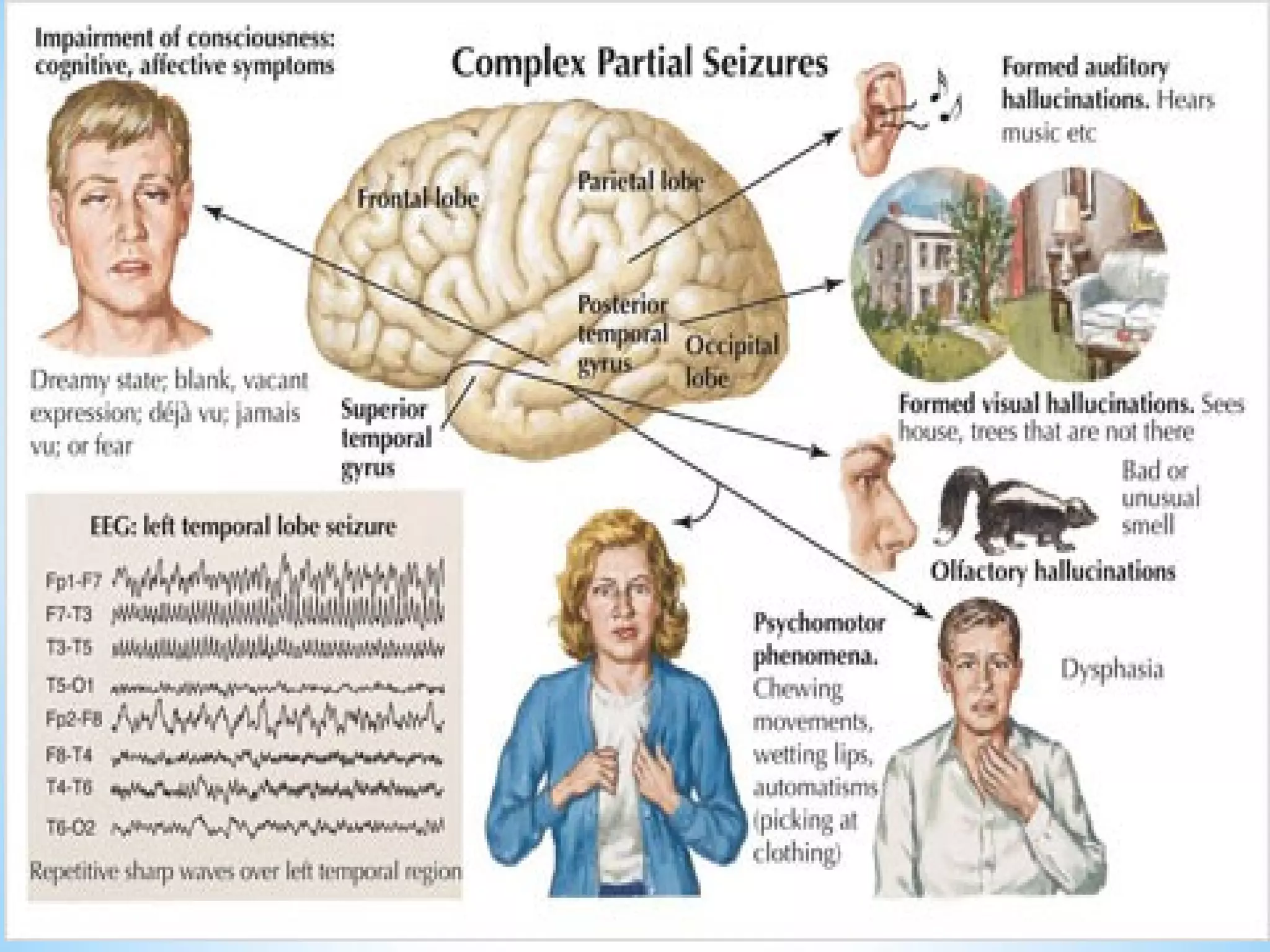
 Often called temporal lobe seizures because they arise from foci
in the mesial and inferior part of temporal lobe or adjacent part of
frontal lobe.
Symptoms often consist of changes of consciousness which reduce
the ability of patient to interact with their surrounding, complete
loss of consciousness is not a primary symptoms.
Consist of repetitive movements which seem purposeful but they
are unpurposeful. E.g, scratching, chewing, swallowing and lips
smacking.
In general patient have no recollection or only incomplete memory
of events at the onset of seizure such as awareness of bad odour.
(Aura).
nwU_gFrO3uo.wmv
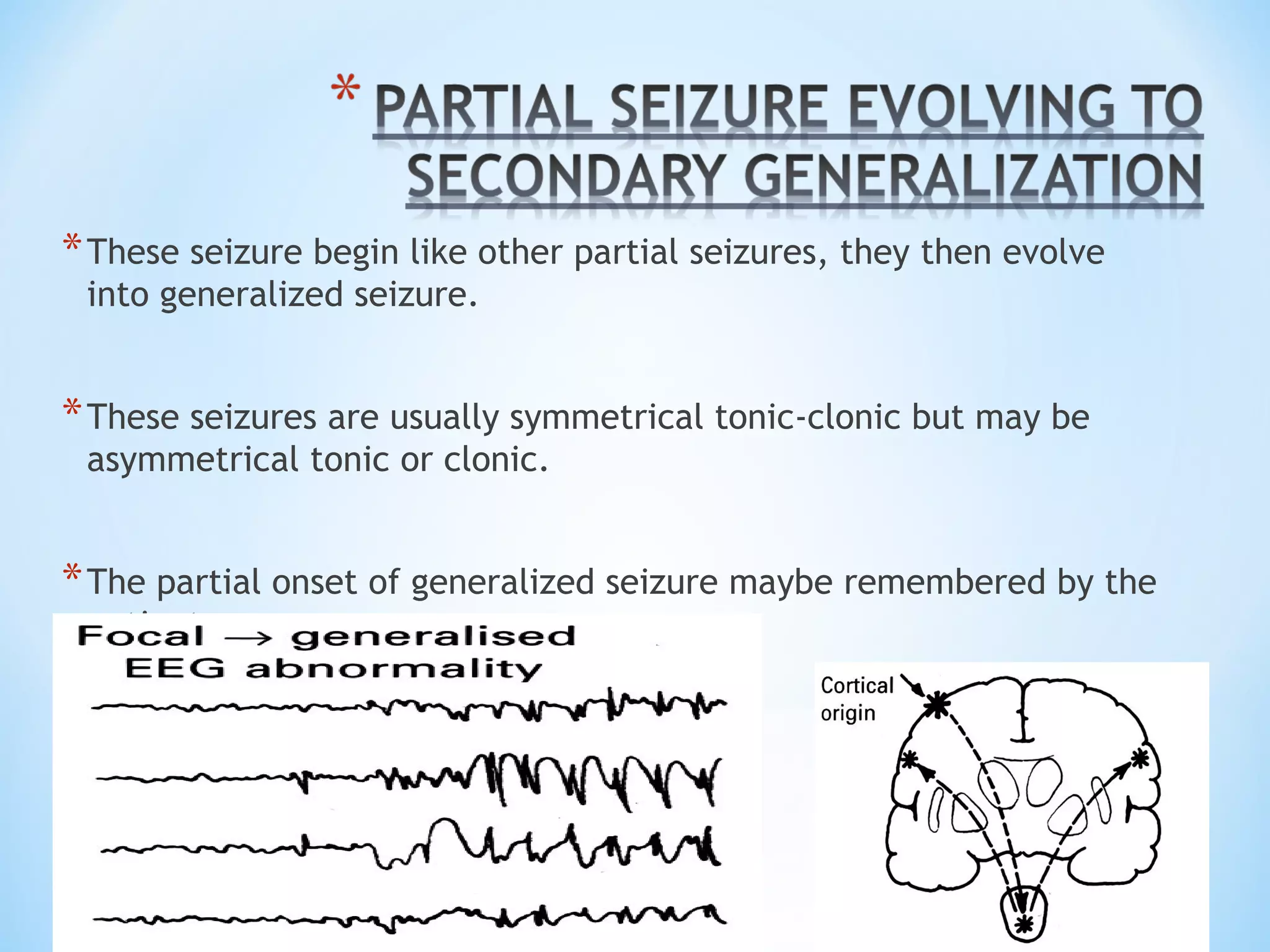
*These seizure begin like other partial seizures, they then evolve
into generalized seizure.
*These seizures are usually symmetrical tonic-clonic but may be
asymmetrical tonic or clonic.
*The partial onset of generalized seizure maybe remembered by the
patient.
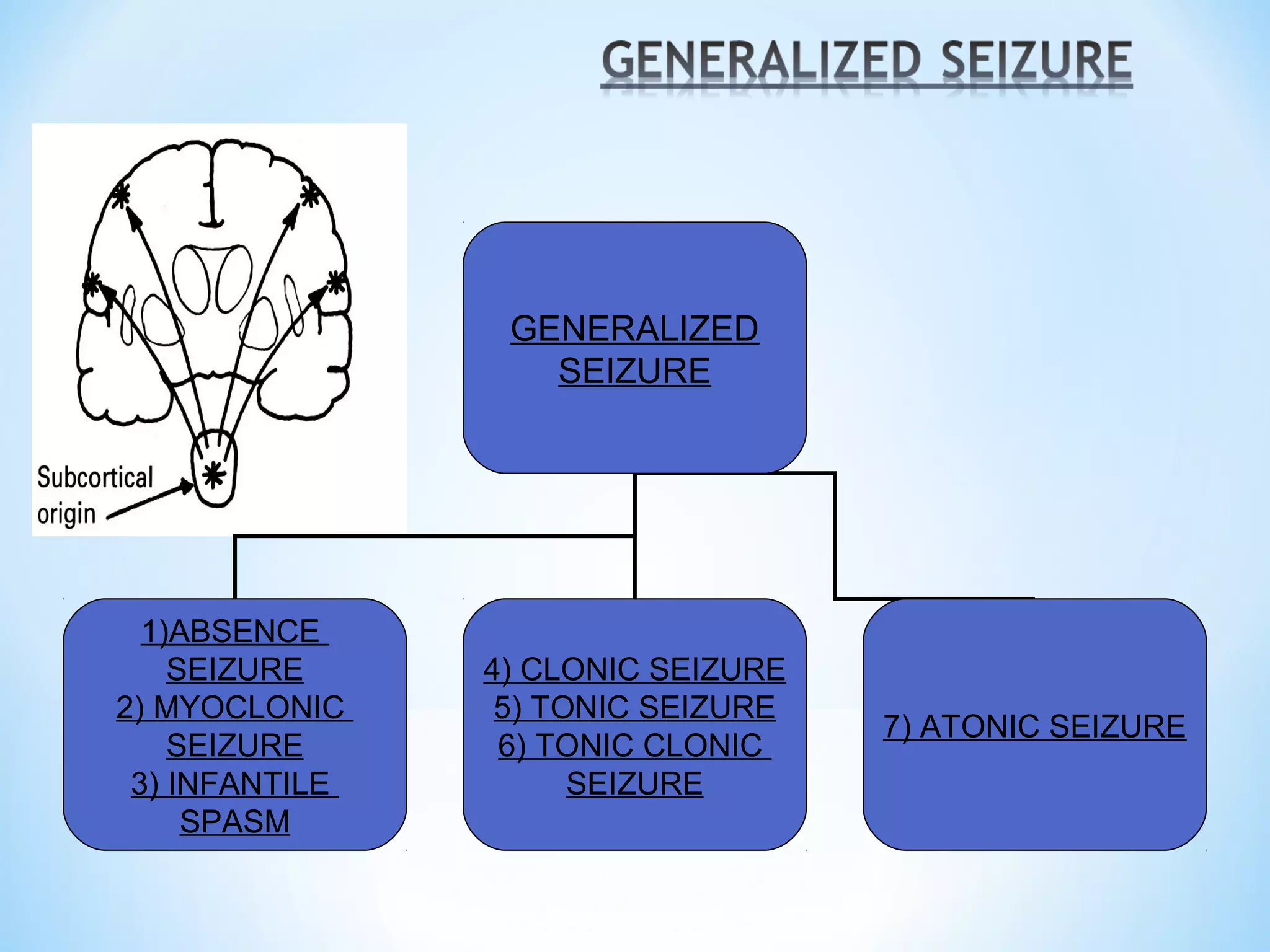
GENERALIZED
SEIZURE
1)ABSENCE
SEIZURE
2) MYOCLONIC
SEIZURE
3) INFANTILE
SPASM
4) CLONIC SEIZURE
5) TONIC SEIZURE
6) TONIC CLONIC
SEIZURE
7) ATONIC SEIZURE
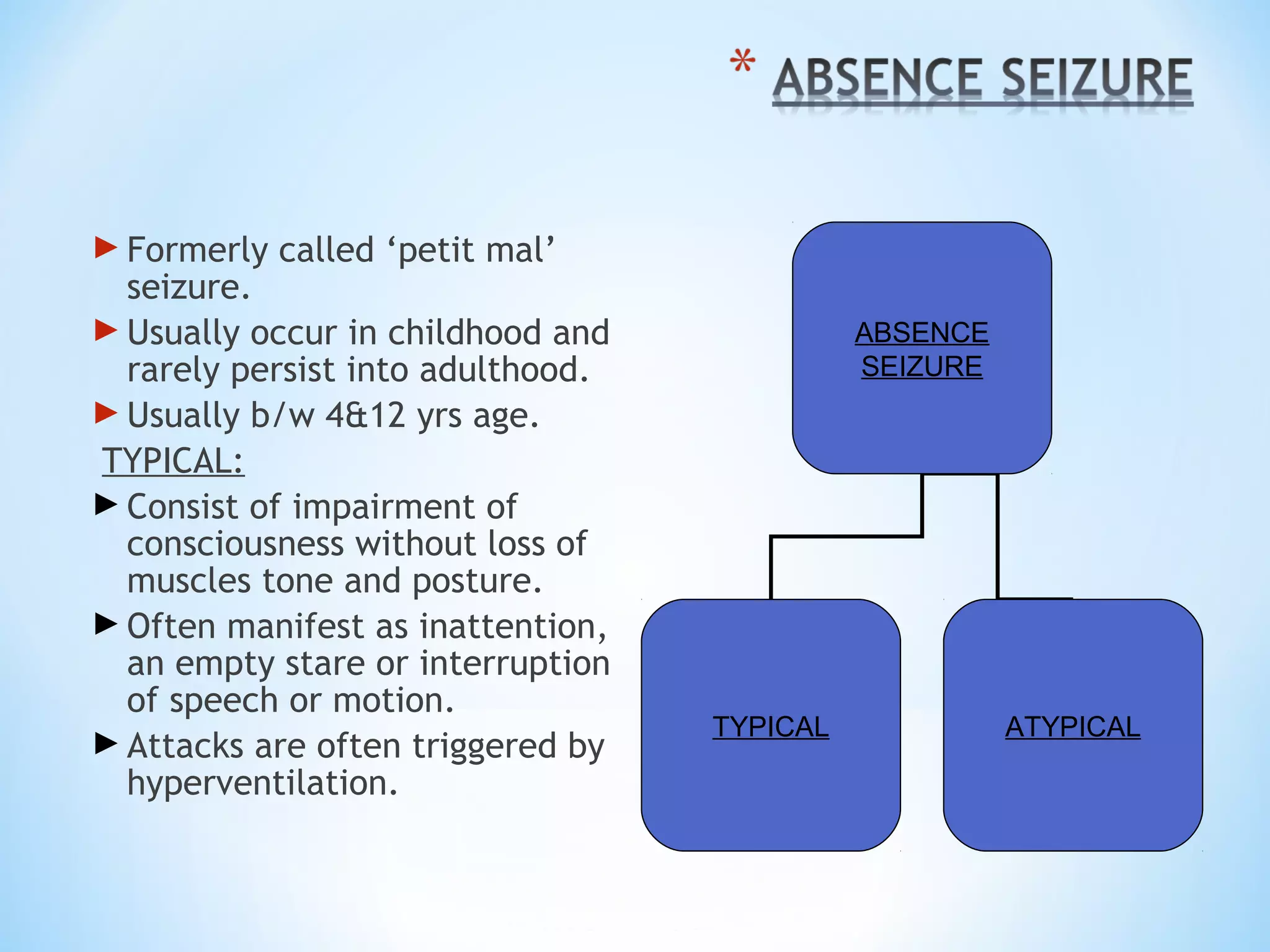
Formerly called ‘petit mal’
seizure.
Usually occur in childhood and
rarely persist into adulthood.
Usually b/w 4&12 yrs age.
TYPICAL:
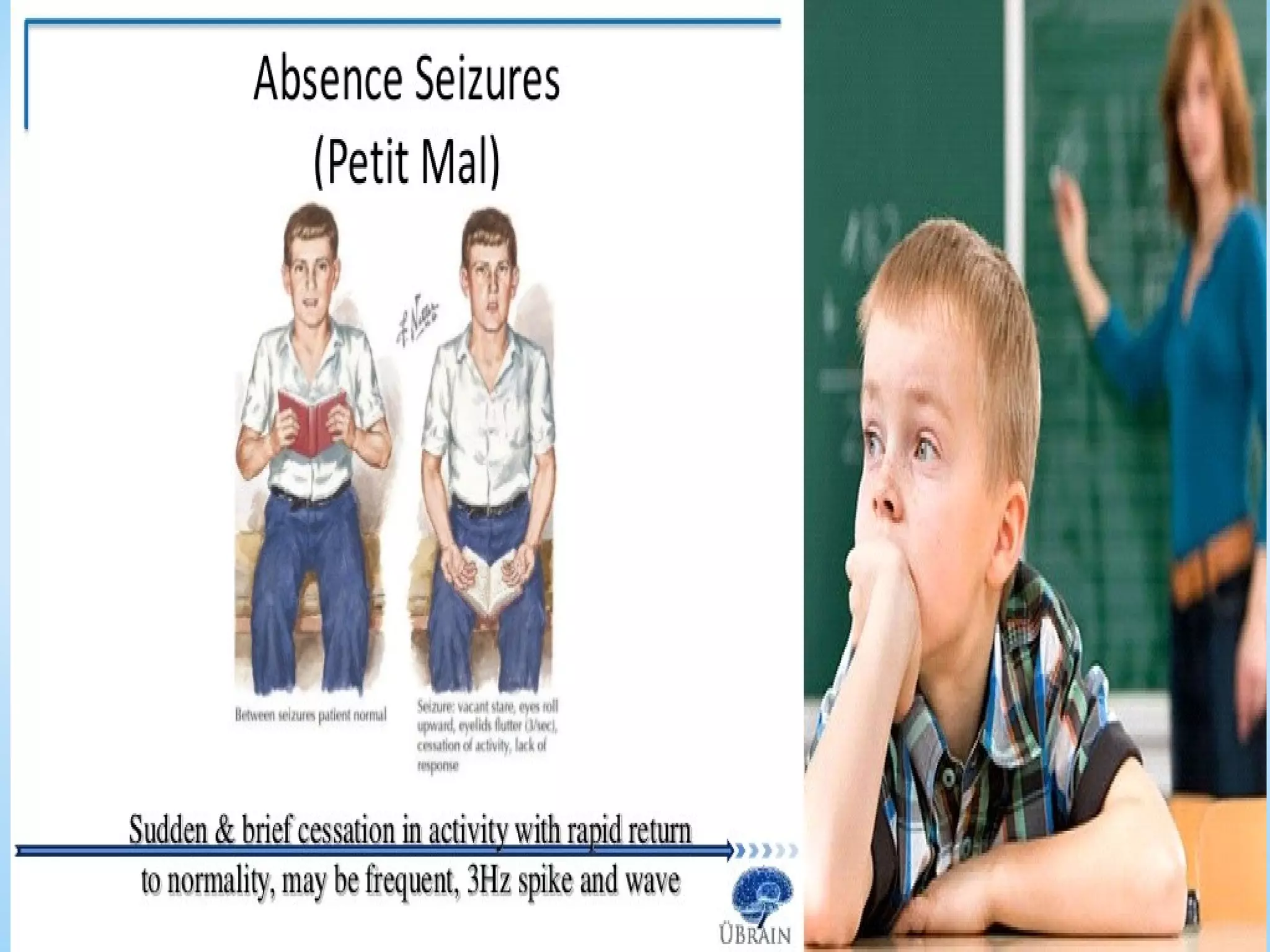
Consist of impairment of
consciousness without loss of
muscles tone and posture.
Often manifest as inattention,
an empty stare or interruption
of speech or motion.
Attacks are often triggered by
hyperventilation.
ABSENCE
SEIZURE
TYPICAL ATYPICAL
*ATYPICAL:
*Characterized by combination of impairment of consciousness and
motor or autonomic changes.
*May have tonic (stiffness) or clonic (jerking) spells or may have
automatism (involuntary behaviour).
*The EEG doesnot have 3/sec spike and wave pattern
absence.wmv
*Absence seizures accompanied by brief, repetitive, often
rhythmic, fast (4-6 Hz) myoclonic jerks of the eyelids with
simultaneous upward deviation of the eyeballs and extension of
the head. Seizures are typically very brief (<6s in duration) and
multiple seizures occur on a daily basis. Mostly awareness is
retained.
*CAUTION If myoclonic seizure with abduction of the upper
limbs  myoclonic absence seizures
*MYOCLONIC ABSENCE
*Rhythmic myoclonic jerks of the shoulders and arms with tonic
abduction that results in progressive lifting of the arms during
the seizure. The myoclonic jerks are typically bilateral but may
be unilateral or asymmetric. Perioral myoclonias and rhythmic
jerks of the head and legs may occur. Seizures last 10-60
seconds and typically occur daily. Level of awareness varies
from complete loss of awareness to retained awareness.
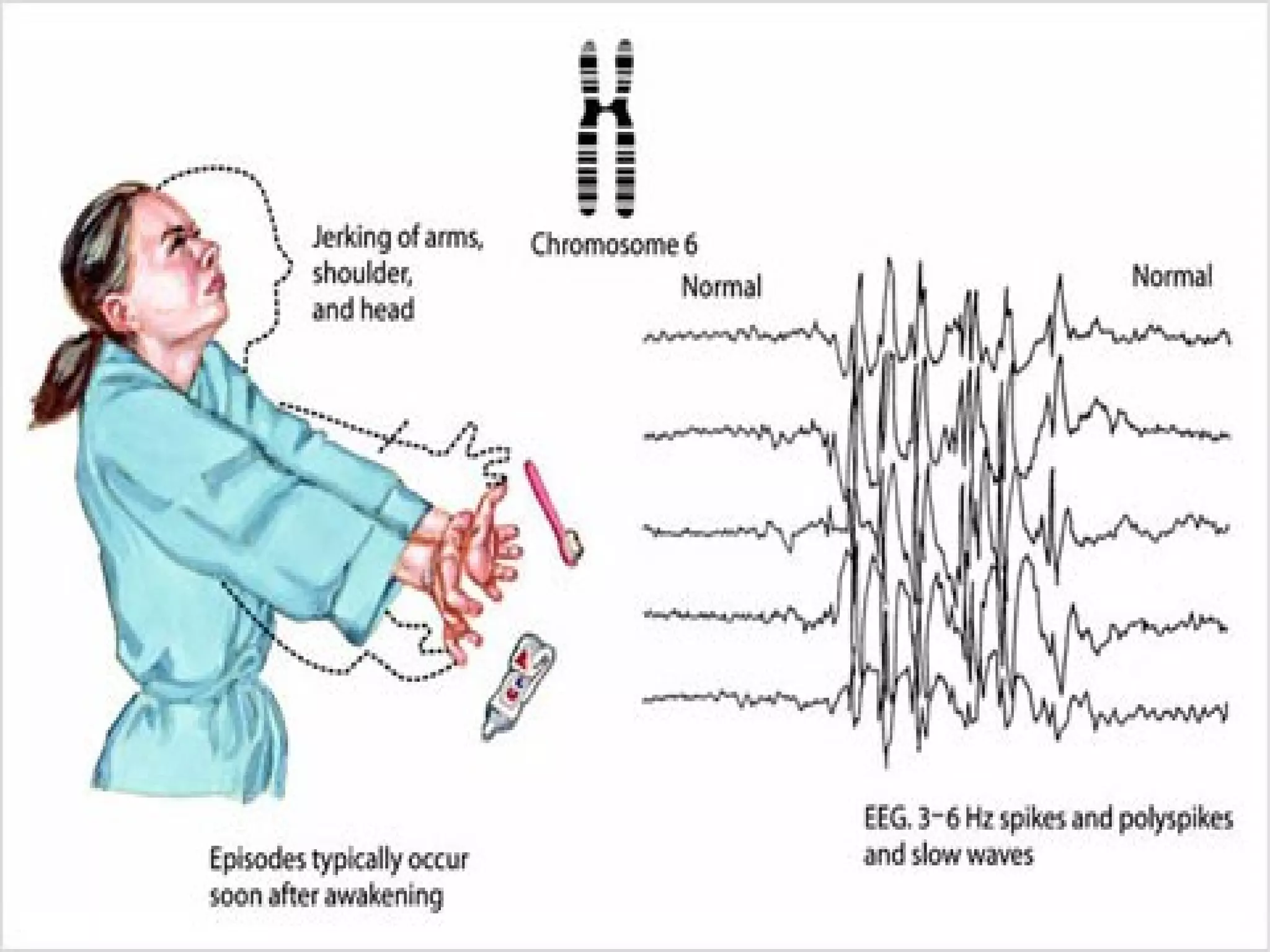
*A myoclonic seizure involves a sudden contraction
of muscles and can appear as a jerk of one or both
arms or sometimes the head.
*Contraction may recurr at irregular or regular
intervals.
*So brief that loss of consciousness cannot be
detected.
*They often happen while falling asleep or within a
short time of waking up.
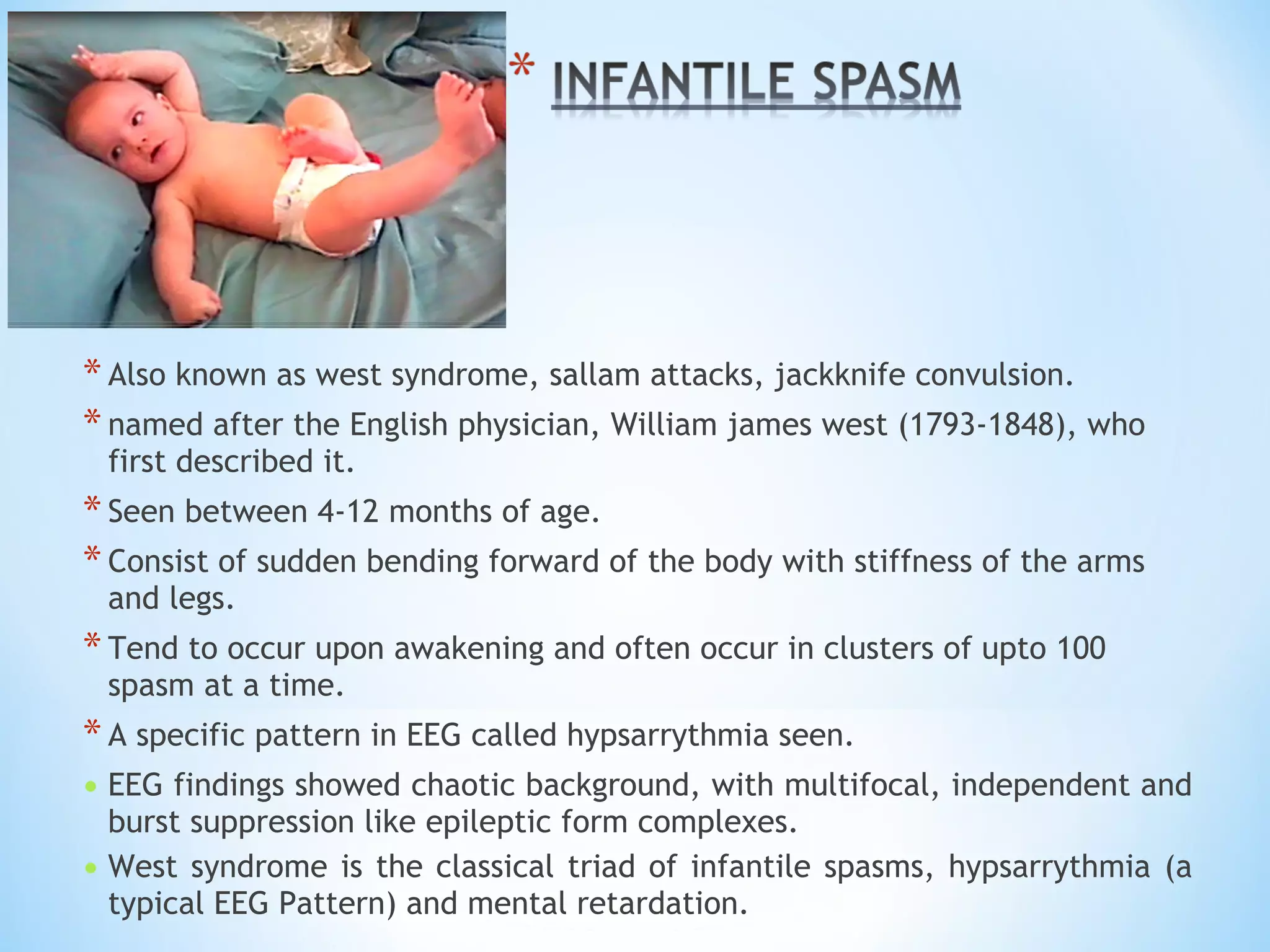
*Also known as west syndrome, sallam attacks, jackknife convulsion.
*named after the English physician, William james west (1793-1848), who
first described it.
*Seen between 4-12 months of age.
*Consist of sudden bending forward of the body with stiffness of the arms
and legs.
*Tend to occur upon awakening and often occur in clusters of upto 100
spasm at a time.
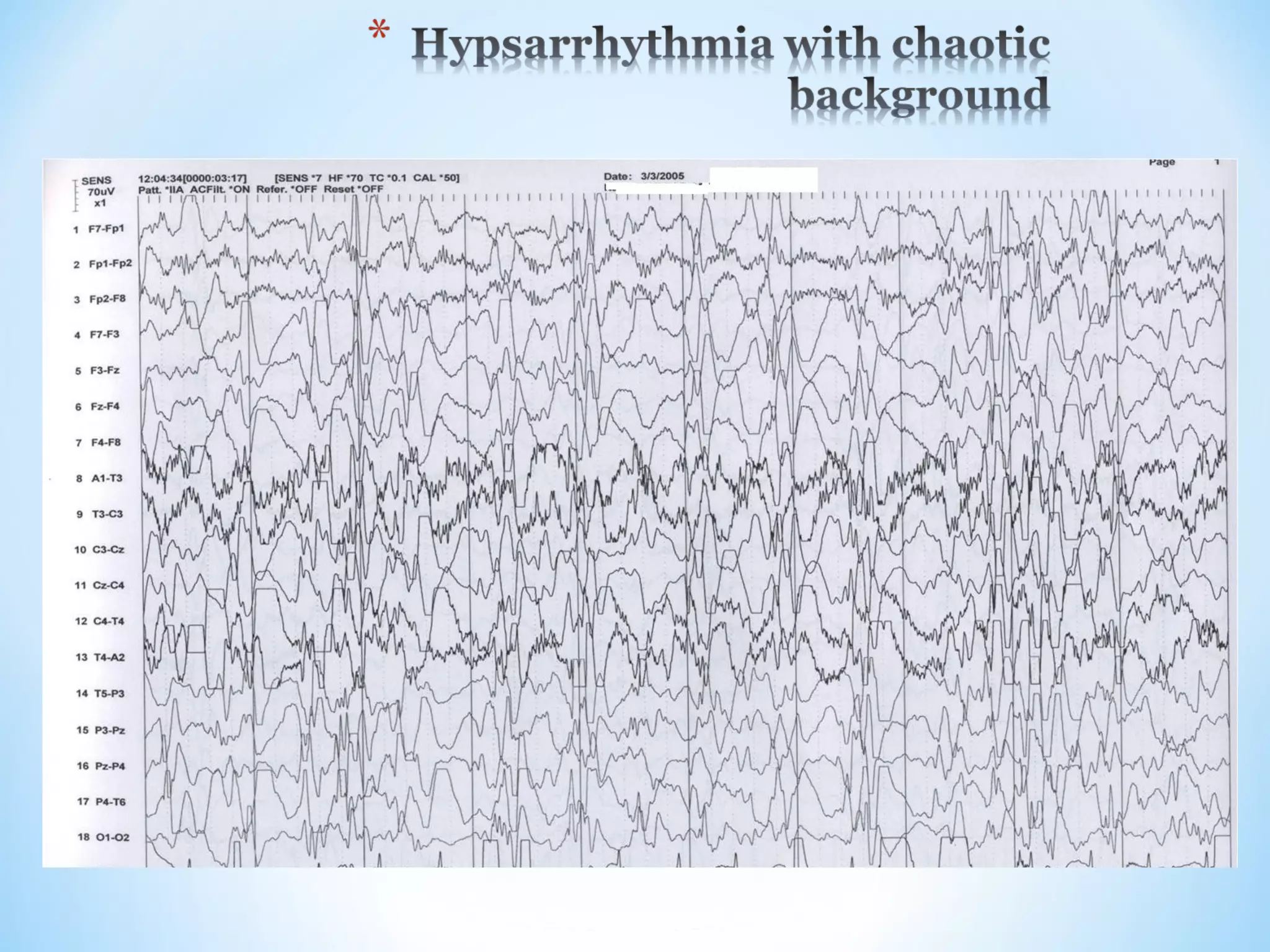
*A specific pattern in EEG called hypsarrythmia seen.
• EEG findings showed chaotic background, with multifocal, independent and
burst suppression like epileptic form complexes.
• West syndrome is the classical triad of infantile spasms, hypsarrythmia (a
typical EEG Pattern) and mental retardation.
infantile.wmv
*Consist of generalized rhythmical myoclonic movements which last
for a minute or more.
*Associated with loss of consciousness.
*Commonly occurs as febrile seizures in childhood.
*EEG findings may include spikes, polyspikes-&-wave complexes
in ictal or interictal period.
TONIC SEIZURE
*Consist of contraction of axial musculature of whole body.
*Last upto 1 minute and associated with loss of consciousness.
*EEG background is often abnormal for age. Rhythmic discharges
are seen in ictal or interictal phase.
*Formerly called ‘grand mal’ seizure.
*Are most severe form and most common type of generalized seizure
in adults.
*Begin suddenly with loss of consciousness, sometimes preceded by a
shrill cry.
*During the initial tonic phase, causing stiffness of body, respiratory
arrest with cyanosis, increased heart rate and blood pressure.
*After 10-20 seconds, this phase is succeeded by clonic phase.
*Now generalized jerky movements of all four limbs occur.
*This clonic phase may result in injury, tongue biting, irregular
respiration and foaming at mouth.
*This clonic phase stops in about 30 seconds and leave the patient in
deep coma from which he gradually recovers.
*Urinary and fecal incontinence may occur in this stage.
*EEG findings may include rhythmic decreasing in frequency and
increasing in amplitude during tonic phase, interrupted by slow
waves during clonic phase.
gtc.wmv
* Consist of sudden loss of
muscles tone.
I) Brief Atonic Seizure:
. Leads to sudden fall or droop
attack.
. Usually last for one or two
seconds.
ii) Long Atonic Seizure:
. Sudden loss of consciousness.
. Fall to floor and remain completely
flaccid for one or several minutes.
ATONIC
SEIZURES
BRIEF ATONIC
SEIZURES
LONG ATONIC
SEIZURES
*A prolonged seizure lasts approximately five minutes longer than
the person’s normal state of seizure.
*This should be regarded as an emergency until proven otherwise. A
prolonged seizure might graduate to status epilepticus.
STATUS EPILEPTICUS
*A condition when consciousness does not return between seizures
for more than 30 min. This state may be life-threatening with the
development of pyrexia, deepening coma and circullatory collapse.
Death occurs in 5-10%.
*Status epilepticus is a Medical Emergency.
*a duration of 5 minutes of continuous generalized convulsive
activity is used arbitrarily as part of the definition of status
epilepticus.
*For a third of epilepsies, the etiology may remain unknown
and the epilepsies may not have distinct clinical and electrical
features that allow organization by epilepsy syndromes. It is in
this group of disorders that more specific phenotyping or time
to observe the evolution of the patient's epilepsy may lead to
the emergence of subgroups for which an etiological diagnosis
can be found.
Classification of seizures

Classification of seizures

  • 1.
  • 2.
    Definition Classification of seizures Partialseizures Simple partial and complex partial seizures Complex partial seizure to sec gen Generalized seizures Absence seizures (Typical, Atypical, eyelid myoclonia, Myoclonic absence) Myoclonic Clonic Tonic Tonic clonic Atonic Unclassified seizures REFERENCES
  • 3.
    SEIZURES Seizures are episodeof sudden disturbance of mental, motor, sensory or autonomic activity caused by a paroxysmal cerebral malfunction. CONVULSIONS Convulsions are violent involuntary contractions of the body musculature. In neurology, the term is usually limited to contractions produced by cerebral seizure activity.
  • 4.
    EPILEPSY A chronic neurologicdisorder manifesting by repeated epileptic seizures (attacks or fits) which result from paroxysmal uncontrolled discharges of neurons within the central nervous system. Epileptic prodrome:- Its change in mode or behavior before the seizure and could be in hours or days before the seizure event. AURA: It’s the initial event, signaling the beginning of seizures. ICTAL or ICTUS: It’s a synonym word for seizure. POST ICTAL: It’s a period after seizure, usually lasting longer than the seizure itself.

  • 5.
    Interictal period:- It’s thetime period between two successive seizure events.   Status Epilepticus:- 1. It is described as the recurrence of seizures by intervals too short to allow recovery of the condition that existed before the onset of the seizures. 2. *An episode of more than 05 minutes of continuous seizure activity, or 3.*Two or more sequential seizures spanning this period without full recovery between seizures. (AES)
  • 6.
    • The seizersclassification being most widely used is proposed by the Commission on classification and Terminology of the International League Against Epilepsy(ILAE). • Classification is necessary for;  New terms & concepts with internationally accepted terminology  Standardization of the seizures types description  New concepts regarding Focal and generalized seizures  Better adaptation of etiological terms  Electro-clinical diagnosis for seizures etc
  • 8.
    • HOW TORECOGNIZE SEIZURES:- •  Anatomical (patient history help us to locate the origin of discharge ) • Pathological (infections or lesions help us to reorganization of Sz) • Clinical (by self observation during seizure) • Electro diagnostically (by the help of EEG+VEEG recording)
  • 10.
    *Also known asfocal seizures. *These seizures are restricted to part of the brain and produce symptoms involving those body parts or mental functions which are most affected by the area of seizure involvement. PARTIAL SEIZURES SIMPLE PARTIAL SEIZURES COMPLEX PARTIAL SEIZURES

  • 11.
    These seizures producefocal motor, sensory, autonomic, mixed or psychic symptoms without change of consciousness. (a) Partial seizure with motor symptoms: i. Focal motor seizures consist of sustained tonic contractions or intermitent clonic contraction. They involve the face, one part of the limb or half of the body. ii. Jacksonian seizures are focal motor seizures which involve adjacent part on one side of the body during seizure. This march is due to the spread of seizure activity over adjacent parts of motor cortex.
  • 12.
    iii. Versive seizurecause turning of the body, usually in a direction towards the side of the seizure. iv. Aphasic seizure are characterized by expressive or global loss of language. They result from seizure activity in language area.
  • 14.
  • 15.
    (b) Partial seizureswith sensory symptoms: i. Somatosensory seizure produce sudden sensation such as tingling, heaviness, numbness or burning which, like motor symptoms, either remain in one part of the body or march over parts. ii. Visual seizure produce hallucination of white or coloured simple shapes, for instance stars and flashes or alteration of visual perception. iii. Auditory seizures cause hallucination of simple sounds. iv. Olfactory seizures produce hallucination of odors. v. Gustatory seizure consist hallucination of taste.
  • 16.
    (c) Partial seizurewith autonomic symptoms: are rarely seen in isolation. Symptoms consist of salivation, perspiration, changes in pupillary size, heart beat, respiration, urinary and epigastric discomfort.
  • 18.
    * Psychic aurasoften originate from the temporal lobe, associated with simple partial seizures: *Psychic Aura Definition *Déjà vu: An illusion of a familiar memory *Jamais vu: When what should be a familiar visual experience becomes unfamiliar *Déjà entendu: An auditory illusion of something familiar *Jamais entendu: When what should be a familiar auditory experience becomes unfamiliar Autoscopy: Seeing oneself in external space, as if the mind has left the body *Derealization: A feeling of unreality of the outside world; the world seems strange and unreal. *Depersonalization: A feeling of unreality in one’s sense of self; feeling as if in a dream or watching oneself act *Macro-/Micropsia: Objects appear larger or smaller than usual *Macr-/Micracusia: Sounds are louder or softer than usual
  • 19.
    *An epileptic disordercan be symptomatic, idiopathic, or cryptogenic. *Symptomatic is a term that means the etiology is known— usually a structural lesion within the brain. Idiopathic is a term that refers to an epilepsy of presumed genetic etiology without a structural brain *lesion or other neurological signs or symptoms. The term has been replace by “genetic” * Cryptogenic is a term that refers to an *epilepsy that is presumed to be symptomatic but the etiology is unknown (1989). The term *cryptogenic has been replaced by “probably symptomatic” *The observable manifestation of the seizures, is known as semiology.
  • 20.
     Often calledtemporal lobe seizures because they arise from foci in the mesial and inferior part of temporal lobe or adjacent part of frontal lobe. Symptoms often consist of changes of consciousness which reduce the ability of patient to interact with their surrounding, complete loss of consciousness is not a primary symptoms. Consist of repetitive movements which seem purposeful but they are unpurposeful. E.g, scratching, chewing, swallowing and lips smacking. In general patient have no recollection or only incomplete memory of events at the onset of seizure such as awareness of bad odour. (Aura).
  • 21.
  • 23.
    *These seizure beginlike other partial seizures, they then evolve into generalized seizure. *These seizures are usually symmetrical tonic-clonic but may be asymmetrical tonic or clonic. *The partial onset of generalized seizure maybe remembered by the patient.
  • 24.
    GENERALIZED SEIZURE 1)ABSENCE SEIZURE 2) MYOCLONIC SEIZURE 3) INFANTILE SPASM 4)CLONIC SEIZURE 5) TONIC SEIZURE 6) TONIC CLONIC SEIZURE 7) ATONIC SEIZURE
  • 25.
    Formerly called ‘petitmal’ seizure. Usually occur in childhood and rarely persist into adulthood. Usually b/w 4&12 yrs age. TYPICAL: Consist of impairment of consciousness without loss of muscles tone and posture. Often manifest as inattention, an empty stare or interruption of speech or motion. Attacks are often triggered by hyperventilation. ABSENCE SEIZURE TYPICAL ATYPICAL
  • 27.
    *ATYPICAL: *Characterized by combinationof impairment of consciousness and motor or autonomic changes. *May have tonic (stiffness) or clonic (jerking) spells or may have automatism (involuntary behaviour). *The EEG doesnot have 3/sec spike and wave pattern
  • 28.
  • 29.
    *Absence seizures accompaniedby brief, repetitive, often rhythmic, fast (4-6 Hz) myoclonic jerks of the eyelids with simultaneous upward deviation of the eyeballs and extension of the head. Seizures are typically very brief (<6s in duration) and multiple seizures occur on a daily basis. Mostly awareness is retained. *CAUTION If myoclonic seizure with abduction of the upper limbs  myoclonic absence seizures *MYOCLONIC ABSENCE *Rhythmic myoclonic jerks of the shoulders and arms with tonic abduction that results in progressive lifting of the arms during the seizure. The myoclonic jerks are typically bilateral but may be unilateral or asymmetric. Perioral myoclonias and rhythmic jerks of the head and legs may occur. Seizures last 10-60 seconds and typically occur daily. Level of awareness varies from complete loss of awareness to retained awareness.
  • 30.
    *A myoclonic seizureinvolves a sudden contraction of muscles and can appear as a jerk of one or both arms or sometimes the head. *Contraction may recurr at irregular or regular intervals. *So brief that loss of consciousness cannot be detected. *They often happen while falling asleep or within a short time of waking up.
  • 32.
    *Also known aswest syndrome, sallam attacks, jackknife convulsion. *named after the English physician, William james west (1793-1848), who first described it. *Seen between 4-12 months of age. *Consist of sudden bending forward of the body with stiffness of the arms and legs. *Tend to occur upon awakening and often occur in clusters of upto 100 spasm at a time. *A specific pattern in EEG called hypsarrythmia seen. • EEG findings showed chaotic background, with multifocal, independent and burst suppression like epileptic form complexes. • West syndrome is the classical triad of infantile spasms, hypsarrythmia (a typical EEG Pattern) and mental retardation.
  • 34.
  • 35.
    *Consist of generalizedrhythmical myoclonic movements which last for a minute or more. *Associated with loss of consciousness. *Commonly occurs as febrile seizures in childhood. *EEG findings may include spikes, polyspikes-&-wave complexes in ictal or interictal period. TONIC SEIZURE *Consist of contraction of axial musculature of whole body. *Last upto 1 minute and associated with loss of consciousness. *EEG background is often abnormal for age. Rhythmic discharges are seen in ictal or interictal phase.
  • 36.
    *Formerly called ‘grandmal’ seizure. *Are most severe form and most common type of generalized seizure in adults. *Begin suddenly with loss of consciousness, sometimes preceded by a shrill cry. *During the initial tonic phase, causing stiffness of body, respiratory arrest with cyanosis, increased heart rate and blood pressure. *After 10-20 seconds, this phase is succeeded by clonic phase. *Now generalized jerky movements of all four limbs occur. *This clonic phase may result in injury, tongue biting, irregular respiration and foaming at mouth. *This clonic phase stops in about 30 seconds and leave the patient in deep coma from which he gradually recovers. *Urinary and fecal incontinence may occur in this stage. *EEG findings may include rhythmic decreasing in frequency and increasing in amplitude during tonic phase, interrupted by slow waves during clonic phase.
  • 37.
  • 38.
    * Consist ofsudden loss of muscles tone. I) Brief Atonic Seizure: . Leads to sudden fall or droop attack. . Usually last for one or two seconds. ii) Long Atonic Seizure: . Sudden loss of consciousness. . Fall to floor and remain completely flaccid for one or several minutes. ATONIC SEIZURES BRIEF ATONIC SEIZURES LONG ATONIC SEIZURES
  • 40.
    *A prolonged seizurelasts approximately five minutes longer than the person’s normal state of seizure. *This should be regarded as an emergency until proven otherwise. A prolonged seizure might graduate to status epilepticus. STATUS EPILEPTICUS *A condition when consciousness does not return between seizures for more than 30 min. This state may be life-threatening with the development of pyrexia, deepening coma and circullatory collapse. Death occurs in 5-10%. *Status epilepticus is a Medical Emergency. *a duration of 5 minutes of continuous generalized convulsive activity is used arbitrarily as part of the definition of status epilepticus.
  • 41.
    *For a thirdof epilepsies, the etiology may remain unknown and the epilepsies may not have distinct clinical and electrical features that allow organization by epilepsy syndromes. It is in this group of disorders that more specific phenotyping or time to observe the evolution of the patient's epilepsy may lead to the emergence of subgroups for which an etiological diagnosis can be found.