SABA KHAN
4640
What Does Regression Mean?
A statistical measure that attempts to determine the
  strength of the relationship between one dependent
  variable (usually denoted by Y) and a series of other
  changing variables (knownas independent
 variables).
 Linear Regression: Y = a + bX + u
Working Area of Regression
Analysis
 Engineering
 Physical and Chemical Science
 Economics
 Management Science
 Biological Science
 Social Science
Why we use regression analysis?
 Regression analysis is a
  statistical tool for the
  investigation of relationships
  between variables.
 Usually, the investigator seeks
  to ascertain the causal effect of
  one variable upon another
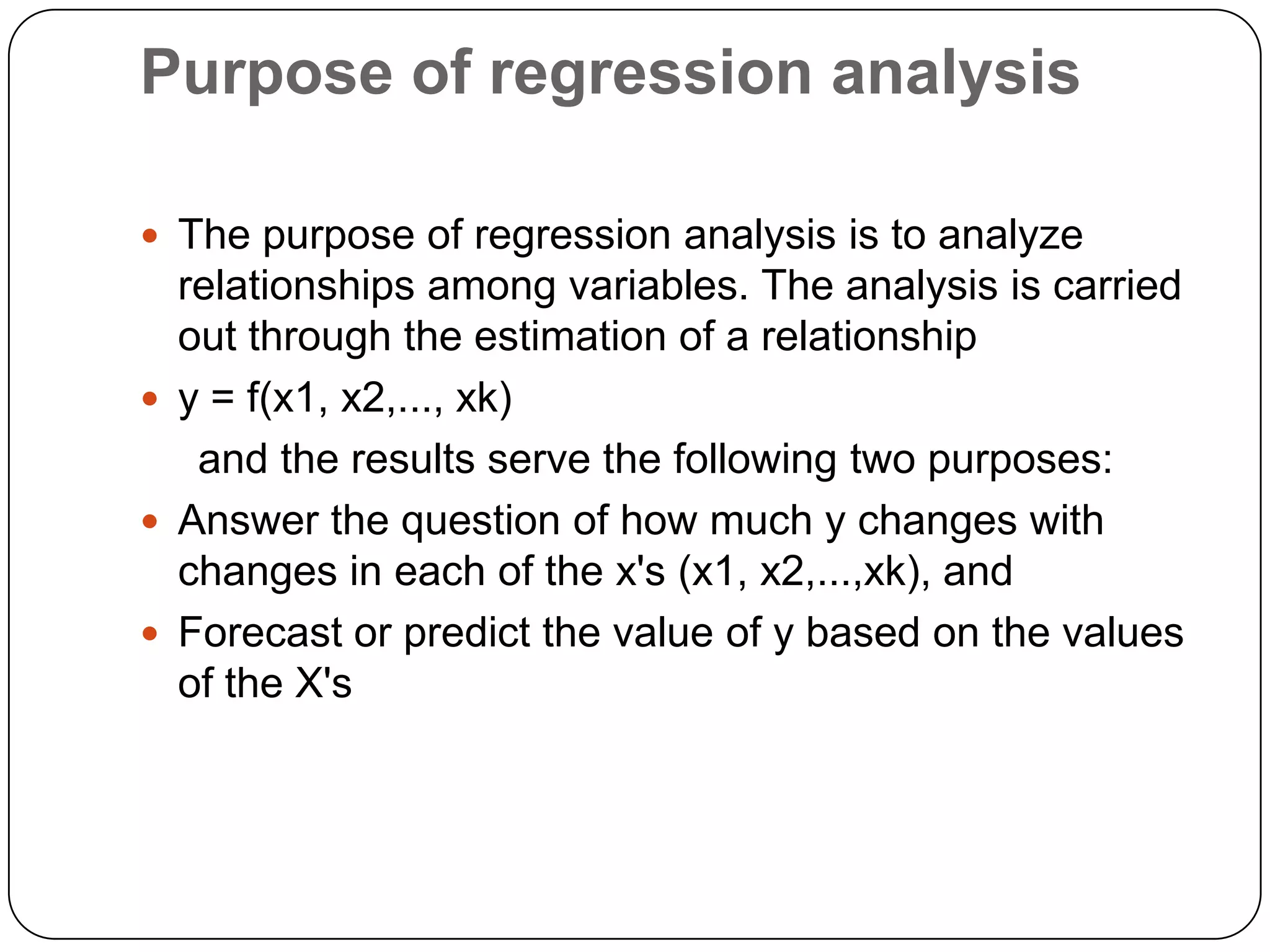
Purpose of regression analysis

 The purpose of regression analysis is to analyze
  relationships among variables. The analysis is carried
  out through the estimation of a relationship
 y = f(x1, x2,..., xk)
   and the results serve the following two purposes:
 Answer the question of how much y changes with
  changes in each of the x's (x1, x2,...,xk), and
 Forecast or predict the value of y based on the values
  of the X's
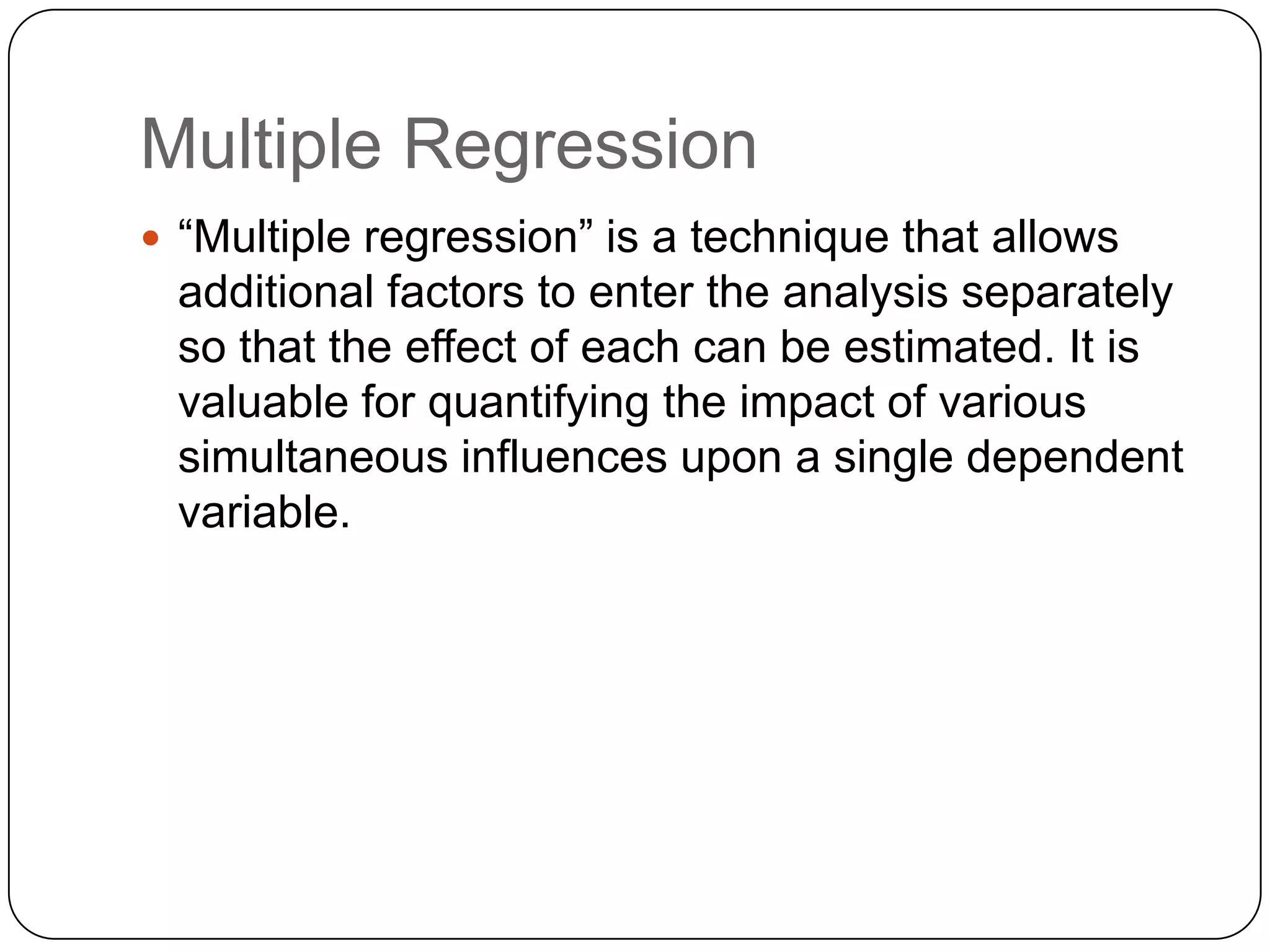
Multiple Regression
 “Multiple regression” is a technique that allows
 additional factors to enter the analysis separately
 so that the effect of each can be estimated. It is
 valuable for quantifying the impact of various
 simultaneous influences upon a single dependent
 variable.
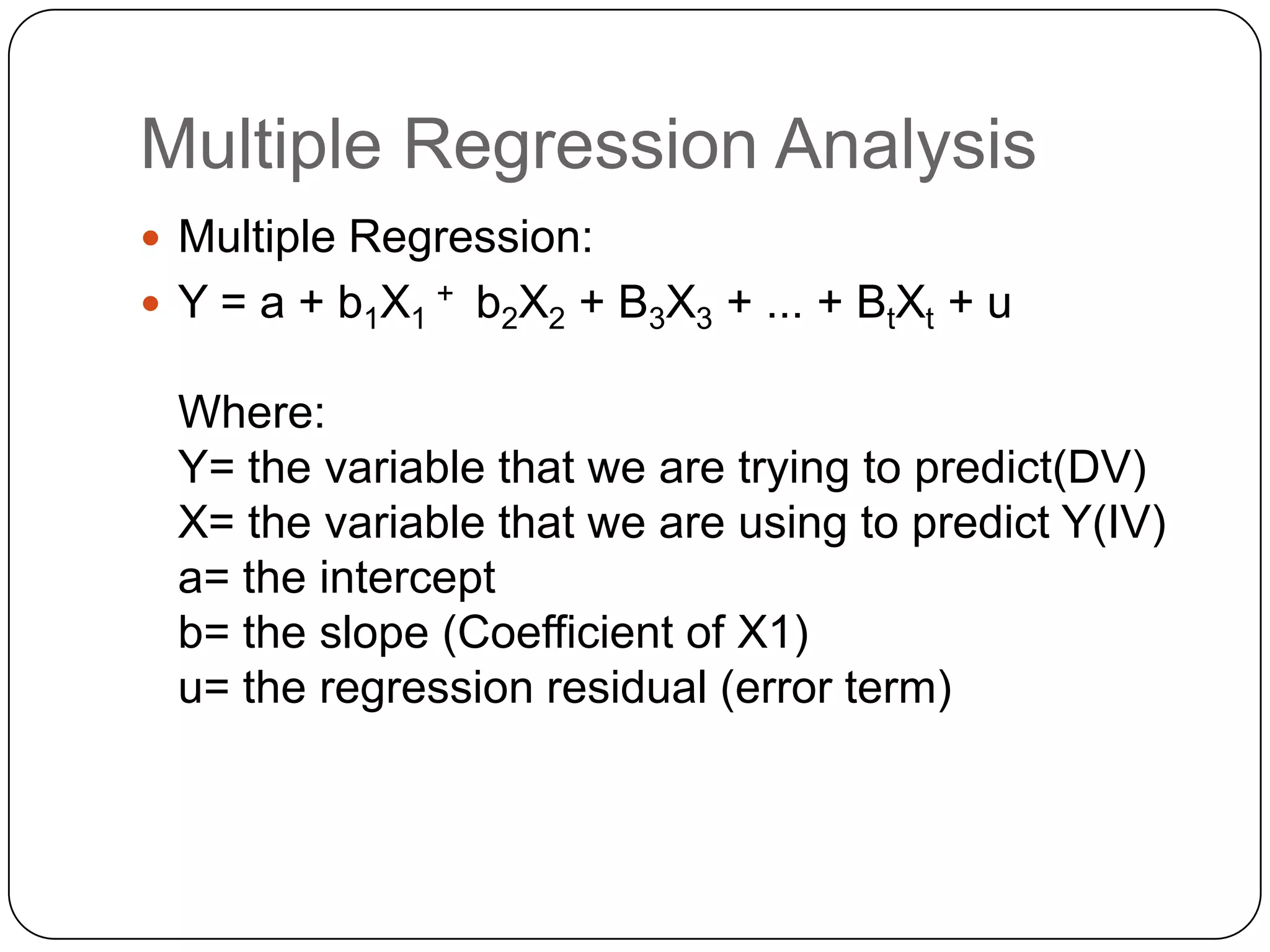
Multiple Regression Analysis
 Multiple Regression:
 Y = a + b1X1 + b2X2 + B3X3 + ... + BtXt + u

 Where:
 Y= the variable that we are trying to predict(DV)
 X= the variable that we are using to predict Y(IV)
 a= the intercept
 b= the slope (Coefficient of X1)
 u= the regression residual (error term)
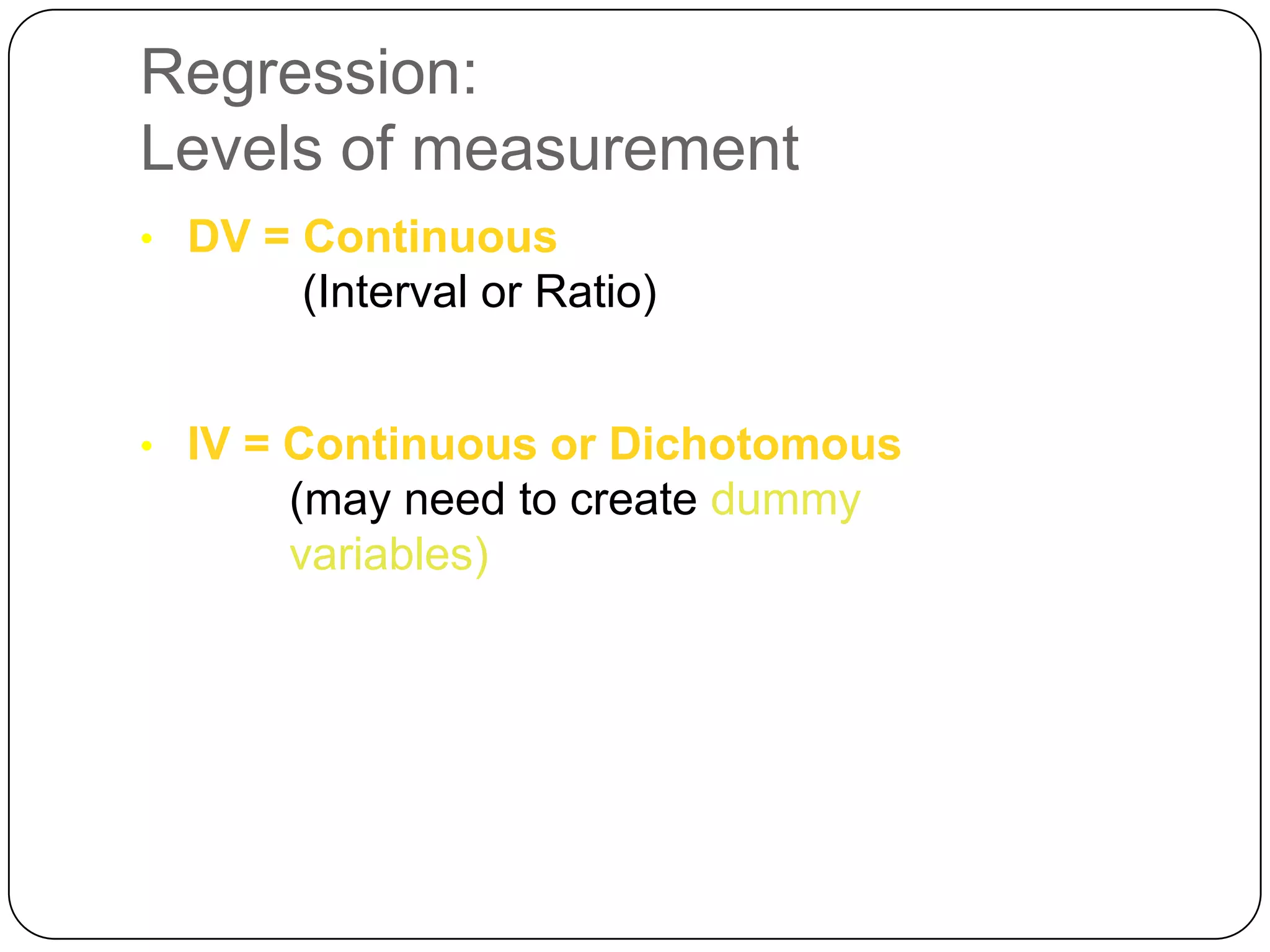
Regression:
Levels of measurement
• DV = Continuous
      (Interval or Ratio)


• IV = Continuous or Dichotomous
      (may need to create dummy
      variables)
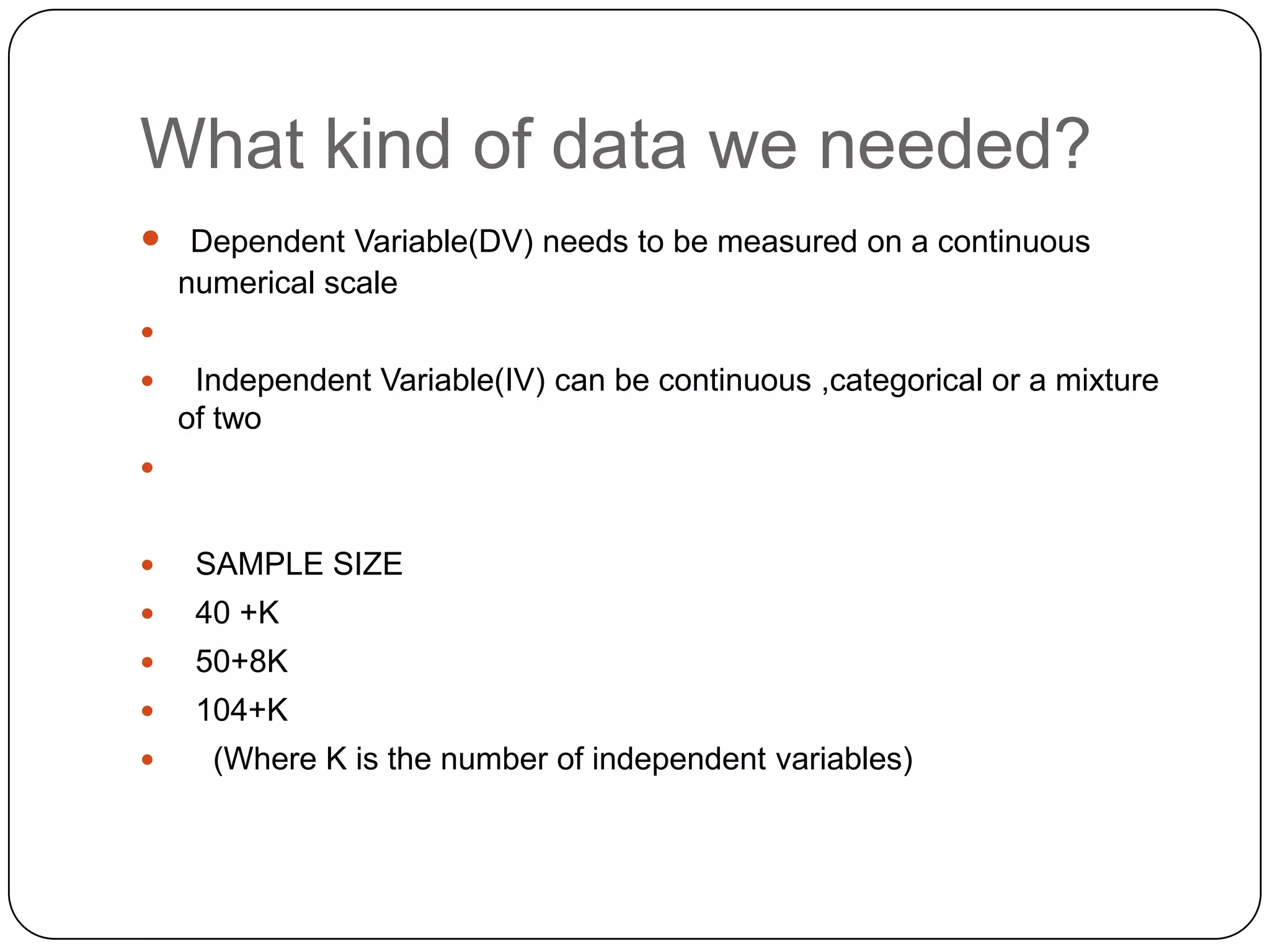
What kind of data we needed?
 Dependent Variable(DV) needs to be measured on a continuous
    numerical scale

    Independent Variable(IV) can be continuous ,categorical or a mixture
    of two



    SAMPLE SIZE
    40 +K
    50+8K
    104+K
     (Where K is the number of independent variables)
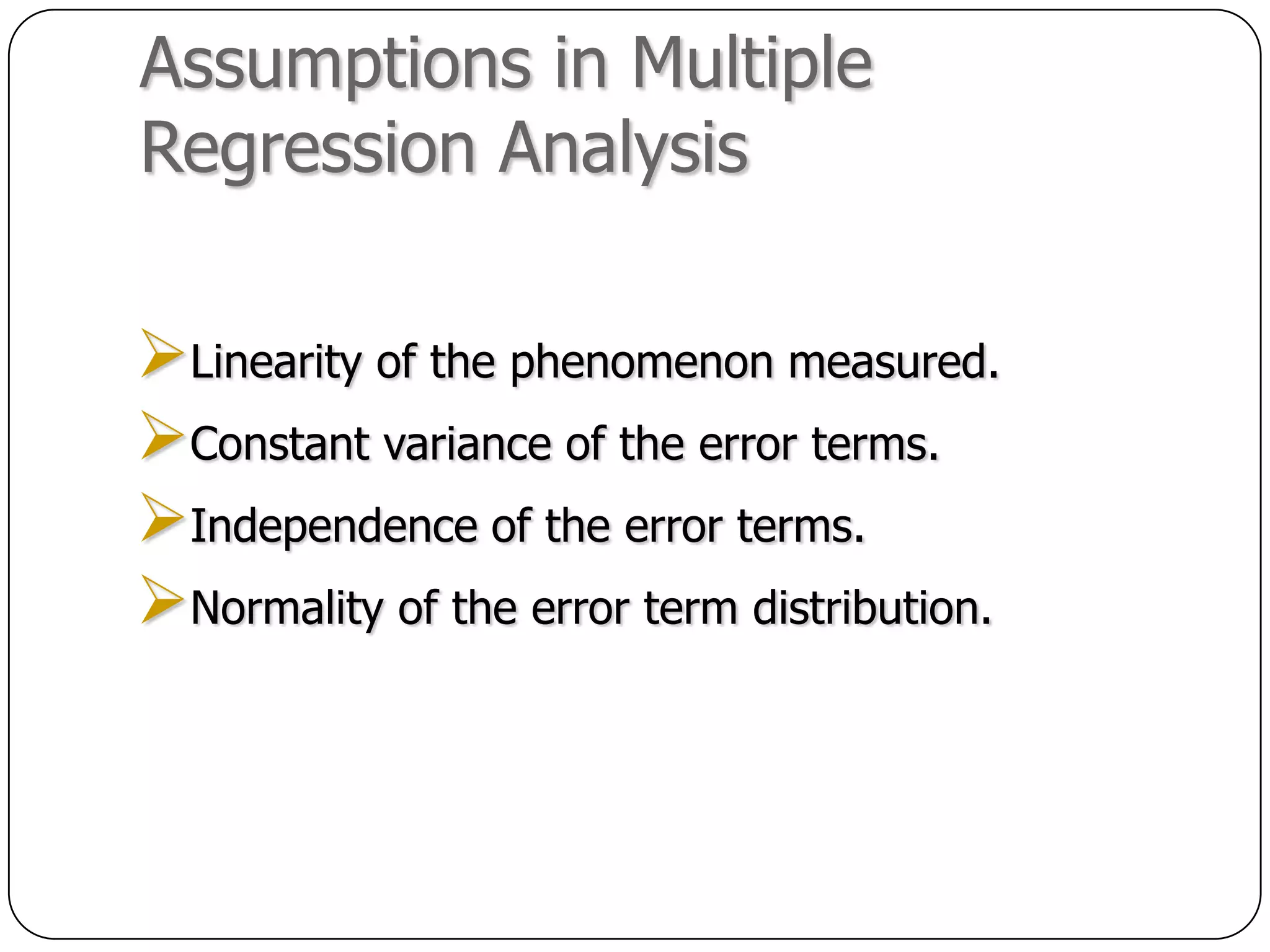
Assumptions in Multiple
Regression Analysis

Linearity of the phenomenon measured.
Constant variance of the error terms.
Independence of the error terms.
Normality of the error term distribution.
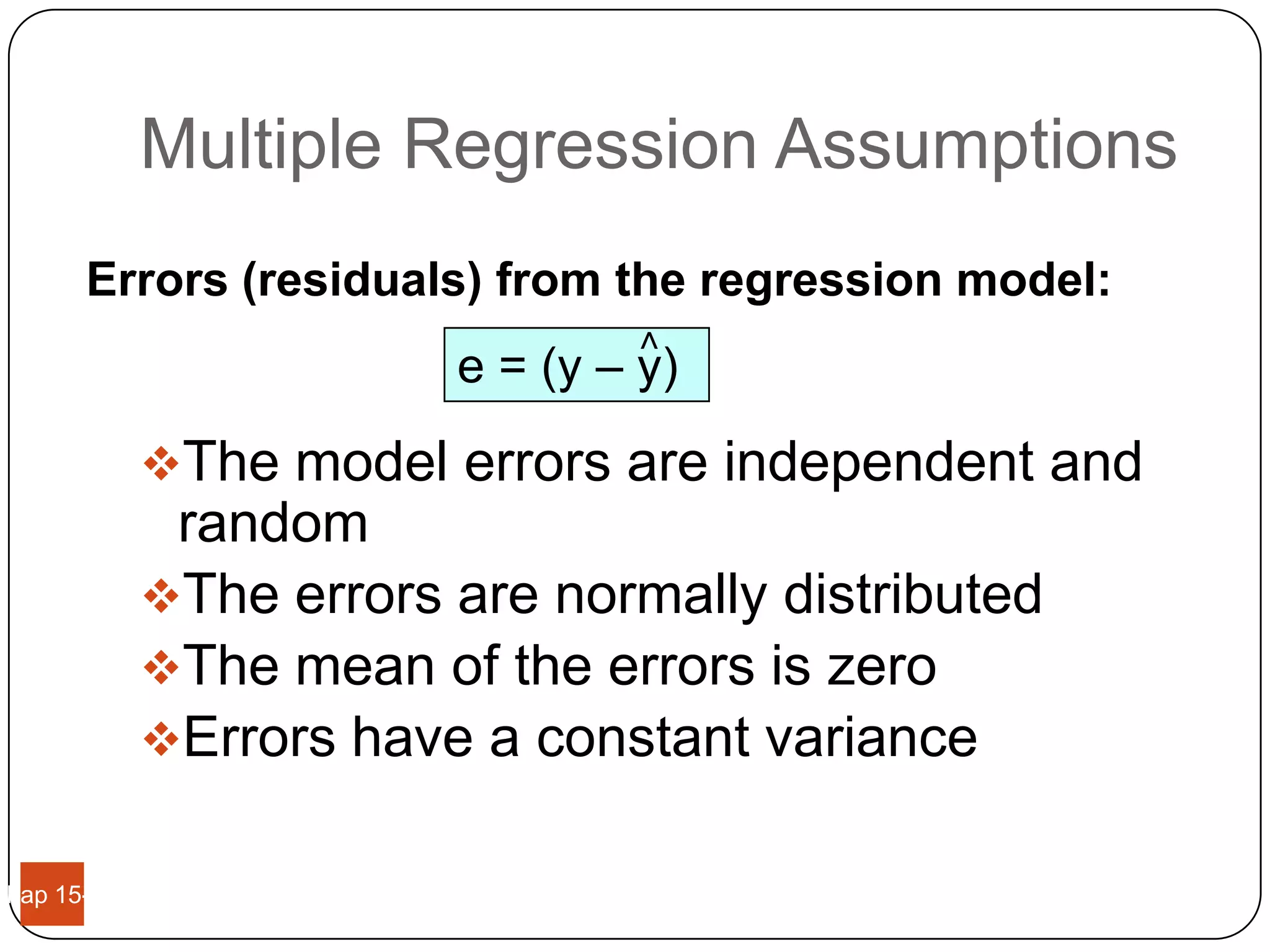
Multiple Regression Assumptions
       Errors (residuals) from the regression model:


                                 <
                         e = (y – y)
             The model errors are independent and
              random
             The errors are normally distributed
             The mean of the errors is zero
             Errors have a constant variance


Chap 15-11
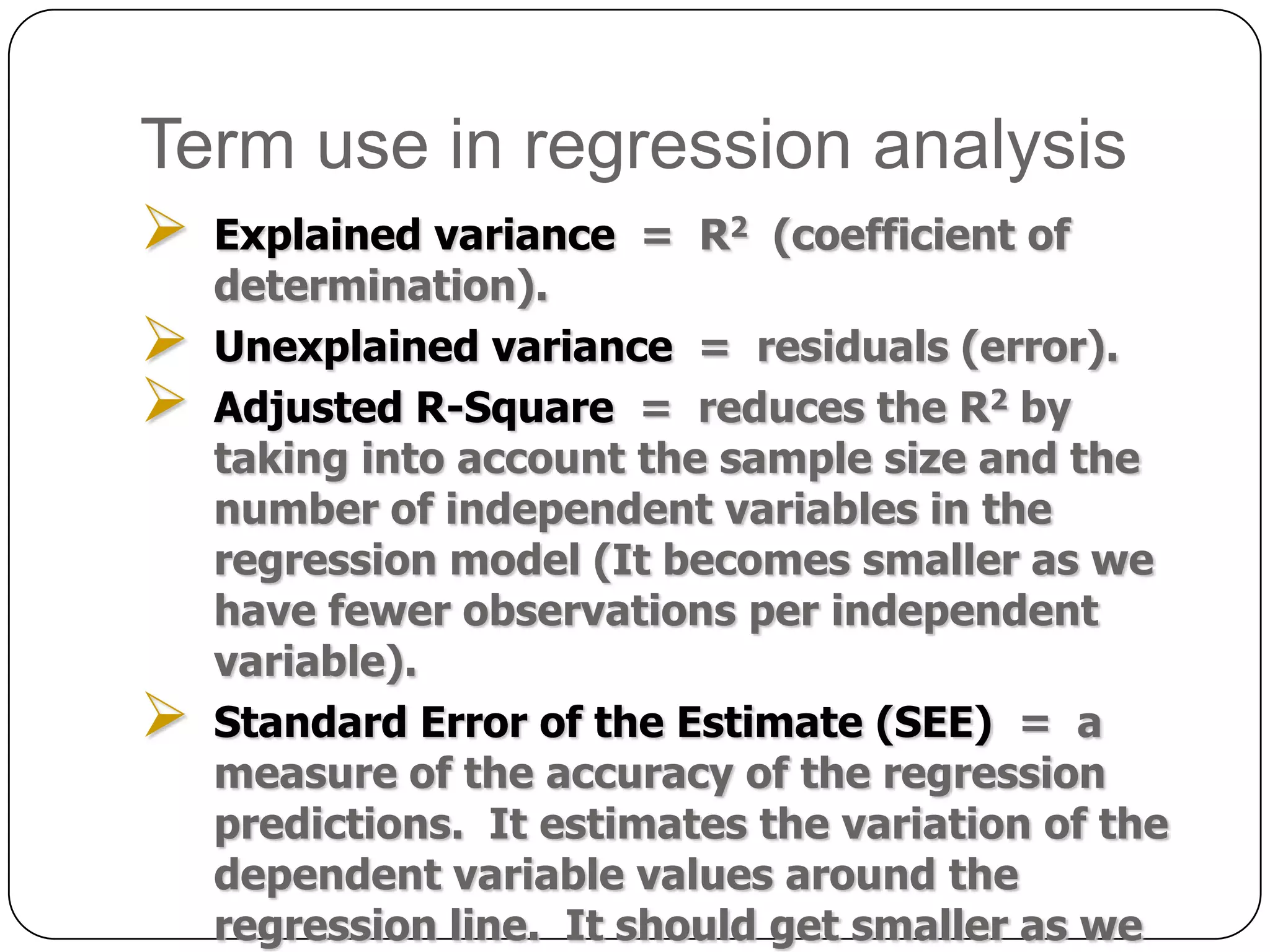
Term use in regression analysis
   Explained variance = R2 (coefficient of
    determination).
   Unexplained variance = residuals (error).
   Adjusted R-Square = reduces the R2 by
    taking into account the sample size and the
    number of independent variables in the
    regression model (It becomes smaller as we
    have fewer observations per independent
    variable).
   Standard Error of the Estimate (SEE) = a
    measure of the accuracy of the regression
    predictions. It estimates the variation of the
    dependent variable values around the
    regression line. It should get smaller as we
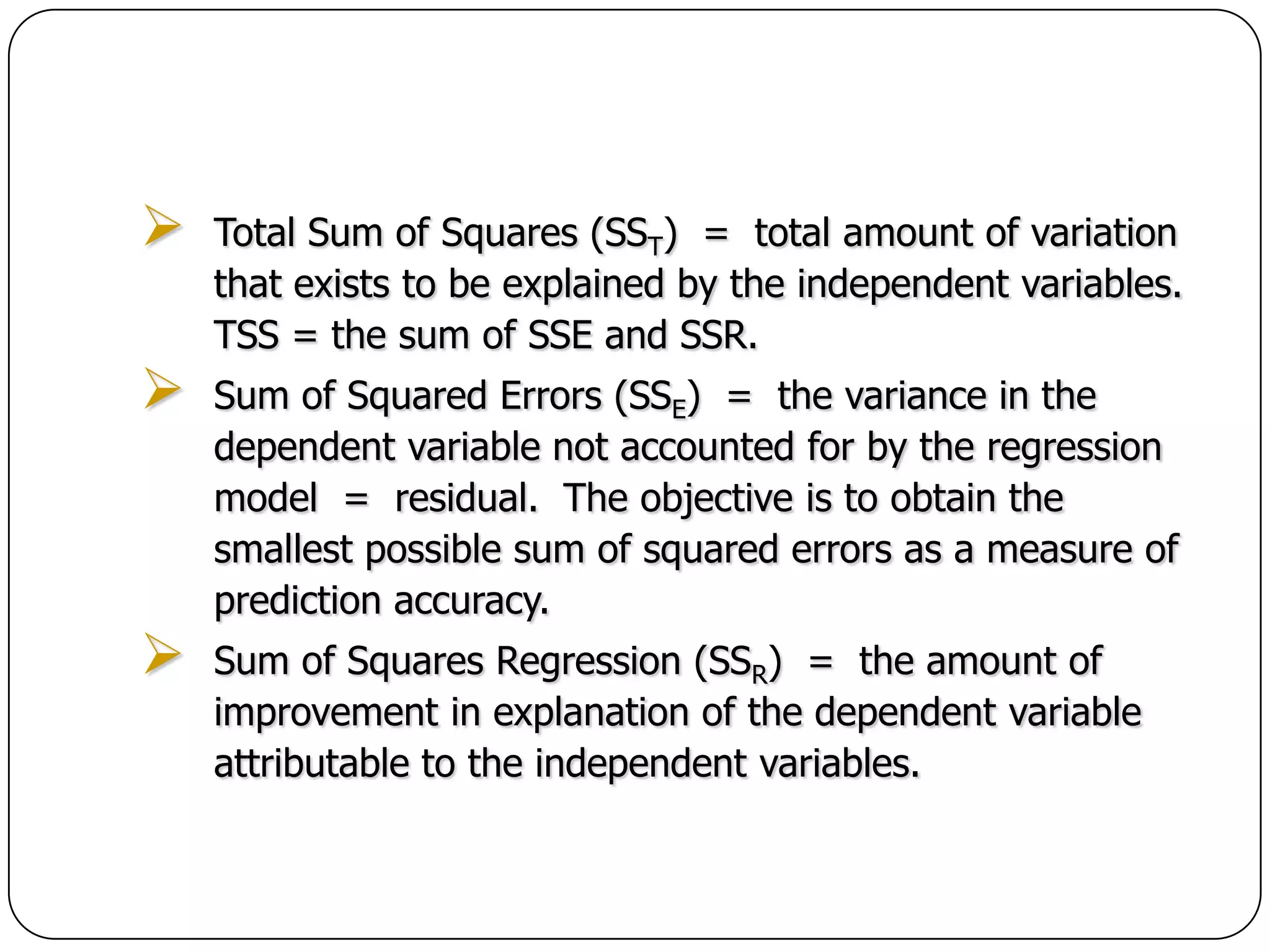
   Total Sum of Squares (SST) = total amount of variation
    that exists to be explained by the independent variables.
    TSS = the sum of SSE and SSR.
   Sum of Squared Errors (SSE) = the variance in the
    dependent variable not accounted for by the regression
    model = residual. The objective is to obtain the
    smallest possible sum of squared errors as a measure of
    prediction accuracy.
   Sum of Squares Regression (SSR) = the amount of
    improvement in explanation of the dependent variable
    attributable to the independent variables.
SPSS
 Now we will show in SPSS

Regression analysis

  • 1.
  • 2.
    What Does RegressionMean? A statistical measure that attempts to determine the strength of the relationship between one dependent variable (usually denoted by Y) and a series of other changing variables (knownas independent variables). Linear Regression: Y = a + bX + u
  • 3.
    Working Area ofRegression Analysis  Engineering  Physical and Chemical Science  Economics  Management Science  Biological Science  Social Science
  • 4.
    Why we useregression analysis?  Regression analysis is a statistical tool for the investigation of relationships between variables.  Usually, the investigator seeks to ascertain the causal effect of one variable upon another
  • 5.
    Purpose of regressionanalysis  The purpose of regression analysis is to analyze relationships among variables. The analysis is carried out through the estimation of a relationship  y = f(x1, x2,..., xk) and the results serve the following two purposes:  Answer the question of how much y changes with changes in each of the x's (x1, x2,...,xk), and  Forecast or predict the value of y based on the values of the X's
  • 6.
    Multiple Regression  “Multipleregression” is a technique that allows additional factors to enter the analysis separately so that the effect of each can be estimated. It is valuable for quantifying the impact of various simultaneous influences upon a single dependent variable.
  • 7.
    Multiple Regression Analysis Multiple Regression:  Y = a + b1X1 + b2X2 + B3X3 + ... + BtXt + u Where: Y= the variable that we are trying to predict(DV) X= the variable that we are using to predict Y(IV) a= the intercept b= the slope (Coefficient of X1) u= the regression residual (error term)
  • 8.
    Regression: Levels of measurement •DV = Continuous (Interval or Ratio) • IV = Continuous or Dichotomous (may need to create dummy variables)
  • 9.
    What kind ofdata we needed?  Dependent Variable(DV) needs to be measured on a continuous numerical scale   Independent Variable(IV) can be continuous ,categorical or a mixture of two   SAMPLE SIZE  40 +K  50+8K  104+K  (Where K is the number of independent variables)
  • 10.
    Assumptions in Multiple RegressionAnalysis Linearity of the phenomenon measured. Constant variance of the error terms. Independence of the error terms. Normality of the error term distribution.
  • 11.
    Multiple Regression Assumptions Errors (residuals) from the regression model: < e = (y – y) The model errors are independent and random The errors are normally distributed The mean of the errors is zero Errors have a constant variance Chap 15-11
  • 12.
    Term use inregression analysis  Explained variance = R2 (coefficient of determination).  Unexplained variance = residuals (error).  Adjusted R-Square = reduces the R2 by taking into account the sample size and the number of independent variables in the regression model (It becomes smaller as we have fewer observations per independent variable).  Standard Error of the Estimate (SEE) = a measure of the accuracy of the regression predictions. It estimates the variation of the dependent variable values around the regression line. It should get smaller as we
  • 13.
    Total Sum of Squares (SST) = total amount of variation that exists to be explained by the independent variables. TSS = the sum of SSE and SSR.  Sum of Squared Errors (SSE) = the variance in the dependent variable not accounted for by the regression model = residual. The objective is to obtain the smallest possible sum of squared errors as a measure of prediction accuracy.  Sum of Squares Regression (SSR) = the amount of improvement in explanation of the dependent variable attributable to the independent variables.
  • 14.
    SPSS  Now wewill show in SPSS

Editor's Notes

  • #3  The two basic types of regression are linear regression and multiple regression. Linear regression uses one independent variable to explain and/or predict the outcome of Y, while multiple regression uses two or more independent variables to predict the outcome. The general form of each type of regression is: