How to
     read
   academic
   research
        (even if you’re not an expert)


Dr. Russell James III, Texas Tech University
     www.EncourageGenerosity.com
Rule 1
Don’t Freak
   Out!
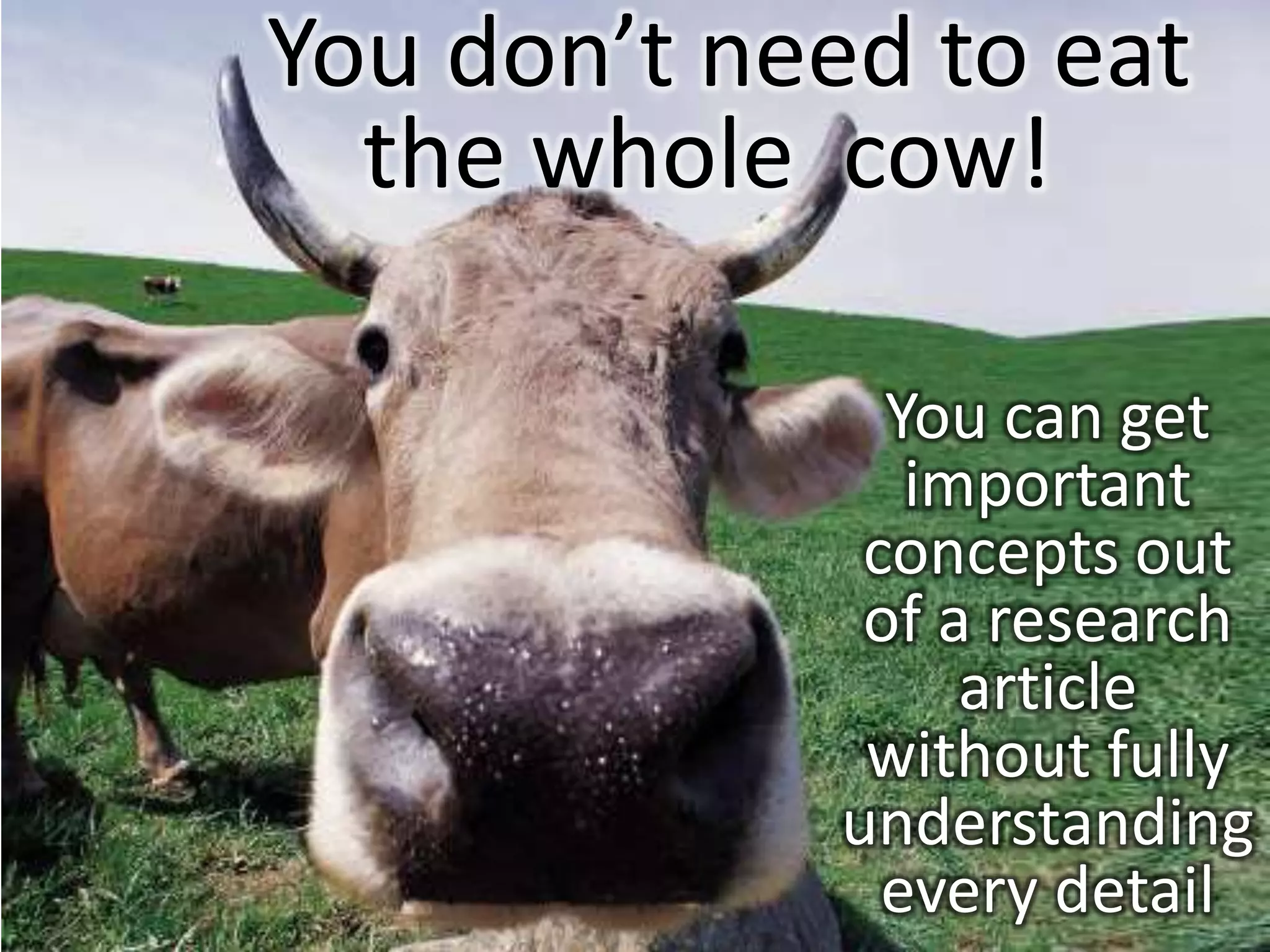
You don’t need to eat
  the whole cow!

               You can get
                important
              concepts out
              of a research
                  article
              without fully
             understanding
               every detail
How do you eat a
cake with rocks in it?


            Don’t try to
            eat the rocks
Questions for an article
1.Do I care about
  the research
  topic?
2.Do I believe the
  findings?
3.So what?
Abstract: Do I care?
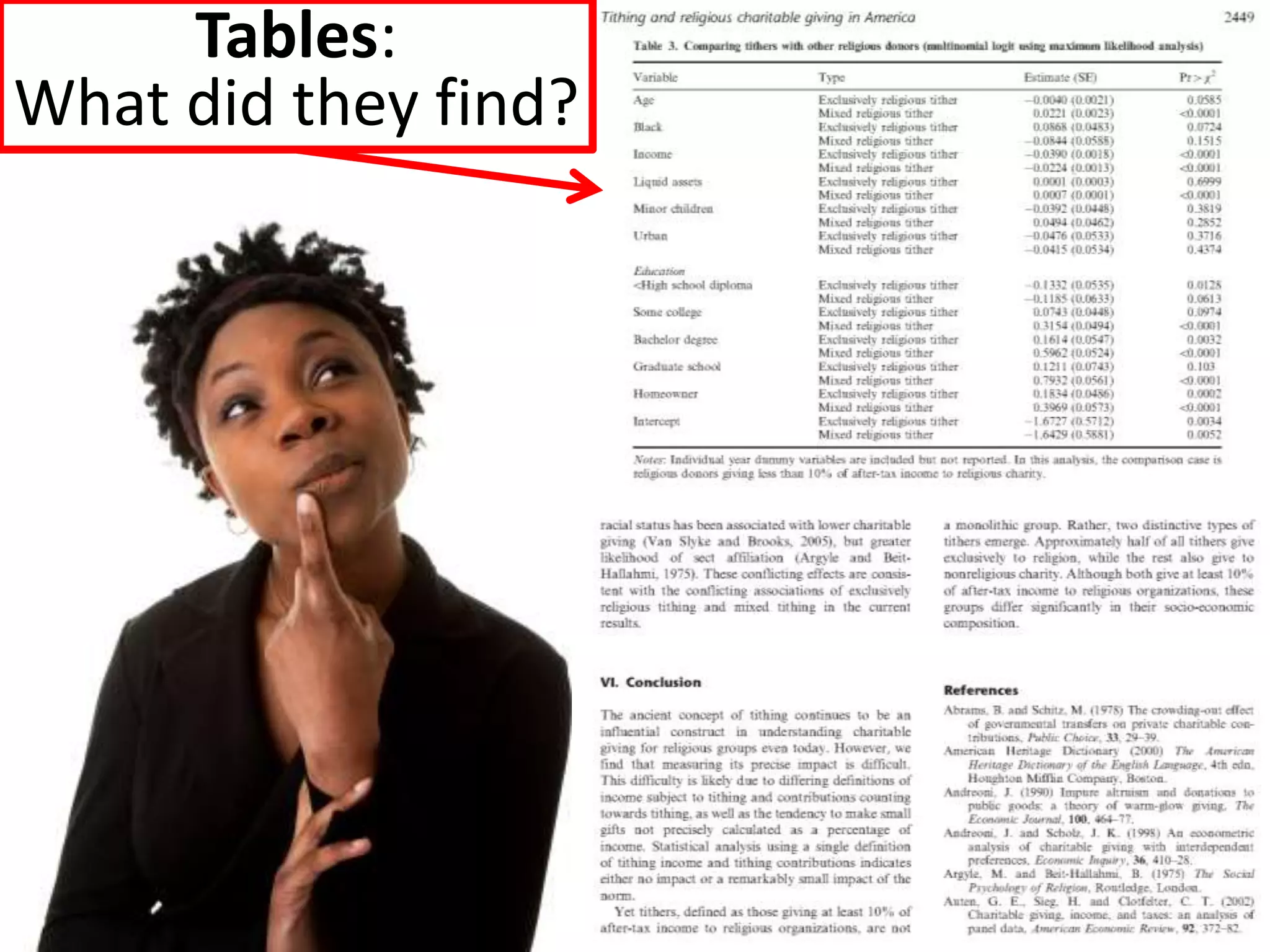
Tables: What did they really find?
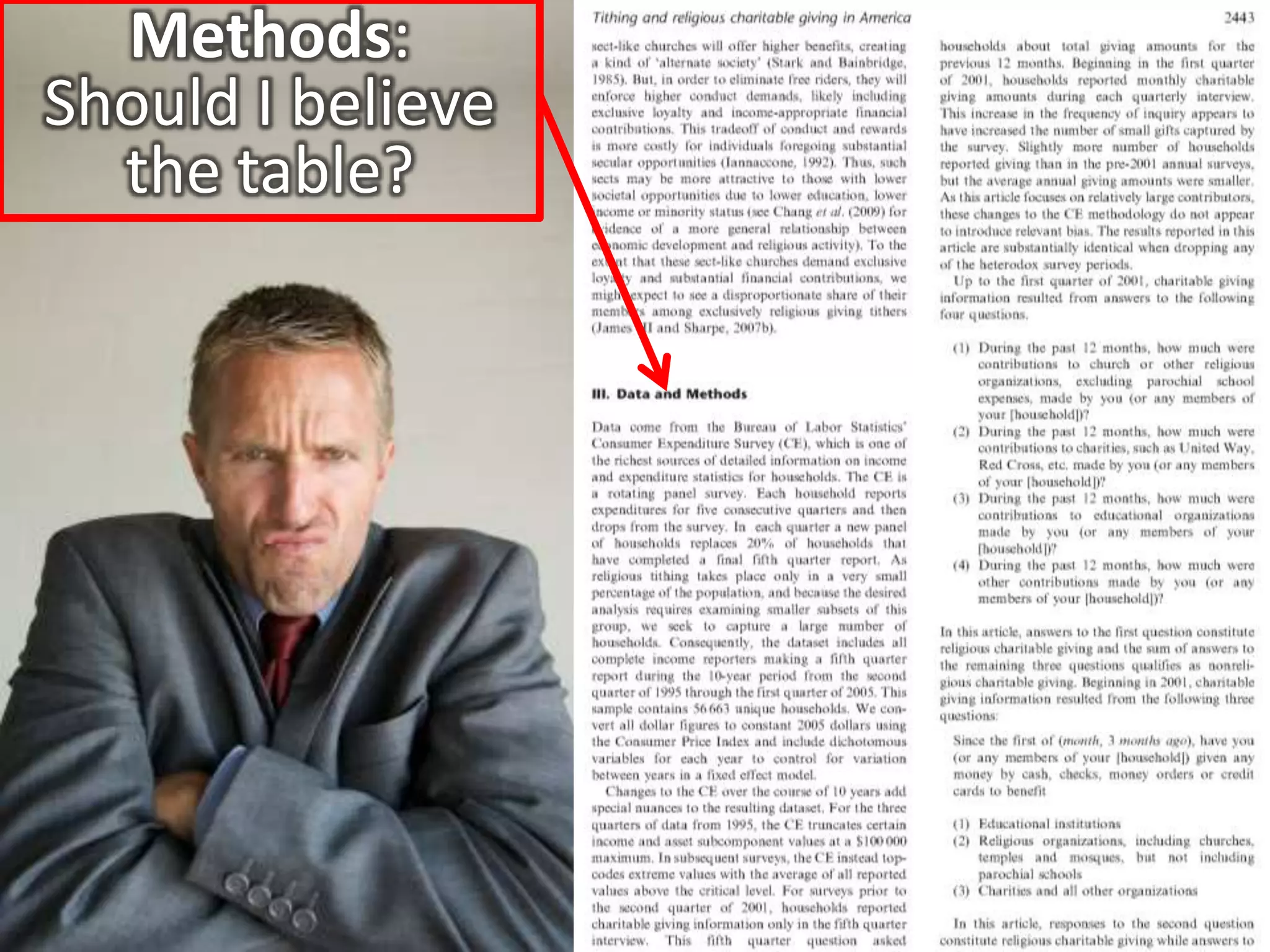
Methods: Do I believe the table?
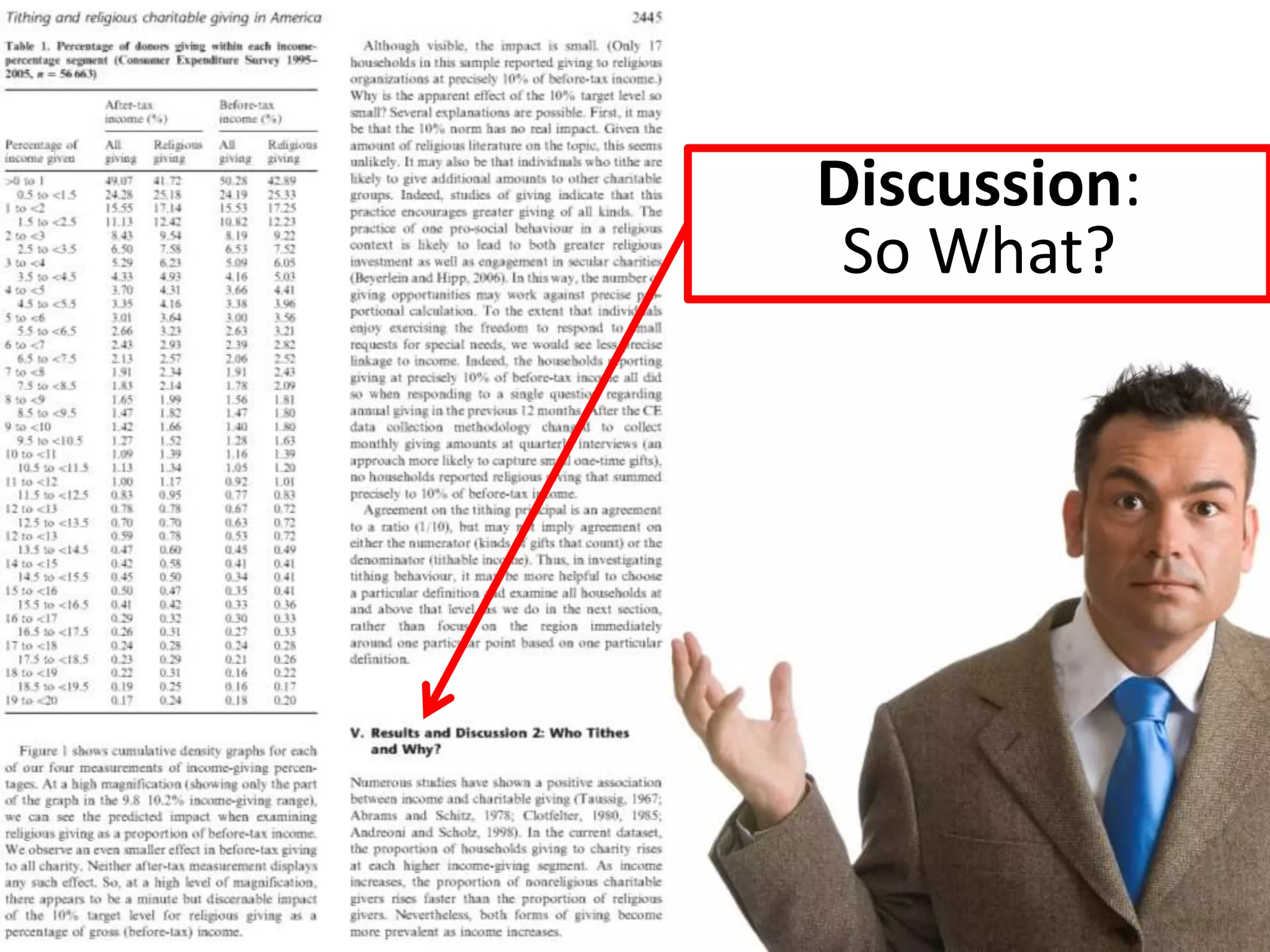
Discussion: So what?
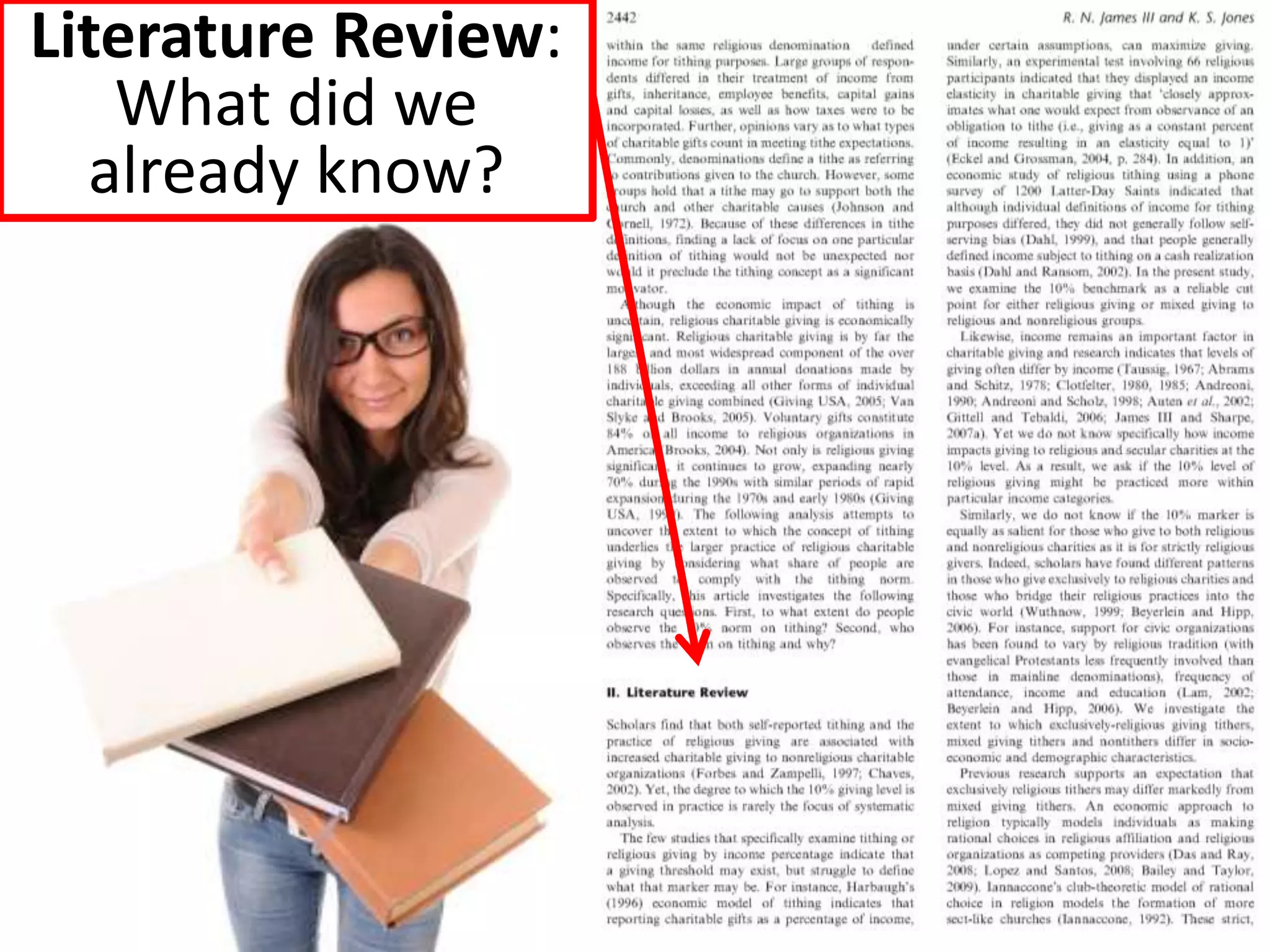
Lit. Review: What did we already know?
Title and Abstract:
     Do I care?
Tables:
What did they find?
Methods:
Should I believe
  the table?
Discussion:
 So What?
Literature Review:
   What did we
  already know?
Should you believe the findings?
Research is messy.
Research often disagrees.
We want to be able to
distinguish strong results
from weak ones.
Bad news

Knowing whether
you should believe
the findings
usually requires
some statistics
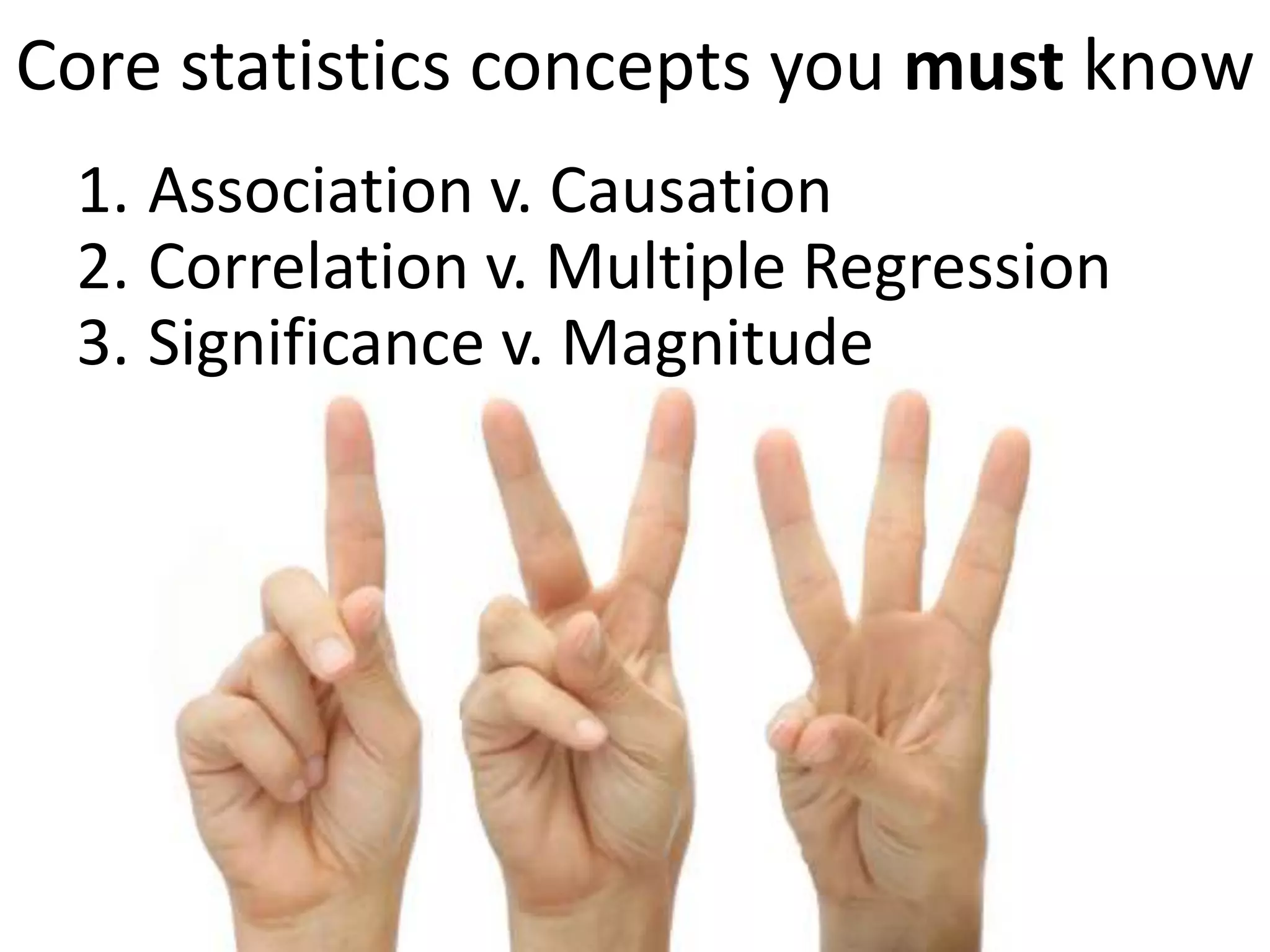
Core statistics concepts you must know
 1. Association v. Causation
 2. Correlation v. Multiple Regression
 3. Significance v. Magnitude
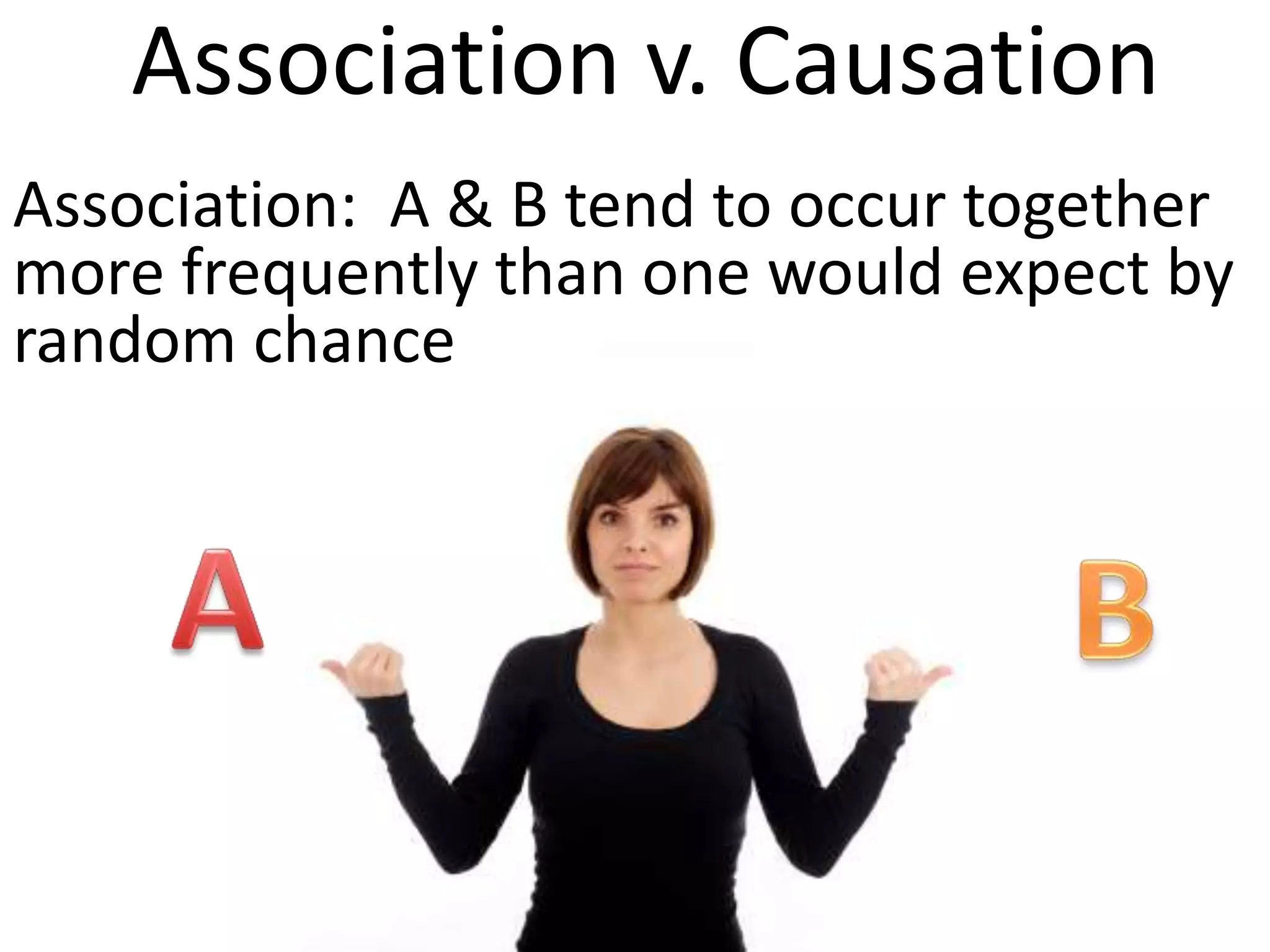
Association v. Causation
Association: A & B tend to occur together
more frequently than one would expect by
random chance
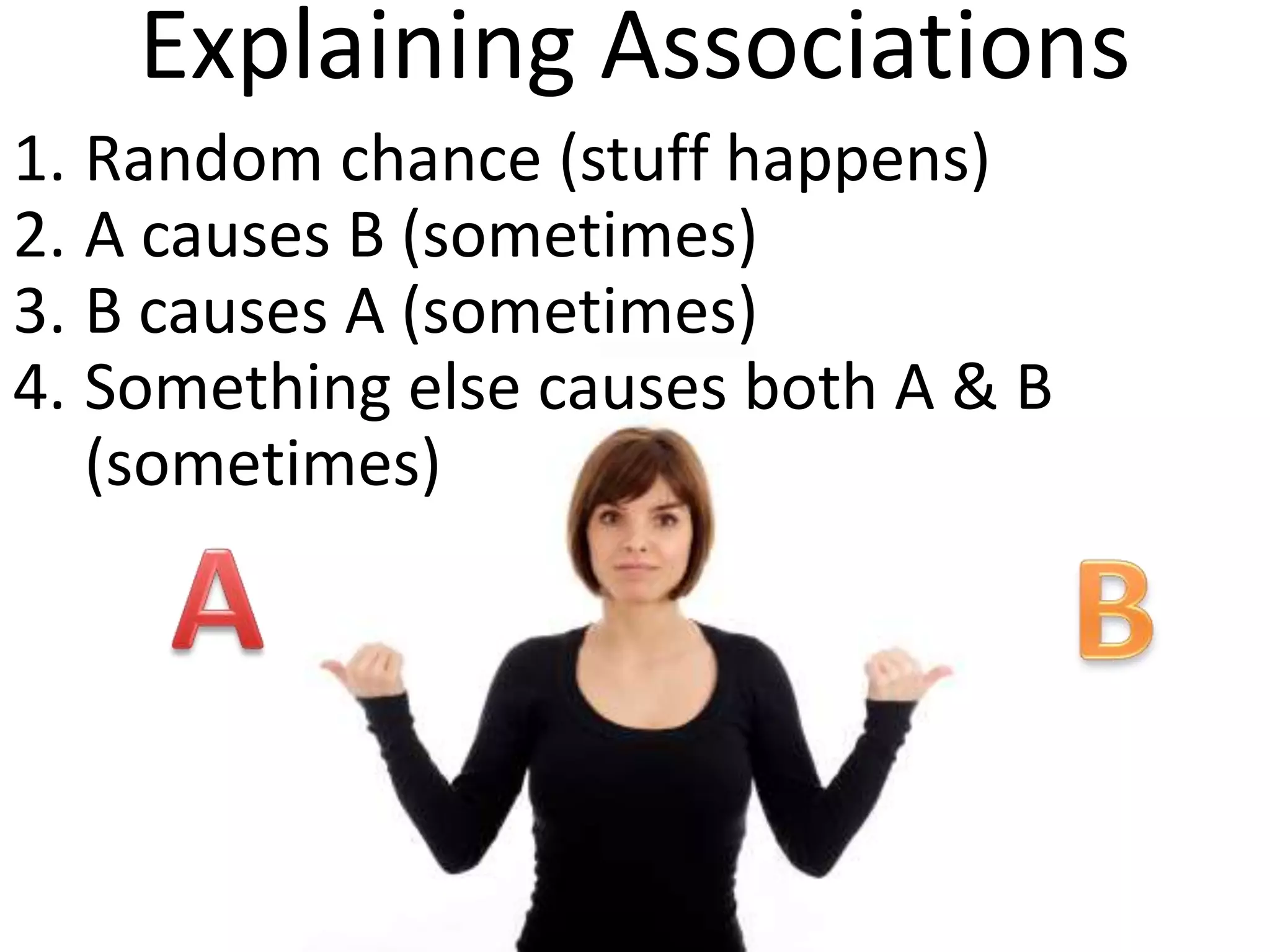
Explaining Associations
1. Random chance (stuff happens)
2. A causes B (sometimes)
3. B causes A (sometimes)
4. Something else causes both A & B
   (sometimes)
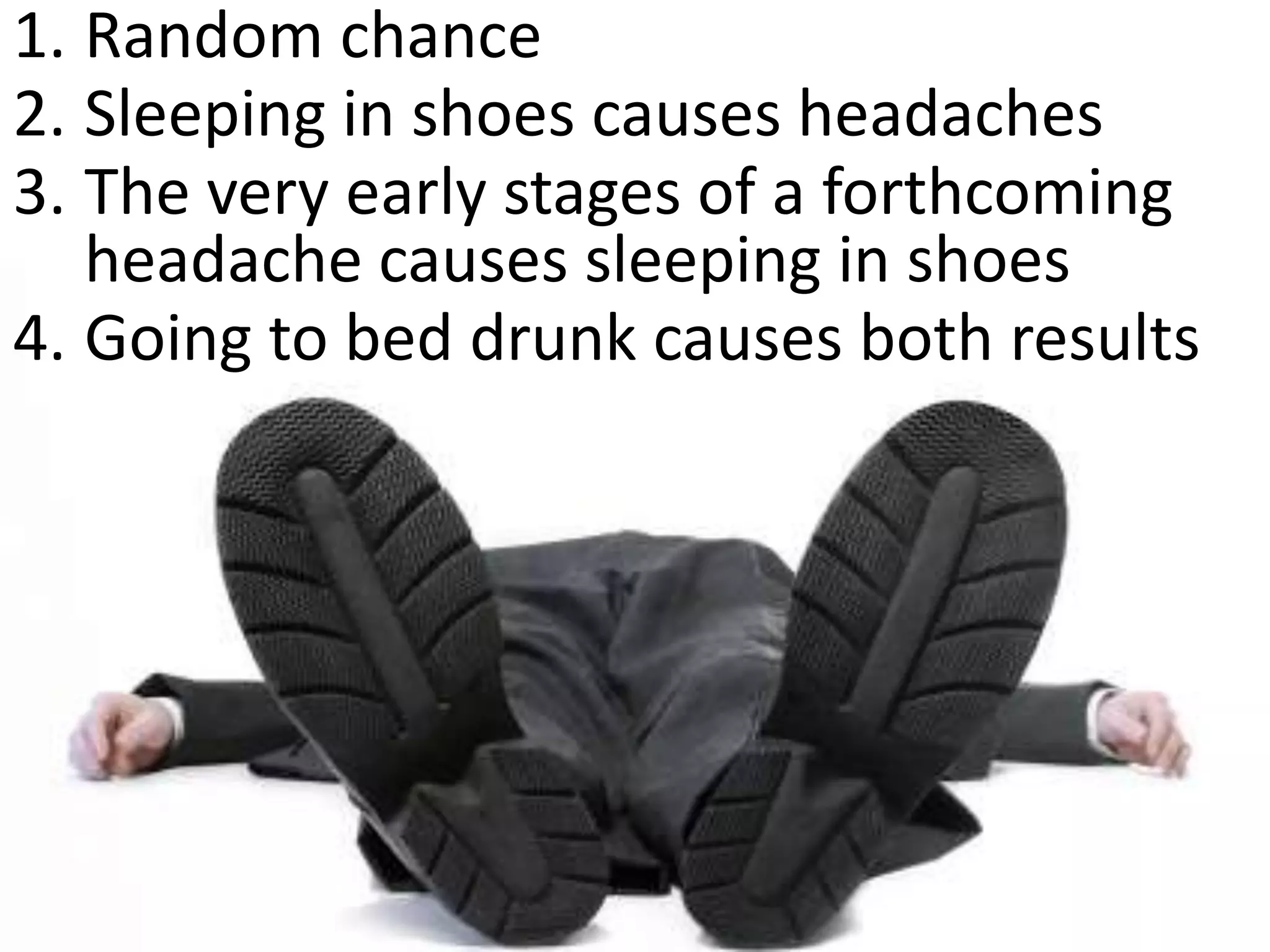
Sleeping in your shoes is associated
with waking up with a headache.

                           Why?
1. Random chance
2. Sleeping in shoes causes headaches
3. The very early stages of a forthcoming
   headache causes sleeping in shoes
4. Going to bed drunk causes both results
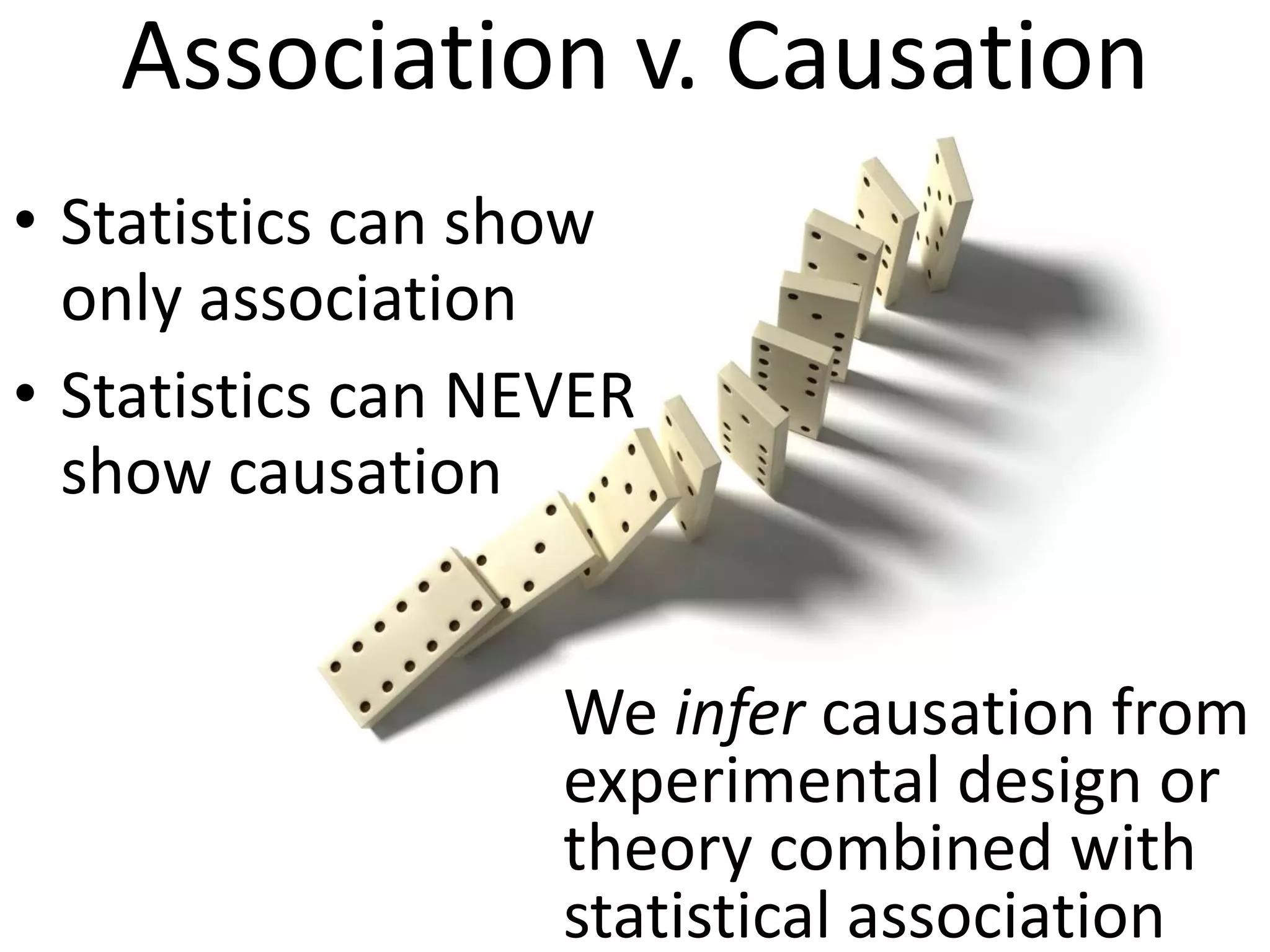
Association v. Causation
• Statistics can show
  only association
• Statistics can NEVER
  show causation


                   We infer causation from
                   experimental design or
                   theory combined with
                   statistical association
Statistics
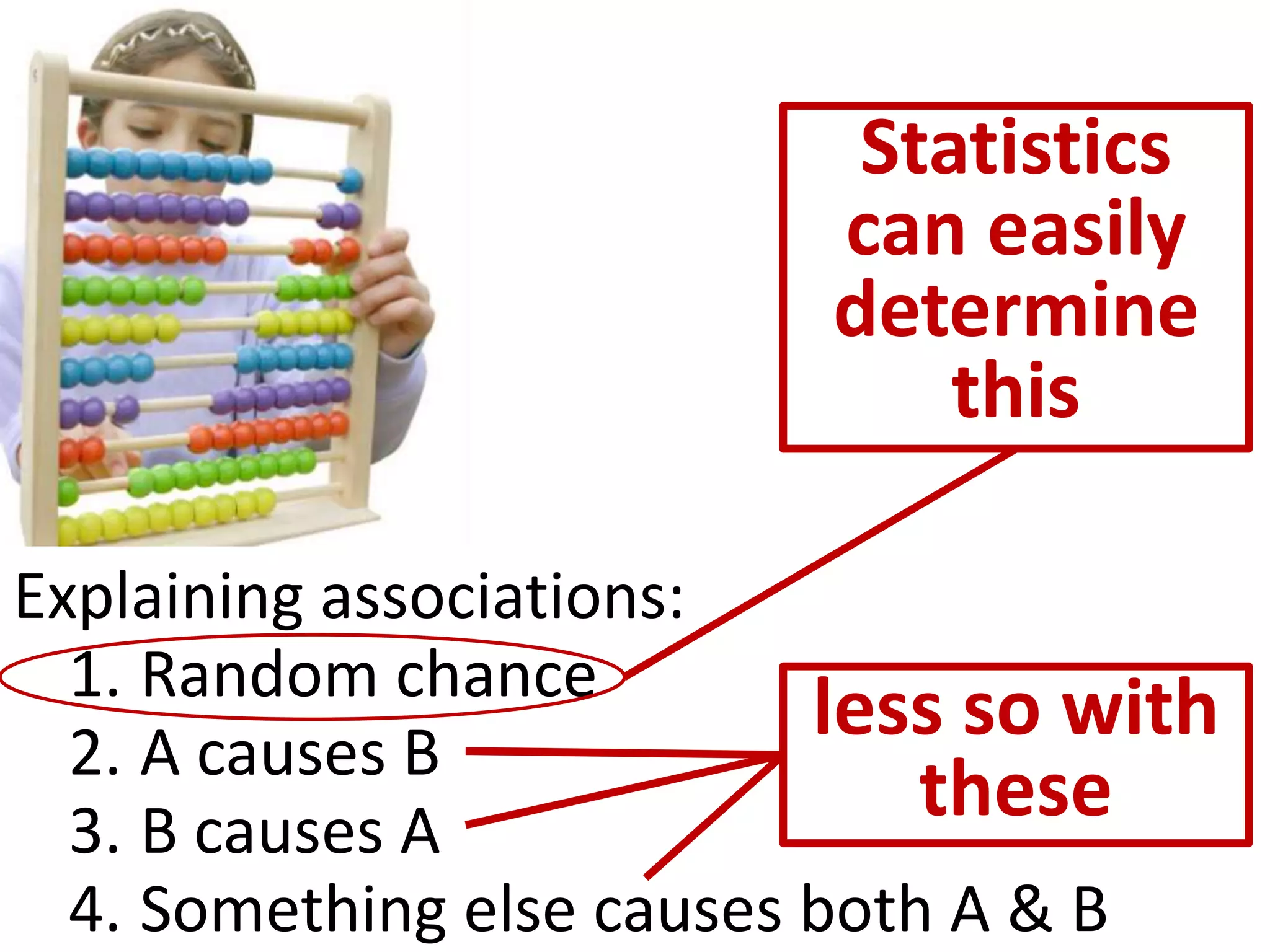
                          can easily
                          determine
                              this

Explaining associations:
  1. Random chance
  2. A causes B
                           less so with
  3. B causes A
                               these
  4. Something else causes both A & B
Correlation
    v.
 Multiple
Regression
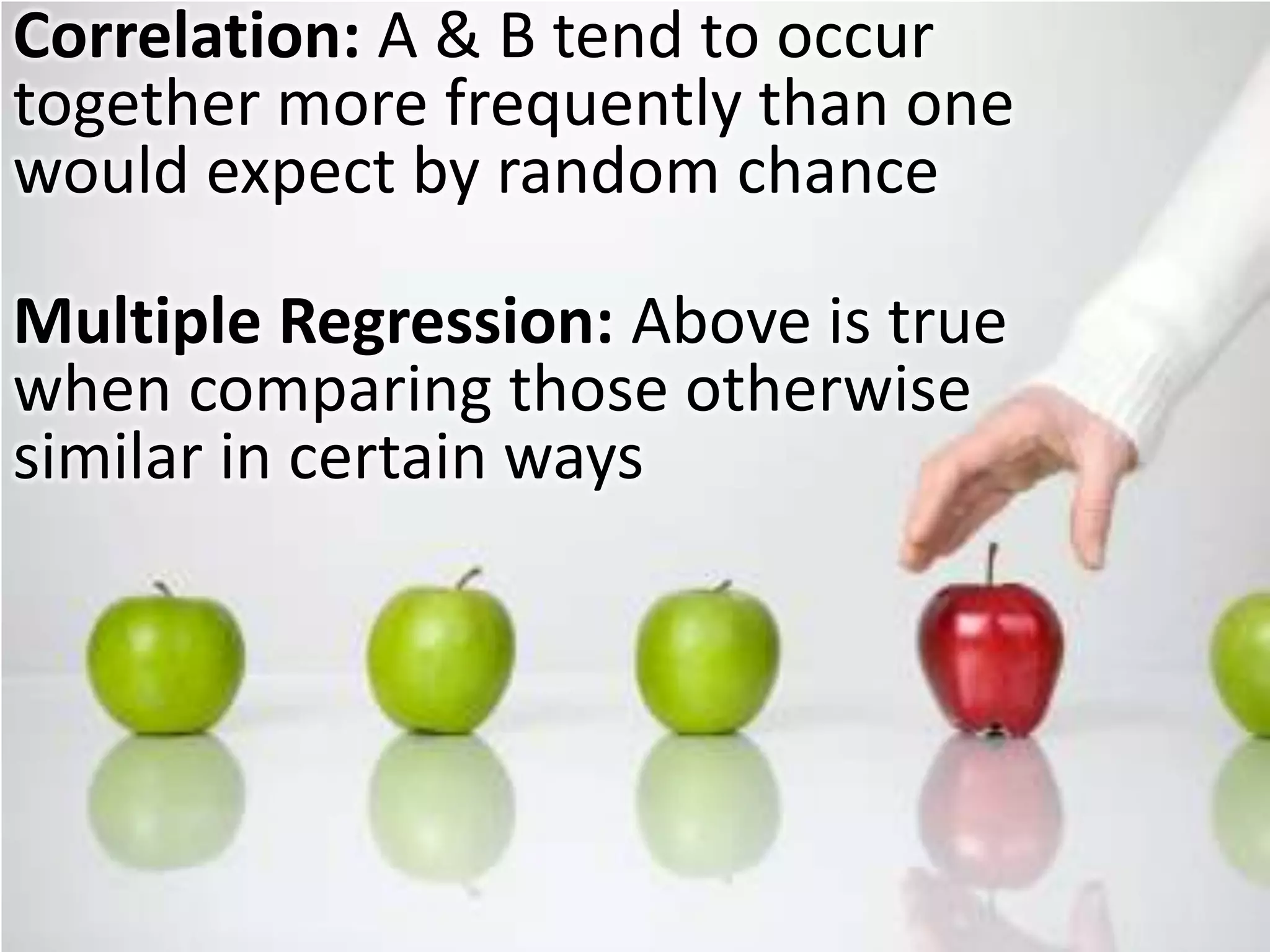
Correlation: A & B tend to occur
together more frequently than one
would expect by random chance

Multiple Regression: Above is true
when comparing those otherwise
similar in certain ways
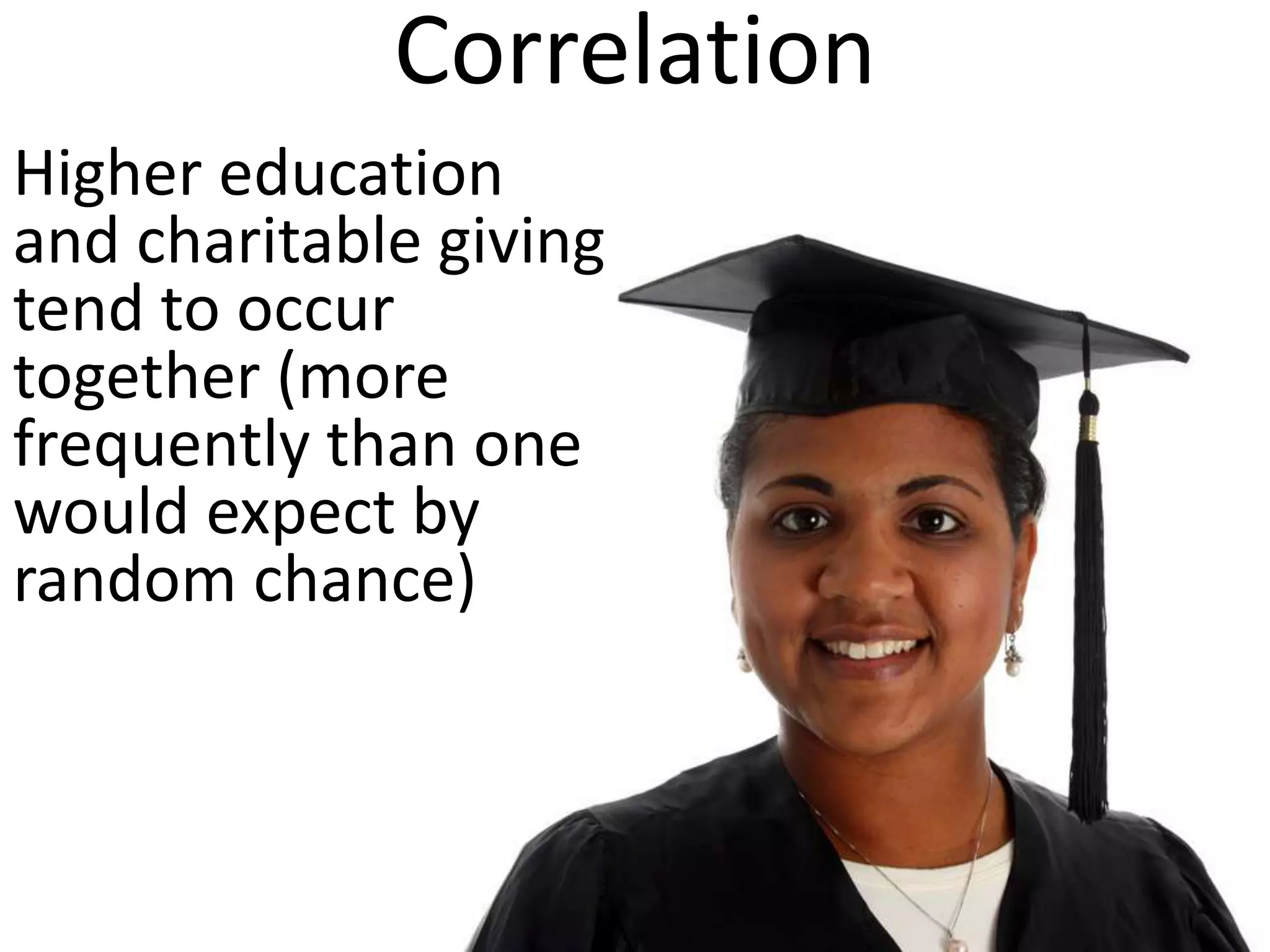
Correlation
Higher education
and charitable giving
tend to occur
together (more
frequently than one
would expect by
random chance)
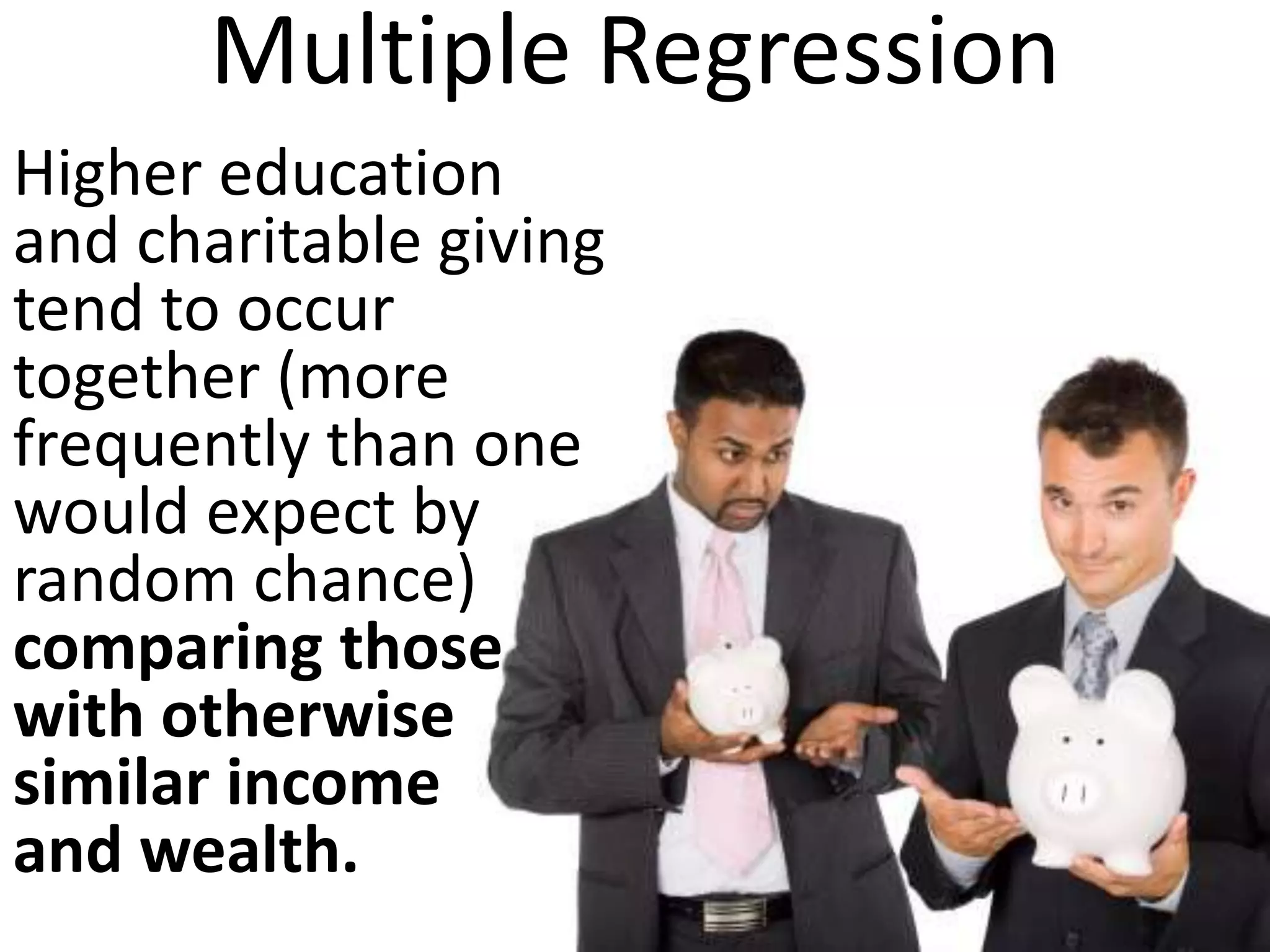
Multiple Regression
Higher education
and charitable giving
tend to occur
together (more
frequently than one
would expect by
random chance)
comparing those
with otherwise
similar income
and wealth
Explaining Associations:
  1. Random chance
  2. A causes B
  3. B causes A
  4. Something else
     causes both A & B

Multiple regression
allows us to exclude
specific items from
#4, unless we can’t or
didn’t measure it.
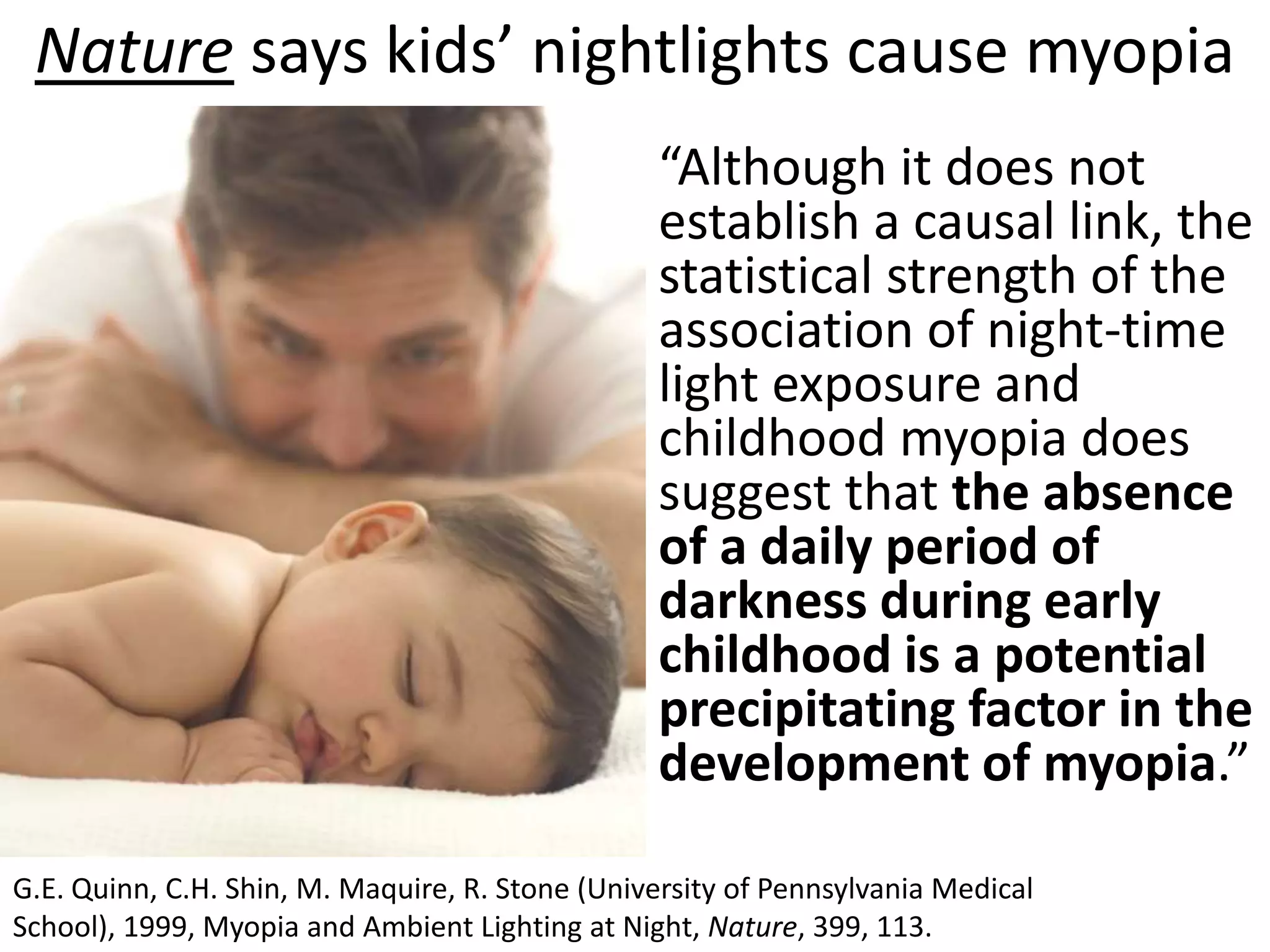
Nature says kids’ nightlights cause myopia
                                                  “Although it does not
                                                  establish a causal link, the
                                                  statistical strength of the
                                                  association of night-time
                                                  light exposure and
                                                  childhood myopia does
                                                  suggest that the absence
                                                  of a daily period of
                                                  darkness during early
                                                  childhood is a potential
                                                  precipitating factor in the
                                                  development of myopia.”

G.E. Quinn, C.H. Shin, M. Maquire, R. Stone (University of Pennsylvania Medical School), 1999,
Myopia and Ambient Lighting at Night, Nature, 399, 113.
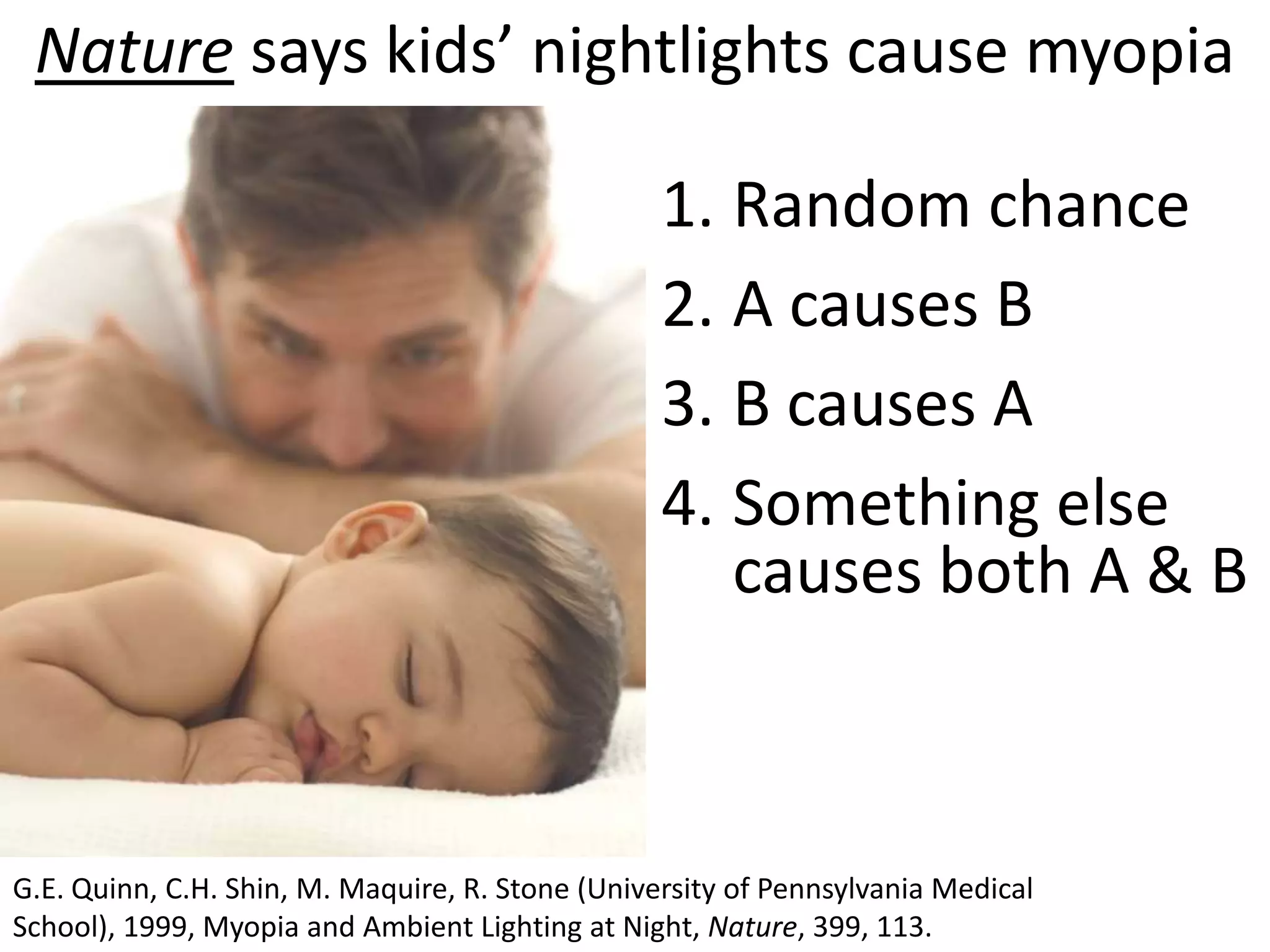
Nature says kids’ nightlights cause myopia

                                                  1. Random chance
                                                  2. A causes B
                                                  3. B causes A
                                                  4. Something else
                                                     causes both A & B


G.E. Quinn, C.H. Shin, M. Maquire, R. Stone (University of Pennsylvania Medical School), 1999,
Myopia and Ambient Lighting at Night, Nature, 399, 113.
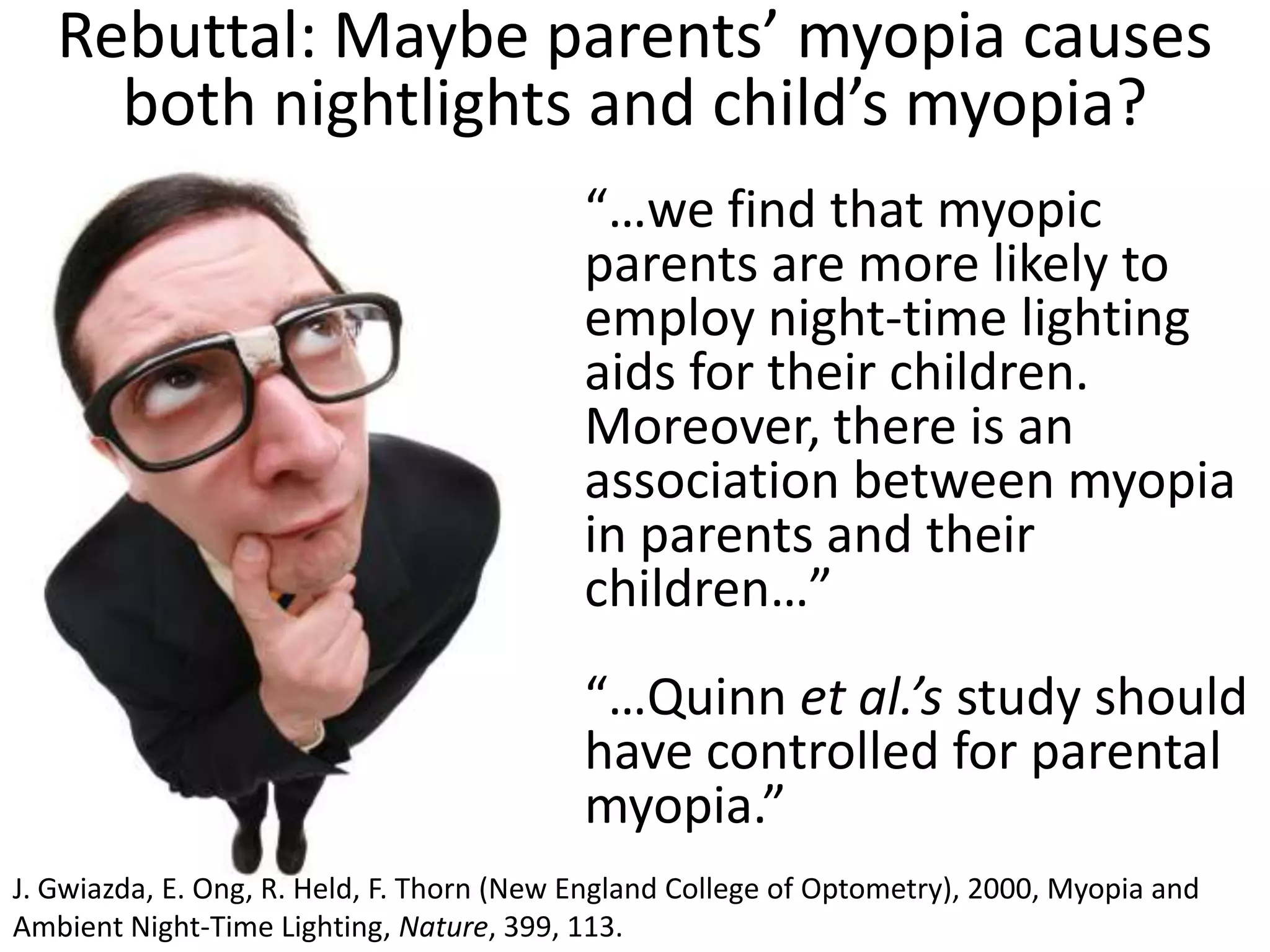
Rebuttal: Maybe parents’ myopia causes
     both nightlights and child’s myopia?
                                           “…we find that myopic
                                           parents are more likely to
                                           employ night-time lighting
                                           aids for their children.
                                           Moreover, there is an
                                           association between myopia
                                           in parents and their
                                           children…”
                                           “…Quinn et al.’s study should
                                           have controlled for parental
                                           myopia.”
J. Gwiazda, E. Ong, R. Held, F. Thorn (New England College of Optometry), 2000, Myopia and
Ambient Night-Time Lighting, Nature, 399, 113.
Significance
      v.
Magnitude
Statistics tests a small sample to
predict the whole population


                  Significance shows how likely
                  our result might have been
                  due to an unusual random
                  sample, rather than an actual
                  difference in the population
Most papers report some measure of statistical
significance (chance that the association was
due to a weird random sample)
   • p-value
   • confidence interval
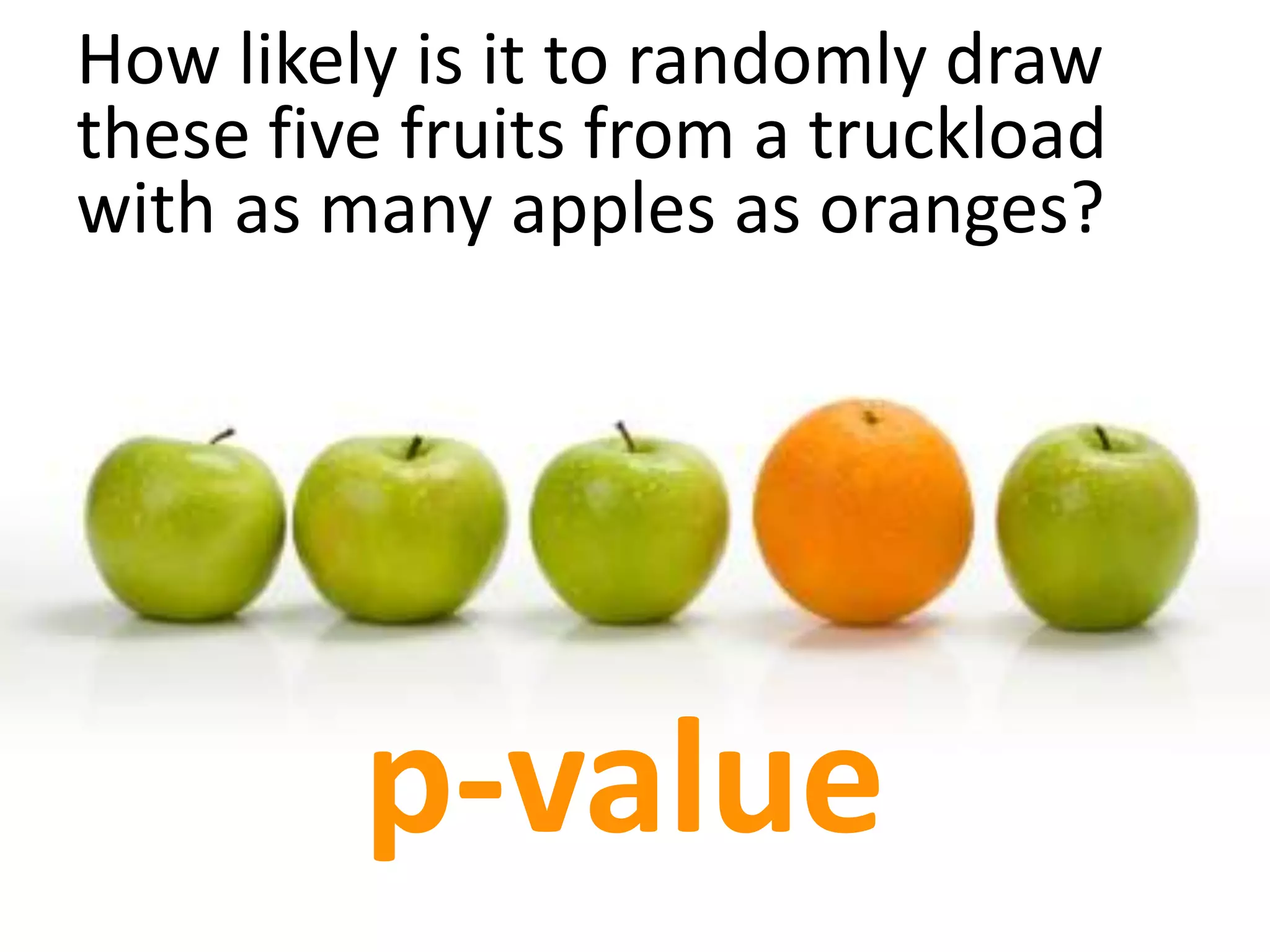
How likely is it to randomly draw
these five fruits from a truckload
with as many apples as oranges?


         p-value
p-value


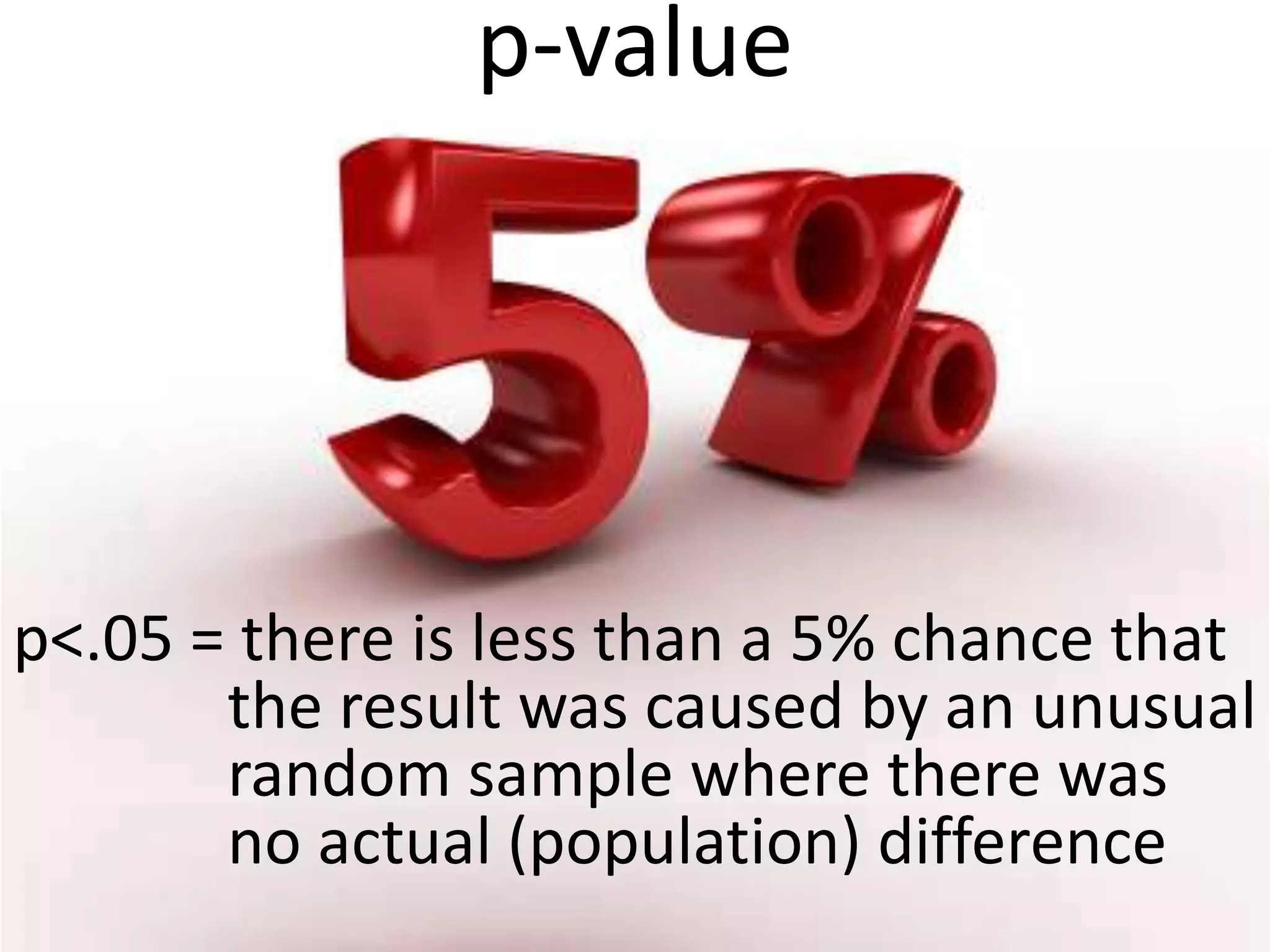
p<.05 = there is less than a 5% chance that
       the result was caused by an unusual
       random sample where there was
       no actual (population) difference
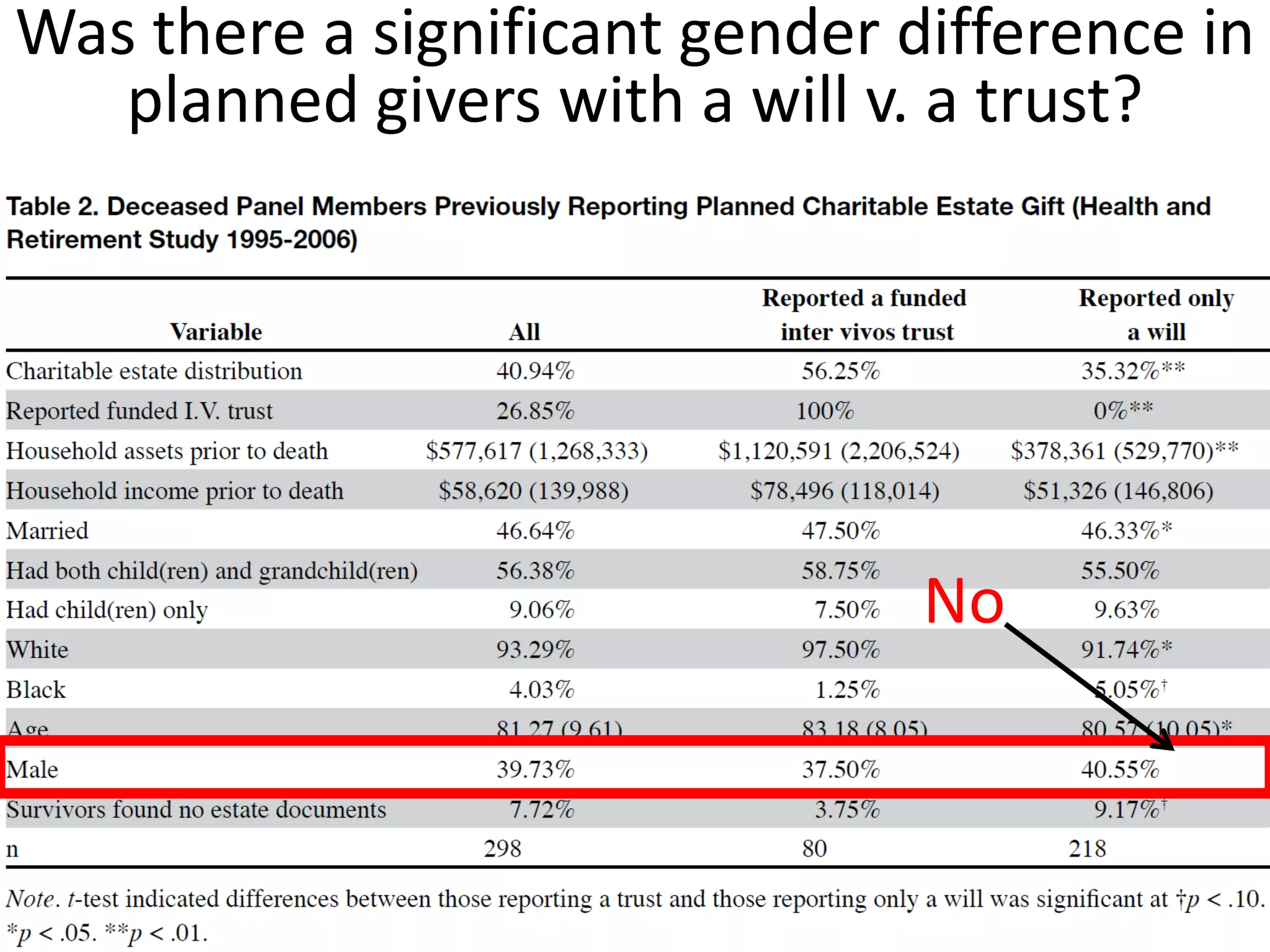
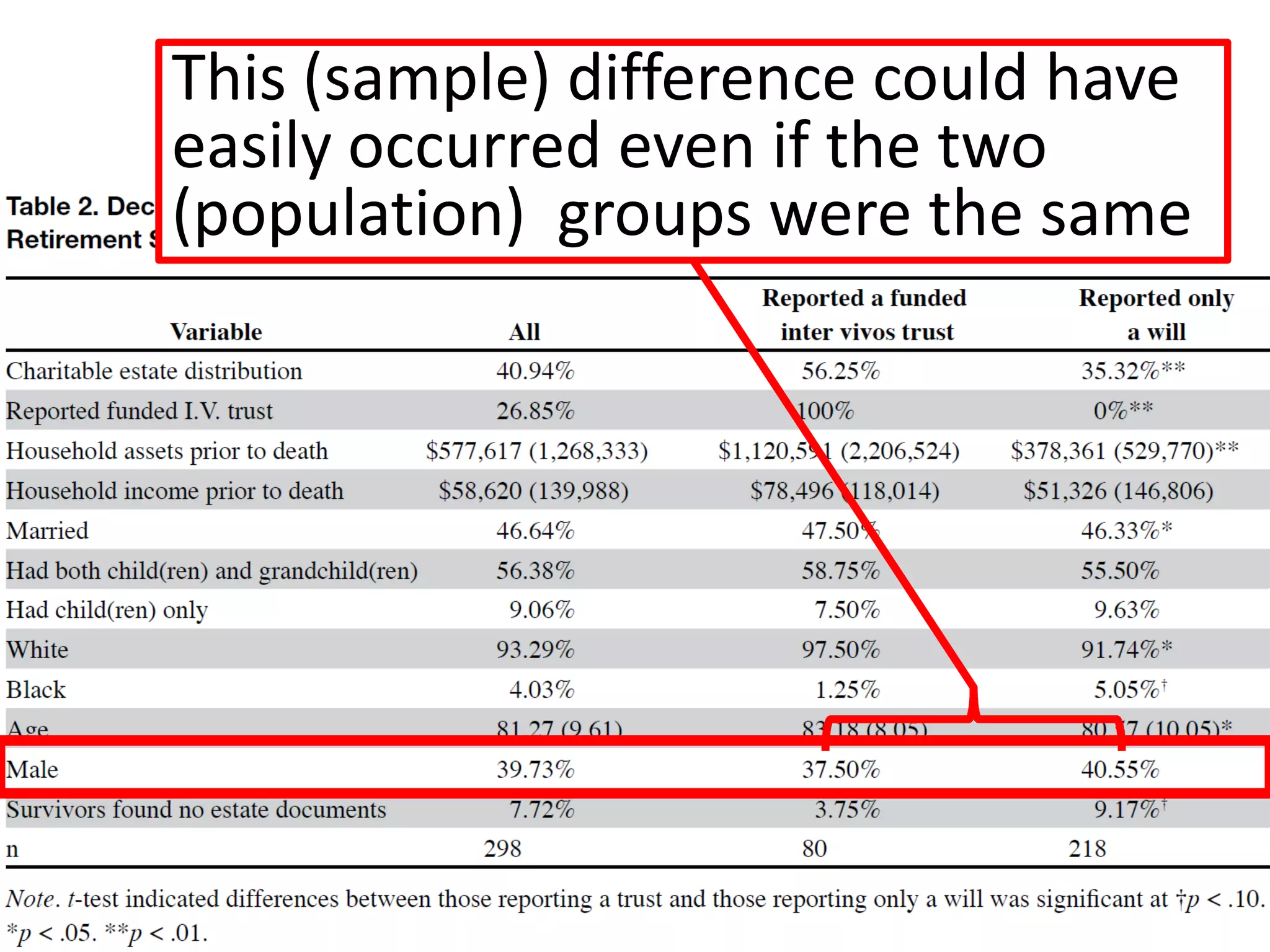
Was there a significant gender difference in
   planned givers with a will v. a trust?


                                No
This (sample) difference could have
easily occurred even if the two
(population) groups were the same
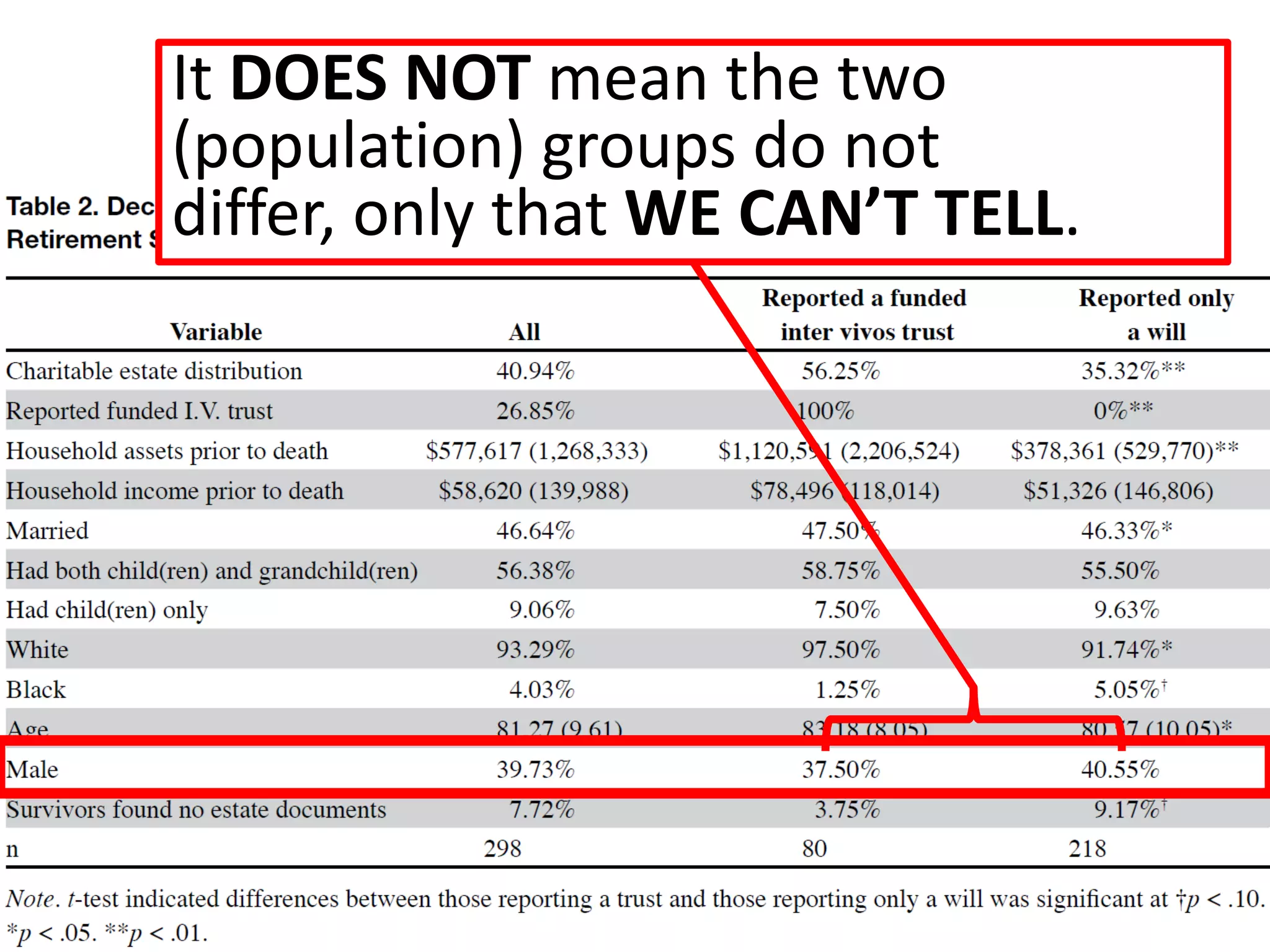
It DOES NOT mean the two
(population) groups do not differ,
only that WE CAN’T TELL.
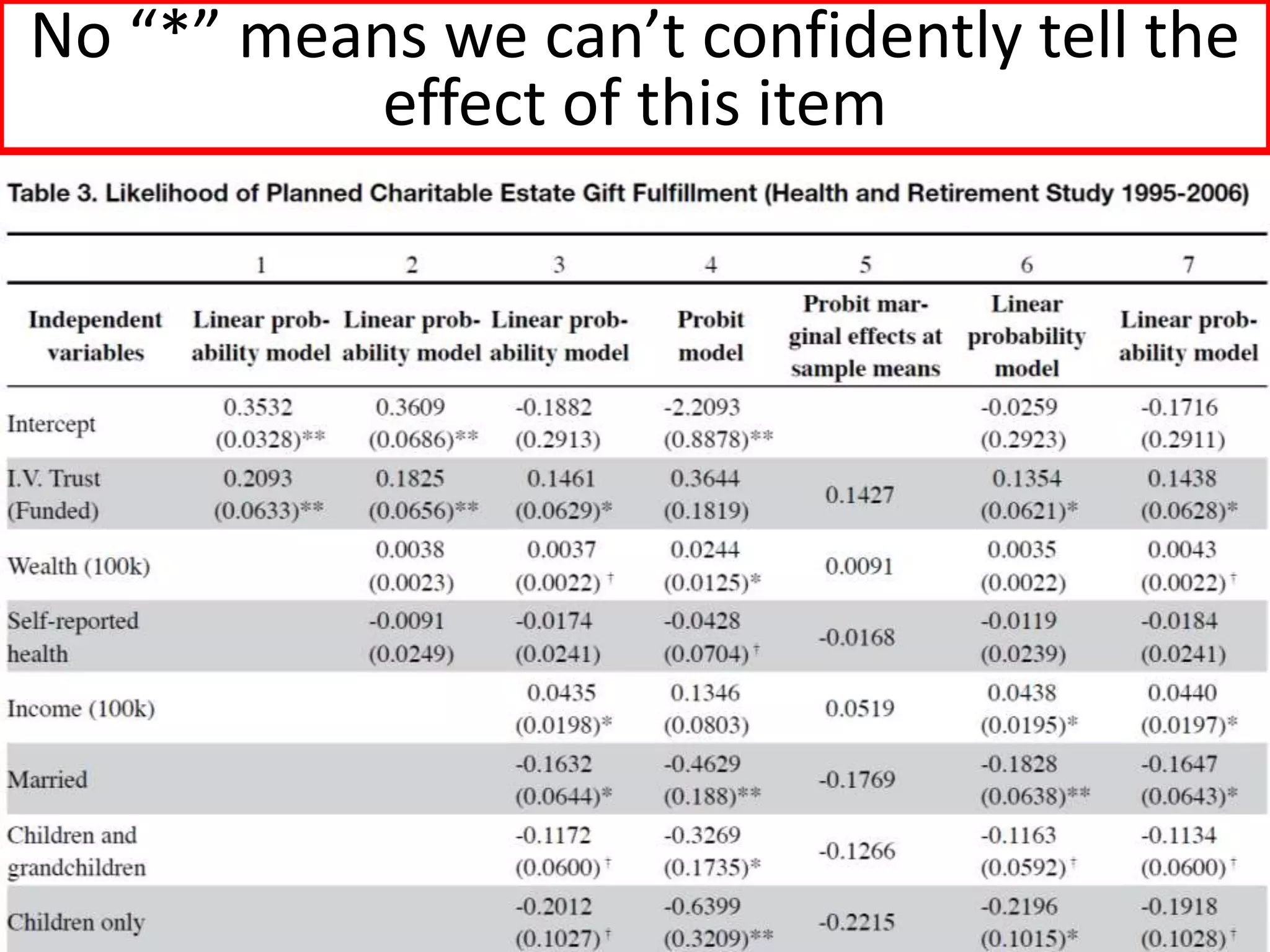
No “*” means we can’t confidently tell the
           effect of this item
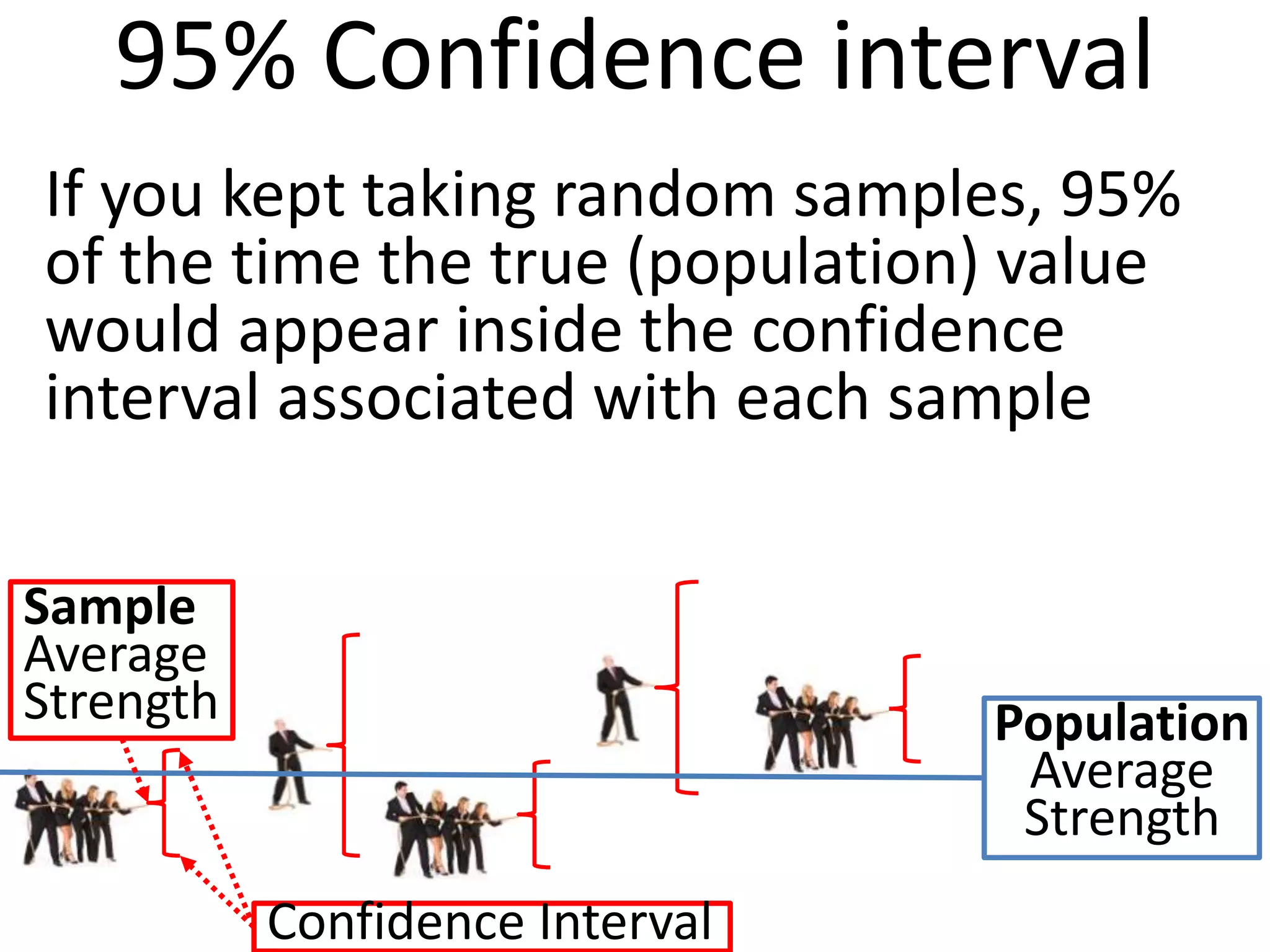
95% Confidence interval
If you kept taking random samples, 95%
of the time the true (population) value
would appear inside the confidence
interval associated with each sample

Sample
Average
Strength                         Population
                                  Average
                                  Strength
           Confidence Interval
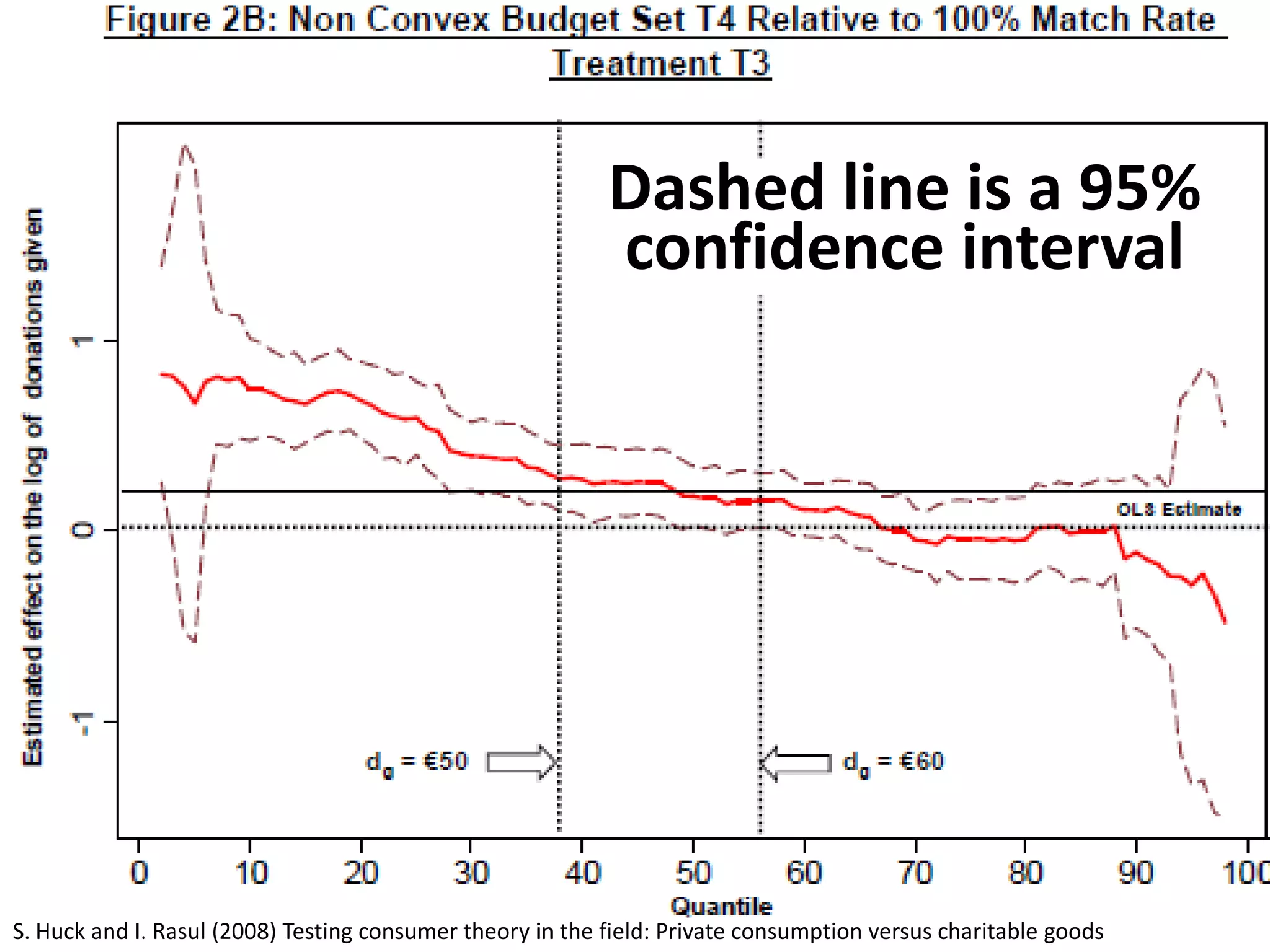
Dashed line is a 95%
                                                           confidence interval


S. Huck and I. Rasul (2008) Testing consumer theory in the field: Private consumption versus charitable goods
Multiple Comparisons Problem
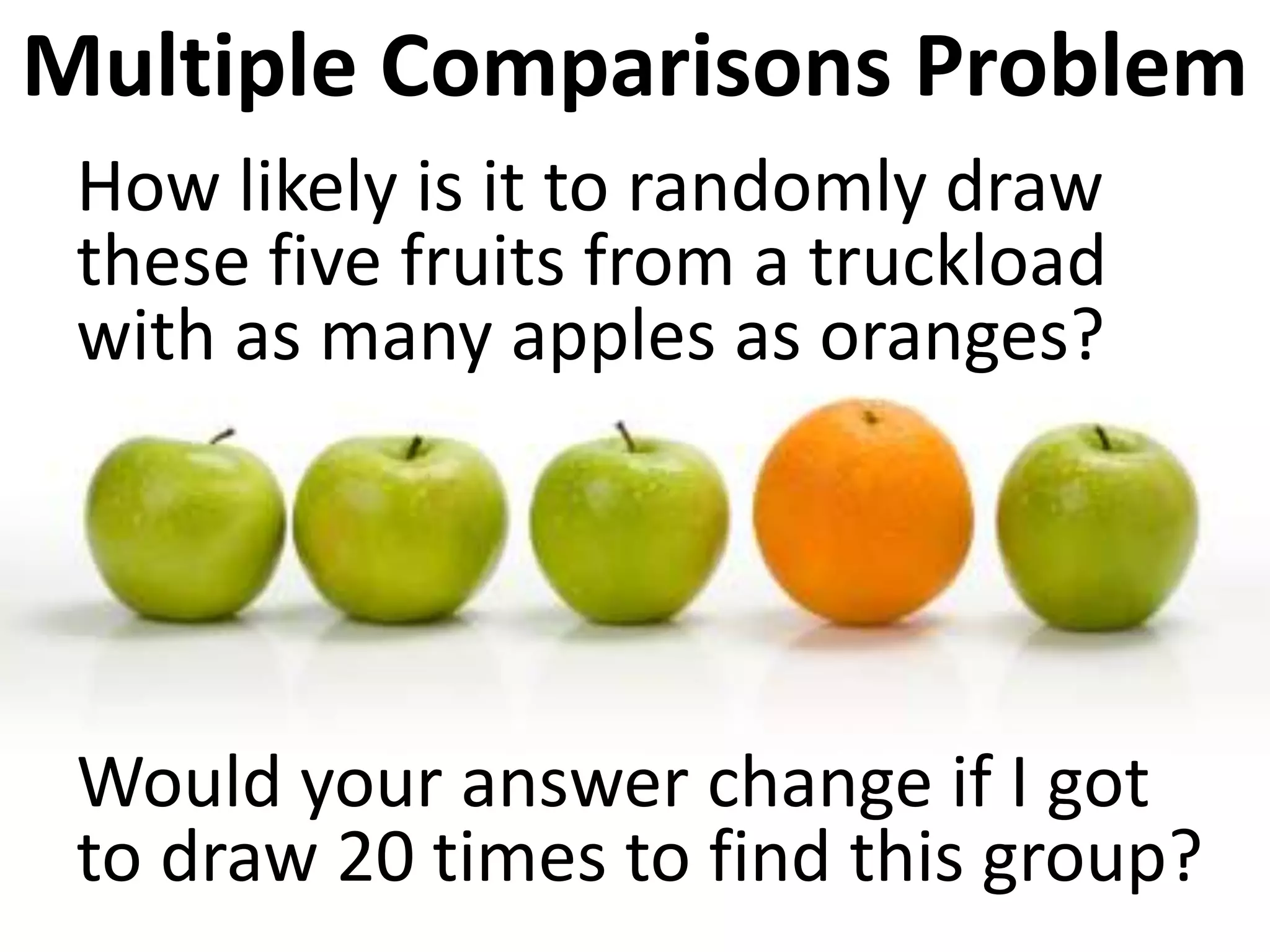
 How likely is it to randomly draw
 these five fruits from a truckload
 with as many apples as oranges?


 Would your answer change if I got
 to draw 20 times to find this group?
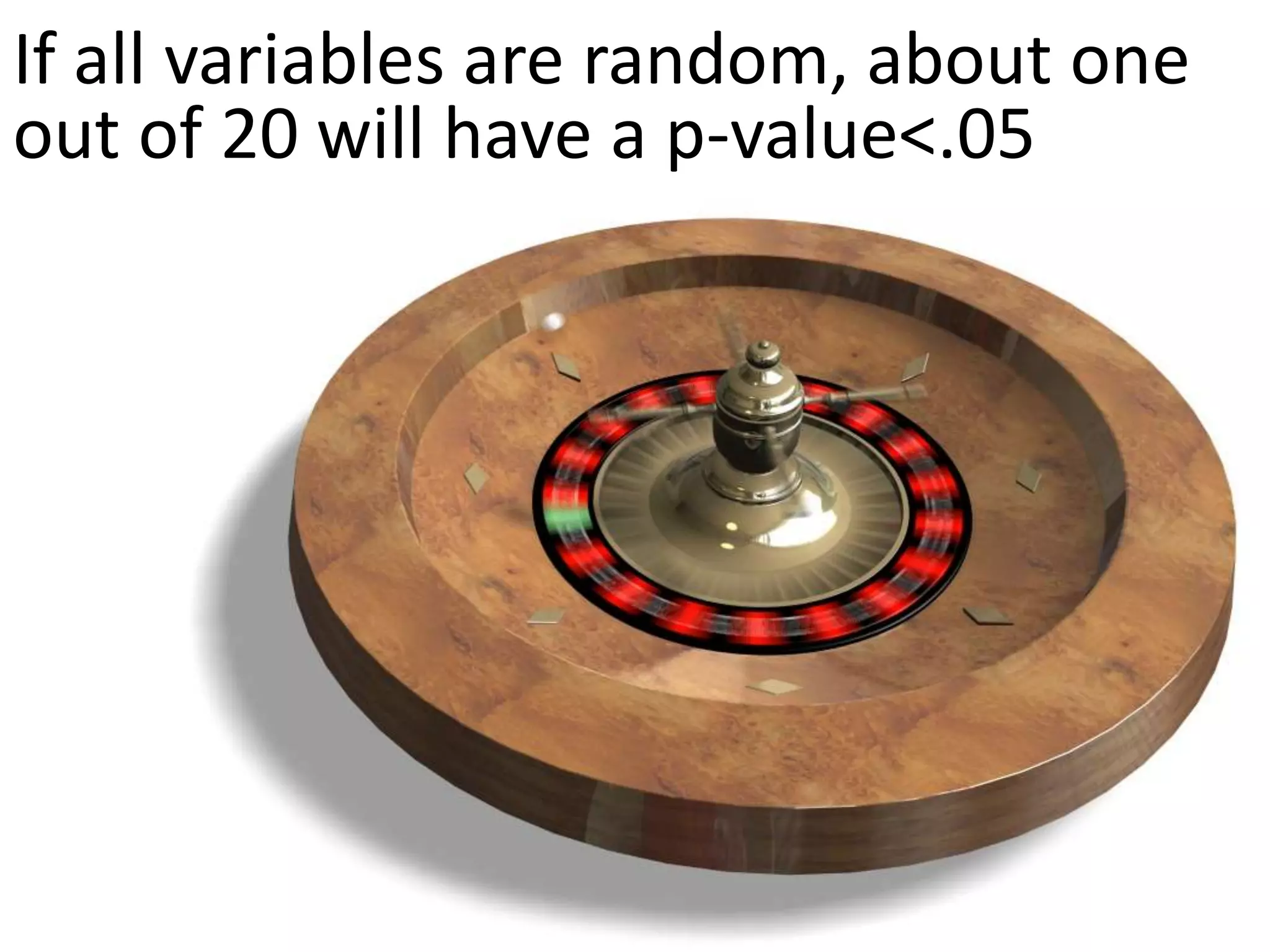
If all variables are random, about one
out of 20 will have a p-value<.05
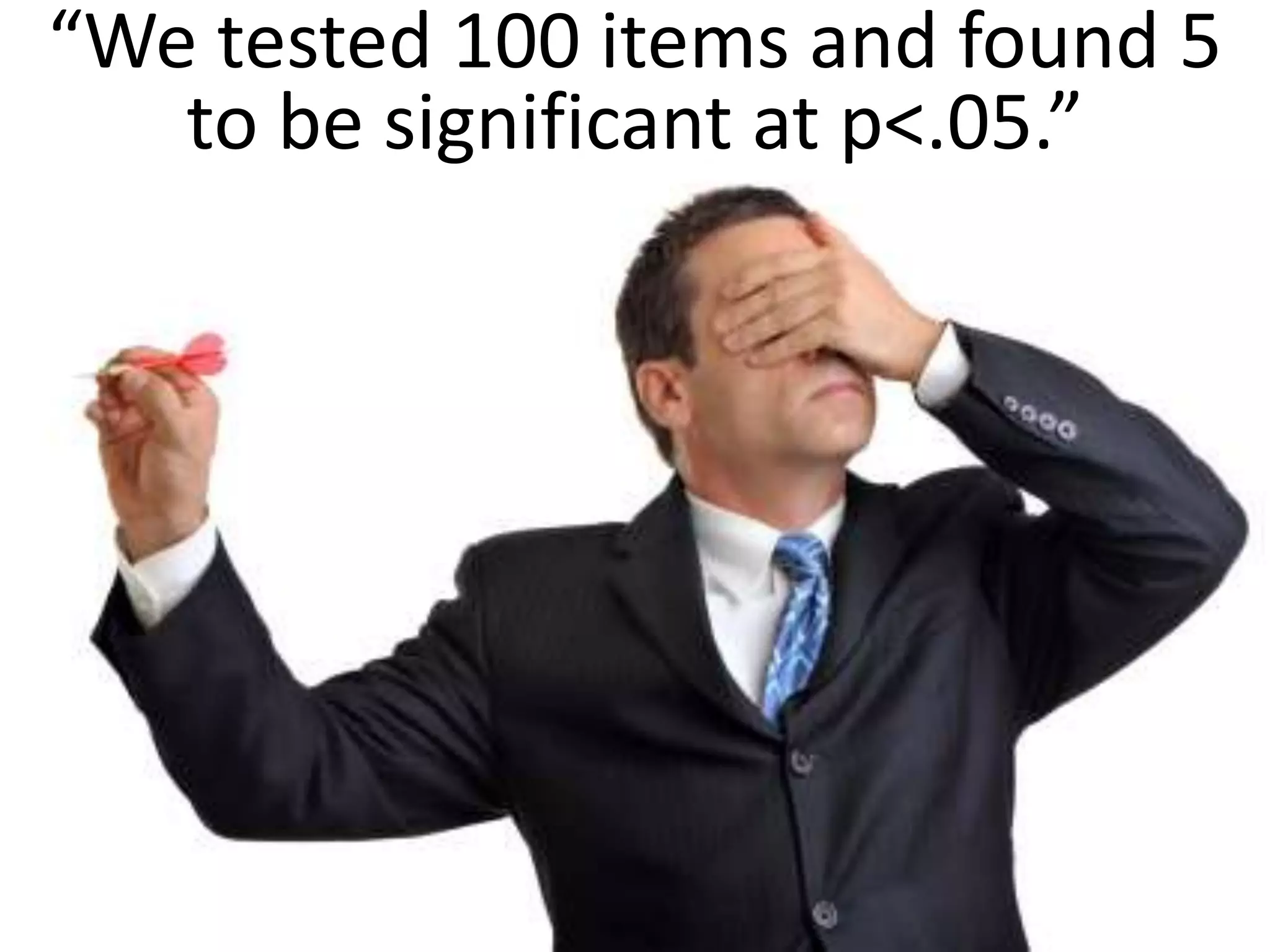
“We tested 100 items and found 5
   to be significant at p<.05.”
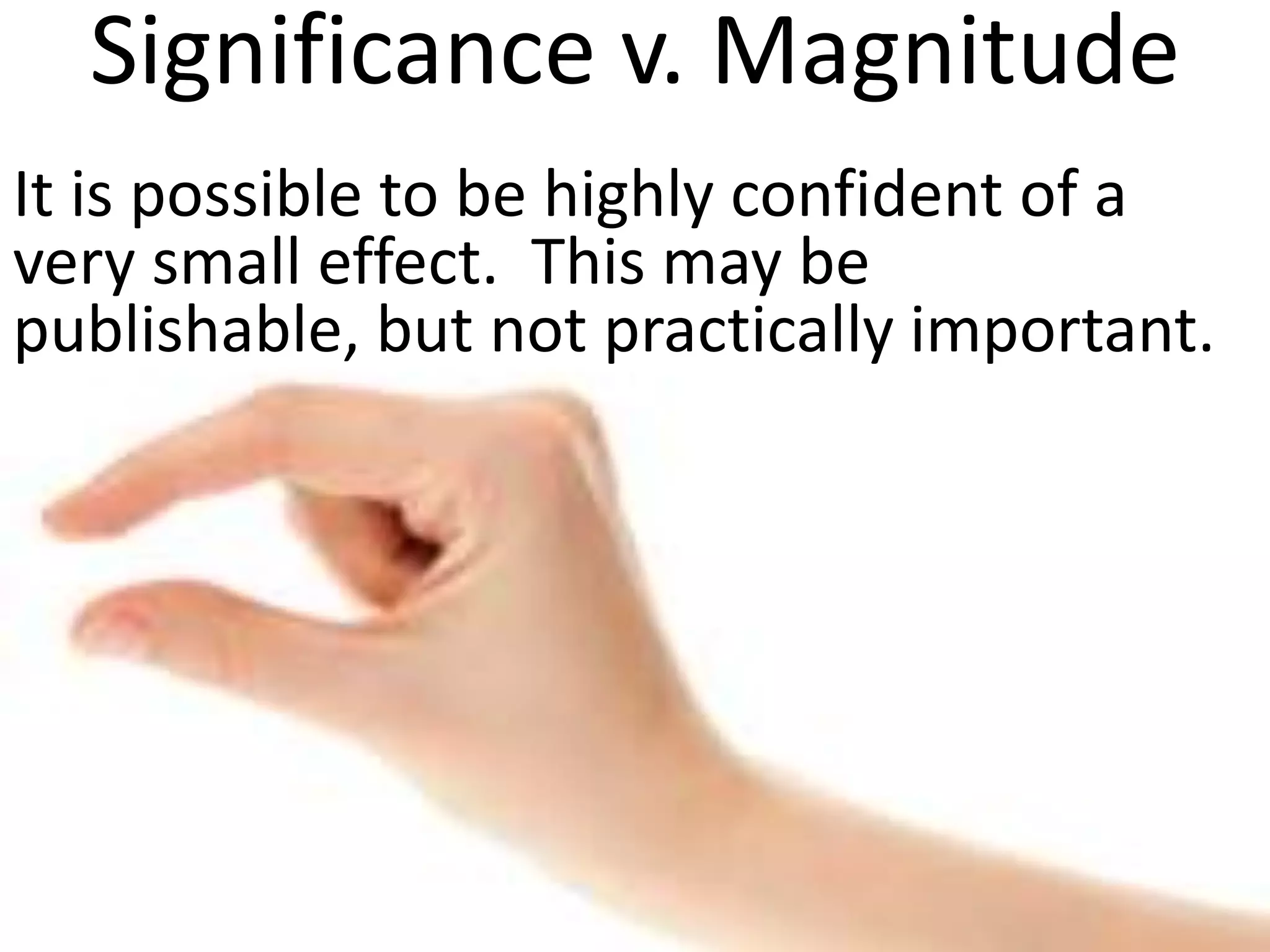
Significance v. Magnitude
It is possible to be highly confident of a
very small effect. This may be publishable,
but not practically important.
Numbers
(coefficients) resulting
     from complex
 statistical techniques
  may not be directly
interpretable in terms
      of real world
       magnitude
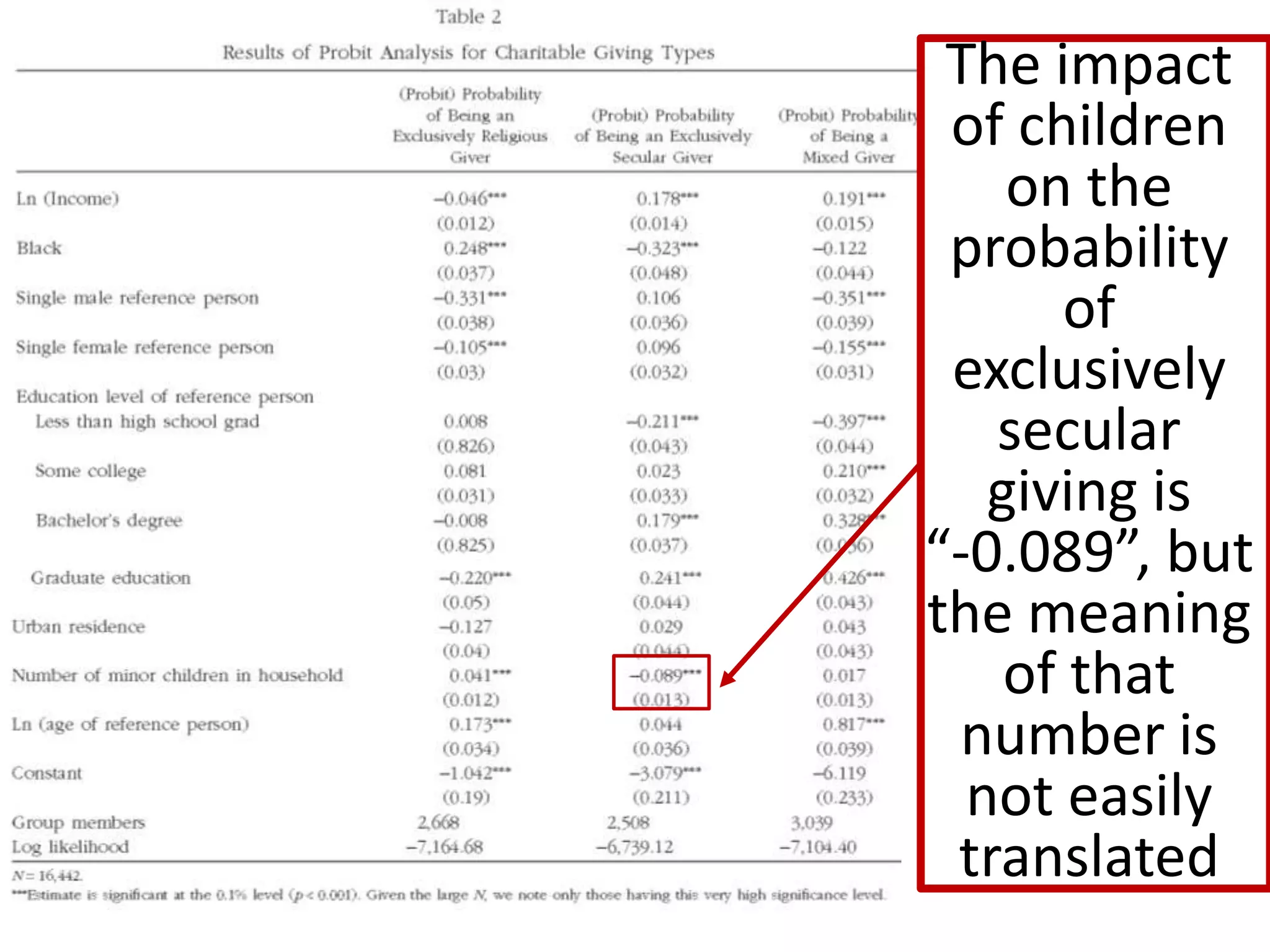
The impact
 of children
    on the
 probability
      of
 exclusively
   secular
   giving is
“-0.089”, but
the meaning
    of that
 number is
  not easily
 translated
Even with complex techniques, we
    can easily compare sign and
magnitude relative to other variables
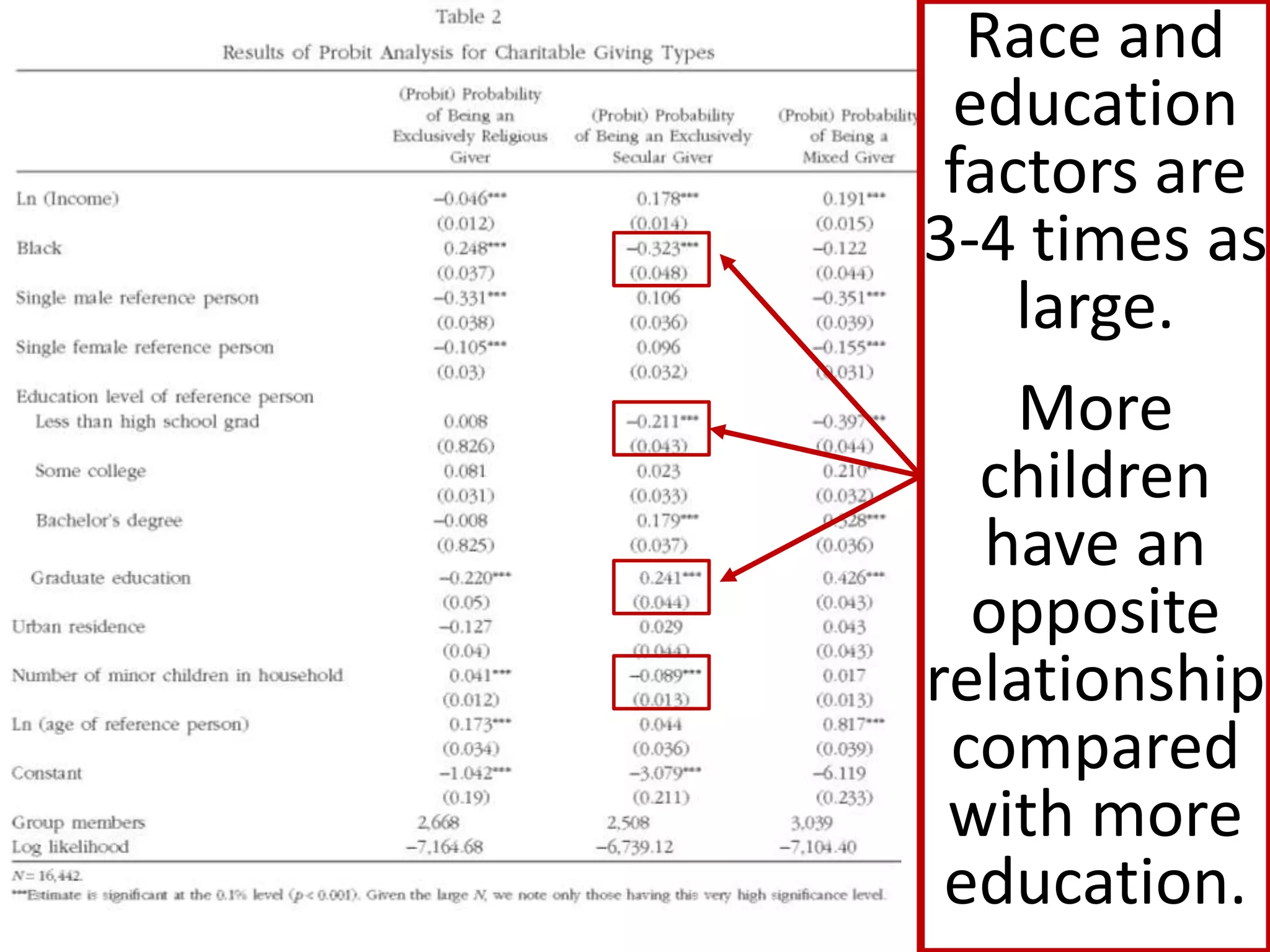
Race and
 education
 factors are
3-4 times as

    large.
    More
  children
   have an
  opposite
relationship
 compared
 with more
 education.
Odds ratios are different
Usually you can
compare sign and
size, but odds ratios
are always positive
Odds ratios: the odds of an event occurring
in one group over the odds of it occurring
              in another group
    <1 negative; >1 positive; =1 none
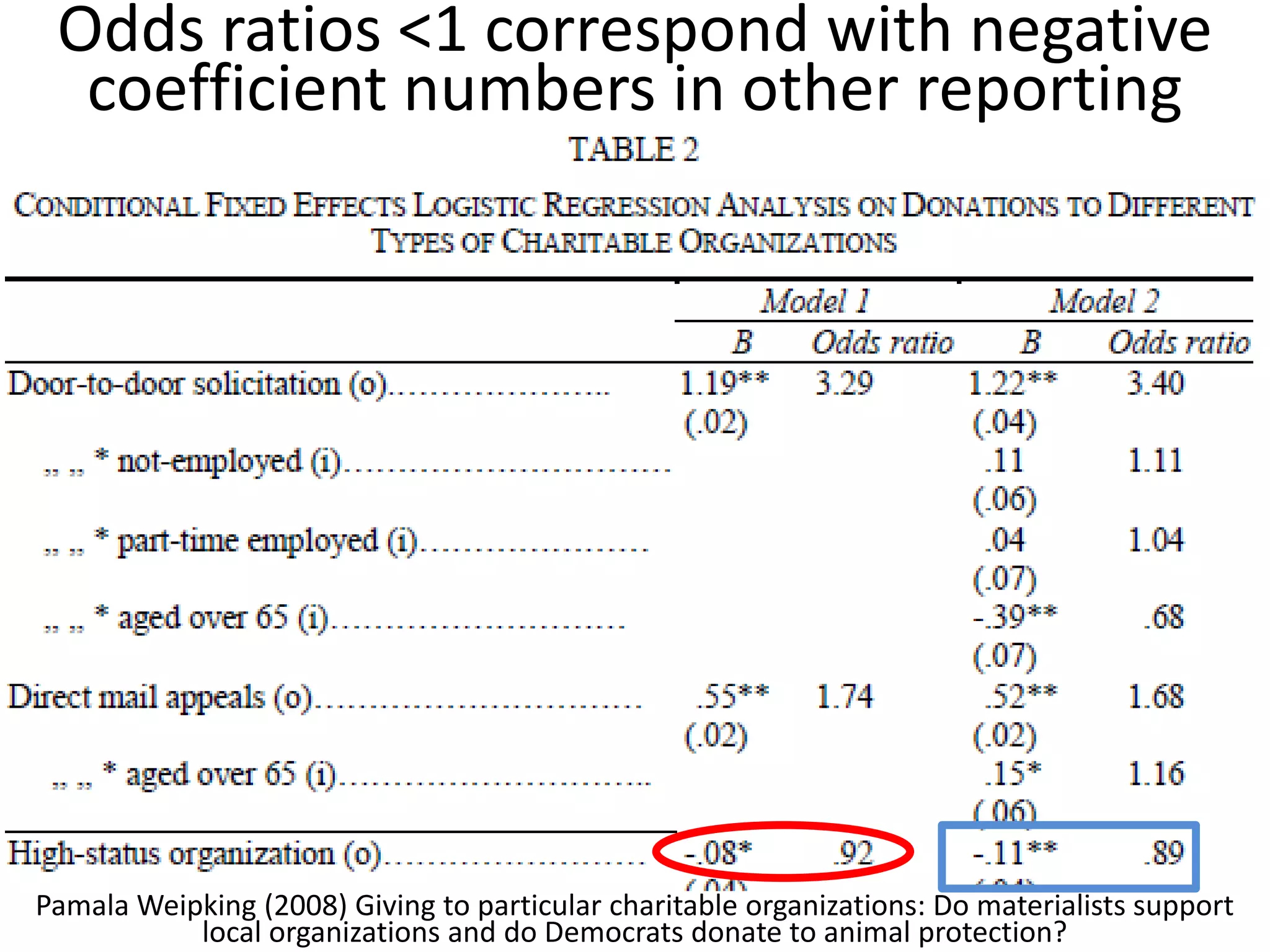
Odds ratios <1 correspond with negative
  coefficient numbers in other reporting


Pamala Weipking (2008) Giving to particular charitable organizations: Do materialists support
           local organizations and do Democrats donate to animal protection?
Finding academic research articles


                       ISI ranked academic
Includes everything,   journals articles only
even working
papers and
industry literature
How to
     read
   academic
   research
        (even if you’re not an expert)


Dr. Russell James III, Texas Tech University
     www.EncourageGenerosity.com

How to read academic research (beginner's guide)

  • 1.
    How to read academic research (even if you’re not an expert) Dr. Russell James III, Texas Tech University www.EncourageGenerosity.com
  • 2.
  • 3.
    You don’t needto eat the whole cow! You can get important concepts out of a research article without fully understanding every detail
  • 4.
    How do youeat a cake with rocks in it? Don’t try to eat the rocks
  • 5.
    Questions for anarticle 1.Do I care about the research topic? 2.Do I believe the findings? 3.So what?
  • 6.
    Abstract: Do Icare? Tables: What did they really find? Methods: Do I believe the table? Discussion: So what? Lit. Review: What did we already know?
  • 7.
  • 8.
  • 9.
  • 10.
  • 11.
    Literature Review: What did we already know?
  • 12.
    Should you believethe findings? Research is messy. Research often disagrees. We want to be able to distinguish strong results from weak ones.
  • 13.
    Bad news Knowing whether youshould believe the findings usually requires some statistics
  • 14.
    Core statistics conceptsyou must know 1. Association v. Causation 2. Correlation v. Multiple Regression 3. Significance v. Magnitude
  • 15.
    Association v. Causation Association:A & B tend to occur together more frequently than one would expect by random chance
  • 16.
    Explaining Associations 1. Randomchance (stuff happens) 2. A causes B (sometimes) 3. B causes A (sometimes) 4. Something else causes both A & B (sometimes)
  • 17.
    Sleeping in yourshoes is associated with waking up with a headache. Why?
  • 18.
    1. Random chance 2.Sleeping in shoes causes headaches 3. The very early stages of a forthcoming headache causes sleeping in shoes 4. Going to bed drunk causes both results
  • 19.
    Association v. Causation •Statistics can show only association • Statistics can NEVER show causation We infer causation from experimental design or theory combined with statistical association
  • 20.
    Statistics can easily determine this Explaining associations: 1. Random chance 2. A causes B less so with 3. B causes A these 4. Something else causes both A & B
  • 21.
    Correlation v. Multiple Regression
  • 22.
    Correlation: A &B tend to occur together more frequently than one would expect by random chance Multiple Regression: Above is true when comparing those otherwise similar in certain ways
  • 23.
    Correlation Higher education and charitablegiving tend to occur together (more frequently than one would expect by random chance)
  • 24.
    Multiple Regression Higher education andcharitable giving tend to occur together (more frequently than one would expect by random chance) comparing those with otherwise similar income and wealth
  • 25.
    Explaining Associations: 1. Random chance 2. A causes B 3. B causes A 4. Something else causes both A & B Multiple regression allows us to exclude specific items from #4, unless we can’t or didn’t measure it.
  • 26.
    Nature says kids’nightlights cause myopia “Although it does not establish a causal link, the statistical strength of the association of night-time light exposure and childhood myopia does suggest that the absence of a daily period of darkness during early childhood is a potential precipitating factor in the development of myopia.” G.E. Quinn, C.H. Shin, M. Maquire, R. Stone (University of Pennsylvania Medical School), 1999, Myopia and Ambient Lighting at Night, Nature, 399, 113.
  • 27.
    Nature says kids’nightlights cause myopia 1. Random chance 2. A causes B 3. B causes A 4. Something else causes both A & B G.E. Quinn, C.H. Shin, M. Maquire, R. Stone (University of Pennsylvania Medical School), 1999, Myopia and Ambient Lighting at Night, Nature, 399, 113.
  • 28.
    Rebuttal: Maybe parents’myopia causes both nightlights and child’s myopia? “…we find that myopic parents are more likely to employ night-time lighting aids for their children. Moreover, there is an association between myopia in parents and their children…” “…Quinn et al.’s study should have controlled for parental myopia.” J. Gwiazda, E. Ong, R. Held, F. Thorn (New England College of Optometry), 2000, Myopia and Ambient Night-Time Lighting, Nature, 399, 113.
  • 29.
    Significance v. Magnitude
  • 30.
    Statistics tests asmall sample to predict the whole population Significance shows how likely our result might have been due to an unusual random sample, rather than an actual difference in the population
  • 31.
    Most papers reportsome measure of statistical significance (chance that the association was due to a weird random sample) • p-value • confidence interval
  • 32.
    How likely isit to randomly draw these five fruits from a truckload with as many apples as oranges? p-value
  • 33.
    p-value p<.05 = thereis less than a 5% chance that the result was caused by an unusual random sample where there was no actual (population) difference
  • 34.
    Was there asignificant gender difference in planned givers with a will v. a trust? No
  • 36.
    This (sample) differencecould have easily occurred even if the two (population) groups were the same
  • 37.
    It DOES NOTmean the two (population) groups do not differ, only that WE CAN’T TELL.
  • 38.
    No “*” meanswe can’t confidently tell the effect of this item
  • 39.
    95% Confidence interval Ifyou kept taking random samples, 95% of the time the true (population) value would appear inside the confidence interval associated with each sample Sample Average Strength Population Average Strength Confidence Interval
  • 40.
    Dashed line isa 95% confidence interval S. Huck and I. Rasul (2008) Testing consumer theory in the field: Private consumption versus charitable goods
  • 41.
    Multiple Comparisons Problem How likely is it to randomly draw these five fruits from a truckload with as many apples as oranges? Would your answer change if I got to draw 20 times to find this group?
  • 42.
    If all variablesare random, about one out of 20 will have a p-value<.05
  • 43.
    “We tested 100items and found 5 to be significant at p<.05.”
  • 44.
    Significance v. Magnitude Itis possible to be highly confident of a very small effect. This may be publishable, but not practically important.
  • 45.
    Numbers (coefficients) resulting from complex statistical techniques may not be directly interpretable in terms of real world magnitude
  • 46.
    The impact ofchildren on the probability of exclusively secular giving is “-0.089”, but the meaning of that number is not easily translated
  • 47.
    Even with complextechniques, we can easily compare sign and magnitude relative to other variables
  • 48.
    Race and education factors are 3-4 times as large. More children have an opposite relationship compared with more education.
  • 49.
    Odds ratios aredifferent Usually you can compare sign and size, but odds ratios are always positive
  • 50.
    Odds ratios: theodds of an event occurring in one group over the odds of it occurring in another group <1 negative; >1 positive; =1 none
  • 51.
    Odds ratios <1correspond with negative coefficient numbers in other reporting Pamala Weipking (2008) Giving to particular charitable organizations: Do materialists support local organizations and do Democrats donate to animal protection?
  • 52.
    Finding academic researcharticles ISI ranked academic Includes everything, journals articles only even working papers and industry literature
  • 53.
    How to read academic research (even if you’re not an expert) Dr. Russell James III, Texas Tech University www.EncourageGenerosity.com