Harnessing
Harnessing
Artificial
Artificial
Intelligence for
Intelligence for
Academic
Academic
Writing
Writing
By
Tope Gloria Olatunde-Aiyedun
Benefits
Benefits
Harnessing artificial
intelligence for
academic writing can
provide several benefits,
ranging from improved
writing efficiency to
enhanced content
quality.
Automated Language
Automated Language
Checking
Checking
AI-powered tools
such as Grammarly,
Turnitin, and
Hemingway Editor
can help you
identify and correct
grammar and
language errors in
your academic
writing.
These tools use
natural language
processing (NLP)
algorithms to
analyze your text
and provide
suggestions for
improvement,
ensuring that your
writing is error-free
and adheres to
academic standards.
Content Generation
Content Generation
AI can assist in generating content for academic
writing. For instance, language models like GPT-3 can
generate text on various topics, making it useful for
tasks such as summarizing articles, generating
citations, or creating outlines for research papers.
This can help you save time and effort in organizing
and structuring your academic writing.
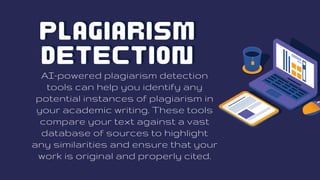
Plagiarism
Plagiarism
Detection
Detection
AI-powered plagiarism detection
tools can help you identify any
potential instances of plagiarism in
your academic writing. These tools
compare your text against a vast
database of sources to highlight
any similarities and ensure that your
work is original and properly cited.
Data Analysis
Data Analysis
AI can be used to analyze and interpret large datasets
for academic research. Machine learning algorithms can
help you analyze complex data, identify patterns, and
draw conclusions from your findings. Tools like R and
Python with libraries such as NumPy, Pandas, and Scikit-
learn can assist you in conducting statistical analysis and
data visualization, which can enhance the quality of your
research.
AI can aid in improving the
language and style of your
academic writing. Tools like
ProWritingAid and LanguageTool
can provide suggestions to
enhance the readability, coherence,
and overall flow of your writing,
helping you to convey your ideas
more effectively.
Language Enhancement
Citation and
Citation and
Reference
Reference
Management
Management
AI-powered citation and reference management
tools like Endnote, Mendeley, and Zotero can help
you manage your references and citations
efficiently. These tools can automatically
generate citations in various citation styles, such
as APA, MLA, and Chicago, and organize your
references for easy retrieval and insertion into
your academic writing.
It's important to note that while AI can be a
valuable tool in academic writing, it should not
replace critical thinking, creativity, and the human
touch in scholarly writing. It's essential to use AI
as an aid and always verify and validate the
accuracy of its suggestions.
This work can be cited/referenced in APA format( 7th Edition)
Olatunde-Aiyedun, T.G. (2023). Harnessing artificial intelligence for academic writing [Presentation slides].
Thank you for
Thank you for
Reading!
Reading!
References
References
Olatunde-Aiyedun, Tope Gloria (2023)

Harnessing Artificial Intelligence (AI) for Academic Writing

  • 1.
  • 2.
    Benefits Benefits Harnessing artificial intelligence for academicwriting can provide several benefits, ranging from improved writing efficiency to enhanced content quality.
  • 3.
    Automated Language Automated Language Checking Checking AI-poweredtools such as Grammarly, Turnitin, and Hemingway Editor can help you identify and correct grammar and language errors in your academic writing. These tools use natural language processing (NLP) algorithms to analyze your text and provide suggestions for improvement, ensuring that your writing is error-free and adheres to academic standards.
  • 4.
    Content Generation Content Generation AIcan assist in generating content for academic writing. For instance, language models like GPT-3 can generate text on various topics, making it useful for tasks such as summarizing articles, generating citations, or creating outlines for research papers. This can help you save time and effort in organizing and structuring your academic writing.
  • 5.
    Plagiarism Plagiarism Detection Detection AI-powered plagiarism detection toolscan help you identify any potential instances of plagiarism in your academic writing. These tools compare your text against a vast database of sources to highlight any similarities and ensure that your work is original and properly cited.
  • 6.
    Data Analysis Data Analysis AIcan be used to analyze and interpret large datasets for academic research. Machine learning algorithms can help you analyze complex data, identify patterns, and draw conclusions from your findings. Tools like R and Python with libraries such as NumPy, Pandas, and Scikit- learn can assist you in conducting statistical analysis and data visualization, which can enhance the quality of your research.
  • 7.
    AI can aidin improving the language and style of your academic writing. Tools like ProWritingAid and LanguageTool can provide suggestions to enhance the readability, coherence, and overall flow of your writing, helping you to convey your ideas more effectively. Language Enhancement Language Enhancement
  • 8.
    Citation and Citation and Reference Reference Management Management AI-poweredcitation and reference management tools like Endnote, Mendeley, and Zotero can help you manage your references and citations efficiently. These tools can automatically generate citations in various citation styles, such as APA, MLA, and Chicago, and organize your references for easy retrieval and insertion into your academic writing. It's important to note that while AI can be a valuable tool in academic writing, it should not replace critical thinking, creativity, and the human touch in scholarly writing. It's essential to use AI as an aid and always verify and validate the accuracy of its suggestions. This work can be cited/referenced in APA format( 7th Edition) Olatunde-Aiyedun, T.G. (2023). Harnessing artificial intelligence for academic writing [Presentation slides].
  • 9.
    Thank you for Thankyou for Reading! Reading!
  • 10.