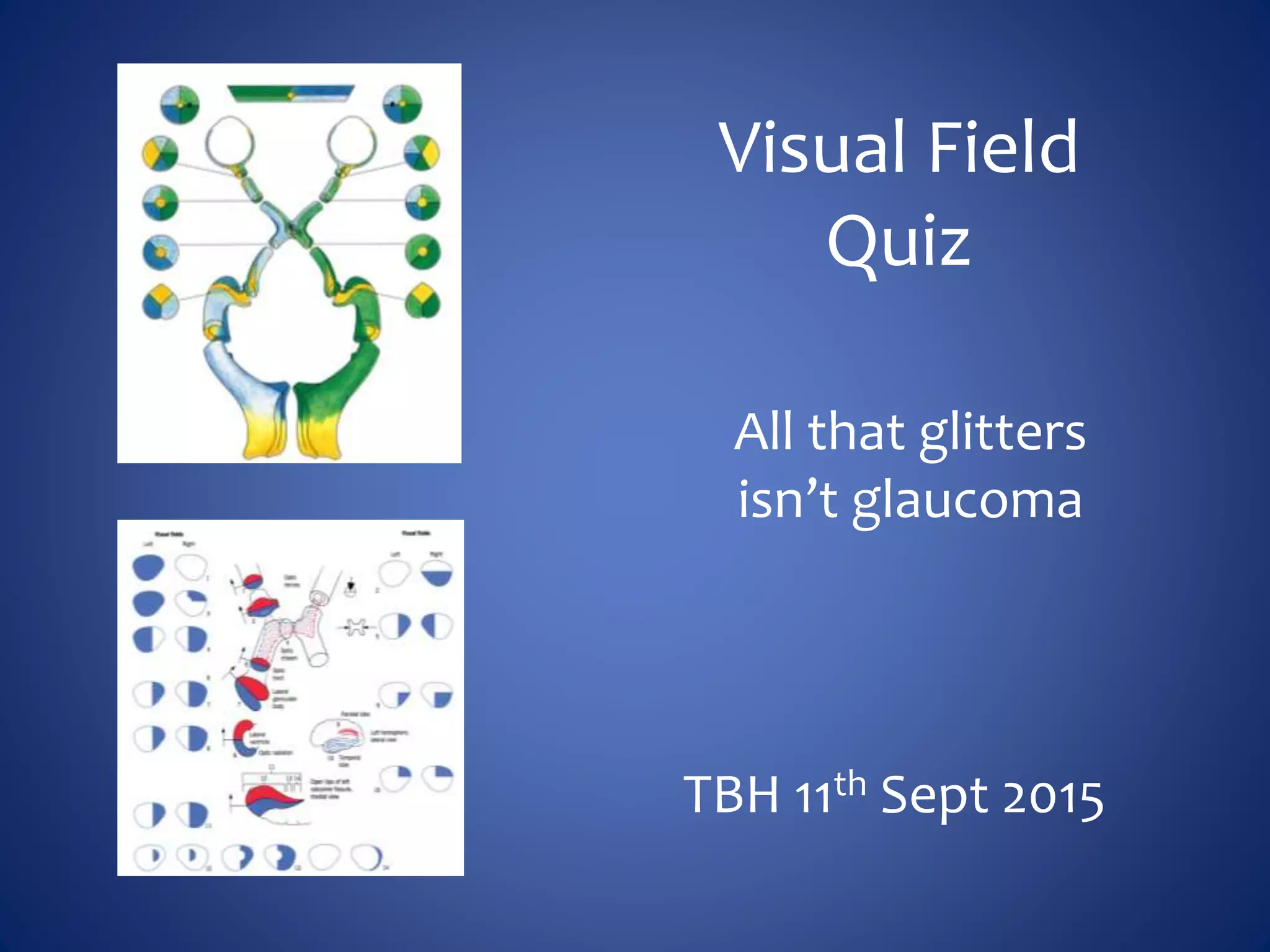
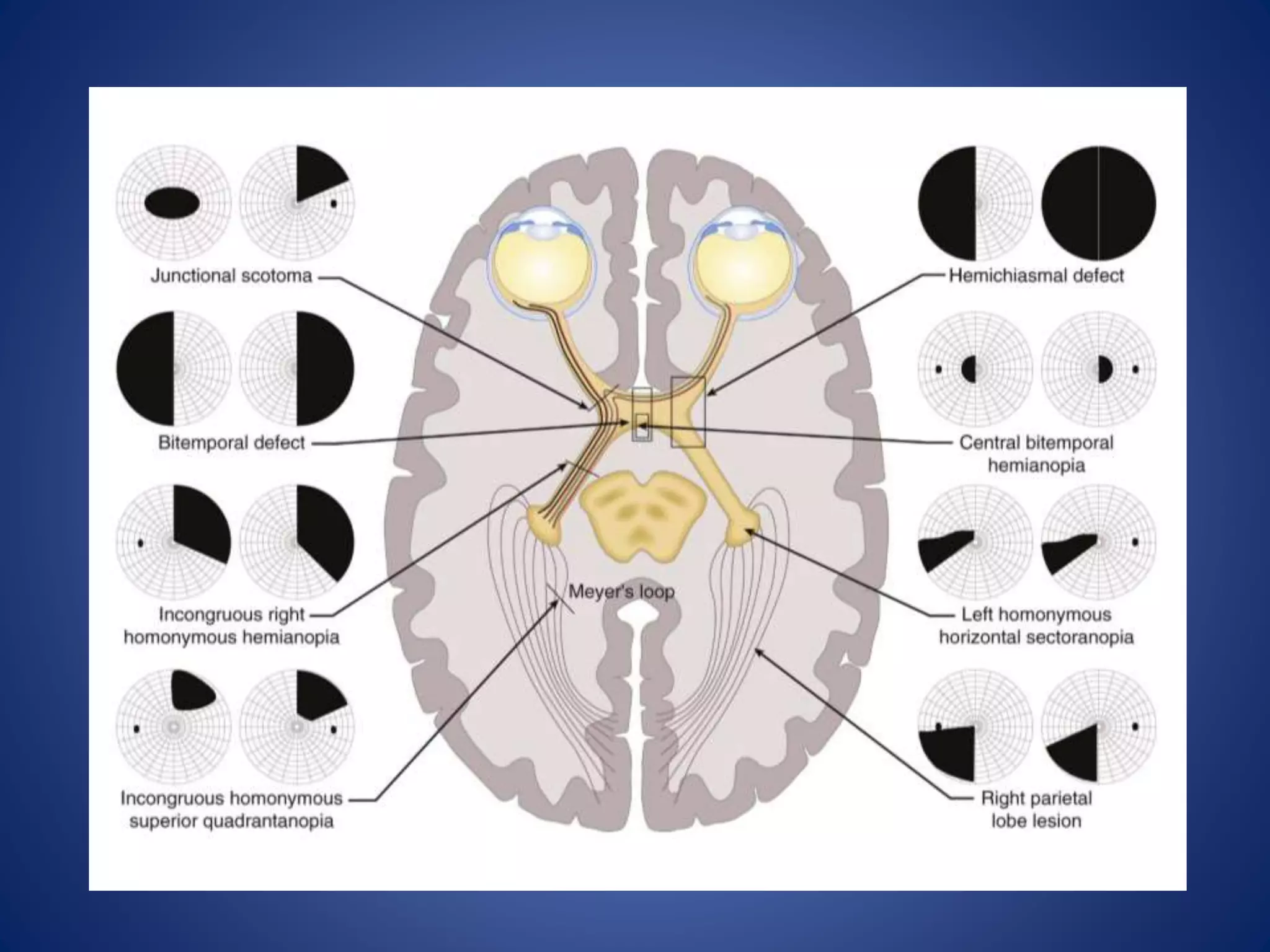
Visual Field
Quiz
All that glitters
isn’t glaucoma
TBH 11th Sept 2015
Static vs Kinetic
Static vs Kinetic
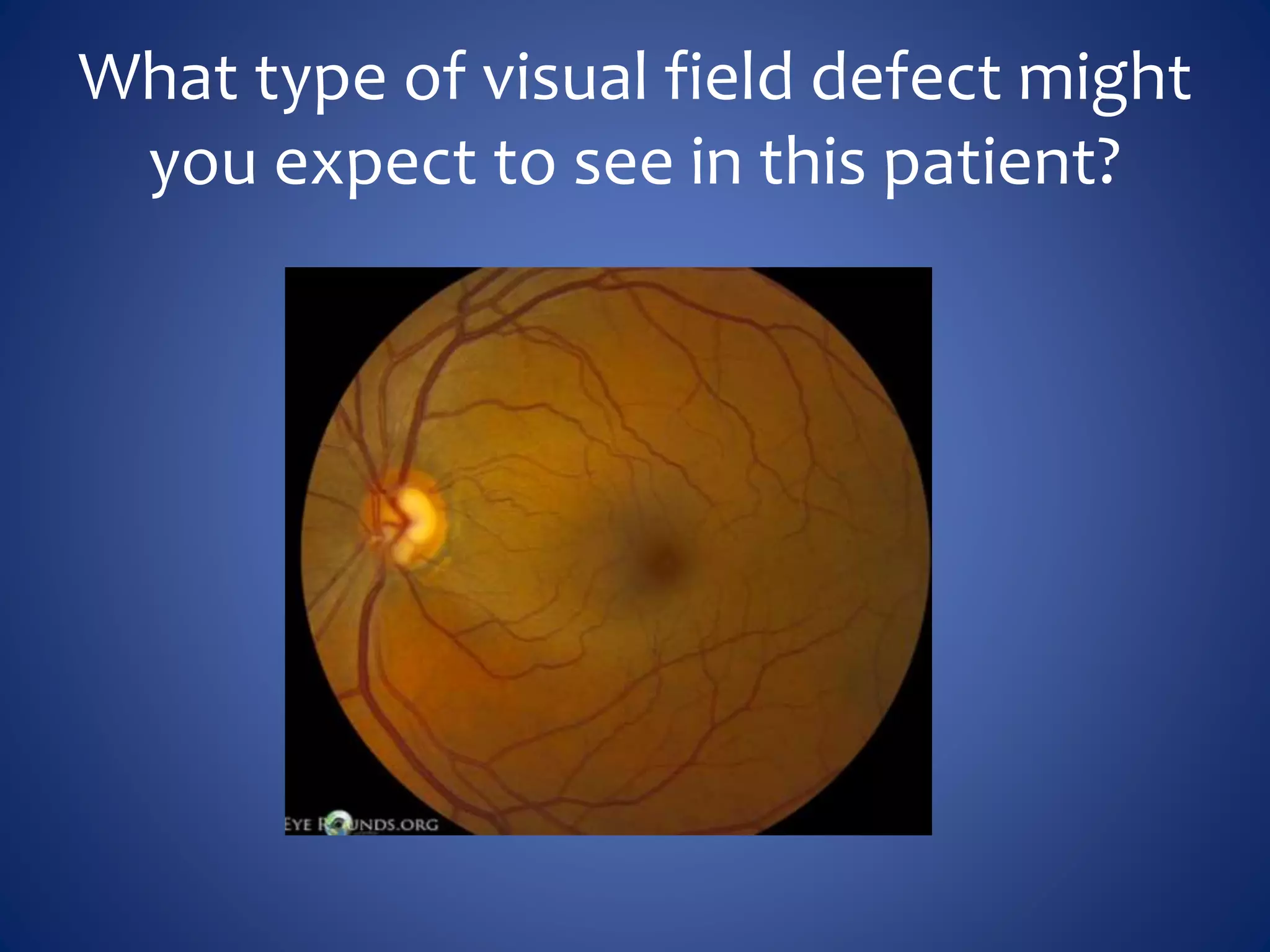
What type of visual field defect might
you expect to see in this patient?
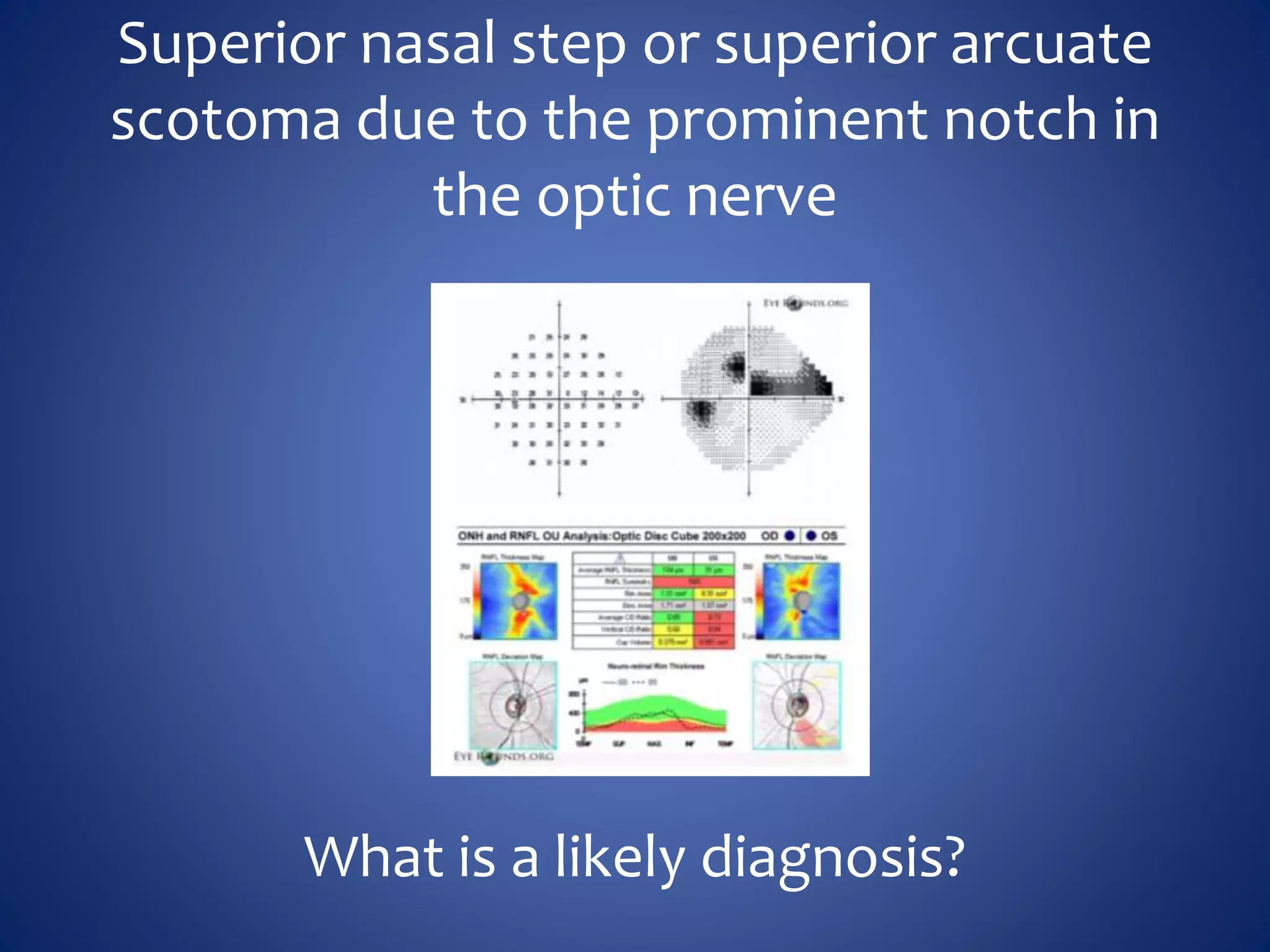
Superior nasal step or superior arcuate
scotoma due to the prominent notch in
the optic nerve
What is a likely diagnosis?
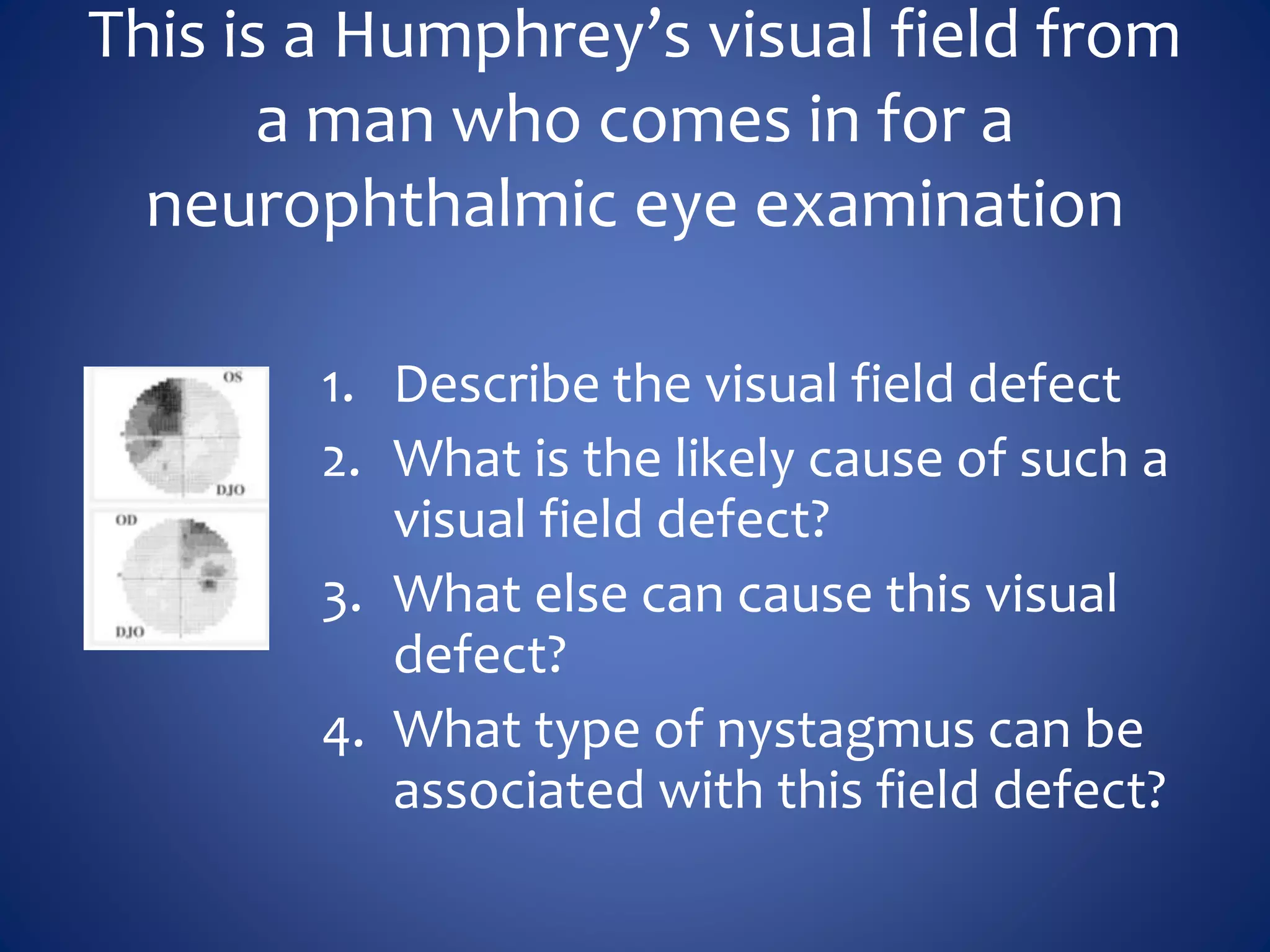
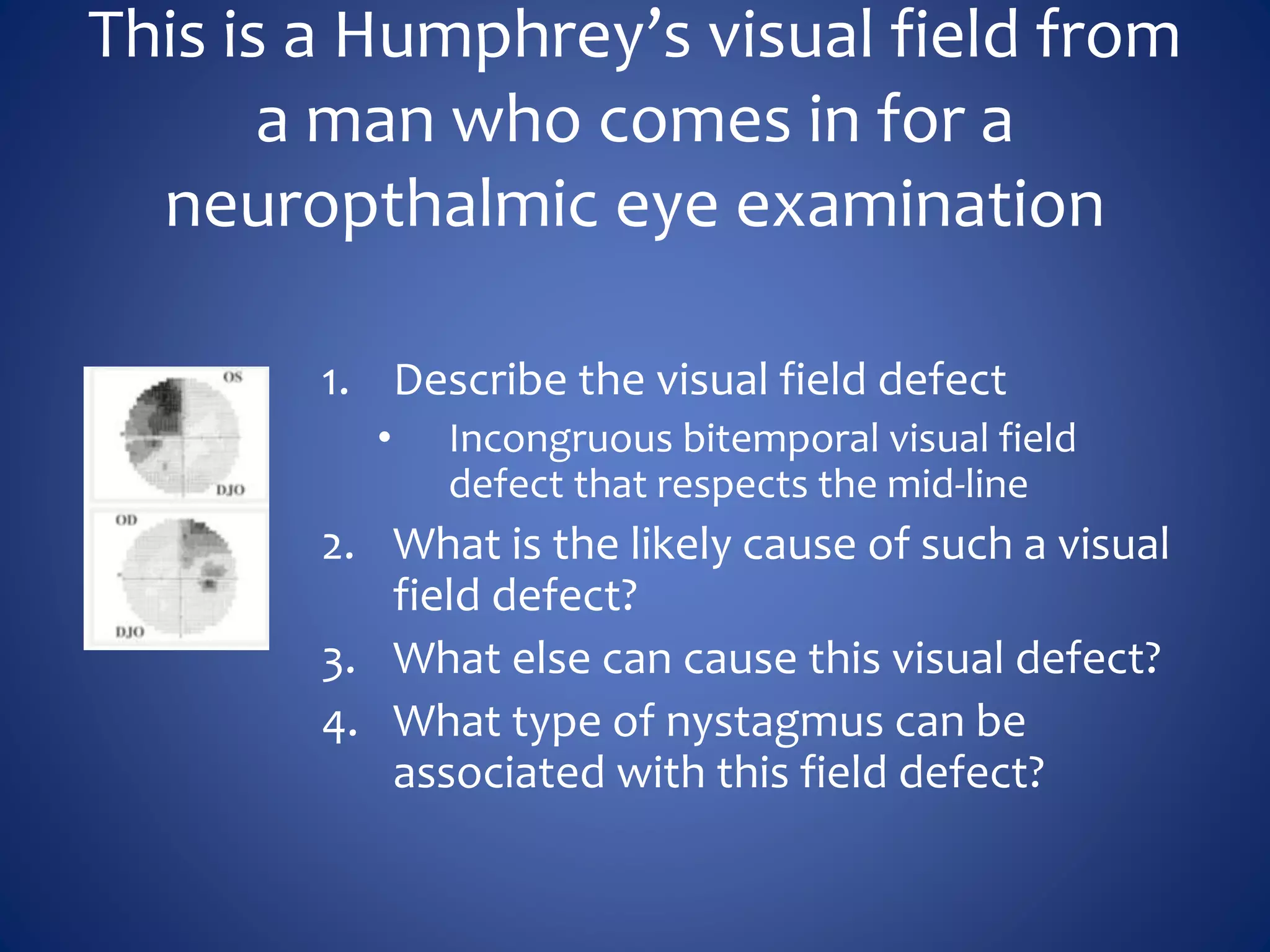
This is a Humphrey’s visual field from
a man who comes in for a
neurophthalmic eye examination
1. Describe the visual field defect
2. What is the likely cause of such a
visual field defect?
3. What else can cause this visual
defect?
4. What type of nystagmus can be
associated with this field defect?
This is a Humphrey’s visual field from
a man who comes in for a
neuropthalmic eye examination
1. Describe the visual field defect
• Incongruous bitemporal visual field
defect that respects the mid-line
2. What is the likely cause of such a visual
field defect?
3. What else can cause this visual defect?
4. What type of nystagmus can be
associated with this field defect?
This is a Humphrey’s visual field from
a man who comes in for a
neuropthalmic eye examination
1. Describe the visual field defect
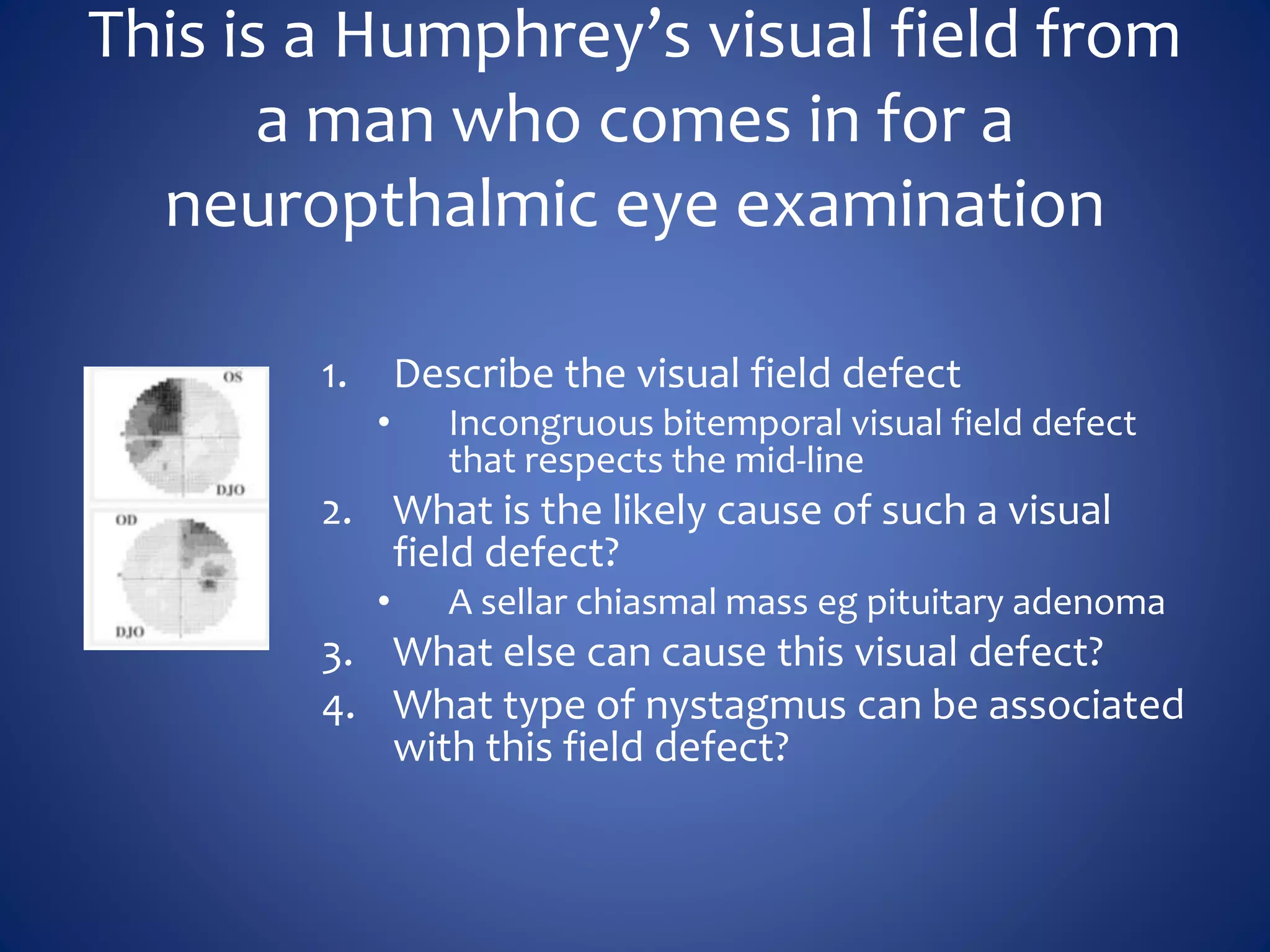
• Incongruous bitemporal visual field defect
that respects the mid-line
2. What is the likely cause of such a visual
field defect?
• A sellar chiasmal mass eg pituitary adenoma
3. What else can cause this visual defect?
4. What type of nystagmus can be associated
with this field defect?
This is a Humphrey’s visual field from
a man who comes in for a
neuropthalmic eye examination
1. Describe the visual field defect
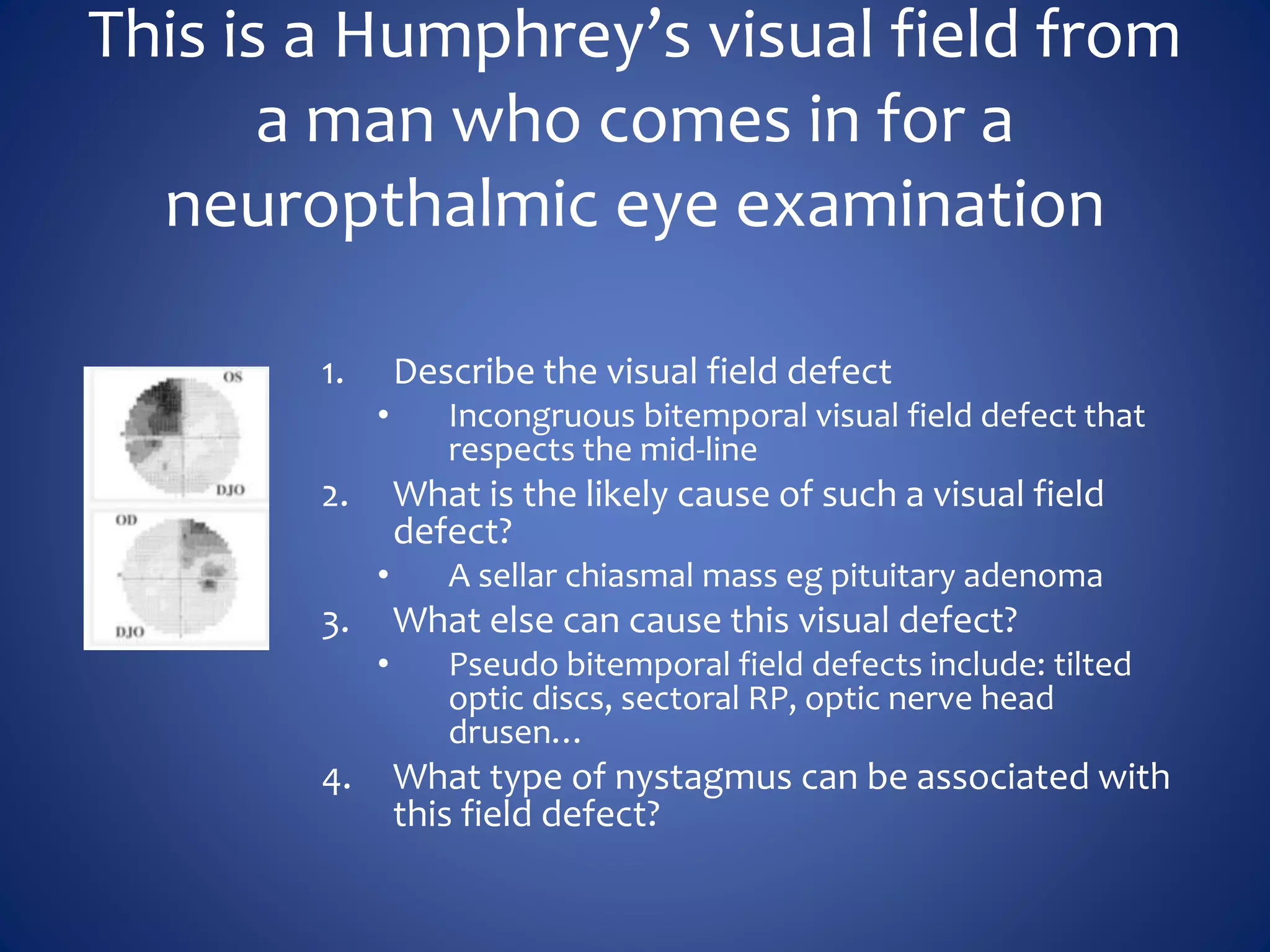
• Incongruous bitemporal visual field defect that
respects the mid-line
2. What is the likely cause of such a visual field
defect?
• A sellar chiasmal mass eg pituitary adenoma
3. What else can cause this visual defect?
• Pseudo bitemporal field defects include: tilted
optic discs, sectoral RP, optic nerve head
drusen…
4. What type of nystagmus can be associated with
this field defect?
This is a Humphrey’s visual field from
a man who comes in for a
neuropthalmic eye examination
1. Describe the visual field defect
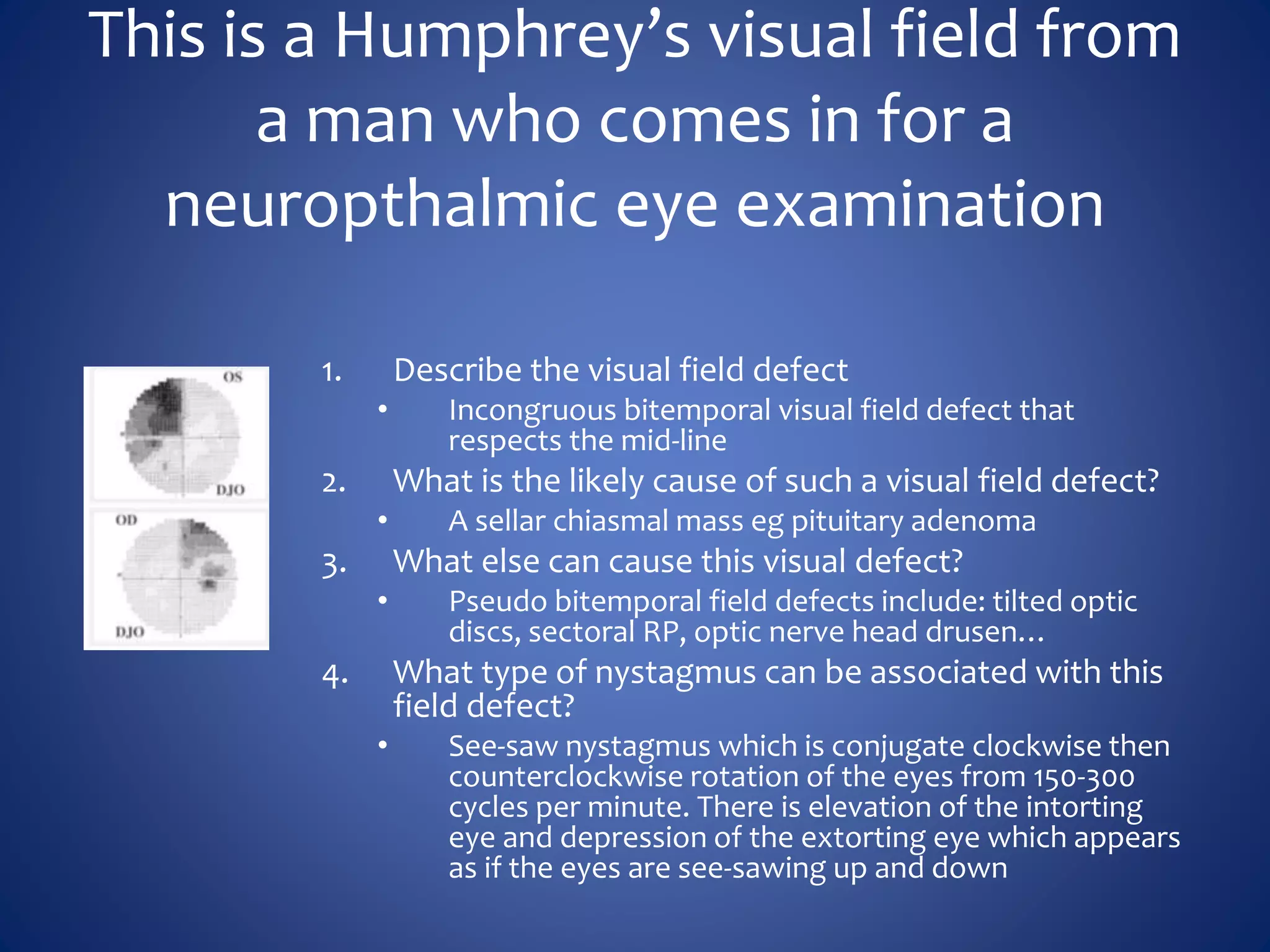
• Incongruous bitemporal visual field defect that
respects the mid-line
2. What is the likely cause of such a visual field defect?
• A sellar chiasmal mass eg pituitary adenoma
3. What else can cause this visual defect?
• Pseudo bitemporal field defects include: tilted optic
discs, sectoral RP, optic nerve head drusen…
4. What type of nystagmus can be associated with this
field defect?
• See-saw nystagmus which is conjugate clockwise then
counterclockwise rotation of the eyes from 150-300
cycles per minute. There is elevation of the intorting
eye and depression of the extorting eye which appears
as if the eyes are see-sawing up and down
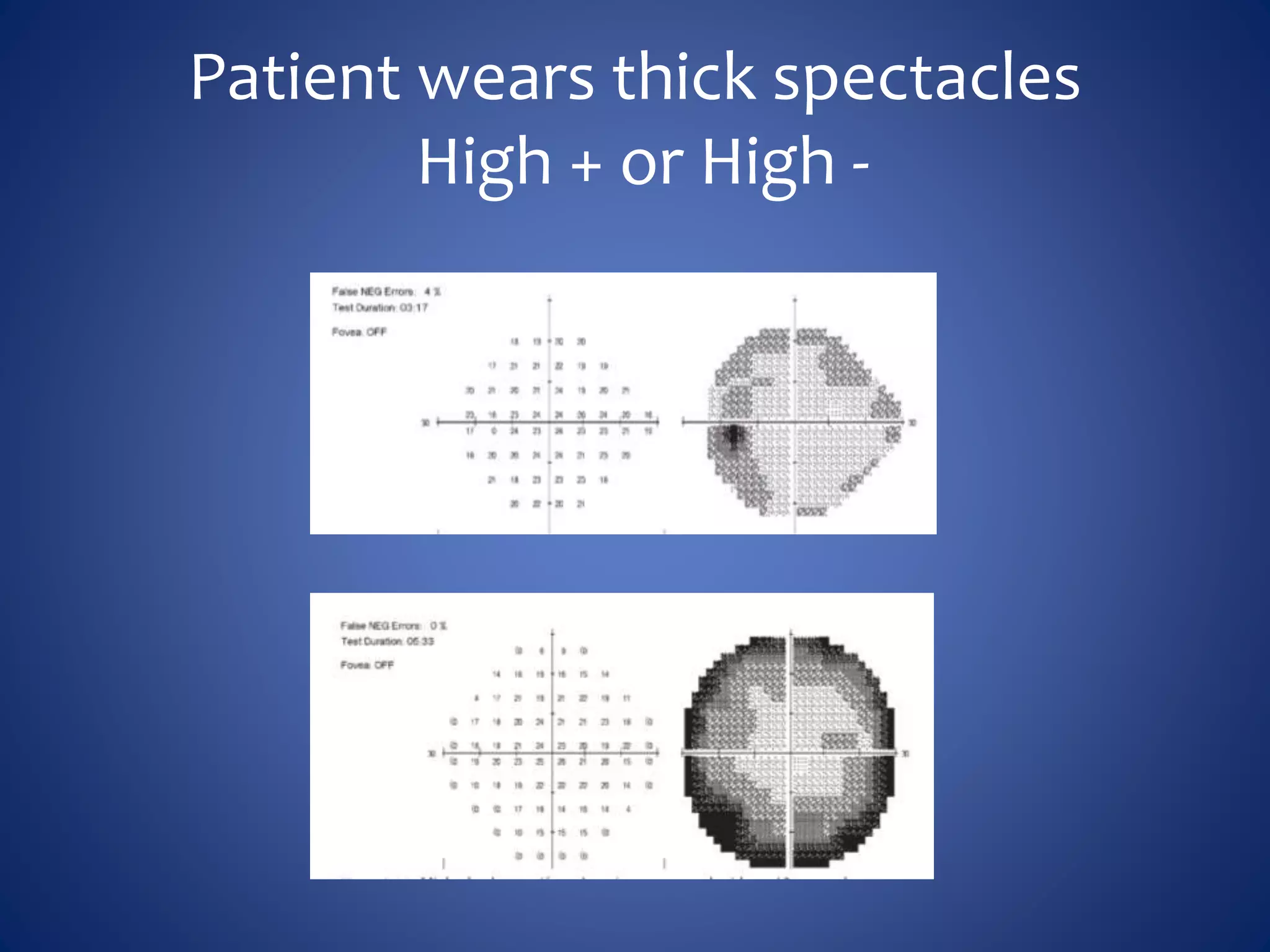
Patient wears thick spectacles
High + or High -
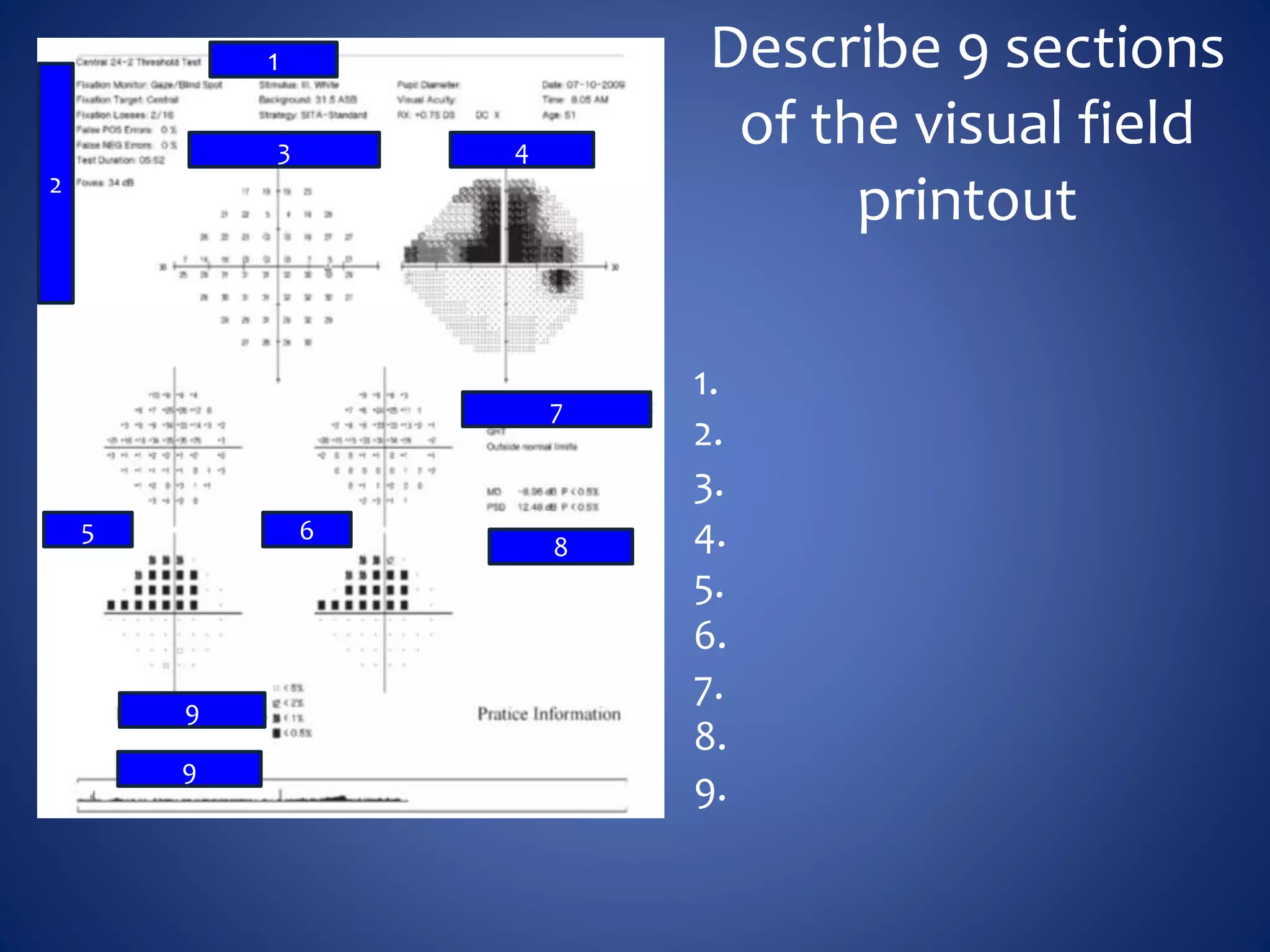
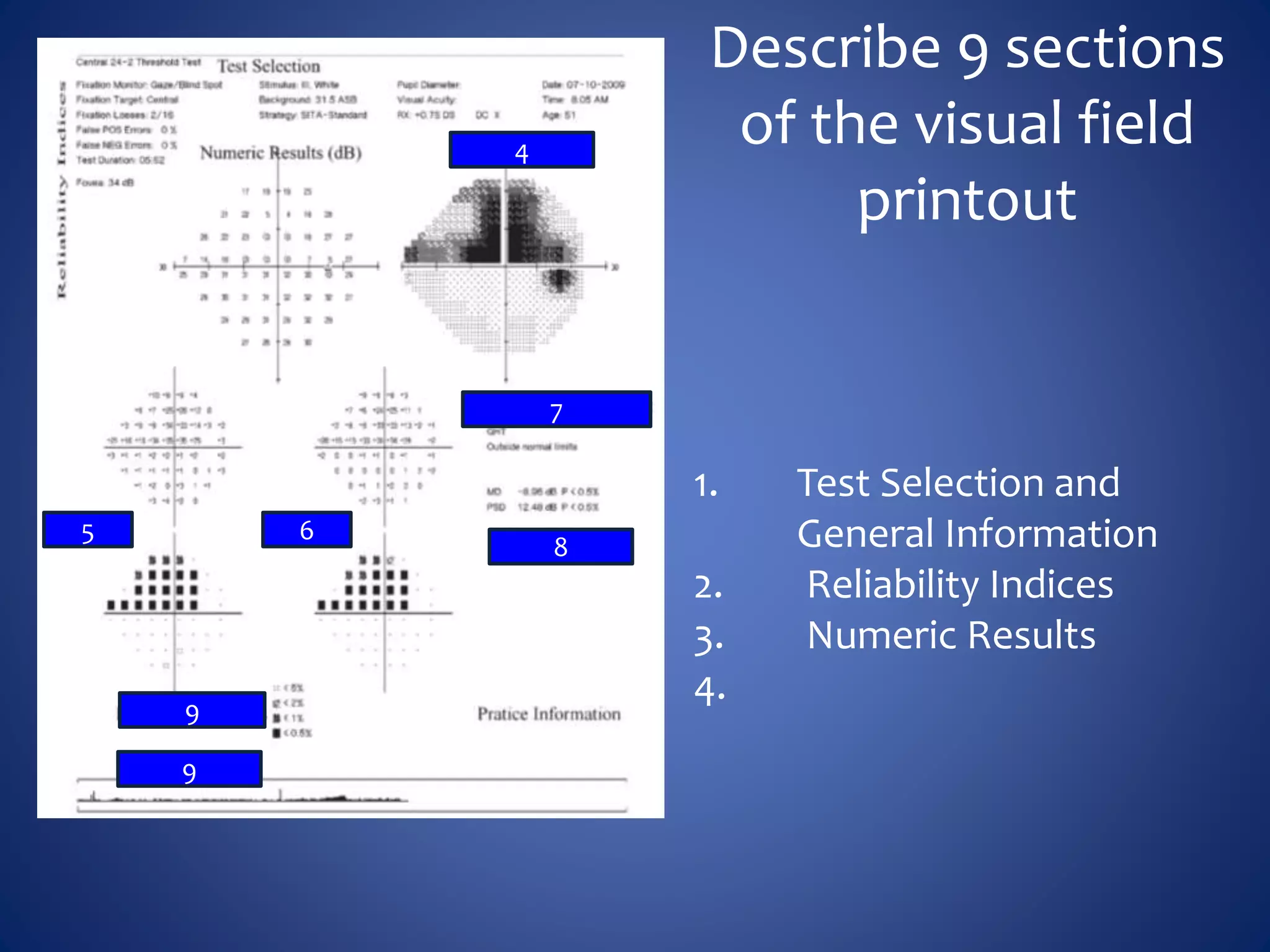
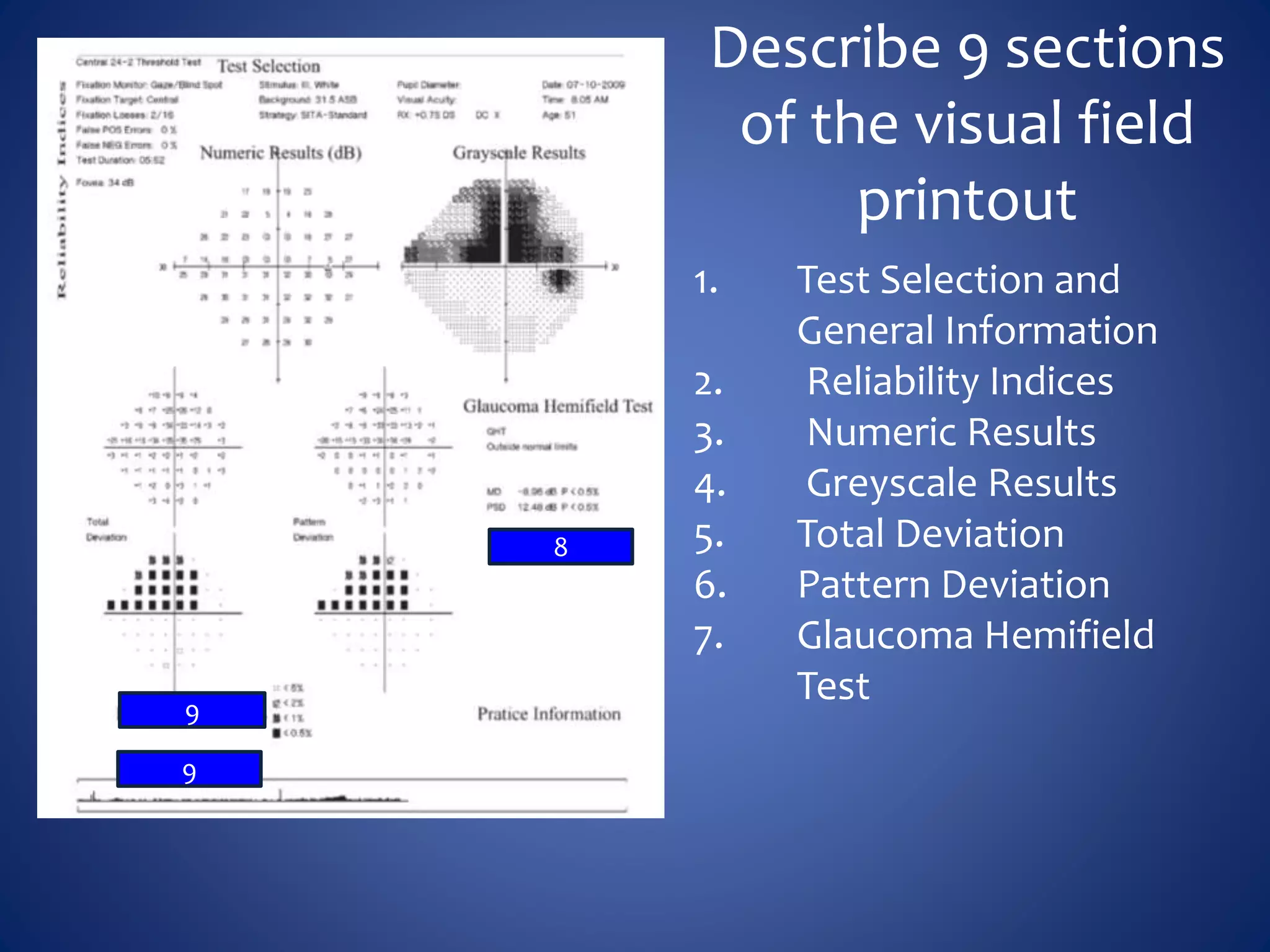
Describe 9 sections
of the visual field
printout
1.
2.
3.
4.
5.
6.
7.
8.
9.
1
5
43
2
6
8
7
9
9
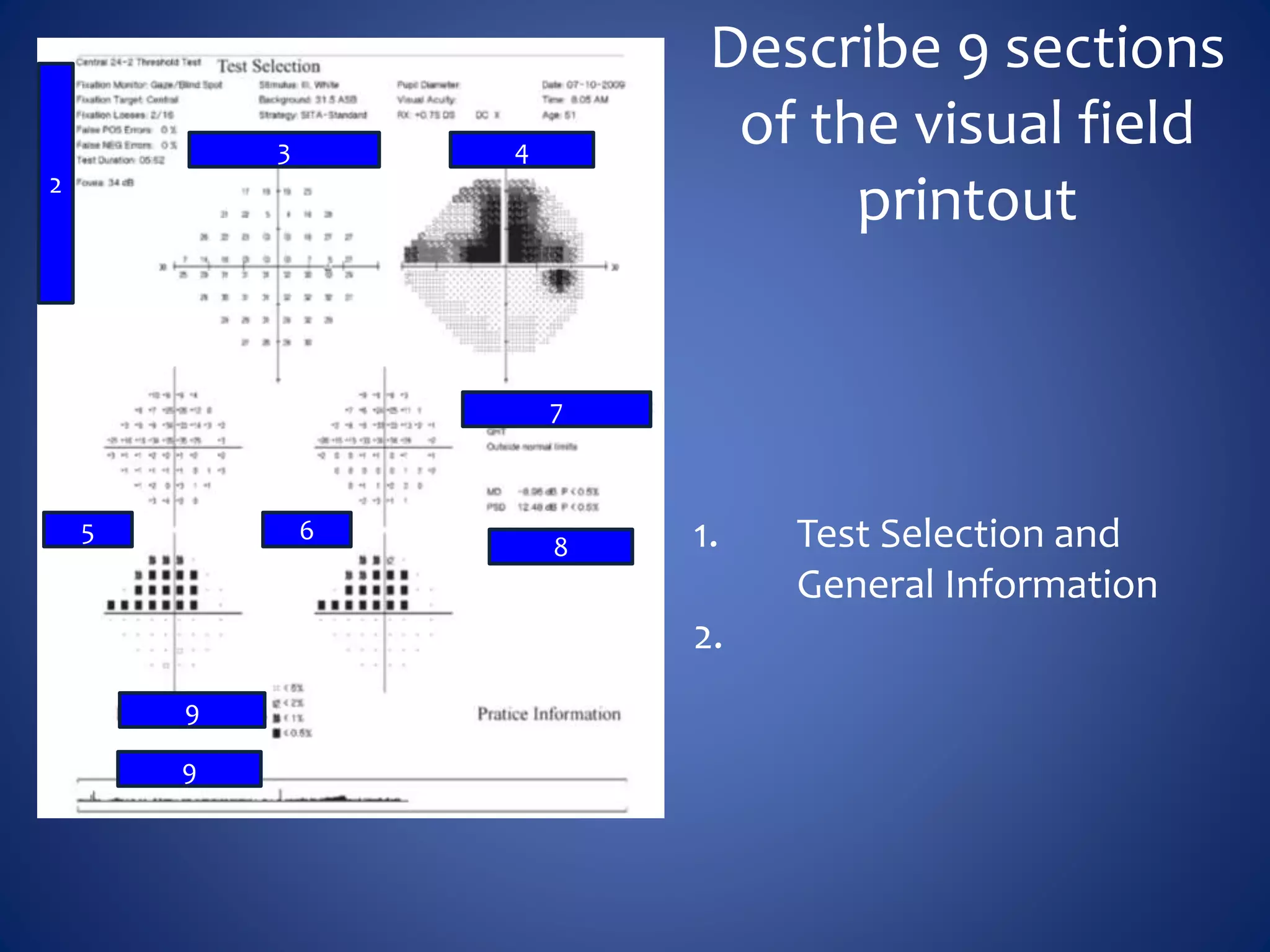
Describe 9 sections
of the visual field
printout
1. Test Selection and
General Information
2.
5
43
2
6
8
7
9
9
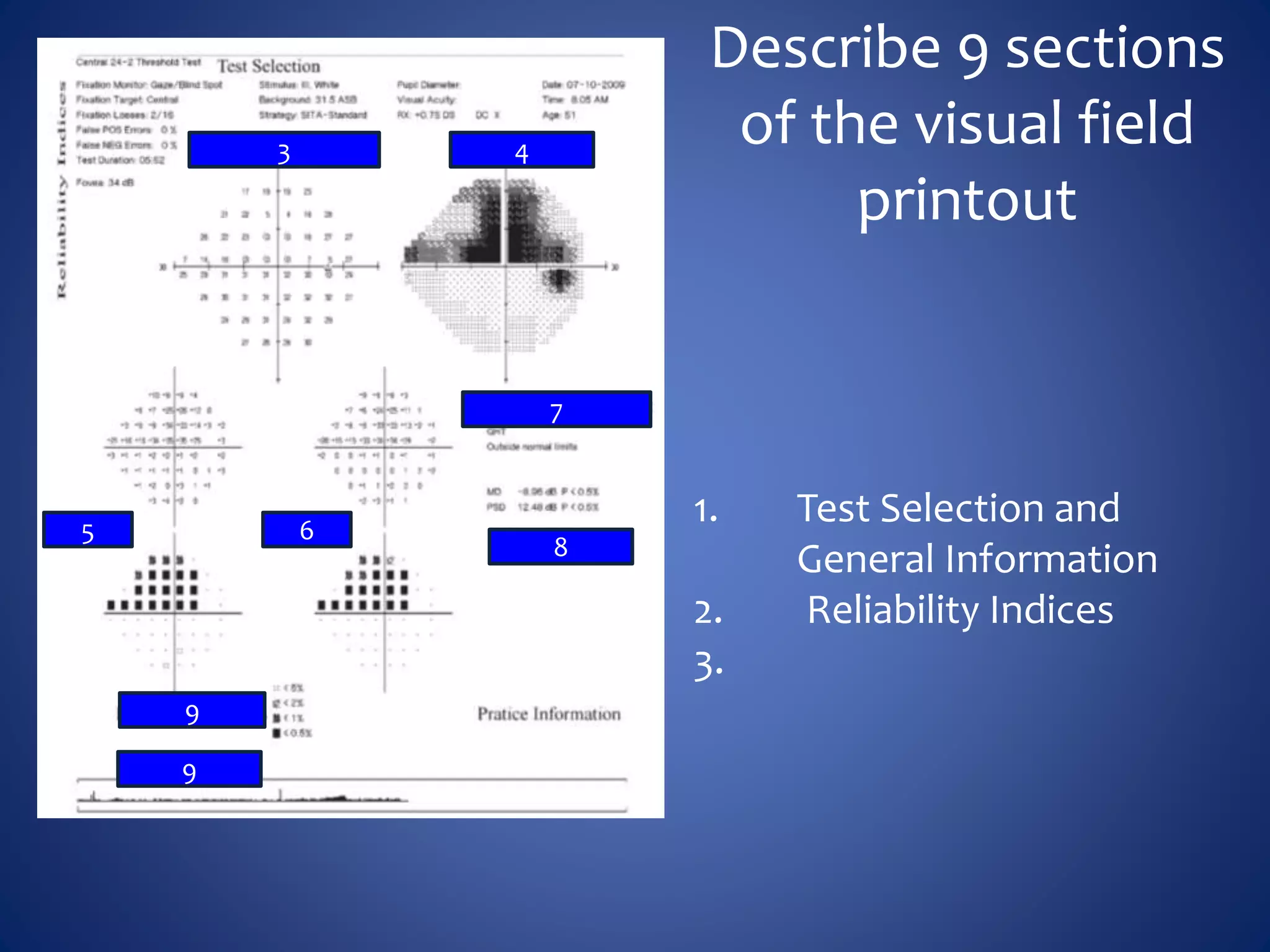
Describe 9 sections
of the visual field
printout
1. Test Selection and
General Information
2. Reliability Indices
3.
5
43
6
8
7
9
9
Describe 9 sections
of the visual field
printout
1. Test Selection and
General Information
2. Reliability Indices
3. Numeric Results
4.
5
4
6
8
7
9
9
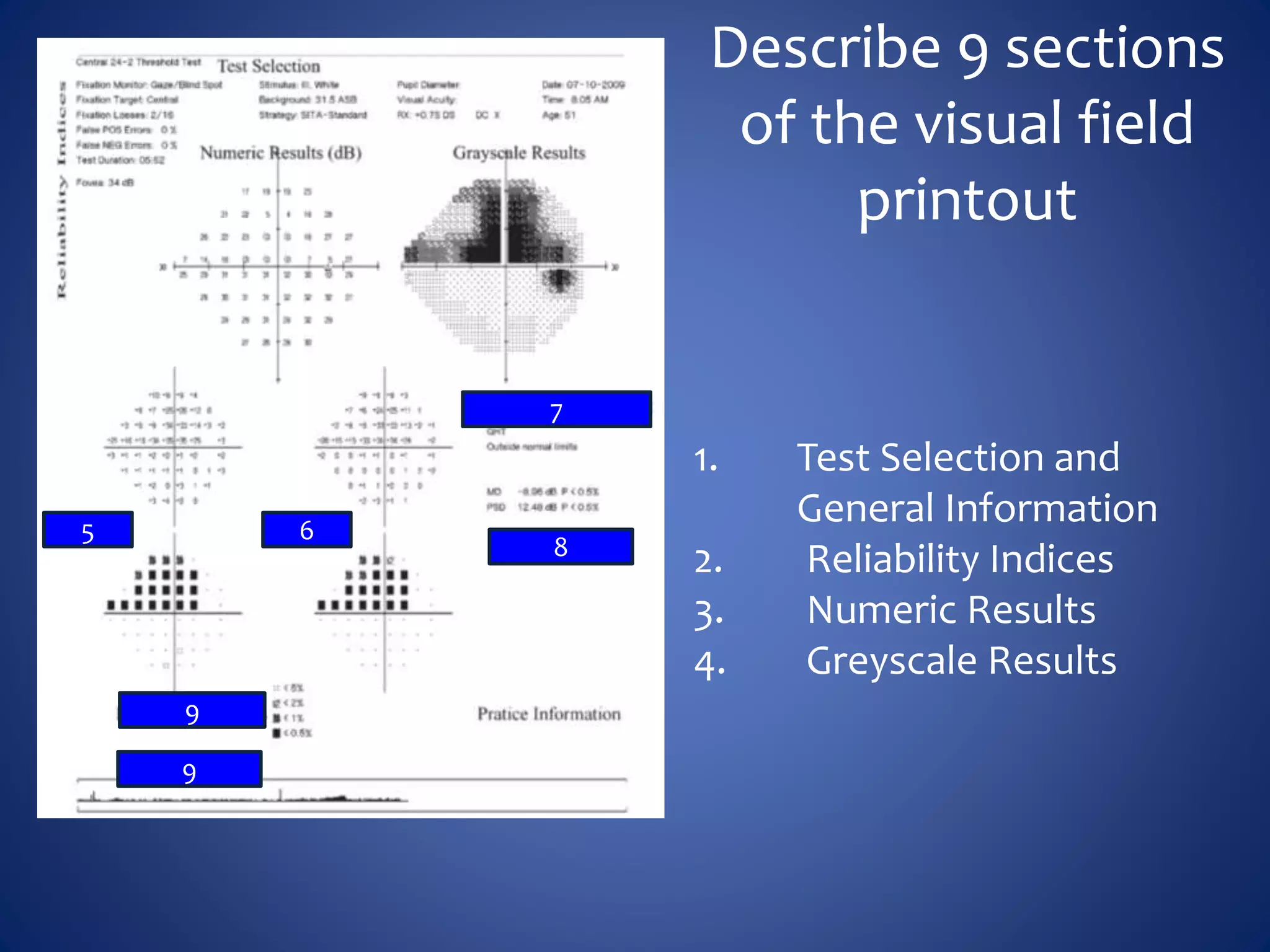
Describe 9 sections
of the visual field
printout
1. Test Selection and
General Information
2. Reliability Indices
3. Numeric Results
4. Greyscale Results
5 6
8
7
9
9
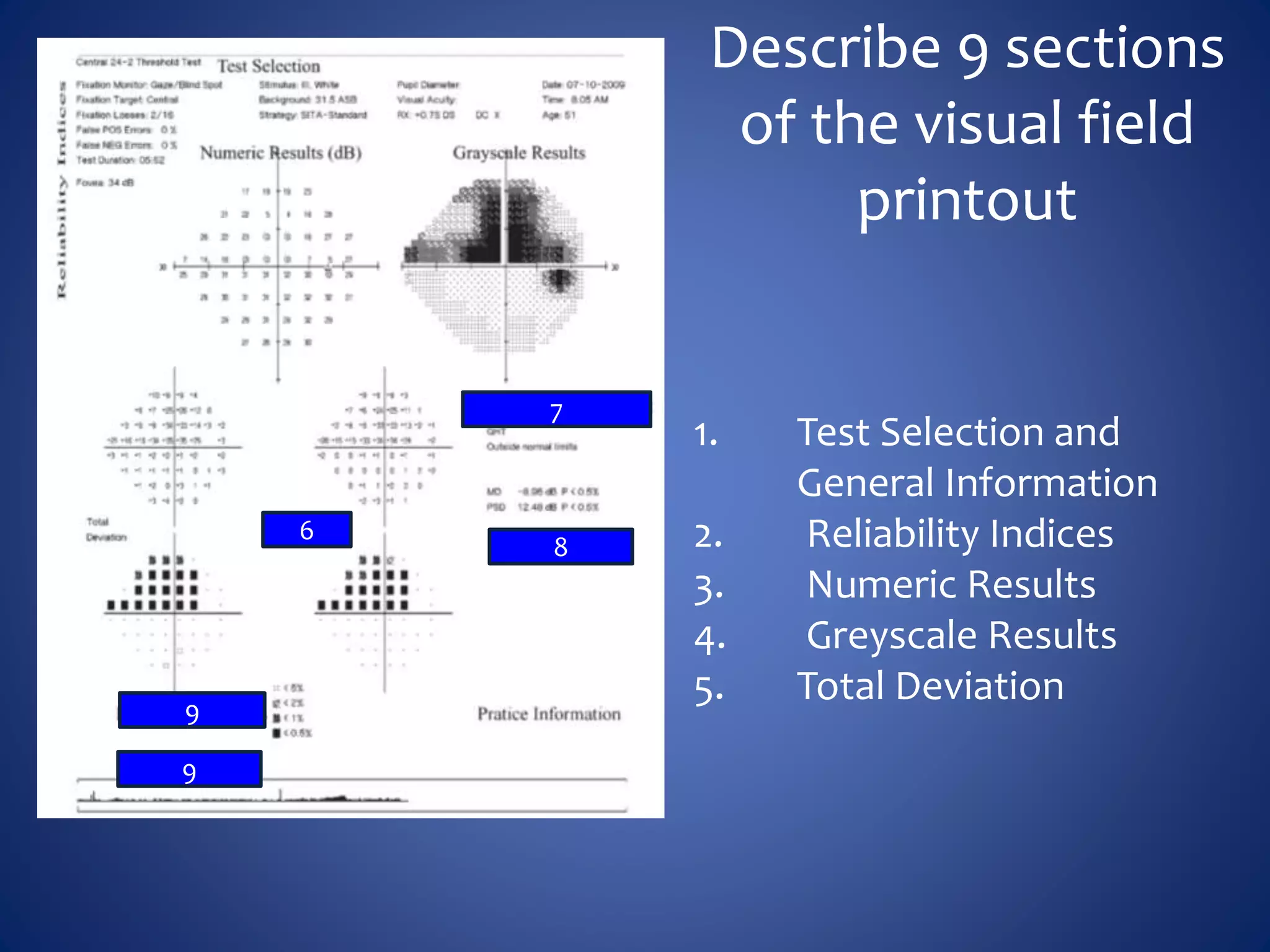
Describe 9 sections
of the visual field
printout
1. Test Selection and
General Information
2. Reliability Indices
3. Numeric Results
4. Greyscale Results
5. Total Deviation
6
8
7
9
9
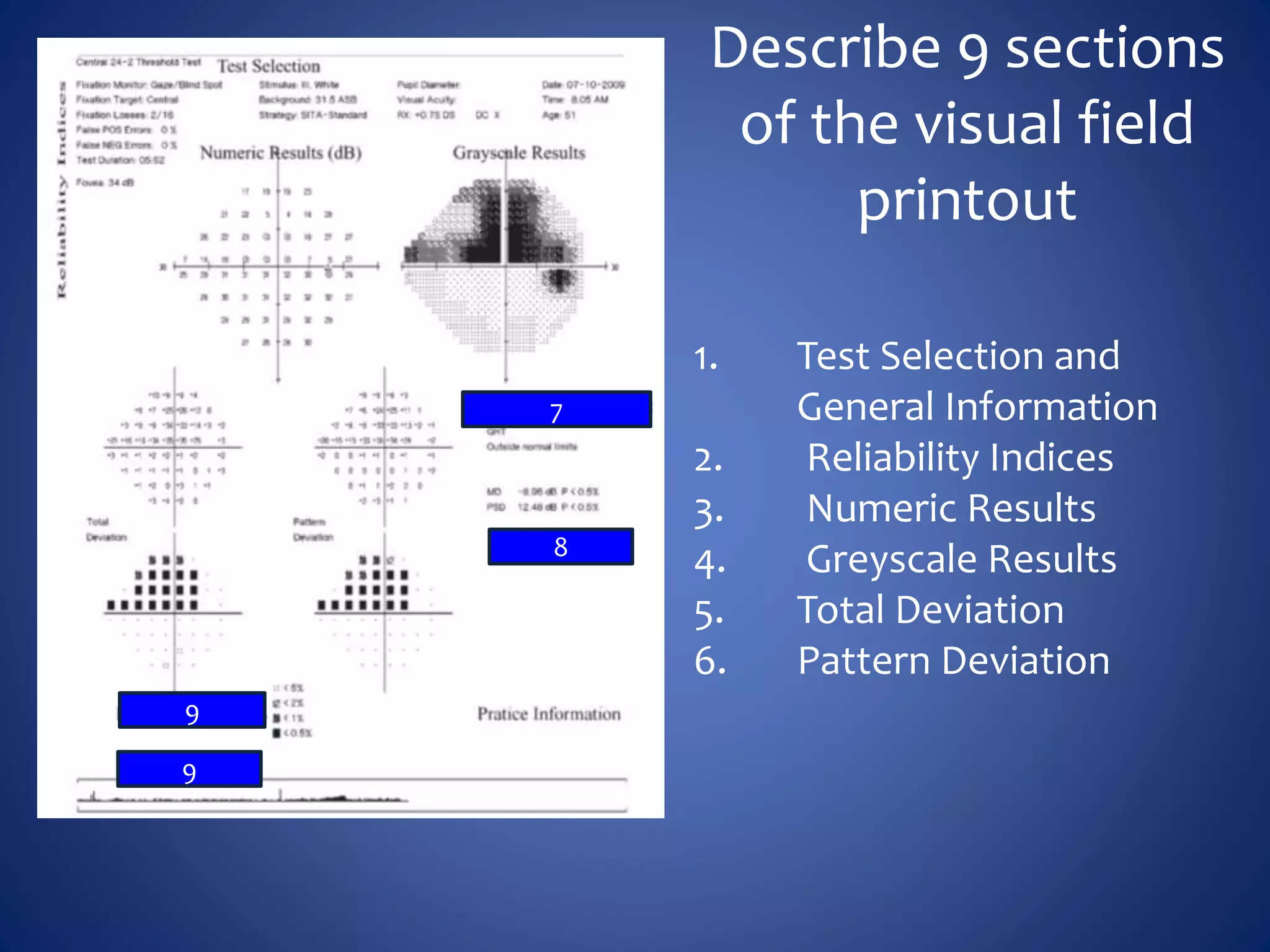
Describe 9 sections
of the visual field
printout
1. Test Selection and
General Information
2. Reliability Indices
3. Numeric Results
4. Greyscale Results
5. Total Deviation
6. Pattern Deviation
8
7
9
9
Describe 9 sections
of the visual field
printout
1. Test Selection and
General Information
2. Reliability Indices
3. Numeric Results
4. Greyscale Results
5. Total Deviation
6. Pattern Deviation
7. Glaucoma Hemifield
Test
8
9
9
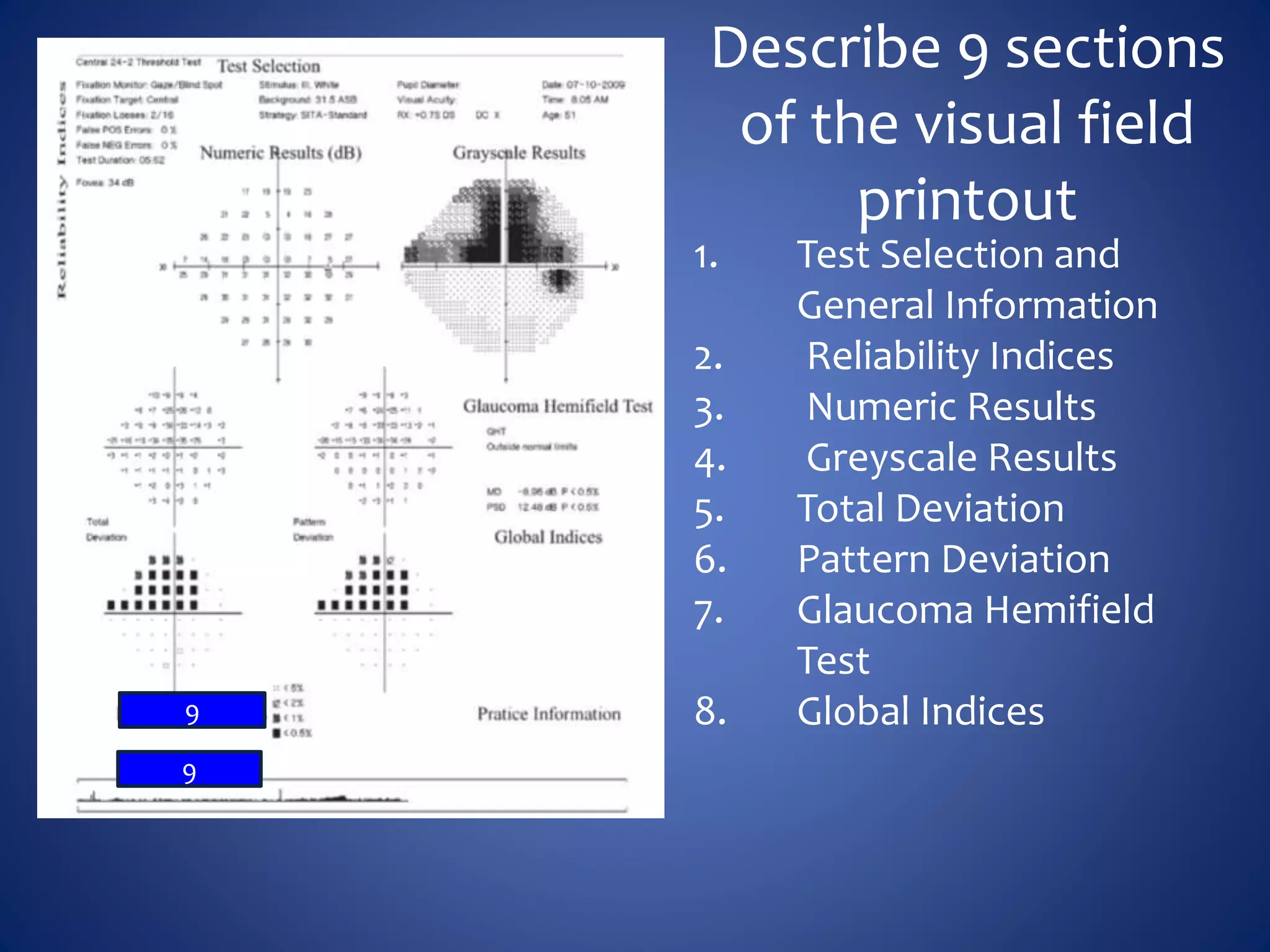
Describe 9 sections
of the visual field
printout
1. Test Selection and
General Information
2. Reliability Indices
3. Numeric Results
4. Greyscale Results
5. Total Deviation
6. Pattern Deviation
7. Glaucoma Hemifield
Test
8. Global Indices
9
9
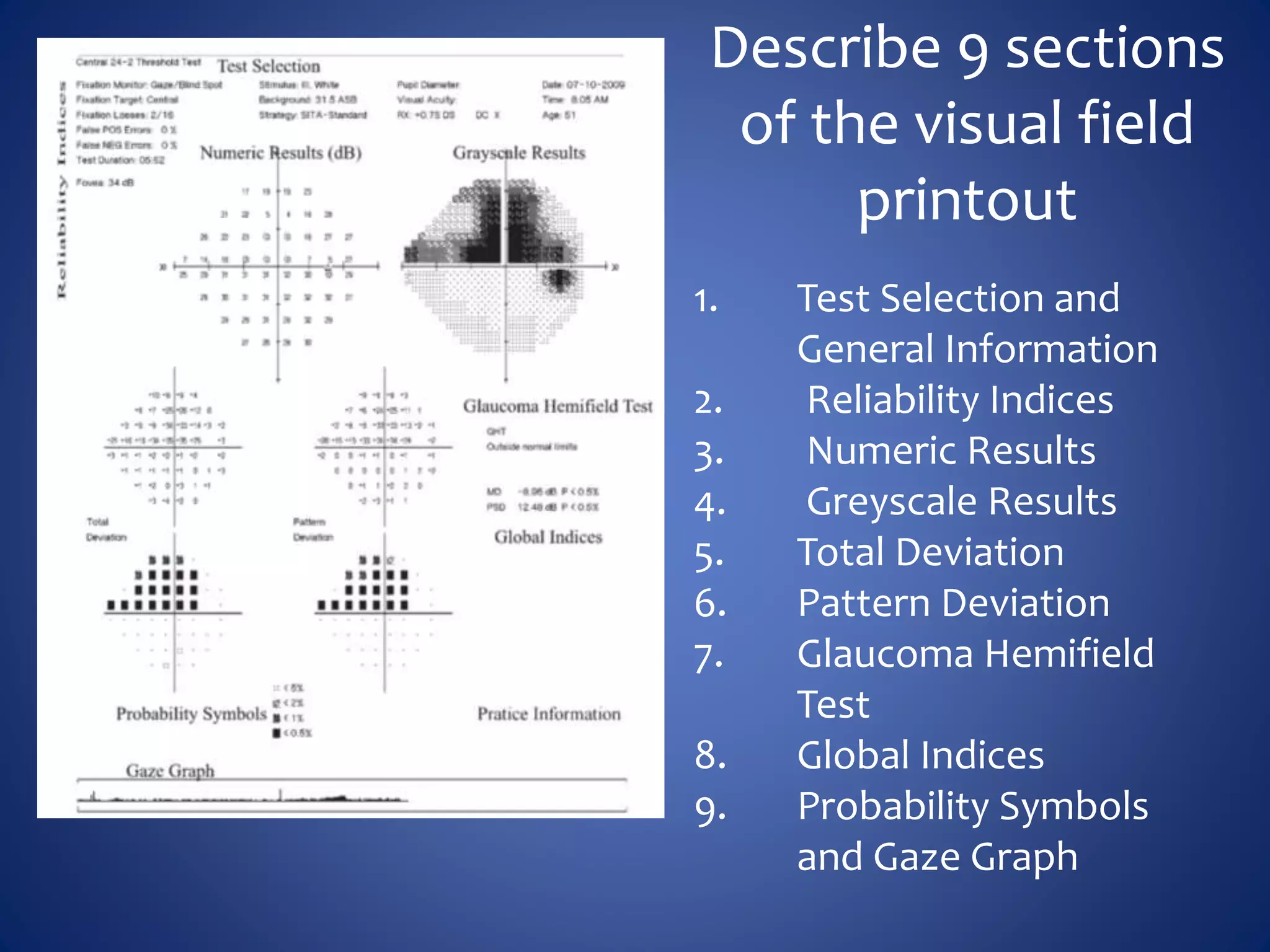
Describe 9 sections
of the visual field
printout
1. Test Selection and
General Information
2. Reliability Indices
3. Numeric Results
4. Greyscale Results
5. Total Deviation
6. Pattern Deviation
7. Glaucoma Hemifield
Test
8. Global Indices
9. Probability Symbols
and Gaze Graph
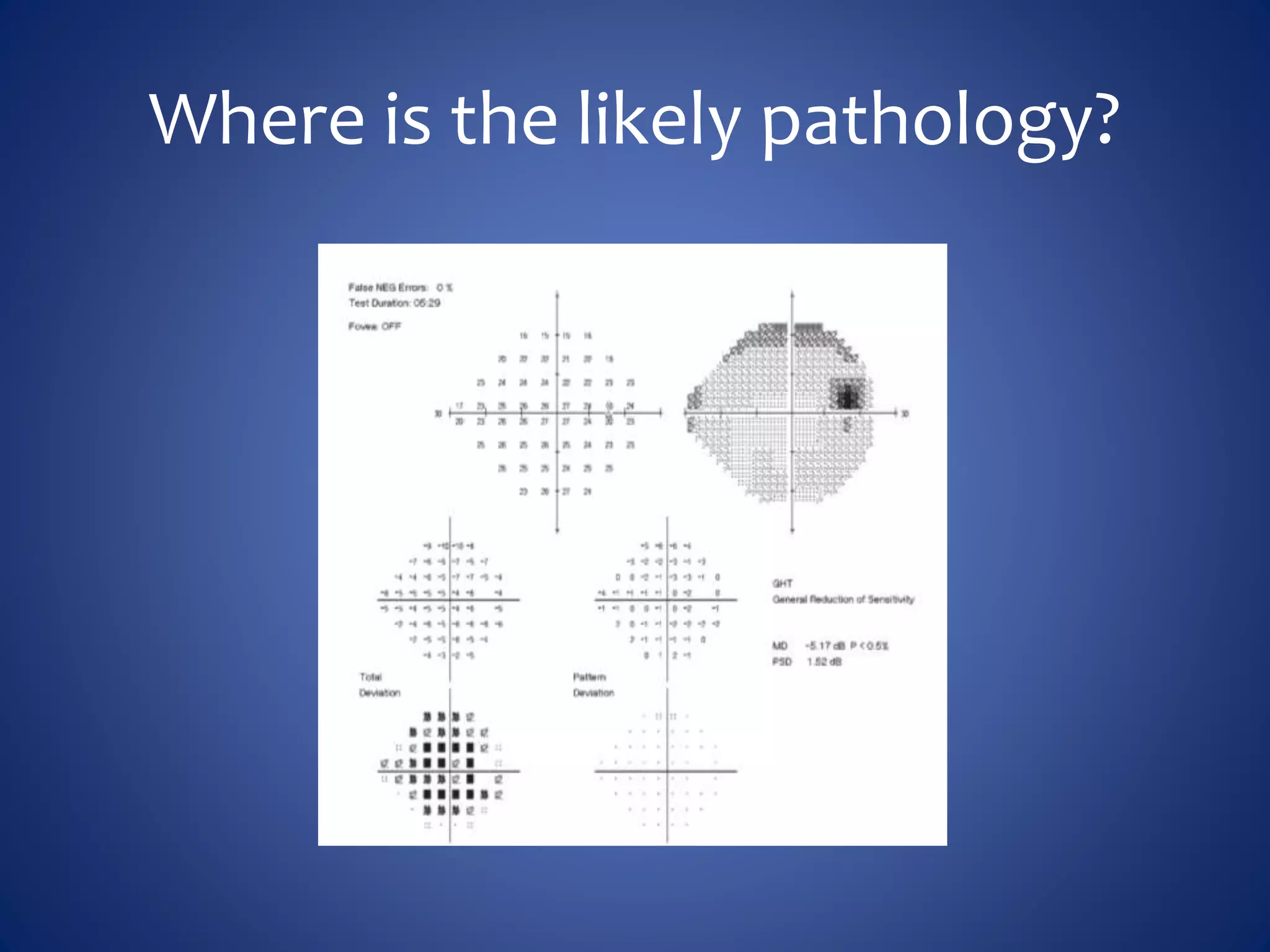
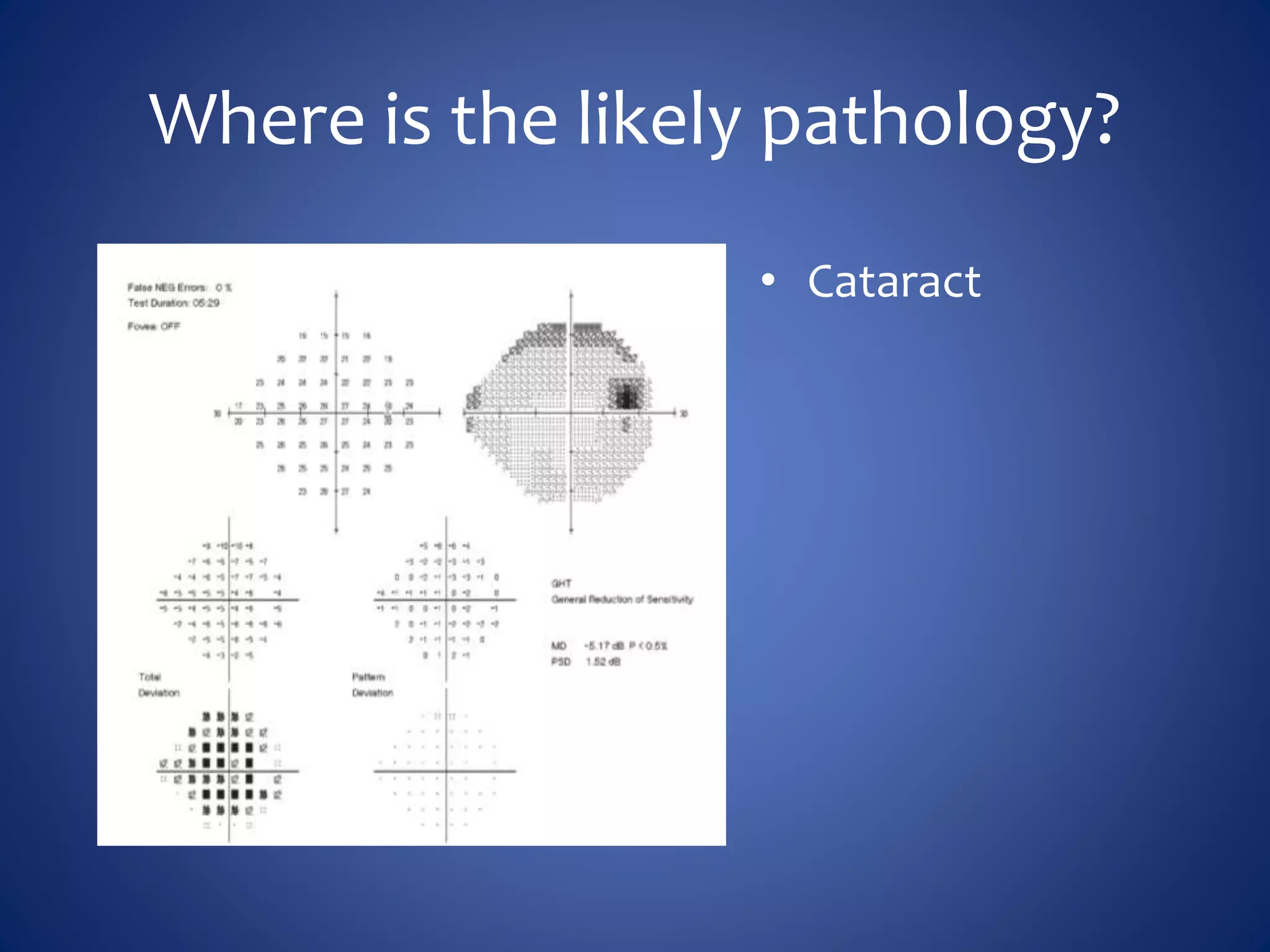
Where is the likely pathology?
• Cataract
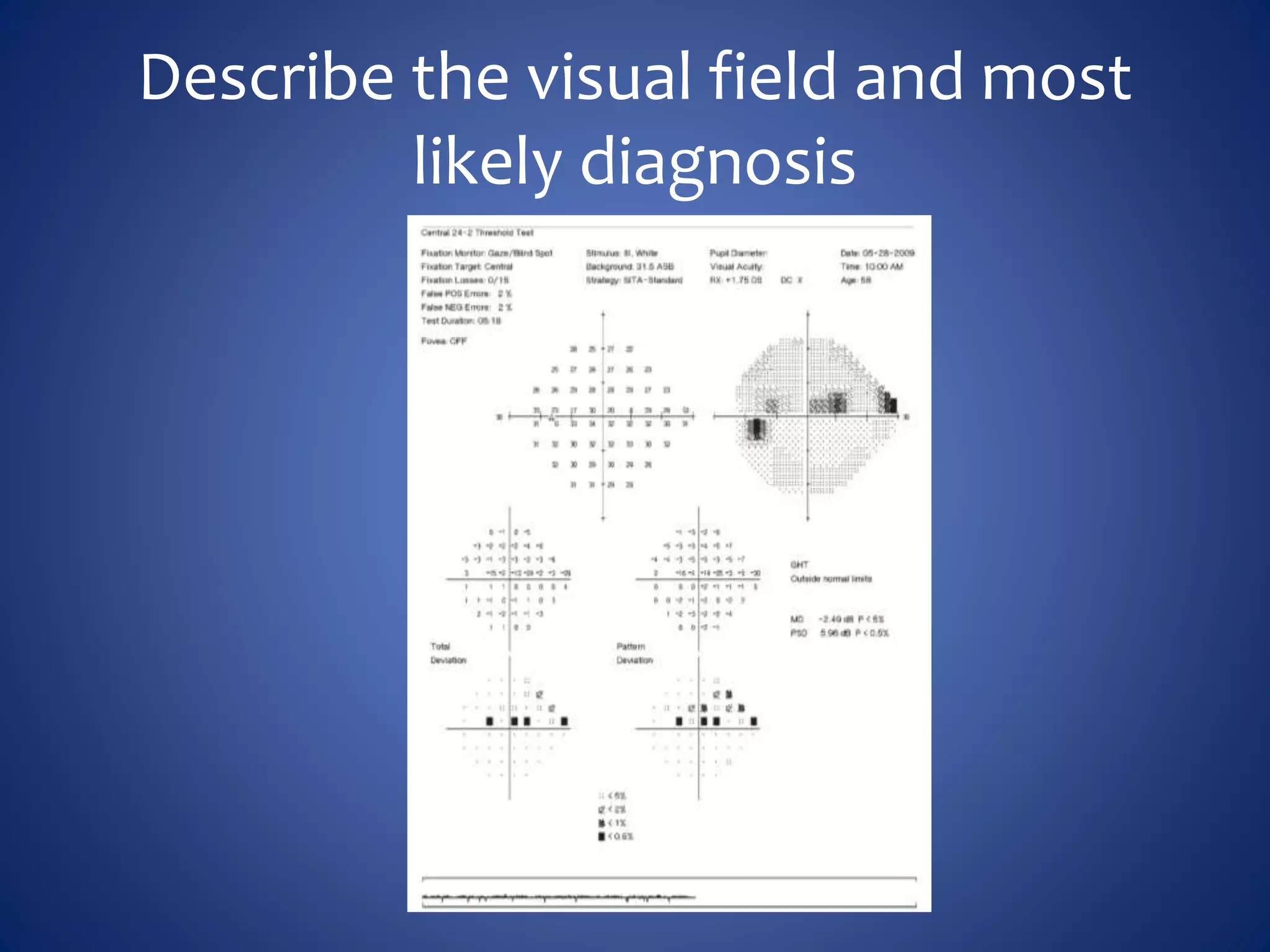
Describe the visual field and most
likely diagnosis
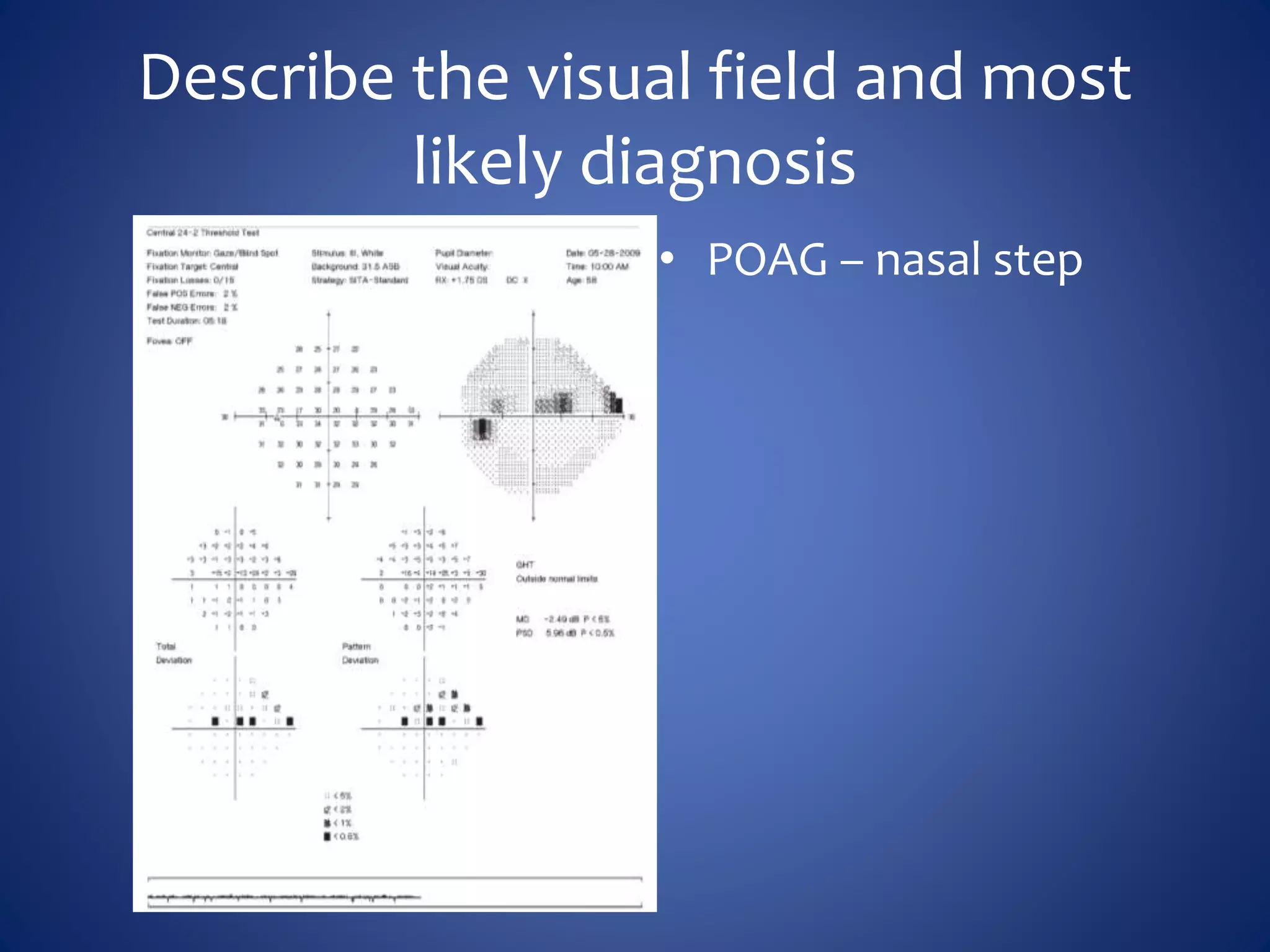
Describe the visual field and most
likely diagnosis
• POAG – nasal step
Describe the visual field and most
likely diagnosis
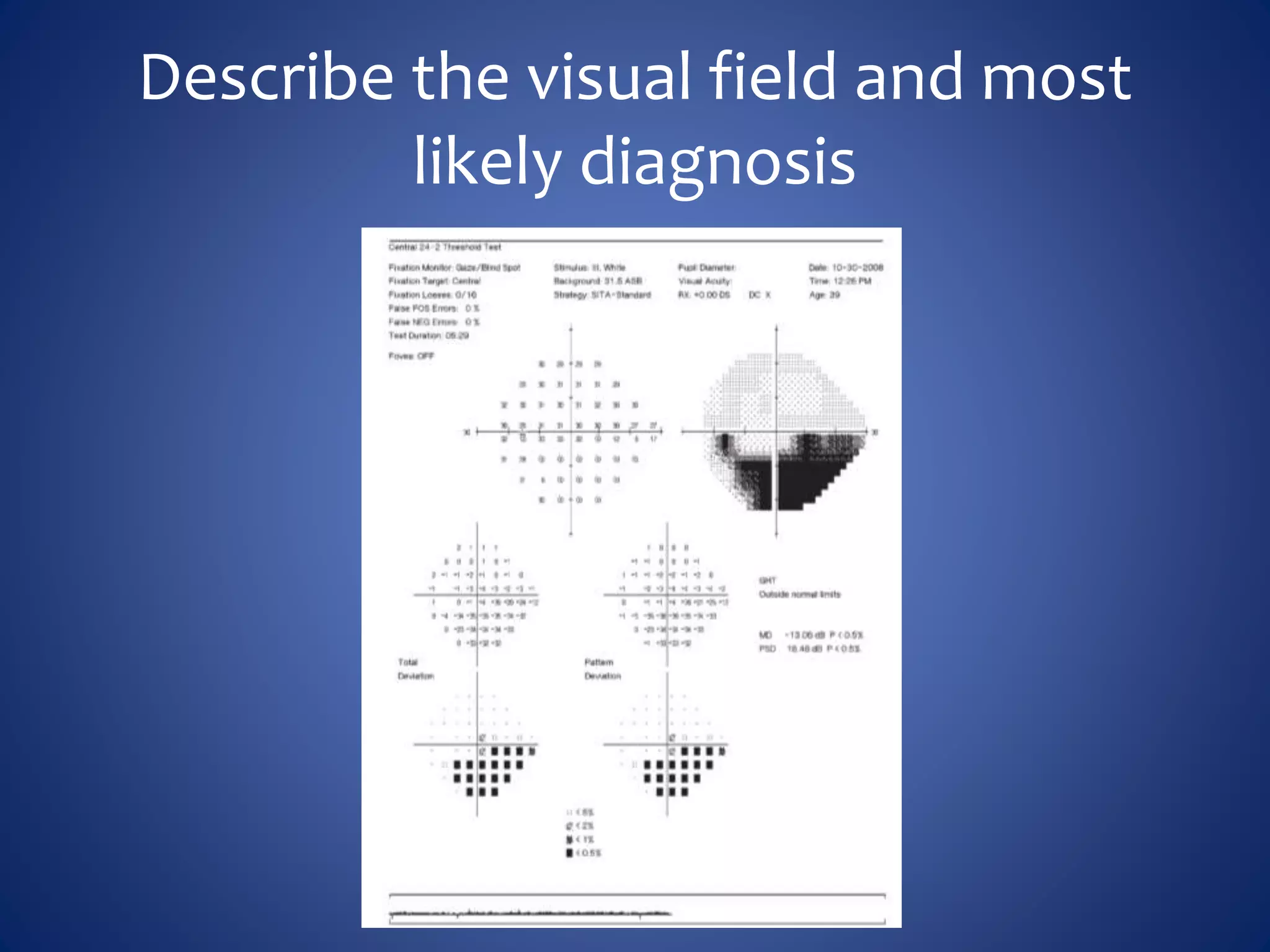
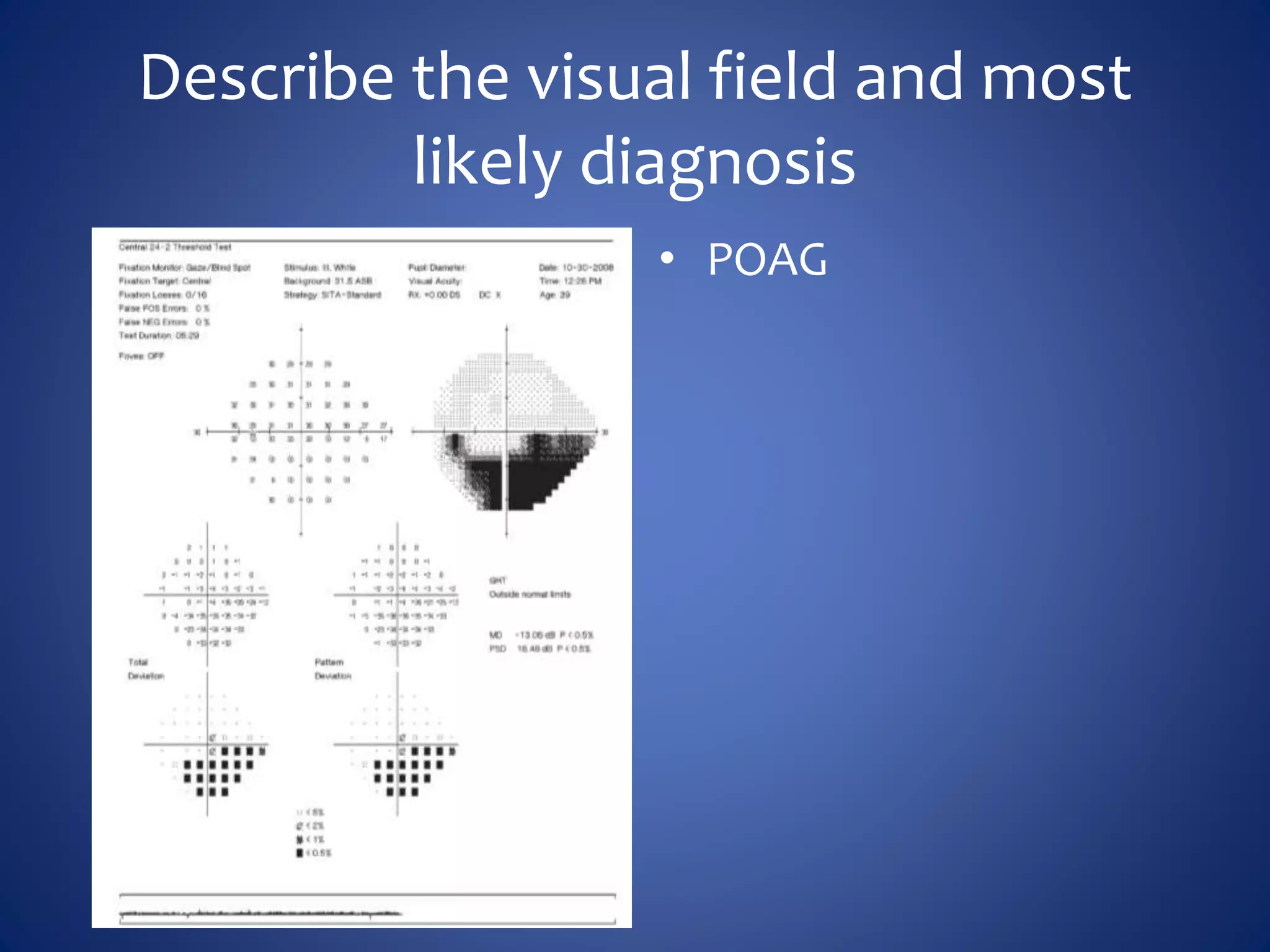
Describe the visual field and most
likely diagnosis
• POAG
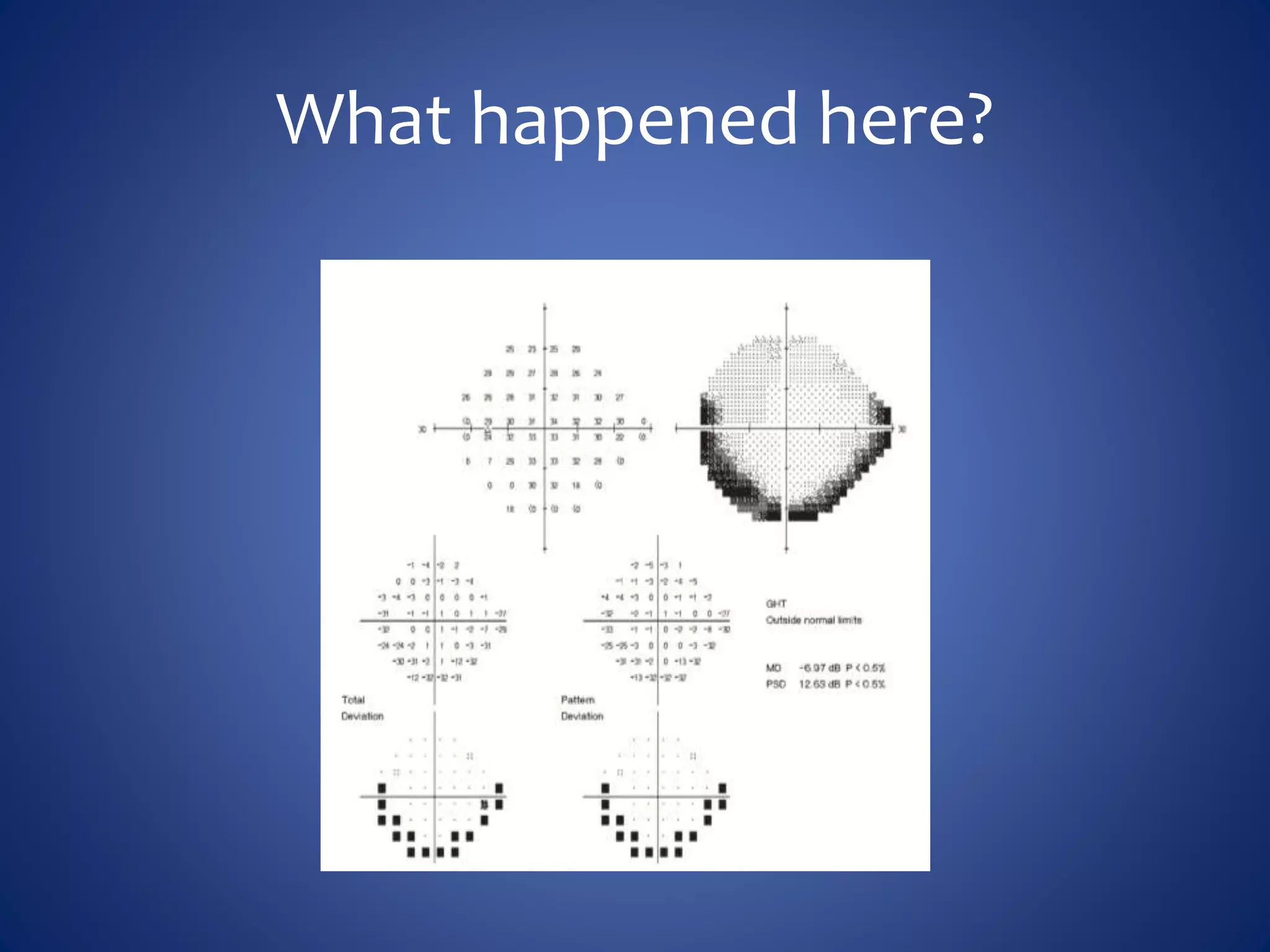
What happened here?
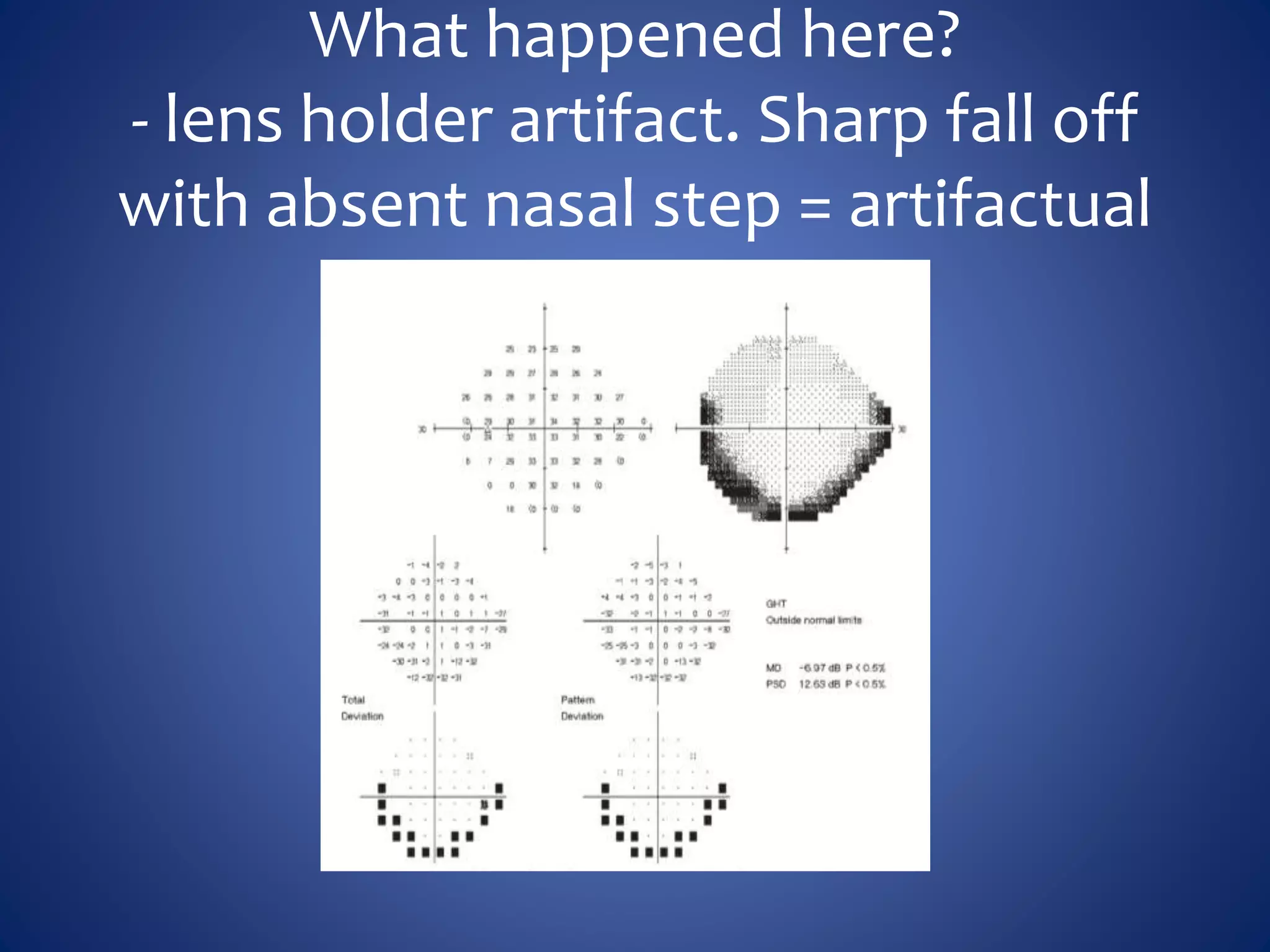
What happened here?
- lens holder artifact. Sharp fall off
with absent nasal step = artifactual
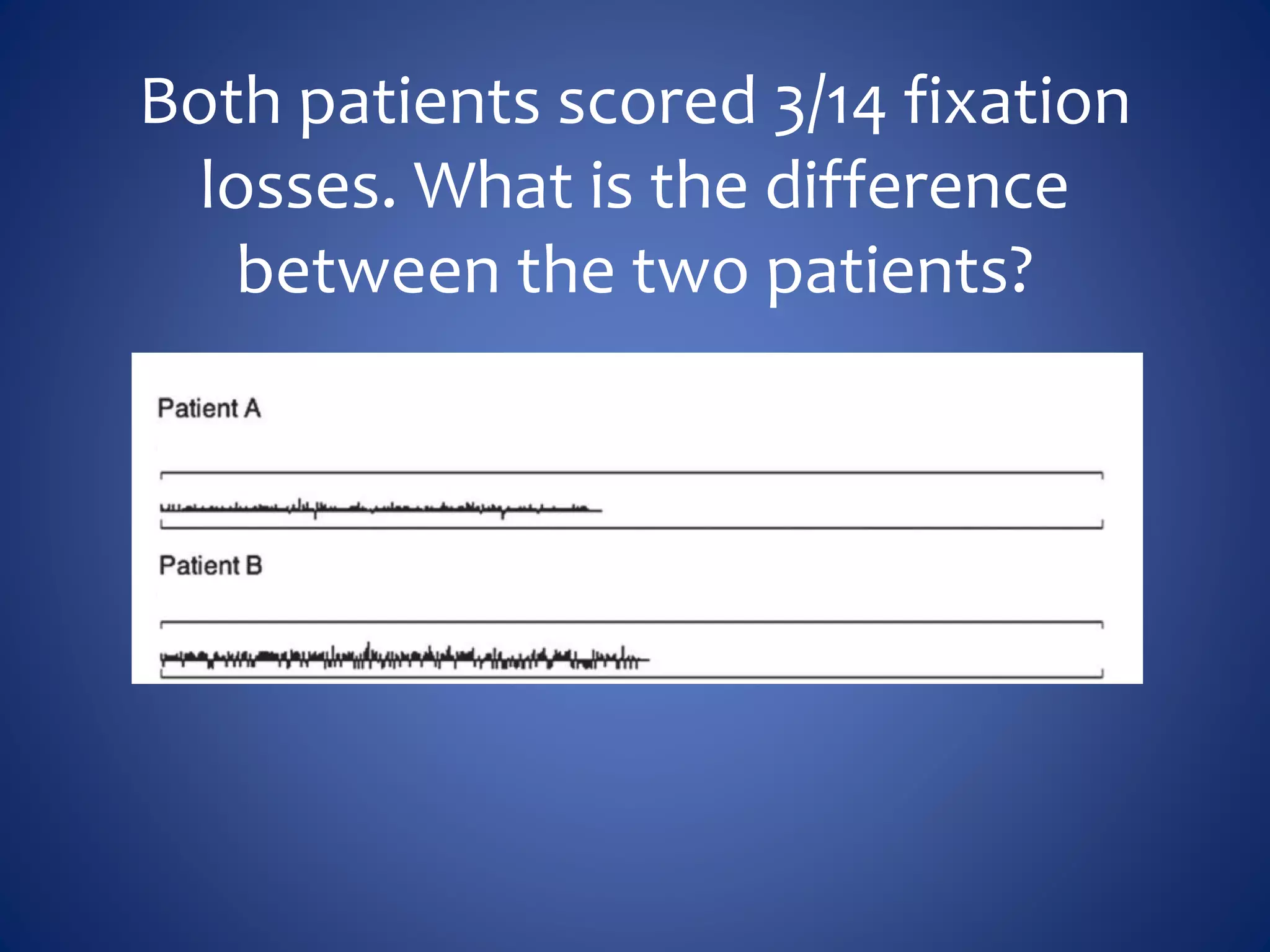
Both patients scored 3/14 fixation
losses. What is the difference
between the two patients?
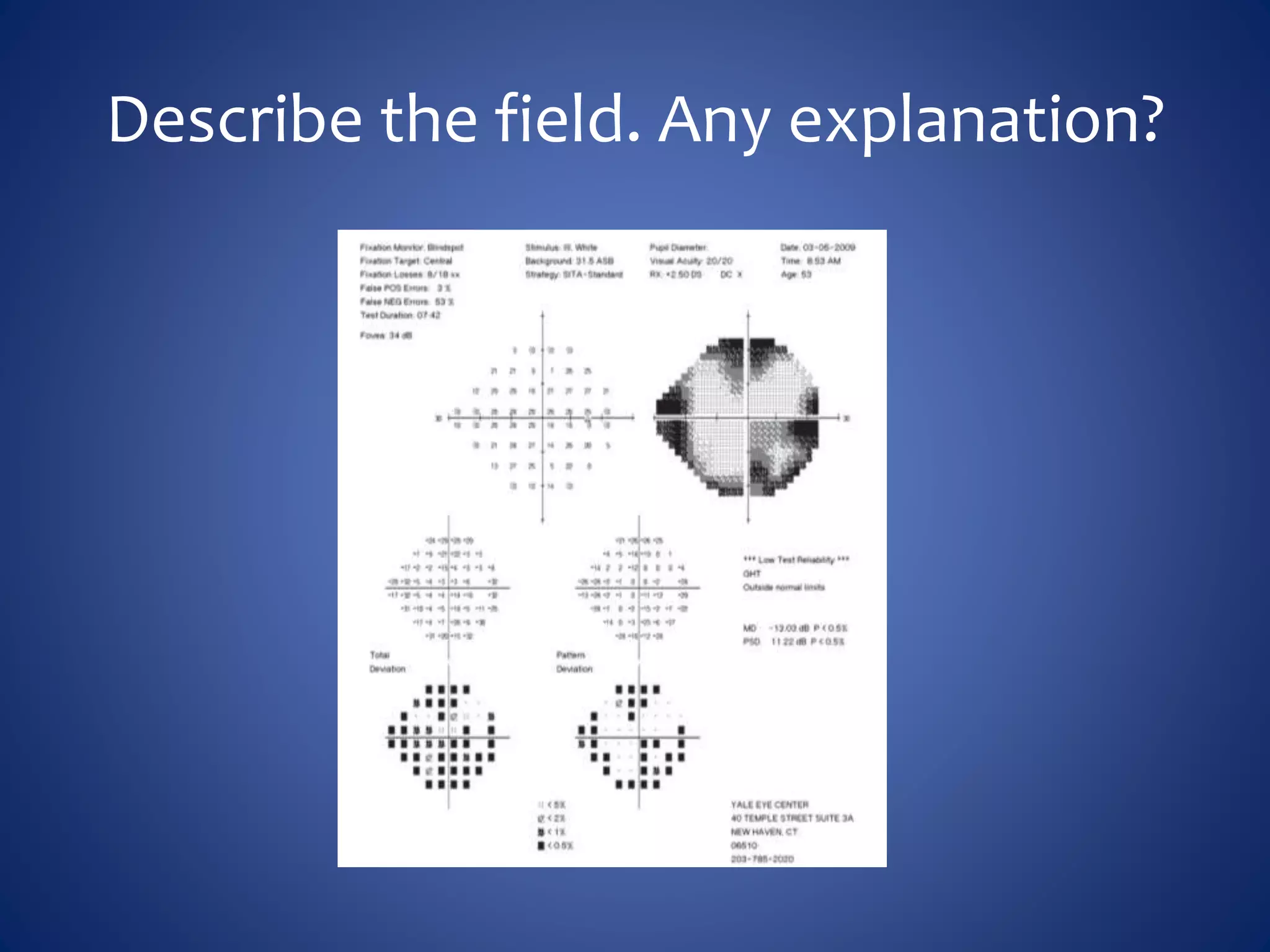
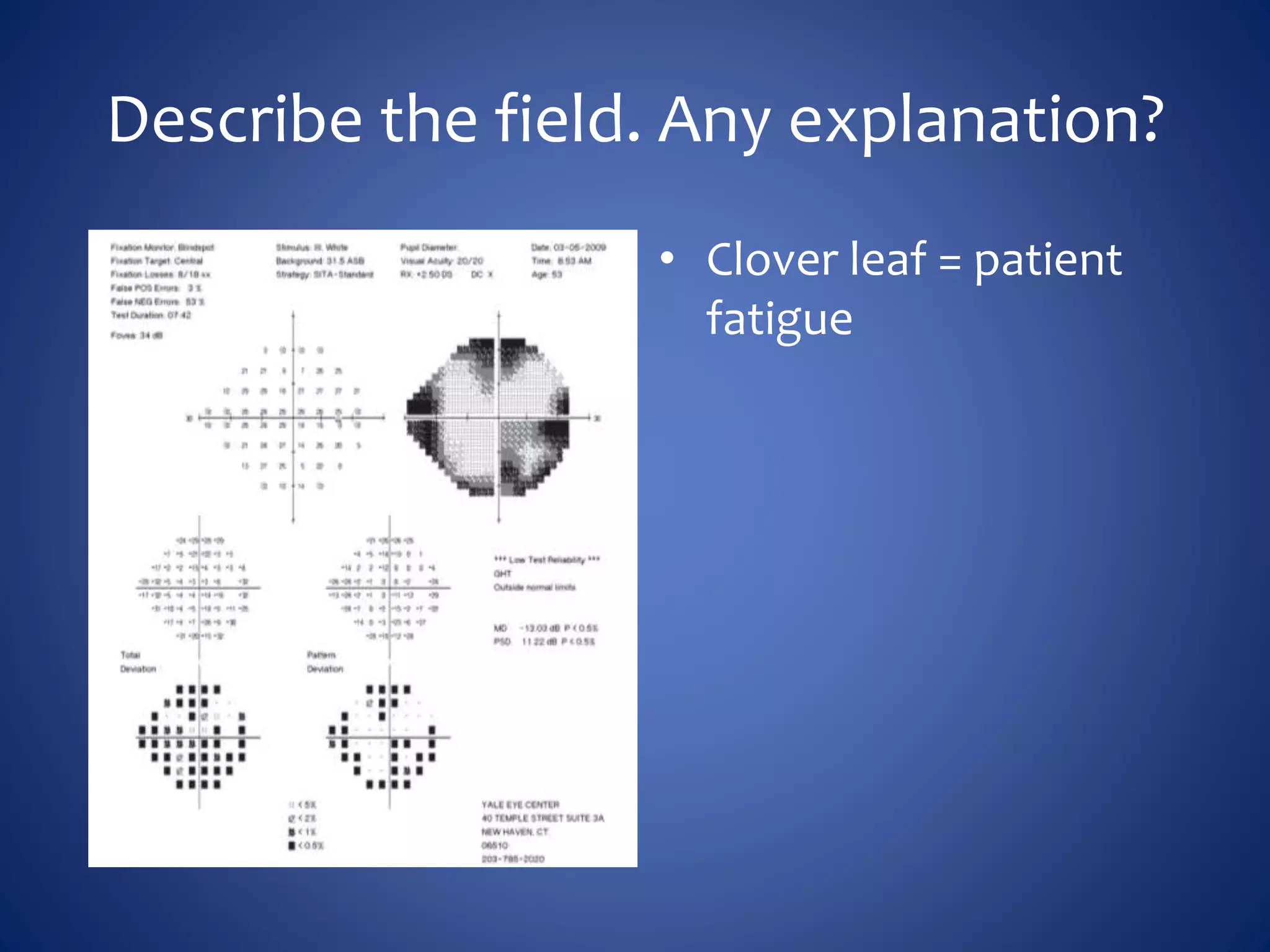
Describe the field. Any explanation?
• Clover leaf = patient
fatigue
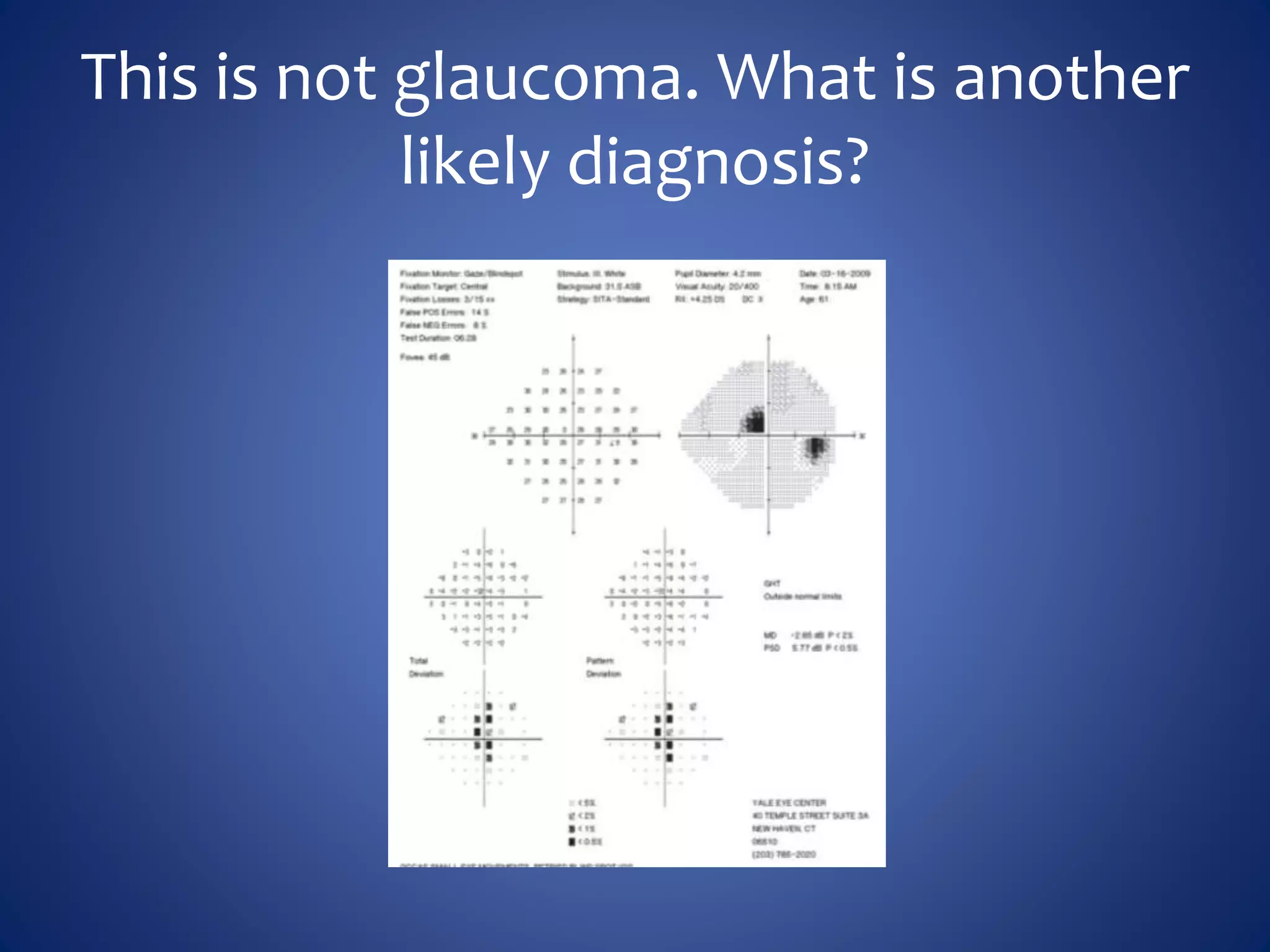
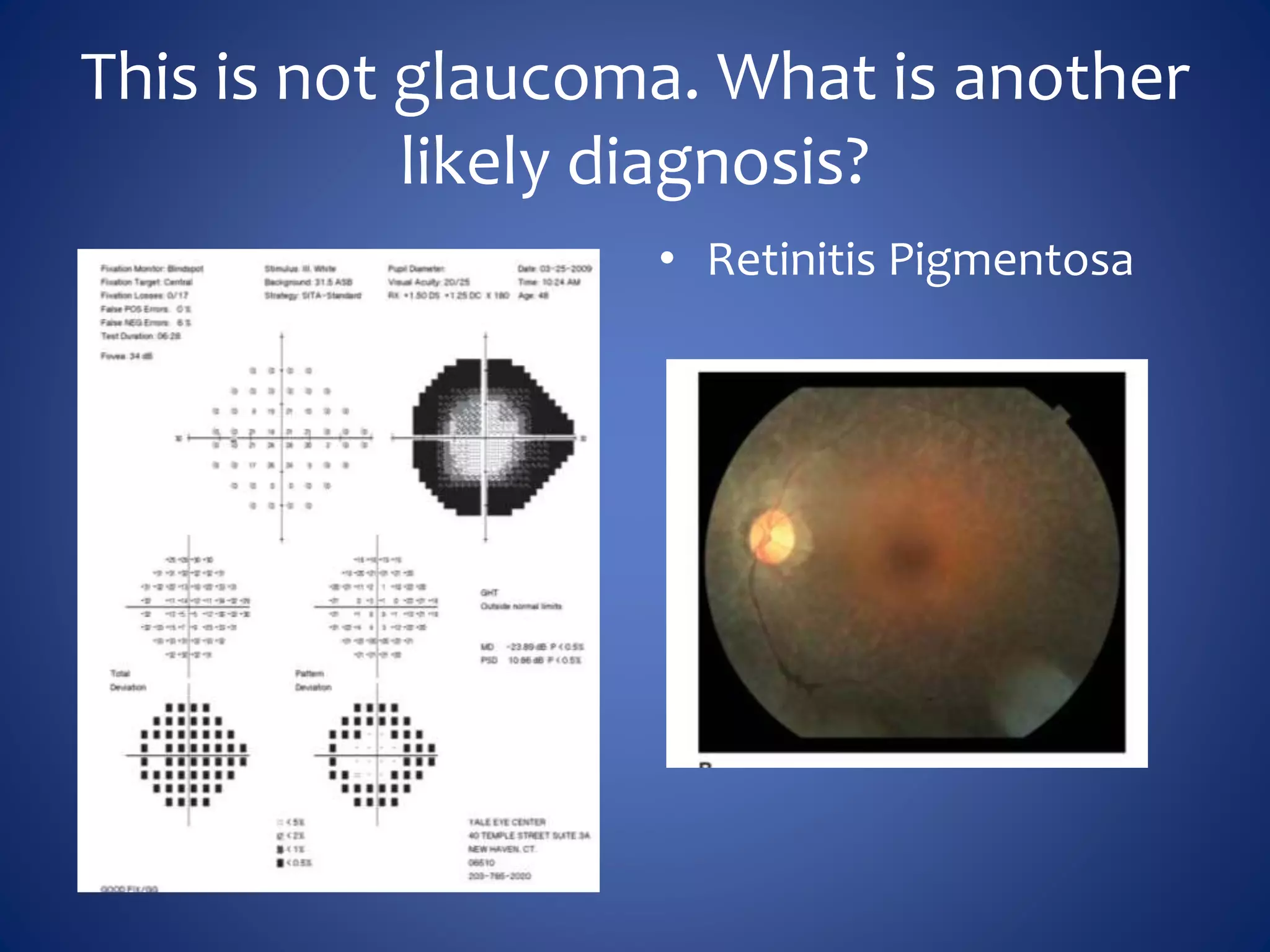
This is not glaucoma. What is another
likely diagnosis?
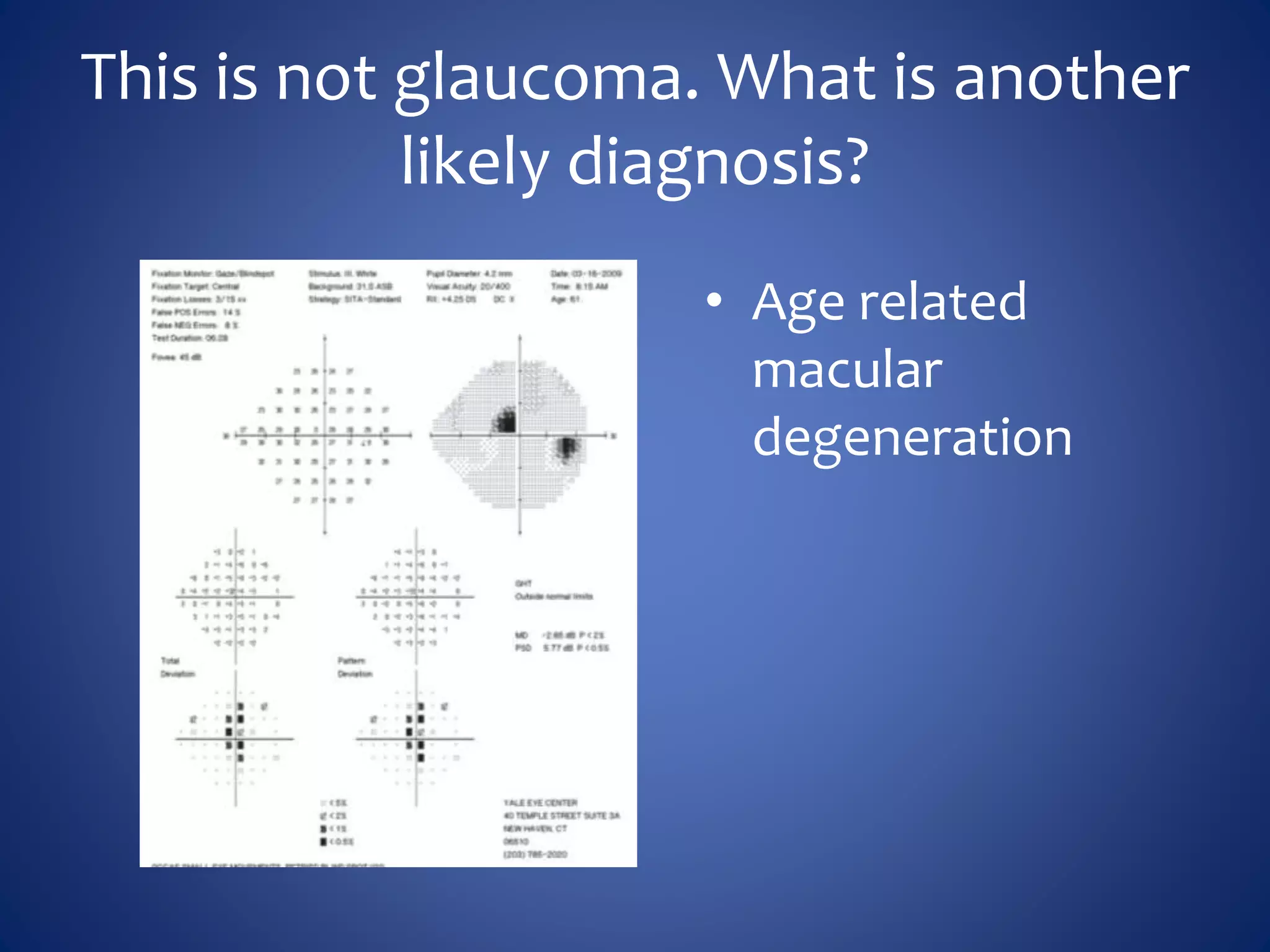
This is not glaucoma. What is another
likely diagnosis?
• Age related
macular
degeneration
This is not glaucoma. What is another
likely diagnosis?
This is not glaucoma. What is another
likely diagnosis?
• Retinitis Pigmentosa
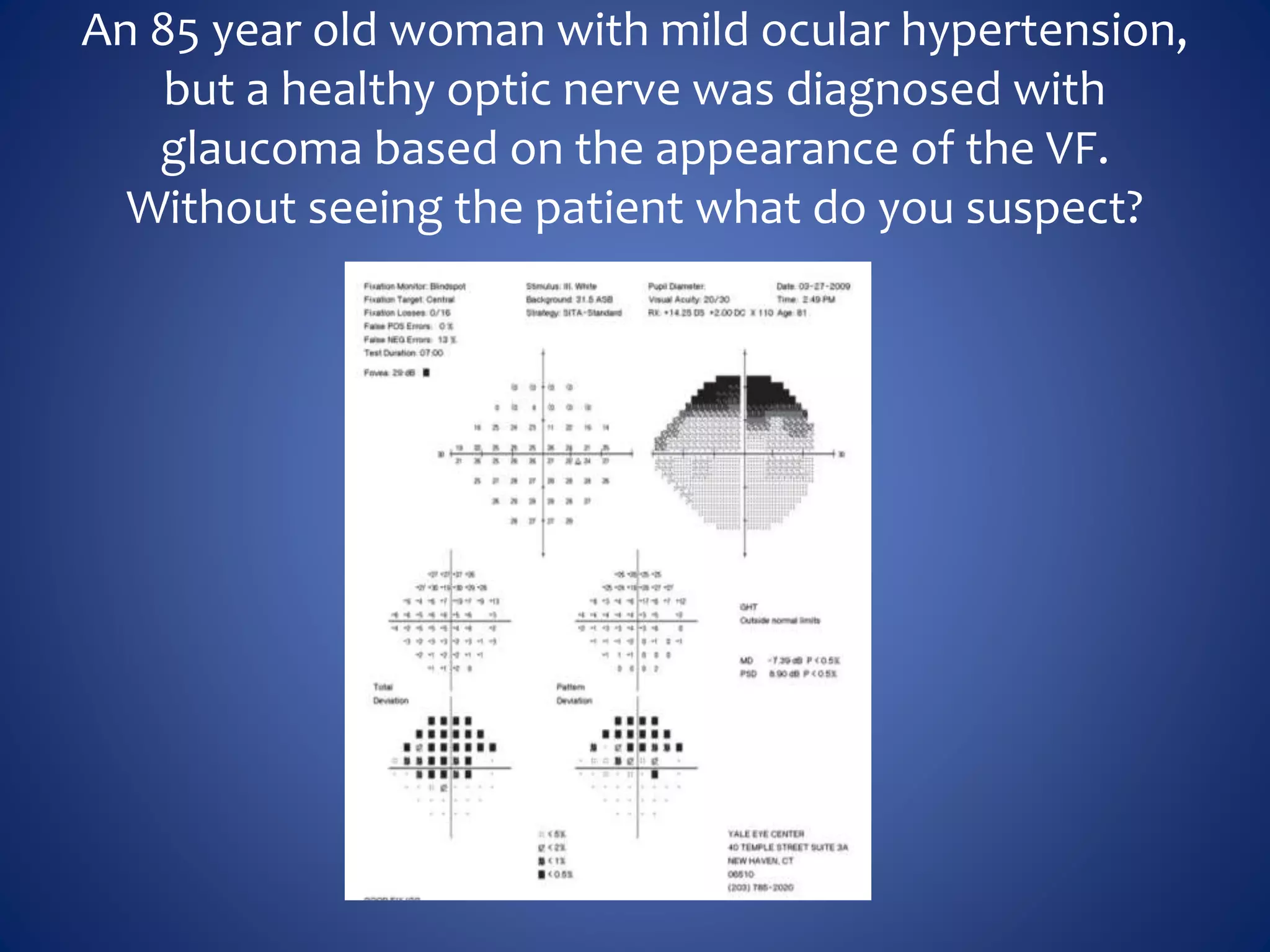
An 85 year old woman with mild ocular hypertension,
but a healthy optic nerve was diagnosed with
glaucoma based on the appearance of the VF.
Without seeing the patient what do you suspect?
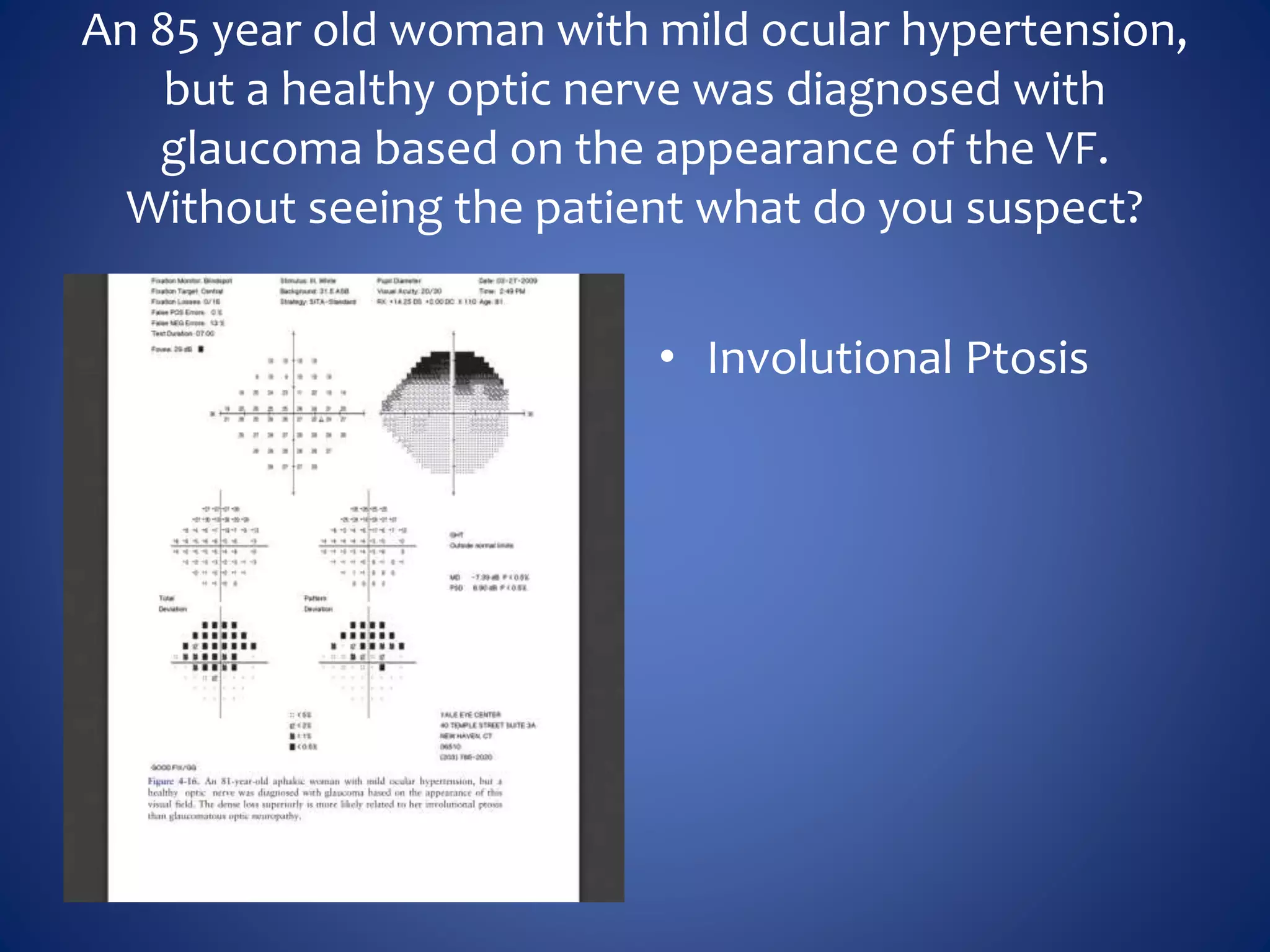
An 85 year old woman with mild ocular hypertension,
but a healthy optic nerve was diagnosed with
glaucoma based on the appearance of the VF.
Without seeing the patient what do you suspect?
• Involutional Ptosis
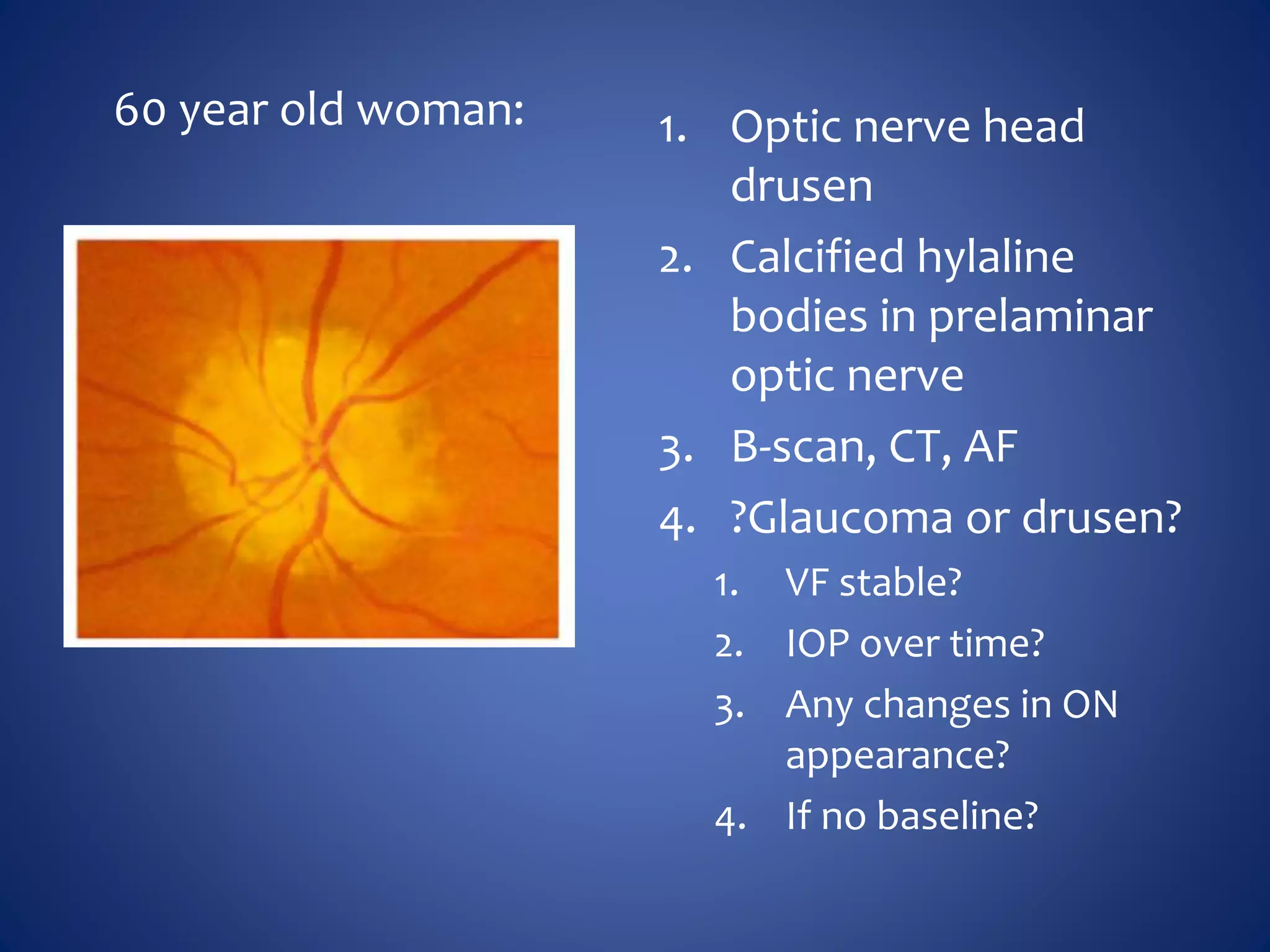
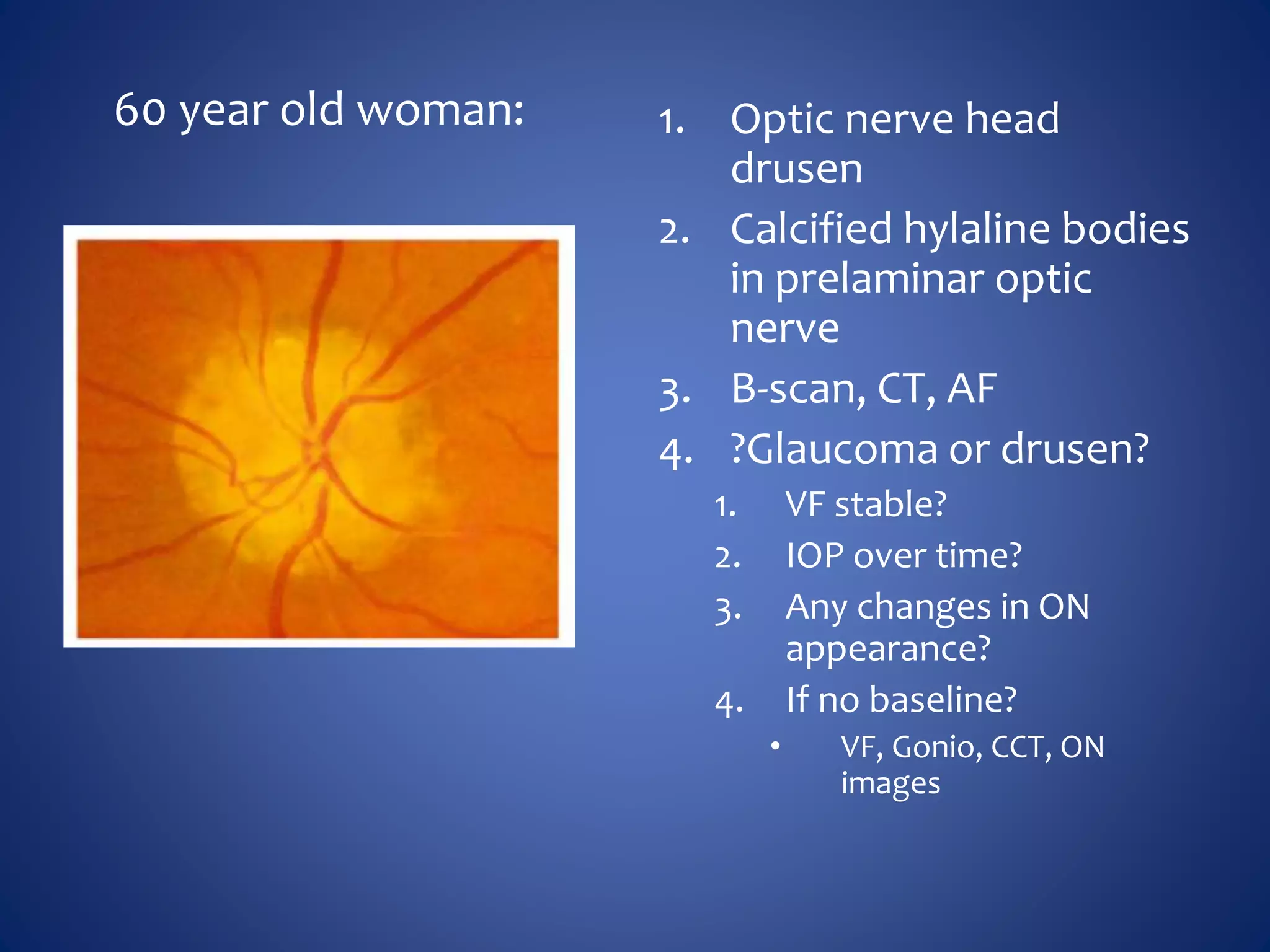
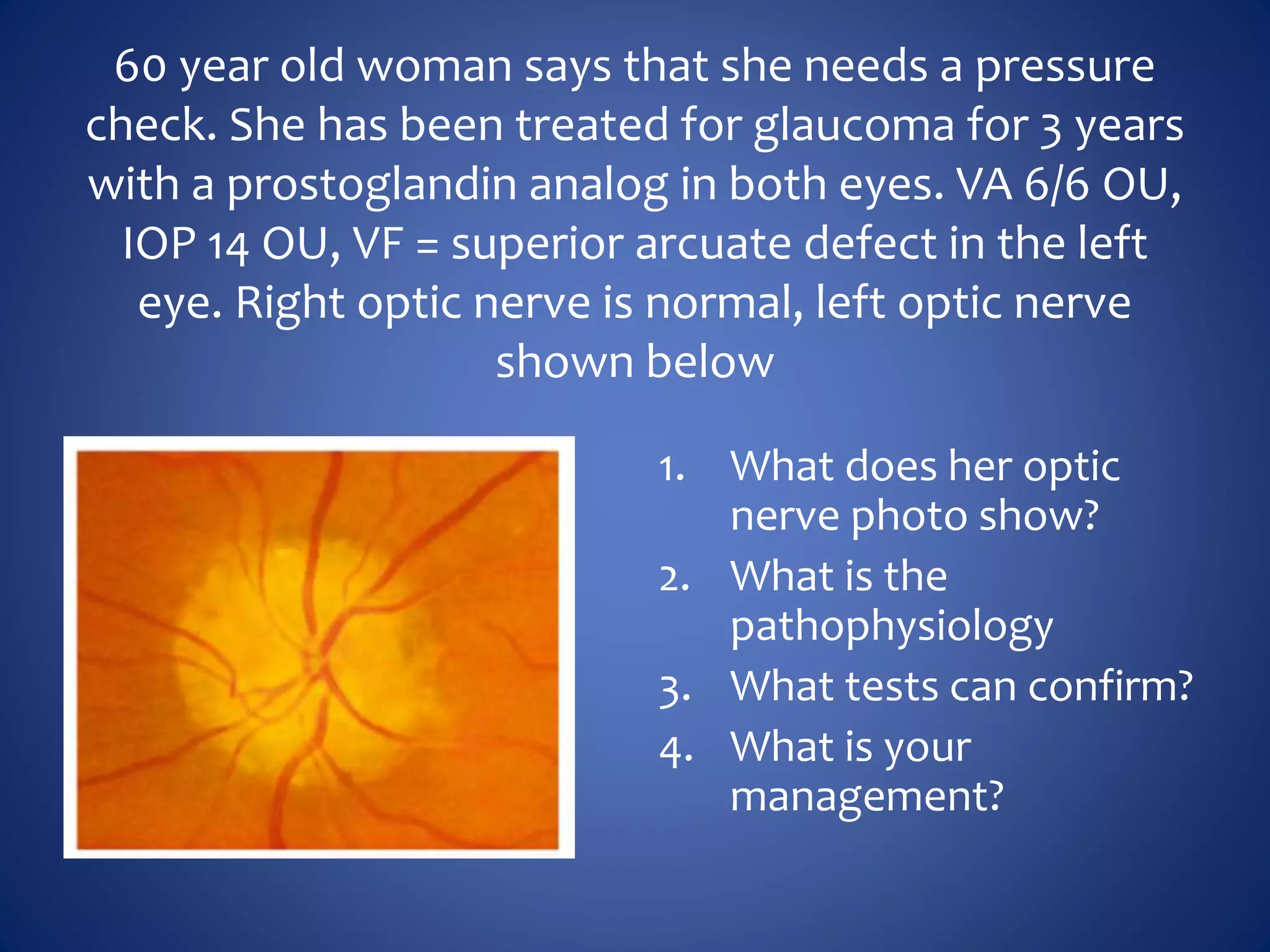
60 year old woman says that she needs a pressure
check. She has been treated for glaucoma for 3 years
with a prostoglandin analog in both eyes. VA 6/6 OU,
IOP 14 OU, VF = superior arcuate defect in the left
eye. Right optic nerve is normal, left optic nerve
shown below
1. What does her optic
nerve photo show?
2. What is the
pathophysiology
3. What tests can confirm?
4. What is your
management?
60 year old woman: 1. Optic nerve head
drusen
2. Calcified hylaline
bodies in prelaminar
optic nerve
3. B-scan, CT, AF
4. ?Glaucoma or drusen?
1. VF stable?
2. IOP over time?
3. Any changes in ON
appearance?
4. If no baseline?
60 year old woman: 1. Optic nerve head
drusen
2. Calcified hylaline bodies
in prelaminar optic
nerve
3. B-scan, CT, AF
4. ?Glaucoma or drusen?
1. VF stable?
2. IOP over time?
3. Any changes in ON
appearance?
4. If no baseline?
• VF, Gonio, CCT, ON
images
60 year old woman: 1. Optic nerve head
drusen
2. Calcified hylaline bodies
in prelaminar optic
nerve
3. B-scan, CT, AF
4. ?Glaucoma or drusen?
1. VF stable?
2. IOP over time?
3. Any changes in ON
appearance?
4. If no baseline?
• VF, Gonio, CCT, ON
images
63 year old man reports difficulty in reading. He says that the
words are clear, but he has trouble following the lines of text
and loses his place. He denies any change in vision, headaches,
or other neurologic symptoms. Exam shows visual acuity of
6/6 in both eyes at distance and near, normal pupillary
response without a RAPD, very early cataract and normal
fundus exam.
Q: What other tests would you perform?
63 year old man reports difficulty in reading. He says that the
words are clear, but he has trouble following the lines of text
and loses his place. He denies any change in vision, headaches,
or other neurologic symptoms. Exam shows visual acuity of
6/6 in both eyes at distance and near, normal pupillary
response without a RAPD, very early cataract and normal
fundus exam.
Q: What other tests would you perform? EOM, Amsler and VF
Additional information: Extraocular motility is full and the eyes
are orthsphoric. Amsler grid reveals a blurry area
inferotemporal to fixation in the right eye…
Humphrey VF testing on next slide…
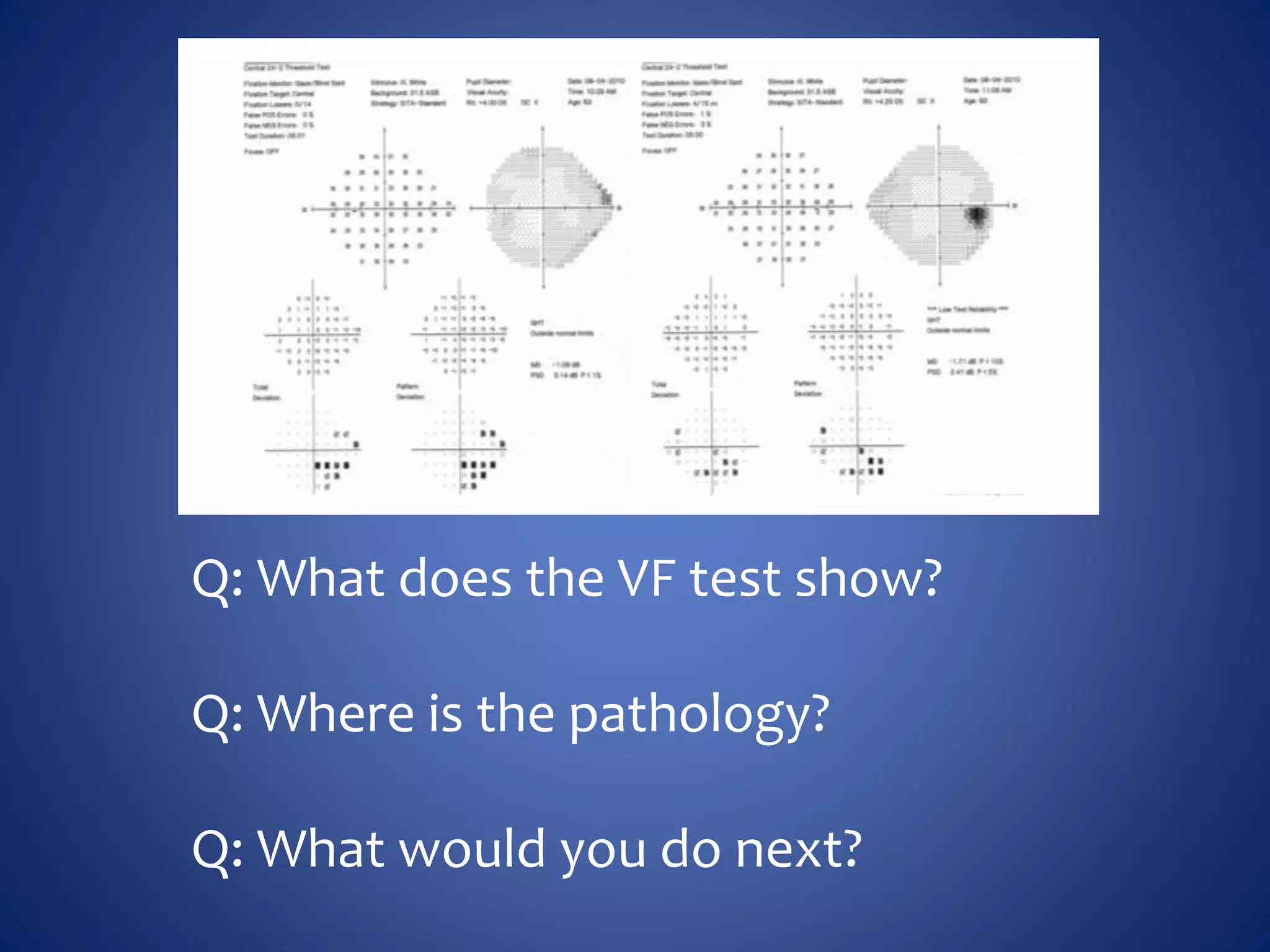
Q: What does the VF test show?
Q: Where is the pathology?
Q: What would you do next?
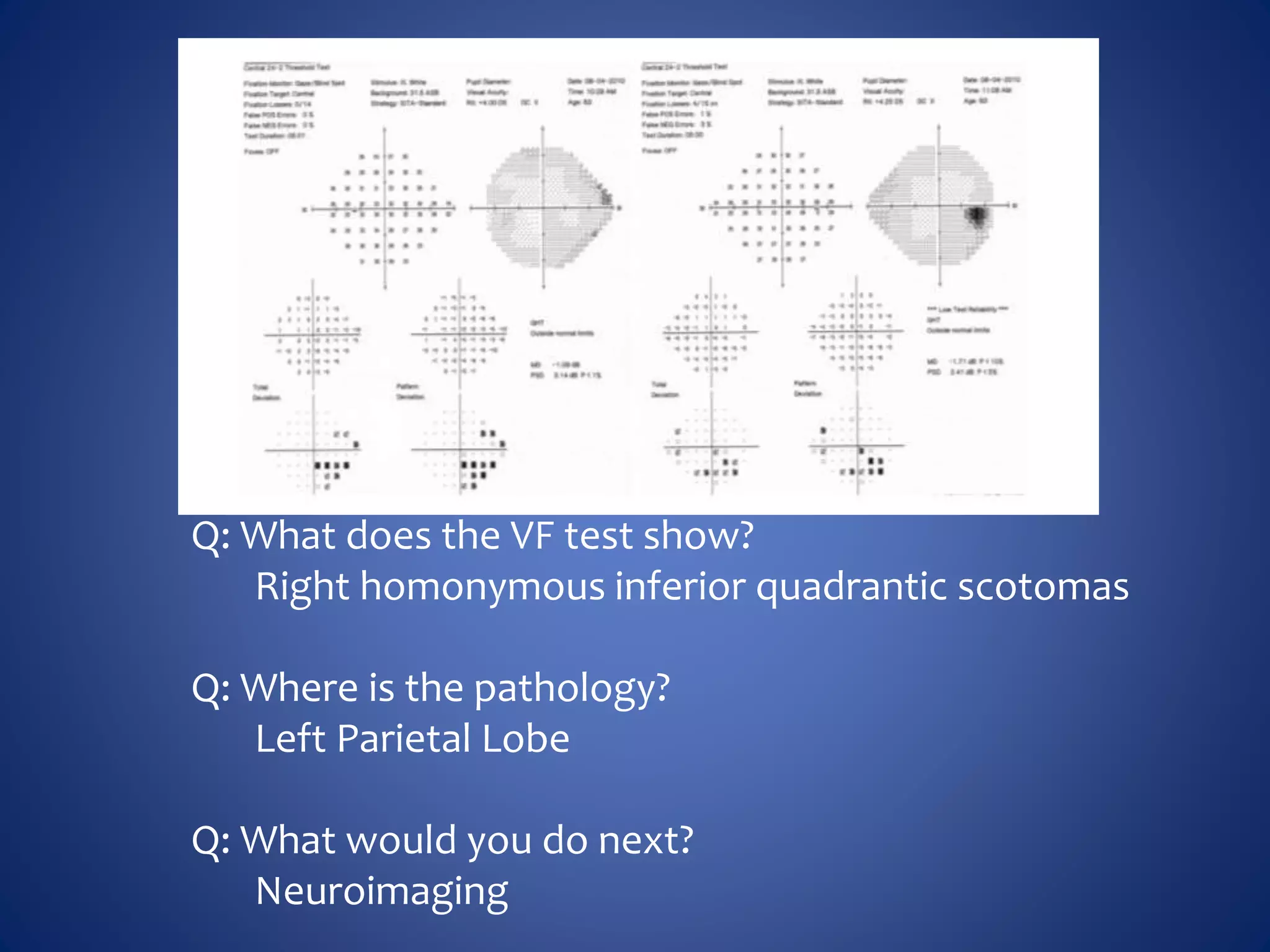
Q: What does the VF test show?
Right homonymous inferior quadrantic scotomas
Q: Where is the pathology?
Left Parietal Lobe
Q: What would you do next?
Neuroimaging
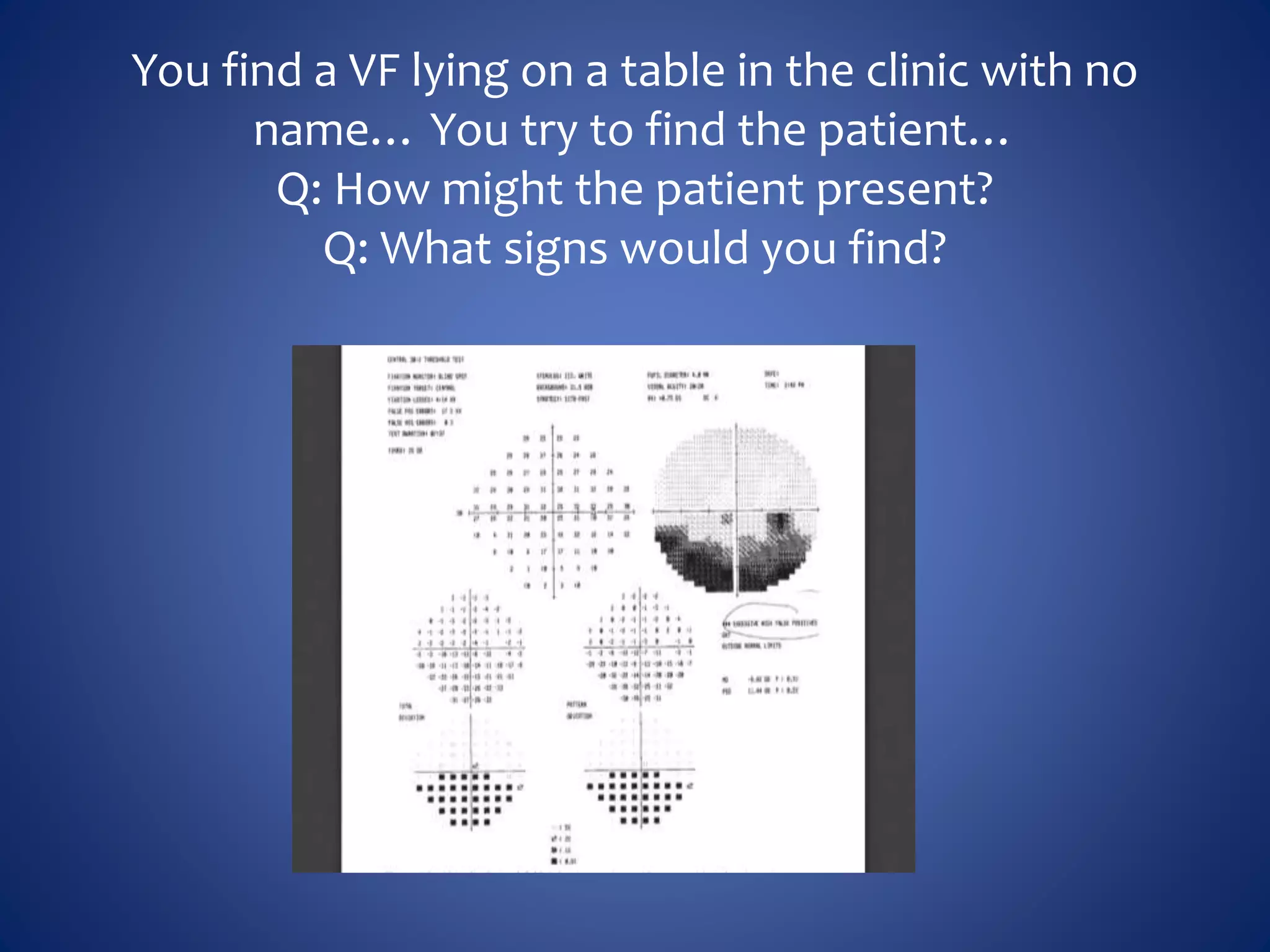
You find a VF lying on a table in the clinic with no
name… You try to find the patient…
Q: How might the patient present?
Q: What signs would you find?
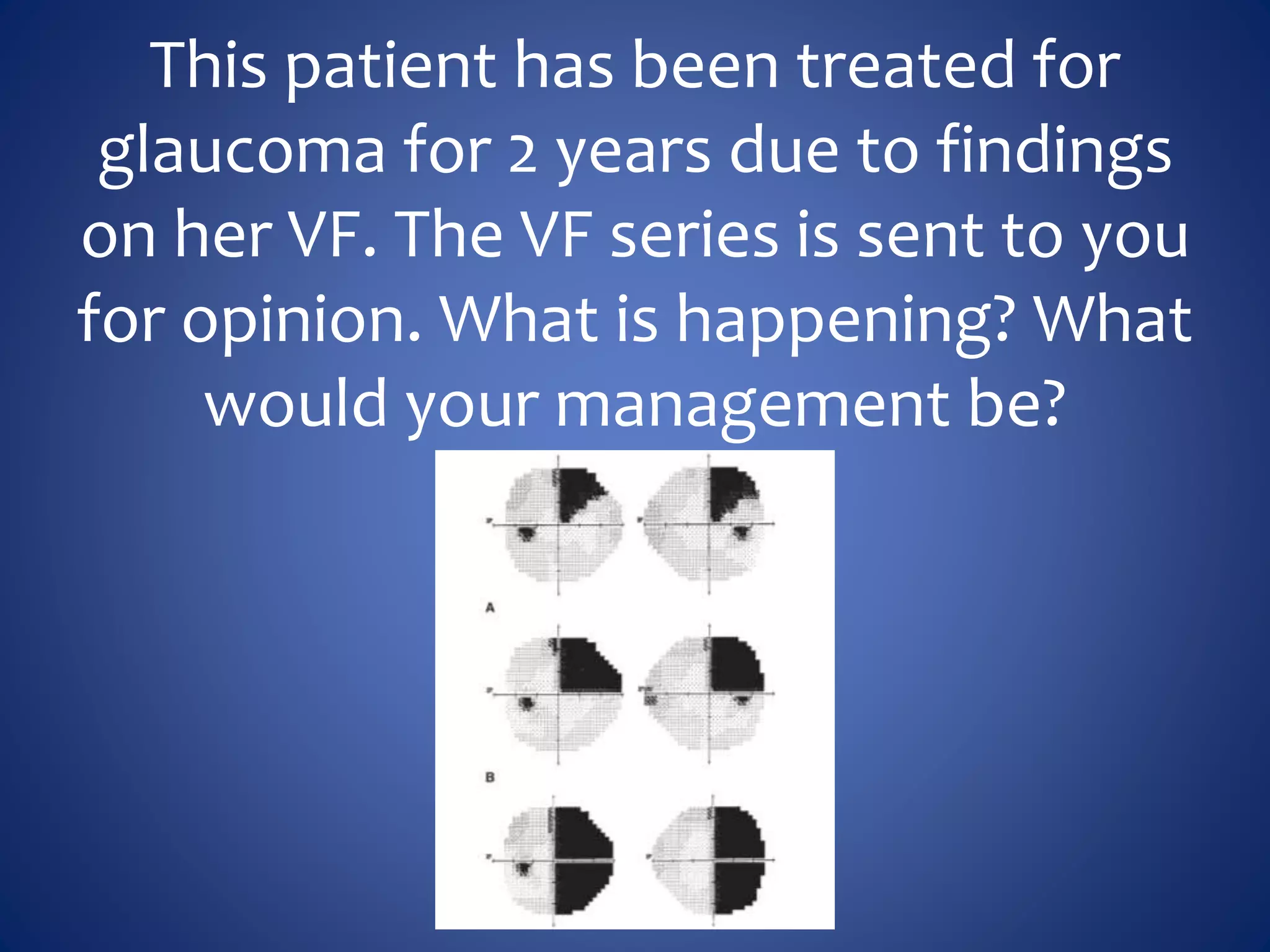
This patient has been treated for
glaucoma for 2 years due to findings
on her VF. The VF series is sent to you
for opinion. What is happening? What
would your management be?
Visual Field Quiz

Visual Field Quiz

  • 1.
    Visual Field Quiz All thatglitters isn’t glaucoma TBH 11th Sept 2015
  • 2.
  • 3.
  • 4.
    What type ofvisual field defect might you expect to see in this patient?
  • 5.
    Superior nasal stepor superior arcuate scotoma due to the prominent notch in the optic nerve What is a likely diagnosis?
  • 6.
    This is aHumphrey’s visual field from a man who comes in for a neurophthalmic eye examination 1. Describe the visual field defect 2. What is the likely cause of such a visual field defect? 3. What else can cause this visual defect? 4. What type of nystagmus can be associated with this field defect?
  • 7.
    This is aHumphrey’s visual field from a man who comes in for a neuropthalmic eye examination 1. Describe the visual field defect • Incongruous bitemporal visual field defect that respects the mid-line 2. What is the likely cause of such a visual field defect? 3. What else can cause this visual defect? 4. What type of nystagmus can be associated with this field defect?
  • 8.
    This is aHumphrey’s visual field from a man who comes in for a neuropthalmic eye examination 1. Describe the visual field defect • Incongruous bitemporal visual field defect that respects the mid-line 2. What is the likely cause of such a visual field defect? • A sellar chiasmal mass eg pituitary adenoma 3. What else can cause this visual defect? 4. What type of nystagmus can be associated with this field defect?
  • 9.
    This is aHumphrey’s visual field from a man who comes in for a neuropthalmic eye examination 1. Describe the visual field defect • Incongruous bitemporal visual field defect that respects the mid-line 2. What is the likely cause of such a visual field defect? • A sellar chiasmal mass eg pituitary adenoma 3. What else can cause this visual defect? • Pseudo bitemporal field defects include: tilted optic discs, sectoral RP, optic nerve head drusen… 4. What type of nystagmus can be associated with this field defect?
  • 10.
    This is aHumphrey’s visual field from a man who comes in for a neuropthalmic eye examination 1. Describe the visual field defect • Incongruous bitemporal visual field defect that respects the mid-line 2. What is the likely cause of such a visual field defect? • A sellar chiasmal mass eg pituitary adenoma 3. What else can cause this visual defect? • Pseudo bitemporal field defects include: tilted optic discs, sectoral RP, optic nerve head drusen… 4. What type of nystagmus can be associated with this field defect? • See-saw nystagmus which is conjugate clockwise then counterclockwise rotation of the eyes from 150-300 cycles per minute. There is elevation of the intorting eye and depression of the extorting eye which appears as if the eyes are see-sawing up and down
  • 11.
    Patient wears thickspectacles High + or High -
  • 12.
    Describe 9 sections ofthe visual field printout 1. 2. 3. 4. 5. 6. 7. 8. 9. 1 5 43 2 6 8 7 9 9
  • 13.
    Describe 9 sections ofthe visual field printout 1. Test Selection and General Information 2. 5 43 2 6 8 7 9 9
  • 14.
    Describe 9 sections ofthe visual field printout 1. Test Selection and General Information 2. Reliability Indices 3. 5 43 6 8 7 9 9
  • 15.
    Describe 9 sections ofthe visual field printout 1. Test Selection and General Information 2. Reliability Indices 3. Numeric Results 4. 5 4 6 8 7 9 9
  • 16.
    Describe 9 sections ofthe visual field printout 1. Test Selection and General Information 2. Reliability Indices 3. Numeric Results 4. Greyscale Results 5 6 8 7 9 9
  • 17.
    Describe 9 sections ofthe visual field printout 1. Test Selection and General Information 2. Reliability Indices 3. Numeric Results 4. Greyscale Results 5. Total Deviation 6 8 7 9 9
  • 18.
    Describe 9 sections ofthe visual field printout 1. Test Selection and General Information 2. Reliability Indices 3. Numeric Results 4. Greyscale Results 5. Total Deviation 6. Pattern Deviation 8 7 9 9
  • 19.
    Describe 9 sections ofthe visual field printout 1. Test Selection and General Information 2. Reliability Indices 3. Numeric Results 4. Greyscale Results 5. Total Deviation 6. Pattern Deviation 7. Glaucoma Hemifield Test 8 9 9
  • 20.
    Describe 9 sections ofthe visual field printout 1. Test Selection and General Information 2. Reliability Indices 3. Numeric Results 4. Greyscale Results 5. Total Deviation 6. Pattern Deviation 7. Glaucoma Hemifield Test 8. Global Indices 9 9
  • 21.
    Describe 9 sections ofthe visual field printout 1. Test Selection and General Information 2. Reliability Indices 3. Numeric Results 4. Greyscale Results 5. Total Deviation 6. Pattern Deviation 7. Glaucoma Hemifield Test 8. Global Indices 9. Probability Symbols and Gaze Graph
  • 22.
    Where is thelikely pathology?
  • 23.
    Where is thelikely pathology? • Cataract
  • 24.
    Describe the visualfield and most likely diagnosis
  • 25.
    Describe the visualfield and most likely diagnosis • POAG – nasal step
  • 26.
    Describe the visualfield and most likely diagnosis
  • 27.
    Describe the visualfield and most likely diagnosis • POAG
  • 28.
  • 29.
    What happened here? -lens holder artifact. Sharp fall off with absent nasal step = artifactual
  • 30.
    Both patients scored3/14 fixation losses. What is the difference between the two patients?
  • 31.
    Describe the field.Any explanation?
  • 32.
    Describe the field.Any explanation? • Clover leaf = patient fatigue
  • 33.
    This is notglaucoma. What is another likely diagnosis?
  • 34.
    This is notglaucoma. What is another likely diagnosis? • Age related macular degeneration
  • 35.
    This is notglaucoma. What is another likely diagnosis?
  • 36.
    This is notglaucoma. What is another likely diagnosis? • Retinitis Pigmentosa
  • 37.
    An 85 yearold woman with mild ocular hypertension, but a healthy optic nerve was diagnosed with glaucoma based on the appearance of the VF. Without seeing the patient what do you suspect?
  • 38.
    An 85 yearold woman with mild ocular hypertension, but a healthy optic nerve was diagnosed with glaucoma based on the appearance of the VF. Without seeing the patient what do you suspect? • Involutional Ptosis
  • 39.
    60 year oldwoman says that she needs a pressure check. She has been treated for glaucoma for 3 years with a prostoglandin analog in both eyes. VA 6/6 OU, IOP 14 OU, VF = superior arcuate defect in the left eye. Right optic nerve is normal, left optic nerve shown below 1. What does her optic nerve photo show? 2. What is the pathophysiology 3. What tests can confirm? 4. What is your management?
  • 40.
    60 year oldwoman: 1. Optic nerve head drusen 2. Calcified hylaline bodies in prelaminar optic nerve 3. B-scan, CT, AF 4. ?Glaucoma or drusen? 1. VF stable? 2. IOP over time? 3. Any changes in ON appearance? 4. If no baseline?
  • 41.
    60 year oldwoman: 1. Optic nerve head drusen 2. Calcified hylaline bodies in prelaminar optic nerve 3. B-scan, CT, AF 4. ?Glaucoma or drusen? 1. VF stable? 2. IOP over time? 3. Any changes in ON appearance? 4. If no baseline? • VF, Gonio, CCT, ON images
  • 42.
    60 year oldwoman: 1. Optic nerve head drusen 2. Calcified hylaline bodies in prelaminar optic nerve 3. B-scan, CT, AF 4. ?Glaucoma or drusen? 1. VF stable? 2. IOP over time? 3. Any changes in ON appearance? 4. If no baseline? • VF, Gonio, CCT, ON images
  • 43.
    63 year oldman reports difficulty in reading. He says that the words are clear, but he has trouble following the lines of text and loses his place. He denies any change in vision, headaches, or other neurologic symptoms. Exam shows visual acuity of 6/6 in both eyes at distance and near, normal pupillary response without a RAPD, very early cataract and normal fundus exam. Q: What other tests would you perform?
  • 44.
    63 year oldman reports difficulty in reading. He says that the words are clear, but he has trouble following the lines of text and loses his place. He denies any change in vision, headaches, or other neurologic symptoms. Exam shows visual acuity of 6/6 in both eyes at distance and near, normal pupillary response without a RAPD, very early cataract and normal fundus exam. Q: What other tests would you perform? EOM, Amsler and VF Additional information: Extraocular motility is full and the eyes are orthsphoric. Amsler grid reveals a blurry area inferotemporal to fixation in the right eye… Humphrey VF testing on next slide…
  • 45.
    Q: What doesthe VF test show? Q: Where is the pathology? Q: What would you do next?
  • 46.
    Q: What doesthe VF test show? Right homonymous inferior quadrantic scotomas Q: Where is the pathology? Left Parietal Lobe Q: What would you do next? Neuroimaging
  • 47.
    You find aVF lying on a table in the clinic with no name… You try to find the patient… Q: How might the patient present? Q: What signs would you find?
  • 48.
    This patient hasbeen treated for glaucoma for 2 years due to findings on her VF. The VF series is sent to you for opinion. What is happening? What would your management be?