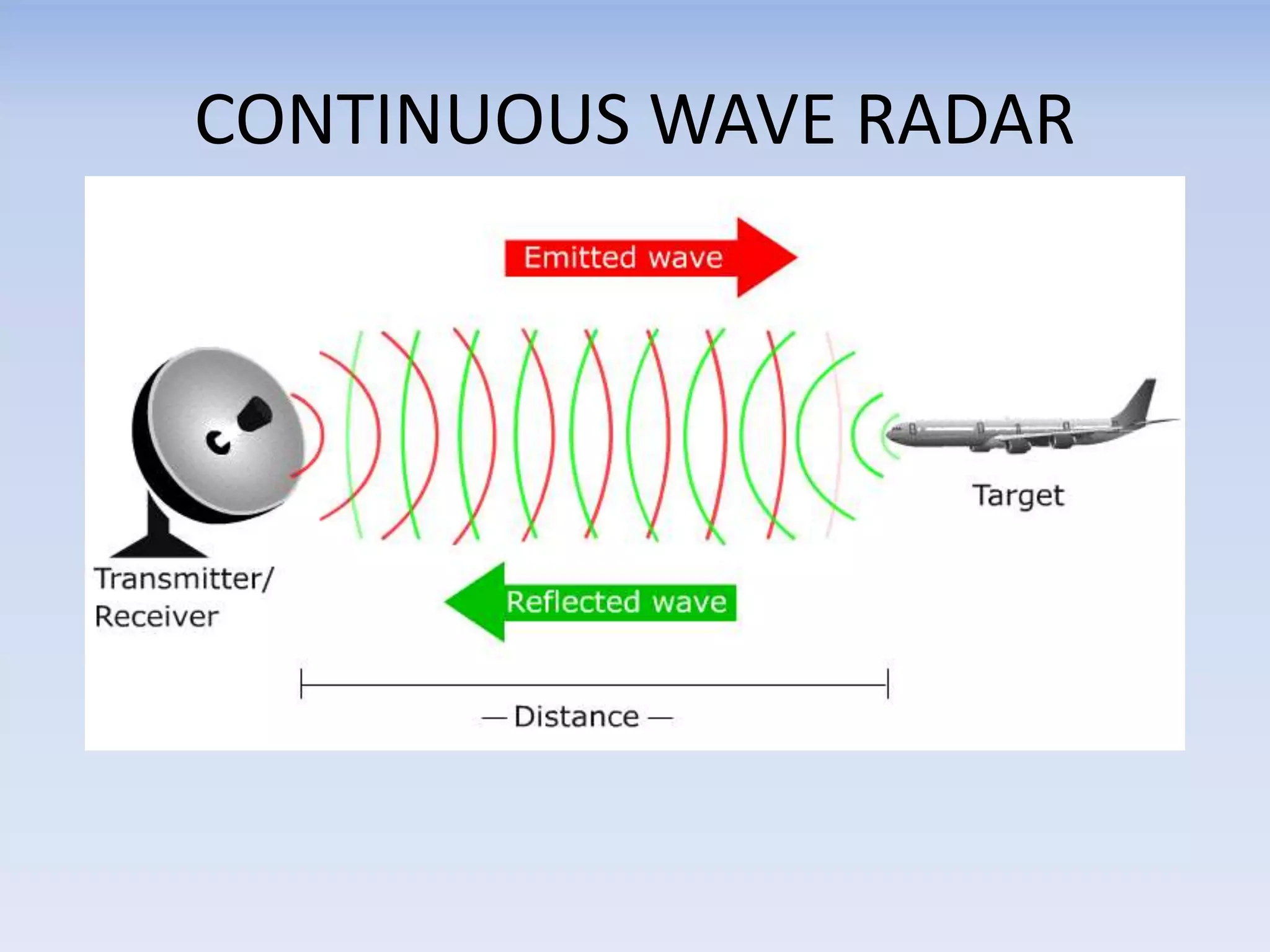
Radar was developed in the early 1900s and used widely in World War II for military purposes like detecting aircraft and ships. Radar works by emitting radio waves that bounce off objects and return to the radar system. By measuring the time it takes for the echo to return, radar can determine the object's distance, direction, speed and other information. There are two main types of radar systems - pulse radar which uses high power pulses and continuous wave radar which emits a continuous signal. Today radar has many applications including weather monitoring, air traffic control and defense systems.
HISTORY OF RADAR
1900-”Nicola Tesla” suggested that the reflection of
electromagnetic waves could be used for detecting of moving
metallic objects.
1904-” Christian Hulsmeyer” built an experimental device
that could detect nearby ships in a dense fog, that were
otherwise completely invisible to the naked eye.
Practical radar was developed in secrecy during World War II
by Britain and other nations.
3.
Radar is somethingthat is in use all around us, although it is
normally invisible. Radar is an object-detection system that
uses radio waves to determine the range, altitude, direction, or
speed of objects. It can be used detect aircraft ,ships , missiles
weather formation, and terrain. Radar was secretly developed
by several nations before and during World War II. The
term RADAR was coined in 1940 by the United States Navy as
an acronym for RAdio Detection And Ranging.
4.
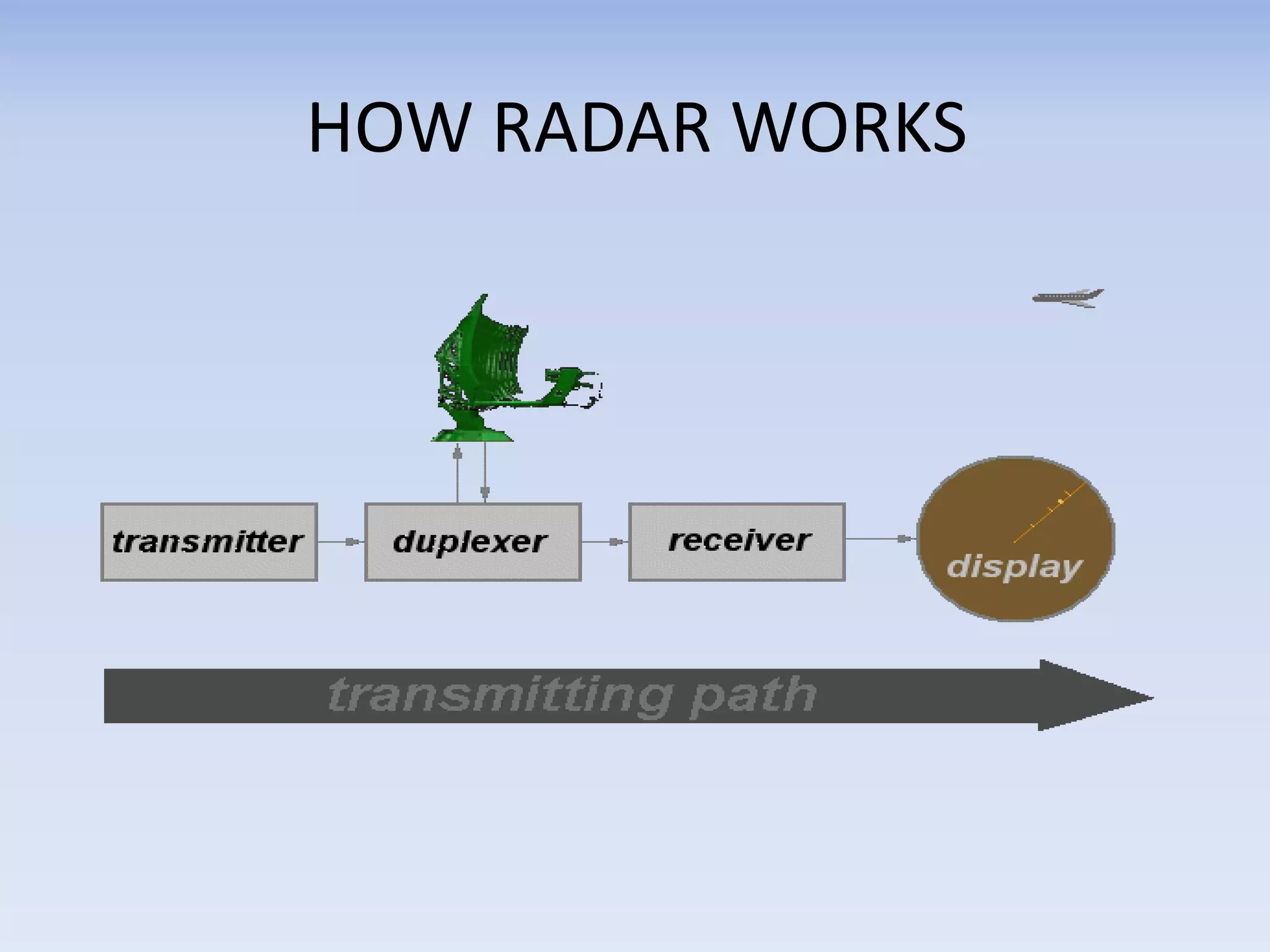
HOW RADAR WORKS?
oA radar system has a transmitter that emits radio
waves called radar signals in predetermined
directions.
o When these come into contact with an object they
are usually reflected or scattered in many directions.
o Radar signals are reflected especially well by
materials of considerable electrical conductivity—
especially by most metals, by seawater and by wet
ground.
Echo is somethingyou experience all
the time. If you shout into a well or a
canyon, the echo comes back a moment
later. The echo occurs because some of
the sound waves in your shout reflect
off of a surface (either the water at the
bottom of the well or the canyon wall
on the far side) and travel back to your
ears. The length of time between the
moment you shout and the moment
that you hear the echo is determined by
the distance between you and the
surface that creates the echo.
ECHO
7.
DOPPLER
EFFECT
• Frequency shiftis caused by
motion that changes the
number of wavelengths
between the reflector and the
radar.
• Doppler shift depends upon
whether the radar
configuration is active or
passive. Active radar transmits
a signal that is reflected back
to the receiver. Passive radar
depends upon the object
sending a signal to the receiver.
Pulse Vs. ContinuousWave
PULSE
• Single Antenna
• Gives Range & Alt.
• Susceptible To Jamming
• Physical Range Determined
By PW and PRF.
CONTINOUS WAVE
• Requires 2 Antennae
• No Range or Alt. Info
• High SNR
• More Difficult to Jam But
Easily Deceived
• Amp can be tuned to look
for expected frequencies
14.
APPLICATIONS OF PULSERADAR
Nautical Radars.
Aviation Radars.
Marine Radars.
Weather-sensing Radars.
Detection and search Radar.
Target Acquisition Radar systems.
Missile Guidance Systems.
Radar for Biological research.
Air traffic control and navigation Radar.
15.
WSR-88
The WSR-88D (Weather
SurveillanceRadar) is a
Doppler radar, introduced
in 1988. In addition to
obtaining intensity and
location of weather cells,
the WSR-88D makes use
of the Doppler shift to
determine radial velocities
of individual cells.
16.
BOXER
The BOXER familyof
lightweight coherent
ground surveillance
radars are
manufactured by
Kelvin Hughes
Surveillance LdT.
primary sensors for
threat detection over
land.