Requirements for Electrical Installations IEE Wiring Regulations  17 th  Edition Part 5
IEE Wiring Regulations  17 th  Edition - Part 5 As stated; one of the larger parts in the 17 th  Edition It consists of 6 chapters: Chapter 51 Common rules. Chapter 52  Selection and erection of wiring systems Chapter 53  Protection, isolation, switching control and    monitoring  Chapter 54  Earthing arrangements and protective      conductors Chapter 55  Other equipment Chapter 56  Safety services
Requirements for Electrical Installations IEE Wiring Regulations  17 th  Edition Part 5 Chapter 52
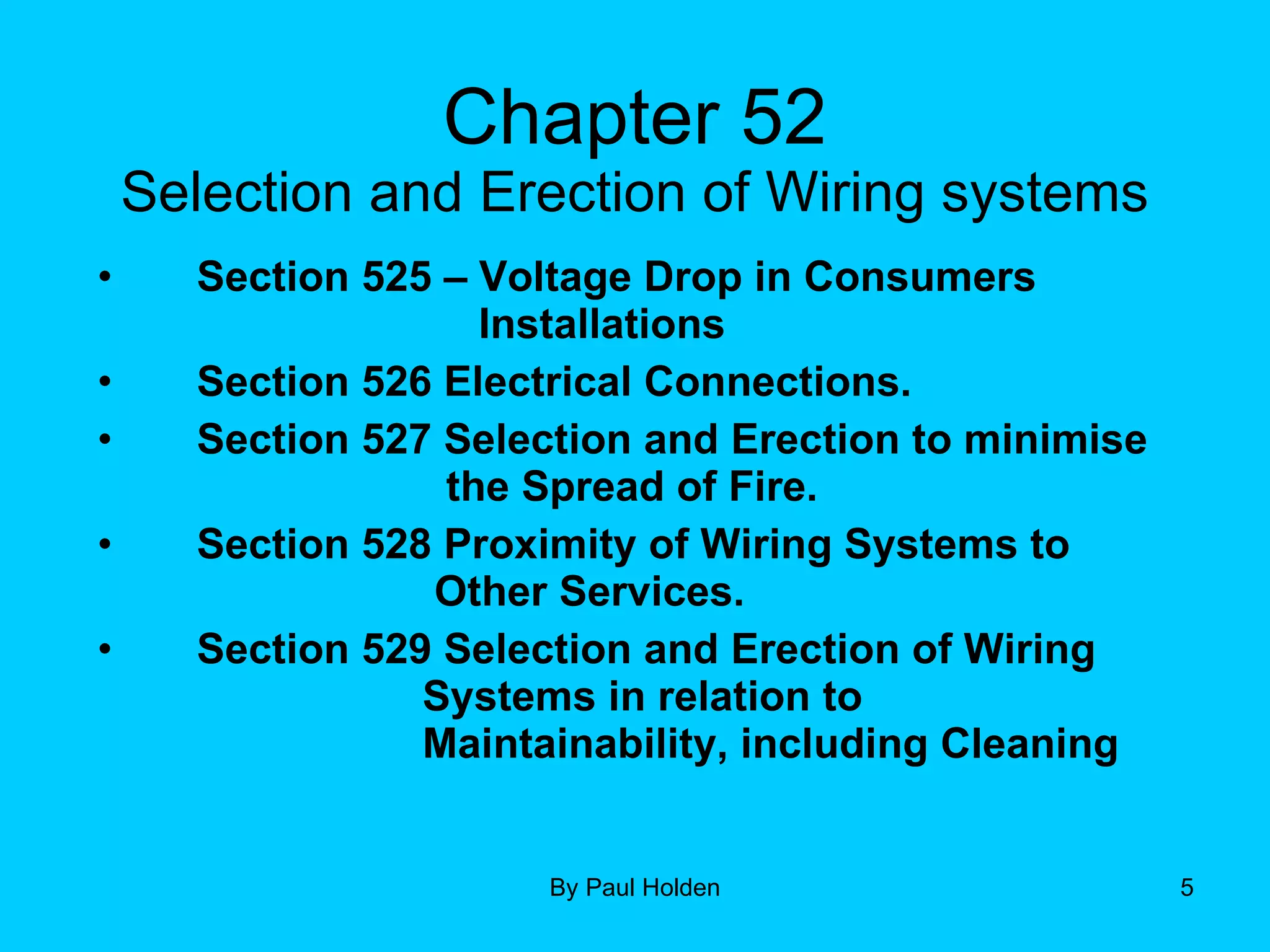
Chapter 52 Selection and Erection of Wiring systems Consists of 10 sections Section 520 - Introduction Section 521 – Types of Wiring Systems Section 522 – Selection and Erection of    Wiring Systems in relation to    External Influences Section 523 – Current Carrying Capacities    of Cables. Section 524 – Cross-Sectional areas of  Conductors of Cables
Chapter 52 Selection and Erection of Wiring systems Section 525 – Voltage Drop in Consumers  Installations Section 526 Electrical Connections. Section 527 Selection and Erection to minimise    the Spread of Fire. Section 528 Proximity of Wiring Systems to    Other Services. Section 529 Selection and Erection of Wiring    Systems in relation to    Maintainability, including Cleaning
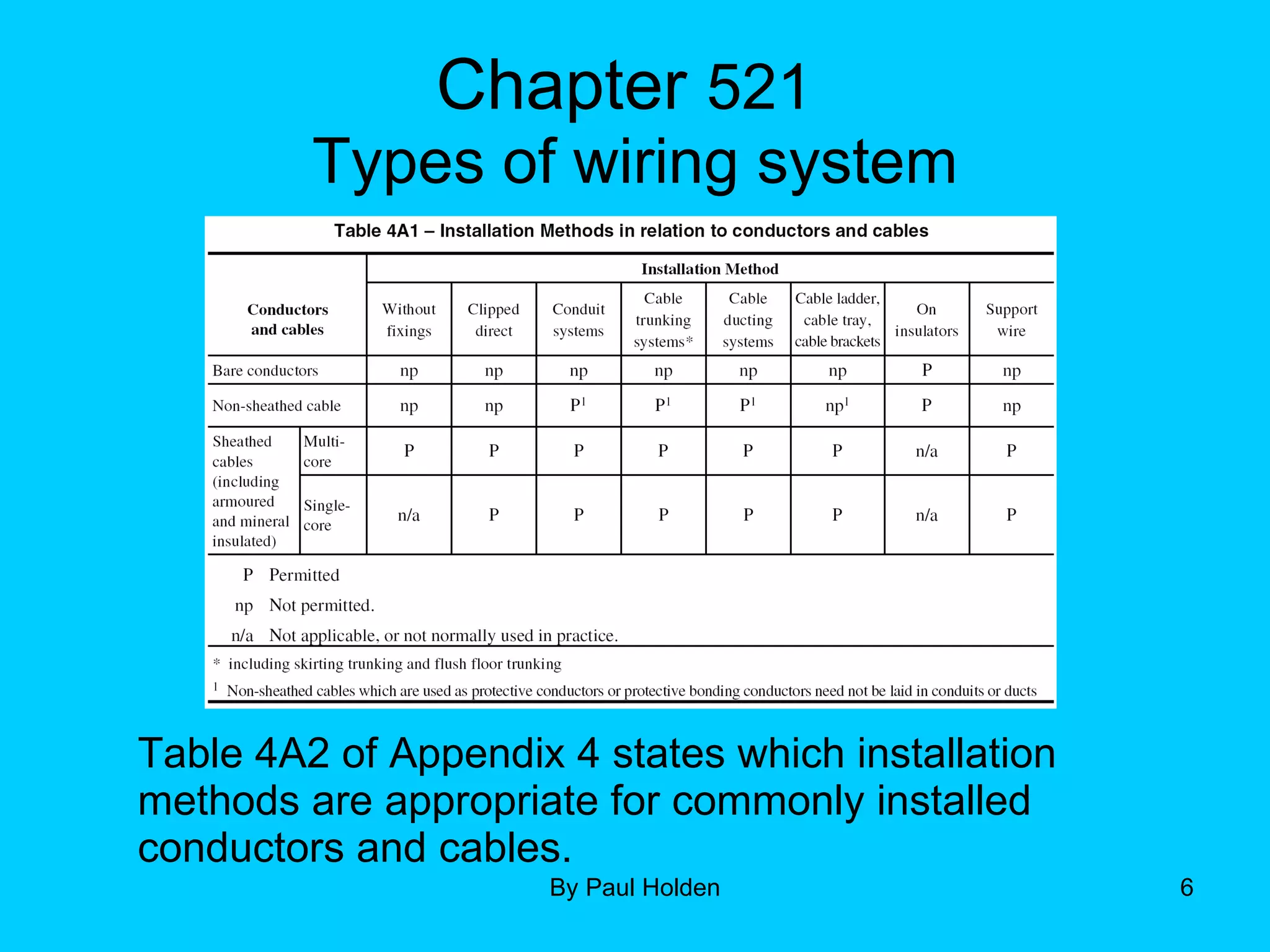
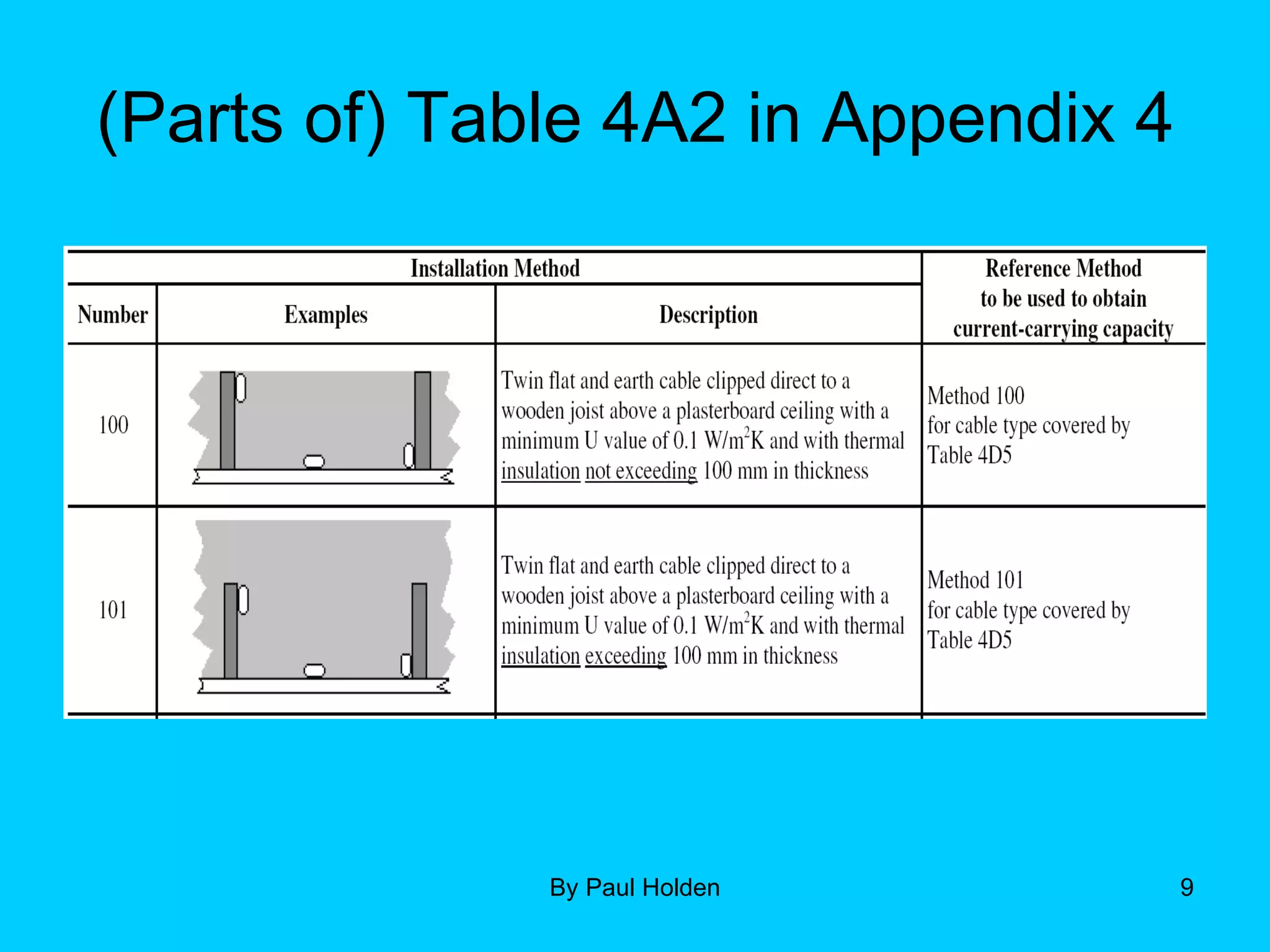
Chapter  521   Types of wiring system Table 4A2 of Appendix 4 states which installation methods are appropriate for commonly installed conductors and cables.
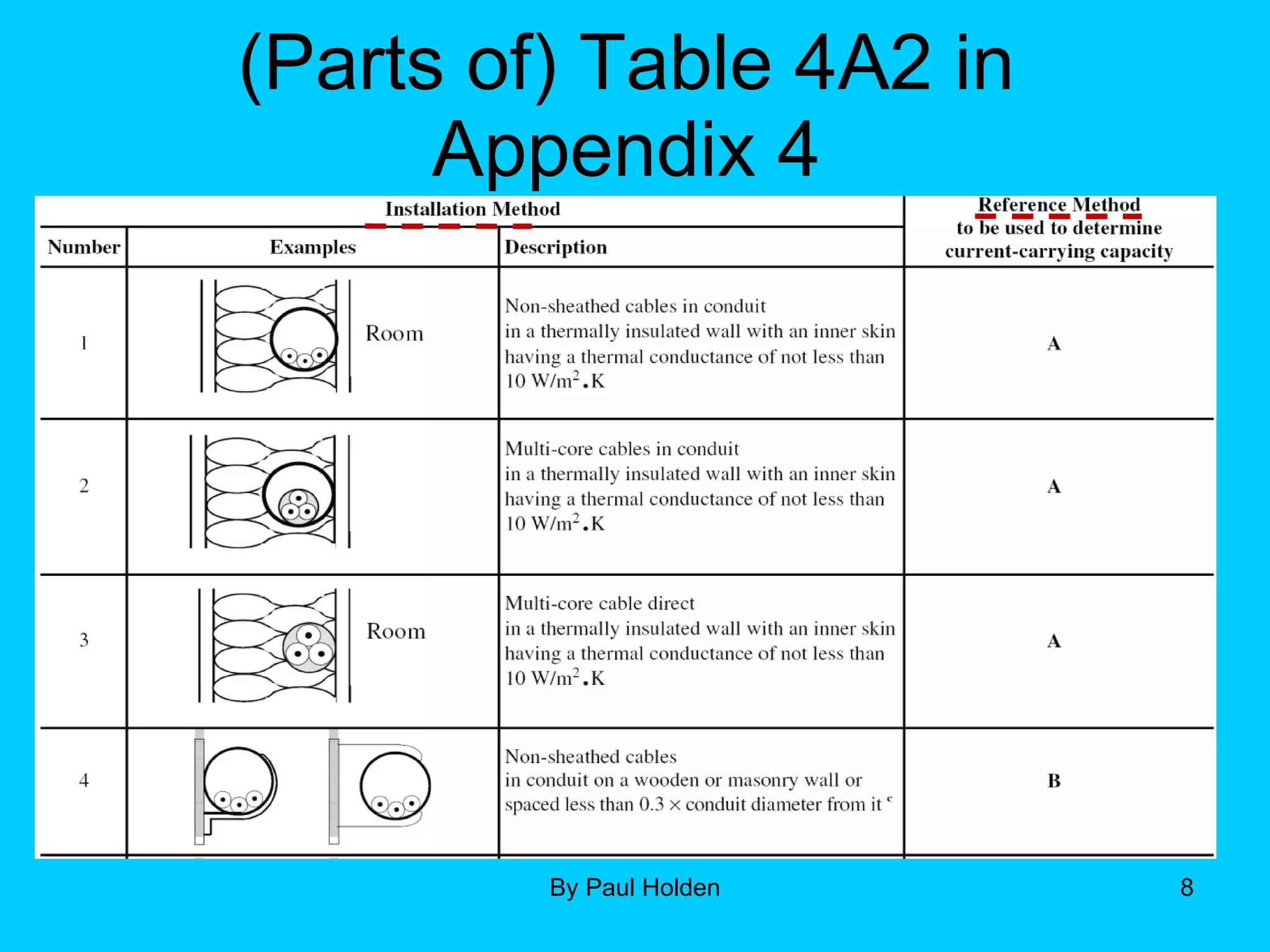
Chapter  521.3 Types of wiring system Examples of wiring systems are shown in Table 4A2.  The table should be used first to find the ‘installation method’, and then the  reference method  relating to it.   The  reference method  is required to determine the current-carrying capacity of a cable or flexible cord from Tables 4D1A to 4J4A . A sample of Table 4A2 is shown on the next slide
(Parts of) Table 4A2 in Appendix 4
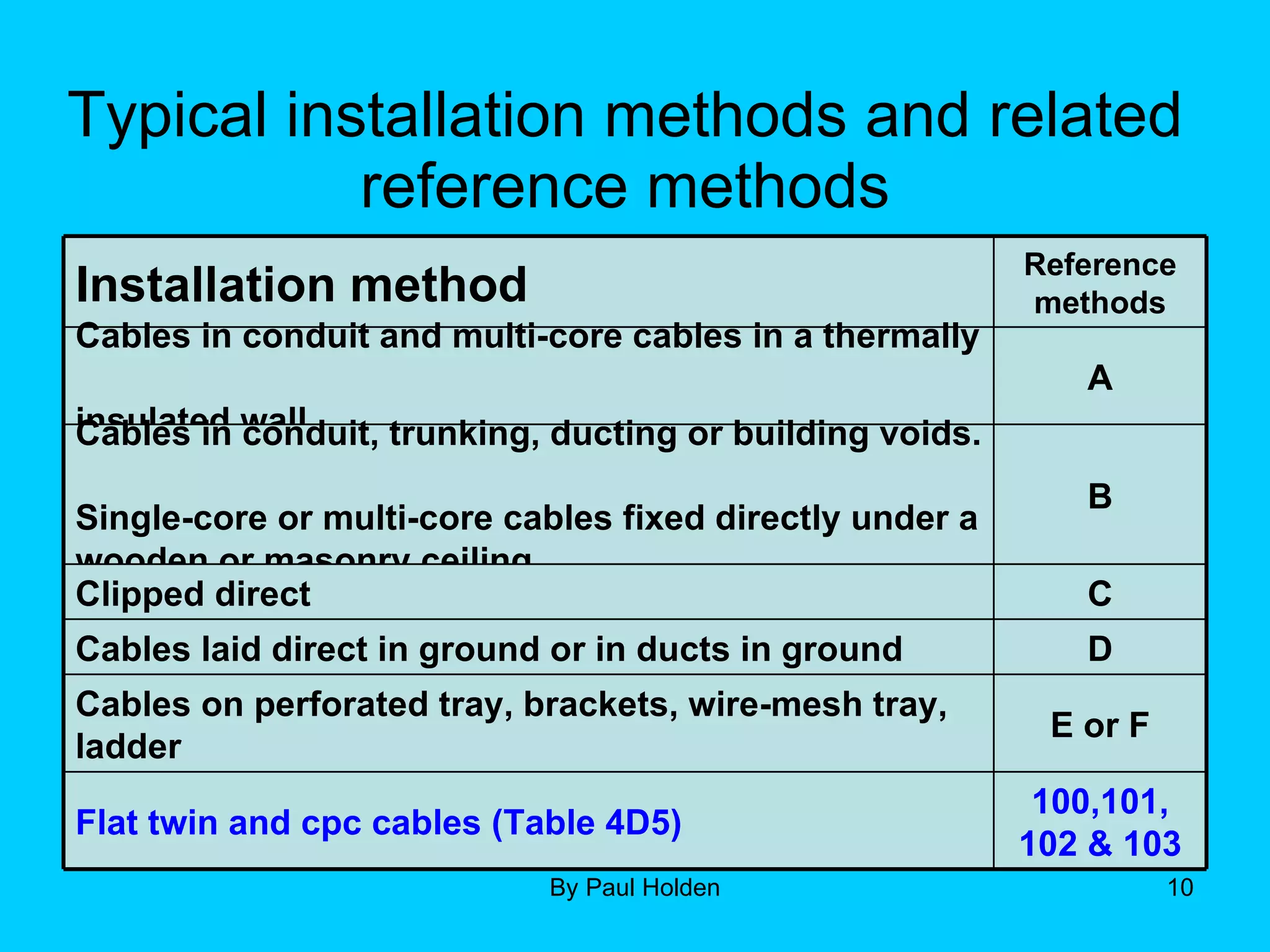
Typical installation methods and related reference methods Installation method Reference methods Cables in conduit and multi-core cables in a thermally  insulated wall A Cables in conduit, trunking, ducting or building voids.  Single-core or multi-core cables fixed directly under a wooden or masonry ceiling.  B Clipped direct  C Cables laid direct in ground or in ducts in ground D Cables on perforated tray, brackets, wire-mesh tray, ladder  E or F Flat twin and cpc cables (Table 4D5)  100,101, 102 & 103
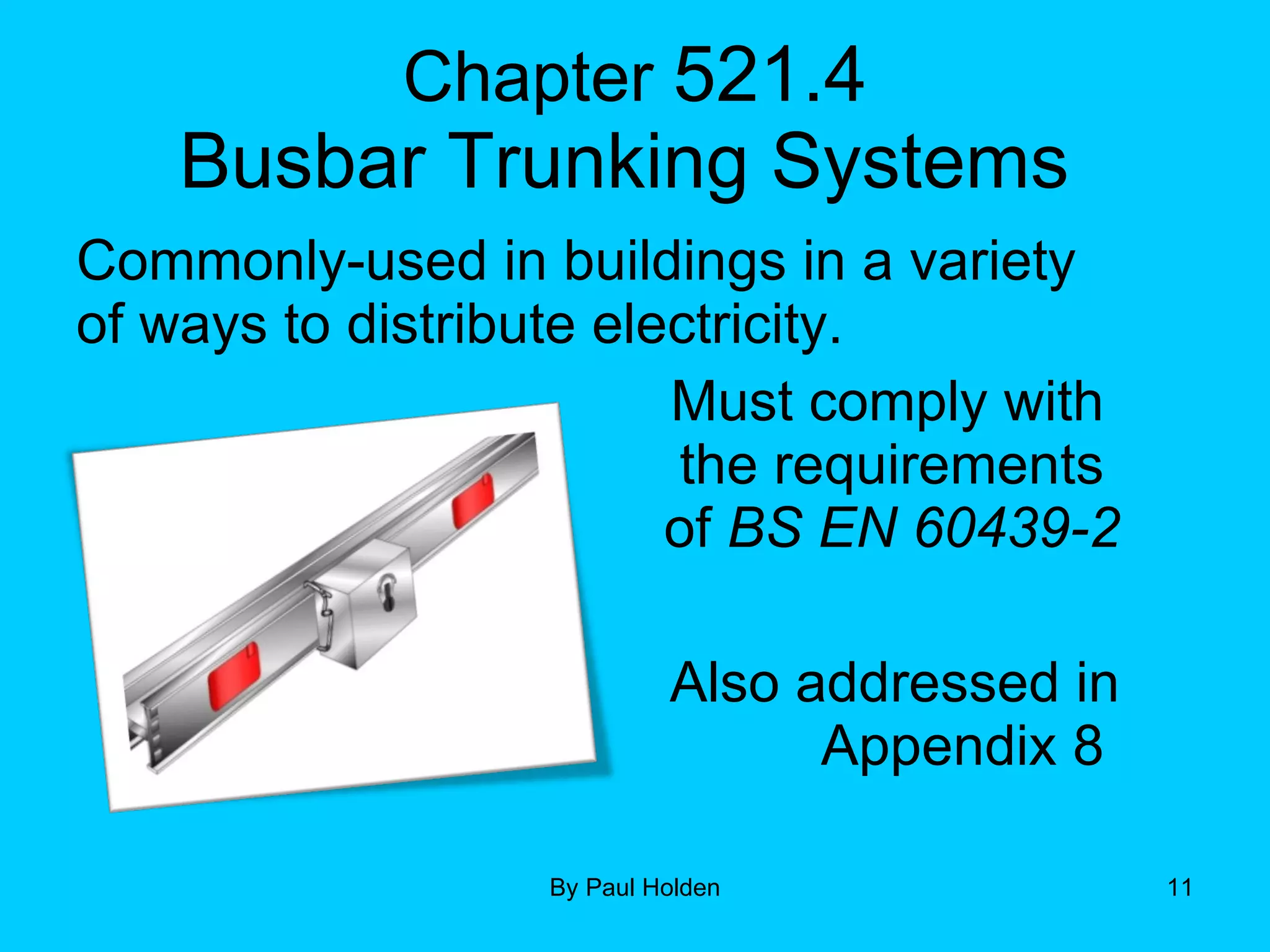
Chapter  521.4 Busbar Trunking Systems  Commonly-used in buildings in a variety of ways to distribute electricity.  Must comply with  the requirements  of  BS EN 60439-2 Also addressed in Appendix 8
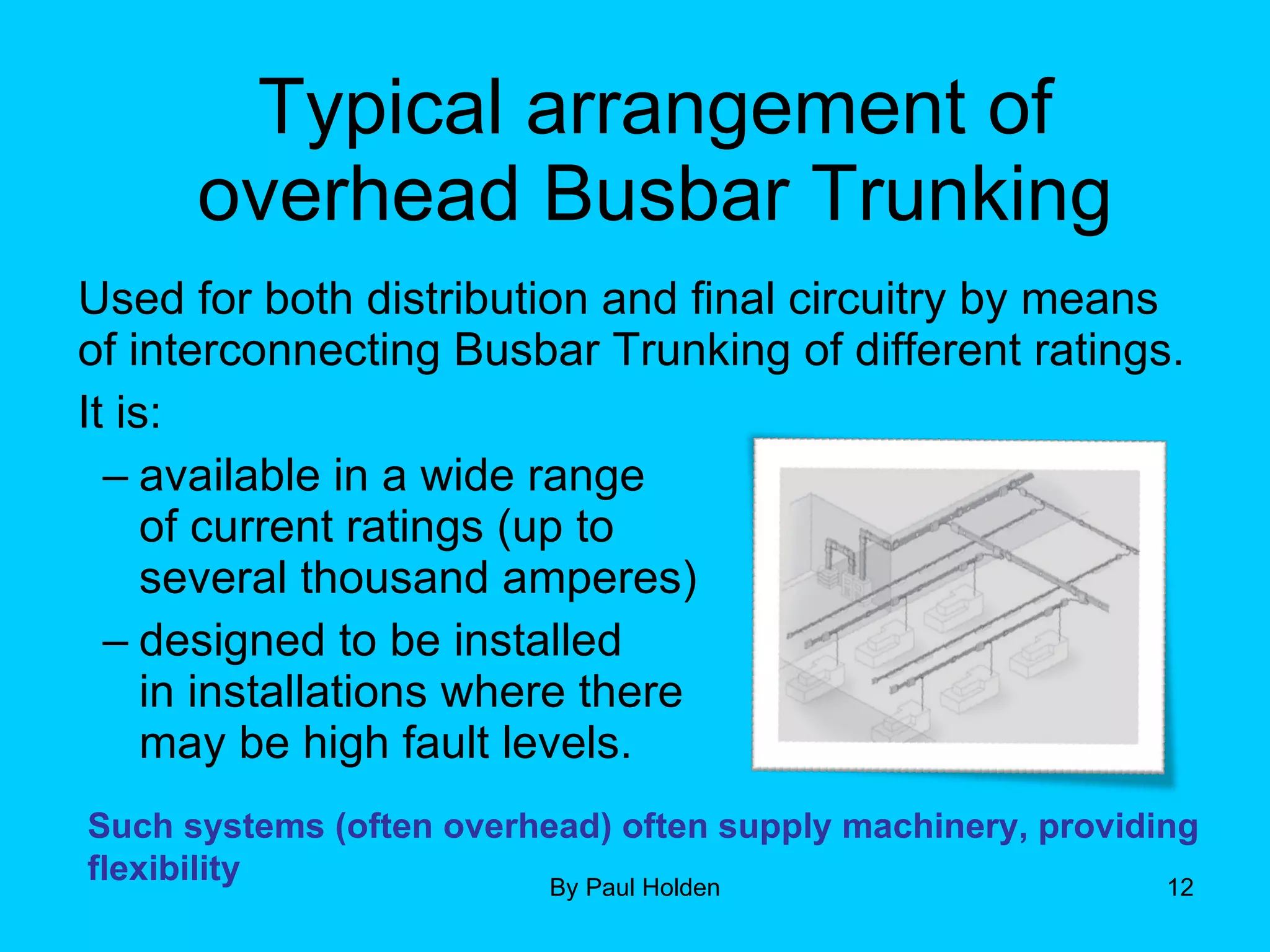
Typical arrangement of overhead Busbar Trunking Used for both distribution and final circuitry by means of interconnecting Busbar Trunking of different ratings. It is: available in a wide range  of current ratings (up to  several thousand amperes) designed to be installed  in installations where there  may be high fault levels. Such systems (often overhead) often supply machinery, providing flexibility
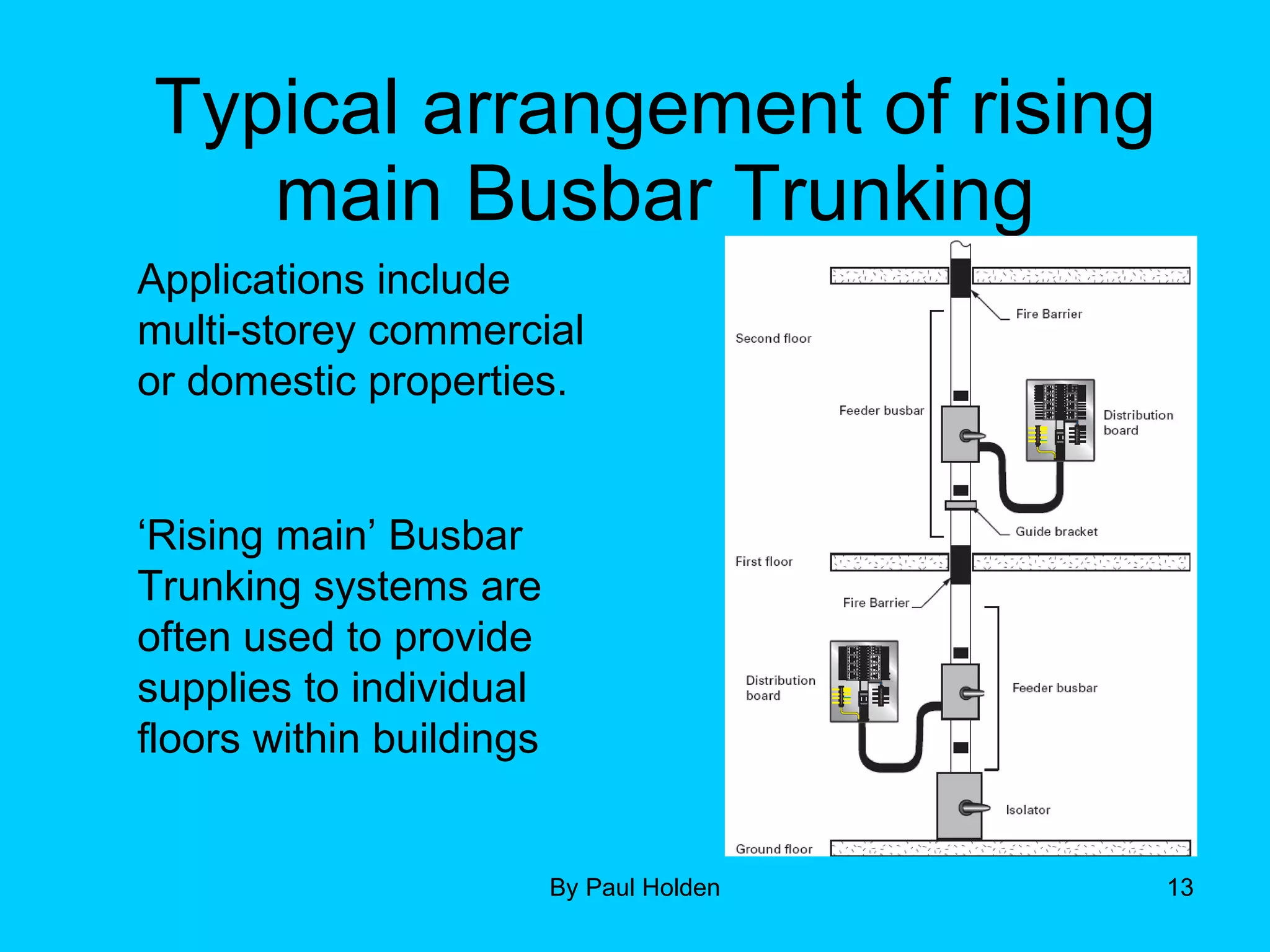
Typical arrangement of rising main Busbar Trunking Applications include multi-storey commercial or domestic properties. ‘ Rising main’ Busbar Trunking systems are often used to provide supplies to individual floors within buildings
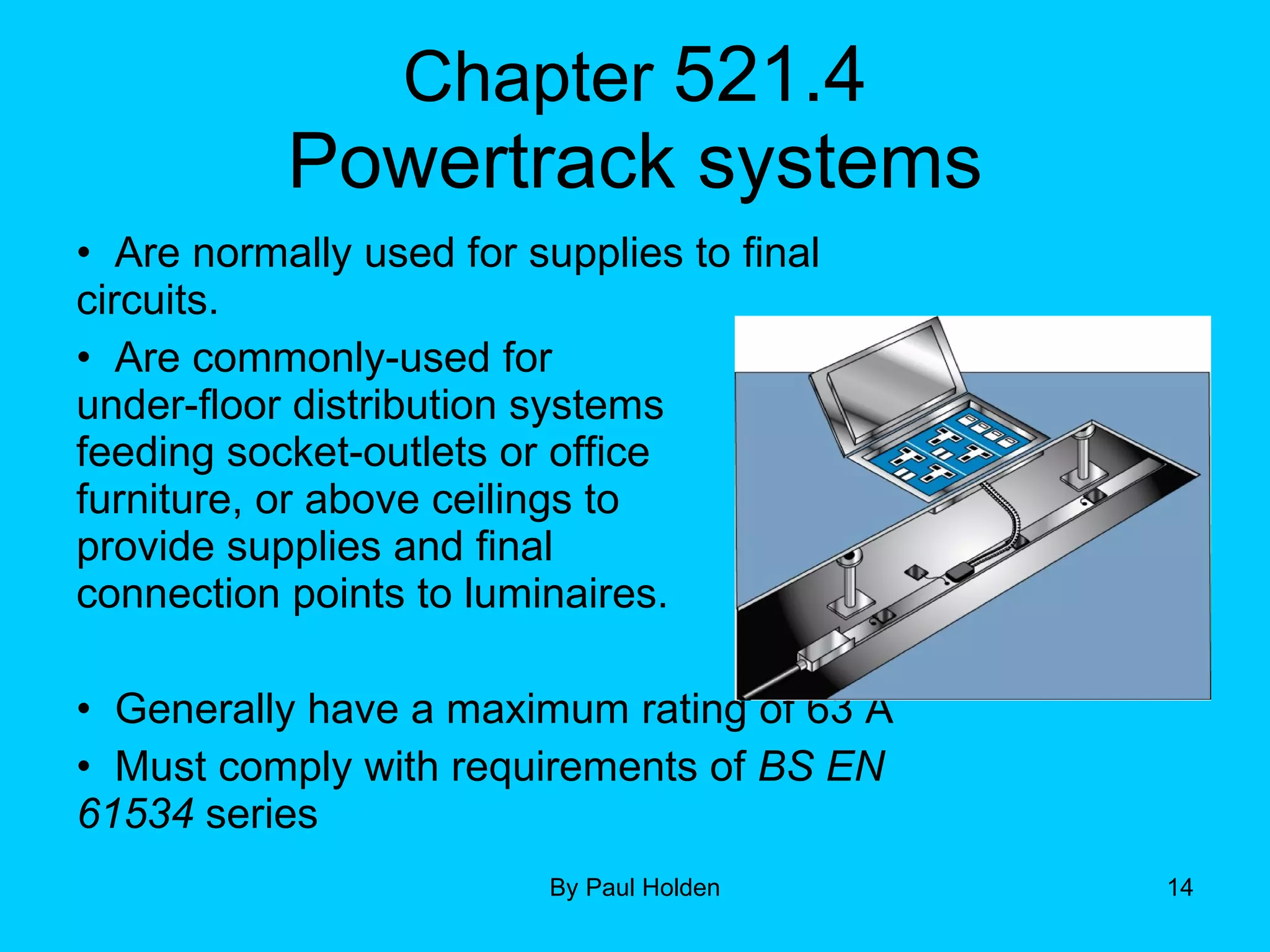
Chapter  521.4 Powertrack systems Are normally used for supplies to final circuits.  Are commonly-used for  under-floor distribution systems  feeding socket-outlets or office  furniture, or above ceilings to  provide supplies and final  connection points to luminaires. Generally have a maximum rating of 63 A Must comply with requirements of  BS EN 61534  series
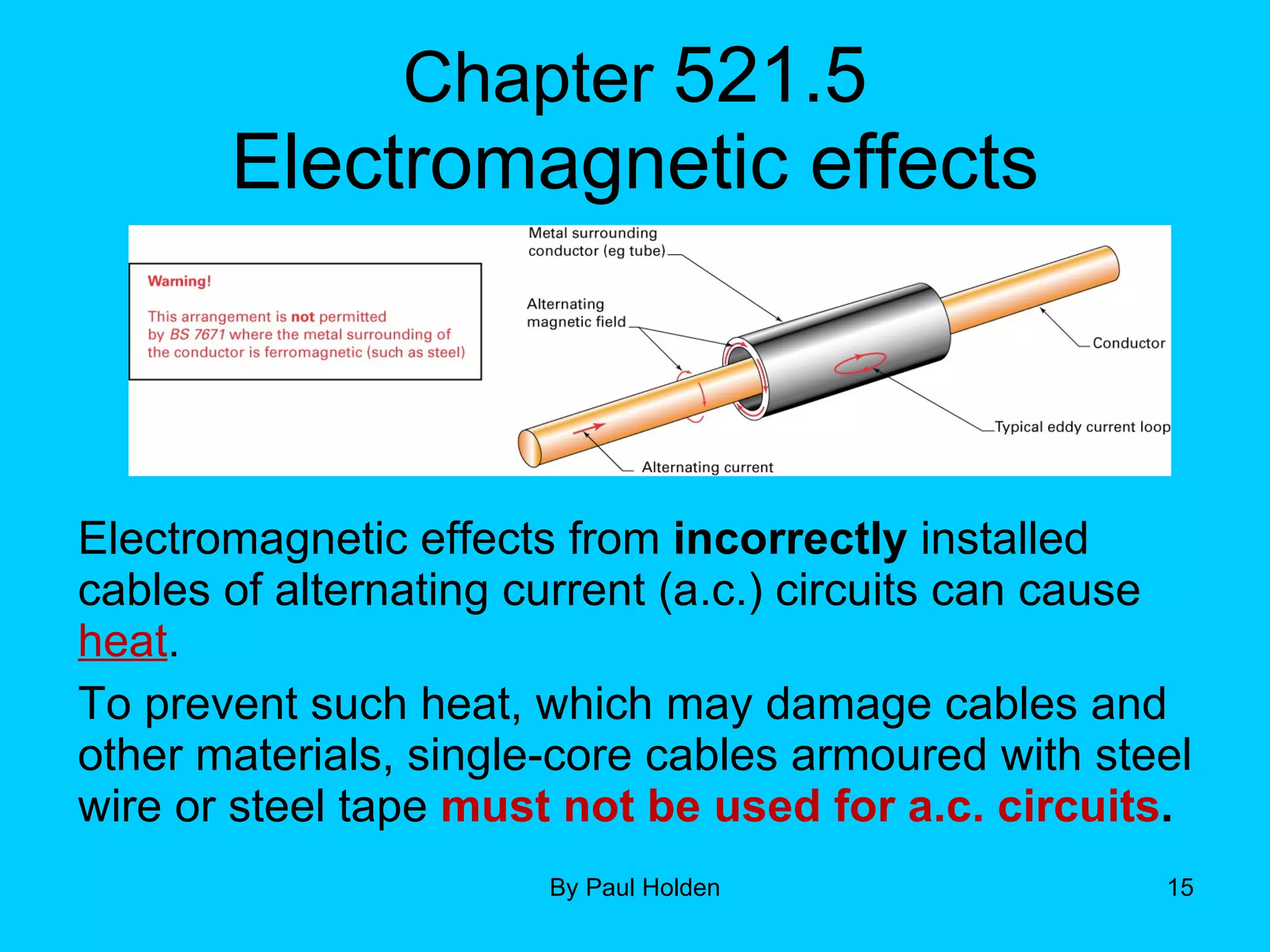
Chapter  521.5 Electromagnetic effects Electromagnetic effects from  incorrectly  installed cables of alternating current (a.c.) circuits can cause  heat .  To prevent such heat, which may damage cables and other materials, single-core cables armoured with steel wire or steel tape  must not be used for a.c. circuits .
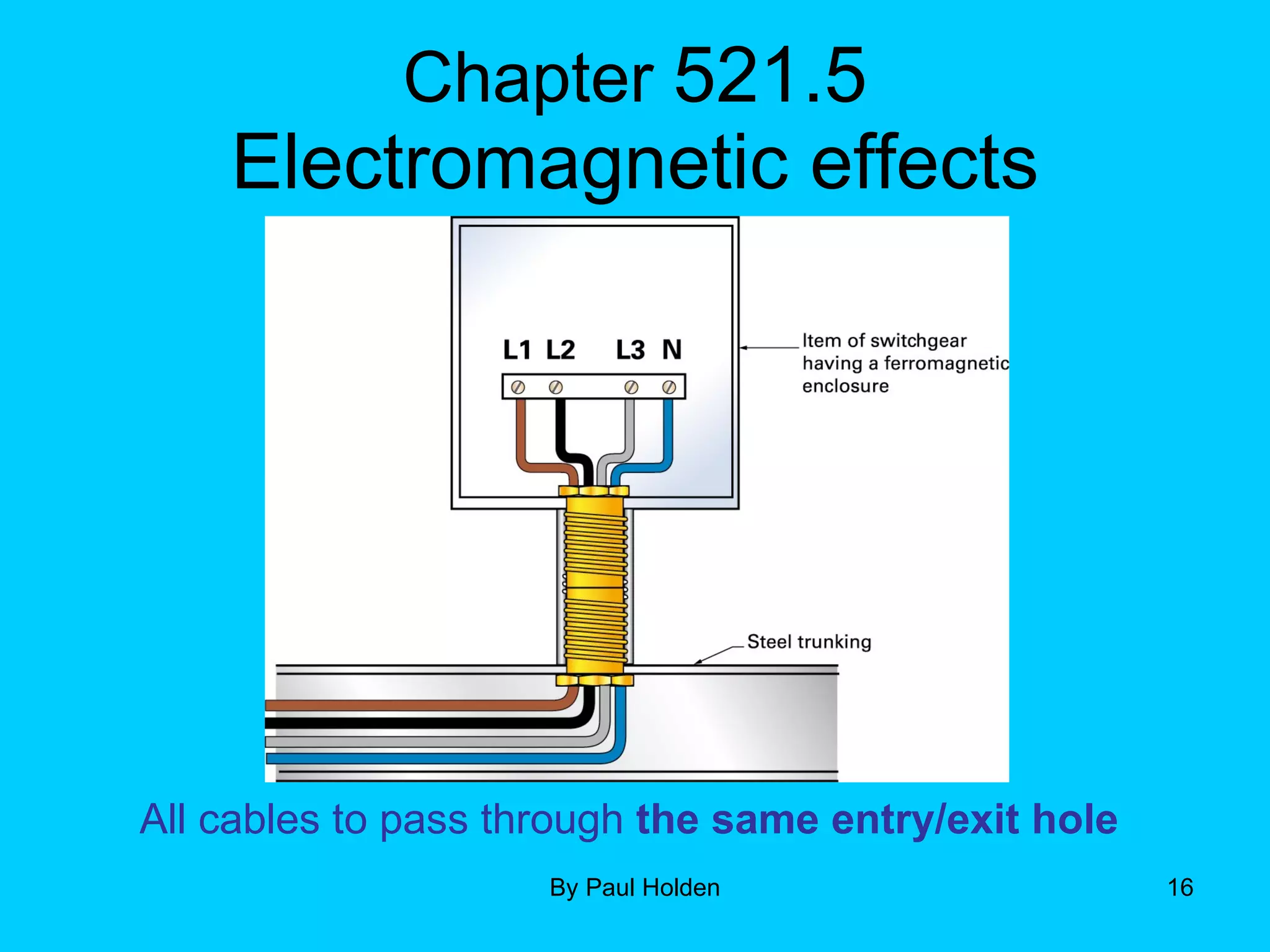
Chapter  521.5 Electromagnetic effects All cables to pass through  the same entry/exit hole
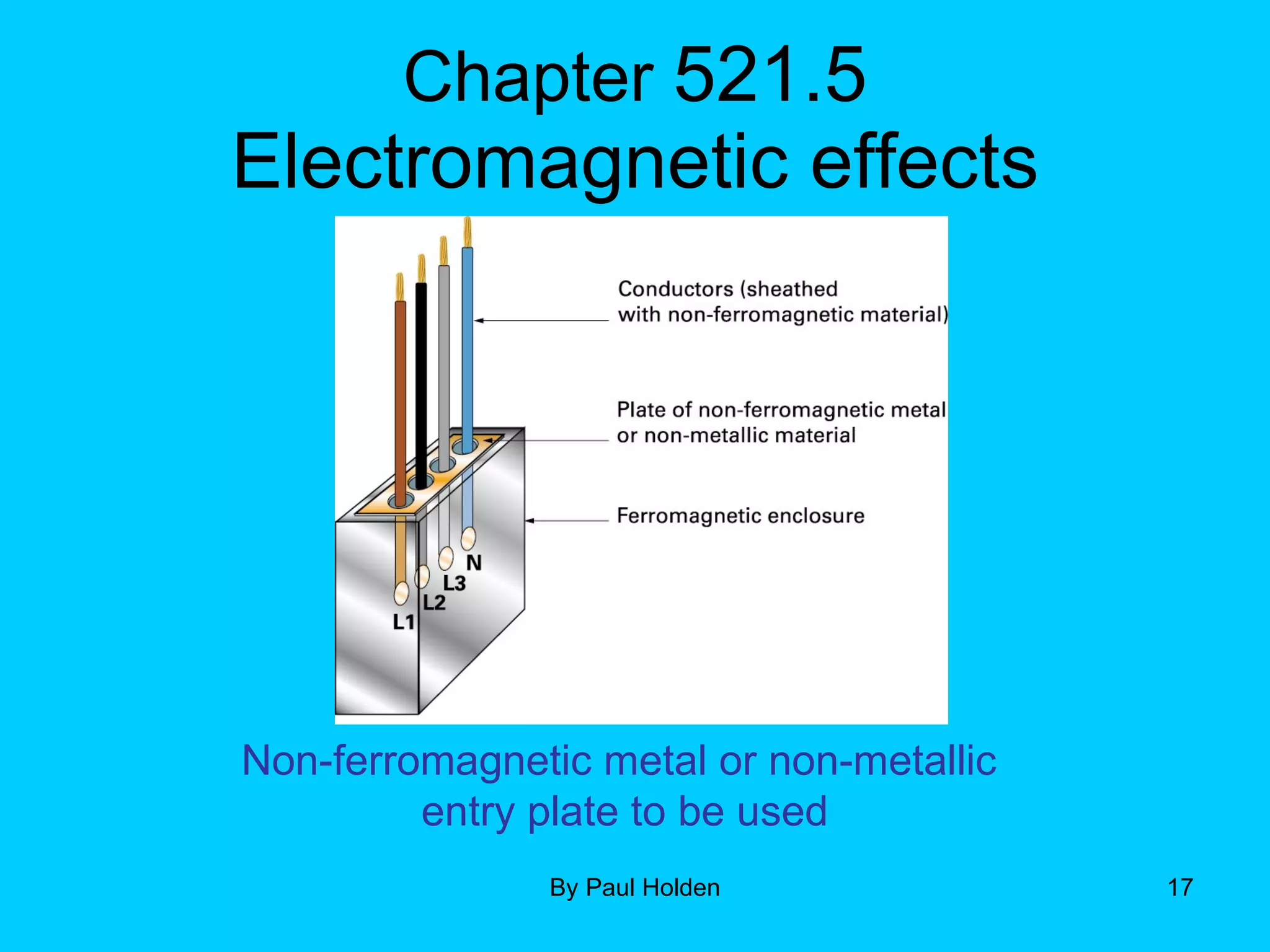
Chapter  521.5 Electromagnetic effects Non-ferromagnetic metal or non-metallic  entry plate to be used
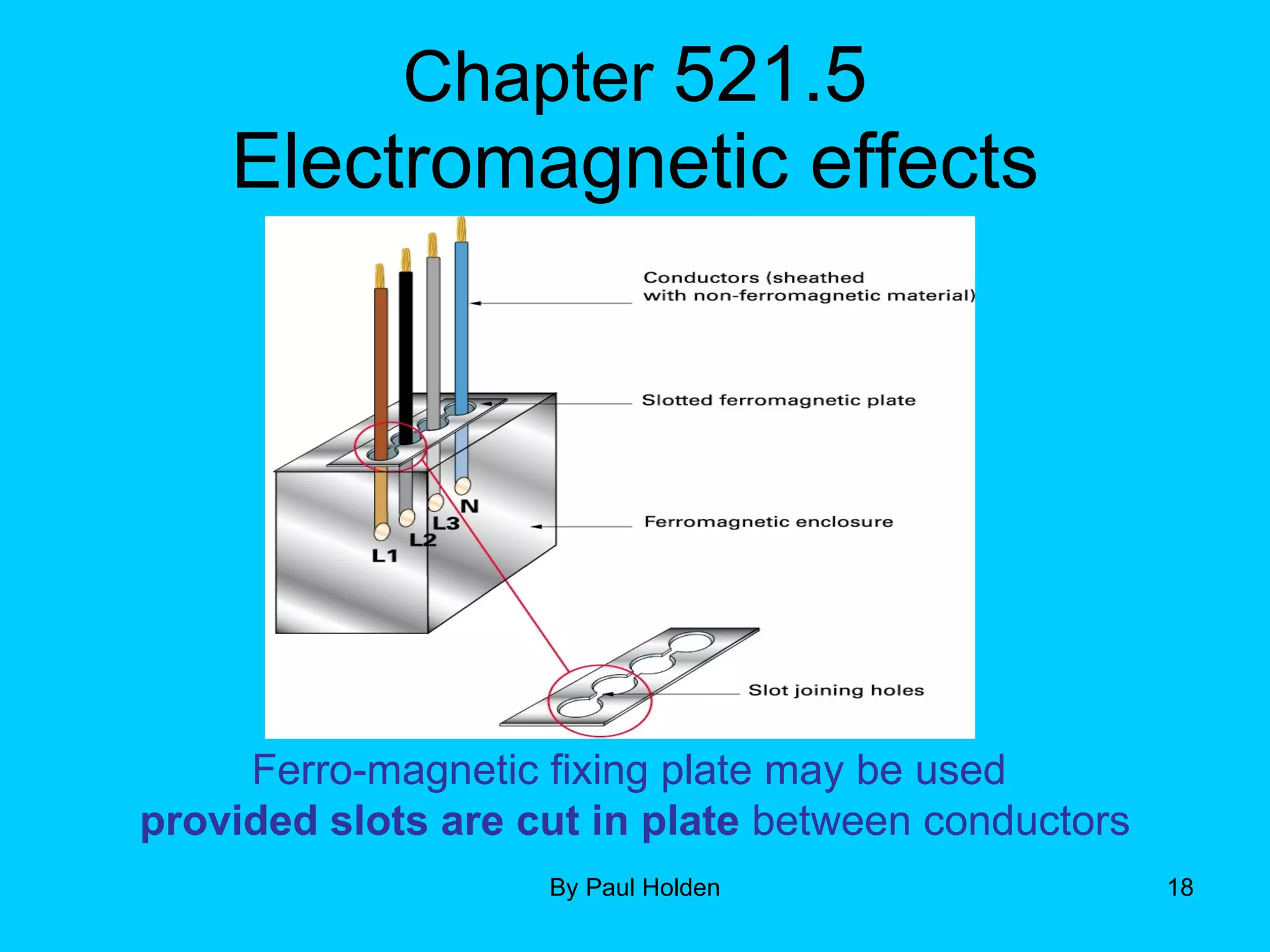
Chapter  521.5 Electromagnetic effects Ferro-magnetic fixing plate may be used  provided slots are cut in plate  between conductors
Chapter 521.6 Conduit, ducting, trunking and ladder systems Regulations 521-6 to 521-10 provide some general requirements for the above wiring systems including: Multiple circuits are permitted within the same wiring system or multi-core cable (See Section 528 though) Separation of conductors from different final circuits (See also Section 314) Use of flexible cables or cords (See also Section 522) Non-sheathed cables  of fixed wiring  to be enclosed  (See  also Section 522)
Chapters  521.7 & 521.8 Regulations 521.7 & 521.8  have already been covered in Part 3 and Section 528 covers the segregation issues in depth
Well that was Section 521 Types of Wiring Systems Does this make sense? GOOD  – We will carry on -  -   -   -   -   -   -   - To section 522

17th Edition Part 5 2 1

  • 1.
    Requirements for ElectricalInstallations IEE Wiring Regulations 17 th Edition Part 5
  • 2.
    IEE Wiring Regulations 17 th Edition - Part 5 As stated; one of the larger parts in the 17 th Edition It consists of 6 chapters: Chapter 51 Common rules. Chapter 52 Selection and erection of wiring systems Chapter 53 Protection, isolation, switching control and monitoring Chapter 54 Earthing arrangements and protective conductors Chapter 55 Other equipment Chapter 56 Safety services
  • 3.
    Requirements for ElectricalInstallations IEE Wiring Regulations 17 th Edition Part 5 Chapter 52
  • 4.
    Chapter 52 Selectionand Erection of Wiring systems Consists of 10 sections Section 520 - Introduction Section 521 – Types of Wiring Systems Section 522 – Selection and Erection of Wiring Systems in relation to External Influences Section 523 – Current Carrying Capacities of Cables. Section 524 – Cross-Sectional areas of Conductors of Cables
  • 5.
    Chapter 52 Selectionand Erection of Wiring systems Section 525 – Voltage Drop in Consumers Installations Section 526 Electrical Connections. Section 527 Selection and Erection to minimise the Spread of Fire. Section 528 Proximity of Wiring Systems to Other Services. Section 529 Selection and Erection of Wiring Systems in relation to Maintainability, including Cleaning
  • 6.
    Chapter 521 Types of wiring system Table 4A2 of Appendix 4 states which installation methods are appropriate for commonly installed conductors and cables.
  • 7.
    Chapter 521.3Types of wiring system Examples of wiring systems are shown in Table 4A2. The table should be used first to find the ‘installation method’, and then the reference method relating to it. The reference method is required to determine the current-carrying capacity of a cable or flexible cord from Tables 4D1A to 4J4A . A sample of Table 4A2 is shown on the next slide
  • 8.
    (Parts of) Table4A2 in Appendix 4
  • 9.
    (Parts of) Table4A2 in Appendix 4
  • 10.
    Typical installation methodsand related reference methods Installation method Reference methods Cables in conduit and multi-core cables in a thermally insulated wall A Cables in conduit, trunking, ducting or building voids. Single-core or multi-core cables fixed directly under a wooden or masonry ceiling. B Clipped direct C Cables laid direct in ground or in ducts in ground D Cables on perforated tray, brackets, wire-mesh tray, ladder E or F Flat twin and cpc cables (Table 4D5) 100,101, 102 & 103
  • 11.
    Chapter 521.4Busbar Trunking Systems Commonly-used in buildings in a variety of ways to distribute electricity. Must comply with the requirements of BS EN 60439-2 Also addressed in Appendix 8
  • 12.
    Typical arrangement ofoverhead Busbar Trunking Used for both distribution and final circuitry by means of interconnecting Busbar Trunking of different ratings. It is: available in a wide range of current ratings (up to several thousand amperes) designed to be installed in installations where there may be high fault levels. Such systems (often overhead) often supply machinery, providing flexibility
  • 13.
    Typical arrangement ofrising main Busbar Trunking Applications include multi-storey commercial or domestic properties. ‘ Rising main’ Busbar Trunking systems are often used to provide supplies to individual floors within buildings
  • 14.
    Chapter 521.4Powertrack systems Are normally used for supplies to final circuits. Are commonly-used for under-floor distribution systems feeding socket-outlets or office furniture, or above ceilings to provide supplies and final connection points to luminaires. Generally have a maximum rating of 63 A Must comply with requirements of BS EN 61534 series
  • 15.
    Chapter 521.5Electromagnetic effects Electromagnetic effects from incorrectly installed cables of alternating current (a.c.) circuits can cause heat . To prevent such heat, which may damage cables and other materials, single-core cables armoured with steel wire or steel tape must not be used for a.c. circuits .
  • 16.
    Chapter 521.5Electromagnetic effects All cables to pass through the same entry/exit hole
  • 17.
    Chapter 521.5Electromagnetic effects Non-ferromagnetic metal or non-metallic entry plate to be used
  • 18.
    Chapter 521.5Electromagnetic effects Ferro-magnetic fixing plate may be used provided slots are cut in plate between conductors
  • 19.
    Chapter 521.6 Conduit,ducting, trunking and ladder systems Regulations 521-6 to 521-10 provide some general requirements for the above wiring systems including: Multiple circuits are permitted within the same wiring system or multi-core cable (See Section 528 though) Separation of conductors from different final circuits (See also Section 314) Use of flexible cables or cords (See also Section 522) Non-sheathed cables of fixed wiring to be enclosed (See also Section 522)
  • 20.
    Chapters 521.7& 521.8 Regulations 521.7 & 521.8 have already been covered in Part 3 and Section 528 covers the segregation issues in depth
  • 21.
    Well that wasSection 521 Types of Wiring Systems Does this make sense? GOOD – We will carry on - - - - - - - - To section 522

Editor's Notes

  • #7 Refer to Appendix 4. Use of Appendix 4 will covered in more detail in Section 523/525. For now it is worth getting students used to finding installation methods and their related reference method.
  • #8 Refer to Appendix 4. Use of Appendix 4 will covered in more detail in Section 523/525. For now it is worth getting students used to finding installation methods and their related reference method.
  • #9 Refer to Appendix 4. Use of Appendix 4 will covered in more detail in Section 523/525. For now it is worth getting students used to finding installation methods and their related reference method.
  • #12 The following slides illustrate busbar and powertrack systems. Bs 7671 does not contain any specific detailed requirements (apart from using the correct British Standards). However Appendix 8 should be quickly referred to. Generally manufacturers information/recommendation should be followed.
  • #13 Such systems (often overhead) are also used to supply machinery, providing flexibility when the connected equipment may require frequent movement.
  • #17 Conductors of a.c. circuits installed in ferromagnetic enclosures (such as steel conduit, trunking or ducting) must be arranged so that the conductors of all line and the related neutral conductor (if any) and the appropriate protective conductor of each circuit are contained in the same enclosure.
  • #18 Where conductors enter a ferromagnetic enclosure, they must be arranged so that they are not individually surrounded by ferromagnetic material, or other provision must be made to prevent eddy (induced) currents. (Using non-ferromagnetic plate)
  • #19 Where conductors enter a ferromagnetic enclosure, they must be arranged so that they are not individually surrounded by ferromagnetic material, or other provision must be made to prevent eddy (induced) currents. (Using slots)
  • #20 Refer to Sections 521.6 and 521.10. Many of these Regulations are covered in later sections of Part 5. Regulation 521.7/521.8 has already been covered in Part 3 and Section 528 covers the segregation issues in depth 521.9 requires the use of flexible cables where equipment is intended to be moved etc and requires flexible cables only to be used where the relevant provisions of the regulations are met. 521.10 is very important (521.10.1) being the regulation confirming that non-sheathed cables must be provided with mechanical protection. For circuit protective conductors see Regulation 543.1.1 (4.0 mm 2 minimum without mechanical protection)