Underground Cable
BESCOM
CONTENTS:
2
 Introduction
 Advantages & Disadvantages
 Construction of Cables
 Insulating Materials for Cables
 Classification of Cables
 Laying of Cables
 Grading of Cables
 Earth Faults
 Summary of Costs.
Introduction:
3
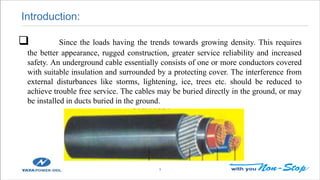
 Since the loads having the trends towards growing density. This requires
the better appearance, rugged construction, greater service reliability and increased
safety. An underground cable essentially consists of one or more conductors covered
with suitable insulation and surrounded by a protecting cover. The interference from
external disturbances like storms, lightening, ice, trees etc. should be reduced to
achieve trouble free service. The cables may be buried directly in the ground, or may
be installed in ducts buried in the ground.
Advantages & Disadvantages
4
Advantages
 Better general appearance
 Less liable to damage through storms
or lighting
 Low maintenance cost
 Less chances of faults
 Small voltage drops
Disadvantages
 The major drawback is that they have
greater installation cost and introduce
insulation problems at high voltages
compared with equivalent overhead
system.
Construction of Cables
5
Construction of Cables
6
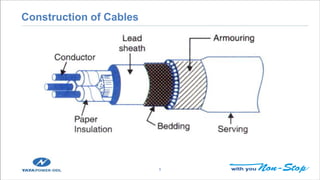
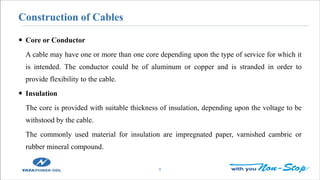
 Core or Conductor
A cable may have one or more than one core depending upon the type of service for which it
is intended. The conductor could be of aluminum or copper and is stranded in order to
provide flexibility to the cable.
 Insulation
The core is provided with suitable thickness of insulation, depending upon the voltage to be
withstood by the cable.
The commonly used material for insulation are impregnated paper, varnished cambric or
rubber mineral compound.
Construction of Cables
7
 Metallic Sheath
A metallic sheath of lead or aluminum is provided over the insulation to protect the
cable from moisture, gases or others damaging liquids
 Bedding
Bedding is provided to protect the metallic sheath from corrosion and from
mechanical damage due to armoring. It is a fibrous material like jute or hessian tape.
Construction of Cables
8
 Armouring
Its purpose is to protect the cable from mechanical injury while laying it or during
the course of handling. It consists of one or two layers of galvanized steel wire or
steel tape.
 Serving
To protect armouring from atmospheric conditions, a layer of fibrous material is
provided.
Insulating Materials for Cables
9
Properties of Insulating Material
10
 High resistivity.
 High dielectric strength.
 Low water absorption.
 Non – inflammable.
 Chemical stability.
 High mechanical strength.
 Capability to with stand high rupturing voltage.
 High tensile strength.
Insulating Materials for Cables
11
• Vulcanized Rubber
 It can be obtained from mixing pure rubber with mineral compounds i-e zinc oxide, red lead
and sulphur and heated upto 150 C.
 It has greater mechanical strength, durability and wear resistant property.
 The sulphur reacts quickly with copper so tinned copper conductors are used.
 It is suitable for low and moderate voltage cables.
CLSSIFICATION OF CABLES
12
 Low tension (L.T) ----- up to 1000V
 High tension (H.T) ----- up to 11, 000V
 Super tension (S.T) ---- from 22KV to 33KV
 Extra high tension (E.H.T) cables --- from 33KV to 66KV
 Extra super voltage cables ------beyond 132KV
Types 3-Core Cable
13
3-Core Cable
Belted Cable
Screened
cable
Pressurized
Type Cables
Oil Filled Cables
H Type Cable S.L. Type Cable
3- Core Cables
14
Belted Cables
In these cables the conductors are wrapped with oil impregnated paper, and then
cores are assembled with filler material. The assembly is enclosed by paper
insulating belt.
These can be used for voltages up to 11KV or in some cases can be used up to
22KV.
High voltages beyond 22KV, the tangential stresses becomes an important
consideration.
As the insulation resistance of paper is quite small along the layer, therefore
tangential stress set up, hence, leakage current along the layer of the paper
insulation.
This leakage current causes local heating, resulting breaking of insulation at any
moment
3-Core Belted Cable
15
Screened Cables
16
 These can be used up to 33kv but in certain cases can be extended up to
66kv.
 These are mainly of two types
 H-type and
 S.L type cables
H-Type Cable
17
H-TYPE Cables:
 Designed by H. Hochstadter.
 Each core is insulated by layer of impregnated paper.
 The insulation on each core is covered with a metallic screen which is usually
of perforated aluminum foil.
 The cores are laid in such a way that metallic screen make contact with one
another.
 Basic advantage of H-TYPE is that the perforation in the metallic screen
assists in the complete impregnation of the cable with the compound and thus
the possibility of air pockets or voids in the dielectric is eliminated.
 The metallic screen increase the heat dissipation power of the cable.
3-Core Cables(H type)
18
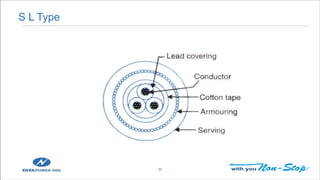
S.L.Type ( Separate Lead)
19
• Each core insulation is covered by its own lead sheath.
• It has two main advantages, firstly the separate sheath minimize the
possibility of core-to-core breakdown. Secondly the, bending of cables
become easy due to the elimination of over all sheath.
• The disadvantage is that the lead sheaths of S.L is much thinner as
compared to H-Type cables, therefore for greater care is required in
manufacturing.
S L Type
20
3-Core Cables
21
Pressurized Type Cables
 In these cables, pressure is maintained above atmosphere either by oil or
by gas.
 Gas pressure cables are used up to 275KV.
 Oil filled cables are used up to 500KV.
3-Core Cables
22
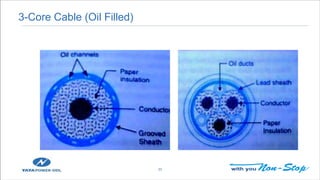
Oil Filled Cables
 Low viscosity oil is kept under pressure and fills the voids in oil
impregnated paper under all conditions of varying load.
 There are three main types of oil filled cables
a. Self-contained circular type
b. Self-contained flat type
c. Pipe Type cables
3-Core Cable (Oil Filled)
23
Laying of Underground Cables
24
Laying Of UG
Cables
Direct Laying
Draw In
System
Solid System
Laying of Underground Cables
25
 The reliability of underground cable network depends to a considerable extent
upon proper laying.
 There are three main methods of Laying underground cables
a. Direct Laying
b. Draw in system
c. Solid system
Direct Laying
26
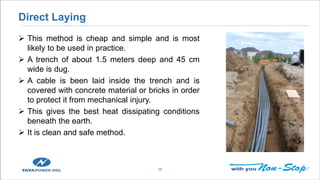
 This method is cheap and simple and is most
likely to be used in practice.
 A trench of about 1.5 meters deep and 45 cm
wide is dug.
 A cable is been laid inside the trench and is
covered with concrete material or bricks in order
to protect it from mechanical injury.
 This gives the best heat dissipating conditions
beneath the earth.
 It is clean and safe method.
Disadvantages of Direct Laying
27
 Localization of fault is difficult
 It can be costlier in congested areas where
 excavation is expensive and inconvenient.
 The maintenance cost is high
Draw in System
28
In this conduit or duct of concrete is laid in ground with
main holes at suitable positions along the cable route.
The cables are then pulled into positions from main holes.
Advantages of Draw in System
29
 It is very high initial cost
 Heat dissipation conditions are not good
 This method is suitable for congested areas where excavation is expensive
and inconvenient
 This is generally used for short lengths cable route such as in workshops, road
crossings where frequent digging is costlier and impossible
Solid System
30
 In this system the cable is laid in open pipes or troughs dug out in earth along
the cable route.
 The troughing is of cast iron or treated wood
 Troughing is filled with a bituminous after cables is laid.
 It provides good mechanical strength
 It has poor heat dissipation conditions
 It requires skilled labour and favorable weather conditions
 It is very much expensive system
Solid System
31
Grading of Cables
32
 Since the stresses are maximum at surface of the conductor or inner most part
of the dielectric.
 The stress goes on decreasing as outer most layer is reached.
 Since the process of achieving the uniform electrostatic stresses on the
dielectric of cables is known as Grading of cables.
 The unequal distribution of stresses is undesirable because,
 if dielectric is chosen according to maximum stress the thickness of cable
increases or either this may lead to breakdown of insulation.
 The following are the two main methods of grading
 Capacitance grading
 Inter sheath grading
EARTH FAULTS
33
 When the conductor of a cable comes in contact with earth, it is called earth
fault or ground fault.
 To identify this fault, one terminal of the megger is connected to the conductor
and the other terminal connected to earth.
 If the megger indicates zero reading, it means the conductor is earthed. The
same procedure is repeated for other conductors of the cable.
Summary of Costs: Overhead vs. Underground
34
 Transmission: Underground may be 4-20 times Overhead.
 Sub transmission: Underground may be 4-20 times Overhead
 Distribution: Underground may be 2-10 times Overhead
 New underground may be cheaper than overhead in special
conditions and costs vary greatly from utility to utility and place to
place.
Thank You

Underground cable

  • 1.
  • 2.
    CONTENTS: 2  Introduction  Advantages& Disadvantages  Construction of Cables  Insulating Materials for Cables  Classification of Cables  Laying of Cables  Grading of Cables  Earth Faults  Summary of Costs.
  • 3.
    Introduction: 3  Since theloads having the trends towards growing density. This requires the better appearance, rugged construction, greater service reliability and increased safety. An underground cable essentially consists of one or more conductors covered with suitable insulation and surrounded by a protecting cover. The interference from external disturbances like storms, lightening, ice, trees etc. should be reduced to achieve trouble free service. The cables may be buried directly in the ground, or may be installed in ducts buried in the ground.
  • 4.
    Advantages & Disadvantages 4 Advantages Better general appearance  Less liable to damage through storms or lighting  Low maintenance cost  Less chances of faults  Small voltage drops Disadvantages  The major drawback is that they have greater installation cost and introduce insulation problems at high voltages compared with equivalent overhead system.
  • 5.
  • 6.
    Construction of Cables 6 Core or Conductor A cable may have one or more than one core depending upon the type of service for which it is intended. The conductor could be of aluminum or copper and is stranded in order to provide flexibility to the cable.  Insulation The core is provided with suitable thickness of insulation, depending upon the voltage to be withstood by the cable. The commonly used material for insulation are impregnated paper, varnished cambric or rubber mineral compound.
  • 7.
    Construction of Cables 7 Metallic Sheath A metallic sheath of lead or aluminum is provided over the insulation to protect the cable from moisture, gases or others damaging liquids  Bedding Bedding is provided to protect the metallic sheath from corrosion and from mechanical damage due to armoring. It is a fibrous material like jute or hessian tape.
  • 8.
    Construction of Cables 8 Armouring Its purpose is to protect the cable from mechanical injury while laying it or during the course of handling. It consists of one or two layers of galvanized steel wire or steel tape.  Serving To protect armouring from atmospheric conditions, a layer of fibrous material is provided.
  • 9.
  • 10.
    Properties of InsulatingMaterial 10  High resistivity.  High dielectric strength.  Low water absorption.  Non – inflammable.  Chemical stability.  High mechanical strength.  Capability to with stand high rupturing voltage.  High tensile strength.
  • 11.
    Insulating Materials forCables 11 • Vulcanized Rubber  It can be obtained from mixing pure rubber with mineral compounds i-e zinc oxide, red lead and sulphur and heated upto 150 C.  It has greater mechanical strength, durability and wear resistant property.  The sulphur reacts quickly with copper so tinned copper conductors are used.  It is suitable for low and moderate voltage cables.
  • 12.
    CLSSIFICATION OF CABLES 12 Low tension (L.T) ----- up to 1000V  High tension (H.T) ----- up to 11, 000V  Super tension (S.T) ---- from 22KV to 33KV  Extra high tension (E.H.T) cables --- from 33KV to 66KV  Extra super voltage cables ------beyond 132KV
  • 13.
    Types 3-Core Cable 13 3-CoreCable Belted Cable Screened cable Pressurized Type Cables Oil Filled Cables H Type Cable S.L. Type Cable
  • 14.
    3- Core Cables 14 BeltedCables In these cables the conductors are wrapped with oil impregnated paper, and then cores are assembled with filler material. The assembly is enclosed by paper insulating belt. These can be used for voltages up to 11KV or in some cases can be used up to 22KV. High voltages beyond 22KV, the tangential stresses becomes an important consideration. As the insulation resistance of paper is quite small along the layer, therefore tangential stress set up, hence, leakage current along the layer of the paper insulation. This leakage current causes local heating, resulting breaking of insulation at any moment
  • 15.
  • 16.
    Screened Cables 16  Thesecan be used up to 33kv but in certain cases can be extended up to 66kv.  These are mainly of two types  H-type and  S.L type cables
  • 17.
    H-Type Cable 17 H-TYPE Cables: Designed by H. Hochstadter.  Each core is insulated by layer of impregnated paper.  The insulation on each core is covered with a metallic screen which is usually of perforated aluminum foil.  The cores are laid in such a way that metallic screen make contact with one another.  Basic advantage of H-TYPE is that the perforation in the metallic screen assists in the complete impregnation of the cable with the compound and thus the possibility of air pockets or voids in the dielectric is eliminated.  The metallic screen increase the heat dissipation power of the cable.
  • 18.
  • 19.
    S.L.Type ( SeparateLead) 19 • Each core insulation is covered by its own lead sheath. • It has two main advantages, firstly the separate sheath minimize the possibility of core-to-core breakdown. Secondly the, bending of cables become easy due to the elimination of over all sheath. • The disadvantage is that the lead sheaths of S.L is much thinner as compared to H-Type cables, therefore for greater care is required in manufacturing.
  • 20.
  • 21.
    3-Core Cables 21 Pressurized TypeCables  In these cables, pressure is maintained above atmosphere either by oil or by gas.  Gas pressure cables are used up to 275KV.  Oil filled cables are used up to 500KV.
  • 22.
    3-Core Cables 22 Oil FilledCables  Low viscosity oil is kept under pressure and fills the voids in oil impregnated paper under all conditions of varying load.  There are three main types of oil filled cables a. Self-contained circular type b. Self-contained flat type c. Pipe Type cables
  • 23.
  • 24.
    Laying of UndergroundCables 24 Laying Of UG Cables Direct Laying Draw In System Solid System
  • 25.
    Laying of UndergroundCables 25  The reliability of underground cable network depends to a considerable extent upon proper laying.  There are three main methods of Laying underground cables a. Direct Laying b. Draw in system c. Solid system
  • 26.
    Direct Laying 26  Thismethod is cheap and simple and is most likely to be used in practice.  A trench of about 1.5 meters deep and 45 cm wide is dug.  A cable is been laid inside the trench and is covered with concrete material or bricks in order to protect it from mechanical injury.  This gives the best heat dissipating conditions beneath the earth.  It is clean and safe method.
  • 27.
    Disadvantages of DirectLaying 27  Localization of fault is difficult  It can be costlier in congested areas where  excavation is expensive and inconvenient.  The maintenance cost is high
  • 28.
    Draw in System 28 Inthis conduit or duct of concrete is laid in ground with main holes at suitable positions along the cable route. The cables are then pulled into positions from main holes.
  • 29.
    Advantages of Drawin System 29  It is very high initial cost  Heat dissipation conditions are not good  This method is suitable for congested areas where excavation is expensive and inconvenient  This is generally used for short lengths cable route such as in workshops, road crossings where frequent digging is costlier and impossible
  • 30.
    Solid System 30  Inthis system the cable is laid in open pipes or troughs dug out in earth along the cable route.  The troughing is of cast iron or treated wood  Troughing is filled with a bituminous after cables is laid.  It provides good mechanical strength  It has poor heat dissipation conditions  It requires skilled labour and favorable weather conditions  It is very much expensive system
  • 31.
  • 32.
    Grading of Cables 32 Since the stresses are maximum at surface of the conductor or inner most part of the dielectric.  The stress goes on decreasing as outer most layer is reached.  Since the process of achieving the uniform electrostatic stresses on the dielectric of cables is known as Grading of cables.  The unequal distribution of stresses is undesirable because,  if dielectric is chosen according to maximum stress the thickness of cable increases or either this may lead to breakdown of insulation.  The following are the two main methods of grading  Capacitance grading  Inter sheath grading
  • 33.
    EARTH FAULTS 33  Whenthe conductor of a cable comes in contact with earth, it is called earth fault or ground fault.  To identify this fault, one terminal of the megger is connected to the conductor and the other terminal connected to earth.  If the megger indicates zero reading, it means the conductor is earthed. The same procedure is repeated for other conductors of the cable.
  • 34.
    Summary of Costs:Overhead vs. Underground 34  Transmission: Underground may be 4-20 times Overhead.  Sub transmission: Underground may be 4-20 times Overhead  Distribution: Underground may be 2-10 times Overhead  New underground may be cheaper than overhead in special conditions and costs vary greatly from utility to utility and place to place.
  • 35.