Requirements for Electrical Installations IEE Wiring Regulations  17 th  Edition Part 2
IEE Wiring Regulations 17 th  Edition Part 2 Definitions   For the purposes of the Regulations, the definitions in part 2 shall apply. Some of these definitions are also aligned to BS 4727 “Glossary of Electrotechnical, Power, Telecommunications, Lighting, and Colour terms”
Part 2 Definitions Within this section are all the definitions used throughout the “Regs Book”. There are also diagrams illustrating the types of earthing arrangements, TT, TN-S, TN-C-S etc. On page 35 there is a concise list of the symbols used in the electrical formulae.
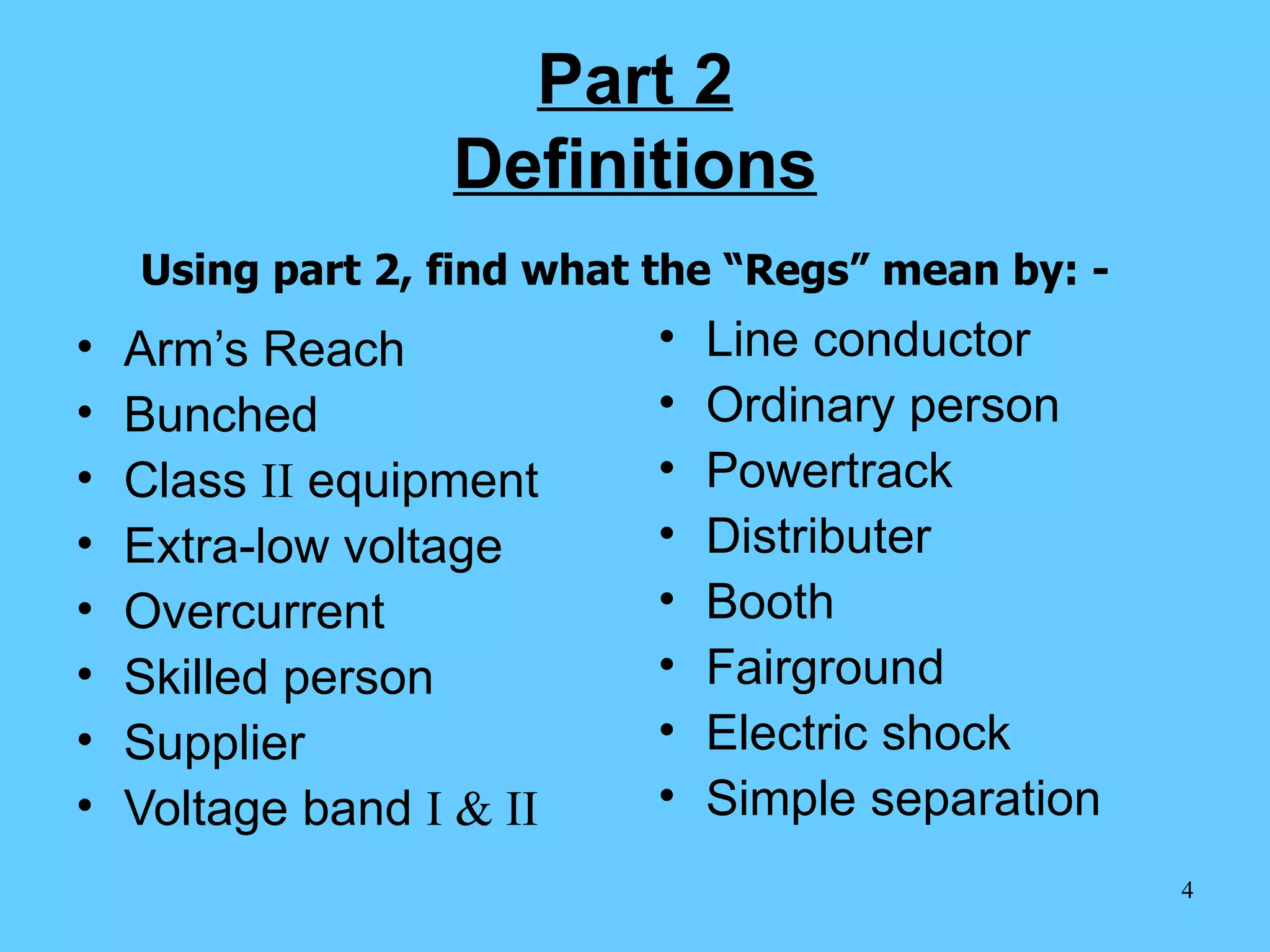
Part 2 Definitions Arm’s Reach Bunched Class  II  equipment Extra-low voltage Overcurrent  Skilled person Supplier  Voltage band  I & II Line conductor Ordinary person Powertrack  Distributer Booth Fairground Electric shock Simple separation Using part 2, find what the “Regs” mean by: -
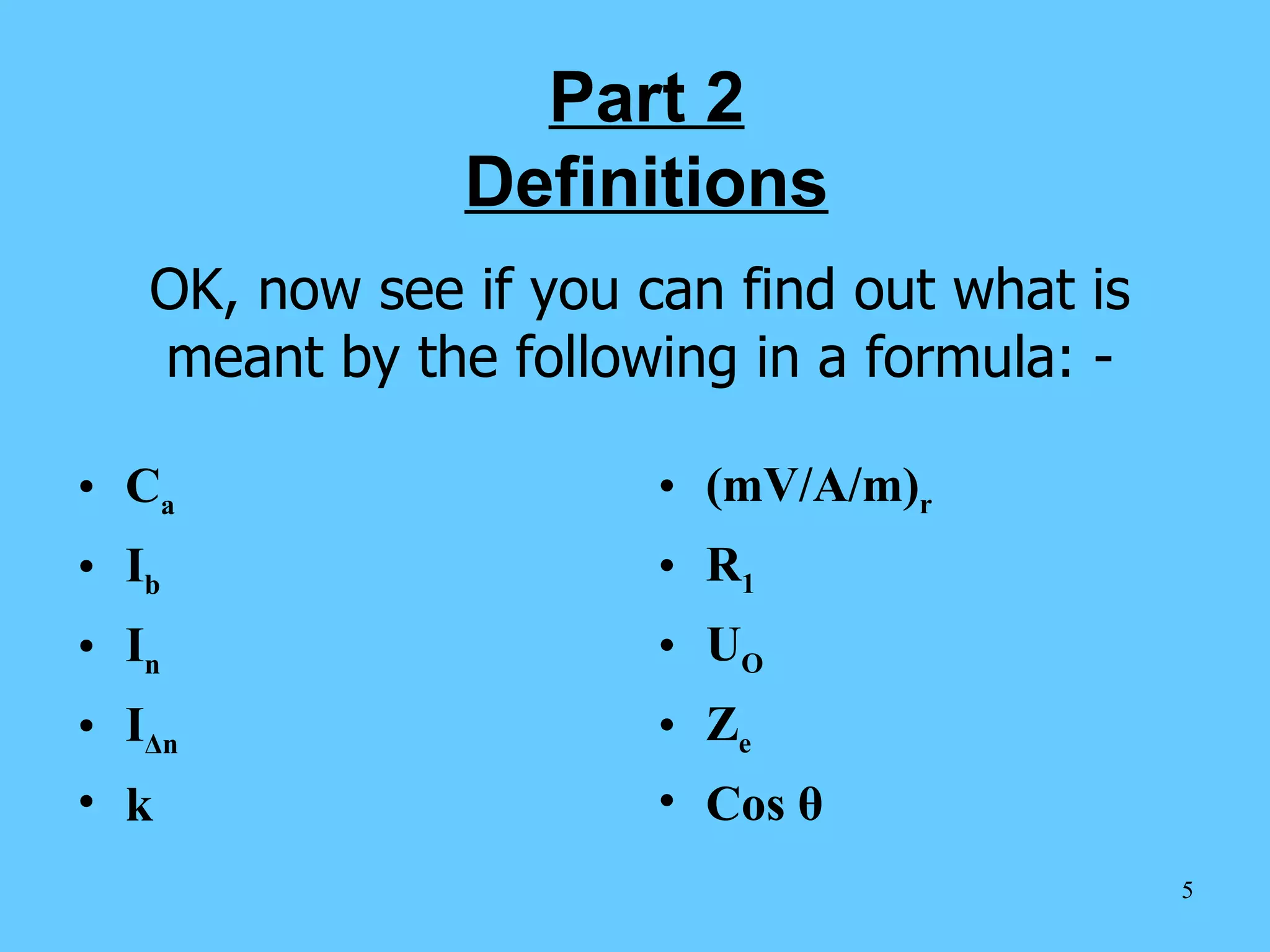
Part 2 Definitions C a I b I n I Δ n k (mV/A/m) r R 1 U O Z e Cos  θ OK, now see if you can find out what is meant by the following in a formula: -
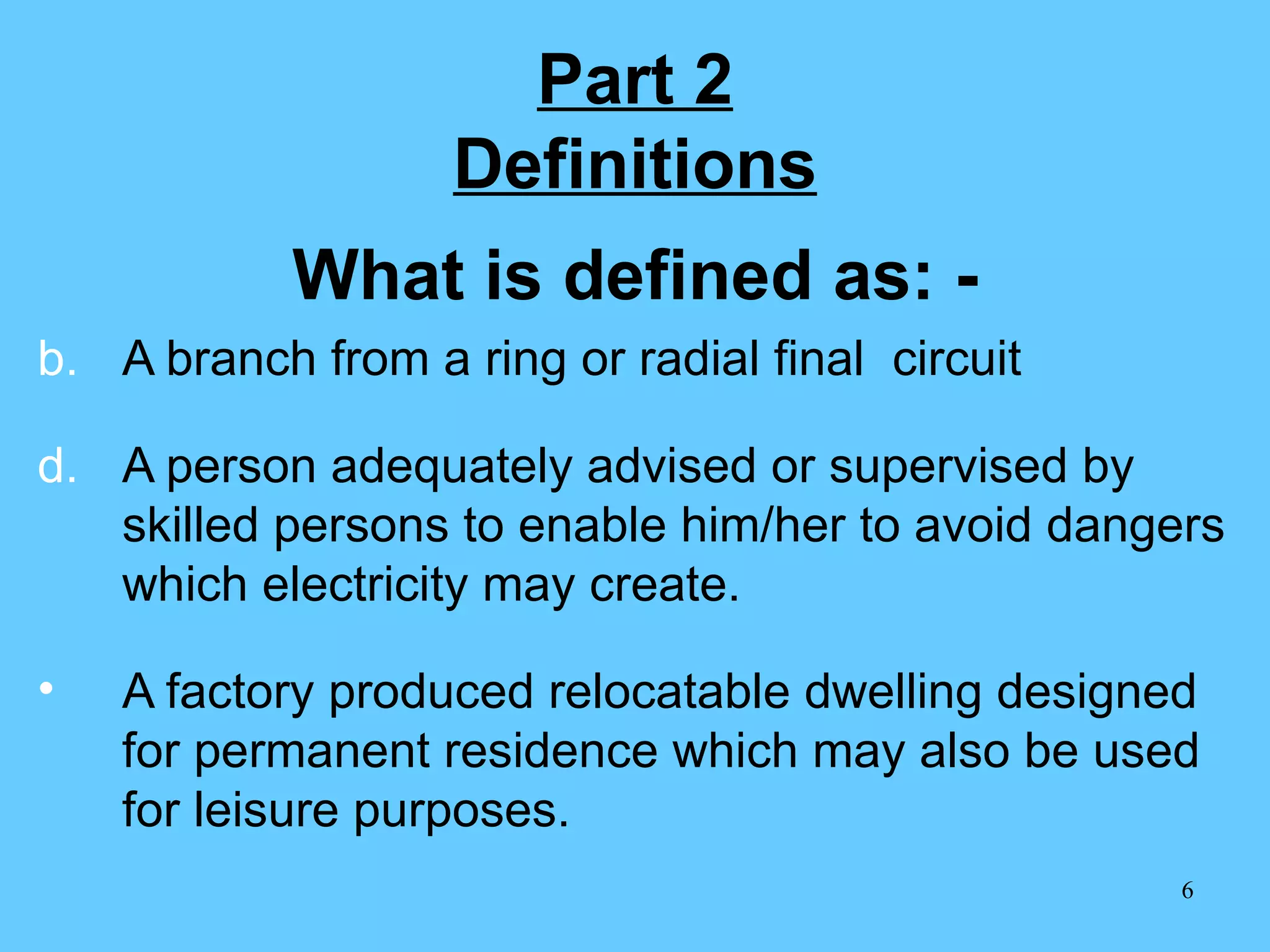
Part 2 Definitions What is defined as: - A branch from a ring or radial final  circuit A person adequately advised or supervised by skilled persons to enable him/her to avoid dangers which electricity may create. A factory produced relocatable dwelling designed for permanent residence which may also be used for leisure purposes.
Part 2 Definitions Well, that was short and sharp and sweet. Does this give you an idea of what we can find in Part 2? Any questions?  [email_address]
Part 2 Definitions The End Part 3 to follow - - -
Requirements for Electrical Installations IEE Wiring Regulations  17 th  Edition Part 3 [email_address]
Part 3 Assessment of General Characteristics   This is another short part. It consists of just 6 chapters.
Part 3 Assessment of General Characteristics This section is all about: - Identification of the characteristics of the installation that will need to be taken into account in choosing and applying the requirements of the subsequent parts
Part 3 Assessment of General Characteristics You must be aware that: - These characteristics may vary from one part of an installation to another and should be assessed for each for each location to be served by the installation
Chapter 31 Purposes, Supplies and   Structure 311 Maximum demand and Diversity. 313 supplies 313.1 General – nominal voltage, frequency, pscc, suitability & rating of protective device at origin. 313.2 supplies for safety services and standby systems
Chapter 31 Purposes, Supplies and Structure 314 Division of Installation (see also 132.3) 314.1 dividing the installation into circuits so as    to: -  Avoid danger and minimise inconvenience in the event of a fault Facilitate safe testing, inspecting and maintenance 314.2 314.3 314.4 Have a look at these for yourself
Chapter 32 Classification of External Influences Refer to Chapter 51 and Appendix 5 for details of  EXTERNAL INFLUENCES
Chapter 33 Compatibility 331 Compatibility of Characteristics 331.1 An assessment shall be made of any characteristics that could have harmful effects on electrical equipment or other services or likely to impair the supply e.g. petrol stations, kiosks and shops within shops There are 11 points we need to consider! – from transient over voltages to power factor
Chapter 33 Compatibility 332 Electromagnetic compatibility 332.1 332.2 See also Chapter 44 – Protection against Voltage Disturbances and Electromagnetic Disturbances. All about ECM standards and EMI standards (interference)
Chapter 34 Maintainability This chapter tells us in brief about: -  Periodic inspections, maintenance and repairs. Effectiveness of the protective measures. Reliability of equipment for the proper functioning of the installation.
Chapter 35 Safety Services Safety services are often regulated by statutory authorities whose requirements have to be met. e.g. Emergency escape lighting Fire alarms Smoke and heat extraction equipment
Chapter 35 Safety Services It also covers the recognised sources for safety services Storage batteries. Primary cells. Generator sets independent of the normal supply. A separate feeder of the supply network effectively independent of the normal feeder.
Chapter 36 Continuity of Service In general terms, this chapter explains that to provide continuity of supply for example life-support systems, we should consider the selection of: - The earthing system The protective device in order to achieve discrimination Number of circuits Multiple power supplies Use of monitoring devices
Part 3 Assessment of General Characteristics  That’s  about it for part 3 The End Part 4 to follow - - - [email_address]

17th Edition Part 2 3

  • 1.
    Requirements for ElectricalInstallations IEE Wiring Regulations 17 th Edition Part 2
  • 2.
    IEE Wiring Regulations17 th Edition Part 2 Definitions For the purposes of the Regulations, the definitions in part 2 shall apply. Some of these definitions are also aligned to BS 4727 “Glossary of Electrotechnical, Power, Telecommunications, Lighting, and Colour terms”
  • 3.
    Part 2 DefinitionsWithin this section are all the definitions used throughout the “Regs Book”. There are also diagrams illustrating the types of earthing arrangements, TT, TN-S, TN-C-S etc. On page 35 there is a concise list of the symbols used in the electrical formulae.
  • 4.
    Part 2 DefinitionsArm’s Reach Bunched Class II equipment Extra-low voltage Overcurrent Skilled person Supplier Voltage band I & II Line conductor Ordinary person Powertrack Distributer Booth Fairground Electric shock Simple separation Using part 2, find what the “Regs” mean by: -
  • 5.
    Part 2 DefinitionsC a I b I n I Δ n k (mV/A/m) r R 1 U O Z e Cos θ OK, now see if you can find out what is meant by the following in a formula: -
  • 6.
    Part 2 DefinitionsWhat is defined as: - A branch from a ring or radial final circuit A person adequately advised or supervised by skilled persons to enable him/her to avoid dangers which electricity may create. A factory produced relocatable dwelling designed for permanent residence which may also be used for leisure purposes.
  • 7.
    Part 2 DefinitionsWell, that was short and sharp and sweet. Does this give you an idea of what we can find in Part 2? Any questions? [email_address]
  • 8.
    Part 2 DefinitionsThe End Part 3 to follow - - -
  • 9.
    Requirements for ElectricalInstallations IEE Wiring Regulations 17 th Edition Part 3 [email_address]
  • 10.
    Part 3 Assessmentof General Characteristics This is another short part. It consists of just 6 chapters.
  • 11.
    Part 3 Assessmentof General Characteristics This section is all about: - Identification of the characteristics of the installation that will need to be taken into account in choosing and applying the requirements of the subsequent parts
  • 12.
    Part 3 Assessmentof General Characteristics You must be aware that: - These characteristics may vary from one part of an installation to another and should be assessed for each for each location to be served by the installation
  • 13.
    Chapter 31 Purposes,Supplies and Structure 311 Maximum demand and Diversity. 313 supplies 313.1 General – nominal voltage, frequency, pscc, suitability & rating of protective device at origin. 313.2 supplies for safety services and standby systems
  • 14.
    Chapter 31 Purposes,Supplies and Structure 314 Division of Installation (see also 132.3) 314.1 dividing the installation into circuits so as to: - Avoid danger and minimise inconvenience in the event of a fault Facilitate safe testing, inspecting and maintenance 314.2 314.3 314.4 Have a look at these for yourself
  • 15.
    Chapter 32 Classificationof External Influences Refer to Chapter 51 and Appendix 5 for details of EXTERNAL INFLUENCES
  • 16.
    Chapter 33 Compatibility331 Compatibility of Characteristics 331.1 An assessment shall be made of any characteristics that could have harmful effects on electrical equipment or other services or likely to impair the supply e.g. petrol stations, kiosks and shops within shops There are 11 points we need to consider! – from transient over voltages to power factor
  • 17.
    Chapter 33 Compatibility332 Electromagnetic compatibility 332.1 332.2 See also Chapter 44 – Protection against Voltage Disturbances and Electromagnetic Disturbances. All about ECM standards and EMI standards (interference)
  • 18.
    Chapter 34 MaintainabilityThis chapter tells us in brief about: - Periodic inspections, maintenance and repairs. Effectiveness of the protective measures. Reliability of equipment for the proper functioning of the installation.
  • 19.
    Chapter 35 SafetyServices Safety services are often regulated by statutory authorities whose requirements have to be met. e.g. Emergency escape lighting Fire alarms Smoke and heat extraction equipment
  • 20.
    Chapter 35 SafetyServices It also covers the recognised sources for safety services Storage batteries. Primary cells. Generator sets independent of the normal supply. A separate feeder of the supply network effectively independent of the normal feeder.
  • 21.
    Chapter 36 Continuityof Service In general terms, this chapter explains that to provide continuity of supply for example life-support systems, we should consider the selection of: - The earthing system The protective device in order to achieve discrimination Number of circuits Multiple power supplies Use of monitoring devices
  • 22.
    Part 3 Assessmentof General Characteristics That’s about it for part 3 The End Part 4 to follow - - - [email_address]