Requirements for Electrical Installations IEE Wiring Regulations  17 th  Edition Part 4
IEE Wiring Regulations  17 th  Edition - Part 4 One  of the larger parts in the 17 th  Edition. It consists of only 4 chapters,  But there is a lot of information in them! 41 – Protection against Electric Shock. 42 – Protection against Thermal Effects. 43 – Protection against Overcurrent. 44 – Protection against voltage disturbances    and Electromagnetic Disturbances.
Requirements for Electrical Installations IEE Wiring Regulations  17 th  Edition Part 4 Chapter 41
Chapter 41 PROTECTION AGAINST ELECTRIC SHOCK This chapter is divided into 9 sections: -  410 - Introduction. 411 - Protective measure: automatic disconnection of supply. 412 - Protective measure: double or reinforced insulation. 413 - Protective measure: electrical separation. 414 - Protective measure: extra low voltage provided by SELV or PELV.
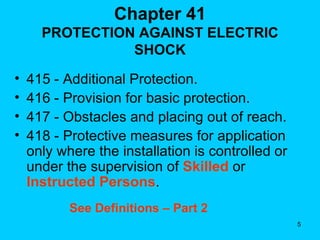
Chapter 41 PROTECTION AGAINST ELECTRIC SHOCK 415 - Additional Protection. 416 - Provision for basic protection. 417 - Obstacles and placing out of reach. 418 - Protective measures for application only where the installation is controlled or under the supervision of  Skilled  or  Instructed Persons . See Definitions – Part 2
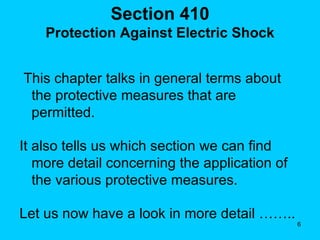
Section 410 Protection Against Electric Shock This chapter talks in general terms about the protective measures that are permitted. It also tells us which section we can find more detail concerning the application of the various protective measures. Let us now have a look in more detail ……..
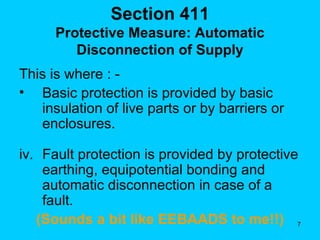
Section 411 Protective Measure: Automatic Disconnection of Supply This is where : -  Basic protection is provided by basic insulation of live parts or by barriers or enclosures. Fault protection is provided by protective earthing, equipotential bonding and automatic disconnection in case of a fault. (Sounds a bit like EEBAADS to me!!)
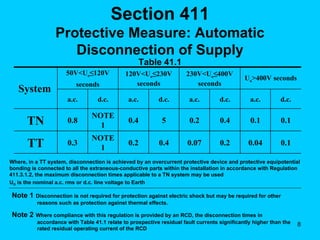
Section 411 Protective Measure: Automatic Disconnection of Supply Table 41.1 Where, in a TT system, disconnection is achieved by an overcurrent protective device and protective equipotential bonding is connected to all the extraneous-conductive parts within the installation in accordance with Regulation 411.3.1.2, the maximum disconnection times applicable to a TN system may be used U O  is the nominal a.c. rms or d.c. line voltage to Earth Note 1   Disconnection   is not required for protection against electric shock but may be required for other reasons such as protection against thermal effects. Note 2   Where compliance with this regulation is provided by an RCD, the disconnection times in accordance with Table 41.1 relate to prospective residual fault currents significantly higher than the rated residual operating current of the RCD 0.1 0.04 0.2 0.07 0.4 0.2 NOTE 1 0.3 TT 0.1 0.1 0.4 0.2 5 0.4 NOTE 1 0.8 TN d.c. a.c. d.c. a.c. d.c. a.c. d.c. a.c. U o >400V  seconds 230V<U o ≤400V seconds 120V<U o ≤230V seconds 50V<U o ≤120V seconds System
Section 411 Protective Measure: Automatic Disconnection of Supply In section  411.7  in covers  Functional Extra Low Voltage (FELV). 411.7.2  Requirements for basic protection. 411.7.3  Requirements for fault protection. 411.7.4  Sources (for FELV). 411.7.5  Plugs, socket outlets, LSCs, DCLs    and cable couplers.
Section 411 Protective Measure: Automatic Disconnection of Supply Reduced low voltage systems. 411.8  deals with the issues for  Basic Protection  and  Fault Protection  for when  SELV & PELV  cannot be used. 411.8.1.2  is concerned with  110V  (63.5V ~ 3 phase) and  55V  to earthed mid-point
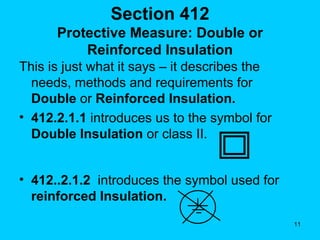
Section 412 Protective Measure: Double or Reinforced Insulation This is just what it says – it describes the needs, methods and requirements for  Double  or  Reinforced Insulation. 412.2.1.1  introduces us to the symbol for  Double Insulation  or class II. 412..2.1.2  introduces the symbol used for  reinforced Insulation.
Section 413 Protective Measure: Electrical Separation   Basic protection provided by: basic insulation of live parts or by barriers or enclosures, and Fault protection provided by: simple separation of the separated circuit from other circuits and from Earth.
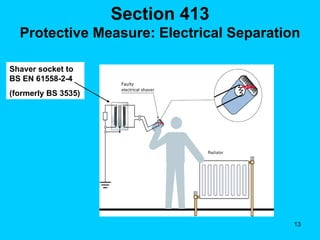
Section 413 Protective Measure: Electrical Separation Shaver socket to BS EN 61558-2-4 (formerly BS 3535)
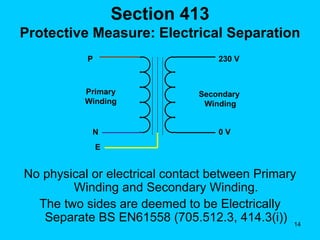
Section 413 Protective Measure: Electrical Separation No physical or electrical contact between Primary Winding and Secondary Winding. The two sides are deemed to be Electrically Separate BS EN61558 (705.512.3, 414.3(i)) P E N 230 V 0 V Primary Winding Secondary  Winding
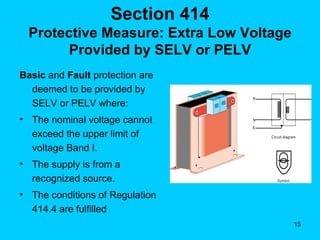
Section 414 Protective Measure: Extra Low Voltage Provided by SELV or PELV Basic  and  Fault  protection are deemed to be provided by SELV or PELV where: The nominal voltage cannot exceed the upper limit of voltage Band I. The supply is from a recognized source.  The conditions of Regulation 414.4 are fulfilled
Section 415 Additional Protection
Section 416 Provisions for Basic Protection
Section 417 Obstacles and Placing Out of Reach
Section 418 Protective Measures for Application only where the Installation is Controlled or Under the Supervision of a Skilled or Instructed Person

17th Edition Part 4

  • 1.
    Requirements for ElectricalInstallations IEE Wiring Regulations 17 th Edition Part 4
  • 2.
    IEE Wiring Regulations 17 th Edition - Part 4 One of the larger parts in the 17 th Edition. It consists of only 4 chapters, But there is a lot of information in them! 41 – Protection against Electric Shock. 42 – Protection against Thermal Effects. 43 – Protection against Overcurrent. 44 – Protection against voltage disturbances and Electromagnetic Disturbances.
  • 3.
    Requirements for ElectricalInstallations IEE Wiring Regulations 17 th Edition Part 4 Chapter 41
  • 4.
    Chapter 41 PROTECTIONAGAINST ELECTRIC SHOCK This chapter is divided into 9 sections: - 410 - Introduction. 411 - Protective measure: automatic disconnection of supply. 412 - Protective measure: double or reinforced insulation. 413 - Protective measure: electrical separation. 414 - Protective measure: extra low voltage provided by SELV or PELV.
  • 5.
    Chapter 41 PROTECTIONAGAINST ELECTRIC SHOCK 415 - Additional Protection. 416 - Provision for basic protection. 417 - Obstacles and placing out of reach. 418 - Protective measures for application only where the installation is controlled or under the supervision of Skilled or Instructed Persons . See Definitions – Part 2
  • 6.
    Section 410 ProtectionAgainst Electric Shock This chapter talks in general terms about the protective measures that are permitted. It also tells us which section we can find more detail concerning the application of the various protective measures. Let us now have a look in more detail ……..
  • 7.
    Section 411 ProtectiveMeasure: Automatic Disconnection of Supply This is where : - Basic protection is provided by basic insulation of live parts or by barriers or enclosures. Fault protection is provided by protective earthing, equipotential bonding and automatic disconnection in case of a fault. (Sounds a bit like EEBAADS to me!!)
  • 8.
    Section 411 ProtectiveMeasure: Automatic Disconnection of Supply Table 41.1 Where, in a TT system, disconnection is achieved by an overcurrent protective device and protective equipotential bonding is connected to all the extraneous-conductive parts within the installation in accordance with Regulation 411.3.1.2, the maximum disconnection times applicable to a TN system may be used U O is the nominal a.c. rms or d.c. line voltage to Earth Note 1 Disconnection is not required for protection against electric shock but may be required for other reasons such as protection against thermal effects. Note 2 Where compliance with this regulation is provided by an RCD, the disconnection times in accordance with Table 41.1 relate to prospective residual fault currents significantly higher than the rated residual operating current of the RCD 0.1 0.04 0.2 0.07 0.4 0.2 NOTE 1 0.3 TT 0.1 0.1 0.4 0.2 5 0.4 NOTE 1 0.8 TN d.c. a.c. d.c. a.c. d.c. a.c. d.c. a.c. U o >400V seconds 230V<U o ≤400V seconds 120V<U o ≤230V seconds 50V<U o ≤120V seconds System
  • 9.
    Section 411 ProtectiveMeasure: Automatic Disconnection of Supply In section 411.7 in covers Functional Extra Low Voltage (FELV). 411.7.2 Requirements for basic protection. 411.7.3 Requirements for fault protection. 411.7.4 Sources (for FELV). 411.7.5 Plugs, socket outlets, LSCs, DCLs and cable couplers.
  • 10.
    Section 411 ProtectiveMeasure: Automatic Disconnection of Supply Reduced low voltage systems. 411.8 deals with the issues for Basic Protection and Fault Protection for when SELV & PELV cannot be used. 411.8.1.2 is concerned with 110V (63.5V ~ 3 phase) and 55V to earthed mid-point
  • 11.
    Section 412 ProtectiveMeasure: Double or Reinforced Insulation This is just what it says – it describes the needs, methods and requirements for Double or Reinforced Insulation. 412.2.1.1 introduces us to the symbol for Double Insulation or class II. 412..2.1.2 introduces the symbol used for reinforced Insulation.
  • 12.
    Section 413 ProtectiveMeasure: Electrical Separation Basic protection provided by: basic insulation of live parts or by barriers or enclosures, and Fault protection provided by: simple separation of the separated circuit from other circuits and from Earth.
  • 13.
    Section 413 ProtectiveMeasure: Electrical Separation Shaver socket to BS EN 61558-2-4 (formerly BS 3535)
  • 14.
    Section 413 ProtectiveMeasure: Electrical Separation No physical or electrical contact between Primary Winding and Secondary Winding. The two sides are deemed to be Electrically Separate BS EN61558 (705.512.3, 414.3(i)) P E N 230 V 0 V Primary Winding Secondary Winding
  • 15.
    Section 414 ProtectiveMeasure: Extra Low Voltage Provided by SELV or PELV Basic and Fault protection are deemed to be provided by SELV or PELV where: The nominal voltage cannot exceed the upper limit of voltage Band I. The supply is from a recognized source. The conditions of Regulation 414.4 are fulfilled
  • 16.
  • 17.
    Section 416 Provisionsfor Basic Protection
  • 18.
    Section 417 Obstaclesand Placing Out of Reach
  • 19.
    Section 418 ProtectiveMeasures for Application only where the Installation is Controlled or Under the Supervision of a Skilled or Instructed Person