Electrical services
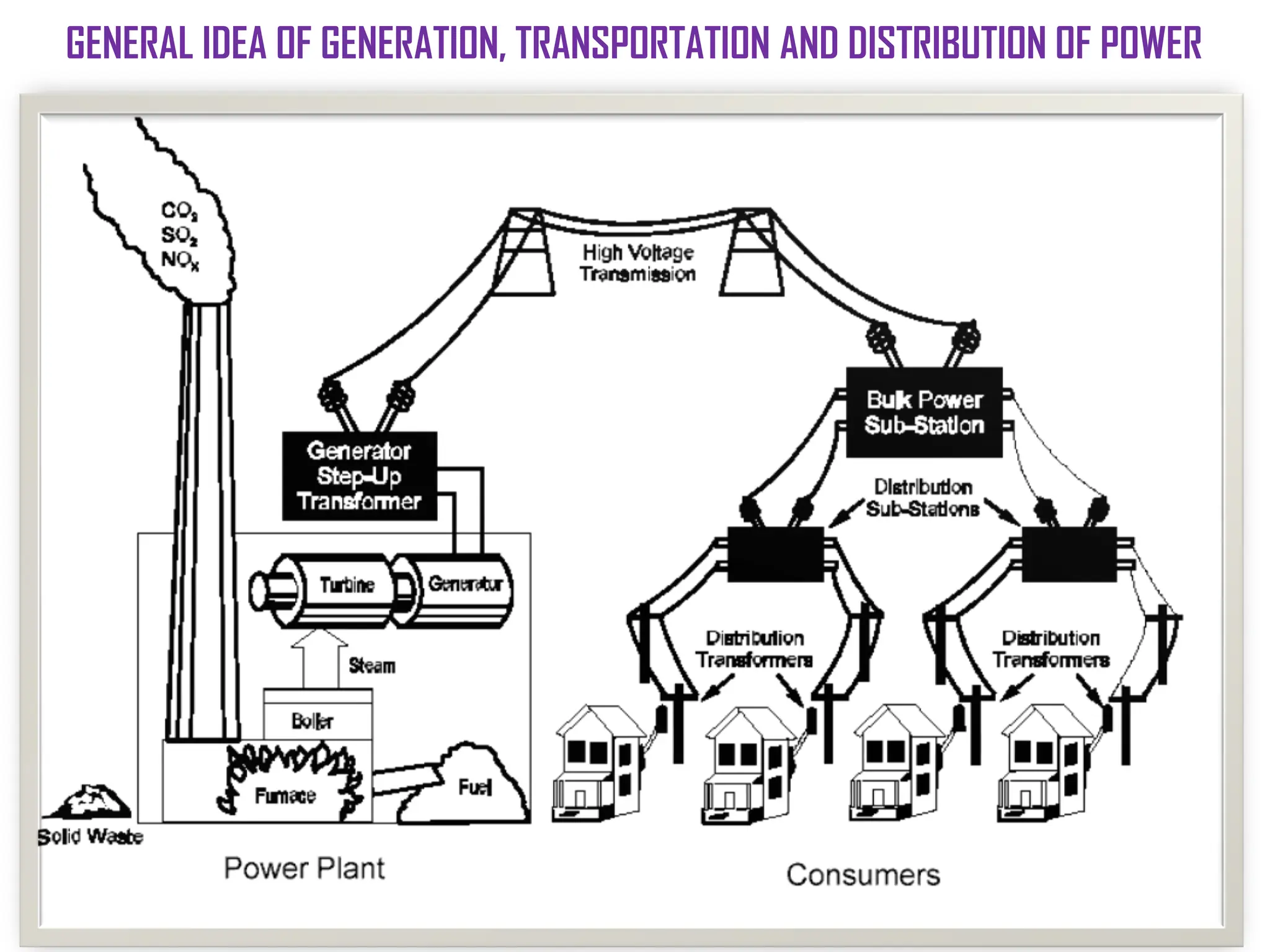
GENERAL IDEA OF GENERATION, TRANSPORTATION AND DISTRIBUTION OF POWER
Modern power grids are extremely complex and
widespread. Surges in power lines can cause massive network
failures and permanent damage to multimillion-dollar equipment
in power generation plants.
After electricity is produced at power plants it has to get
to the customers that use the electricity. As generators spin,
they produce electricity with a voltage of about 25,000 volts [a
volt is a measurement of electromotive force in electricity, the
electric force that pushes electrons around a circuit].
The transmission and distribution system delivers
electricity from the generating site (electric power plant) to
residential, commercial, and industrial facilities.
INTRODUCTION
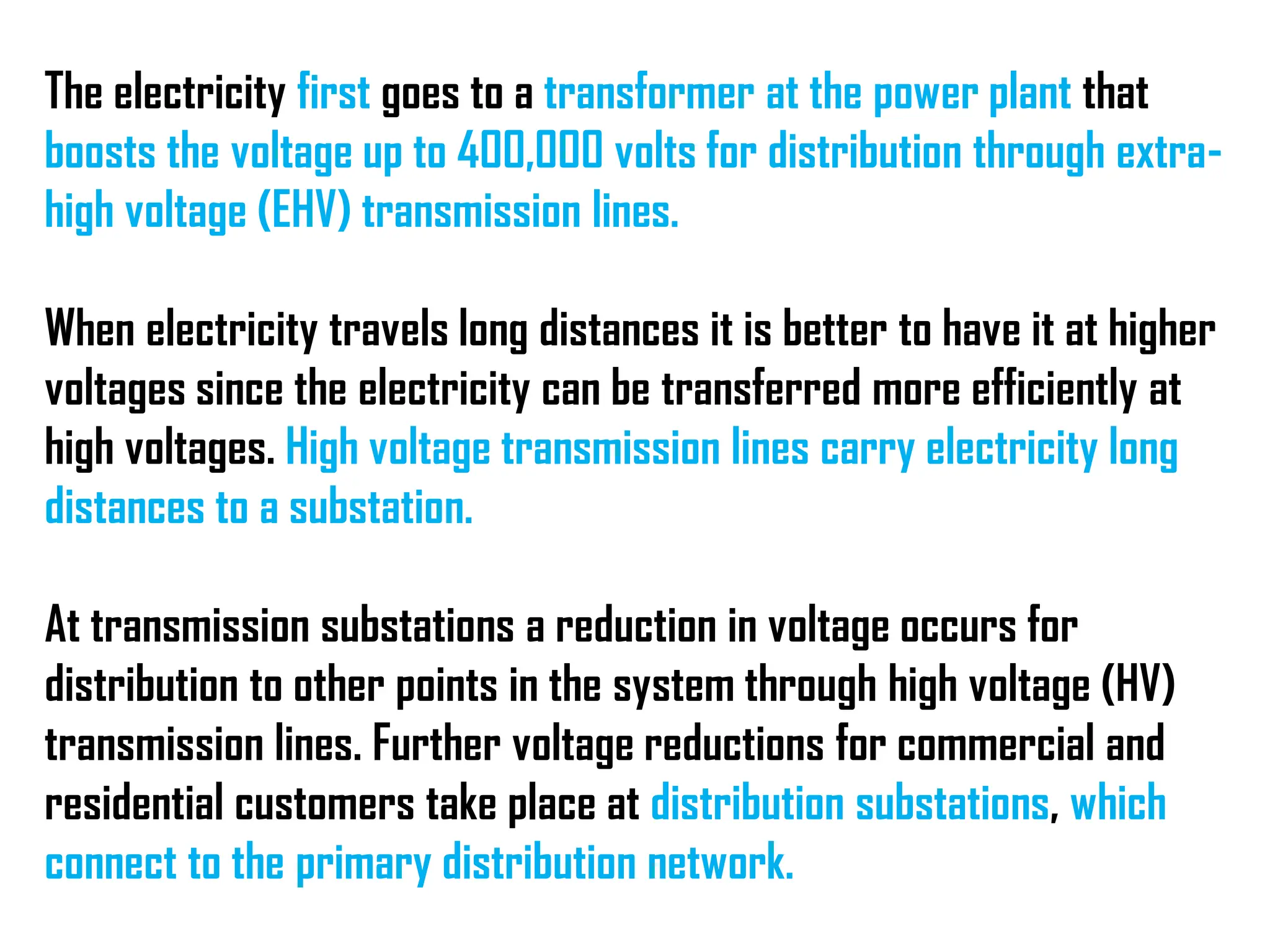
The electricity first goes to a transformer at the power plant that
boosts the voltage up to 400,000 volts for distribution through extra-
high voltage (EHV) transmission lines.
When electricity travels long distances it is better to have it at higher
voltages since the electricity can be transferred more efficiently at
high voltages. High voltage transmission lines carry electricity long
distances to a substation.
At transmission substations a reduction in voltage occurs for
distribution to other points in the system through high voltage (HV)
transmission lines. Further voltage reductions for commercial and
residential customers take place at distribution substations, which
connect to the primary distribution network.
Utility transmission and distribution systems [T&D] systems link
electric generators with end users through a network of power lines
and associated components.
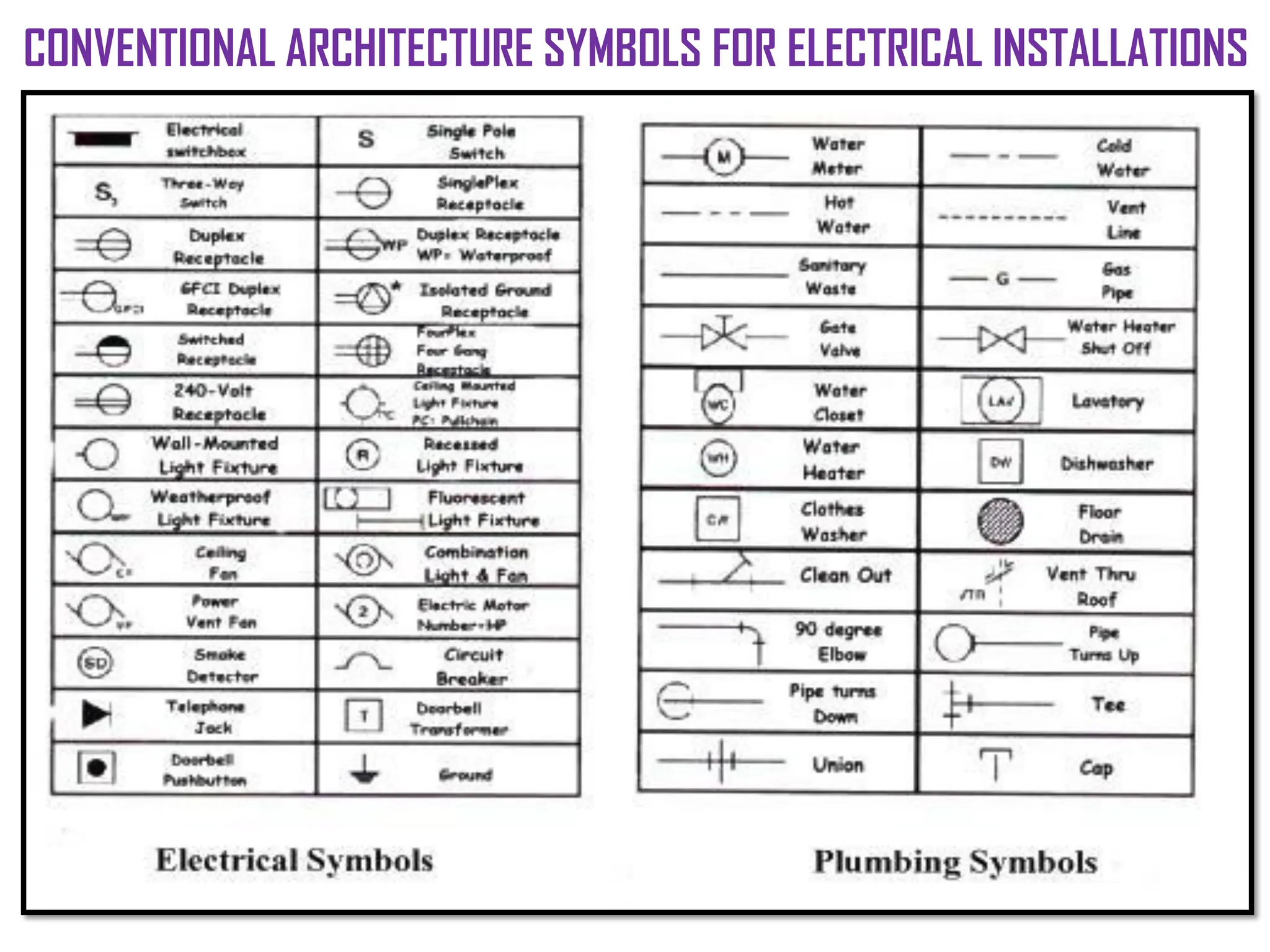
CONVENTIONAL ARCHITECTURE SYMBOLS FOR ELECTRICAL INSTALLATIONS
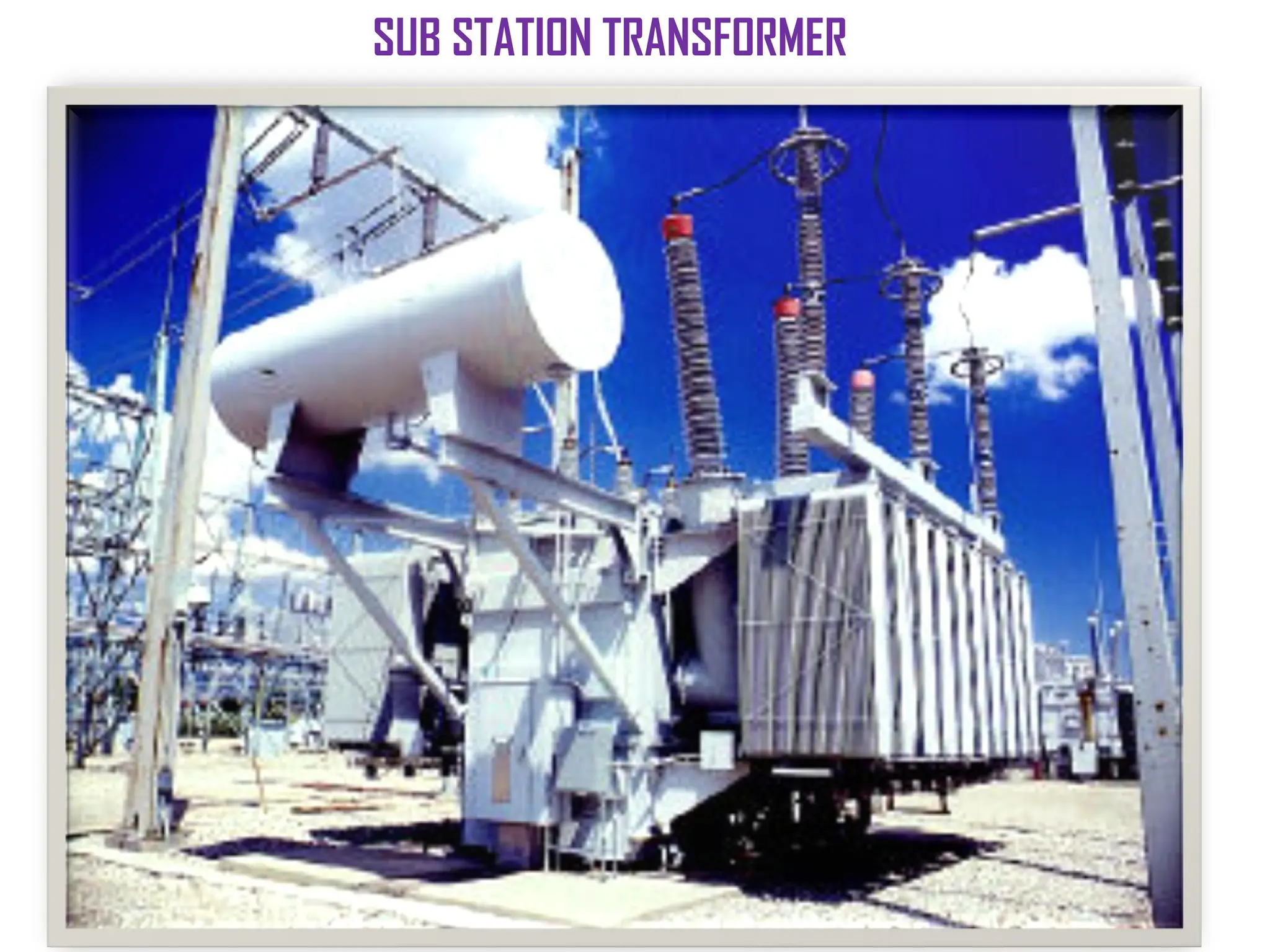
SUB STATION TRANSFORMER
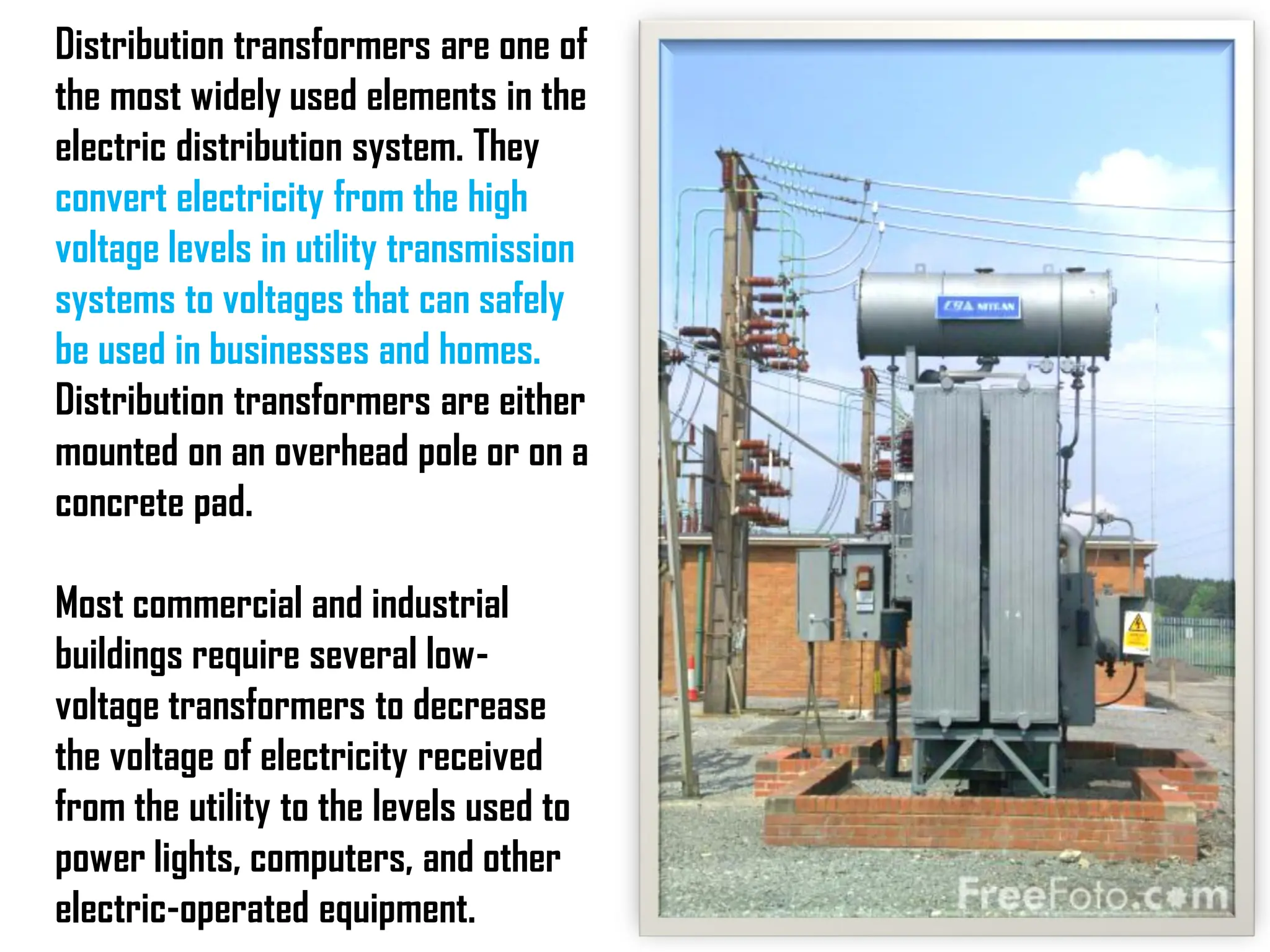
Distribution transformers are one of
the most widely used elements in the
electric distribution system. They
convert electricity from the high
voltage levels in utility transmission
systems to voltages that can safely
be used in businesses and homes.
Distribution transformers are either
mounted on an overhead pole or on a
concrete pad.
Most commercial and industrial
buildings require several low-
voltage transformers to decrease
the voltage of electricity received
from the utility to the levels used to
power lights, computers, and other
electric-operated equipment.
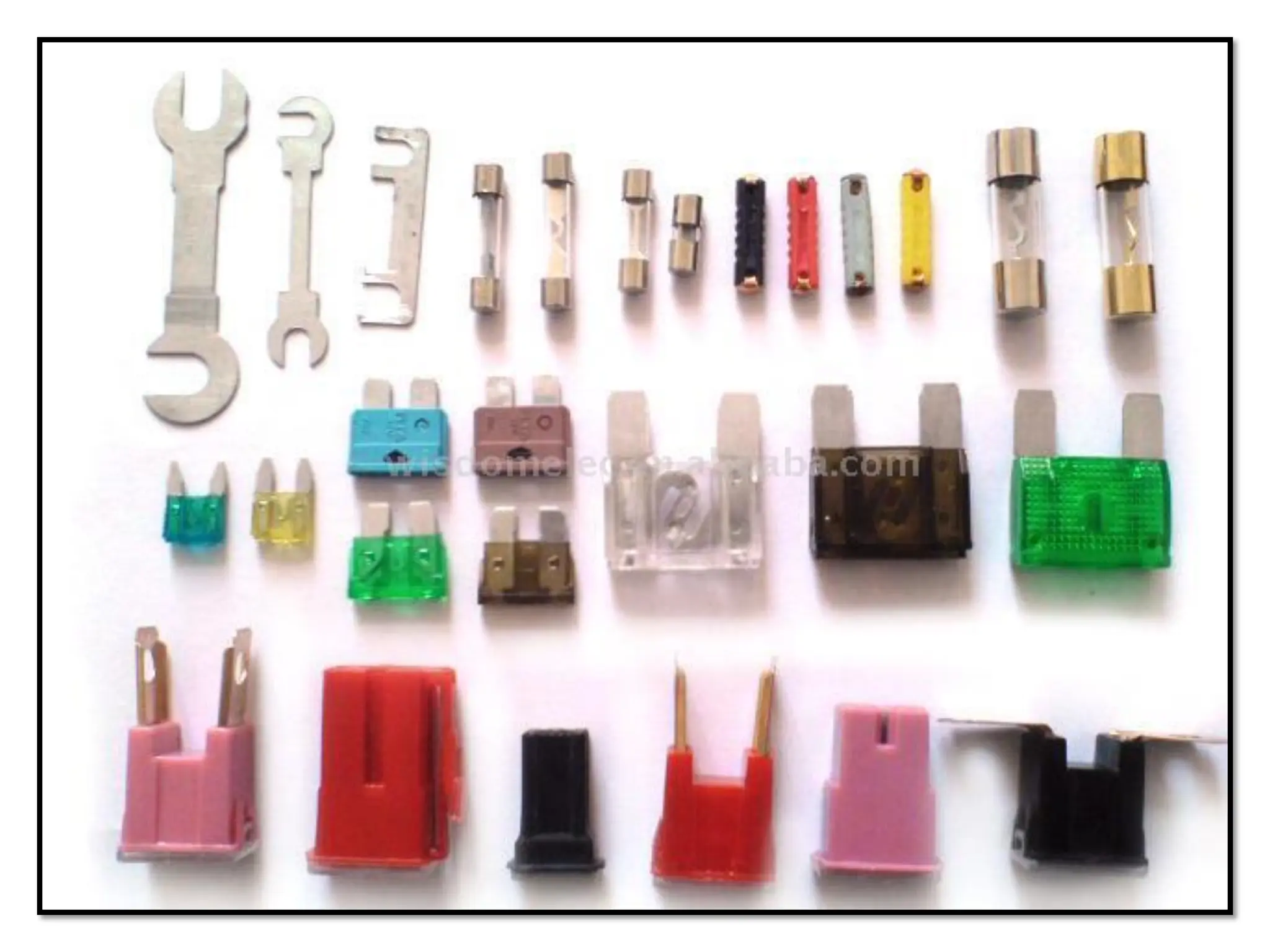
Fuses
A fuse is a very thin wire, which either melts or vaporizes
when too much current flows through it.
The thin wire may be made of aluminum, tin-coated copper
or nickel.
The resulting open in the circuit stops current flow.
In electronic equipment, most fuses are cylindrical glass
or ceramic type with a metal cap at each end! The current rating
also can be seen in one of the two metal end caps.
There are two basic types of fuses: fast acting and slow blow.
The fast acting type will open very quickly when their particular
current rating is exceeded. This is important for analog meter
movements, which can quickly be destroyed when too much
current flows through them, for even a very small amount of time.
Slow blow fuse have a coiled construction inside. They are designed
to open only on a continued overload, such as a short circuit.
he purpose of coiled construction is to prevent the fuse from
blowing on just a temporary current surge.
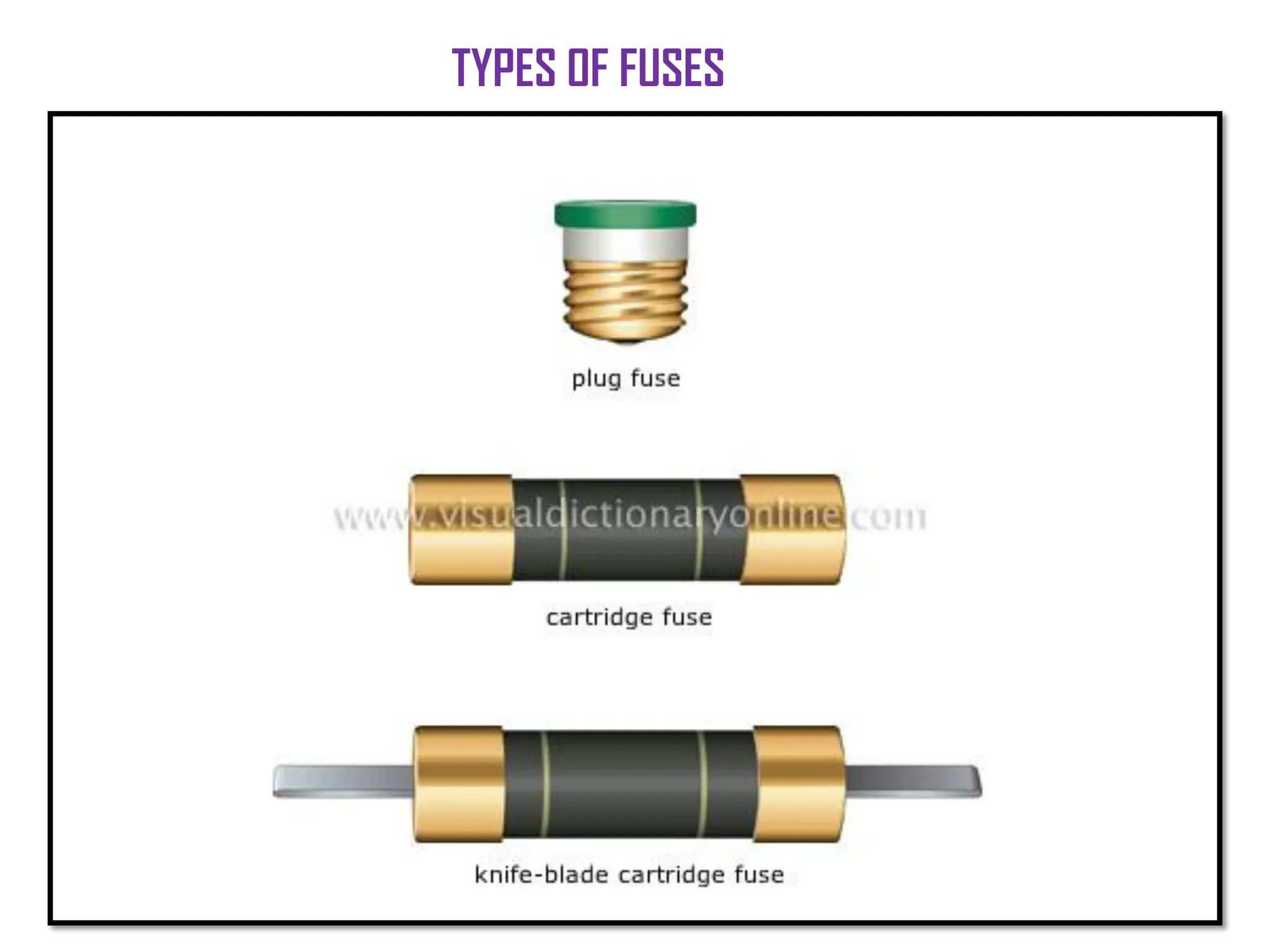
TYPES OF FUSES
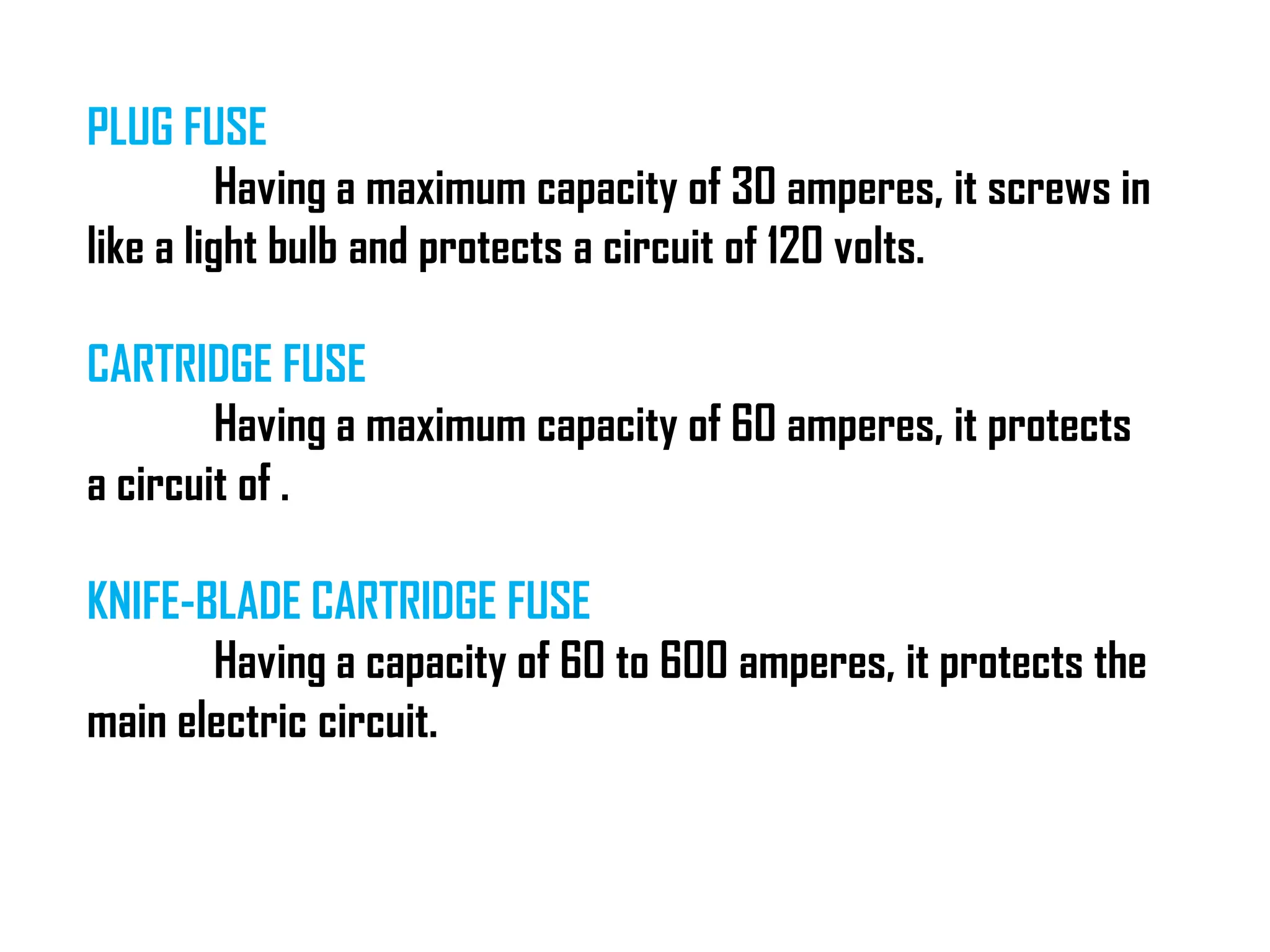
PLUG FUSE
Having a maximum capacity of 30 amperes, it screws in
like a light bulb and protects a circuit of 120 volts.
CARTRIDGE FUSE
Having a maximum capacity of 60 amperes, it protects
a circuit of .
KNIFE-BLADE CARTRIDGE FUSE
Having a capacity of 60 to 600 amperes, it protects the
main electric circuit.
TYPES OF FUSES
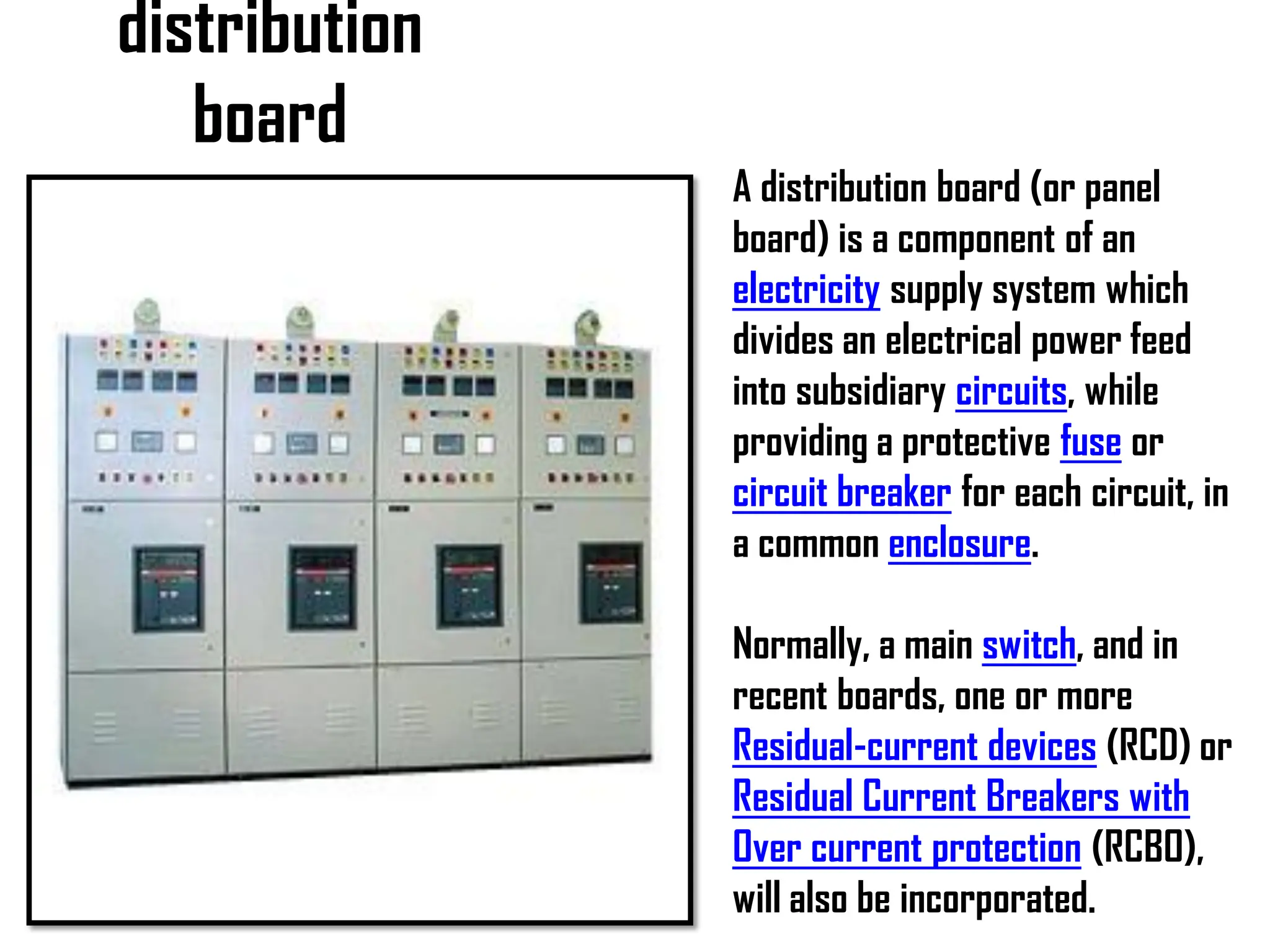
distribution
board
A distribution board (or panel
board) is a component of an
electricity supply system which
divides an electrical power feed
into subsidiary circuits, while
providing a protective fuse or
circuit breaker for each circuit, in
a common enclosure.
Normally, a main switch, and in
recent boards, one or more
Residual-current devices (RCD) or
Residual Current Breakers with
Over current protection (RCBO),
will also be incorporated.
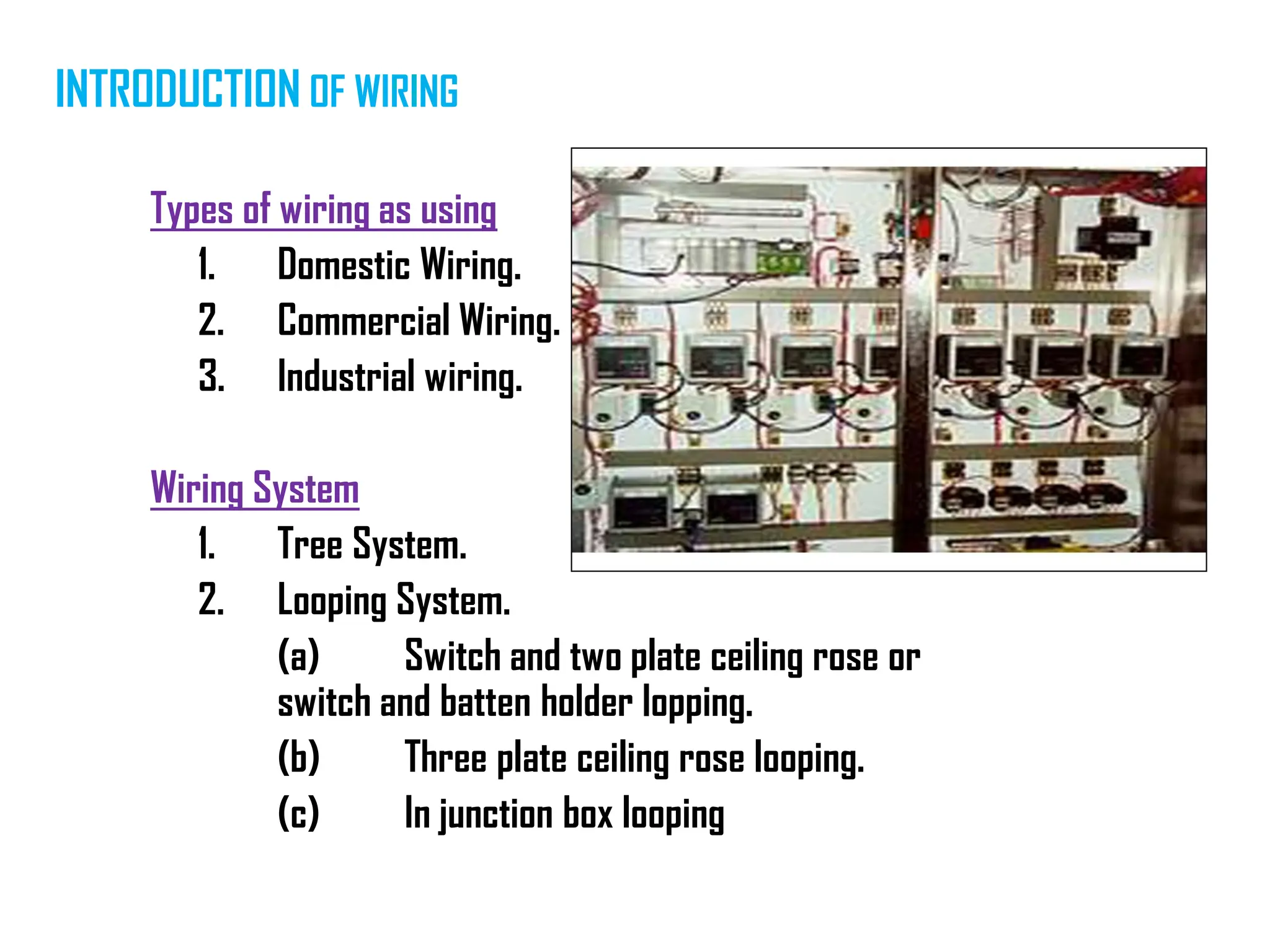
WIRING SYSTEM
Types of wiring as using
1. Domestic Wiring.
2. Commercial Wiring.
3. Industrial wiring.
Wiring System
1. Tree System.
2. Looping System.
(a) Switch and two plate ceiling rose or
switch and batten holder lopping.
(b) Three plate ceiling rose looping.
(c) In junction box looping
INTRODUCTION OF WIRING
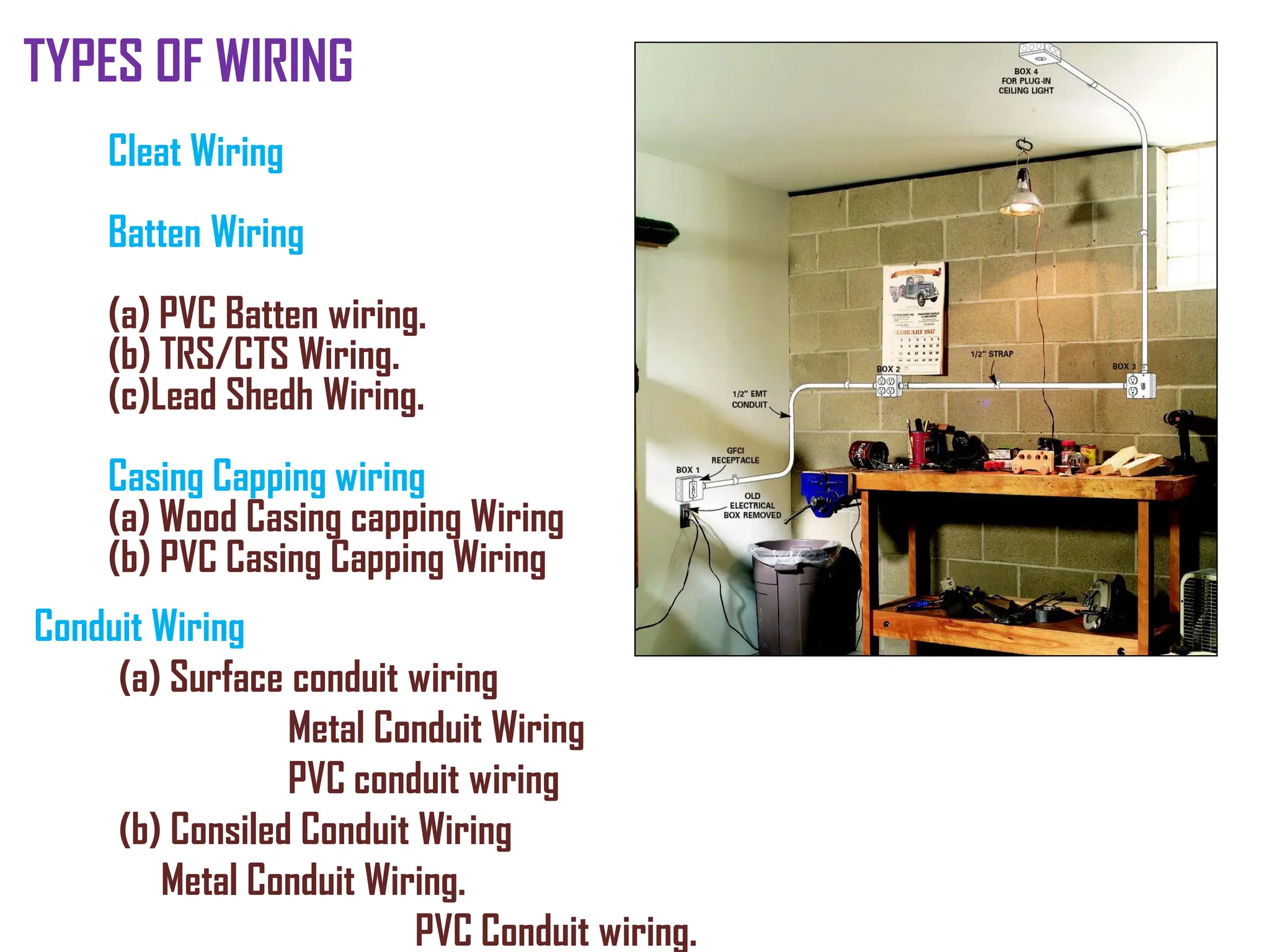
TYPES OF WIRING
Cleat Wiring
Batten Wiring
(a) PVC Batten wiring.
(b) TRS/CTS Wiring.
(c)Lead Shedh Wiring.
Casing Capping wiring
(a) Wood Casing capping Wiring
(b) PVC Casing Capping Wiring
Conduit Wiring
(a) Surface conduit wiring
Metal Conduit Wiring
PVC conduit wiring
(b) Consiled Conduit Wiring
Metal Conduit Wiring.
PVC Conduit wiring.
CLEAT WIRING
Introduction
The types of wiring to be adopted is dependent on
various factors, viz, durability, safety, appearance, cost,
consumer’s budget etc.
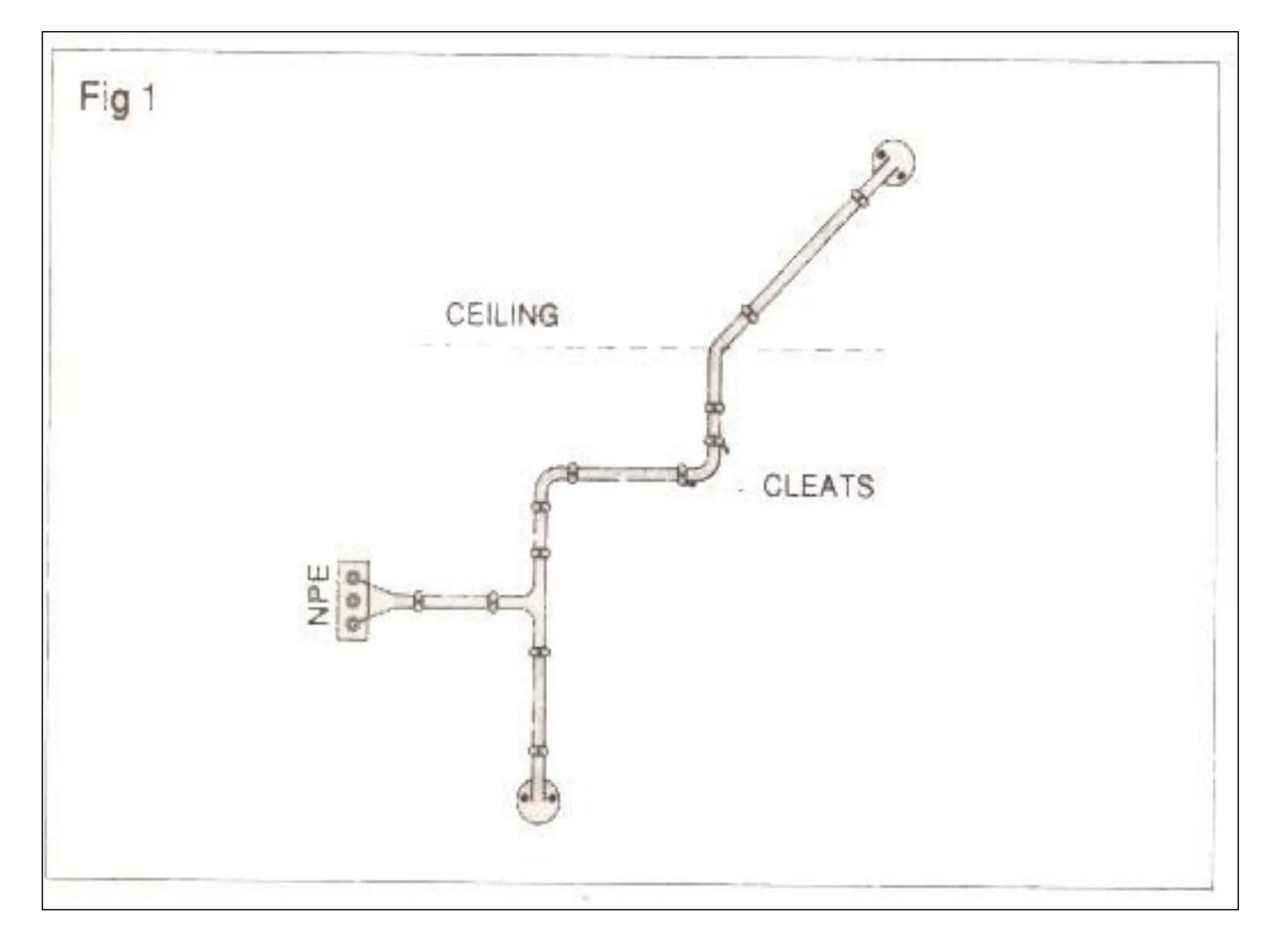
Cleat wiring
This System uses insulated Cables sub protected
in porcelain cleats.
Cleat wiring is recommended only for temporary installations.
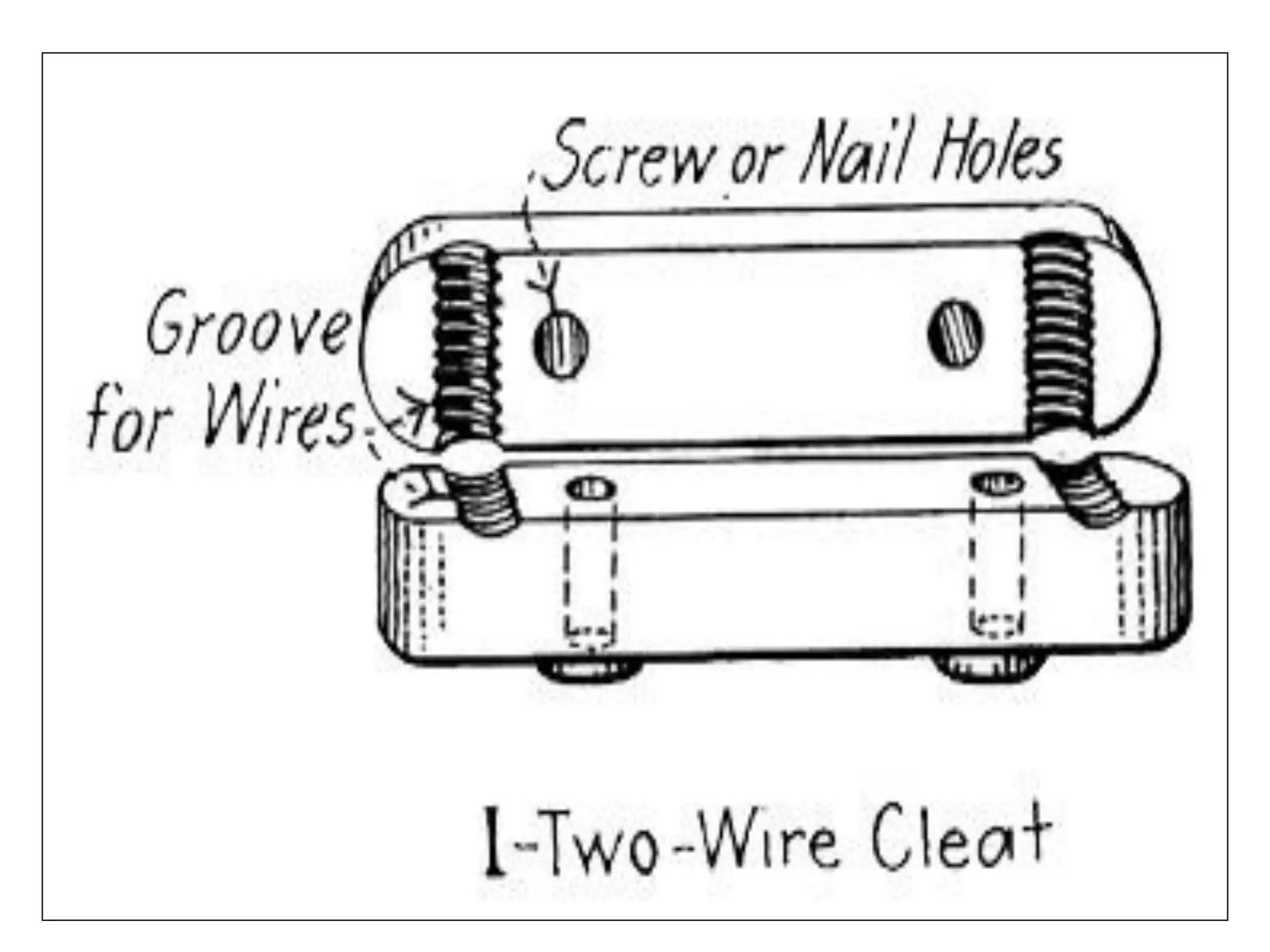
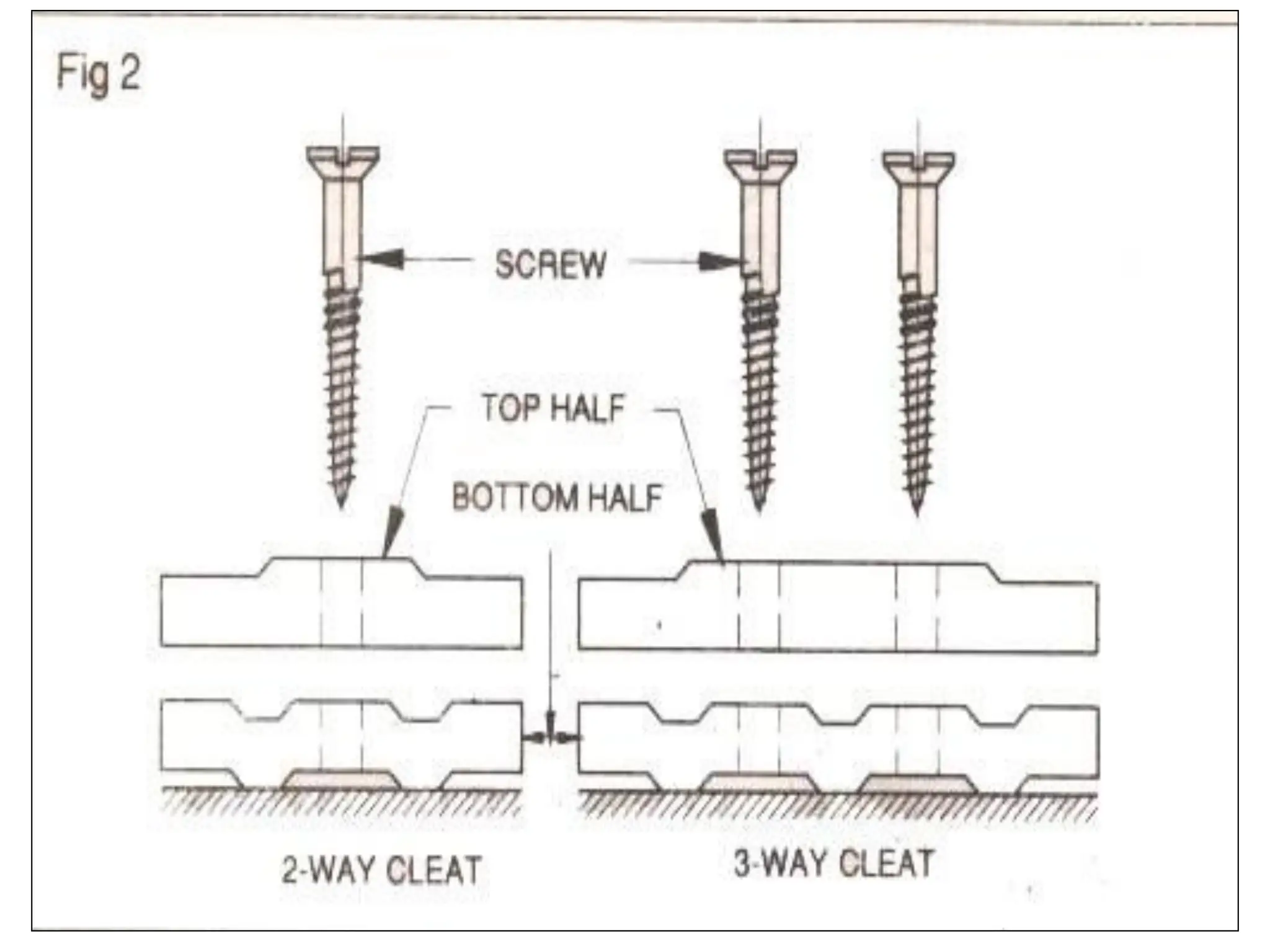
The cleats are made in pairs having bottom and top halves.
The bottom half is grooved to receive the wire and the top half is
for cable grip.
Initially the bottom and top cleats are fixed on the wall loosely
according to the layout.
Then the cable is drawn, tensioned and the cleats are tightened by
the screw.
Cleats are of three types, having one, two or three grooves, so as
to receive one, two or three wires. Two types of cleats.
Cleat wiring is one of the cheapest wiring considering the initial
cost and labor, and is most suitable for temporary wiring.
This wiring can be quickly installed, easily inspected and altered.
When not required, this wiring could be dismantled without damage
to the cables, cleats and accessories.
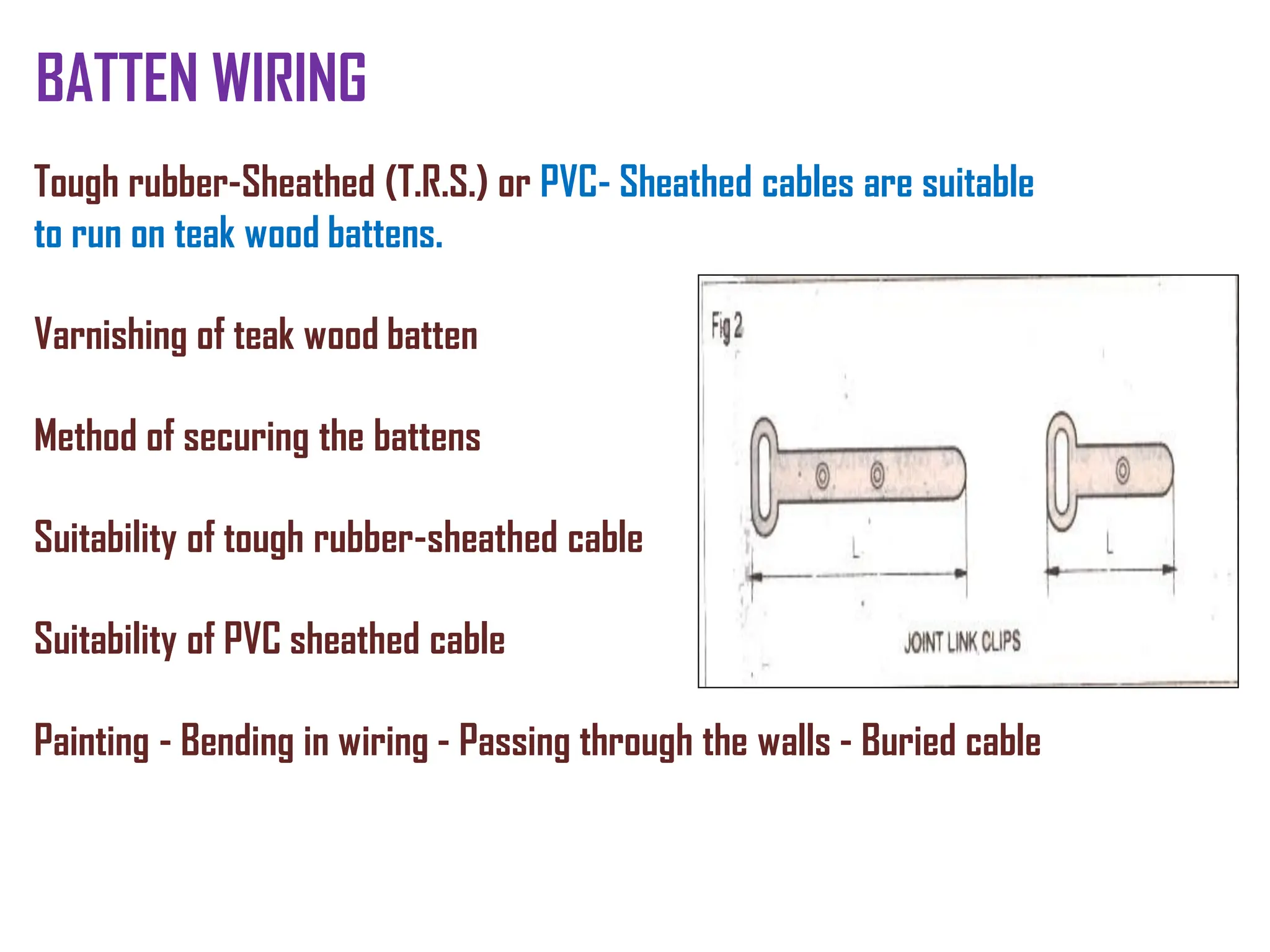
BATTEN WIRING
Tough rubber-Sheathed (T.R.S.) or PVC- Sheathed cables are suitable
to run on teak wood battens.
Varnishing of teak wood batten
Method of securing the battens
Suitability of tough rubber-sheathed cable
Suitability of PVC sheathed cable
Painting - Bending in wiring - Passing through the walls - Buried cable
CASING CAPPING WIRING
Introduction
This system of wiring is suitable for low voltage
installation, in this wiring, cables like vulcanized rubber,
insulated cables or plastic insulated cables are use and carried
within the wood casing enclosures.
The wood casing wiring system shall not be use in damp
places and in ill-ventilated places, unless suitable precautions
are taken.
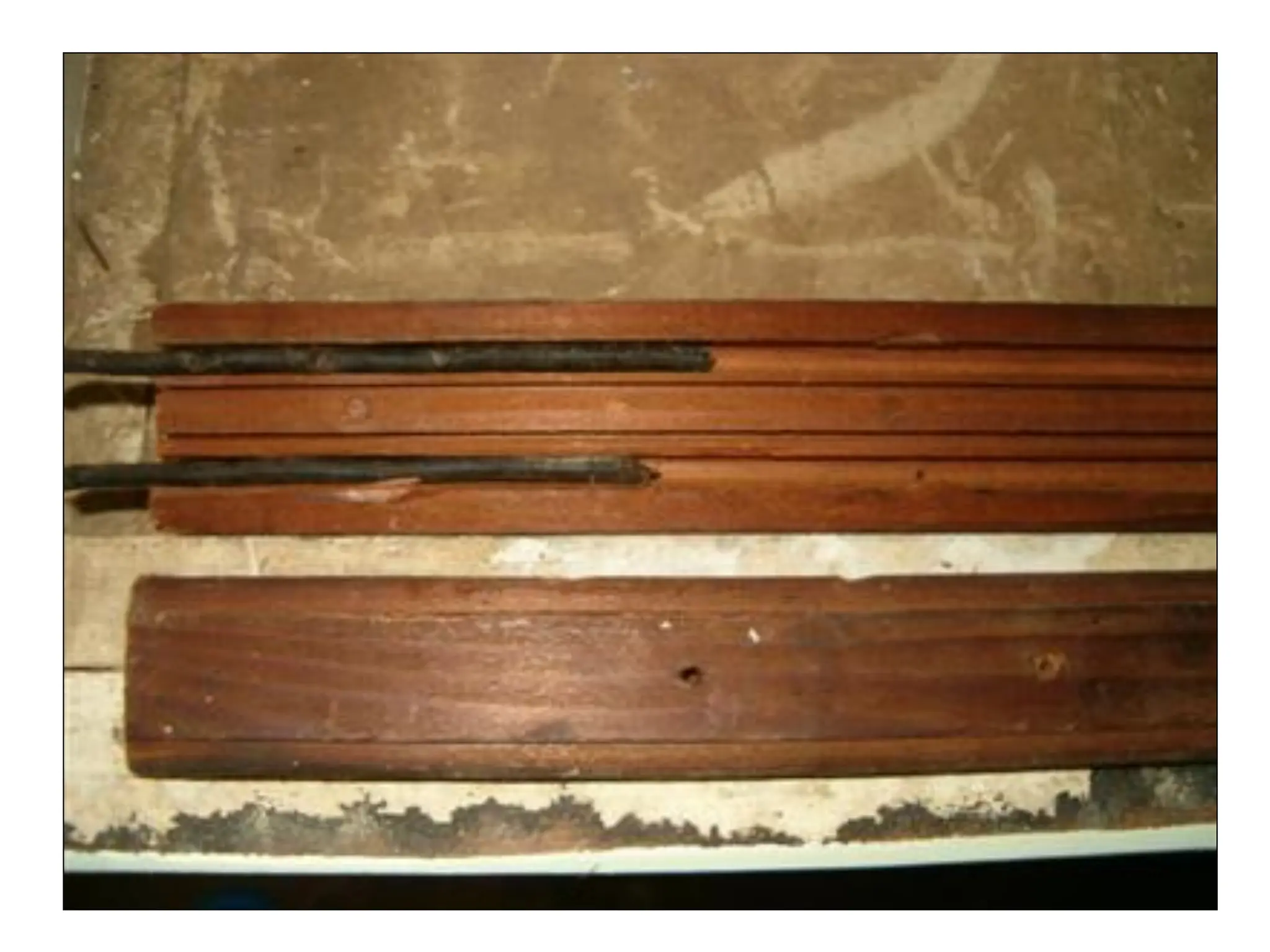
Material and pattern of casing
All casing shall be of first class, seasoned teak wood or any other
approved hardwood free from knots, shakes, saps or other defects, with all
the sides planed to a smooth finish, and all sides well varnished, both inside
and out side with pure shellac varnish.
The casing shall have a grooved body with a beaded or plain- molded cover as
desired.
CONDUIT WIRING
Introduction
In general, a conduit is defined as a tube or channel.
Tubular conduit is the most commonly used material in electrical
installations.
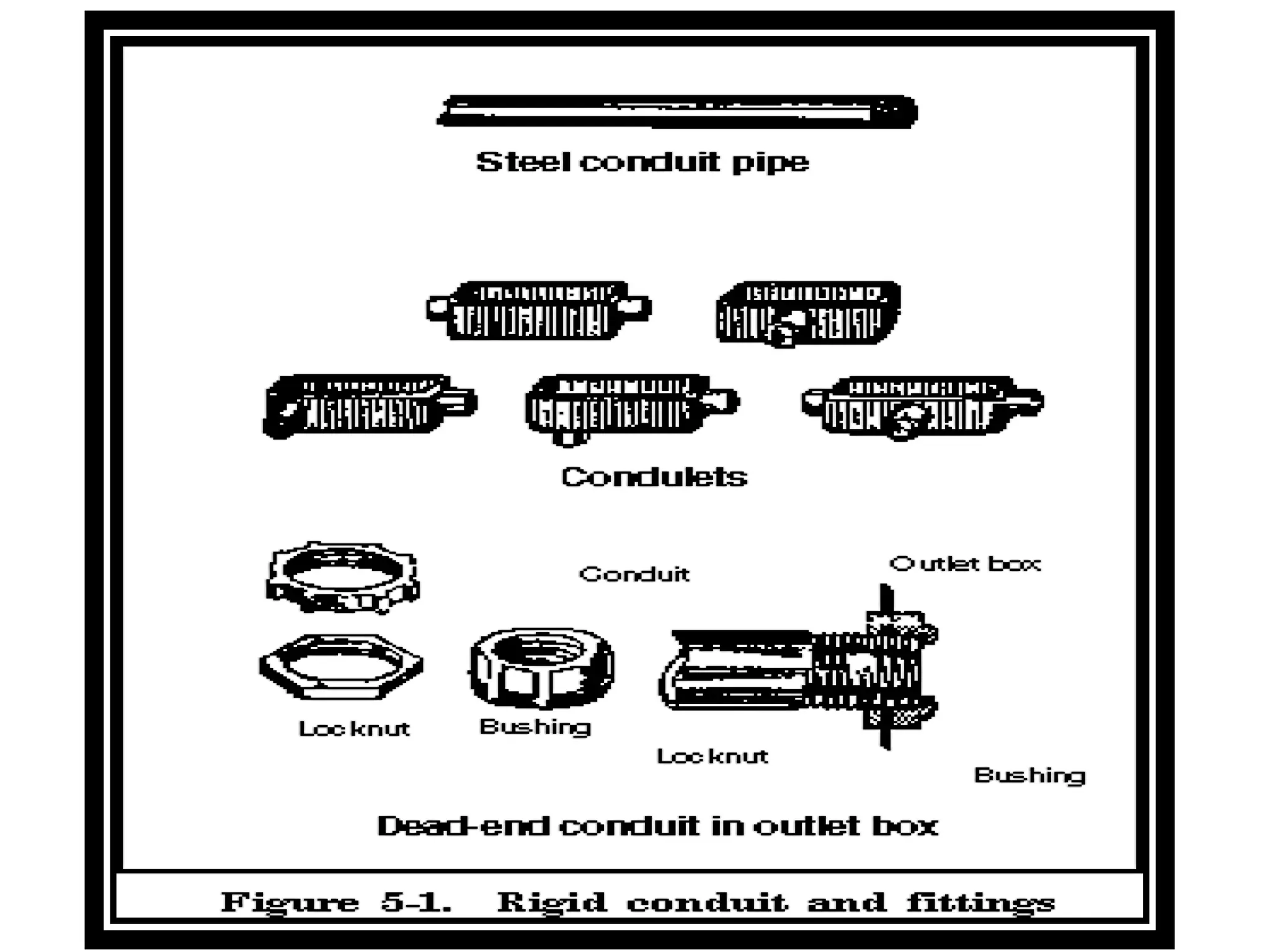
TYPES OF CONDUITS
There are four types of conduits used for wiring.
Rigid steel conduit
Rigid non-metallic conduit
Flexible steel conduit
Flexible non metallic conduit.
When cables are drawn through the conduit and terminated at the outlet
or switch points, the system of wiring is called conduit wiring.
Wire is used to electrically connect circuit parts, devices, equipment etc.
There are various kinds of wiring materials.
The different types of wire can be divided largely into two categories: single wire
and twisted strand wire.
It really doesn't matter which kind you use for a given application, but usually,
single wire is used to connect devices (resistors, capacitors etc) together on the
PWB. (Parts that don't move)
It is also used for jumper wiring.
Twisted strand wire can bend freely, so it can be used for wiring on the PWB, and
also to connect discrete pieces of equipment.
and enameled wire with a burnt
WIRING MATERIAL
If single wire is used to connect separate equipment, it will break soon, as it is
not very flexible.
It is convenient to use the single tin coated wire of the diameter 0.32 mm for
the wiring of PWB.
If the diameter is larger, soldering becomes a little bit difficult. And if the
diameter is too thin, it becomes difficult to bend the wire the way you want it to
stay.
It's best to use whatever wire you are comfortable with, and not worry about
those things.
If you want to connect separated parts on the PWB, twisted wire covered with
soft insulation material is most convenient for wiring.
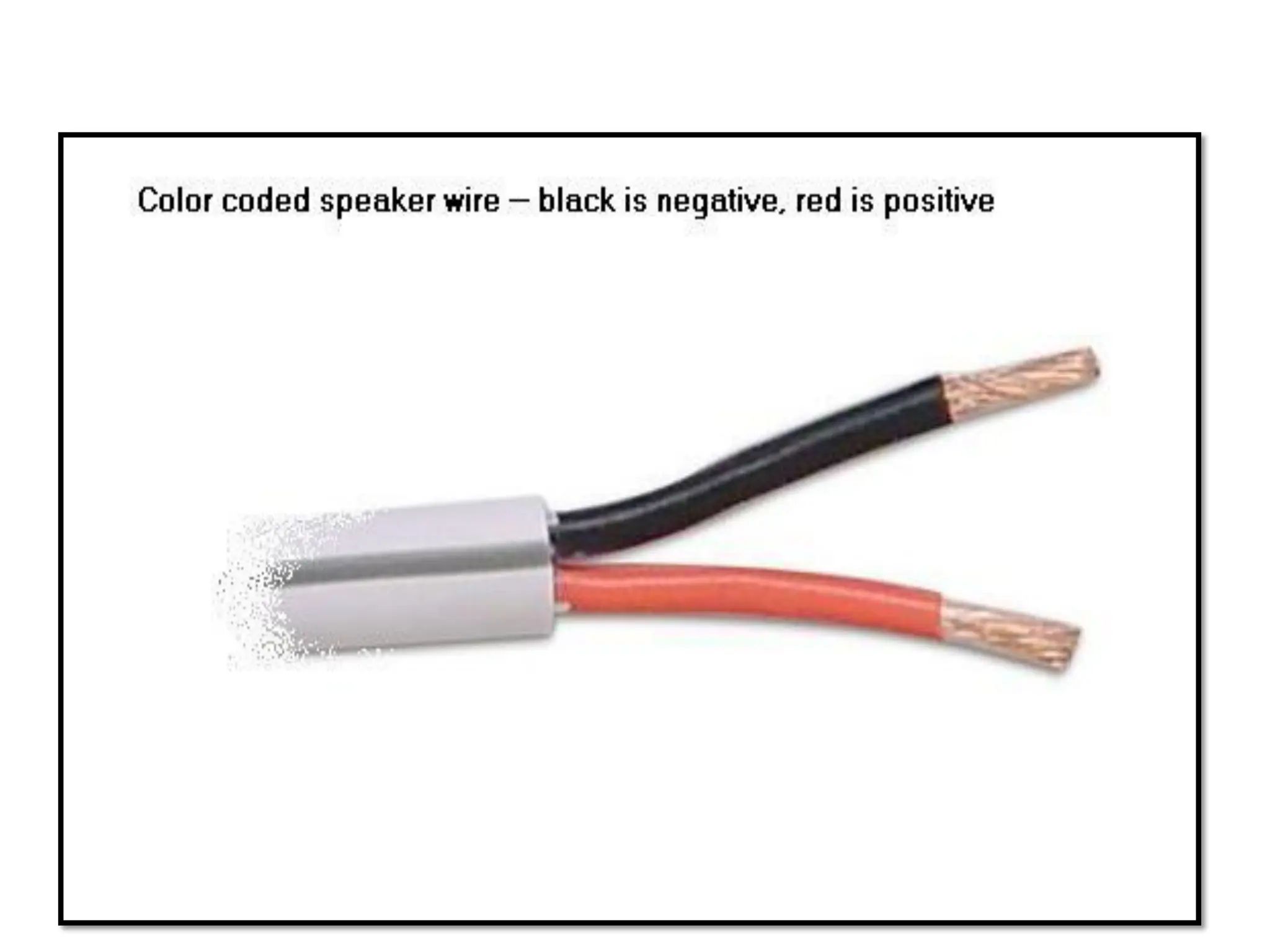
It's convenient to wire the circuit using different color wires for different
purposes. Otherwise, wiring the circuit with many wires the same color gets
confusing.
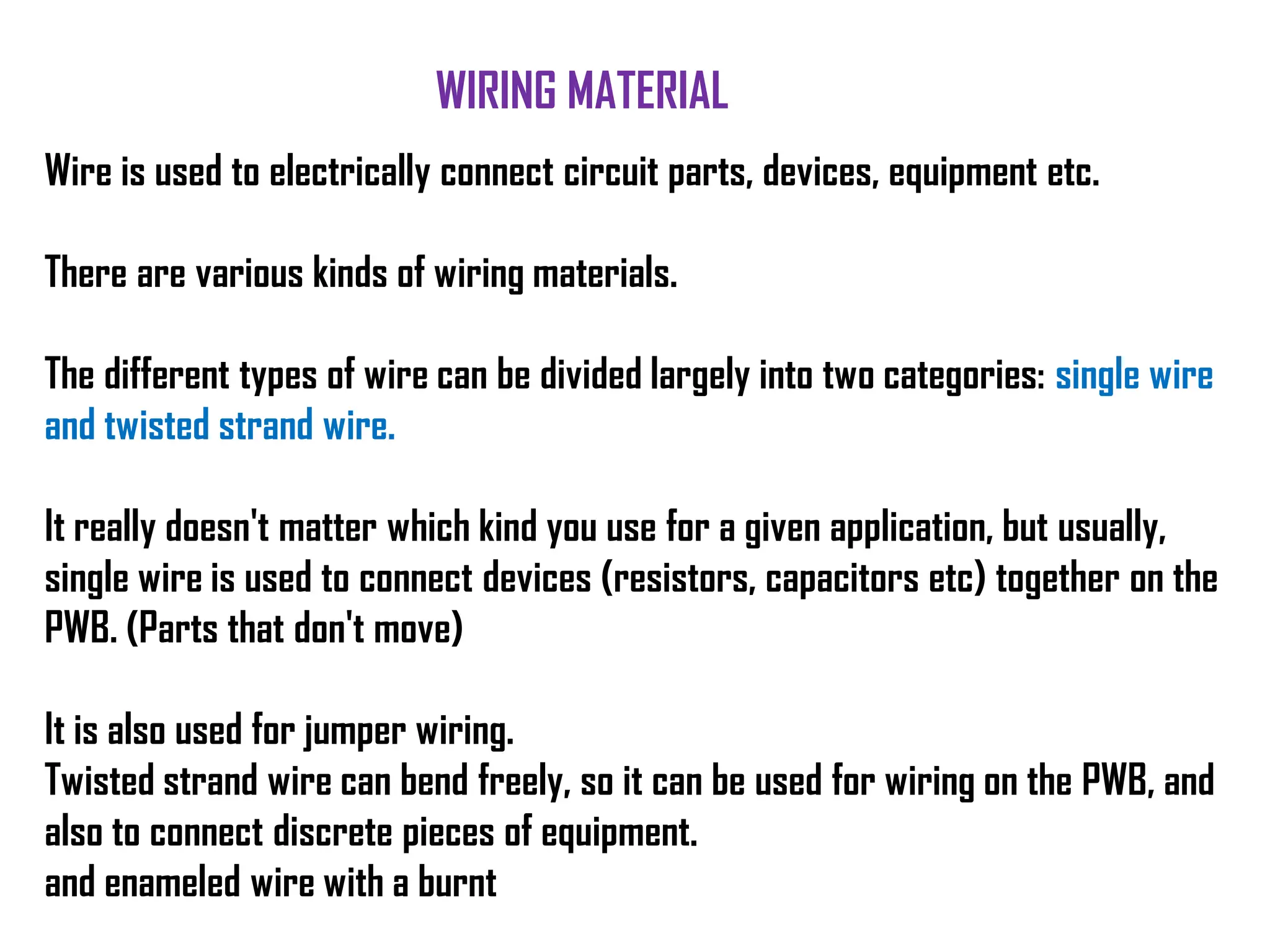
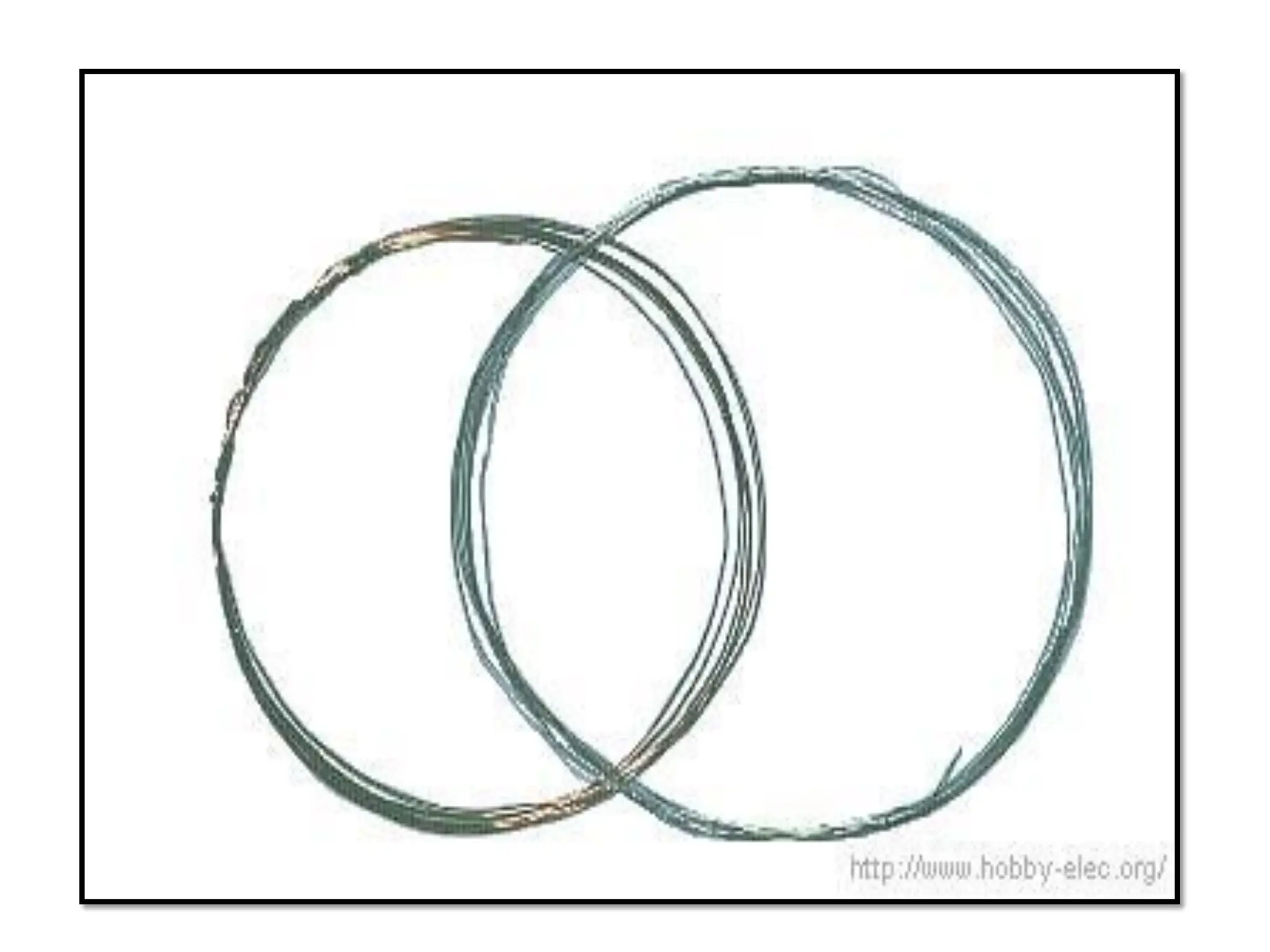
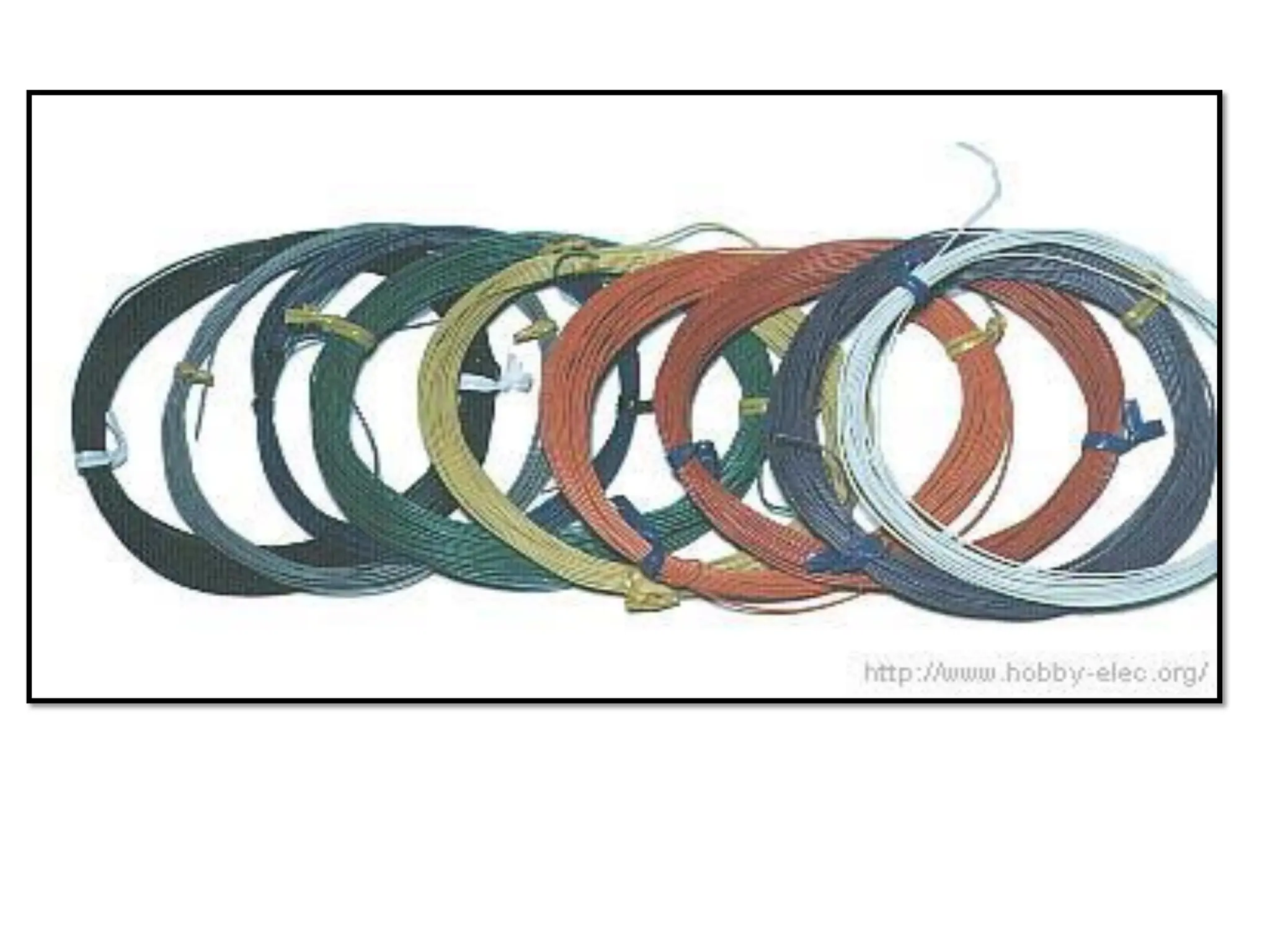
The photograph on the left shows several colors of twisted wire.
It is called 0.12/7PVC.
The pictured wire is comprised of 7 tin coated wires 0.12 mm each in diameter,
covered by very thin PVC plastic.
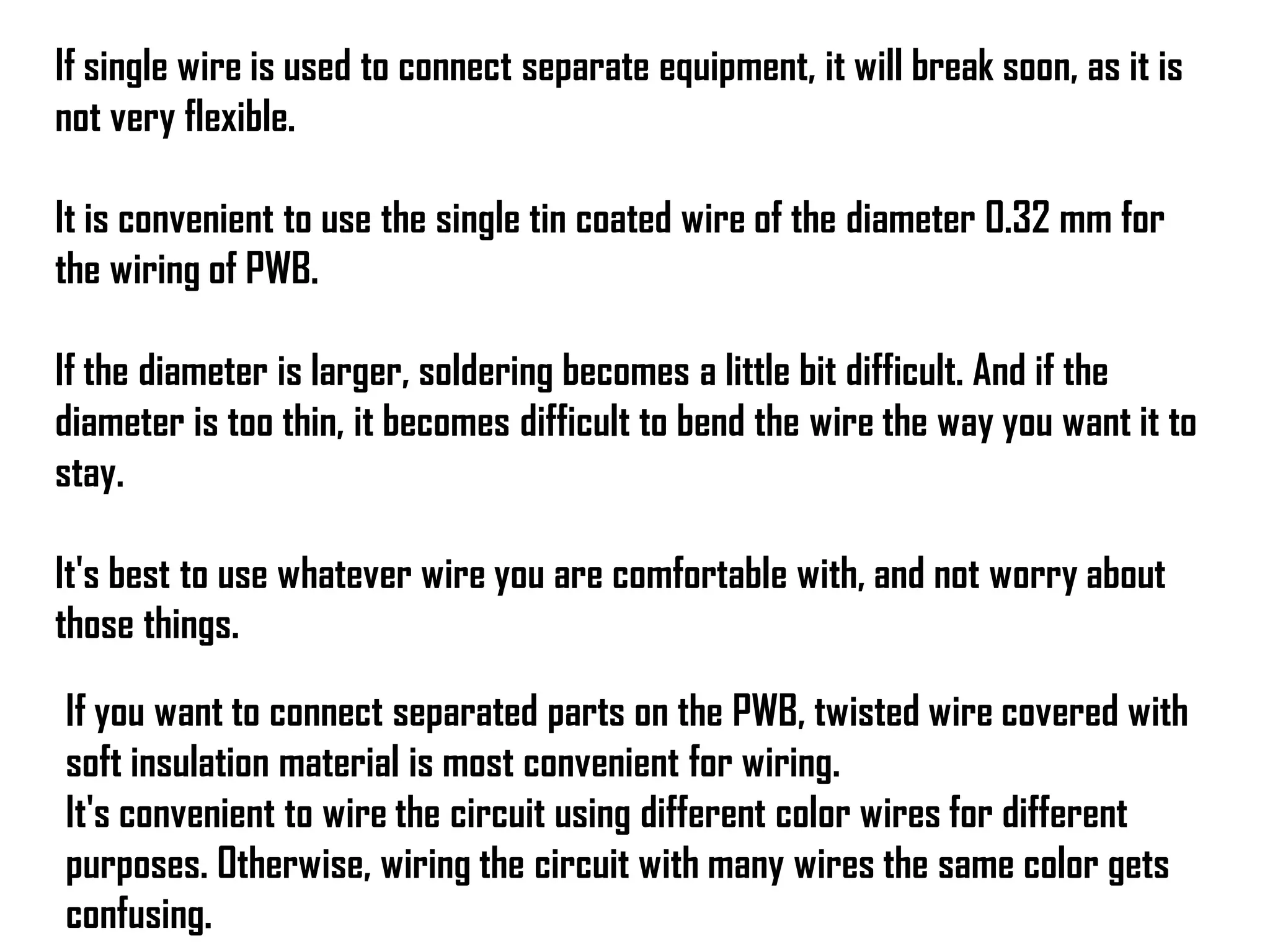
In the photograph to the right is pictured tin coated wire with a diameter of 0.32
mm.
It is convenient to use for wiring components, jumper wiring etc. when you are
building a circuit on a universal PWB.
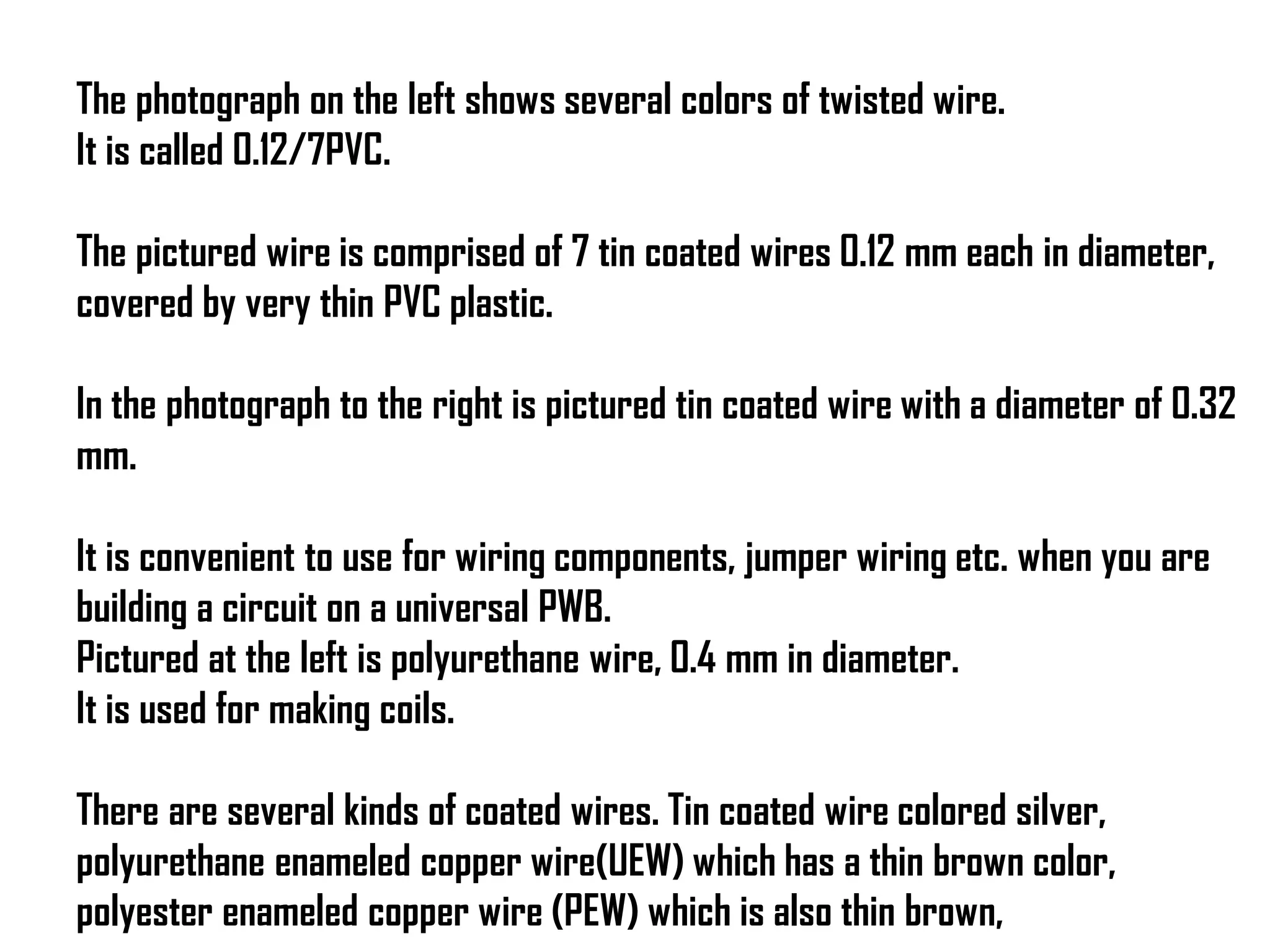
Pictured at the left is polyurethane wire, 0.4 mm in diameter.
It is used for making coils.
There are several kinds of coated wires. Tin coated wire colored silver,
polyurethane enameled copper wire(UEW) which has a thin brown color,
polyester enameled copper wire (PEW) which is also thin brown,
TYPES OF SWITCHES
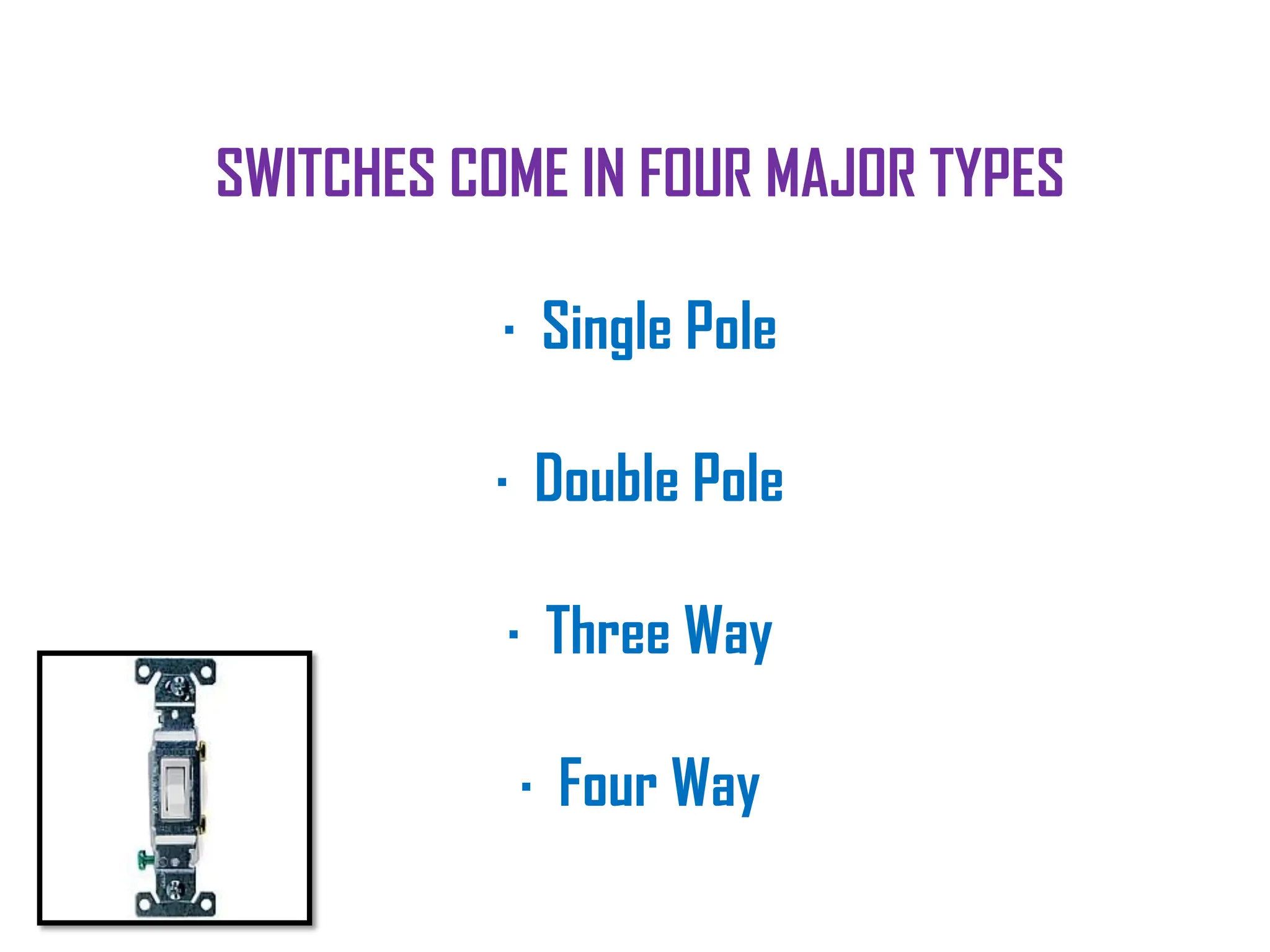
INTRODUCTION: TYPES OF SWITCHES
The switch is one of the most basic yet important electrical
devise in the home.
Although they almost all look the same once the face plate
is on, they can function very differently.
Their are a few key types of switches you need to know
about and I'll describe them in this tutorial.
Switches can come in a toggle style (like those shown in
this tutorial), but can also come in a more design oriented
"rocker" or "paddle" style such as those made popular by the
Leviton "Decora".
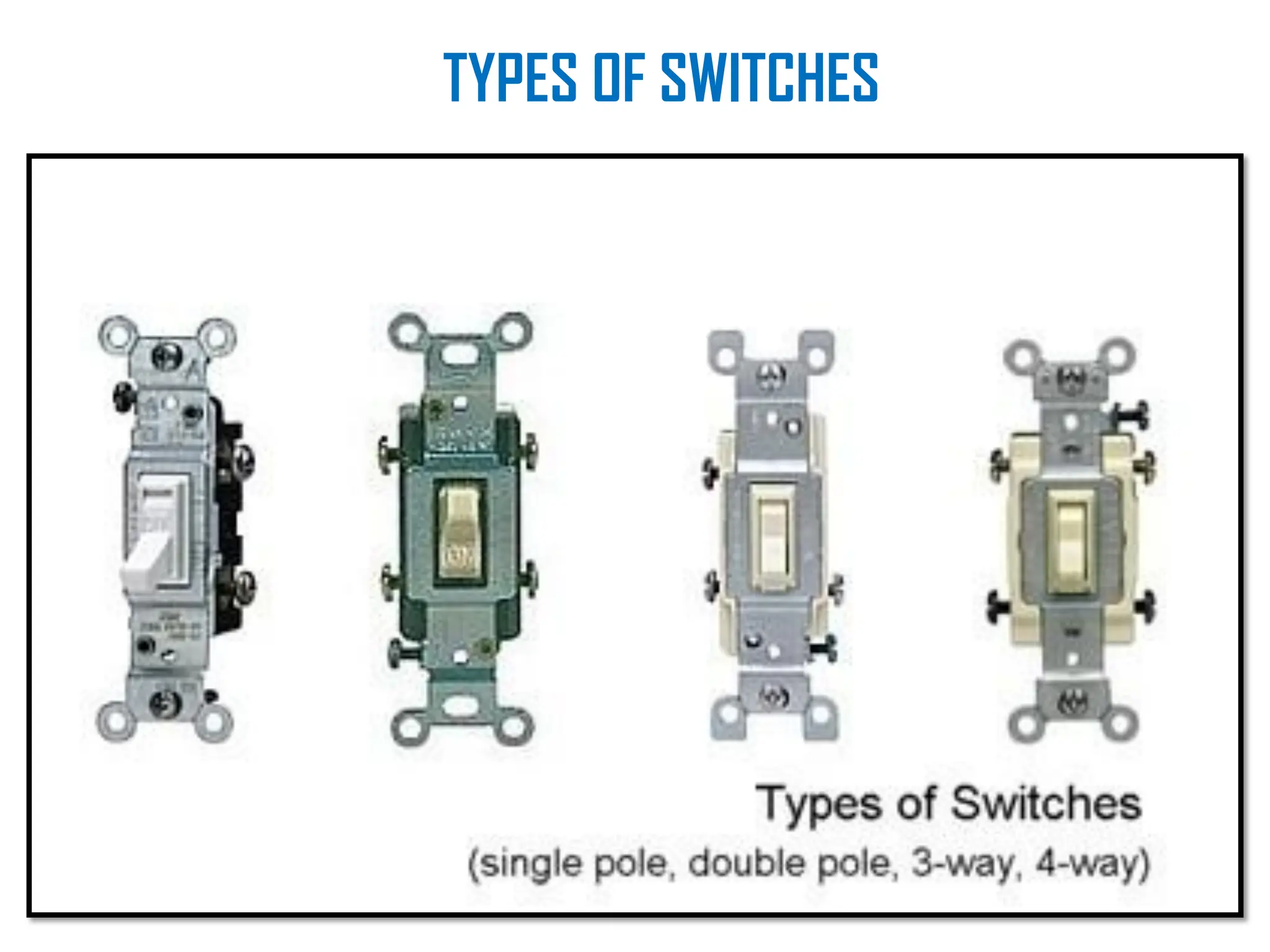
SWITCHES COME IN FOUR MAJOR TYPES
· Single Pole
· Double Pole
· Three Way
· Four Way
TYPES OF SWITCHES
Single Pole Switch
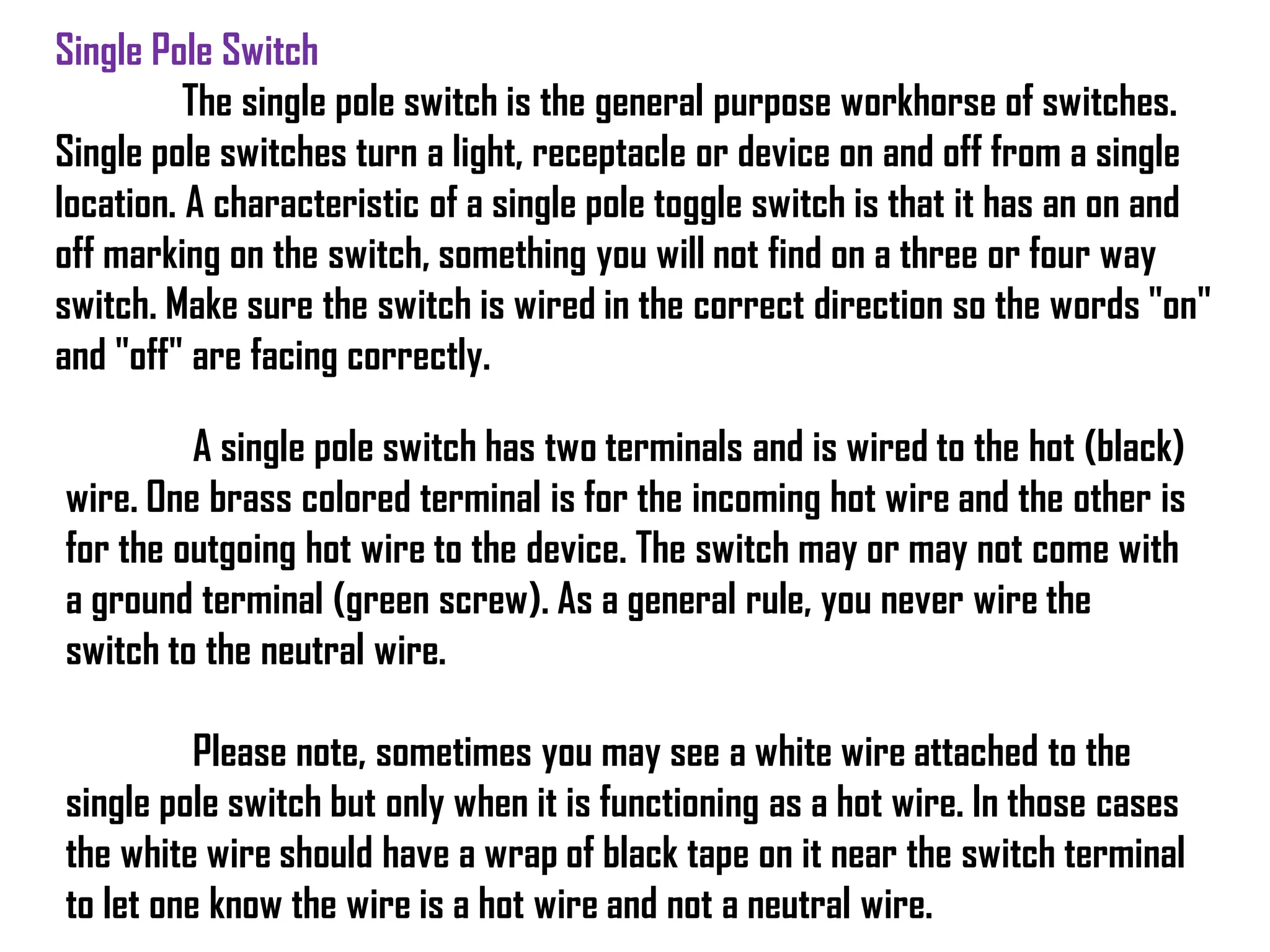
The single pole switch is the general purpose workhorse of switches.
Single pole switches turn a light, receptacle or device on and off from a single
location. A characteristic of a single pole toggle switch is that it has an on and
off marking on the switch, something you will not find on a three or four way
switch. Make sure the switch is wired in the correct direction so the words "on"
and "off" are facing correctly.
A single pole switch has two terminals and is wired to the hot (black)
wire. One brass colored terminal is for the incoming hot wire and the other is
for the outgoing hot wire to the device. The switch may or may not come with
a ground terminal (green screw). As a general rule, you never wire the
switch to the neutral wire.
Please note, sometimes you may see a white wire attached to the
single pole switch but only when it is functioning as a hot wire. In those cases
the white wire should have a wrap of black tape on it near the switch terminal
to let one know the wire is a hot wire and not a neutral wire.
Double Pole Switch
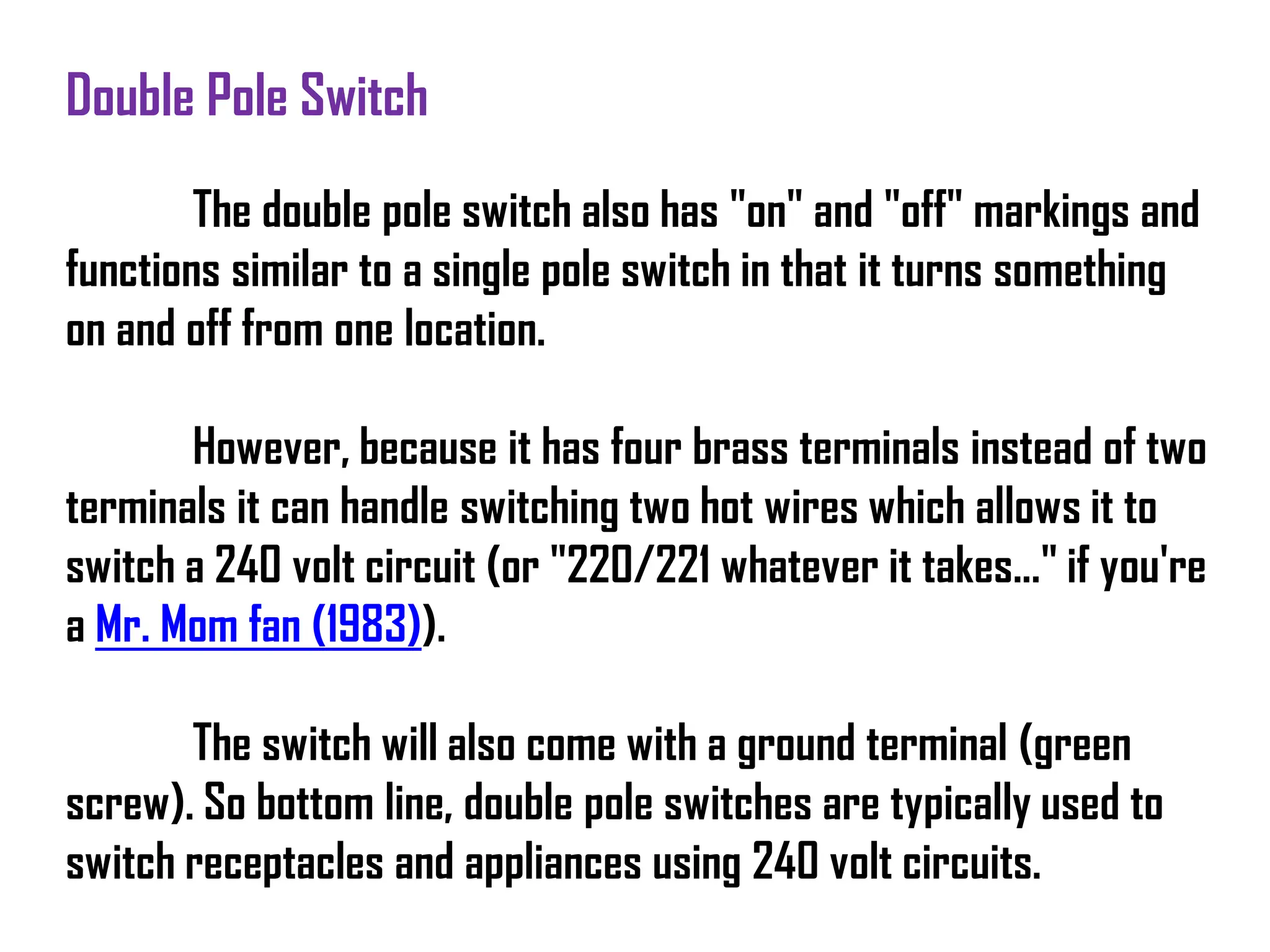
The double pole switch also has "on" and "off" markings and
functions similar to a single pole switch in that it turns something
on and off from one location.
However, because it has four brass terminals instead of two
terminals it can handle switching two hot wires which allows it to
switch a 240 volt circuit (or "220/221 whatever it takes..." if you're
a Mr. Mom fan (1983)).
The switch will also come with a ground terminal (green
screw). So bottom line, double pole switches are typically used to
switch receptacles and appliances using 240 volt circuits.
Three Way Switch
The three way switch is always used in pairs and allows you to turn a
light or receptacle on and off from two different locations.
These switches have no "on" or "off" markings because the on and
off positions will vary as the switches are used.
The three way switch has three terminal screws and here's where it
can start getting confusing for most people (but it won't be for you, don't
worry).
The black "hot" wire is attached to the darkest screw terminal
marked "COM" for "common." The other two terminals are used to wire up
what are called "travelers" or leads for the switch
It makes no real difference which traveler wire goes to what traveler terminal
on the switch. The switch will also come with a ground terminal (green screw).
The trick in replacing a old switch is to mark the COM or common wire off the
old three way switch before you replace the old switch.
Please note, you cannot use any other type of switch in a three way
application, and again, these switches must be used in pairs.
Four Way Switch
The four way switch is used in between two three-way switches to
control an outlet or light fixture from three different locations. If you
wanted to control from more than three locations, say five locations, you
would still use two three-way switches (one on each end) but now you'd use
three four-way switches in between the two three-ways.
The four way switch looks the same as a double pole switch
except that a four-way switch will have no "on" or "off" markings.
The four-way switch has four terminals most always brass in
color. There is no COM or "common" wire like a three-way switch.
The four-way switch simply functions as a switching device for
the traveler wires between the three-way switches.
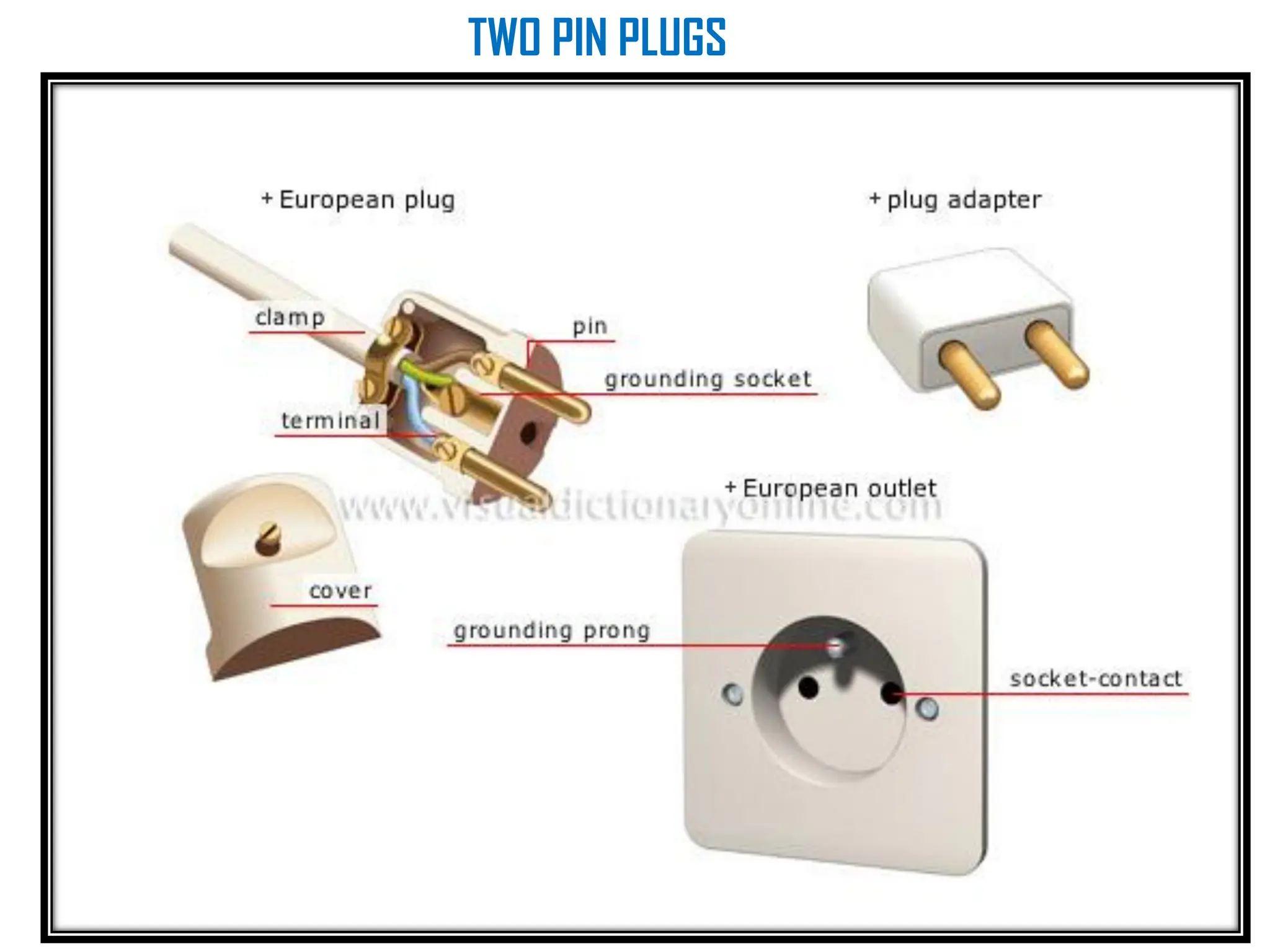
TWO PIN PLUGS
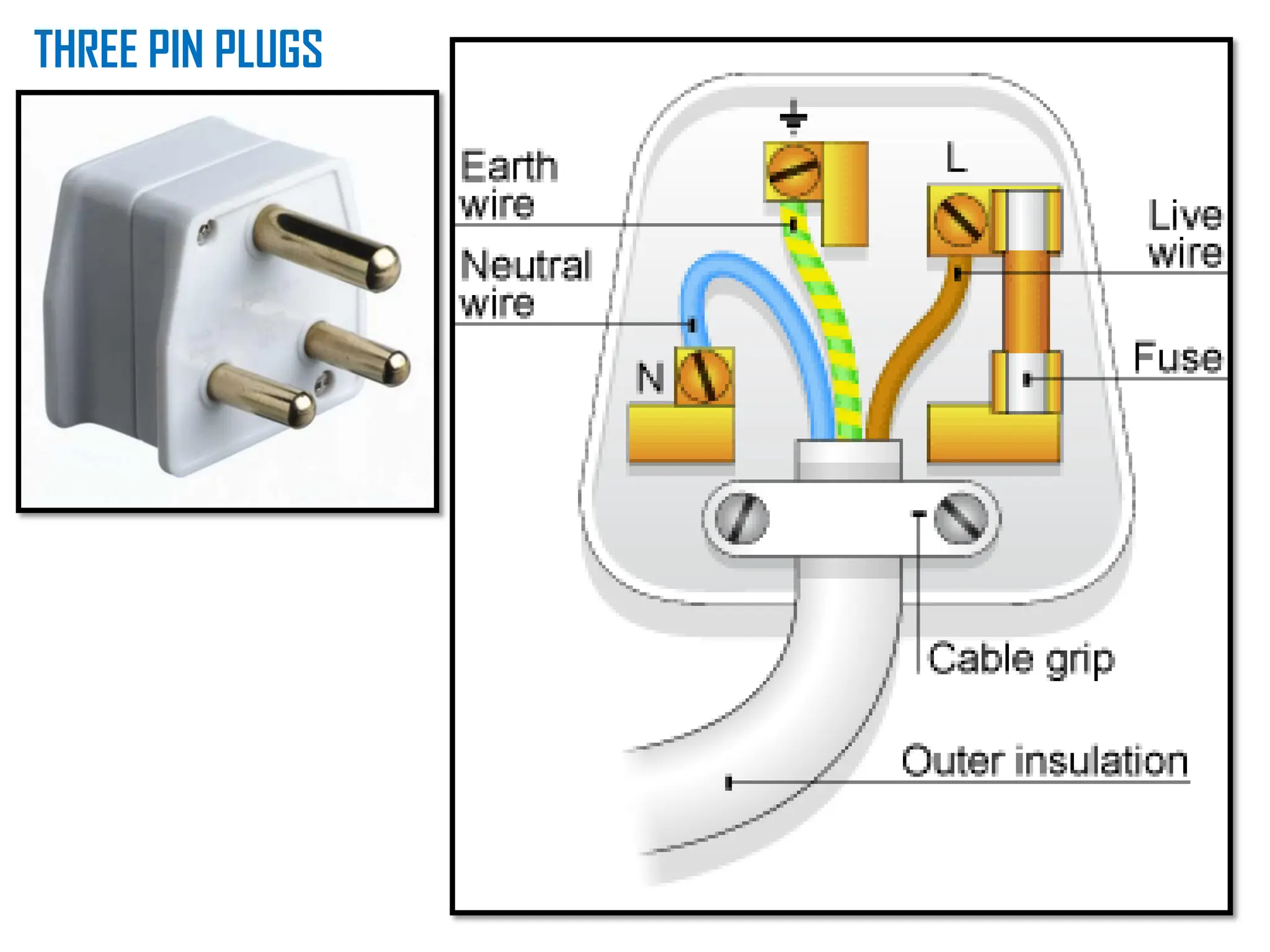
THREE PIN PLUGS
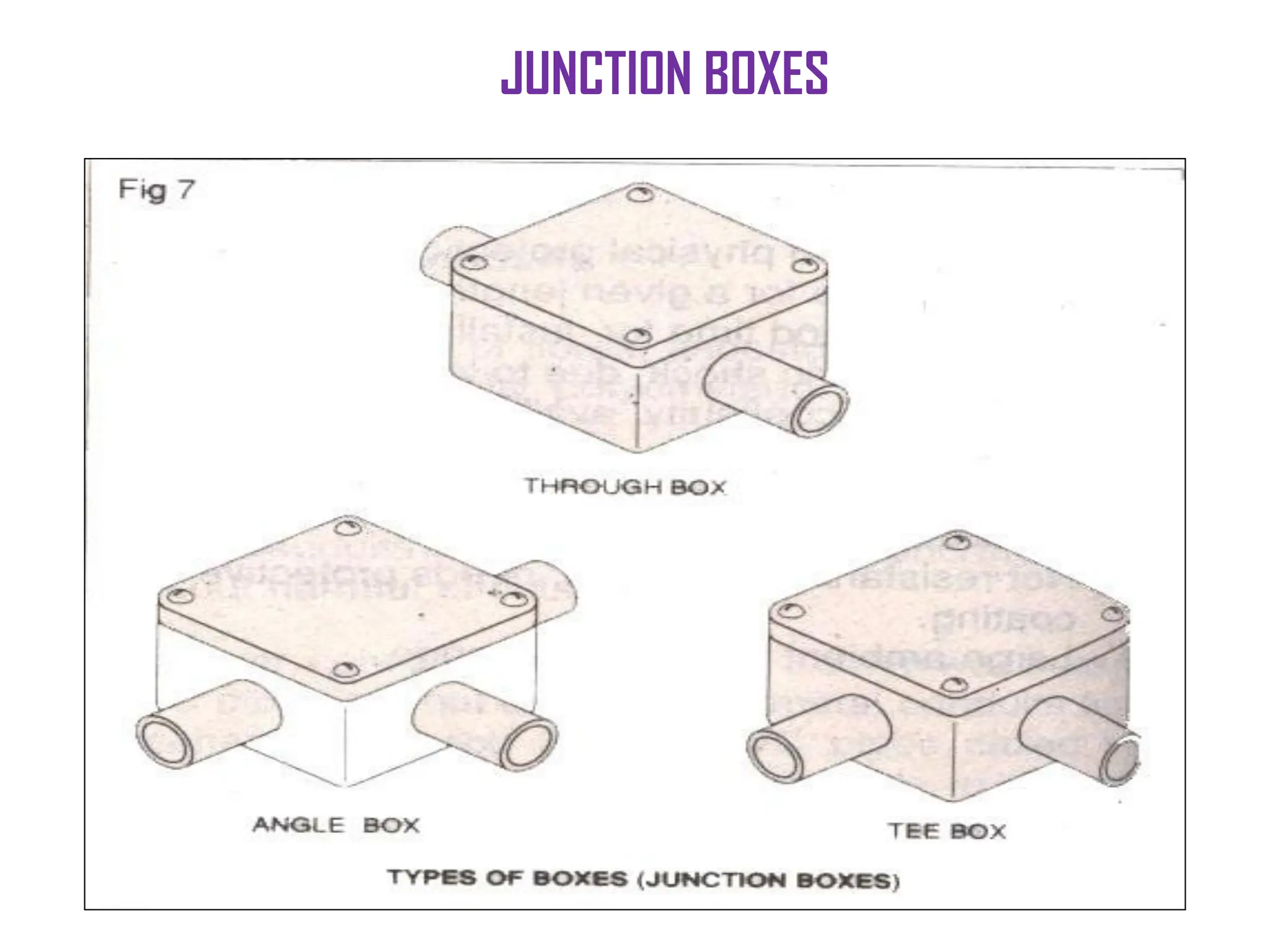
JUNCTION BOXES
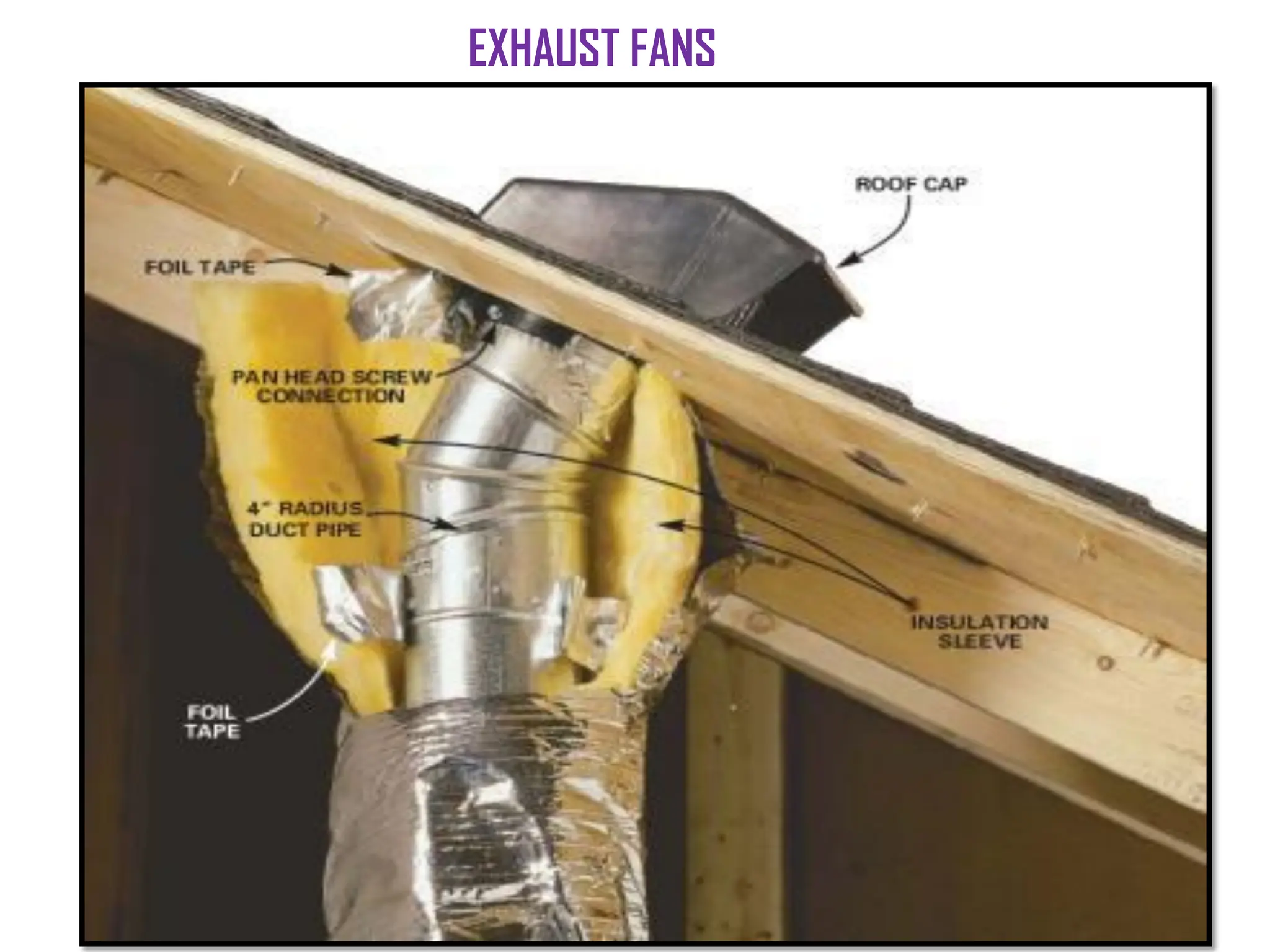
EXHAUST FANS
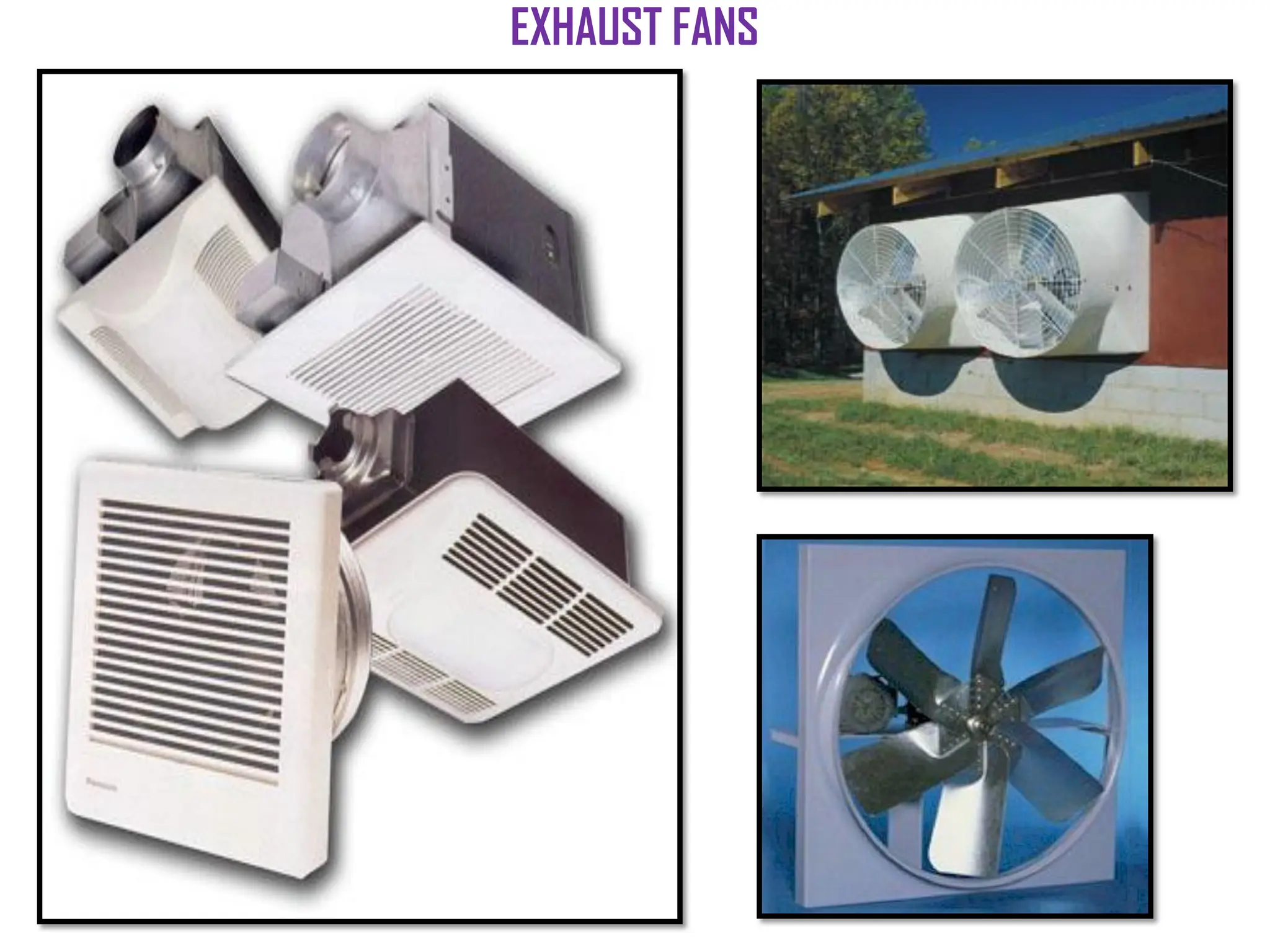
EXHAUST FANS
Electrical terms and units of measure
Power
Power is the rate at which energy is produced or used. The unit of
measurement for power is the watt (W).
If you examine a light bulb carefully you will see that it has maybe "45, 60 or
100 watts" written on it. If it has "60 watts" written on it this means that it
uses 60 joules of energy for every second it is on.
If a power station has an output of 600 megawatts (MW) of electrical power, it
is producing 600 000 000 joules of energy every second. Imagine how many
light bulbs that would keep going!
Voltage
The volt is named in honour of Alessandro Volta, an Italian scientist.
Voltage is the difference of electrical potential between two points of an
electrical or electronic circuit, expressed in volts.
It measures the potential energy of an electric field to cause an electric current
in an electrical conductor.
Depending on the difference of electrical potential it is called extra low voltage,
low voltage, high voltage or extra high voltage.
Voltage is the unit of measure for electro-motive force required to pass one
ampere through a resistance of one ohm (see "Resistance" below).
Ampere
The ampere (or "amp"), named after the French scientist Andre Maria
Ampere, is a measure applied to the flow of electrons. An "amp" is a unit of
measurement for electrical current.
One ampere represents the rate of 1 coulomb of charge per second. A
coulomb is equivalent to 6.24 X 10¹⁸ electron charges, hence a current of
one amp means a flow of 6.24 X 10¹⁸ electron charges passes any given
cross section of the conductor per second.
Resistance ohm
The German scientist Georg Simon Ohm discovered that in any conductor,
electrons encounter a resistance whilst flowing through a circuit. He proved
experimentally that the current in a metallic conductor is directly
proportional to the voltage between its ends.
Power
A watt is the unit of electric power. One watt is a measure of the power
consumed when a current of one "ampere" flows under a pressure of one
"volt".
Electrical arithmetic
On all electrical appliances you will find the "rating" marked in watts (for
example, iron - 600 watts, heater - 1 000 watts, lamps - 100 watts. The power
taken by any appliance (such as a toaster, heater, kettle etc.) is found by
multiplying the voltage by the current:
watts = volts X amperes (Amps)
and
1000 watts = 1 Kilowatt (kW)
1,000,000 watts = 1 Megawatt (MW)
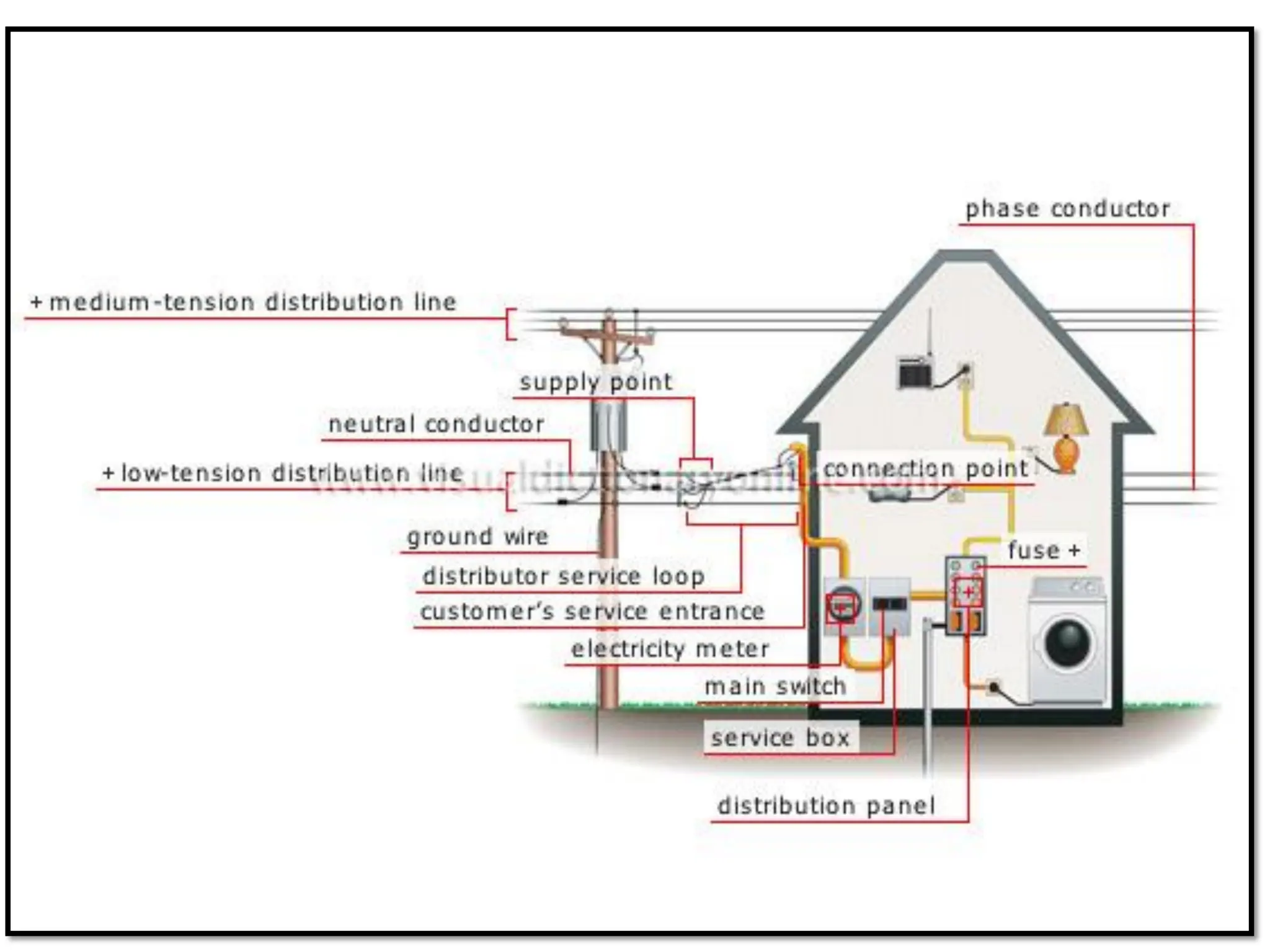
SUPPLY TO BUILDING
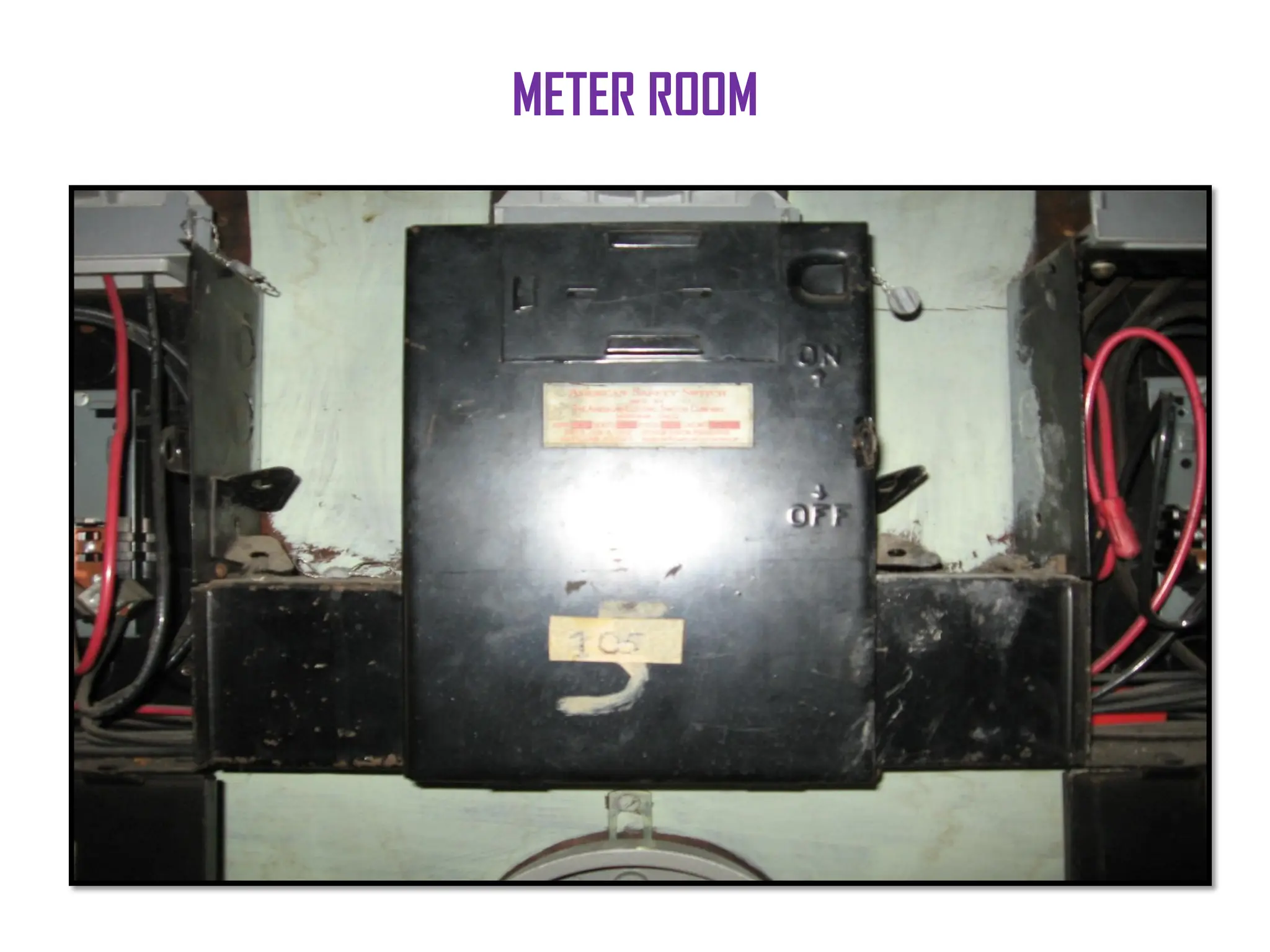
METER ROOM
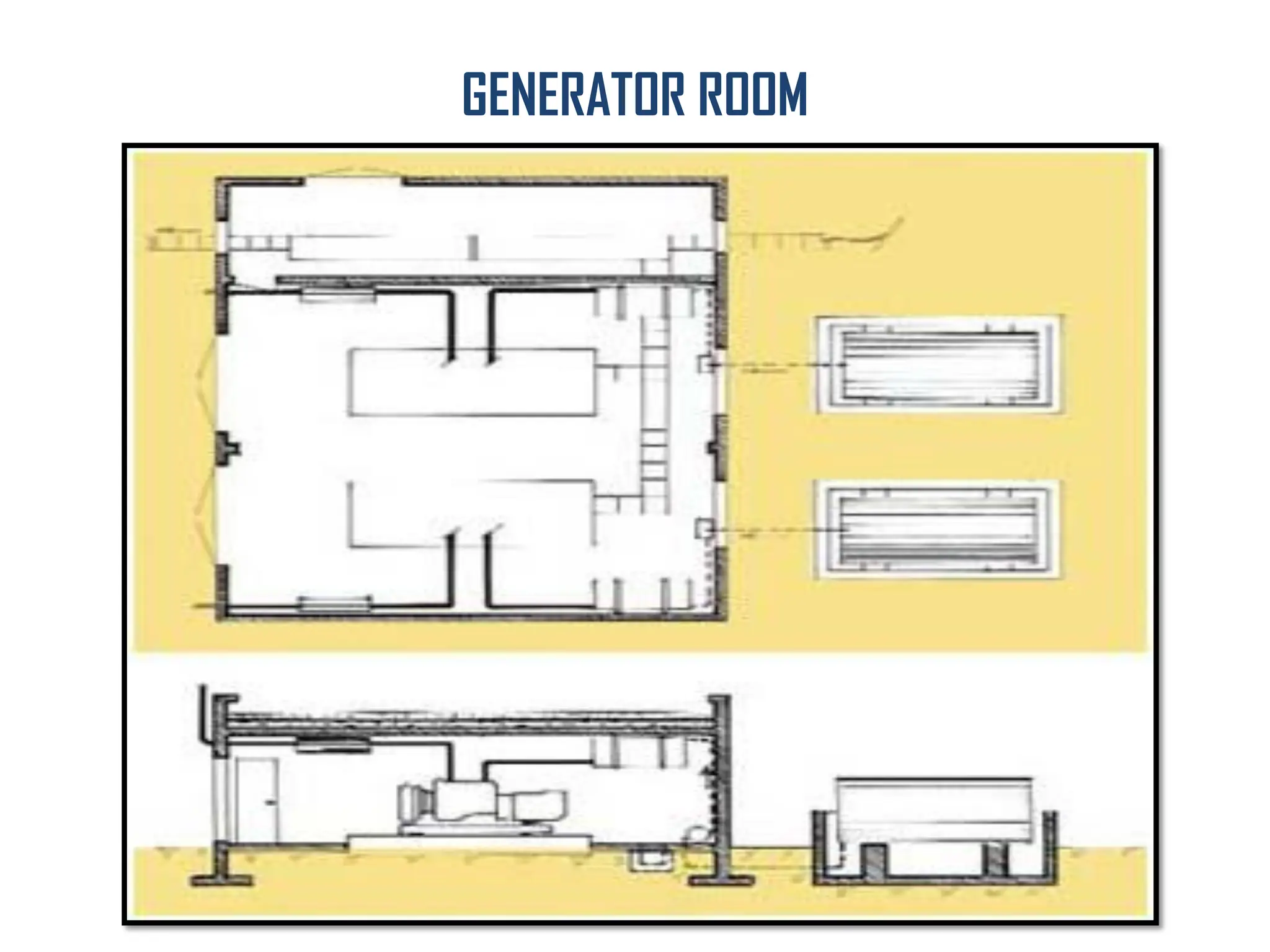
GENERATOR ROOM

Electrical services WITH WIRING FUSES DISTRIBUTION SYSTEMS

  • 1.
  • 2.
    GENERAL IDEA OFGENERATION, TRANSPORTATION AND DISTRIBUTION OF POWER
  • 3.
    Modern power gridsare extremely complex and widespread. Surges in power lines can cause massive network failures and permanent damage to multimillion-dollar equipment in power generation plants. After electricity is produced at power plants it has to get to the customers that use the electricity. As generators spin, they produce electricity with a voltage of about 25,000 volts [a volt is a measurement of electromotive force in electricity, the electric force that pushes electrons around a circuit]. The transmission and distribution system delivers electricity from the generating site (electric power plant) to residential, commercial, and industrial facilities. INTRODUCTION
  • 4.
    The electricity firstgoes to a transformer at the power plant that boosts the voltage up to 400,000 volts for distribution through extra- high voltage (EHV) transmission lines. When electricity travels long distances it is better to have it at higher voltages since the electricity can be transferred more efficiently at high voltages. High voltage transmission lines carry electricity long distances to a substation. At transmission substations a reduction in voltage occurs for distribution to other points in the system through high voltage (HV) transmission lines. Further voltage reductions for commercial and residential customers take place at distribution substations, which connect to the primary distribution network.
  • 5.
    Utility transmission anddistribution systems [T&D] systems link electric generators with end users through a network of power lines and associated components.
  • 6.
    CONVENTIONAL ARCHITECTURE SYMBOLSFOR ELECTRICAL INSTALLATIONS
  • 7.
  • 8.
    Distribution transformers areone of the most widely used elements in the electric distribution system. They convert electricity from the high voltage levels in utility transmission systems to voltages that can safely be used in businesses and homes. Distribution transformers are either mounted on an overhead pole or on a concrete pad. Most commercial and industrial buildings require several low- voltage transformers to decrease the voltage of electricity received from the utility to the levels used to power lights, computers, and other electric-operated equipment.
  • 10.
    Fuses A fuse isa very thin wire, which either melts or vaporizes when too much current flows through it. The thin wire may be made of aluminum, tin-coated copper or nickel. The resulting open in the circuit stops current flow. In electronic equipment, most fuses are cylindrical glass or ceramic type with a metal cap at each end! The current rating also can be seen in one of the two metal end caps.
  • 12.
    There are twobasic types of fuses: fast acting and slow blow. The fast acting type will open very quickly when their particular current rating is exceeded. This is important for analog meter movements, which can quickly be destroyed when too much current flows through them, for even a very small amount of time. Slow blow fuse have a coiled construction inside. They are designed to open only on a continued overload, such as a short circuit. he purpose of coiled construction is to prevent the fuse from blowing on just a temporary current surge. TYPES OF FUSES
  • 13.
    PLUG FUSE Having amaximum capacity of 30 amperes, it screws in like a light bulb and protects a circuit of 120 volts. CARTRIDGE FUSE Having a maximum capacity of 60 amperes, it protects a circuit of . KNIFE-BLADE CARTRIDGE FUSE Having a capacity of 60 to 600 amperes, it protects the main electric circuit.
  • 14.
  • 15.
    distribution board A distribution board(or panel board) is a component of an electricity supply system which divides an electrical power feed into subsidiary circuits, while providing a protective fuse or circuit breaker for each circuit, in a common enclosure. Normally, a main switch, and in recent boards, one or more Residual-current devices (RCD) or Residual Current Breakers with Over current protection (RCBO), will also be incorporated.
  • 16.
  • 17.
    Types of wiringas using 1. Domestic Wiring. 2. Commercial Wiring. 3. Industrial wiring. Wiring System 1. Tree System. 2. Looping System. (a) Switch and two plate ceiling rose or switch and batten holder lopping. (b) Three plate ceiling rose looping. (c) In junction box looping INTRODUCTION OF WIRING
  • 18.
    TYPES OF WIRING CleatWiring Batten Wiring (a) PVC Batten wiring. (b) TRS/CTS Wiring. (c)Lead Shedh Wiring. Casing Capping wiring (a) Wood Casing capping Wiring (b) PVC Casing Capping Wiring Conduit Wiring (a) Surface conduit wiring Metal Conduit Wiring PVC conduit wiring (b) Consiled Conduit Wiring Metal Conduit Wiring. PVC Conduit wiring.
  • 19.
    CLEAT WIRING Introduction The typesof wiring to be adopted is dependent on various factors, viz, durability, safety, appearance, cost, consumer’s budget etc. Cleat wiring This System uses insulated Cables sub protected in porcelain cleats. Cleat wiring is recommended only for temporary installations. The cleats are made in pairs having bottom and top halves.
  • 20.
    The bottom halfis grooved to receive the wire and the top half is for cable grip. Initially the bottom and top cleats are fixed on the wall loosely according to the layout. Then the cable is drawn, tensioned and the cleats are tightened by the screw. Cleats are of three types, having one, two or three grooves, so as to receive one, two or three wires. Two types of cleats.
  • 21.
    Cleat wiring isone of the cheapest wiring considering the initial cost and labor, and is most suitable for temporary wiring. This wiring can be quickly installed, easily inspected and altered. When not required, this wiring could be dismantled without damage to the cables, cleats and accessories.
  • 25.
    BATTEN WIRING Tough rubber-Sheathed(T.R.S.) or PVC- Sheathed cables are suitable to run on teak wood battens. Varnishing of teak wood batten Method of securing the battens Suitability of tough rubber-sheathed cable Suitability of PVC sheathed cable Painting - Bending in wiring - Passing through the walls - Buried cable
  • 26.
    CASING CAPPING WIRING Introduction Thissystem of wiring is suitable for low voltage installation, in this wiring, cables like vulcanized rubber, insulated cables or plastic insulated cables are use and carried within the wood casing enclosures. The wood casing wiring system shall not be use in damp places and in ill-ventilated places, unless suitable precautions are taken.
  • 28.
    Material and patternof casing All casing shall be of first class, seasoned teak wood or any other approved hardwood free from knots, shakes, saps or other defects, with all the sides planed to a smooth finish, and all sides well varnished, both inside and out side with pure shellac varnish. The casing shall have a grooved body with a beaded or plain- molded cover as desired. CONDUIT WIRING Introduction In general, a conduit is defined as a tube or channel. Tubular conduit is the most commonly used material in electrical installations.
  • 29.
    TYPES OF CONDUITS Thereare four types of conduits used for wiring. Rigid steel conduit Rigid non-metallic conduit Flexible steel conduit Flexible non metallic conduit. When cables are drawn through the conduit and terminated at the outlet or switch points, the system of wiring is called conduit wiring.
  • 31.
    Wire is usedto electrically connect circuit parts, devices, equipment etc. There are various kinds of wiring materials. The different types of wire can be divided largely into two categories: single wire and twisted strand wire. It really doesn't matter which kind you use for a given application, but usually, single wire is used to connect devices (resistors, capacitors etc) together on the PWB. (Parts that don't move) It is also used for jumper wiring. Twisted strand wire can bend freely, so it can be used for wiring on the PWB, and also to connect discrete pieces of equipment. and enameled wire with a burnt WIRING MATERIAL
  • 32.
    If single wireis used to connect separate equipment, it will break soon, as it is not very flexible. It is convenient to use the single tin coated wire of the diameter 0.32 mm for the wiring of PWB. If the diameter is larger, soldering becomes a little bit difficult. And if the diameter is too thin, it becomes difficult to bend the wire the way you want it to stay. It's best to use whatever wire you are comfortable with, and not worry about those things. If you want to connect separated parts on the PWB, twisted wire covered with soft insulation material is most convenient for wiring. It's convenient to wire the circuit using different color wires for different purposes. Otherwise, wiring the circuit with many wires the same color gets confusing.
  • 33.
    The photograph onthe left shows several colors of twisted wire. It is called 0.12/7PVC. The pictured wire is comprised of 7 tin coated wires 0.12 mm each in diameter, covered by very thin PVC plastic. In the photograph to the right is pictured tin coated wire with a diameter of 0.32 mm. It is convenient to use for wiring components, jumper wiring etc. when you are building a circuit on a universal PWB. Pictured at the left is polyurethane wire, 0.4 mm in diameter. It is used for making coils. There are several kinds of coated wires. Tin coated wire colored silver, polyurethane enameled copper wire(UEW) which has a thin brown color, polyester enameled copper wire (PEW) which is also thin brown,
  • 37.
  • 38.
    INTRODUCTION: TYPES OFSWITCHES The switch is one of the most basic yet important electrical devise in the home. Although they almost all look the same once the face plate is on, they can function very differently. Their are a few key types of switches you need to know about and I'll describe them in this tutorial. Switches can come in a toggle style (like those shown in this tutorial), but can also come in a more design oriented "rocker" or "paddle" style such as those made popular by the Leviton "Decora".
  • 39.
    SWITCHES COME INFOUR MAJOR TYPES · Single Pole · Double Pole · Three Way · Four Way
  • 40.
  • 41.
    Single Pole Switch Thesingle pole switch is the general purpose workhorse of switches. Single pole switches turn a light, receptacle or device on and off from a single location. A characteristic of a single pole toggle switch is that it has an on and off marking on the switch, something you will not find on a three or four way switch. Make sure the switch is wired in the correct direction so the words "on" and "off" are facing correctly. A single pole switch has two terminals and is wired to the hot (black) wire. One brass colored terminal is for the incoming hot wire and the other is for the outgoing hot wire to the device. The switch may or may not come with a ground terminal (green screw). As a general rule, you never wire the switch to the neutral wire. Please note, sometimes you may see a white wire attached to the single pole switch but only when it is functioning as a hot wire. In those cases the white wire should have a wrap of black tape on it near the switch terminal to let one know the wire is a hot wire and not a neutral wire.
  • 42.
    Double Pole Switch Thedouble pole switch also has "on" and "off" markings and functions similar to a single pole switch in that it turns something on and off from one location. However, because it has four brass terminals instead of two terminals it can handle switching two hot wires which allows it to switch a 240 volt circuit (or "220/221 whatever it takes..." if you're a Mr. Mom fan (1983)). The switch will also come with a ground terminal (green screw). So bottom line, double pole switches are typically used to switch receptacles and appliances using 240 volt circuits.
  • 43.
    Three Way Switch Thethree way switch is always used in pairs and allows you to turn a light or receptacle on and off from two different locations. These switches have no "on" or "off" markings because the on and off positions will vary as the switches are used. The three way switch has three terminal screws and here's where it can start getting confusing for most people (but it won't be for you, don't worry). The black "hot" wire is attached to the darkest screw terminal marked "COM" for "common." The other two terminals are used to wire up what are called "travelers" or leads for the switch
  • 44.
    It makes noreal difference which traveler wire goes to what traveler terminal on the switch. The switch will also come with a ground terminal (green screw). The trick in replacing a old switch is to mark the COM or common wire off the old three way switch before you replace the old switch. Please note, you cannot use any other type of switch in a three way application, and again, these switches must be used in pairs. Four Way Switch The four way switch is used in between two three-way switches to control an outlet or light fixture from three different locations. If you wanted to control from more than three locations, say five locations, you would still use two three-way switches (one on each end) but now you'd use three four-way switches in between the two three-ways.
  • 45.
    The four wayswitch looks the same as a double pole switch except that a four-way switch will have no "on" or "off" markings. The four-way switch has four terminals most always brass in color. There is no COM or "common" wire like a three-way switch. The four-way switch simply functions as a switching device for the traveler wires between the three-way switches.
  • 46.
  • 47.
  • 48.
  • 49.
  • 50.
  • 51.
    Electrical terms andunits of measure Power Power is the rate at which energy is produced or used. The unit of measurement for power is the watt (W). If you examine a light bulb carefully you will see that it has maybe "45, 60 or 100 watts" written on it. If it has "60 watts" written on it this means that it uses 60 joules of energy for every second it is on. If a power station has an output of 600 megawatts (MW) of electrical power, it is producing 600 000 000 joules of energy every second. Imagine how many light bulbs that would keep going!
  • 52.
    Voltage The volt isnamed in honour of Alessandro Volta, an Italian scientist. Voltage is the difference of electrical potential between two points of an electrical or electronic circuit, expressed in volts. It measures the potential energy of an electric field to cause an electric current in an electrical conductor. Depending on the difference of electrical potential it is called extra low voltage, low voltage, high voltage or extra high voltage. Voltage is the unit of measure for electro-motive force required to pass one ampere through a resistance of one ohm (see "Resistance" below).
  • 53.
    Ampere The ampere (or"amp"), named after the French scientist Andre Maria Ampere, is a measure applied to the flow of electrons. An "amp" is a unit of measurement for electrical current. One ampere represents the rate of 1 coulomb of charge per second. A coulomb is equivalent to 6.24 X 10¹⁸ electron charges, hence a current of one amp means a flow of 6.24 X 10¹⁸ electron charges passes any given cross section of the conductor per second. Resistance ohm The German scientist Georg Simon Ohm discovered that in any conductor, electrons encounter a resistance whilst flowing through a circuit. He proved experimentally that the current in a metallic conductor is directly proportional to the voltage between its ends.
  • 54.
    Power A watt isthe unit of electric power. One watt is a measure of the power consumed when a current of one "ampere" flows under a pressure of one "volt". Electrical arithmetic On all electrical appliances you will find the "rating" marked in watts (for example, iron - 600 watts, heater - 1 000 watts, lamps - 100 watts. The power taken by any appliance (such as a toaster, heater, kettle etc.) is found by multiplying the voltage by the current: watts = volts X amperes (Amps) and 1000 watts = 1 Kilowatt (kW) 1,000,000 watts = 1 Megawatt (MW)
  • 55.
  • 57.
  • 58.