DATA COLLECTION
PRIMARY & SECONDARY
PRESENTATION BY:
Amogh Kadam
Rizwan Shaikh
Prathmesh Parab
INTRODUCTION
Data collection is a term used to describe
a process of preparing and collecting data
 Systematic gathering of data for
a particular purpose from various
sources, that has been systematically
observed, recorded, organized.
 Data are the basic inputs to any decision
making process in business

PURPOSE OF DATA
COLLECTION








The purpose of data collection isto obtain information
to keep on record
to make decisions
about important issues,
to pass information on
to others
CLASSIFICATION OF DATA

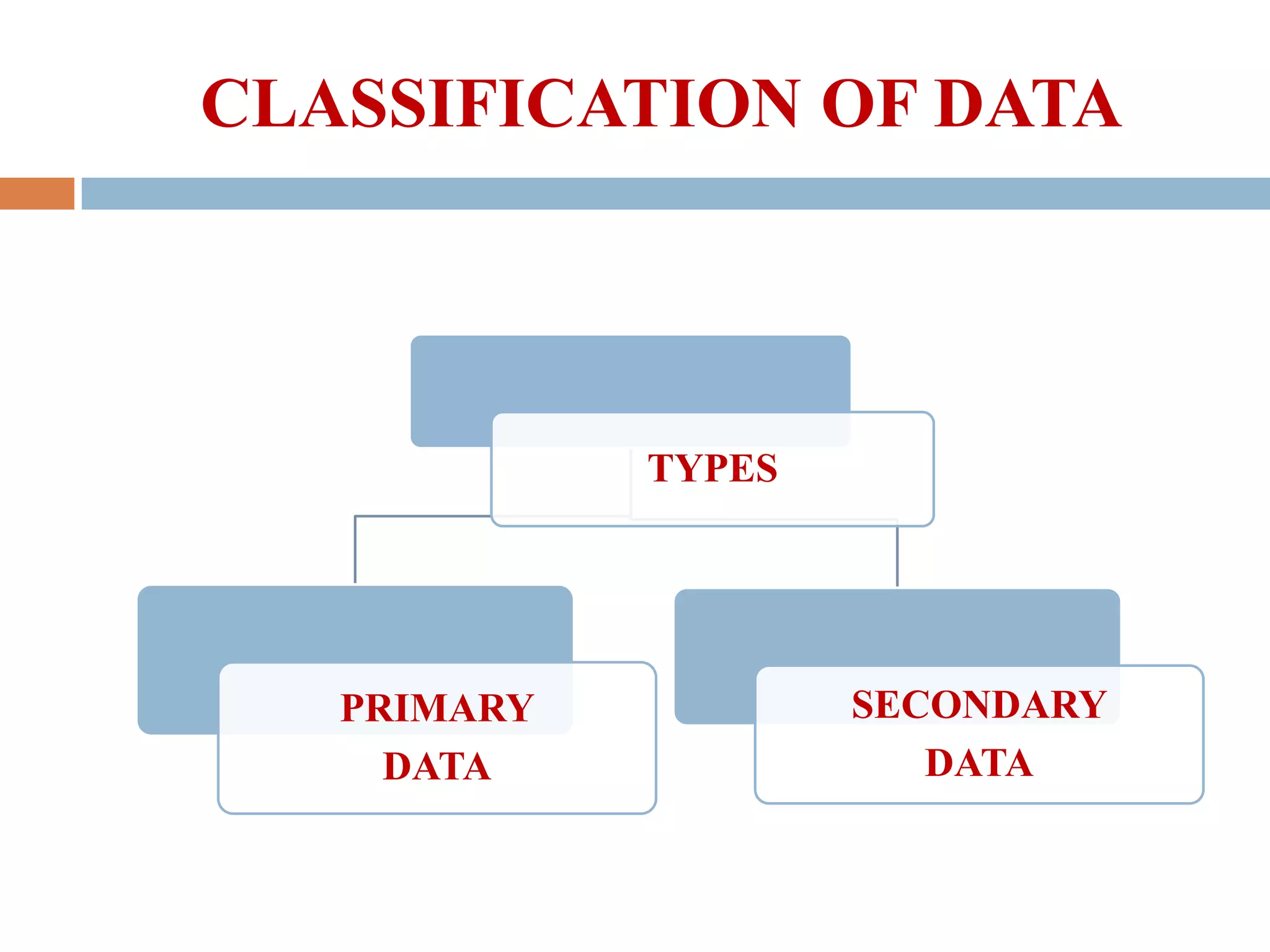
TYPES

PRIMARY
DATA

SECONDARY
DATA
PRIMARY DATA










The data which are collected from the field under
the control and supervision of an investigator
Primary data means original data that has been
collected specially for the purpose in mind
This type of data are generally afresh and collected
for the first time
It is useful for current studies as well as for future
studies
For example: your own questionnaire.
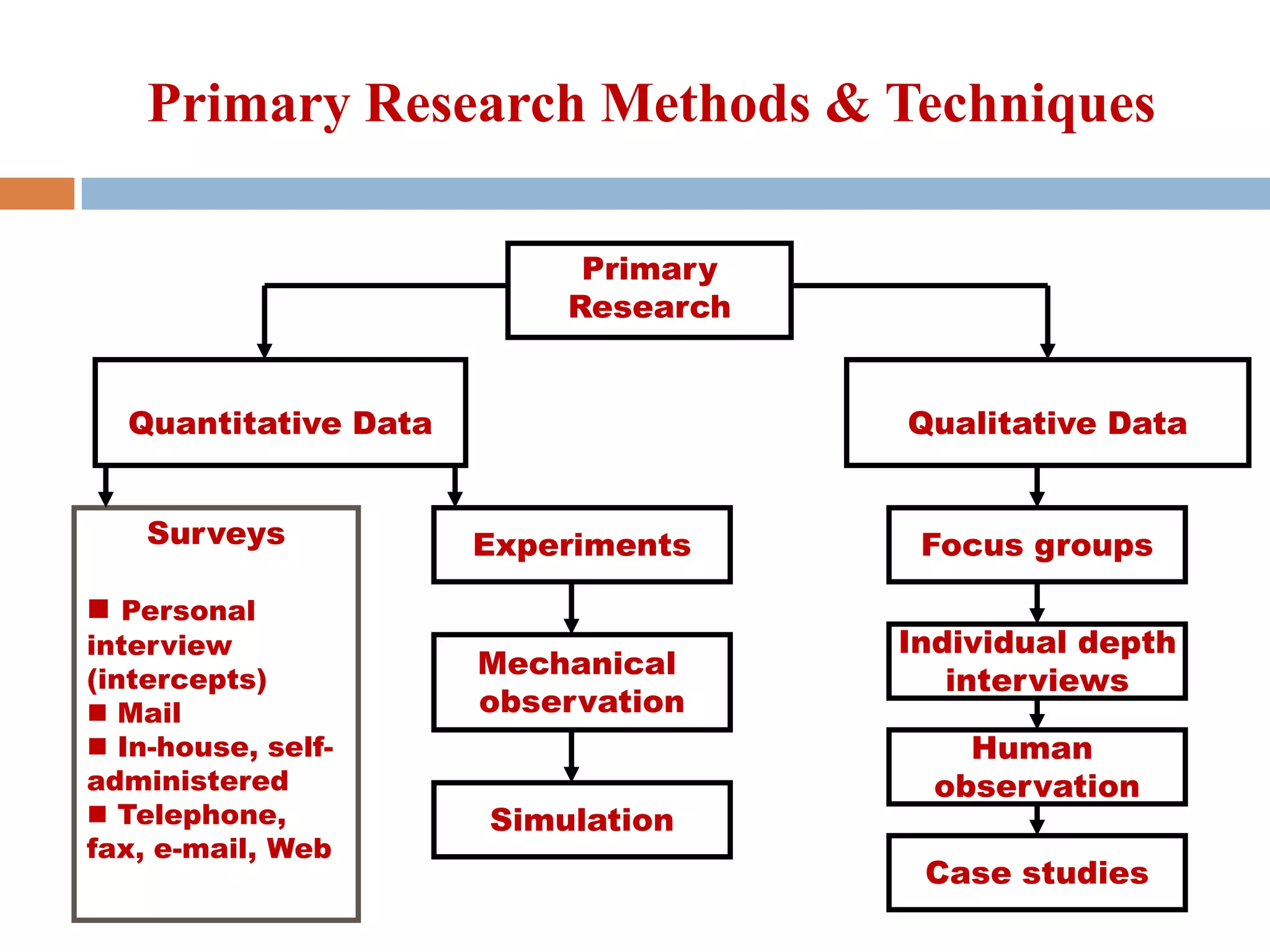
Primary Research Methods & Techniques
Primary
Research
Quantitative Data

Surveys

Qualitative Data

Experiments

 Personal

interview
(intercepts)
 Mail
 In-house, selfadministered
 Telephone,
fax, e-mail, Web

Mechanical
observation
Simulation

Focus groups
Individual depth
interviews

Human
observation
Case studies
Primary Research Methods & Techniques






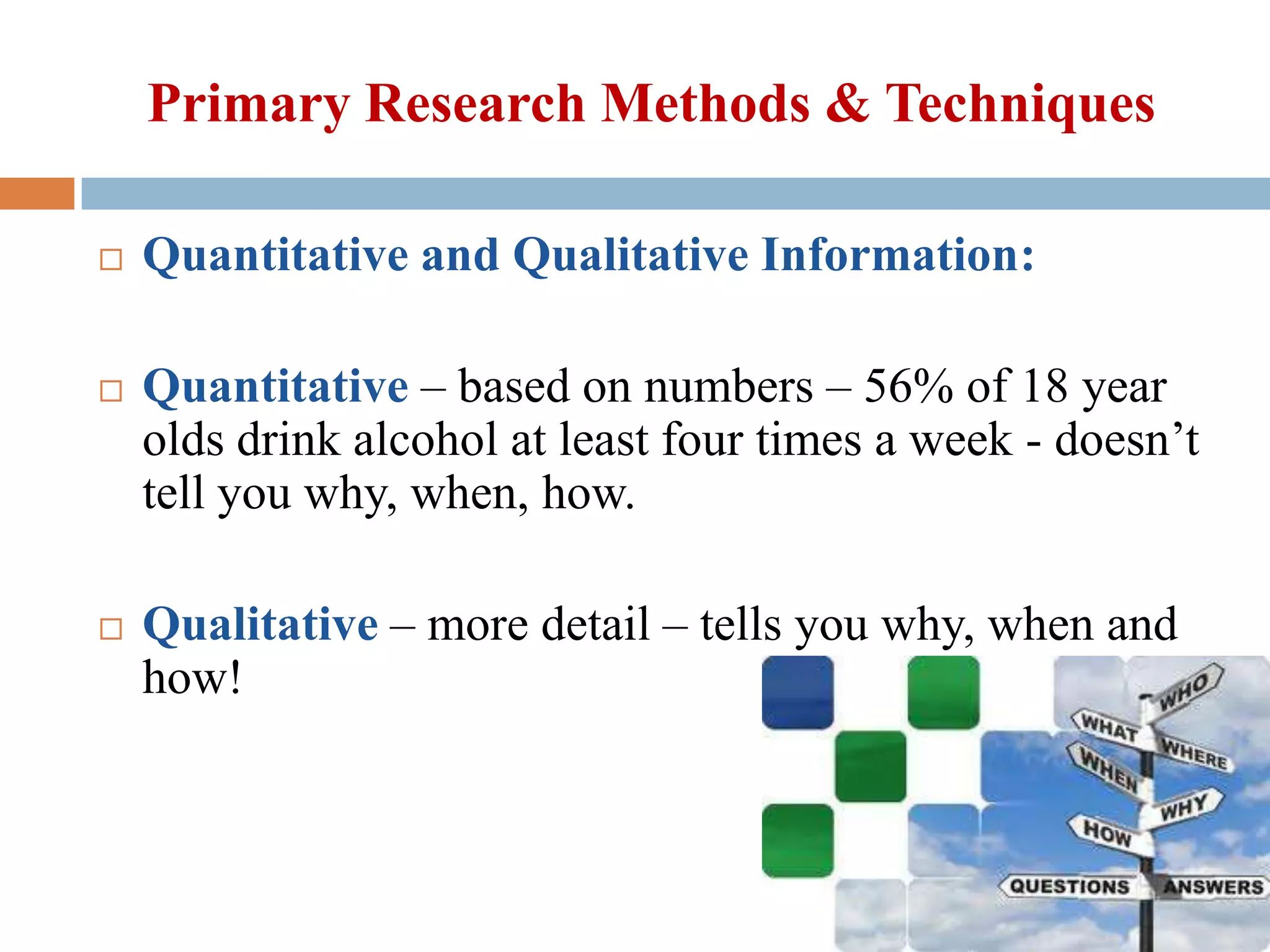
Quantitative and Qualitative Information:
Quantitative – based on numbers – 56% of 18 year
olds drink alcohol at least four times a week - doesn’t
tell you why, when, how.
Qualitative – more detail – tells you why, when and
how!
Primary Research Categories


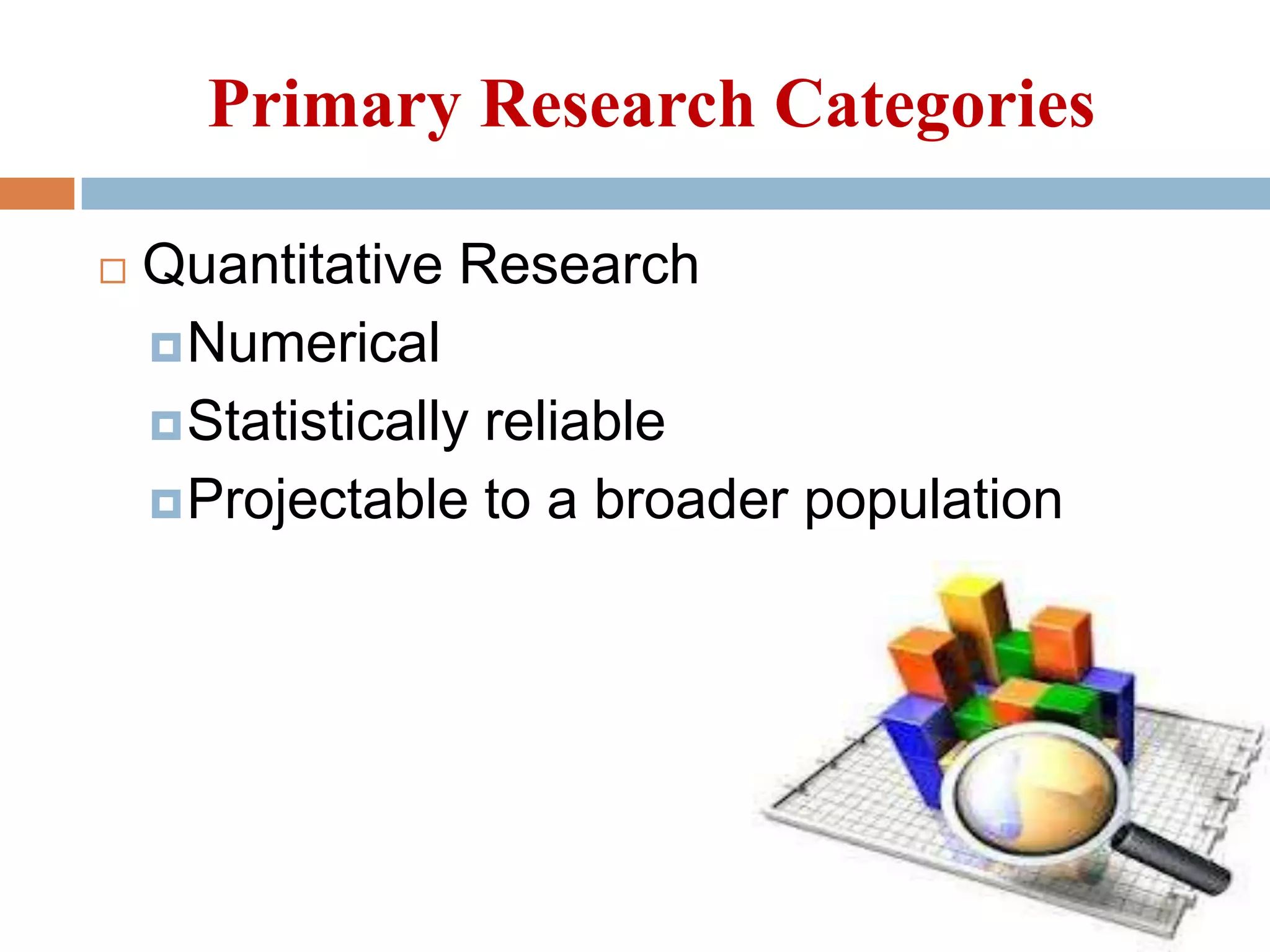
Quantitative Research
 Numerical
 Statistically reliable
 Projectable to a broader population
Quantitative Research Categories



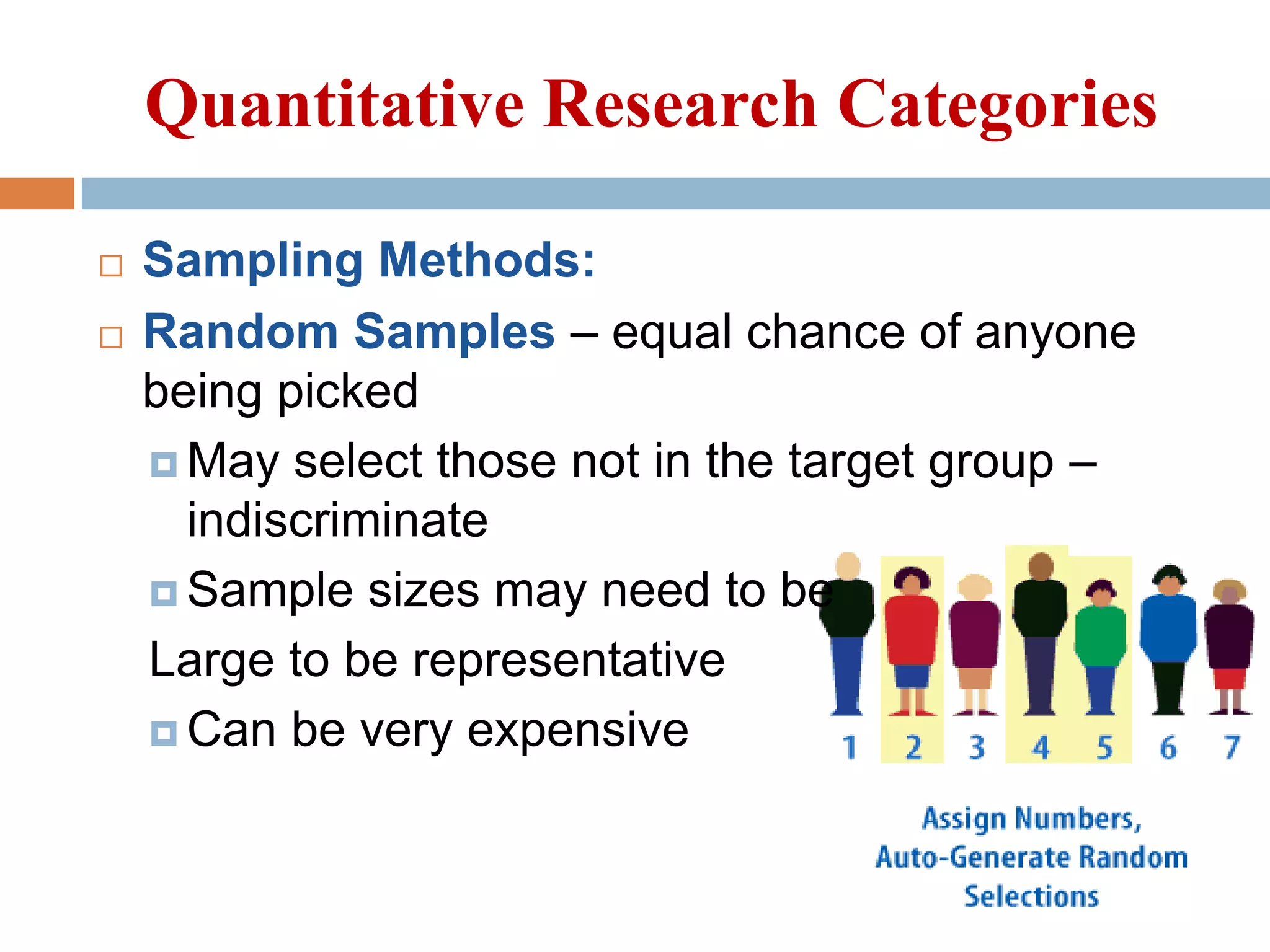
Sampling Methods:
Random Samples – equal chance of anyone
being picked
 May select those not in the target group –
indiscriminate
 Sample sizes may need to be
Large to be representative
 Can be very expensive
Quantitative Research Categories


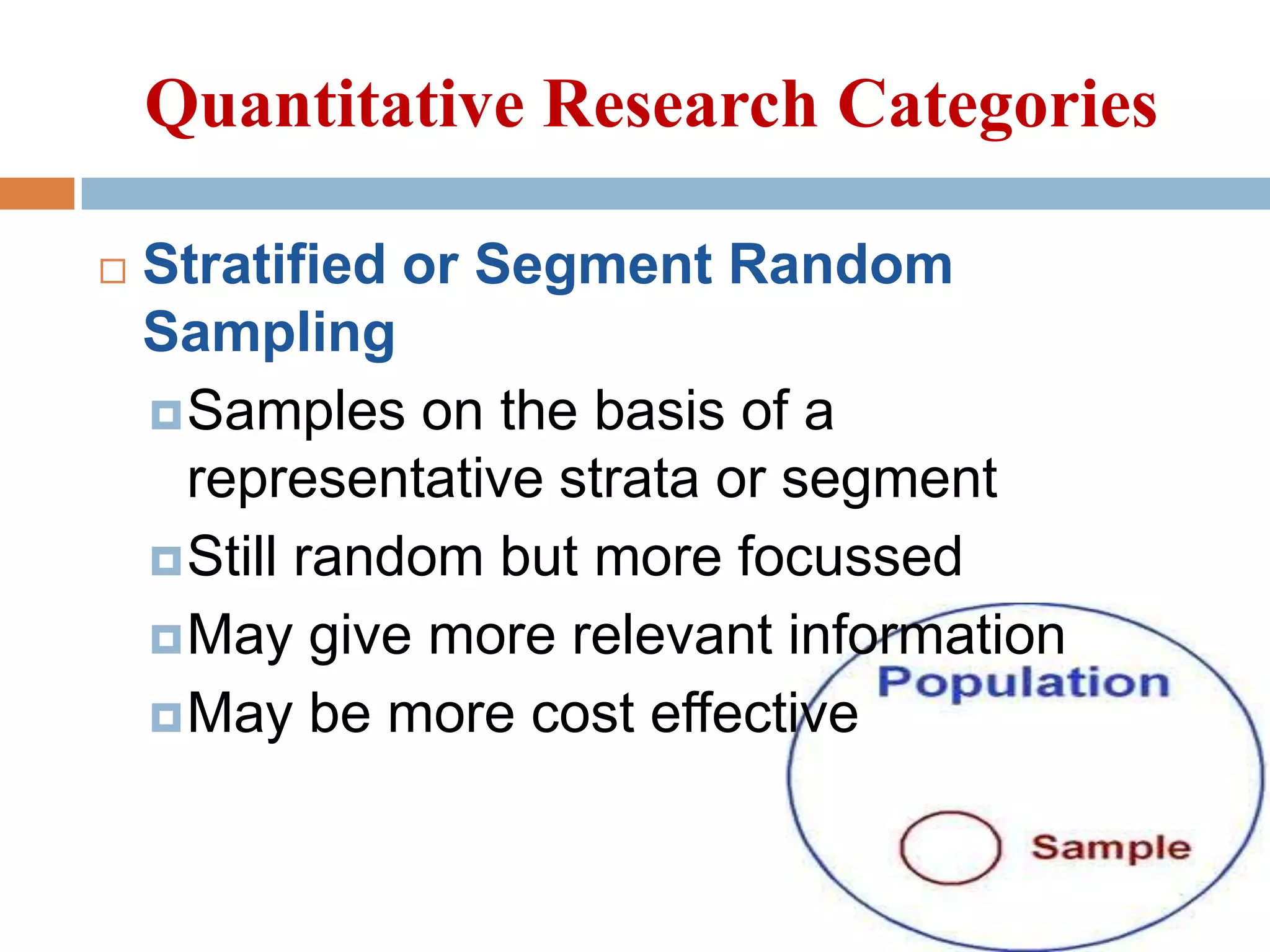
Stratified or Segment Random
Sampling
 Samples on the basis of a
representative strata or segment
 Still random but more focussed
 May give more relevant information
 May be more cost effective
Quantitative Research Categories


Quota Sampling
– by segment
 Not randomly selected
 Specific number on each segment are
interviewed, etc.
 May not be fully representative
 Cheaper method
 Again
Qualitative Research Categories


Qualitative Research
 In-depth, insight generating
 Non-numerical
 ‘Directional’



Common Techniques
 Personal interviews (depth, one-on-one)
 Focus groups (8-12) and mini-groups (36)
METHODS








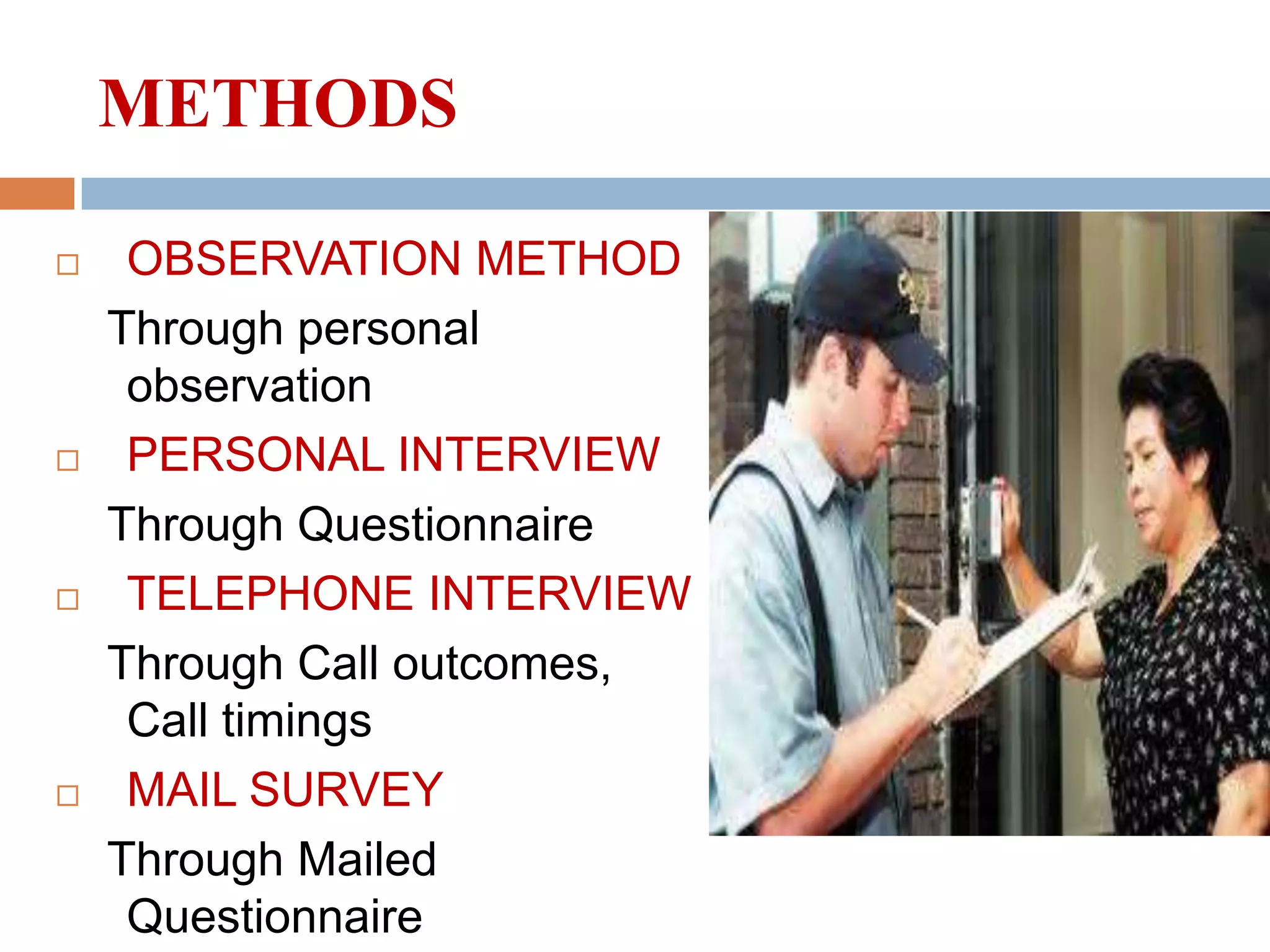
OBSERVATION METHOD
Through personal
observation
PERSONAL INTERVIEW
Through Questionnaire
TELEPHONE INTERVIEW
Through Call outcomes,
Call timings
MAIL SURVEY
Through Mailed
Questionnaire
SECONDARY DATA









Data gathered and recorded by someone else prior
to and for a purpose other than the current project
Secondary data is data that has been collected for
another purpose.
It involves less cost, time and effort
Secondary data is data that is being reused. Usually
in a different context.
For example: data from a book.
SOURCES


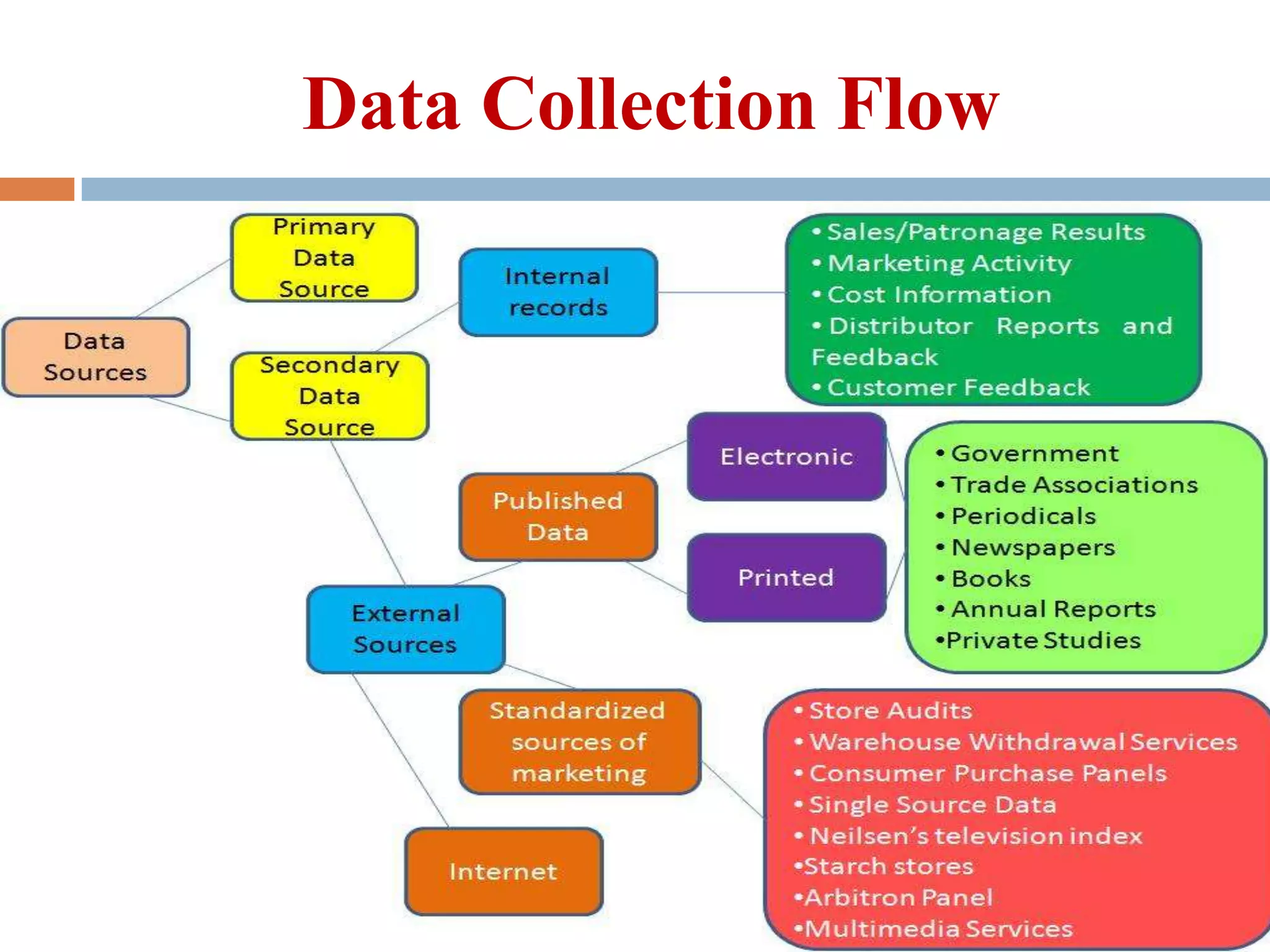
INTERNAL SOURCES

Internal sources of secondary data are usually
for marketing application Sales Records
 Marketing Activity
 Cost Information
 Distributor reports and feedback
 Customer feedback
SOURCES









EXTERNAL SOURCES
External sources of secondary data are usually
for Financial applicationJournals
Books
Magazines
Newspaper
Libraries
The Internet
Advantages & Disadvantages of
Primary Data
Advantages
 Targeted Issues are addressed
 Data interpretation is better
 Efficient Spending for Information
 Decency of Data
 Proprietary Issues
 Addresses Specific Research Issues
 Greater Control

Advantages & Disadvantages of
Primary Data
Disadvantages
 High Cost
 Time Consuming
 Inaccurate Feed-backs
 More number of resources is required

Advantages & Disadvantages of
Secondary Data
Advantages
 Ease of Access
 Low Cost to Acquire
 Clarification of Research Question
 May Answer Research Question

Disadvantages & Disadvantages of
Secondary Data
Disadvantages
 Quality of Research
 Not Specific to Researcher’s Needs
 Incomplete Information
 Not Timely

Data Collection Flow
Data Collection-Primary & Secondary

Data Collection-Primary & Secondary

  • 1.
    DATA COLLECTION PRIMARY &SECONDARY PRESENTATION BY: Amogh Kadam Rizwan Shaikh Prathmesh Parab
  • 2.
    INTRODUCTION Data collection isa term used to describe a process of preparing and collecting data  Systematic gathering of data for a particular purpose from various sources, that has been systematically observed, recorded, organized.  Data are the basic inputs to any decision making process in business 
  • 3.
    PURPOSE OF DATA COLLECTION      Thepurpose of data collection isto obtain information to keep on record to make decisions about important issues, to pass information on to others
  • 4.
  • 5.
    PRIMARY DATA      The datawhich are collected from the field under the control and supervision of an investigator Primary data means original data that has been collected specially for the purpose in mind This type of data are generally afresh and collected for the first time It is useful for current studies as well as for future studies For example: your own questionnaire.
  • 6.
    Primary Research Methods& Techniques Primary Research Quantitative Data Surveys Qualitative Data Experiments  Personal interview (intercepts)  Mail  In-house, selfadministered  Telephone, fax, e-mail, Web Mechanical observation Simulation Focus groups Individual depth interviews Human observation Case studies
  • 7.
    Primary Research Methods& Techniques    Quantitative and Qualitative Information: Quantitative – based on numbers – 56% of 18 year olds drink alcohol at least four times a week - doesn’t tell you why, when, how. Qualitative – more detail – tells you why, when and how!
  • 8.
    Primary Research Categories  QuantitativeResearch  Numerical  Statistically reliable  Projectable to a broader population
  • 9.
    Quantitative Research Categories   SamplingMethods: Random Samples – equal chance of anyone being picked  May select those not in the target group – indiscriminate  Sample sizes may need to be Large to be representative  Can be very expensive
  • 10.
    Quantitative Research Categories  Stratifiedor Segment Random Sampling  Samples on the basis of a representative strata or segment  Still random but more focussed  May give more relevant information  May be more cost effective
  • 11.
    Quantitative Research Categories  QuotaSampling – by segment  Not randomly selected  Specific number on each segment are interviewed, etc.  May not be fully representative  Cheaper method  Again
  • 12.
    Qualitative Research Categories  QualitativeResearch  In-depth, insight generating  Non-numerical  ‘Directional’  Common Techniques  Personal interviews (depth, one-on-one)  Focus groups (8-12) and mini-groups (36)
  • 13.
    METHODS     OBSERVATION METHOD Through personal observation PERSONALINTERVIEW Through Questionnaire TELEPHONE INTERVIEW Through Call outcomes, Call timings MAIL SURVEY Through Mailed Questionnaire
  • 14.
    SECONDARY DATA      Data gatheredand recorded by someone else prior to and for a purpose other than the current project Secondary data is data that has been collected for another purpose. It involves less cost, time and effort Secondary data is data that is being reused. Usually in a different context. For example: data from a book.
  • 15.
    SOURCES  INTERNAL SOURCES Internal sourcesof secondary data are usually for marketing application Sales Records  Marketing Activity  Cost Information  Distributor reports and feedback  Customer feedback
  • 16.
    SOURCES        EXTERNAL SOURCES External sourcesof secondary data are usually for Financial applicationJournals Books Magazines Newspaper Libraries The Internet
  • 17.
    Advantages & Disadvantagesof Primary Data Advantages  Targeted Issues are addressed  Data interpretation is better  Efficient Spending for Information  Decency of Data  Proprietary Issues  Addresses Specific Research Issues  Greater Control 
  • 18.
    Advantages & Disadvantagesof Primary Data Disadvantages  High Cost  Time Consuming  Inaccurate Feed-backs  More number of resources is required 
  • 19.
    Advantages & Disadvantagesof Secondary Data Advantages  Ease of Access  Low Cost to Acquire  Clarification of Research Question  May Answer Research Question 
  • 20.
    Disadvantages & Disadvantagesof Secondary Data Disadvantages  Quality of Research  Not Specific to Researcher’s Needs  Incomplete Information  Not Timely 
  • 21.