Methods of Data Collection
Presented by
Presented by
Santosh Borkakati
Santosh Borkakati
Asst. Professor
Asst. Professor
Department of Economics
Mangaldai College
Mangaldai College
What is Data?
What is Data?
 Data is a existing information
Data is a existing information
/knowledge
/knowledge represented
represented or
or coded
coded in
in
some form suitable for better
usage or processing.
Data is a set of values of qualitative
Data is a set of values of qualitative
or quantitative variables.
Quantitative Vs Qualitative Data
 Quantitative data are anything that can be
Quantitative data are anything that can be
expressed as a number, or quantified. These
data may be represented by ordinal, interval or
ratio scales and lend themselves to most
statistical manipulation.
 Qualitative data is a categorical measurement
Qualitative data is a categorical measurement
expressed not in terms of numbers, but rather
by means of a natural language description. In
statistics, it is often used interchangeably with
"categorical" data.
"categorical" data.
For example: favorite color = "blue"
Quantitative Vs Qualitative Data
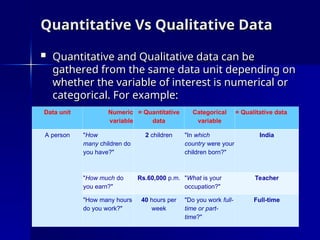
 Quantitative and Qualitative data can be
Quantitative and Qualitative data can be
gathered from the same data unit depending on
whether the variable of interest is numerical or
categorical. For example:
Data unit Numeric
variable
= Quantitative
data
Categorical
variable
= Qualitative data
A person "How
many children do
you have?"
2 children "In which
country were your
children born?"
India
"How much do
you earn?"
Rs.60,000 p.m. "What is your
occupation?"
Teacher
"How many hours
do you work?"
40 hours per
week
"Do you work full-
time or part-
time?"
Full-time
Primary and Secondary Data
 The task of data collection begins after a
The task of data collection begins after a
research problem has been defined and
research design/plan chalked out.
 While deciding about the method of data
While deciding about the method of data
collection to be used for the study, the
researcher should keep in mind two types
of data viz., primary and secondary.
Primary and Secondary Data
 Primary Data are collected by the researcher.
Primary Data are collected by the researcher.
 Secondary data collected by someone else and
Secondary data collected by someone else and
have already been passed through the statistical
process.
process.
 A researcher as per requirement of study may
A researcher as per requirement of study may
decide on use of primary data or secondary
data or both.
data or both.
 Both primary and secondary data have their own
Both primary and secondary data have their own
pros and cons.
pros and cons.
Methods of Collecting Data
 The methods of collecting data
The methods of collecting data
mainly refers to collecting primary
data.
data.
 As secondary data are already
As secondary data are already
available, we have to carefully choose
the sources , relevancy of data and
reliability.
reliability.
Collecting Secondary Data
 Sources of secondary data are existing
Sources of secondary data are existing
literature, Reports of professional
agencies, Departments, Archives,
Internet, etc.
Internet, etc.
 While collecting secondary data one has
While collecting secondary data one has
to follow legal procedures required and
maintain the academic ethics.
Methods of Collecting
Primary Data
Primary Data
There are several methods of collecting
primary data, particularly in surveys and
descriptive research. Important ones are-
 Observation
Observation
 Interview
Interview
 Questionnaire
Questionnaire
 Schedule
Schedule
 Other Methods
Other Methods
Observation
Observation
See what is happening
– traffic patterns
traffic patterns
– land use patterns
land use patterns
– layout of city and rural areas
layout of city and rural areas
– quality of housing
quality of housing
– condition of roads
condition of roads
– conditions of buildings
conditions of buildings
– who goes to a health clinic
who goes to a health clinic
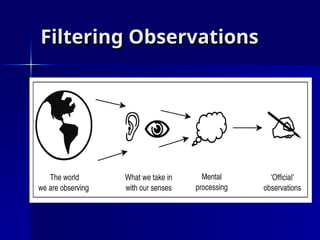
Filtering Observations
Observation is Helpful
when:
when:
 Need direct information
Need direct information
 Trying to understand ongoing
Trying to understand ongoing
behavior
behavior
 There is physical evidence, products,
There is physical evidence, products,
or outputs than can be observed
 Need to provide alternative when
Need to provide alternative when
other data collection is infeasible or
inappropriate
inappropriate
Types of Observation
 Participatory and Non Participatory
Participatory and Non Participatory
 Candid and Covert
Candid and Covert
 Structured, Semi-structured and
Structured, Semi-structured and
Unstructured.
Unstructured.
 Controlled and Uncontrolled
Controlled and Uncontrolled
Advantages/Disadvantages of
Observation
Observation
Advantages:
Advantages:
 Subjective bias eliminated
Subjective bias eliminated
 Researcher gets current information
Researcher gets current information
 Independent of Respondents
Independent of Respondents
 Disadvantages:
Disadvantages:
 Expensive, Time consuming
Expensive, Time consuming
 Limited information
Limited information
 Unforeseen factors may influence observation
Unforeseen factors may influence observation
Interview
Interview
 The interview method of collecting data
The interview method of collecting data
involves presentation of oral-verbal stimuli
and reply in terms of oral-verbal responses.
 This method can be used through personal
This method can be used through personal
interviews or telephone interviews.
 Structured, Semi-Structured or
Structured, Semi-Structured or
Unstructured Interview.
Interview Types
Interview Types
 Personal Interviews
Personal Interviews: Interviewer asking questions
: Interviewer asking questions
generally in a face-to-face contact to the other
person or persons. Direct personal investigation
or Indirect oral investigation.
 Focused Interview
Focused Interview is meant to focus attention on
is meant to focus attention on
the given experience of the respondent and its
effects.
effects.
 Clinical Interview
Clinical Interview is concerned with broad
is concerned with broad
underlying feelings or motivations or with the
course of individual’s life experience.
 Non-directive Interview
Non-directive Interview is that where the
is that where the
interviewer’s function is simply to encourage the
respondent to talk about the given topic with a
bare minimum of direct questioning.
Skill
Skill of Interviewer
of Interviewer
The main game in interviewing is to
facilitate an interviewee’s ability to
answer. This involves:
– easing respondents into the interview
easing respondents into the interview
– asking strategic questions
asking strategic questions
– prompting and probing appropriately
prompting and probing appropriately
– keeping it moving
keeping it moving
– winding it down when the time is right
winding it down when the time is right
Merits/Demerits of Interview
Merits:
Merits:
 More and in depth information obtained
More and in depth information obtained
 Personal Information
Personal Information
 Greater Flexibility
Greater Flexibility
 Adaptation as per the respondent
Adaptation as per the respondent
Demerits:
Demerits:
 Bias of Interviewer
Bias of Interviewer
 Expensive/Time Consuming
Expensive/Time Consuming
 Need expertise
Need expertise
Questionnaire Method
 A questionnaire is sent (usually by post) to
A questionnaire is sent (usually by post) to
persons concerned with a request to answer
the questions and return the questionnaire.
 A questionnaire consists of a number of
A questionnaire consists of a number of
questions printed in a definite order.
 The respondents have to answer the
The respondents have to answer the
questions on their own.
Steps in questionnaire
construction
construction
 Preparation
Preparation
 Constructing the first draft
Constructing the first draft
 Self-evaluation
Self-evaluation
 External evaluation
External evaluation
 Revision
Revision
 Pre-test or Pilot study
Pre-test or Pilot study
 Revision
Revision
 Second pre-testing
Second pre-testing
 Preparing final draft
Preparing final draft
Essentials of a Good
Questionnaire
Questionnaire
 Questionnaire should be short and simple
Questionnaire should be short and simple
 Question arranged in from simple to difficult.
Question arranged in from simple to difficult.
 Personal and intimate questions should be
Personal and intimate questions should be
left to the end.
left to the end.
 Technical term and vague expression should
Technical term and vague expression should
be avoided.
be avoided.
 Questions should be answered in yes or no ;
Questions should be answered in yes or no ;
multiple choice.
multiple choice.
 Control question to cross check the
Control question to cross check the
information of the responded.
Advantages of Questionnaire
 Lower cost
Lower cost
 Time saving
Time saving
 Accessibility to widespread respondents
Accessibility to widespread respondents
 No interviewer’s bias
No interviewer’s bias
 Greater anonymity
Greater anonymity
 Respondent’s convenience
Respondent’s convenience
 Standard wordings
Standard wordings
 No Variation
No Variation
Disadvantages of questionnaire
 Questionnaires can be used only for educated people.
Questionnaires can be used only for educated people.
 Sometimes different respondent’s interpreted questions
Sometimes different respondent’s interpreted questions
differently
differently
 Questionnaires do not provide an opportunity to collect
Questionnaires do not provide an opportunity to collect
additional information
 Researchers are not sure whether the person to whom the
Researchers are not sure whether the person to whom the
questionnaire was mailed has himself answered the
questions.
questions.
 Many questions remain unanswered
Many questions remain unanswered
 The respondent can consult other persons before filling
The respondent can consult other persons before filling
in the questionnaire.
Collection of Data Through Schedule
 Schedules like questionnaires
Schedules like questionnaires
contain a set of questions.
 Researcher /Enumerators appointed
Researcher /Enumerators appointed
collect data through schedules.
 Enumerators go to the field, put
Enumerators go to the field, put
questions to the respondents and
fill the schedules.
fill the schedules.
 Enumerators need to be trained.
Enumerators need to be trained.
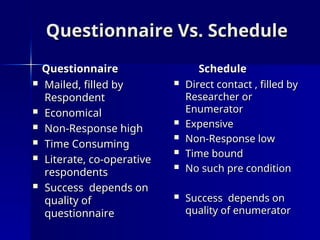
Questionnaire Vs. Schedule
Questionnaire
Questionnaire
 Mailed, filled by
Mailed, filled by
Respondent
Respondent
 Economical
Economical
 Non-Response high
Non-Response high
 Time Consuming
Time Consuming
 Literate, co-operative
Literate, co-operative
respondents
respondents
 Success depends on
Success depends on
quality of
quality of
questionnaire
questionnaire
Schedule
Schedule
 Direct contact , filled by
Direct contact , filled by
Researcher or
Researcher or
Enumerator
Enumerator
 Expensive
Expensive
 Non-Response low
Non-Response low
 Time bound
Time bound
 No such pre condition
No such pre condition
 Success depends on
Success depends on
quality of enumerator
Some Other Methods
Some Other Methods
 Warranty Cards
Warranty Cards Post card size cards sent to
Post card size cards sent to
customers and feedback collected through
asking questions.
asking questions.
 Distributor or Store Audits
Distributor or Store Audits are performed by
are performed by
manufacturer/distributor through salesmen.
Information so obtained are used to estimate
market size, market share, seasonal sales
pattern, etc.
pattern, etc.
 Pantry Audits
Pantry Audits From the observation of pantry of
From the observation of pantry of
customer to know purchase habit of people ( of
which product, what brand, etc.). Questions may
be asked at the time of audit.
Some Other Methods
Some Other Methods
 Consumer Panels
Consumer Panels Pantry audit approach on a
Pantry audit approach on a
regular basis is known as ‘consumer panel’,
where a set of consumers are arranged to come
to an understanding to maintain detailed daily
records of their consumption and the same is
made available to investigator on demands.
 Projective techniques
Projective techniques developed by
developed by
psychologists to use projections of respondents
for inferring about underlying motives, urges, or
intentions which are such that the respondent
either resists to reveal them or is unable to
figure out himself.
figure out himself.
Some Other Methods
Some Other Methods
 Use of Mechanical Devices
Use of Mechanical Devices Eye Camera is used to
Eye Camera is used to
record the focus of eyes of a respondent on a
specific portion of a sketch or diagram or written
material. Psychogalvanometer is used for
measuring the extent of body excitement as a
result of the visual stimulus. Motion picture
camera is used to record movement of
consumer at time of purchase. Audiometer is
used to know the preferences to TV channels,
programmes.
programmes.
Some Other Methods
Some Other Methods
 Depth interviews
Depth interviews are those interviews that are
are those interviews that are
designed to discover underlying motives and
desires and are often used in motivational
research. Indirect question or projective
technique are used to know the behaviour of
respondents.
respondents.
 Content Analysis
Content Analysis Analyzing the contents of
Analyzing the contents of
documentary materials such as books,
magazines, newspapers and the contents of all
other verbal materials which can be either
spoken or printed.
spoken or printed.
Selection of Appropriate Method
of Data Collection
of Data Collection
 Nature, Scope and Object of enquiry
Nature, Scope and Object of enquiry
 Availability of Fund
Availability of Fund
 Availability of Time
Availability of Time
 Degree of Precision Required
Degree of Precision Required
Precautions in Data Collection
 The data must be relevant to the research
The data must be relevant to the research
problem.
problem.
 It should be collected through formal or
It should be collected through formal or
standardized research tools.
 The data should be such as these can be
The data should be such as these can be
subjected to statistical treatment easily.
 The data should have minimum
The data should have minimum
measurement error.
measurement error.
Precautions in Data Collection
 The data must be tenable for the
The data must be tenable for the
verification of the hypotheses.
 The data should be collected through
The data should be collected through
objective procedure.
 The data should be accurate and precise.
The data should be accurate and precise.
 The data should be reliable and valid
The data should be reliable and valid
 The data should be complete in itself and
The data should be complete in itself and
also comprehensive in nature.
THANK YOU
THANK YOU

Methods of Data Collections for research .ppt

  • 1.
    Methods of DataCollection Methods of Data Collection Presented by Presented by Santosh Borkakati Santosh Borkakati Asst. Professor Asst. Professor Department of Economics Department of Economics Mangaldai College Mangaldai College
  • 2.
    What is Data? Whatis Data?  Data is a existing information Data is a existing information /knowledge /knowledge represented represented or or coded coded in in some form suitable for better some form suitable for better usage or processing. usage or processing. Data is a set of values of qualitative Data is a set of values of qualitative or quantitative variables. or quantitative variables.
  • 3.
    Quantitative Vs QualitativeData Quantitative Vs Qualitative Data  Quantitative data are anything that can be Quantitative data are anything that can be expressed as a number, or quantified. These expressed as a number, or quantified. These data may be represented by ordinal, interval or data may be represented by ordinal, interval or ratio scales and lend themselves to most ratio scales and lend themselves to most statistical manipulation. statistical manipulation.  Qualitative data is a categorical measurement Qualitative data is a categorical measurement expressed not in terms of numbers, but rather expressed not in terms of numbers, but rather by means of a natural language description. In by means of a natural language description. In statistics, it is often used interchangeably with statistics, it is often used interchangeably with "categorical" data. "categorical" data. For example: favorite color = "blue" For example: favorite color = "blue"
  • 4.
    Quantitative Vs QualitativeData Quantitative Vs Qualitative Data  Quantitative and Qualitative data can be Quantitative and Qualitative data can be gathered from the same data unit depending on gathered from the same data unit depending on whether the variable of interest is numerical or whether the variable of interest is numerical or categorical. For example: categorical. For example: Data unit Numeric variable = Quantitative data Categorical variable = Qualitative data A person "How many children do you have?" 2 children "In which country were your children born?" India "How much do you earn?" Rs.60,000 p.m. "What is your occupation?" Teacher "How many hours do you work?" 40 hours per week "Do you work full- time or part- time?" Full-time
  • 5.
    Primary and SecondaryData Primary and Secondary Data  The task of data collection begins after a The task of data collection begins after a research problem has been defined and research problem has been defined and research design/plan chalked out. research design/plan chalked out.  While deciding about the method of data While deciding about the method of data collection to be used for the study, the collection to be used for the study, the researcher should keep in mind two types researcher should keep in mind two types of data viz., primary and secondary. of data viz., primary and secondary.
  • 6.
    Primary and SecondaryData Primary and Secondary Data  Primary Data are collected by the researcher. Primary Data are collected by the researcher.  Secondary data collected by someone else and Secondary data collected by someone else and have already been passed through the statistical have already been passed through the statistical process. process.  A researcher as per requirement of study may A researcher as per requirement of study may decide on use of primary data or secondary decide on use of primary data or secondary data or both. data or both.  Both primary and secondary data have their own Both primary and secondary data have their own pros and cons. pros and cons.
  • 7.
    Methods of CollectingData Methods of Collecting Data  The methods of collecting data The methods of collecting data mainly refers to collecting primary mainly refers to collecting primary data. data.  As secondary data are already As secondary data are already available, we have to carefully choose available, we have to carefully choose the sources , relevancy of data and the sources , relevancy of data and reliability. reliability.
  • 8.
    Collecting Secondary Data CollectingSecondary Data  Sources of secondary data are existing Sources of secondary data are existing literature, Reports of professional literature, Reports of professional agencies, Departments, Archives, agencies, Departments, Archives, Internet, etc. Internet, etc.  While collecting secondary data one has While collecting secondary data one has to follow legal procedures required and to follow legal procedures required and maintain the academic ethics. maintain the academic ethics.
  • 9.
    Methods of Collecting Methodsof Collecting Primary Data Primary Data There are several methods of collecting There are several methods of collecting primary data, particularly in surveys and primary data, particularly in surveys and descriptive research. Important ones are- descriptive research. Important ones are-  Observation Observation  Interview Interview  Questionnaire Questionnaire  Schedule Schedule  Other Methods Other Methods
  • 10.
    Observation Observation See what ishappening See what is happening – traffic patterns traffic patterns – land use patterns land use patterns – layout of city and rural areas layout of city and rural areas – quality of housing quality of housing – condition of roads condition of roads – conditions of buildings conditions of buildings – who goes to a health clinic who goes to a health clinic
  • 11.
  • 12.
    Observation is Helpful Observationis Helpful when: when:  Need direct information Need direct information  Trying to understand ongoing Trying to understand ongoing behavior behavior  There is physical evidence, products, There is physical evidence, products, or outputs than can be observed or outputs than can be observed  Need to provide alternative when Need to provide alternative when other data collection is infeasible or other data collection is infeasible or inappropriate inappropriate
  • 13.
    Types of Observation Typesof Observation  Participatory and Non Participatory Participatory and Non Participatory  Candid and Covert Candid and Covert  Structured, Semi-structured and Structured, Semi-structured and Unstructured. Unstructured.  Controlled and Uncontrolled Controlled and Uncontrolled
  • 14.
    Advantages/Disadvantages of Advantages/Disadvantages of Observation Observation Advantages: Advantages: Subjective bias eliminated Subjective bias eliminated  Researcher gets current information Researcher gets current information  Independent of Respondents Independent of Respondents  Disadvantages: Disadvantages:  Expensive, Time consuming Expensive, Time consuming  Limited information Limited information  Unforeseen factors may influence observation Unforeseen factors may influence observation
  • 15.
    Interview Interview  The interviewmethod of collecting data The interview method of collecting data involves presentation of oral-verbal stimuli involves presentation of oral-verbal stimuli and reply in terms of oral-verbal responses. and reply in terms of oral-verbal responses.  This method can be used through personal This method can be used through personal interviews or telephone interviews. interviews or telephone interviews.  Structured, Semi-Structured or Structured, Semi-Structured or Unstructured Interview. Unstructured Interview.
  • 16.
    Interview Types Interview Types Personal Interviews Personal Interviews: Interviewer asking questions : Interviewer asking questions generally in a face-to-face contact to the other generally in a face-to-face contact to the other person or persons. Direct personal investigation person or persons. Direct personal investigation or Indirect oral investigation. or Indirect oral investigation.  Focused Interview Focused Interview is meant to focus attention on is meant to focus attention on the given experience of the respondent and its the given experience of the respondent and its effects. effects.  Clinical Interview Clinical Interview is concerned with broad is concerned with broad underlying feelings or motivations or with the underlying feelings or motivations or with the course of individual’s life experience. course of individual’s life experience.  Non-directive Interview Non-directive Interview is that where the is that where the interviewer’s function is simply to encourage the interviewer’s function is simply to encourage the respondent to talk about the given topic with a respondent to talk about the given topic with a bare minimum of direct questioning. bare minimum of direct questioning.
  • 17.
    Skill Skill of Interviewer ofInterviewer The main game in interviewing is to The main game in interviewing is to facilitate an interviewee’s ability to facilitate an interviewee’s ability to answer. This involves: answer. This involves: – easing respondents into the interview easing respondents into the interview – asking strategic questions asking strategic questions – prompting and probing appropriately prompting and probing appropriately – keeping it moving keeping it moving – winding it down when the time is right winding it down when the time is right
  • 18.
    Merits/Demerits of Interview Merits/Demeritsof Interview Merits: Merits:  More and in depth information obtained More and in depth information obtained  Personal Information Personal Information  Greater Flexibility Greater Flexibility  Adaptation as per the respondent Adaptation as per the respondent Demerits: Demerits:  Bias of Interviewer Bias of Interviewer  Expensive/Time Consuming Expensive/Time Consuming  Need expertise Need expertise
  • 19.
    Questionnaire Method Questionnaire Method A questionnaire is sent (usually by post) to A questionnaire is sent (usually by post) to persons concerned with a request to answer persons concerned with a request to answer the questions and return the questionnaire. the questions and return the questionnaire.  A questionnaire consists of a number of A questionnaire consists of a number of questions printed in a definite order. questions printed in a definite order.  The respondents have to answer the The respondents have to answer the questions on their own. questions on their own.
  • 20.
    Steps in questionnaire Stepsin questionnaire construction construction  Preparation Preparation  Constructing the first draft Constructing the first draft  Self-evaluation Self-evaluation  External evaluation External evaluation  Revision Revision  Pre-test or Pilot study Pre-test or Pilot study  Revision Revision  Second pre-testing Second pre-testing  Preparing final draft Preparing final draft
  • 21.
    Essentials of aGood Essentials of a Good Questionnaire Questionnaire  Questionnaire should be short and simple Questionnaire should be short and simple  Question arranged in from simple to difficult. Question arranged in from simple to difficult.  Personal and intimate questions should be Personal and intimate questions should be left to the end. left to the end.  Technical term and vague expression should Technical term and vague expression should be avoided. be avoided.  Questions should be answered in yes or no ; Questions should be answered in yes or no ; multiple choice. multiple choice.  Control question to cross check the Control question to cross check the information of the responded. information of the responded.
  • 22.
    Advantages of Questionnaire Advantagesof Questionnaire  Lower cost Lower cost  Time saving Time saving  Accessibility to widespread respondents Accessibility to widespread respondents  No interviewer’s bias No interviewer’s bias  Greater anonymity Greater anonymity  Respondent’s convenience Respondent’s convenience  Standard wordings Standard wordings  No Variation No Variation
  • 23.
    Disadvantages of questionnaire Disadvantagesof questionnaire  Questionnaires can be used only for educated people. Questionnaires can be used only for educated people.  Sometimes different respondent’s interpreted questions Sometimes different respondent’s interpreted questions differently differently  Questionnaires do not provide an opportunity to collect Questionnaires do not provide an opportunity to collect additional information additional information  Researchers are not sure whether the person to whom the Researchers are not sure whether the person to whom the questionnaire was mailed has himself answered the questionnaire was mailed has himself answered the questions. questions.  Many questions remain unanswered Many questions remain unanswered  The respondent can consult other persons before filling The respondent can consult other persons before filling in the questionnaire. in the questionnaire.
  • 24.
    Collection of DataThrough Schedule Collection of Data Through Schedule  Schedules like questionnaires Schedules like questionnaires contain a set of questions. contain a set of questions.  Researcher /Enumerators appointed Researcher /Enumerators appointed collect data through schedules. collect data through schedules.  Enumerators go to the field, put Enumerators go to the field, put questions to the respondents and questions to the respondents and fill the schedules. fill the schedules.  Enumerators need to be trained. Enumerators need to be trained.
  • 25.
    Questionnaire Vs. Schedule QuestionnaireVs. Schedule Questionnaire Questionnaire  Mailed, filled by Mailed, filled by Respondent Respondent  Economical Economical  Non-Response high Non-Response high  Time Consuming Time Consuming  Literate, co-operative Literate, co-operative respondents respondents  Success depends on Success depends on quality of quality of questionnaire questionnaire Schedule Schedule  Direct contact , filled by Direct contact , filled by Researcher or Researcher or Enumerator Enumerator  Expensive Expensive  Non-Response low Non-Response low  Time bound Time bound  No such pre condition No such pre condition  Success depends on Success depends on quality of enumerator quality of enumerator
  • 26.
    Some Other Methods SomeOther Methods  Warranty Cards Warranty Cards Post card size cards sent to Post card size cards sent to customers and feedback collected through customers and feedback collected through asking questions. asking questions.  Distributor or Store Audits Distributor or Store Audits are performed by are performed by manufacturer/distributor through salesmen. manufacturer/distributor through salesmen. Information so obtained are used to estimate Information so obtained are used to estimate market size, market share, seasonal sales market size, market share, seasonal sales pattern, etc. pattern, etc.  Pantry Audits Pantry Audits From the observation of pantry of From the observation of pantry of customer to know purchase habit of people ( of customer to know purchase habit of people ( of which product, what brand, etc.). Questions may which product, what brand, etc.). Questions may be asked at the time of audit. be asked at the time of audit.
  • 27.
    Some Other Methods SomeOther Methods  Consumer Panels Consumer Panels Pantry audit approach on a Pantry audit approach on a regular basis is known as ‘consumer panel’, regular basis is known as ‘consumer panel’, where a set of consumers are arranged to come where a set of consumers are arranged to come to an understanding to maintain detailed daily to an understanding to maintain detailed daily records of their consumption and the same is records of their consumption and the same is made available to investigator on demands. made available to investigator on demands.  Projective techniques Projective techniques developed by developed by psychologists to use projections of respondents psychologists to use projections of respondents for inferring about underlying motives, urges, or for inferring about underlying motives, urges, or intentions which are such that the respondent intentions which are such that the respondent either resists to reveal them or is unable to either resists to reveal them or is unable to figure out himself. figure out himself.
  • 28.
    Some Other Methods SomeOther Methods  Use of Mechanical Devices Use of Mechanical Devices Eye Camera is used to Eye Camera is used to record the focus of eyes of a respondent on a record the focus of eyes of a respondent on a specific portion of a sketch or diagram or written specific portion of a sketch or diagram or written material. Psychogalvanometer is used for material. Psychogalvanometer is used for measuring the extent of body excitement as a measuring the extent of body excitement as a result of the visual stimulus. Motion picture result of the visual stimulus. Motion picture camera is used to record movement of camera is used to record movement of consumer at time of purchase. Audiometer is consumer at time of purchase. Audiometer is used to know the preferences to TV channels, used to know the preferences to TV channels, programmes. programmes.
  • 29.
    Some Other Methods SomeOther Methods  Depth interviews Depth interviews are those interviews that are are those interviews that are designed to discover underlying motives and designed to discover underlying motives and desires and are often used in motivational desires and are often used in motivational research. Indirect question or projective research. Indirect question or projective technique are used to know the behaviour of technique are used to know the behaviour of respondents. respondents.  Content Analysis Content Analysis Analyzing the contents of Analyzing the contents of documentary materials such as books, documentary materials such as books, magazines, newspapers and the contents of all magazines, newspapers and the contents of all other verbal materials which can be either other verbal materials which can be either spoken or printed. spoken or printed.
  • 30.
    Selection of AppropriateMethod Selection of Appropriate Method of Data Collection of Data Collection  Nature, Scope and Object of enquiry Nature, Scope and Object of enquiry  Availability of Fund Availability of Fund  Availability of Time Availability of Time  Degree of Precision Required Degree of Precision Required
  • 31.
    Precautions in DataCollection Precautions in Data Collection  The data must be relevant to the research The data must be relevant to the research problem. problem.  It should be collected through formal or It should be collected through formal or standardized research tools. standardized research tools.  The data should be such as these can be The data should be such as these can be subjected to statistical treatment easily. subjected to statistical treatment easily.  The data should have minimum The data should have minimum measurement error. measurement error.
  • 32.
    Precautions in DataCollection Precautions in Data Collection  The data must be tenable for the The data must be tenable for the verification of the hypotheses. verification of the hypotheses.  The data should be collected through The data should be collected through objective procedure. objective procedure.  The data should be accurate and precise. The data should be accurate and precise.  The data should be reliable and valid The data should be reliable and valid  The data should be complete in itself and The data should be complete in itself and also comprehensive in nature. also comprehensive in nature.
  • 33.