Chapter 13: Human and Artificial Intelligence
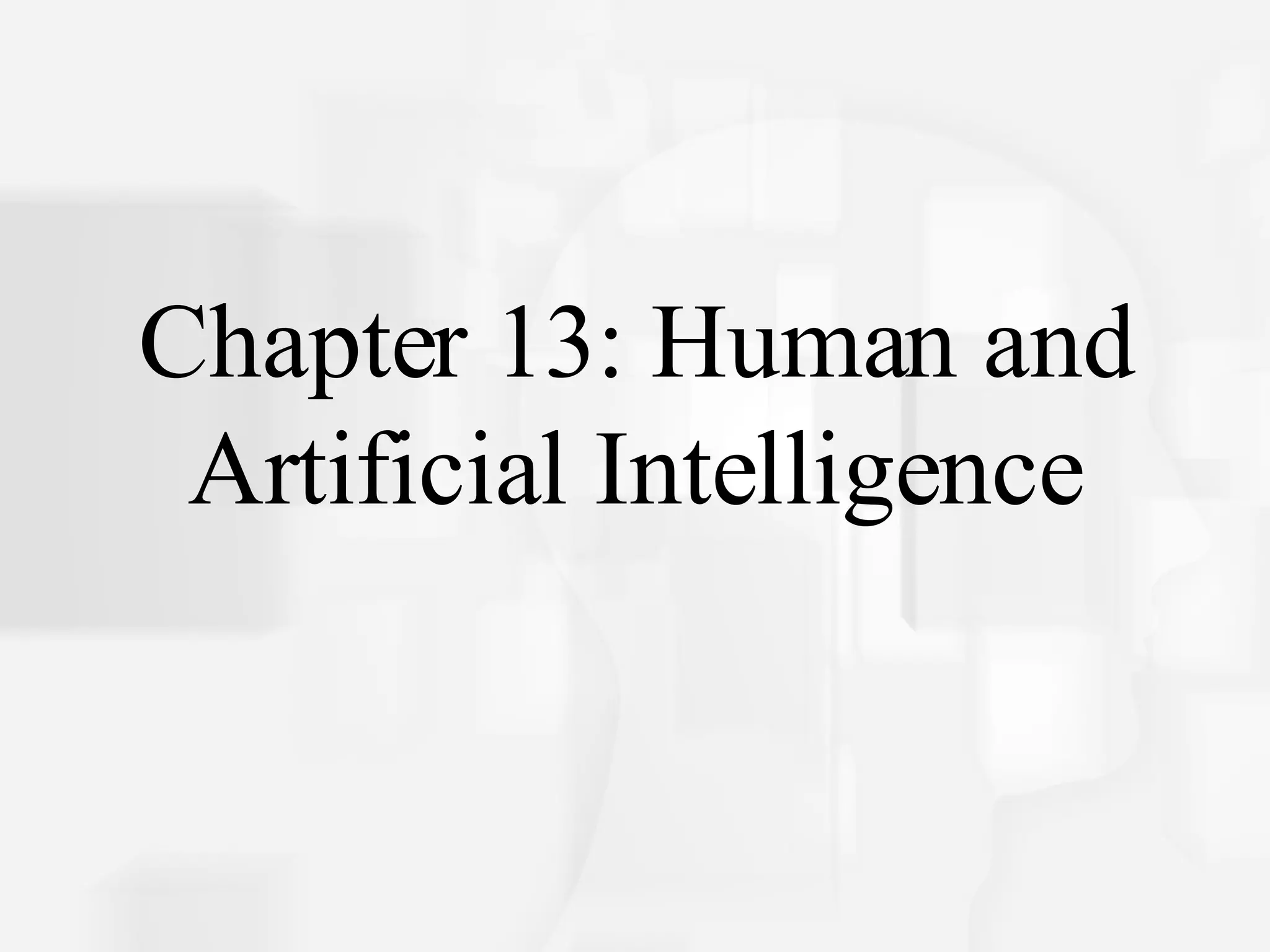
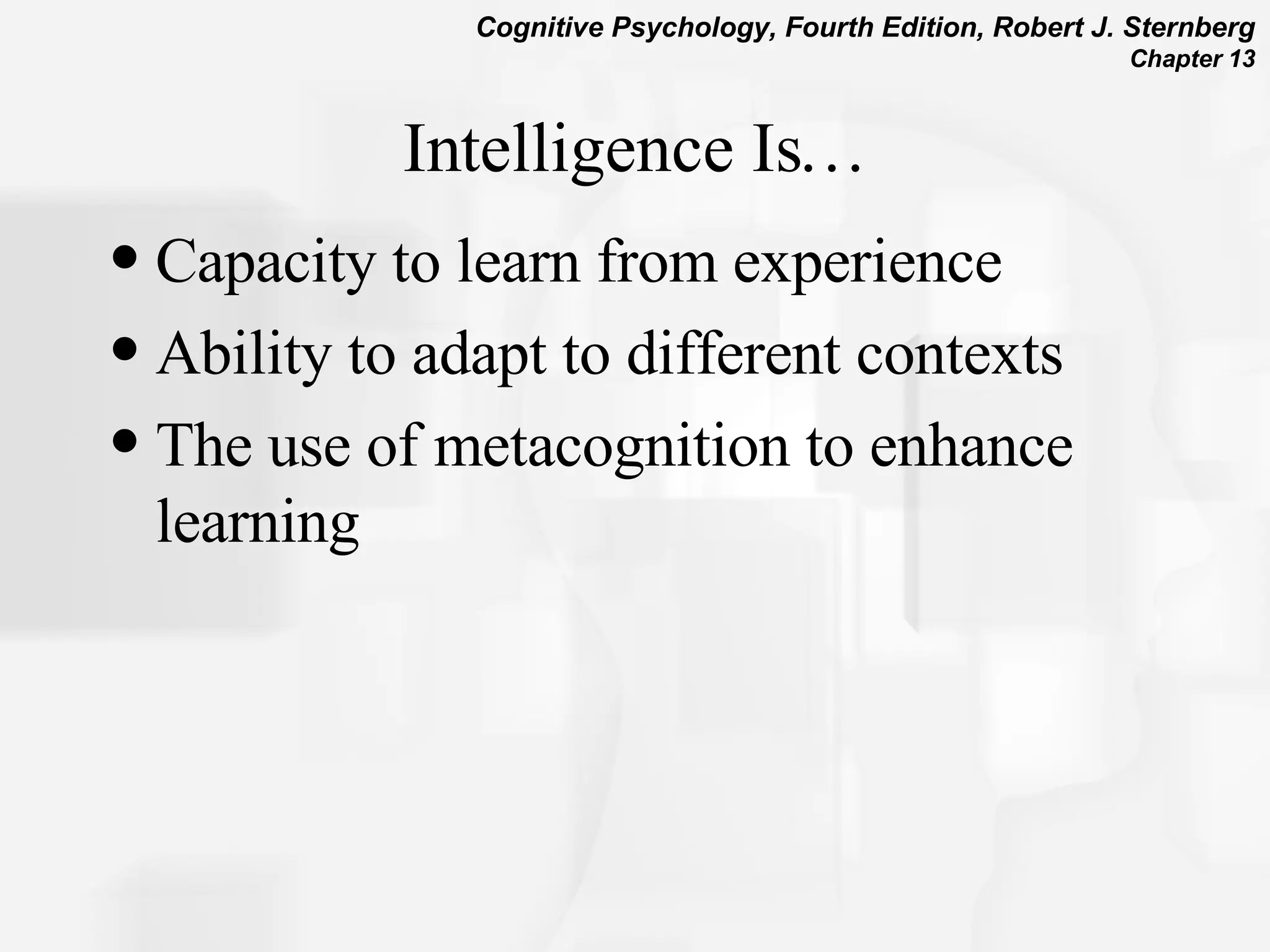
What Do You Consider Intelligence?
Intelligence Is… Capacity to learn from experience Ability to adapt to different contexts The use of metacognition to enhance learning
Emotional Intelligence Mayer & Salovey (1997)  “ The capacity to reason about emotions, and of emotions to enhance thinking. It includes the abilities to accurately perceive emotions, to access and generate emotions so as to assist thought, to understand emotions and emotional knowledge, and to reflectively regulate emotions so as to promote emotional and intellectual growth”
Social Intelligence Ability to get along with others  Knowledge of social matters Insight into moods or underlying personality traits of others
Artificial Intelligence The computational part of the ability to achieve goals in the world
Historical Trends Emphasize psychophysical abilities Galton  Examine relationships of sensory abilities  Emphasize on judgment  Binet (1904) Identify children needing special instruction  Compared child’s abilities to what the  average  child at that age could do
Historical Trends Terman (1900s) Created an English version of Binet’s test (called it the Stanford-Binet) Created the  intelligence quotient (IQ) : divide mental age by chronological age then multiply by 100 Became the first modern “intelligence” test
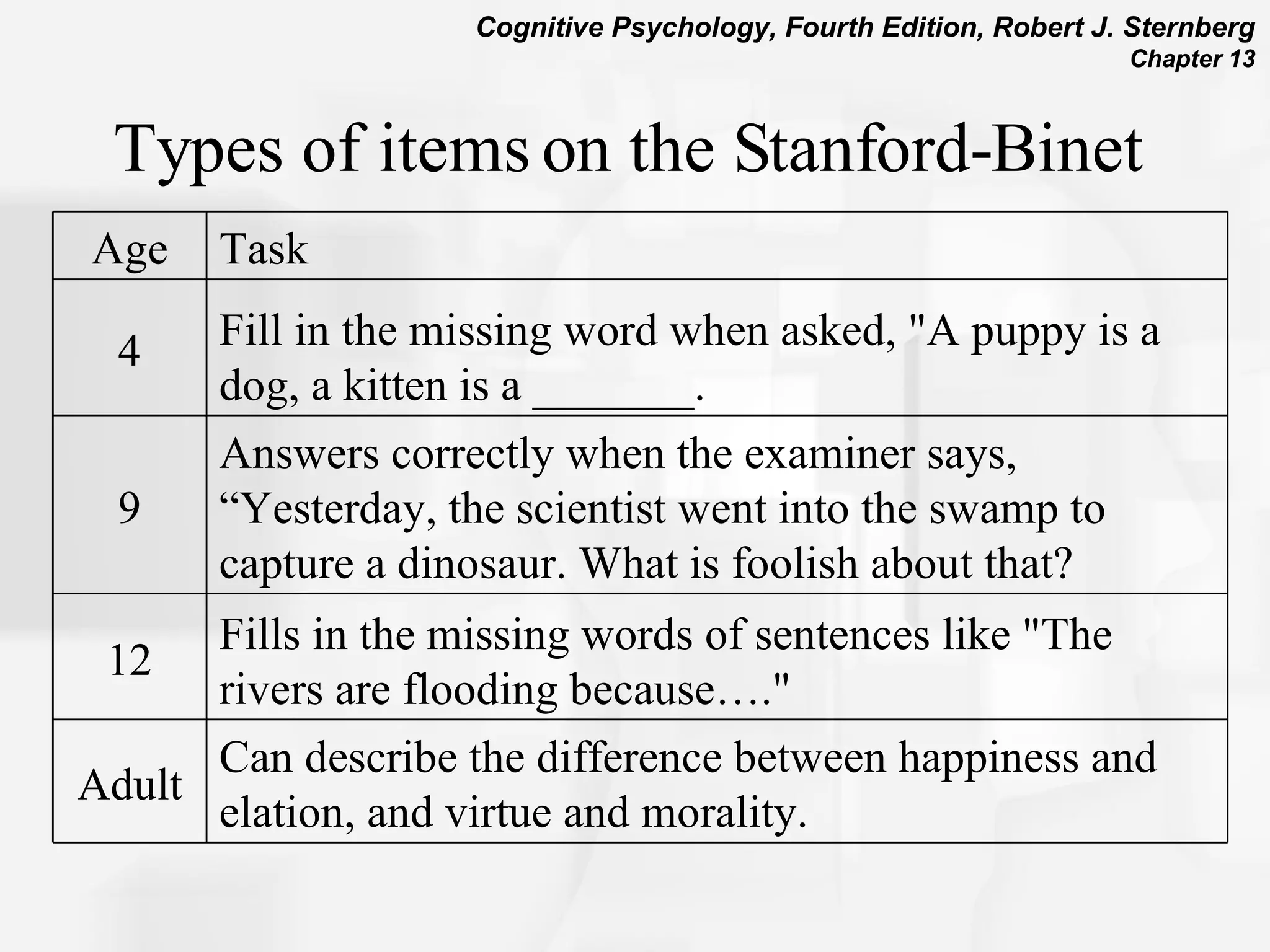
Types of items on the Stanford-Binet   Can describe the difference between happiness and elation, and virtue and morality. Adult Fills in the missing words of sentences like "The rivers are flooding because…." 12 Answers correctly when the examiner says, “Yesterday, the scientist went into the swamp to capture a dinosaur. What is foolish about that? 9 Fill in the missing word when asked, "A puppy is a dog, a kitten is a _______.  4 Task Age
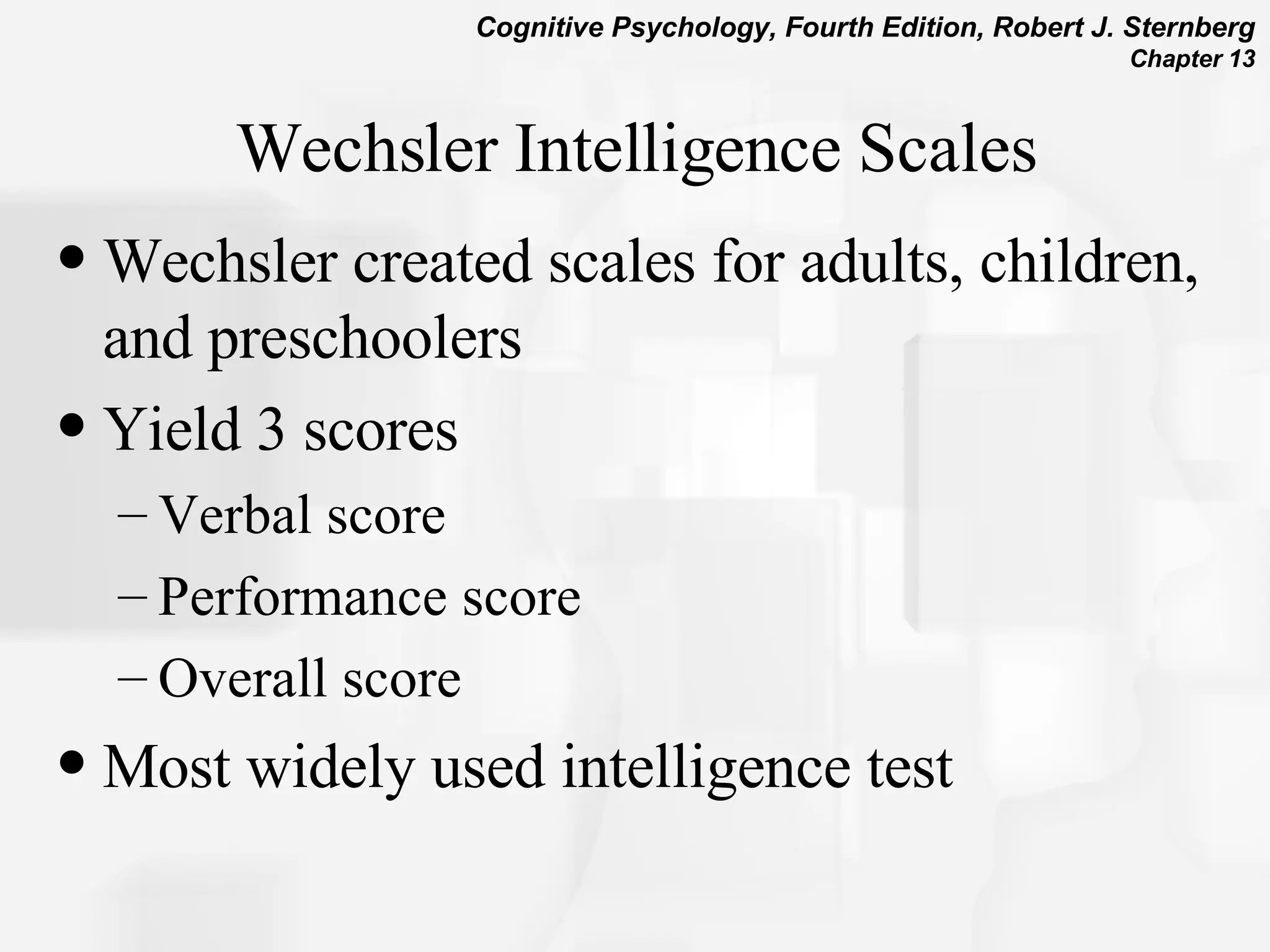
Wechsler Intelligence Scales Wechsler created scales for adults, children, and preschoolers Yield 3 scores Verbal score Performance score Overall score Most widely used intelligence test
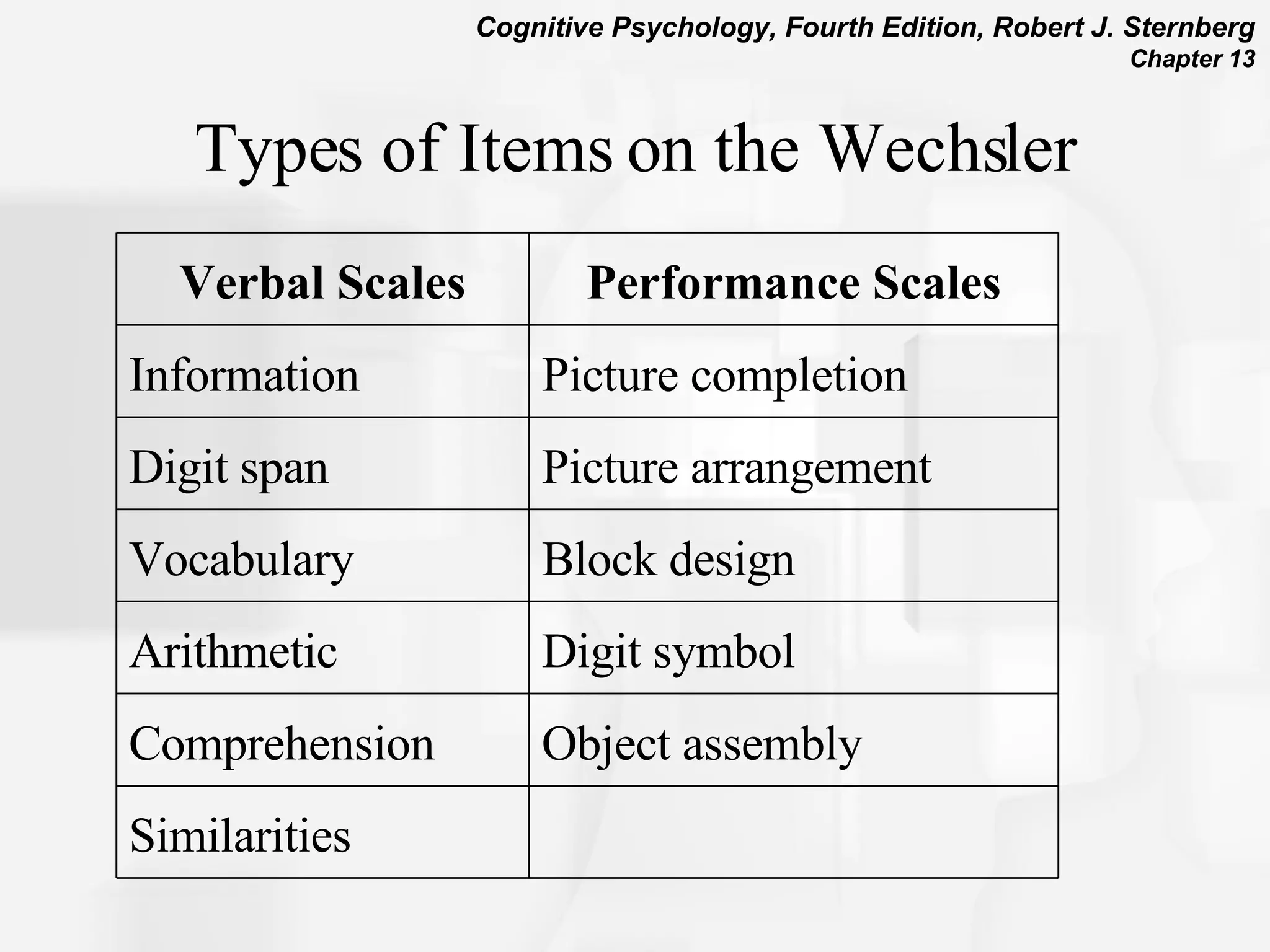
Types of Items on the Wechsler   Similarities Object assembly Comprehension Digit symbol Arithmetic Block design Vocabulary Picture arrangement Digit span Picture completion Information Performance Scales Verbal Scales
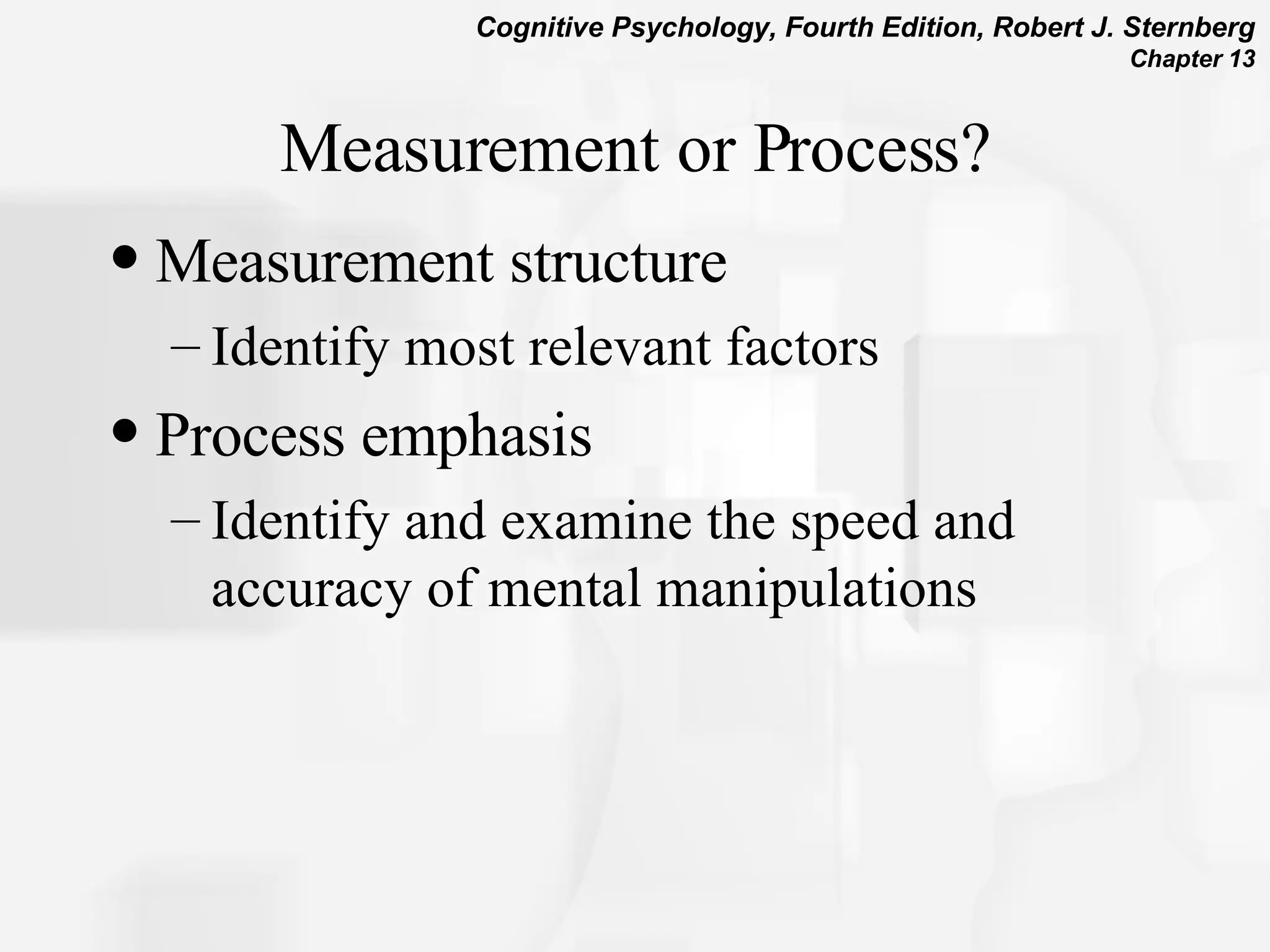
Measurement or Process? Measurement structure Identify most relevant factors  Process emphasis Identify and examine the speed and accuracy of mental manipulations
Nature, Nurture, or Both? Is intelligence genetic? Is intelligence acquired? Is intelligence a combination of both?
Factor Analysis   Primary method used to describe intelligence structure Correlations among many dependent variables are examined with the goal of discovering something about the nature of the factors that affect them How many different factors are needed to explain the pattern of relationships among these variables?
Factor Analysis Matrix 0.57 0.04 0.02 Series completion 0.65 -0.01 -0.03 Block patterns 0.77 0.20 0.05 Paper folding -0.02 0.87 -0.24 Multiplication 0.10 0.82 0.02 Identifying shapes 0.04 0.91 0.08 Counting dots -0.02 0.04 0.81 Word meaning -0.01 -0.05 0.86 Sentence completion 0.06 0.10 0.84 Paragraph comprehension Visual Numerical Reading  
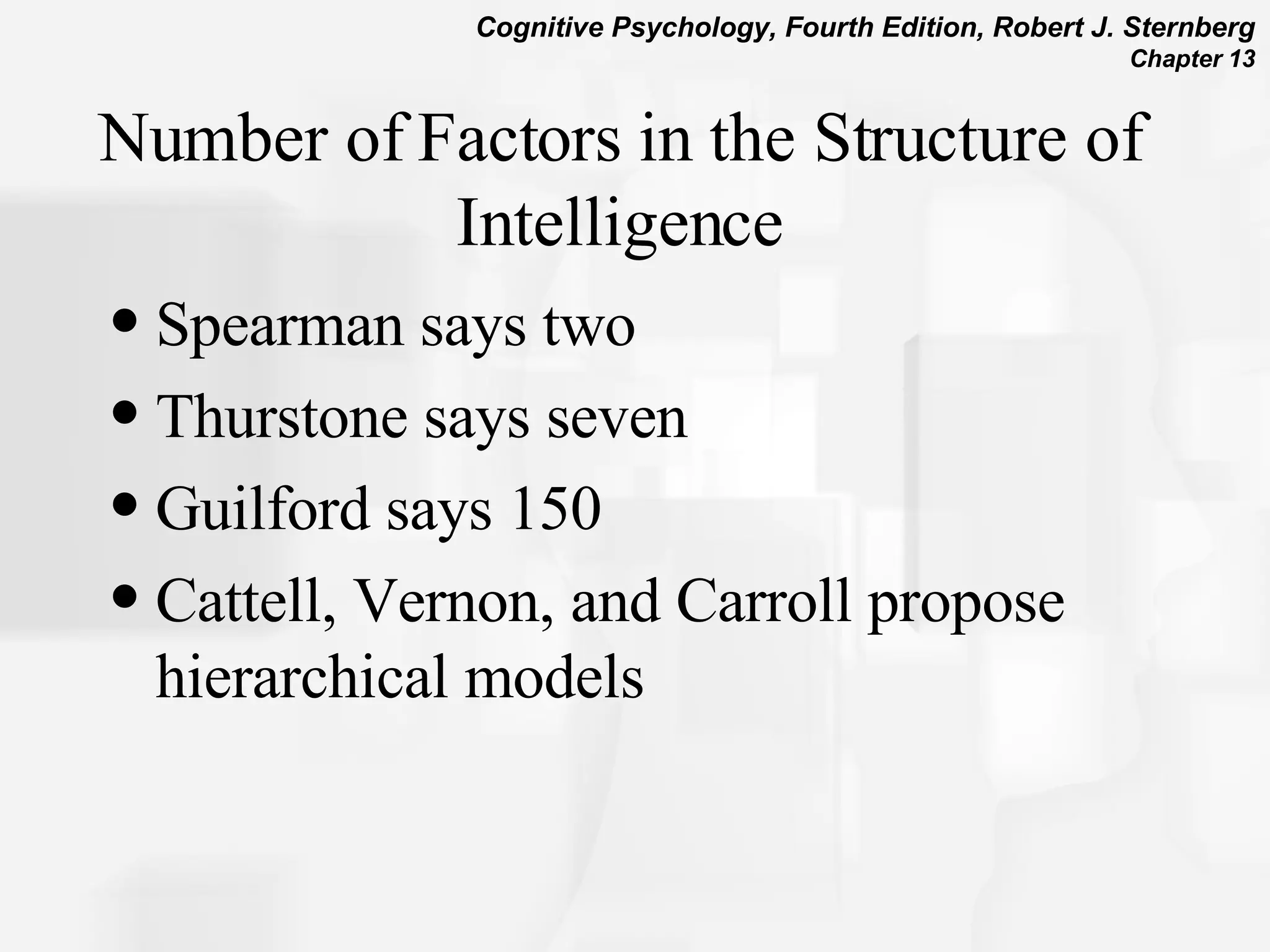
Number of Factors in the Structure of Intelligence Spearman says two Thurstone says seven Guilford says 150 Cattell, Vernon, and Carroll propose hierarchical models
Spearman’s “g” Factor Two-factor theory of intelligence All intellective functioning was due to an overall mental ability – “g” Accompanied by specific abilities for differing mental tasks
Thurstone’s 7 Primary Mental Abilities Verbal comprehension Verbal fluency Inductive reasoning Spatial visualization Number Memory Perceptual speed
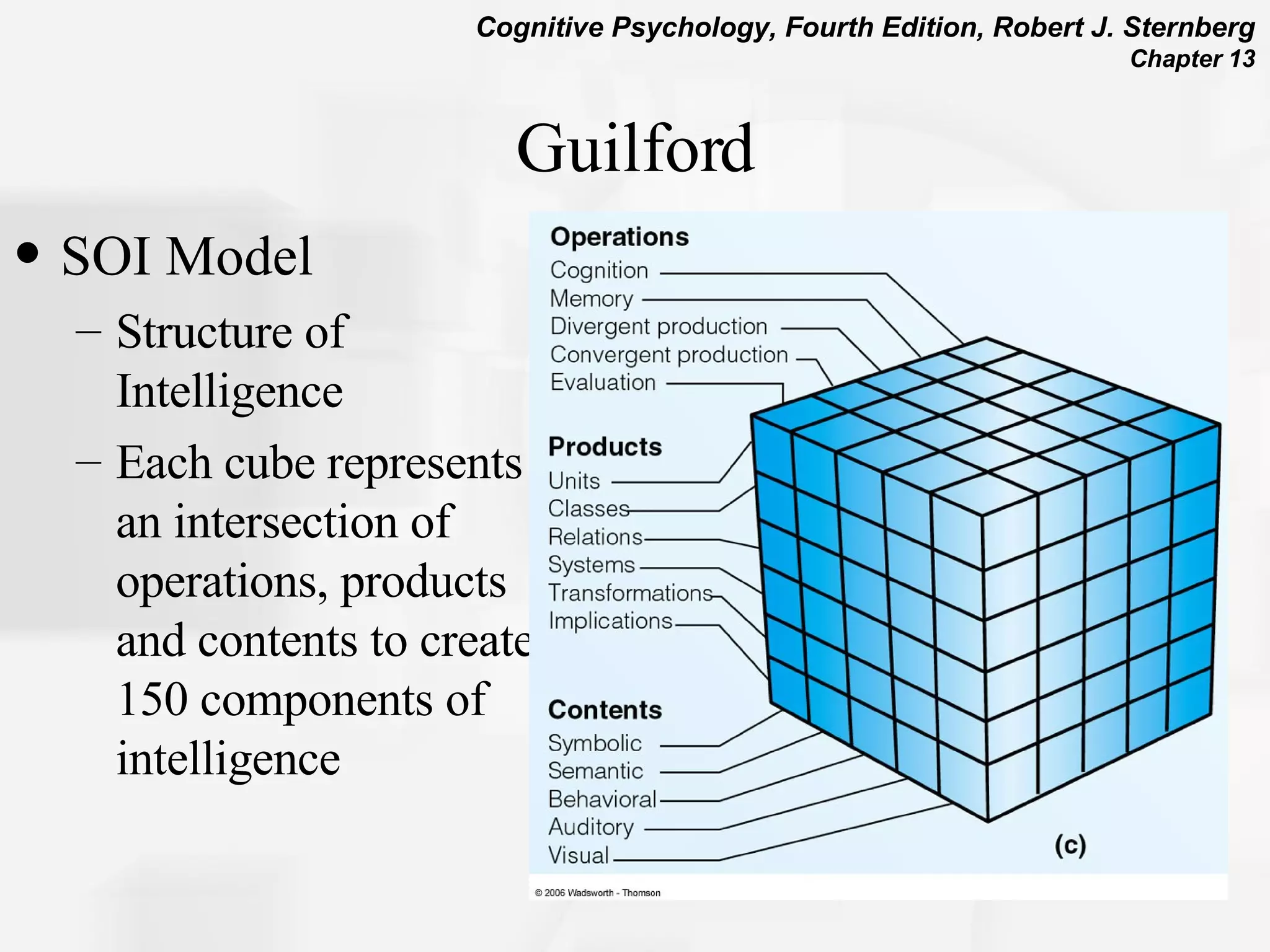
Guilford SOI Model Structure of Intelligence Each cube represents an intersection of operations, products and contents to create 150 components of intelligence
Cattell’s Fluid and Crystallized Intelligence Fluid intelligence Ability to reason and use information Peaks approximately at age 20 Crystallized intelligence Acquired skill and learned knowledge Continues to increase into old age
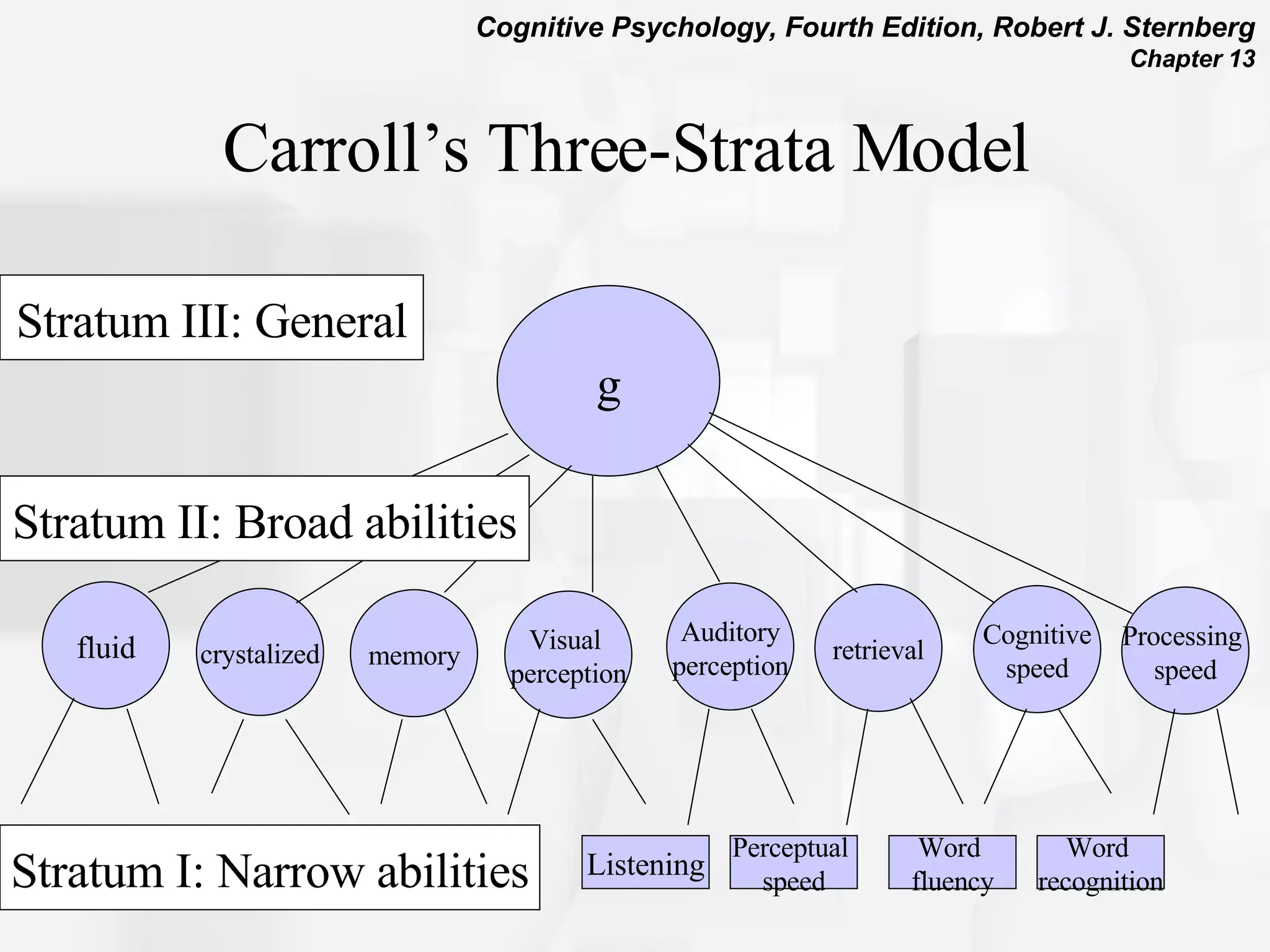
Carroll’s Three-Strata Model  g fluid crystalized memory Visual  perception Auditory perception retrieval Cognitive speed Processing  speed Stratum II: Broad abilities Stratum III: General Stratum I: Narrow abilities Listening Perceptual  speed Word  fluency Word  recognition
Historical Trends & Intelligence In the past, focus was on the product, identify aptitudes, measure, and create models based on data  During 1960’s & 1970’s conceptualization changed to what are the processes involved?  Information processing models focus on the processes that are involved in intelligence
Information Processing & Intelligence Inspection time How long a stimuli has to be viewed before an accurate judgment can be made How quickly a person gives their answer is irrelevant, participants are encouraged to take their time
Inspection Time Demonstration *
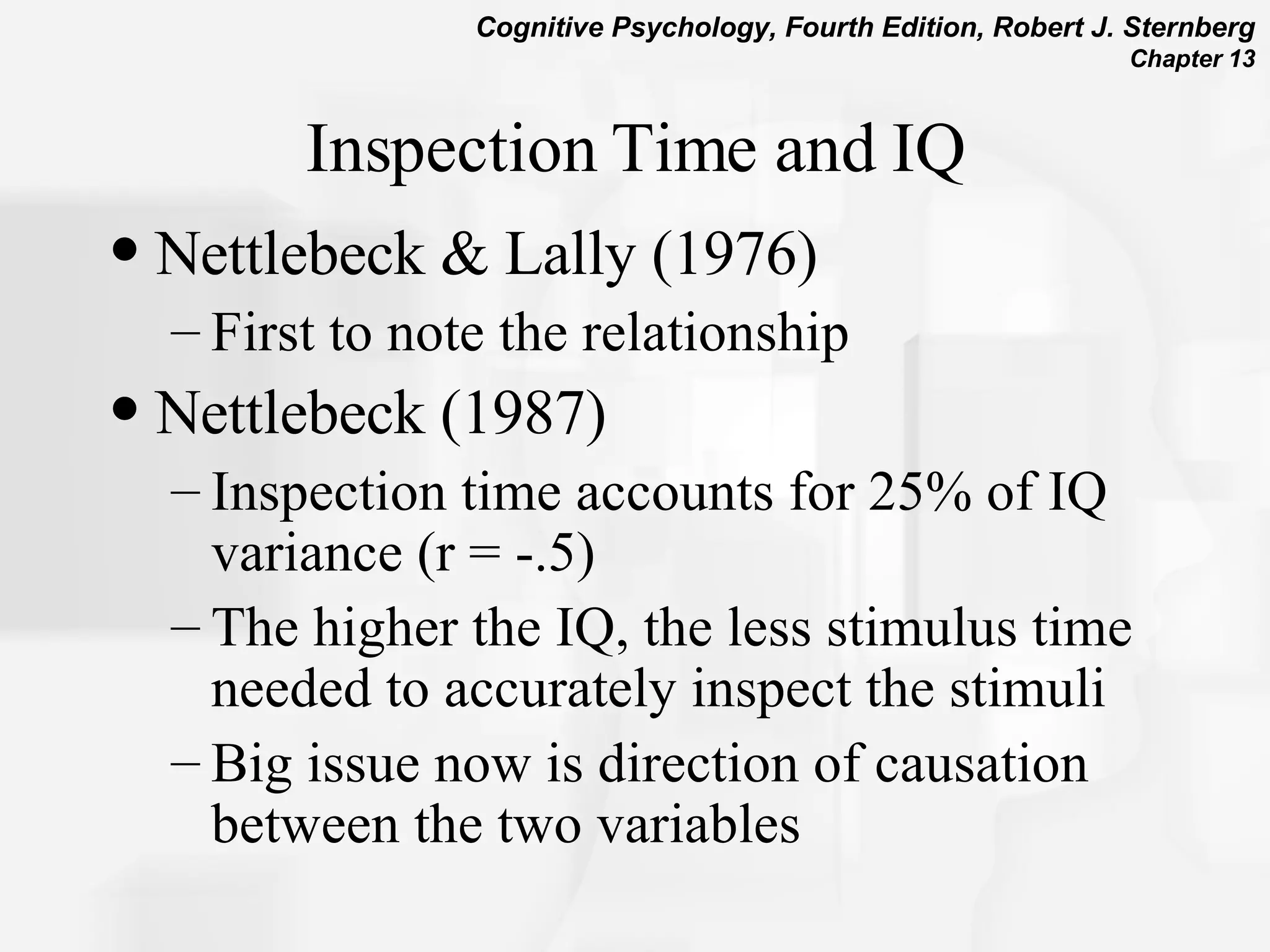
Inspection Time and IQ Nettlebeck & Lally (1976) First to note the relationship Nettlebeck (1987)  Inspection time accounts for 25% of IQ variance (r = -.5) The higher the IQ, the less stimulus time needed to accurately inspect the stimuli Big issue now is direction of causation between the two variables
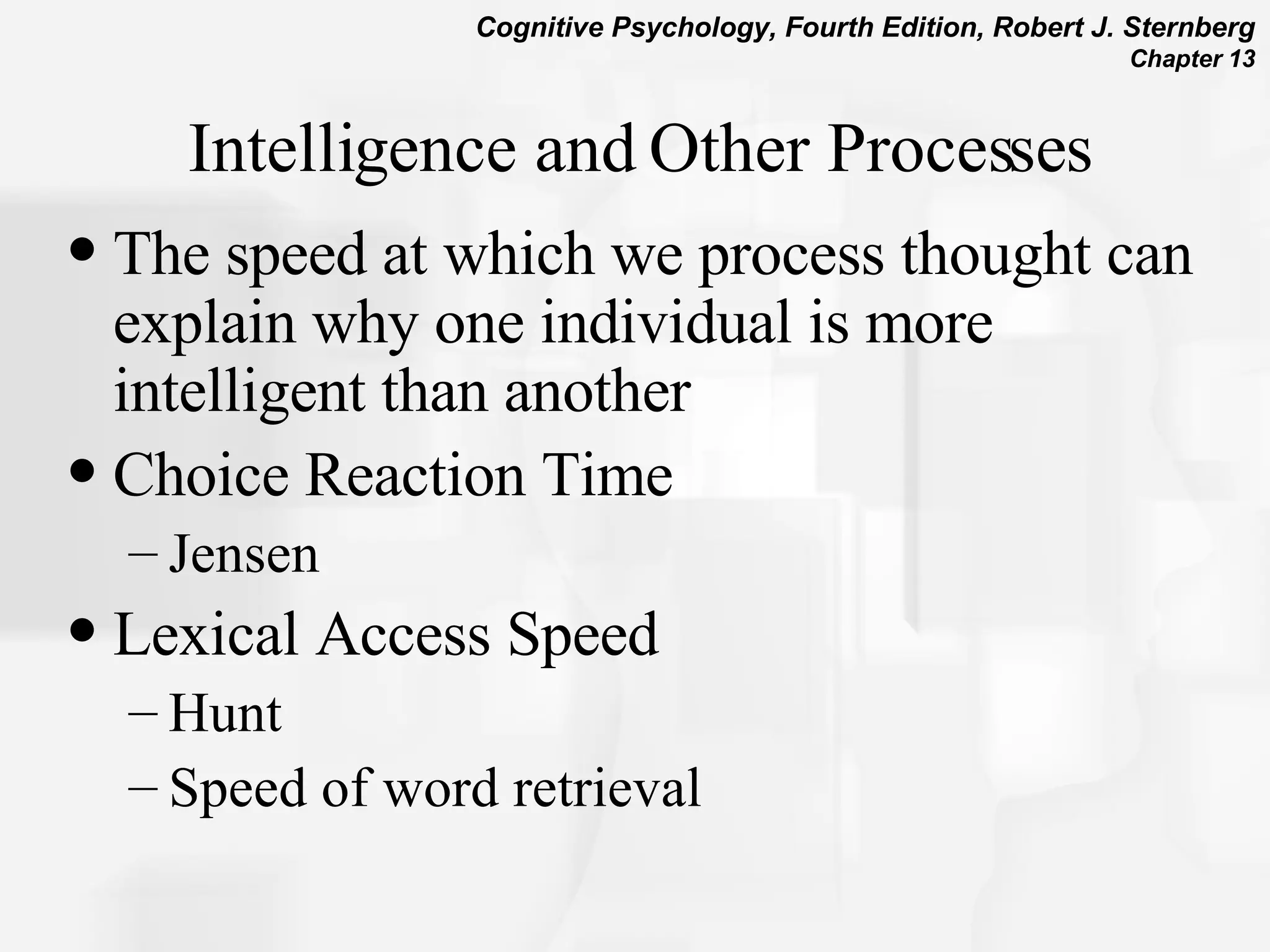
Intelligence and Other Processes The speed at which we process thought can explain why one individual is more intelligent than another  Choice Reaction Time Jensen  Lexical Access Speed Hunt  Speed of word retrieval
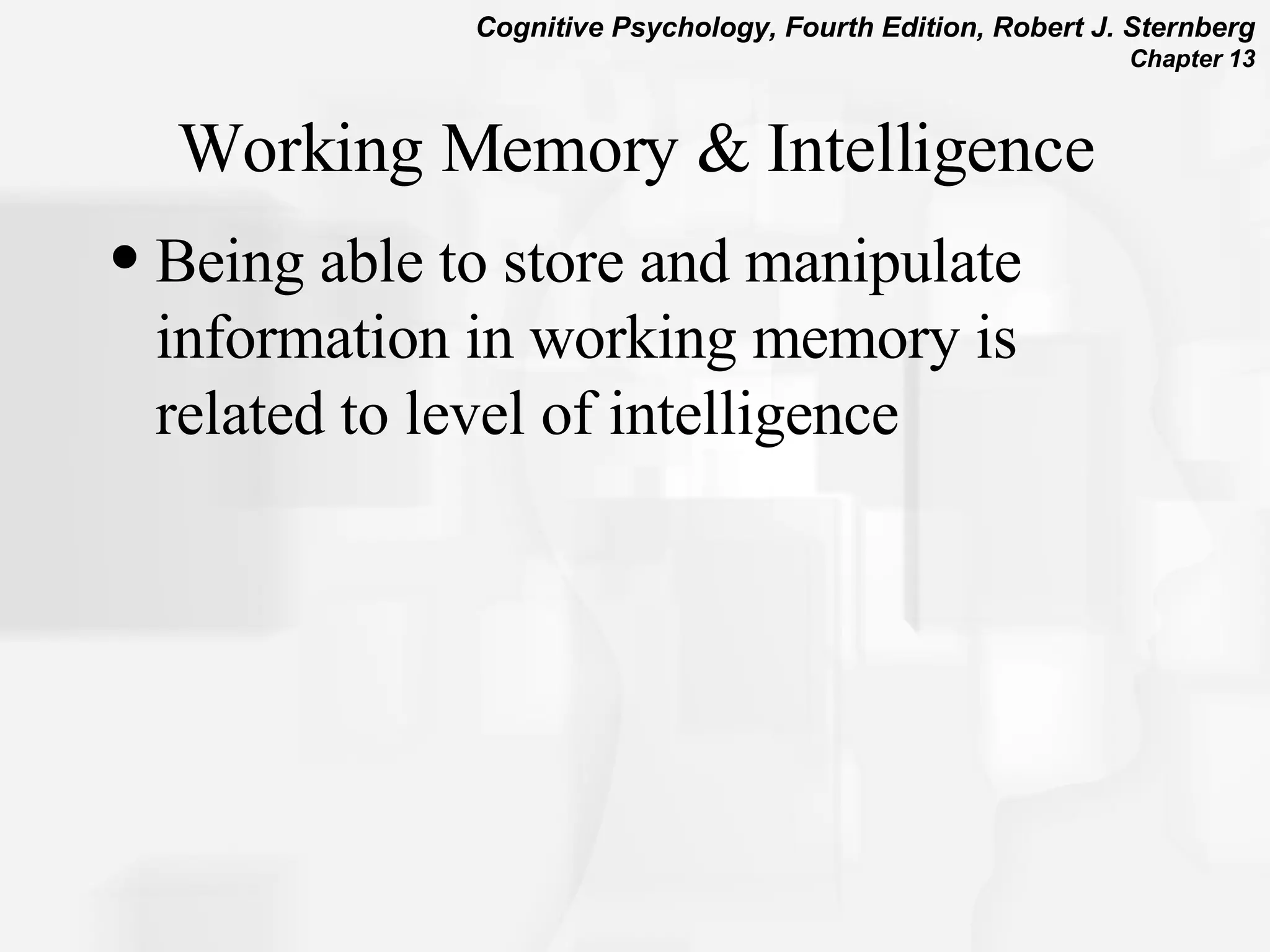
Working Memory & Intelligence Being able to store and manipulate information in working memory is related to level of intelligence
Componential Analysis This approach involves identifying the steps in complex information-processing tasks and seeing how each process contributes to the decision Sternberg’s componential analysis on solving analogies Red : Stop :: Green : ____ Graceful: Clumsy :: late : _____ Encode - Identify each term of the problem Inference - Discover rule between 1 st  two terms Mapping - Map rule to second set of terms  Application - Apply relationship and generate final term
Sternberg’s Findings Measured amount reaction time for each step Found more intelligent participants took longer to encode, but less time to complete the remaining steps Global versus local planning
Contextualist View of Intelligence Culture and definition of intelligence are intertwined Differs from one culture to another Critical in one culture may be unimportant in another culture Measurement of intelligence will be influenced by culture
Culture Differences Western cultures view intelligence as a means for individuals to devise categories and to engage in rational debate Eastern cultures see it as a way for members of a community to recognize contradiction and complexity and to play their social roles successfully
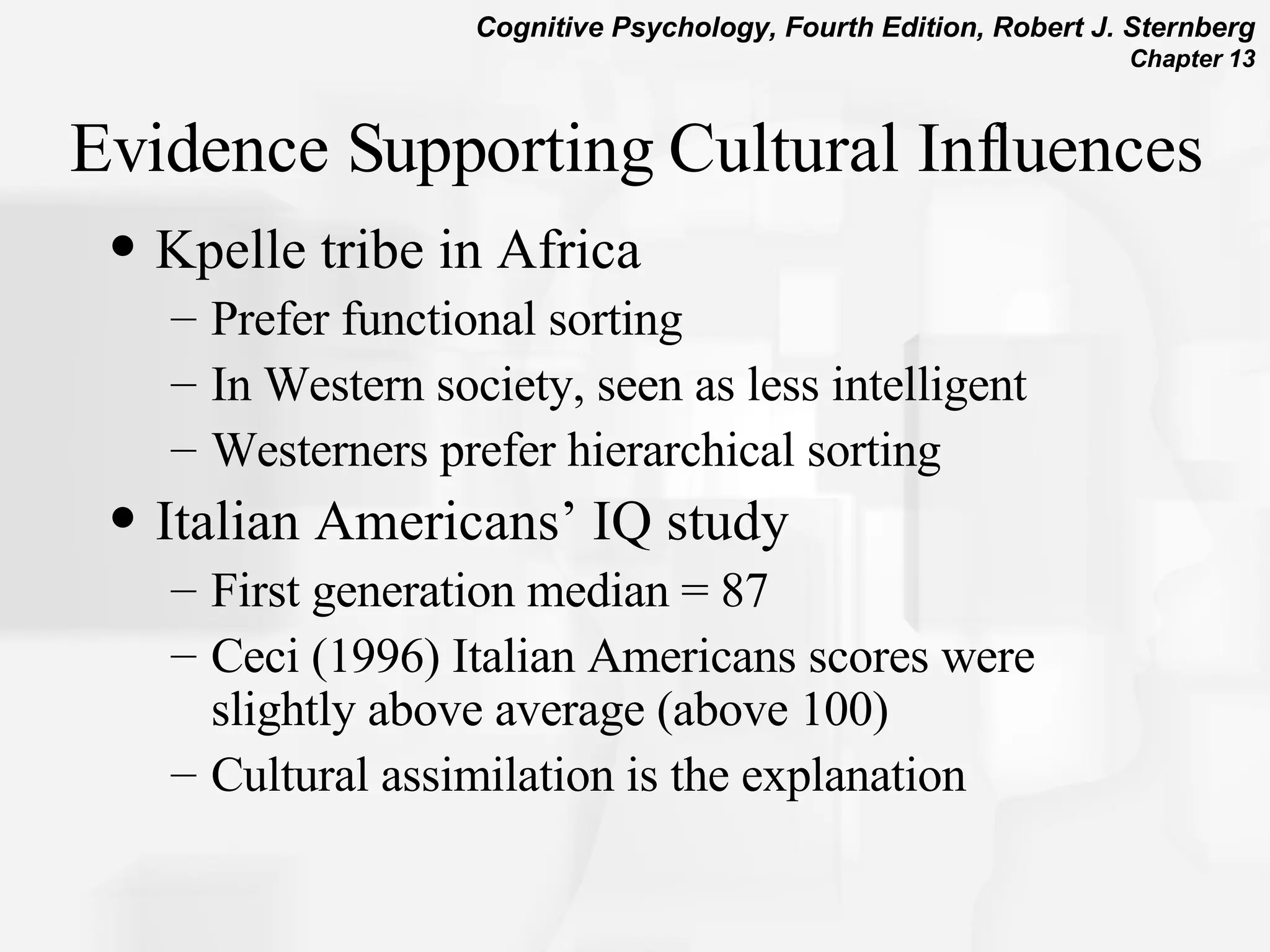
Evidence Supporting Cultural Influences Kpelle tribe in Africa  Prefer functional sorting In Western society, seen as less intelligent Westerners prefer hierarchical sorting Italian Americans’ IQ study First generation median = 87 Ceci (1996) Italian Americans scores were slightly above average (above 100)  Cultural assimilation is the explanation
Gardner’s Multiple Intelligences Eight types of abilities that are independent of one another Visual / Spatial Intelligence Musical Intelligence  Verbal Intelligence  Logical/Mathematical Intelligence Interpersonal Intelligence  Intrapersonal Intelligence  Bodily / Kinesthetic Intelligence  Naturalist Intelligence
Gardner’s Theory Is modular, each type is independent of another Allows for existence of savants
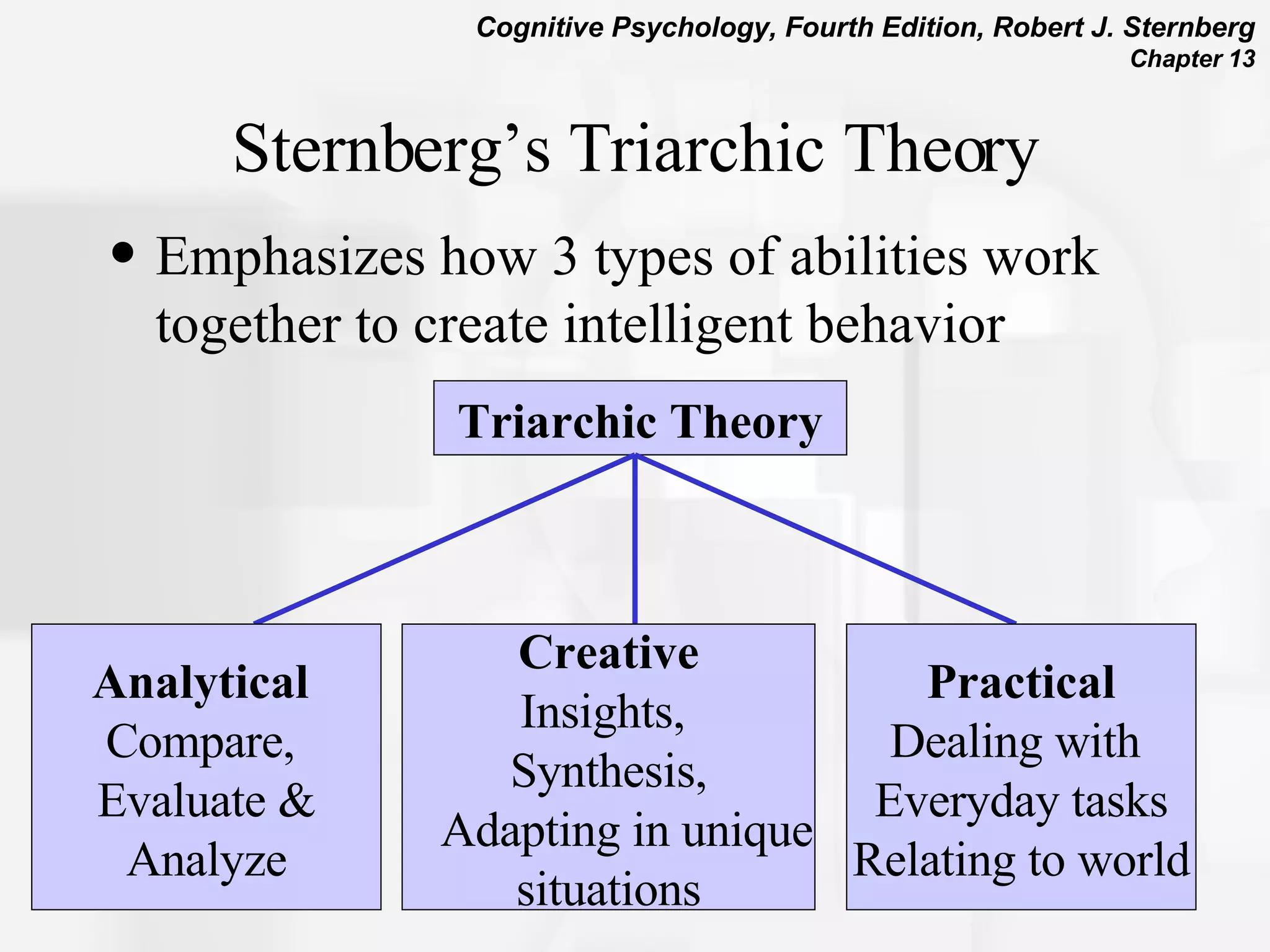
Sternberg’s Triarchic Theory Emphasizes how 3 types of abilities work together to create intelligent behavior Triarchic Theory Analytical   Compare,  Evaluate & Analyze Creative Insights,  Synthesis, Adapting in unique situations Practical Dealing with   Everyday tasks Relating to world
Sternberg’s Triarchic Theory Intelligence involves not merely adapting to one’s  environment but in some cases modifying the environment or selecting another Intelligences are developing abilities not fixed characteristics of an individual; Traditional definitions conceptualize intelligence to remain essentially constant throughout an adult life  Intelligence means adapting using your strengths and improving or compensating for your weaknesses
Artificial Intelligence The Turing test Used to refer to a proposal made by Turing (1950) as a way of dealing with the question whether machines can think Can an observer who has a conversation with a computer and a human figure out which conversationalist is the computer? Computer passes Turing test if the person cannot
Computer Programs Better than Humans Deep Blue and Chess 1,000,000,000,000 positions/sec  100 - 200 billion moves considered Able to evaluate moves Beat world champion Kasparov in 1997 match
Psychotherapy AI ELIZA Weizenbaum (1966) created this program to engage in a dialogue imitative of the style favored in Rogerian psychotherapy The program can successfully emulate human conversation to a degree that humans often assumed they were communicating remotely over teletype with another human ELIZA's technique of responding to keyword-matching demonstrated the plausibility of natural language understanding by computers  PARRY Colby (1963) created a computer simulation of a paranoid human  Psychologists reliably judged PARRY's interactive output as being paranoid schizophrenic and were unable to distinguish transcripts of a session with PARRY from that of a session originating from a human patient
Expert Systems Telephone network maintenance Credit evaluation Tax planning Detection of insider securities trading Mineral exploration Irrigation and pest management Predicting failure of diesel engines Medical diagnosis Class selection for students
Limitations of Expert Systems Can handle only narrow domains Do not possess common sense/intuition Have a limited ability to learn
Summary To date, no computer AI can match all dimensions of human intelligence For algorithmic problems, computers can perform faster, however humans still write the programming

chapter13

  • 1.
    Chapter 13: Humanand Artificial Intelligence
  • 2.
    What Do YouConsider Intelligence?
  • 3.
    Intelligence Is… Capacityto learn from experience Ability to adapt to different contexts The use of metacognition to enhance learning
  • 4.
    Emotional Intelligence Mayer& Salovey (1997) “ The capacity to reason about emotions, and of emotions to enhance thinking. It includes the abilities to accurately perceive emotions, to access and generate emotions so as to assist thought, to understand emotions and emotional knowledge, and to reflectively regulate emotions so as to promote emotional and intellectual growth”
  • 5.
    Social Intelligence Abilityto get along with others Knowledge of social matters Insight into moods or underlying personality traits of others
  • 6.
    Artificial Intelligence Thecomputational part of the ability to achieve goals in the world
  • 7.
    Historical Trends Emphasizepsychophysical abilities Galton Examine relationships of sensory abilities Emphasize on judgment Binet (1904) Identify children needing special instruction Compared child’s abilities to what the average child at that age could do
  • 8.
    Historical Trends Terman(1900s) Created an English version of Binet’s test (called it the Stanford-Binet) Created the intelligence quotient (IQ) : divide mental age by chronological age then multiply by 100 Became the first modern “intelligence” test
  • 9.
    Types of itemson the Stanford-Binet Can describe the difference between happiness and elation, and virtue and morality. Adult Fills in the missing words of sentences like "The rivers are flooding because…." 12 Answers correctly when the examiner says, “Yesterday, the scientist went into the swamp to capture a dinosaur. What is foolish about that? 9 Fill in the missing word when asked, "A puppy is a dog, a kitten is a _______. 4 Task Age
  • 10.
    Wechsler Intelligence ScalesWechsler created scales for adults, children, and preschoolers Yield 3 scores Verbal score Performance score Overall score Most widely used intelligence test
  • 11.
    Types of Itemson the Wechsler   Similarities Object assembly Comprehension Digit symbol Arithmetic Block design Vocabulary Picture arrangement Digit span Picture completion Information Performance Scales Verbal Scales
  • 12.
    Measurement or Process?Measurement structure Identify most relevant factors Process emphasis Identify and examine the speed and accuracy of mental manipulations
  • 13.
    Nature, Nurture, orBoth? Is intelligence genetic? Is intelligence acquired? Is intelligence a combination of both?
  • 14.
    Factor Analysis Primary method used to describe intelligence structure Correlations among many dependent variables are examined with the goal of discovering something about the nature of the factors that affect them How many different factors are needed to explain the pattern of relationships among these variables?
  • 15.
    Factor Analysis Matrix0.57 0.04 0.02 Series completion 0.65 -0.01 -0.03 Block patterns 0.77 0.20 0.05 Paper folding -0.02 0.87 -0.24 Multiplication 0.10 0.82 0.02 Identifying shapes 0.04 0.91 0.08 Counting dots -0.02 0.04 0.81 Word meaning -0.01 -0.05 0.86 Sentence completion 0.06 0.10 0.84 Paragraph comprehension Visual Numerical Reading  
  • 16.
    Number of Factorsin the Structure of Intelligence Spearman says two Thurstone says seven Guilford says 150 Cattell, Vernon, and Carroll propose hierarchical models
  • 17.
    Spearman’s “g” FactorTwo-factor theory of intelligence All intellective functioning was due to an overall mental ability – “g” Accompanied by specific abilities for differing mental tasks
  • 18.
    Thurstone’s 7 PrimaryMental Abilities Verbal comprehension Verbal fluency Inductive reasoning Spatial visualization Number Memory Perceptual speed
  • 19.
    Guilford SOI ModelStructure of Intelligence Each cube represents an intersection of operations, products and contents to create 150 components of intelligence
  • 20.
    Cattell’s Fluid andCrystallized Intelligence Fluid intelligence Ability to reason and use information Peaks approximately at age 20 Crystallized intelligence Acquired skill and learned knowledge Continues to increase into old age
  • 21.
    Carroll’s Three-Strata Model g fluid crystalized memory Visual perception Auditory perception retrieval Cognitive speed Processing speed Stratum II: Broad abilities Stratum III: General Stratum I: Narrow abilities Listening Perceptual speed Word fluency Word recognition
  • 22.
    Historical Trends &Intelligence In the past, focus was on the product, identify aptitudes, measure, and create models based on data During 1960’s & 1970’s conceptualization changed to what are the processes involved? Information processing models focus on the processes that are involved in intelligence
  • 23.
    Information Processing &Intelligence Inspection time How long a stimuli has to be viewed before an accurate judgment can be made How quickly a person gives their answer is irrelevant, participants are encouraged to take their time
  • 24.
  • 25.
    Inspection Time andIQ Nettlebeck & Lally (1976) First to note the relationship Nettlebeck (1987) Inspection time accounts for 25% of IQ variance (r = -.5) The higher the IQ, the less stimulus time needed to accurately inspect the stimuli Big issue now is direction of causation between the two variables
  • 26.
    Intelligence and OtherProcesses The speed at which we process thought can explain why one individual is more intelligent than another Choice Reaction Time Jensen Lexical Access Speed Hunt Speed of word retrieval
  • 27.
    Working Memory &Intelligence Being able to store and manipulate information in working memory is related to level of intelligence
  • 28.
    Componential Analysis Thisapproach involves identifying the steps in complex information-processing tasks and seeing how each process contributes to the decision Sternberg’s componential analysis on solving analogies Red : Stop :: Green : ____ Graceful: Clumsy :: late : _____ Encode - Identify each term of the problem Inference - Discover rule between 1 st two terms Mapping - Map rule to second set of terms Application - Apply relationship and generate final term
  • 29.
    Sternberg’s Findings Measuredamount reaction time for each step Found more intelligent participants took longer to encode, but less time to complete the remaining steps Global versus local planning
  • 30.
    Contextualist View ofIntelligence Culture and definition of intelligence are intertwined Differs from one culture to another Critical in one culture may be unimportant in another culture Measurement of intelligence will be influenced by culture
  • 31.
    Culture Differences Westerncultures view intelligence as a means for individuals to devise categories and to engage in rational debate Eastern cultures see it as a way for members of a community to recognize contradiction and complexity and to play their social roles successfully
  • 32.
    Evidence Supporting CulturalInfluences Kpelle tribe in Africa Prefer functional sorting In Western society, seen as less intelligent Westerners prefer hierarchical sorting Italian Americans’ IQ study First generation median = 87 Ceci (1996) Italian Americans scores were slightly above average (above 100) Cultural assimilation is the explanation
  • 33.
    Gardner’s Multiple IntelligencesEight types of abilities that are independent of one another Visual / Spatial Intelligence Musical Intelligence Verbal Intelligence Logical/Mathematical Intelligence Interpersonal Intelligence Intrapersonal Intelligence Bodily / Kinesthetic Intelligence Naturalist Intelligence
  • 34.
    Gardner’s Theory Ismodular, each type is independent of another Allows for existence of savants
  • 35.
    Sternberg’s Triarchic TheoryEmphasizes how 3 types of abilities work together to create intelligent behavior Triarchic Theory Analytical Compare, Evaluate & Analyze Creative Insights, Synthesis, Adapting in unique situations Practical Dealing with Everyday tasks Relating to world
  • 36.
    Sternberg’s Triarchic TheoryIntelligence involves not merely adapting to one’s environment but in some cases modifying the environment or selecting another Intelligences are developing abilities not fixed characteristics of an individual; Traditional definitions conceptualize intelligence to remain essentially constant throughout an adult life Intelligence means adapting using your strengths and improving or compensating for your weaknesses
  • 37.
    Artificial Intelligence TheTuring test Used to refer to a proposal made by Turing (1950) as a way of dealing with the question whether machines can think Can an observer who has a conversation with a computer and a human figure out which conversationalist is the computer? Computer passes Turing test if the person cannot
  • 38.
    Computer Programs Betterthan Humans Deep Blue and Chess 1,000,000,000,000 positions/sec 100 - 200 billion moves considered Able to evaluate moves Beat world champion Kasparov in 1997 match
  • 39.
    Psychotherapy AI ELIZAWeizenbaum (1966) created this program to engage in a dialogue imitative of the style favored in Rogerian psychotherapy The program can successfully emulate human conversation to a degree that humans often assumed they were communicating remotely over teletype with another human ELIZA's technique of responding to keyword-matching demonstrated the plausibility of natural language understanding by computers PARRY Colby (1963) created a computer simulation of a paranoid human Psychologists reliably judged PARRY's interactive output as being paranoid schizophrenic and were unable to distinguish transcripts of a session with PARRY from that of a session originating from a human patient
  • 40.
    Expert Systems Telephonenetwork maintenance Credit evaluation Tax planning Detection of insider securities trading Mineral exploration Irrigation and pest management Predicting failure of diesel engines Medical diagnosis Class selection for students
  • 41.
    Limitations of ExpertSystems Can handle only narrow domains Do not possess common sense/intuition Have a limited ability to learn
  • 42.
    Summary To date,no computer AI can match all dimensions of human intelligence For algorithmic problems, computers can perform faster, however humans still write the programming