AUDITING AND ASSURANCE 
CHAPTER 3 
AUDIT ON FINANCIAL STATEMENT
GROUP MEMBERS : 
1. UMMI SARAH BINTI ABD KGUPOR 
10DAT11F2006 
2. NOR SHAWAL LEILA BINTI ZAHARUDIN 
10DAT11F2011 
3. NUR AZWEEN SYAFIERA BINTI ABD NASIR 
10DAT11F2025 
4. SITI AISHAH BINTI MUSA 
10DAT11F2032 
CLASS : DAT 6A
3.1 REVENUE AND 
EXPENDITURE
3.1.1 PURPOSE 
• Measured at their fair value of the 
consideration received or receivable 
• Ensure voluntary compliance between all 
documentations, control, policies and 
guidelines 
• Test control for detection significant 
weaknesses and check financial statements
3.1.2 EVIDENCE 
Evidence selection 
a) Sales of goods and services 
b) Payments received for goods and services 
c) Good returned by claims received from 
customers
a) Sales of goods and services 
1) Receiving and recording customers orders 
2) Authorising credit terms and shipment 
3) Confirming orders 
4) Executing shipping orders for goods or work 
orders for the performance of services 
5) Recording the shipments or services 
performed
b) Payments received for goods and 
services 
1) Receiving the cash and depositing in the bank 
cash 
2) Comparing amounts remitted with recorded 
amounts 
3) Authorising discounts and allowances 
4) Recording cash receipts, discounts and 
allowances
c) Good returned by claims received 
from customers 
1) Receiving and accepting goods and claims 
2) Preparing receiving reports 
3) Reviewing claims 
4) Authorising credits 
5) Preparing and mailing credit memo 
6) Recording returns and claim
3.1.3 SUITABLE AUDIT OBJECTIVES 
1) authorisation – all are pre-approved by 
responsible personnel 
2) completeness – all valid transactions are included 
in the accounting records 
3) accuracy 
4) Validity 
5) Physical safeguards and security 
6) Error handling 
7) Segregation of duties
3.1.4 SUITABLE AUDIT TEST 
1) Authoring sales transactions 
2) Adequate segregation of duties 
3) Adequate documents and records 
4) pre-numbered documents 
5) Monthly statements 
6) internal verifications procedures
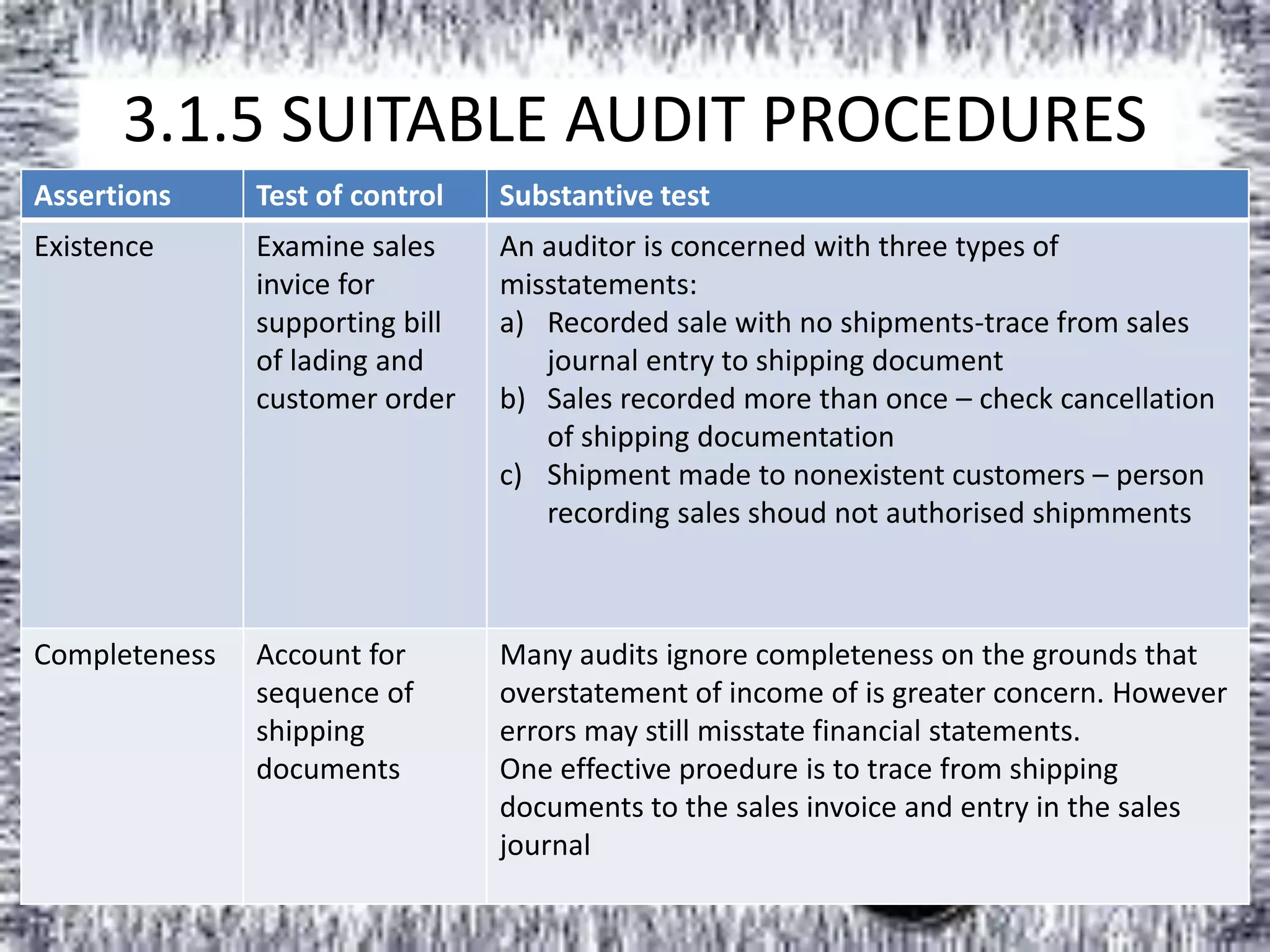
3.1.5 SUITABLE AUDIT PROCEDURES 
Assertions Test of control Substantive test 
Existence Examine sales 
invice for 
supporting bill 
of lading and 
customer order 
An auditor is concerned with three types of 
misstatements: 
a) Recorded sale with no shipments-trace from sales 
journal entry to shipping document 
b) Sales recorded more than once – check cancellation 
of shipping documentation 
c) Shipment made to nonexistent customers – person 
recording sales shoud not authorised shipmments 
Completeness Account for 
sequence of 
shipping 
documents 
Many audits ignore completeness on the grounds that 
overstatement of income of is greater concern. However 
errors may still misstate financial statements. 
One effective proedure is to trace from shipping 
documents to the sales invoice and entry in the sales 
journal
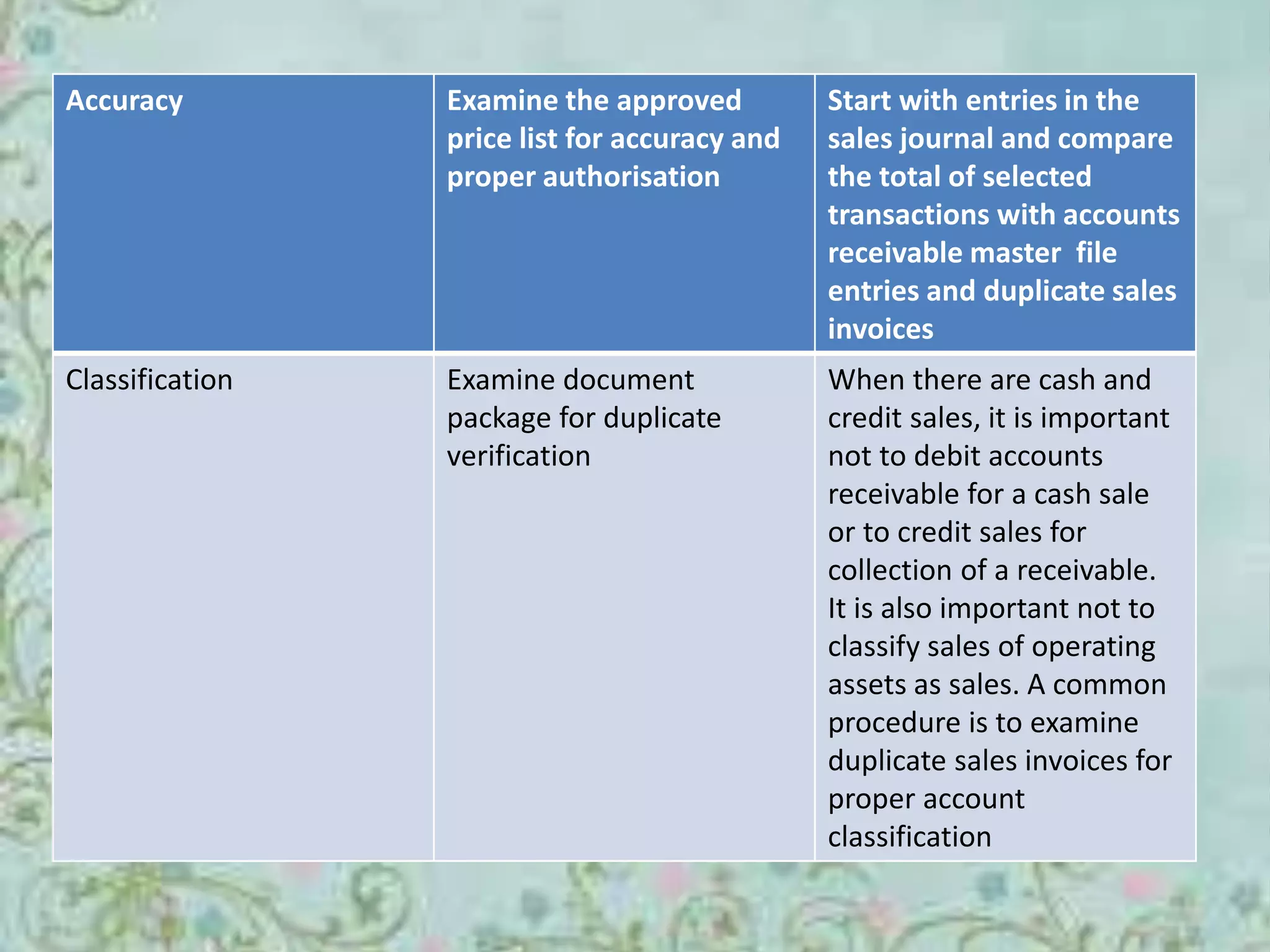
Accuracy Examine the approved 
price list for accuracy and 
proper authorisation 
Start with entries in the 
sales journal and compare 
the total of selected 
transactions with accounts 
receivable master file 
entries and duplicate sales 
invoices 
Classification Examine document 
package for duplicate 
verification 
When there are cash and 
credit sales, it is important 
not to debit accounts 
receivable for a cash sale 
or to credit sales for 
collection of a receivable. 
It is also important not to 
classify sales of operating 
assets as sales. A common 
procedure is to examine 
duplicate sales invoices for 
proper account 
classification
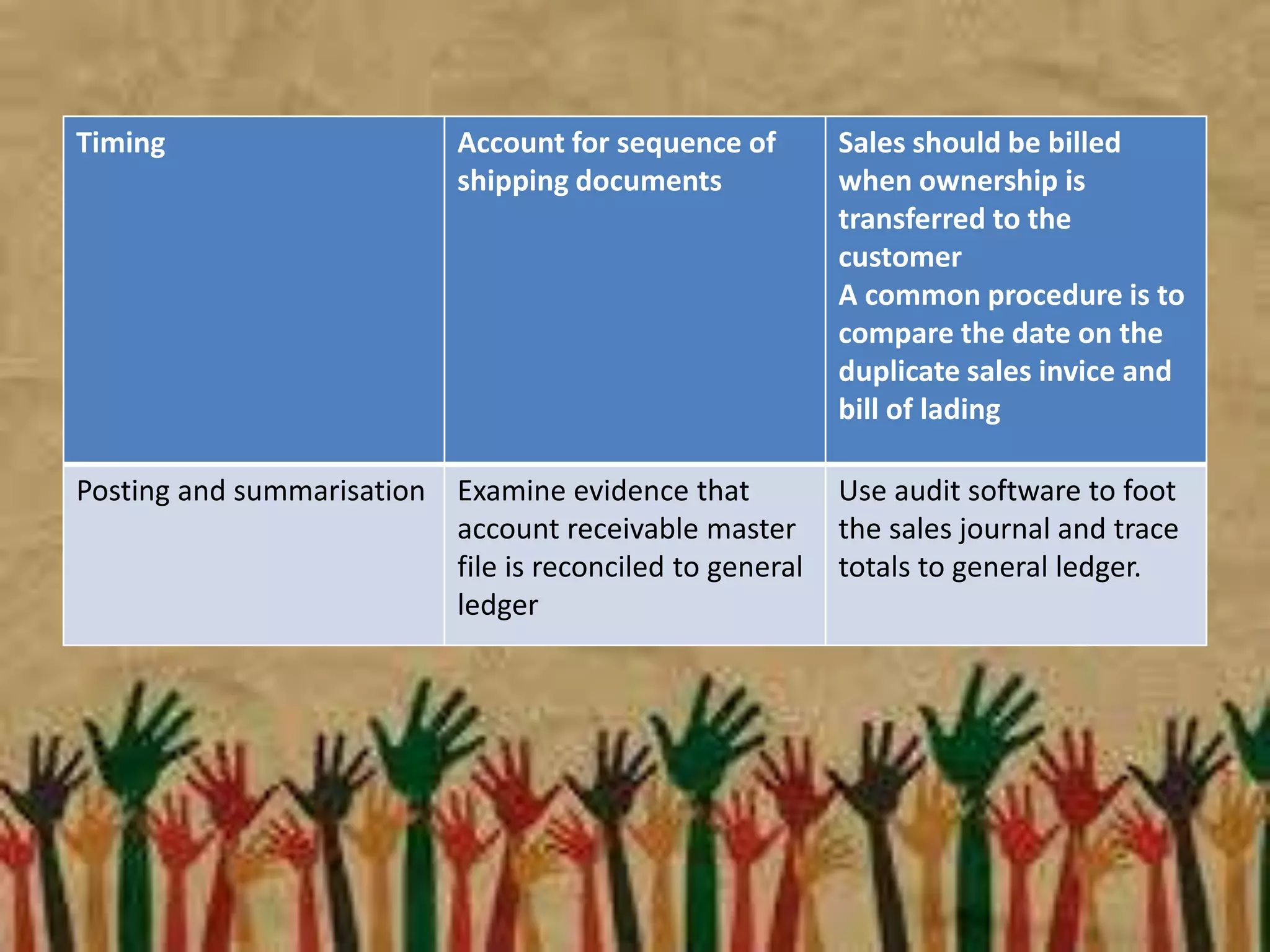
Timing Account for sequence of 
shipping documents 
Sales should be billed 
when ownership is 
transferred to the 
customer 
A common procedure is to 
compare the date on the 
duplicate sales invice and 
bill of lading 
Posting and summarisation Examine evidence that 
account receivable master 
file is reconciled to general 
ledger 
Use audit software to foot 
the sales journal and trace 
totals to general ledger.
3.2 CASH AND BANK BALANCES 
EVIDENCE
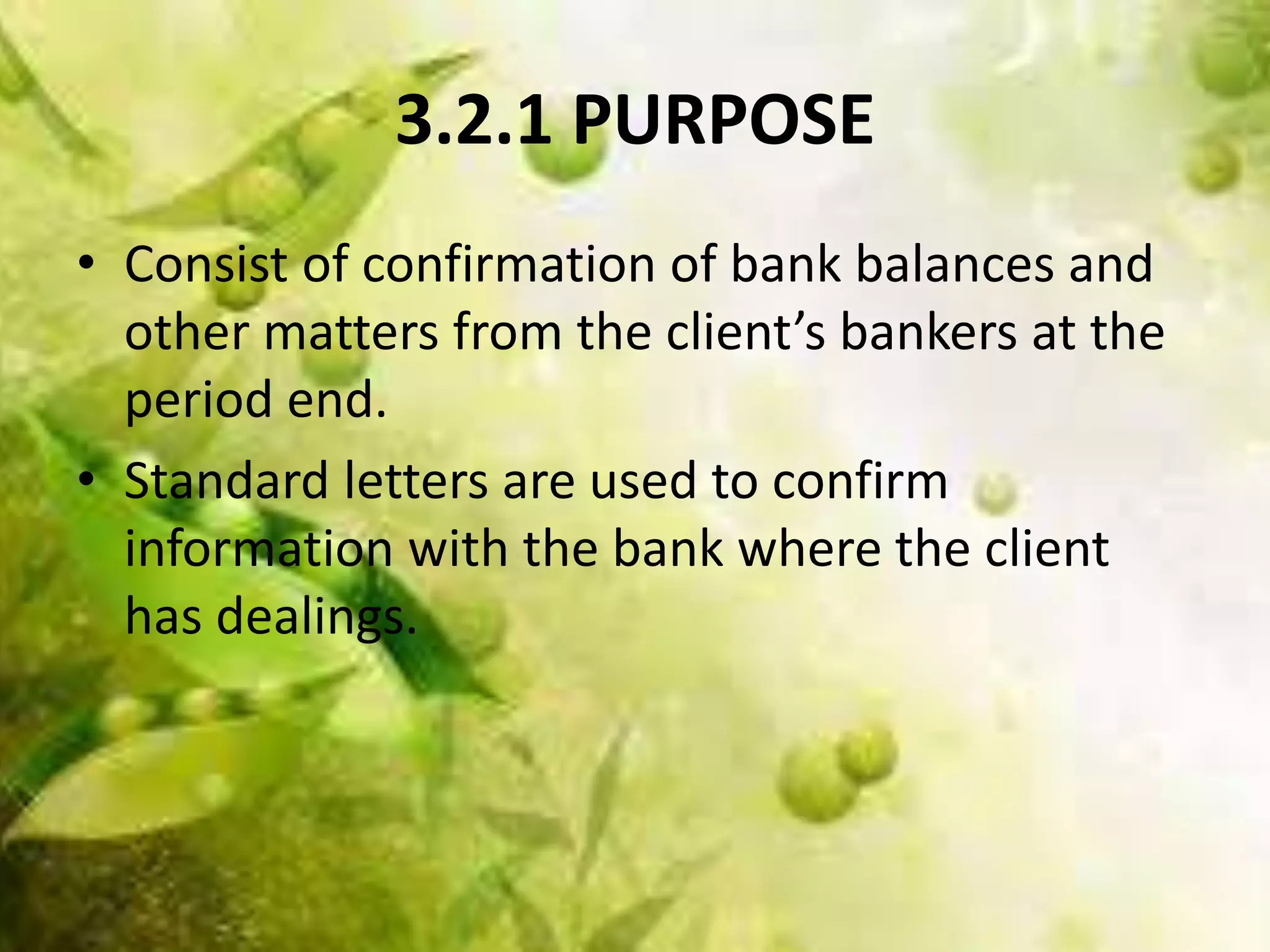
3.2.1 PURPOSE 
• Consist of confirmation of bank balances and 
other matters from the client’s bankers at the 
period end. 
• Standard letters are used to confirm 
information with the bank where the client 
has dealings.
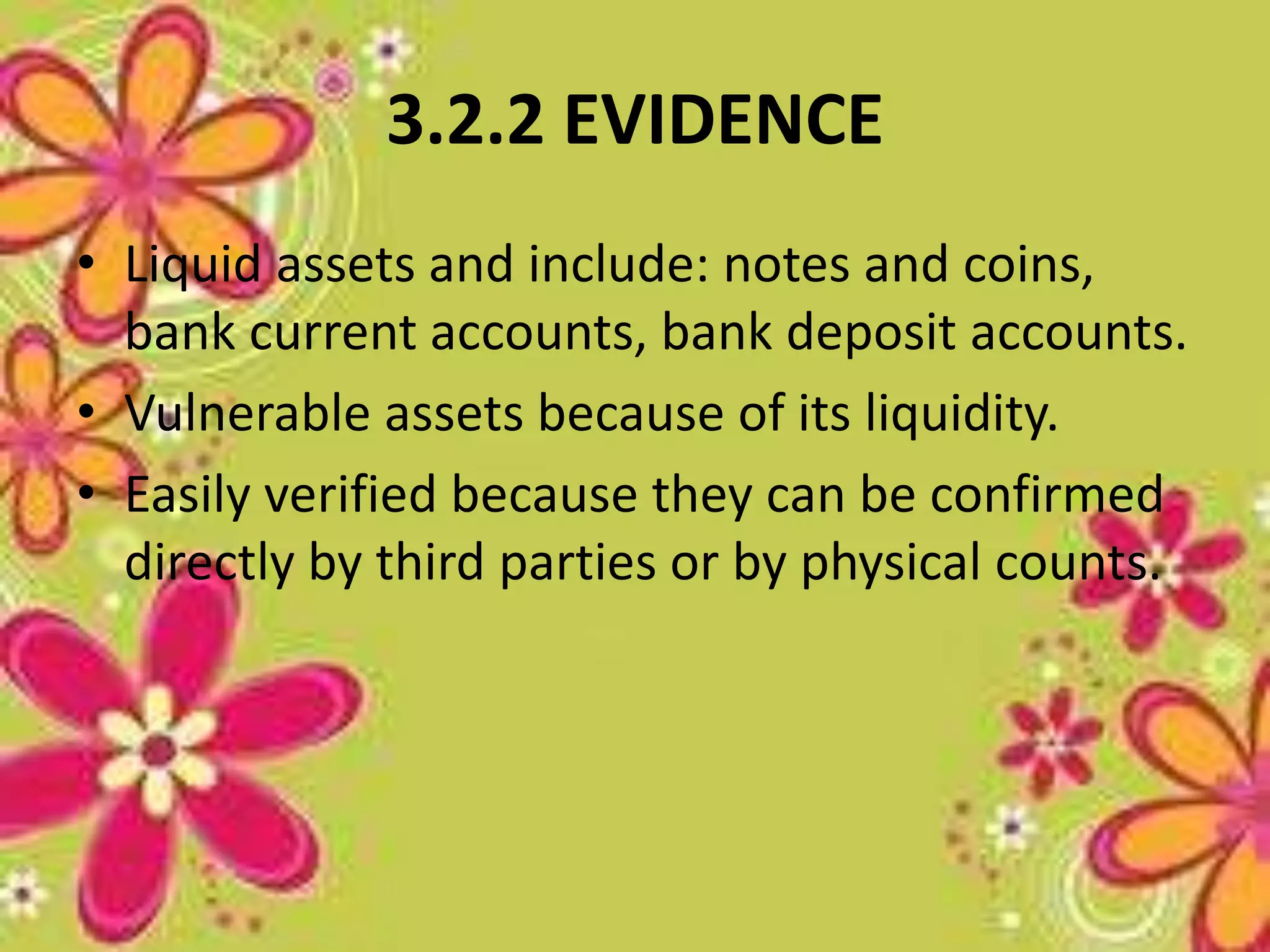
3.2.2 EVIDENCE 
• Liquid assets and include: notes and coins, 
bank current accounts, bank deposit accounts. 
• Vulnerable assets because of its liquidity. 
• Easily verified because they can be confirmed 
directly by third parties or by physical counts.
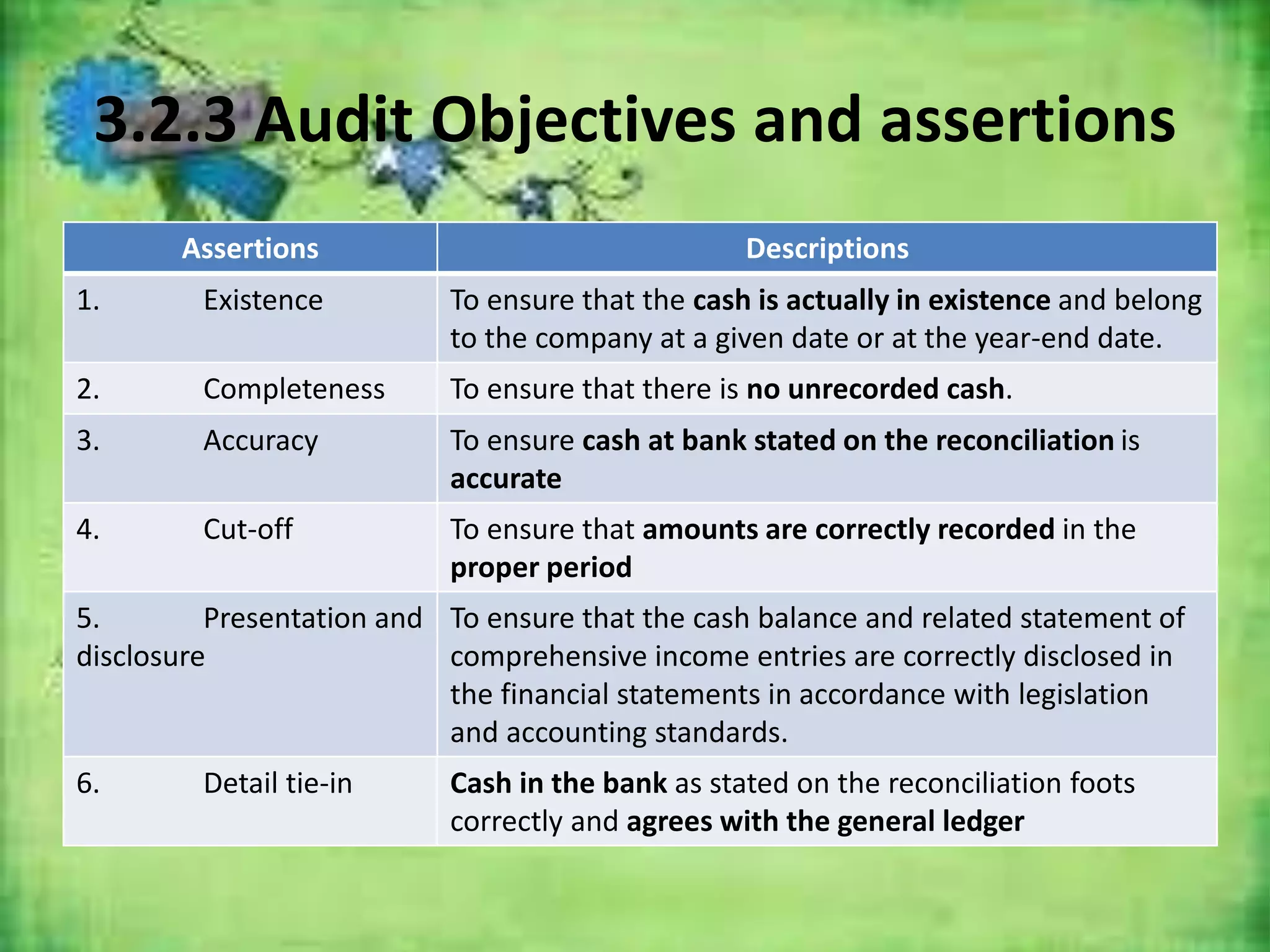
3.2.3 Audit Objectives and assertions 
Assertions Descriptions 
1. Existence To ensure that the cash is actually in existence and belong 
to the company at a given date or at the year-end date. 
2. Completeness To ensure that there is no unrecorded cash. 
3. Accuracy To ensure cash at bank stated on the reconciliation is 
accurate 
4. Cut-off To ensure that amounts are correctly recorded in the 
proper period 
5. Presentation and 
disclosure 
To ensure that the cash balance and related statement of 
comprehensive income entries are correctly disclosed in 
the financial statements in accordance with legislation 
and accounting standards. 
6. Detail tie-in Cash in the bank as stated on the reconciliation foots 
correctly and agrees with the general ledger
3.2.4 Suitable audit test to be 
used when auditing
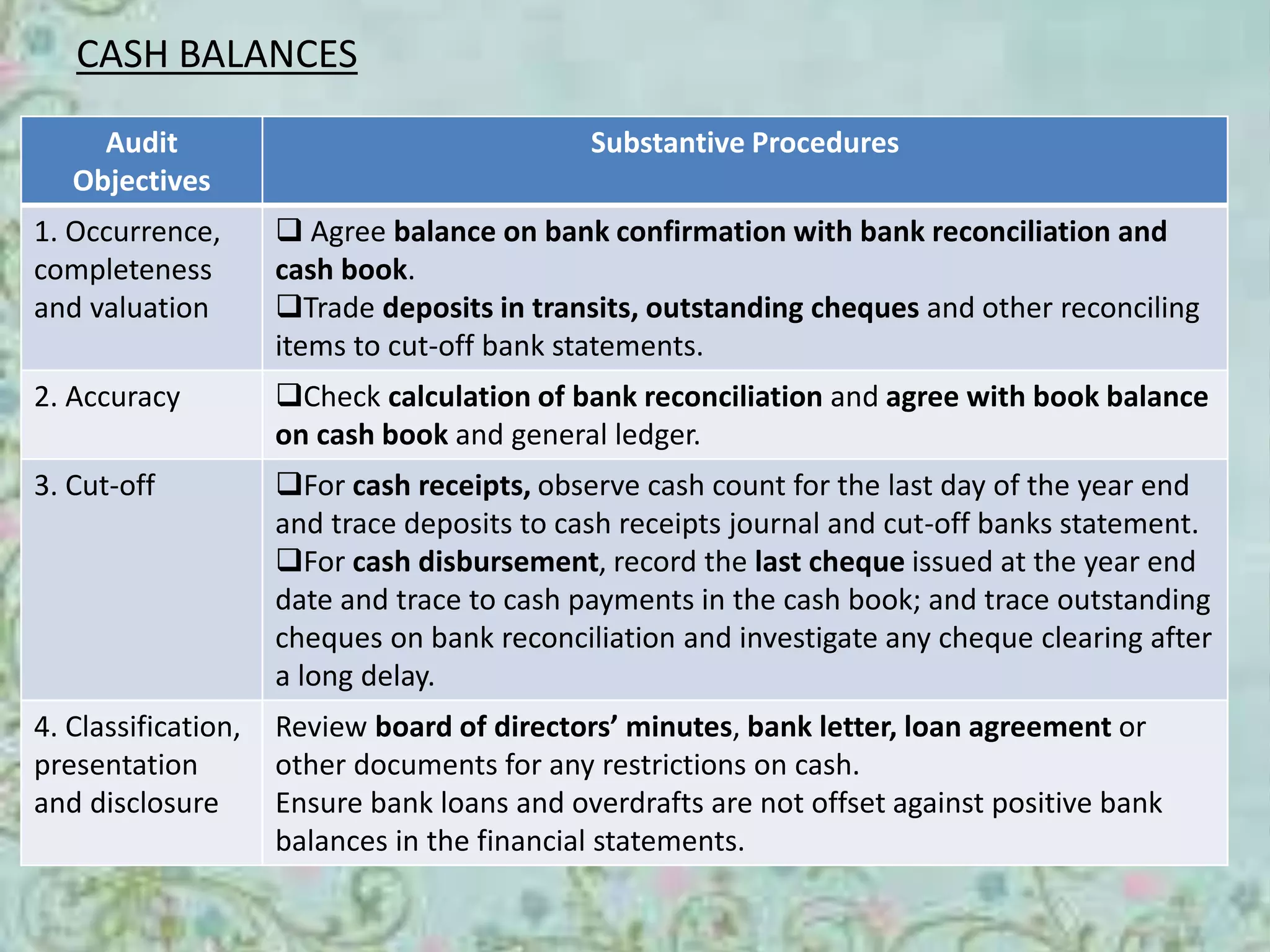
CASH BALANCES 
Audit 
Objectives 
Substantive Procedures 
1. Occurrence, 
completeness 
and valuation 
 Agree balance on bank confirmation with bank reconciliation and 
cash book. 
Trade deposits in transits, outstanding cheques and other reconciling 
items to cut-off bank statements. 
2. Accuracy Check calculation of bank reconciliation and agree with book balance 
on cash book and general ledger. 
3. Cut-off For cash receipts, observe cash count for the last day of the year end 
and trace deposits to cash receipts journal and cut-off banks statement. 
For cash disbursement, record the last cheque issued at the year end 
date and trace to cash payments in the cash book; and trace outstanding 
cheques on bank reconciliation and investigate any cheque clearing after 
a long delay. 
4. Classification, 
presentation 
and disclosure 
Review board of directors’ minutes, bank letter, loan agreement or 
other documents for any restrictions on cash. 
Ensure bank loans and overdrafts are not offset against positive bank 
balances in the financial statements.
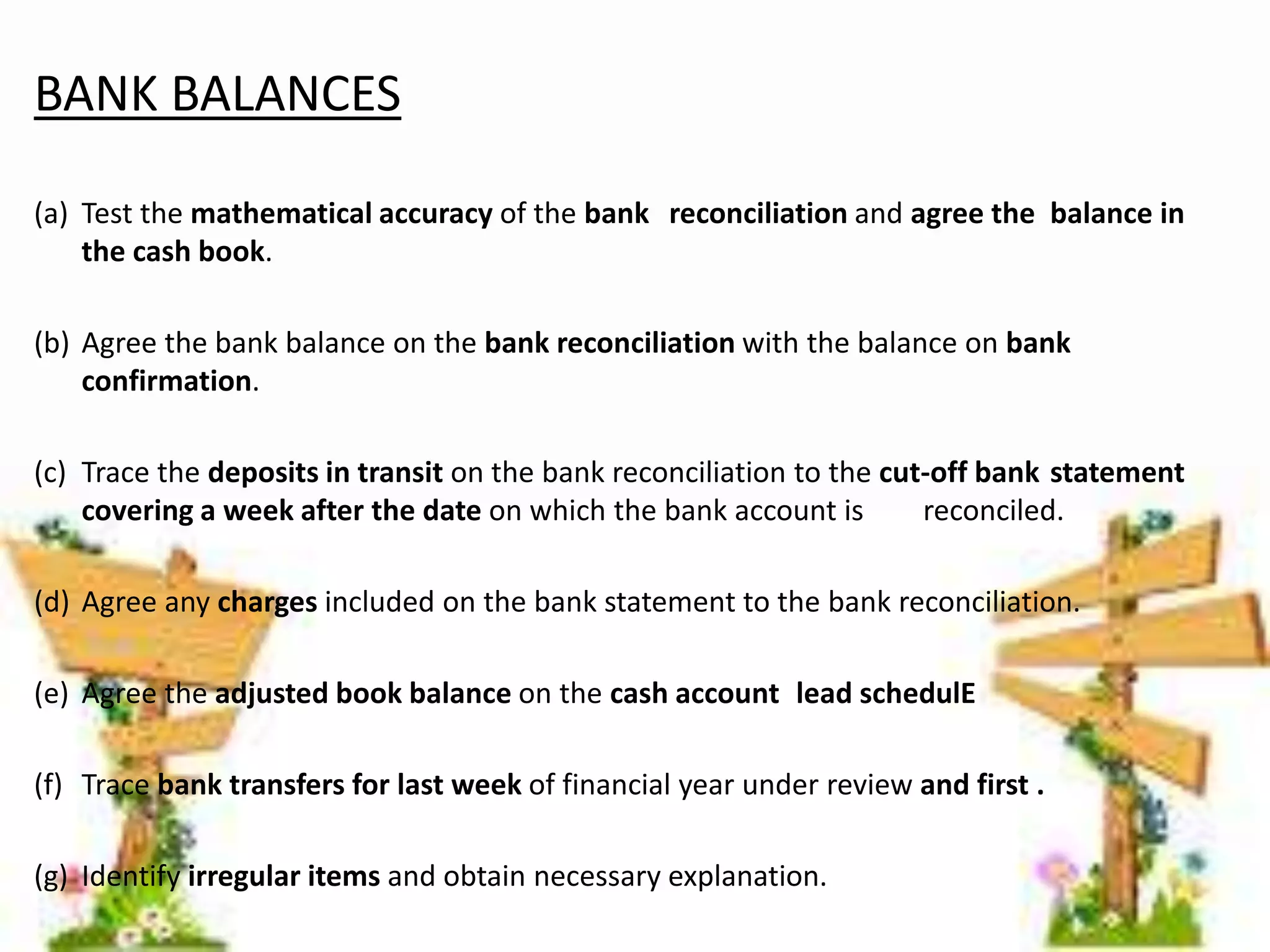
BANK BALANCES 
(a) Test the mathematical accuracy of the bank reconciliation and agree the balance in 
the cash book. 
(b) Agree the bank balance on the bank reconciliation with the balance on bank 
confirmation. 
(c) Trace the deposits in transit on the bank reconciliation to the cut-off bank statement 
covering a week after the date on which the bank account is reconciled. 
(d) Agree any charges included on the bank statement to the bank reconciliation. 
(e) Agree the adjusted book balance on the cash account lead schedulE 
(f) Trace bank transfers for last week of financial year under review and first . 
(g) Identify irregular items and obtain necessary explanation.
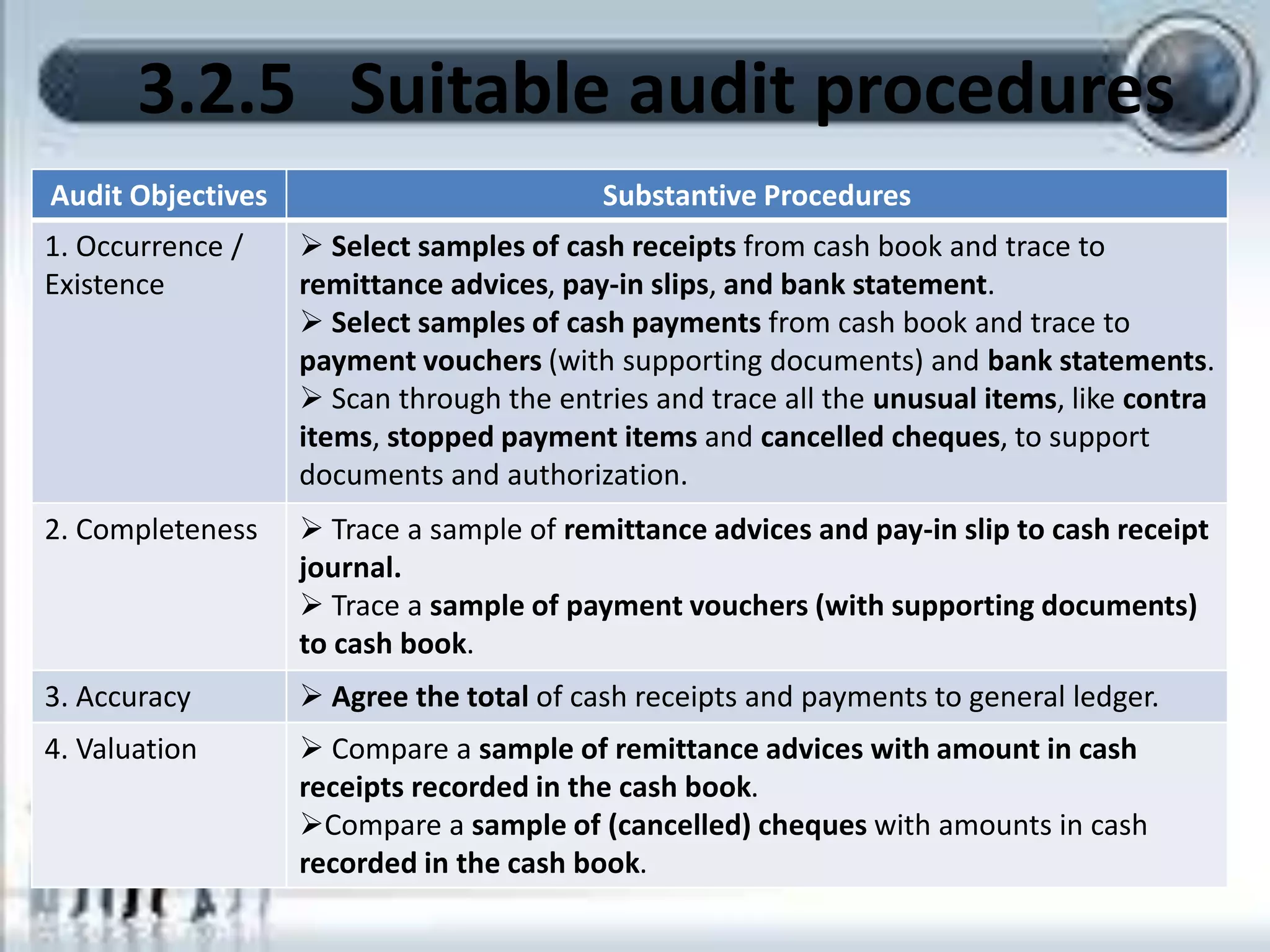
3.2.5 Suitable audit procedures 
Audit Objectives Substantive Procedures 
1. Occurrence / 
Existence 
 Select samples of cash receipts from cash book and trace to 
remittance advices, pay-in slips, and bank statement. 
 Select samples of cash payments from cash book and trace to 
payment vouchers (with supporting documents) and bank statements. 
 Scan through the entries and trace all the unusual items, like contra 
items, stopped payment items and cancelled cheques, to support 
documents and authorization. 
2. Completeness  Trace a sample of remittance advices and pay-in slip to cash receipt 
journal. 
 Trace a sample of payment vouchers (with supporting documents) 
to cash book. 
3. Accuracy  Agree the total of cash receipts and payments to general ledger. 
4. Valuation  Compare a sample of remittance advices with amount in cash 
receipts recorded in the cash book. 
Compare a sample of (cancelled) cheques with amounts in cash 
recorded in the cash book.
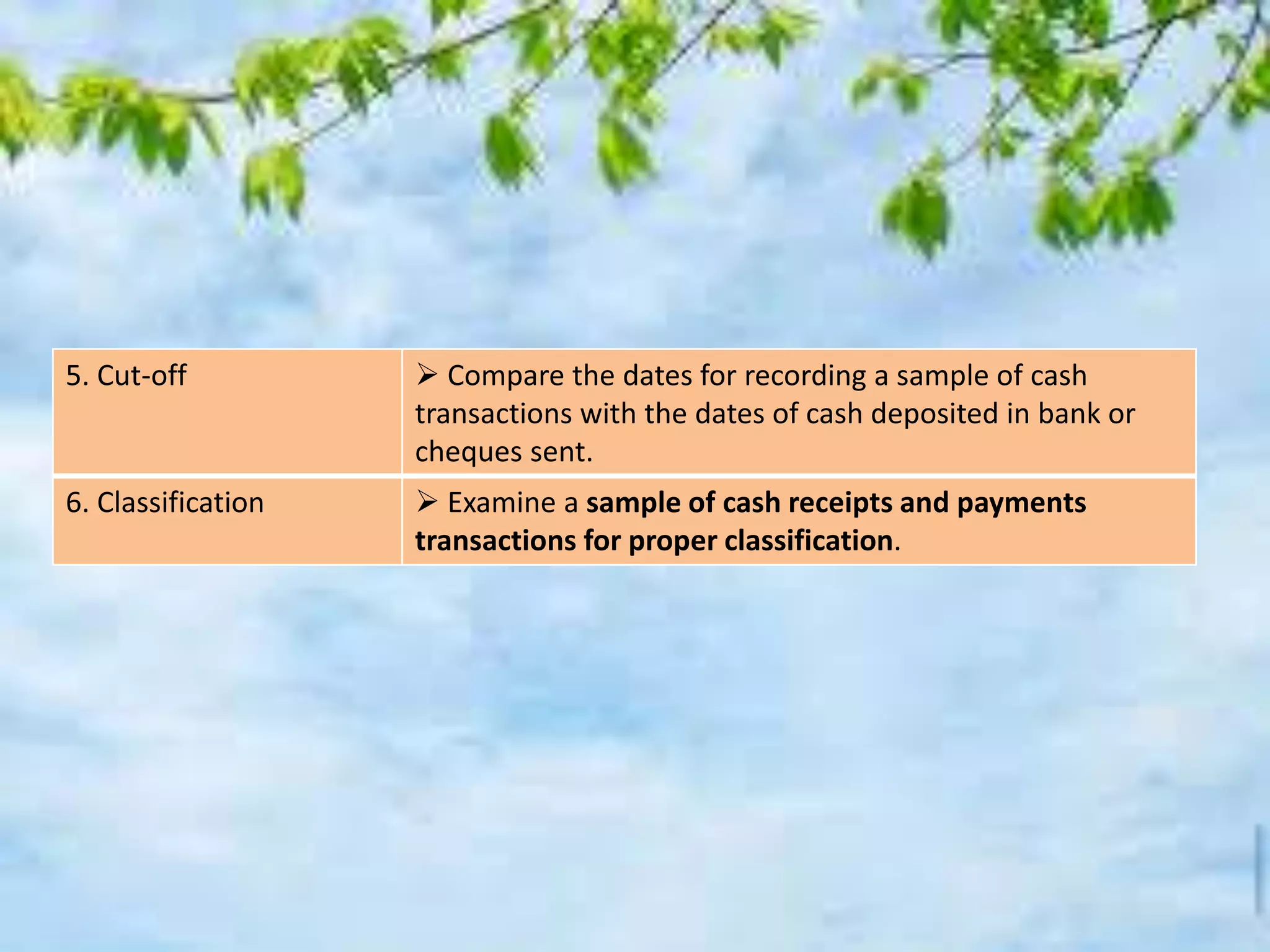
5. Cut-off  Compare the dates for recording a sample of cash 
transactions with the dates of cash deposited in bank or 
cheques sent. 
6. Classification  Examine a sample of cash receipts and payments 
transactions for proper classification.
3.3 CONCEPT OF AUDITING IN 
INVESTMENT
3.3.1 Purpose 
• To ensure that purchases and disposals of 
investments are properly authorized , 
recorded and accounted for 
• To ensure that investments are properly 
valued and disclosed in the financial 
statements
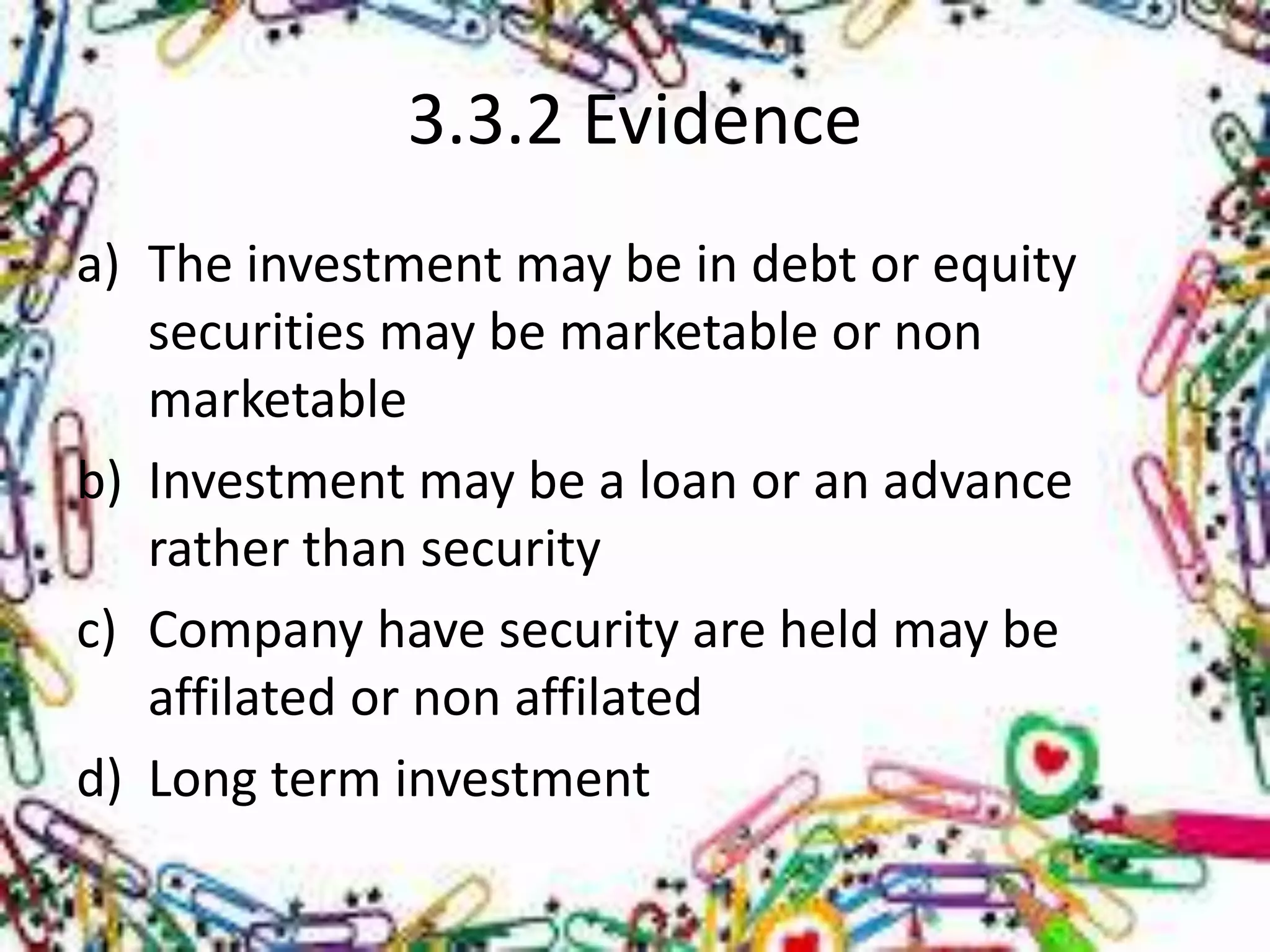
3.3.2 Evidence 
a) The investment may be in debt or equity 
securities may be marketable or non 
marketable 
b) Investment may be a loan or an advance 
rather than security 
c) Company have security are held may be 
affilated or non affilated 
d) Long term investment
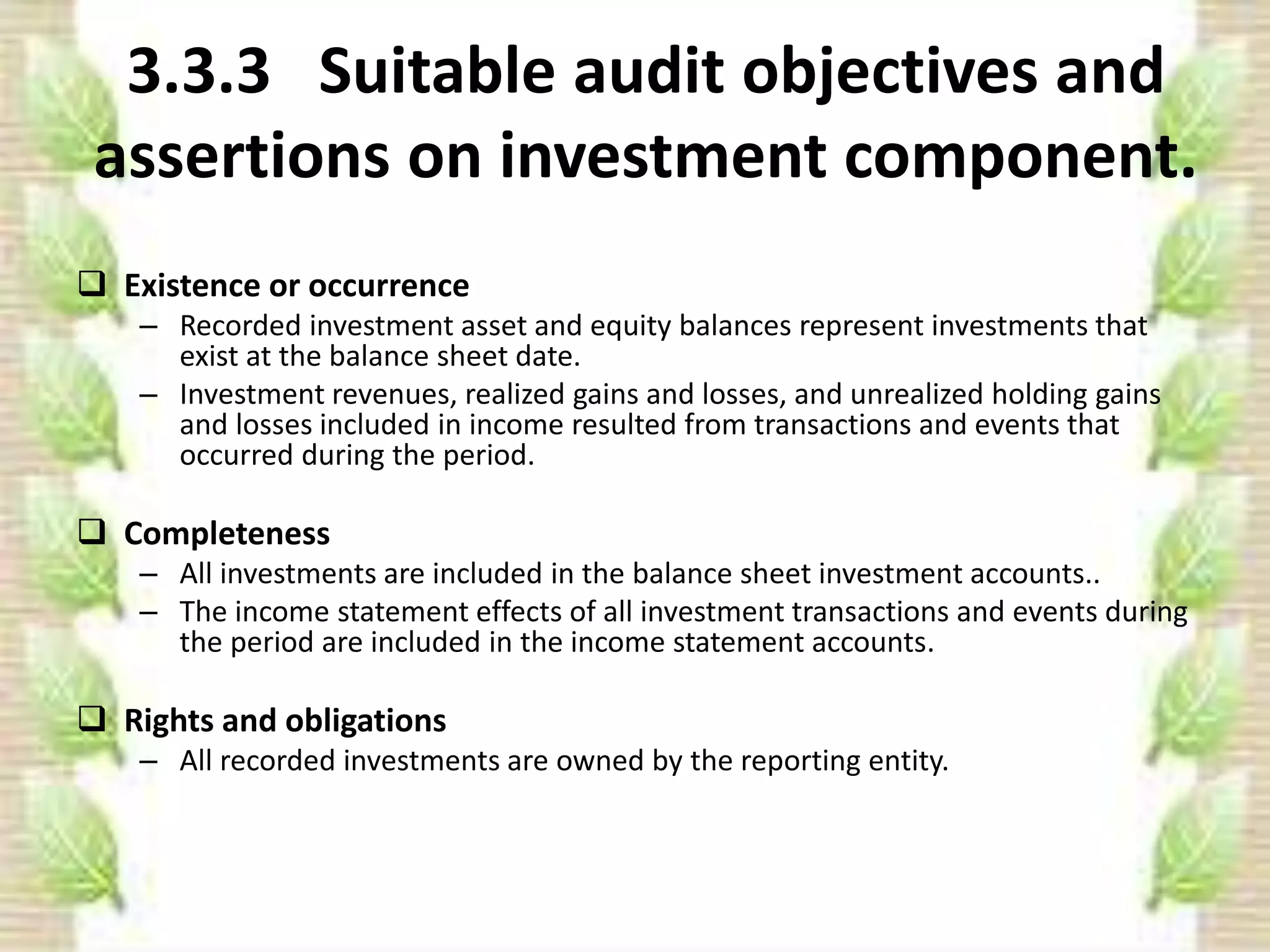
3.3.3 Suitable audit objectives and 
assertions on investment component. 
 Existence or occurrence 
– Recorded investment asset and equity balances represent investments that 
exist at the balance sheet date. 
– Investment revenues, realized gains and losses, and unrealized holding gains 
and losses included in income resulted from transactions and events that 
occurred during the period. 
 Completeness 
– All investments are included in the balance sheet investment accounts.. 
– The income statement effects of all investment transactions and events during 
the period are included in the income statement accounts. 
 Rights and obligations 
– All recorded investments are owned by the reporting entity.
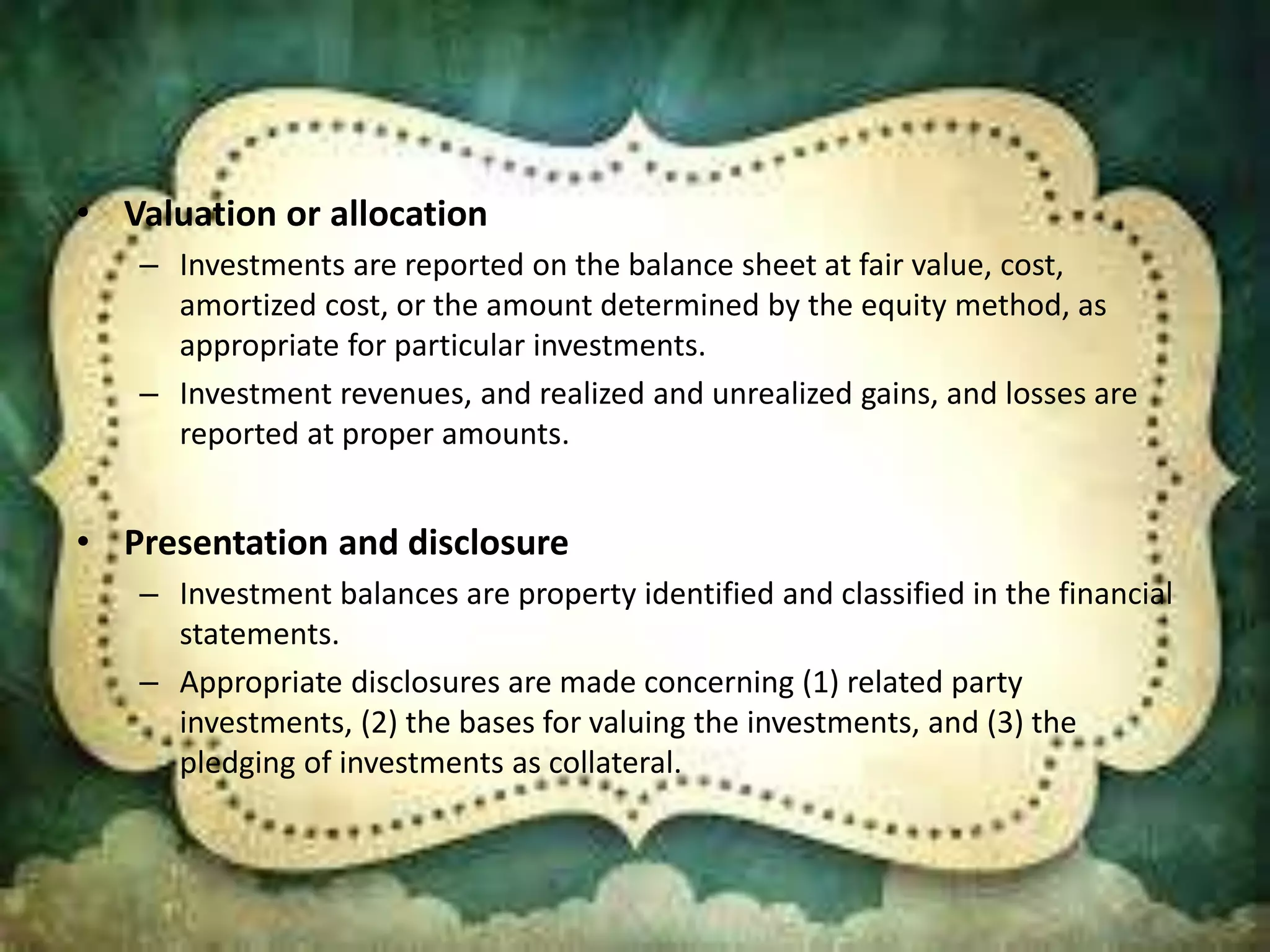
• Valuation or allocation 
– Investments are reported on the balance sheet at fair value, cost, 
amortized cost, or the amount determined by the equity method, as 
appropriate for particular investments. 
– Investment revenues, and realized and unrealized gains, and losses are 
reported at proper amounts. 
• Presentation and disclosure 
– Investment balances are property identified and classified in the financial 
statements. 
– Appropriate disclosures are made concerning (1) related party 
investments, (2) the bases for valuing the investments, and (3) the 
pledging of investments as collateral.
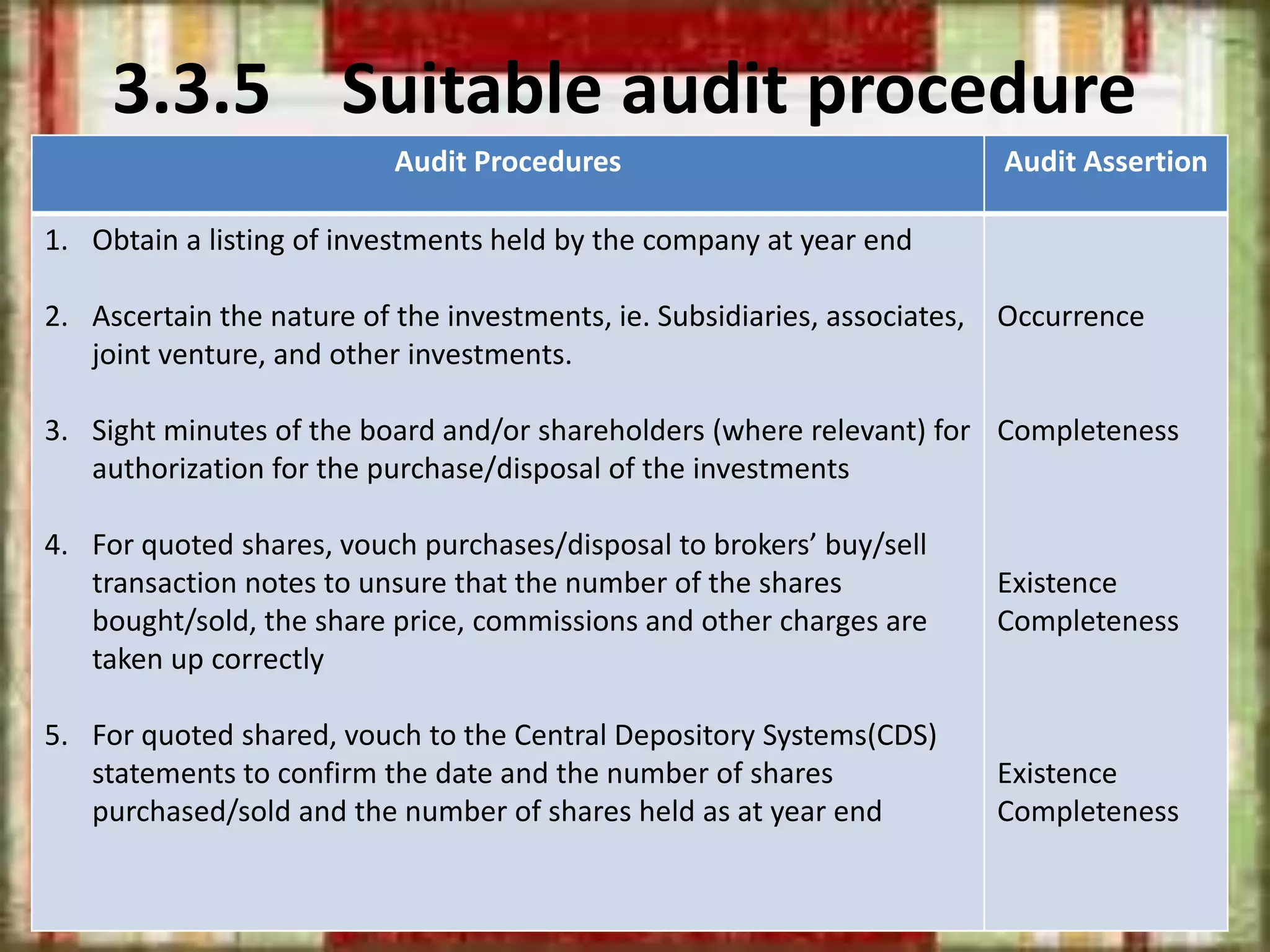
3.3.5 Suitable audit procedure 
Audit Procedures Audit Assertion 
1. Obtain a listing of investments held by the company at year end 
2. Ascertain the nature of the investments, ie. Subsidiaries, associates, 
joint venture, and other investments. 
3. Sight minutes of the board and/or shareholders (where relevant) for 
authorization for the purchase/disposal of the investments 
4. For quoted shares, vouch purchases/disposal to brokers’ buy/sell 
transaction notes to unsure that the number of the shares 
bought/sold, the share price, commissions and other charges are 
taken up correctly 
5. For quoted shared, vouch to the Central Depository Systems(CDS) 
statements to confirm the date and the number of shares 
purchased/sold and the number of shares held as at year end 
Occurrence 
Completeness 
Existence 
Completeness 
Existence 
Completeness
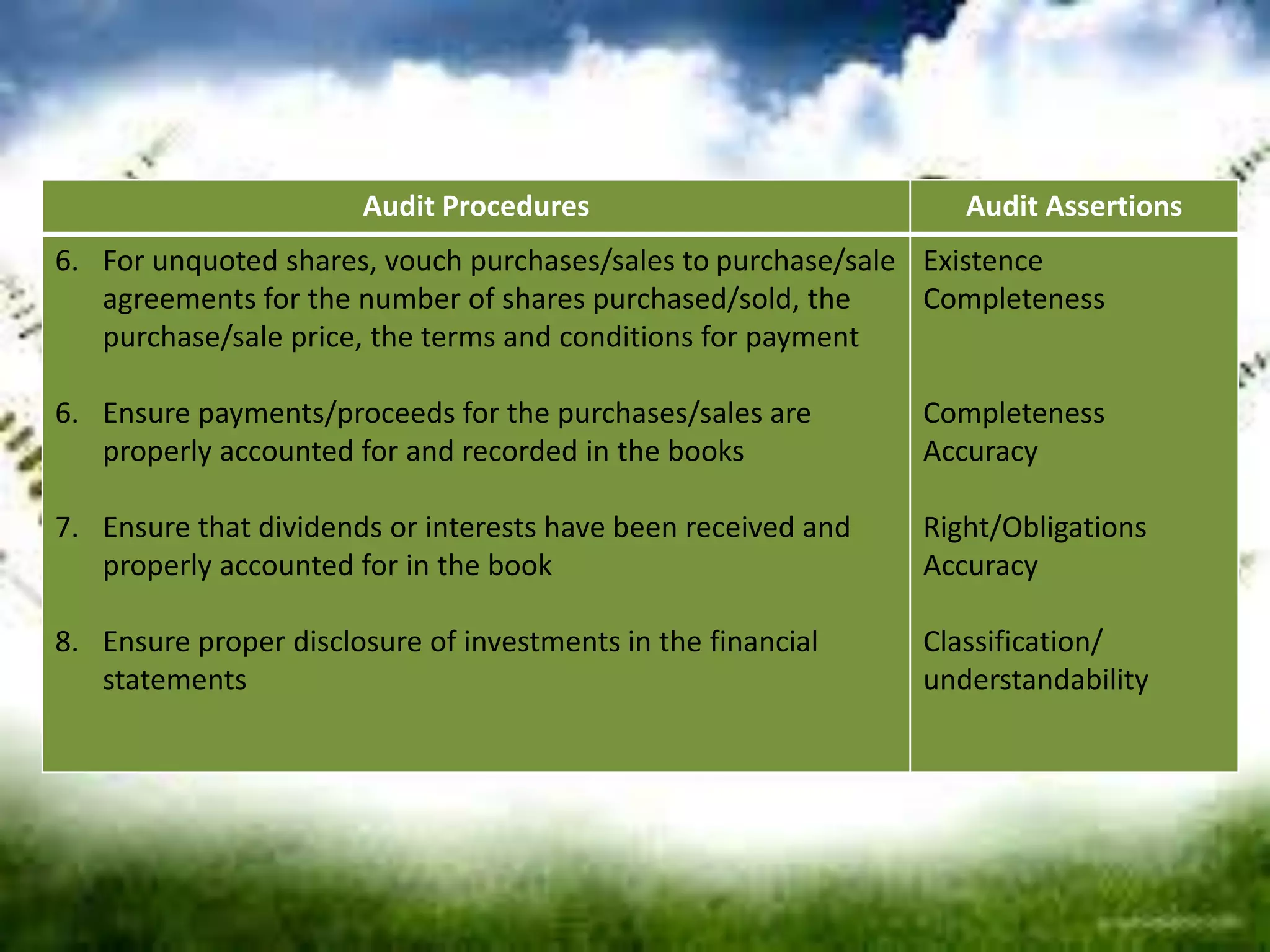
Audit Procedures Audit Assertions 
6. For unquoted shares, vouch purchases/sales to purchase/sale 
agreements for the number of shares purchased/sold, the 
purchase/sale price, the terms and conditions for payment 
6. Ensure payments/proceeds for the purchases/sales are 
properly accounted for and recorded in the books 
7. Ensure that dividends or interests have been received and 
properly accounted for in the book 
8. Ensure proper disclosure of investments in the financial 
statements 
Existence 
Completeness 
Completeness 
Accuracy 
Right/Obligations 
Accuracy 
Classification/ 
understandability
THE END

Chapter 3 (2)

  • 1.
    AUDITING AND ASSURANCE CHAPTER 3 AUDIT ON FINANCIAL STATEMENT
  • 2.
    GROUP MEMBERS : 1. UMMI SARAH BINTI ABD KGUPOR 10DAT11F2006 2. NOR SHAWAL LEILA BINTI ZAHARUDIN 10DAT11F2011 3. NUR AZWEEN SYAFIERA BINTI ABD NASIR 10DAT11F2025 4. SITI AISHAH BINTI MUSA 10DAT11F2032 CLASS : DAT 6A
  • 3.
    3.1 REVENUE AND EXPENDITURE
  • 4.
    3.1.1 PURPOSE •Measured at their fair value of the consideration received or receivable • Ensure voluntary compliance between all documentations, control, policies and guidelines • Test control for detection significant weaknesses and check financial statements
  • 5.
    3.1.2 EVIDENCE Evidenceselection a) Sales of goods and services b) Payments received for goods and services c) Good returned by claims received from customers
  • 6.
    a) Sales ofgoods and services 1) Receiving and recording customers orders 2) Authorising credit terms and shipment 3) Confirming orders 4) Executing shipping orders for goods or work orders for the performance of services 5) Recording the shipments or services performed
  • 7.
    b) Payments receivedfor goods and services 1) Receiving the cash and depositing in the bank cash 2) Comparing amounts remitted with recorded amounts 3) Authorising discounts and allowances 4) Recording cash receipts, discounts and allowances
  • 8.
    c) Good returnedby claims received from customers 1) Receiving and accepting goods and claims 2) Preparing receiving reports 3) Reviewing claims 4) Authorising credits 5) Preparing and mailing credit memo 6) Recording returns and claim
  • 9.
    3.1.3 SUITABLE AUDITOBJECTIVES 1) authorisation – all are pre-approved by responsible personnel 2) completeness – all valid transactions are included in the accounting records 3) accuracy 4) Validity 5) Physical safeguards and security 6) Error handling 7) Segregation of duties
  • 10.
    3.1.4 SUITABLE AUDITTEST 1) Authoring sales transactions 2) Adequate segregation of duties 3) Adequate documents and records 4) pre-numbered documents 5) Monthly statements 6) internal verifications procedures
  • 11.
    3.1.5 SUITABLE AUDITPROCEDURES Assertions Test of control Substantive test Existence Examine sales invice for supporting bill of lading and customer order An auditor is concerned with three types of misstatements: a) Recorded sale with no shipments-trace from sales journal entry to shipping document b) Sales recorded more than once – check cancellation of shipping documentation c) Shipment made to nonexistent customers – person recording sales shoud not authorised shipmments Completeness Account for sequence of shipping documents Many audits ignore completeness on the grounds that overstatement of income of is greater concern. However errors may still misstate financial statements. One effective proedure is to trace from shipping documents to the sales invoice and entry in the sales journal
  • 12.
    Accuracy Examine theapproved price list for accuracy and proper authorisation Start with entries in the sales journal and compare the total of selected transactions with accounts receivable master file entries and duplicate sales invoices Classification Examine document package for duplicate verification When there are cash and credit sales, it is important not to debit accounts receivable for a cash sale or to credit sales for collection of a receivable. It is also important not to classify sales of operating assets as sales. A common procedure is to examine duplicate sales invoices for proper account classification
  • 13.
    Timing Account forsequence of shipping documents Sales should be billed when ownership is transferred to the customer A common procedure is to compare the date on the duplicate sales invice and bill of lading Posting and summarisation Examine evidence that account receivable master file is reconciled to general ledger Use audit software to foot the sales journal and trace totals to general ledger.
  • 14.
    3.2 CASH ANDBANK BALANCES EVIDENCE
  • 15.
    3.2.1 PURPOSE •Consist of confirmation of bank balances and other matters from the client’s bankers at the period end. • Standard letters are used to confirm information with the bank where the client has dealings.
  • 16.
    3.2.2 EVIDENCE •Liquid assets and include: notes and coins, bank current accounts, bank deposit accounts. • Vulnerable assets because of its liquidity. • Easily verified because they can be confirmed directly by third parties or by physical counts.
  • 17.
    3.2.3 Audit Objectivesand assertions Assertions Descriptions 1. Existence To ensure that the cash is actually in existence and belong to the company at a given date or at the year-end date. 2. Completeness To ensure that there is no unrecorded cash. 3. Accuracy To ensure cash at bank stated on the reconciliation is accurate 4. Cut-off To ensure that amounts are correctly recorded in the proper period 5. Presentation and disclosure To ensure that the cash balance and related statement of comprehensive income entries are correctly disclosed in the financial statements in accordance with legislation and accounting standards. 6. Detail tie-in Cash in the bank as stated on the reconciliation foots correctly and agrees with the general ledger
  • 18.
    3.2.4 Suitable audittest to be used when auditing
  • 19.
    CASH BALANCES Audit Objectives Substantive Procedures 1. Occurrence, completeness and valuation  Agree balance on bank confirmation with bank reconciliation and cash book. Trade deposits in transits, outstanding cheques and other reconciling items to cut-off bank statements. 2. Accuracy Check calculation of bank reconciliation and agree with book balance on cash book and general ledger. 3. Cut-off For cash receipts, observe cash count for the last day of the year end and trace deposits to cash receipts journal and cut-off banks statement. For cash disbursement, record the last cheque issued at the year end date and trace to cash payments in the cash book; and trace outstanding cheques on bank reconciliation and investigate any cheque clearing after a long delay. 4. Classification, presentation and disclosure Review board of directors’ minutes, bank letter, loan agreement or other documents for any restrictions on cash. Ensure bank loans and overdrafts are not offset against positive bank balances in the financial statements.
  • 20.
    BANK BALANCES (a)Test the mathematical accuracy of the bank reconciliation and agree the balance in the cash book. (b) Agree the bank balance on the bank reconciliation with the balance on bank confirmation. (c) Trace the deposits in transit on the bank reconciliation to the cut-off bank statement covering a week after the date on which the bank account is reconciled. (d) Agree any charges included on the bank statement to the bank reconciliation. (e) Agree the adjusted book balance on the cash account lead schedulE (f) Trace bank transfers for last week of financial year under review and first . (g) Identify irregular items and obtain necessary explanation.
  • 21.
    3.2.5 Suitable auditprocedures Audit Objectives Substantive Procedures 1. Occurrence / Existence  Select samples of cash receipts from cash book and trace to remittance advices, pay-in slips, and bank statement.  Select samples of cash payments from cash book and trace to payment vouchers (with supporting documents) and bank statements.  Scan through the entries and trace all the unusual items, like contra items, stopped payment items and cancelled cheques, to support documents and authorization. 2. Completeness  Trace a sample of remittance advices and pay-in slip to cash receipt journal.  Trace a sample of payment vouchers (with supporting documents) to cash book. 3. Accuracy  Agree the total of cash receipts and payments to general ledger. 4. Valuation  Compare a sample of remittance advices with amount in cash receipts recorded in the cash book. Compare a sample of (cancelled) cheques with amounts in cash recorded in the cash book.
  • 22.
    5. Cut-off Compare the dates for recording a sample of cash transactions with the dates of cash deposited in bank or cheques sent. 6. Classification  Examine a sample of cash receipts and payments transactions for proper classification.
  • 23.
    3.3 CONCEPT OFAUDITING IN INVESTMENT
  • 24.
    3.3.1 Purpose •To ensure that purchases and disposals of investments are properly authorized , recorded and accounted for • To ensure that investments are properly valued and disclosed in the financial statements
  • 25.
    3.3.2 Evidence a)The investment may be in debt or equity securities may be marketable or non marketable b) Investment may be a loan or an advance rather than security c) Company have security are held may be affilated or non affilated d) Long term investment
  • 26.
    3.3.3 Suitable auditobjectives and assertions on investment component.  Existence or occurrence – Recorded investment asset and equity balances represent investments that exist at the balance sheet date. – Investment revenues, realized gains and losses, and unrealized holding gains and losses included in income resulted from transactions and events that occurred during the period.  Completeness – All investments are included in the balance sheet investment accounts.. – The income statement effects of all investment transactions and events during the period are included in the income statement accounts.  Rights and obligations – All recorded investments are owned by the reporting entity.
  • 27.
    • Valuation orallocation – Investments are reported on the balance sheet at fair value, cost, amortized cost, or the amount determined by the equity method, as appropriate for particular investments. – Investment revenues, and realized and unrealized gains, and losses are reported at proper amounts. • Presentation and disclosure – Investment balances are property identified and classified in the financial statements. – Appropriate disclosures are made concerning (1) related party investments, (2) the bases for valuing the investments, and (3) the pledging of investments as collateral.
  • 28.
    3.3.5 Suitable auditprocedure Audit Procedures Audit Assertion 1. Obtain a listing of investments held by the company at year end 2. Ascertain the nature of the investments, ie. Subsidiaries, associates, joint venture, and other investments. 3. Sight minutes of the board and/or shareholders (where relevant) for authorization for the purchase/disposal of the investments 4. For quoted shares, vouch purchases/disposal to brokers’ buy/sell transaction notes to unsure that the number of the shares bought/sold, the share price, commissions and other charges are taken up correctly 5. For quoted shared, vouch to the Central Depository Systems(CDS) statements to confirm the date and the number of shares purchased/sold and the number of shares held as at year end Occurrence Completeness Existence Completeness Existence Completeness
  • 29.
    Audit Procedures AuditAssertions 6. For unquoted shares, vouch purchases/sales to purchase/sale agreements for the number of shares purchased/sold, the purchase/sale price, the terms and conditions for payment 6. Ensure payments/proceeds for the purchases/sales are properly accounted for and recorded in the books 7. Ensure that dividends or interests have been received and properly accounted for in the book 8. Ensure proper disclosure of investments in the financial statements Existence Completeness Completeness Accuracy Right/Obligations Accuracy Classification/ understandability
  • 30.