Week 6:
Audit of Sales Cycle,
Audit Sampling and
Inventory.
Lecture 6_Summary : Sales and Inventory Cycle
• Audit of Sales Cycle
- Sales and cash receipts
- Sales returns and allowances
- Key controls
• Sampling Decisions
- Representative sampling
- Statistical Sampling
- Non- statistical Sampling
• Inventory & Warehousing
- Audit test
- Physical
- Pricing and Compilation
• Accounts Receivable
- Audit tests
- Aged and uncollectible debts
- Cash receipts
Audit of Sales Cycle
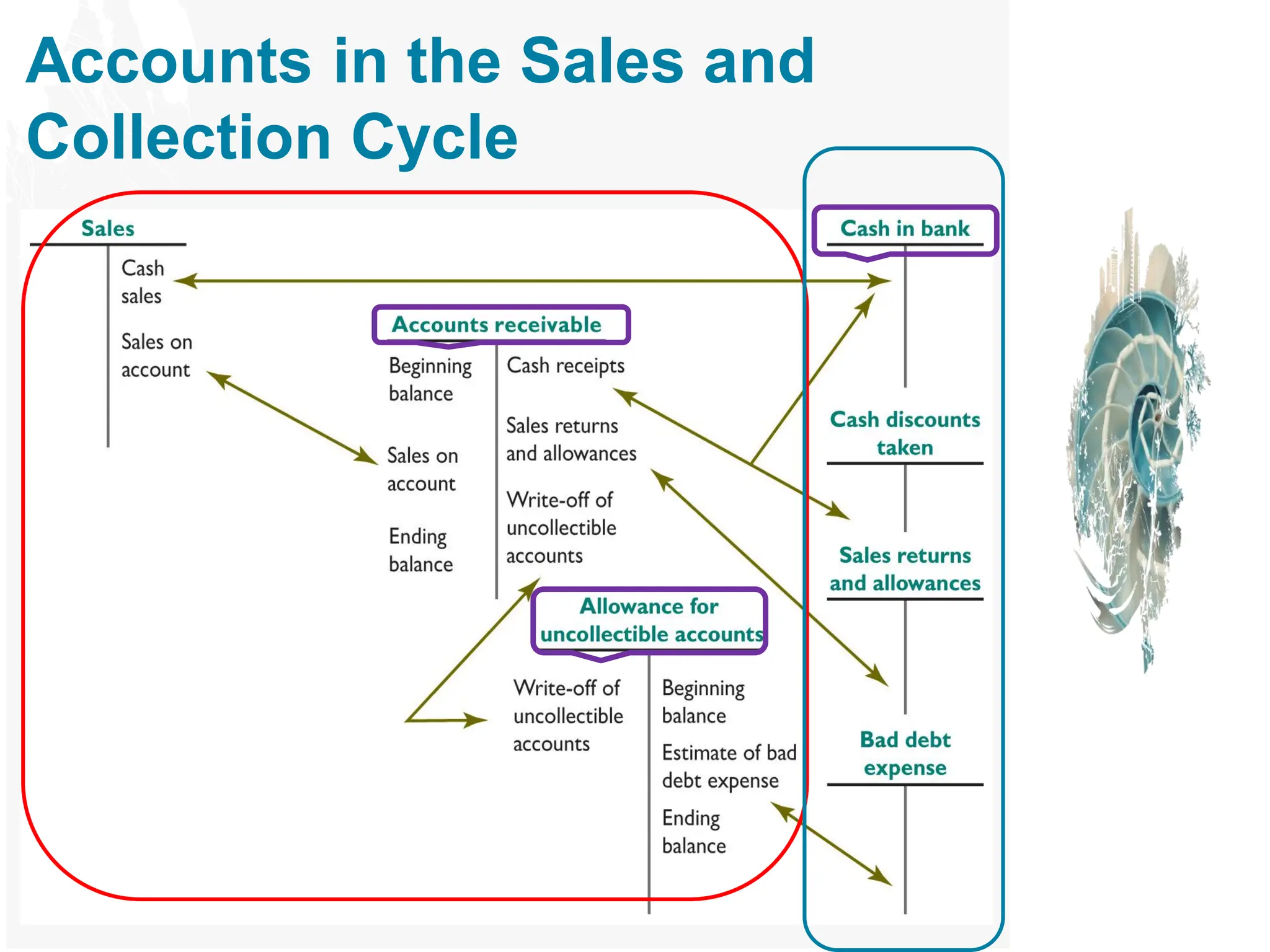
Accounts in the Sales and
Collection Cycle
Accounts and Classes of
Transactions in the Sales and
Collection Cycle
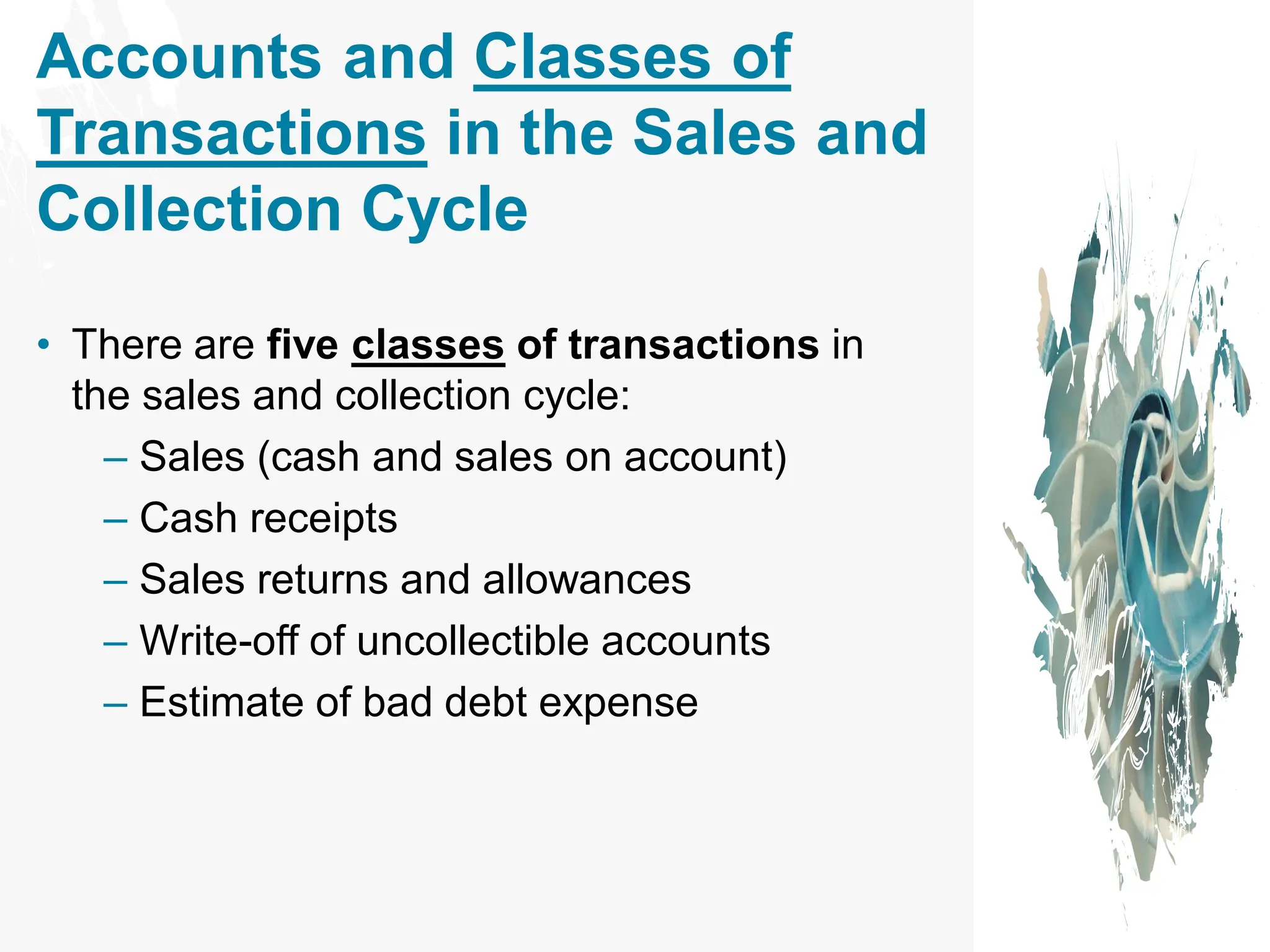
• There are five classes of transactions in
the sales and collection cycle:
– Sales (cash and sales on account)
– Cash receipts
– Sales returns and allowances
– Write-off of uncollectible accounts
– Estimate of bad debt expense
Business Functions in the Cycle
and Related Documents and
Records
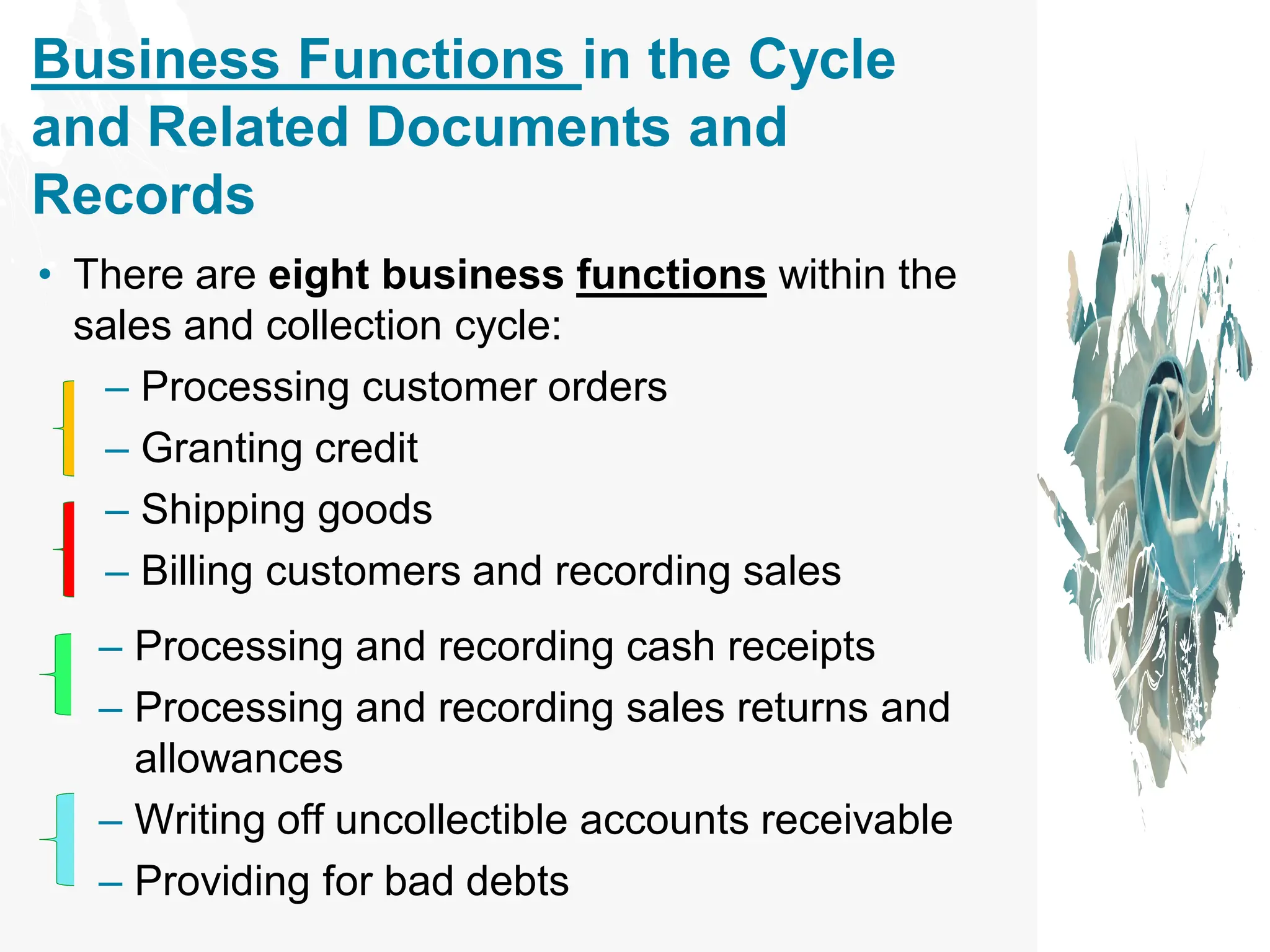
• There are eight business functions within the
sales and collection cycle:
– Processing customer orders
– Granting credit
– Shipping goods
– Billing customers and recording sales
– Processing and recording cash receipts
– Processing and recording sales returns and
allowances
– Writing off uncollectible accounts receivable
– Providing for bad debts
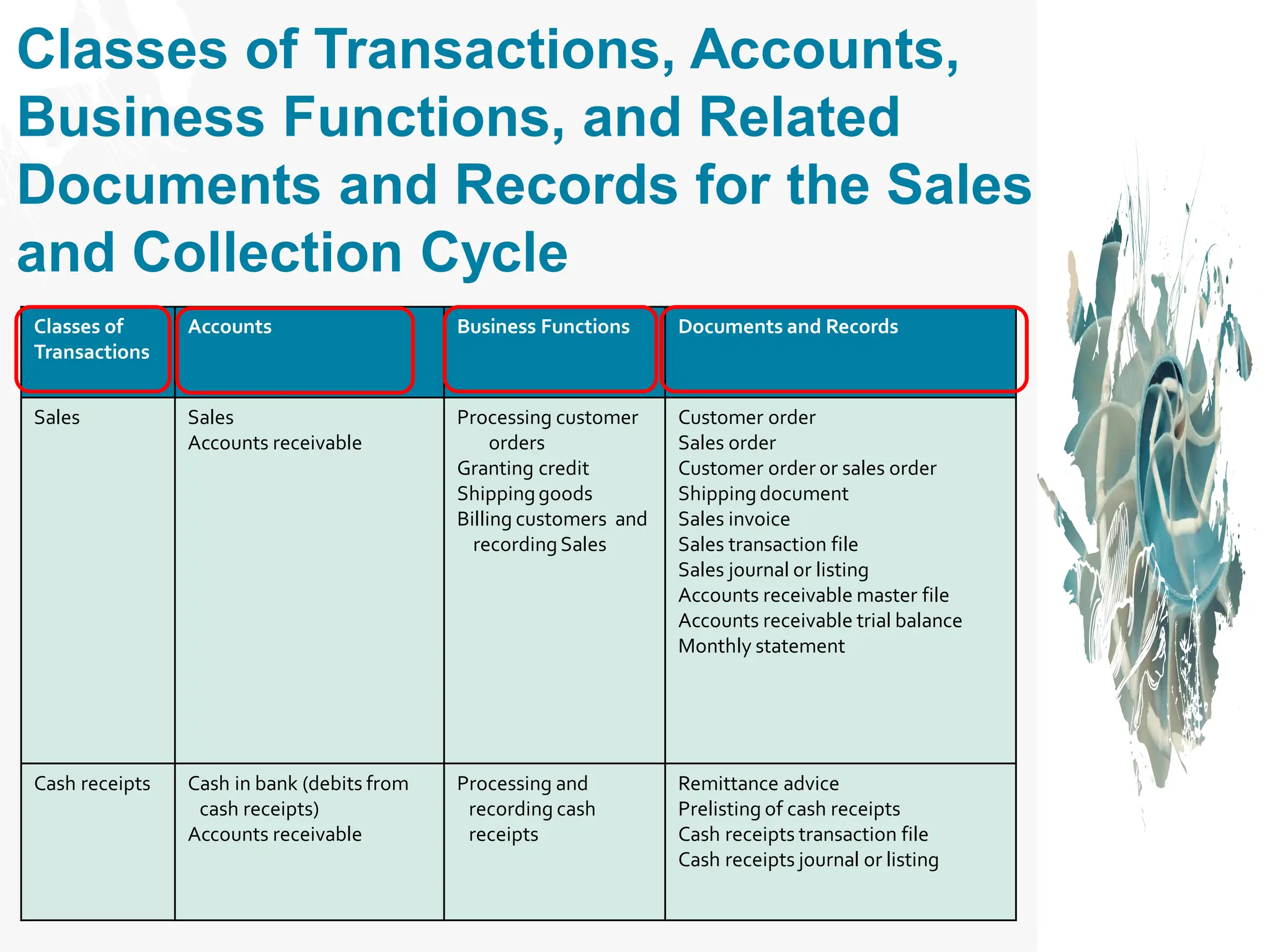
Classes of Transactions, Accounts,
Business Functions, and Related
Documents and Records for the Sales
and Collection Cycle
Classes of
Transactions
Accounts Business Functions Documents and Records
Sales Sales
Accounts receivable
Processing customer
orders
Granting credit
Shippinggoods
Billing customers and
recordingSales
Customer order
Sales order
Customer order or sales order
Shippingdocument
Sales invoice
Sales transaction file
Sales journal or listing
Accounts receivable master file
Accounts receivable trial balance
Monthly statement
Cash receipts Cash in bank (debits from
cash receipts)
Accounts receivable
Processing and
recording cash
receipts
Remittance advice
Prelisting of cash receipts
Cash receipts transaction file
Cash receipts journal or listing
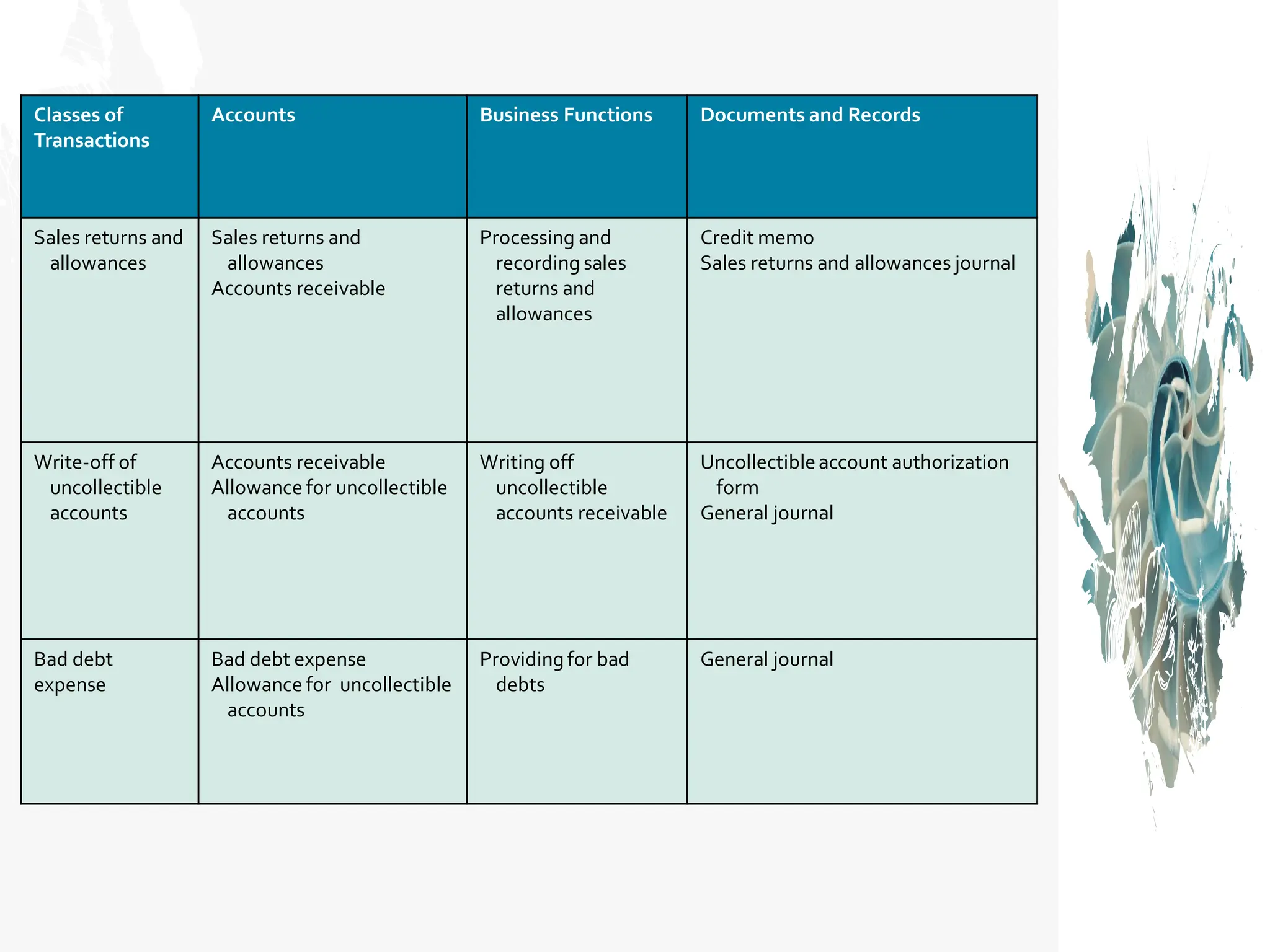
Classes of
Transactions
Accounts Business Functions Documents and Records
Sales returns and
allowances
Sales returns and
allowances
Accounts receivable
Processing and
recording sales
returns and
allowances
Credit memo
Sales returns and allowances journal
Write-off of
uncollectible
accounts
Accounts receivable
Allowance for uncollectible
accounts
Writing off
uncollectible
accounts receivable
Uncollectibleaccount authorization
form
General journal
Bad debt
expense
Bad debt expense
Allowance for uncollectible
accounts
Providingfor bad
debts
General journal
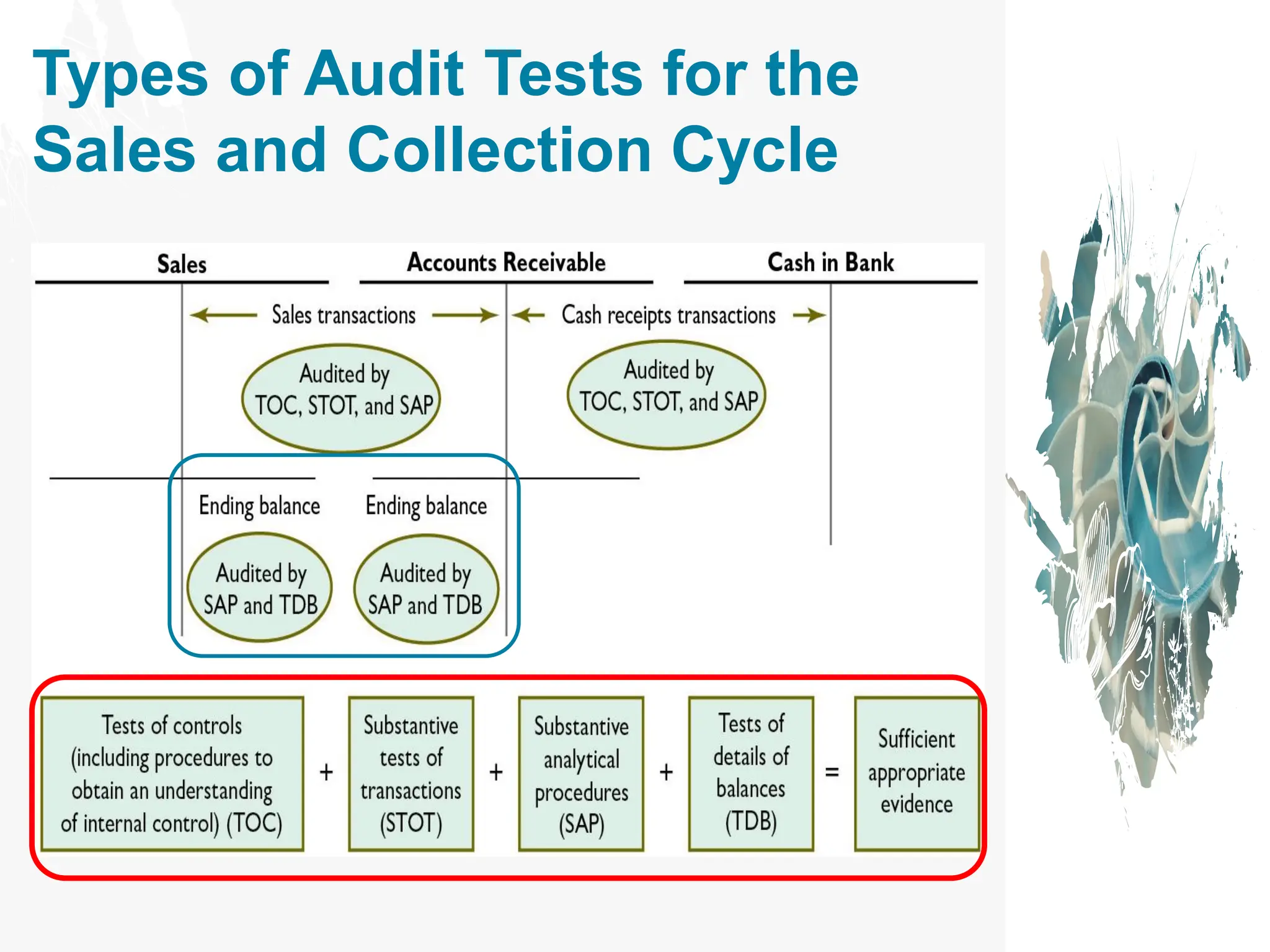
Types of Audit Tests for the
Sales and Collection Cycle
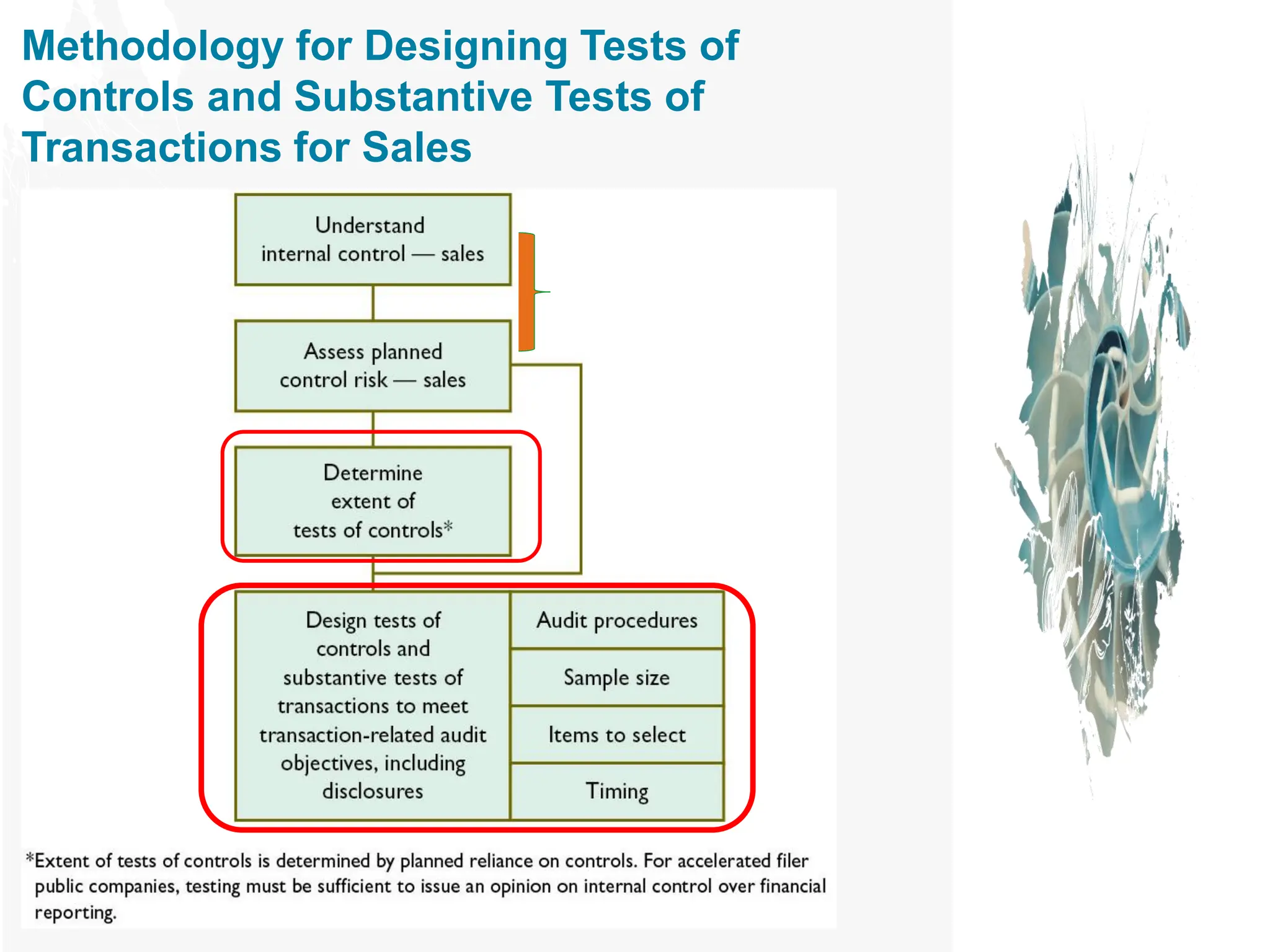
Methodology for Designing Tests of
Controls and Substantive Tests of
Transactions for Sales
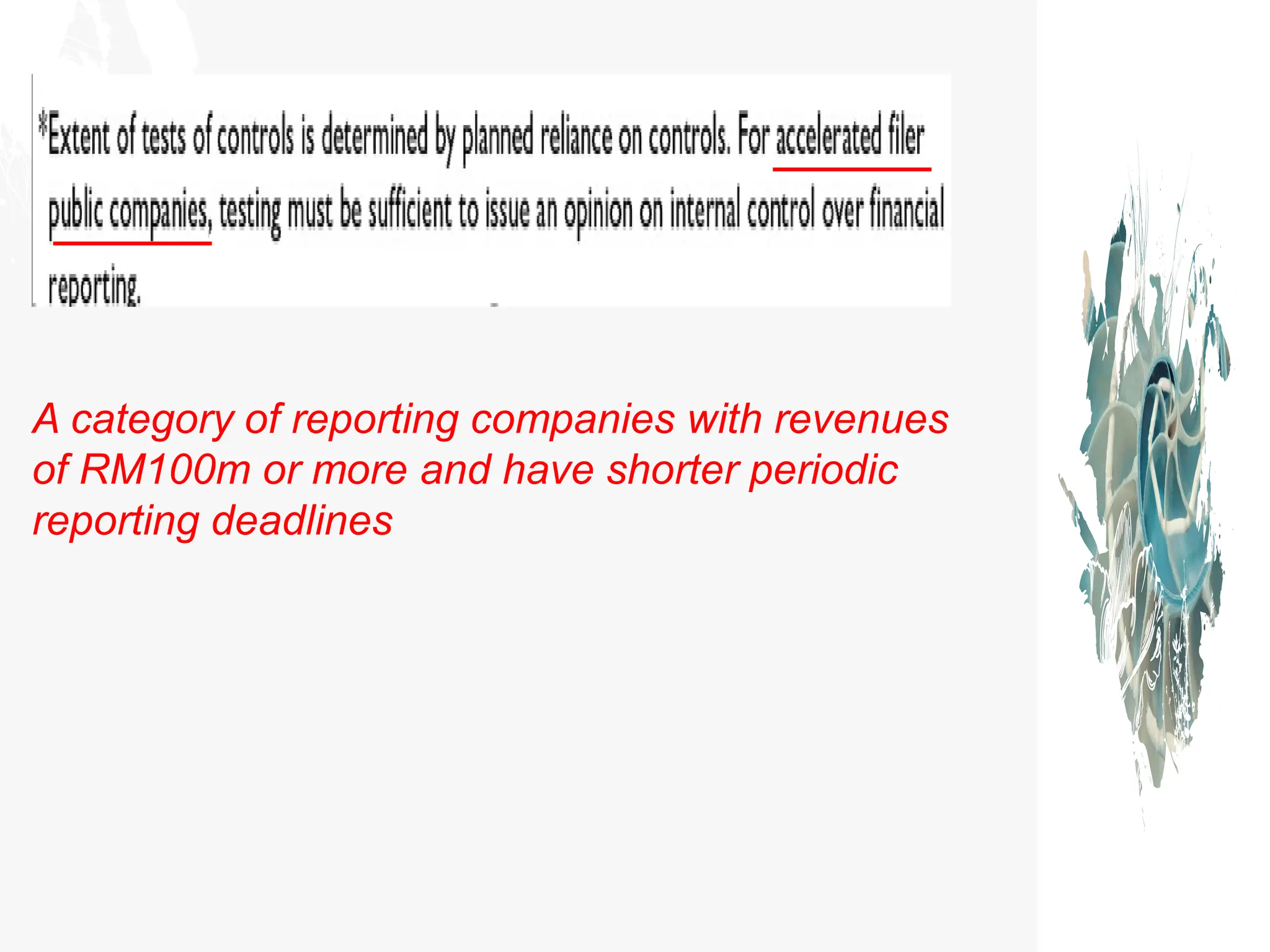
A category of reporting companies with revenues
of RM100m or more and have shorter periodic
reporting deadlines
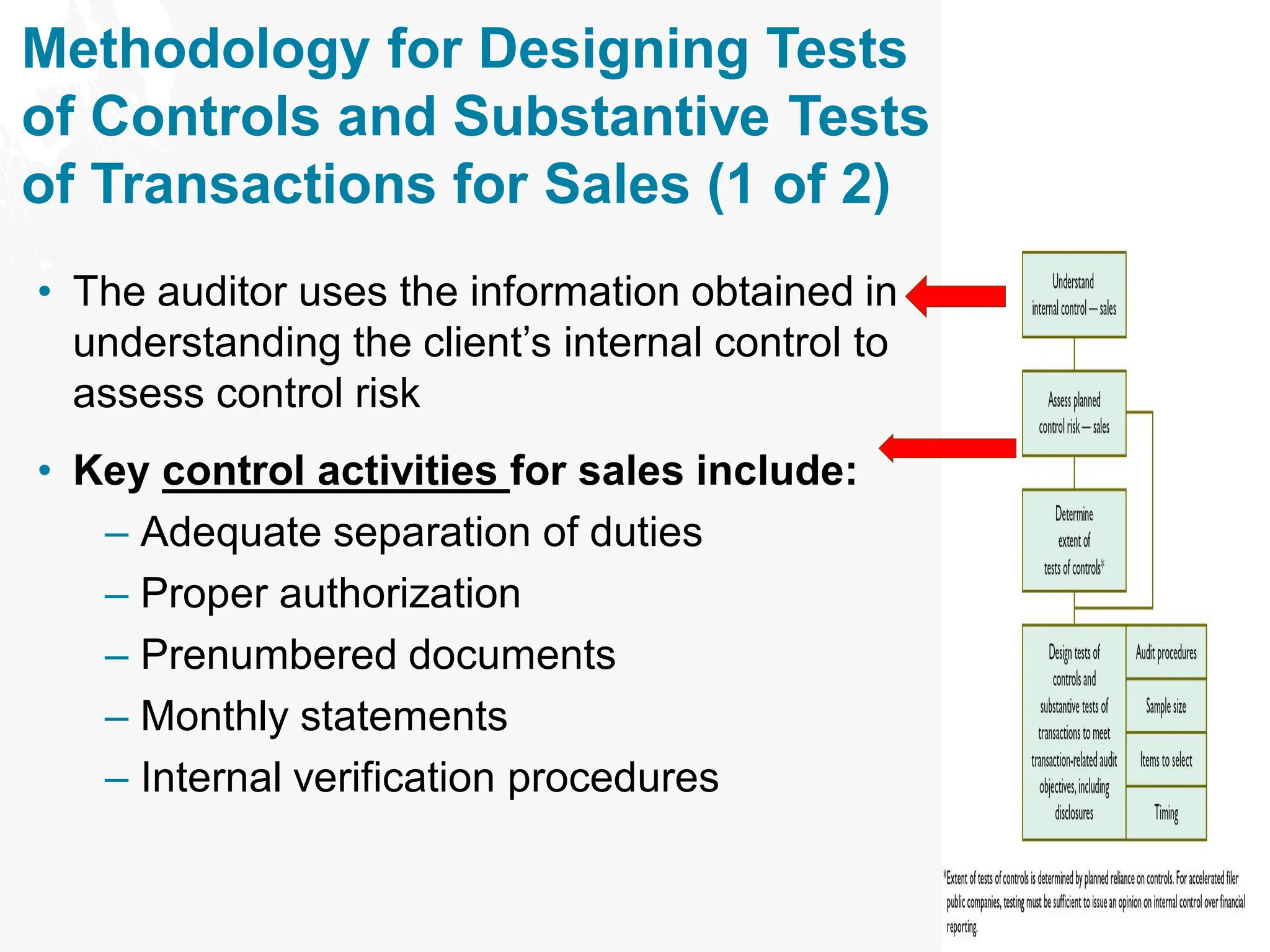
Methodology for Designing Tests
of Controls and Substantive Tests
of Transactions for Sales (1 of 2)
• The auditor uses the information obtained in
understanding the client’s internal control to
assess control risk
• Key control activities for sales include:
– Adequate separation of duties
– Proper authorization
– Prenumbered documents
– Monthly statements
– Internal verification procedures
Methodology for Designing Tests of
Controls and Substantive Tests of
Transactions for Sales (2 of 2)
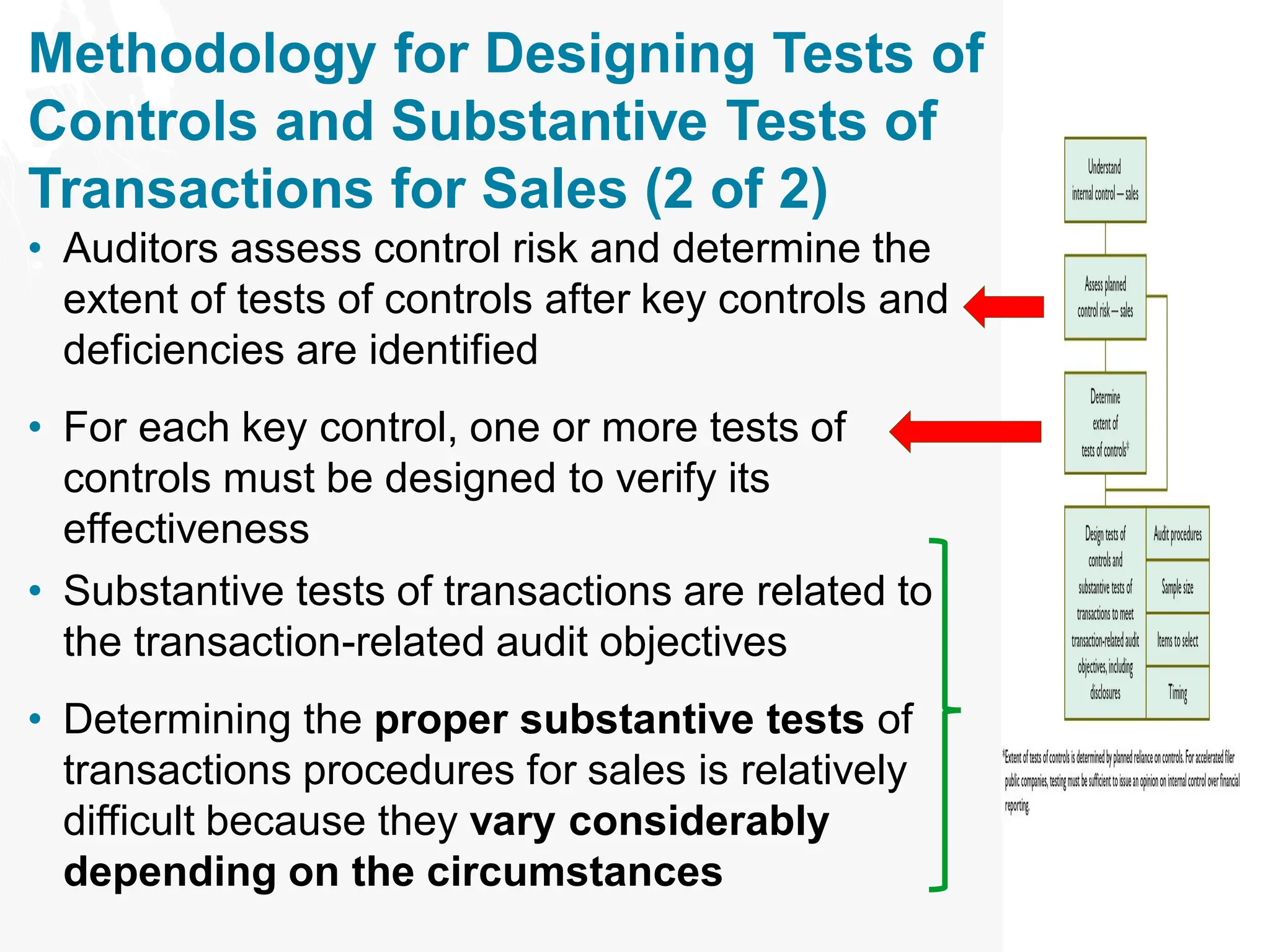
• Auditors assess control risk and determine the
extent of tests of controls after key controls and
deficiencies are identified
• For each key control, one or more tests of
controls must be designed to verify its
effectiveness
• Substantive tests of transactions are related to
the transaction-related audit objectives
• Determining the proper substantive tests of
transactions procedures for sales is relatively
difficult because they vary considerably
depending on the circumstances
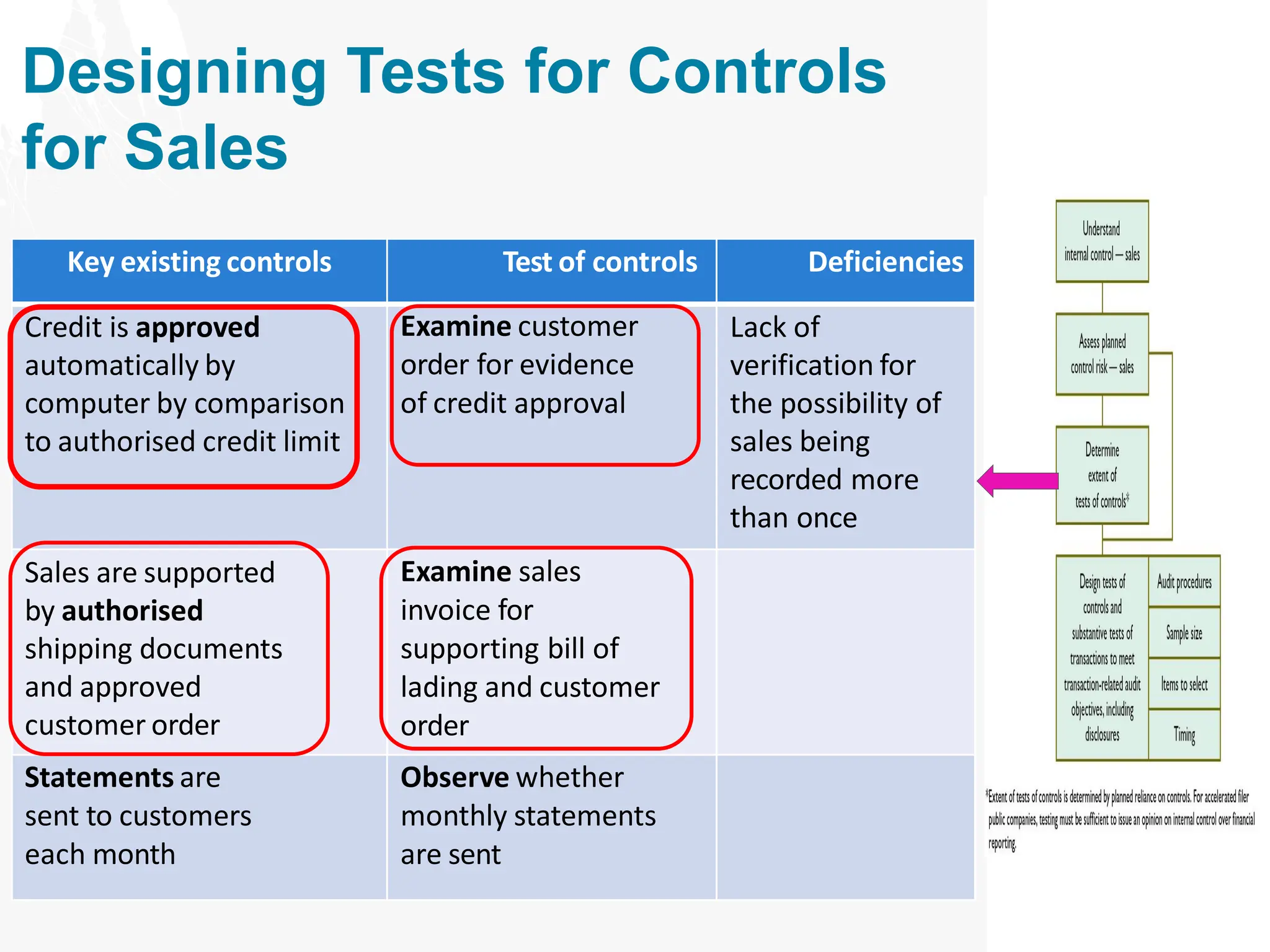
Designing Tests for Controls
for Sales
Key existing controls Test of controls Deficiencies
Credit is approved
automatically by
computer by comparison
to authorised credit limit
Examine customer
order for evidence
of credit approval
Lack of
verification for
the possibility of
sales being
recorded more
than once
Sales are supported
by authorised
shipping documents
and approved
customer order
Examine sales
invoice for
supporting bill of
lading and customer
order
Statements are
sent to customers
each month
Observe whether
monthly statements
are sent
Assessing Key Controls for Sales
• Adequate Separation of Duties—Proper
separation of duties helps to prevent misstatements
due to both errors and fraud.
• Proper Authorization—The auditor is concerned
about authorization at three points:
1. Credit must be properly authorized before a sale
takes place.
2. Goods should be shipped only after proper
authorization.
3. Prices, including basic terms, freight, and
discounts, must be authorized.
• Adequate Documents and Records—May be
paper or electronic.
Assessing Key Controls for Sales
• Prenumbered Documents—This helps prevent
both the failure to bill and duplicate billings and
recordings.
• Monthly Statements—This is a useful
control because it encourages customers to
respond if their balance is incorrect.
• Internal Verification Process—Can be manual
or computerized.
Determine Extent of Tests of Controls—After
key controls and deficiencies are identified,
auditors assess control risk and determine the
extent of tests of controls.
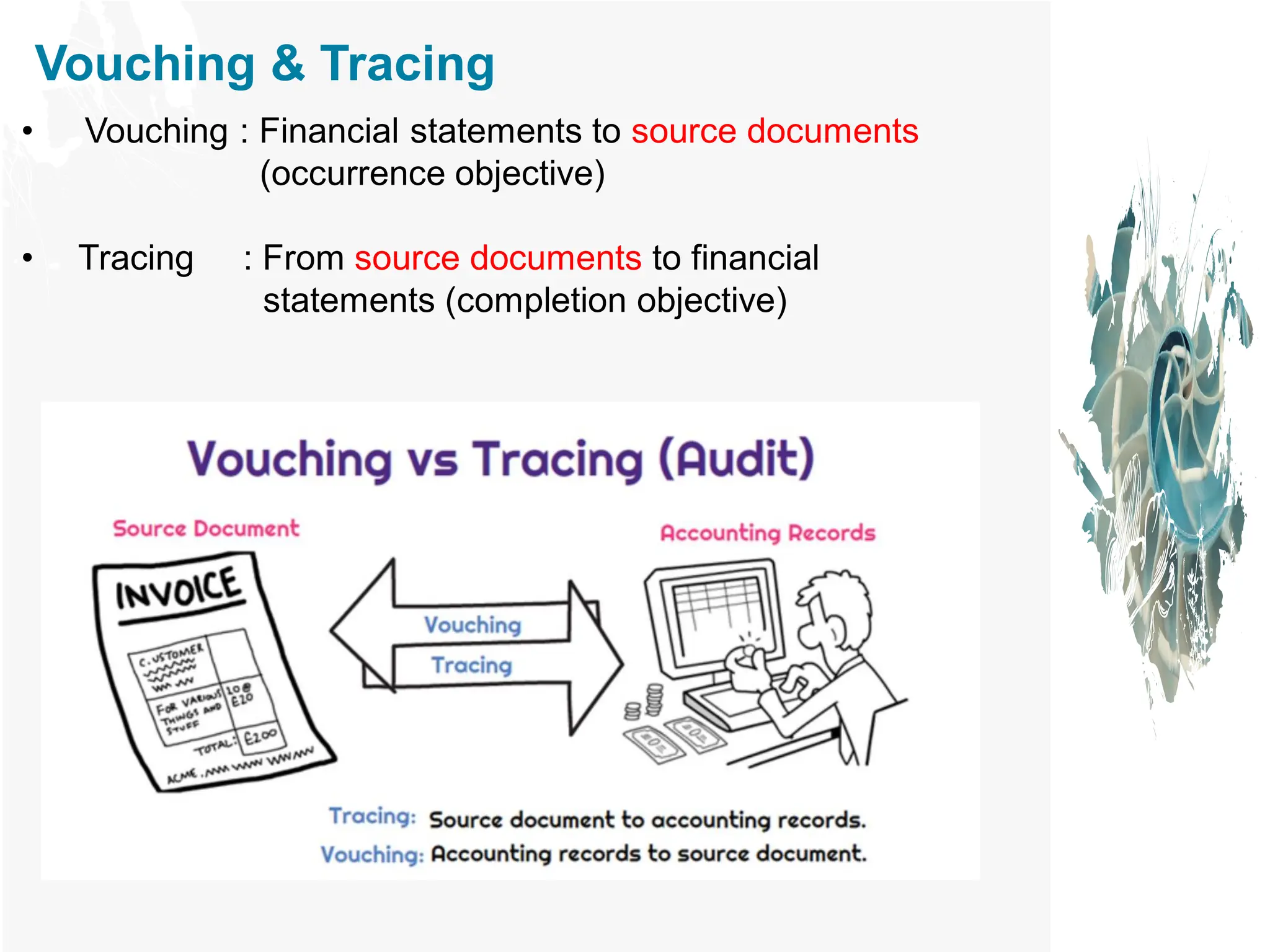
Vouching & Tracing
• Vouching : Financial statements to source documents
(occurrence objective)
• Tracing : From source documents to financial
statements (completion objective)
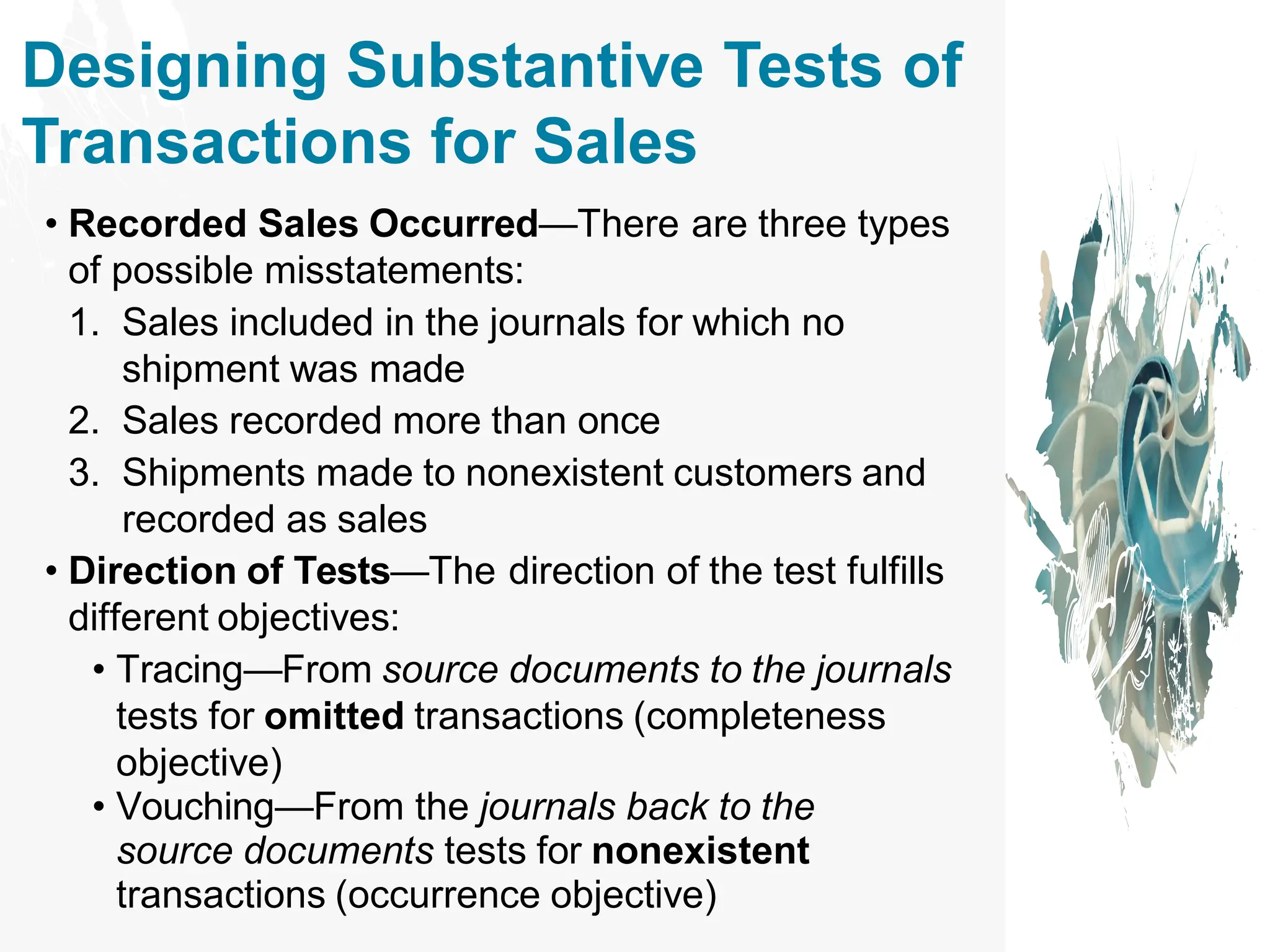
Designing Substantive Tests of
Transactions for Sales
• Recorded Sales Occurred—There are three types
of possible misstatements:
1. Sales included in the journals for which no
shipment was made
2. Sales recorded more than once
3. Shipments made to nonexistent customers and
recorded as sales
• Direction of Tests—The direction of the test fulfills
different objectives:
• Tracing—From source documents to the journals
tests for omitted transactions (completeness
objective)
• Vouching—From the journals back to the
source documents tests for nonexistent
transactions (occurrence objective)
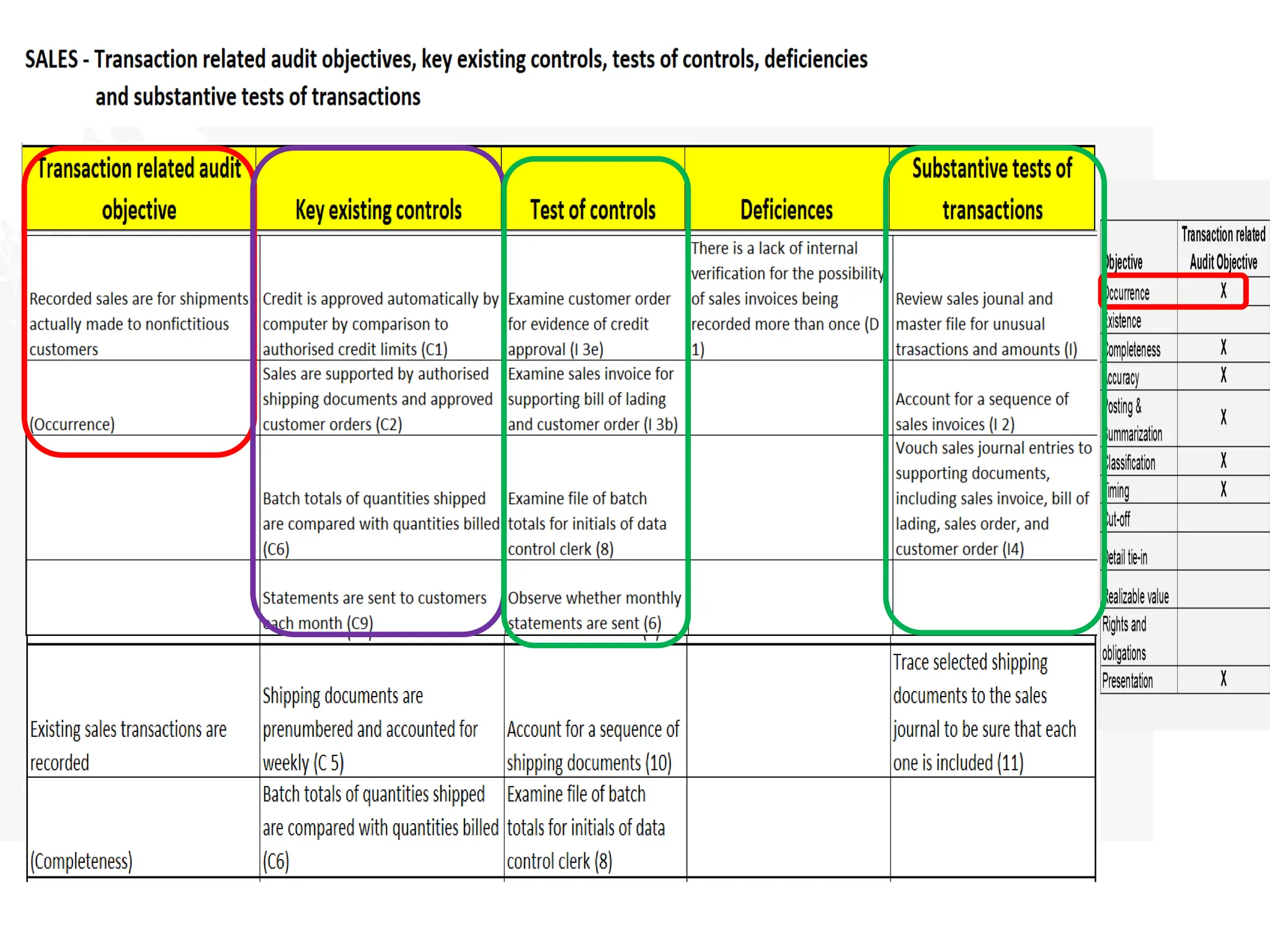
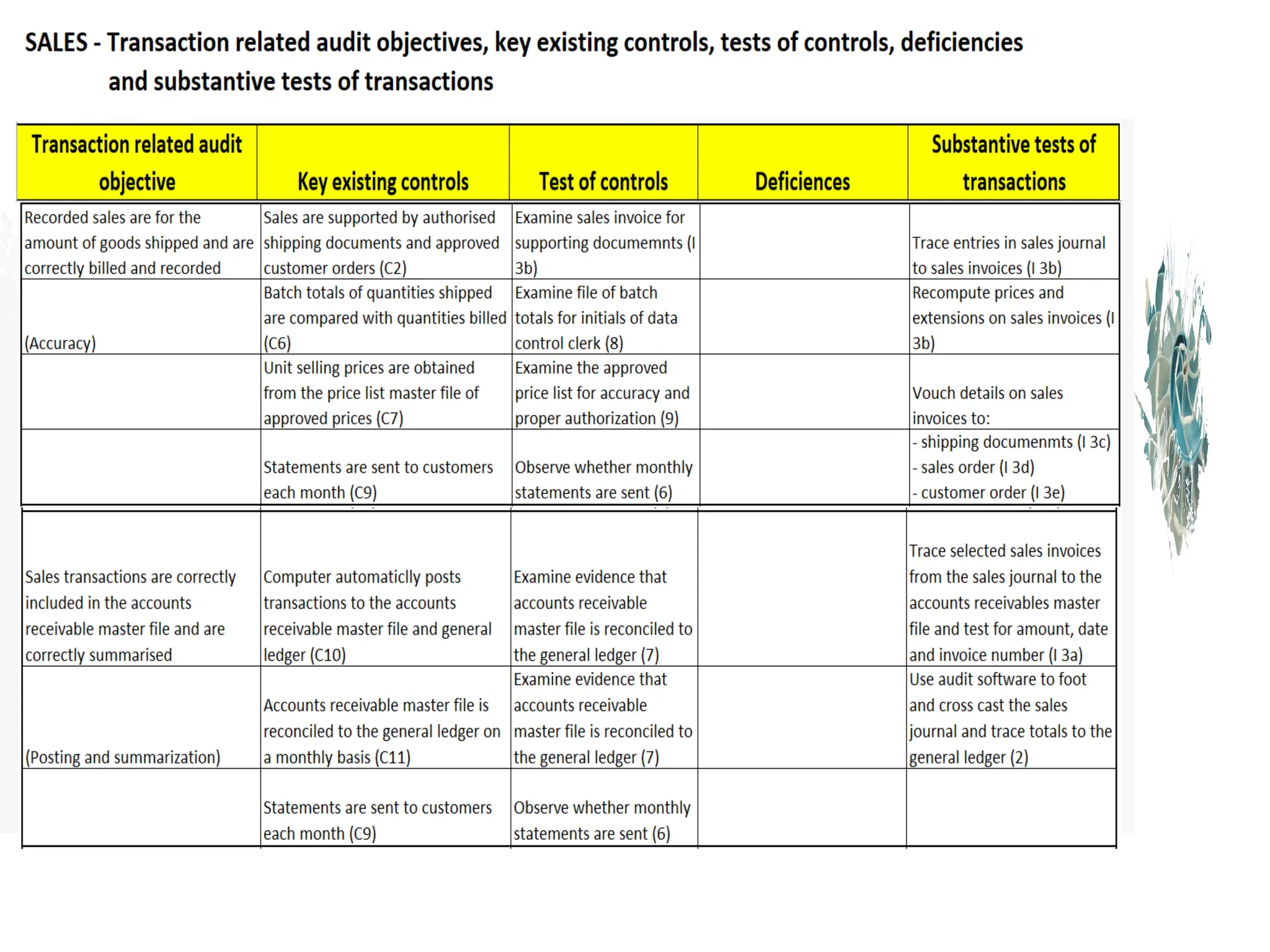
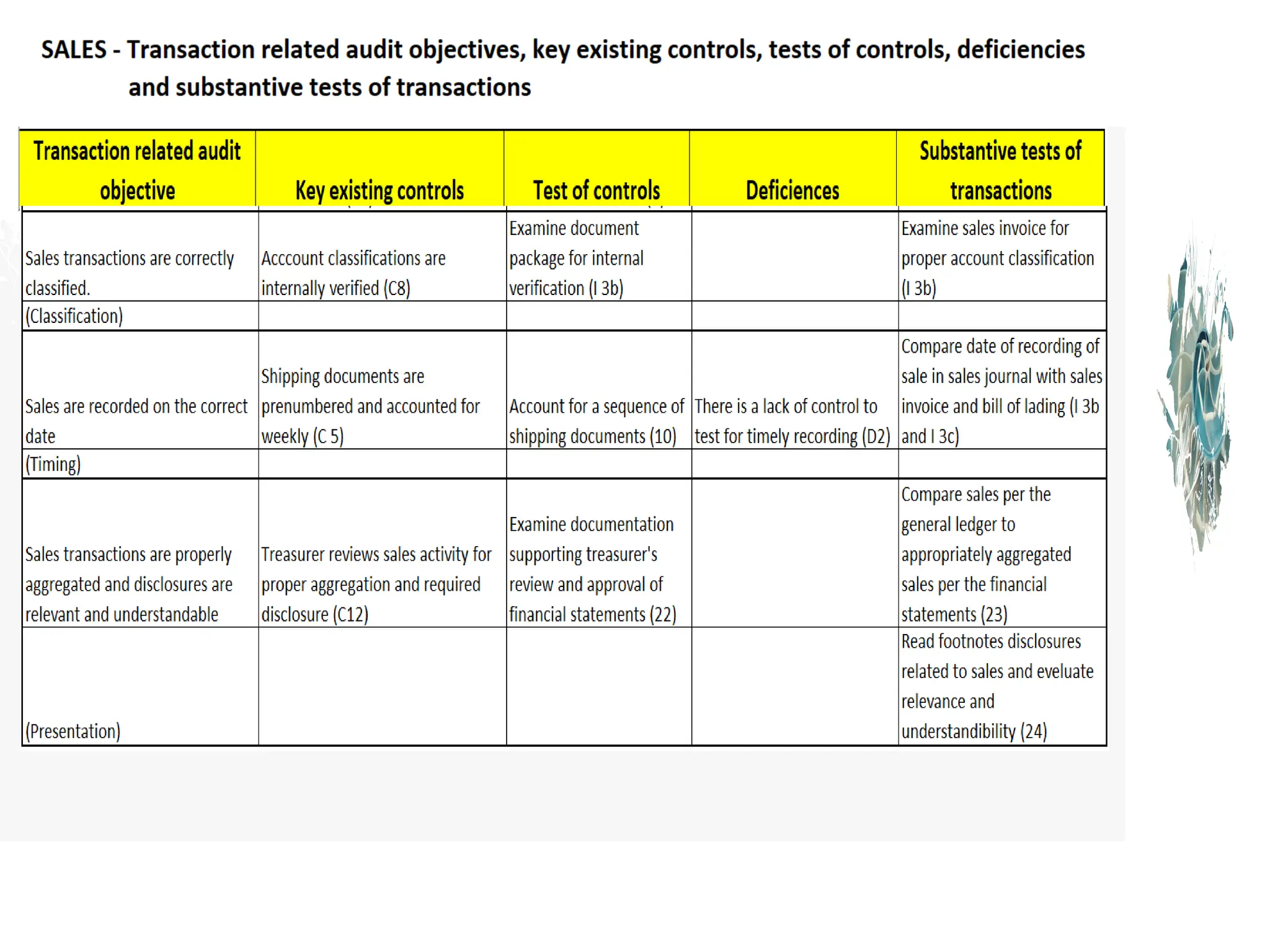
Substantive Tests of
Transactions for Sales
Transactionrelated audit
objectives
Substantive test of transactions
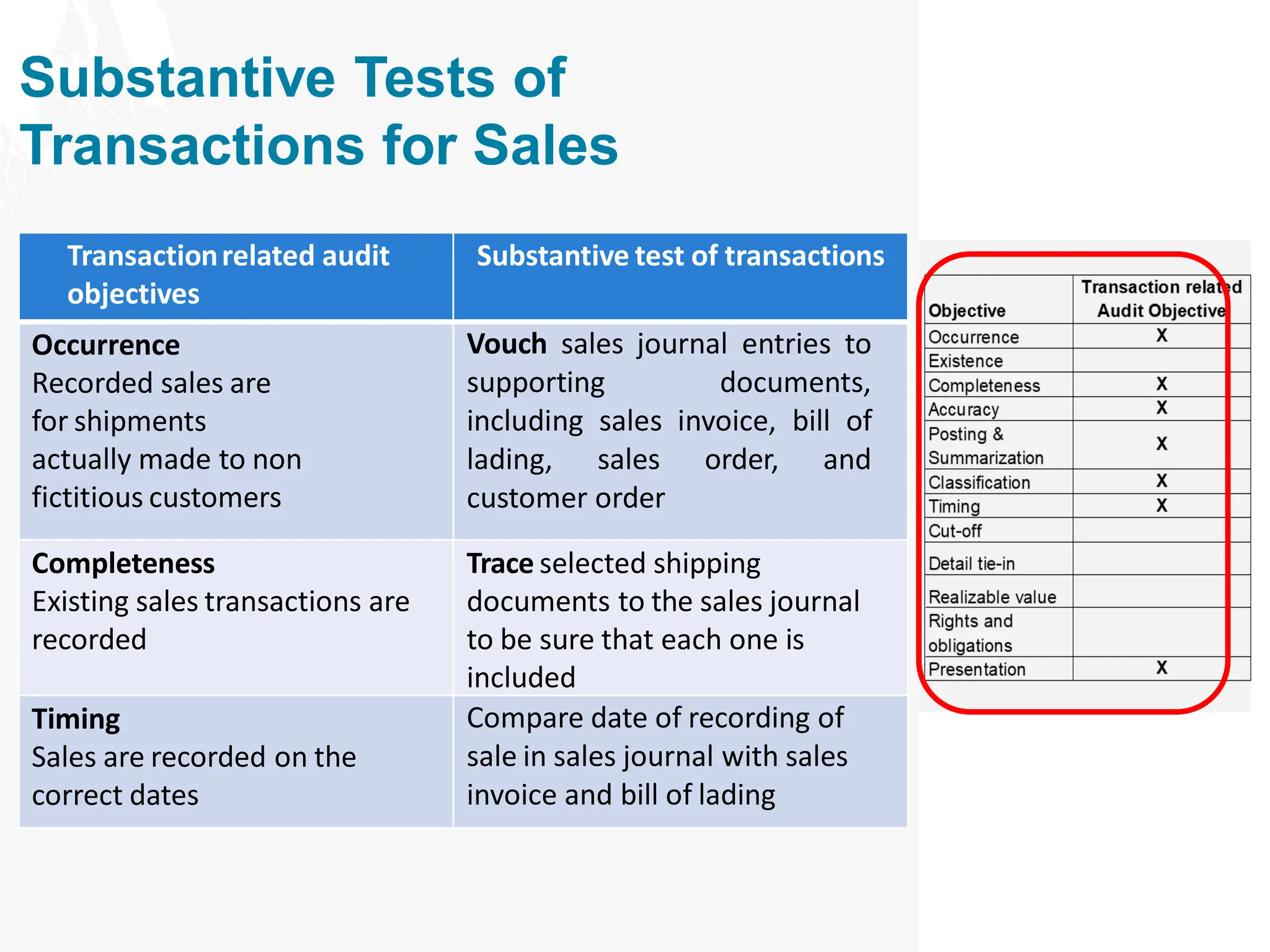
Occurrence
Recorded sales are
for shipments
actually made to non
fictitious customers
Vouch sales journal entries to
supporting documents,
including sales invoice, bill of
lading, sales order, and
customer order
Completeness
Existing sales transactions are
recorded
Trace selected shipping
documents to the sales journal
to be sure that each one is
included
Timing
Sales are recorded on the
correct dates
Compare date of recording of
sale in sales journal with sales
invoice and bill of lading
Effect of Results of Tests of Controls
and Substantive Tests of Transactions
(1 of 2)
• The results of the tests of controls and
substantive tests of transactions have a
significant effect on the remainder of the audit,
especially on substantive tests of details of
balances
• If the test results are unsatisfactory, it is
necessary to:
– Do additional substantive testing of
sales, sales returns and allowances, write-
off of uncollectible accounts, and
processing cash receipts
Effect of Results of Test of
Controls and Substantive Tests of
Transactions (2 of 2)
• The most significant effect of the results
of the tests of controls and substantive
tests of transactions in the sales and
collection cycle is:
– Confirmation of accounts receivable
▪ The type of confirmation, the size of
the sample, and the timing of the test
are all affected
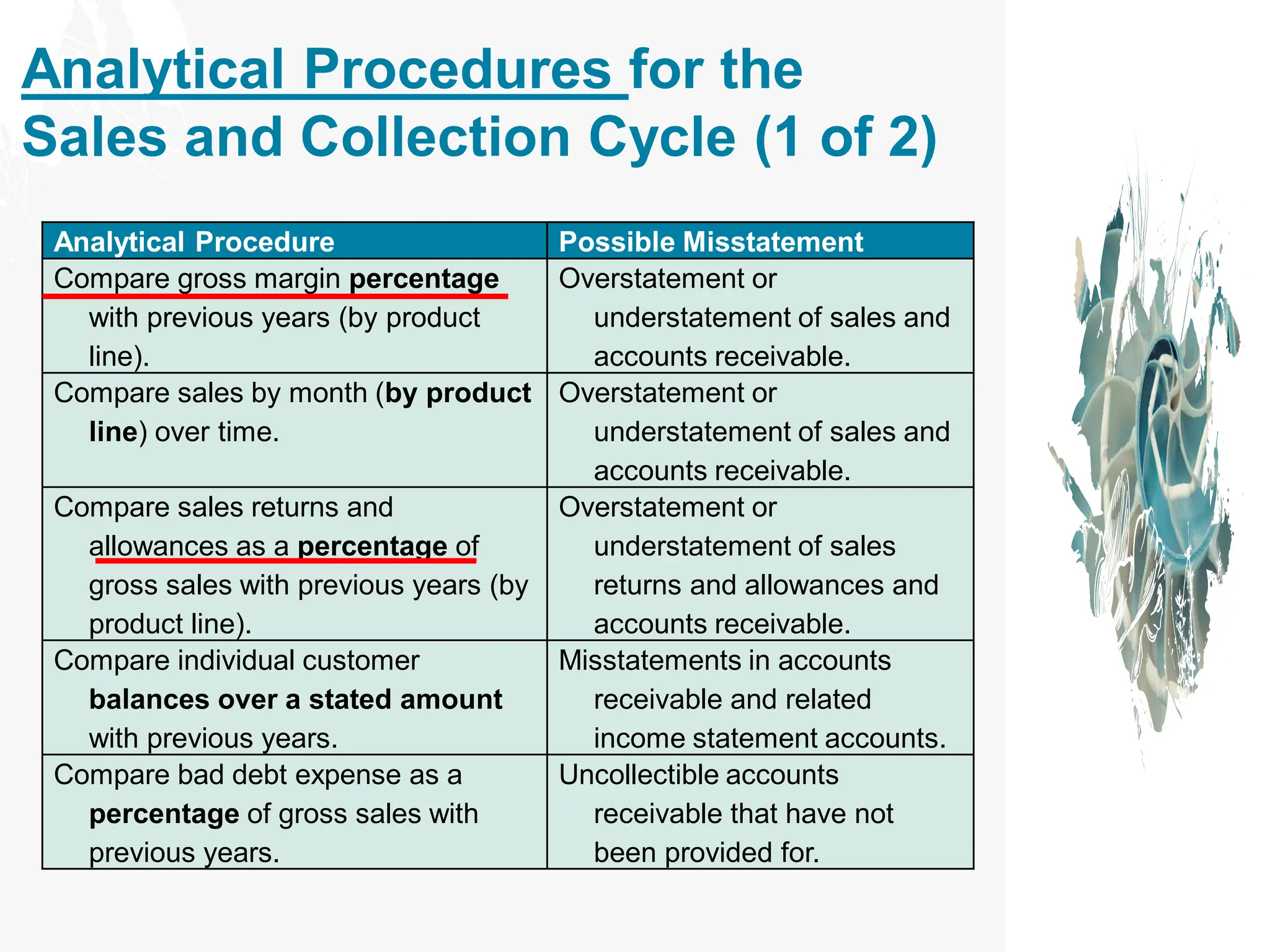
Analytical Procedures for the
Sales and Collection Cycle (1 of 2)
Analytical Procedure Possible Misstatement
Compare gross margin percentage
with previous years (by product
line).
Overstatement or
understatement of sales and
accounts receivable.
Compare sales by month (by product
line) over time.
Overstatement or
understatement of sales and
accounts receivable.
Compare sales returns and
allowances as a percentage of
gross sales with previous years (by
product line).
Overstatement or
understatement of sales
returns and allowances and
accounts receivable.
Compare individual customer
balances over a stated amount
with previous years.
Misstatements in accounts
receivable and related
income statement accounts.
Compare bad debt expense as a
percentage of gross sales with
previous years.
Uncollectible accounts
receivable that have not
been provided for.
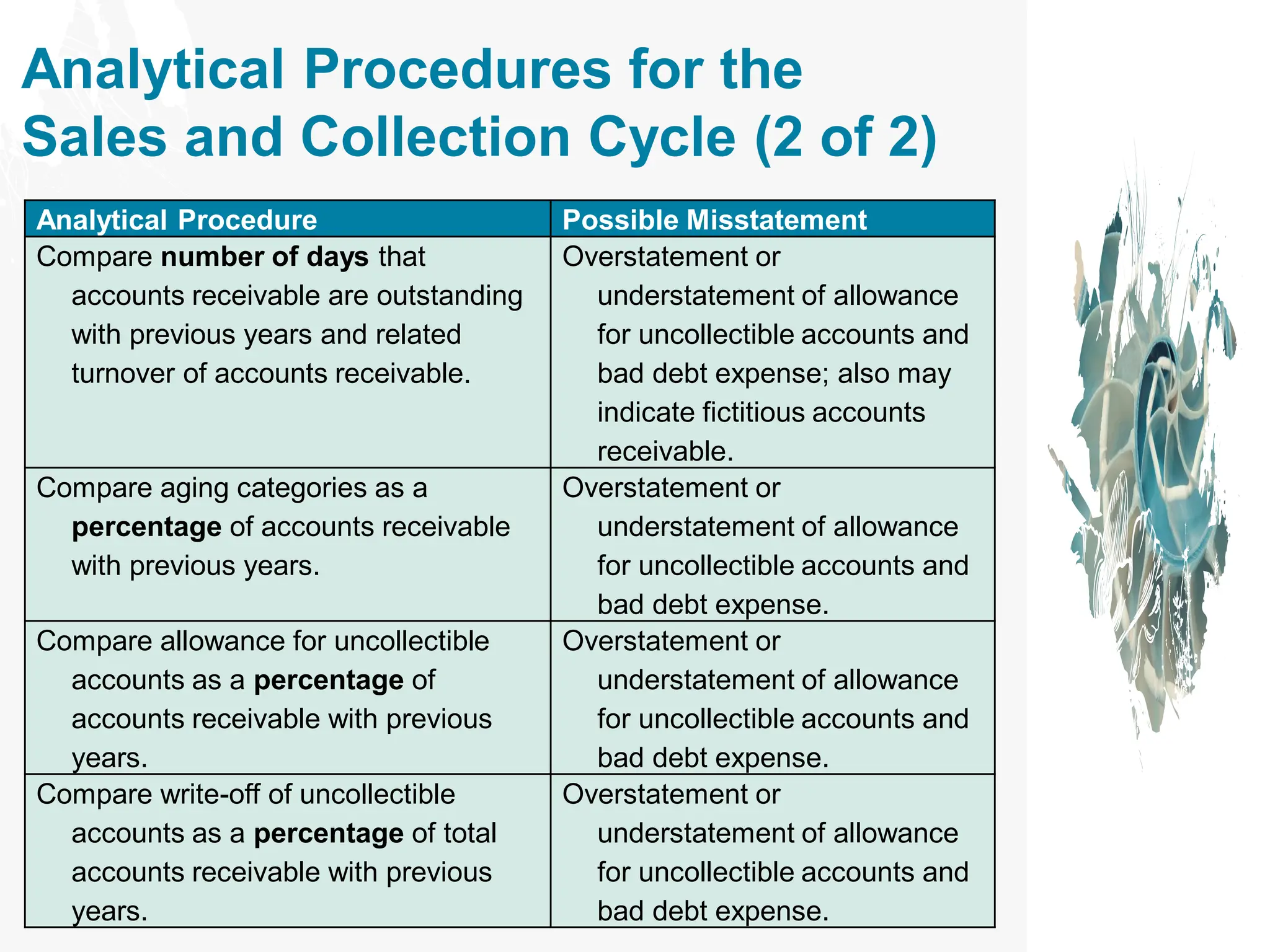
Analytical Procedures for the
Sales and Collection Cycle (2 of 2)
Analytical Procedure Possible Misstatement
Compare number of days that
accounts receivable are outstanding
with previous years and related
turnover of accounts receivable.
Overstatement or
understatement of allowance
for uncollectible accounts and
bad debt expense; also may
indicate fictitious accounts
receivable.
Compare aging categories as a
percentage of accounts receivable
with previous years.
Overstatement or
understatement of allowance
for uncollectible accounts and
bad debt expense.
Compare allowance for uncollectible
accounts as a percentage of
accounts receivable with previous
years.
Overstatement or
understatement of allowance
for uncollectible accounts and
bad debt expense.
Compare write-off of uncollectible
accounts as a percentage of total
accounts receivable with previous
years.
Overstatement or
understatement of allowance
for uncollectible accounts and
bad debt expense.
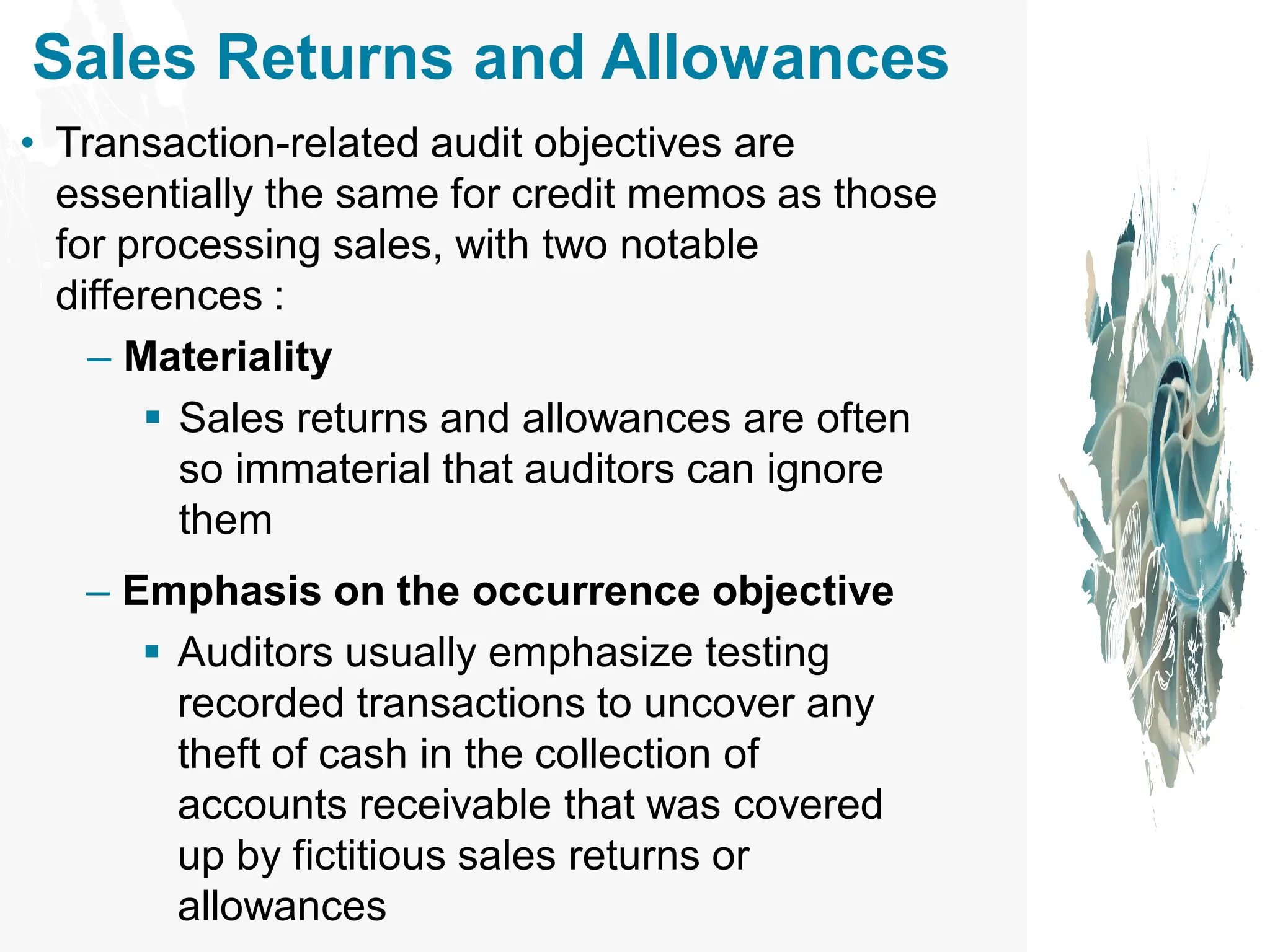
Sales Returns and Allowances
• Transaction-related audit objectives are
essentially the same for credit memos as those
for processing sales, with two notable
differences :
– Materiality
▪ Sales returns and allowances are often
so immaterial that auditors can ignore
them
– Emphasis on the occurrence objective
▪ Auditors usually emphasize testing
recorded transactions to uncover any
theft of cash in the collection of
accounts receivable that was covered
up by fictitious sales returns or
allowances
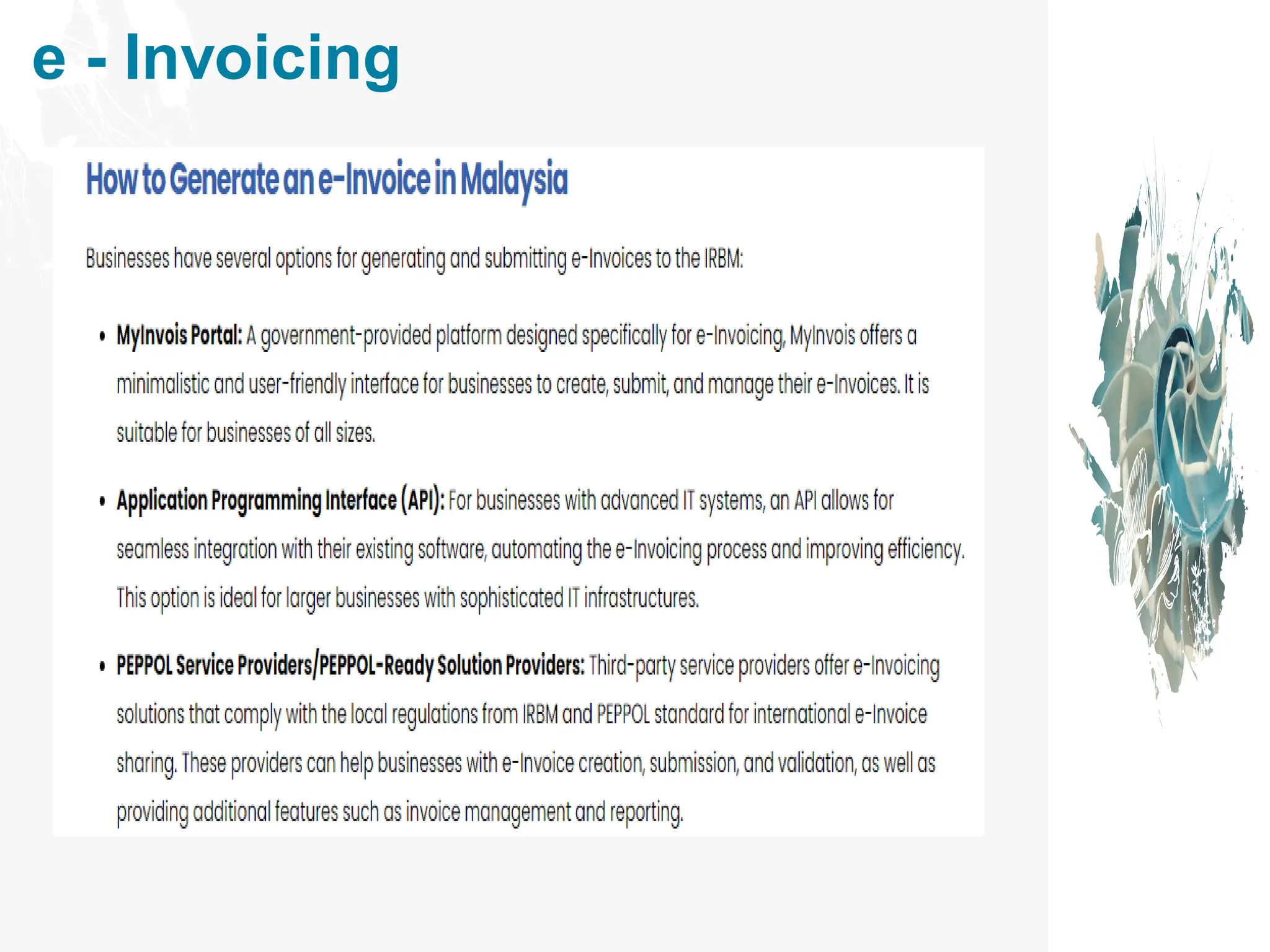
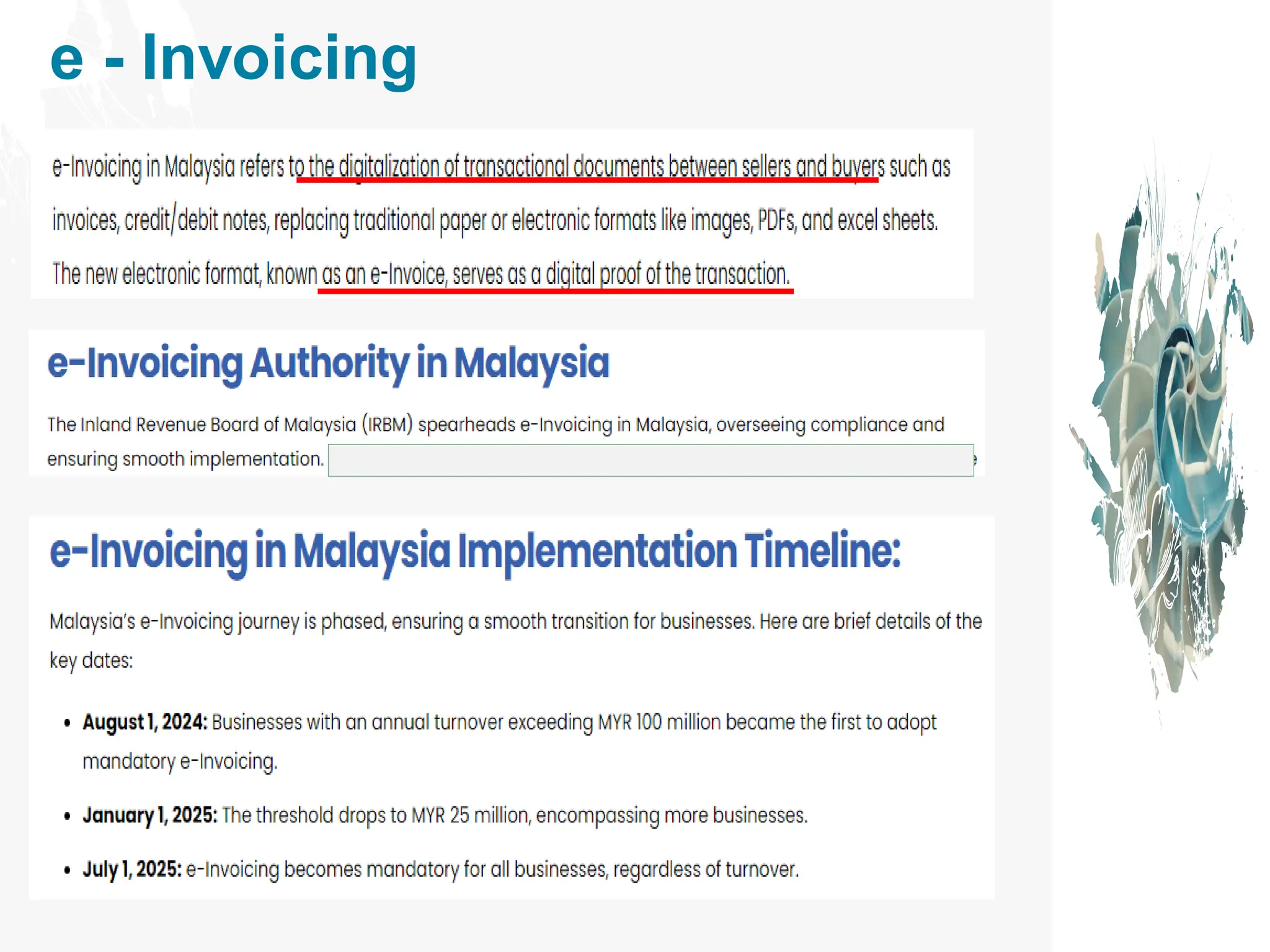
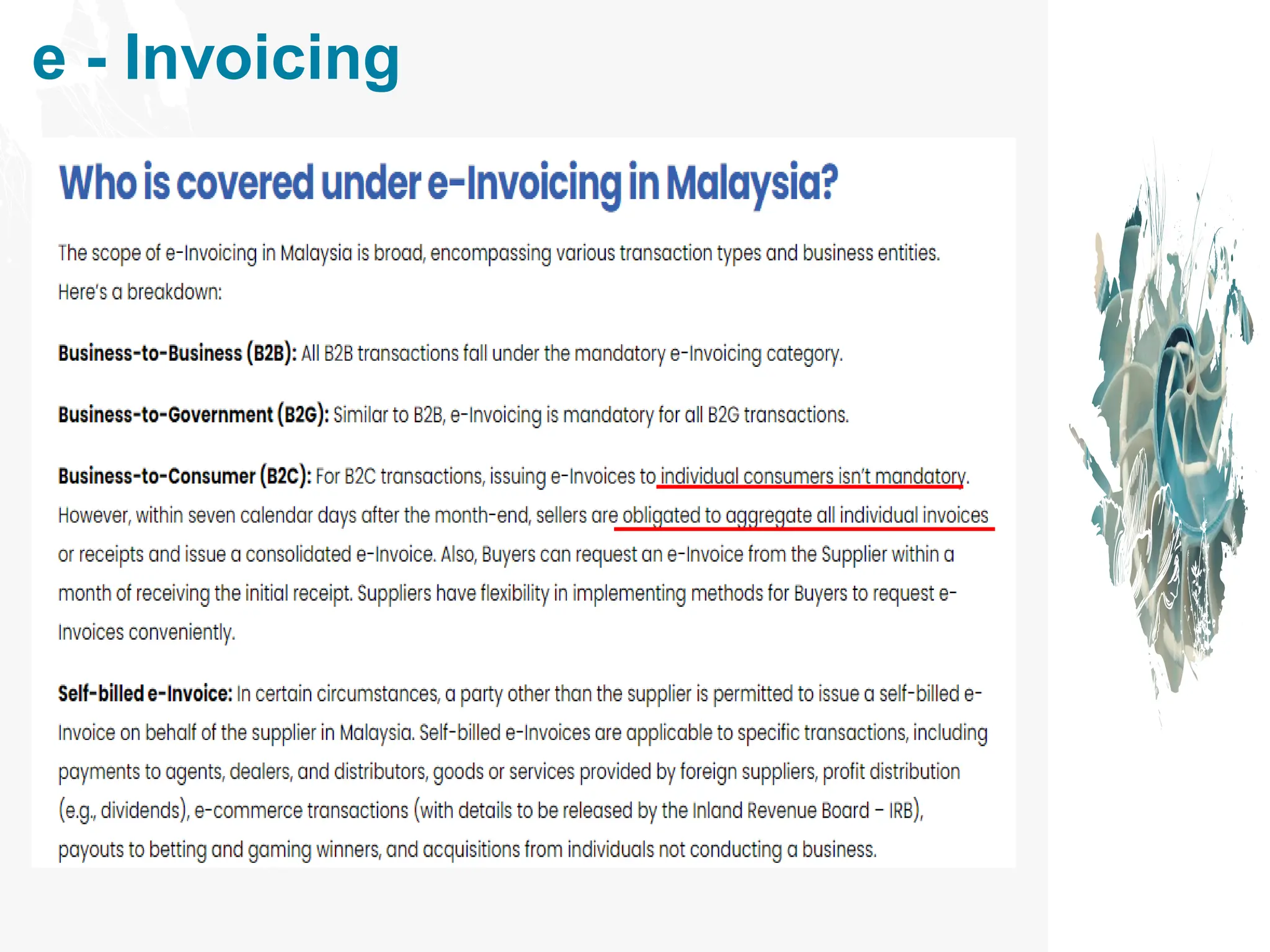
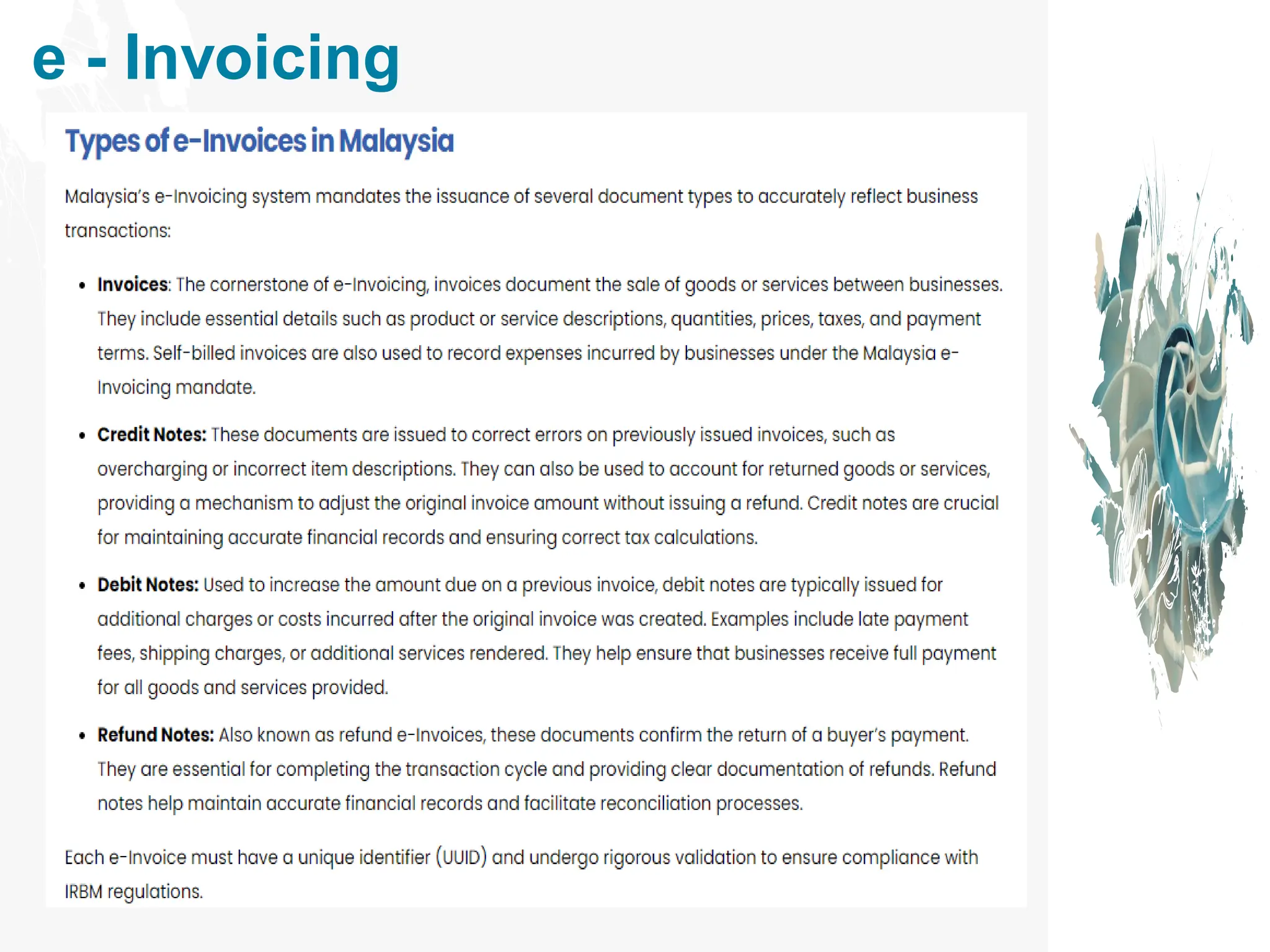
e - Invoicing
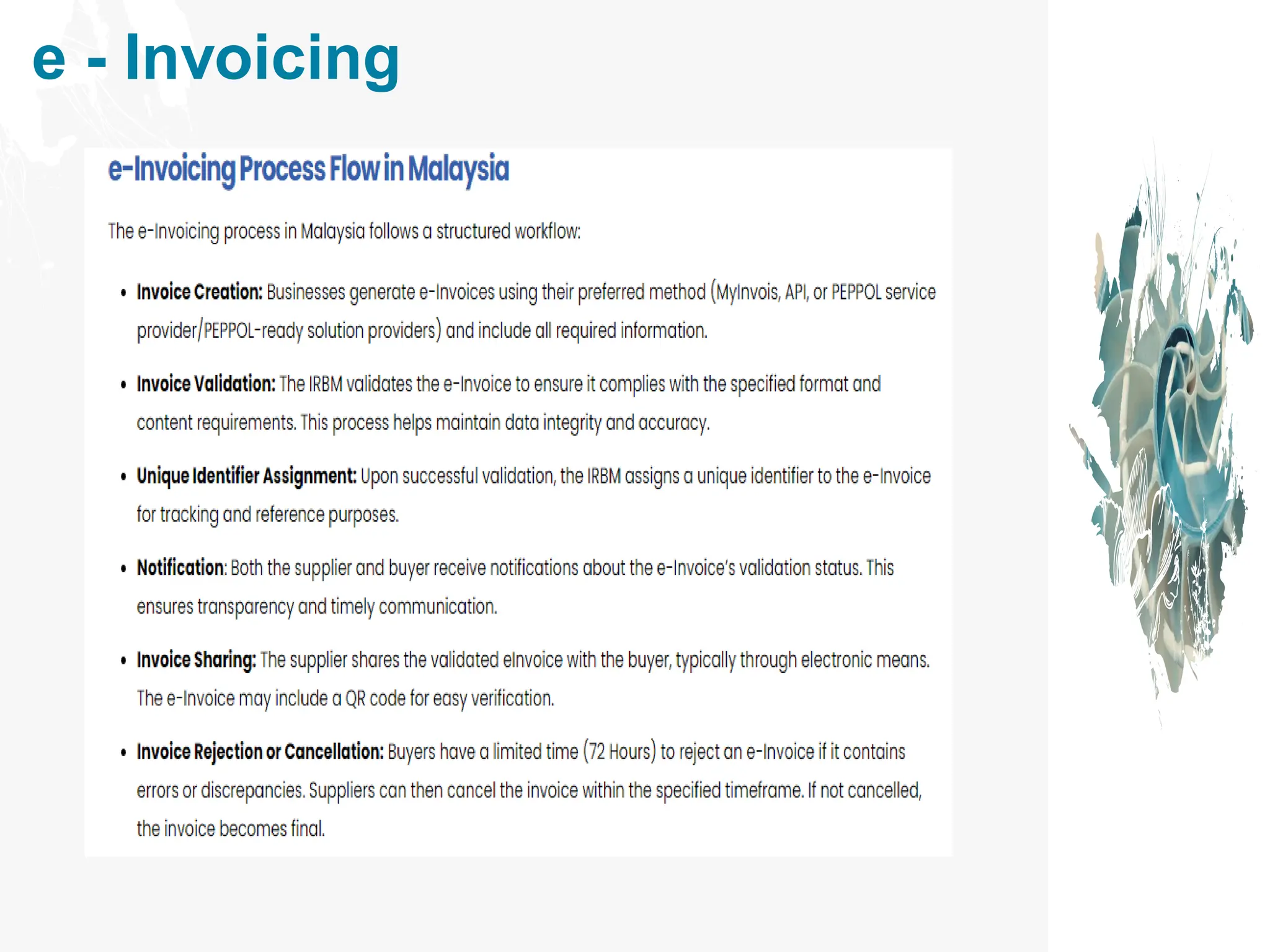
e - Invoicing
e - Invoicing
e - Invoicing
e - Invoicing
Audit Sampling
Sampling Decisions
Sample size is based on the following factors:
▪ Performance materiality
▪ Inherent risk
▪ Control risk
▪ Achieved detection risk from other
substantive tests
▪ Type of confirmation
Selection of the Items for Testing: Some type of
stratification is desirable with most confirmations.
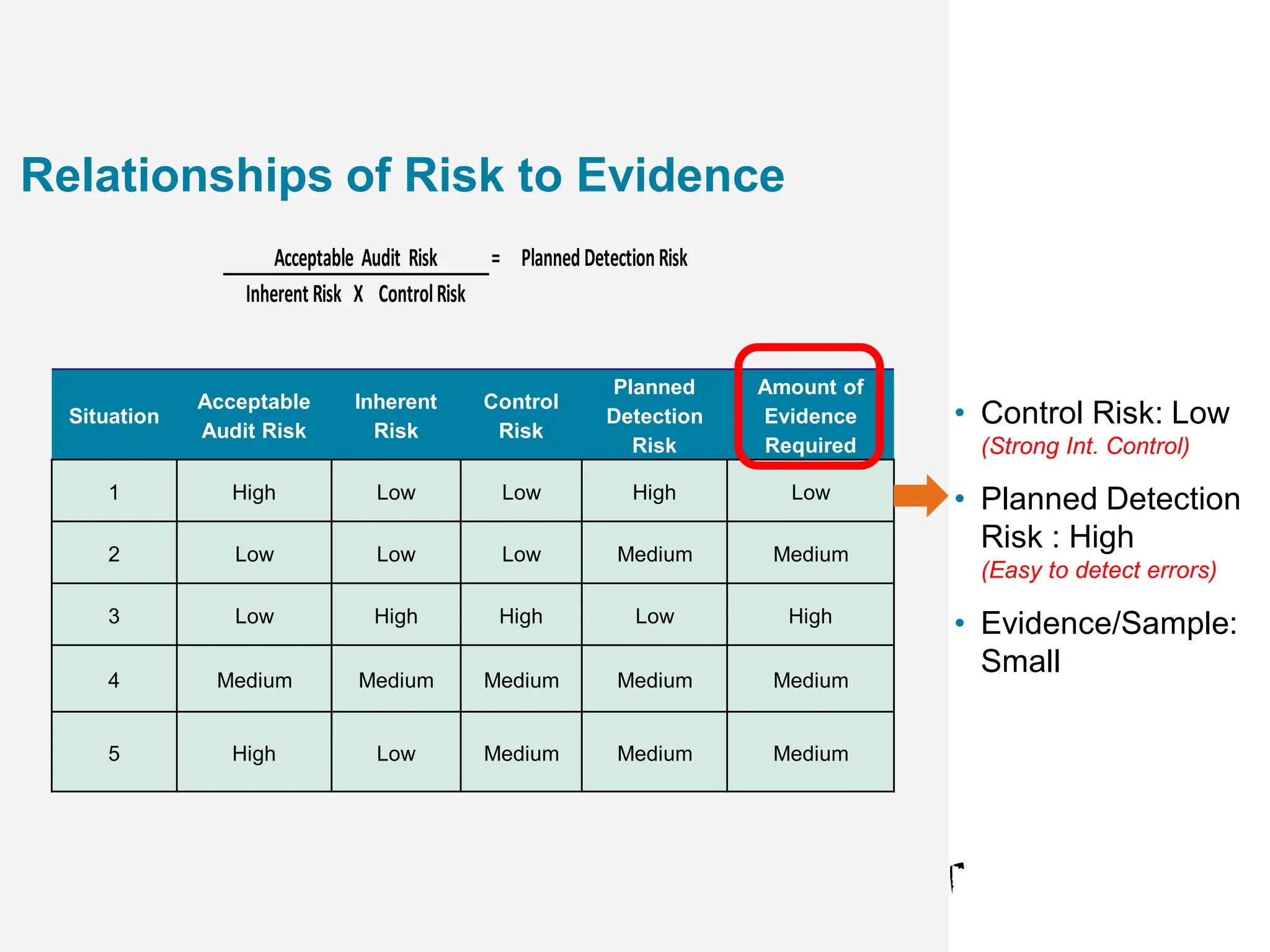
Relationships of Risk to Evidence
Situation
Acceptable
Audit Risk
Inherent
Risk
Control
Risk
Planned
Detection
Risk
Amount of
Evidence
Required
1 High Low Low High Low
2 Low Low Low Medium Medium
3 Low High High Low High
4 Medium Medium Medium Medium Medium
5 High Low Medium Medium Medium
Acceptable Audit Risk = Planned DetectionRisk
Inherent Risk X ControlRisk
• Control Risk: Low
(Strong Int. Control)
• Planned Detection
Risk : High
(Easy to detect errors)
• Evidence/Sample:
Small
Representative Sampling (1 of 2)
• When selecting a sample from a population, the
auditor strives to obtain a representative sample
• A representative sample is:
– One in which the characteristics in the
sample are approximately the same as
those of the population
• In practice, auditors never know whether a
sample is representative, even after all testing is
complete
• Auditors can increase the likelihood of a
sample being representative by using care in:
– Designing the sampling process
– Selecting the sample
– Evaluating the sample results
Representative Sampling (2 of 2)
• There are two types of risks that can lead
to sampling error or non sampling error:
– Sampling risk
▪ Risk that an auditor reaches an
incorrect conclusion because the
sample is not representative of the
population
– Nonsampling risk
▪ Risk that the auditor reaches an
incorrect conclusion for any reason not
related to sampling risk
Statistical Versus Nonstatistical Sampling
and Probabilistic Versus Nonprobabilistic
Sample Selection
• Audit sampling methods can be divided into
two broad categories:
– Statistical sampling
– Nonstatistical sampling
• Both involve three phases:
– Plan the sample
– Select the sample and perform the tests
– Evaluate the results
Application of Statistical Attributes
Sampling (1 of 2)
• The steps for attributes sampling are the same
as those for nonstatistical sampling with a few
exceptions:
– Specify acceptable risk of overreliance
▪ The concepts are the same, but the
method of quantifying is usually different.
Rather than using high, medium, and low,
the auditor will use a specific amount
– Determine the initial sample size
▪ The factors that affect the initial sample size
are the same, but in attributes sampling, the
auditor uses tables developed from
statistical formulas or audit software to
determine the initial sample size
Application of Statistical Attributes
Sampling (2 of 2)
– Select the sample
▪ The only difference in sample selection is
that probabilistic methods must be used for
statistical sampling
– Generalize from the sample to the population
▪ For attributes sampling, the auditor
calculates the computed upper exception
rate using statistical formulas
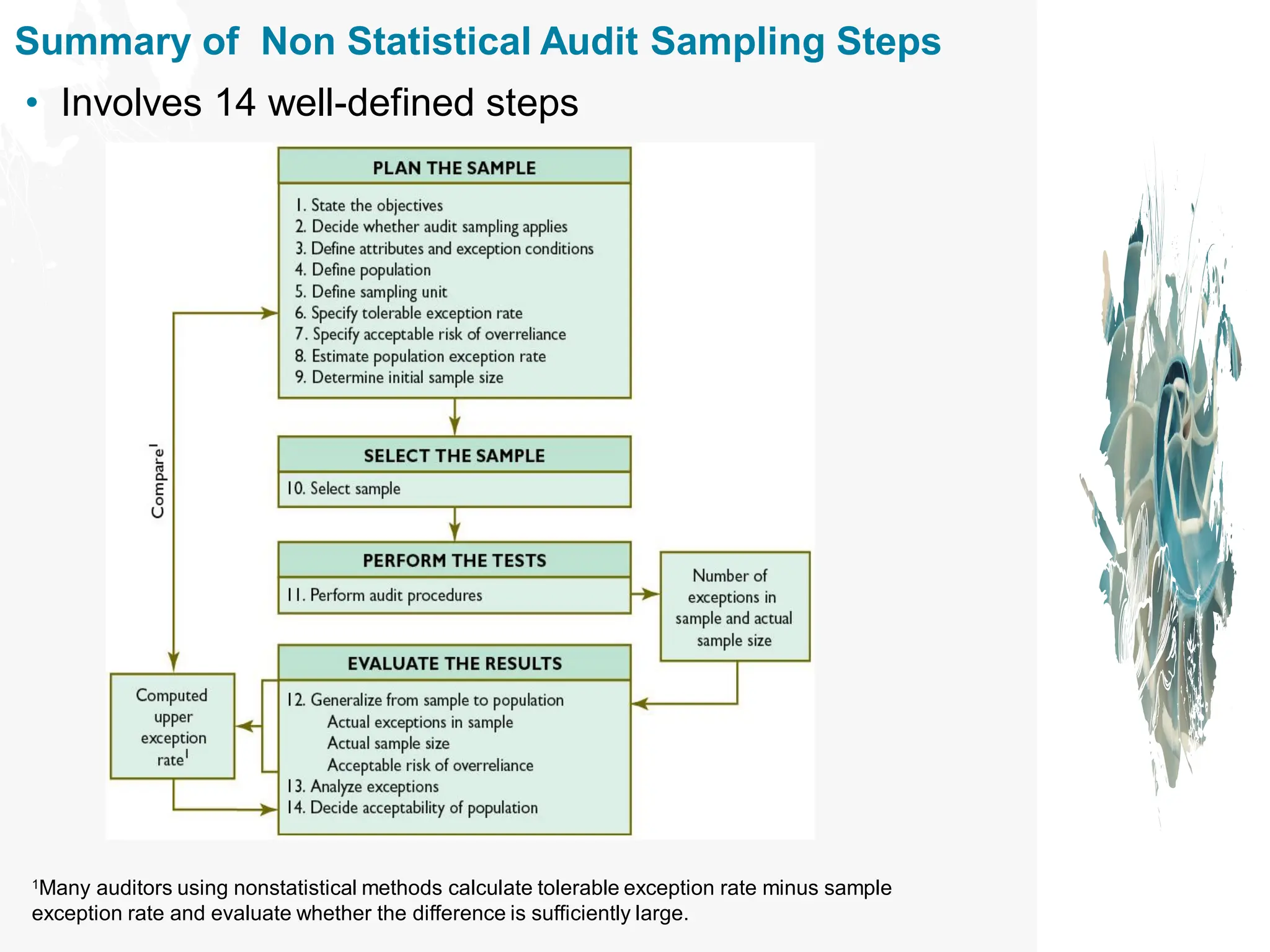
Summary of Non Statistical Audit Sampling Steps
1Many auditors using nonstatistical methods calculate tolerable exception rate minus sample
exception rate and evaluate whether the difference is sufficiently large.
• Involves 14 well-defined steps
Nonstatistical Sampling and Probabilistic
Versus Nonprobabilistic Sample Selection
(1 of 2)
• There are two methods auditors can use
when selecting a sample:
– Probabilistic sample selection
– Nonprobabilistic sample selection
Nonstatistical Sampling and Probabilistic
Versus Nonprobabilistic Sample
Selection (2 of 2)
• Auditing standards permit auditors to use either
statistical or nonstatistical sampling methods
• When statistical sampling is used, the sample
must be a probabilistic one
• Auditors may make nonstatistical evaluations
when using probabilistic selection,
– But it is never acceptable to evaluate a
nonprobabilistic (non random) sample using
statistical methods
Sample Selection Methods (1 of 2)
• Probabilistic sample selection methods
include the following (1 of 2):
– Simple random sample selection
▪ Every possible combination of population
items has an equal chance of being
included in the sample
– Systematic sample selection
▪ The auditor calculates an interval and
then selects the items for the sample
based on the size of the interval
Probabilistic Sample Selection Methods
• Probabilistic sample selection methods include
the following :
– Probability proportional to size sample
selection
▪ In many auditing situations, it is
advantageous to select samples that
emphasize population items with larger
recorded amounts
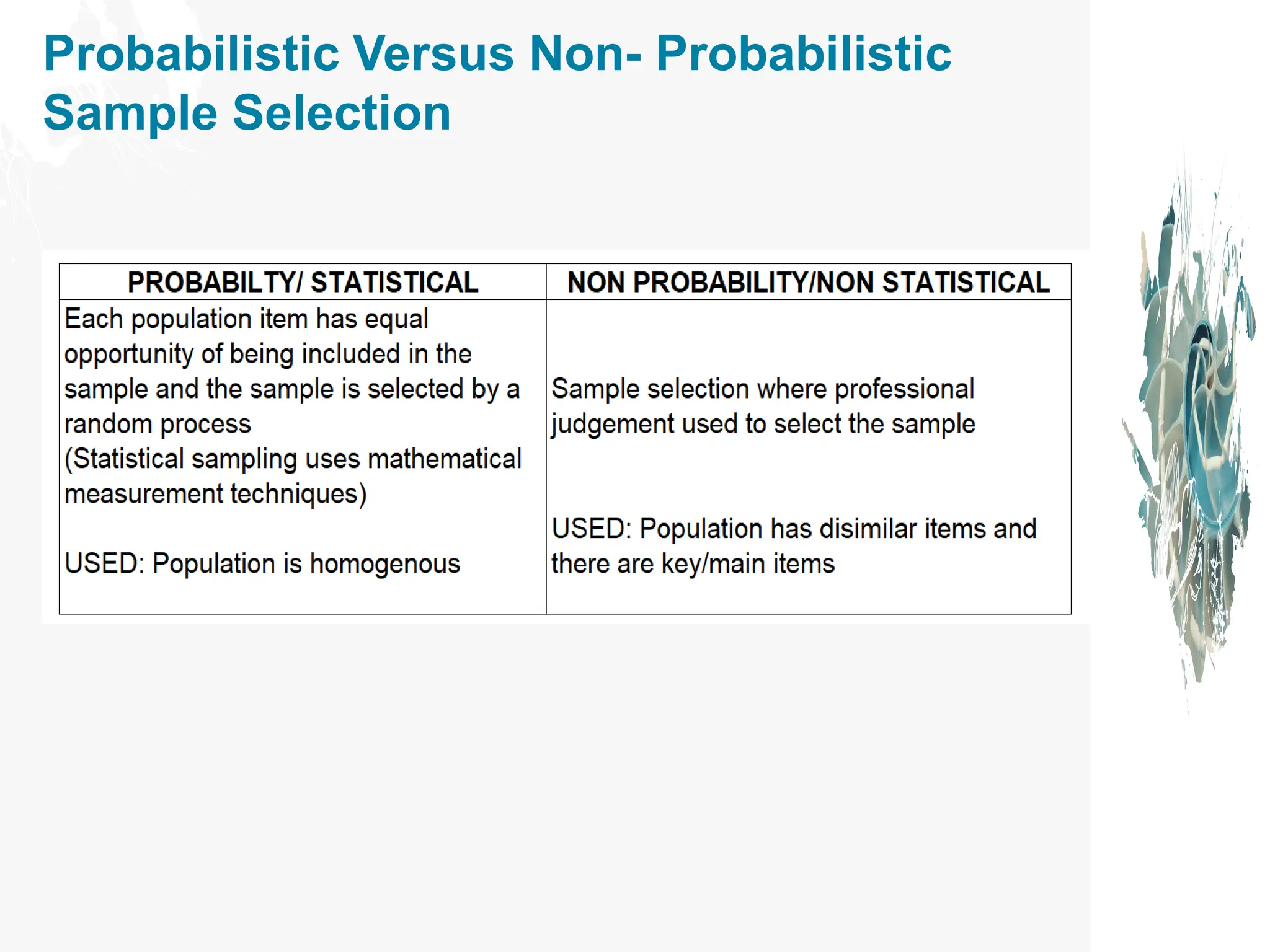
• Nonprobabilistic sample selection methods include:
– Haphazard sample selection
▪ The selection of items without any conscious
bias by the auditor
– Block sample selection
▪ Auditors select the first item in a block, and
the remainder of the block is chosen in
sequence
Probabilistic Versus Non- Probabilistic
Sample Selection
Sampling for Exception Rates (1 of 2)
• Auditors use sampling for tests of controls
and substantive tests of transactions to
determine:
– Whether controls are operating effectively
and whether the rate of monetary errors is
below tolerable limits
– To do this, auditors estimate the percent (the
occurrence rate or exception rate) of items in
a population containing a characteristic or
attribute of interest
Sampling for Exception Rates (2 of 2)
• Auditors are interested in the following
types of exceptions in populations of
accounting data:
– Deviations from the client’s established
controls
– Monetary misstatements in populations of
transaction data
– Monetary misstatements in populations of
account balance details
Non- Statistical Sample Rejected
When non- statistical sampling for tests of details of balances is
rejected, additional tests:
Accounts Receivable
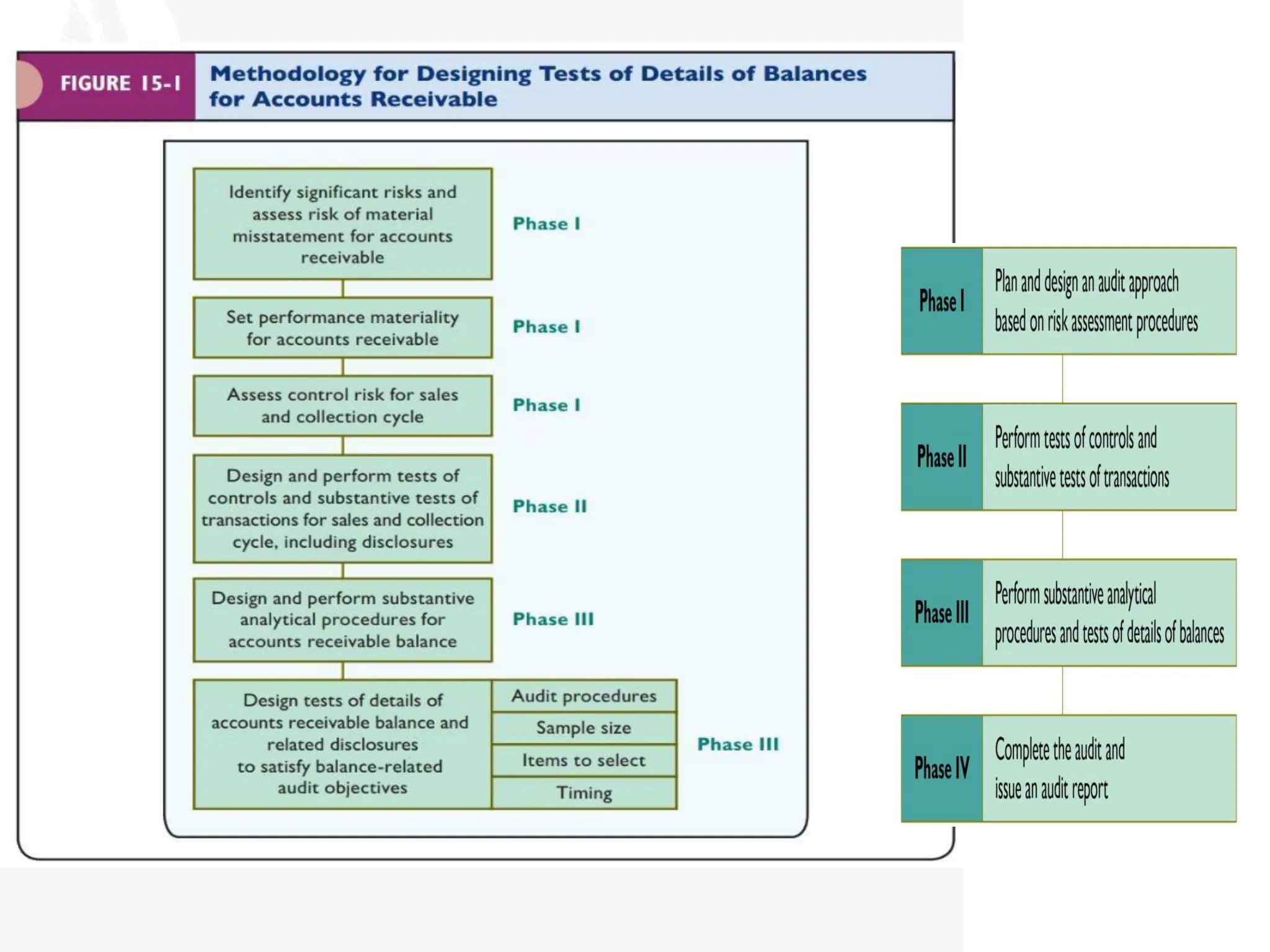
Methodology for Designing
Tests of Details of Balances
• Tests of accounts receivable are based on the
auditor’s risk assessment procedures
• Auditor performs preliminary analytical
procedures that may indicate increased risk
of misstatements in accounts receivable
• As part of the assessment of the risk of
material misstatement, the auditor determines
whether any of the risks identified are a
significant risk
Methodology for Designing Tests
of Details of Balances
• Internal controls over sales and cash receipts
and the related accounts receivable are at
least reasonably effective for most companies
• Auditors are especially concerned with
three aspects of internal controls:
– Controls that prevent or detect
embezzlements
– Controls over cutoff
– Controls related to the allowance for
uncollectible accounts
Design and Perform Substantive
Analytical Procedures (1 of 3)
• Most substantive analytical procedures
performed during the detailed testing phase
are done before tests of details of balances
since the results of the substantive
analytical procedure affect the extent of
detail testing
• Auditors perform both planning and
substantive analytical procedures for the
entire sales and collection cycle, not just
accounts receivable
Design and Perform Substantive
Analytical Procedures (2 of 3)
• In addition to the analytical procedures,
auditors should review accounts
receivable for:
– Large and unusual amounts, such as
large balances
– Accounts that have been outstanding for a
long time
– Receivables from affiliated companies,
officers, directors, and other related
parties
– Credit balances
Design and Perform Substantive
Analytical Procedures (3 of 3)
• If the results are favorable
–They reduce the extent to which the
auditor needs to perform detailed tests of
balances
• If the results uncover unusual fluctuations
–The auditor should make additional
inquiries of management
Designing Tests of Details of
Balances
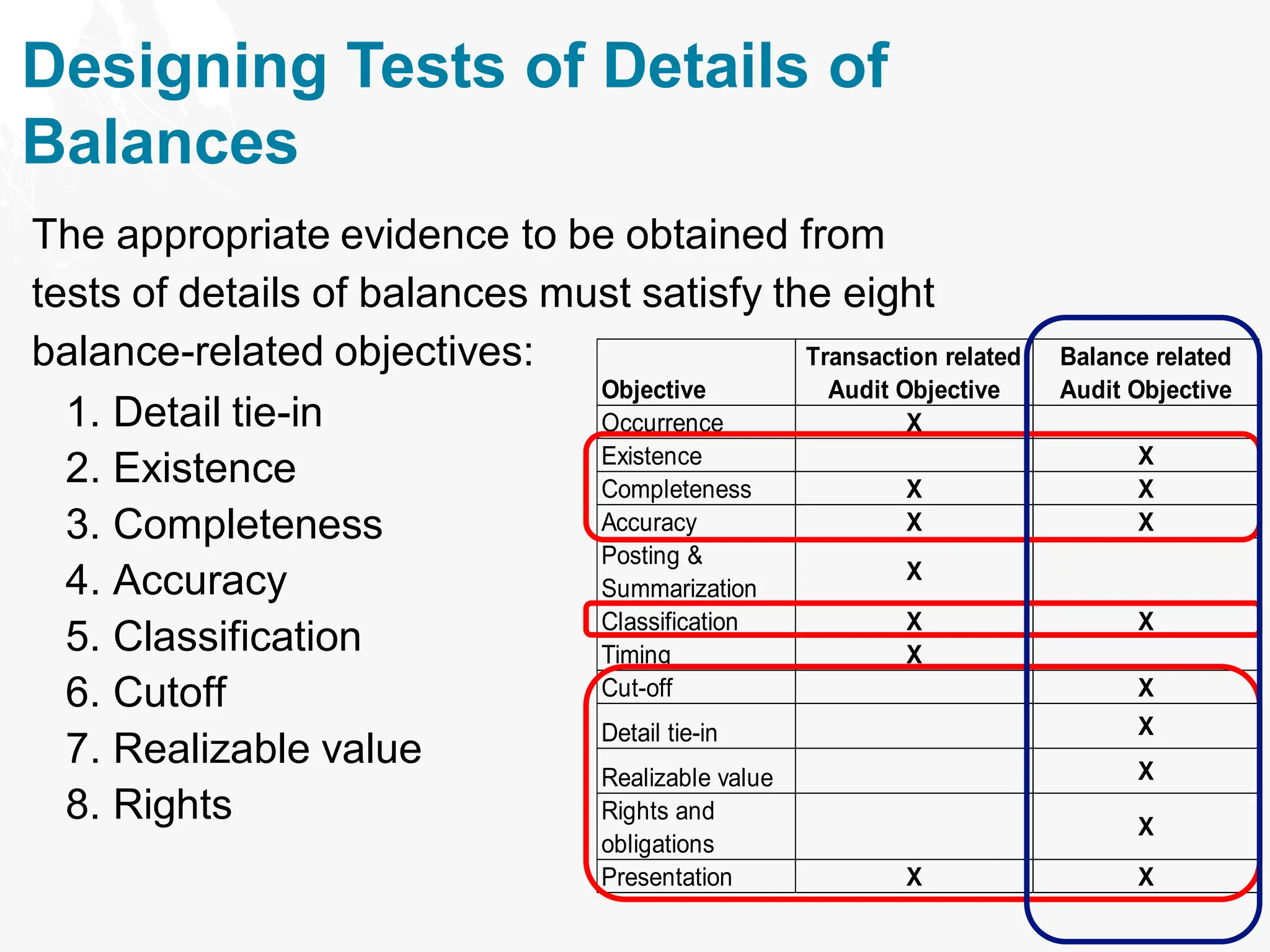
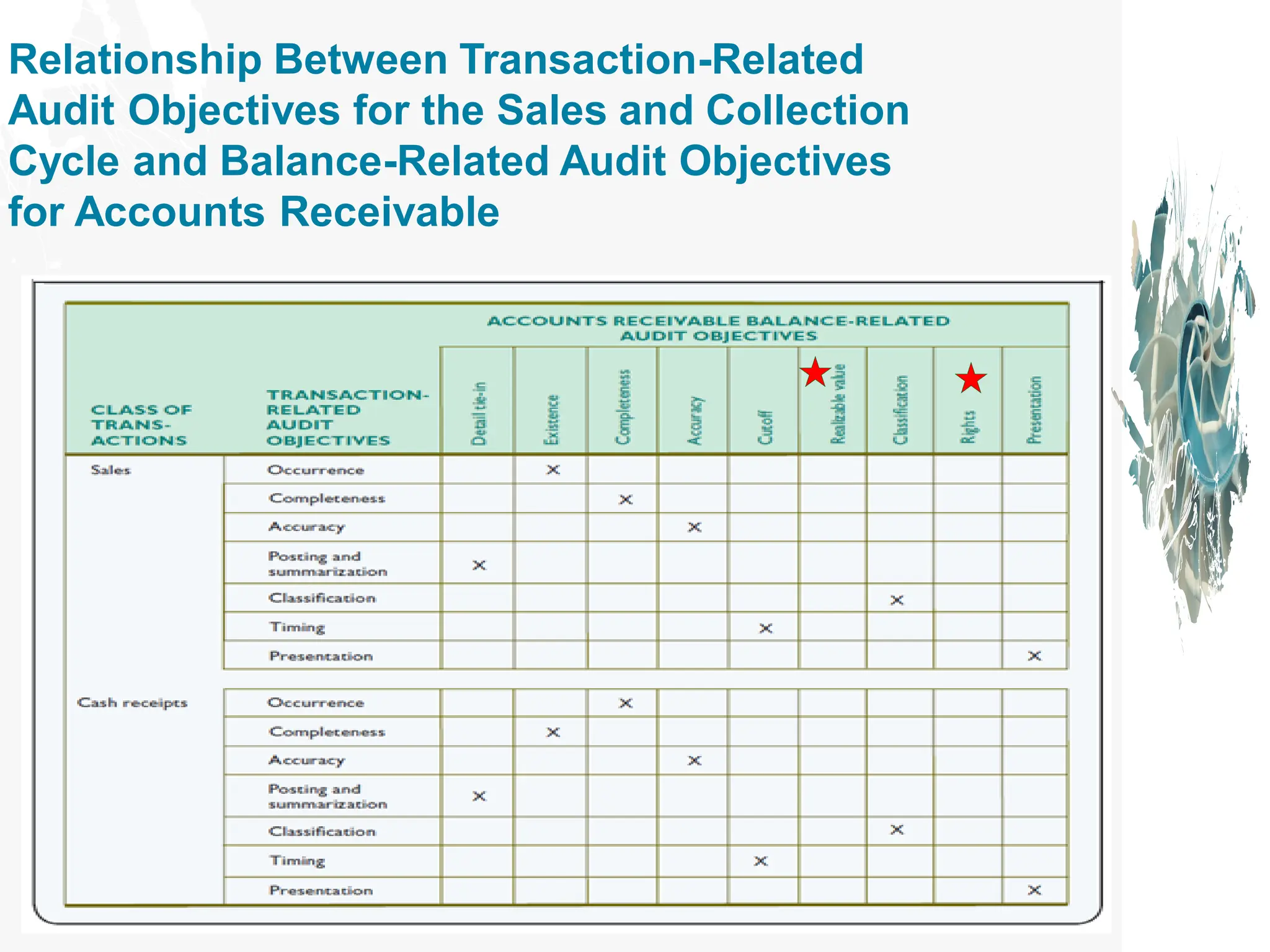
The appropriate evidence to be obtained from
tests of details of balances must satisfy the eight
balance-related objectives:
1. Detail tie-in
2. Existence
3. Completeness
4. Accuracy
5. Classification
6. Cutoff
7. Realizable value
8. Rights
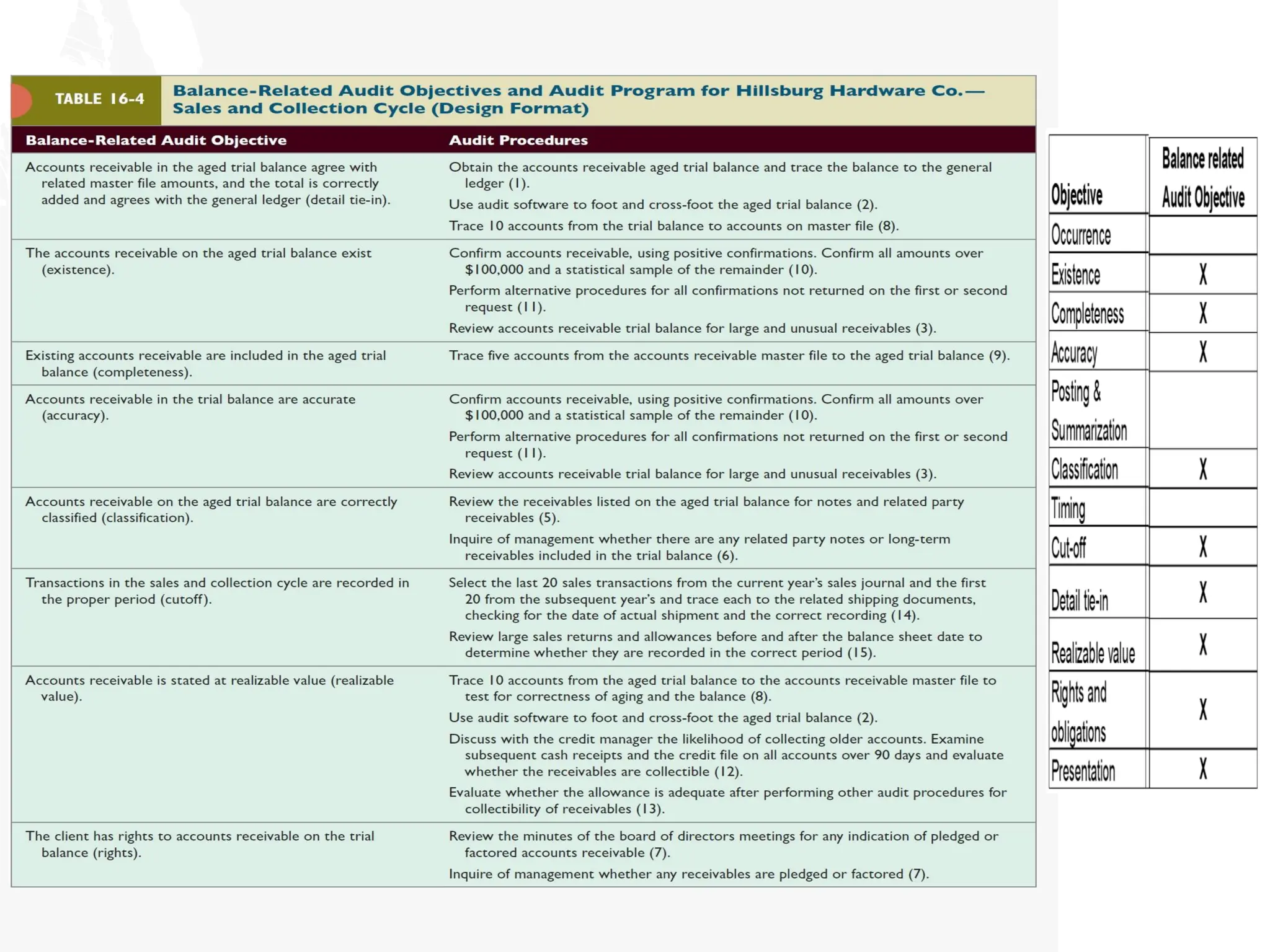
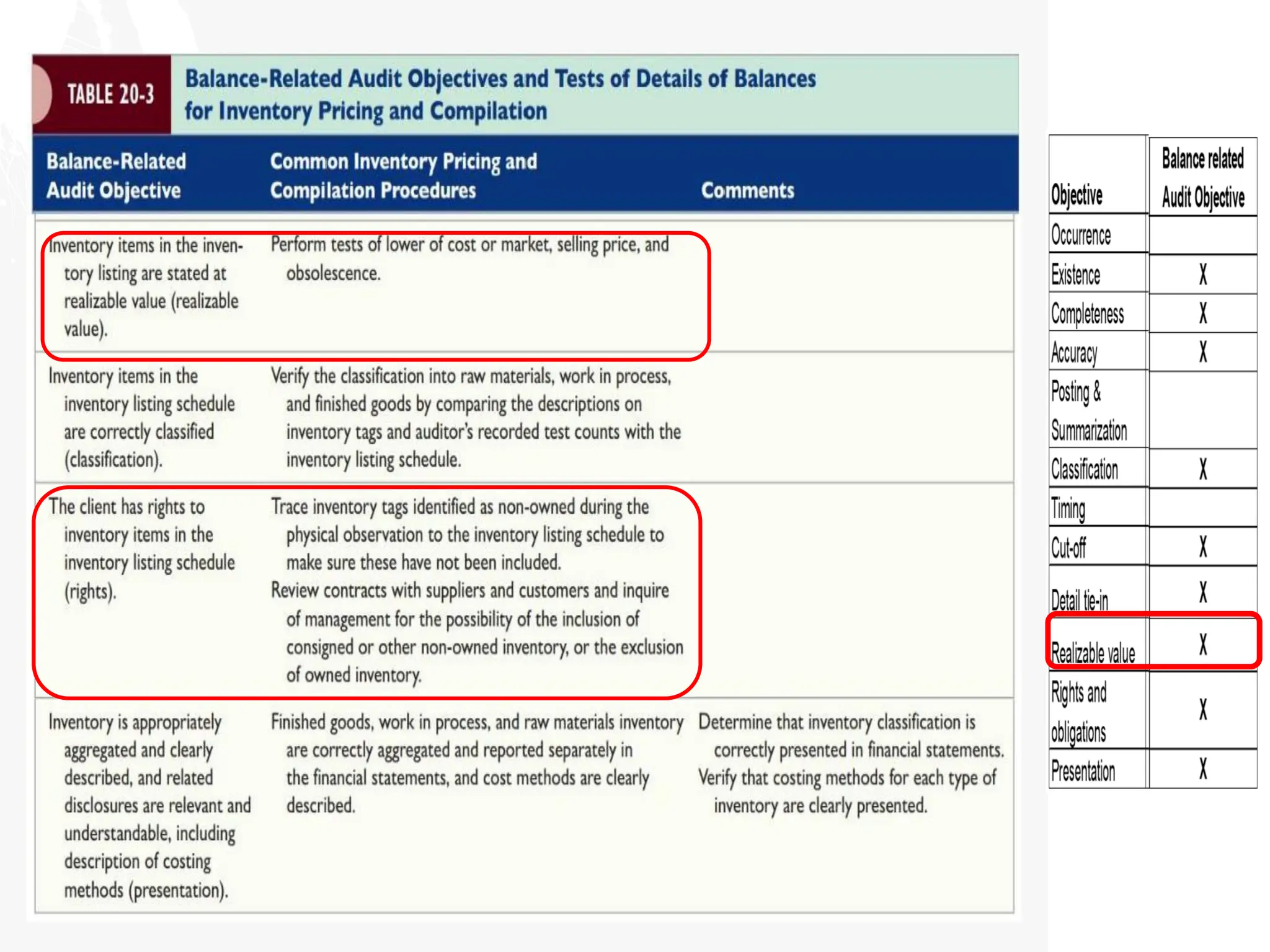
Objective
Transaction related
Audit Objective
Balance related
Audit Objective
Occurrence X
Existence X
Completeness X X
Accuracy X X
Posting &
Summarization
X
Classification X X
Timing X
Cut-off X
Detail tie-in X
Realizable value X
Rights and
obligations
X
Presentation X X
Designing Tests of Details of
Balances
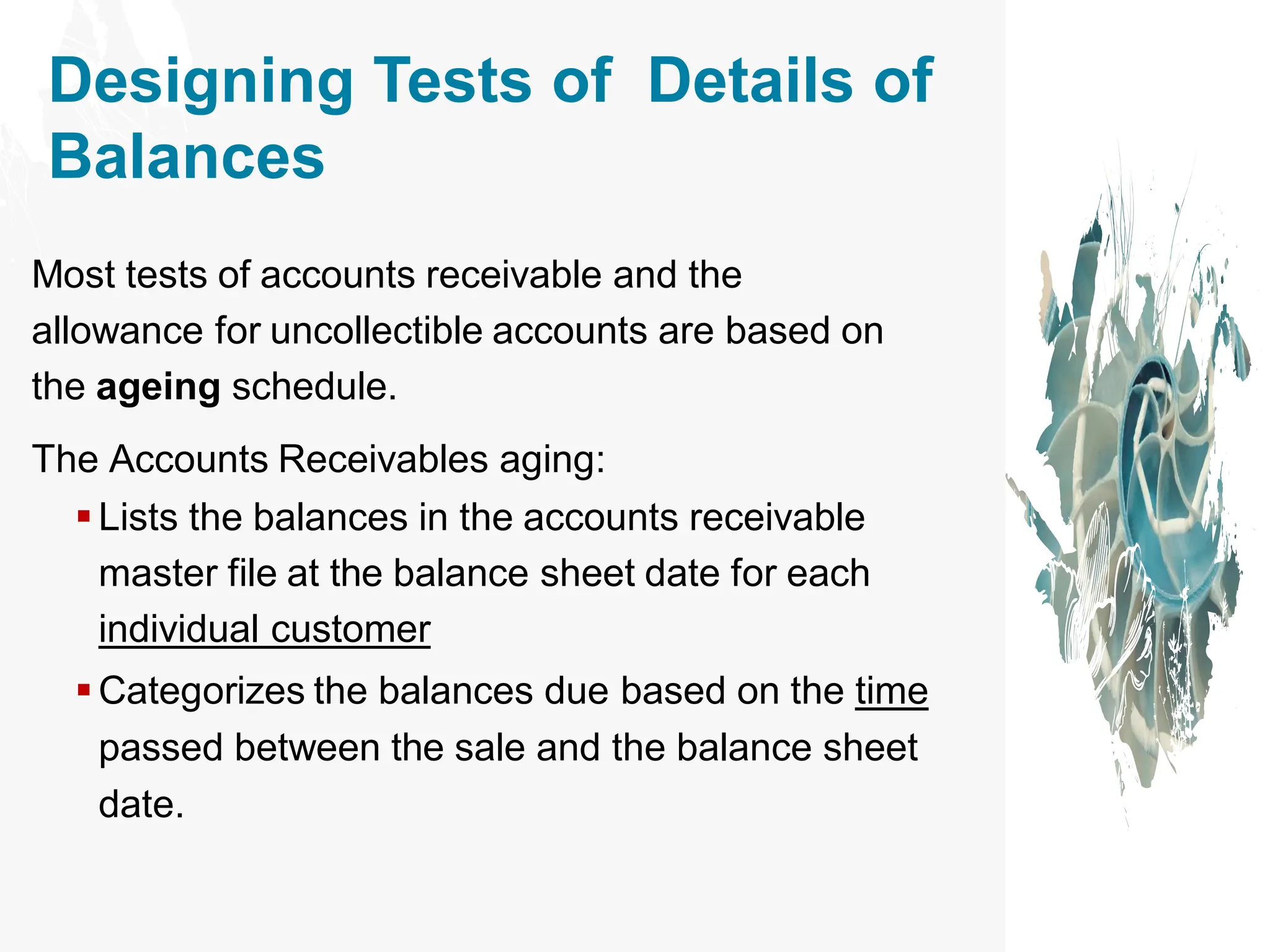
Most tests of accounts receivable and the
allowance for uncollectible accounts are based on
the ageing schedule.
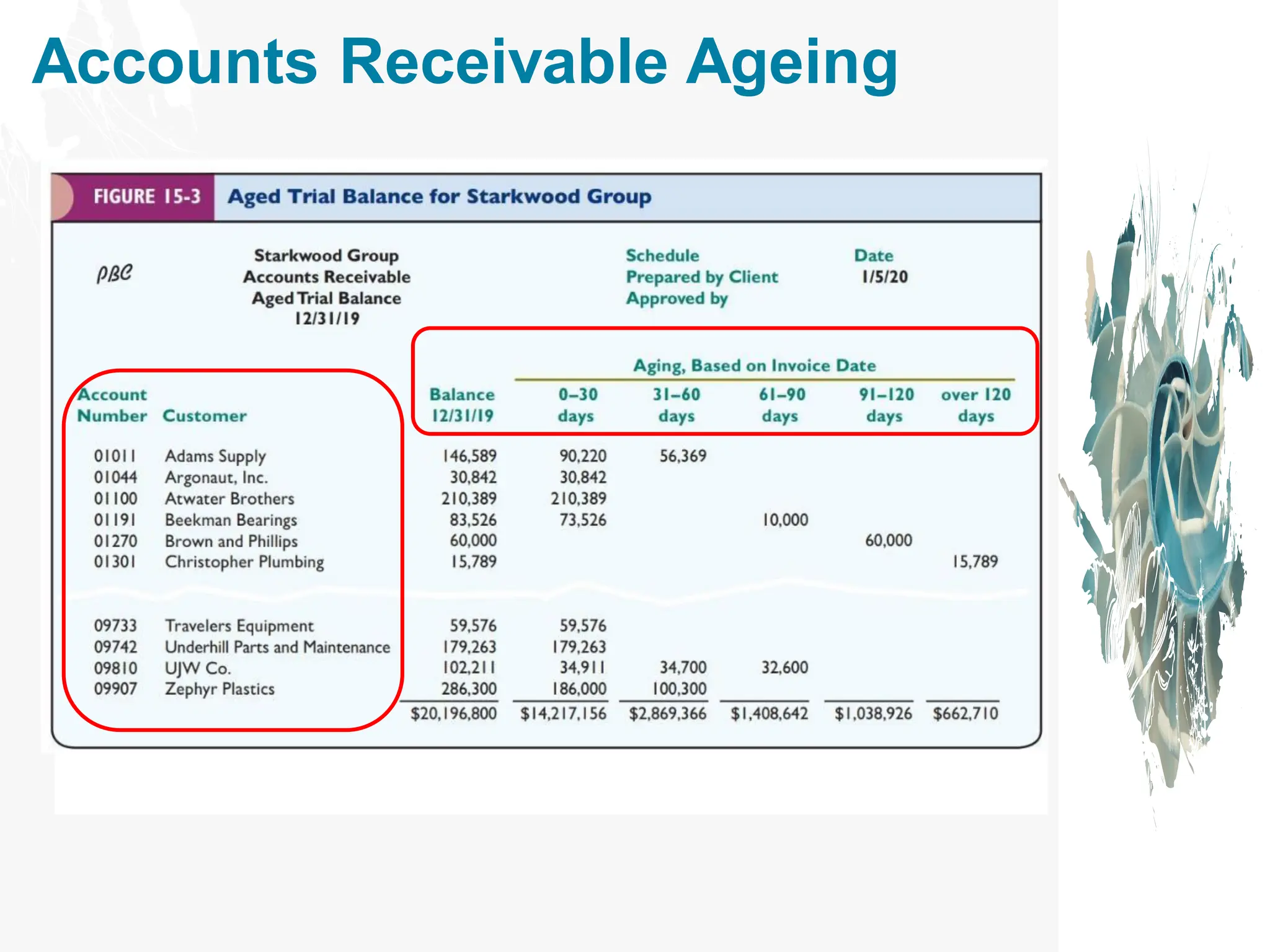
The Accounts Receivables aging:
▪ Lists the balances in the accounts receivable
master file at the balance sheet date for each
individual customer
▪ Categorizes the balances due based on the time
passed between the sale and the balance sheet
date.
Designing Tests of Details of
Balances
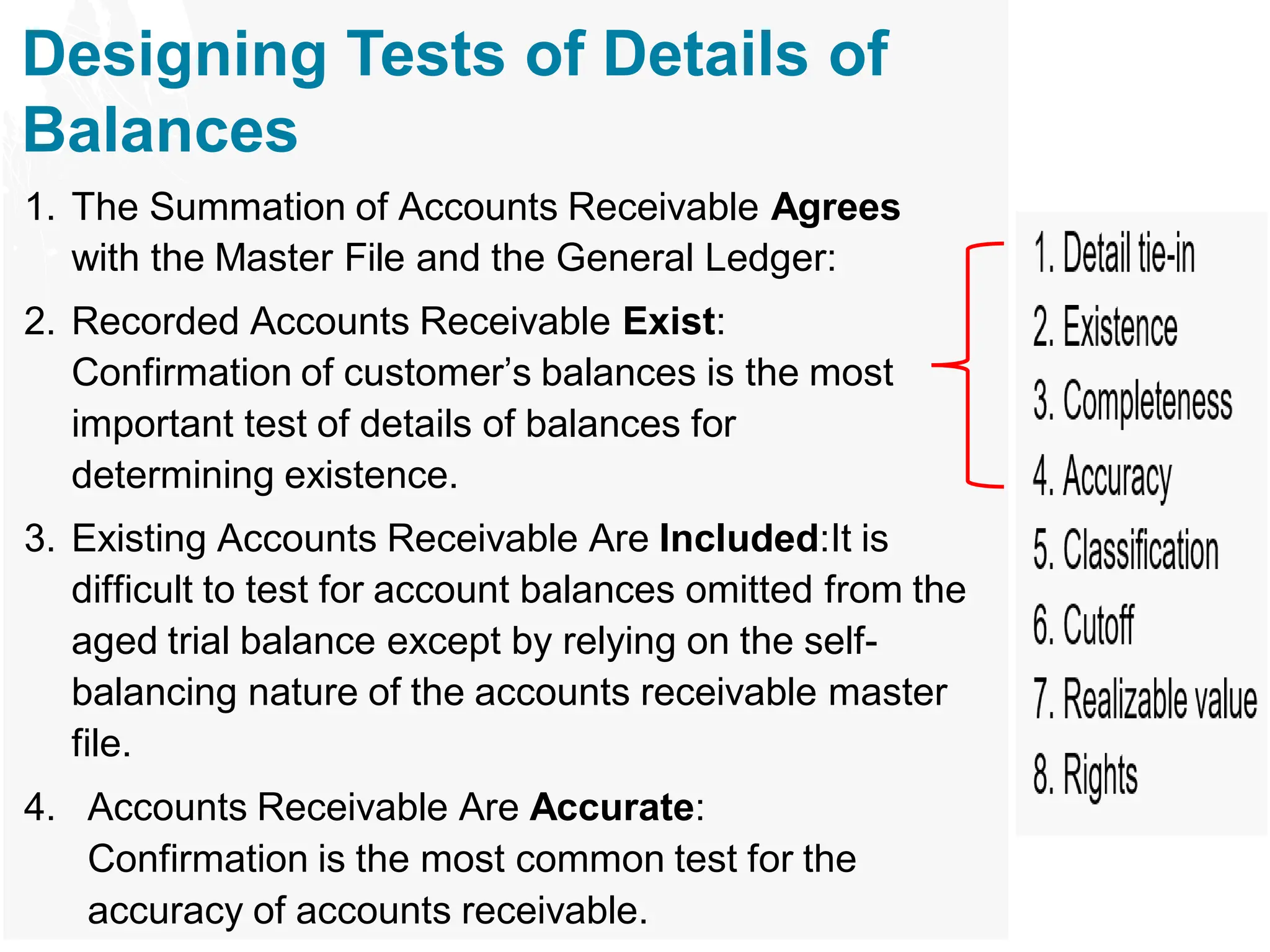
1. The Summation of Accounts Receivable Agrees
with the Master File and the General Ledger:
2. Recorded Accounts Receivable Exist:
Confirmation of customer’s balances is the most
important test of details of balances for
determining existence.
3. Existing Accounts Receivable Are Included:It is
difficult to test for account balances omitted from the
aged trial balance except by relying on the self-
balancing nature of the accounts receivable master
file.
4. Accounts Receivable Are Accurate:
Confirmation is the most common test for the
accuracy of accounts receivable.
Designing Tests of Details of
Balances (cont’d)
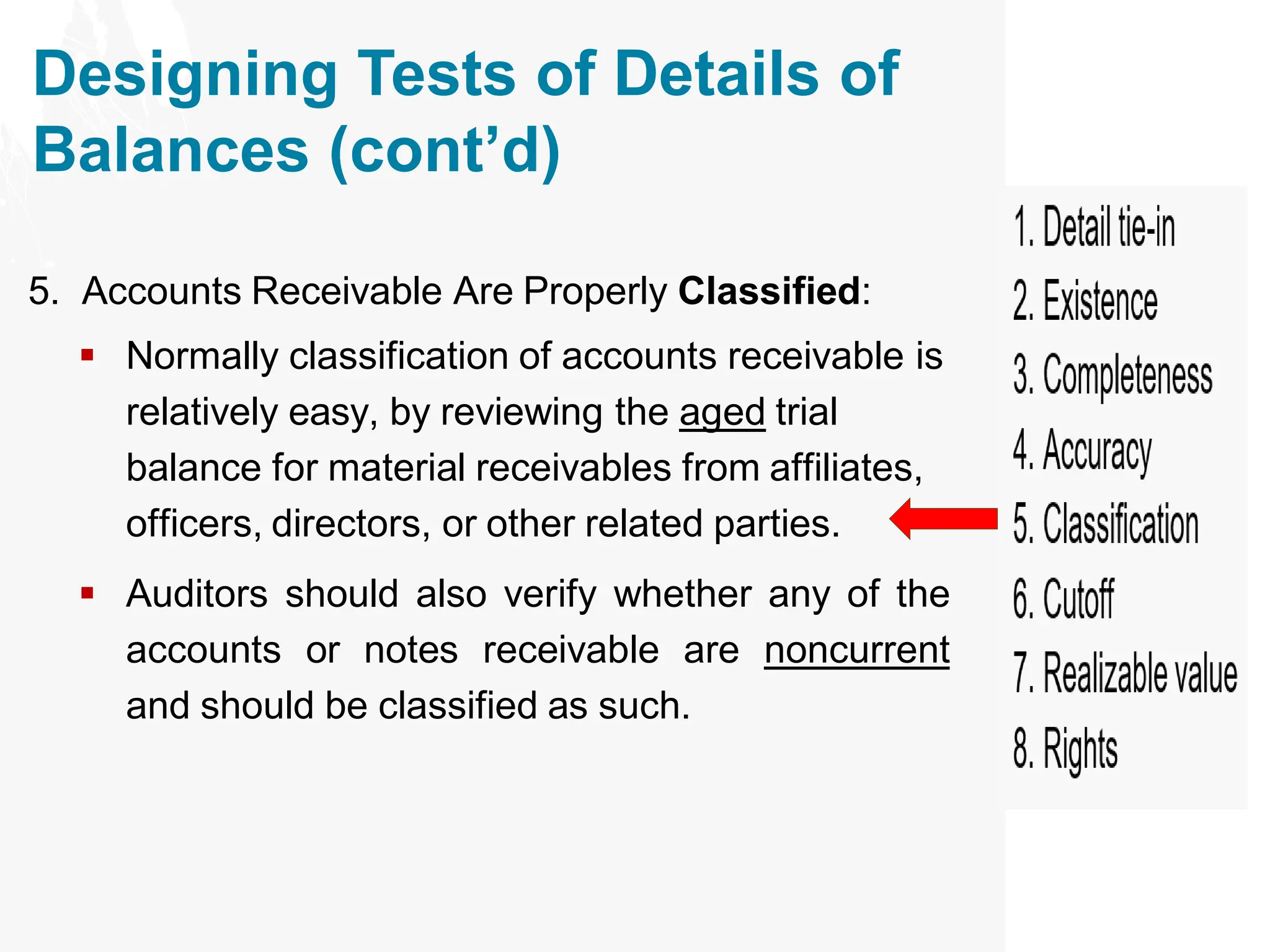
5. Accounts Receivable Are Properly Classified:
▪ Normally classification of accounts receivable is
relatively easy, by reviewing the aged trial
balance for material receivables from affiliates,
officers, directors, or other related parties.
▪ Auditors should also verify whether any of the
accounts or notes receivable are noncurrent
and should be classified as such.
Designing Tests of Details of
Balances (cont’d)
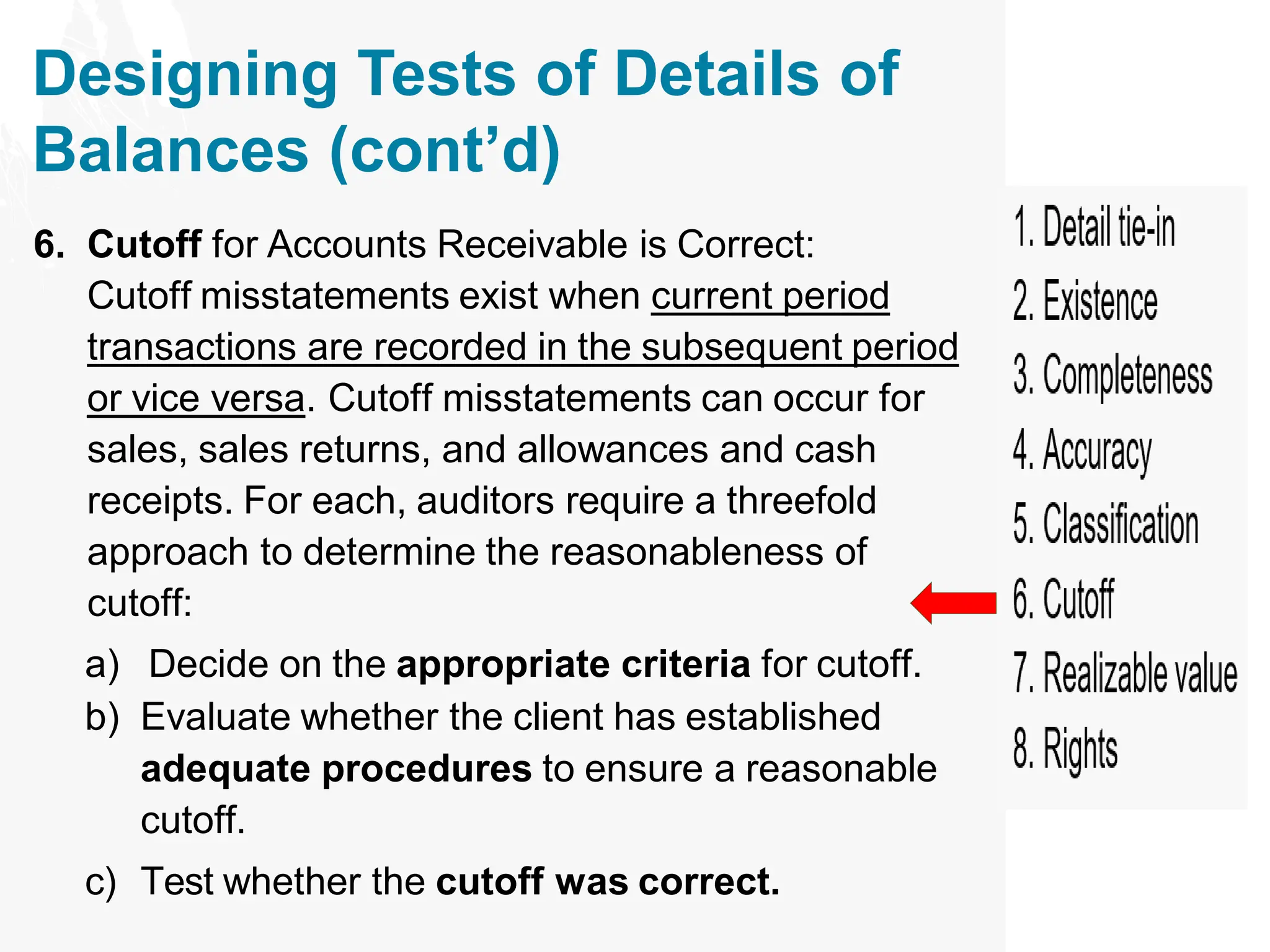
6. Cutoff for Accounts Receivable is Correct:
Cutoff misstatements exist when current period
transactions are recorded in the subsequent period
or vice versa. Cutoff misstatements can occur for
sales, sales returns, and allowances and cash
receipts. For each, auditors require a threefold
approach to determine the reasonableness of
cutoff:
a) Decide on the appropriate criteria for cutoff.
b) Evaluate whether the client has established
adequate procedures to ensure a reasonable
cutoff.
c) Test whether the cutoff was correct.
Designing Tests of Details of
Balances (cont’d)
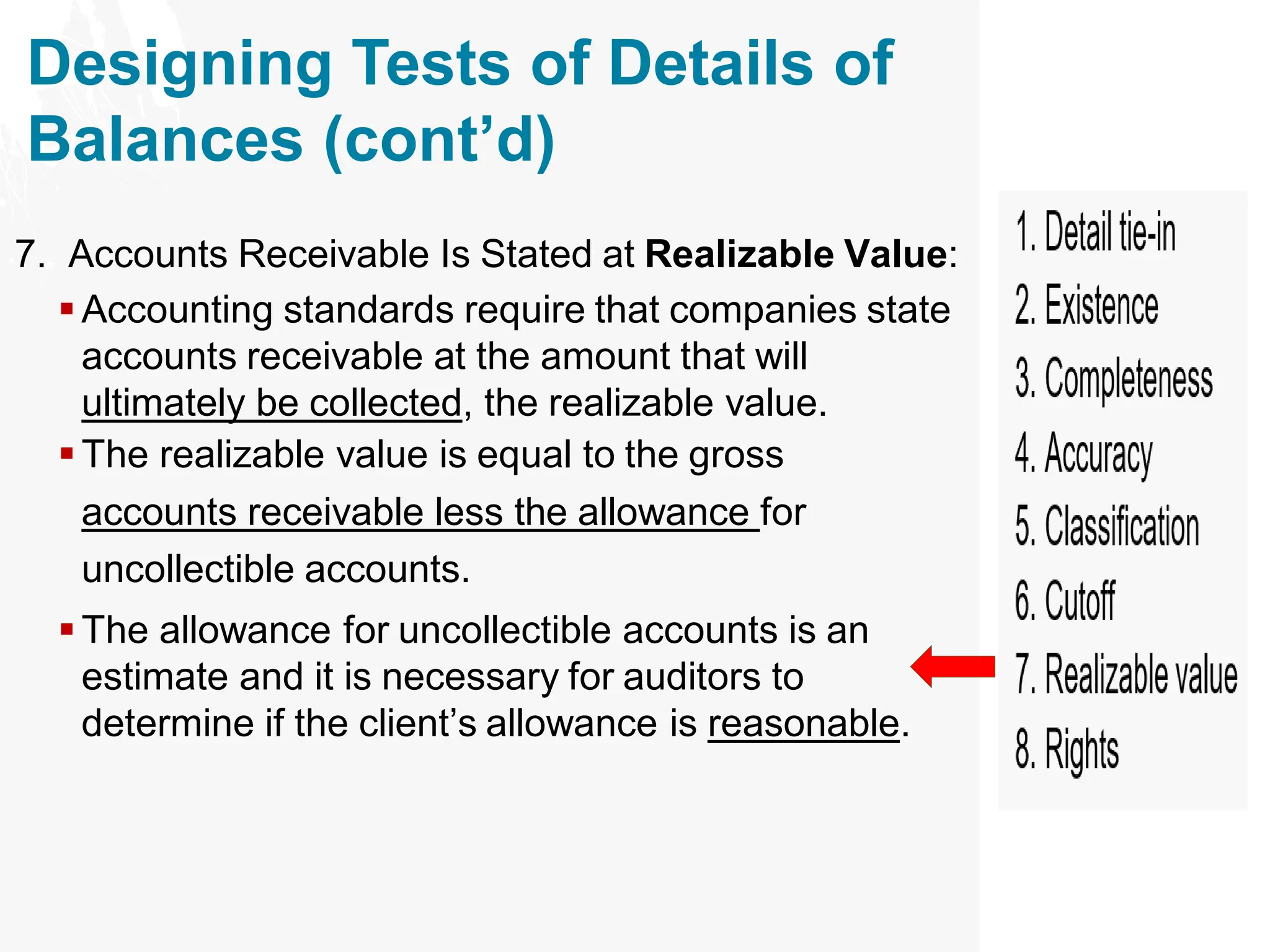
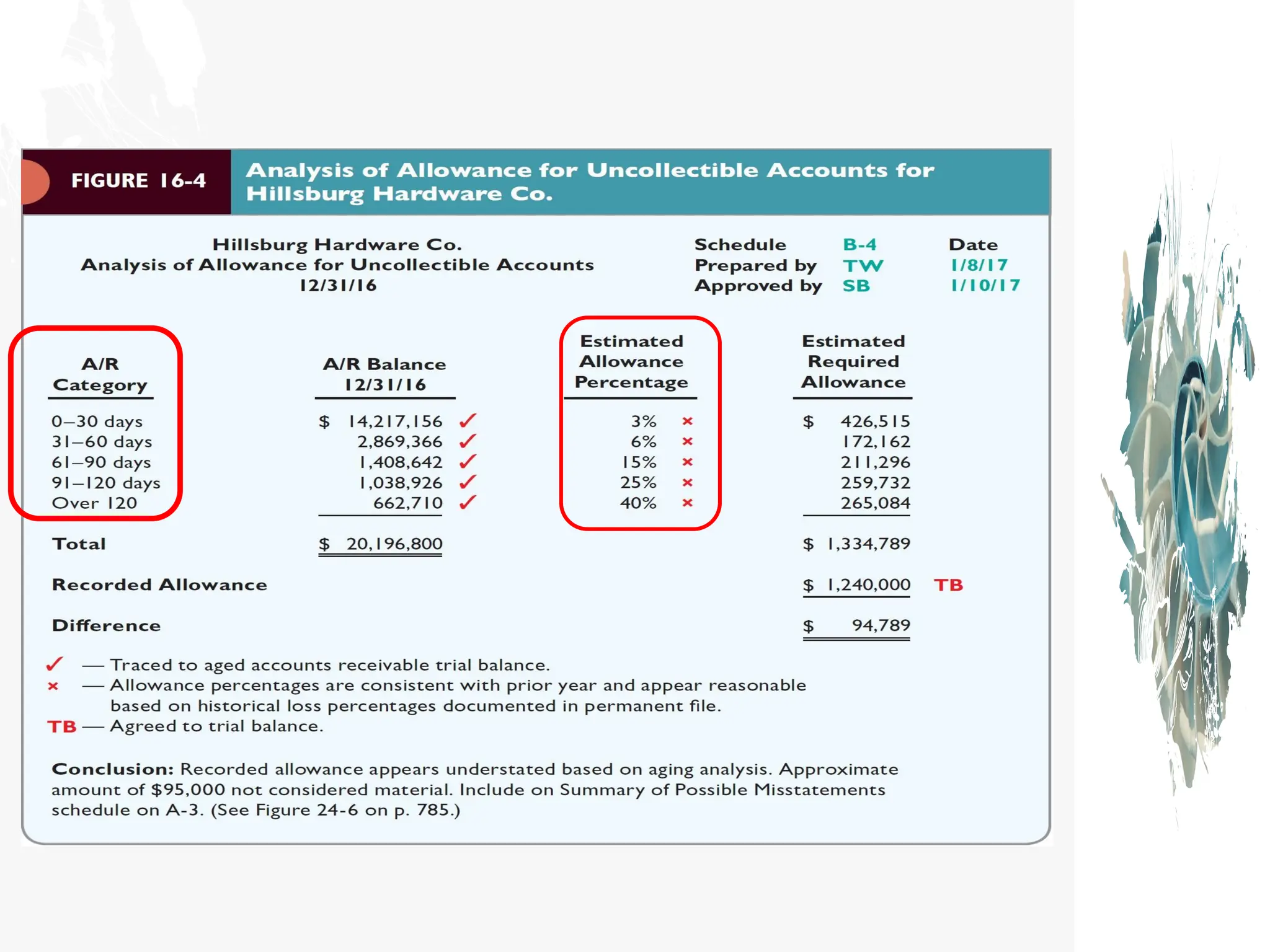
7. Accounts Receivable Is Stated at Realizable Value:
▪ Accounting standards require that companies state
accounts receivable at the amount that will
ultimately be collected, the realizable value.
▪ The realizable value is equal to the gross
accounts receivable less the allowance for
uncollectible accounts.
▪ The allowance for uncollectible accounts is an
estimate and it is necessary for auditors to
determine if the client’s allowance is reasonable.
Designing Tests of Details of
Balances (cont’d)
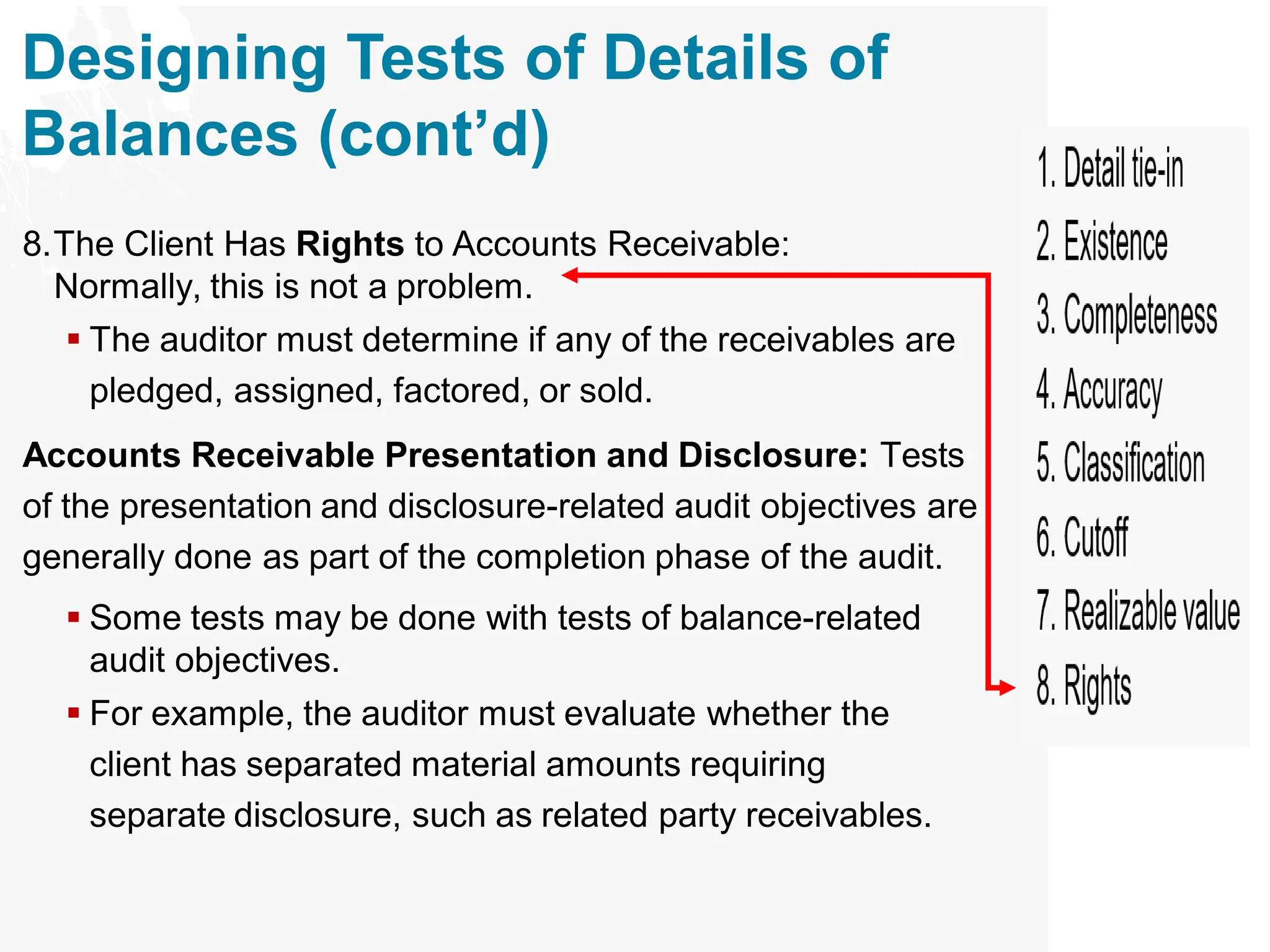
8.The Client Has Rights to Accounts Receivable:
Normally, this is not a problem.
▪ The auditor must determine if any of the receivables are
pledged, assigned, factored, or sold.
Accounts Receivable Presentation and Disclosure: Tests
of the presentation and disclosure-related audit objectives are
generally done as part of the completion phase of the audit.
▪ Some tests may be done with tests of balance-related
audit objectives.
▪ For example, the auditor must evaluate whether the
client has separated material amounts requiring
separate disclosure, such as related party receivables.
Audit Tests for Uncollectible
Accounts (1 of 2)
• The auditor’s primary concern here is the
possibility of client personnel covering up an
embezzlement by writing off accounts receivable
that have already been collected
• The major control for preventing this fraud is
proper authorization of the write-off of
uncollectible accounts
Audit Tests for Uncollectible
Accounts (2 of 2)
• Realizable value of accounts receivable is
often a significant concern for the auditor
• There are two other controls to address
this:
– The preparation of a periodic aged
accounts receivable trial balance for review
and follow-up by appropriate management
personnel
– A policy of writing off uncollectible accounts
when they are no longer likely to be
collected
– Perform a hindsight evaluation
Accounts Receivable Ageing
Relationship Between Transaction-Related
Audit Objectives for the Sales and Collection
Cycle and Balance-Related Audit Objectives
for Accounts Receivable
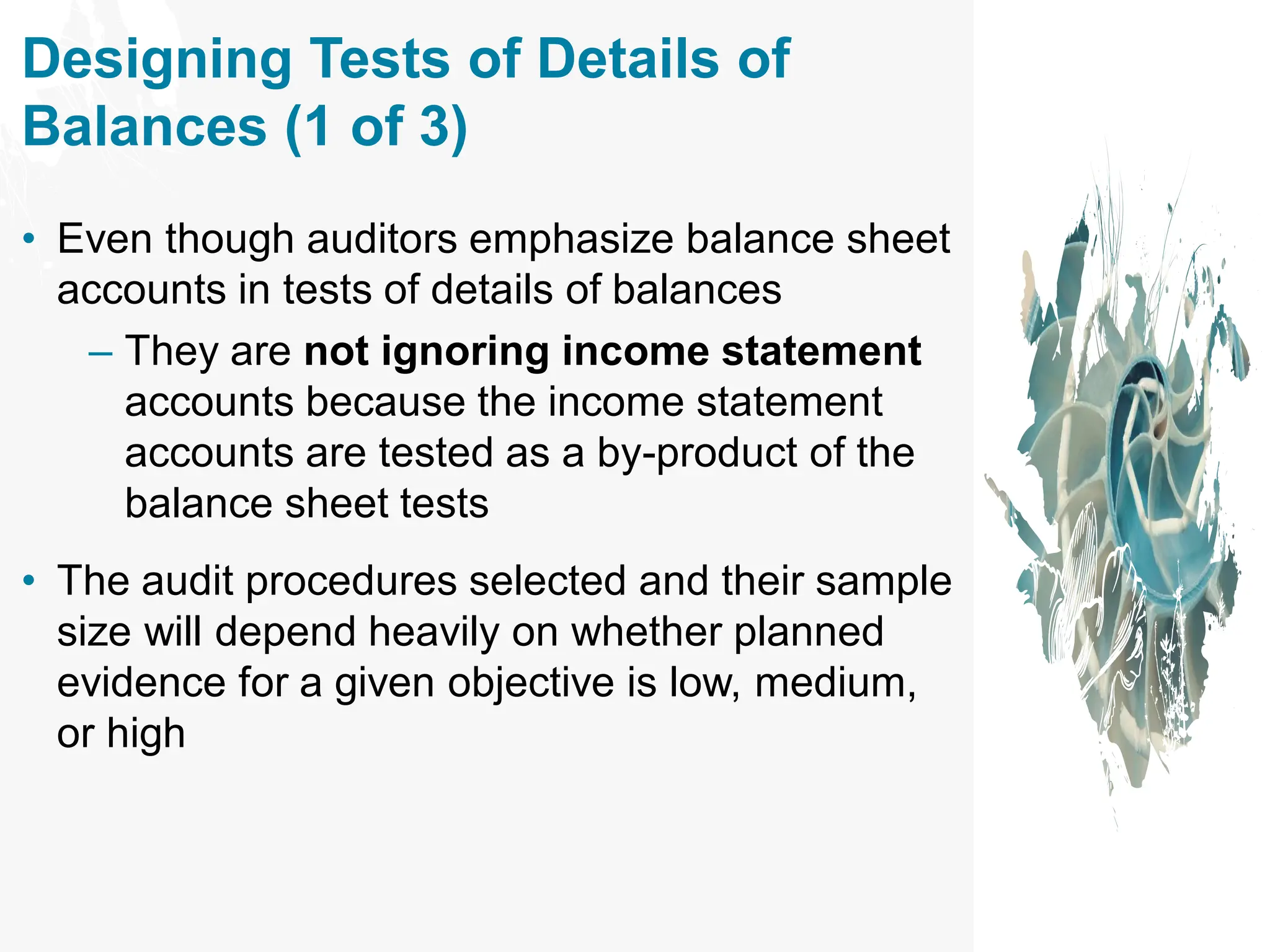
Designing Tests of Details of
Balances (1 of 3)
• Even though auditors emphasize balance sheet
accounts in tests of details of balances
– They are not ignoring income statement
accounts because the income statement
accounts are tested as a by-product of the
balance sheet tests
• The audit procedures selected and their sample
size will depend heavily on whether planned
evidence for a given objective is low, medium,
or high
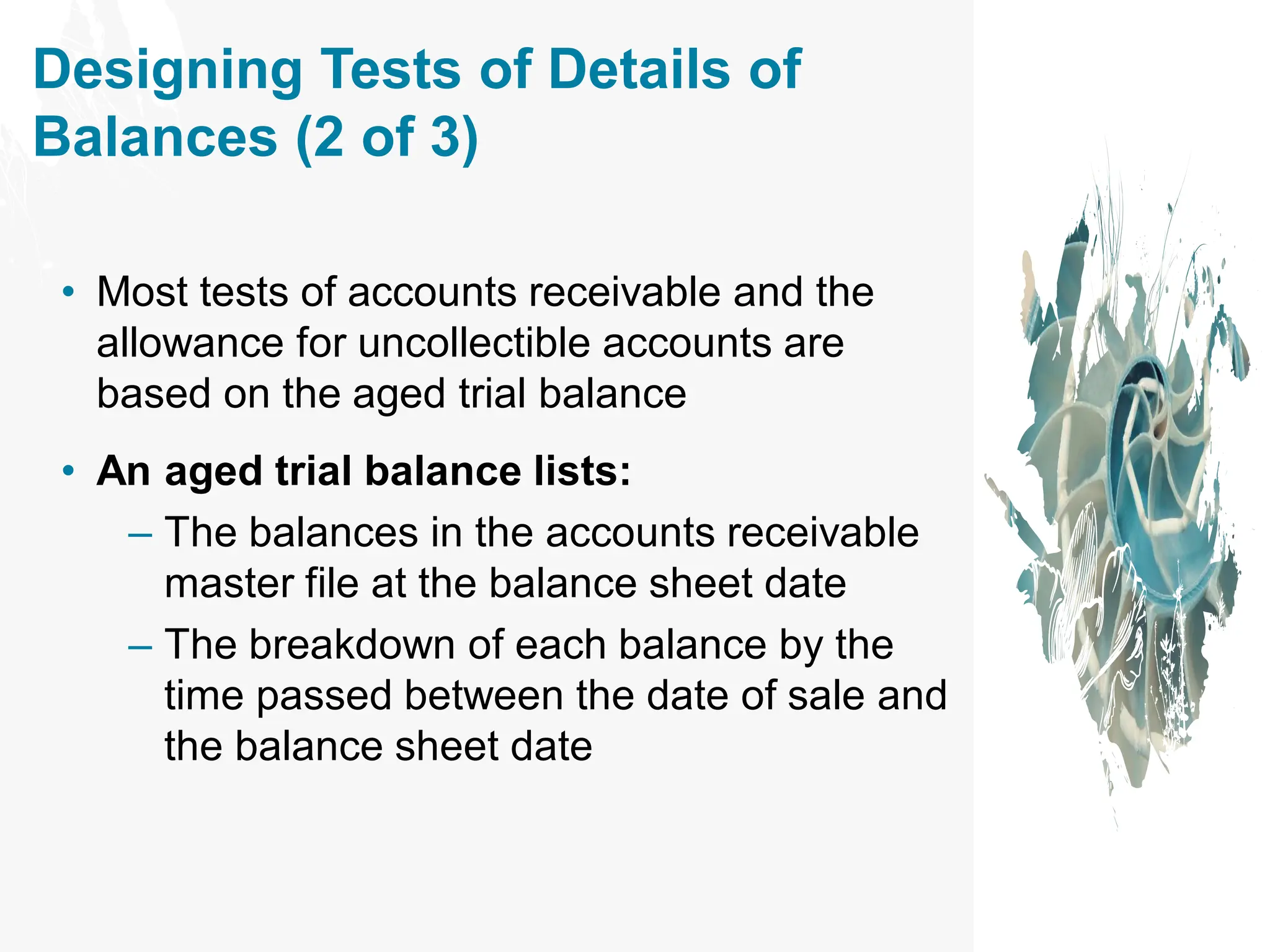
Designing Tests of Details of
Balances (2 of 3)
• Most tests of accounts receivable and the
allowance for uncollectible accounts are
based on the aged trial balance
• An aged trial balance lists:
– The balances in the accounts receivable
master file at the balance sheet date
– The breakdown of each balance by the
time passed between the date of sale and
the balance sheet date
Designing Tests of Details of
Balances (3 of 3)
• The auditor’s tests of details of balances for
accounts receivable include :
– Recorded accounts receivable exist
– Existing accounts receivable are included
– Accounts receivable are accurate
– Cutoff for accounts receivable is correct
– Accounts receivable is stated at realizable
value
– Accounts receivable are properly classified
– The client has rights to accounts receivable
– Accounts receivable presentation and
disclosure
Confirmation of Accounts
Receivable (1 of 4)
• Confirmation of accounts receivable is the
most important test of details of accounts
receivable
• The primary purpose of accounts receivable
confirmation is to satisfy the existence,
accuracy, and cutoff objectives
• The confirmation can be a direct written
response from a third party in paper or
electronic form
Confirmation of Accounts
Receivable (2 of 4)
• Auditors should use external confirmations
for accounts receivable unless:
– The overall accounts receivable balance is
immaterial
– The auditor considers confirmations
ineffective evidence because response
rates will likely be inadequate or unreliable
– The auditor’s assessed level of the risk of
material misstatement is low and other
substantive evidence can be accumulated
to provide sufficient evidence
Confirmation of Accounts
Receivable (3 of 4)
• Types of confirmation include positive and
negative confirmation
• The most reliable evidence from confirmations is
obtained when they are sent close to the
balance sheet date
• Sample size for confirming accounts receivable
is based on performance materiality, inherent
risk, control risk, detection risk, and types of
confirmation
Confirmation of Accounts
Receivable (4 of 4)
• Nonresponses to positive confirmations do
not provide audit evidence, though
nonresponses to negative confirmations
provide some evidence of the existence
assertion
• It is necessary to follow up on nonresponses
with alternative procedures
– The objective is to determine by a means
other than confirmation whether the
nonconfirmed account existed and was
properly stated at the confirmation date
Audit Sampling for Tests of
Details of Balances
Comparisons of audit sampling
for tests of details of Balances
and for tests of controls and
Substantive Tests of Transactions
(1 of 3)
• Auditor wants to make inferences about the
entire population based on a sample
• Both sampling and nonsampling risks are
therefore important for tests of controls,
substantive tests of transactions, and tests of
details of balances
• To address sampling risk, auditors can use
either nonstatistical or statistical methods for all
three types of tests
Comparisons of Audit Sampling for
Tests of Details of Balances and for
Tests of Controls and Substantive
Tests of Transactions (2 of 3)
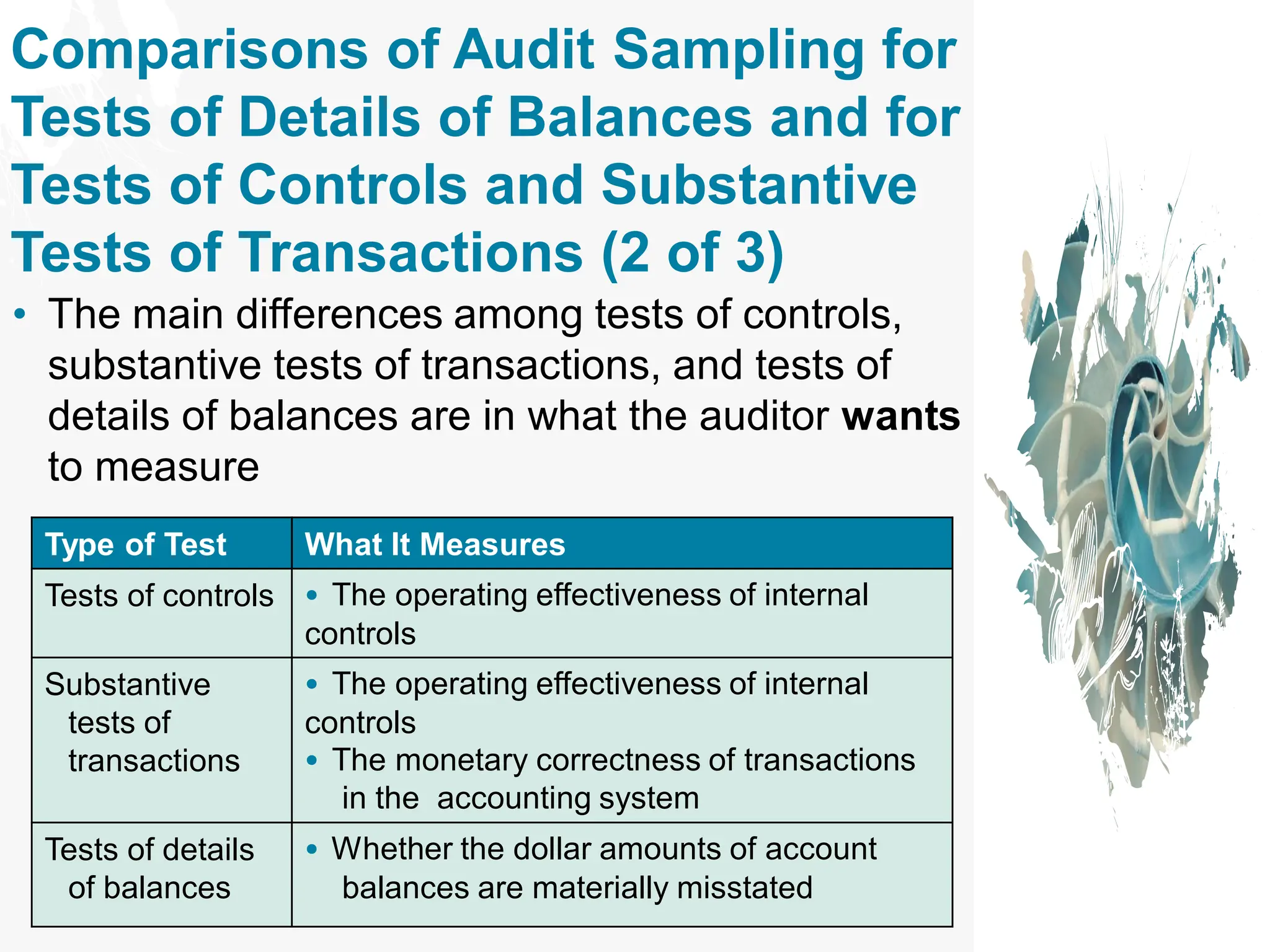
• The main differences among tests of controls,
substantive tests of transactions, and tests of
details of balances are in what the auditor wants
to measure
Type of Test What It Measures
Tests of controls • The operating effectiveness of internal
controls
Substantive
tests of
transactions
• The operating effectiveness of internal
controls
• The monetary correctness of transactions
in the accounting system
Tests of details
of balances
• Whether the dollar amounts of account
balances are materially misstated
Comparisons of Audit Sampling for
Tests of Details of Balances and for
Tests of Controls and Substantive
Tests of Transactions (3 of 3)
• Auditors perform tests of controls and
substantive tests of transactions to:
– Determine whether the exception rate in the
population is sufficiently low
– Reduce assessed control risk and thereby
reduce tests of details of balances
– Conclude that the control is operating
effectively for purposes of auditing internal
control over financial reporting for larger
public companies
Audit of Cash Receipts
Methodology for Designing Tests of
Controls and Substantive Tests of
Transactions for Cash Receipts (1
of 2)
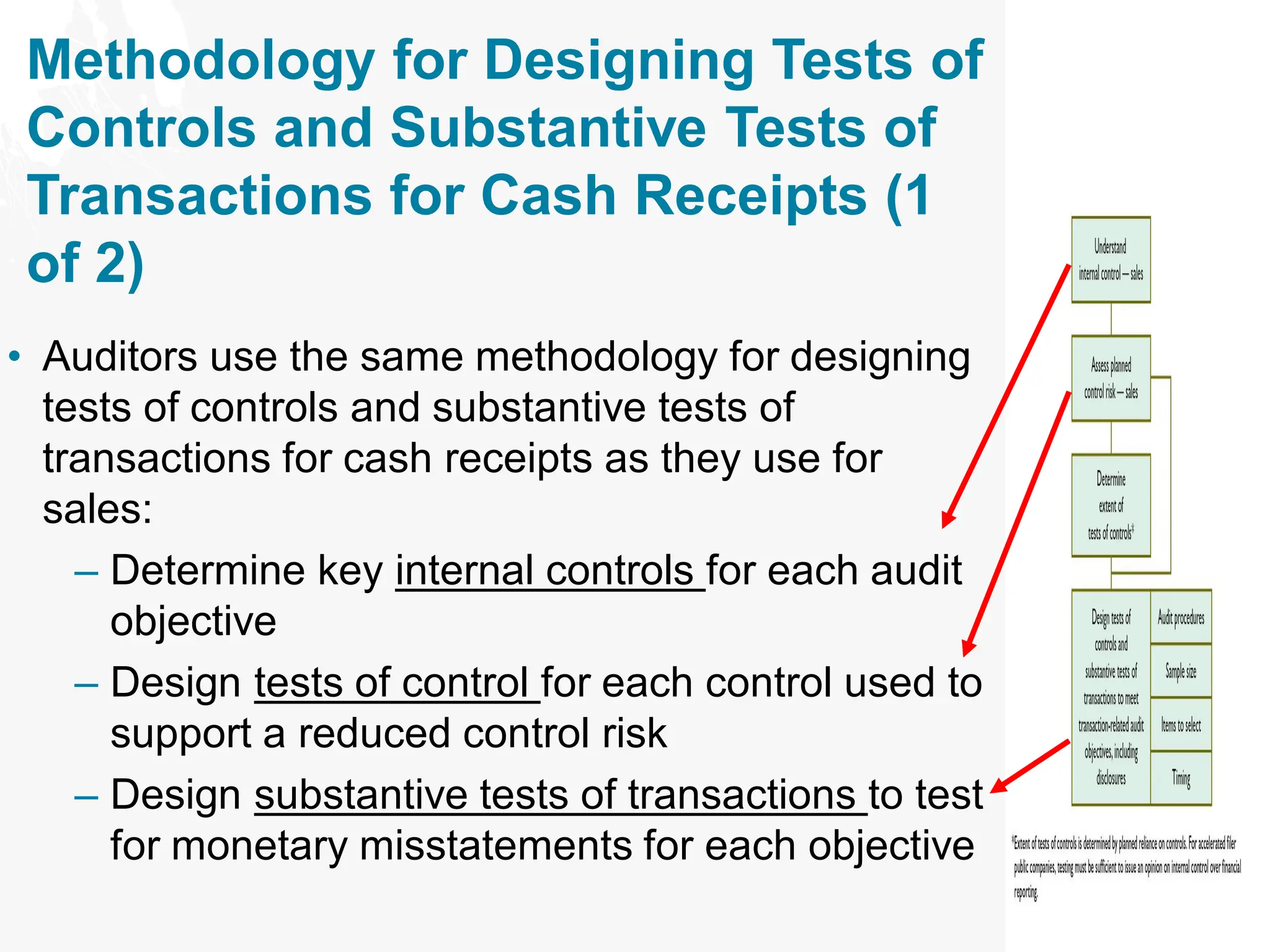
• Auditors use the same methodology for designing
tests of controls and substantive tests of
transactions for cash receipts as they use for
sales:
– Determine key internal controls for each audit
objective
– Design tests of control for each control used to
support a reduced control risk
– Design substantive tests of transactions to test
for monetary misstatements for each objective
Methodology for Designing Tests
of Controls and Substantive Tests
of Transactions for Cash Receipts
(2 of 2)
• An essential part of the auditor’s responsibility
in auditing cash receipts is to identify
deficiencies in internal control that increase the
likelihood of fraud
• Audit procedures that are designed
primarily for the discovery of fraud include:
– Determine whether cash received was
recorded
– Prepare proof of cash receipts
– Test to discover lapping of accounts
receivable
Designing Test of Controls for
Receipts
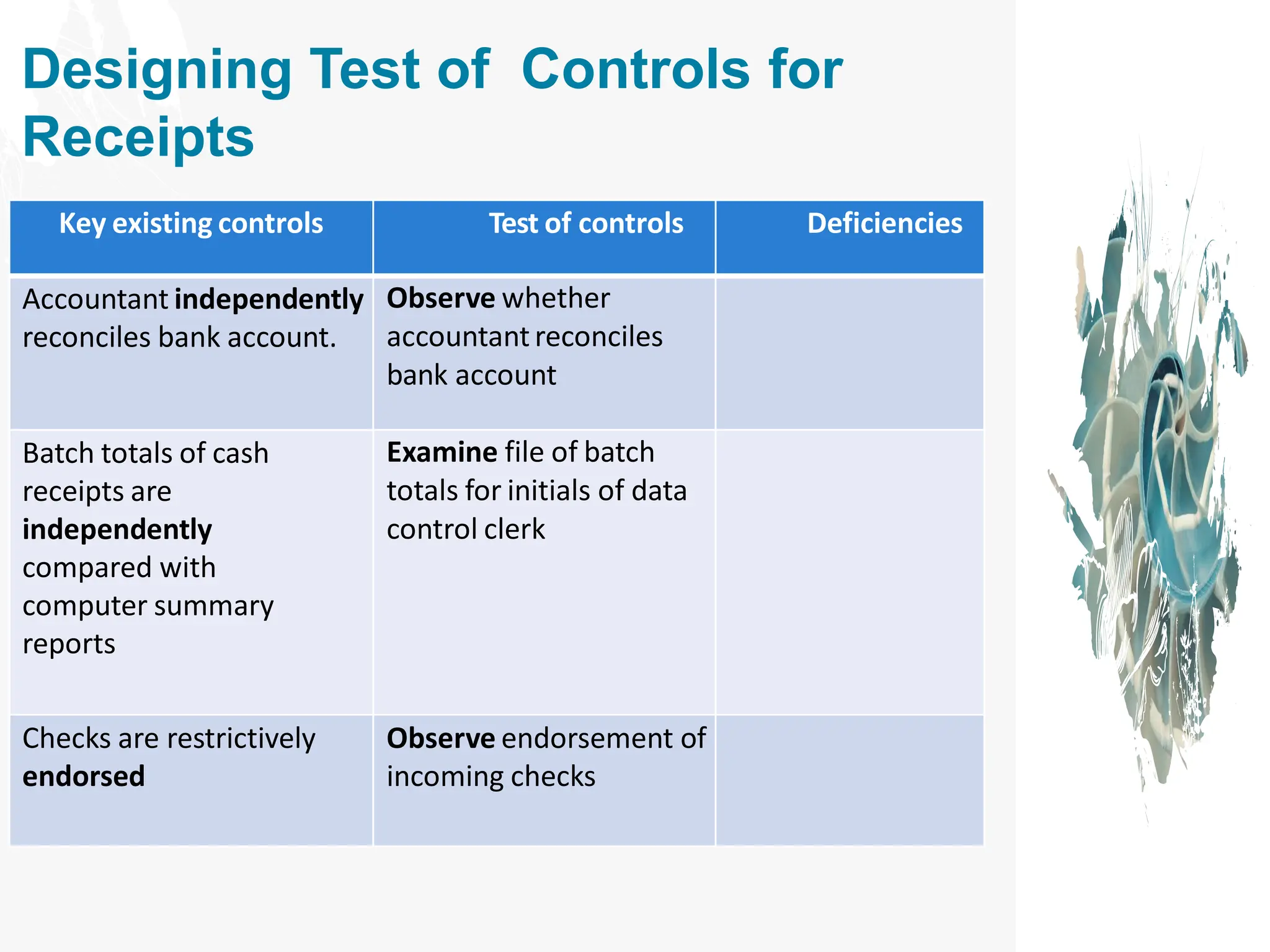
Key existing controls Test of controls Deficiencies
Accountant independently
reconciles bank account.
Observe whether
accountantreconciles
bank account
Batch totals of cash
receipts are
independently
compared with
computer summary
reports
Examine file of batch
totals for initials of data
control clerk
Checks are restrictively
endorsed
Observe endorsement of
incoming checks
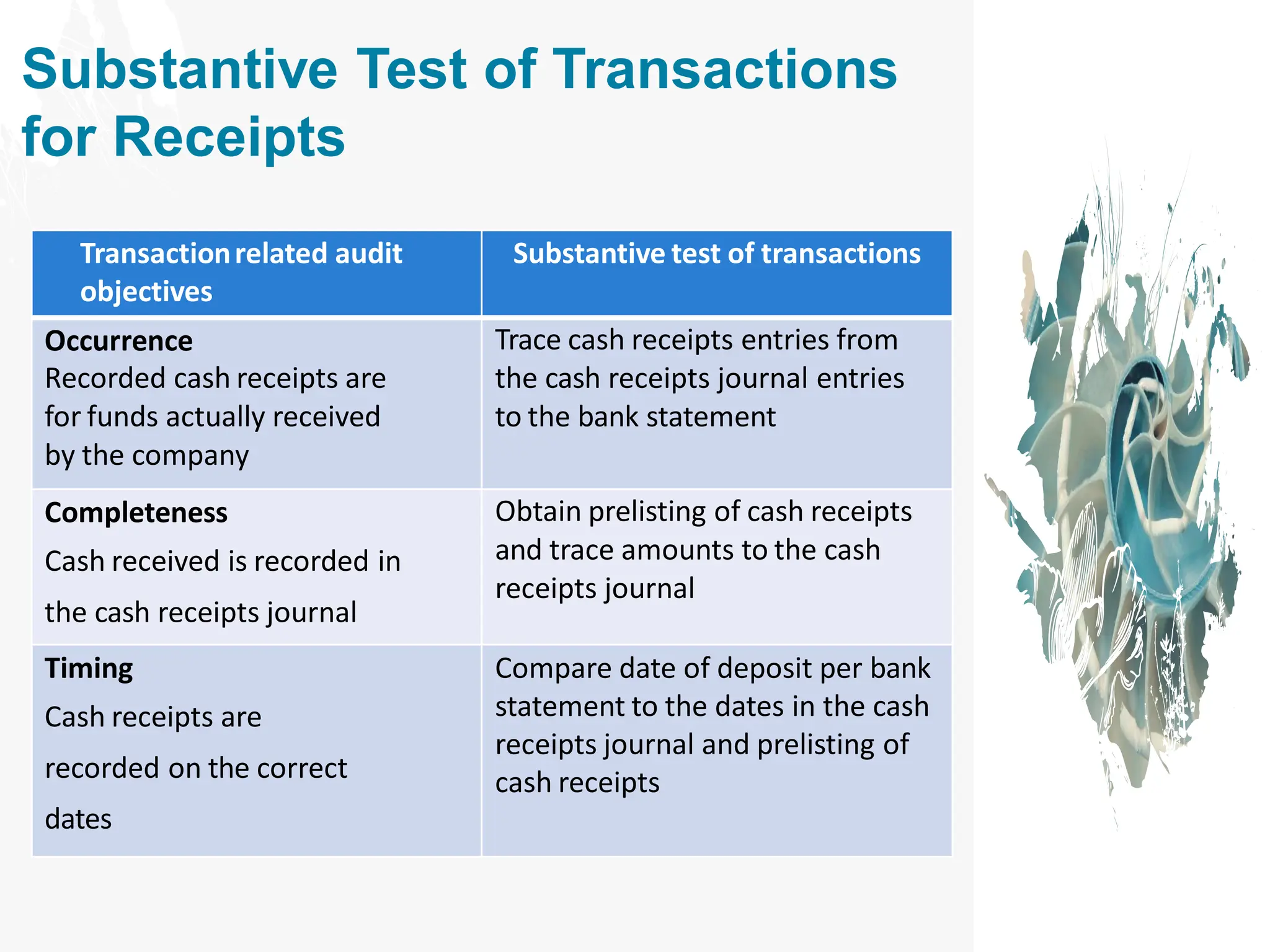
Substantive Test of Transactions
for Receipts
Transactionrelated audit
objectives
Substantive test of transactions
Occurrence
Recorded cash receipts are
for funds actually received
by the company
Trace cash receipts entries from
the cash receipts journal entries
to the bank statement
Completeness
Cash received is recorded in
the cash receipts journal
Obtain prelisting of cash receipts
and trace amounts to the cash
receipts journal
Timing
Cash receipts are
recorded on the correct
dates
Compare date of deposit per bank
statement to the dates in the cash
receipts journal and prelisting of
cash receipts
INVENTORY &
WAREHOUSING
CYCLE
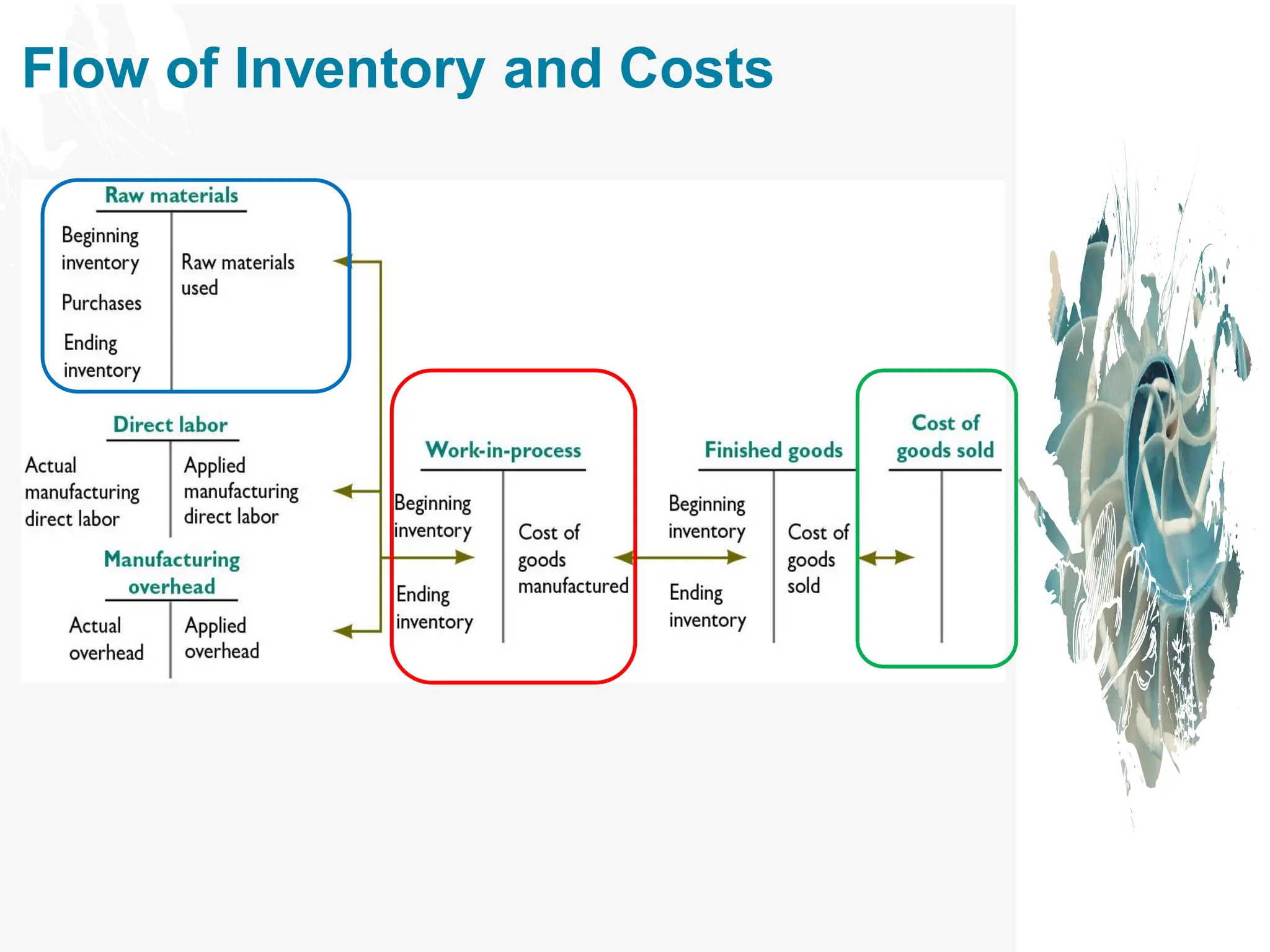
Flow of Inventory and Costs
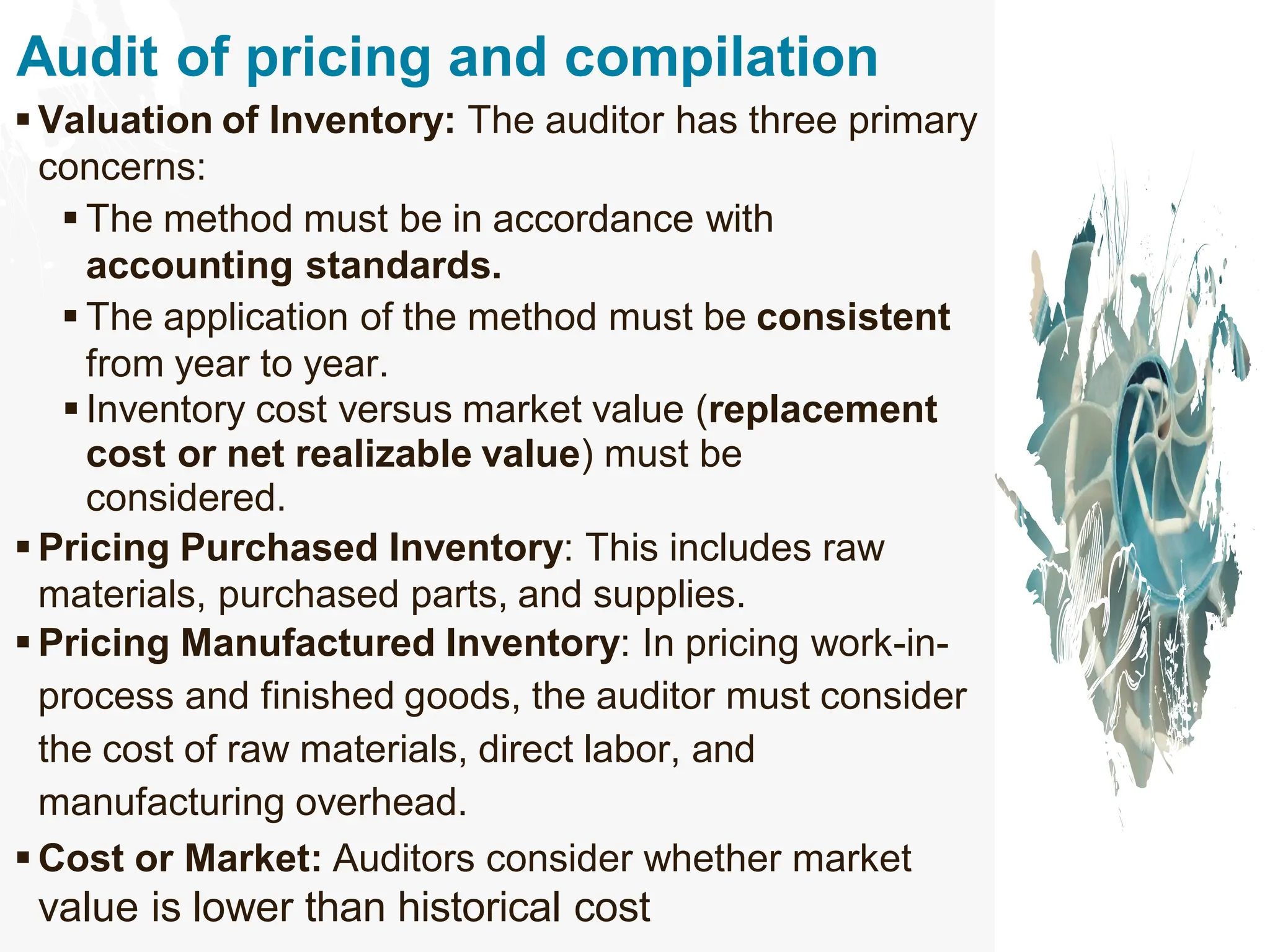
Audit of pricing and compilation
▪ Valuation of Inventory: The auditor has three primary
concerns:
▪ The method must be in accordance with
accounting standards.
▪ The application of the method must be consistent
from year to year.
▪ Inventory cost versus market value (replacement
cost or net realizable value) must be
considered.
▪ Pricing Purchased Inventory: This includes raw
materials, purchased parts, and supplies.
▪ Pricing Manufactured Inventory: In pricing work-in-
process and finished goods, the auditor must consider
the cost of raw materials, direct labor, and
manufacturing overhead.
▪ Cost or Market: Auditors consider whether market
value is lower than historical cost
Business Functions in the Cycle
and Related Documents and
Records (1 of 3)
• The inventory and warehousing cycle can
be thought of as comprising two separate
but closely related systems:
– The physical flow of goods
– The related costs
Business Functions in the Cycle
and Related Documents and
Records (2 of 3)
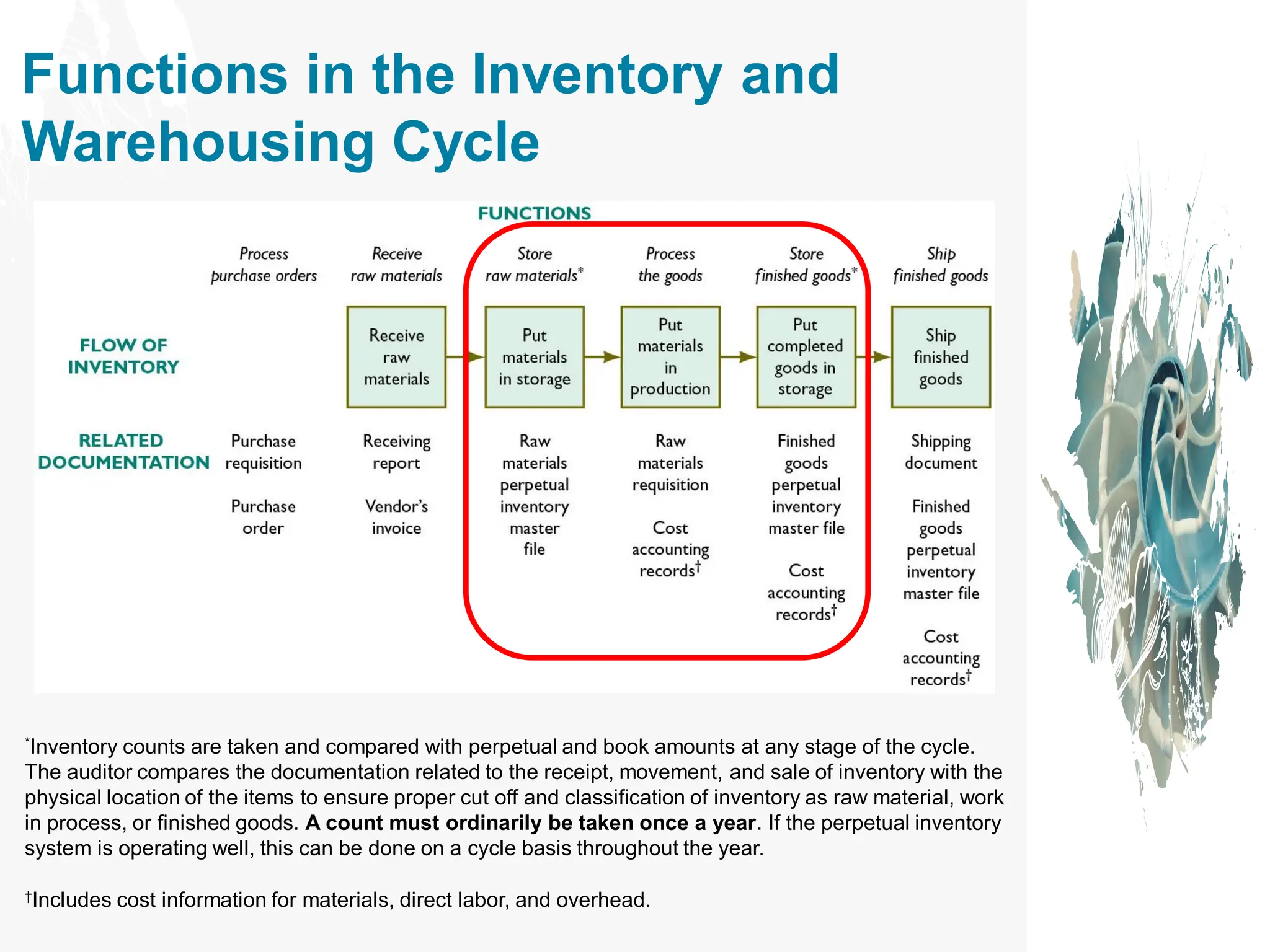
• There are six functions that make up the
inventory and warehousing cycle:
– Process purchase orders
– Receive raw materials
– Store raw materials
– Process the goods
– Store finished goods
– Ship finished goods
Business Functions in the Cycle
and Related Documents and
Records (3 of 3)
• A perpetual inventory master file is a type of
record used for inventory which typically
includes information about the units of inventory
acquired, sold, and on hand
• Separate computerized perpetual records are
likely to be kept for raw materials, work-in-
process, and finished goods
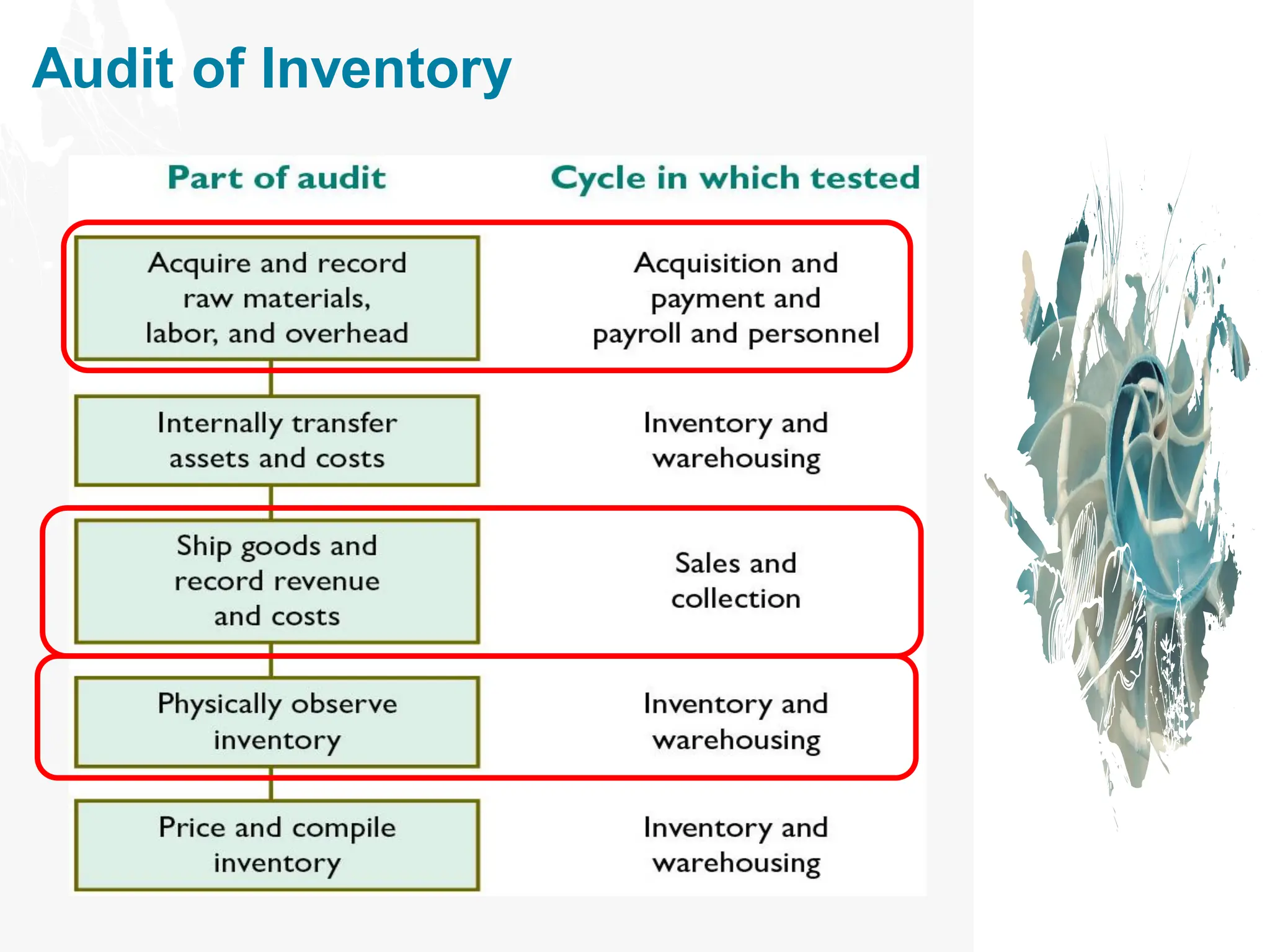
Parts of the Audit of Inventory
• The audit of the inventory and warehousing
cycle can be divided into five activities
within the cycle:
– Acquire and record raw materials, labor, and
overhead
– Internally transfer assets and costs
– Ship goods and record revenue and costs
– Physically observe inventory
– Price and compile inventory
Functions in the Inventory and
Warehousing Cycle
*Inventory counts are taken and compared with perpetual and book amounts at any stage of the cycle.
The auditor compares the documentation related to the receipt, movement, and sale of inventory with the
physical location of the items to ensure proper cut off and classification of inventory as raw material, work
in process, or finished goods. A count must ordinarily be taken once a year. If the perpetual inventory
system is operating well, this can be done on a cycle basis throughout the year.
†Includes cost information for materials, direct labor, and overhead.
Audit of Inventory
Substantive Analytical Procedures
• Substantive analytical procedures are important for
auditors to examine the relationship of inventory
account balances with other financial statement
accounts
• Auditors often use nonfinancial information to
assess the reasonableness of inventory-related
balances
• Inventory is often the largest asset on the balance
sheet for many companies
• Significant improvements in audit effectiveness and
efficiency may be achieved by use of audit data
analytics
• Auditors may be able to use audit software to test
entire populations for certain audit tests,eliminating
the need for more costly tests involving sampling
Substantive Analytical Procedures for the
Inventory and Warehousing Cycle
Substantive Analytical Procedure Possible Misstatement
Compare gross margin percentage
with that of previous years.
Overstatement or understatement of
inventory and cost of goods sold.
Compare inventory turnover (cost of
goods sold divided by average
inventory) with that of previous
years.
Obsolete inventory, which affects
inventory and cost of goods sold.
Overstatement or understatement of
inventory.
Compare unit costs of inventory with
those of previous years.
Overstatement or understatement of
unit costs, which affects inventory
and cost of goods sold.
Compare extended inventory value
with that of previous years.
Misstatements in compilation, unit
costs, or extensions, which affect
inventory and cost of goods sold.
Compare current-year manufacturing
costs with those of previous years
(variable costs should be adjusted
for changes in volume).
Misstatements of unit costs of
inventory, especially direct labor
and manufacturing overhead,
which affect inventory and cost of
goods sold.
Physical Observation of Inventory
(1 of 3)
• Obtaining an understanding of the client’s
industry and business is more important for both
physical inventory observation and inventory
pricing and compilation than for most audit areas
• Auditors often first familiarize themselves with
the client’s inventory by conducting a tour of the
client’s inventory facilities, including receiving,
storage, production, planning, and record-
keeping areas
• Auditing standards require auditors to meet
following inventory observation
requirements:
– Be present at the time the client counts its
inventory
– Observe the client’s counting procedures
– Make inquiries of client personnel about
their counting procedures
– Make their own independent tests of the
physical count
Physical Observation of Inventory
(2 of 3)
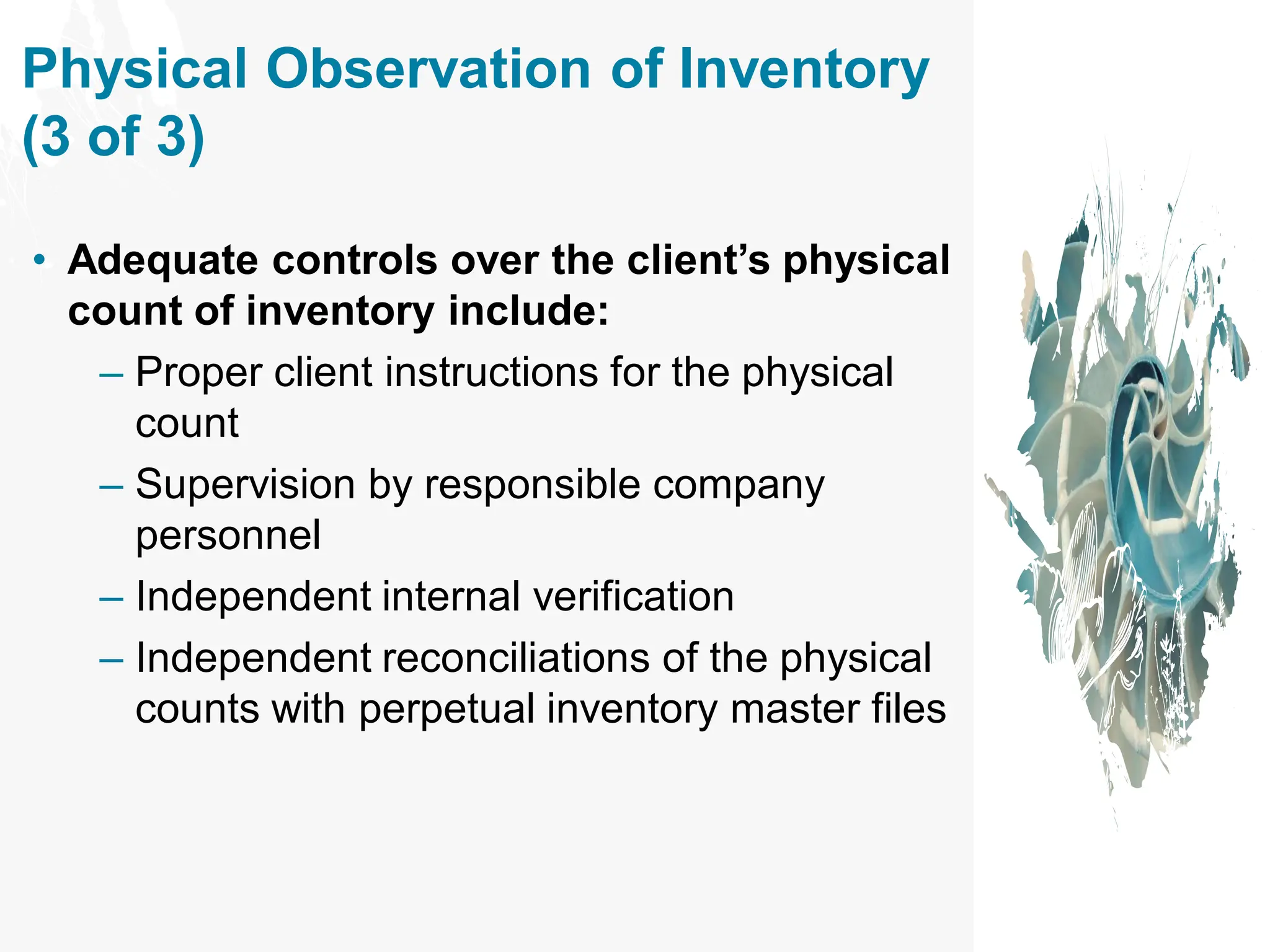
• Adequate controls over the client’s physical
count of inventory include:
– Proper client instructions for the physical
count
– Supervision by responsible company
personnel
– Independent internal verification
– Independent reconciliations of the physical
counts with perpetual inventory master files
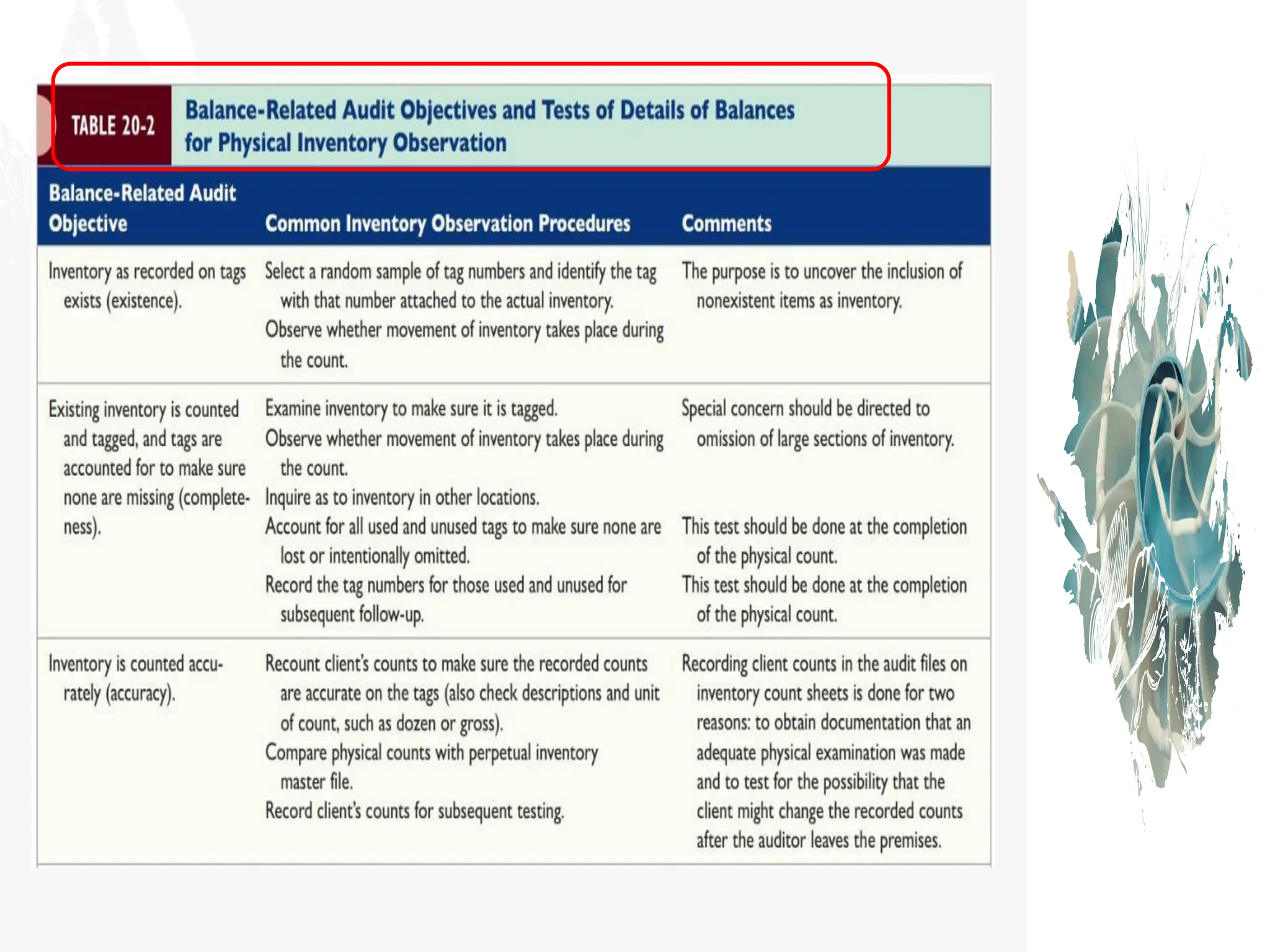
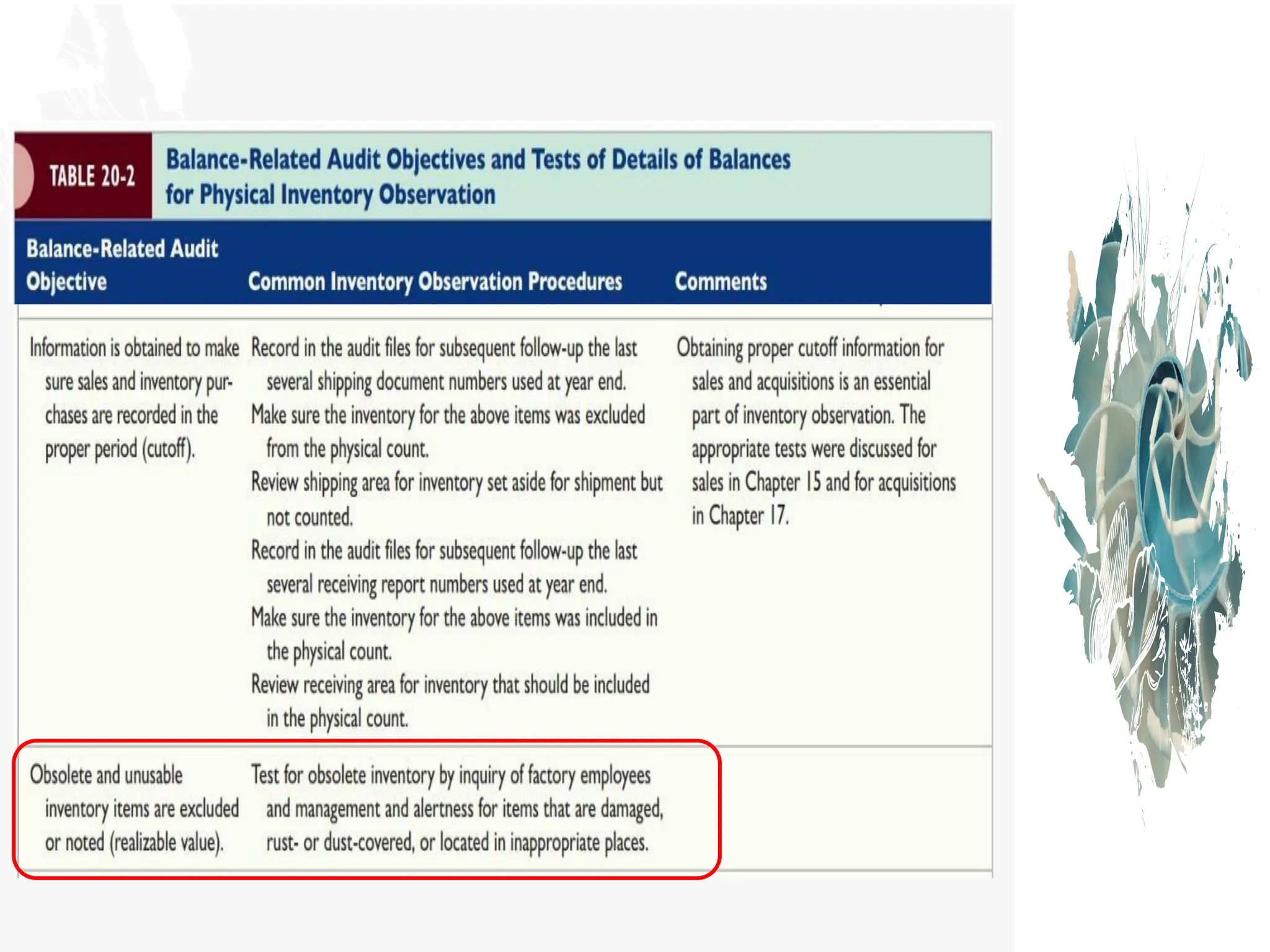
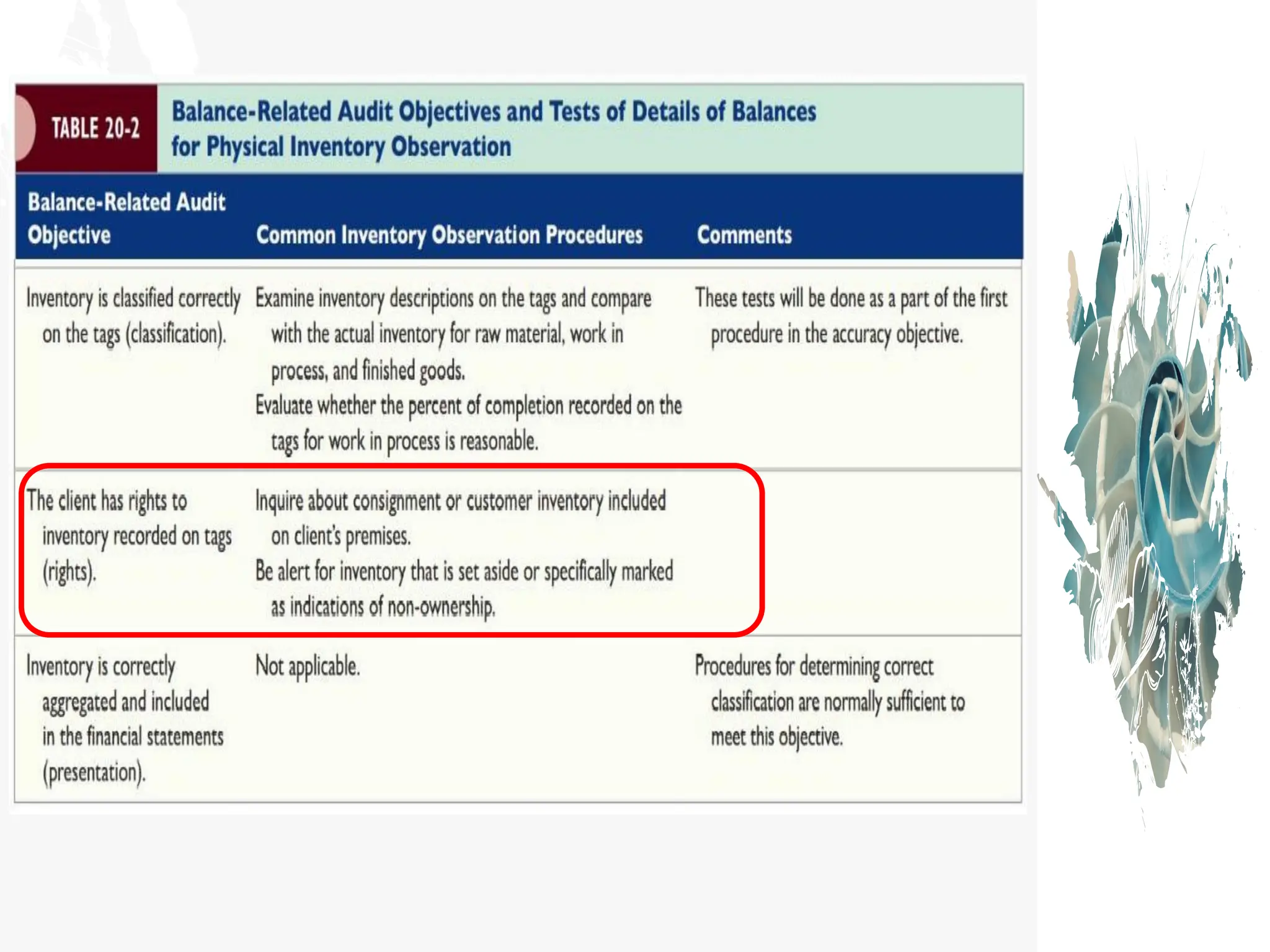
Physical Observation of Inventory
(3 of 3)
Audit of Pricing and Compilation
(1 of 2)
• Auditors must verify that the physical counts
or perpetual record quantities are correctly
priced and compiled
• Inventory price tests include all the tests of the
client’s unit prices to determine whether they
are correct
• Inventory compilation tests include testing the
client’s summarization of the inventory
counts, recalculating price times quantity,
footing the inventory summary, and tracing the
totals to the general ledger
Audit of Pricing and Compilation
(2 of 2)
Adequate internal controls surrounding the
tracking of unit costs that are integrated with
production and other accounting records provide
assurance that clients use reasonable costs for
valuing ending inventory
• In performing inventory valuation tests, the
auditor has three concerns:
– The method must be in accordance with
accounting standards
– The application of the method must be
consistent from year to year
– Inventory cost versus market value must
be considered
• Aerial drones or unmanned aerial vehicle (“UAV”) raises
opportunities for productivity savings
• Drones can photograph, sense and survey large amounts
of inventory at once, from multiple angles and over the
entire storage area
• Powerful image processing software analyzes photographs
and videos and converts the data into fast and accurate
inventory counts
• Drone inventory data can be combined with sensor
information, manual counts and other approaches to
enhance sensitivity, count quality and speed.
DRONES - PHYSICAL
VERIFICATION
Drones are used in many sectors:
• Mining, quarries and mineral extraction
• Energy production, power transmission
• Agriculture – farming yields, soil quality and crop
management
• Civil infrastructure – roads, building management
• Land survey and real estate
• Construction, development, major building and
engineering projects
• Communication networks – cellular towers
• Operations, repairs and maintenance planning
DRONES – PHYSICAL Verification
(cont’d)
Legal considerations for using drones include:
• Weight, speed, maximum altitude
PWC released a report in 2018 where they showed
how drones would impact the UK economy by 2030.
• Collection of data
• Apart from inventory, used in verification of assets
• Used in assessing impairment of assets
• Used in remote areas eg oil rigs or real estate
DRONES – PHYSICAL Verification
(cont’d)
May 1995
• Sold goods at below cost and allocated losses to the
company’s hundreds of stores in the form of increases in
inventory costs.
• Issued fake invoices for merchandise purchases, made
fictitious journal entries to increase inventory and decrease
cost of sales, recognized inventory purchases but failed to
accrue a liability and over-counted and double-counted
merchandise.
• Concealed the inventory shortages because the auditors
observed inventory in only four stores out of 300, and they
informed Phar-Mor, months in advance, which stores they
would visit.
• The company would fully stock the four selected stores but
allocated the fictitious inventory increases to the other 296
stores.
• The auditors, Coopers & Lybrand, never uncovered the
fraud and had to pay over $300 mil in civil judgments. The
CFO was sentenced to 33 months in prison and CEO went to
jail for 5 years.
The Great Salad Oil Swindle
• American Express sent inspectors to verify the
existence of vegetable oil that acted as collateral, but
they didn’t know many of the tanks were filled mostly
with water with a minimum of oil floating on the
top to fool the inspectors. Because oil rises to the
top of water, if a dipstick was lowered into the tank it
would appear to be full of oil.
• Some of the tanks were connected with pipes to other
tanks so the oil could be transferred between tanks
when the inspectors went from one tank to the other.
• A whistleblower eventually tipped off the inspectors
but by the time the swindle collapsed, De Angelis had
obtained loans of $180 mil ($1.5 bil today) from 51
banks.
The Great Salad Oil Swindle
• Assess Business and Inherent Risks – the
company speculated heavily in the futures market
on soybean and cottonseed oil.
• Understand inventory type and characteristics – oil
floats on water
• Develop inventory count procedures according to the
inventory type – tanks were interconnected and oil
could be moved about
• Undertake substantive analytical procedures
total volume of oil was more than the capacity
of all the tanks
• Undertake substantive tests of transactions –
fictitious purchases were created to substantiate
the inventory.
XEROX ACCOUNTING FRAUD
▪ Xerox is a US based company incorporated in New York
which manufactures, sells and leases document imaging
products, services and supplies in the United States and 130
other countries.
▪ Xerox sells copiers and other office equipment outright to its
customers for cash, but more frequently enters into long-
term lease agreements in which customers pay a single
monthly fee in return for the equipment, service, supplies
and financing.
▪ Xerox refers to these arrangements as bundled leases and the
monthly payment as "Total Cost of Ownership" . Although the
popularity of bundled leases versus outright cash sales varies
somewhat from country to country, Xerox has successfully
promoted the leasing concept since the early 1980s so that,
beginning in the early 1990s, bundled lease transactions
constituted the majority of its revenue.
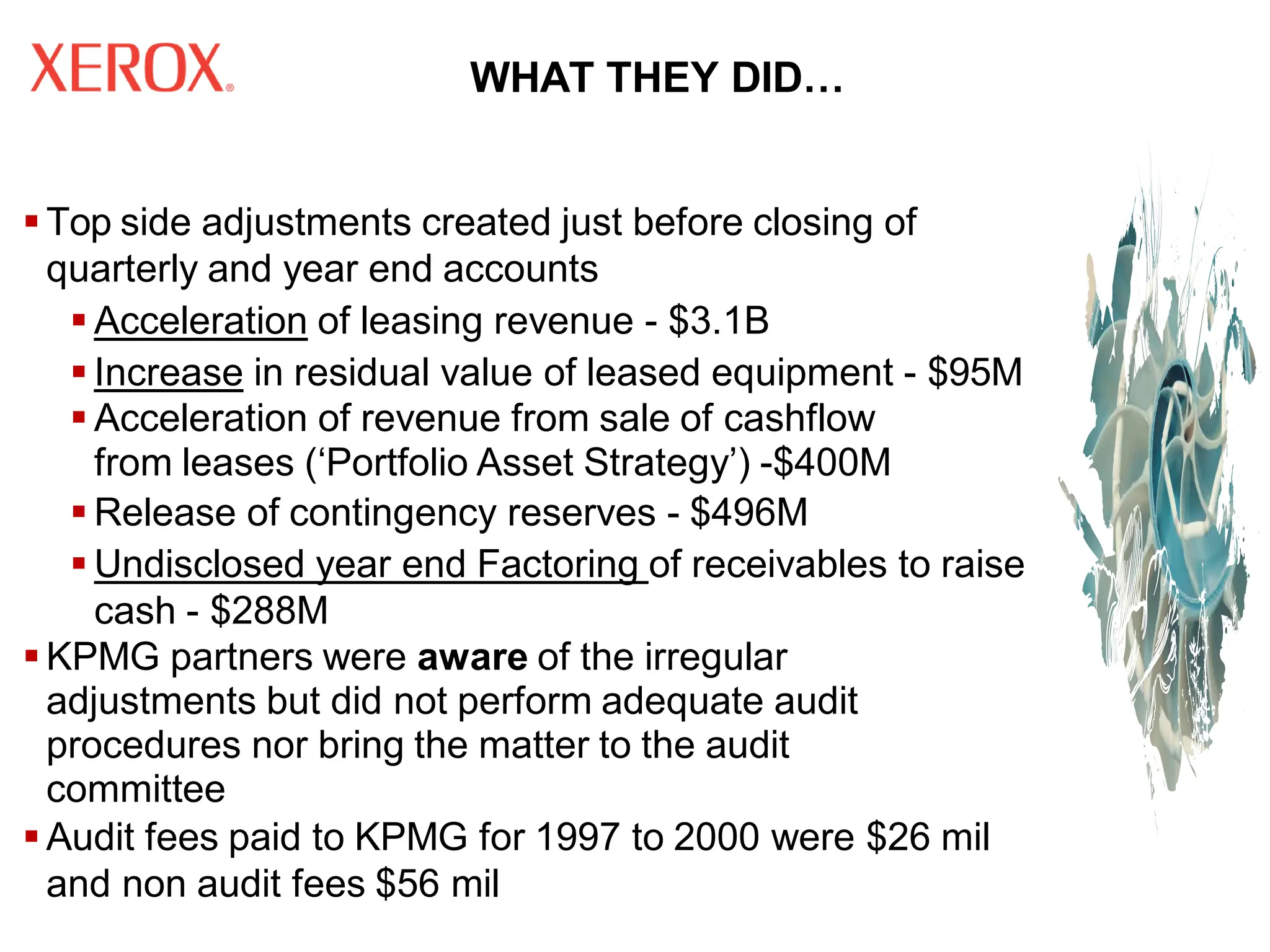
WHAT THEY DID…
▪ Top side adjustments created just before closing of
quarterly and year end accounts
▪ Acceleration of leasing revenue - $3.1B
▪ Increase in residual value of leased equipment - $95M
▪ Acceleration of revenue from sale of cashflow
from leases (‘Portfolio Asset Strategy’) -$400M
▪ Release of contingency reserves - $496M
▪ Undisclosed year end Factoring of receivables to raise
cash - $288M
▪ KPMG partners were aware of the irregular
adjustments but did not perform adequate audit
procedures nor bring the matter to the audit
committee
▪ Audit fees paid to KPMG for 1997 to 2000 were $26 mil
and non audit fees $56 mil
WHY?
▪ This was necessary because corporations are under
enormous pressure from Wall Street investors to keep up
short-term earnings.
▪ Otherwise, their share values will drop, which not only
threatens companies heavily reliant on share values to
finance debt, but also has financial consequences for top
executives, whose huge incomes are bound up with
stock options.
▪ The SEC investigation noted that “compensation of Xerox
senior management depended significantly on their ability
to meet [earnings] targets.”
▪ Because of the accounting manipulations, top Xerox
executives were able to cash in on stock options valued
at an estimated $35 million.

Week 6_Sales Cyle and Collection Cycle.pdf

  • 1.
    Week 6: Audit ofSales Cycle, Audit Sampling and Inventory.
  • 2.
    Lecture 6_Summary :Sales and Inventory Cycle • Audit of Sales Cycle - Sales and cash receipts - Sales returns and allowances - Key controls • Sampling Decisions - Representative sampling - Statistical Sampling - Non- statistical Sampling • Inventory & Warehousing - Audit test - Physical - Pricing and Compilation • Accounts Receivable - Audit tests - Aged and uncollectible debts - Cash receipts
  • 3.
  • 4.
    Accounts in theSales and Collection Cycle
  • 5.
    Accounts and Classesof Transactions in the Sales and Collection Cycle • There are five classes of transactions in the sales and collection cycle: – Sales (cash and sales on account) – Cash receipts – Sales returns and allowances – Write-off of uncollectible accounts – Estimate of bad debt expense
  • 6.
    Business Functions inthe Cycle and Related Documents and Records • There are eight business functions within the sales and collection cycle: – Processing customer orders – Granting credit – Shipping goods – Billing customers and recording sales – Processing and recording cash receipts – Processing and recording sales returns and allowances – Writing off uncollectible accounts receivable – Providing for bad debts
  • 7.
    Classes of Transactions,Accounts, Business Functions, and Related Documents and Records for the Sales and Collection Cycle Classes of Transactions Accounts Business Functions Documents and Records Sales Sales Accounts receivable Processing customer orders Granting credit Shippinggoods Billing customers and recordingSales Customer order Sales order Customer order or sales order Shippingdocument Sales invoice Sales transaction file Sales journal or listing Accounts receivable master file Accounts receivable trial balance Monthly statement Cash receipts Cash in bank (debits from cash receipts) Accounts receivable Processing and recording cash receipts Remittance advice Prelisting of cash receipts Cash receipts transaction file Cash receipts journal or listing
  • 8.
    Classes of Transactions Accounts BusinessFunctions Documents and Records Sales returns and allowances Sales returns and allowances Accounts receivable Processing and recording sales returns and allowances Credit memo Sales returns and allowances journal Write-off of uncollectible accounts Accounts receivable Allowance for uncollectible accounts Writing off uncollectible accounts receivable Uncollectibleaccount authorization form General journal Bad debt expense Bad debt expense Allowance for uncollectible accounts Providingfor bad debts General journal
  • 9.
    Types of AuditTests for the Sales and Collection Cycle
  • 10.
    Methodology for DesigningTests of Controls and Substantive Tests of Transactions for Sales
  • 11.
    A category ofreporting companies with revenues of RM100m or more and have shorter periodic reporting deadlines
  • 12.
    Methodology for DesigningTests of Controls and Substantive Tests of Transactions for Sales (1 of 2) • The auditor uses the information obtained in understanding the client’s internal control to assess control risk • Key control activities for sales include: – Adequate separation of duties – Proper authorization – Prenumbered documents – Monthly statements – Internal verification procedures
  • 13.
    Methodology for DesigningTests of Controls and Substantive Tests of Transactions for Sales (2 of 2) • Auditors assess control risk and determine the extent of tests of controls after key controls and deficiencies are identified • For each key control, one or more tests of controls must be designed to verify its effectiveness • Substantive tests of transactions are related to the transaction-related audit objectives • Determining the proper substantive tests of transactions procedures for sales is relatively difficult because they vary considerably depending on the circumstances
  • 14.
    Designing Tests forControls for Sales Key existing controls Test of controls Deficiencies Credit is approved automatically by computer by comparison to authorised credit limit Examine customer order for evidence of credit approval Lack of verification for the possibility of sales being recorded more than once Sales are supported by authorised shipping documents and approved customer order Examine sales invoice for supporting bill of lading and customer order Statements are sent to customers each month Observe whether monthly statements are sent
  • 15.
    Assessing Key Controlsfor Sales • Adequate Separation of Duties—Proper separation of duties helps to prevent misstatements due to both errors and fraud. • Proper Authorization—The auditor is concerned about authorization at three points: 1. Credit must be properly authorized before a sale takes place. 2. Goods should be shipped only after proper authorization. 3. Prices, including basic terms, freight, and discounts, must be authorized. • Adequate Documents and Records—May be paper or electronic.
  • 16.
    Assessing Key Controlsfor Sales • Prenumbered Documents—This helps prevent both the failure to bill and duplicate billings and recordings. • Monthly Statements—This is a useful control because it encourages customers to respond if their balance is incorrect. • Internal Verification Process—Can be manual or computerized. Determine Extent of Tests of Controls—After key controls and deficiencies are identified, auditors assess control risk and determine the extent of tests of controls.
  • 17.
    Vouching & Tracing •Vouching : Financial statements to source documents (occurrence objective) • Tracing : From source documents to financial statements (completion objective)
  • 18.
    Designing Substantive Testsof Transactions for Sales • Recorded Sales Occurred—There are three types of possible misstatements: 1. Sales included in the journals for which no shipment was made 2. Sales recorded more than once 3. Shipments made to nonexistent customers and recorded as sales • Direction of Tests—The direction of the test fulfills different objectives: • Tracing—From source documents to the journals tests for omitted transactions (completeness objective) • Vouching—From the journals back to the source documents tests for nonexistent transactions (occurrence objective)
  • 19.
    Substantive Tests of Transactionsfor Sales Transactionrelated audit objectives Substantive test of transactions Occurrence Recorded sales are for shipments actually made to non fictitious customers Vouch sales journal entries to supporting documents, including sales invoice, bill of lading, sales order, and customer order Completeness Existing sales transactions are recorded Trace selected shipping documents to the sales journal to be sure that each one is included Timing Sales are recorded on the correct dates Compare date of recording of sale in sales journal with sales invoice and bill of lading
  • 20.
    Effect of Resultsof Tests of Controls and Substantive Tests of Transactions (1 of 2) • The results of the tests of controls and substantive tests of transactions have a significant effect on the remainder of the audit, especially on substantive tests of details of balances • If the test results are unsatisfactory, it is necessary to: – Do additional substantive testing of sales, sales returns and allowances, write- off of uncollectible accounts, and processing cash receipts
  • 21.
    Effect of Resultsof Test of Controls and Substantive Tests of Transactions (2 of 2) • The most significant effect of the results of the tests of controls and substantive tests of transactions in the sales and collection cycle is: – Confirmation of accounts receivable ▪ The type of confirmation, the size of the sample, and the timing of the test are all affected
  • 25.
    Analytical Procedures forthe Sales and Collection Cycle (1 of 2) Analytical Procedure Possible Misstatement Compare gross margin percentage with previous years (by product line). Overstatement or understatement of sales and accounts receivable. Compare sales by month (by product line) over time. Overstatement or understatement of sales and accounts receivable. Compare sales returns and allowances as a percentage of gross sales with previous years (by product line). Overstatement or understatement of sales returns and allowances and accounts receivable. Compare individual customer balances over a stated amount with previous years. Misstatements in accounts receivable and related income statement accounts. Compare bad debt expense as a percentage of gross sales with previous years. Uncollectible accounts receivable that have not been provided for.
  • 26.
    Analytical Procedures forthe Sales and Collection Cycle (2 of 2) Analytical Procedure Possible Misstatement Compare number of days that accounts receivable are outstanding with previous years and related turnover of accounts receivable. Overstatement or understatement of allowance for uncollectible accounts and bad debt expense; also may indicate fictitious accounts receivable. Compare aging categories as a percentage of accounts receivable with previous years. Overstatement or understatement of allowance for uncollectible accounts and bad debt expense. Compare allowance for uncollectible accounts as a percentage of accounts receivable with previous years. Overstatement or understatement of allowance for uncollectible accounts and bad debt expense. Compare write-off of uncollectible accounts as a percentage of total accounts receivable with previous years. Overstatement or understatement of allowance for uncollectible accounts and bad debt expense.
  • 27.
    Sales Returns andAllowances • Transaction-related audit objectives are essentially the same for credit memos as those for processing sales, with two notable differences : – Materiality ▪ Sales returns and allowances are often so immaterial that auditors can ignore them – Emphasis on the occurrence objective ▪ Auditors usually emphasize testing recorded transactions to uncover any theft of cash in the collection of accounts receivable that was covered up by fictitious sales returns or allowances
  • 28.
  • 29.
  • 30.
  • 31.
  • 32.
  • 33.
  • 34.
    Sampling Decisions Sample sizeis based on the following factors: ▪ Performance materiality ▪ Inherent risk ▪ Control risk ▪ Achieved detection risk from other substantive tests ▪ Type of confirmation Selection of the Items for Testing: Some type of stratification is desirable with most confirmations.
  • 35.
    Relationships of Riskto Evidence Situation Acceptable Audit Risk Inherent Risk Control Risk Planned Detection Risk Amount of Evidence Required 1 High Low Low High Low 2 Low Low Low Medium Medium 3 Low High High Low High 4 Medium Medium Medium Medium Medium 5 High Low Medium Medium Medium Acceptable Audit Risk = Planned DetectionRisk Inherent Risk X ControlRisk • Control Risk: Low (Strong Int. Control) • Planned Detection Risk : High (Easy to detect errors) • Evidence/Sample: Small
  • 36.
    Representative Sampling (1of 2) • When selecting a sample from a population, the auditor strives to obtain a representative sample • A representative sample is: – One in which the characteristics in the sample are approximately the same as those of the population • In practice, auditors never know whether a sample is representative, even after all testing is complete • Auditors can increase the likelihood of a sample being representative by using care in: – Designing the sampling process – Selecting the sample – Evaluating the sample results
  • 37.
    Representative Sampling (2of 2) • There are two types of risks that can lead to sampling error or non sampling error: – Sampling risk ▪ Risk that an auditor reaches an incorrect conclusion because the sample is not representative of the population – Nonsampling risk ▪ Risk that the auditor reaches an incorrect conclusion for any reason not related to sampling risk
  • 38.
    Statistical Versus NonstatisticalSampling and Probabilistic Versus Nonprobabilistic Sample Selection • Audit sampling methods can be divided into two broad categories: – Statistical sampling – Nonstatistical sampling • Both involve three phases: – Plan the sample – Select the sample and perform the tests – Evaluate the results
  • 39.
    Application of StatisticalAttributes Sampling (1 of 2) • The steps for attributes sampling are the same as those for nonstatistical sampling with a few exceptions: – Specify acceptable risk of overreliance ▪ The concepts are the same, but the method of quantifying is usually different. Rather than using high, medium, and low, the auditor will use a specific amount – Determine the initial sample size ▪ The factors that affect the initial sample size are the same, but in attributes sampling, the auditor uses tables developed from statistical formulas or audit software to determine the initial sample size
  • 40.
    Application of StatisticalAttributes Sampling (2 of 2) – Select the sample ▪ The only difference in sample selection is that probabilistic methods must be used for statistical sampling – Generalize from the sample to the population ▪ For attributes sampling, the auditor calculates the computed upper exception rate using statistical formulas
  • 41.
    Summary of NonStatistical Audit Sampling Steps 1Many auditors using nonstatistical methods calculate tolerable exception rate minus sample exception rate and evaluate whether the difference is sufficiently large. • Involves 14 well-defined steps
  • 42.
    Nonstatistical Sampling andProbabilistic Versus Nonprobabilistic Sample Selection (1 of 2) • There are two methods auditors can use when selecting a sample: – Probabilistic sample selection – Nonprobabilistic sample selection
  • 43.
    Nonstatistical Sampling andProbabilistic Versus Nonprobabilistic Sample Selection (2 of 2) • Auditing standards permit auditors to use either statistical or nonstatistical sampling methods • When statistical sampling is used, the sample must be a probabilistic one • Auditors may make nonstatistical evaluations when using probabilistic selection, – But it is never acceptable to evaluate a nonprobabilistic (non random) sample using statistical methods
  • 44.
    Sample Selection Methods(1 of 2) • Probabilistic sample selection methods include the following (1 of 2): – Simple random sample selection ▪ Every possible combination of population items has an equal chance of being included in the sample – Systematic sample selection ▪ The auditor calculates an interval and then selects the items for the sample based on the size of the interval
  • 45.
    Probabilistic Sample SelectionMethods • Probabilistic sample selection methods include the following : – Probability proportional to size sample selection ▪ In many auditing situations, it is advantageous to select samples that emphasize population items with larger recorded amounts • Nonprobabilistic sample selection methods include: – Haphazard sample selection ▪ The selection of items without any conscious bias by the auditor – Block sample selection ▪ Auditors select the first item in a block, and the remainder of the block is chosen in sequence
  • 46.
    Probabilistic Versus Non-Probabilistic Sample Selection
  • 47.
    Sampling for ExceptionRates (1 of 2) • Auditors use sampling for tests of controls and substantive tests of transactions to determine: – Whether controls are operating effectively and whether the rate of monetary errors is below tolerable limits – To do this, auditors estimate the percent (the occurrence rate or exception rate) of items in a population containing a characteristic or attribute of interest
  • 48.
    Sampling for ExceptionRates (2 of 2) • Auditors are interested in the following types of exceptions in populations of accounting data: – Deviations from the client’s established controls – Monetary misstatements in populations of transaction data – Monetary misstatements in populations of account balance details
  • 49.
    Non- Statistical SampleRejected When non- statistical sampling for tests of details of balances is rejected, additional tests:
  • 50.
  • 51.
    Methodology for Designing Testsof Details of Balances • Tests of accounts receivable are based on the auditor’s risk assessment procedures • Auditor performs preliminary analytical procedures that may indicate increased risk of misstatements in accounts receivable • As part of the assessment of the risk of material misstatement, the auditor determines whether any of the risks identified are a significant risk
  • 52.
    Methodology for DesigningTests of Details of Balances • Internal controls over sales and cash receipts and the related accounts receivable are at least reasonably effective for most companies • Auditors are especially concerned with three aspects of internal controls: – Controls that prevent or detect embezzlements – Controls over cutoff – Controls related to the allowance for uncollectible accounts
  • 54.
    Design and PerformSubstantive Analytical Procedures (1 of 3) • Most substantive analytical procedures performed during the detailed testing phase are done before tests of details of balances since the results of the substantive analytical procedure affect the extent of detail testing • Auditors perform both planning and substantive analytical procedures for the entire sales and collection cycle, not just accounts receivable
  • 55.
    Design and PerformSubstantive Analytical Procedures (2 of 3) • In addition to the analytical procedures, auditors should review accounts receivable for: – Large and unusual amounts, such as large balances – Accounts that have been outstanding for a long time – Receivables from affiliated companies, officers, directors, and other related parties – Credit balances
  • 56.
    Design and PerformSubstantive Analytical Procedures (3 of 3) • If the results are favorable –They reduce the extent to which the auditor needs to perform detailed tests of balances • If the results uncover unusual fluctuations –The auditor should make additional inquiries of management
  • 57.
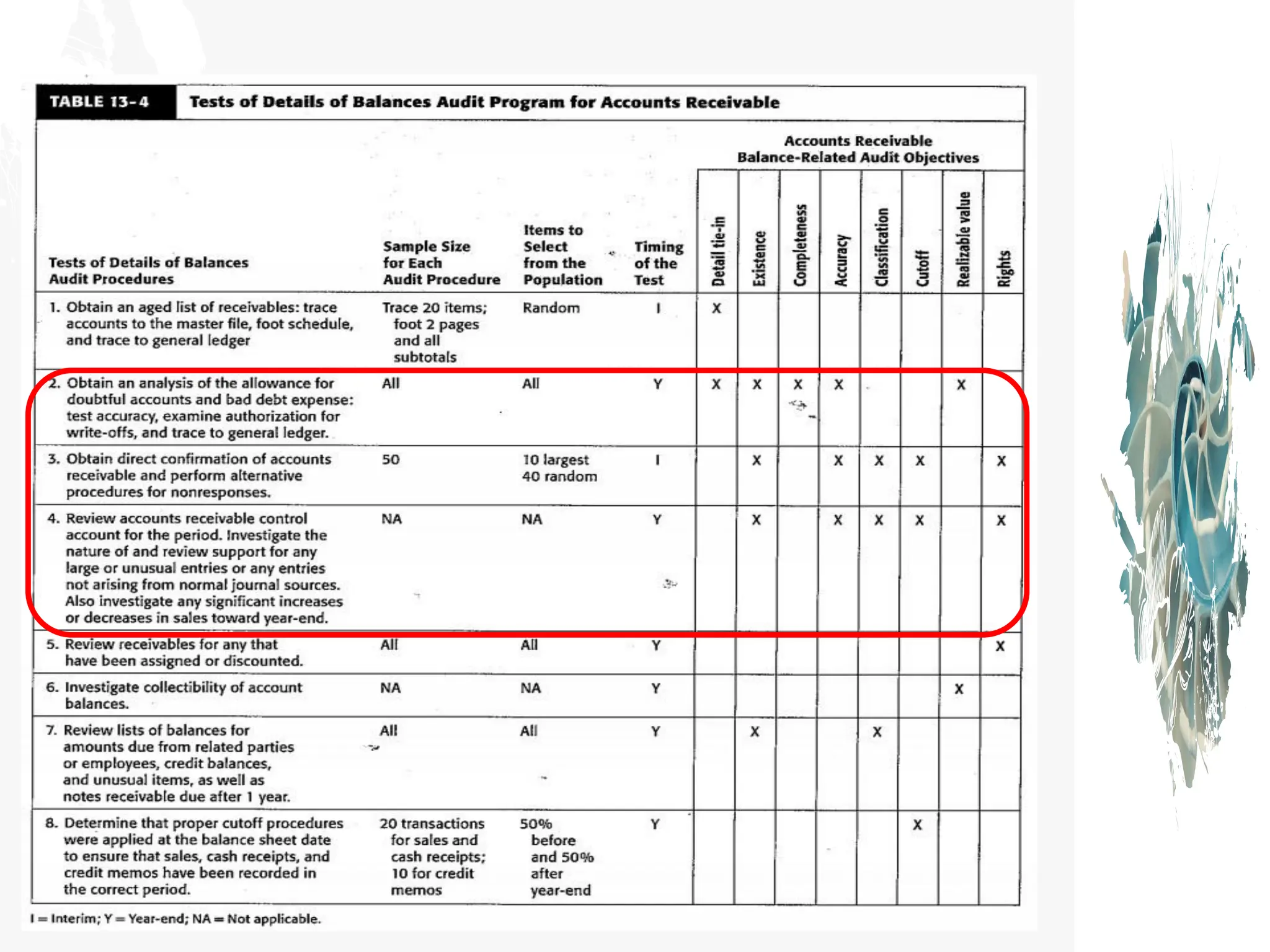
    Designing Tests ofDetails of Balances The appropriate evidence to be obtained from tests of details of balances must satisfy the eight balance-related objectives: 1. Detail tie-in 2. Existence 3. Completeness 4. Accuracy 5. Classification 6. Cutoff 7. Realizable value 8. Rights Objective Transaction related Audit Objective Balance related Audit Objective Occurrence X Existence X Completeness X X Accuracy X X Posting & Summarization X Classification X X Timing X Cut-off X Detail tie-in X Realizable value X Rights and obligations X Presentation X X
  • 58.
    Designing Tests ofDetails of Balances Most tests of accounts receivable and the allowance for uncollectible accounts are based on the ageing schedule. The Accounts Receivables aging: ▪ Lists the balances in the accounts receivable master file at the balance sheet date for each individual customer ▪ Categorizes the balances due based on the time passed between the sale and the balance sheet date.
  • 59.
    Designing Tests ofDetails of Balances 1. The Summation of Accounts Receivable Agrees with the Master File and the General Ledger: 2. Recorded Accounts Receivable Exist: Confirmation of customer’s balances is the most important test of details of balances for determining existence. 3. Existing Accounts Receivable Are Included:It is difficult to test for account balances omitted from the aged trial balance except by relying on the self- balancing nature of the accounts receivable master file. 4. Accounts Receivable Are Accurate: Confirmation is the most common test for the accuracy of accounts receivable.
  • 60.
    Designing Tests ofDetails of Balances (cont’d) 5. Accounts Receivable Are Properly Classified: ▪ Normally classification of accounts receivable is relatively easy, by reviewing the aged trial balance for material receivables from affiliates, officers, directors, or other related parties. ▪ Auditors should also verify whether any of the accounts or notes receivable are noncurrent and should be classified as such.
  • 61.
    Designing Tests ofDetails of Balances (cont’d) 6. Cutoff for Accounts Receivable is Correct: Cutoff misstatements exist when current period transactions are recorded in the subsequent period or vice versa. Cutoff misstatements can occur for sales, sales returns, and allowances and cash receipts. For each, auditors require a threefold approach to determine the reasonableness of cutoff: a) Decide on the appropriate criteria for cutoff. b) Evaluate whether the client has established adequate procedures to ensure a reasonable cutoff. c) Test whether the cutoff was correct.
  • 62.
    Designing Tests ofDetails of Balances (cont’d) 7. Accounts Receivable Is Stated at Realizable Value: ▪ Accounting standards require that companies state accounts receivable at the amount that will ultimately be collected, the realizable value. ▪ The realizable value is equal to the gross accounts receivable less the allowance for uncollectible accounts. ▪ The allowance for uncollectible accounts is an estimate and it is necessary for auditors to determine if the client’s allowance is reasonable.
  • 63.
    Designing Tests ofDetails of Balances (cont’d) 8.The Client Has Rights to Accounts Receivable: Normally, this is not a problem. ▪ The auditor must determine if any of the receivables are pledged, assigned, factored, or sold. Accounts Receivable Presentation and Disclosure: Tests of the presentation and disclosure-related audit objectives are generally done as part of the completion phase of the audit. ▪ Some tests may be done with tests of balance-related audit objectives. ▪ For example, the auditor must evaluate whether the client has separated material amounts requiring separate disclosure, such as related party receivables.
  • 64.
    Audit Tests forUncollectible Accounts (1 of 2) • The auditor’s primary concern here is the possibility of client personnel covering up an embezzlement by writing off accounts receivable that have already been collected • The major control for preventing this fraud is proper authorization of the write-off of uncollectible accounts
  • 65.
    Audit Tests forUncollectible Accounts (2 of 2) • Realizable value of accounts receivable is often a significant concern for the auditor • There are two other controls to address this: – The preparation of a periodic aged accounts receivable trial balance for review and follow-up by appropriate management personnel – A policy of writing off uncollectible accounts when they are no longer likely to be collected – Perform a hindsight evaluation
  • 66.
  • 68.
    Relationship Between Transaction-Related AuditObjectives for the Sales and Collection Cycle and Balance-Related Audit Objectives for Accounts Receivable
  • 71.
    Designing Tests ofDetails of Balances (1 of 3) • Even though auditors emphasize balance sheet accounts in tests of details of balances – They are not ignoring income statement accounts because the income statement accounts are tested as a by-product of the balance sheet tests • The audit procedures selected and their sample size will depend heavily on whether planned evidence for a given objective is low, medium, or high
  • 72.
    Designing Tests ofDetails of Balances (2 of 3) • Most tests of accounts receivable and the allowance for uncollectible accounts are based on the aged trial balance • An aged trial balance lists: – The balances in the accounts receivable master file at the balance sheet date – The breakdown of each balance by the time passed between the date of sale and the balance sheet date
  • 73.
    Designing Tests ofDetails of Balances (3 of 3) • The auditor’s tests of details of balances for accounts receivable include : – Recorded accounts receivable exist – Existing accounts receivable are included – Accounts receivable are accurate – Cutoff for accounts receivable is correct – Accounts receivable is stated at realizable value – Accounts receivable are properly classified – The client has rights to accounts receivable – Accounts receivable presentation and disclosure
  • 74.
    Confirmation of Accounts Receivable(1 of 4) • Confirmation of accounts receivable is the most important test of details of accounts receivable • The primary purpose of accounts receivable confirmation is to satisfy the existence, accuracy, and cutoff objectives • The confirmation can be a direct written response from a third party in paper or electronic form
  • 75.
    Confirmation of Accounts Receivable(2 of 4) • Auditors should use external confirmations for accounts receivable unless: – The overall accounts receivable balance is immaterial – The auditor considers confirmations ineffective evidence because response rates will likely be inadequate or unreliable – The auditor’s assessed level of the risk of material misstatement is low and other substantive evidence can be accumulated to provide sufficient evidence
  • 76.
    Confirmation of Accounts Receivable(3 of 4) • Types of confirmation include positive and negative confirmation • The most reliable evidence from confirmations is obtained when they are sent close to the balance sheet date • Sample size for confirming accounts receivable is based on performance materiality, inherent risk, control risk, detection risk, and types of confirmation
  • 77.
    Confirmation of Accounts Receivable(4 of 4) • Nonresponses to positive confirmations do not provide audit evidence, though nonresponses to negative confirmations provide some evidence of the existence assertion • It is necessary to follow up on nonresponses with alternative procedures – The objective is to determine by a means other than confirmation whether the nonconfirmed account existed and was properly stated at the confirmation date
  • 78.
    Audit Sampling forTests of Details of Balances
  • 79.
    Comparisons of auditsampling for tests of details of Balances and for tests of controls and Substantive Tests of Transactions (1 of 3) • Auditor wants to make inferences about the entire population based on a sample • Both sampling and nonsampling risks are therefore important for tests of controls, substantive tests of transactions, and tests of details of balances • To address sampling risk, auditors can use either nonstatistical or statistical methods for all three types of tests
  • 80.
    Comparisons of AuditSampling for Tests of Details of Balances and for Tests of Controls and Substantive Tests of Transactions (2 of 3) • The main differences among tests of controls, substantive tests of transactions, and tests of details of balances are in what the auditor wants to measure Type of Test What It Measures Tests of controls • The operating effectiveness of internal controls Substantive tests of transactions • The operating effectiveness of internal controls • The monetary correctness of transactions in the accounting system Tests of details of balances • Whether the dollar amounts of account balances are materially misstated
  • 81.
    Comparisons of AuditSampling for Tests of Details of Balances and for Tests of Controls and Substantive Tests of Transactions (3 of 3) • Auditors perform tests of controls and substantive tests of transactions to: – Determine whether the exception rate in the population is sufficiently low – Reduce assessed control risk and thereby reduce tests of details of balances – Conclude that the control is operating effectively for purposes of auditing internal control over financial reporting for larger public companies
  • 82.
    Audit of CashReceipts
  • 83.
    Methodology for DesigningTests of Controls and Substantive Tests of Transactions for Cash Receipts (1 of 2) • Auditors use the same methodology for designing tests of controls and substantive tests of transactions for cash receipts as they use for sales: – Determine key internal controls for each audit objective – Design tests of control for each control used to support a reduced control risk – Design substantive tests of transactions to test for monetary misstatements for each objective
  • 84.
    Methodology for DesigningTests of Controls and Substantive Tests of Transactions for Cash Receipts (2 of 2) • An essential part of the auditor’s responsibility in auditing cash receipts is to identify deficiencies in internal control that increase the likelihood of fraud • Audit procedures that are designed primarily for the discovery of fraud include: – Determine whether cash received was recorded – Prepare proof of cash receipts – Test to discover lapping of accounts receivable
  • 85.
    Designing Test ofControls for Receipts Key existing controls Test of controls Deficiencies Accountant independently reconciles bank account. Observe whether accountantreconciles bank account Batch totals of cash receipts are independently compared with computer summary reports Examine file of batch totals for initials of data control clerk Checks are restrictively endorsed Observe endorsement of incoming checks
  • 86.
    Substantive Test ofTransactions for Receipts Transactionrelated audit objectives Substantive test of transactions Occurrence Recorded cash receipts are for funds actually received by the company Trace cash receipts entries from the cash receipts journal entries to the bank statement Completeness Cash received is recorded in the cash receipts journal Obtain prelisting of cash receipts and trace amounts to the cash receipts journal Timing Cash receipts are recorded on the correct dates Compare date of deposit per bank statement to the dates in the cash receipts journal and prelisting of cash receipts
  • 87.
  • 88.
  • 89.
    Audit of pricingand compilation ▪ Valuation of Inventory: The auditor has three primary concerns: ▪ The method must be in accordance with accounting standards. ▪ The application of the method must be consistent from year to year. ▪ Inventory cost versus market value (replacement cost or net realizable value) must be considered. ▪ Pricing Purchased Inventory: This includes raw materials, purchased parts, and supplies. ▪ Pricing Manufactured Inventory: In pricing work-in- process and finished goods, the auditor must consider the cost of raw materials, direct labor, and manufacturing overhead. ▪ Cost or Market: Auditors consider whether market value is lower than historical cost
  • 91.
    Business Functions inthe Cycle and Related Documents and Records (1 of 3) • The inventory and warehousing cycle can be thought of as comprising two separate but closely related systems: – The physical flow of goods – The related costs
  • 92.
    Business Functions inthe Cycle and Related Documents and Records (2 of 3) • There are six functions that make up the inventory and warehousing cycle: – Process purchase orders – Receive raw materials – Store raw materials – Process the goods – Store finished goods – Ship finished goods
  • 93.
    Business Functions inthe Cycle and Related Documents and Records (3 of 3) • A perpetual inventory master file is a type of record used for inventory which typically includes information about the units of inventory acquired, sold, and on hand • Separate computerized perpetual records are likely to be kept for raw materials, work-in- process, and finished goods
  • 94.
    Parts of theAudit of Inventory • The audit of the inventory and warehousing cycle can be divided into five activities within the cycle: – Acquire and record raw materials, labor, and overhead – Internally transfer assets and costs – Ship goods and record revenue and costs – Physically observe inventory – Price and compile inventory
  • 95.
    Functions in theInventory and Warehousing Cycle *Inventory counts are taken and compared with perpetual and book amounts at any stage of the cycle. The auditor compares the documentation related to the receipt, movement, and sale of inventory with the physical location of the items to ensure proper cut off and classification of inventory as raw material, work in process, or finished goods. A count must ordinarily be taken once a year. If the perpetual inventory system is operating well, this can be done on a cycle basis throughout the year. †Includes cost information for materials, direct labor, and overhead.
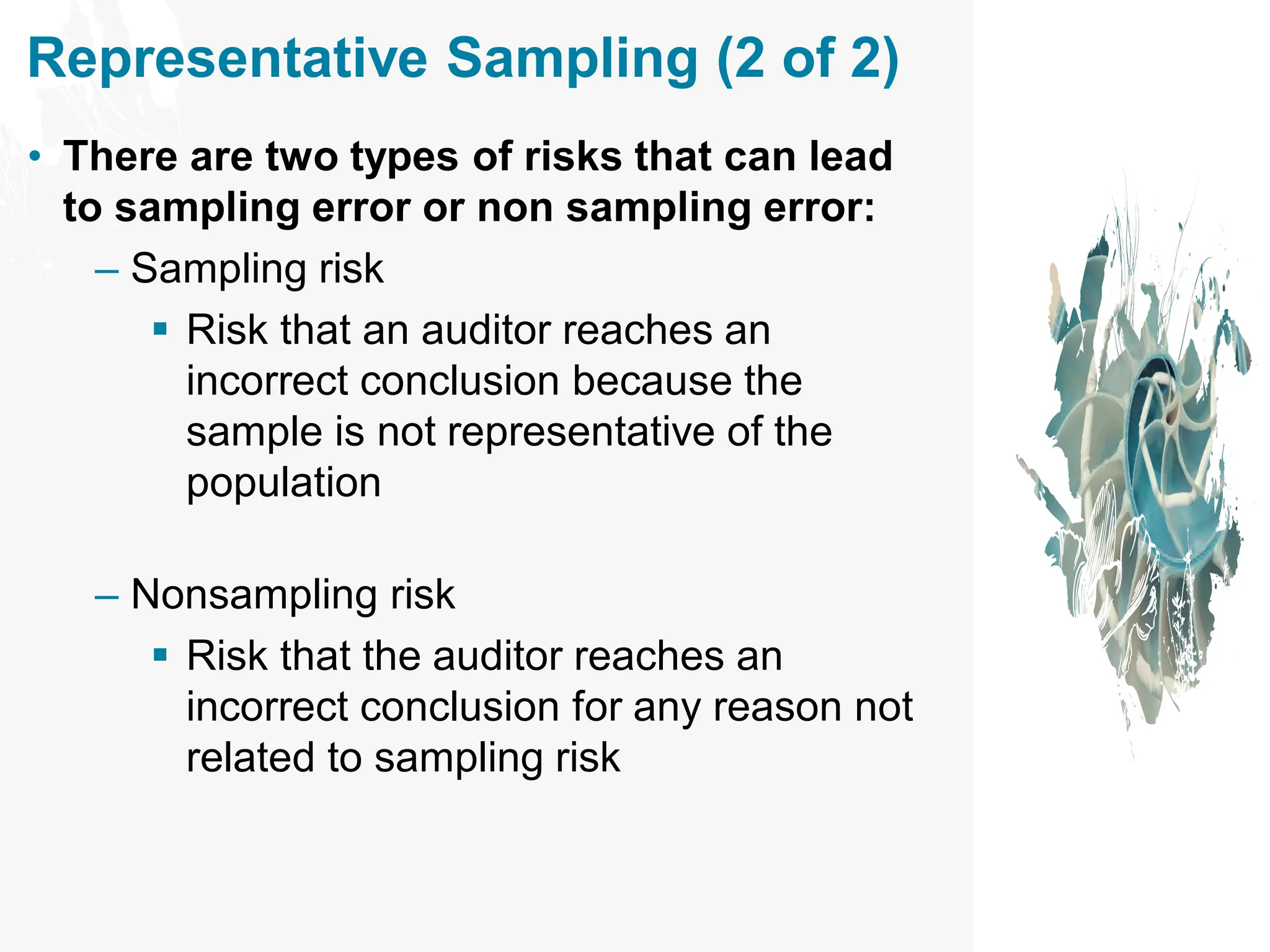
  • 96.
  • 97.
    Substantive Analytical Procedures •Substantive analytical procedures are important for auditors to examine the relationship of inventory account balances with other financial statement accounts • Auditors often use nonfinancial information to assess the reasonableness of inventory-related balances • Inventory is often the largest asset on the balance sheet for many companies • Significant improvements in audit effectiveness and efficiency may be achieved by use of audit data analytics • Auditors may be able to use audit software to test entire populations for certain audit tests,eliminating the need for more costly tests involving sampling
  • 98.
    Substantive Analytical Proceduresfor the Inventory and Warehousing Cycle Substantive Analytical Procedure Possible Misstatement Compare gross margin percentage with that of previous years. Overstatement or understatement of inventory and cost of goods sold. Compare inventory turnover (cost of goods sold divided by average inventory) with that of previous years. Obsolete inventory, which affects inventory and cost of goods sold. Overstatement or understatement of inventory. Compare unit costs of inventory with those of previous years. Overstatement or understatement of unit costs, which affects inventory and cost of goods sold. Compare extended inventory value with that of previous years. Misstatements in compilation, unit costs, or extensions, which affect inventory and cost of goods sold. Compare current-year manufacturing costs with those of previous years (variable costs should be adjusted for changes in volume). Misstatements of unit costs of inventory, especially direct labor and manufacturing overhead, which affect inventory and cost of goods sold.
  • 99.
    Physical Observation ofInventory (1 of 3) • Obtaining an understanding of the client’s industry and business is more important for both physical inventory observation and inventory pricing and compilation than for most audit areas • Auditors often first familiarize themselves with the client’s inventory by conducting a tour of the client’s inventory facilities, including receiving, storage, production, planning, and record- keeping areas
  • 100.
    • Auditing standardsrequire auditors to meet following inventory observation requirements: – Be present at the time the client counts its inventory – Observe the client’s counting procedures – Make inquiries of client personnel about their counting procedures – Make their own independent tests of the physical count Physical Observation of Inventory (2 of 3)
  • 101.
    • Adequate controlsover the client’s physical count of inventory include: – Proper client instructions for the physical count – Supervision by responsible company personnel – Independent internal verification – Independent reconciliations of the physical counts with perpetual inventory master files Physical Observation of Inventory (3 of 3)
  • 105.
    Audit of Pricingand Compilation (1 of 2) • Auditors must verify that the physical counts or perpetual record quantities are correctly priced and compiled • Inventory price tests include all the tests of the client’s unit prices to determine whether they are correct • Inventory compilation tests include testing the client’s summarization of the inventory counts, recalculating price times quantity, footing the inventory summary, and tracing the totals to the general ledger
  • 106.
    Audit of Pricingand Compilation (2 of 2) Adequate internal controls surrounding the tracking of unit costs that are integrated with production and other accounting records provide assurance that clients use reasonable costs for valuing ending inventory • In performing inventory valuation tests, the auditor has three concerns: – The method must be in accordance with accounting standards – The application of the method must be consistent from year to year – Inventory cost versus market value must be considered
  • 107.
    • Aerial dronesor unmanned aerial vehicle (“UAV”) raises opportunities for productivity savings • Drones can photograph, sense and survey large amounts of inventory at once, from multiple angles and over the entire storage area • Powerful image processing software analyzes photographs and videos and converts the data into fast and accurate inventory counts • Drone inventory data can be combined with sensor information, manual counts and other approaches to enhance sensitivity, count quality and speed. DRONES - PHYSICAL VERIFICATION
  • 108.
    Drones are usedin many sectors: • Mining, quarries and mineral extraction • Energy production, power transmission • Agriculture – farming yields, soil quality and crop management • Civil infrastructure – roads, building management • Land survey and real estate • Construction, development, major building and engineering projects • Communication networks – cellular towers • Operations, repairs and maintenance planning DRONES – PHYSICAL Verification (cont’d)
  • 109.
    Legal considerations forusing drones include: • Weight, speed, maximum altitude PWC released a report in 2018 where they showed how drones would impact the UK economy by 2030. • Collection of data • Apart from inventory, used in verification of assets • Used in assessing impairment of assets • Used in remote areas eg oil rigs or real estate DRONES – PHYSICAL Verification (cont’d)
  • 110.
    May 1995 • Soldgoods at below cost and allocated losses to the company’s hundreds of stores in the form of increases in inventory costs. • Issued fake invoices for merchandise purchases, made fictitious journal entries to increase inventory and decrease cost of sales, recognized inventory purchases but failed to accrue a liability and over-counted and double-counted merchandise. • Concealed the inventory shortages because the auditors observed inventory in only four stores out of 300, and they informed Phar-Mor, months in advance, which stores they would visit. • The company would fully stock the four selected stores but allocated the fictitious inventory increases to the other 296 stores. • The auditors, Coopers & Lybrand, never uncovered the fraud and had to pay over $300 mil in civil judgments. The CFO was sentenced to 33 months in prison and CEO went to jail for 5 years.
  • 111.
    The Great SaladOil Swindle • American Express sent inspectors to verify the existence of vegetable oil that acted as collateral, but they didn’t know many of the tanks were filled mostly with water with a minimum of oil floating on the top to fool the inspectors. Because oil rises to the top of water, if a dipstick was lowered into the tank it would appear to be full of oil. • Some of the tanks were connected with pipes to other tanks so the oil could be transferred between tanks when the inspectors went from one tank to the other. • A whistleblower eventually tipped off the inspectors but by the time the swindle collapsed, De Angelis had obtained loans of $180 mil ($1.5 bil today) from 51 banks.
  • 112.
    The Great SaladOil Swindle • Assess Business and Inherent Risks – the company speculated heavily in the futures market on soybean and cottonseed oil. • Understand inventory type and characteristics – oil floats on water • Develop inventory count procedures according to the inventory type – tanks were interconnected and oil could be moved about • Undertake substantive analytical procedures total volume of oil was more than the capacity of all the tanks • Undertake substantive tests of transactions – fictitious purchases were created to substantiate the inventory.
  • 113.
    XEROX ACCOUNTING FRAUD ▪Xerox is a US based company incorporated in New York which manufactures, sells and leases document imaging products, services and supplies in the United States and 130 other countries. ▪ Xerox sells copiers and other office equipment outright to its customers for cash, but more frequently enters into long- term lease agreements in which customers pay a single monthly fee in return for the equipment, service, supplies and financing. ▪ Xerox refers to these arrangements as bundled leases and the monthly payment as "Total Cost of Ownership" . Although the popularity of bundled leases versus outright cash sales varies somewhat from country to country, Xerox has successfully promoted the leasing concept since the early 1980s so that, beginning in the early 1990s, bundled lease transactions constituted the majority of its revenue.
  • 114.
    WHAT THEY DID… ▪Top side adjustments created just before closing of quarterly and year end accounts ▪ Acceleration of leasing revenue - $3.1B ▪ Increase in residual value of leased equipment - $95M ▪ Acceleration of revenue from sale of cashflow from leases (‘Portfolio Asset Strategy’) -$400M ▪ Release of contingency reserves - $496M ▪ Undisclosed year end Factoring of receivables to raise cash - $288M ▪ KPMG partners were aware of the irregular adjustments but did not perform adequate audit procedures nor bring the matter to the audit committee ▪ Audit fees paid to KPMG for 1997 to 2000 were $26 mil and non audit fees $56 mil
  • 115.
    WHY? ▪ This wasnecessary because corporations are under enormous pressure from Wall Street investors to keep up short-term earnings. ▪ Otherwise, their share values will drop, which not only threatens companies heavily reliant on share values to finance debt, but also has financial consequences for top executives, whose huge incomes are bound up with stock options. ▪ The SEC investigation noted that “compensation of Xerox senior management depended significantly on their ability to meet [earnings] targets.” ▪ Because of the accounting manipulations, top Xerox executives were able to cash in on stock options valued at an estimated $35 million.