The document outlines how to write a research paper, highlighting its definition and essential components such as title, abstract, introduction, materials and methods, results, discussion, acknowledgements, and references. It emphasizes the importance of clear and concise writing, accurate data presentation, and adherence to specific journal guidelines for publication. Additionally, it covers the submission and revision process, including the need for feedback from advisors and colleagues.
Overview of research papers and their components, emphasizing communication within the scientific community.
Definition of a research paper as a report detailing scientific findings for a specific audience.
Key elements of a research paper: Title, authors, keywords, abstract, introduction, methods, results, discussion, conclusion, acknowledgements, and references.
Guidelines for crafting a clear title and listing authors with their affiliations while avoiding relevant titles or degrees.
Instructions for writing an abstract as a concise summary and choosing effective keywords for indexing.
Importance of introducing the research topic, justifying methodology, and stating objectives clearly.
Details about materials and methods to enable reproducibility of experiments, including the specifics of organisms used.
Focus on presenting results clearly and accurately, including processed data and visual aids, avoiding raw data.
Interpretation of results, comparison with existing literature, and implications for future research directions.
Expression of gratitude toward contributors, equipment providers, and funding agencies essential for the research.
Guidance on compiling a reference list citing sources accurately in the preferred format of journals.
Criteria for choosing a suitable journal for research publication, focusing on readership and impact factors.
Steps ensuring the paper's readiness for submission, including feedback from peers and compliance with journal criteria.
Importance of revising manuscripts based on reviewer feedback and final checks before publication.
HOW TO WRITEA RESEARCH PAPER
PRESENTED BY:
Muddasir Basheer
Pre-Ph.D. student,
GGV Bilaspur, (C.G)
2.
* What isresearch paper ?
* What are the components of a good research
paper?
3.
RESEARCH PAPER
Itis a report prepared at the end of a research work
based on the finding through the series of scientific
experiment / field study to communicate the findings
among the specific audience.
It explains the experimental design, results obtained, the
interpretation and significance of the data with its future
implication.
The audience generally belongs to the scientific
community and may be working in the same or related
field.
4.
Components of aresearch
paper:
Title
Name(s) of the author(s) with the address of the institution(s)
to which the author(s) belonged when the work was carried
out
Keywords
Abstract
Introduction
Material and Methods
Results
Discussion
Conclusion
Acknowledgements
References
5.
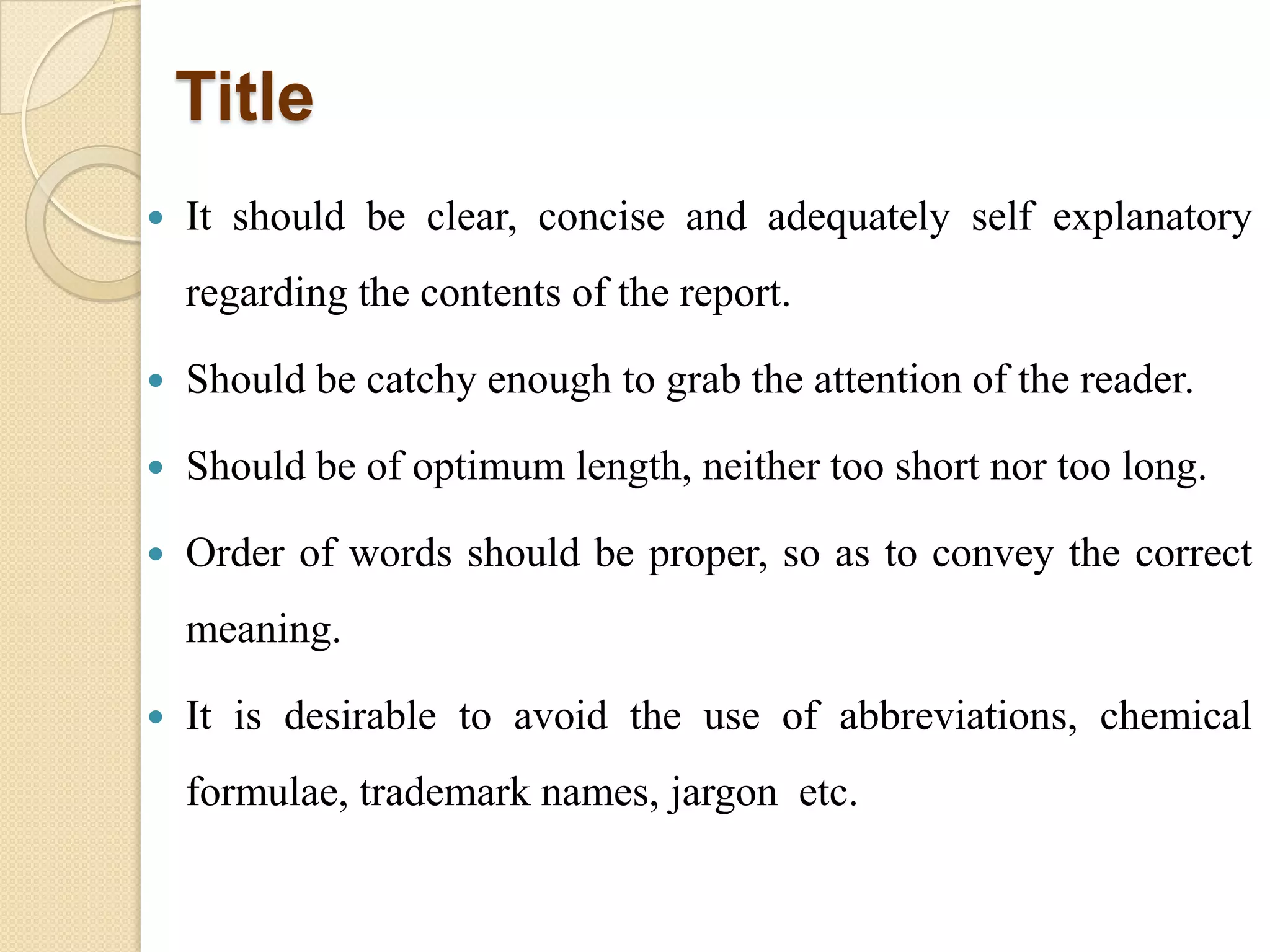
Title
It shouldbe clear, concise and adequately self explanatory
regarding the contents of the report.
Should be catchy enough to grab the attention of the reader.
Should be of optimum length, neither too short nor too long.
Order of words should be proper, so as to convey the correct
meaning.
It is desirable to avoid the use of abbreviations, chemical
formulae, trademark names, jargon etc.
6.
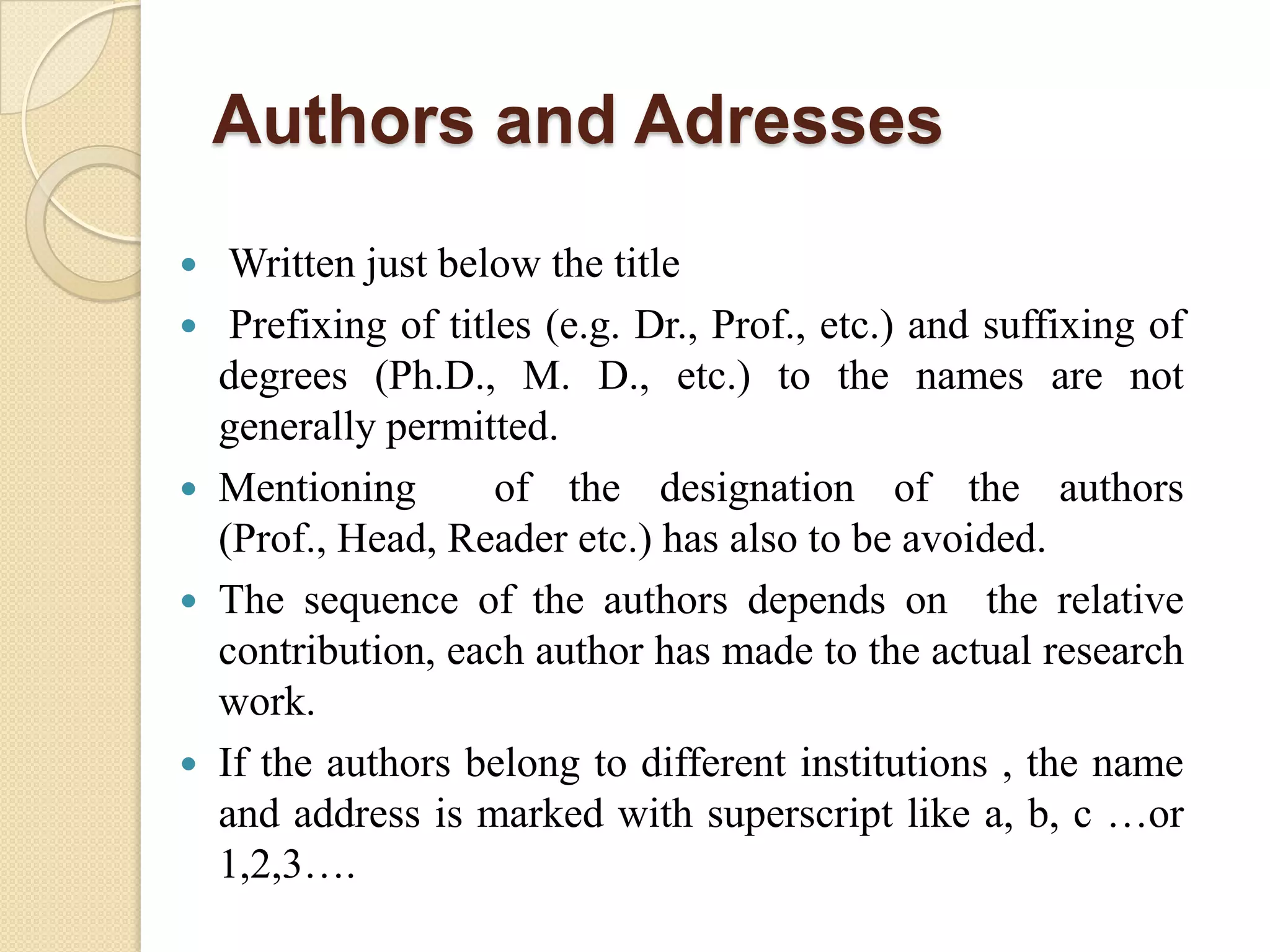
Authors and Adresses
Written just below the title
Prefixing of titles (e.g. Dr., Prof., etc.) and suffixing of
degrees (Ph.D., M. D., etc.) to the names are not
generally permitted.
Mentioning of the designation of the authors
(Prof., Head, Reader etc.) has also to be avoided.
The sequence of the authors depends on the relative
contribution, each author has made to the actual research
work.
If the authors belong to different institutions , the name
and address is marked with superscript like a, b, c …or
1,2,3….
7.
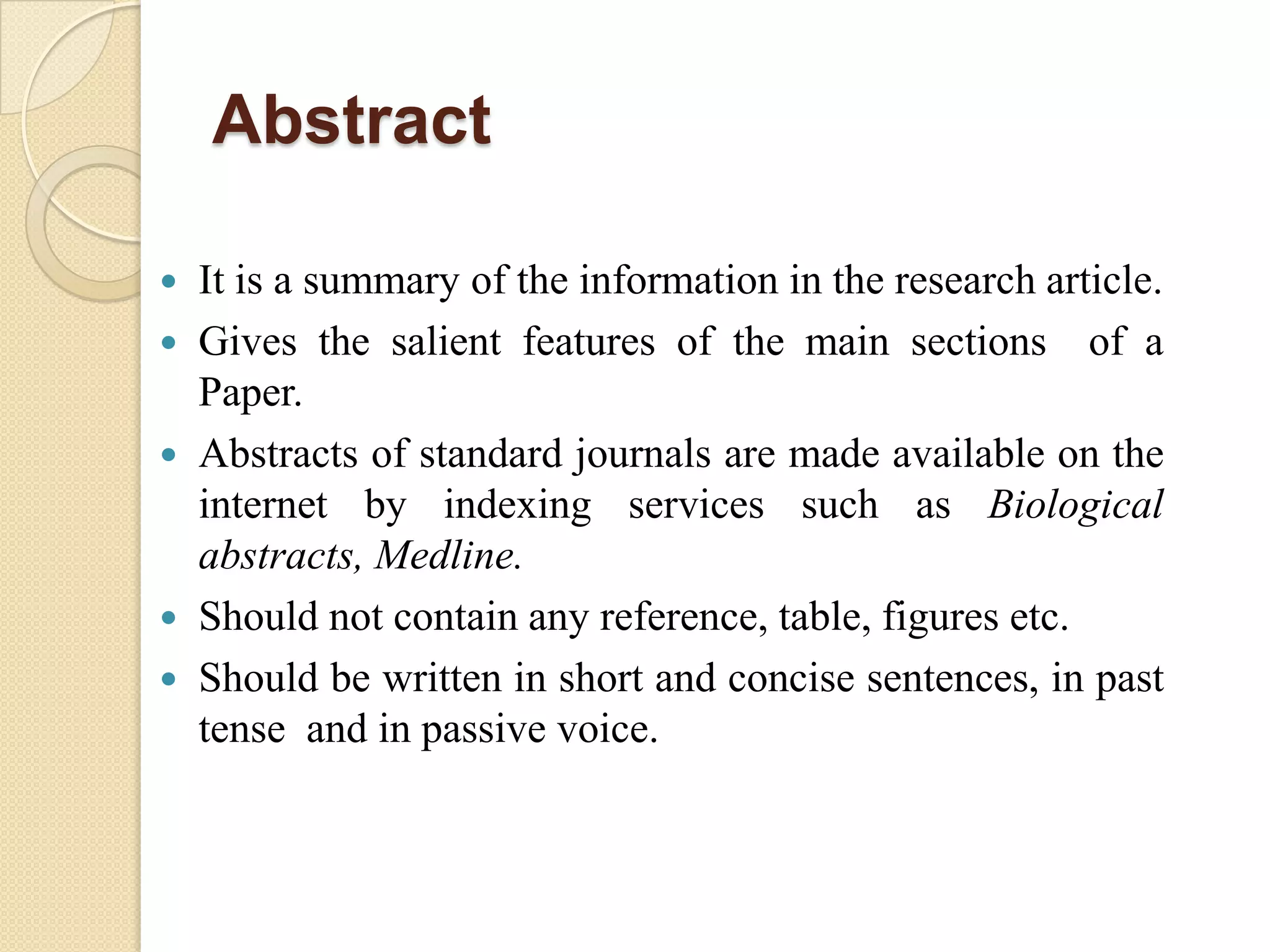
Abstract
It isa summary of the information in the research article.
Gives the salient features of the main sections of a
Paper.
Abstracts of standard journals are made available on the
internet by indexing services such as Biological
abstracts, Medline.
Should not contain any reference, table, figures etc.
Should be written in short and concise sentences, in past
tense and in passive voice.
8.
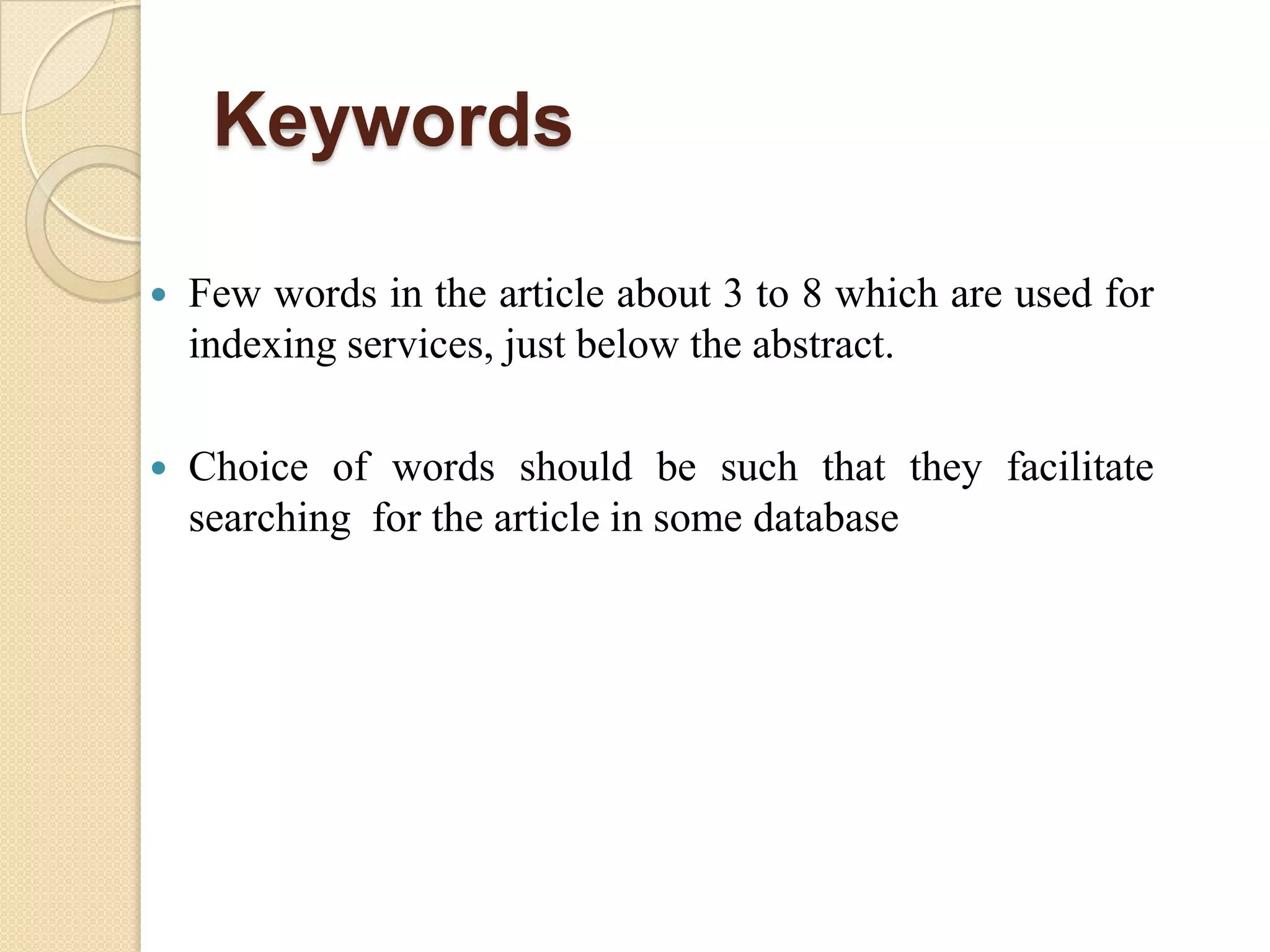
Keywords
Few wordsin the article about 3 to 8 which are used for
indexing services, just below the abstract.
Choice of words should be such that they facilitate
searching for the article in some database
9.
Introduction
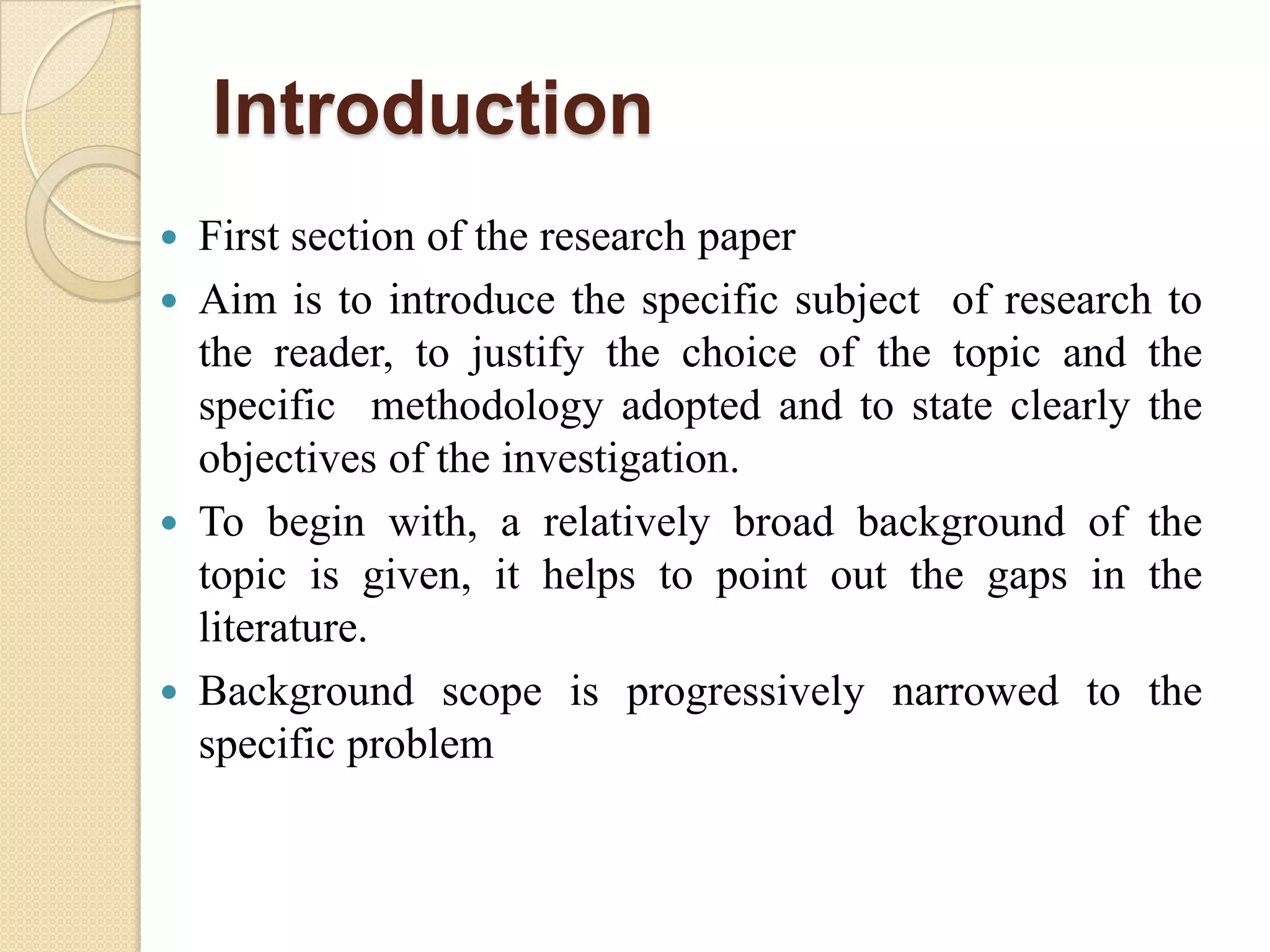
First sectionof the research paper
Aim is to introduce the specific subject of research to
the reader, to justify the choice of the topic and the
specific methodology adopted and to state clearly the
objectives of the investigation.
To begin with, a relatively broad background of the
topic is given, it helps to point out the gaps in the
literature.
Background scope is progressively narrowed to the
specific problem
10.
Continue…
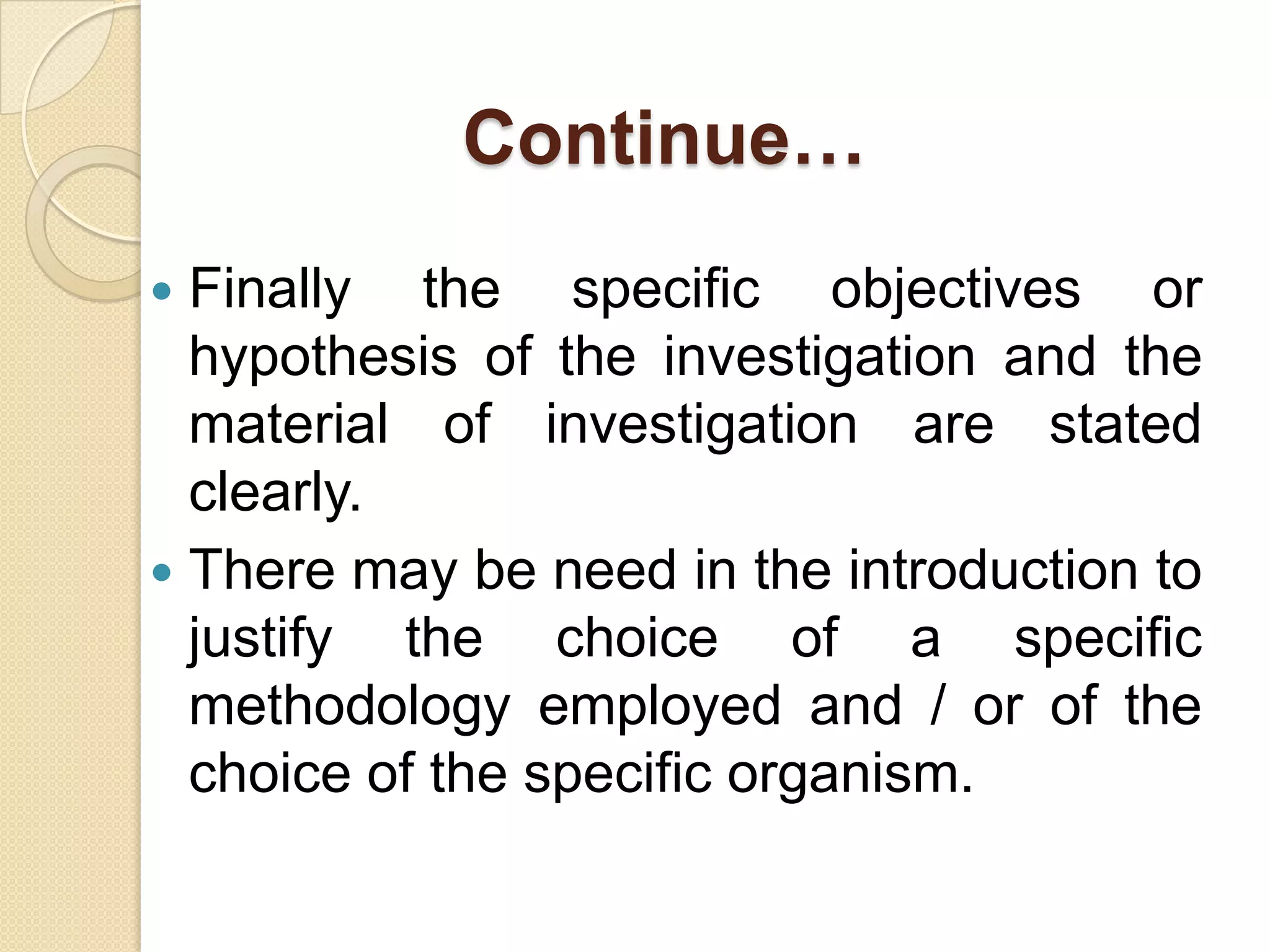
Finally thespecific objectives or
hypothesis of the investigation and the
material of investigation are stated
clearly.
There may be need in the introduction to
justify the choice of a specific
methodology employed and / or of the
choice of the specific organism.
11.
Materials and methods
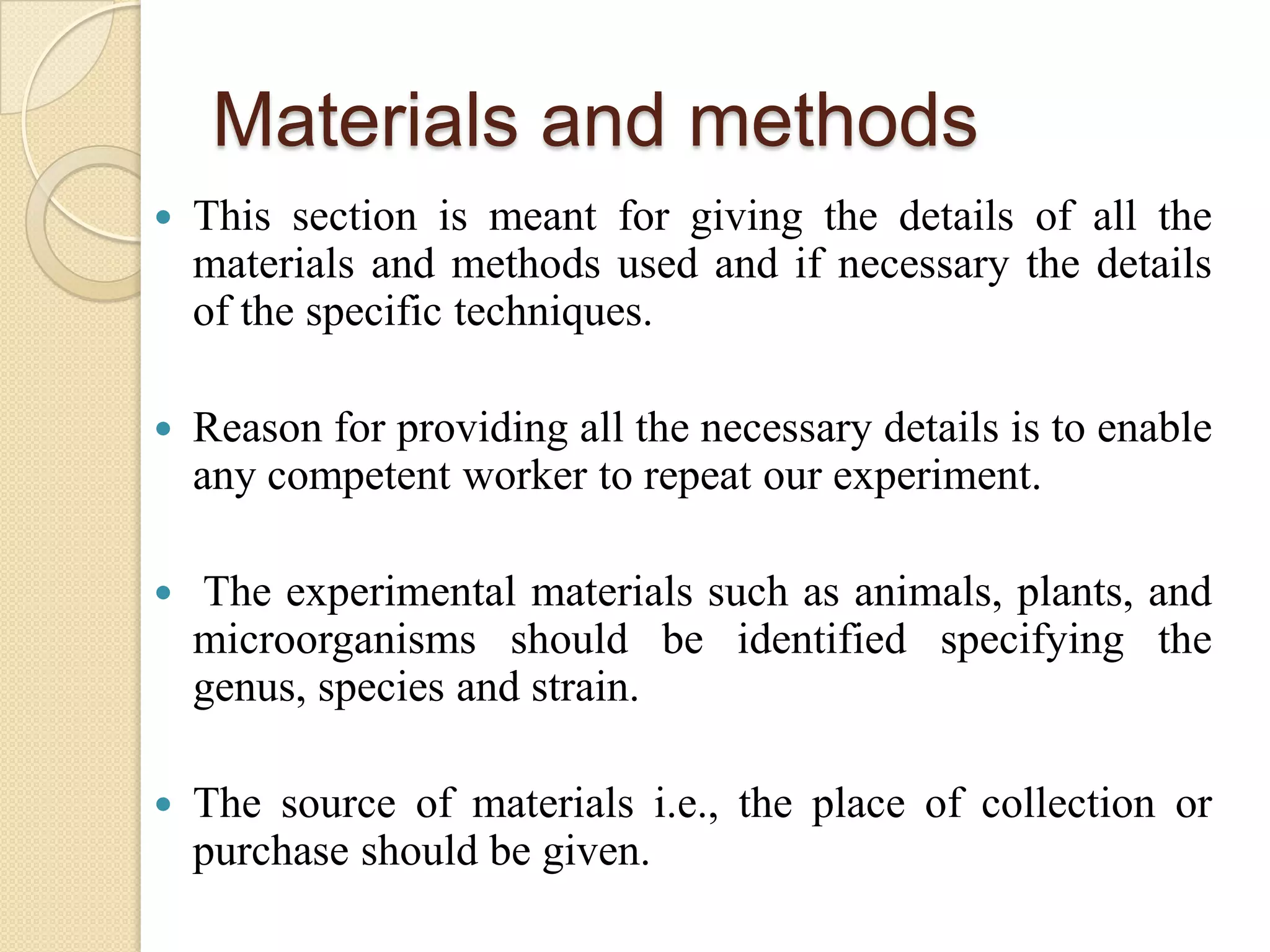
This section is meant for giving the details of all the
materials and methods used and if necessary the details
of the specific techniques.
Reason for providing all the necessary details is to enable
any competent worker to repeat our experiment.
The experimental materials such as animals, plants, and
microorganisms should be identified specifying the
genus, species and strain.
The source of materials i.e., the place of collection or
purchase should be given.
12.
Continue…
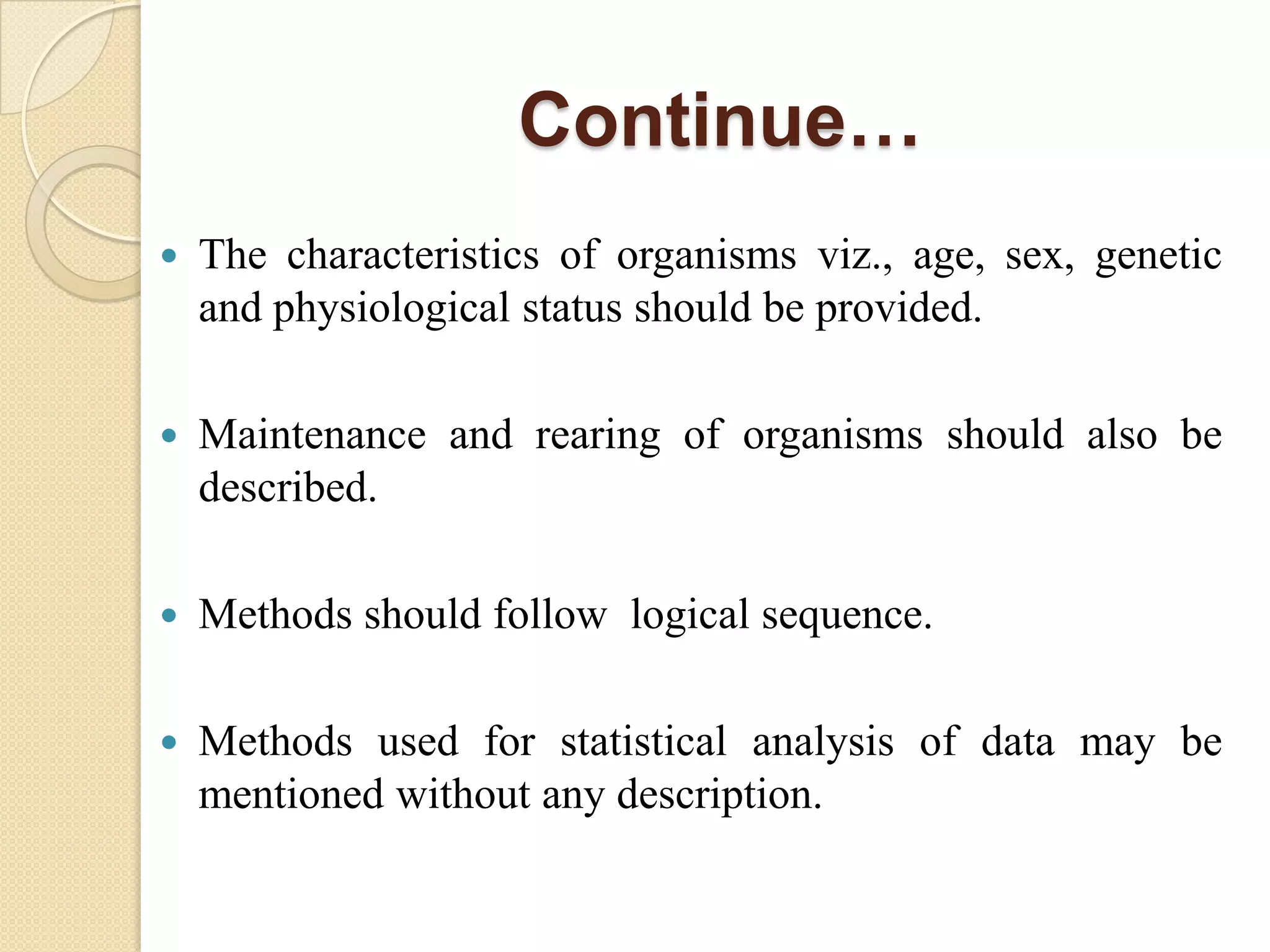
The characteristicsof organisms viz., age, sex, genetic
and physiological status should be provided.
Maintenance and rearing of organisms should also be
described.
Methods should follow logical sequence.
Methods used for statistical analysis of data may be
mentioned without any description.
13.
Results
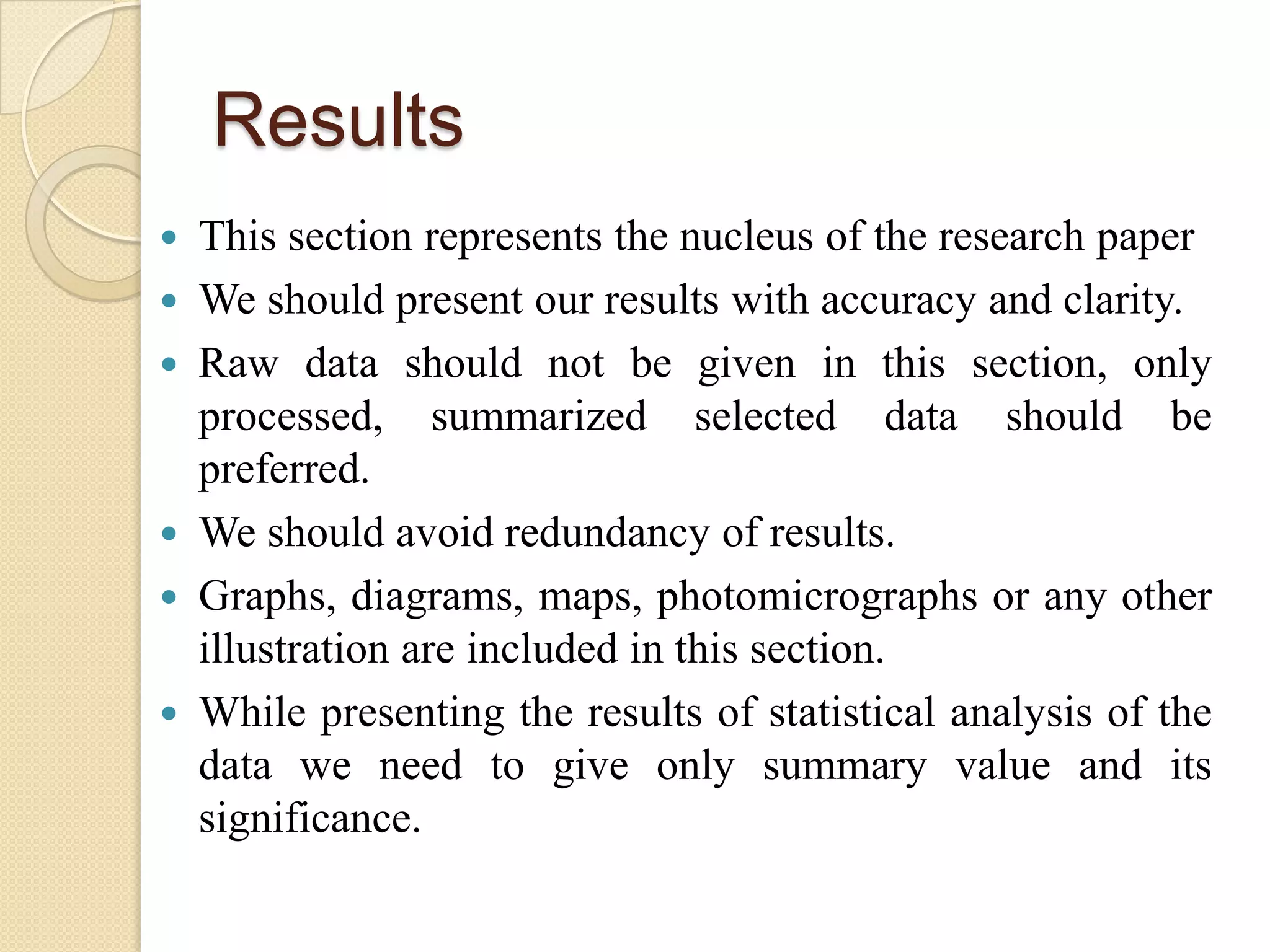
This sectionrepresents the nucleus of the research paper
We should present our results with accuracy and clarity.
Raw data should not be given in this section, only
processed, summarized selected data should be
preferred.
We should avoid redundancy of results.
Graphs, diagrams, maps, photomicrographs or any other
illustration are included in this section.
While presenting the results of statistical analysis of the
data we need to give only summary value and its
significance.
14.
Discussion
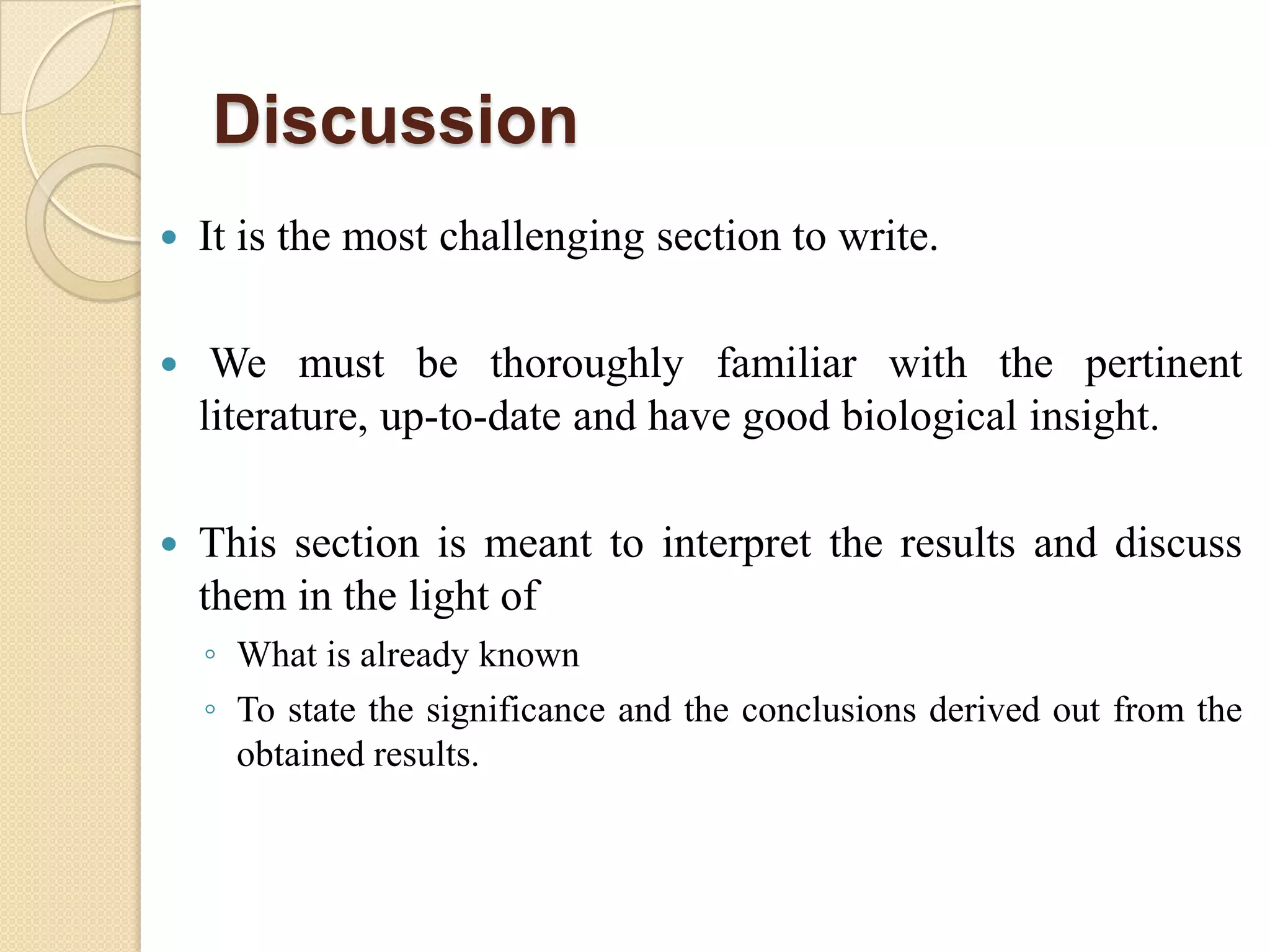
It isthe most challenging section to write.
We must be thoroughly familiar with the pertinent
literature, up-to-date and have good biological insight.
This section is meant to interpret the results and discuss
them in the light of
◦ What is already known
◦ To state the significance and the conclusions derived out from the
obtained results.
15.
Continue…..
Any goodresearch paper should contain a comparison of
the results and interpretations to other studies citing
references from the literature i.e., to show how they
agree or contrast with previously published work.
The conclusions finally should made in such a way
which appears with suggestions for future course of
research in the specific organism or even wide variety of
organisms and mention the possible yield of such works.
16.
ACKNOWLEDGEMENTS
Meant to expressthe researchers gratitude
to:
Those who provided significant
technical help.
Sources, individuals, laboratories,
companies etc. which helped the
researcher with special equipment,
chemicals, specimens etc.
The agencies (e.g., UGC, DBT, ICMR)
that sponsored the research project
programme and provided
fellowship to the authors should be
17.
References
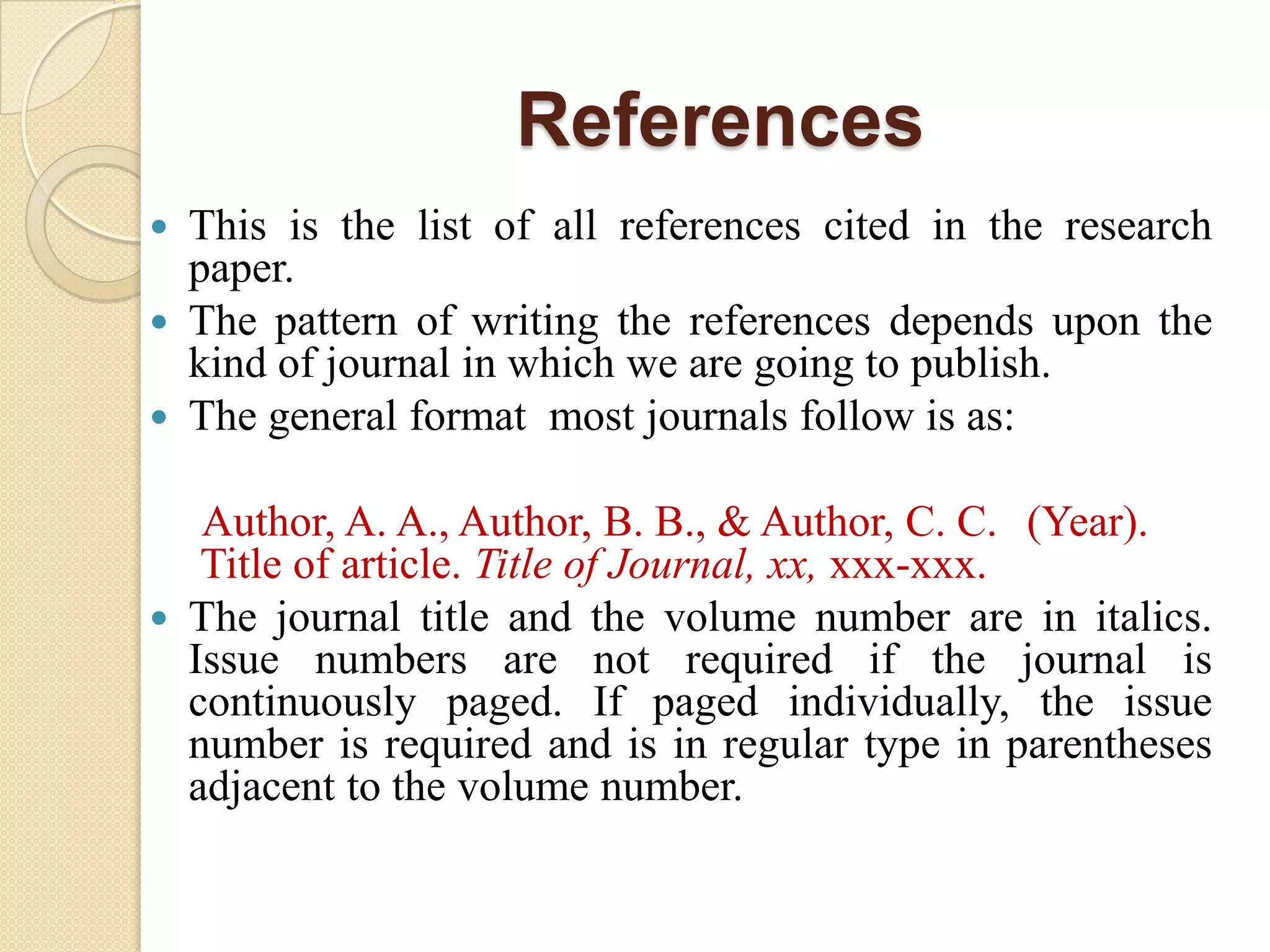
This isthe list of all references cited in the research
paper.
The pattern of writing the references depends upon the
kind of journal in which we are going to publish.
The general format most journals follow is as:
Author, A. A., Author, B. B., & Author, C. C. (Year).
Title of article. Title of Journal, xx, xxx-xxx.
The journal title and the volume number are in italics.
Issue numbers are not required if the journal is
continuously paged. If paged individually, the issue
number is required and is in regular type in parentheses
adjacent to the volume number.
18.
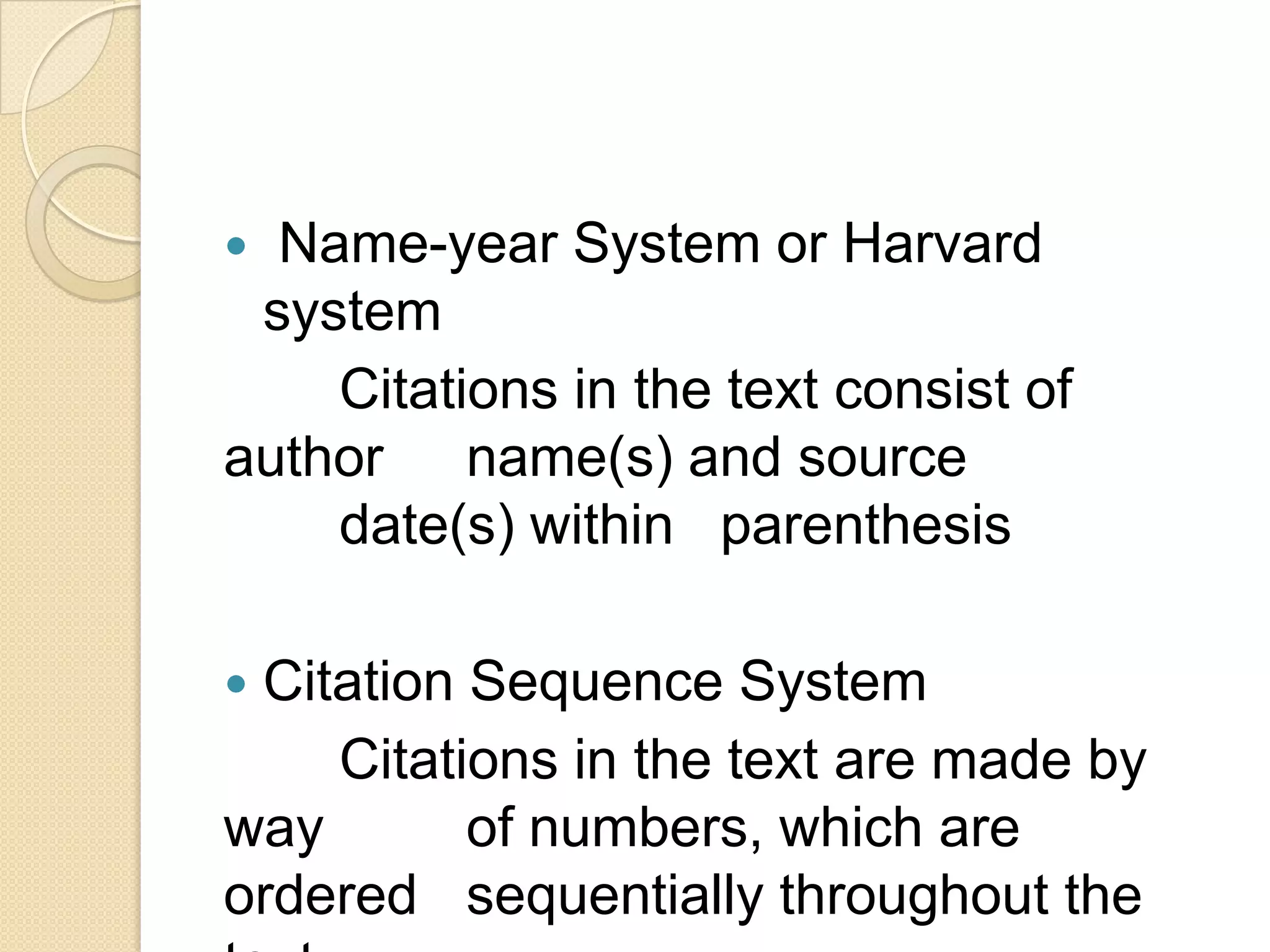
Name-year Systemor Harvard
system
Citations in the text consist of
author name(s) and source
date(s) within parenthesis
Citation Sequence System
Citations in the text are made by
way of numbers, which are
ordered sequentially throughout the
19.
Selection of ajournal
Each journal specializes in a specific area of research.
Hence its readership varies. A proper choice of journal
can make a larger impact of any research paper.
The focus and readership of the journal should be
considered - general vs. specialized area journal.
We should select 2 or 3 journals in the chosen area with
relatively high impact factors. Discussion with the
advisor is must to decide the type of journal.
Authors should always be particular for the journal’s
submission criteria and format before the submission.
20.
Submission
After readingthe finalized paper carefully and checking the
accuracy of figures and captions in terms of correctly
referred figures to in the text.
A feedback from advisor and colleagues is always needed.
We should make sure that the paper is read by at least one
or two colleagues who is not familiar with the specific
work.
A cover letter should be provided to the editor along with a
brief paragraph highlighting the importance of this work
and names of possible reviewers.
Approval from all co-authors is important before
finalizing the version of the paper
Paper should be submitted online along with copyright
form.
21.
Revision and galleyproof
The manuscript is usually reviewed by 2-3 reviewers
Reviewers point out deficiencies and/or suggestions to improve the
scientific content
Their comments should be read carefully. (If reviewer misunderstands
a point, the point probably needs revision or additional support.)
One should not blame to the reviewer for any misunderstanding!
We should be polite and respectful when disagreeing a reviewer’s
comment
A point-to-point explanation of changes made in the text in response to
reviewers’ comments should be incorporated while submission of
revised manuscript.
Once again, a carefully reading of the paper for its accuracy in
presenting the data should be checked by the author.
Once accepted for publication a proof of the paper has to be received
online within a month – At this stage there is one last chance to make
the final corrections, if any.