Skill Development Workshop
on
Art of Scientific and Research Writing
By
Dr. V Surendra Reddy
Professor Dept of CSE.
Sri Venkateswara College Of Engineering & Technology, Srikakulam.
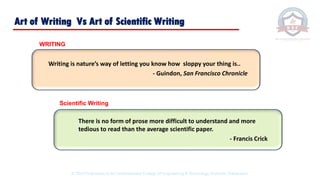
Art of Writing Vs Art of Scientific Writing
Writing is nature’s way of letting you know how sloppy your thing is..
- Guindon, San Francisco Chronicle
There is no form of prose more difficult to understand and more
tedious to read than the average scientific paper.
- Francis Crick
Scientific Writing
WRITING
© 2020 Proprietary to Sri Venkateswara College Of Engineering & Technology, Etcherla, Srikakulam.
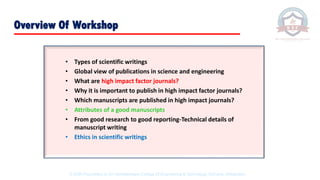
• Types of scientific writings
• Global view of publications in science and engineering
• What are high impact factor journals?
• Why it is important to publish in high impact factor journals?
• Which manuscripts are published in high impact journals?
• Attributes of a good manuscripts
• From good research to good reporting-Technical details of
manuscript writing
• Ethics in scientific writings
Overview Of Workshop
© 2020 Proprietary to Sri Venkateswara College Of Engineering & Technology, Etcherla, Srikakulam.
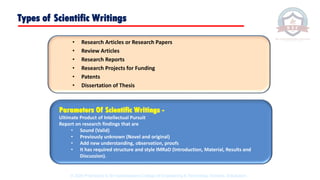
Types of Scientific Writings
• Research Articles or Research Papers
• Review Articles
• Research Reports
• Research Projects for Funding
• Patents
• Dissertation of Thesis
Parameters Of Scientific Writings -
Ultimate Product of Intellectual Pursuit
Report on research findings that are
• Sound (Valid)
• Previously unknown (Novel and original)
• Add new understanding, observation, proofs
• It has required structure and style IMRaD (Introduction, Material, Results and
Discussion).
© 2020 Proprietary to Sri Venkateswara College Of Engineering & Technology, Etcherla, Srikakulam.
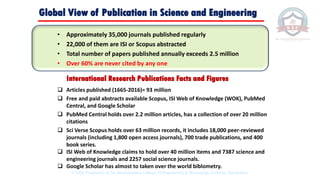
• Approximately 35,000 journals published regularly
• 22,000 of them are ISI or Scopus abstracted
• Total number of papers published annually exceeds 2.5 million
• Over 60% are never cited by any one
Global View of Publication in Science and Engineering
❑ Articles published (1665-2016)= 93 million
❑ Free and paid abstracts available Scopus, ISI Web of Knowledge (WOK), PubMed
Central, and Google Scholar
❑ PubMed Central holds over 2.2 million articles, has a collection of over 20 million
citations
❑ Sci Verse Scopus holds over 63 million records, it includes 18,000 peer-reviewed
journals (including 1,800 open access journals), 700 trade publications, and 400
book series.
❑ ISI Web of Knowledge claims to hold over 40 million items and 7387 science and
engineering journals and 2257 social science journals.
❑ Google Scholar has almost to taken over the world biblometry.
International Research Publications Facts and Figures
© 2020 Proprietary to Sri Venkateswara College Of Engineering & Technology, Etcherla, Srikakulam.
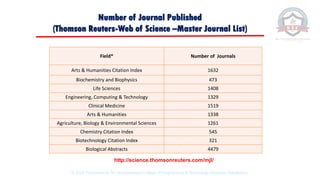
Field* Number of Journals
Arts & Humanities Citation Index 1632
Biochemistry and Biophysics 473
Life Sciences 1408
Engineering, Computing & Technology 1329
Clinical Medicine 1519
Arts & Humanities 1338
Agriculture, Biology & Environmental Sciences 1261
Chemistry Citation Index 545
Biotechnology Citation Index 321
Biological Abstracts 4479
http://science.thomsonreuters.com/mjl/
Number of Journal Published
(Thomson Reuters-Web of Science –Master Journal List)
© 2020 Proprietary to Sri Venkateswara College Of Engineering & Technology, Etcherla, Srikakulam.
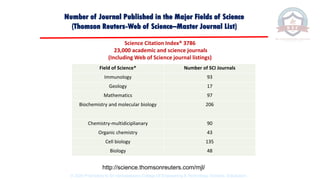
Science Citation Index® 3786
23,000 academic and science journals
(Including Web of Science journal listings)
http://science.thomsonreuters.com/mjl/
Field of Science* Number of SCI Journals
Immunology 93
Geology 17
Mathematics 97
Biochemistry and molecular biology 206
Chemistry-multidiciplianary 90
Organic chemistry 43
Cell biology 135
Biology 48
Number of Journal Published in the Major Fields of Science
(Thomson Reuters-Web of Science–Master Journal List)
© 2020 Proprietary to Sri Venkateswara College Of Engineering & Technology, Etcherla, Srikakulam.
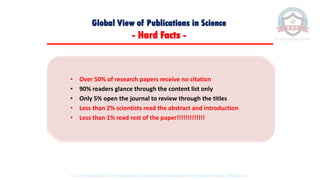
• Over 50% of research papers receive no citation
• 90% readers glance through the content list only
• Only 5% open the journal to review through the titles
• Less than 2% scientists read the abstract and introduction
• Less than 1% read rest of the paper!!!!!!!!!!!!!
Global View of Publications in Science
- Hard Facts -
© 2020 Proprietary to Sri Venkateswara College Of Engineering & Technology, Etcherla, Srikakulam.
• Impact factor of journal is the frequency of its citations.
• High impact factor journals are the ones which have high frequency of citations by
others
• It is a superficial, but internationally accepted, measure of quality of journals
• A good high impact journal may publish a paper which have low to zero citations.
What are High Impact Factor Journals?
© 2020 Proprietary to Sri Venkateswara College Of Engineering & Technology, Etcherla, Srikakulam.
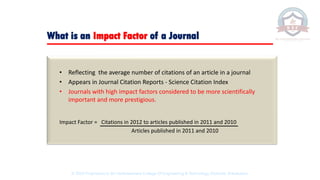
What is an Impact Factor of a Journal
• Reflecting the average number of citations of an article in a journal
• Appears in Journal Citation Reports - Science Citation Index
• Journals with high impact factors considered to be more scientifically
important and more prestigious.
Impact Factor = Citations in 2012 to articles published in 2011 and 2010
Articles published in 2011 and 2010
© 2020 Proprietary to Sri Venkateswara College Of Engineering & Technology, Etcherla, Srikakulam.
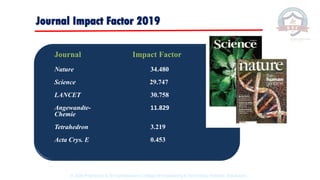
Journal Impact Factor 2019
Journal Impact Factor
Nature 34.480
Science 29.747
LANCET 30.758
Angewandte- 11.829
Chemie
Tetrahedron 3.219
Acta Crys. E 0.453
5907 journals
© 2020 Proprietary to Sri Venkateswara College Of Engineering & Technology, Etcherla, Srikakulam.
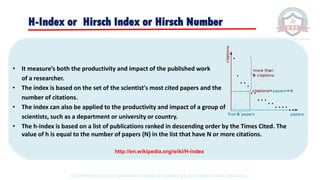
• It measure’s both the productivity and impact of the published work
of a researcher.
• The index is based on the set of the scientist's most cited papers and the
number of citations.
• The index can also be applied to the productivity and impact of a group of
scientists, such as a department or university or country.
• The h-index is based on a list of publications ranked in descending order by the Times Cited. The
value of h is equal to the number of papers (N) in the list that have N or more citations.
H-Index or Hirsch Index or Hirsch Number
http://en.wikipedia.org/wiki/H-index
© 2020 Proprietary to Sri Venkateswara College Of Engineering & Technology, Etcherla, Srikakulam.
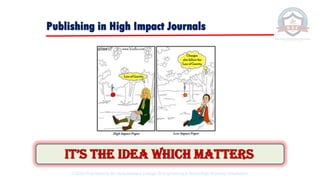
Publishing in High Impact Journals
It’s the Idea whIch matters
© 2020 Proprietary to Sri Venkateswara College Of Engineering & Technology, Etcherla, Srikakulam.
E-Journals
Vs
Print Journal
© 2020 Proprietary to Sri Venkateswara College Of Engineering & Technology, Etcherla, Srikakulam.
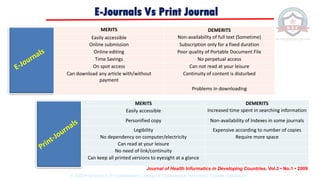
Journal of Health Informatics in Developing Countries, Vol.3 • No.1 • 2009
MERITS DEMERITS
Easily accessible Non-availability of full text (Sometime)
Online submission Subscription only for a fixed duration
Online editing Poor quality of Portable Document File
Time Savings No perpetual access
On spot access Can not read at your leisure
Can download any article with/without
payment
Continuity of content is disturbed
Problems in downloading
MERITS DEMERITS
Easily accessible Increased time spent in searching information
Personified copy Non-availability of Indexes in some journals
Legibility Expensive according to number of copies
No dependency on computer/electricity Require more space
Can read at your leisure
No need of link/continuity
Can keep all printed versions to eyesight at a glance
E-Journals Vs Print Journal
© 2020 Proprietary to Sri Venkateswara College Of Engineering & Technology, Etcherla, Srikakulam.
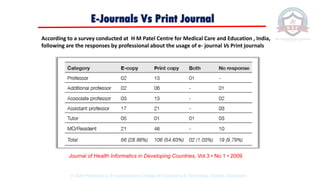
According to a survey conducted at H M Patel Centre for Medical Care and Education , India,
following are the responses by professional about the usage of e- journal Vs Print journals
Journal of Health Informatics in Developing Countries, Vol.3 • No.1 • 2009
E-Journals Vs Print Journal
© 2020 Proprietary to Sri Venkateswara College Of Engineering & Technology, Etcherla, Srikakulam.
Why it is Important to Publish in
High Impact Factor Journals?
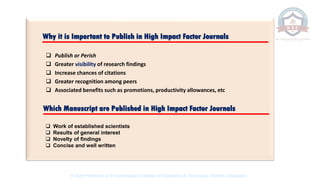
❑ Publish or Perish
❑ Greater visibility of research findings
❑ Increase chances of citations
❑ Greater recognition among peers
❑ Associated benefits such as promotions, productivity allowances, etc
Why it is Important to Publish in High Impact Factor Journals
Which Manuscript are Published in High Impact Factor Journals
❑ Work of established scientists
❑ Results of general interest
❑ Novelty of findings
❑ Concise and well written
© 2020 Proprietary to Sri Venkateswara College Of Engineering & Technology, Etcherla, Srikakulam.
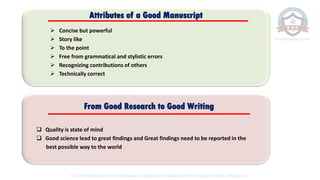
➢ Concise but powerful
➢ Story like
➢ To the point
➢ Free from grammatical and stylistic errors
➢ Recognizing contributions of others
➢ Technically correct
Attributes of a Good Manuscript
❑ Quality is state of mind
❑ Good science lead to great findings and Great findings need to be reported in the
best possible way to the world
From Good Research to Good Writing
© 2020 Proprietary to Sri Venkateswara College Of Engineering & Technology, Etcherla, Srikakulam.
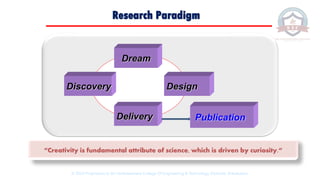
Research Paradigm
Delivery
Dream
DesignDiscovery
“Creativity is fundamental attribute of science, which is driven by curiosity.“
Publication
© 2020 Proprietary to Sri Venkateswara College Of Engineering & Technology, Etcherla, Srikakulam.
Why Publishing Research Articles is Important?
Ideally it is
➢ To communicate and share the new discoveries in science to improve the quality
of life and for providing better healthcare.
➢ Make contributions to society.
More often is
➢ To be advance in the field.
➢ To get the research funding/grants.
➢ To get the tenure.
➢ To improve the scientific impact of institute/individual recognition by peers.
© 2020 Proprietary to Sri Venkateswara College Of Engineering & Technology, Etcherla, Srikakulam.
When to Publish or Not to Publish?
• Quality of the scientific study
• Invention and innovation
• Depth of the study
• Interest of scientific community and layman
• Audience
• Message in the publication
• Time of publication
AIM HIGH - Go for first tier journals if you have time and temperament to write a good manuscript.
Decide the target journal before writing or drafting the article.
Prefer those journals which publish similar work or the journal articles you are citing for your work.
If you think that your competitor is ahead of you, go for second tier rapid publication journal, because it
is important to first
Deciding the Journal for Publishing
© 2020 Proprietary to Sri Venkateswara College Of Engineering & Technology, Etcherla, Srikakulam.
Points to be Considered before Publishing
• Targeted audience
• Prestige of journal and your own institution
• Access (open access/ subscribed)
– availability free of charge on the World Wide Web
– On payment
• Impact factor of the journal
• Probability of acceptance
• Publication time
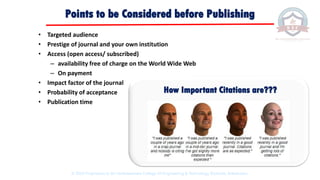
How Important Citations are???
© 2020 Proprietary to Sri Venkateswara College Of Engineering & Technology, Etcherla, Srikakulam.
www.weirdscience.ca
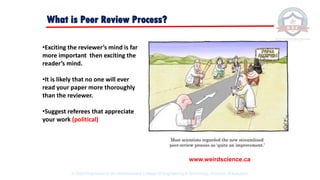
What is Peer Review Process?
•Exciting the reviewer’s mind is far
more important then exciting the
reader’s mind.
•It is likely that no one will ever
read your paper more thoroughly
than the reviewer.
•Suggest referees that appreciate
your work (political)
© 2020 Proprietary to Sri Venkateswara College Of Engineering & Technology, Etcherla, Srikakulam.
Criteria of a Good Research Publication
•Novel idea (out of the box thinking)
•Quality science/research
•Good writing and attractive presentation
•Published in high impact journal
Remember a good article is the one that is read and cited!
Kinds of the Research Articles
o Letters
o Articles
o Communications
o Research notes
o Supplemental articles
© 2020 Proprietary to Sri Venkateswara College Of Engineering & Technology, Etcherla, Srikakulam.
Writing is a critical step in science although scientists are not
trained to write.
Even very creative experiments and novel results will have dull
impact if the manuscript is not written well.
Technical Details of Manuscript Writing
© 2020 Proprietary to Sri Venkateswara College Of Engineering & Technology, Etcherla, Srikakulam.
Key to Writing Skills
• The path to writing well is to read excellent writers and write...and write…and write.
• “Free write” your thoughts. Don’t worry about structure initially.
• Use the best paper in your field as a template and try to convert your free write-up
into a format.
• Keep writing concise, dynamic and simple in construction.
• Convey enthusiasm in your writing so it attract the audience.
© 2020 Proprietary to Sri Venkateswara College Of Engineering & Technology, Etcherla, Srikakulam.
When to Write a Draft of Manuscript?
• BEST PRACTICE- Prepare the figures and write the draft as the experiment is progressing
•Second Best practice- Write the first draft at a meeting where work is first presented. The
experiment will be fresh in mind and free time in the evenings may be sufficient to write a
draft.
•Alternatively, the script of a seminar can often be used as a starting draft.
•WORST PRACTICE is to write a paper after you have left the place (lab.) where the work
was performed.
© 2020 Proprietary to Sri Venkateswara College Of Engineering & Technology, Etcherla, Srikakulam.
Divide and Conquer!!!!!!!
• Divide and work on.....
Eat an elephant bit by bit
• If you get stuck on a particular section, just skip to a different section
that is easiest to write.
• It means the easiest first and the most difficult later.
© 2020 Proprietary to Sri Venkateswara College Of Engineering & Technology, Etcherla, Srikakulam.
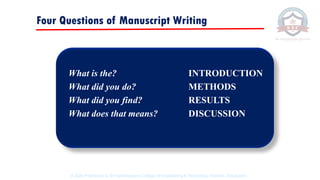
Four Questions of Manuscript Writing
What is the? INTRODUCTION
What did you do? METHODS
What did you find? RESULTS
What does that means? DISCUSSION
© 2020 Proprietary to Sri Venkateswara College Of Engineering & Technology, Etcherla, Srikakulam.
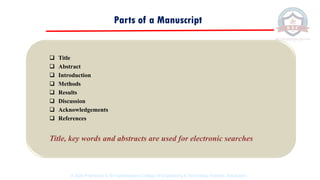
Parts of a Manuscript
❑ Title
❑ Abstract
❑ Introduction
❑ Methods
❑ Results
❑ Discussion
❑ Acknowledgements
❑ References
Title, key words and abstracts are used for electronic searches
© 2020 Proprietary to Sri Venkateswara College Of Engineering & Technology, Etcherla, Srikakulam.
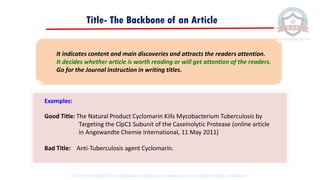
Title- The Backbone of an Article
Examples:
Good Title: The Natural Product Cyclomarin Kills Mycobacterium Tuberculosis by
Targeting the ClpC1 Subunit of the Caseinolytic Protease (online article
in Angewandte Chemie International, 11 May 2011)
Bad Title: Anti-Tuberculosis agent Cyclomarin.
It indicates content and main discoveries and attracts the readers attention.
It decides whether article is worth reading or will get attention of the readers.
Go for the Journal instruction in writing titles.
© 2020 Proprietary to Sri Venkateswara College Of Engineering & Technology, Etcherla, Srikakulam.
The Impact of Article Titles on Citation Hits
• Most published articles are not cited- the title play a vital role
• Construction of an article title has a significant impact on citation frequency.
• By a study conducted by Thomas S. Jacques and Neil J. Sebire* there was a strong
association between increasing title length and citation rate.
• Electronic searches are now preferred over other means, which includes SciFinder,
PubMed, Web of Science, Google Scholar, etc.
• These searches are based on the title or key word .
• Longer, comprehensive titles are more likely to contain given search terms.
• Therefore the title should provide clear description, finding of study
© 2020 Proprietary to Sri Venkateswara College Of Engineering & Technology, Etcherla, Srikakulam.
Nature’s style -Manuscript Formatting Guide
Titles
• Titles do not exceed two lines in print.
• Titles do not normally include numbers, acronyms,
abbreviations or punctuation.
• They should include sufficient detail for indexing purposes
but be general enough for readers outside the field to
appreciate what the paper is about.
www.nature.com
© 2020 Proprietary to Sri Venkateswara College Of Engineering & Technology, Etcherla, Srikakulam.
• Should be informative, indicative and reflects the main ‘story’ of the article.
• The only chance you have to get the reader’s attention.
• Should be crisp, concise and accurate.
• Gives the quick idea of the contents (Stand alone).
• What and how was done
• Provide a brief conclusions
• I generally write abstract at the end
The detailed information must be present in the body text, not in abstract.
Abstract- Most Critical Part of Paper
© 2020 Proprietary to Sri Venkateswara College Of Engineering & Technology, Etcherla, Srikakulam.
• Structured
– IMRaD formula
• Unstructured
– Paragraphs- few sentences summarizing each section
Skeleton of an Article
IMRaD structure- Writing a draft
Introduction--- What is the?
Materials and methods/experimental procedures-- What did you do?
Results-- What did you find?
and
Discussion-- What does it mean?
© 2020 Proprietary to Sri Venkateswara College Of Engineering & Technology, Etcherla, Srikakulam.
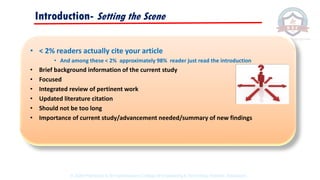
• < 2% readers actually cite your article
• And among these < 2% approximately 98% reader just read the introduction
• Brief background information of the current study
• Focused
• Integrated review of pertinent work
• Updated literature citation
• Should not be too long
• Importance of current study/advancement needed/summary of new findings
Introduction- Setting the Scene
© 2020 Proprietary to Sri Venkateswara College Of Engineering & Technology, Etcherla, Srikakulam.
• Ask question to yourself that why should anyone read your paper
amongst the 1000’s appearing that month?
Create-A-Research-Space
• It should introduce the topic and relates to the existing research.
• significance of your research.
• Capture your audience. Why is your experiment important?
Avoid comprehensive review, self citations, etc
Introduction
© 2020 Proprietary to Sri Venkateswara College Of Engineering & Technology, Etcherla, Srikakulam.
Material and Methods
• Write the methods section first because it is the easiest to write.
• Provide enough details for competent researchers to repeat the experiment (Who, What,
When, Where, How, and Why?)
• Start writing when experiments still in progress
• Sufficient information must be provided for reproducibility
• Study design-new methods must be described in detail
• Supplies, manufacturer, country needs to be added
• Animal, human, protections details
• Measurements/ instruments
• Statistical analysis and data collection
• Descriptive subheadings– general experimental methods, animals, spectral data, etc
© 2020 Proprietary to Sri Venkateswara College Of Engineering & Technology, Etcherla, Srikakulam.
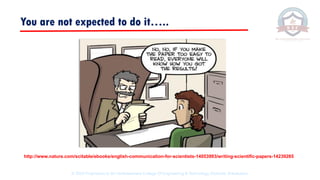
http://www.nature.com/scitable/ebooks/english-communication-for-scientists-14053993/writing-scientific-papers-14239285
You are not expected to do it…..
© 2020 Proprietary to Sri Venkateswara College Of Engineering & Technology, Etcherla, Srikakulam.
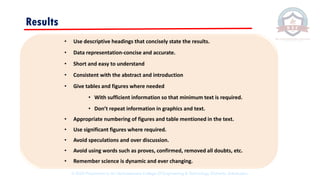
• Use descriptive headings that concisely state the results.
• Data representation-concise and accurate.
• Short and easy to understand
• Consistent with the abstract and introduction
• Give tables and figures where needed
• With sufficient information so that minimum text is required.
• Don’t repeat information in graphics and text.
• Appropriate numbering of figures and table mentioned in the text.
• Use significant figures where required.
• Avoid speculations and over discussion.
• Avoid using words such as proves, confirmed, removed all doubts, etc.
• Remember science is dynamic and ever changing.
Results
© 2020 Proprietary to Sri Venkateswara College Of Engineering & Technology, Etcherla, Srikakulam.
Discussion
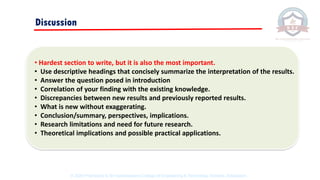
• Hardest section to write, but it is also the most important.
• Use descriptive headings that concisely summarize the interpretation of the results.
• Answer the question posed in introduction
• Correlation of your finding with the existing knowledge.
• Discrepancies between new results and previously reported results.
• What is new without exaggerating.
• Conclusion/summary, perspectives, implications.
• Research limitations and need for future research.
• Theoretical implications and possible practical applications.
© 2020 Proprietary to Sri Venkateswara College Of Engineering & Technology, Etcherla, Srikakulam.
• Identify key findings and application
• Should not be a summary of the work done- abstract is doing fine with that.
• Consistent with experimental and introduction
Conclusion
• Cite current and key pertinent references
• Reference citations must be accurate and complete
• Read the references
• Use correct style for journal
References
© 2020 Proprietary to Sri Venkateswara College Of Engineering & Technology, Etcherla, Srikakulam.
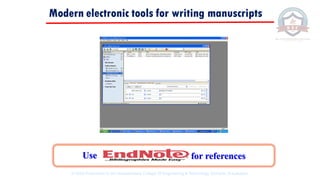
Modern electronic tools for writing manuscripts
Use for references
© 2020 Proprietary to Sri Venkateswara College Of Engineering & Technology, Etcherla, Srikakulam.
Acknowledgments
o Funding agencies
o Intellectual contributions
o Dedications
o Notes
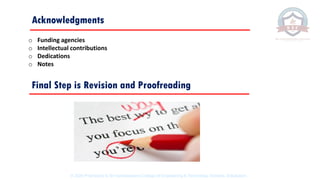
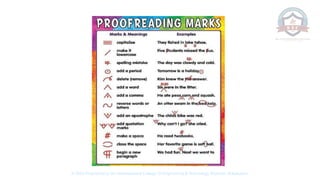
Final Step is Revision and Proofreading
© 2020 Proprietary to Sri Venkateswara College Of Engineering & Technology, Etcherla, Srikakulam.
Revision, Revision, Revision
• After writing the first draft, at least a dozen revision are
usually needed to improve to the text.
• Make sure that all authors read the first draft.
Give them timeline...
© 2020 Proprietary to Sri Venkateswara College Of Engineering & Technology, Etcherla, Srikakulam.
Revision
• Effectiveness of the study
• Supporting information
• Order and flow of the article
• Must be leaving reader with a new question
Revision and Proof Reading
© 2020 Proprietary to Sri Venkateswara College Of Engineering & Technology, Etcherla, Srikakulam.
• Proof Reading - All authors should participate
• Grammar and spelling errors
• Consistent verb tense
• Vocabulary
• Tighten the sentences
• Spell-check
• Punctuation
• Typos
• Technical terms
• Scientific symbols
• Reaction scheme
• Chemical structures/names
• References
Revision and Proof Reading
© 2020 Proprietary to Sri Venkateswara College Of Engineering & Technology, Etcherla, Srikakulam.
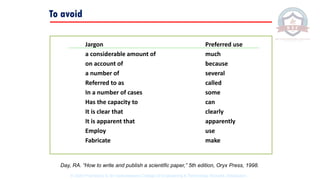
To avoid
Jargon Preferred use
a considerable amount of much
on account of because
a number of several
Referred to as called
In a number of cases some
Has the capacity to can
It is clear that clearly
It is apparent that apparently
Employ use
Fabricate make
Day, RA. “How to write and publish a scientific paper,” 5th edition, Oryx Press, 1998.
© 2020 Proprietary to Sri Venkateswara College Of Engineering & Technology, Etcherla, Srikakulam.
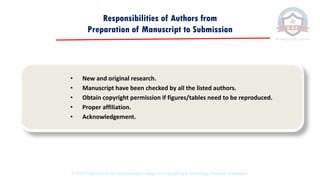
Responsibilities of Authors from
Preparation of Manuscript to Submission
• New and original research.
• Manuscript have been checked by all the listed authors.
• Obtain copyright permission if figures/tables need to be reproduced.
• Proper affiliation.
• Acknowledgement.
© 2020 Proprietary to Sri Venkateswara College Of Engineering & Technology, Etcherla, Srikakulam.
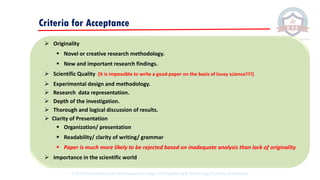
➢ Originality
▪ Novel or creative research methodology.
▪ New and important research findings.
➢ Scientific Quality (It is impossible to write a good paper on the basis of lousy science!!!!)
➢ Experimental design and methodology.
➢ Research data representation.
➢ Depth of the investigation.
➢ Thorough and logical discussion of results.
➢ Clarity of Presentation
▪ Organization/ presentation
▪ Readability/ clarity of writing/ grammar
▪ Paper is much more likely to be rejected based on inadequate analysis than lack of originality
➢ Importance in the scientific world
Criteria for Acceptance
© 2020 Proprietary to Sri Venkateswara College Of Engineering & Technology, Etcherla, Srikakulam.
Major Reasons for Rejection
•The study is just confirmation of previous research i.e. not novel
•Poor experimental design
•Targeted journal is not suitable
•Weakly written/presentation and language
© 2020 Proprietary to Sri Venkateswara College Of Engineering & Technology, Etcherla, Srikakulam.
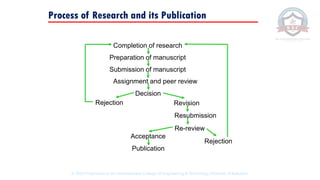
Process of Research and its Publication
Completion of research
Preparation of manuscript
Submission of manuscript
Assignment and peer review
Decision
Revision
Resubmission
Re-review
Acceptance
Publication
Rejection
Rejection
© 2020 Proprietary to Sri Venkateswara College Of Engineering & Technology, Etcherla, Srikakulam.
The most important factors that influence whether
your manuscript will be considered/reviewed for
publication are the title, abstract, cover letter, and
your reputation based on your previous work.
© 2020 Proprietary to Sri Venkateswara College Of Engineering & Technology, Etcherla, Srikakulam.
Ethics in Scientific Writings
© 2020 Proprietary to Sri Venkateswara College Of Engineering & Technology, Etcherla, Srikakulam.
Do’s and Don’t in Scientific Writings
• Be factual
• Be honourable
• Be legal
• Be truthful
• Be objectives
• Be accurate
• Don’t deceive
• Don’t falsify
• Don’t plagiarize
© 2020 Proprietary to Sri Venkateswara College Of Engineering & Technology, Etcherla, Srikakulam.
Ethics in Scientific Writings
• Authorship issues
• Informed consent/ institutional review board/ ethical review board
approval
• Acknowledging past and present contributions of others
• Registered Clinical Trials
• Acknowledge Grants/funding
• Avoid Fragmentary or duplicate publications
© 2020 Proprietary to Sri Venkateswara College Of Engineering & Technology, Etcherla, Srikakulam.
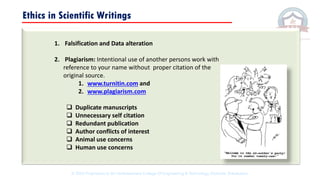
Ethics in Scientific Writings
1. Falsification and Data alteration
2. Plagiarism: Intentional use of another persons work with
reference to your name without proper citation of the
original source.
1. www.turnitin.com and
2. www.plagiarism.com
❑ Duplicate manuscripts
❑ Unnecessary self citation
❑ Redundant publication
❑ Author conflicts of interest
❑ Animal use concerns
❑ Human use concerns
© 2020 Proprietary to Sri Venkateswara College Of Engineering & Technology, Etcherla, Srikakulam.
Thank you very much.
© 2020 Proprietary to Sri Venkateswara College Of Engineering & Technology, Etcherla, Srikakulam.

Research paper writing skills

  • 1.
    Skill Development Workshop on Artof Scientific and Research Writing By Dr. V Surendra Reddy Professor Dept of CSE. Sri Venkateswara College Of Engineering & Technology, Srikakulam.
  • 2.
    Art of WritingVs Art of Scientific Writing Writing is nature’s way of letting you know how sloppy your thing is.. - Guindon, San Francisco Chronicle There is no form of prose more difficult to understand and more tedious to read than the average scientific paper. - Francis Crick Scientific Writing WRITING © 2020 Proprietary to Sri Venkateswara College Of Engineering & Technology, Etcherla, Srikakulam.
  • 3.
    • Types ofscientific writings • Global view of publications in science and engineering • What are high impact factor journals? • Why it is important to publish in high impact factor journals? • Which manuscripts are published in high impact journals? • Attributes of a good manuscripts • From good research to good reporting-Technical details of manuscript writing • Ethics in scientific writings Overview Of Workshop © 2020 Proprietary to Sri Venkateswara College Of Engineering & Technology, Etcherla, Srikakulam.
  • 4.
    Types of ScientificWritings • Research Articles or Research Papers • Review Articles • Research Reports • Research Projects for Funding • Patents • Dissertation of Thesis Parameters Of Scientific Writings - Ultimate Product of Intellectual Pursuit Report on research findings that are • Sound (Valid) • Previously unknown (Novel and original) • Add new understanding, observation, proofs • It has required structure and style IMRaD (Introduction, Material, Results and Discussion). © 2020 Proprietary to Sri Venkateswara College Of Engineering & Technology, Etcherla, Srikakulam.
  • 5.
    • Approximately 35,000journals published regularly • 22,000 of them are ISI or Scopus abstracted • Total number of papers published annually exceeds 2.5 million • Over 60% are never cited by any one Global View of Publication in Science and Engineering ❑ Articles published (1665-2016)= 93 million ❑ Free and paid abstracts available Scopus, ISI Web of Knowledge (WOK), PubMed Central, and Google Scholar ❑ PubMed Central holds over 2.2 million articles, has a collection of over 20 million citations ❑ Sci Verse Scopus holds over 63 million records, it includes 18,000 peer-reviewed journals (including 1,800 open access journals), 700 trade publications, and 400 book series. ❑ ISI Web of Knowledge claims to hold over 40 million items and 7387 science and engineering journals and 2257 social science journals. ❑ Google Scholar has almost to taken over the world biblometry. International Research Publications Facts and Figures © 2020 Proprietary to Sri Venkateswara College Of Engineering & Technology, Etcherla, Srikakulam.
  • 6.
    Field* Number ofJournals Arts & Humanities Citation Index 1632 Biochemistry and Biophysics 473 Life Sciences 1408 Engineering, Computing & Technology 1329 Clinical Medicine 1519 Arts & Humanities 1338 Agriculture, Biology & Environmental Sciences 1261 Chemistry Citation Index 545 Biotechnology Citation Index 321 Biological Abstracts 4479 http://science.thomsonreuters.com/mjl/ Number of Journal Published (Thomson Reuters-Web of Science –Master Journal List) © 2020 Proprietary to Sri Venkateswara College Of Engineering & Technology, Etcherla, Srikakulam.
  • 7.
    Science Citation Index®3786 23,000 academic and science journals (Including Web of Science journal listings) http://science.thomsonreuters.com/mjl/ Field of Science* Number of SCI Journals Immunology 93 Geology 17 Mathematics 97 Biochemistry and molecular biology 206 Chemistry-multidiciplianary 90 Organic chemistry 43 Cell biology 135 Biology 48 Number of Journal Published in the Major Fields of Science (Thomson Reuters-Web of Science–Master Journal List) © 2020 Proprietary to Sri Venkateswara College Of Engineering & Technology, Etcherla, Srikakulam.
  • 8.
    • Over 50%of research papers receive no citation • 90% readers glance through the content list only • Only 5% open the journal to review through the titles • Less than 2% scientists read the abstract and introduction • Less than 1% read rest of the paper!!!!!!!!!!!!! Global View of Publications in Science - Hard Facts - © 2020 Proprietary to Sri Venkateswara College Of Engineering & Technology, Etcherla, Srikakulam.
  • 9.
    • Impact factorof journal is the frequency of its citations. • High impact factor journals are the ones which have high frequency of citations by others • It is a superficial, but internationally accepted, measure of quality of journals • A good high impact journal may publish a paper which have low to zero citations. What are High Impact Factor Journals? © 2020 Proprietary to Sri Venkateswara College Of Engineering & Technology, Etcherla, Srikakulam.
  • 10.
    What is anImpact Factor of a Journal • Reflecting the average number of citations of an article in a journal • Appears in Journal Citation Reports - Science Citation Index • Journals with high impact factors considered to be more scientifically important and more prestigious. Impact Factor = Citations in 2012 to articles published in 2011 and 2010 Articles published in 2011 and 2010 © 2020 Proprietary to Sri Venkateswara College Of Engineering & Technology, Etcherla, Srikakulam.
  • 11.
    Journal Impact Factor2019 Journal Impact Factor Nature 34.480 Science 29.747 LANCET 30.758 Angewandte- 11.829 Chemie Tetrahedron 3.219 Acta Crys. E 0.453 5907 journals © 2020 Proprietary to Sri Venkateswara College Of Engineering & Technology, Etcherla, Srikakulam.
  • 12.
    • It measure’sboth the productivity and impact of the published work of a researcher. • The index is based on the set of the scientist's most cited papers and the number of citations. • The index can also be applied to the productivity and impact of a group of scientists, such as a department or university or country. • The h-index is based on a list of publications ranked in descending order by the Times Cited. The value of h is equal to the number of papers (N) in the list that have N or more citations. H-Index or Hirsch Index or Hirsch Number http://en.wikipedia.org/wiki/H-index © 2020 Proprietary to Sri Venkateswara College Of Engineering & Technology, Etcherla, Srikakulam.
  • 13.
    Publishing in HighImpact Journals It’s the Idea whIch matters © 2020 Proprietary to Sri Venkateswara College Of Engineering & Technology, Etcherla, Srikakulam.
  • 14.
    E-Journals Vs Print Journal © 2020Proprietary to Sri Venkateswara College Of Engineering & Technology, Etcherla, Srikakulam.
  • 15.
    Journal of HealthInformatics in Developing Countries, Vol.3 • No.1 • 2009 MERITS DEMERITS Easily accessible Non-availability of full text (Sometime) Online submission Subscription only for a fixed duration Online editing Poor quality of Portable Document File Time Savings No perpetual access On spot access Can not read at your leisure Can download any article with/without payment Continuity of content is disturbed Problems in downloading MERITS DEMERITS Easily accessible Increased time spent in searching information Personified copy Non-availability of Indexes in some journals Legibility Expensive according to number of copies No dependency on computer/electricity Require more space Can read at your leisure No need of link/continuity Can keep all printed versions to eyesight at a glance E-Journals Vs Print Journal © 2020 Proprietary to Sri Venkateswara College Of Engineering & Technology, Etcherla, Srikakulam.
  • 16.
    According to asurvey conducted at H M Patel Centre for Medical Care and Education , India, following are the responses by professional about the usage of e- journal Vs Print journals Journal of Health Informatics in Developing Countries, Vol.3 • No.1 • 2009 E-Journals Vs Print Journal © 2020 Proprietary to Sri Venkateswara College Of Engineering & Technology, Etcherla, Srikakulam.
  • 17.
    Why it isImportant to Publish in High Impact Factor Journals?
  • 18.
    ❑ Publish orPerish ❑ Greater visibility of research findings ❑ Increase chances of citations ❑ Greater recognition among peers ❑ Associated benefits such as promotions, productivity allowances, etc Why it is Important to Publish in High Impact Factor Journals Which Manuscript are Published in High Impact Factor Journals ❑ Work of established scientists ❑ Results of general interest ❑ Novelty of findings ❑ Concise and well written © 2020 Proprietary to Sri Venkateswara College Of Engineering & Technology, Etcherla, Srikakulam.
  • 19.
    ➢ Concise butpowerful ➢ Story like ➢ To the point ➢ Free from grammatical and stylistic errors ➢ Recognizing contributions of others ➢ Technically correct Attributes of a Good Manuscript ❑ Quality is state of mind ❑ Good science lead to great findings and Great findings need to be reported in the best possible way to the world From Good Research to Good Writing © 2020 Proprietary to Sri Venkateswara College Of Engineering & Technology, Etcherla, Srikakulam.
  • 20.
    Research Paradigm Delivery Dream DesignDiscovery “Creativity isfundamental attribute of science, which is driven by curiosity.“ Publication © 2020 Proprietary to Sri Venkateswara College Of Engineering & Technology, Etcherla, Srikakulam.
  • 21.
    Why Publishing ResearchArticles is Important? Ideally it is ➢ To communicate and share the new discoveries in science to improve the quality of life and for providing better healthcare. ➢ Make contributions to society. More often is ➢ To be advance in the field. ➢ To get the research funding/grants. ➢ To get the tenure. ➢ To improve the scientific impact of institute/individual recognition by peers. © 2020 Proprietary to Sri Venkateswara College Of Engineering & Technology, Etcherla, Srikakulam.
  • 22.
    When to Publishor Not to Publish? • Quality of the scientific study • Invention and innovation • Depth of the study • Interest of scientific community and layman • Audience • Message in the publication • Time of publication AIM HIGH - Go for first tier journals if you have time and temperament to write a good manuscript. Decide the target journal before writing or drafting the article. Prefer those journals which publish similar work or the journal articles you are citing for your work. If you think that your competitor is ahead of you, go for second tier rapid publication journal, because it is important to first Deciding the Journal for Publishing © 2020 Proprietary to Sri Venkateswara College Of Engineering & Technology, Etcherla, Srikakulam.
  • 23.
    Points to beConsidered before Publishing • Targeted audience • Prestige of journal and your own institution • Access (open access/ subscribed) – availability free of charge on the World Wide Web – On payment • Impact factor of the journal • Probability of acceptance • Publication time How Important Citations are??? © 2020 Proprietary to Sri Venkateswara College Of Engineering & Technology, Etcherla, Srikakulam.
  • 24.
    www.weirdscience.ca What is PeerReview Process? •Exciting the reviewer’s mind is far more important then exciting the reader’s mind. •It is likely that no one will ever read your paper more thoroughly than the reviewer. •Suggest referees that appreciate your work (political) © 2020 Proprietary to Sri Venkateswara College Of Engineering & Technology, Etcherla, Srikakulam.
  • 25.
    Criteria of aGood Research Publication •Novel idea (out of the box thinking) •Quality science/research •Good writing and attractive presentation •Published in high impact journal Remember a good article is the one that is read and cited! Kinds of the Research Articles o Letters o Articles o Communications o Research notes o Supplemental articles © 2020 Proprietary to Sri Venkateswara College Of Engineering & Technology, Etcherla, Srikakulam.
  • 26.
    Writing is acritical step in science although scientists are not trained to write. Even very creative experiments and novel results will have dull impact if the manuscript is not written well. Technical Details of Manuscript Writing © 2020 Proprietary to Sri Venkateswara College Of Engineering & Technology, Etcherla, Srikakulam.
  • 27.
    Key to WritingSkills • The path to writing well is to read excellent writers and write...and write…and write. • “Free write” your thoughts. Don’t worry about structure initially. • Use the best paper in your field as a template and try to convert your free write-up into a format. • Keep writing concise, dynamic and simple in construction. • Convey enthusiasm in your writing so it attract the audience. © 2020 Proprietary to Sri Venkateswara College Of Engineering & Technology, Etcherla, Srikakulam.
  • 28.
    When to Writea Draft of Manuscript? • BEST PRACTICE- Prepare the figures and write the draft as the experiment is progressing •Second Best practice- Write the first draft at a meeting where work is first presented. The experiment will be fresh in mind and free time in the evenings may be sufficient to write a draft. •Alternatively, the script of a seminar can often be used as a starting draft. •WORST PRACTICE is to write a paper after you have left the place (lab.) where the work was performed. © 2020 Proprietary to Sri Venkateswara College Of Engineering & Technology, Etcherla, Srikakulam.
  • 29.
    Divide and Conquer!!!!!!! •Divide and work on..... Eat an elephant bit by bit • If you get stuck on a particular section, just skip to a different section that is easiest to write. • It means the easiest first and the most difficult later. © 2020 Proprietary to Sri Venkateswara College Of Engineering & Technology, Etcherla, Srikakulam.
  • 30.
    Four Questions ofManuscript Writing What is the? INTRODUCTION What did you do? METHODS What did you find? RESULTS What does that means? DISCUSSION © 2020 Proprietary to Sri Venkateswara College Of Engineering & Technology, Etcherla, Srikakulam.
  • 31.
    Parts of aManuscript ❑ Title ❑ Abstract ❑ Introduction ❑ Methods ❑ Results ❑ Discussion ❑ Acknowledgements ❑ References Title, key words and abstracts are used for electronic searches © 2020 Proprietary to Sri Venkateswara College Of Engineering & Technology, Etcherla, Srikakulam.
  • 32.
    Title- The Backboneof an Article Examples: Good Title: The Natural Product Cyclomarin Kills Mycobacterium Tuberculosis by Targeting the ClpC1 Subunit of the Caseinolytic Protease (online article in Angewandte Chemie International, 11 May 2011) Bad Title: Anti-Tuberculosis agent Cyclomarin. It indicates content and main discoveries and attracts the readers attention. It decides whether article is worth reading or will get attention of the readers. Go for the Journal instruction in writing titles. © 2020 Proprietary to Sri Venkateswara College Of Engineering & Technology, Etcherla, Srikakulam.
  • 33.
    The Impact ofArticle Titles on Citation Hits • Most published articles are not cited- the title play a vital role • Construction of an article title has a significant impact on citation frequency. • By a study conducted by Thomas S. Jacques and Neil J. Sebire* there was a strong association between increasing title length and citation rate. • Electronic searches are now preferred over other means, which includes SciFinder, PubMed, Web of Science, Google Scholar, etc. • These searches are based on the title or key word . • Longer, comprehensive titles are more likely to contain given search terms. • Therefore the title should provide clear description, finding of study © 2020 Proprietary to Sri Venkateswara College Of Engineering & Technology, Etcherla, Srikakulam.
  • 34.
    Nature’s style -ManuscriptFormatting Guide Titles • Titles do not exceed two lines in print. • Titles do not normally include numbers, acronyms, abbreviations or punctuation. • They should include sufficient detail for indexing purposes but be general enough for readers outside the field to appreciate what the paper is about. www.nature.com © 2020 Proprietary to Sri Venkateswara College Of Engineering & Technology, Etcherla, Srikakulam.
  • 35.
    • Should beinformative, indicative and reflects the main ‘story’ of the article. • The only chance you have to get the reader’s attention. • Should be crisp, concise and accurate. • Gives the quick idea of the contents (Stand alone). • What and how was done • Provide a brief conclusions • I generally write abstract at the end The detailed information must be present in the body text, not in abstract. Abstract- Most Critical Part of Paper © 2020 Proprietary to Sri Venkateswara College Of Engineering & Technology, Etcherla, Srikakulam.
  • 36.
    • Structured – IMRaDformula • Unstructured – Paragraphs- few sentences summarizing each section Skeleton of an Article IMRaD structure- Writing a draft Introduction--- What is the? Materials and methods/experimental procedures-- What did you do? Results-- What did you find? and Discussion-- What does it mean? © 2020 Proprietary to Sri Venkateswara College Of Engineering & Technology, Etcherla, Srikakulam.
  • 37.
    • < 2%readers actually cite your article • And among these < 2% approximately 98% reader just read the introduction • Brief background information of the current study • Focused • Integrated review of pertinent work • Updated literature citation • Should not be too long • Importance of current study/advancement needed/summary of new findings Introduction- Setting the Scene © 2020 Proprietary to Sri Venkateswara College Of Engineering & Technology, Etcherla, Srikakulam.
  • 38.
    • Ask questionto yourself that why should anyone read your paper amongst the 1000’s appearing that month? Create-A-Research-Space • It should introduce the topic and relates to the existing research. • significance of your research. • Capture your audience. Why is your experiment important? Avoid comprehensive review, self citations, etc Introduction © 2020 Proprietary to Sri Venkateswara College Of Engineering & Technology, Etcherla, Srikakulam.
  • 39.
    Material and Methods •Write the methods section first because it is the easiest to write. • Provide enough details for competent researchers to repeat the experiment (Who, What, When, Where, How, and Why?) • Start writing when experiments still in progress • Sufficient information must be provided for reproducibility • Study design-new methods must be described in detail • Supplies, manufacturer, country needs to be added • Animal, human, protections details • Measurements/ instruments • Statistical analysis and data collection • Descriptive subheadings– general experimental methods, animals, spectral data, etc © 2020 Proprietary to Sri Venkateswara College Of Engineering & Technology, Etcherla, Srikakulam.
  • 40.
    http://www.nature.com/scitable/ebooks/english-communication-for-scientists-14053993/writing-scientific-papers-14239285 You are notexpected to do it….. © 2020 Proprietary to Sri Venkateswara College Of Engineering & Technology, Etcherla, Srikakulam.
  • 41.
    • Use descriptiveheadings that concisely state the results. • Data representation-concise and accurate. • Short and easy to understand • Consistent with the abstract and introduction • Give tables and figures where needed • With sufficient information so that minimum text is required. • Don’t repeat information in graphics and text. • Appropriate numbering of figures and table mentioned in the text. • Use significant figures where required. • Avoid speculations and over discussion. • Avoid using words such as proves, confirmed, removed all doubts, etc. • Remember science is dynamic and ever changing. Results © 2020 Proprietary to Sri Venkateswara College Of Engineering & Technology, Etcherla, Srikakulam.
  • 42.
    Discussion • Hardest sectionto write, but it is also the most important. • Use descriptive headings that concisely summarize the interpretation of the results. • Answer the question posed in introduction • Correlation of your finding with the existing knowledge. • Discrepancies between new results and previously reported results. • What is new without exaggerating. • Conclusion/summary, perspectives, implications. • Research limitations and need for future research. • Theoretical implications and possible practical applications. © 2020 Proprietary to Sri Venkateswara College Of Engineering & Technology, Etcherla, Srikakulam.
  • 43.
    • Identify keyfindings and application • Should not be a summary of the work done- abstract is doing fine with that. • Consistent with experimental and introduction Conclusion • Cite current and key pertinent references • Reference citations must be accurate and complete • Read the references • Use correct style for journal References © 2020 Proprietary to Sri Venkateswara College Of Engineering & Technology, Etcherla, Srikakulam.
  • 44.
    Modern electronic toolsfor writing manuscripts Use for references © 2020 Proprietary to Sri Venkateswara College Of Engineering & Technology, Etcherla, Srikakulam.
  • 45.
    Acknowledgments o Funding agencies oIntellectual contributions o Dedications o Notes Final Step is Revision and Proofreading © 2020 Proprietary to Sri Venkateswara College Of Engineering & Technology, Etcherla, Srikakulam.
  • 46.
    Revision, Revision, Revision •After writing the first draft, at least a dozen revision are usually needed to improve to the text. • Make sure that all authors read the first draft. Give them timeline... © 2020 Proprietary to Sri Venkateswara College Of Engineering & Technology, Etcherla, Srikakulam.
  • 47.
    Revision • Effectiveness ofthe study • Supporting information • Order and flow of the article • Must be leaving reader with a new question Revision and Proof Reading © 2020 Proprietary to Sri Venkateswara College Of Engineering & Technology, Etcherla, Srikakulam.
  • 48.
    • Proof Reading- All authors should participate • Grammar and spelling errors • Consistent verb tense • Vocabulary • Tighten the sentences • Spell-check • Punctuation • Typos • Technical terms • Scientific symbols • Reaction scheme • Chemical structures/names • References Revision and Proof Reading © 2020 Proprietary to Sri Venkateswara College Of Engineering & Technology, Etcherla, Srikakulam.
  • 49.
    © 2020 Proprietaryto Sri Venkateswara College Of Engineering & Technology, Etcherla, Srikakulam.
  • 50.
    To avoid Jargon Preferreduse a considerable amount of much on account of because a number of several Referred to as called In a number of cases some Has the capacity to can It is clear that clearly It is apparent that apparently Employ use Fabricate make Day, RA. “How to write and publish a scientific paper,” 5th edition, Oryx Press, 1998. © 2020 Proprietary to Sri Venkateswara College Of Engineering & Technology, Etcherla, Srikakulam.
  • 51.
    Responsibilities of Authorsfrom Preparation of Manuscript to Submission • New and original research. • Manuscript have been checked by all the listed authors. • Obtain copyright permission if figures/tables need to be reproduced. • Proper affiliation. • Acknowledgement. © 2020 Proprietary to Sri Venkateswara College Of Engineering & Technology, Etcherla, Srikakulam.
  • 52.
    ➢ Originality ▪ Novelor creative research methodology. ▪ New and important research findings. ➢ Scientific Quality (It is impossible to write a good paper on the basis of lousy science!!!!) ➢ Experimental design and methodology. ➢ Research data representation. ➢ Depth of the investigation. ➢ Thorough and logical discussion of results. ➢ Clarity of Presentation ▪ Organization/ presentation ▪ Readability/ clarity of writing/ grammar ▪ Paper is much more likely to be rejected based on inadequate analysis than lack of originality ➢ Importance in the scientific world Criteria for Acceptance © 2020 Proprietary to Sri Venkateswara College Of Engineering & Technology, Etcherla, Srikakulam.
  • 53.
    Major Reasons forRejection •The study is just confirmation of previous research i.e. not novel •Poor experimental design •Targeted journal is not suitable •Weakly written/presentation and language © 2020 Proprietary to Sri Venkateswara College Of Engineering & Technology, Etcherla, Srikakulam.
  • 54.
    Process of Researchand its Publication Completion of research Preparation of manuscript Submission of manuscript Assignment and peer review Decision Revision Resubmission Re-review Acceptance Publication Rejection Rejection © 2020 Proprietary to Sri Venkateswara College Of Engineering & Technology, Etcherla, Srikakulam.
  • 55.
    The most importantfactors that influence whether your manuscript will be considered/reviewed for publication are the title, abstract, cover letter, and your reputation based on your previous work. © 2020 Proprietary to Sri Venkateswara College Of Engineering & Technology, Etcherla, Srikakulam.
  • 56.
    Ethics in ScientificWritings © 2020 Proprietary to Sri Venkateswara College Of Engineering & Technology, Etcherla, Srikakulam.
  • 57.
    Do’s and Don’tin Scientific Writings • Be factual • Be honourable • Be legal • Be truthful • Be objectives • Be accurate • Don’t deceive • Don’t falsify • Don’t plagiarize © 2020 Proprietary to Sri Venkateswara College Of Engineering & Technology, Etcherla, Srikakulam.
  • 58.
    Ethics in ScientificWritings • Authorship issues • Informed consent/ institutional review board/ ethical review board approval • Acknowledging past and present contributions of others • Registered Clinical Trials • Acknowledge Grants/funding • Avoid Fragmentary or duplicate publications © 2020 Proprietary to Sri Venkateswara College Of Engineering & Technology, Etcherla, Srikakulam.
  • 59.
    Ethics in ScientificWritings 1. Falsification and Data alteration 2. Plagiarism: Intentional use of another persons work with reference to your name without proper citation of the original source. 1. www.turnitin.com and 2. www.plagiarism.com ❑ Duplicate manuscripts ❑ Unnecessary self citation ❑ Redundant publication ❑ Author conflicts of interest ❑ Animal use concerns ❑ Human use concerns © 2020 Proprietary to Sri Venkateswara College Of Engineering & Technology, Etcherla, Srikakulam.
  • 60.
    Thank you verymuch. © 2020 Proprietary to Sri Venkateswara College Of Engineering & Technology, Etcherla, Srikakulam.