This document discusses animal behavior and how it is influenced by both innate and learned responses. It defines behavior as a response to a stimulus and explains that behavior helps organisms maintain homeostasis to survive and reproduce. The types of stimuli that can trigger behaviors include internal cues like hunger or pain, as well as external cues from predators, mates, or environmental changes. Sensory receptors detect these stimuli and activate the nervous system. Behaviors can be innate or learned through various processes like habituation, observational learning, classical and operant conditioning, play, and insight learning. Both innate behaviors like migration and learned behaviors like language are described.
-continues or enhancesresponse
away from set point
*blood clotting; childbirth
-stops and returns toward set point
*most body responses
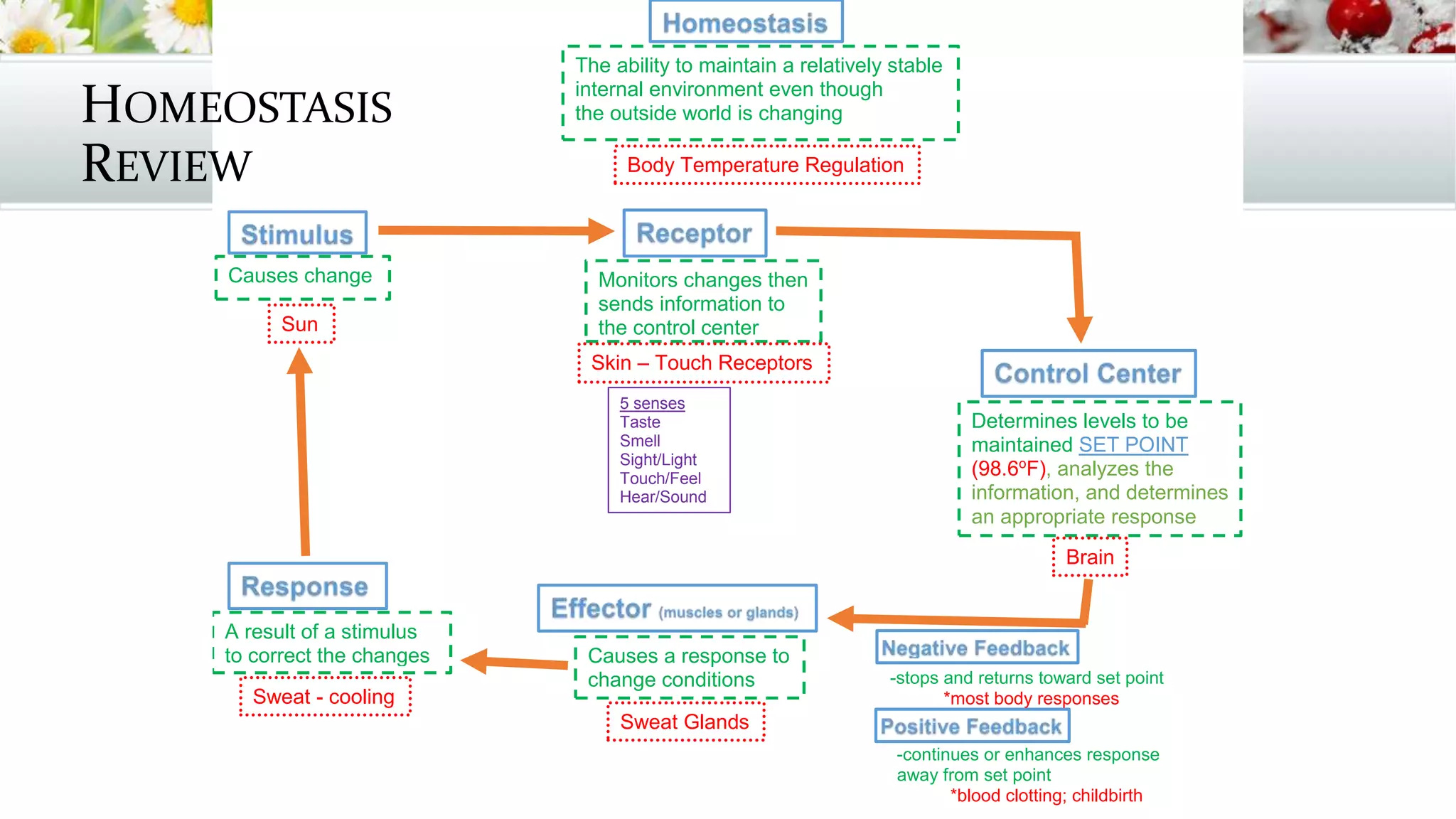
The ability to maintain a relatively stable
internal environment even though
the outside world is changing
Body Temperature Regulation
Causes change
Sun
Monitors changes then
sends information to
the control center
Skin – Touch Receptors
5 senses
Taste
Smell
Sight/Light
Touch/Feel
Hear/Sound
Determines levels to be
maintained SET POINT
(98.6o
F), analyzes the
information, and determines
an appropriate response
Brain
Causes a response to
change conditions
Sweat Glands
A result of a stimulus
to correct the changes
Sweat - cooling
HOMEOSTASIS
REVIEW
WHY BEHAVE?
Behavior isadaptive, because it helps an organism
survive and reproduce.
Behavior maintains homeostasis, which helps the
organisms support the conditions it needs to live.
5.
TYPES OF STIMULI
Internal Stimuli
Examples:
Hunger signals a need for more energy and causes an animal to search for food
Thirst signals a loss of internal fluid and causes an animal to look for water
Pain warns an animal that some part of its body may be subject to injury and
causes it to take some action to avoid injury
External Stimuli
Examples:
The sound of a predator can cause an animal to hide or run away to avoid being
caught
The sight of potential mate can trigger courtship behaviors
Changes in day length can trigger reproductive behaviors or migration
6.
SPECIALIZED CELLS (A.K.A.RECEPTORS)
Sensory cells detect:
Light
Sound
Chemicals
Activate the animal’s nervous system.
May cause adrenaline release
“Fight-or-Flight” Nervous System
Muscles activated
7.
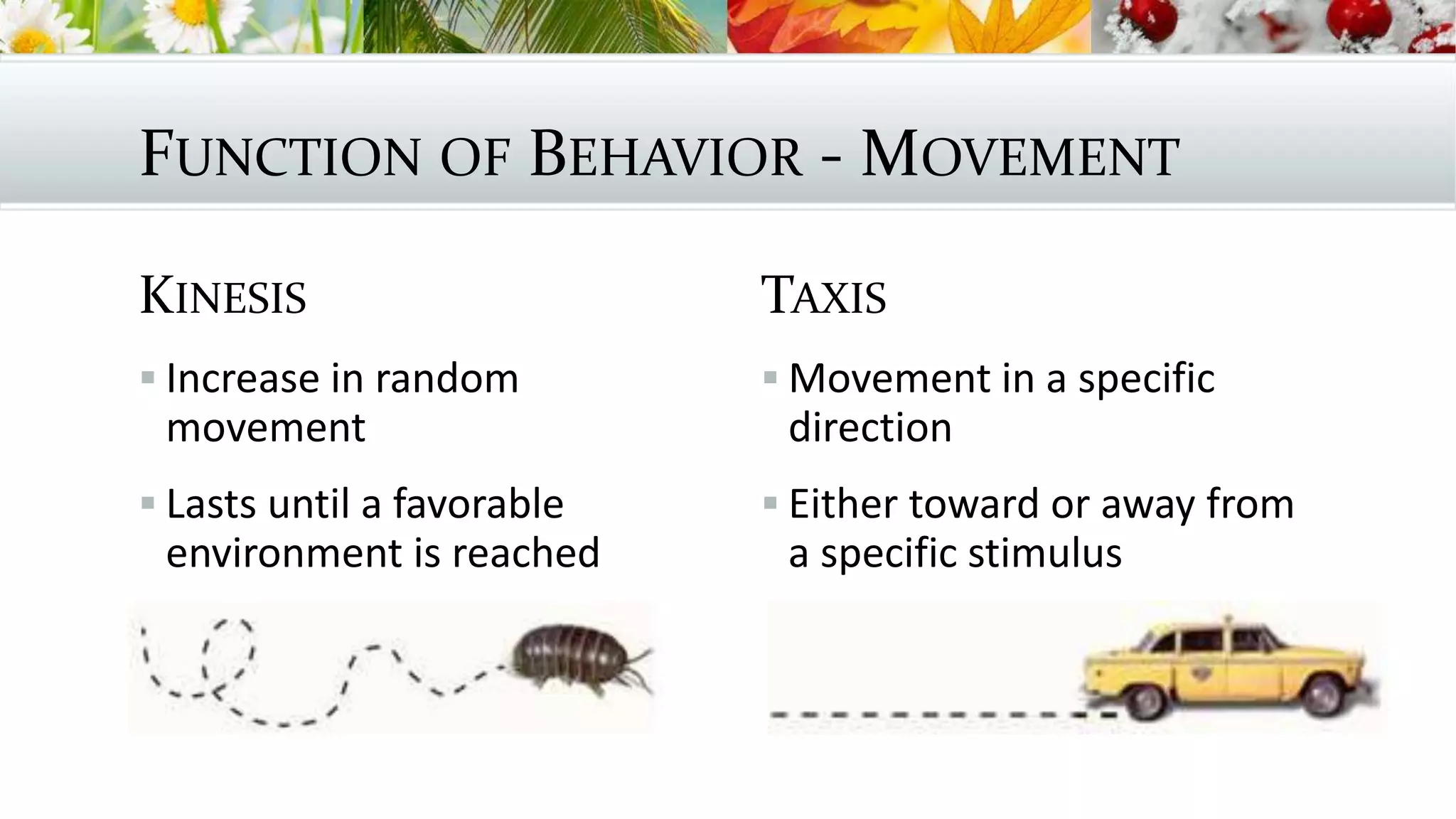
FUNCTION OF BEHAVIOR- MOVEMENT
KINESIS
Increase in random
movement
Lasts until a favorable
environment is reached
TAXIS
Movement in a specific
direction
Either toward or away from
a specific stimulus
8.
BEHAVIOR IN CYCLES
CircadianRhythm – daily pattern of activity
Example: Sleep – daily activity over 24-hours
Biological Clock – internal mechanism of activity
patterns
Example: Melatonin secretion by the brain that can
detect light changes
9.
BEHAVIOR IN CYCLES
Hibernation– avoidance of cold winter temperatures
Animals have:
Decreased body temperature
Decreased heart rate
Decreased breathing rate
Prepare by eating large amounts of fat for:
Food source
Insulation
Light and temperature determine when an animal enters
and exits hibernation
10.
BEHAVIOR IN CYCLES
Migration
Set in motion by a variety of internal and external
stimuli:
Example: Birds
Day length controls hunger gain weight increased
fat storage fuels long distance migration
11.
TYPES OF BEHAVIORS
InnateBehavior
A behavior with which the organism is born
Learned Behavior
A change in behavior due to experience
12.
INNATE VS LEARNEDBEHAVIOR
Innate Behaviors Learned Behaviors
Inborn behavior
Genetically Based
Based on Experience
Not modified by the individual
Modified by the individual by trial and
error
Generally uniform
Low variation in population
High variation in population
Unaffected by the environment Highly affected by the environment
Beneficial behavior
Survival and reproduction
Capacity to learn may be product of
natural selection
13.
INNATE VS LEARNEDBEHAVIOR
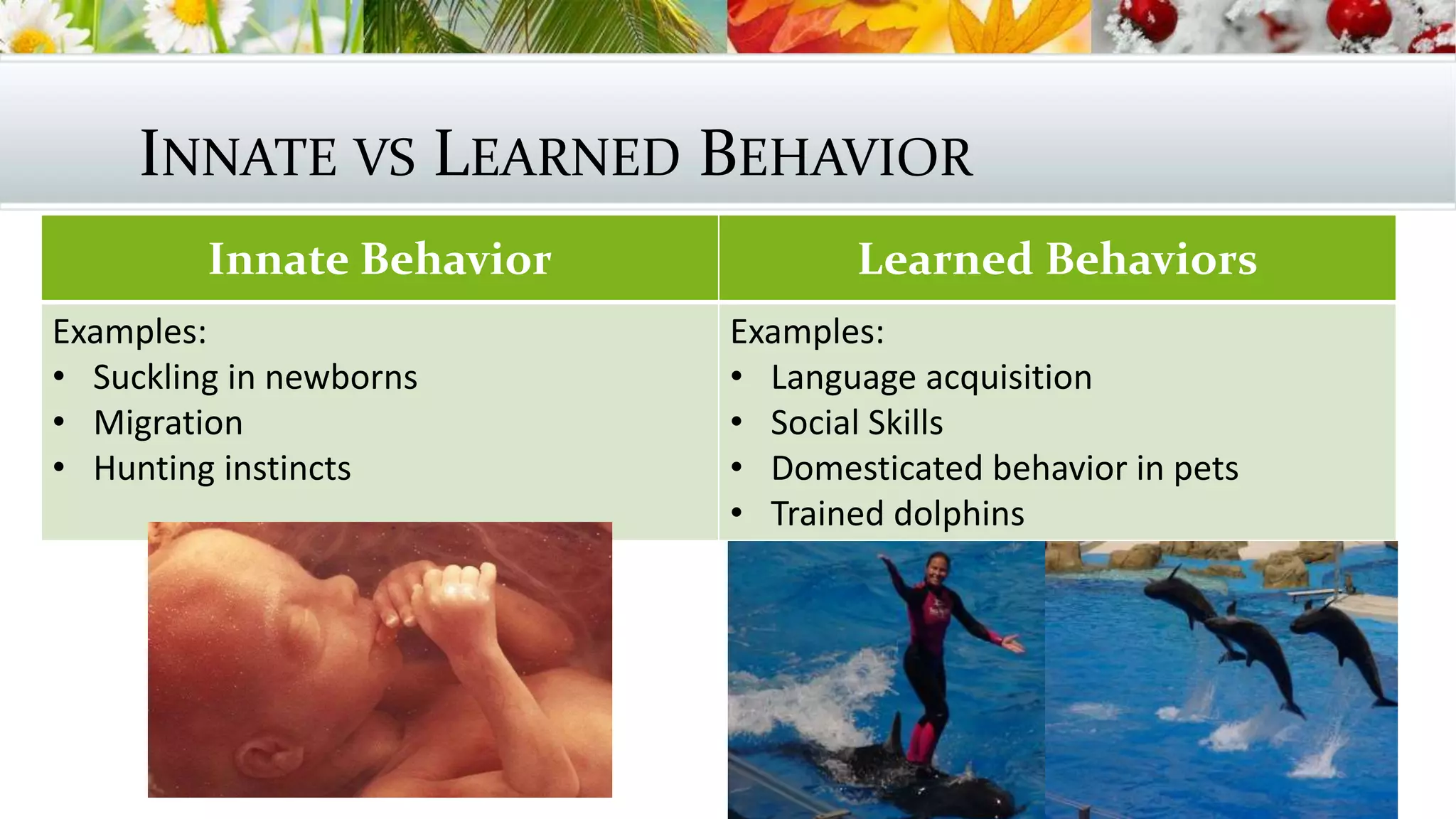
Innate Behavior Learned Behaviors
Examples:
• Suckling in newborns
• Migration
• Hunting instincts
Examples:
• Language acquisition
• Social Skills
• Domesticated behavior in pets
• Trained dolphins
14.
INNATE OR LEARNED?
Science Today: Facial Expressions | California Academy of Sciences
TYPES OF LEARNEDBEHAVIOR
1. Habituation
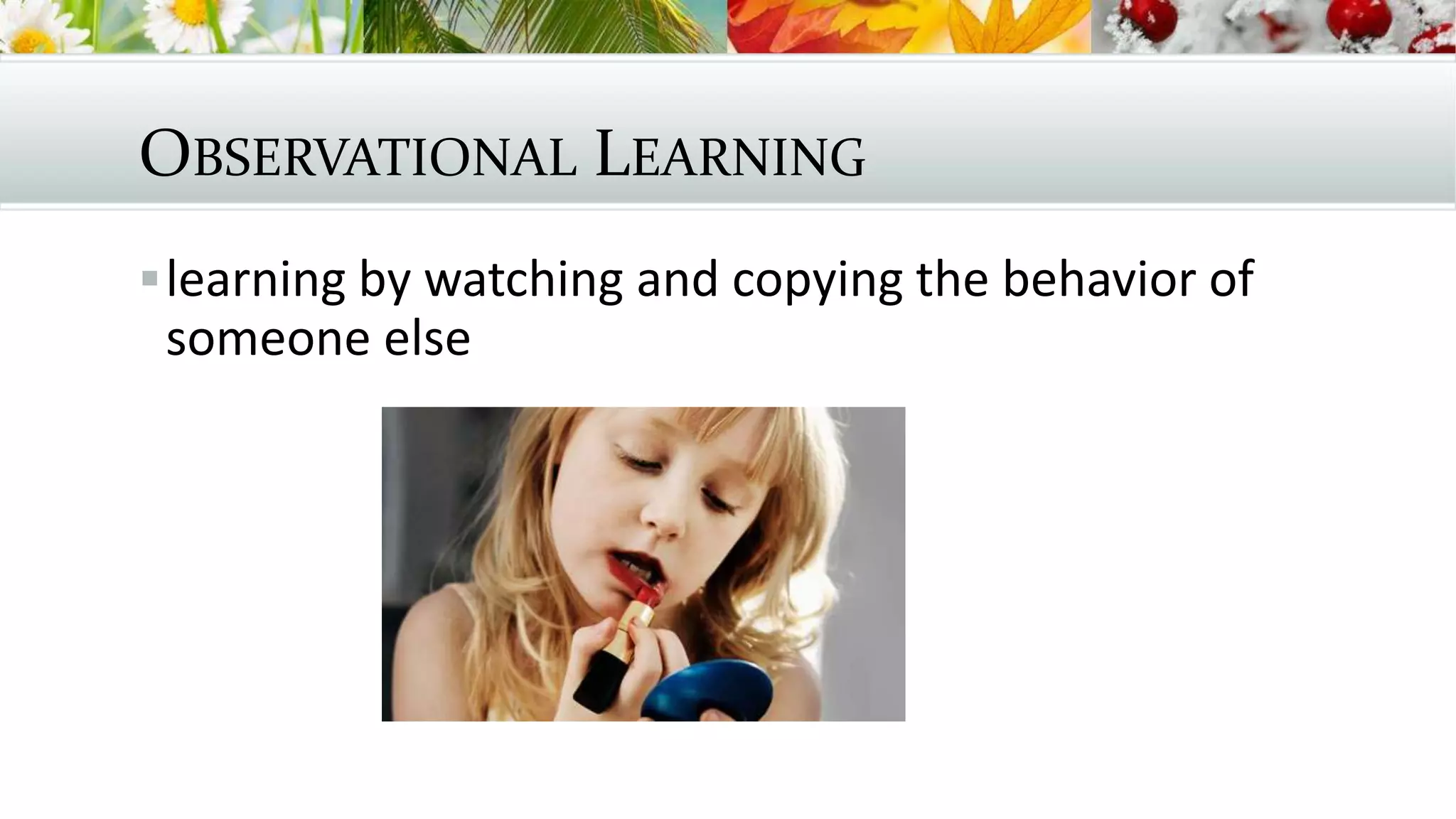
2. Observational Learning
3. Conditioning
4. Play
5. Insight
18.
HABITUATION
Forming a habit
Learningto get used to something after being
exposed to it for a while
Example: The habit of seeing a scarecrow in the exact same place
in the garden every day causes birds to get used to, and basically
ignore, the stimulus
CONDITIONING
A way tomodify (train) an animal’s behavior in
response to a certain stimuli
Reward or punishment
2 types
1. Classical Conditioning
2. Operant Conditioning
22.
CLASSICAL CONDITIONING
A processin which an animal learns to associate a
previously neutral stimulus with a behavior once
triggered by a different stimulus
Pavlov’s Dog









![Neural_control_of_animal_behaviour[1]789.pptx](https://cdn.slidesharecdn.com/ss_thumbnails/neuralcontrolofanimalbehaviour1789-230207172442-5de82c6f-thumbnail.jpg?width=640&height=640&fit=bounds)


