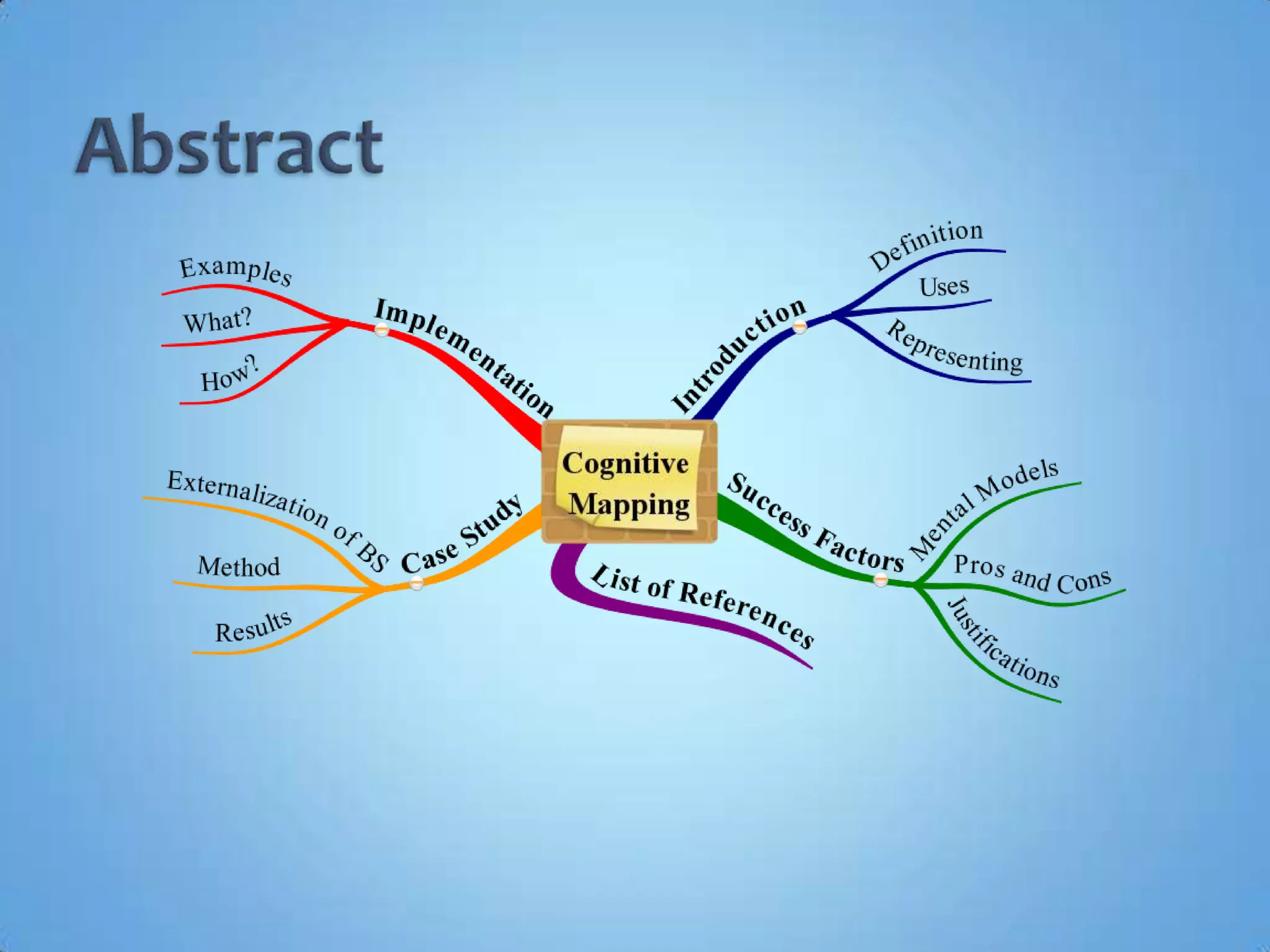
This document discusses cognitive mapping as a method to transform tacit knowledge into explicit knowledge. It defines cognitive maps as graphical representations of mental models that can codify a person's knowledge. The document outlines how cognitive maps are constructed by collecting information from pre-existing and new data, and coding it in the form of a map. It discusses different types of elements that can be included in cognitive maps, such as goals, critical success factors, and actions. The document also presents a case study that used cognitive mapping to externalize the mental models of business strategies for a unique portfolio of projects.
In this document
Powered by AI
Discusses cognitive mapping as a method to transform tacit to explicit knowledge, visualizing mental models.Describes a case study using cognitive mapping for structuring thoughts and externalizing business strategies.
Lists references for further reading and acknowledges the significance of tacit knowledge in collaborative contexts.
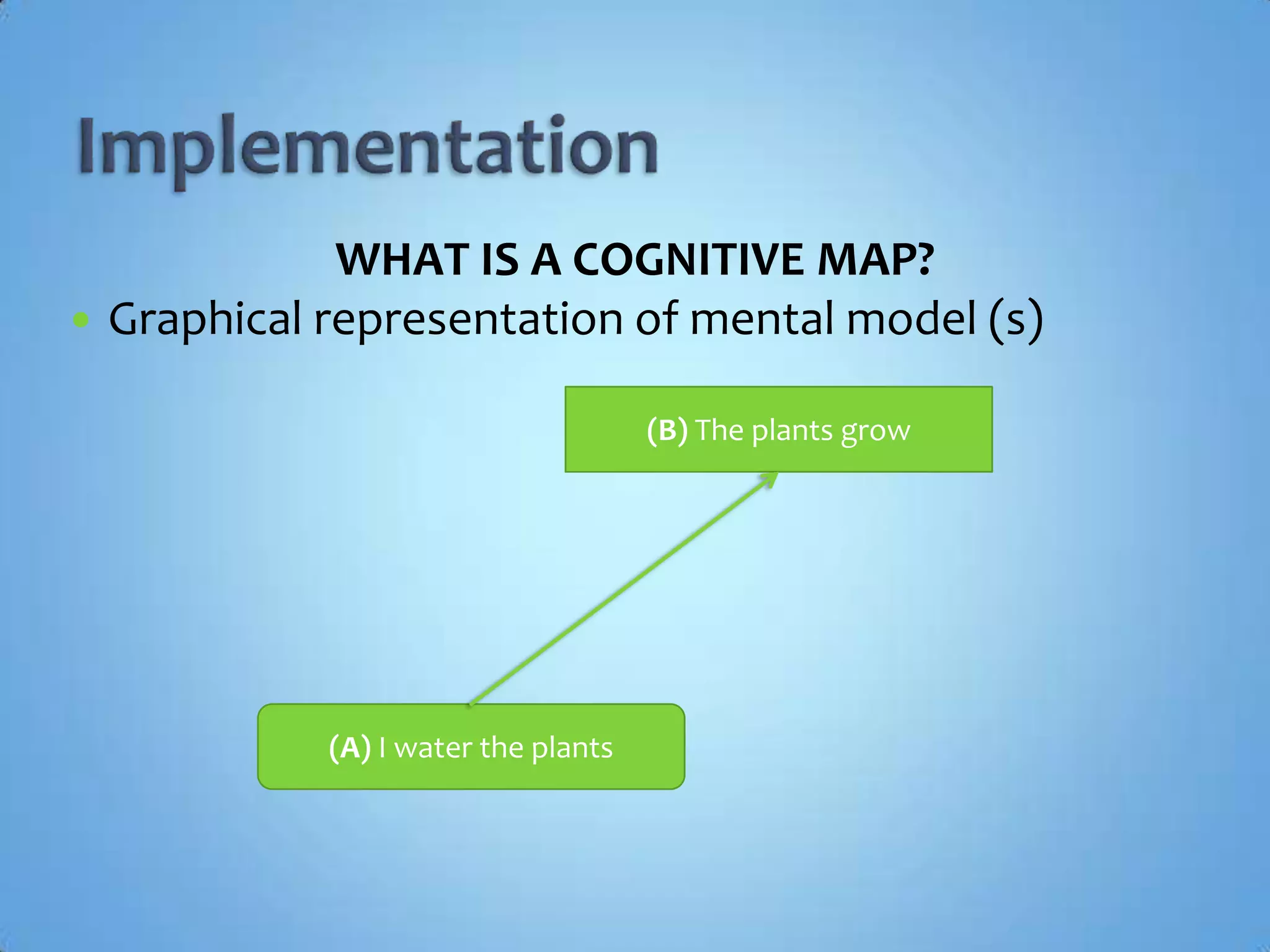
ImplementationWHAT IS ACOGNITIVE MAP?Graphical representation of mental model (s)(B) The plants grow(A) I water the plants
5.
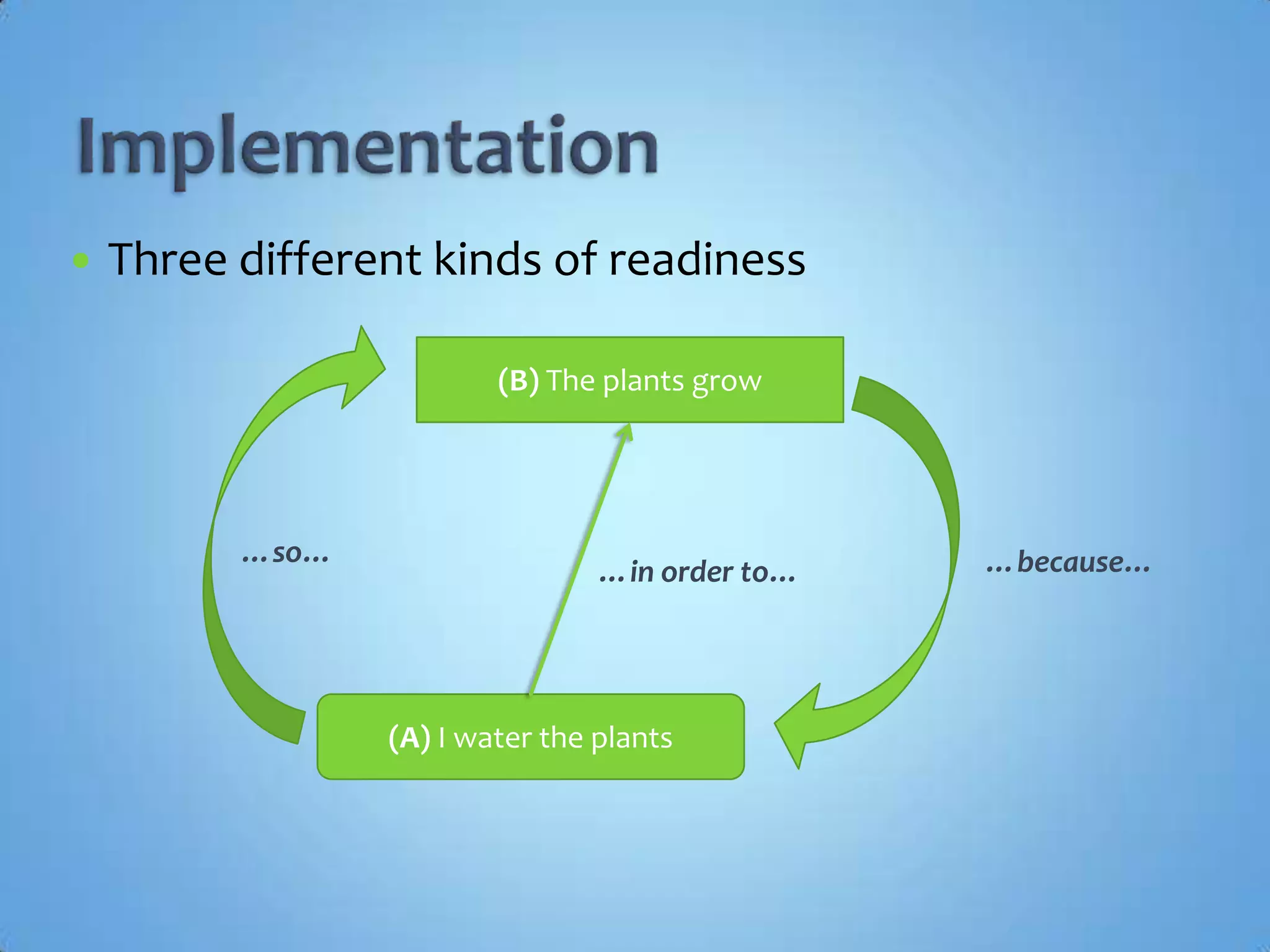
Three different kindsof readinessImplementation(B) The plants grow…so……because……in order to…(A) I water the plants
6.
ImplementationHOW IS ACOGNITIVE MAP CONSTRUCTED?Collect the informationPre-existing dataData collected for the construction process of the cognitive mapCode the information in a shape of mapNOTE: No interviewing protocol exists to guide a researcher in gathering data to be coded.Eden’s group, from Strathclyde University in Glasgow
7.
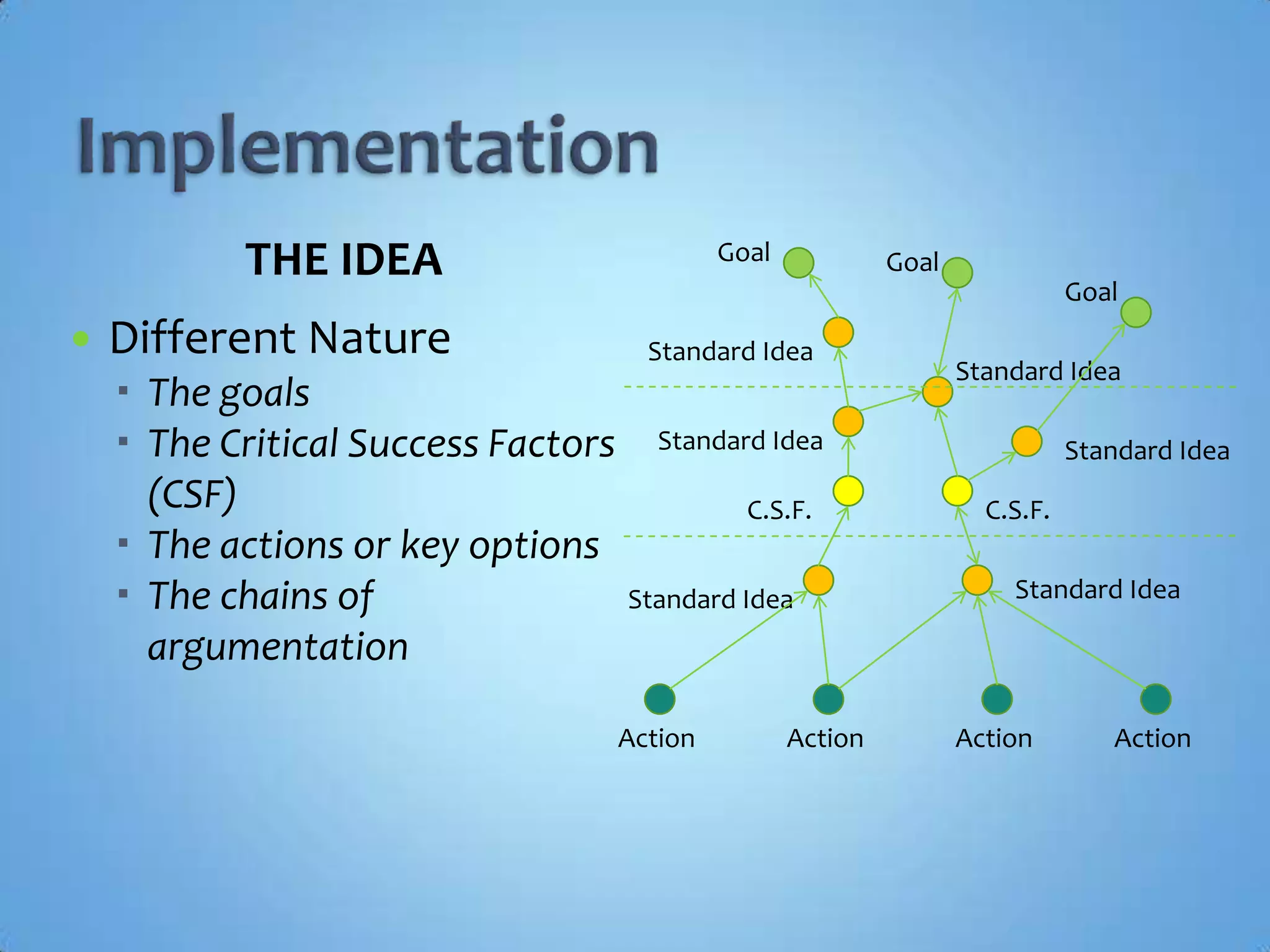
ImplementationTHE IDEADifferent NatureThegoalsThe Critical Success Factors (CSF) The actions or key optionsThe chains of argumentationStandard IdeaGoalGoalGoalC.S.F.C.S.F.Standard IdeaStandard IdeaStandard IdeaStandard IdeaStandard IdeaActionActionActionAction
8.
ImplementationHow ideas areorganized in a cognitive map?Standard IdeaGoalGoalGoalC.S.F.C.S.F.Standard IdeaStandard IdeaStandard IdeaStandard IdeaStandard IdeaActionActionActionAction
9.
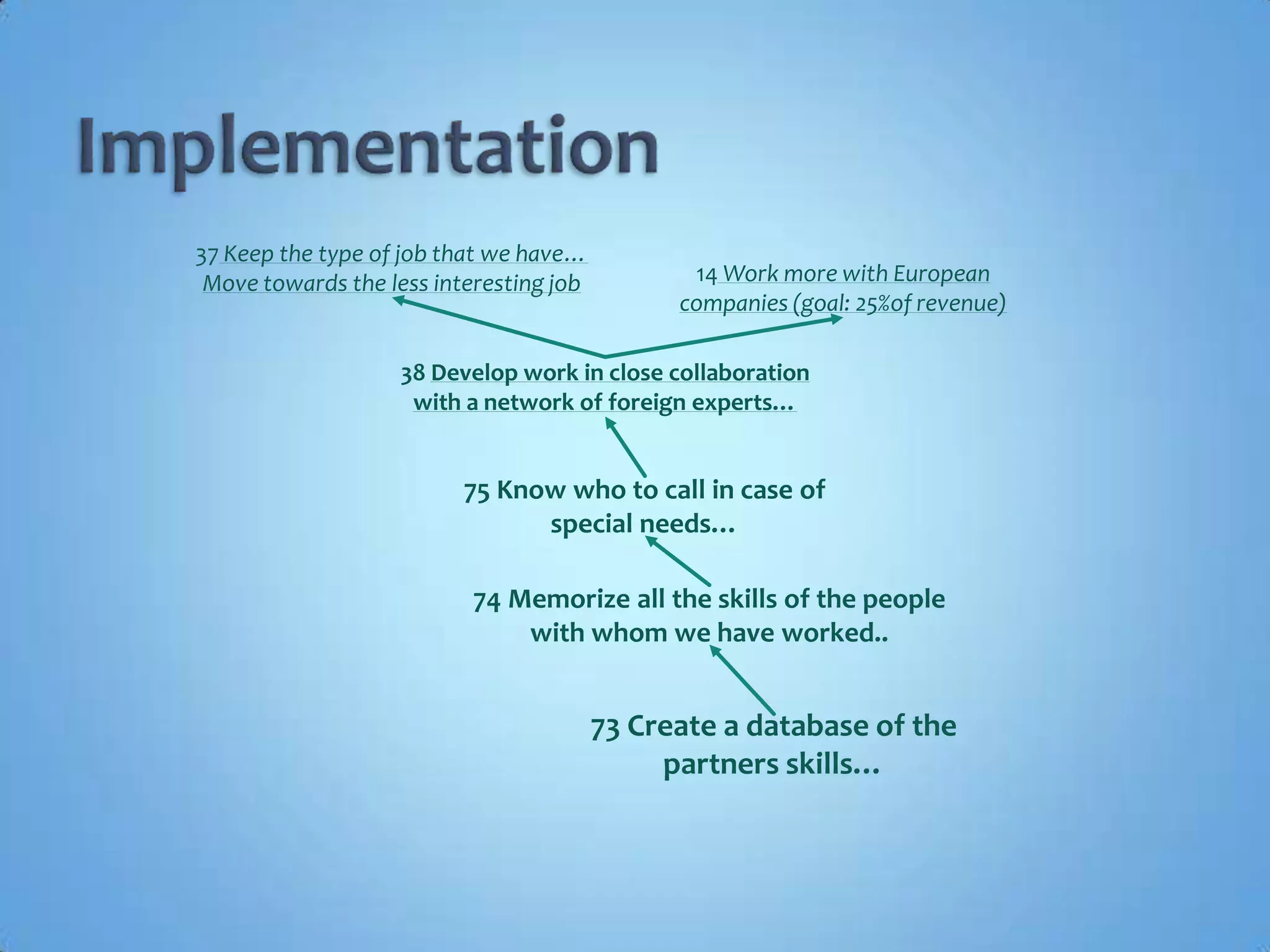
Implementation37 Keep thetype of job that we have…Move towards the less interesting job14 Work more with European companies (goal: 25%of revenue) 38 Develop work in close collaboration with a network of foreign experts…75 Know who to call in case of special needs…74 Memorize all the skills of the people with whom we have worked..73 Create a database of the partners skills…
10.
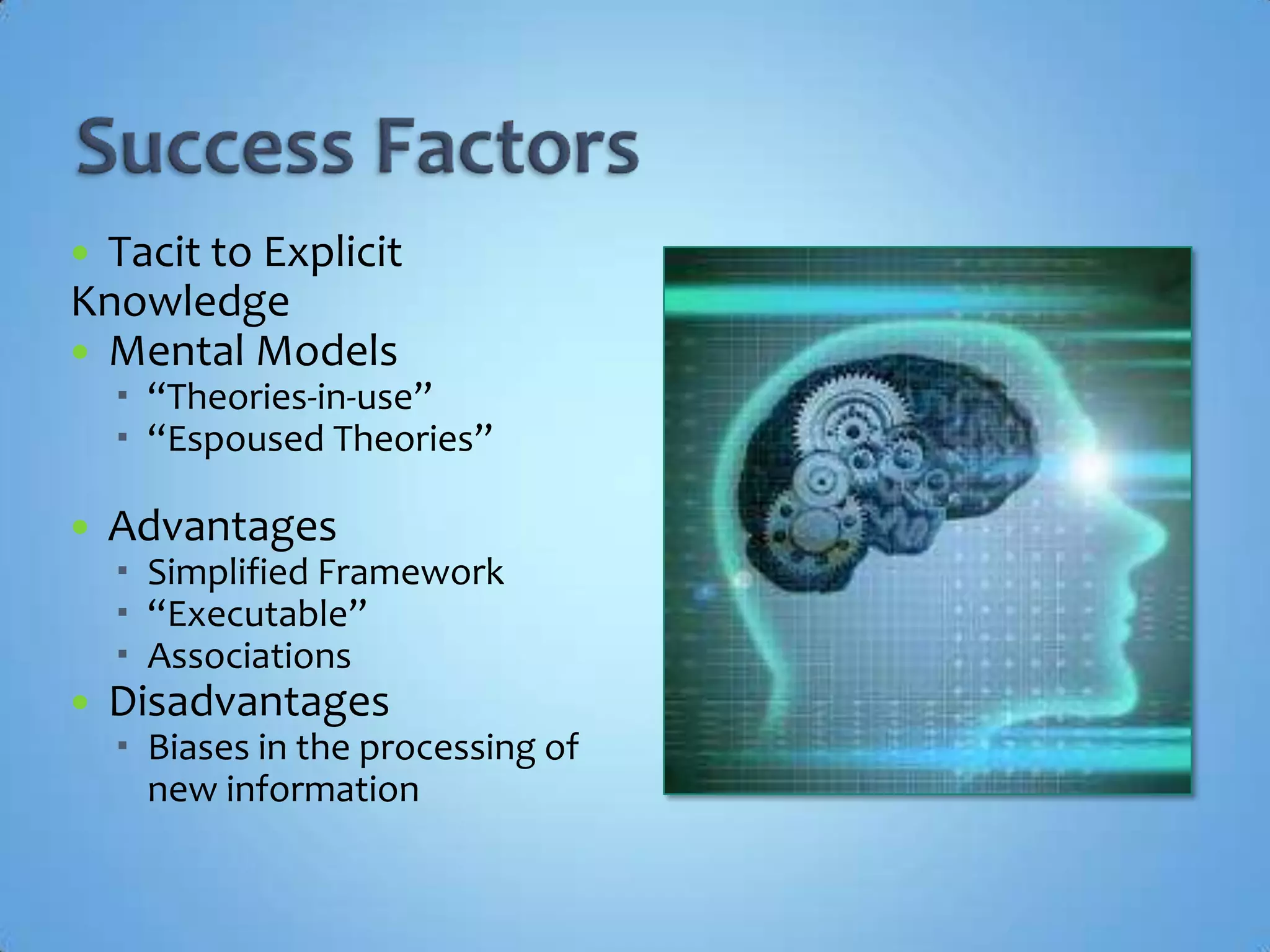
Success FactorsTacit toExplicit KnowledgeMental Models“Theories-in-use”“Espoused Theories”AdvantagesSimplified Framework“Executable”AssociationsDisadvantagesBiases in the processing of new information
11.
Success FactorsMental ModelsTransformationMap in PocketSense of Security and DirectionsNew patterns / New experiencesJustificationsQuestioning the AssumptionsComparison of new and existing Mental ModelsMoving the individual knowledge to the group
12.
Case StudyEXTERNALIZATION OFBUSINESS STRATEGY MENTAL MODELSUnique Portfolio of ProjectsReasons to use cognitive mappingAllows modeling of Mental ModelsStructuring of ThoughtsCommunicate IdeasConsideration of actions
13.
Case StudyQuick Descriptionof the MethodElaboration of the INDIVIDUAL portfolio of projects1Week 1-2First CONFRONTATION of the individual portfolio of projects2Week 5COLECTIVE construction of the final portfolio of projects3Week 6
List of References[1]www.wikipedia.com[2] Florence Rodhain, “TACIT TO EXPLICIT: TRANSFORMING KNOWLEDGE THROUGH COGNITIVE MAPPING – AN EXPERIMENT” [3] http://www.knowledgeboard.com [4] Nonaka, I., and Takeuchi, H., The Knowledge-Creating Company, Oxford University Press, New York, 1995. [5] Natalie M. Steiger and David M. Steiger, University of Maine, “Knowledge Management in Decision Making: Instance-Based Cognitive Mapping”[6] Johnson-Laird, P. and Byrne, R. “Mental Model Website: A Gentle Introduction,” [online via] http://www.tcd.ie/Psychology/Ruth_Byrne/mental_models/, 2000 (accessed July 16, 2005). [7] Johnson-Laird, P., Mental Models. Cambridge University Press, Boston, 1983.[8] Argyris, C. and Schӧn, D.A. Organizational Learning II: Theory, Method, and Practice [9] Weick, K.E., “Cartographic Myths in Organizations,” in Mapping Strategic Thought (Huff, A.S., ed.), John Wiley and Sons, New York, 1990, pp. 1-10.[10] Bereiter, C. and Schardamalia, M. “Cognitive coping strategies and the problem of ‘inert knowledge’ ” In Thinking and Learning Skills: Research and Open Questions (Vol 2) (Chipman, S., Segal J., and Glaser, R., eds.), Lawrence Erlbaum, Hillsdale, NJ, 1985.
16.
Many Thanks!!! “The importanceof tacit knowledge is how we explicate it to those around us and those whom we work with.”