CH Gowri Kumar [email_address]
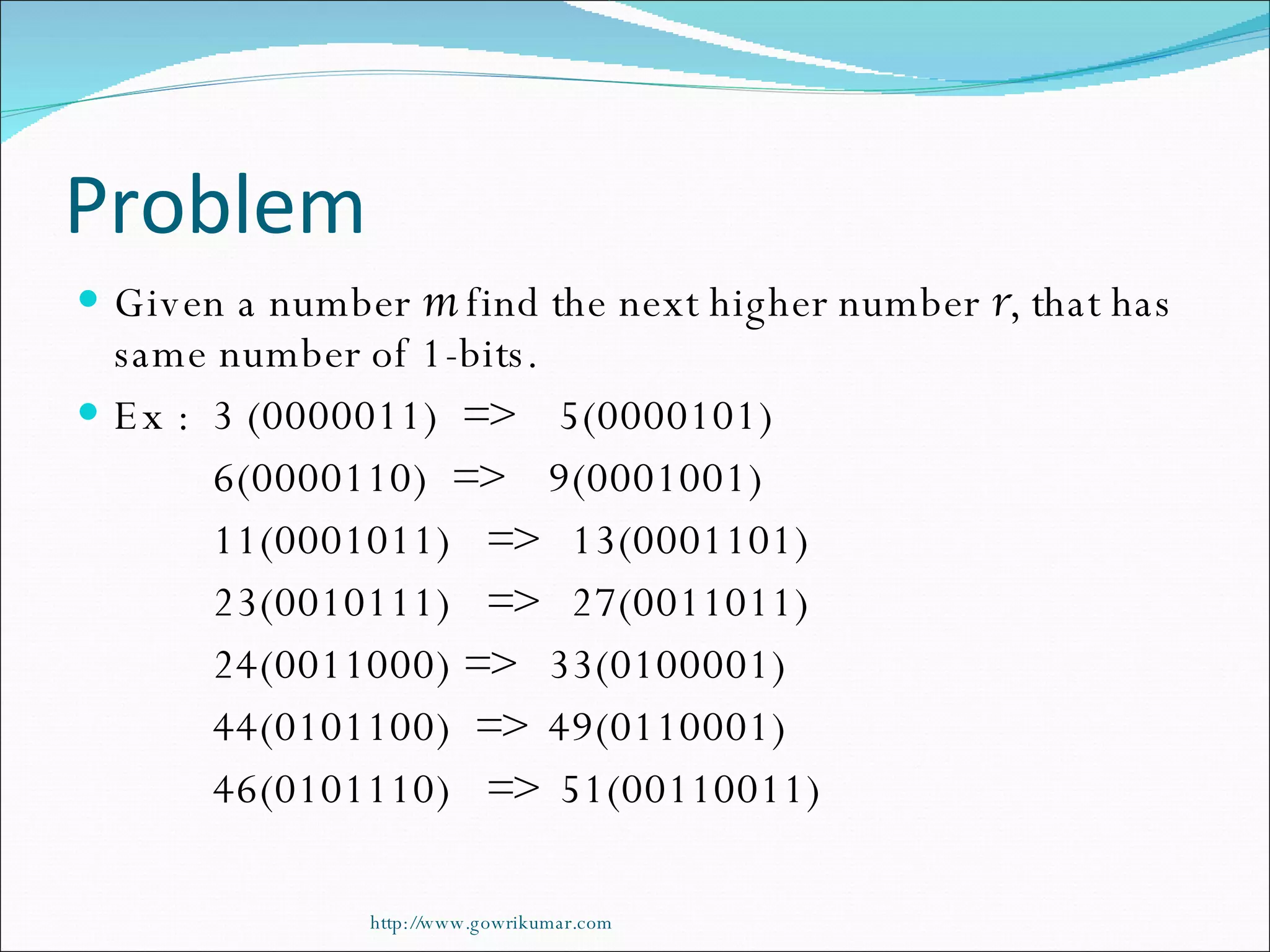
Problem Given a number  m  find the next higher number  r , that has same number of 1-bits. Ex :  3 (0000011)  =>  5(0000101) 6(0000110)  =>  9(0001001) 11(0001011)  =>  13(0001101) 23(0010111)  =>  27(0011011) 24(0011000) =>  33(0100001) 44(0101100)  =>  49(0110001) 46(0101110)  =>  51(00110011) http://www.gowrikumar.com
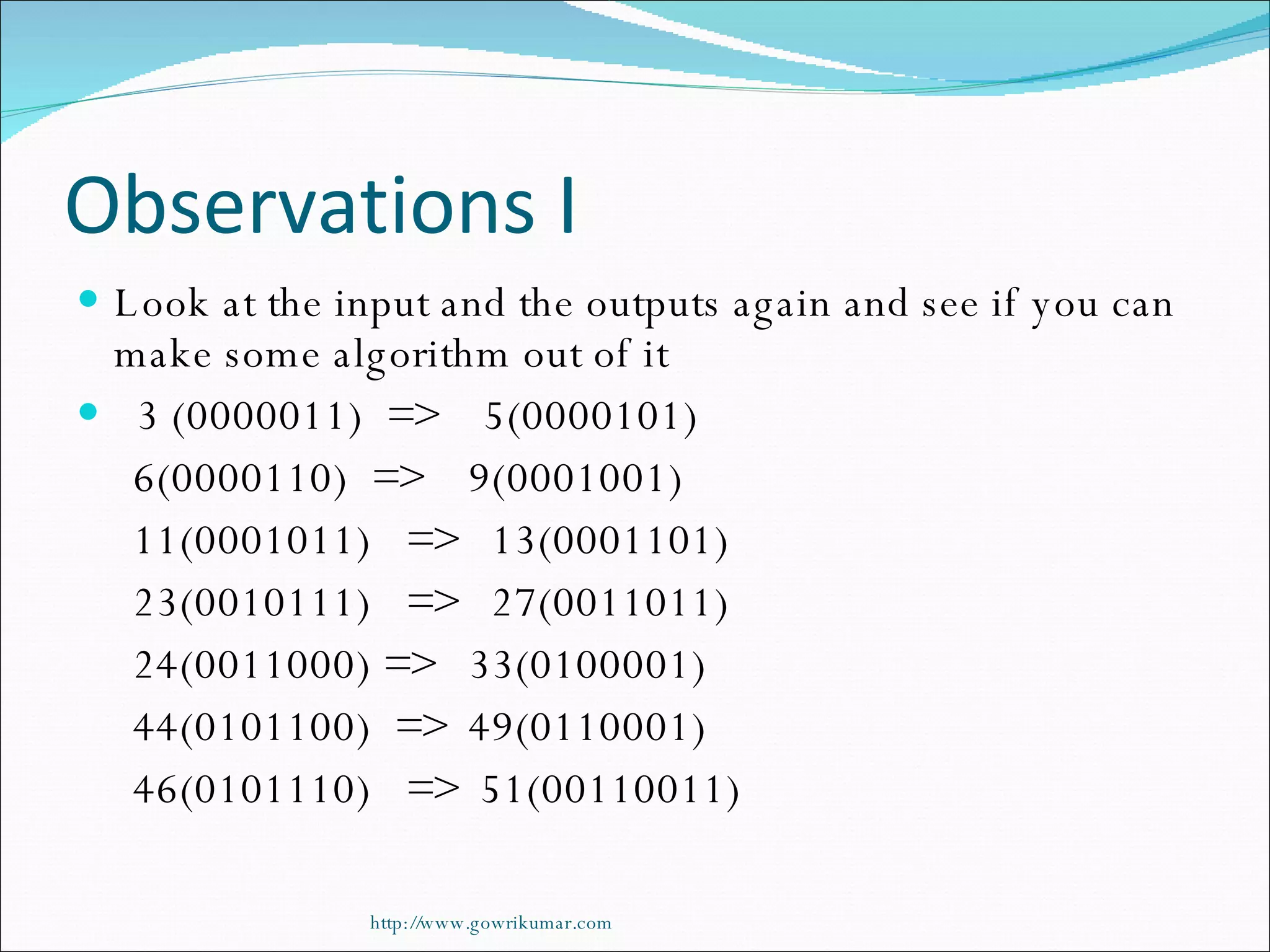
Observations I Look at the input and the outputs again and see if you can make some algorithm out of it 3 (0000011)  =>  5(0000101) 6(0000110)  =>  9(0001001) 11(0001011)  =>  13(0001101) 23(0010111)  =>  27(0011011) 24(0011000) =>  33(0100001) 44(0101100)  =>  49(0110001) 46(0101110)  =>  51(00110011) http://www.gowrikumar.com
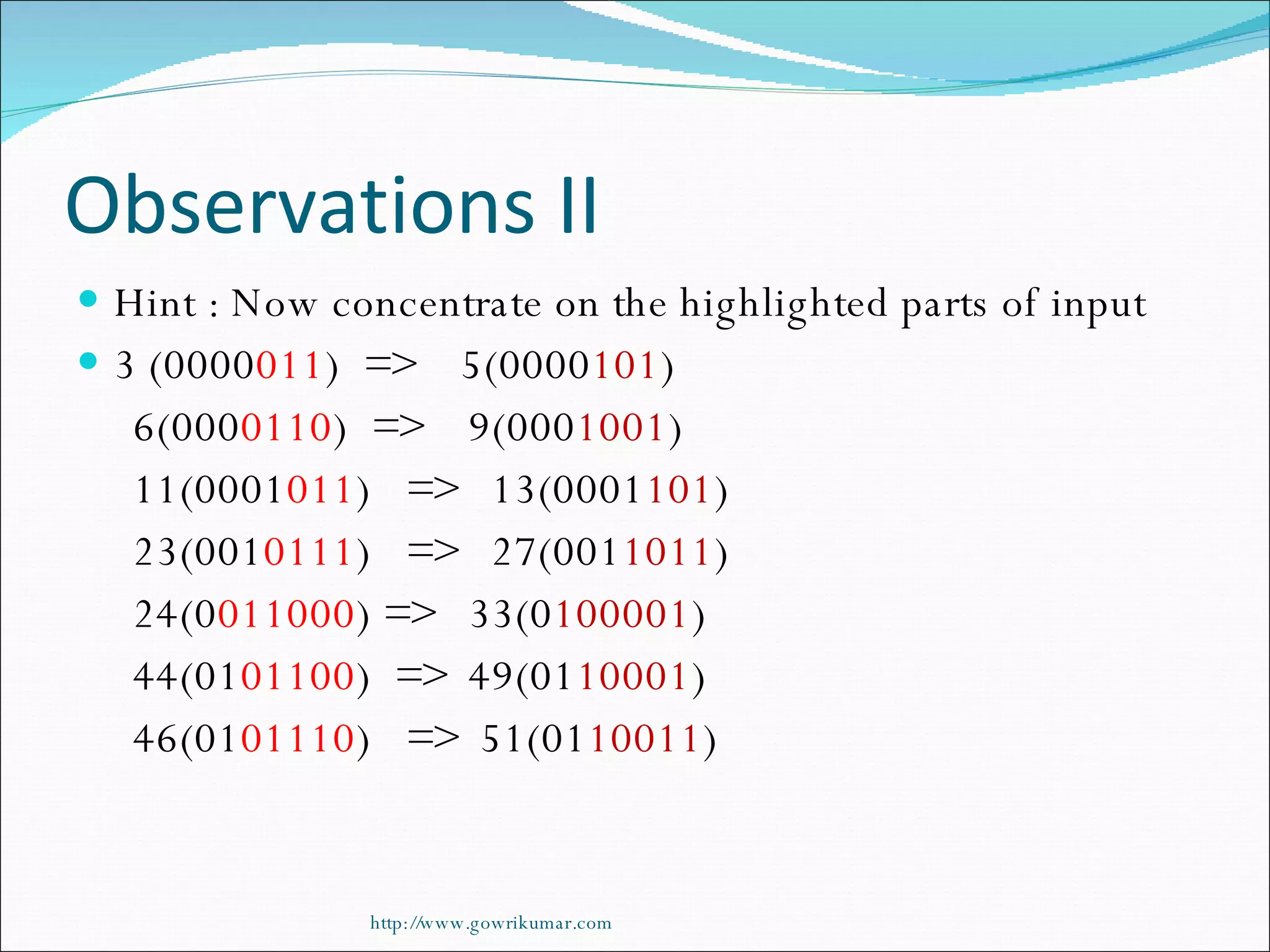
Observations II Hint : Now concentrate on the highlighted parts of input 3 (0000 011 )  =>  5(0000 101 ) 6(000 0110 )  =>  9(000 1001 ) 11(0001 011 )  =>  13(0001 101 ) 23(001 0111 )  =>  27(001 1011 ) 24(0 011000 ) =>  33(0 100001 ) 44(01 01100 )  =>  49(01 10001 ) 46(01 01110 )  =>  51(01 10011 ) http://www.gowrikumar.com
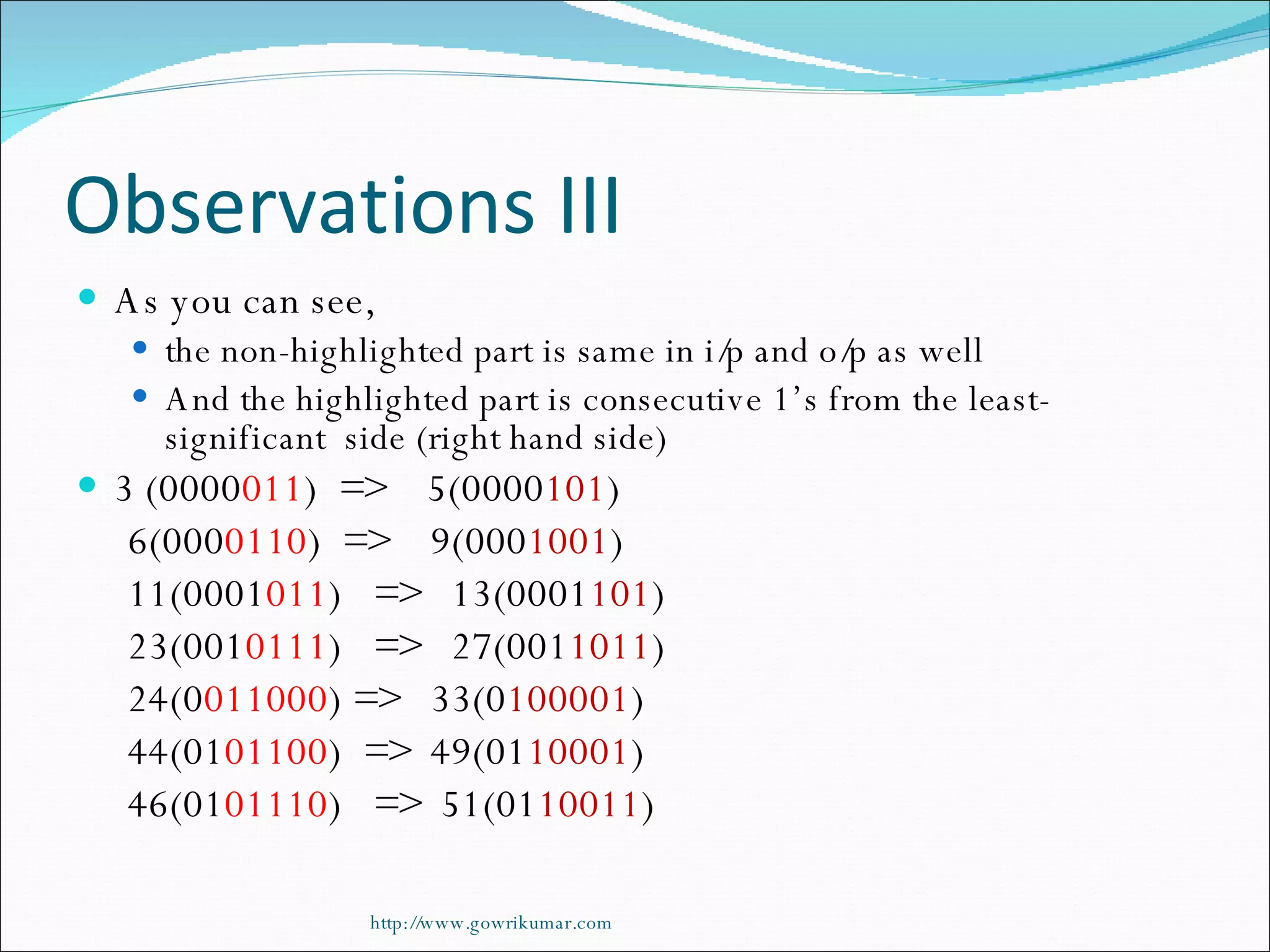
Observations III As you can see,  the non-highlighted part is same in i/p and o/p as well And the highlighted part is consecutive 1’s from the least-significant  side (right hand side) 3 (0000 011 )  =>  5(0000 101 ) 6(000 0110 )  =>  9(000 1001 ) 11(0001 011 )  =>  13(0001 101 ) 23(001 0111 )  =>  27(001 1011 ) 24(0 011000 ) =>  33(0 100001 ) 44(01 01100 )  =>  49(01 10001 ) 46(01 01110 )  =>  51(01 10011 ) http://www.gowrikumar.com
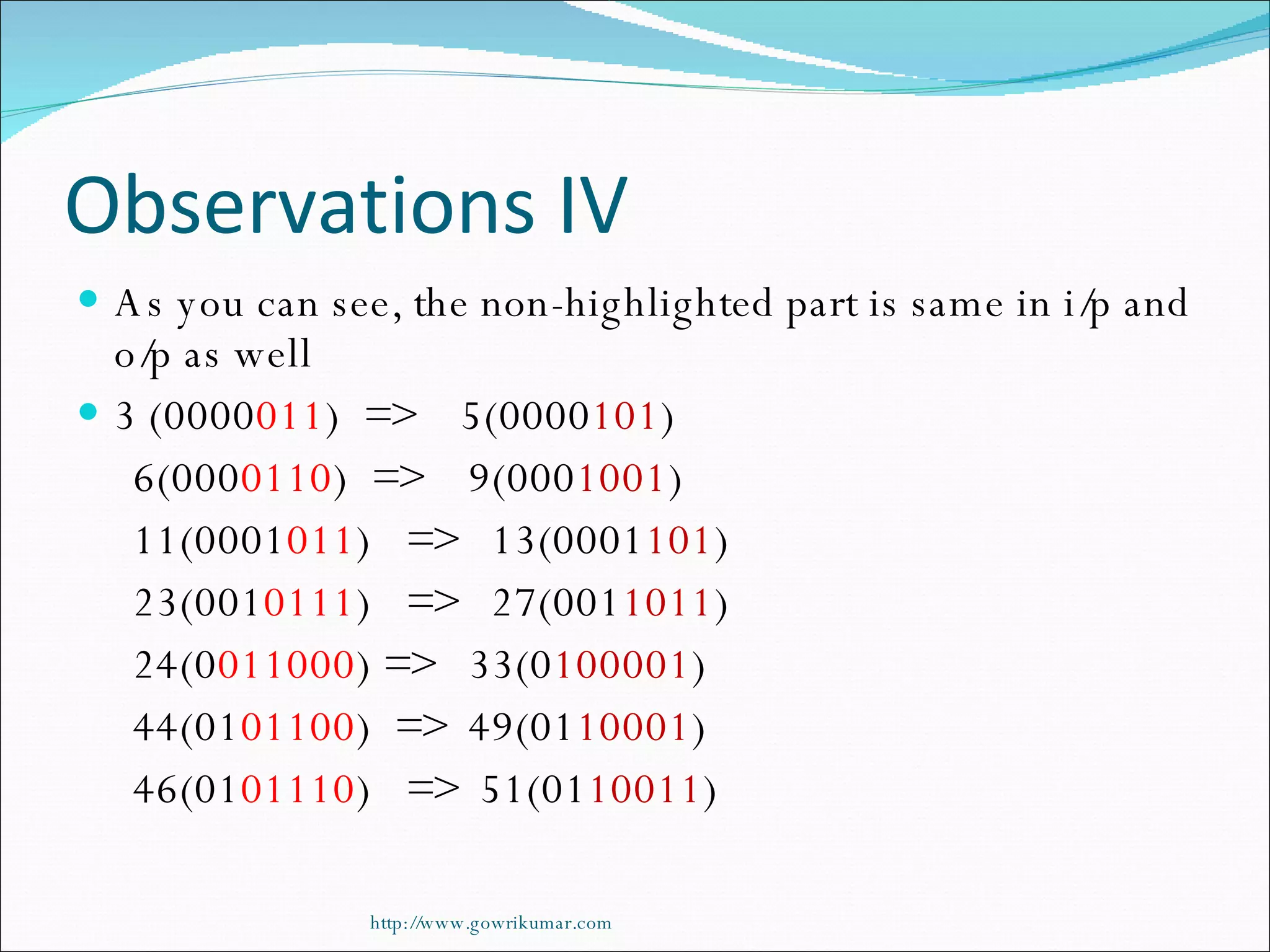
Observations IV As you can see, the non-highlighted part is same in i/p and o/p as well 3 (0000 011 )  =>  5(0000 101 ) 6(000 0110 )  =>  9(000 1001 ) 11(0001 011 )  =>  13(0001 101 ) 23(001 0111 )  =>  27(001 1011 ) 24(0 011000 ) =>  33(0 100001 ) 44(01 01100 )  =>  49(01 10001 ) 46(01 01110 )  =>  51(01 10011 ) http://www.gowrikumar.com
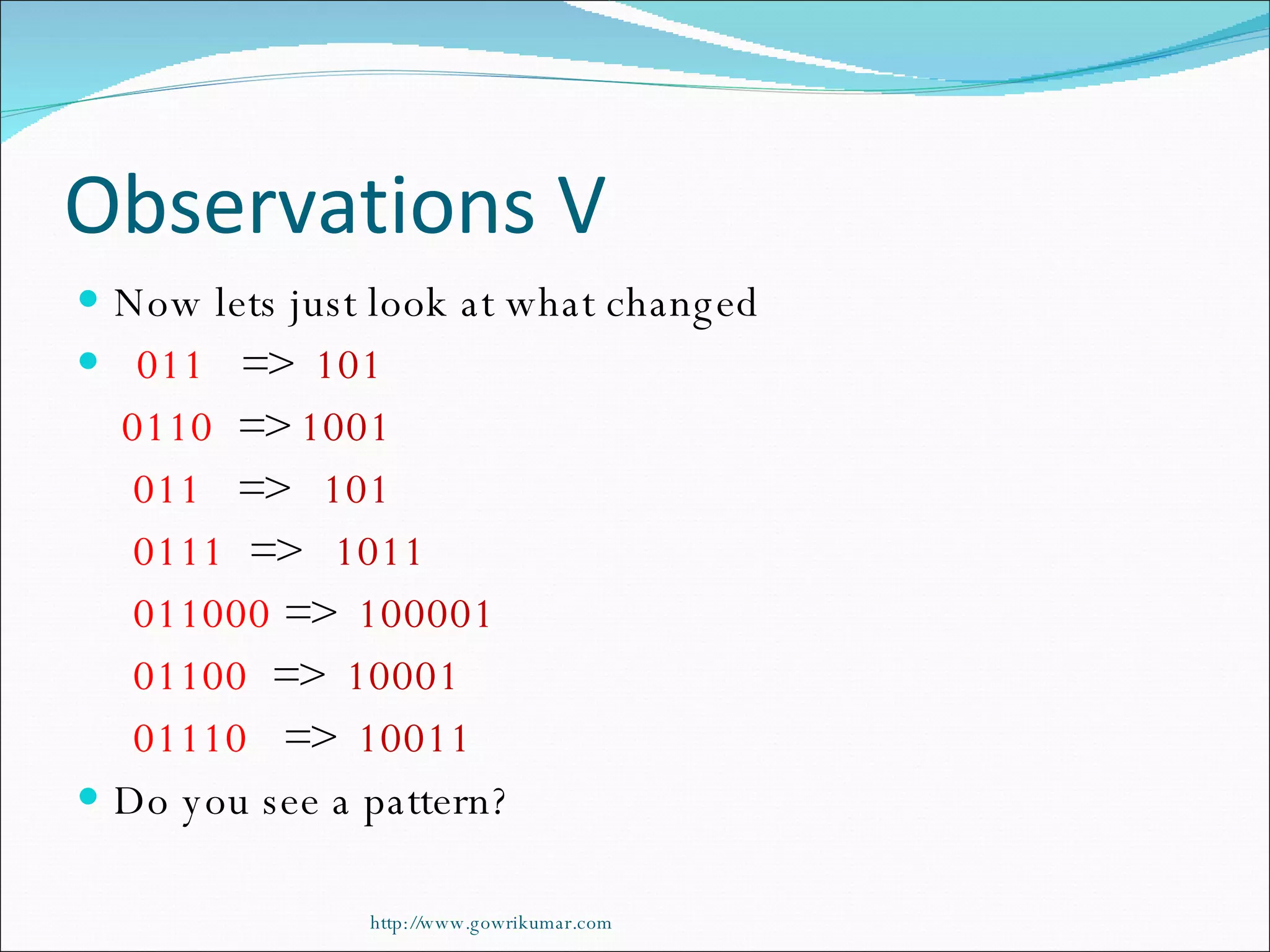
Observations V Now lets just look at what changed 011   =>  101 0110   =>  1001 011   =>  101 0111   =>  1011 011000  =>  100001 01100   =>  10001 01110   =>  10011 Do you see a pattern? http://www.gowrikumar.com
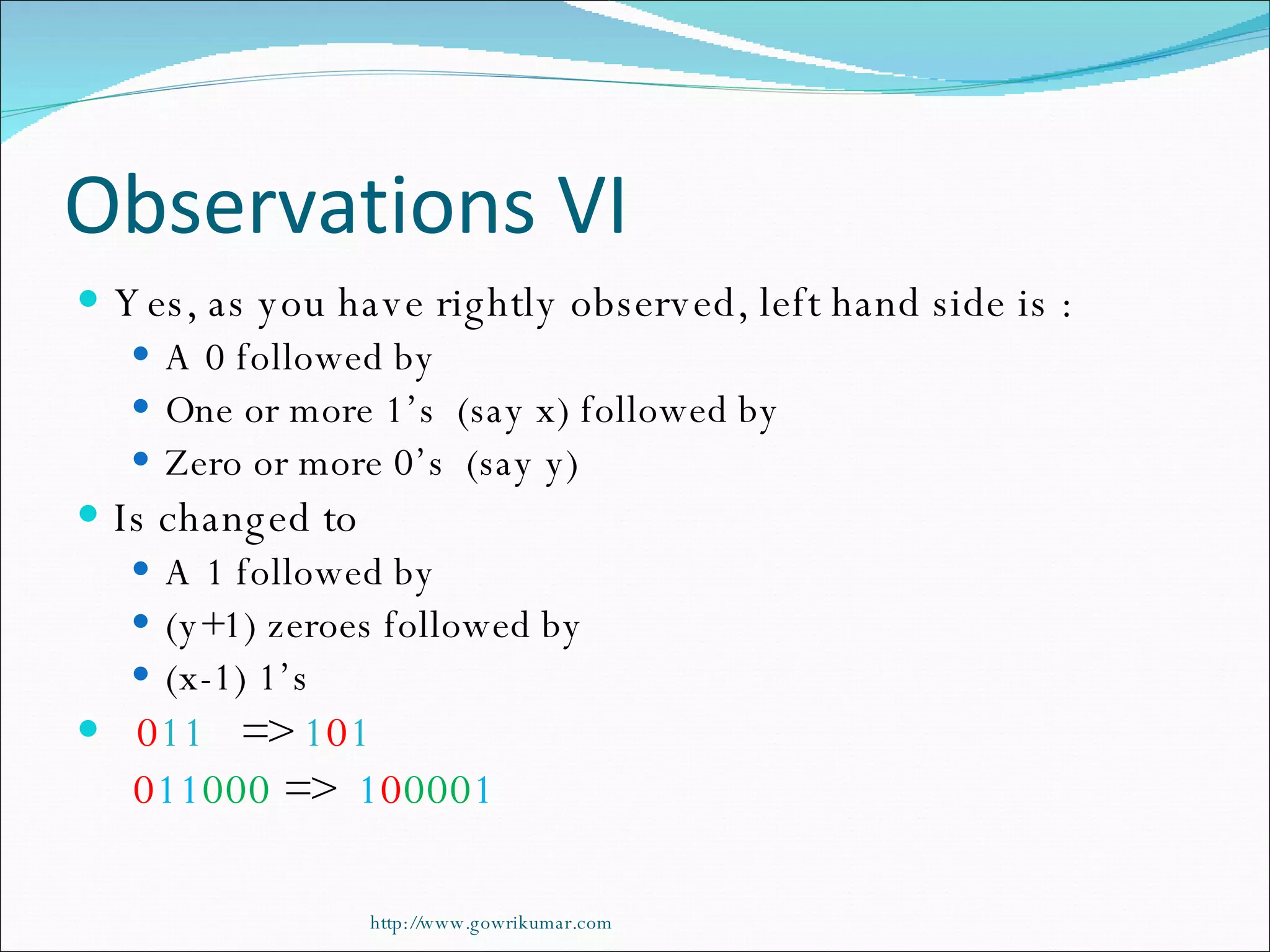
Observations VI Yes, as you have rightly observed, left hand side is : A 0 followed by  One or more 1’s  (say x) followed by Zero or more 0’s  (say y) Is changed to A 1 followed by (y+1) zeroes followed by (x-1) 1’s 0 11   =>  1 0 1 0 11 000  =>  1 0 000 1 http://www.gowrikumar.com
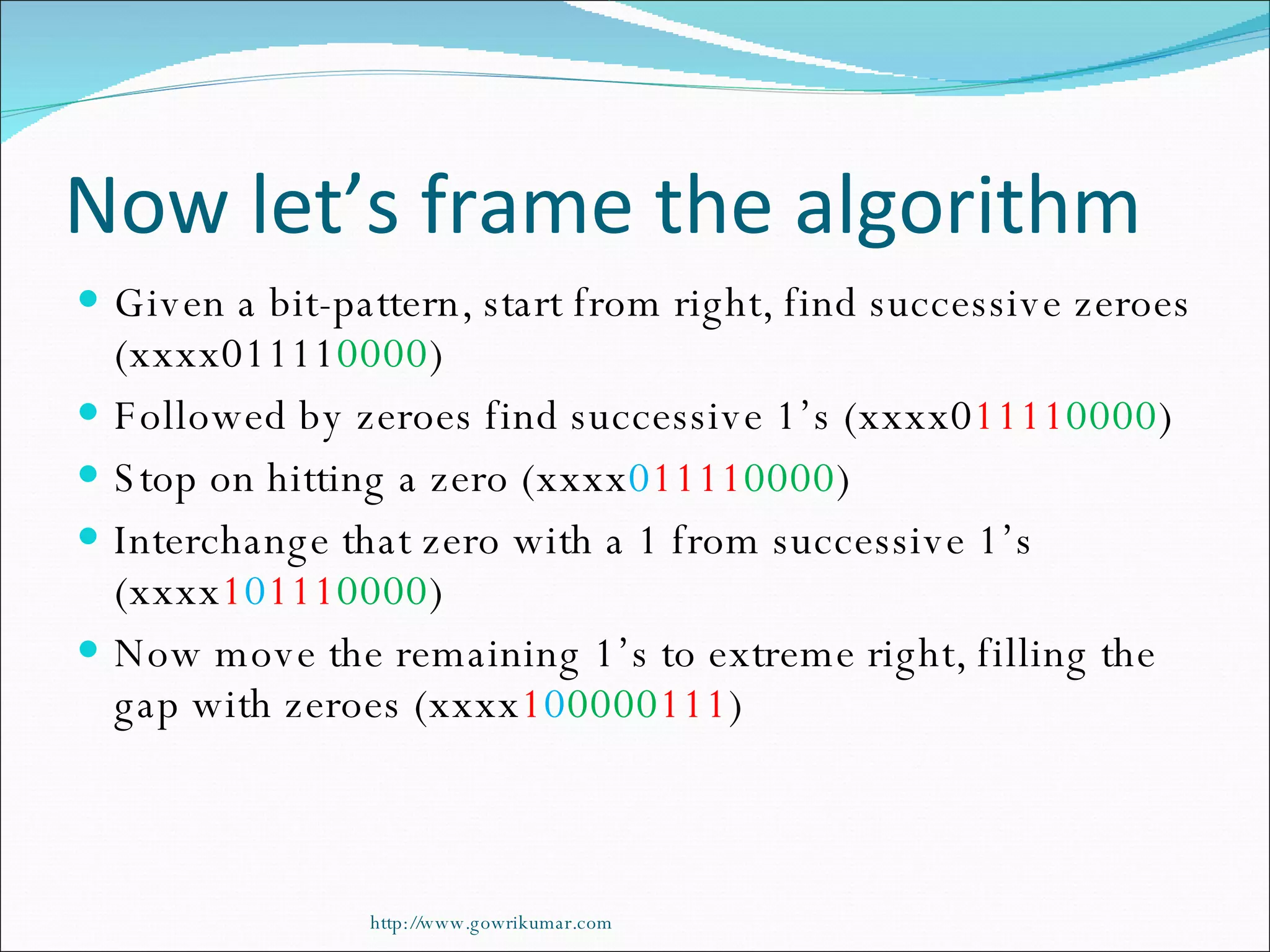
Now let’s frame the algorithm Given a bit-pattern, start from right, find successive zeroes (xxxx01111 0000 ) Followed by zeroes find successive 1’s (xxxx0 1111 0000 ) Stop on hitting a zero (xxxx 0 1111 0000 ) Interchange that zero with a 1 from successive 1’s (xxxx 1 0 111 0000 ) Now move the remaining 1’s to extreme right, filling the gap with zeroes (xxxx 1 0 0000 111 ) http://www.gowrikumar.com
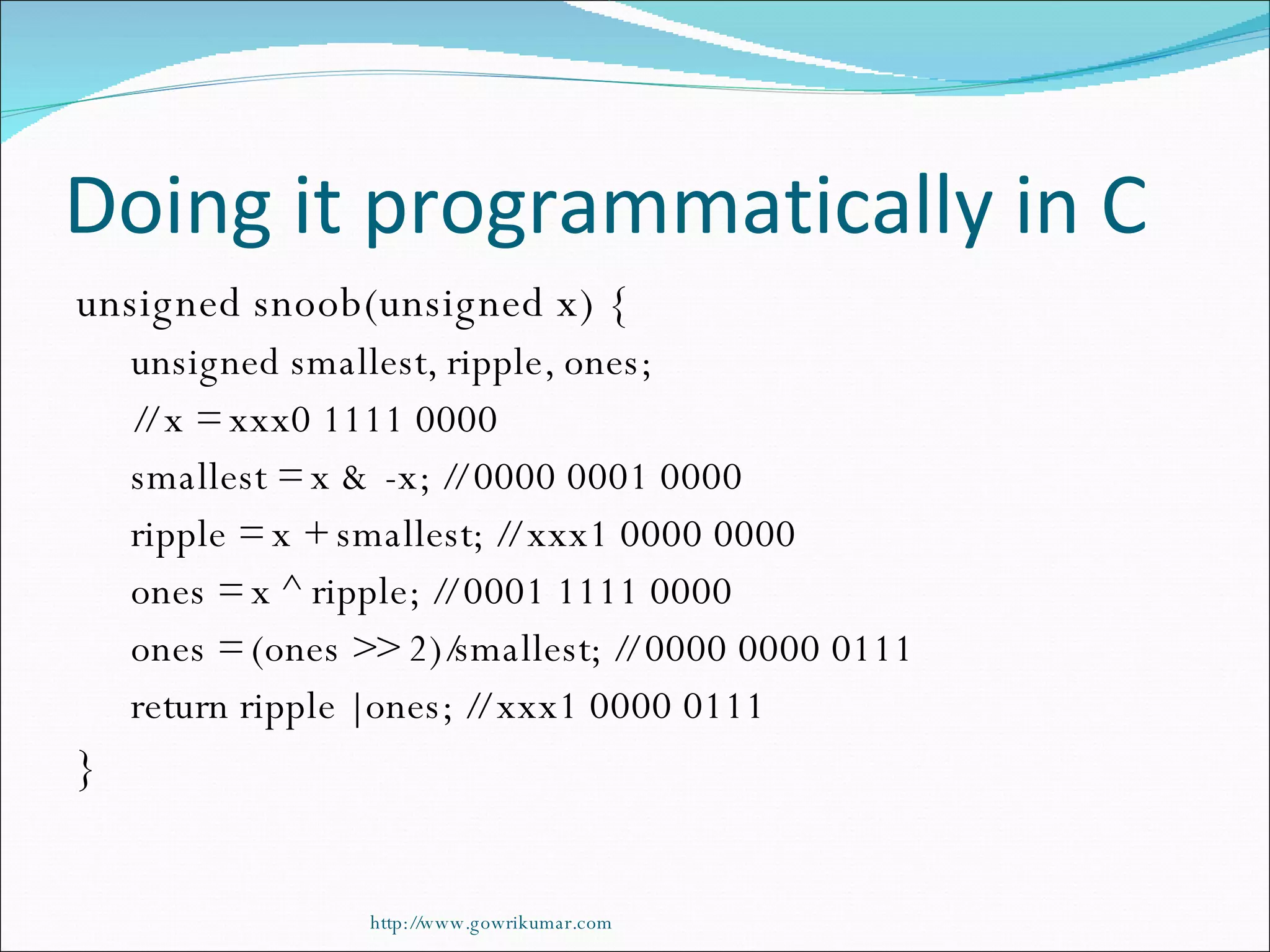
Doing it programmatically in C unsigned snoob(unsigned x) { unsigned smallest, ripple, ones; // x = xxx0 1111 0000 smallest = x & -x; // 0000 0001 0000 ripple = x + smallest; // xxx1 0000 0000 ones = x ^ ripple; // 0001 1111 0000 ones = (ones >> 2)/smallest; // 0000 0000 0111 return ripple | ones; // xxx1 0000 0111 } http://www.gowrikumar.com
Reference Hackers Delight  ( chapter 2 – Basics ) http://www.gowrikumar.com

Next higher number with same number of binary bits set

  • 1.
    CH Gowri Kumar[email_address]
  • 2.
    Problem Given anumber m find the next higher number r , that has same number of 1-bits. Ex : 3 (0000011) => 5(0000101) 6(0000110) => 9(0001001) 11(0001011) => 13(0001101) 23(0010111) => 27(0011011) 24(0011000) => 33(0100001) 44(0101100) => 49(0110001) 46(0101110) => 51(00110011) http://www.gowrikumar.com
  • 3.
    Observations I Lookat the input and the outputs again and see if you can make some algorithm out of it 3 (0000011) => 5(0000101) 6(0000110) => 9(0001001) 11(0001011) => 13(0001101) 23(0010111) => 27(0011011) 24(0011000) => 33(0100001) 44(0101100) => 49(0110001) 46(0101110) => 51(00110011) http://www.gowrikumar.com
  • 4.
    Observations II Hint: Now concentrate on the highlighted parts of input 3 (0000 011 ) => 5(0000 101 ) 6(000 0110 ) => 9(000 1001 ) 11(0001 011 ) => 13(0001 101 ) 23(001 0111 ) => 27(001 1011 ) 24(0 011000 ) => 33(0 100001 ) 44(01 01100 ) => 49(01 10001 ) 46(01 01110 ) => 51(01 10011 ) http://www.gowrikumar.com
  • 5.
    Observations III Asyou can see, the non-highlighted part is same in i/p and o/p as well And the highlighted part is consecutive 1’s from the least-significant side (right hand side) 3 (0000 011 ) => 5(0000 101 ) 6(000 0110 ) => 9(000 1001 ) 11(0001 011 ) => 13(0001 101 ) 23(001 0111 ) => 27(001 1011 ) 24(0 011000 ) => 33(0 100001 ) 44(01 01100 ) => 49(01 10001 ) 46(01 01110 ) => 51(01 10011 ) http://www.gowrikumar.com
  • 6.
    Observations IV Asyou can see, the non-highlighted part is same in i/p and o/p as well 3 (0000 011 ) => 5(0000 101 ) 6(000 0110 ) => 9(000 1001 ) 11(0001 011 ) => 13(0001 101 ) 23(001 0111 ) => 27(001 1011 ) 24(0 011000 ) => 33(0 100001 ) 44(01 01100 ) => 49(01 10001 ) 46(01 01110 ) => 51(01 10011 ) http://www.gowrikumar.com
  • 7.
    Observations V Nowlets just look at what changed 011 => 101 0110 => 1001 011 => 101 0111 => 1011 011000 => 100001 01100 => 10001 01110 => 10011 Do you see a pattern? http://www.gowrikumar.com
  • 8.
    Observations VI Yes,as you have rightly observed, left hand side is : A 0 followed by One or more 1’s (say x) followed by Zero or more 0’s (say y) Is changed to A 1 followed by (y+1) zeroes followed by (x-1) 1’s 0 11 => 1 0 1 0 11 000 => 1 0 000 1 http://www.gowrikumar.com
  • 9.
    Now let’s framethe algorithm Given a bit-pattern, start from right, find successive zeroes (xxxx01111 0000 ) Followed by zeroes find successive 1’s (xxxx0 1111 0000 ) Stop on hitting a zero (xxxx 0 1111 0000 ) Interchange that zero with a 1 from successive 1’s (xxxx 1 0 111 0000 ) Now move the remaining 1’s to extreme right, filling the gap with zeroes (xxxx 1 0 0000 111 ) http://www.gowrikumar.com
  • 10.
    Doing it programmaticallyin C unsigned snoob(unsigned x) { unsigned smallest, ripple, ones; // x = xxx0 1111 0000 smallest = x & -x; // 0000 0001 0000 ripple = x + smallest; // xxx1 0000 0000 ones = x ^ ripple; // 0001 1111 0000 ones = (ones >> 2)/smallest; // 0000 0000 0111 return ripple | ones; // xxx1 0000 0111 } http://www.gowrikumar.com
  • 11.
    Reference Hackers Delight ( chapter 2 – Basics ) http://www.gowrikumar.com