CHAPTER 11 Coping with NP-completeness
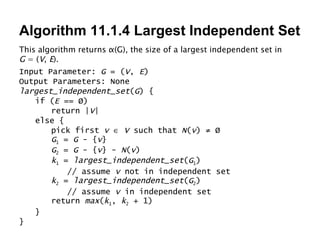
Algorithm 11.1.4 Largest Independent Set This algorithm returns  α (G), the size of a largest independent set in  G  = ( V ,  E ). Input Parameter:  G  = ( V ,  E ) Output Parameters: None largest_independent_set ( G ) { if ( E  == Ø) return | V | else { pick first  v      V  such that  N ( v ) ≠ Ø G 1  =  G  - { v } G 2  =  G  - { v } -  N ( v ) k 1  =  largest_independent_set ( G 1 ) // assume  v  not in independent set k 2  =  largest_independent_set ( G 2 ) // assume  v  in independent set return  max ( k 1 ,  k 2  + 1) } }
Algorithm 11.1.11 3-Satisfiability This algorithm takes as an input a formula in CNF in which every clause contains at most three literals and returns true if and only if is satisfiable.
Input Parameter:  ϕ   Output Parameters: None 3_satisfiability ( ϕ ) { if ( ϕ  does not contain any clauses) return  ϕ  // ϕ  is the logical constant true or false if ( ϕ  contains a clause with one literal  a ) { ϕ  =  ϕ [ a  -> true] //  a  has to be true return 3_satisfiability( ϕ ) } if ( ϕ  contains a clause with two literals  a ,  b ) { ϕ 1  =  ϕ [ a  -> false][ b  -> true] ϕ 2  =  ϕ [ a  -> true] return 3_satisfiability( ϕ 1 )||3_satisfiability( ϕ 2 ) } if ( ϕ  contains a clause with three literals  a ,  b ,  c ) { ϕ 1  =  ϕ [ a  -> false][ b  -> false][ c  -> true] ϕ 2  =  ϕ [ a  -> false][ b  -> true] ϕ 3  =  ϕ [ a  -> true] return 3_satisfiability( ϕ 1 ) || 3_satisfiability( ϕ 2 ) || 3_satisfiability( ϕ 3 ) } }
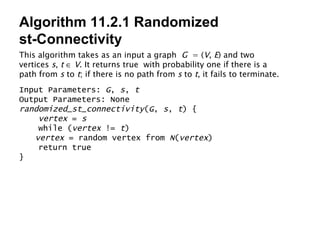
Algorithm 11.2.1 Randomized  st-Connectivity This algorithm takes as an input a graph  G   = ( V ,  E ) and two vertices  s ,  t      V . It returns true  with probability one if there is a path from  s  to  t ; if there is no path from  s  to  t , it fails to terminate. Input Parameters:  G ,  s ,  t Output Parameters: None randomized_st_connectivity ( G ,  s ,  t ) { vertex  =  s while ( vertex  !=  t ) vertex  = random vertex from  N ( vertex ) return true }
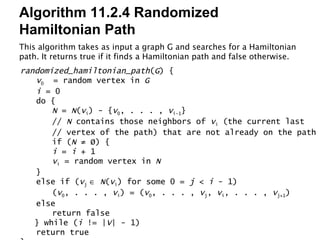
Algorithm 11.2.4 Randomized Hamiltonian Path This algorithm takes as input a graph G and searches for a Hamiltonian path. It returns true if it finds a Hamiltonian path and false otherwise. randomized_hamiltonian_path ( G ) { v 0   = random vertex in  G i  = 0 do { N  =  N ( v i ) - { v 0 , . . . ,  v i-1 } //  N  contains those neighbors of  v i  (the current last // vertex of the path) that are not already on the path if ( N  ≠ Ø) { i  =  i  + 1 v i  = random vertex in  N } else if ( v j     N ( v i ) for some 0 =  j  <  i  - 1) ( v 0 , . . . ,  v i ) = ( v 0 , . . . ,  v j ,  v i , . . . ,  v j+1 ) else return false } while ( i  != | V | - 1) return true }
Algorithm 11.3.8 Next Fit This algorithm computes an assignment  b  of  n  items with sizes  s [1], . . . ,  s [ n ]    (0, 1] into bins and returns the number  k  of bins it used. Input Parameter:  s Output Parameters: None next_fit ( s ) { n  =  s . last k  = 1 // current bin size  = 0 //accumulated size of items in current bin for  i  = 1 to  n if ( size  +  s [ i ] = 1) { b [ i ] =  k  // enough room to add item  i  to bin  k size  =  size  +  s [ i ] } else { k  =  k  + 1 b [ i ] =  k size  =  s [ i ] } return  k }
Algorithm 11.3.13 First Fit This algorithm computes an assignment  b  of  n  items with sizes  s [1], . . . ,  s [ n ]    (0, 1] into bins and returns the number  k  of bins it used.
Input Parameter:  s Output Parameters: None first_fit ( s ) { n  =  s . last k  = 1 // number of bins used c [ k ] = 0 //  c [ i ] is the total size of items in bin  i for  i  = 1 to  n  { j  = 1 while ( c [ j ] +  s [ i ] > 1) { j  =  j  + 1 if ( j  >  k ) { // open new bin k  =  j   c [ k ] = 0 } } // add item  i  to bin  j b [ i ] =  j   c [ j ] =  c [ j ] +  s [ i ] } return  k }
Algorithm 11.3.16 First Fit Decreasing This algorithm computes an assignment  b  of  n  items with sizes  s [1], . . . ,  s [ n ]    (0, 1] into bins and returns the number  k  of bins it used. Input Parameter:  s Output Parameters: None first_fit_decreasing ( s ) { s . sort (>) // sort  s  in decreasing order return  first_fit ( s ) }
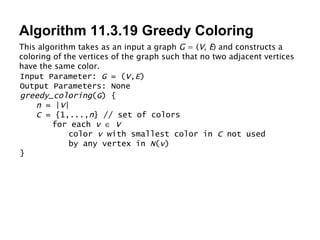
Algorithm 11.3.19 Greedy Coloring This algorithm takes as an input a graph  G  = ( V ,  E ) and constructs a coloring of the vertices of the graph such that no two adjacent vertices have the same color. Input Parameter:  G  = ( V , E ) Output Parameters: None greedy_coloring ( G ) { n  = | V | C  = {1,..., n } // set of colors for each  v      V color  v  with smallest color in  C  not used  by any vertex in  N ( v ) }
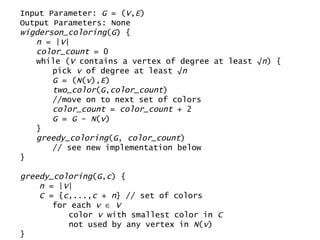
Algorithm 11.3.23 Wigderson Coloring This algorithm takes as input a 3-colorable graph  G  = ( V ,  E ) and constructs a coloring of the vertices of the graph such that no two adjacent vertices have the same color.
Input Parameter:  G  = ( V , E ) Output Parameters: None wigderson_coloring ( G ) { n  = | V | color_count  = 0 while ( V  contains a vertex of degree at least √ n ) { pick  v  of degree at least √ n G  = ( N ( v ), E ) two_color ( G , color_count ) //move on to next set of colors color_count  =  color_count  + 2  G  =  G  -  N ( v ) } greedy_coloring ( G ,  color_count )  // see new implementation below } greedy_coloring ( G , c ) { n  = | V | C  = { c ,..., c  +  n } // set of colors for each  v      V color  v  with smallest color in  C   not used by any vertex in  N ( v ) }
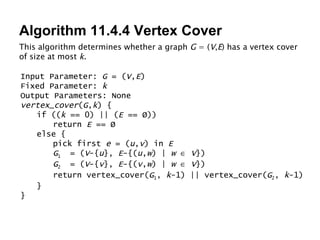
Algorithm 11.4.4 Vertex Cover This algorithm determines whether a graph  G  = ( V , E ) has a vertex cover of size at most  k . Input Parameter:  G  = ( V , E ) Fixed Parameter:  k Output Parameters: None vertex_cover ( G , k ) { if (( k  == 0) || ( E  == Ø)) return  E  == Ø else { pick first  e  = ( u , v ) in  E G 1   = ( V -{ u },  E -{( u , w ) |  w      V }) G 2   = ( V -{ v },  E -{( v , w ) |  w      V }) return vertex_cover( G 1 ,  k -1) || vertex_cover( G 2 ,  k -1) } }
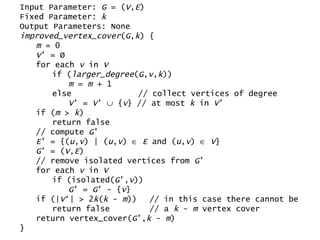
Algorithm 11.4.7 Vertex Cover, Improved This algorithm determines whether a graph  G  = ( V , E ) has a vertex cover of size at most  k .
Input Parameter:  G  = ( V , E ) Fixed Parameter:  k Output Parameters: None improved_vertex_cover ( G , k ) { m  = 0 V ’ = Ø for each  v  in  V if ( larger_degree ( G , v , k )) m  =  m  + 1 else  // collect vertices of degree V ’ =  V ’    { v } // at most  k  in  V ’ if ( m  >  k ) return false // compute  G ’ E ’ = {( u , v ) | ( u , v )     E  and ( u , v )     V } G ’ = ( V , E ) // remove isolated vertices from  G ’ for each  v  in  V if (isolated( G ’, v )) G ’ =  G ’ - { v } if (| V ‘| > 2 k ( k  -  m ))  // in this case there cannot be  return false  // a  k  -  m  vertex cover return vertex_cover( G ’, k  -  m ) }
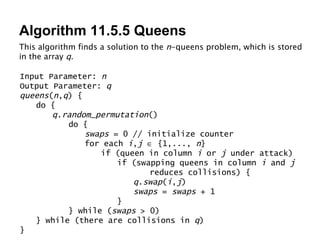
Algorithm 11.5.5 Queens This algorithm finds a solution to the  n -queens problem, which is stored in the array  q . Input Parameter:  n Output Parameter:  q queens ( n , q ) { do { q . random_permutation () do { swaps  = 0 // initialize counter for each  i , j     {1,...,  n } if (queen in column  i  or  j  under attack) if (swapping queens in column  i  and  j   reduces collisions) { q . swap ( i , j ) swaps  =  swaps  + 1 } } while ( swaps  > 0) } while (there are collisions in  q ) }
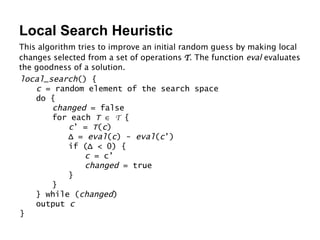
Local Search Heuristic This algorithm tries to improve an initial random guess by making local changes selected from a set of operations  T . The function  eval  evaluates the goodness of a solution. local_search () { c  = random element of the search space do { changed  = false for each  T      T  { c ’ =  T ( c ) Δ  =  eval ( c ) -  eval ( c ’) if ( Δ  < 0) { c  = c’ changed  = true } } } while ( changed ) output  c }
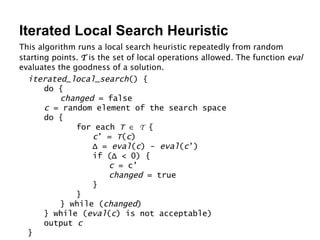
Iterated Local Search Heuristic This algorithm runs a local search heuristic repeatedly from random starting points.  T  is the set of local operations allowed. The function  eval  evaluates the goodness of a solution. iterated_local_search () { do { changed  = false c  = random element of the search space do { for each  T      T  { c ’ =  T ( c ) Δ  =  eval ( c ) -  eval ( c ’) if ( Δ  < 0) { c  = c’ changed  = true } } } while ( changed ) } while ( eval ( c ) is not acceptable) output  c }
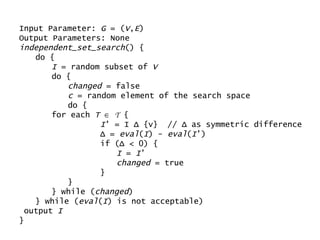
Algorithm 11.5.7 Independent Set Search This algorithm searches for a large independent set in the input graph  G  .
Input Parameter:  G  = ( V , E ) Output Parameters: None independent_set_search () { do { I  = random subset of  V do { changed  = false c  = random element of the search space do { for each  T      T  { I ’ = I  Δ  {v}  //  Δ  as symmetric difference Δ  =  eval ( I ) -  eval ( I ’) if ( Δ  < 0) { I  =  I ’ changed  = true } } } while ( changed ) } while ( eval ( I ) is not acceptable) output  I }
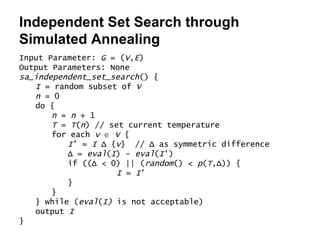
Independent Set Search through Simulated Annealing Input Parameter:  G  = ( V , E ) Output Parameters: None sa_independent_set_search () { I  = random subset of  V n  = 0 do { n  =  n  + 1 T  =  T ( n ) // set current temperature for each  v      V  { I ’ =  I   Δ  { v }  //  Δ  as symmetric difference Δ  =  eval ( I ) -  eval ( I ’) if (( Δ  < 0) || ( random () <  p ( T , Δ )) { I  =  I ’ } } } while ( eval ( I)  is not acceptable) output  I }

Chap11alg

  • 1.
    CHAPTER 11 Copingwith NP-completeness
  • 2.
    Algorithm 11.1.4 LargestIndependent Set This algorithm returns α (G), the size of a largest independent set in G = ( V , E ). Input Parameter: G = ( V , E ) Output Parameters: None largest_independent_set ( G ) { if ( E == Ø) return | V | else { pick first v  V such that N ( v ) ≠ Ø G 1 = G - { v } G 2 = G - { v } - N ( v ) k 1 = largest_independent_set ( G 1 ) // assume v not in independent set k 2 = largest_independent_set ( G 2 ) // assume v in independent set return max ( k 1 , k 2 + 1) } }
  • 3.
    Algorithm 11.1.11 3-SatisfiabilityThis algorithm takes as an input a formula in CNF in which every clause contains at most three literals and returns true if and only if is satisfiable.
  • 4.
    Input Parameter: ϕ Output Parameters: None 3_satisfiability ( ϕ ) { if ( ϕ does not contain any clauses) return ϕ // ϕ is the logical constant true or false if ( ϕ contains a clause with one literal a ) { ϕ = ϕ [ a -> true] // a has to be true return 3_satisfiability( ϕ ) } if ( ϕ contains a clause with two literals a , b ) { ϕ 1 = ϕ [ a -> false][ b -> true] ϕ 2 = ϕ [ a -> true] return 3_satisfiability( ϕ 1 )||3_satisfiability( ϕ 2 ) } if ( ϕ contains a clause with three literals a , b , c ) { ϕ 1 = ϕ [ a -> false][ b -> false][ c -> true] ϕ 2 = ϕ [ a -> false][ b -> true] ϕ 3 = ϕ [ a -> true] return 3_satisfiability( ϕ 1 ) || 3_satisfiability( ϕ 2 ) || 3_satisfiability( ϕ 3 ) } }
  • 5.
    Algorithm 11.2.1 Randomized st-Connectivity This algorithm takes as an input a graph G = ( V , E ) and two vertices s , t  V . It returns true with probability one if there is a path from s to t ; if there is no path from s to t , it fails to terminate. Input Parameters: G , s , t Output Parameters: None randomized_st_connectivity ( G , s , t ) { vertex = s while ( vertex != t ) vertex = random vertex from N ( vertex ) return true }
  • 6.
    Algorithm 11.2.4 RandomizedHamiltonian Path This algorithm takes as input a graph G and searches for a Hamiltonian path. It returns true if it finds a Hamiltonian path and false otherwise. randomized_hamiltonian_path ( G ) { v 0 = random vertex in G i = 0 do { N = N ( v i ) - { v 0 , . . . , v i-1 } // N contains those neighbors of v i (the current last // vertex of the path) that are not already on the path if ( N ≠ Ø) { i = i + 1 v i = random vertex in N } else if ( v j  N ( v i ) for some 0 = j < i - 1) ( v 0 , . . . , v i ) = ( v 0 , . . . , v j , v i , . . . , v j+1 ) else return false } while ( i != | V | - 1) return true }
  • 7.
    Algorithm 11.3.8 NextFit This algorithm computes an assignment b of n items with sizes s [1], . . . , s [ n ]  (0, 1] into bins and returns the number k of bins it used. Input Parameter: s Output Parameters: None next_fit ( s ) { n = s . last k = 1 // current bin size = 0 //accumulated size of items in current bin for i = 1 to n if ( size + s [ i ] = 1) { b [ i ] = k // enough room to add item i to bin k size = size + s [ i ] } else { k = k + 1 b [ i ] = k size = s [ i ] } return k }
  • 8.
    Algorithm 11.3.13 FirstFit This algorithm computes an assignment b of n items with sizes s [1], . . . , s [ n ]  (0, 1] into bins and returns the number k of bins it used.
  • 9.
    Input Parameter: s Output Parameters: None first_fit ( s ) { n = s . last k = 1 // number of bins used c [ k ] = 0 // c [ i ] is the total size of items in bin i for i = 1 to n { j = 1 while ( c [ j ] + s [ i ] > 1) { j = j + 1 if ( j > k ) { // open new bin k = j c [ k ] = 0 } } // add item i to bin j b [ i ] = j c [ j ] = c [ j ] + s [ i ] } return k }
  • 10.
    Algorithm 11.3.16 FirstFit Decreasing This algorithm computes an assignment b of n items with sizes s [1], . . . , s [ n ]  (0, 1] into bins and returns the number k of bins it used. Input Parameter: s Output Parameters: None first_fit_decreasing ( s ) { s . sort (>) // sort s in decreasing order return first_fit ( s ) }
  • 11.
    Algorithm 11.3.19 GreedyColoring This algorithm takes as an input a graph G = ( V , E ) and constructs a coloring of the vertices of the graph such that no two adjacent vertices have the same color. Input Parameter: G = ( V , E ) Output Parameters: None greedy_coloring ( G ) { n = | V | C = {1,..., n } // set of colors for each v  V color v with smallest color in C not used by any vertex in N ( v ) }
  • 12.
    Algorithm 11.3.23 WigdersonColoring This algorithm takes as input a 3-colorable graph G = ( V , E ) and constructs a coloring of the vertices of the graph such that no two adjacent vertices have the same color.
  • 13.
    Input Parameter: G = ( V , E ) Output Parameters: None wigderson_coloring ( G ) { n = | V | color_count = 0 while ( V contains a vertex of degree at least √ n ) { pick v of degree at least √ n G = ( N ( v ), E ) two_color ( G , color_count ) //move on to next set of colors color_count = color_count + 2 G = G - N ( v ) } greedy_coloring ( G , color_count ) // see new implementation below } greedy_coloring ( G , c ) { n = | V | C = { c ,..., c + n } // set of colors for each v  V color v with smallest color in C not used by any vertex in N ( v ) }
  • 14.
    Algorithm 11.4.4 VertexCover This algorithm determines whether a graph G = ( V , E ) has a vertex cover of size at most k . Input Parameter: G = ( V , E ) Fixed Parameter: k Output Parameters: None vertex_cover ( G , k ) { if (( k == 0) || ( E == Ø)) return E == Ø else { pick first e = ( u , v ) in E G 1 = ( V -{ u }, E -{( u , w ) | w  V }) G 2 = ( V -{ v }, E -{( v , w ) | w  V }) return vertex_cover( G 1 , k -1) || vertex_cover( G 2 , k -1) } }
  • 15.
    Algorithm 11.4.7 VertexCover, Improved This algorithm determines whether a graph G = ( V , E ) has a vertex cover of size at most k .
  • 16.
    Input Parameter: G = ( V , E ) Fixed Parameter: k Output Parameters: None improved_vertex_cover ( G , k ) { m = 0 V ’ = Ø for each v in V if ( larger_degree ( G , v , k )) m = m + 1 else // collect vertices of degree V ’ = V ’  { v } // at most k in V ’ if ( m > k ) return false // compute G ’ E ’ = {( u , v ) | ( u , v )  E and ( u , v )  V } G ’ = ( V , E ) // remove isolated vertices from G ’ for each v in V if (isolated( G ’, v )) G ’ = G ’ - { v } if (| V ‘| > 2 k ( k - m )) // in this case there cannot be return false // a k - m vertex cover return vertex_cover( G ’, k - m ) }
  • 17.
    Algorithm 11.5.5 QueensThis algorithm finds a solution to the n -queens problem, which is stored in the array q . Input Parameter: n Output Parameter: q queens ( n , q ) { do { q . random_permutation () do { swaps = 0 // initialize counter for each i , j  {1,..., n } if (queen in column i or j under attack) if (swapping queens in column i and j reduces collisions) { q . swap ( i , j ) swaps = swaps + 1 } } while ( swaps > 0) } while (there are collisions in q ) }
  • 18.
    Local Search HeuristicThis algorithm tries to improve an initial random guess by making local changes selected from a set of operations T . The function eval evaluates the goodness of a solution. local_search () { c = random element of the search space do { changed = false for each T  T { c ’ = T ( c ) Δ = eval ( c ) - eval ( c ’) if ( Δ < 0) { c = c’ changed = true } } } while ( changed ) output c }
  • 19.
    Iterated Local SearchHeuristic This algorithm runs a local search heuristic repeatedly from random starting points. T is the set of local operations allowed. The function eval evaluates the goodness of a solution. iterated_local_search () { do { changed = false c = random element of the search space do { for each T  T { c ’ = T ( c ) Δ = eval ( c ) - eval ( c ’) if ( Δ < 0) { c = c’ changed = true } } } while ( changed ) } while ( eval ( c ) is not acceptable) output c }
  • 20.
    Algorithm 11.5.7 IndependentSet Search This algorithm searches for a large independent set in the input graph G .
  • 21.
    Input Parameter: G = ( V , E ) Output Parameters: None independent_set_search () { do { I = random subset of V do { changed = false c = random element of the search space do { for each T  T { I ’ = I Δ {v} // Δ as symmetric difference Δ = eval ( I ) - eval ( I ’) if ( Δ < 0) { I = I ’ changed = true } } } while ( changed ) } while ( eval ( I ) is not acceptable) output I }
  • 22.
    Independent Set Searchthrough Simulated Annealing Input Parameter: G = ( V , E ) Output Parameters: None sa_independent_set_search () { I = random subset of V n = 0 do { n = n + 1 T = T ( n ) // set current temperature for each v  V { I ’ = I Δ { v } // Δ as symmetric difference Δ = eval ( I ) - eval ( I ’) if (( Δ < 0) || ( random () < p ( T , Δ )) { I = I ’ } } } while ( eval ( I) is not acceptable) output I }