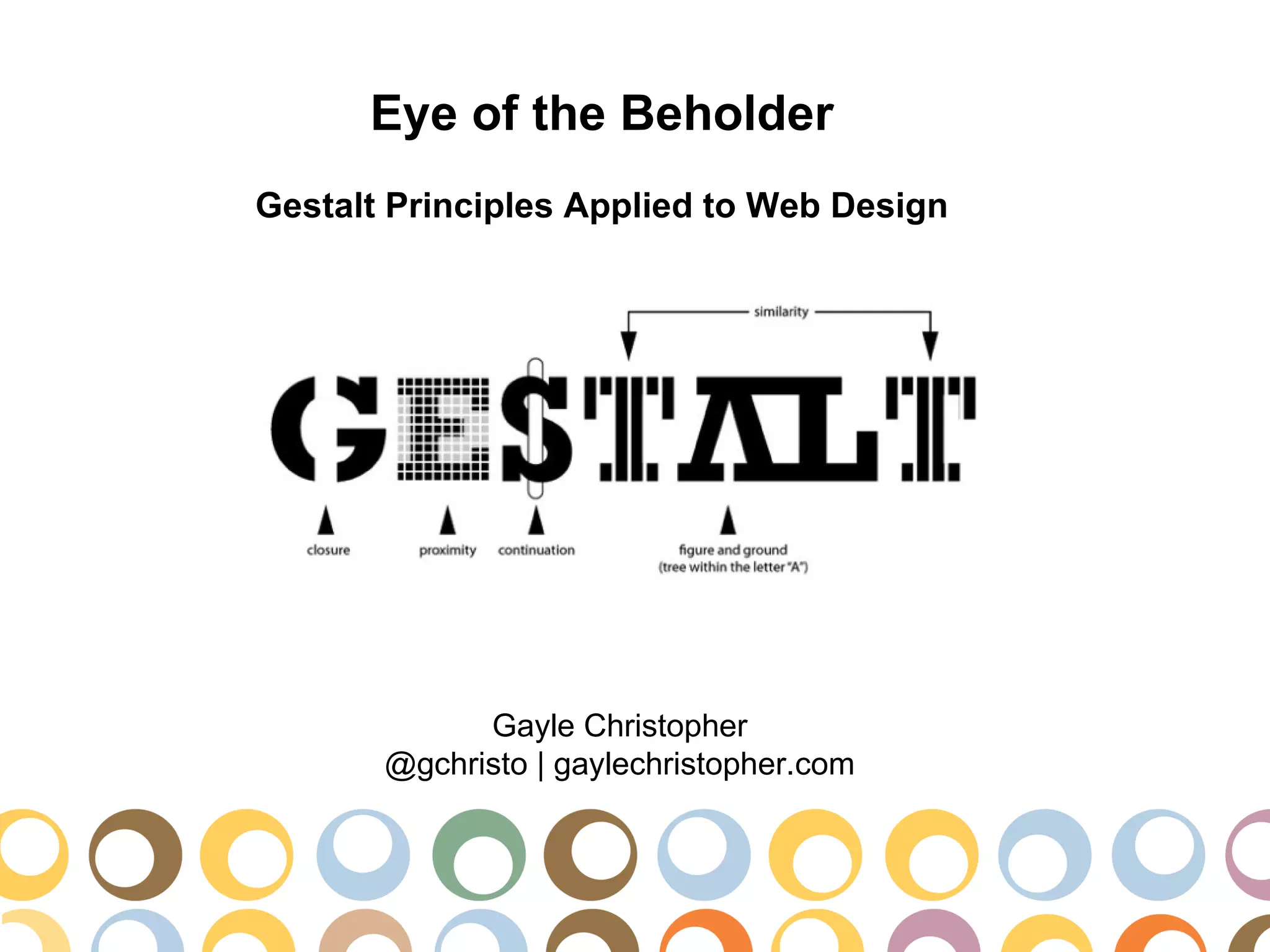
Eye of the Beholder
Gestalt Principles Applied to Web Design


             Gayle Christopher
       @gchristo | gaylechristopher.com
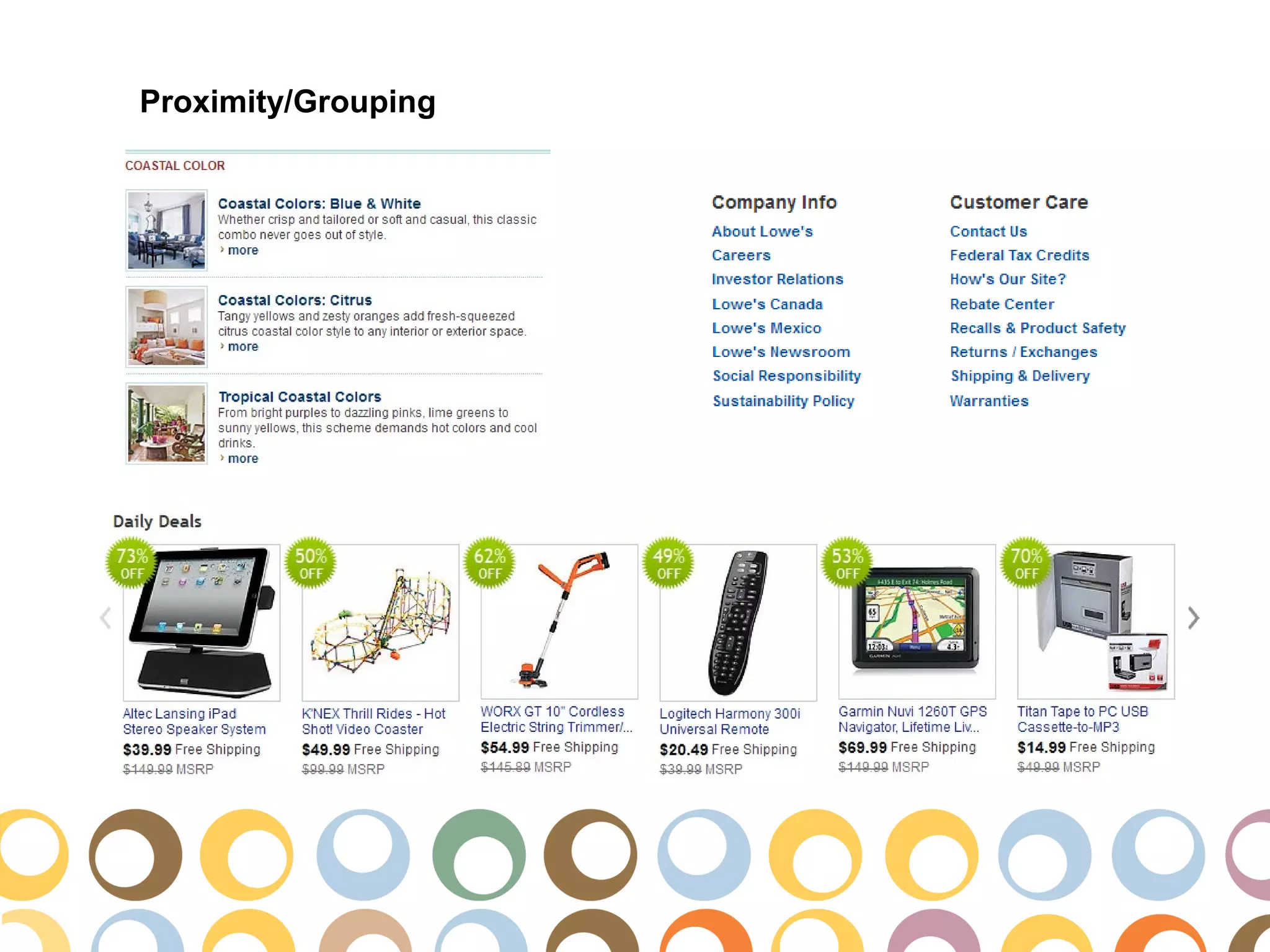
Proximity/Grouping
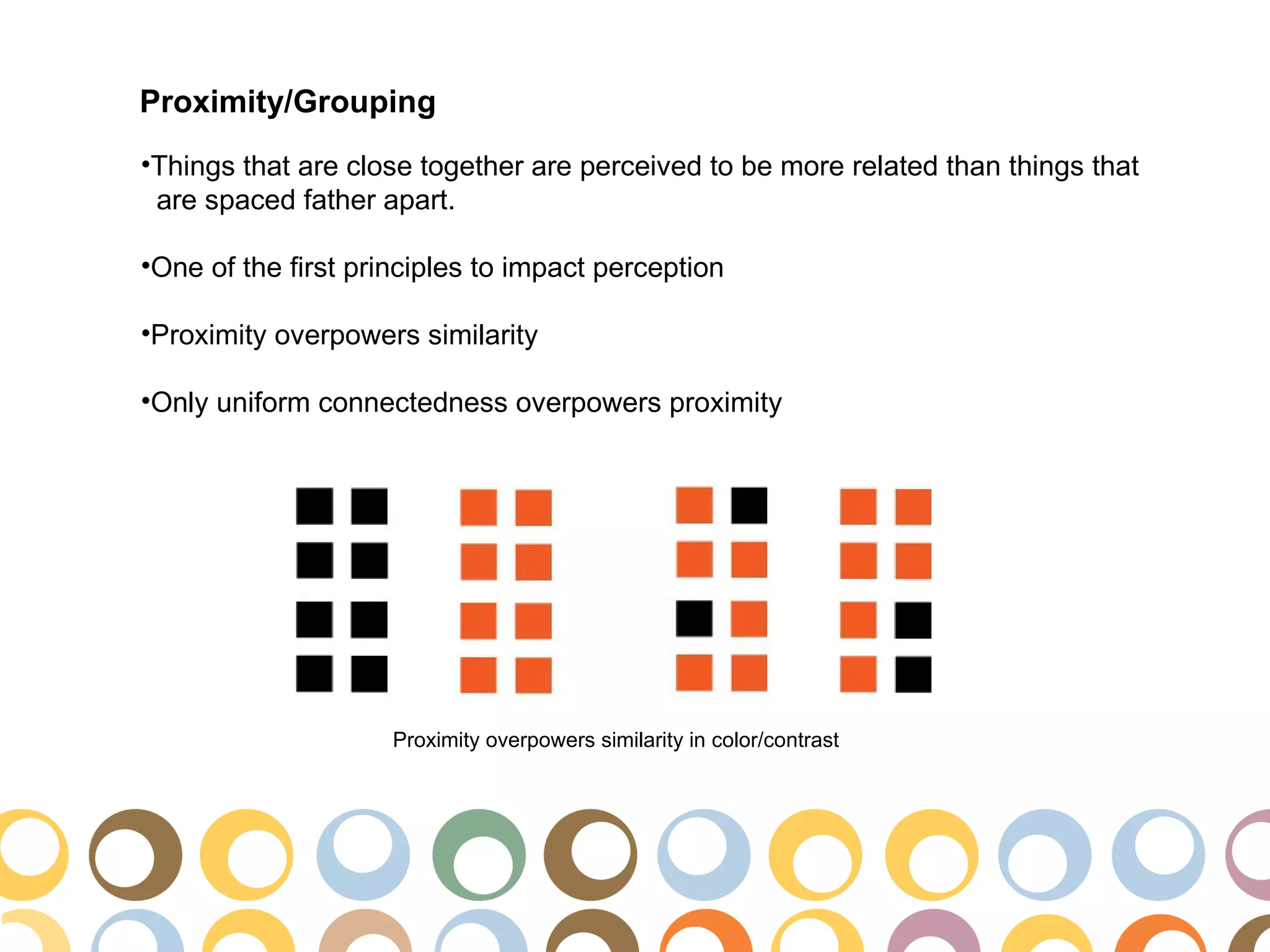
•Things that are close together are perceived to be more related than things that
 are spaced father apart.

•One of the first principles to impact perception

•Proximity overpowers similarity

•Only uniform connectedness overpowers proximity


                     Proximity overpowers similarity in color/contrast
Proximity/Grouping
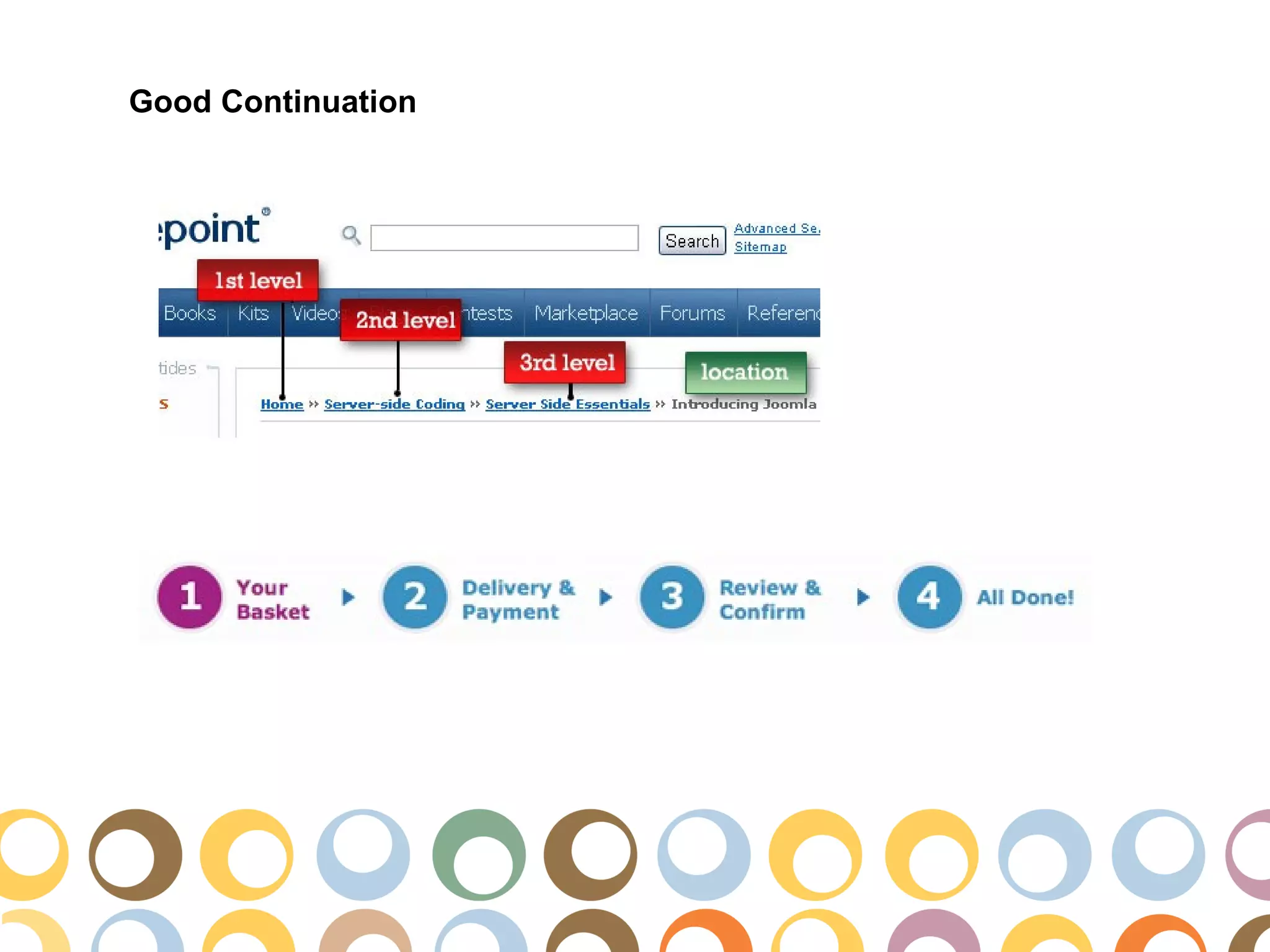
Good Continuation
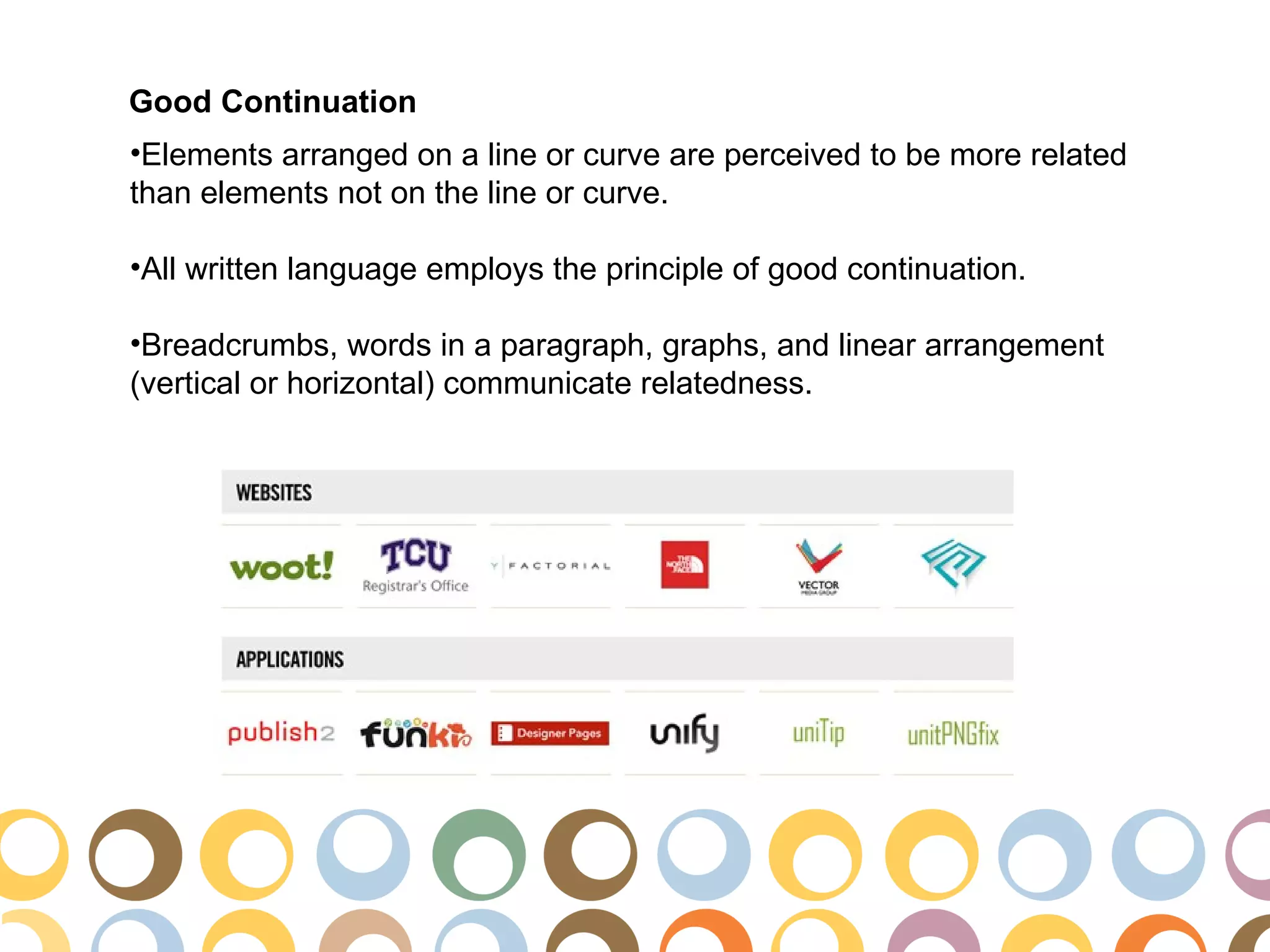
•Elements arranged on a line or curve are perceived to be more related
than elements not on the line or curve.

•All written language employs the principle of good continuation.

•Breadcrumbs, words in a paragraph, graphs, and linear arrangement
(vertical or horizontal) communicate relatedness.
Good Continuation
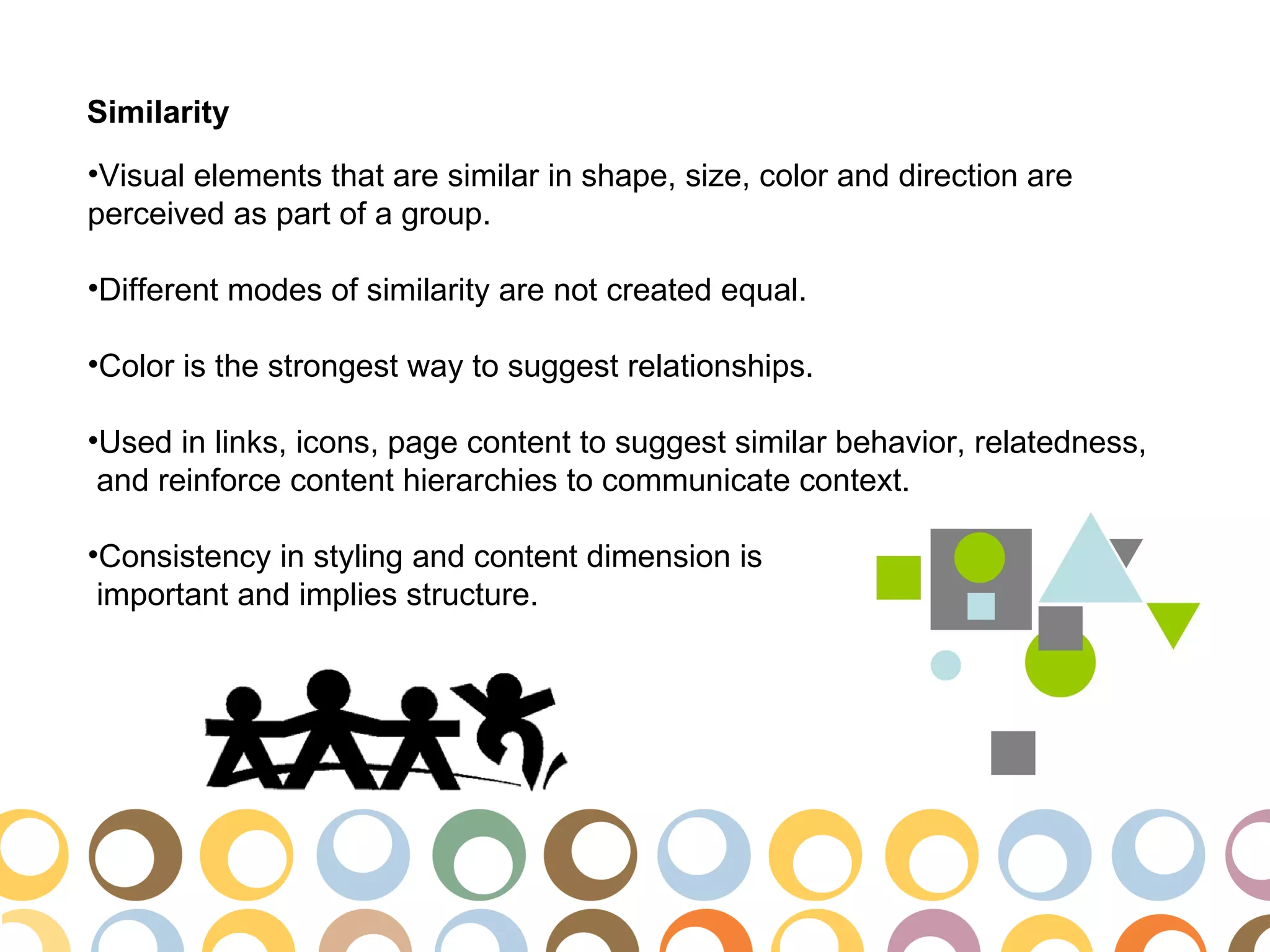
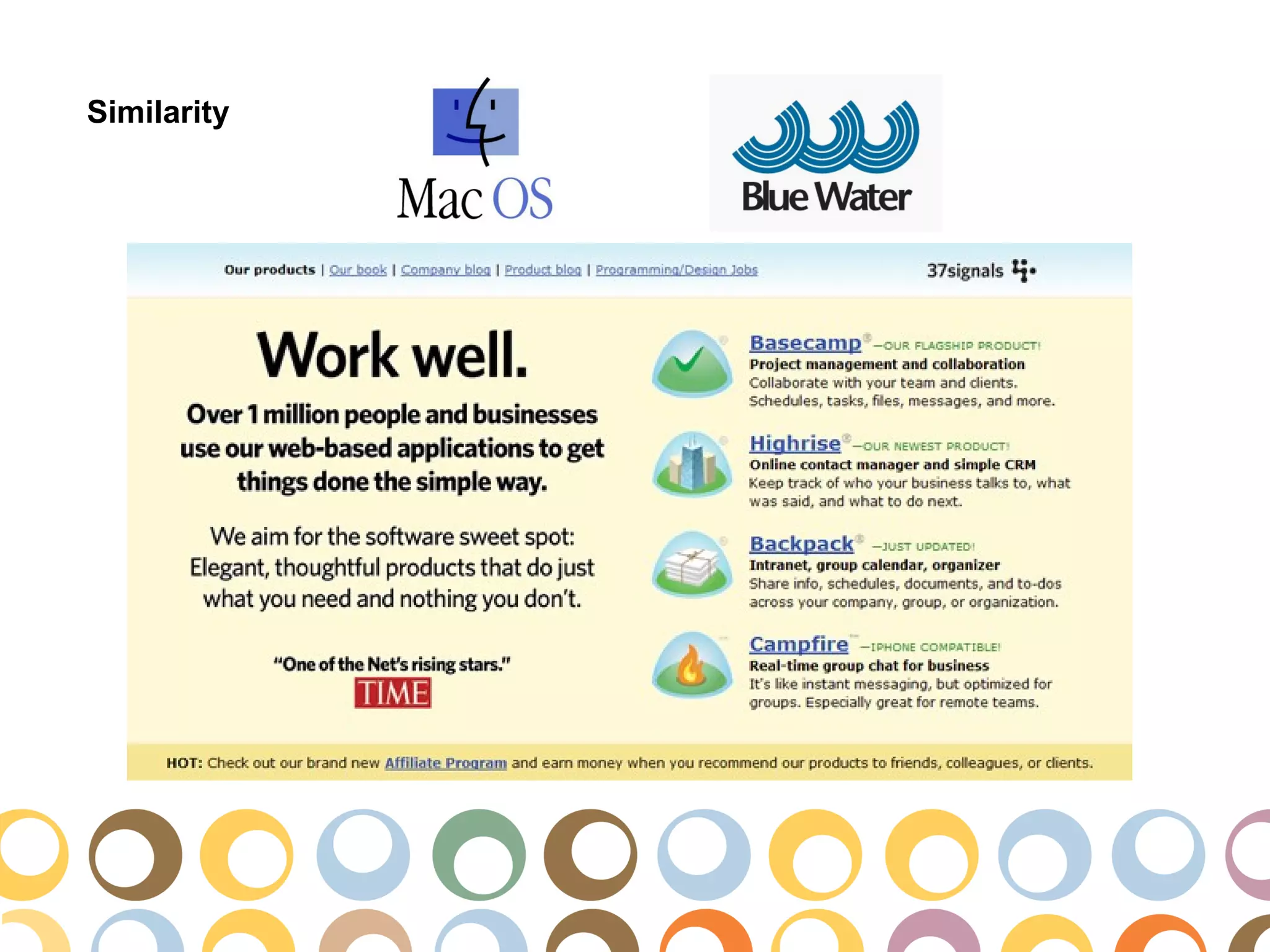
Similarity
•Visual elements that are similar in shape, size, color and direction are
perceived as part of a group.

•Different modes of similarity are not created equal.

•Color is the strongest way to suggest relationships.

•Used in links, icons, page content to suggest similar behavior, relatedness,
 and reinforce content hierarchies to communicate context.

•Consistency in styling and content dimension is
 important and implies structure.
Similarity
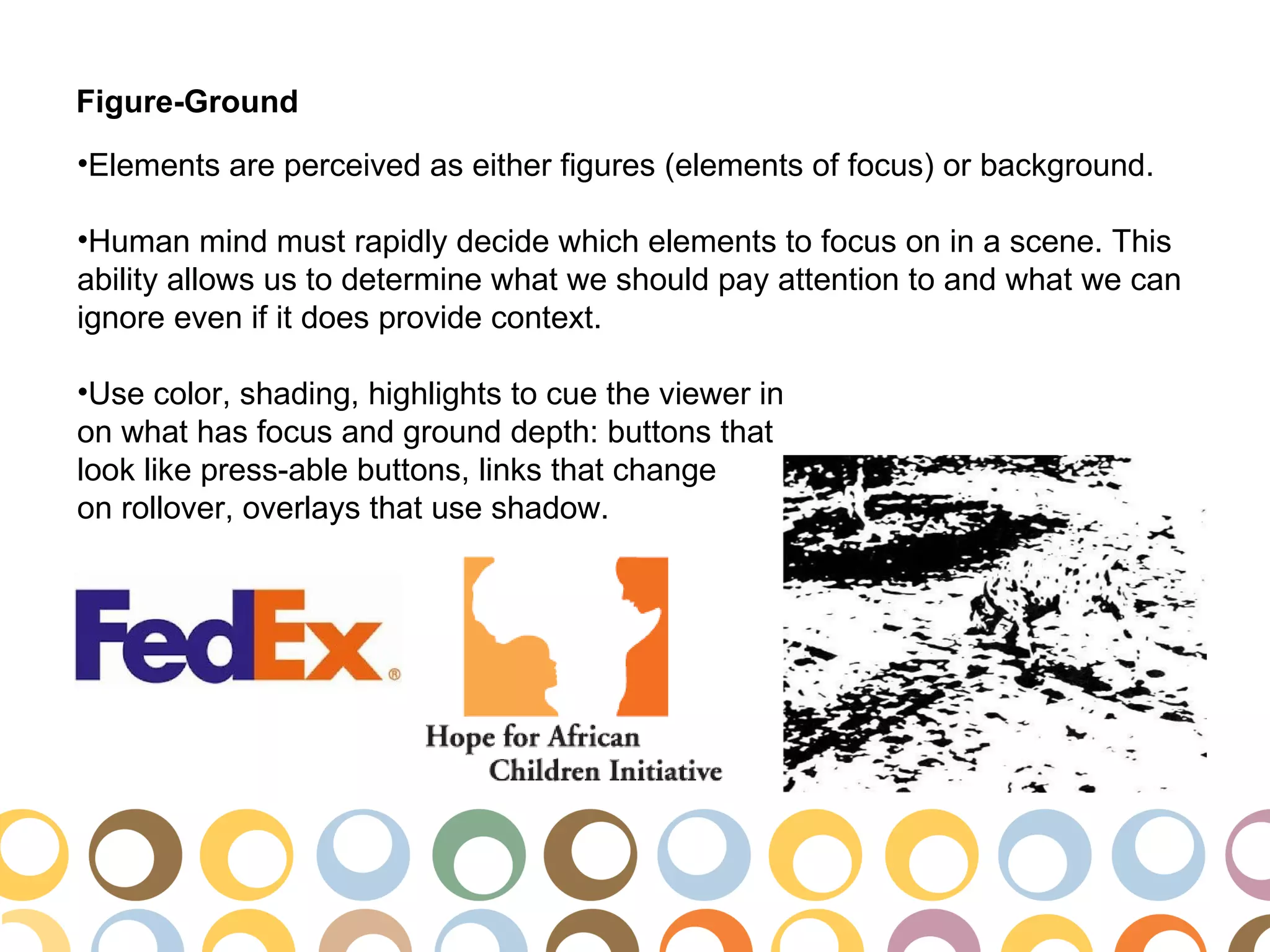
Figure-Ground
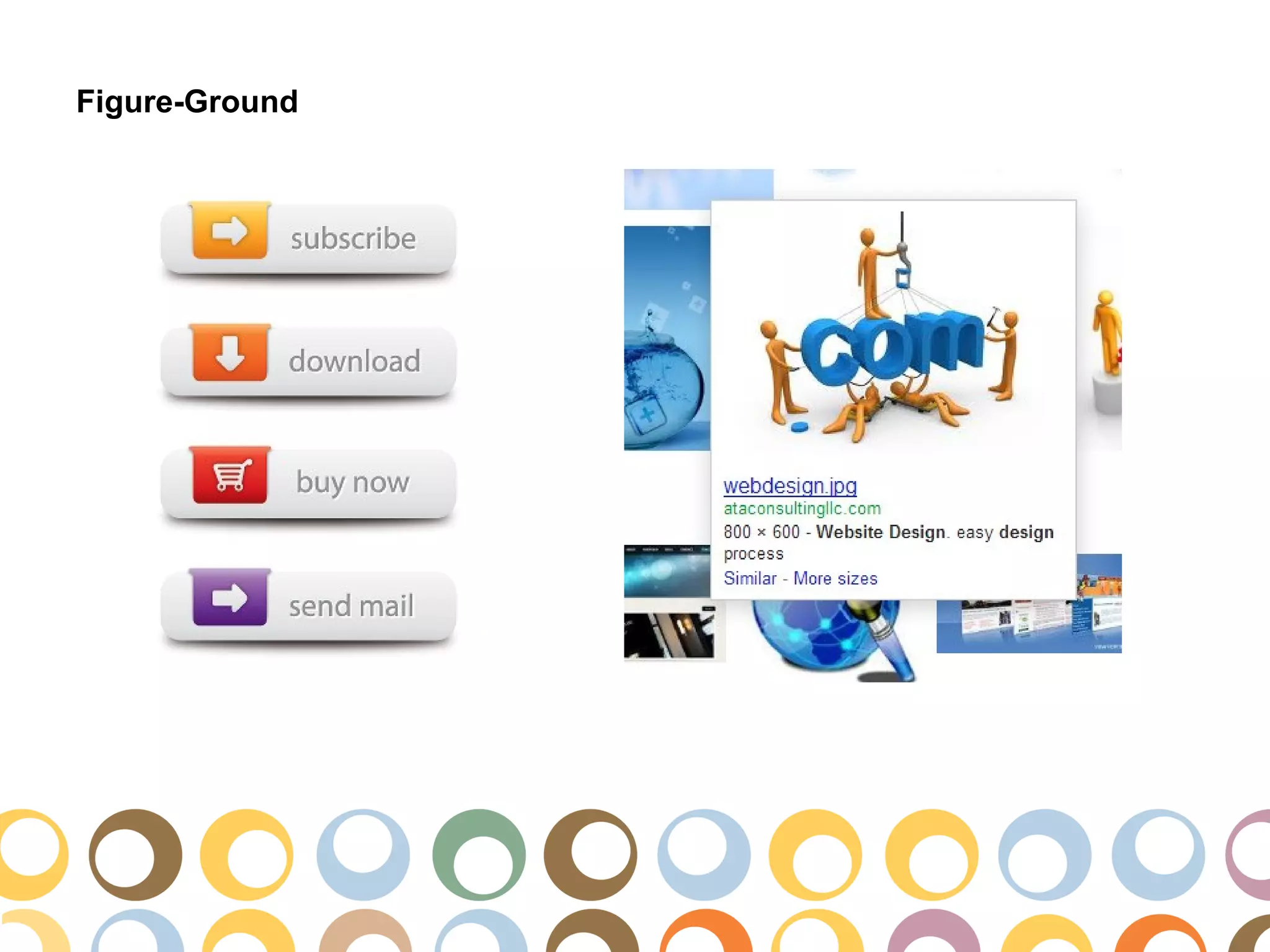
•Elements are perceived as either figures (elements of focus) or background.

•Human mind must rapidly decide which elements to focus on in a scene. This
ability allows us to determine what we should pay attention to and what we can
ignore even if it does provide context.

•Use color, shading, highlights to cue the viewer in
on what has focus and ground depth: buttons that
look like press-able buttons, links that change
on rollover, overlays that use shadow.
Figure-Ground
Common Fate
•We perceive elements moving in the same direction as being more
related than stationary objects or those moving in different directions.
example

•Humans recognize contrasting movement more so than color, contrast,
size or any other visual cue.

•Very automatic.

•Moving objects are perceived as
figure. Stationary objects are seen
as ground.

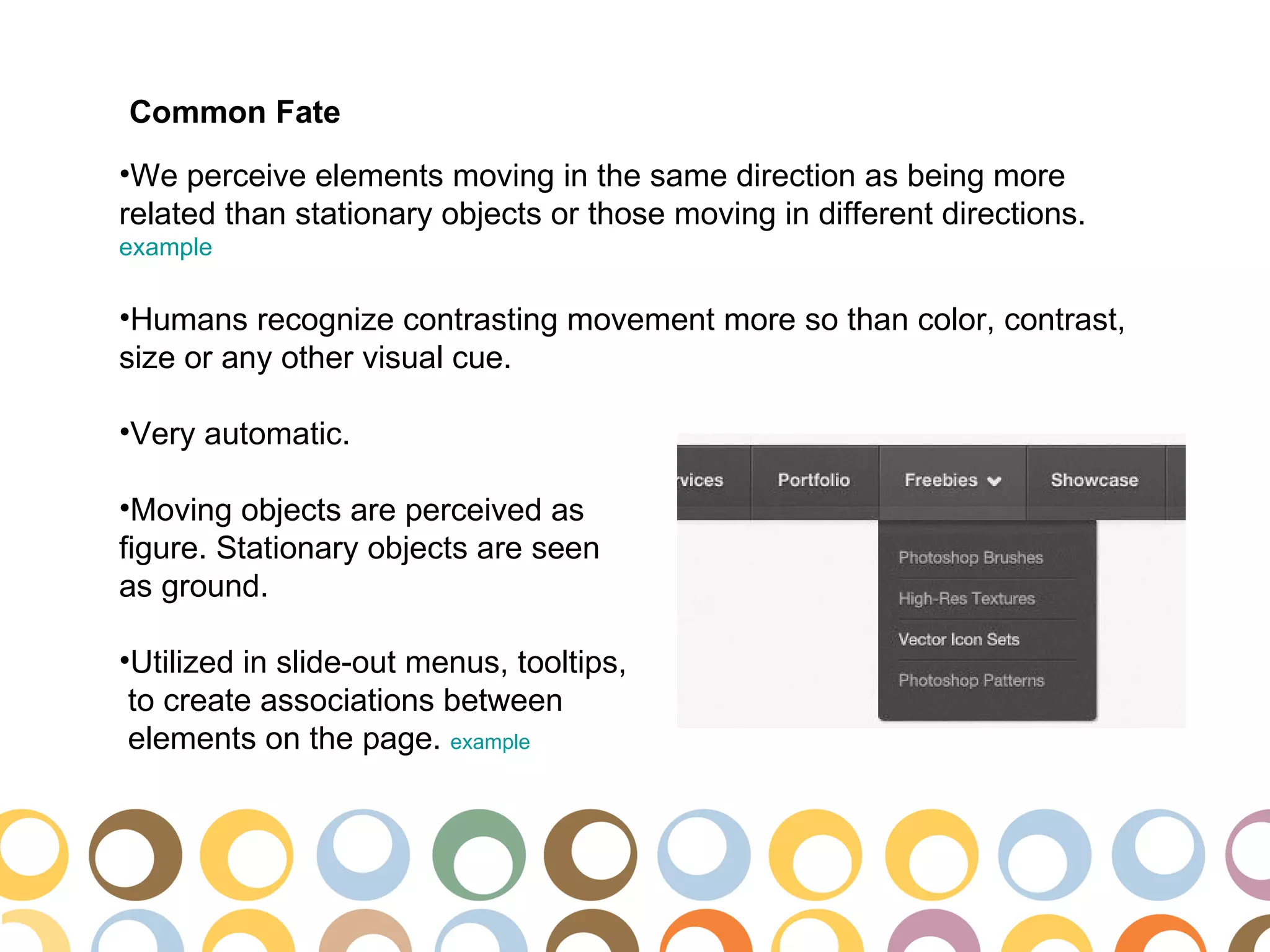
•Utilized in slide-out menus, tooltips,
 to create associations between
 elements on the page. example
Common Fate

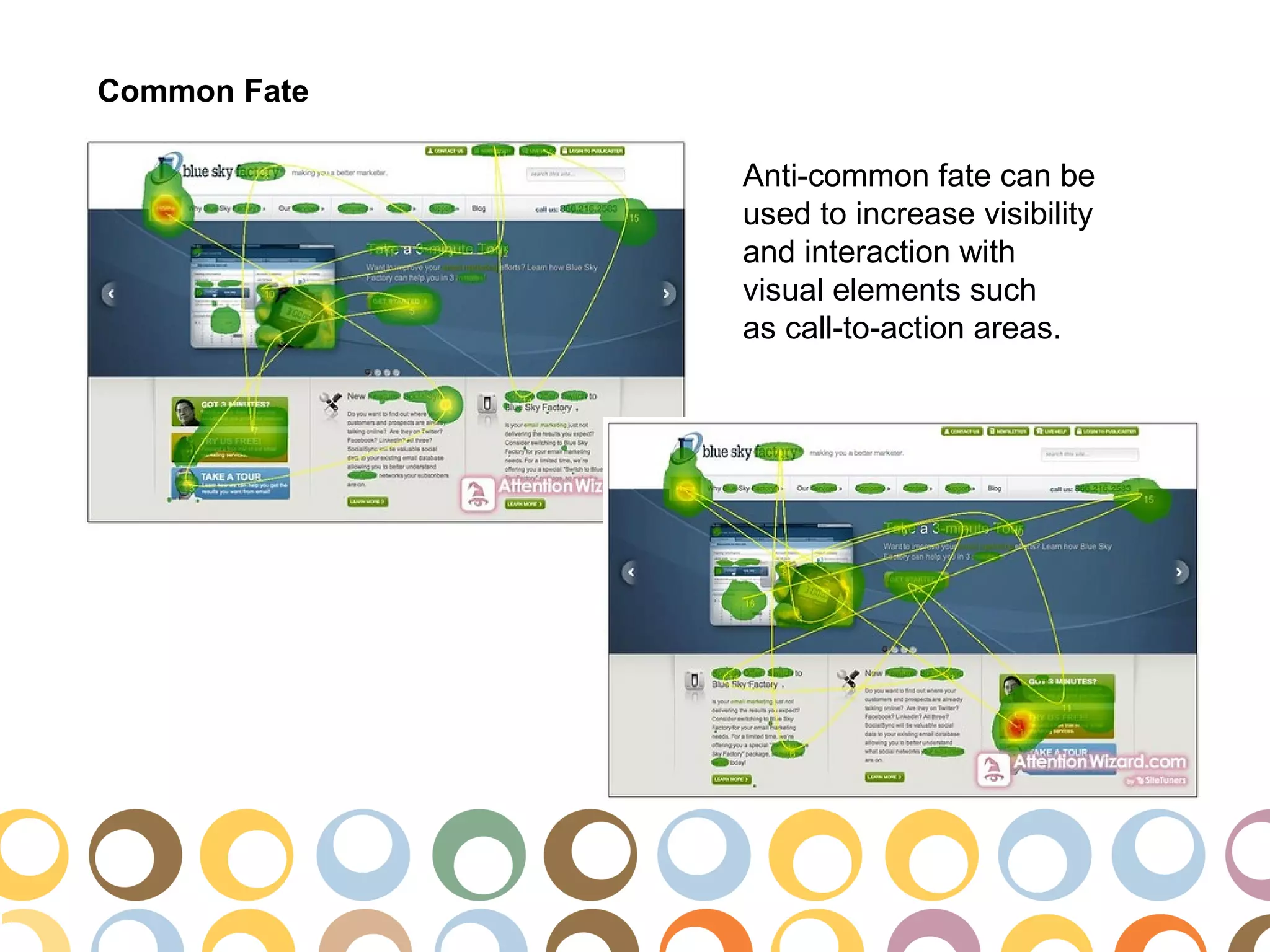
              Anti-common fate can be
              used to increase visibility
              and interaction with
              visual elements such
              as call-to-action areas.
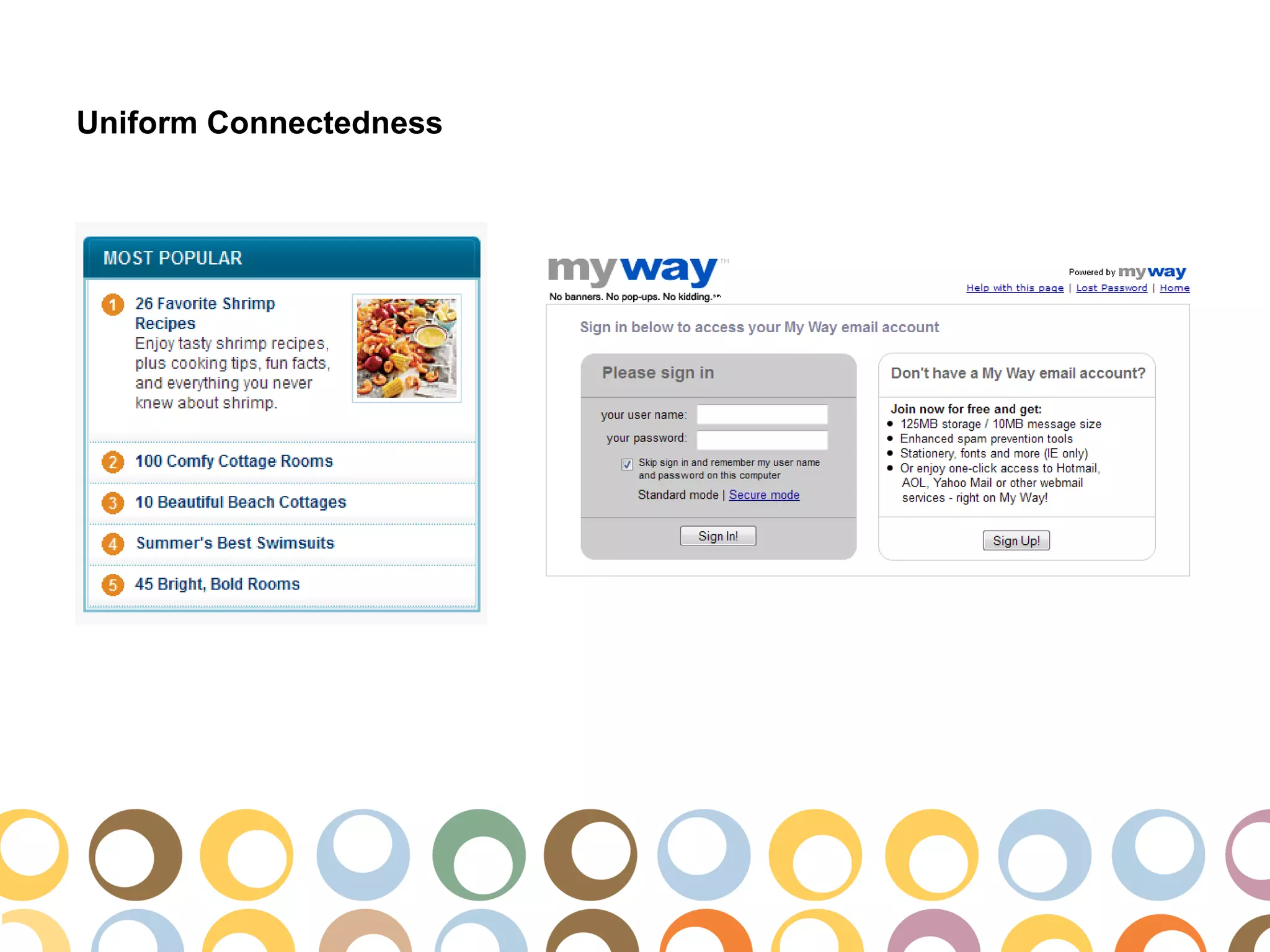
Uniform Connectedness

•Uniform visual properties in visual elements cause them to be perceived
as more related. Causes us to perceive groups rather than individual things.

•Strongest of the Gestalt Principles of relatedness.

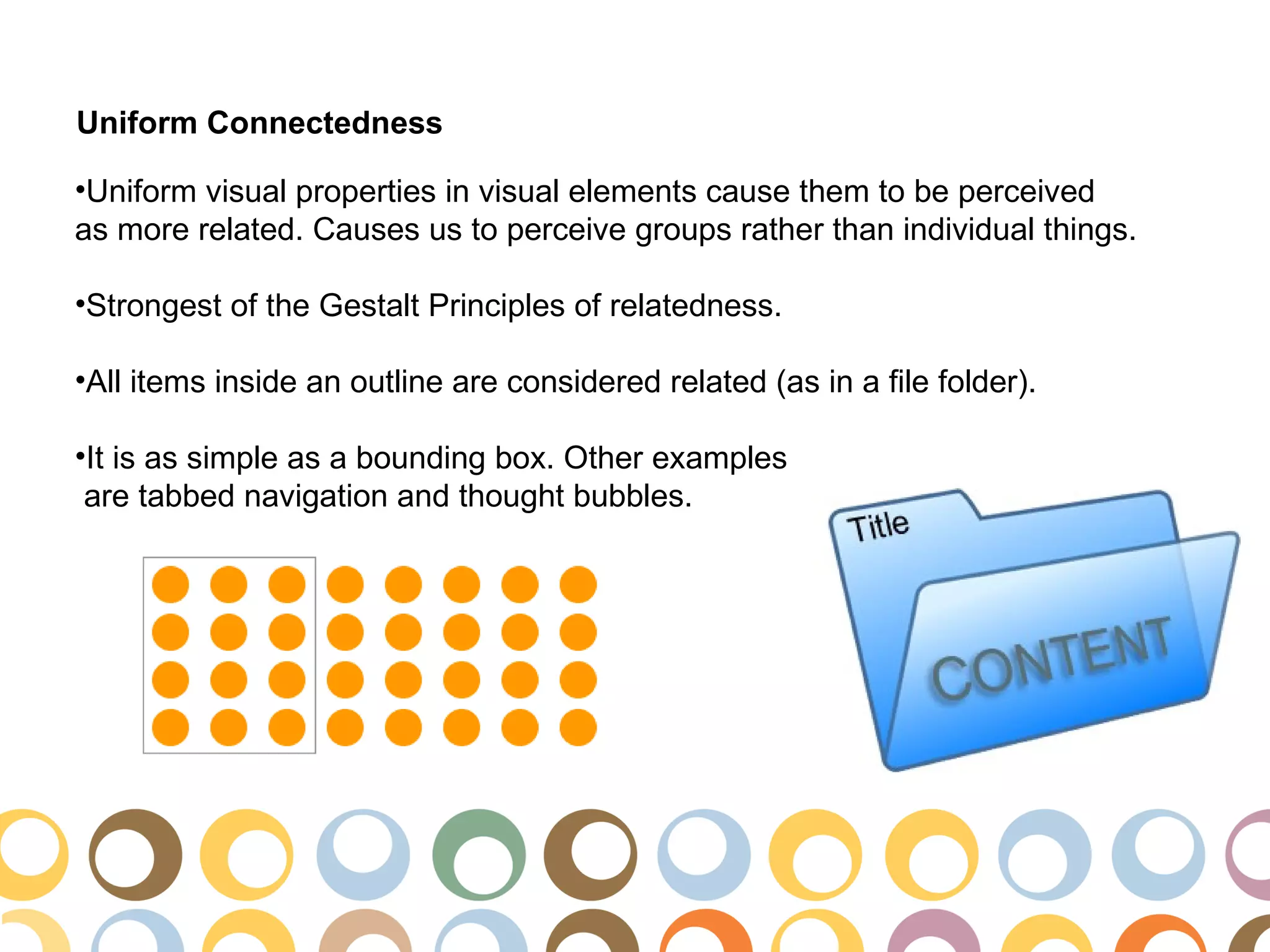
•All items inside an outline are considered related (as in a file folder).

•It is as simple as a bounding box. Other examples
 are tabbed navigation and thought bubbles.
Uniform Connectedness
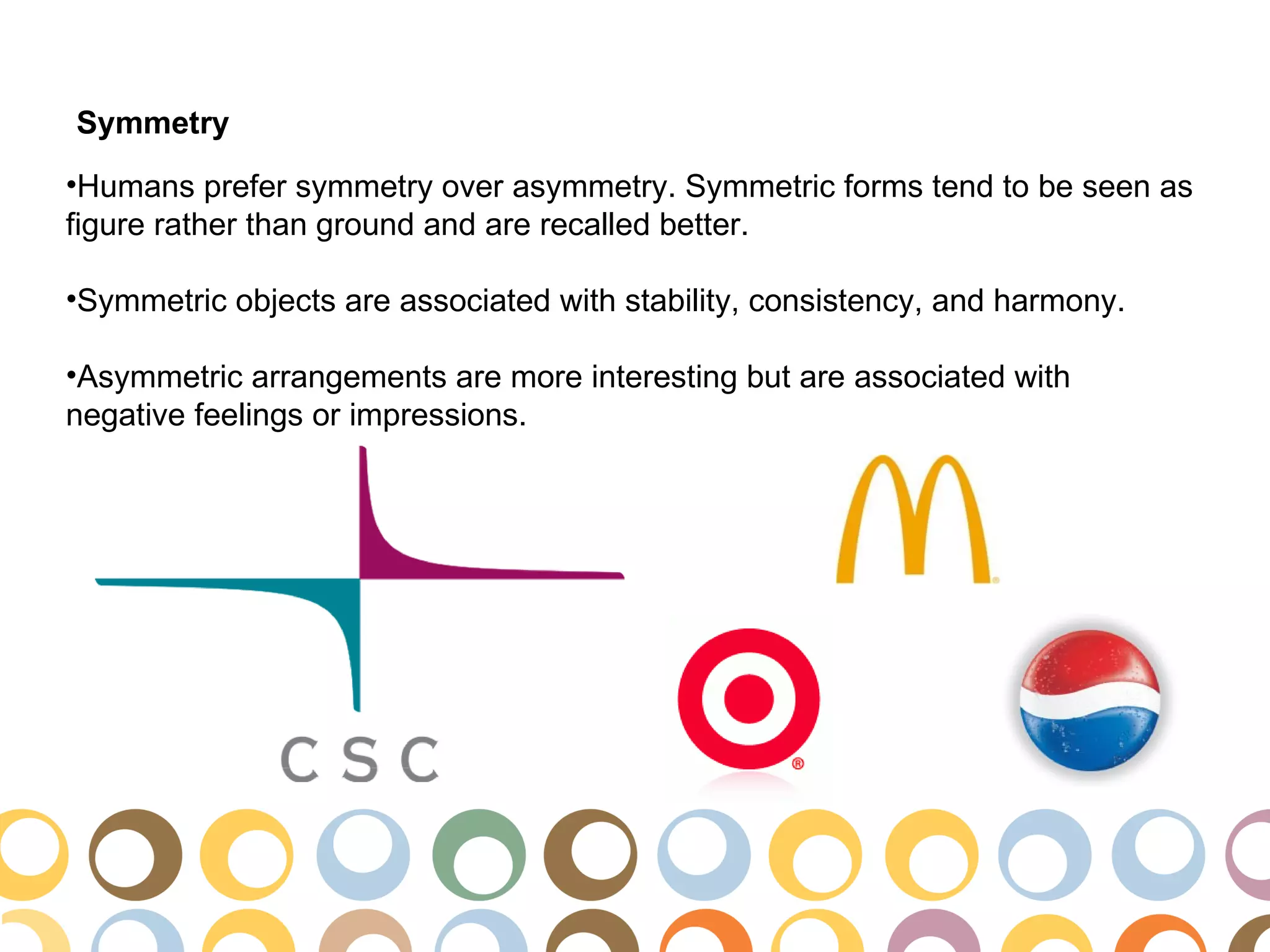
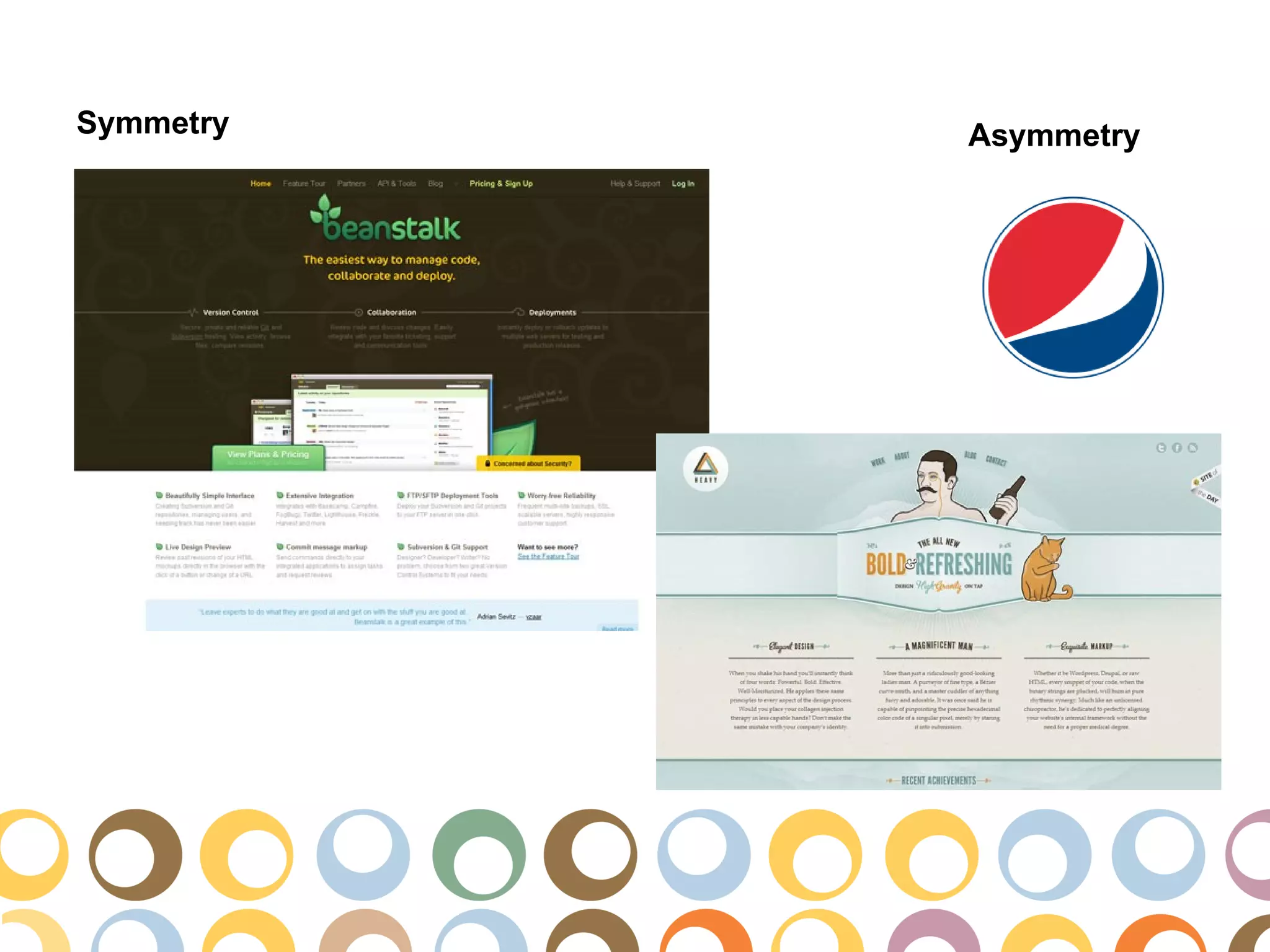
Symmetry
•Humans prefer symmetry over asymmetry. Symmetric forms tend to be seen as
figure rather than ground and are recalled better.

•Symmetric objects are associated with stability, consistency, and harmony.

•Asymmetric arrangements are more interesting but are associated with
negative feelings or impressions.
Symmetry   Asymmetry
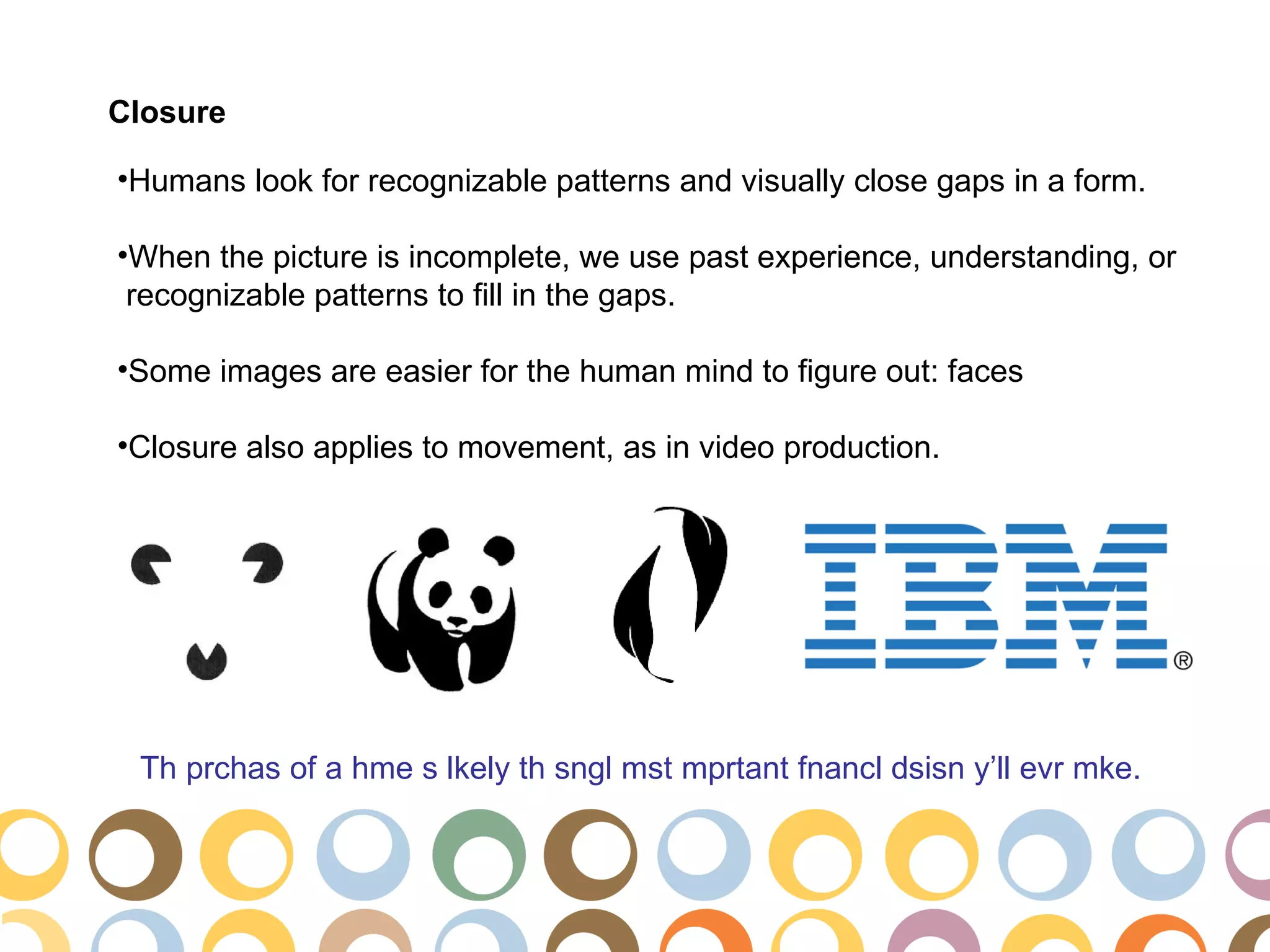
Closure

•Humans look for recognizable patterns and visually close gaps in a form.

•When the picture is incomplete, we use past experience, understanding, or
 recognizable patterns to fill in the gaps.

•Some images are easier for the human mind to figure out: faces

•Closure also applies to movement, as in video production.


 Th prchas of a hme s lkely th sngl mst mprtant fnancl dsisn y’ll evr mke.
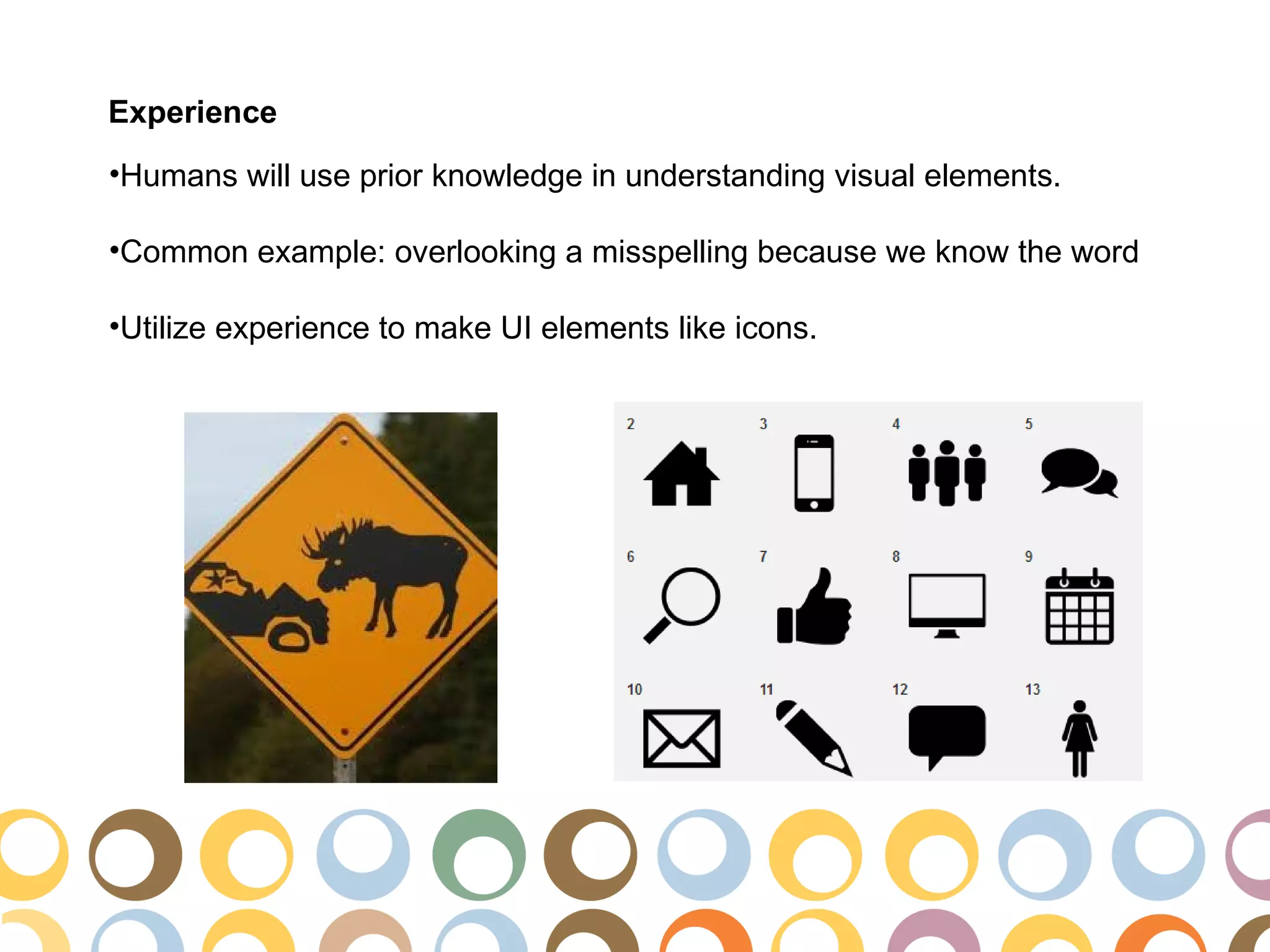
Experience
•Humans will use prior knowledge in understanding visual elements.

•Common example: overlooking a misspelling because we know the word

•Utilize experience to make UI elements like icons.
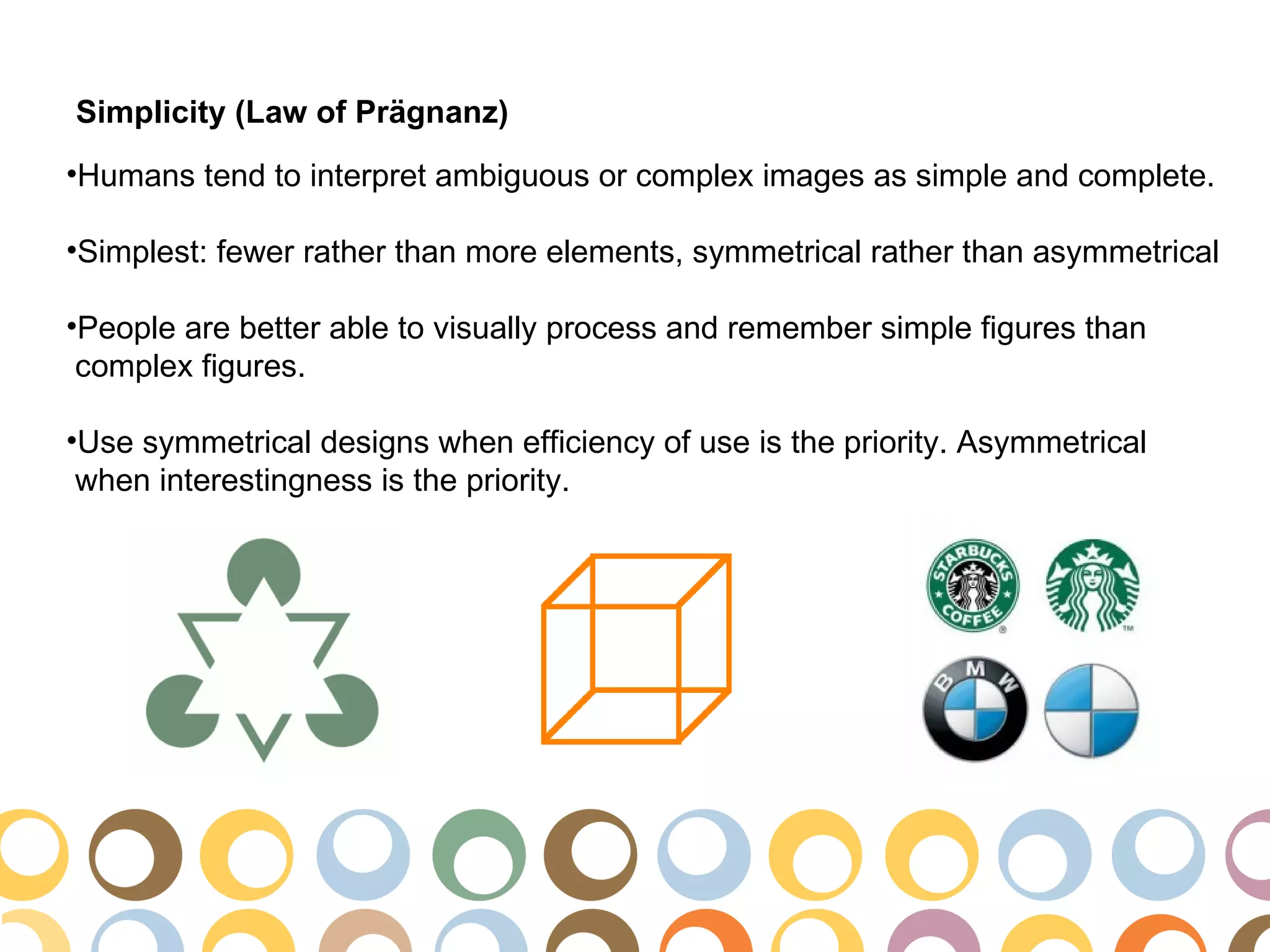
Simplicity (Law of Prägnanz)
•Humans tend to interpret ambiguous or complex images as simple and complete.

•Simplest: fewer rather than more elements, symmetrical rather than asymmetrical

•People are better able to visually process and remember simple figures than
 complex figures.

•Use symmetrical designs when efficiency of use is the priority. Asymmetrical
 when interestingness is the priority.
Simplicity (Law of Prägnanz)


                               New twitter


          Old twitter
Resources
Gestalt Theory in Interactive Media Design
Journal of Humanities & Social Sciences, 2008 Vol 2, Issue 1

Top 5 Laws of Perceptual Organization

Principles of Design

Interaction Design and Gestalt Principles

Six Gestalt Principles of Web Design

Gestalt Principles of Perceptual Organization

Close Relationship Between Gestalt Principles and Design

Universal Principles of Design ISBN-13: 978-1-59253-587-3

Gestalt Principles of Design

  • 1.
    Eye of theBeholder Gestalt Principles Applied to Web Design Gayle Christopher @gchristo | gaylechristopher.com
  • 2.
    Proximity/Grouping •Things that areclose together are perceived to be more related than things that are spaced father apart. •One of the first principles to impact perception •Proximity overpowers similarity •Only uniform connectedness overpowers proximity Proximity overpowers similarity in color/contrast
  • 3.
  • 4.
    Good Continuation •Elements arrangedon a line or curve are perceived to be more related than elements not on the line or curve. •All written language employs the principle of good continuation. •Breadcrumbs, words in a paragraph, graphs, and linear arrangement (vertical or horizontal) communicate relatedness.
  • 5.
  • 6.
    Similarity •Visual elements thatare similar in shape, size, color and direction are perceived as part of a group. •Different modes of similarity are not created equal. •Color is the strongest way to suggest relationships. •Used in links, icons, page content to suggest similar behavior, relatedness, and reinforce content hierarchies to communicate context. •Consistency in styling and content dimension is important and implies structure.
  • 7.
  • 8.
    Figure-Ground •Elements are perceivedas either figures (elements of focus) or background. •Human mind must rapidly decide which elements to focus on in a scene. This ability allows us to determine what we should pay attention to and what we can ignore even if it does provide context. •Use color, shading, highlights to cue the viewer in on what has focus and ground depth: buttons that look like press-able buttons, links that change on rollover, overlays that use shadow.
  • 9.
  • 10.
    Common Fate •We perceiveelements moving in the same direction as being more related than stationary objects or those moving in different directions. example •Humans recognize contrasting movement more so than color, contrast, size or any other visual cue. •Very automatic. •Moving objects are perceived as figure. Stationary objects are seen as ground. •Utilized in slide-out menus, tooltips, to create associations between elements on the page. example
  • 11.
    Common Fate Anti-common fate can be used to increase visibility and interaction with visual elements such as call-to-action areas.
  • 12.
    Uniform Connectedness •Uniform visualproperties in visual elements cause them to be perceived as more related. Causes us to perceive groups rather than individual things. •Strongest of the Gestalt Principles of relatedness. •All items inside an outline are considered related (as in a file folder). •It is as simple as a bounding box. Other examples are tabbed navigation and thought bubbles.
  • 13.
  • 14.
    Symmetry •Humans prefer symmetryover asymmetry. Symmetric forms tend to be seen as figure rather than ground and are recalled better. •Symmetric objects are associated with stability, consistency, and harmony. •Asymmetric arrangements are more interesting but are associated with negative feelings or impressions.
  • 15.
    Symmetry Asymmetry
  • 16.
    Closure •Humans look forrecognizable patterns and visually close gaps in a form. •When the picture is incomplete, we use past experience, understanding, or recognizable patterns to fill in the gaps. •Some images are easier for the human mind to figure out: faces •Closure also applies to movement, as in video production. Th prchas of a hme s lkely th sngl mst mprtant fnancl dsisn y’ll evr mke.
  • 17.
    Experience •Humans will useprior knowledge in understanding visual elements. •Common example: overlooking a misspelling because we know the word •Utilize experience to make UI elements like icons.
  • 18.
    Simplicity (Law ofPrägnanz) •Humans tend to interpret ambiguous or complex images as simple and complete. •Simplest: fewer rather than more elements, symmetrical rather than asymmetrical •People are better able to visually process and remember simple figures than complex figures. •Use symmetrical designs when efficiency of use is the priority. Asymmetrical when interestingness is the priority.
  • 19.
    Simplicity (Law ofPrägnanz) New twitter Old twitter
  • 20.
    Resources Gestalt Theory inInteractive Media Design Journal of Humanities & Social Sciences, 2008 Vol 2, Issue 1 Top 5 Laws of Perceptual Organization Principles of Design Interaction Design and Gestalt Principles Six Gestalt Principles of Web Design Gestalt Principles of Perceptual Organization Close Relationship Between Gestalt Principles and Design Universal Principles of Design ISBN-13: 978-1-59253-587-3