Dr. Deepak R Nagargoje,
Astt. Professor in Chemistry,
MPASC College, Panvel,
Dist. Raigad (Maharashtra)
Introduction
Most of the molecules of importance to living systems are
enantioenriched or enantiopure
Examples include:
Amino Acids
Sugars
 Proteins
Nucleic Acids
Vitamins
Terpenes
Alkaloids and
Steroids.
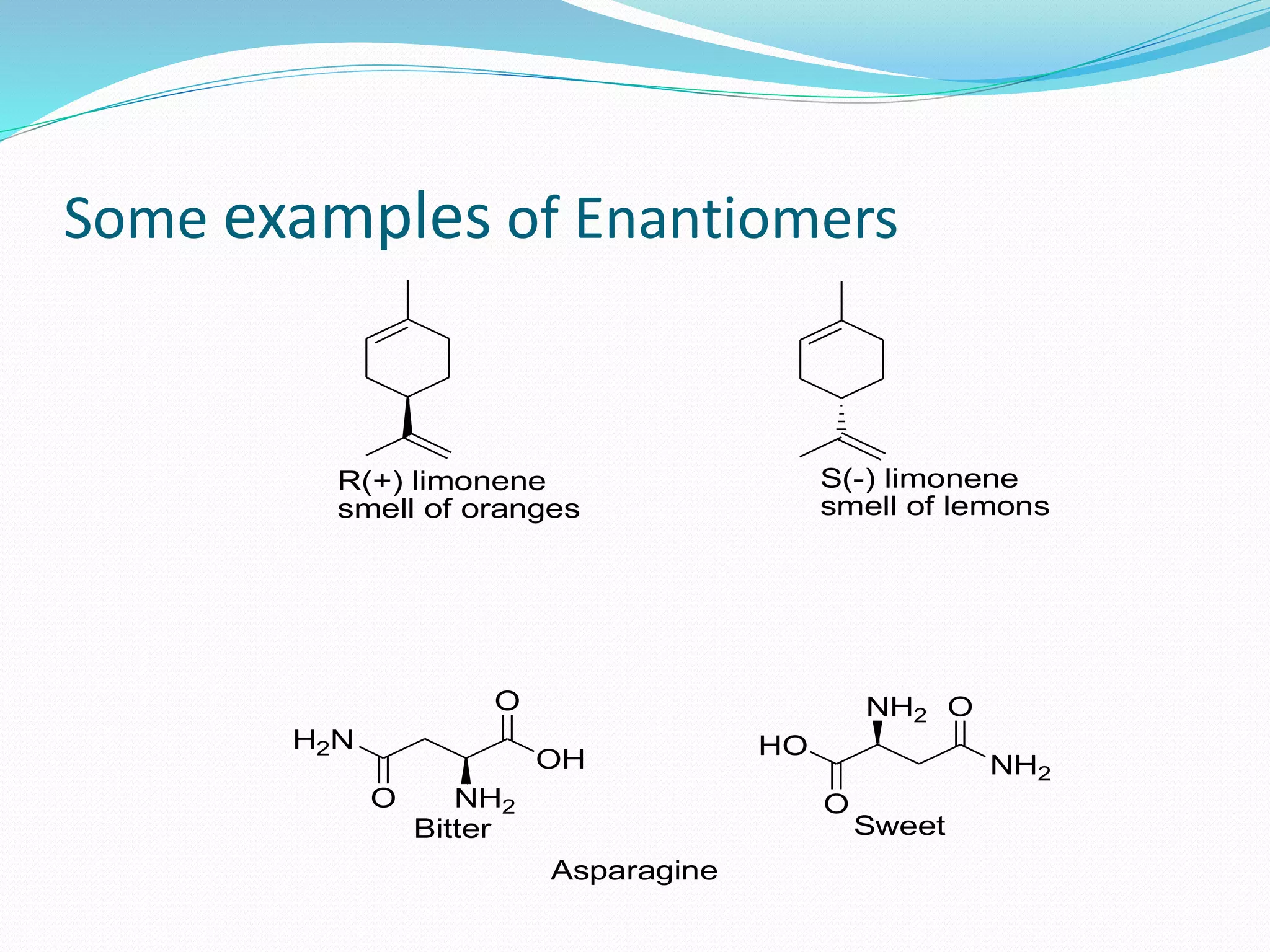
Some examples of Enantiomers
R(+) limonene
smell of oranges
S(-) limonene
smell of lemons
H2N
OH
O
O
NH2
HO
NH2
O
O
NH2
Bitter Sweet
Asparagine
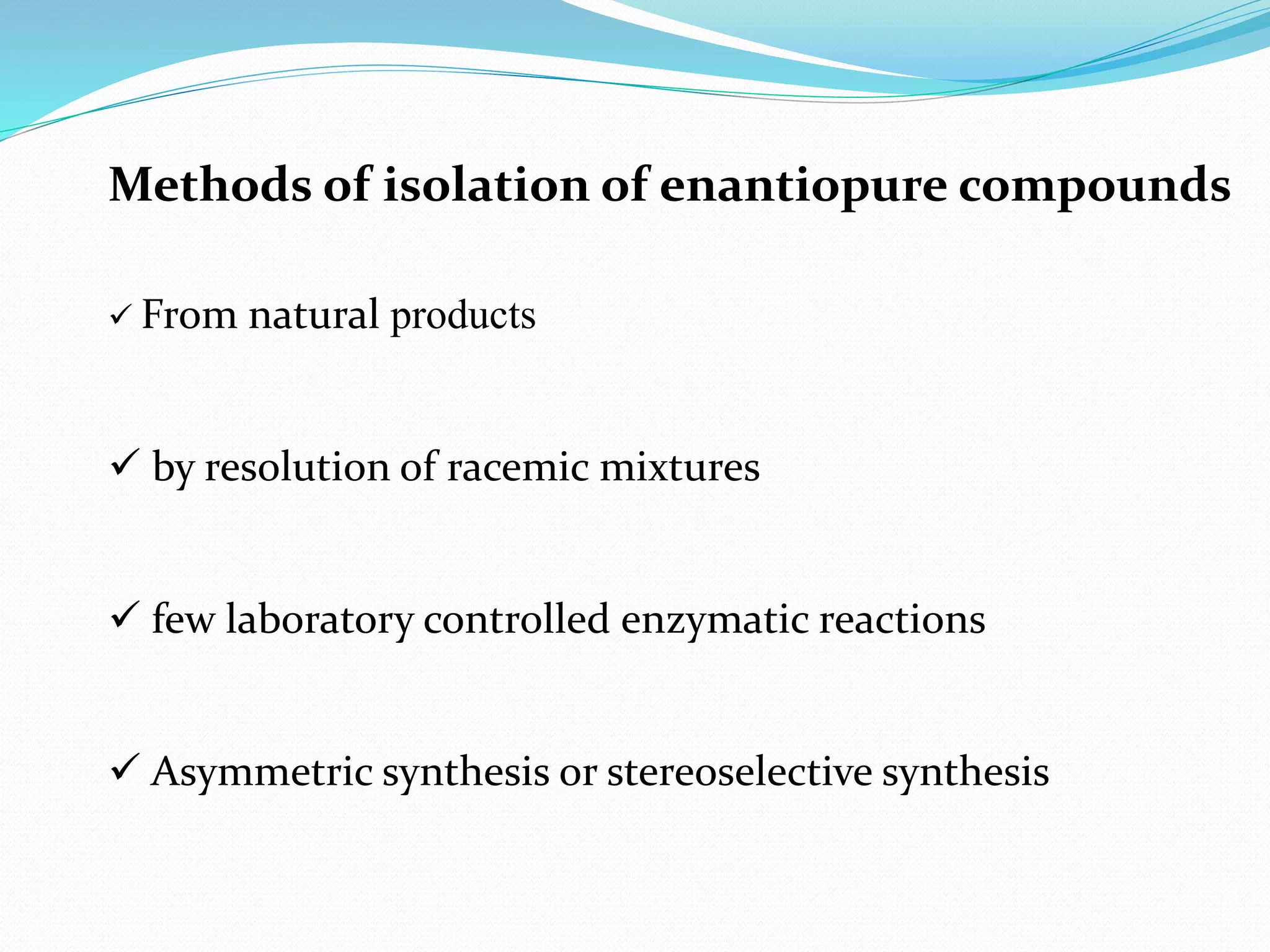
Methods of isolation of enantiopure compounds
 From natural products
 by resolution of racemic mixtures
 few laboratory controlled enzymatic reactions
 Asymmetric synthesis or stereoselective synthesis
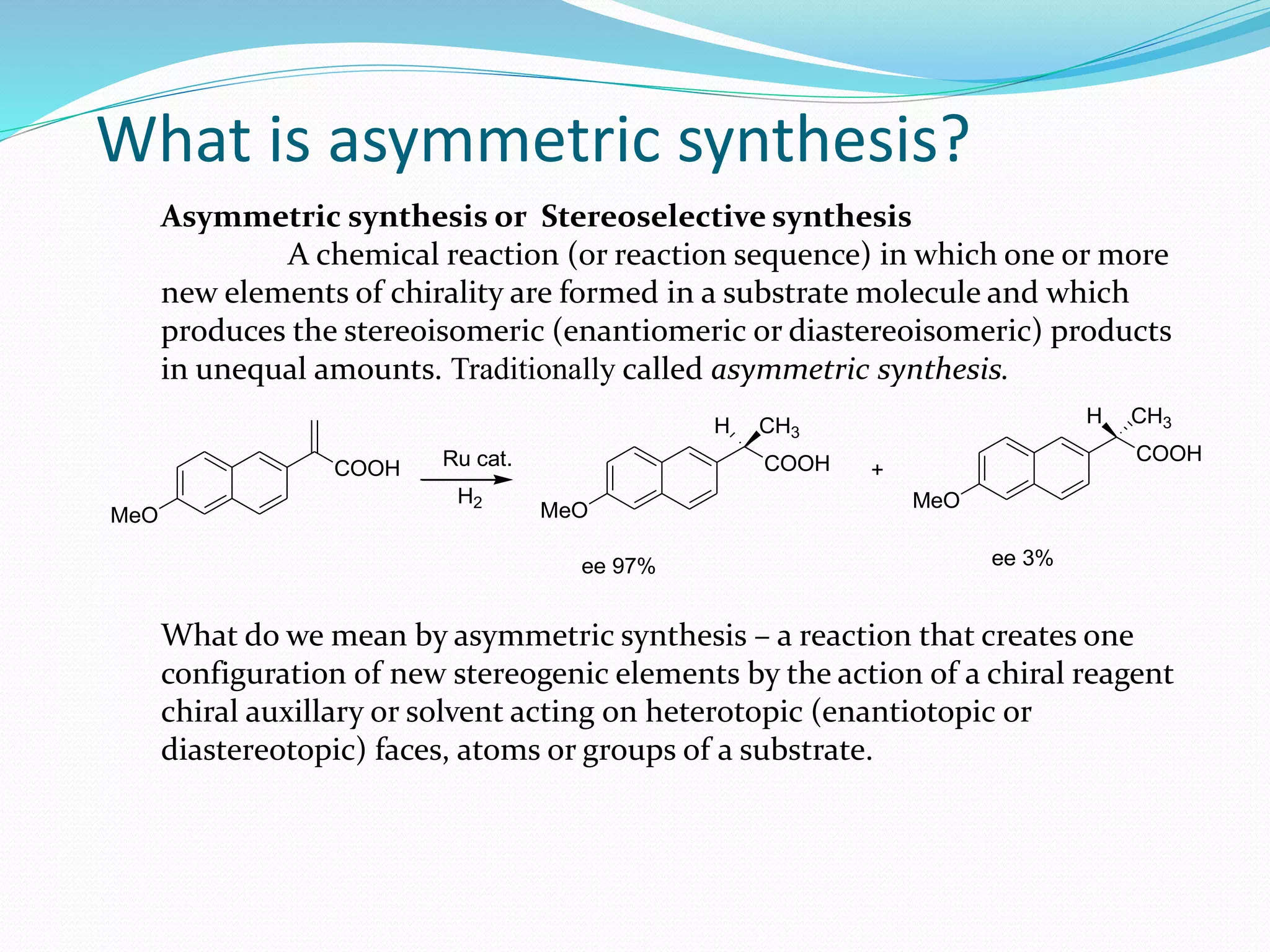
What is asymmetric synthesis?
Asymmetric synthesis or Stereoselective synthesis
A chemical reaction (or reaction sequence) in which one or more
new elements of chirality are formed in a substrate molecule and which
produces the stereoisomeric (enantiomeric or diastereoisomeric) products
in unequal amounts. Traditionally called asymmetric synthesis.
What do we mean by asymmetric synthesis – a reaction that creates one
configuration of new stereogenic elements by the action of a chiral reagent
chiral auxillary or solvent acting on heterotopic (enantiotopic or
diastereotopic) faces, atoms or groups of a substrate.
MeO
COOH
MeO
COOH
MeO
COOH
+
ee 97% ee 3%
H2
H CH3CH3H
Ru cat.
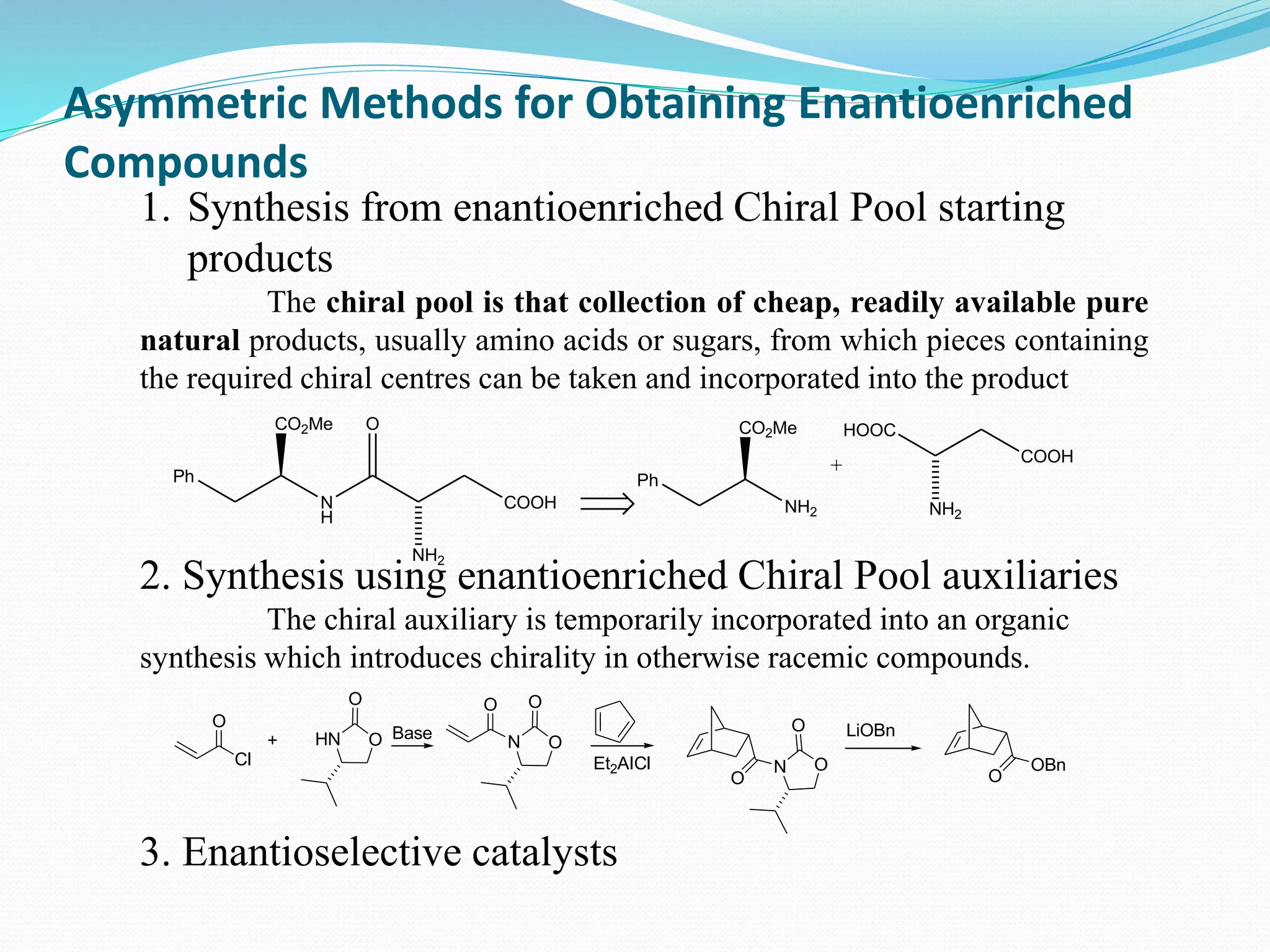
Asymmetric Methods for Obtaining Enantioenriched
Compounds
1. Synthesis from enantioenriched Chiral Pool starting
products
The chiral pool is that collection of cheap, readily available pure
natural products, usually amino acids or sugars, from which pieces containing
the required chiral centres can be taken and incorporated into the product
2. Synthesis using enantioenriched Chiral Pool auxiliaries
The chiral auxiliary is temporarily incorporated into an organic
synthesis which introduces chirality in otherwise racemic compounds.
3. Enantioselective catalysts
Ph
N
H
COOH
NH2
OCO2Me
Ph
NH2
HOOC
COOH
NH2
CO2Me
+
Cl
O
+ HN O
O
N O
OO
Et2AICl
Base
N
O
O
O
O
OBn
LiOBn
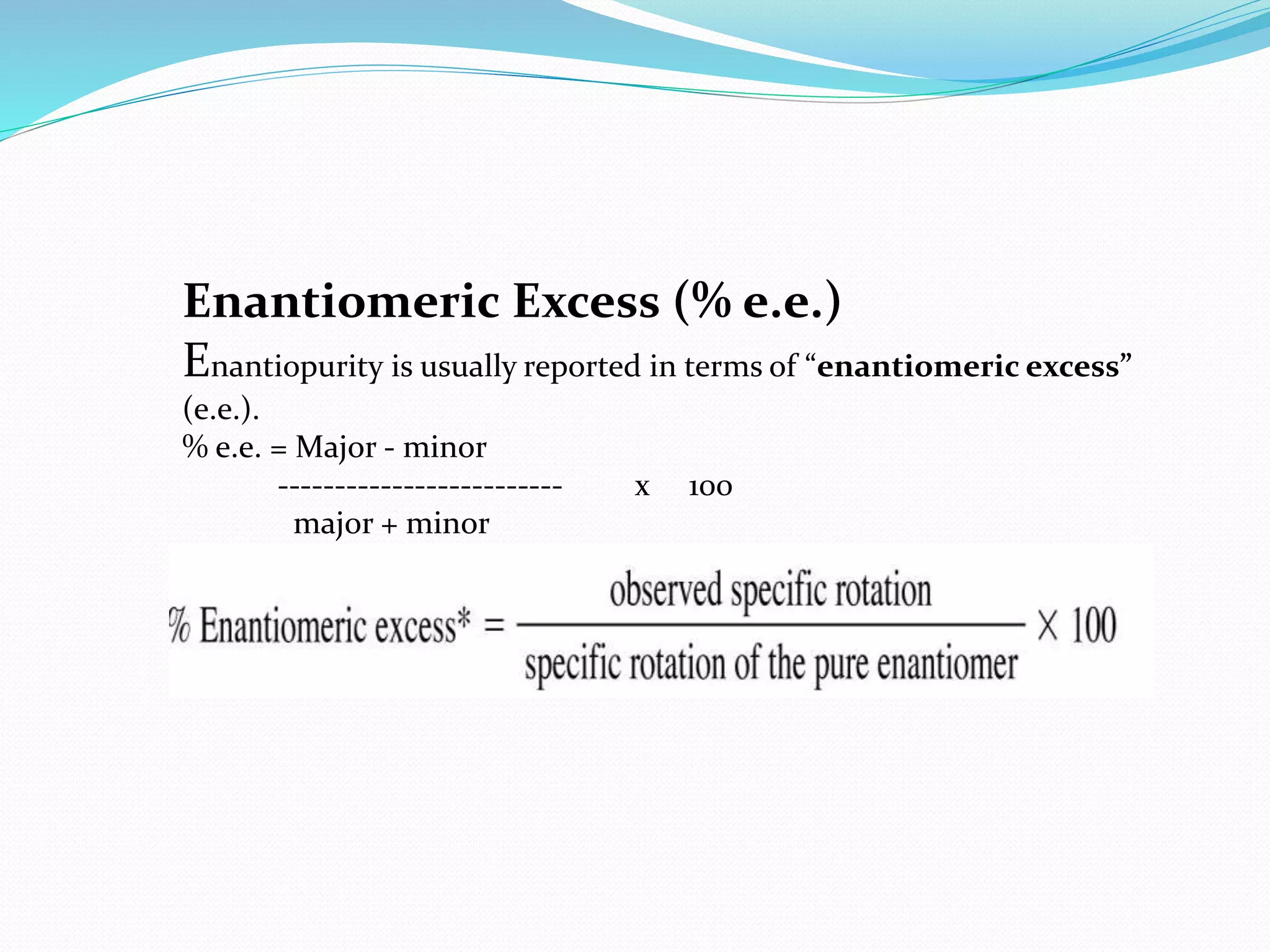
Enantiomeric Excess (% e.e.)
Enantiopurity is usually reported in terms of “enantiomeric excess”
(e.e.).
% e.e. = Major - minor
------------------------- x 100
major + minor
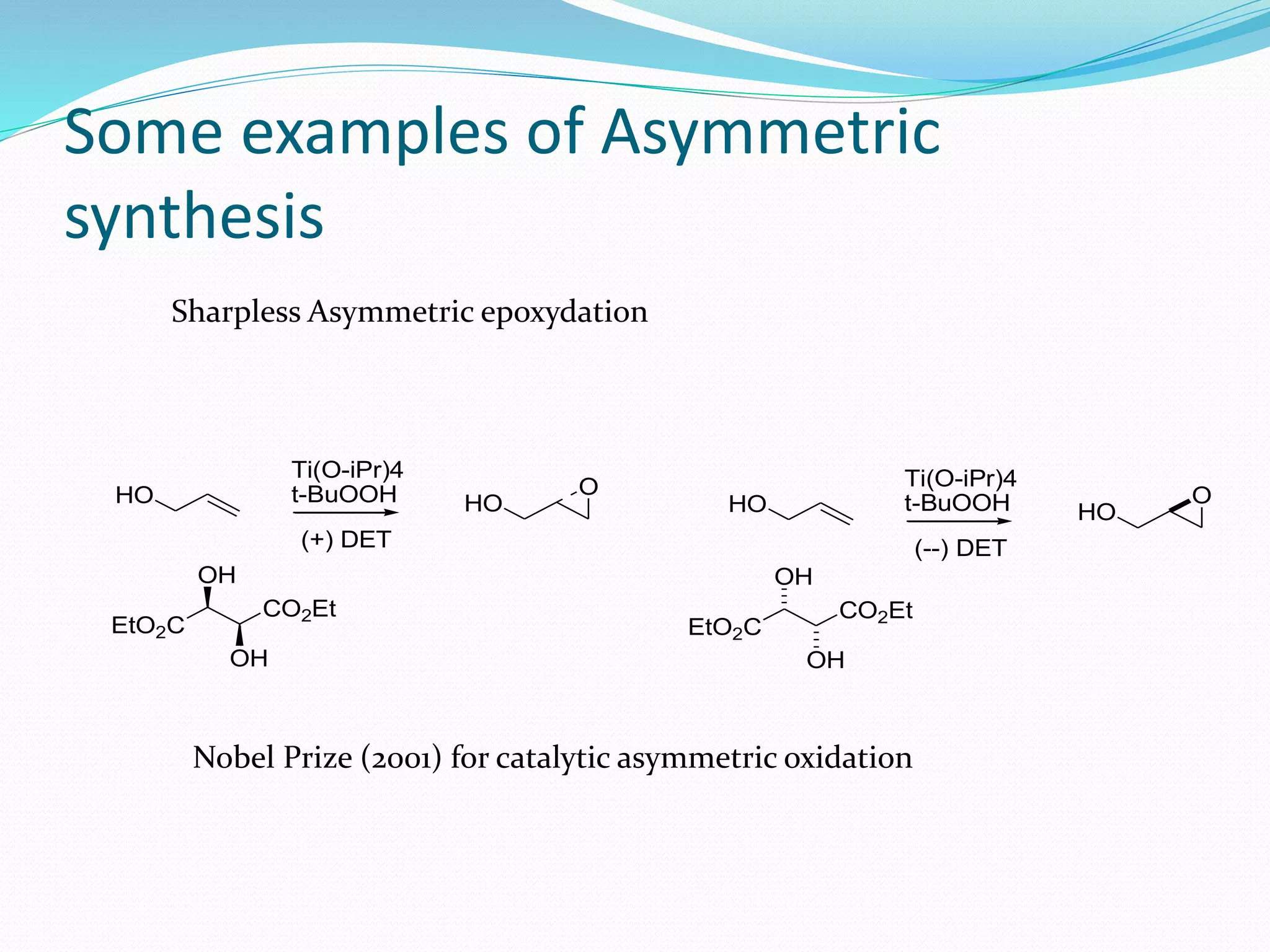
Some examples of Asymmetric
synthesis
Sharpless Asymmetric epoxydation
HO HO
O
Ti(O-iPr)4
t-BuOOH
(+) DET
HO HO
O
Ti(O-iPr)4
t-BuOOH
(--) DET
EtO2C
CO2Et
OH
OH
EtO2C
CO2Et
OH
OH
Nobel Prize (2001) for catalytic asymmetric oxidation
Other reactions
1) Asymmetric Aldol and related reactions
2) Asymmetric Diels-alder reaction
3) Asymmetric dihyxoxylation, aminohydroxylation etc.
4) Asymmetric reductions
5) Asymmetric transfer hydrogenation
6) Asymmetric hydrosilation reactions
7) Asymmetric reactions for synthesis of natural products
References
1) www.iupac.org
2) Principles and Applications of Asymmetric Synthesis, Guo-Quin Lin, Wiley
Interscience.
3) Organic Reaction Mechanism by Prof. A. K. Parasher, New Age
Publishers, New Delhi
4) Organic Chemistry , J. Clayden et al, Oxford University
Press, Manchester
Thank you

Asymmetric synthesis

  • 1.
    Dr. Deepak RNagargoje, Astt. Professor in Chemistry, MPASC College, Panvel, Dist. Raigad (Maharashtra)
  • 2.
    Introduction Most of themolecules of importance to living systems are enantioenriched or enantiopure Examples include: Amino Acids Sugars  Proteins Nucleic Acids Vitamins Terpenes Alkaloids and Steroids.
  • 3.
    Some examples ofEnantiomers R(+) limonene smell of oranges S(-) limonene smell of lemons H2N OH O O NH2 HO NH2 O O NH2 Bitter Sweet Asparagine
  • 4.
    Methods of isolationof enantiopure compounds  From natural products  by resolution of racemic mixtures  few laboratory controlled enzymatic reactions  Asymmetric synthesis or stereoselective synthesis
  • 5.
    What is asymmetricsynthesis? Asymmetric synthesis or Stereoselective synthesis A chemical reaction (or reaction sequence) in which one or more new elements of chirality are formed in a substrate molecule and which produces the stereoisomeric (enantiomeric or diastereoisomeric) products in unequal amounts. Traditionally called asymmetric synthesis. What do we mean by asymmetric synthesis – a reaction that creates one configuration of new stereogenic elements by the action of a chiral reagent chiral auxillary or solvent acting on heterotopic (enantiotopic or diastereotopic) faces, atoms or groups of a substrate. MeO COOH MeO COOH MeO COOH + ee 97% ee 3% H2 H CH3CH3H Ru cat.
  • 6.
    Asymmetric Methods forObtaining Enantioenriched Compounds 1. Synthesis from enantioenriched Chiral Pool starting products The chiral pool is that collection of cheap, readily available pure natural products, usually amino acids or sugars, from which pieces containing the required chiral centres can be taken and incorporated into the product 2. Synthesis using enantioenriched Chiral Pool auxiliaries The chiral auxiliary is temporarily incorporated into an organic synthesis which introduces chirality in otherwise racemic compounds. 3. Enantioselective catalysts Ph N H COOH NH2 OCO2Me Ph NH2 HOOC COOH NH2 CO2Me + Cl O + HN O O N O OO Et2AICl Base N O O O O OBn LiOBn
  • 7.
    Enantiomeric Excess (%e.e.) Enantiopurity is usually reported in terms of “enantiomeric excess” (e.e.). % e.e. = Major - minor ------------------------- x 100 major + minor
  • 8.
    Some examples ofAsymmetric synthesis Sharpless Asymmetric epoxydation HO HO O Ti(O-iPr)4 t-BuOOH (+) DET HO HO O Ti(O-iPr)4 t-BuOOH (--) DET EtO2C CO2Et OH OH EtO2C CO2Et OH OH Nobel Prize (2001) for catalytic asymmetric oxidation
  • 9.
    Other reactions 1) AsymmetricAldol and related reactions 2) Asymmetric Diels-alder reaction 3) Asymmetric dihyxoxylation, aminohydroxylation etc. 4) Asymmetric reductions 5) Asymmetric transfer hydrogenation 6) Asymmetric hydrosilation reactions 7) Asymmetric reactions for synthesis of natural products
  • 10.
    References 1) www.iupac.org 2) Principlesand Applications of Asymmetric Synthesis, Guo-Quin Lin, Wiley Interscience. 3) Organic Reaction Mechanism by Prof. A. K. Parasher, New Age Publishers, New Delhi 4) Organic Chemistry , J. Clayden et al, Oxford University Press, Manchester
  • 11.