The Project Management Process - Week 1

Loading...

Flash Player 9 (or above) is needed to view presentations.
We have detected that you do not have it on your computer. To install it, go here.

5 comments

Comments 1 - 5 of 5 previous next Post a comment

  • + moiguest moiguest 2 months ago
    You make your presentations in such a way that your audience will not be bored but at the same time absorb the things that you are discussing. This helped me a lot. Even a college student like me can very well understand this. Thanks. Good job!
  • + shourong shourong 5 months ago
    Man, the spirit of your PM guidelines are very much similar to the way the Communist Party manages the 1.3 billion population in China. It works!!!
  • + chin894 chin894 6 months ago
    Craig, excellent from week 1 to 11. Even an old retiree like me can understand your well prepared slides, very informative and educational. Keep up the good work !
  • + gueste06746 gueste06746 6 months ago
    Excellent stuff!!
  • + craigwbrown Craig Brown 10 months ago
    Hi readers. Comments and feedback are welcomed!
Post a comment
Embed Video
Edit your comment Cancel

74 Favorites & 4 Groups

The Project Management Process - Week 1 - Presentation Transcript

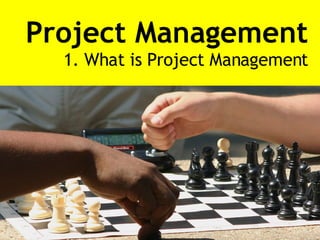
  1. Project Management 1. What is Project Management
  2. Week 1
  3. Turn your phones off Picture by Mike Licht, NotionsCapital.com http://www.flickr.com/photos/notionscapital/869847216/
  4. Welcome
    • 2 parts
    • Intro – who am I, what we’ll be doing this semester, assessments
    • About projects – The Project Management Framework
  5. First
    • Form into 12 Groups
    1st
  6. Revision Groups
  7. Second
    • Your motivation
    2nd
  8. Who wants to be a project manager?
  9. Why?
  10. Who wants to work with a project manager?
  11. When? Where? How?
  12. A walk through the course outline Photo by Tricky at flickr http://www.flickr.com/photos/sovietuk/1432861455/sizes/o/
  13. The textbook
    • Gray, C., & Larson, E. (2006). Project management – The managerial process (3rd ed.). NY: McGraw-Hill. 658.404 G791p3      
  14. Revision Week 13 Global IT Project Management Current Issues in Project Management Weeks 10 – 12 Managing Project Teams Project Conflict Management Performance Management Weeks 7 – 9 Managing Project Change Project Marketing Project Leadership Weeks 4 – 6 Project Management Framework Project Selection and Portfolio Management Project Management Plans Weeks 1 – 3
  15. B 50% End of semester Final Examination A 15% Week 11, Wednesday 1 st October 4pm Week 7 Team Report A 15% Week 8, Wednesday 10 th September 4pm Week 2 Team Project Proposal (Stage-2) A 10% Week 5, Wednesday 20 th August 4pm Week 2 Team Project Proposal (Stage-1) A 10% Weeks 1-11 Weekly Tutorial Participation Task Type Weighting Due Date Release Date Assessment Task
    • View
    • > Notes Page
  16. Week 1
    • The Project Management Framework
  17. 8 things you want to know
    • What is a Project?
    • Process Groups
    • The Triple Constraint
    • What is Project Management?
    • The Project Manager
    • Importance of Project Management
    • Project Management Framework
    • Integrated Approach
  18. 1. What is a Project?
    • All projects have a beginning, a middle and an end.
    Beginning Middle End
    • A definition:
    • “ A temporary endeavor undertaken to accomplish a unique purpose”
    Beginning Middle End
    • Source: CHAOS Report 1995 by the Standish Group
    • Access it here: h ttp://net.educause.edu/ir/library/pdf/NCP08083B.pdf
    Not even completed Typically 189% over budget OTOBOS 53% Challenged 16% Success 31% Critical Failures 1994 1 2 3 4 5 6 7 8
    • More & more IT projects are starting each year
    500K 300K 200K 1998 2001 2002 ?? 2007
    • Projects have a common set of characteristics which can also be defined by what they are not
    A target outcome A defined life span Cross organisational participation New or unique Time, Cost and performance requirements
    • Projects have a common set of characteristics which can also be defined by what they are not
    A target outcome A defined life span Cross organisational participation New or unique Time, Cost and performance requirements
  19. Explorations Go on indefinitely One team or one person working alone Creating the same thing multiple times No constraints on time, cost or performance What a project isn’t
  20. Projects v Not Projects
  21. Process Groups
    • All projects typically go through these five processes
    Close Initiate Plan Monitor & Control Implement
    • A process is a series of actions directed towards a particular result.
    Step 1 Step 2 Step 3 Result activity inputs outputs
  22. Figure 1.1 Project Life Cycle (Gray & Larson, 2006, p6)
  23.  
  24. PMI and the PMBOK
    • www.pmi.org
    • PMP certification
    • Google PMBOK.pdf
    • There are alternatives to PMI
    • Numbers from Craig Brown (Sept 2007)
    7,100 Australia AIPM 15,000 UK APM 30,000 Europe IPMA 240,000 USA PMI Number of members Head office Project Management Organisation
  25. 3. The Triple Constraint
    • Also known as the IRON TRIANGLE
    Time Scope Cost
  26. Figure 1.1 Triple Constraint of Project Management (Schwalbe, 2006, p8)
  27. The Quadruple Constraint
    • Warning: Quality has many definitions
    Quality Time Scope Cost
  28. 4. What is Project Management?
    • Advantages of Project Management
      • Better control of financial, physical, and human resources
      • Improved customer relations
      • Shorter development times
      • Lower costs
      • Higher quality and increased reliability
      • Higher profit margins
      • Improved productivity
      • Better internal coordination
  29.  
  30. 5. The Project Manager
    • Week 6 – Leading Teams
    • Week 7 – Managing Teams
  31. (Schwalbe, 2006, p17)
  32. (Schwalbe, 2006, p22)
  33. 6. Importance of Project Management
    • Increased use of Project Management
      • Compressed product life cycle
      • Global competition
      • Knowledge explosion
      • Corporate downsizing
      • Increased customer focus
      • Development of Third World and closed economies
  34. 7. Project Management Framework
    • The PMBOK’s 9 Knowledge areas
    Integration Management Time Management Cost Management Scope Management Quality Management HR Management Risk Management Communication Management Procurement Management
  35. Figure 1.2 Project Management Framework (Schwalbe, 2006, p9)
  36. 8. Integrated Approach
    • Why would a team member be a stakeholder?
    • Stakeholders
    • are people involved in or affected by project activities
    • Stakeholders include:
    • Project sponsor
    • Project manager
    • Project team
    • Support staff
    • Customers
    • Suppliers
    • Opponents to the project
  37. Project Team Suppliers Customers Opponents Sponsor & Supporters
    • The PMBOK’s 9 Knowledge areas
    Integration Management Time Management Cost Management Scope Management Quality Management HR Management Risk Management Communication Management Procurement Management
    • Time Management
    Integration Management Time Management Cost Management Scope Management Quality Management HR Management Risk Management Communication Management Procurement Management
    • Cost management
    Integration Management Time Management Cost Management Scope Management Quality Management HR Management Risk Management Communication Management Procurement Management
    • Scope Management
    Integration Management Time Management Cost Management Scope Management Quality Management HR Management Risk Management Communication Management Procurement Management
    • Quality Management
    Integration Management Time Management Cost Management Scope Management Quality Management HR Management Risk Management Communication Management Procurement Management
  38. Remember this?
    • The first four knowledge areas are Core Functions
    • The next four knowledge areas are Facilitating Processes
    Integration Management Time Management Cost Management Scope Management Quality Management HR Management Risk Management Communication Management Procurement Management
    • HR Management
    Integration Management Time Management Cost Management Scope Management Quality Management HR Management Risk Management Communication Management Procurement Management
    • Risk Management
    Integration Management Time Management Cost Management Scope Management Quality Management HR Management Risk Management Communication Management Procurement Management
    • Communications Management
    Integration Management Time Management Cost Management Scope Management Quality Management HR Management Risk Management Communication Management Procurement Management
    • Procurement Management
    Integration Management Time Management Cost Management Scope Management Quality Management HR Management Risk Management Communication Management Procurement Management
    • What knowledge area do
    • contract labourers fall into?
    Contract staff ? HR Management Procurement Management
    • Integration Management – pulling it all together
    Integration Management Time Management Cost Management Scope Management Quality Management HR Management Risk Management Communication Management Procurement Management
  39. What if it’s not Integrated? Integration Management Time Management Cost Management Scope Management Quality Management HR Management Risk Management Communication Management Procurement Management
  40. Figure 1.2 Integrated Management of Projects (Gray & Larson, 2006, p13)
    • Which ones are most important for projects?
    Technical skills People Skills Budgeting, Scheduling, Documenting Leading, Motivating, Listening, Empathising
  41. Figure 1.3 Technical and Sociocultural Dimensions of Project Management (Gray & Larson, 2006, p13)
  42. BetterProjects.net
    • Title page pic care of dbking & CC @ Flickr
    • http://flickr.com/photos/bootbearwdc/20109566/

+ Craig BrownCraig Brown, 2 years ago

custom

18773 views, 74 favs, 14 embeds more stats

An introduction to project management
More info about this document

© All Rights Reserved

Go to text version

  • Total Views 18773
    • 18540 on SlideShare
    • 233 from embeds
  • Comments 5
  • Favorites 74
  • Downloads 4236
Most viewed embeds
  • 101 views on http://www.betterprojects.net
  • 64 views on http://lessons-learned.persianblog.ir
  • 32 views on http://it.toolbox.com
  • 9 views on http://www.craigwbrown.net
  • 7 views on http://iphoneknowledge.blogspot.com

more

All embeds
  • 101 views on http://www.betterprojects.net
  • 64 views on http://lessons-learned.persianblog.ir
  • 32 views on http://it.toolbox.com
  • 9 views on http://www.craigwbrown.net
  • 7 views on http://iphoneknowledge.blogspot.com
  • 5 views on http://www.programstep.info
  • 5 views on https://ldsteams.ldschurch.org
  • 3 views on http://programstep.info
  • 2 views on http://www.globalprojectmanagement.org
  • 1 views on http://www.fachak.com
  • 1 views on http://www.clearspring.com
  • 1 views on http://www.lessons-learned.persianblog.ir
  • 1 views on http://64.233.183.104
  • 1 views on http://redmine.ntis.us.to

less

Flagged as inappropriate Flag as inappropriate
Flag as inappropriate

Select your reason for flagging this presentation as inappropriate. If needed, use the feedback form to let us know more details.

Cancel
File a copyright complaint
Having problems? Go to our helpdesk?

Categories