Ahmed
Yousry
PMBOK 5th. Edition
Project Management Professi
onal
(PMP)
Section (1)
Introduction
Course Contents
Project Management Professional
Project Management Body of Knowledge
(PMBOK Guide 5th.Edition)
Course Contents
 Section 1: Introduction
 Section 2: Organizational influences and project life cycle
 Section 3: Project management processes
 Section 4: Project integration management
 Section 5: Project scope management
 Section 6: Project time management
 Section 7: Project cost management
Course Contents
 Section 8: Project quality management
 Section 9: Project human resource management
 Section 10: Project communications management
 Section 11: Project risk management
 Section 12: Project procurement management
 Section 13: Project stakeholder management
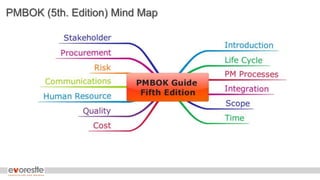
PMBOK (5th. Edition) Mind Map
Course Contents
 Section 1: Introduction
 PMBOK Guide
 Project
 Project Management
 Portfolio Management
 Program Management
 Organizational Project Management (OPM)
 Project Vs. Operations Vs. Organizational Strategy
 Business Value
 Project Manager
Course Contents
 Section 2: Organizational influences and project life cycle
 Organizational Influences on PM
 Stakeholders
 Project Team
 Project Life Cycle
Course Contents
 Section 3: Project Management Processes
 Common Project Management Process Interactions
 Project Management Process Groups
 Initiating Process Group
 Planning Process Group
 Executing Process Group
 Monitoring and Controlling Process Group
 Closing Process Group
 Knowledge Areas
Course Contents
 Section 4: Project Integration Management
 Develop Project Charter
 Develop Project Management Plan
 Direct and Manage Project Work
 Monitor and Control Project Work
 Perform Integrated Change Control
 Close Project or Phase
Course Contents
 Section 5: Project scope management
 Plan Scope Management
 Collect Requirements
 Define Scope
 Create WBS
 Validate Scope
 Control Scope
Course Contents
 Section 6: Project Time Management
 Plan Schedule Management
 Define Activities
 Sequence Activities
 Estimate Activity Resources
 Estimate Activity Durations
 Develop Schedule
 Control Schedule
Course Contents
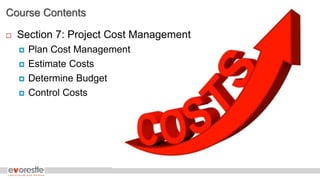
 Section 7: Project Cost Management
 Plan Cost Management
 Estimate Costs
 Determine Budget
 Control Costs
Course Contents
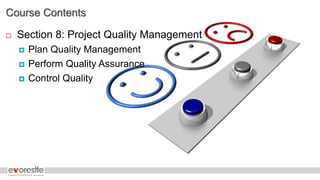
 Section 8: Project Quality Management
 Plan Quality Management
 Perform Quality Assurance
 Control Quality
Course Contents
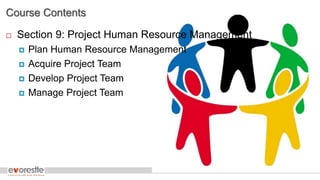
 Section 9: Project Human Resource Management
 Plan Human Resource Management
 Acquire Project Team
 Develop Project Team
 Manage Project Team
Course Contents
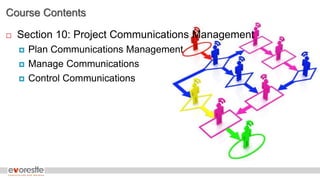
 Section 10: Project Communications Management
 Plan Communications Management
 Manage Communications
 Control Communications
Course Contents
 Section 11: Project Risk Management
 Plan Risk Management
 Identify Risks
 Perform Qualitative Risk Analysis
 Perform Quantitative Risk Analysis
 Plan Risk Responses
 Control Risks
Course Contents
 Section 12: Project Procurement Management
 Plan Procurement Management
 Conduct Procurements
 Control Procurements
 Close Procurements
Course Contents
 Section 13: Project Stakeholder Management
 Identify Stakeholders
 Plan Stakeholder Management
 Manage Stakeholder Engagement
 Control Stakeholder Engagement
PMBOK Guide
PMBOK Guide Editions
 White Paper (1983)
 PMBOK V.1 (1996)
 PMBOK V.2 (2000)
 PMBOK V.3 (2004)
 PMBOK V.4 (2008)
 PMBOK V.5
 December 31, 2012
PMBOK Guide
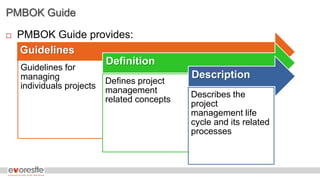
 PMBOK Guide provides:
Guidelines
Guidelines for
managing
individuals projects
Definition
Defines project
management
related concepts
Description
Describes the
project
management life
cycle and its related
processes
PMBOK Guide Contains:
The globally
recognized
standard and guide
for the project
management
profession
 Standard: is a formal
document that describes
established:
 Norms
 Methods
 Processes
 Practices
 Professions: such as
 Law, Medicine, Accounting,
Finance, Engineer.
PMBOK Guide
 Purpose of the PMBOK Guide:
 The acceptance of project management as a profession indicates
that:
 The application of knowledge
 The Processes
 Skills
 Tools and techniques
Can have a significant impact on project success
PMBOK Guide
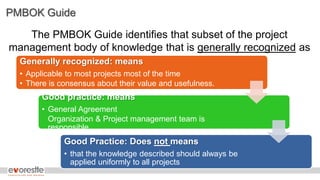
The PMBOK Guide identifies that subset of the project
management body of knowledge that is generally recognized as
good practice.Generally recognized: means
• Applicable to most projects most of the time
• There is consensus about their value and usefulness.
Good practice: means
• General Agreement
Organization & Project management team is
responsible
Good Practice: Does not means
• that the knowledge described should always be
applied uniformly to all projects
PMBOK Guide
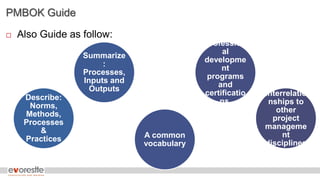
 Also Guide as follow:
Describe:
Norms,
Methods,
Processes
&
Practices
Summarize
:
Processes,
Inputs and
Outputs
A common
vocabulary
Profession
al
developme
nt
programs
and
certificatio
ns.
Interrelatio
nships to
other
project
manageme
nt
disciplines
What is new in PMBOK Guide v5
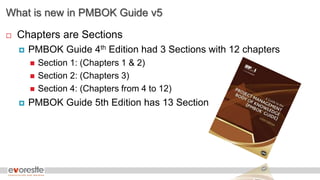
 Chapters are Sections
 PMBOK Guide 4th Edition had 3 Sections with 12 chapters
 Section 1: (Chapters 1 & 2)
 Section 2: (Chapters 3)
 Section 4: (Chapters from 4 to 12)
 PMBOK Guide 5th Edition has 13 Section
What is new in PMBOK Guide v5
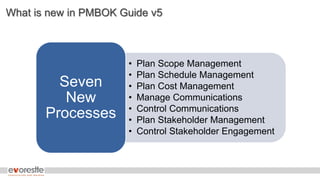
• Plan Scope Management
• Plan Schedule Management
• Plan Cost Management
• Manage Communications
• Control Communications
• Plan Stakeholder Management
• Control Stakeholder Engagement
Seven
New
Processes
What is new in PMBOK Guide v5
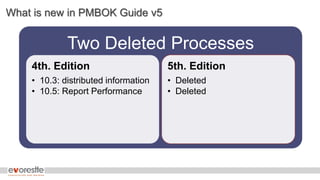
Two Deleted Processes
4th. Edition
• 10.3: distributed information
• 10.5: Report Performance
5th. Edition
• Deleted
• Deleted
What is new in PMBOK Guide v5
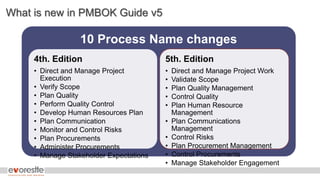
10 Process Name changes
4th. Edition
• Direct and Manage Project
Execution
• Verify Scope
• Plan Quality
• Perform Quality Control
• Develop Human Resources Plan
• Plan Communication
• Monitor and Control Risks
• Plan Procurements
• Administer Procurements
• Manage Stakeholder Expectations
5th. Edition
• Direct and Manage Project Work
• Validate Scope
• Plan Quality Management
• Control Quality
• Plan Human Resource
Management
• Plan Communications
Management
• Control Risks
• Plan Procurement Management
• Control Procurements
• Manage Stakeholder Engagement
What is new in PMBOK Guide v5
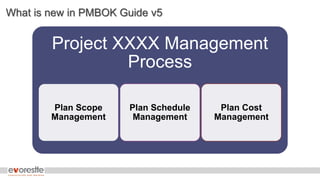
Project XXXX Management
Process
Plan Scope
Management
Plan Schedule
Management
Plan Cost
Management
What is new in PMBOK Guide v5
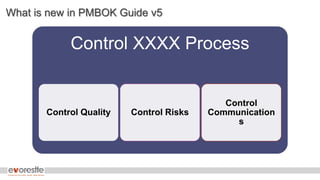
Control XXXX Process
Control Quality Control Risks
Control
Communication
s
What is new in PMBOK Guide v5
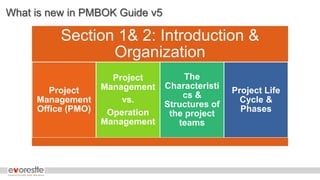
Section 1& 2: Introduction &
Organization
Project
Management
Office (PMO)
Project
Management
vs.
Operation
Management
The
Characteristi
cs &
Structures of
the project
teams
Project Life
Cycle &
Phases
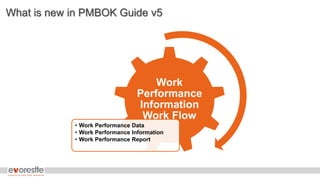
What is new in PMBOK Guide v5
Work
Performance
Information
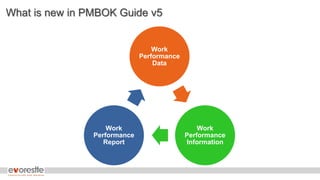
Work Flow
• Work Performance Data
• Work Performance Information
• Work Performance Report
What is new in PMBOK Guide v5
Work
Performance
Data
Work
Performance
Information
Work
Performance
Report
What is a Project?
A temporary endeavor undertaken to create
a unique product, service, or result
 Temporary
 Purpose
 Unique
 Beginning & End
 Resourses
What is a Project?
 Every Project:
 Has a beginning and end.
 Creates a unique product, service or result.
 Temporary does not mean short in duration.
 Temporary refers to the project’s engagement and its longevity.
 Temporary does not typically apply to the product, service, or result
created by the project.
 Most projects are undertaken to create a lasting outcome.
What is a Project?
 The project ends when:
1. Objectives achieved.
2. Objectives will not achieved.
3. Objectives cannot be met.
4. When the need for the project no longer exists.
5. When the client (customer, sponsor, or champion) wishes to terminate
the project.
What is a Project?
 A project can create:
 A product.
 A service or a capability to perform a service.
 An improvement in the existing product or service lines.
 A result.
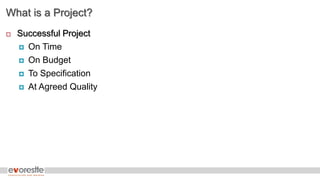
What is a Project?
 Successful Project
 On Time
 On Budget
 To Specification
 At Agreed Quality
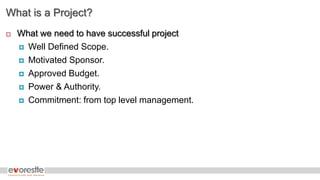
What is a Project?
 What we need to have successful project
 Well Defined Scope.
 Motivated Sponsor.
 Approved Budget.
 Power & Authority.
 Commitment: from top level management.
What is a Project?
 Notes:
 The outcome of the project may be tangible or intangible.
 Project activities can be new to members of a project team, which may
necessitate more dedicated planning than other routine work.
 Projects are undertaken at all organizational levels.
What is a Project?
 Notes:
 A project can involve:
 A single individual
 Multiple individuals
 A single organizational unit
 Multiple organizational units from multiple organizations.
 Repetitive elements may be present in some project deliverables and
activities, this repetition does not change the fundamental, unique
characteristics of the project work.
What is a Project?
 Examples:
 Developing a new product, service, or result.
 Effecting a change in the structure, processes of an organization.
 Developing or acquiring a new or modified information system.
 Constructing a building, infrastructure …
 Implementing, improving or enhancing existing business processes and
procedures.
What is Project Management?
The application of knowledge, skills, tools, and techniques to
project activities to meet the project requirements.
 PM is accomplished through the 47 processes, which are
categorized into five Process Groups:
1. Initiating
2. Planning
3. Executing
4. Monitoring and Controlling
5. Closing
Project Management
 Managing a project typically includes:
 Identifying Requirements
 Addressing the needs, concerns, and expectations of the
stakeholders in planning and executing the project
 Setting up, maintaining, and carrying out communications among
stakeholders
 Managing stakeholders towards meeting project requirements
and creating project deliverables.
Project Management
 Managing a project typically includes:
 Balancing the competing project constraints, which include:
 Scope
 Quality
 Schedule
 Budget
 Resources
 Risks
Project Management
 Notes:
 If the schedule is shortened:
 Often the budget needs to be increased to add additional resources to
complete the same amount of work in less time
 If a budget increase is not possible
 The scope or targeted quality may be reduced to deliver the project’s
end result in less time within the same budget amount
Project Management
 Notes:
 Stakeholders with different ideas = Greater challenge.
 Changing the project requirements or objectives may create
additional risks.
Project Management
 Progressive Elaboration (Rolling Wave Planning)
 Because of the potential for change:-
 The project management plan is iterative and goes through
progressive elaboration throughout the project’s life cycle.
 Progressive elaboration:
 Involves continuously improving and detailing a plan as more-detailed
and specific information and more accurate estimates become
available
Portfolios, Programs, and Projects
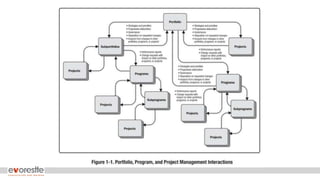
 The Relationships among Portfolios, Programs, and Projects
 A portfolio refers to a collection of:
 Projects, programs, subportfolios, and operations managed as a
group to achieve strategic objectives.
 Programs are grouped within a portfolio and are comprised of:
 Subprograms, projects, or other work that are managed in a
coordinated fashion in support of the portfolio.
Portfolios, Programs, and Projects
 Relationships among Portfolio Management, Program
Management, Project Management and Organizational Project
Management
Portfolio, Program, and Project Management are aligned with or
driven by Organizational Strategies.
Conversely
Portfolio, Program, and Project Management differ in the way
each contributes to the achievement of strategic goals.
Portfolios, Programs, and Projects
 Relationships among Portfolio Management, Program
Management, Project Management and Organizational Project
Management
 Portfolio Management aligns with organizational strategies by
selecting:
 The right programs or projects
 Prioritizing the work
 Providing the needed resources
Portfolios, Programs, and Projects
 Relationships among Portfolio Management, Program
Management, Project Management and Organizational Project
Management
 Program Management harmonizes its projects and program
components and controls interdependencies in order to realize
specified benefits
Portfolios, Programs, and Projects
 Relationships among Portfolio Management, Program
Management, Project Management and Organizational Project
Management
 Project Management develops and implements plans to achieve
a specific scope.
 Driven by the objectives of the program or portfolio.
Portfolios, Programs, and Projects
 Program management:
The application of knowledge, skills, tools, and techniques to a
program in order to meet the program requirements and to obtain
benefits and control not available by managing projects individually
Portfolios, Programs, and Projects
 Portfolio Management
A portfolio refers to projects, programs, subportfolios, and operations
managed as a group to achieve strategic objectives.
Project Management Office (PMO)
 PMO:
 A management structure that standardizes the project-related
governance processes and facilitates the sharing of resources,
methodologies, tools, and techniques.
 The responsibilities of a PMO can range:
 From providing project management support functions
 To actually being responsible for the direct management of one or
more projects.
Project Management Office
 There are several types of PMO structures in organizations,
each varying in the degree of control and influence they have
on projects within the organization, such as:
 Supportive
 Controlling
 Compliance
 Directive
Project Management Office
 A primary function of a PMO is to support project managers in
a variety of ways which may include:
 Managing shared resources
 Identifying and developing project management methodology
 Coaching, mentoring, training
 Monitoring the project management standards, policies,
procedures & templates by means of project audits.
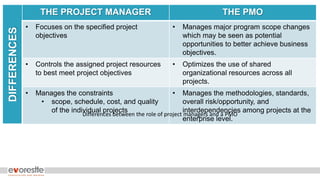
DIFFERENCES THE PROJECT MANAGER THE PMO
• Focuses on the specified project
objectives
• Manages major program scope changes
which may be seen as potential
opportunities to better achieve business
objectives.
• Controls the assigned project resources
to best meet project objectives
• Optimizes the use of shared
organizational resources across all
projects.
• Manages the constraints
• scope, schedule, cost, and quality
of the individual projects
• Manages the methodologies, standards,
overall risk/opportunity, and
interdependencies among projects at the
enterprise level.
Differences between the role of project managers and a PMO
Business value
 Business value is:
 a concept that is unique to each organization.
 The entire value of the business
 The total sum of all tangible and intangible elements.
 Tangible elements include monetary assets, fixtures, stockholder
equity, and utility.
 Intangible elements include good will, brand recognition, public
benefit, and trademarks.
The Role of the Project Manager
 The project manager is:
 The person assigned by the performing
organization to lead the team that is responsible for
achieving the project objectives.
 The role of a project manager is distinct from:
1. Functional manager
OR
2. Operations manager.
The Role of the Project Manager
 The project manager is:
 PM also works closely & in collaboration with other
roles, such as:
 a business analyst
 quality assurance manager
 subject matter experts.
The Role of the Project Manager
 PM Responsibilities:
 PMs have the responsibility to satisfy the needs:
 Task needs
 Team needs
 Individual needs
The Role of the Project Manager
 Interpersonal Skills
 PMs accomplish work
through the project team
and other stakeholders.
 Effective PMs require a
balance of:
 Ethical skills
 Interpersonal skills
 Conceptual skills
The Role of the Project Manager
 Interpersonal Skills
 Leadership
 Team building
 Motivation
 Communication
 Influencing
 Decision making
 Political and cultural
awareness
 Negotiation
 Trust building
 Conflict management
 Coaching
Section 1: introduction

Section 1: introduction

  • 1.
    Ahmed Yousry PMBOK 5th. Edition ProjectManagement Professi onal (PMP) Section (1) Introduction
  • 2.
    Course Contents Project ManagementProfessional Project Management Body of Knowledge (PMBOK Guide 5th.Edition)
  • 3.
    Course Contents  Section1: Introduction  Section 2: Organizational influences and project life cycle  Section 3: Project management processes  Section 4: Project integration management  Section 5: Project scope management  Section 6: Project time management  Section 7: Project cost management
  • 4.
    Course Contents  Section8: Project quality management  Section 9: Project human resource management  Section 10: Project communications management  Section 11: Project risk management  Section 12: Project procurement management  Section 13: Project stakeholder management
  • 5.
  • 6.
    Course Contents  Section1: Introduction  PMBOK Guide  Project  Project Management  Portfolio Management  Program Management  Organizational Project Management (OPM)  Project Vs. Operations Vs. Organizational Strategy  Business Value  Project Manager
  • 7.
    Course Contents  Section2: Organizational influences and project life cycle  Organizational Influences on PM  Stakeholders  Project Team  Project Life Cycle
  • 8.
    Course Contents  Section3: Project Management Processes  Common Project Management Process Interactions  Project Management Process Groups  Initiating Process Group  Planning Process Group  Executing Process Group  Monitoring and Controlling Process Group  Closing Process Group  Knowledge Areas
  • 9.
    Course Contents  Section4: Project Integration Management  Develop Project Charter  Develop Project Management Plan  Direct and Manage Project Work  Monitor and Control Project Work  Perform Integrated Change Control  Close Project or Phase
  • 10.
    Course Contents  Section5: Project scope management  Plan Scope Management  Collect Requirements  Define Scope  Create WBS  Validate Scope  Control Scope
  • 11.
    Course Contents  Section6: Project Time Management  Plan Schedule Management  Define Activities  Sequence Activities  Estimate Activity Resources  Estimate Activity Durations  Develop Schedule  Control Schedule
  • 12.
    Course Contents  Section7: Project Cost Management  Plan Cost Management  Estimate Costs  Determine Budget  Control Costs
  • 13.
    Course Contents  Section8: Project Quality Management  Plan Quality Management  Perform Quality Assurance  Control Quality
  • 14.
    Course Contents  Section9: Project Human Resource Management  Plan Human Resource Management  Acquire Project Team  Develop Project Team  Manage Project Team
  • 15.
    Course Contents  Section10: Project Communications Management  Plan Communications Management  Manage Communications  Control Communications
  • 16.
    Course Contents  Section11: Project Risk Management  Plan Risk Management  Identify Risks  Perform Qualitative Risk Analysis  Perform Quantitative Risk Analysis  Plan Risk Responses  Control Risks
  • 17.
    Course Contents  Section12: Project Procurement Management  Plan Procurement Management  Conduct Procurements  Control Procurements  Close Procurements
  • 18.
    Course Contents  Section13: Project Stakeholder Management  Identify Stakeholders  Plan Stakeholder Management  Manage Stakeholder Engagement  Control Stakeholder Engagement
  • 19.
  • 20.
    PMBOK Guide Editions White Paper (1983)  PMBOK V.1 (1996)  PMBOK V.2 (2000)  PMBOK V.3 (2004)  PMBOK V.4 (2008)  PMBOK V.5  December 31, 2012
  • 21.
    PMBOK Guide  PMBOKGuide provides: Guidelines Guidelines for managing individuals projects Definition Defines project management related concepts Description Describes the project management life cycle and its related processes
  • 22.
    PMBOK Guide Contains: Theglobally recognized standard and guide for the project management profession  Standard: is a formal document that describes established:  Norms  Methods  Processes  Practices  Professions: such as  Law, Medicine, Accounting, Finance, Engineer.
  • 23.
    PMBOK Guide  Purposeof the PMBOK Guide:  The acceptance of project management as a profession indicates that:  The application of knowledge  The Processes  Skills  Tools and techniques Can have a significant impact on project success
  • 24.
    PMBOK Guide The PMBOKGuide identifies that subset of the project management body of knowledge that is generally recognized as good practice.Generally recognized: means • Applicable to most projects most of the time • There is consensus about their value and usefulness. Good practice: means • General Agreement Organization & Project management team is responsible Good Practice: Does not means • that the knowledge described should always be applied uniformly to all projects
  • 25.
    PMBOK Guide  AlsoGuide as follow: Describe: Norms, Methods, Processes & Practices Summarize : Processes, Inputs and Outputs A common vocabulary Profession al developme nt programs and certificatio ns. Interrelatio nships to other project manageme nt disciplines
  • 26.
    What is newin PMBOK Guide v5  Chapters are Sections  PMBOK Guide 4th Edition had 3 Sections with 12 chapters  Section 1: (Chapters 1 & 2)  Section 2: (Chapters 3)  Section 4: (Chapters from 4 to 12)  PMBOK Guide 5th Edition has 13 Section
  • 27.
    What is newin PMBOK Guide v5 • Plan Scope Management • Plan Schedule Management • Plan Cost Management • Manage Communications • Control Communications • Plan Stakeholder Management • Control Stakeholder Engagement Seven New Processes
  • 28.
    What is newin PMBOK Guide v5 Two Deleted Processes 4th. Edition • 10.3: distributed information • 10.5: Report Performance 5th. Edition • Deleted • Deleted
  • 29.
    What is newin PMBOK Guide v5 10 Process Name changes 4th. Edition • Direct and Manage Project Execution • Verify Scope • Plan Quality • Perform Quality Control • Develop Human Resources Plan • Plan Communication • Monitor and Control Risks • Plan Procurements • Administer Procurements • Manage Stakeholder Expectations 5th. Edition • Direct and Manage Project Work • Validate Scope • Plan Quality Management • Control Quality • Plan Human Resource Management • Plan Communications Management • Control Risks • Plan Procurement Management • Control Procurements • Manage Stakeholder Engagement
  • 30.
    What is newin PMBOK Guide v5 Project XXXX Management Process Plan Scope Management Plan Schedule Management Plan Cost Management
  • 31.
    What is newin PMBOK Guide v5 Control XXXX Process Control Quality Control Risks Control Communication s
  • 32.
    What is newin PMBOK Guide v5 Section 1& 2: Introduction & Organization Project Management Office (PMO) Project Management vs. Operation Management The Characteristi cs & Structures of the project teams Project Life Cycle & Phases
  • 33.
    What is newin PMBOK Guide v5 Work Performance Information Work Flow • Work Performance Data • Work Performance Information • Work Performance Report
  • 34.
    What is newin PMBOK Guide v5 Work Performance Data Work Performance Information Work Performance Report
  • 35.
    What is aProject? A temporary endeavor undertaken to create a unique product, service, or result  Temporary  Purpose  Unique  Beginning & End  Resourses
  • 36.
    What is aProject?  Every Project:  Has a beginning and end.  Creates a unique product, service or result.  Temporary does not mean short in duration.  Temporary refers to the project’s engagement and its longevity.  Temporary does not typically apply to the product, service, or result created by the project.  Most projects are undertaken to create a lasting outcome.
  • 37.
    What is aProject?  The project ends when: 1. Objectives achieved. 2. Objectives will not achieved. 3. Objectives cannot be met. 4. When the need for the project no longer exists. 5. When the client (customer, sponsor, or champion) wishes to terminate the project.
  • 38.
    What is aProject?  A project can create:  A product.  A service or a capability to perform a service.  An improvement in the existing product or service lines.  A result.
  • 39.
    What is aProject?  Successful Project  On Time  On Budget  To Specification  At Agreed Quality
  • 40.
    What is aProject?  What we need to have successful project  Well Defined Scope.  Motivated Sponsor.  Approved Budget.  Power & Authority.  Commitment: from top level management.
  • 41.
    What is aProject?  Notes:  The outcome of the project may be tangible or intangible.  Project activities can be new to members of a project team, which may necessitate more dedicated planning than other routine work.  Projects are undertaken at all organizational levels.
  • 42.
    What is aProject?  Notes:  A project can involve:  A single individual  Multiple individuals  A single organizational unit  Multiple organizational units from multiple organizations.  Repetitive elements may be present in some project deliverables and activities, this repetition does not change the fundamental, unique characteristics of the project work.
  • 43.
    What is aProject?  Examples:  Developing a new product, service, or result.  Effecting a change in the structure, processes of an organization.  Developing or acquiring a new or modified information system.  Constructing a building, infrastructure …  Implementing, improving or enhancing existing business processes and procedures.
  • 44.
    What is ProjectManagement? The application of knowledge, skills, tools, and techniques to project activities to meet the project requirements.  PM is accomplished through the 47 processes, which are categorized into five Process Groups: 1. Initiating 2. Planning 3. Executing 4. Monitoring and Controlling 5. Closing
  • 45.
    Project Management  Managinga project typically includes:  Identifying Requirements  Addressing the needs, concerns, and expectations of the stakeholders in planning and executing the project  Setting up, maintaining, and carrying out communications among stakeholders  Managing stakeholders towards meeting project requirements and creating project deliverables.
  • 46.
    Project Management  Managinga project typically includes:  Balancing the competing project constraints, which include:  Scope  Quality  Schedule  Budget  Resources  Risks
  • 47.
    Project Management  Notes: If the schedule is shortened:  Often the budget needs to be increased to add additional resources to complete the same amount of work in less time  If a budget increase is not possible  The scope or targeted quality may be reduced to deliver the project’s end result in less time within the same budget amount
  • 48.
    Project Management  Notes: Stakeholders with different ideas = Greater challenge.  Changing the project requirements or objectives may create additional risks.
  • 49.
    Project Management  ProgressiveElaboration (Rolling Wave Planning)  Because of the potential for change:-  The project management plan is iterative and goes through progressive elaboration throughout the project’s life cycle.  Progressive elaboration:  Involves continuously improving and detailing a plan as more-detailed and specific information and more accurate estimates become available
  • 50.
    Portfolios, Programs, andProjects  The Relationships among Portfolios, Programs, and Projects  A portfolio refers to a collection of:  Projects, programs, subportfolios, and operations managed as a group to achieve strategic objectives.  Programs are grouped within a portfolio and are comprised of:  Subprograms, projects, or other work that are managed in a coordinated fashion in support of the portfolio.
  • 52.
    Portfolios, Programs, andProjects  Relationships among Portfolio Management, Program Management, Project Management and Organizational Project Management Portfolio, Program, and Project Management are aligned with or driven by Organizational Strategies. Conversely Portfolio, Program, and Project Management differ in the way each contributes to the achievement of strategic goals.
  • 53.
    Portfolios, Programs, andProjects  Relationships among Portfolio Management, Program Management, Project Management and Organizational Project Management  Portfolio Management aligns with organizational strategies by selecting:  The right programs or projects  Prioritizing the work  Providing the needed resources
  • 54.
    Portfolios, Programs, andProjects  Relationships among Portfolio Management, Program Management, Project Management and Organizational Project Management  Program Management harmonizes its projects and program components and controls interdependencies in order to realize specified benefits
  • 55.
    Portfolios, Programs, andProjects  Relationships among Portfolio Management, Program Management, Project Management and Organizational Project Management  Project Management develops and implements plans to achieve a specific scope.  Driven by the objectives of the program or portfolio.
  • 56.
    Portfolios, Programs, andProjects  Program management: The application of knowledge, skills, tools, and techniques to a program in order to meet the program requirements and to obtain benefits and control not available by managing projects individually
  • 57.
    Portfolios, Programs, andProjects  Portfolio Management A portfolio refers to projects, programs, subportfolios, and operations managed as a group to achieve strategic objectives.
  • 58.
    Project Management Office(PMO)  PMO:  A management structure that standardizes the project-related governance processes and facilitates the sharing of resources, methodologies, tools, and techniques.  The responsibilities of a PMO can range:  From providing project management support functions  To actually being responsible for the direct management of one or more projects.
  • 59.
    Project Management Office There are several types of PMO structures in organizations, each varying in the degree of control and influence they have on projects within the organization, such as:  Supportive  Controlling  Compliance  Directive
  • 60.
    Project Management Office A primary function of a PMO is to support project managers in a variety of ways which may include:  Managing shared resources  Identifying and developing project management methodology  Coaching, mentoring, training  Monitoring the project management standards, policies, procedures & templates by means of project audits.
  • 61.
    DIFFERENCES THE PROJECTMANAGER THE PMO • Focuses on the specified project objectives • Manages major program scope changes which may be seen as potential opportunities to better achieve business objectives. • Controls the assigned project resources to best meet project objectives • Optimizes the use of shared organizational resources across all projects. • Manages the constraints • scope, schedule, cost, and quality of the individual projects • Manages the methodologies, standards, overall risk/opportunity, and interdependencies among projects at the enterprise level. Differences between the role of project managers and a PMO
  • 62.
    Business value  Businessvalue is:  a concept that is unique to each organization.  The entire value of the business  The total sum of all tangible and intangible elements.  Tangible elements include monetary assets, fixtures, stockholder equity, and utility.  Intangible elements include good will, brand recognition, public benefit, and trademarks.
  • 63.
    The Role ofthe Project Manager  The project manager is:  The person assigned by the performing organization to lead the team that is responsible for achieving the project objectives.  The role of a project manager is distinct from: 1. Functional manager OR 2. Operations manager.
  • 64.
    The Role ofthe Project Manager  The project manager is:  PM also works closely & in collaboration with other roles, such as:  a business analyst  quality assurance manager  subject matter experts.
  • 65.
    The Role ofthe Project Manager  PM Responsibilities:  PMs have the responsibility to satisfy the needs:  Task needs  Team needs  Individual needs
  • 66.
    The Role ofthe Project Manager  Interpersonal Skills  PMs accomplish work through the project team and other stakeholders.  Effective PMs require a balance of:  Ethical skills  Interpersonal skills  Conceptual skills
  • 67.
    The Role ofthe Project Manager  Interpersonal Skills  Leadership  Team building  Motivation  Communication  Influencing  Decision making  Political and cultural awareness  Negotiation  Trust building  Conflict management  Coaching

Editor's Notes

  • #22 PMBOK® Guide: A Guide to the Project Management Body of Knowledge - Fifth Edition provides: Guidelines for managing individual projects Defines project management related concepts Describes the project management life cycle and its related processes.
  • #23 PMBOK Guide Contains: The globally recognized standard and guide for the project management profession يشمل المعايير المعترف بها عالميا ودليل الأرشادى لمهنة إدارة المشاريع
  • #24 إن قبول إدارة المشاريع باعتبارها مهنة يشير الى أن: تطبيق المعرفة العمليات المهارات الأدوات والتقنيات يمكن أن يكون لها تأثير كبير على نجاح المشروع
  • #25 دليل PMBOK بتوضيح المجموعة الثانوية و الفرعية من المجالات المعرفية لأدارة المشروعات و التى تعتبر من المعترف بها بصورة عامة كممارسة جيدة (Generally Recognized) المعترف بها عموما: بعنى ... تنطبق على معظم المشاريع في معظم الوقت هناك توافق في الآراء حول قيمتها وفائدتها (Good Practice) الممارسات الجيدة: تعنى ... الاتفاق العام على هذة الممارسات الفريق المؤسسى و فريق إدارة هو المسئول عن إختيار الأجراءءات المناسبةلتنفيذ المشروع (Good Practice) الممارسة الجيدة: لا تعنى ... أن مجالات المعرفة التى وصفت ينبغي دائما أن تطبق بشكل موحد على جميع المشاريع
  • #39 Project can creates: A product: That can be either a component of another item. An enhancement of an item. An end item in itself. A service or a capability to perform a service e.g.: a business function that supports production or distribution An improvement in the existing product or service lines e.g.: A Six Sigma project undertaken to reduce defects) A result: Such as an outcome or document (e.g., a research project that develops knowledge that can be used to determine whether a trend exists or a new process will benefit society)
  • #80 من خلال تعزيز و تمكين للمؤسسات من خلال: الهيكلية الثقافية التكنولوجية ممارسات الموارد البشرية ويمكن للمنظمات و المؤسسسات زيادة تيسير المواءمة بين أنشطة (Portfolio) وأنشطة (Program) وأنشطة إدارة المشاريع By continuously conducting portfolio strategic alignment and optimization, performing business impact analyses, and developing robust organizational enablers, organizations can achieve successful transitions within the portfolio, program, and project domains and attain effective investment management and business value realization.
  • #83 1. In other cases, a project manager may be one of several project managers who report to a program or portfolio manager who is ultimately responsible for enterprise-wide projects. 2. In this type: PM works closely with the program or portfolio manager to achieve the project objectives and to ensure the project management plan aligns with the overarching program plan.