PRESENTATION TITLE Presenter Name  |  Date
Abstract Greenhouse gas (GHG) emissions continue their relentless rise, even though the global CO2 level is already considerably higher than it has been on earth for over two million years.  One of the significant contributors to increased GHG is the ITC industry itself, roughly equal to the emissions from the aviation industry. As universities researchers increasingly employ computational and cyberinfrastructure technologies, these very enablers of modern scientific discovery are coming into question because of their growing contributions to GHG emissions.  As a result, some universities and R&E networks are starting to explore new types of computational and network architectures that not only benefit research, but also have reduced associated GHG emissions. Optical high speed research networks and distributed zero carbon cyberinfrastructure data centers with network virtualization, web services and grids will be a critical component of this emerging architecture.  We review the trends and spotlight specific projects that offer hope for averting this cyber-carbon crisis.
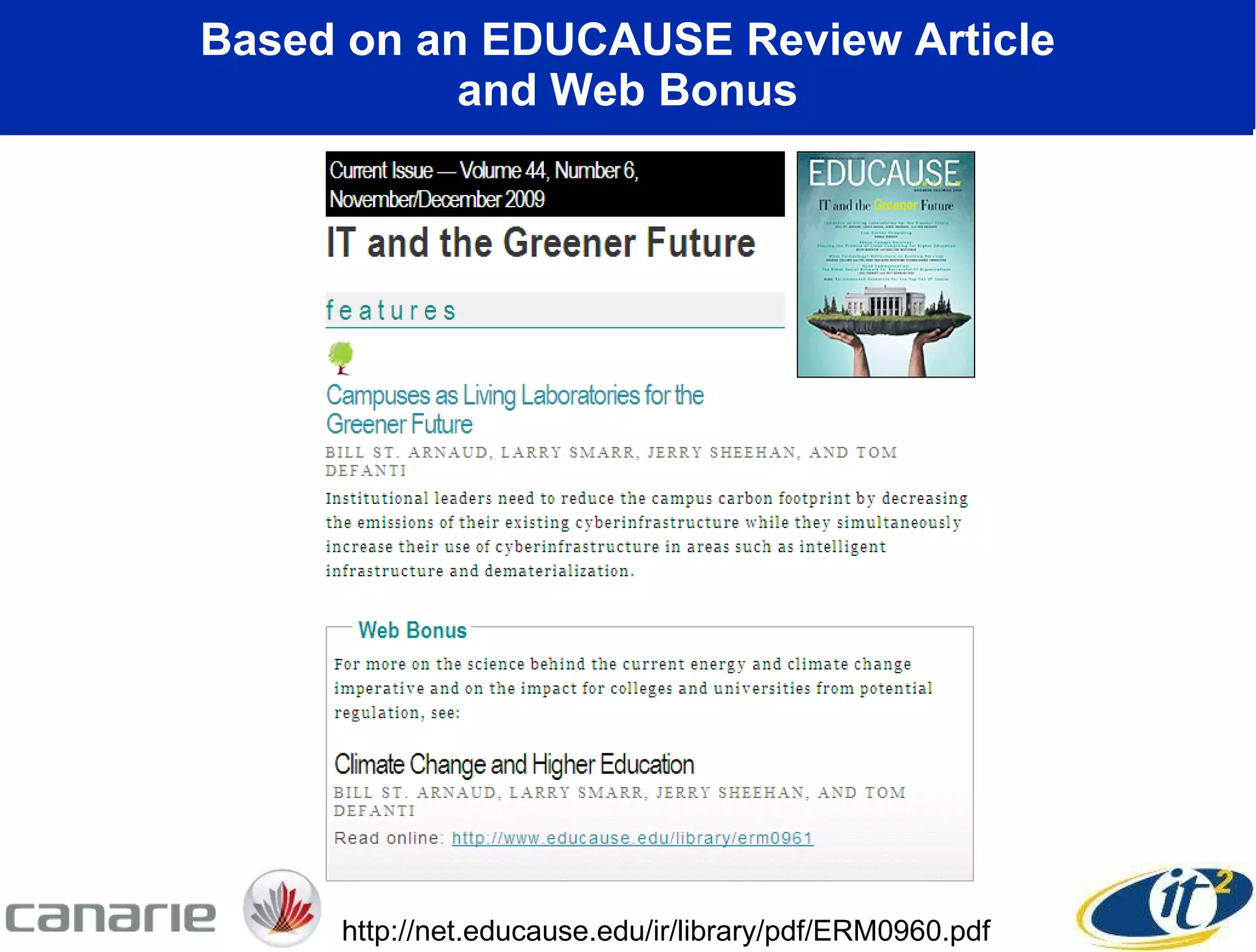
Based on an EDUCAUSE Review Article and Web Bonus http://net.educause.edu/ir/library/pdf/ERM0960.pdf
Science of Climate Change
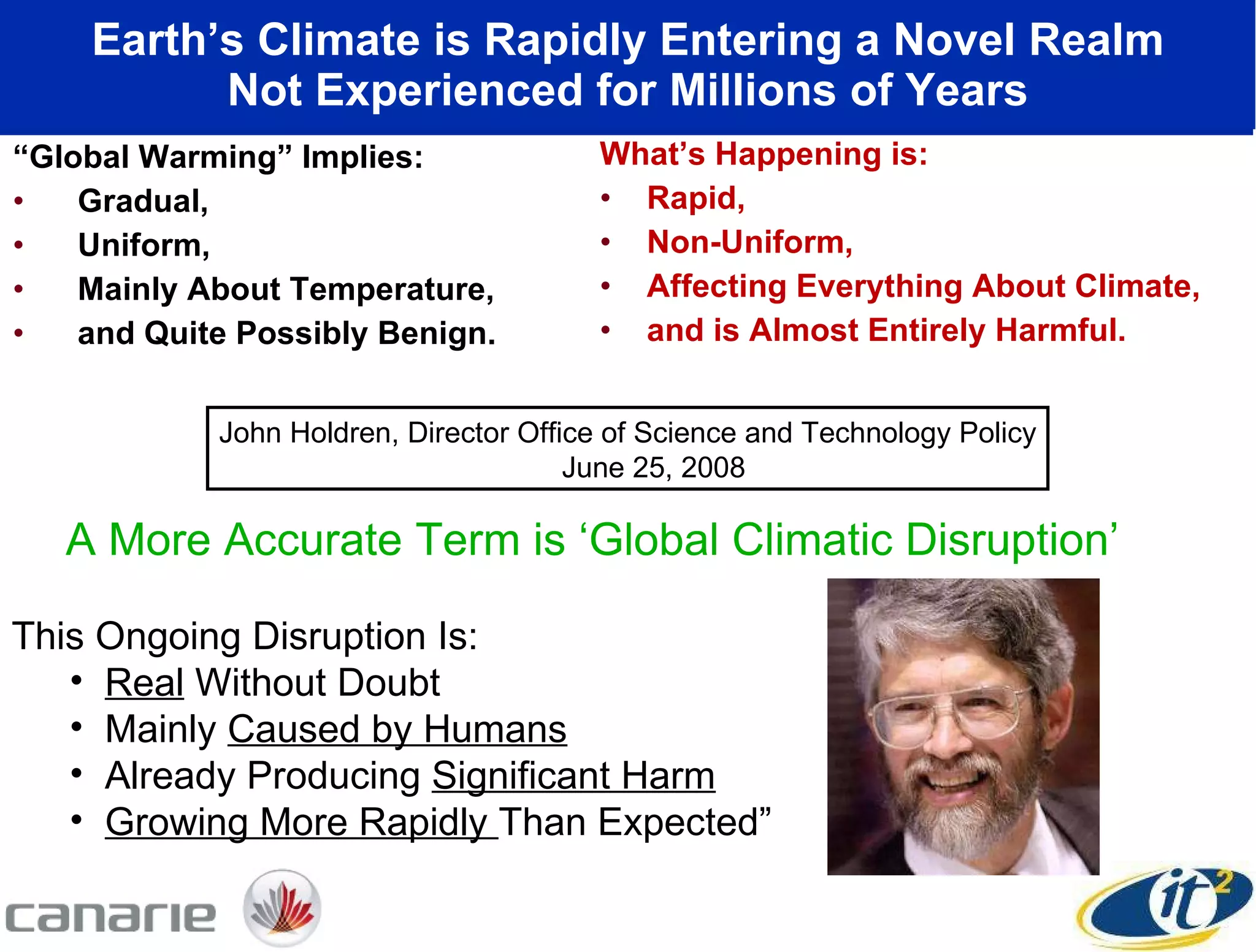
Earth’s Climate is Rapidly Entering a Novel Realm Not Experienced for Millions of Years “ Global Warming” Implies :   Gradual,  Uniform,  Mainly About Temperature,  a nd Quite Possibly Benign. What’s Happening  i s :   Rapid,  Non- U niform,  Affecting Everything About Climate,  a nd  i s Almost Entirely Harmful. A More Accurate Term is ‘Global Climatic Disruption’ This Ongoing Disruption Is: Real  Without Doubt Mainly  Caused by Humans Already Producing  Significant Harm Growing More Rapidly  Than Expected” John Holdren, Director Office of Science and Technology Policy June 25, 2008
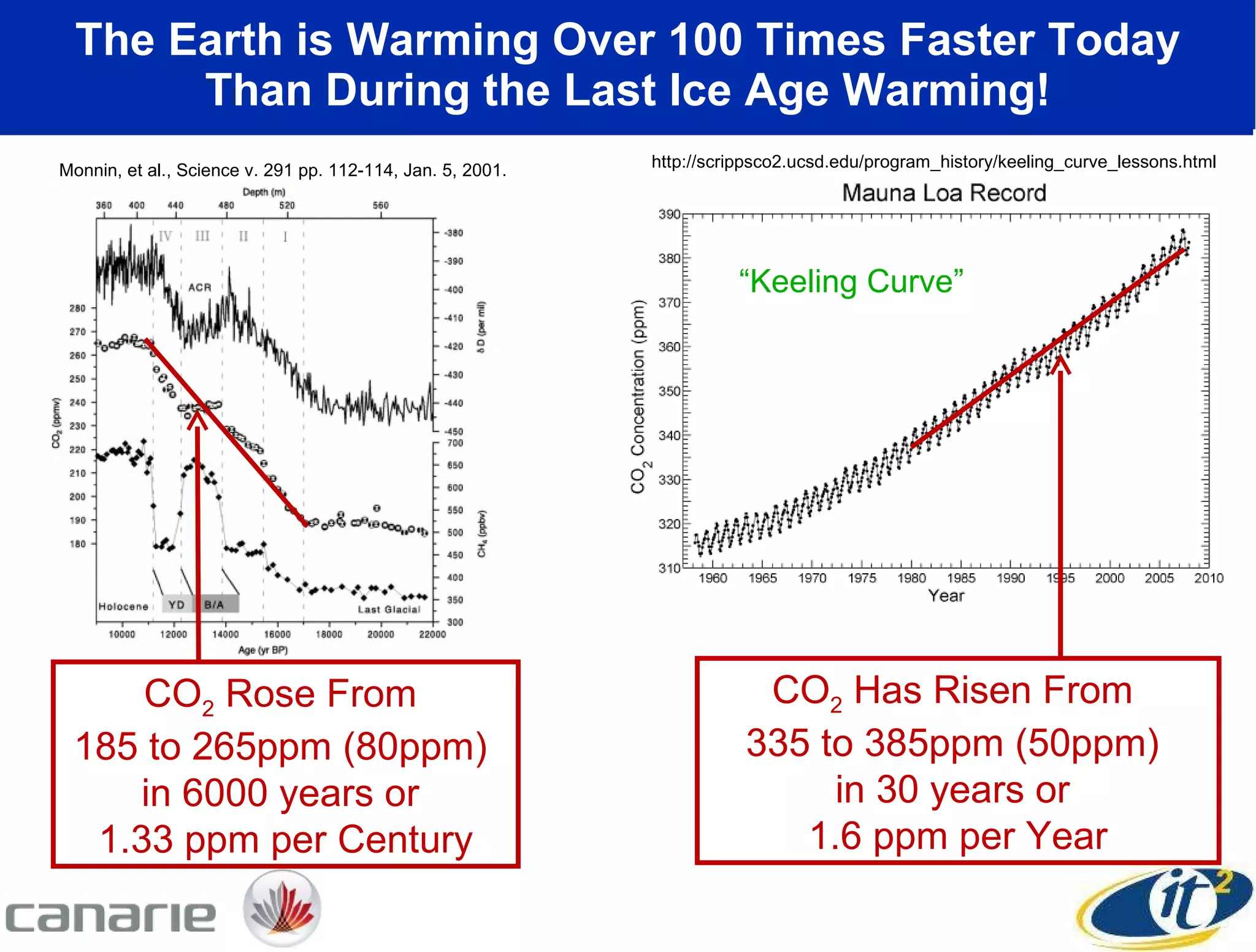
The Earth is Warming Over 100 Times Faster Today Than During the Last Ice Age Warming! http://scrippsco2.ucsd.edu/program_history/keeling_curve_lessons.html Monnin, et al., Science v. 291 pp. 112-114, Jan. 5, 2001. “ Keeling Curve” CO 2  Rose From  185 to 265ppm (80ppm)  in 6000 years or  1.33 ppm per Century CO 2  Has Risen From  335 to 385ppm (50ppm)  in 30 years or  1.6 ppm per Year
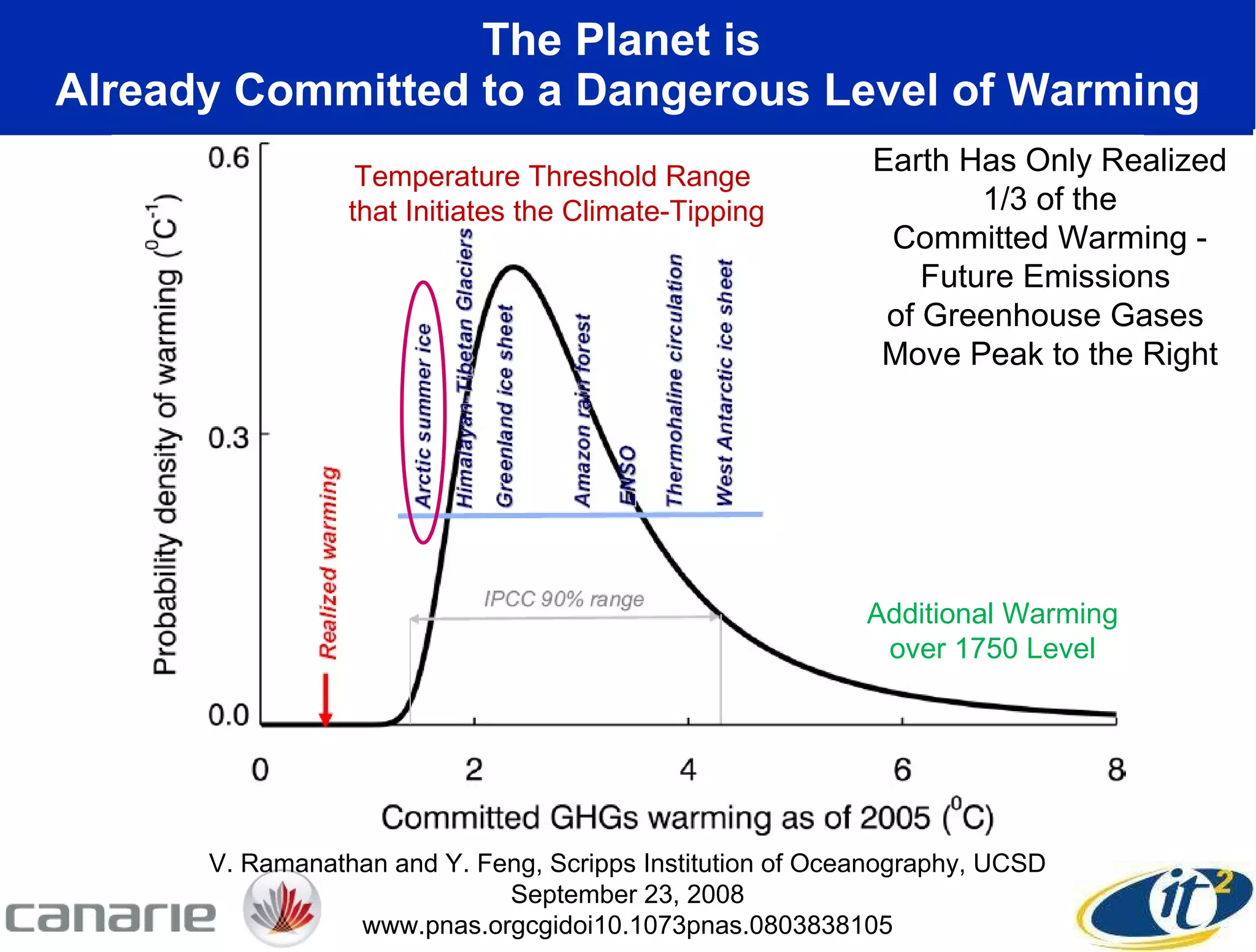
The Planet is  Already Committed to a Dangerous Level of Warming Temperature Threshold Range  that Initiates the Climate-Tipping V. Ramanathan and Y. Feng, Scripps Institution of Oceanography, UCSD September 23, 2008 www.pnas.orgcgidoi10.1073pnas.0803838105 Additional Warming over 1750 Level Earth Has Only Realized 1/3 of the Committed Warming - Future Emissions  of Greenhouse Gases  Move Peak to the Right
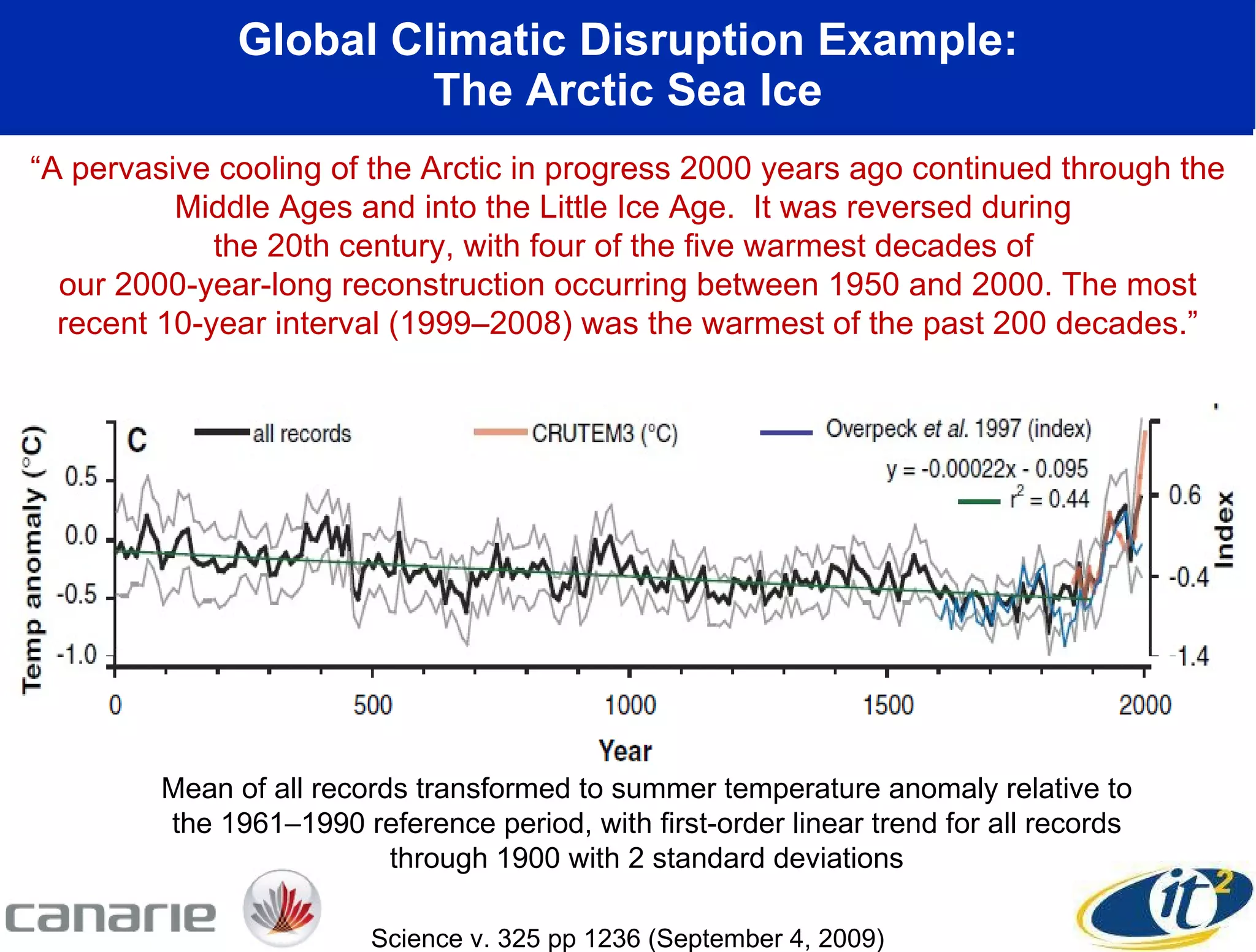
Global Climatic Disruption Example: The Arctic Sea Ice Mean of all records transformed to summer temperature anomaly relative to the 1961–1990 reference period, with first-order linear trend for all records through 1900 with 2 standard deviations “ A pervasive cooling of the Arctic in progress 2000 years ago continued through the Middle Ages and into the Little Ice Age.  It was reversed during  the 20th century, with four of the five warmest decades of  our 2000-year-long reconstruction occurring between 1950 and 2000. The most recent 10-year interval (1999–2008) was the warmest of the past 200 decades.” Science v. 325 pp 1236 (September 4, 2009)
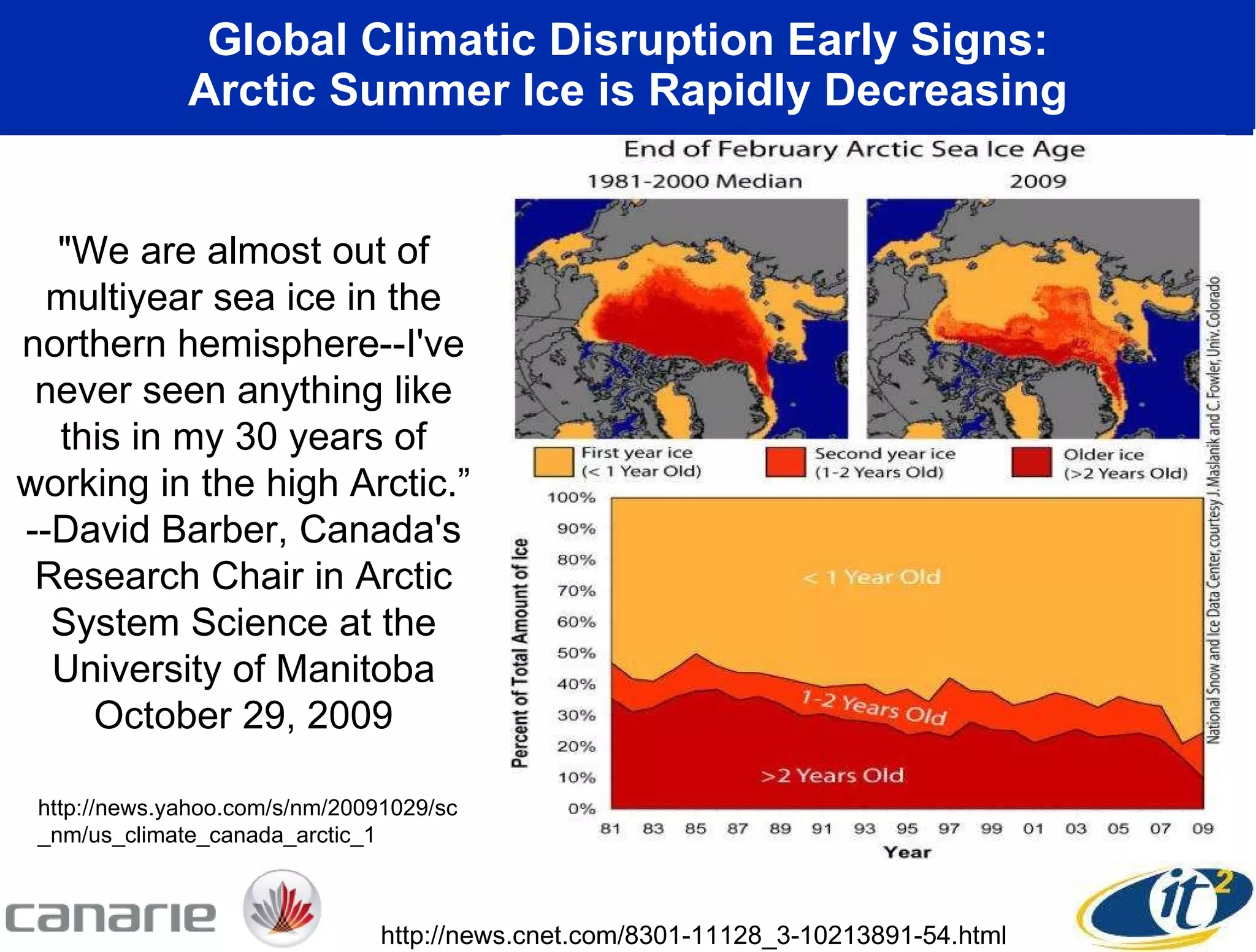
Global Climatic Disruption Early Signs: Arctic Summer Ice is Rapidly Decreasing "We are almost out of multiyear sea ice in the northern hemisphere--I've never seen anything like this in my 30 years of working in the high Arctic.” --David Barber, Canada's Research Chair in Arctic System Science at the University of Manitoba October 29, 2009 http://news.cnet.com/8301-11128_3-10213891-54.html http://news.yahoo.com/s/nm/20091029/sc_nm/us_climate_canada_arctic_1
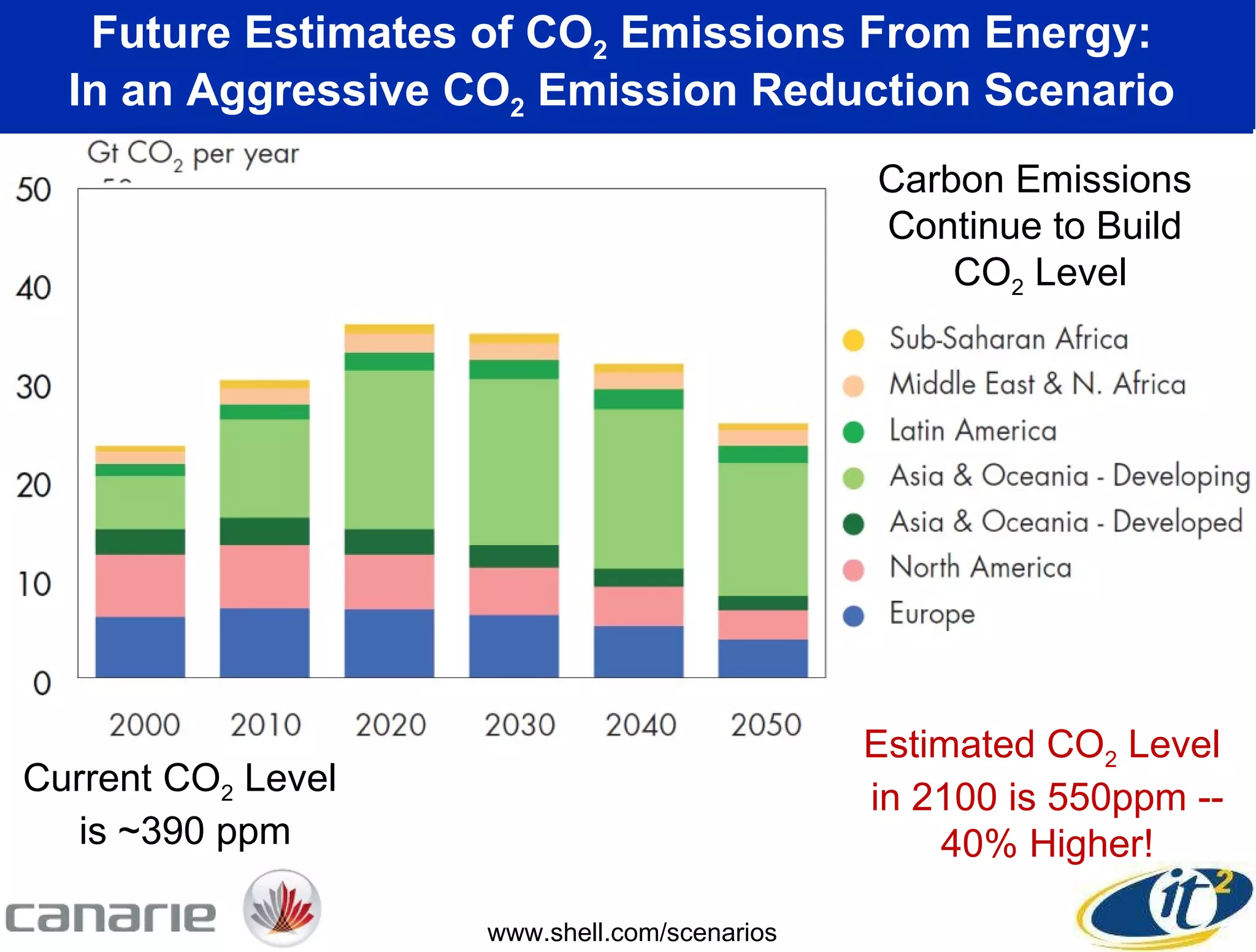
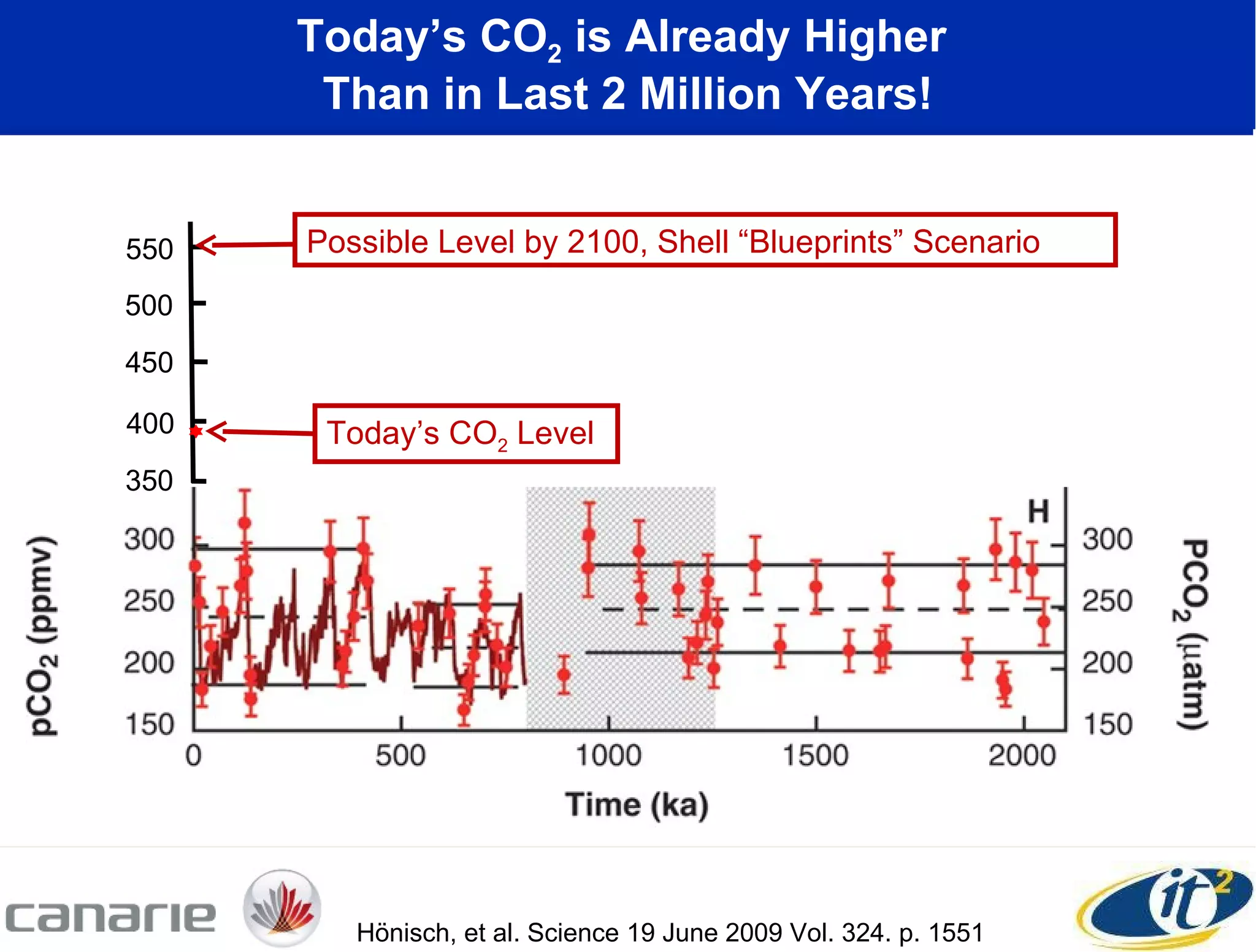
Future Estimates of CO 2  Emissions From Energy:  In an Aggressive CO 2  Emission Reduction Scenario  www.shell.com/scenarios Estimated CO 2  Level  in 2100 is 550ppm -- 40% Higher! Current CO 2  Level  is ~390 ppm Carbon Emissions  Continue to Build  CO 2  Level
Today’s CO 2  is Already Higher  Than in Last 2 Million Years! Hönisch, et al. Science 19 June 2009 Vol. 324. p. 1551 350 400 450 500 550 Today’s CO 2  Level Possible Level by 2100, Shell “Blueprints” Scenario
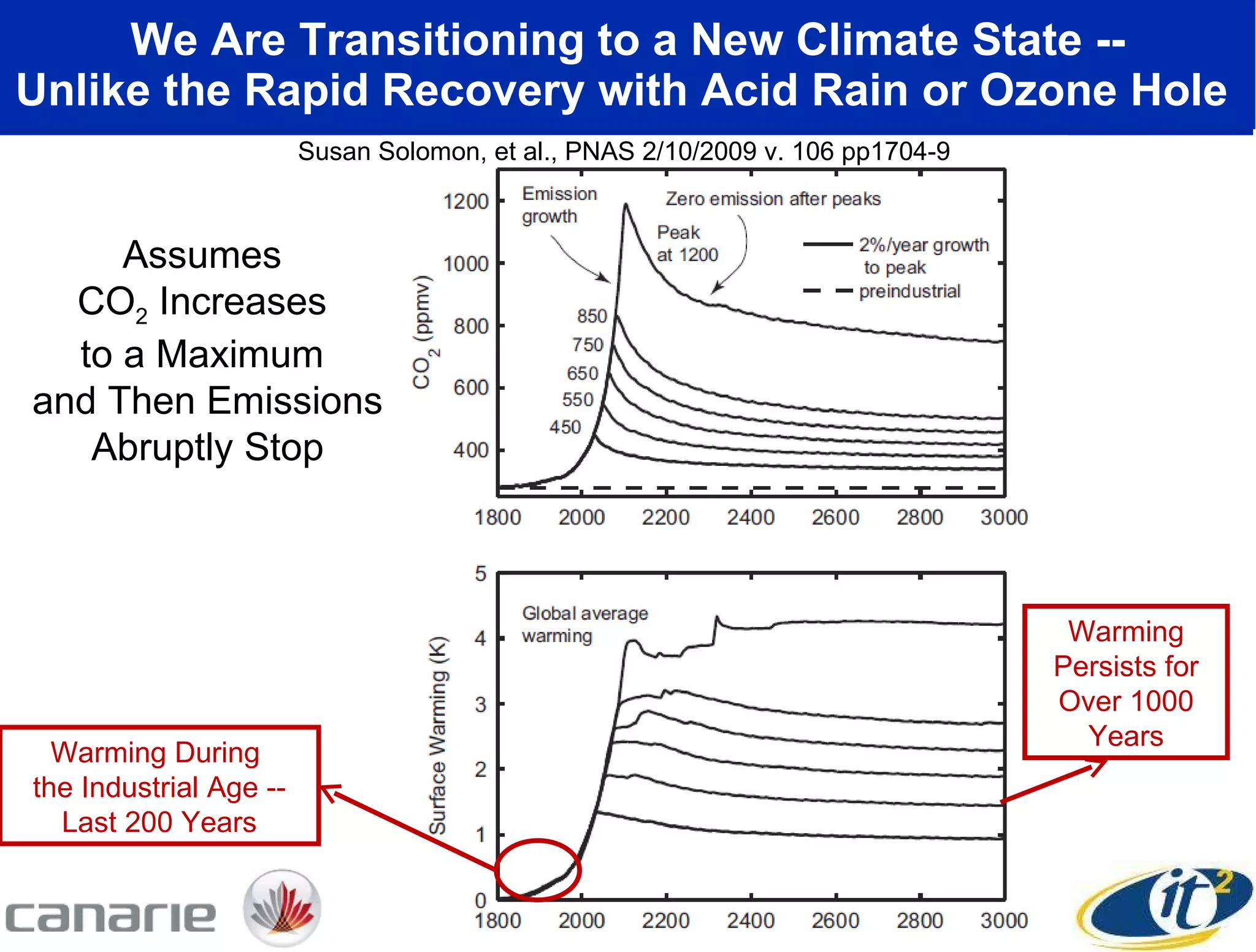
We Are Transitioning to a New Climate State -- Unlike the Rapid Recovery with Acid Rain or Ozone Hole  Susan Solomon, et al., PNAS 2/10/2009 v. 106 pp1704-9  Assumes  CO 2  Increases  to a Maximum  and Then Emissions Abruptly Stop Warming During  the Industrial Age -- Last 200 Years Warming Persists for Over 1000 Years
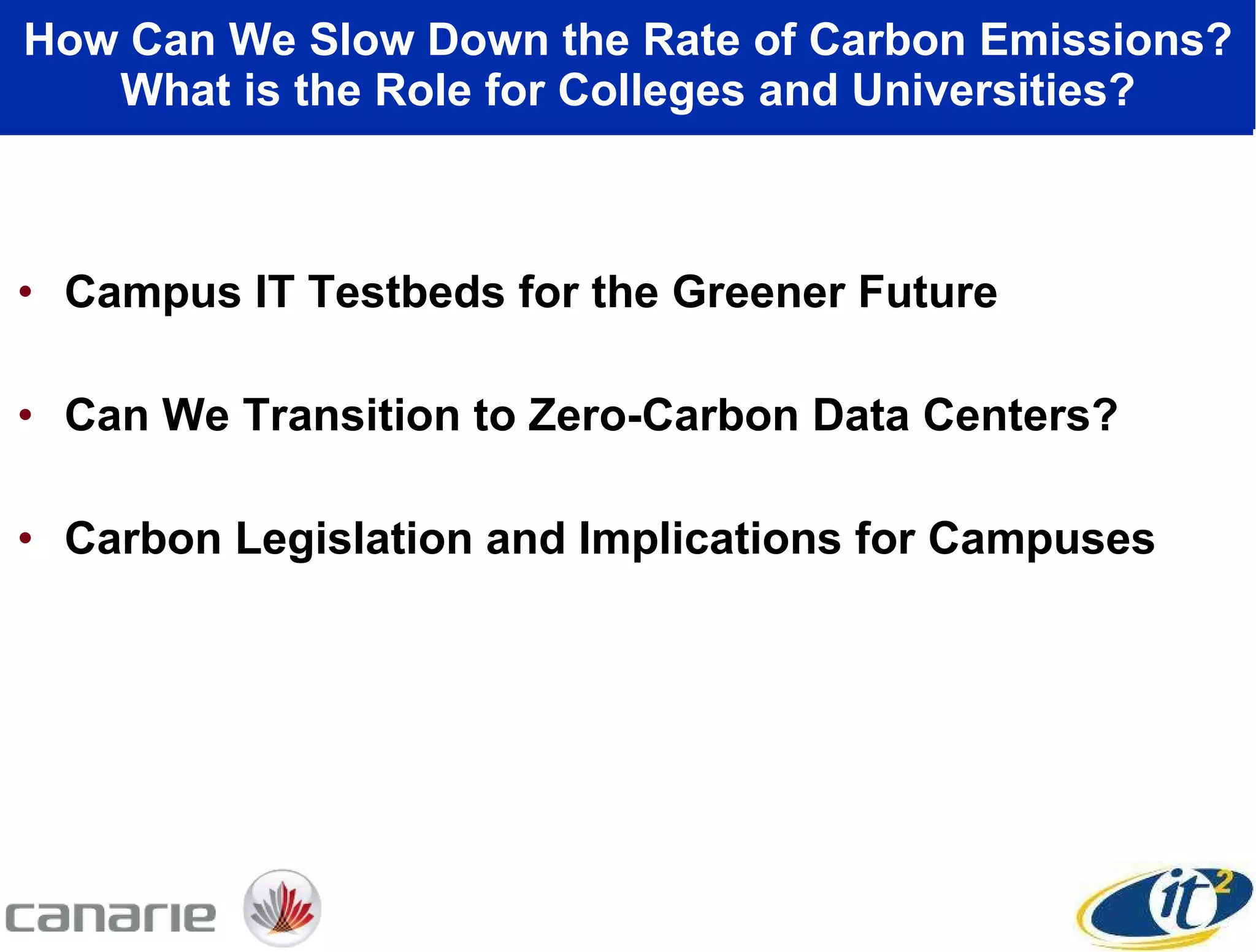
How Can We Slow Down the Rate of Carbon Emissions? What is the Role for Colleges and Universities? Campus IT Testbeds for the Greener Future Can We Transition to Zero-Carbon Data Centers? Carbon Legislation and Implications for Campuses
Campus IT Testbeds for the Greener Future
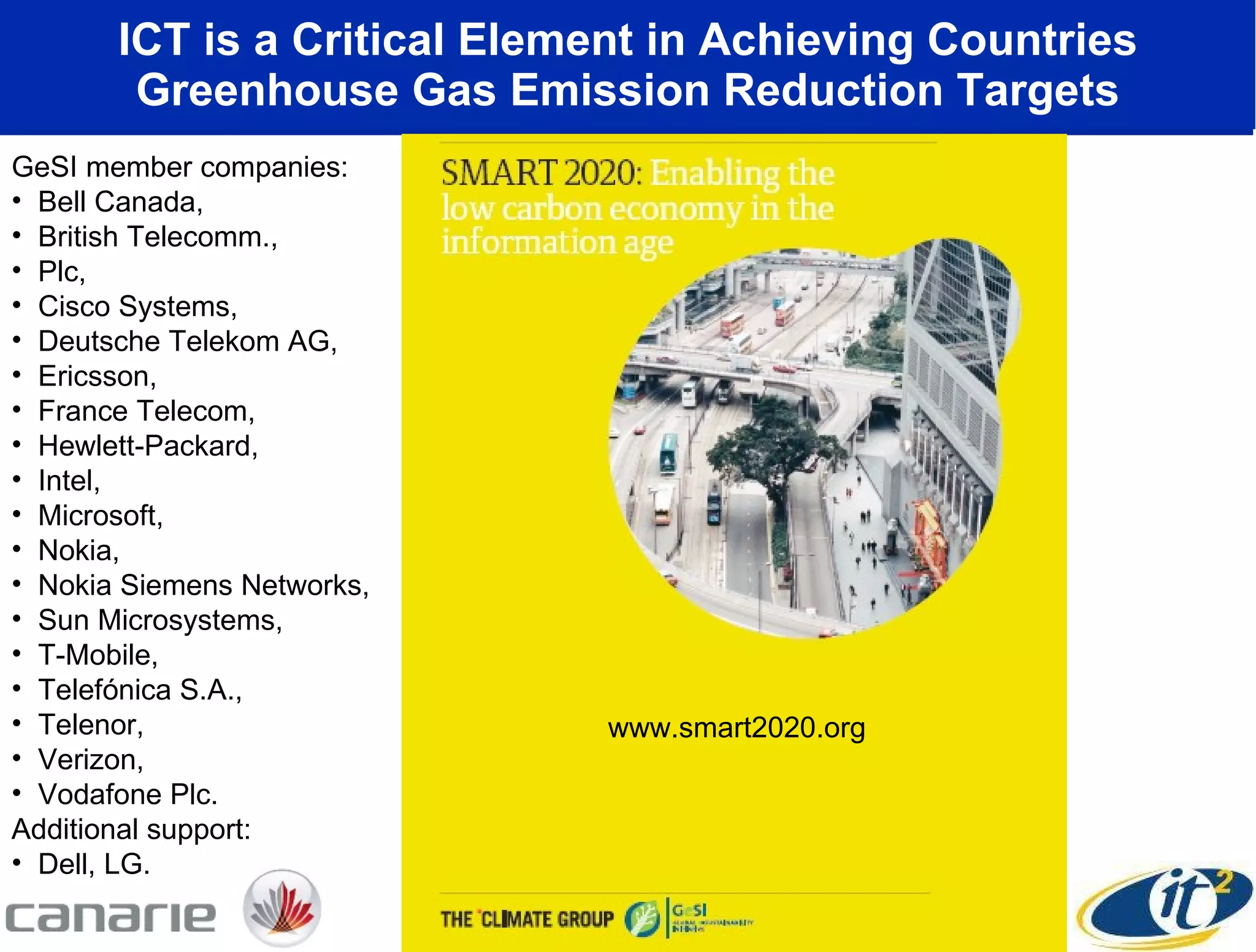
ICT is a Critical Element in Achieving Countries Greenhouse Gas Emission Reduction Targets www.smart2020.org GeSI member companies:  Bell Canada,  British Telecomm.,  Plc,  Cisco Systems,  Deutsche Telekom AG,  Ericsson,  France Telecom,  Hewlett-Packard,  Intel,  Microsoft,  Nokia,  Nokia Siemens Networks,  Sun Microsystems,  T-Mobile,  Telefónica S.A.,  Telenor,  Verizon,  Vodafone Plc.  Additional support:  Dell, LG.
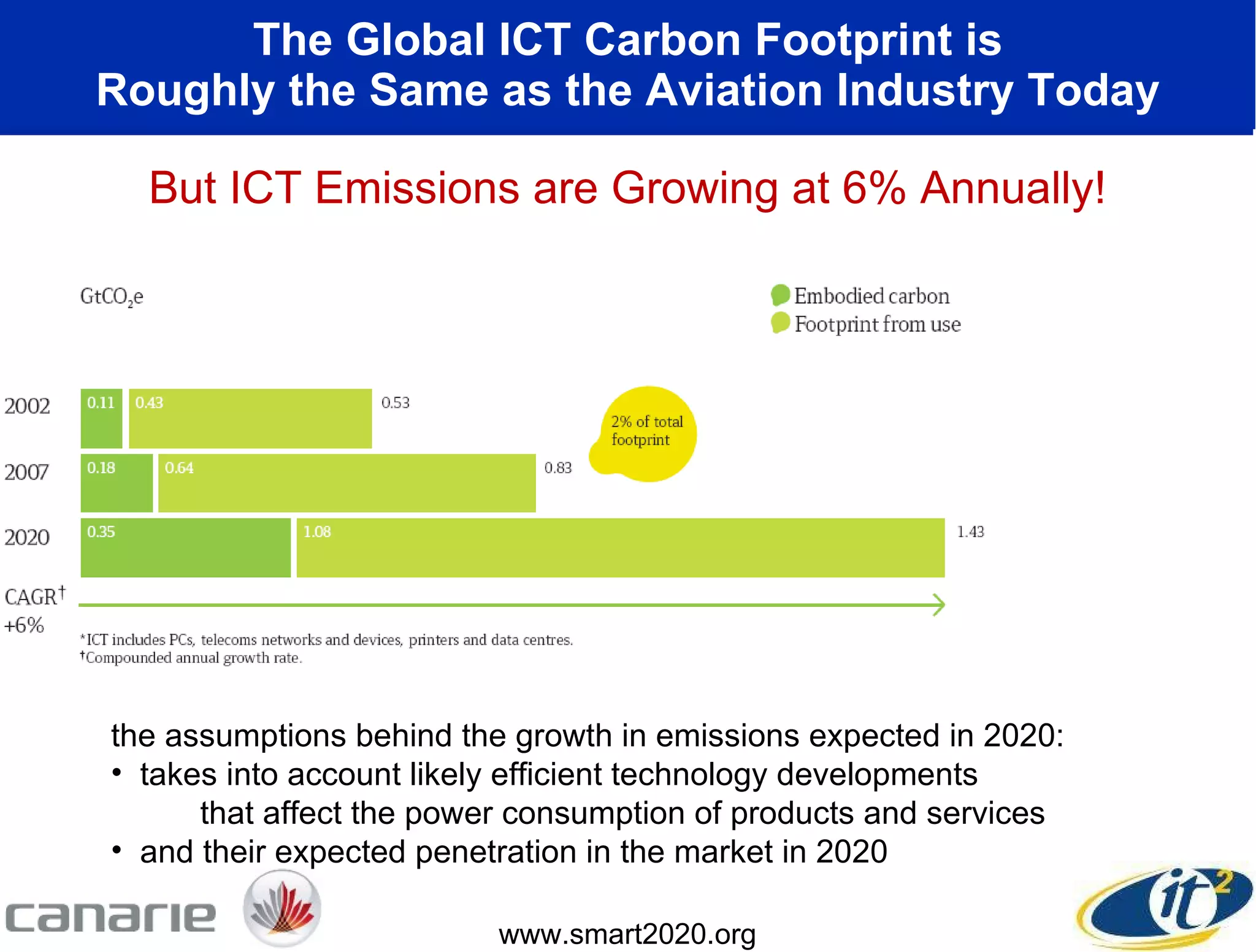
The Global ICT Carbon Footprint is Roughly the Same as the Aviation Industry Today www.smart2020.org But ICT Emissions are Growing at 6% Annually! the assumptions behind the growth in emissions expected in 2020:  takes into account likely efficient technology developments    that affect the power consumption of products and services and their expected penetration in the market in 2020
But, If IT is Used in New Ways Carbon Savings Can Be Much Larger! Major Opportunities for the United States* Smart Buildings Virtual Meetings Smart Transportation Systems Smart Electrical Grids * Smart 2020 United States Report Addendum www.smart2020.org While the sector plans to significantly step up  the energy efficiency of its products and services,  IT’s largest influence  will be by enabling  energy efficiencies in other sectors, an opportunity  that could deliver  carbon savings five times larger  than  the total emissions from the entire ICT sector in 2020. --Smart 2020 Report
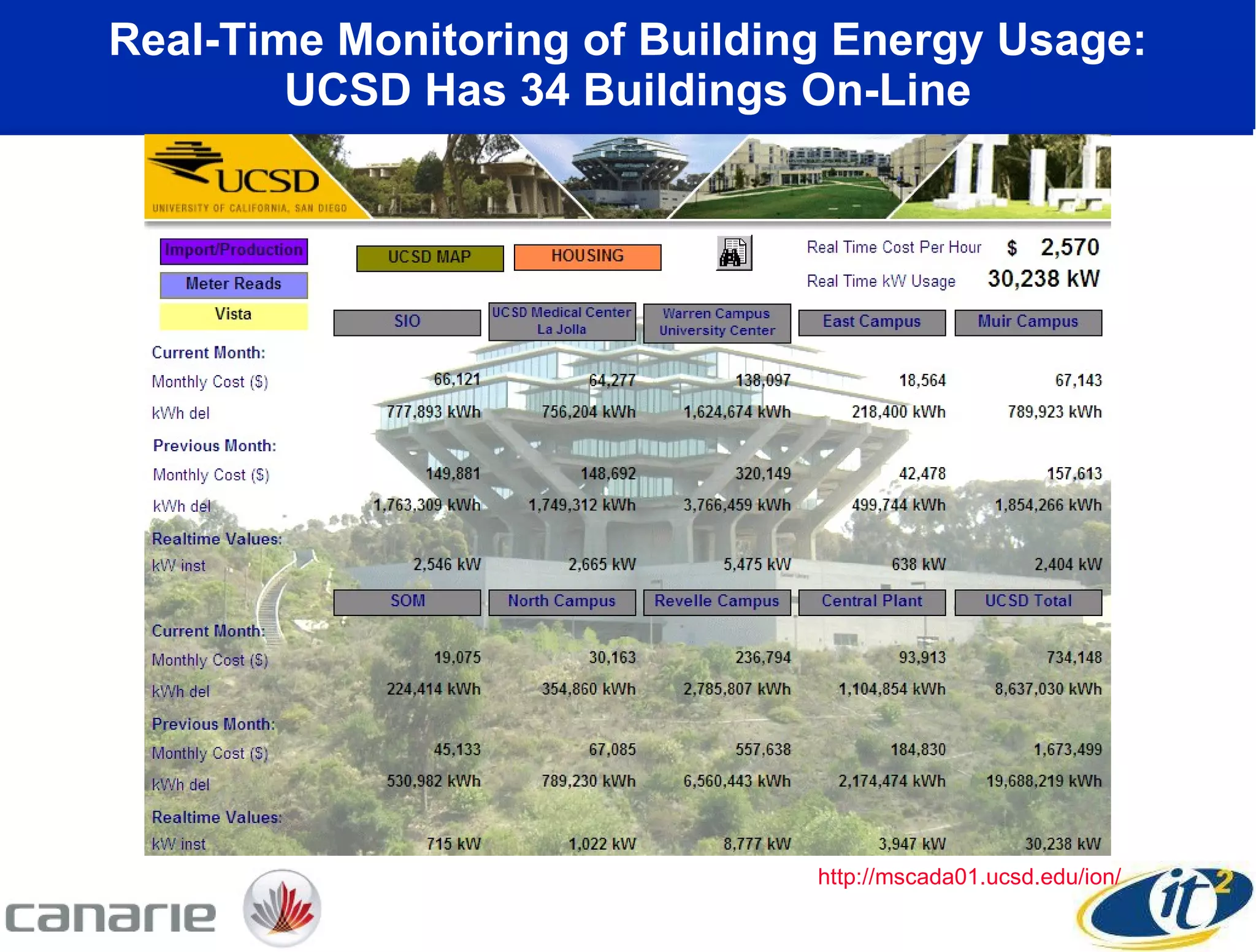
Real-Time Monitoring of Building Energy Usage: UCSD Has 34 Buildings On-Line http://mscada01.ucsd.edu/ion/
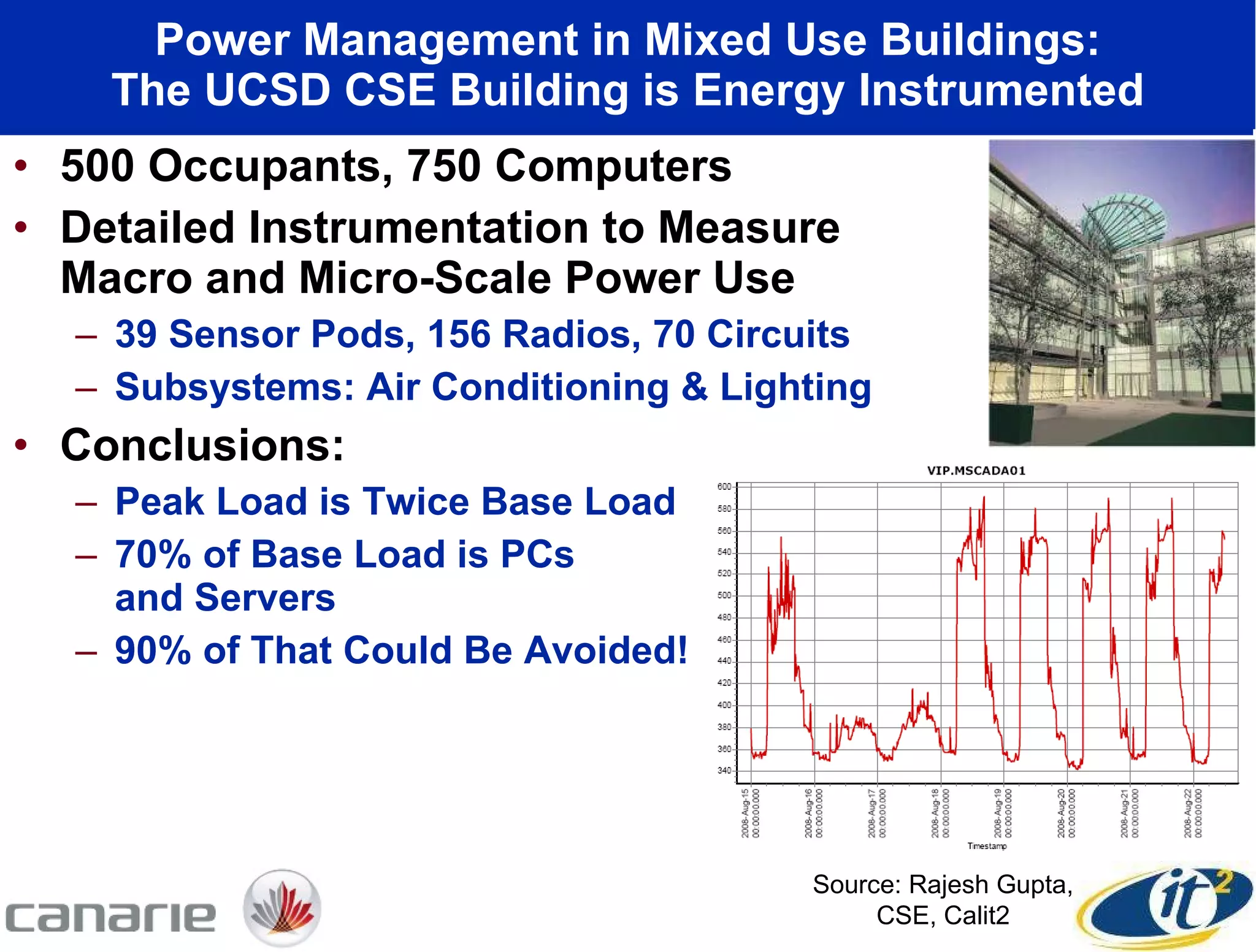
Power Management in Mixed Use Buildings: The UCSD CSE Building is Energy Instrumented 500 Occupants, 750 Computers Detailed Instrumentation to Measure Macro and Micro-Scale Power Use  39 Sensor Pods, 156 Radios, 70 Circuits Subsystems: Air Conditioning & Lighting Conclusions: Peak Load is Twice Base Load 70% of Base Load is PCs  and Servers 90% of That Could Be Avoided! Source: Rajesh Gupta, CSE, Calit2
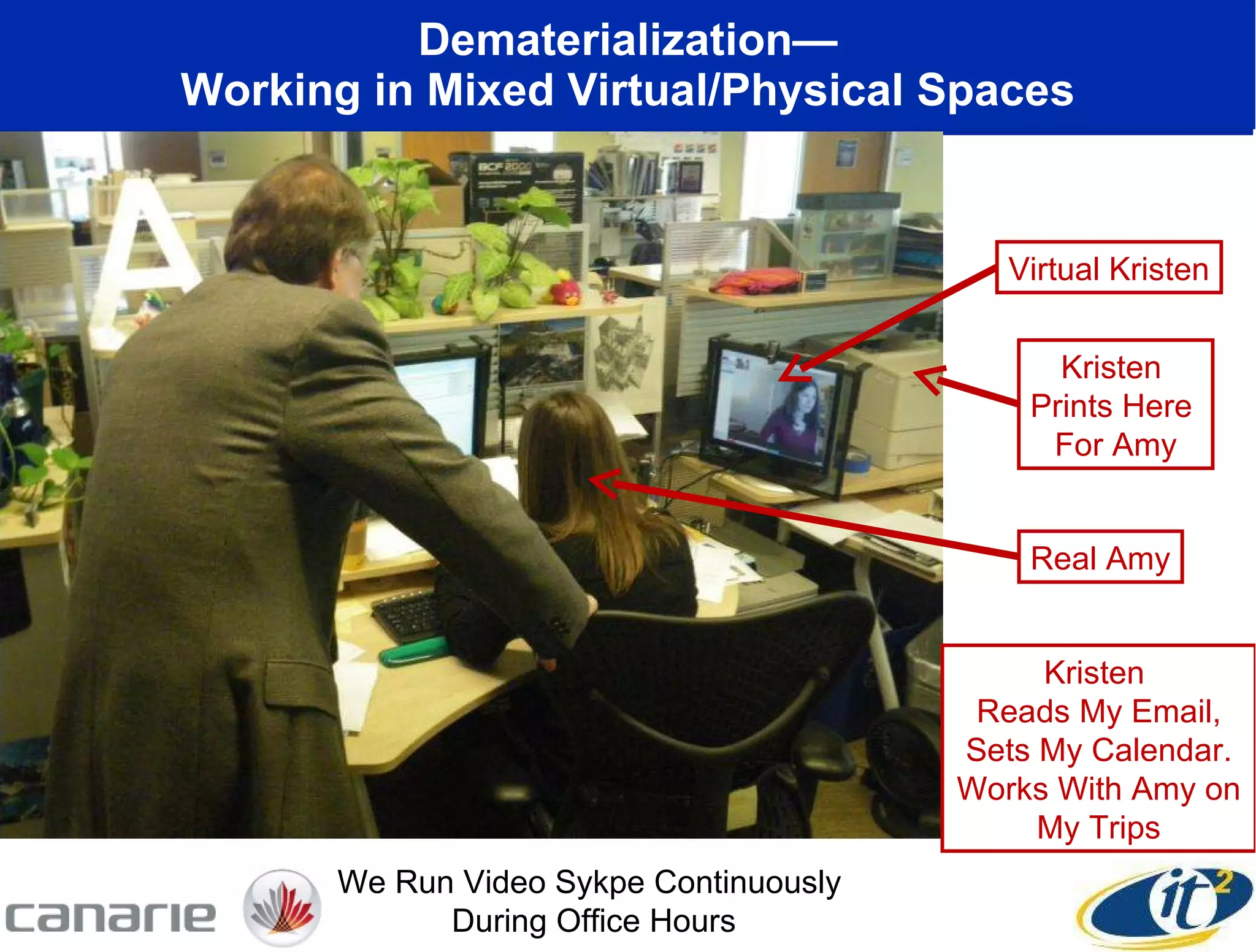
Dematerialization— Working in Mixed Virtual/Physical Spaces We Run Video Sykpe Continuously  During Office Hours Kristen  Reads My Email, Sets My Calendar. Works With Amy on My Trips Virtual Kristen Kristen  Prints Here  For Amy Real Amy
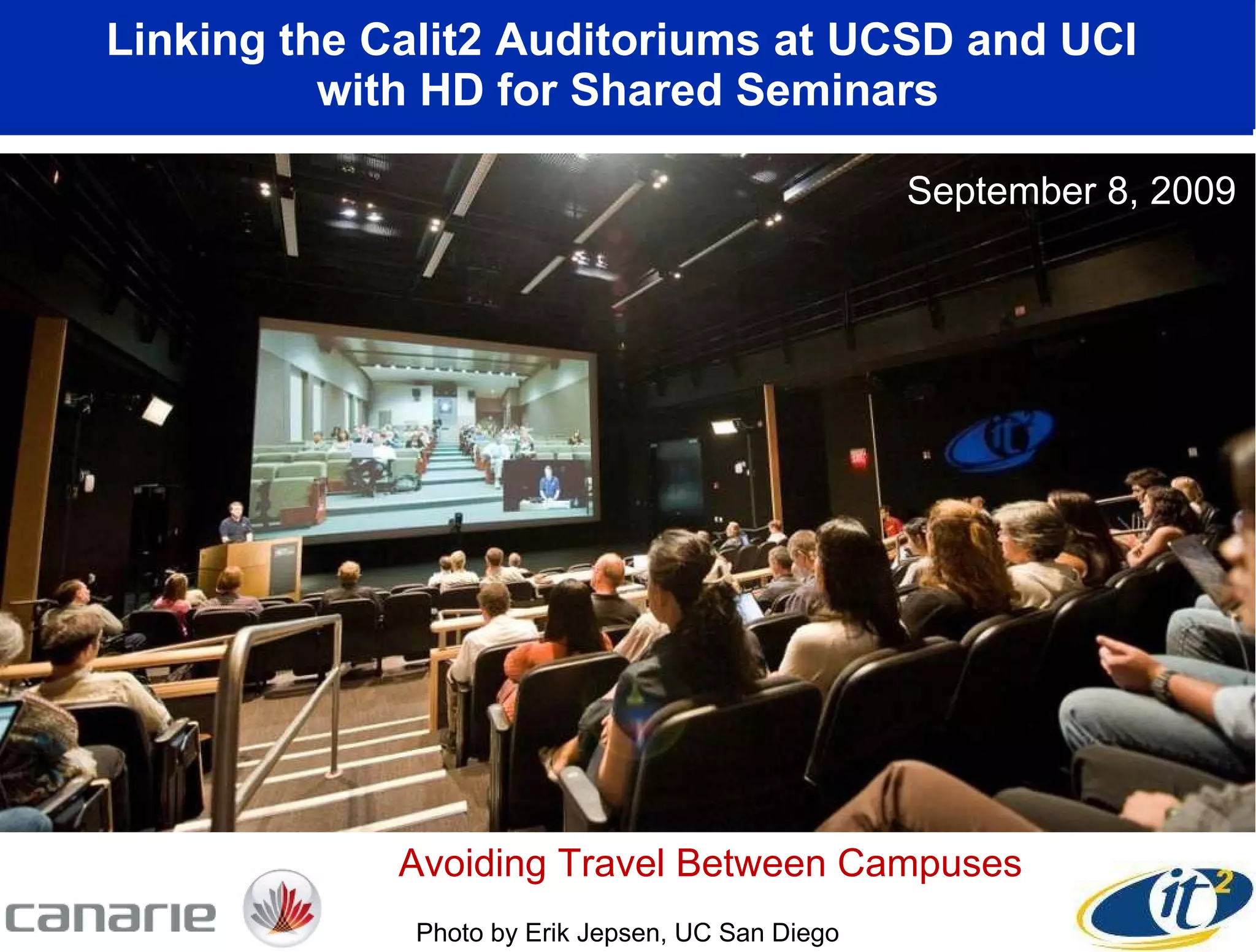
Linking the Calit2 Auditoriums at UCSD and UCI  with HD for Shared Seminars September 8, 2009 Photo by Erik Jepsen, UC San Diego Avoiding Travel Between Campuses September 8, 2009
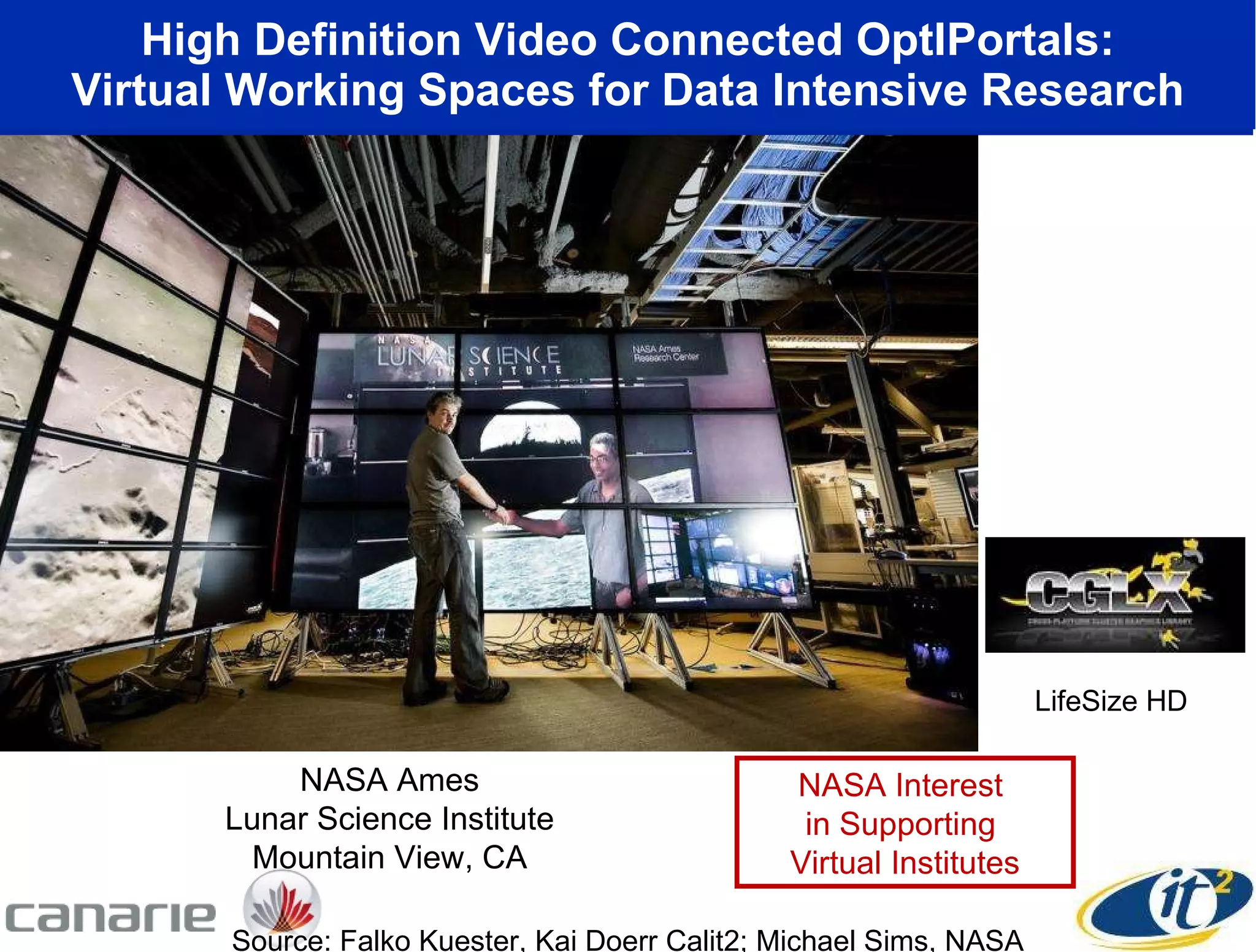
High Definition Video Connected OptIPortals: Virtual Working Spaces for Data Intensive Research Source: Falko Kuester, Kai Doerr Calit2; Michael Sims, NASA NASA Ames Lunar Science Institute Mountain View, CA NASA Interest  in Supporting  Virtual Institutes LifeSize HD
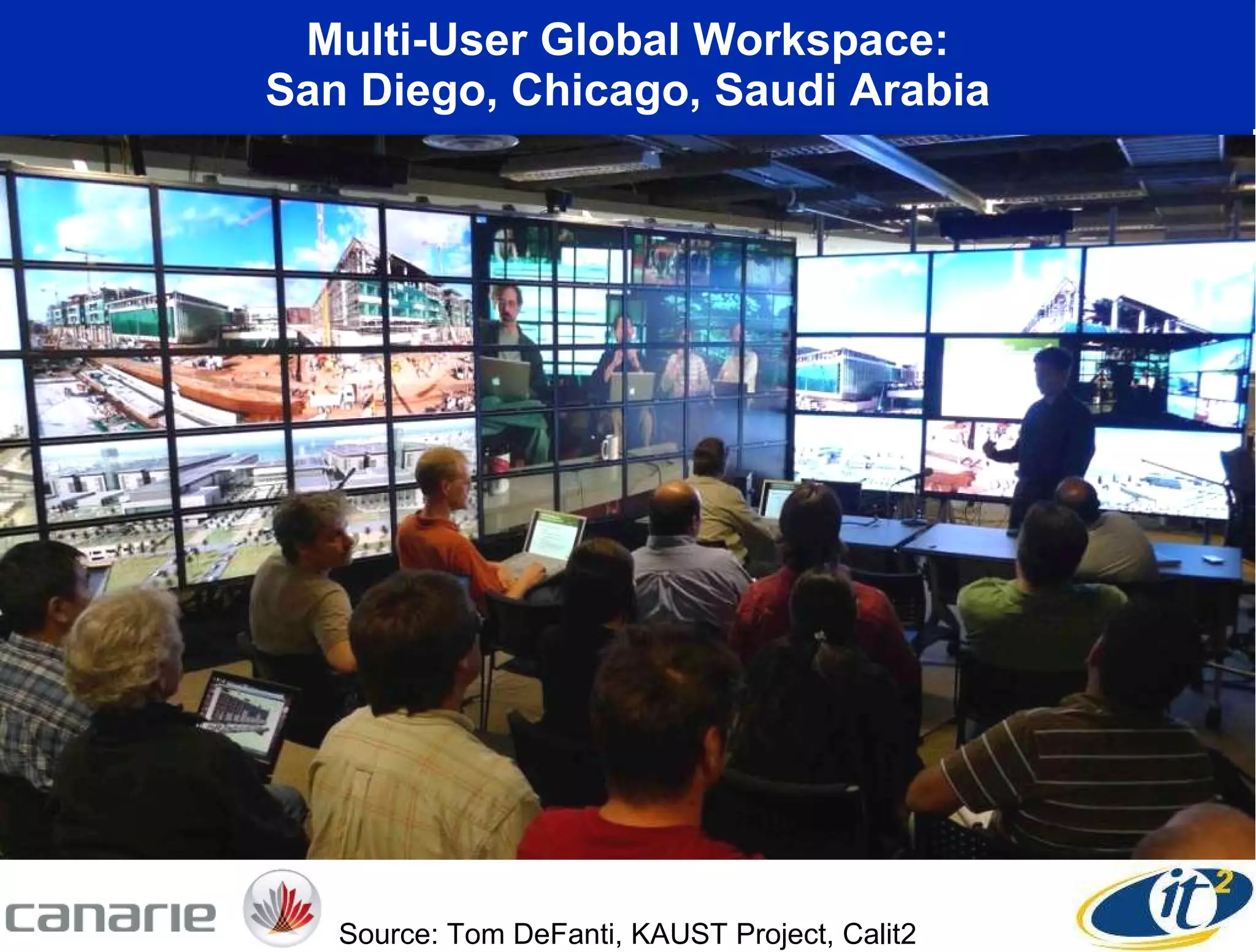
Multi-User Global Workspace: San Diego, Chicago, Saudi Arabia Source: Tom DeFanti, KAUST Project, Calit2
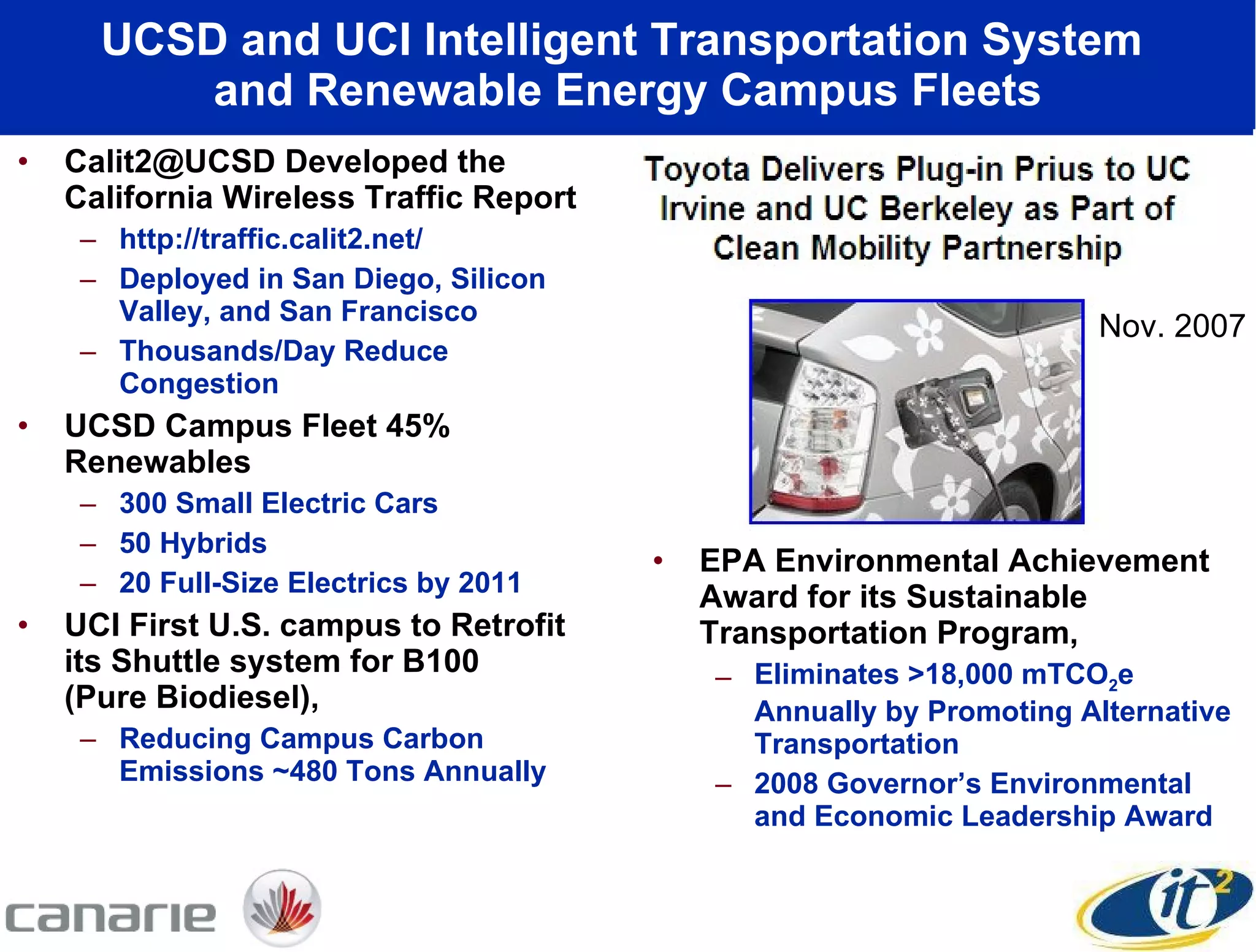
UCSD and UCI Intelligent Transportation System  and Renewable Energy Campus Fleets Calit2@UCSD Developed the California Wireless Traffic Report http://traffic.calit2.net/ Deployed in San Diego, Silicon Valley, and San Francisco Thousands/Day Reduce Congestion  UCSD Campus Fleet 45% Renewables 300 Small Electric Cars 50 Hybrids 20 Full-Size Electrics by 2011 UCI First U.S. campus to Retrofit its Shuttle system for B100  (Pure Biodiesel), Reducing Campus Carbon Emissions ~480 Tons Annually EPA Environmental Achievement Award for its Sustainable Transportation Program,  Eliminates >18,000 mTCO 2 e Annually by Promoting Alternative Transportation 2008 Governor’s Environmental and Economic Leadership Award  Nov. 2007
How Your Campus Can Lower Carbon Emissions —UCI Example “ Best Overall” Category of California’s “Flex Your Power” Statewide Energy-Efficiency Campaign in December 2008 Saving 3.7 GWh of Electricity FY 2007–8 Reducing Peak Demand by up to 68 Percent  A 62,000 Ton-Hour Chilled-Water Thermal Energy Storage System Can Reduce up to 6 MW of Electrical Peak Demand Annually: Saving Nearly 4 Million Gallons of Water Eliminates 62,000 mTCO 2 e  Saves the Campus $28.9 Million All New Campus Buildings Will Be Gold LEED Highest % On-Campus Students In UC System Source: Arnaud, Smarr, DeFanti, Sheehan, EDUCAUSE Review
Sustainable Data Centers
The NSF-Funded UCSD GreenLight Project:  Instrumenting the Energy Cost of Cluster Computing Focus on 5 Communities with At-Scale Computing Needs: Metagenomics Ocean Observing Microscopy  Bioinformatics Digital Media Goal: Measure, Monitor, & Web Publish  Real-Time Sensor Outputs Via Service-Oriented Architectures Allow Researchers Anywhere to Study Computing Energy Cost Enable Scientists to Explore Tactics for Maximizing Work/Watt Develop Middleware that Automates Optimal Choice  of Compute/RAM Power Strategies for Desired Greenness
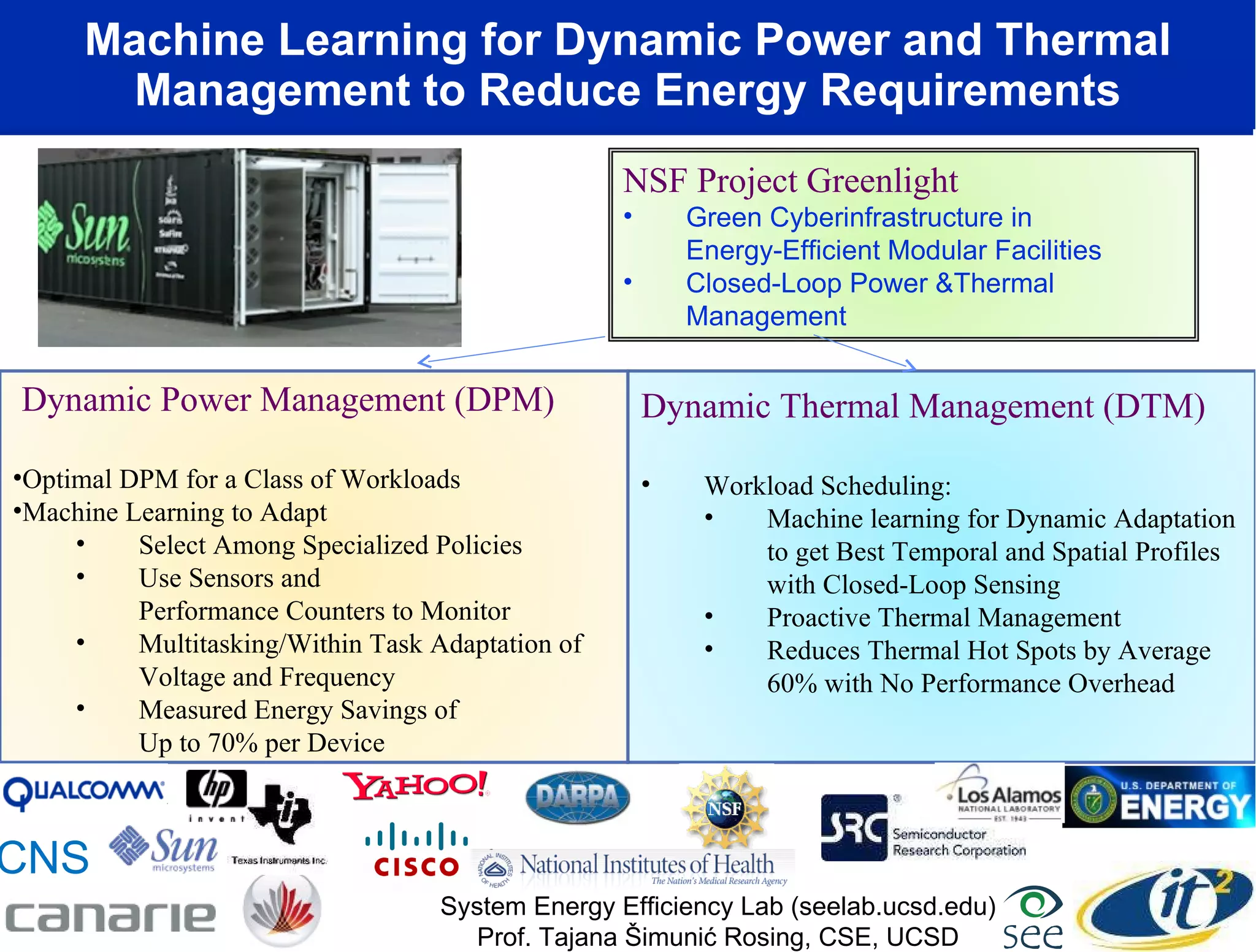
Machine Learning for Dynamic Power and Thermal Management to Reduce Energy Requirements Dynamic Thermal Management (DTM) Workload Scheduling: Machine learning for Dynamic Adaptation to get Best Temporal and Spatial Profiles with Closed-Loop Sensing Proactive Thermal Management Reduces Thermal Hot Spots by Average 60% with No Performance Overhead Dynamic Power Management (DPM) Optimal DPM for a Class of Workloads Machine Learning to Adapt Select Among Specialized Policies Use Sensors and  Performance Counters to Monitor Multitasking/Within Task Adaptation of Voltage and Frequency Measured Energy Savings of  Up to 70% per Device System Energy Efficiency Lab (seelab.ucsd.edu) Prof. Tajana Šimunić Rosing, CSE, UCSD CNS NSF Project Greenlight Green Cyberinfrastructure in  Energy-Efficient Modular Facilities  Closed-Loop Power &Thermal Management
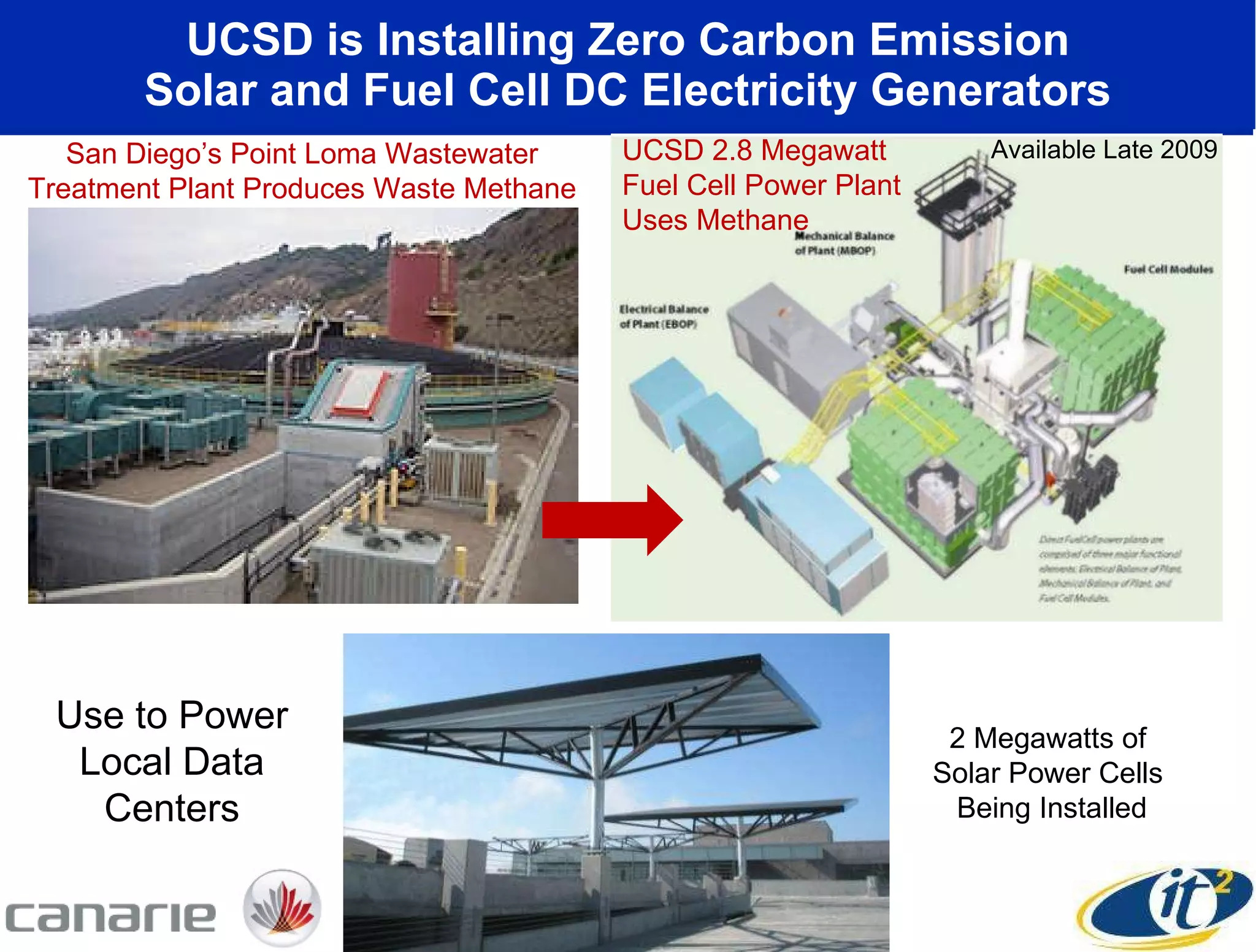
UCSD is Installing Zero Carbon Emission Solar and Fuel Cell DC Electricity Generators San Diego’s Point Loma Wastewater Treatment Plant Produces Waste Methane UCSD 2.8 Megawatt  Fuel Cell Power Plant  Uses Methane 2 Megawatts of  Solar Power Cells  Being Installed Available Late 2009 Use to Power Local Data Centers
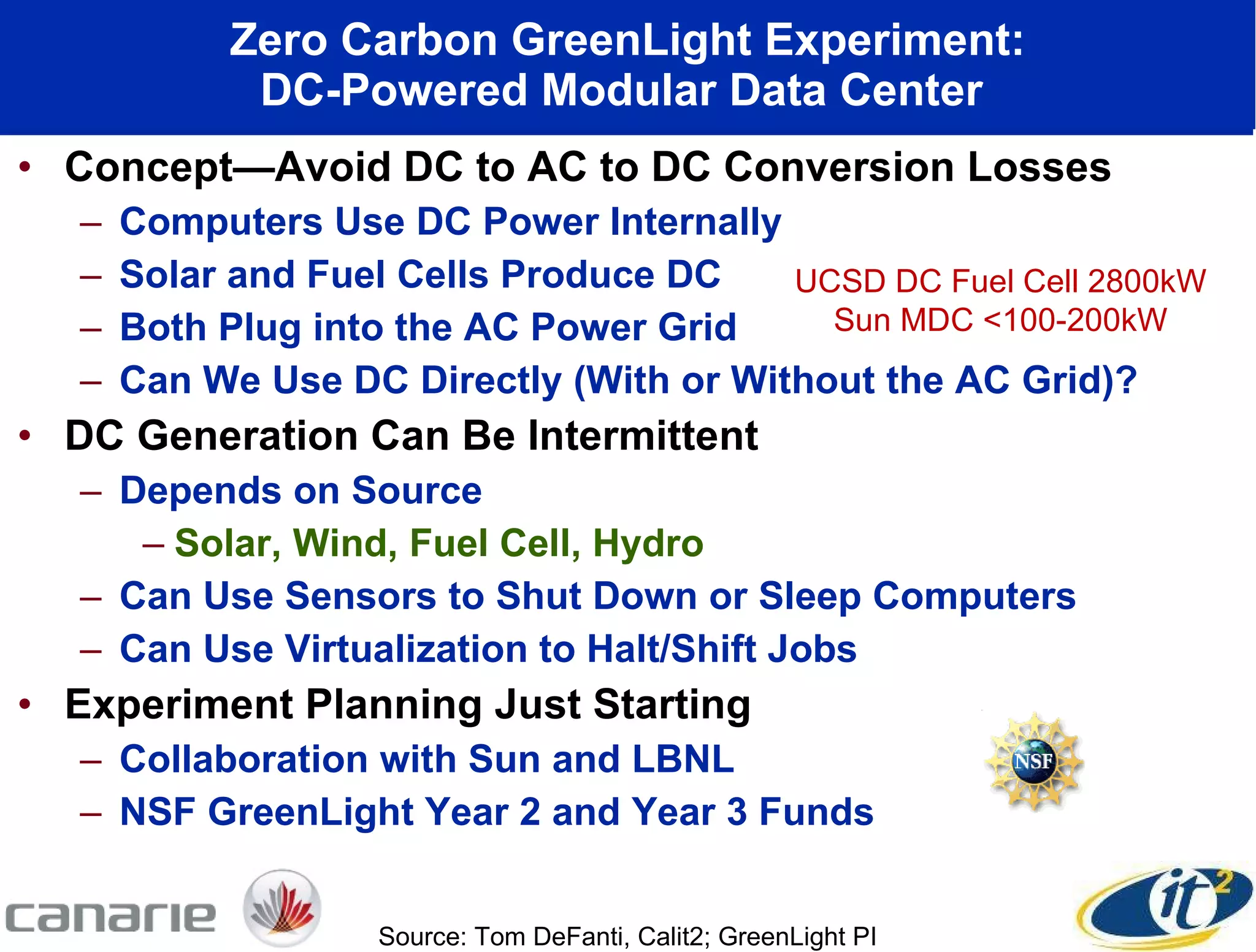
Zero Carbon GreenLight Experiment: DC-Powered Modular Data Center  Concept—Avoid DC to AC to DC Conversion Losses Computers Use DC Power Internally Solar and Fuel Cells Produce DC Both Plug into the AC Power Grid Can We Use DC Directly (With or Without the AC Grid)? DC Generation Can Be Intermittent  Depends on Source  Solar, Wind, Fuel Cell, Hydro Can Use Sensors to Shut Down or Sleep Computers Can Use Virtualization to Halt/Shift Jobs Experiment Planning Just Starting Collaboration with Sun and LBNL NSF GreenLight Year 2 and Year 3 Funds  Source: Tom DeFanti, Calit2; GreenLight PI UCSD DC Fuel Cell 2800kW Sun MDC <100-200kW
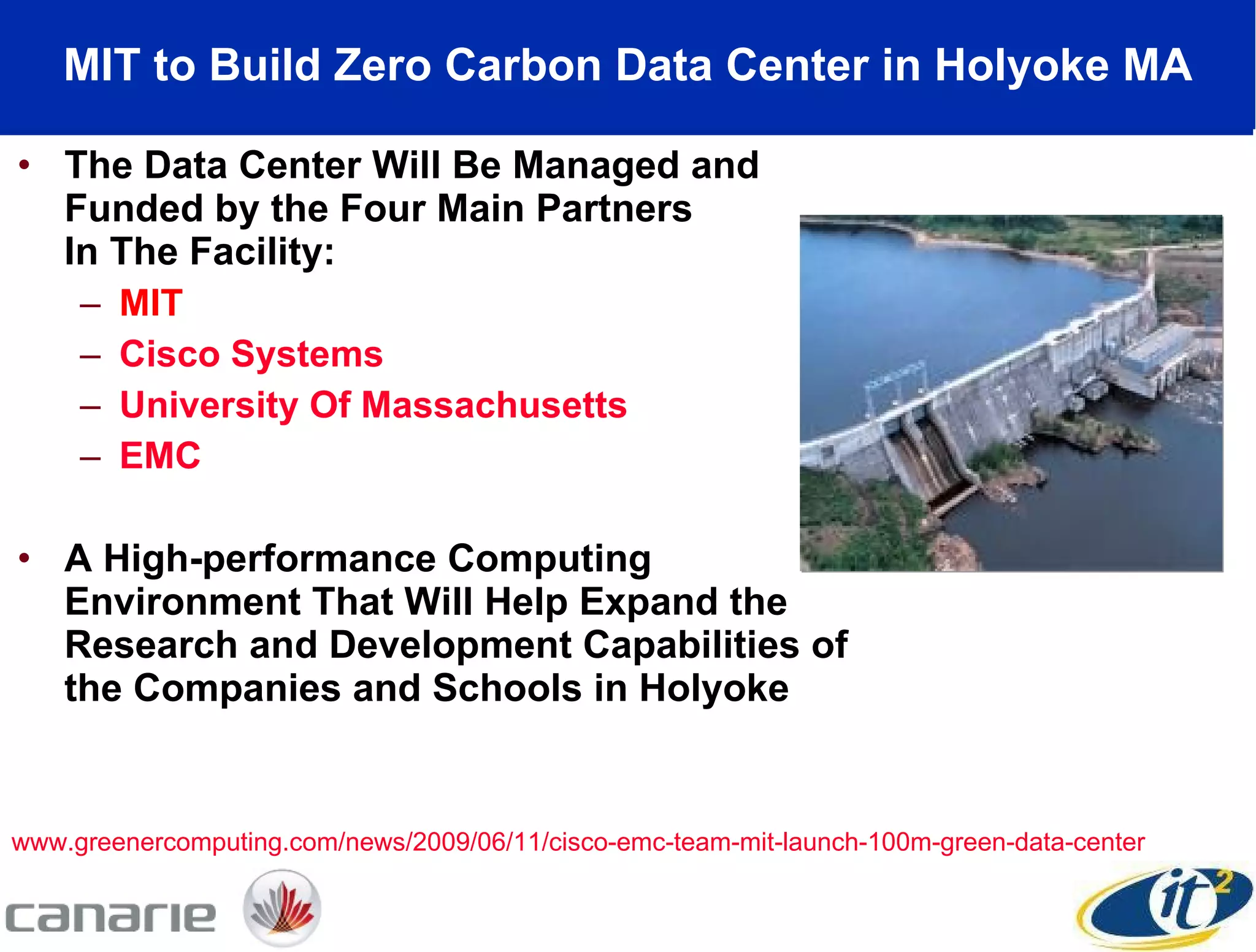
MIT to Build Zero Carbon Data Center in Holyoke MA The Data Center Will Be Managed and Funded by the Four Main Partners  In The Facility:  MIT Cisco Systems   University Of Massachusetts   EMC A High-performance Computing Environment That Will Help Expand the Research and Development Capabilities of the Companies and Schools in Holyoke www.greenercomputing.com/news/2009/06/11/cisco-emc-team-mit-launch-100m-green-data-center
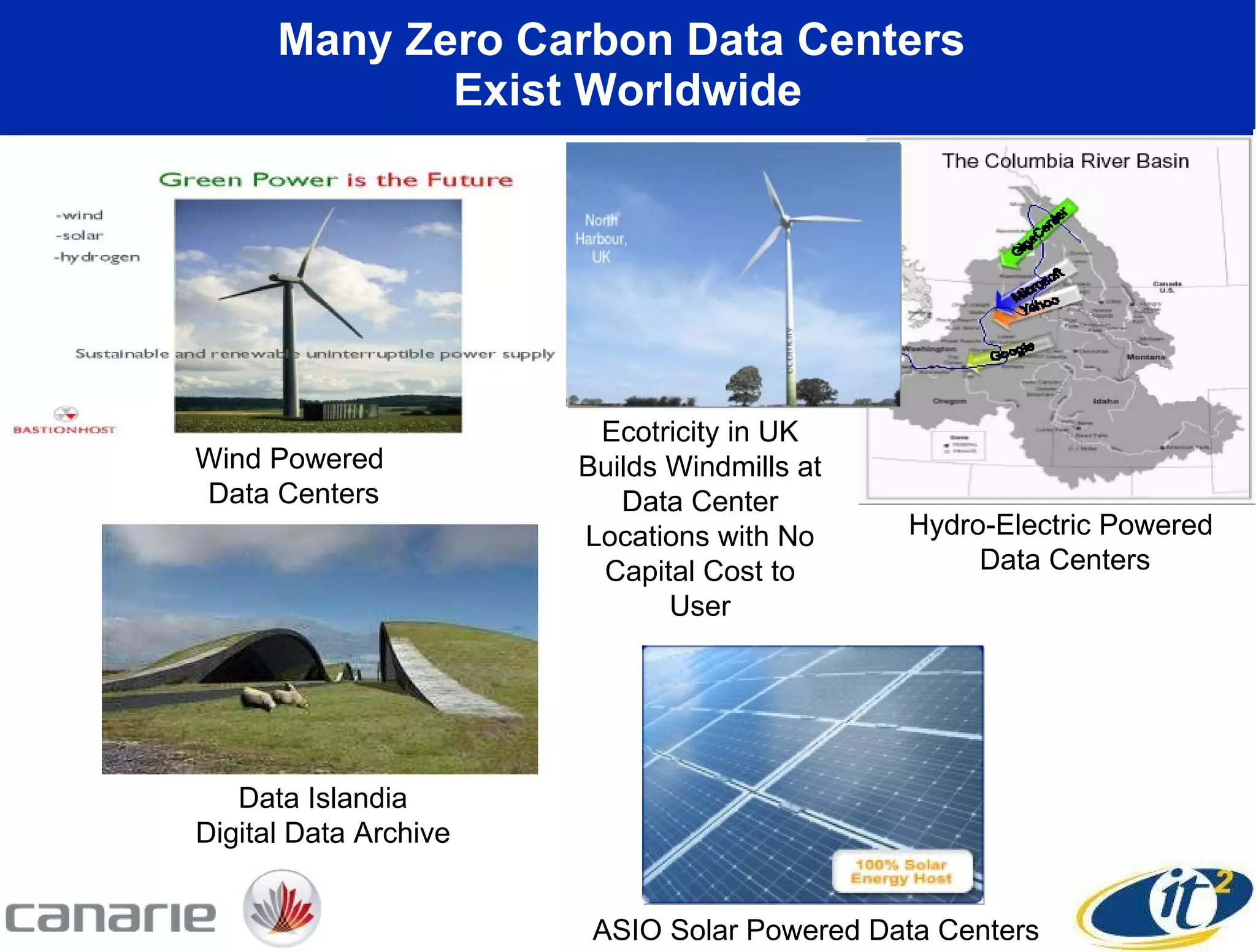
Many Zero Carbon Data Centers  Exist Worldwide Hydro-Electric Powered  Data Centers Data Islandia Digital Data Archive ASIO Solar Powered Data Centers Wind Powered  Data Centers Ecotricity in UK Builds Windmills at Data Center Locations with No Capital Cost to User
The Concept Use cyber infrastructure to combat global warming by reducing computing infrastructure’s carbon footprint Find efficient ways to share computing facilities that are close to sources of green power by utilizing BCNET’s advanced network infrastructure within the Province Make it possible for BC’s Universities to reduce their carbon footprint by relocating their existing ICT infrastructure to “greener facilities”  Build a zero carbon data centre and use the BCNET/CANARIE ROADM network to connect users to it Zero Carbon Leadership  in British Columbia: BCNET
CANARIE Green Cyberinfrastructure Pilot --  $3M Allocation  Two Objectives: Technical Viability and Usability for Relocating Computers to Zero Carbon Data Centers and  “Follow the Sun/Follow the Wind” Network Business Case Viability of Offering Carbon Offsets  (and/or Equivalent in Services) to IT Departments and University Researchers Who Reduce Their Carbon Footprint by Relocating Computers and Instrumentation  to Zero Carbon Data Centers International Partnership with Possible  Zero Carbon Nodes Using Virtual Router/Computers  in Spain, Ireland, California, Australia,  British Columbia, Ottawa, Quebec and Nova Scotia  25
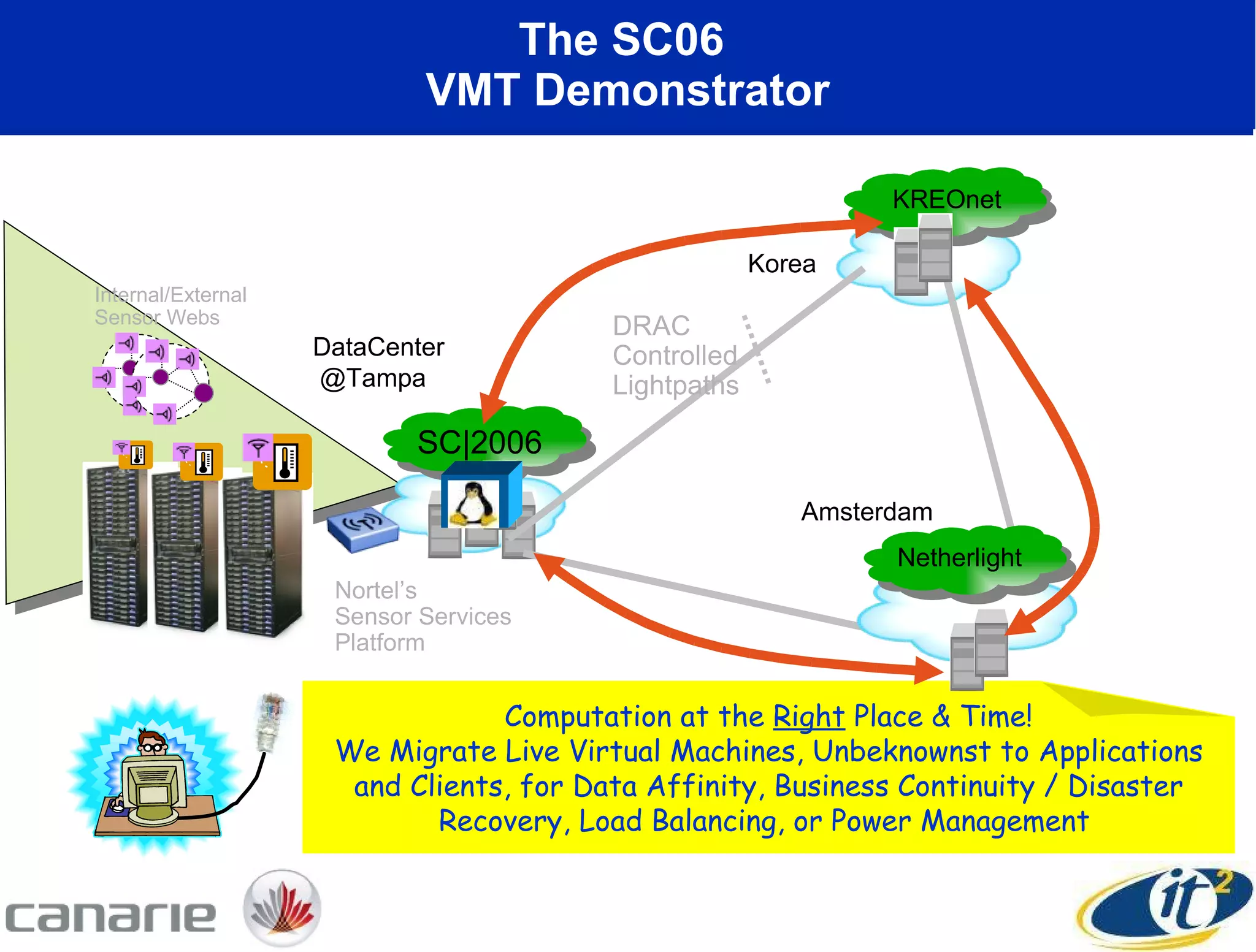
The SC06  VMT Demonstrator Computation at the  Right  Place & Time! We Migrate Live Virtual Machines, Unbeknownst to Applications and Clients, for Data Affinity, Business Continuity / Disaster Recovery, Load Balancing, or Power Management  DataCenter @Tampa SC|2006 Nortel’s Sensor Services Platform Korea KREOnet Netherlight DRAC Controlled Lightpaths Internal/External Sensor Webs Amsterdam
CO2 Regulations and Universities
The IPCC Recommends  a 25-40% Reduction Below 1990 Levels by 2020 On September 27, 2006, Governor Schwarzenegger signed California  the Global Warming Solutions Act  of 2006 Assembly Bill 32 (AB32) Requires Reduction of GHG by 2020 Only to 1990 Levels 10% Reduction from 2008 Levels; 30% from BAU 2020 Levels 4 Tons of CO 2 -Equiv. Reduction for Every Person in California! The European Union Requires Reduction of GHG by 2020 to  20% Below  1990 Levels (12/12/2008) Neither the U.S. or Canada has an Official Target Yet President Obama Has Endorsed the AB32 2020 Goal
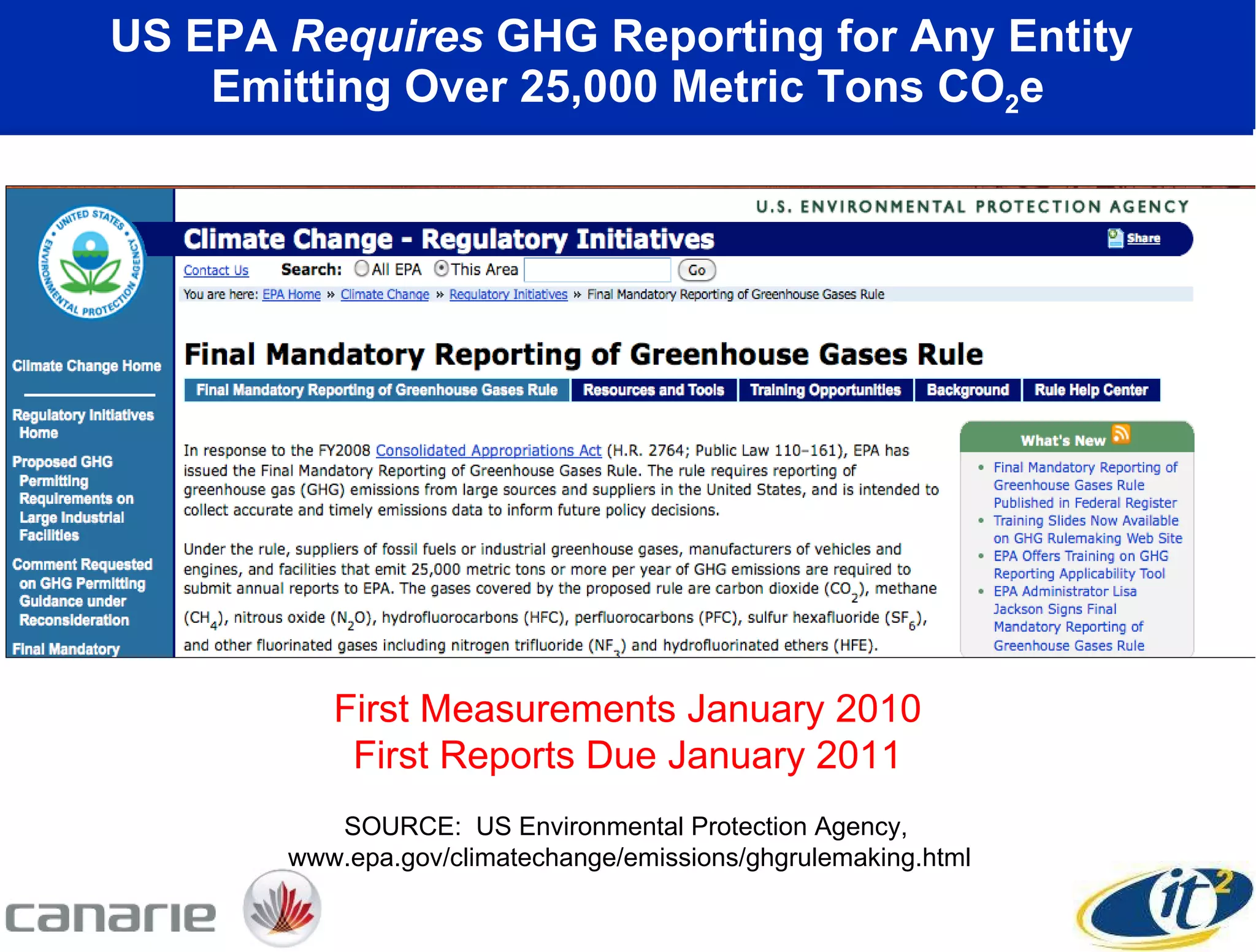
US EPA  Requires  GHG Reporting for Any Entity  Emitting Over 25,000 Metric Tons CO 2 e SOURCE:  US Environmental Protection Agency,  www.epa.gov/climatechange/emissions/ghgrulemaking.html First Measurements January 2010 First Reports Due January 2011
Most US Universities Will Become Regulated Entities --   Emitting Over 25,000 Metric Tons CO 2 e SOURCE:  American College and University Presidents Climate Commitment, http://acupcc.aashe.org/ Gross Emissions  Scope 1 & 2 (CO 2 e) Year US EPA GHG Rule Requires Reporting in 2011? 491,258 2008 YES! 52,2709 2008 YES! 80,498 2007 YES! 234,000 2008 YES! 309, 117 2008 YES! 192,862 2008 YES!
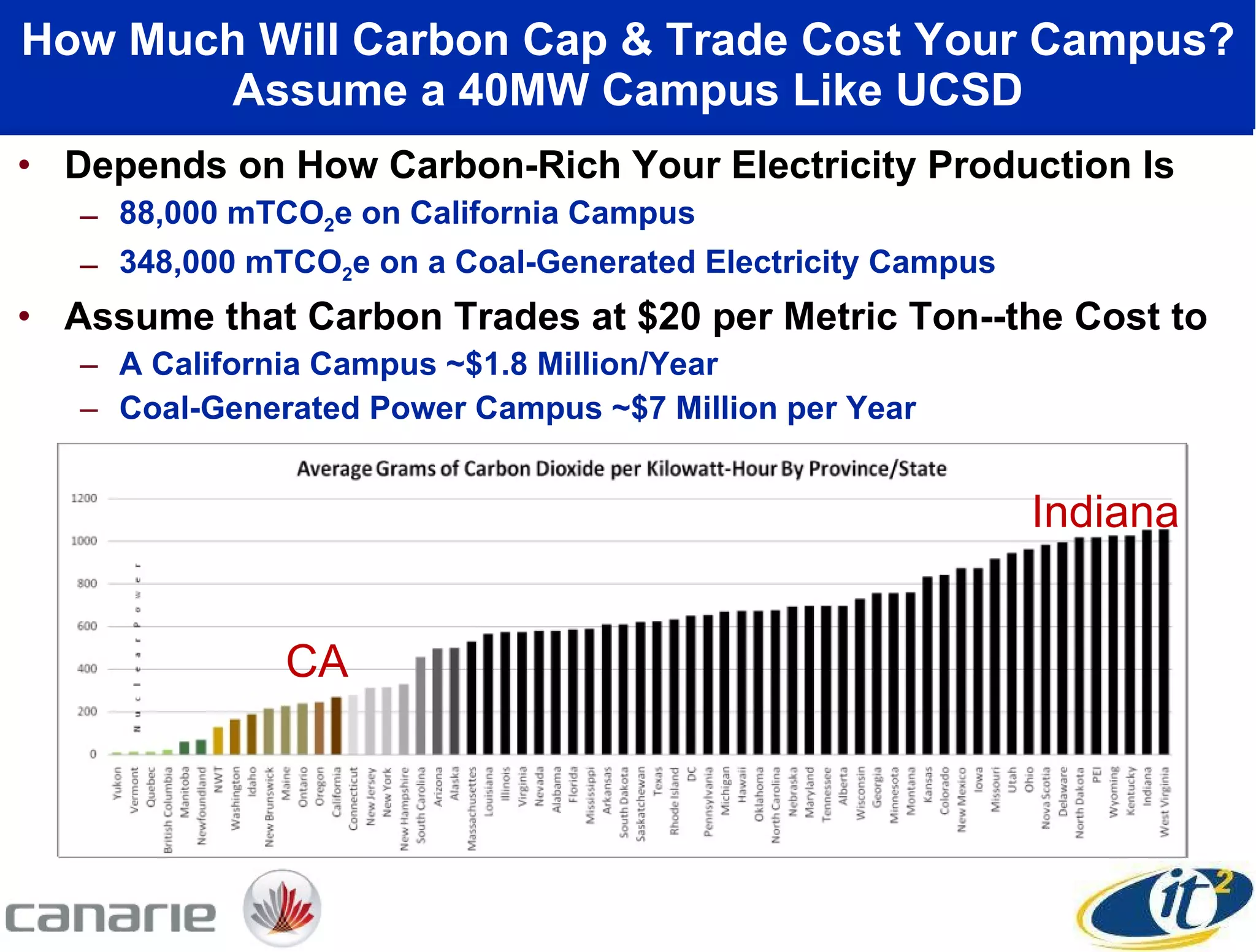
How Much Will Carbon Cap & Trade Cost Your Campus? Assume a 40MW Campus Like UCSD Depends on How Carbon-Rich Your Electricity Production Is 88,000 mTCO 2 e on California Campus 348,000 mTCO 2 e on a Coal-Generated Electricity Campus Assume that Carbon Trades at $20 per Metric Ton--the Cost to  A California Campus ~$1.8 Million/Year Coal-Generated Power Campus ~$7 Million per Year CA Indiana
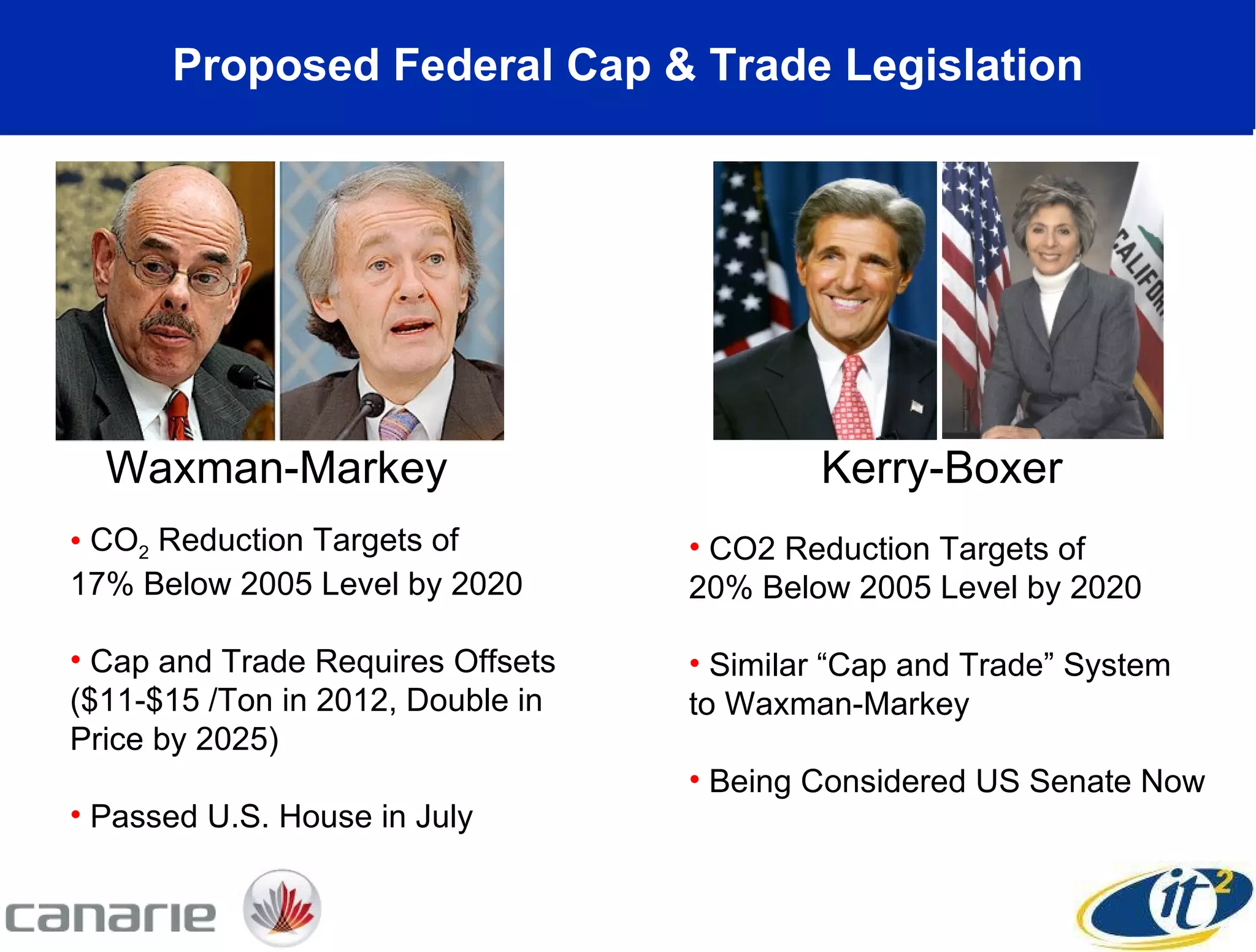
Proposed Federal Cap & Trade Legislation Waxman-Markey CO 2  Reduction Targets of  17% Below 2005 Level by 2020 Cap and Trade Requires Offsets ($11-$15 /Ton in 2012, Double in Price by 2025) Passed U.S. House in July Kerry-Boxer CO2 Reduction Targets of  20% Below 2005 Level by 2020 Similar “Cap and Trade” System  to Waxman-Markey Being Considered US Senate Now
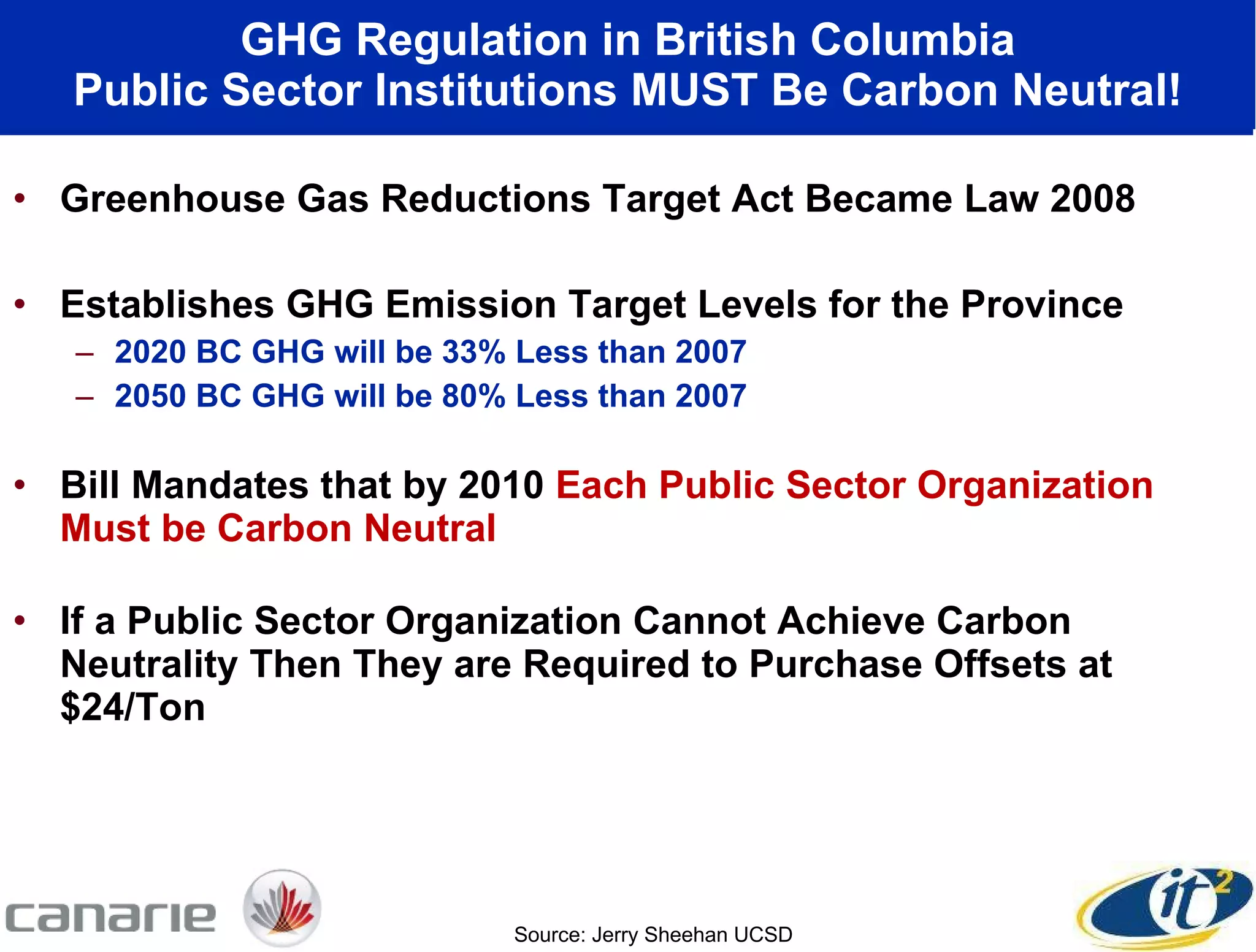
Greenhouse Gas Reductions Target Act Became Law 2008 Establishes GHG Emission Target Levels for the Province 2020 BC GHG will be 33% Less than 2007 2050 BC GHG will be 80% Less than 2007 Bill Mandates that by 2010  Each Public Sector Organization Must be Carbon Neutral If a Public Sector Organization Cannot Achieve Carbon Neutrality Then They are Required to Purchase Offsets at $24/Ton GHG Regulation in British Columbia Public Sector Institutions MUST Be Carbon Neutral! Source: Jerry Sheehan UCSD
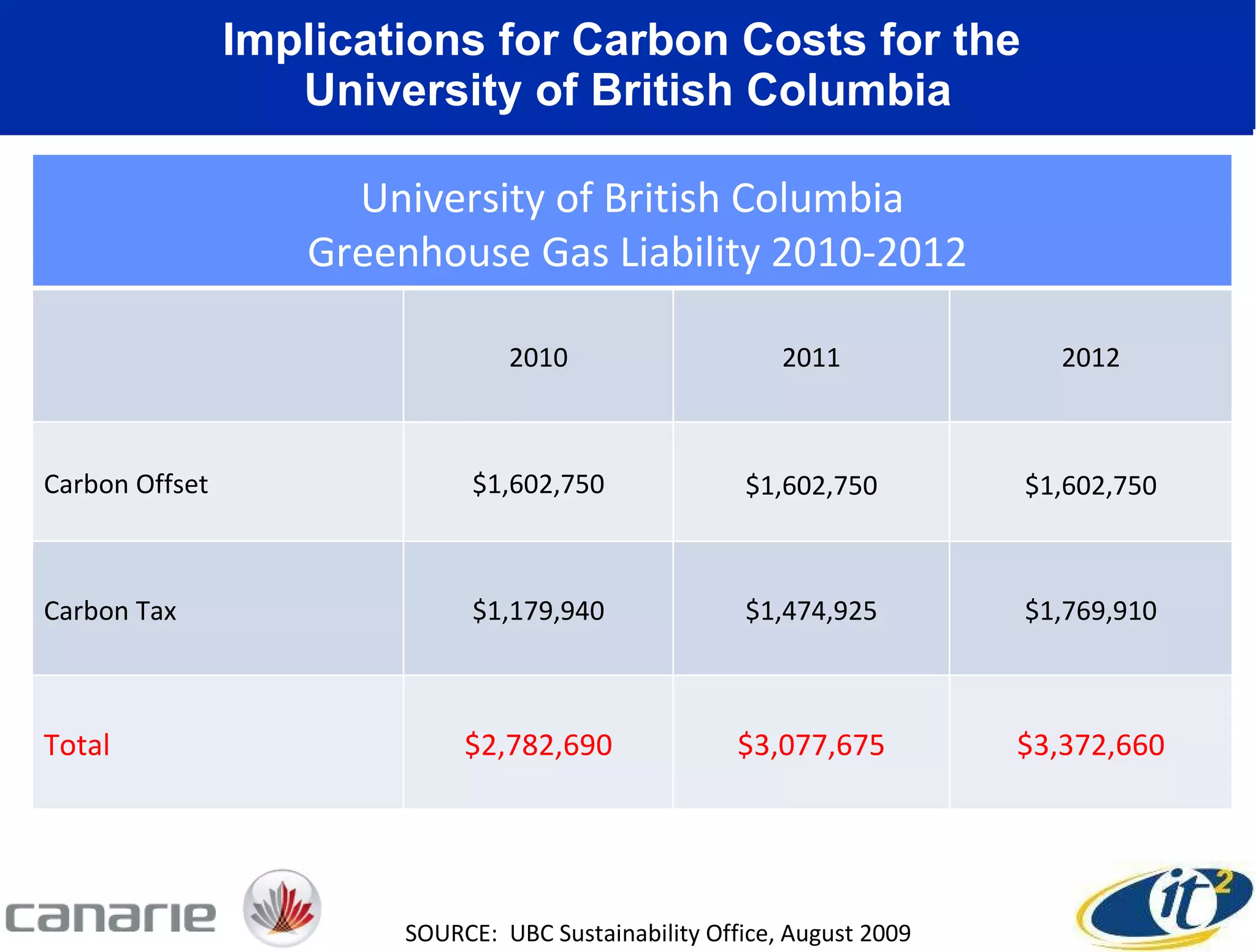
Implications for Carbon Costs for the  University of British Columbia SOURCE:  UBC Sustainability Office, August 2009 University of British Columbia Greenhouse Gas Liability 2010-2012 2010 2011 2012 Carbon Offset $1,602,750 $1,602,750 $1,602,750 Carbon Tax $1,179,940 $1,474,925 $1,769,910 Total $2,782,690 $3,077,675 $3,372,660
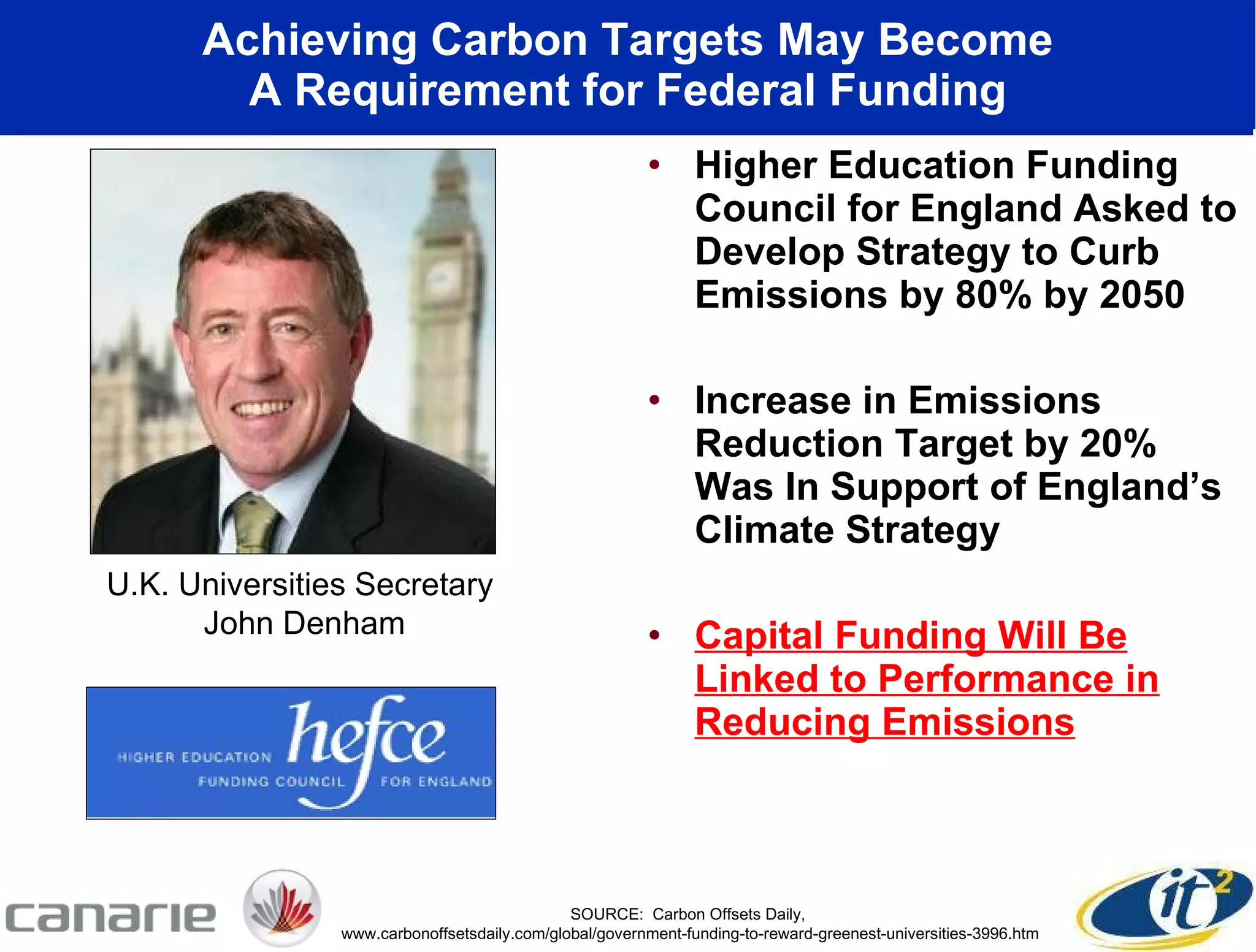
Achieving Carbon Targets May Become A Requirement for Federal Funding Higher Education Funding Council for England Asked to Develop Strategy to Curb Emissions by 80% by 2050 Increase in Emissions Reduction Target by 20% Was In Support of England’s Climate Strategy  Capital Funding Will Be Linked to Performance in Reducing Emissions U.K. Universities Secretary  John Denham SOURCE:  Carbon Offsets Daily, www.carbonoffsetsdaily.com/global/government-funding-to-reward-greenest-universities-3996.htm
We Need to Bring Together the Stakeholders To Cross-Educate and Seek Common Ground [email_address]
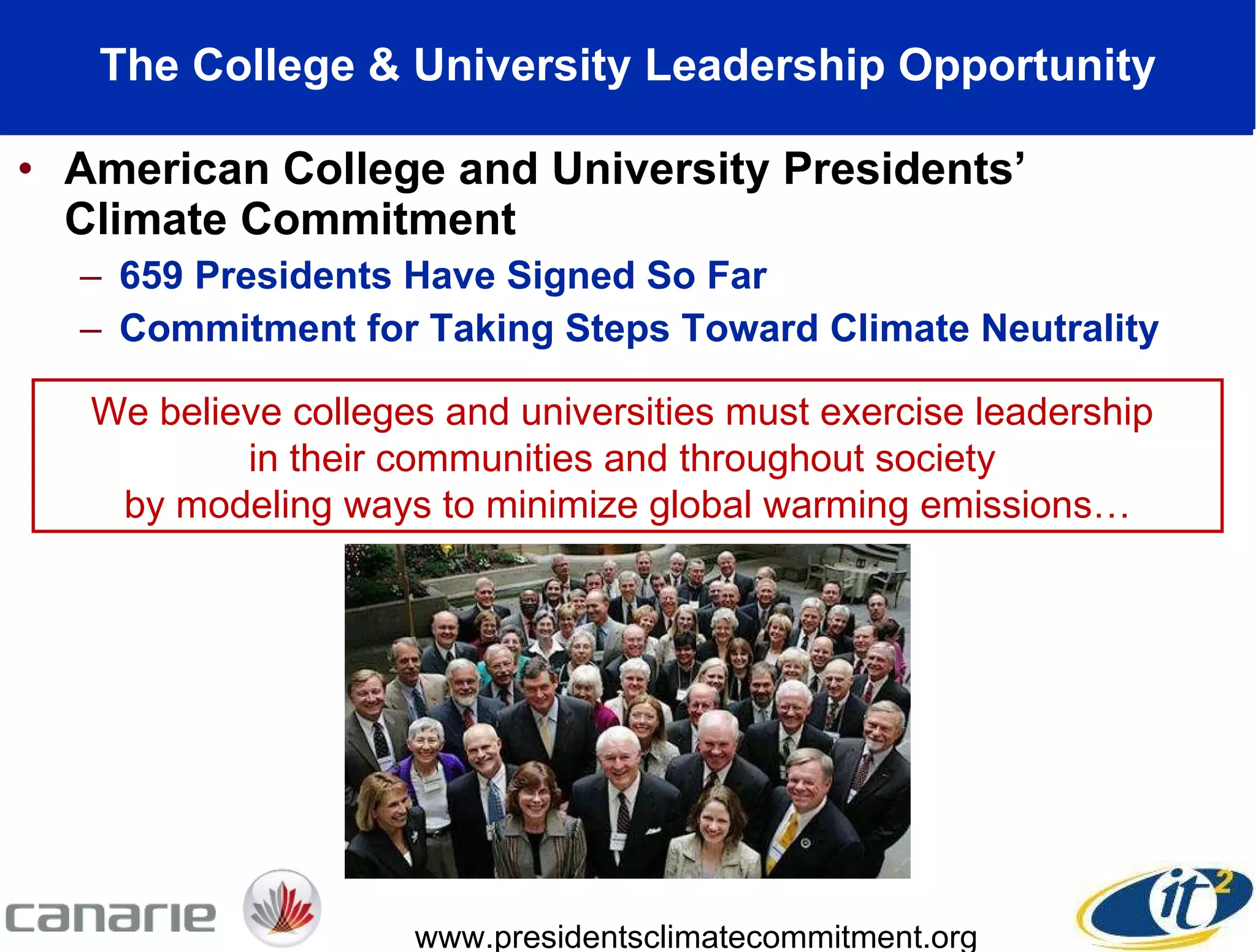
The College & University Leadership Opportunity American College and University Presidents’  Climate Commitment 659 Presidents Have Signed So Far Commitment for Taking Steps Toward Climate Neutrality We believe colleges and universities must exercise leadership  in their communities and throughout society  by modeling ways to minimize global warming emissions… www.presidentsclimatecommitment.org
“ It Will Be the Biggest Single Peacetime Project Humankind Will Have Ever Undertaken”
Let’s Keep The Conversation Going Blogspot Twitter http://twitter.com/lsmarr www.facebook.com   Larry Smarr Facebook Larry Smarr Bill St. Arnaud http://billstarnaud.blogspot.com

Educause09 Smarr Arnaud

  • 1.
  • 2.
    Abstract Greenhouse gas(GHG) emissions continue their relentless rise, even though the global CO2 level is already considerably higher than it has been on earth for over two million years.  One of the significant contributors to increased GHG is the ITC industry itself, roughly equal to the emissions from the aviation industry. As universities researchers increasingly employ computational and cyberinfrastructure technologies, these very enablers of modern scientific discovery are coming into question because of their growing contributions to GHG emissions.  As a result, some universities and R&E networks are starting to explore new types of computational and network architectures that not only benefit research, but also have reduced associated GHG emissions. Optical high speed research networks and distributed zero carbon cyberinfrastructure data centers with network virtualization, web services and grids will be a critical component of this emerging architecture.  We review the trends and spotlight specific projects that offer hope for averting this cyber-carbon crisis.
  • 3.
    Based on anEDUCAUSE Review Article and Web Bonus http://net.educause.edu/ir/library/pdf/ERM0960.pdf
  • 4.
  • 5.
    Earth’s Climate isRapidly Entering a Novel Realm Not Experienced for Millions of Years “ Global Warming” Implies : Gradual, Uniform, Mainly About Temperature, a nd Quite Possibly Benign. What’s Happening i s : Rapid, Non- U niform, Affecting Everything About Climate, a nd i s Almost Entirely Harmful. A More Accurate Term is ‘Global Climatic Disruption’ This Ongoing Disruption Is: Real Without Doubt Mainly Caused by Humans Already Producing Significant Harm Growing More Rapidly Than Expected” John Holdren, Director Office of Science and Technology Policy June 25, 2008
  • 6.
    The Earth isWarming Over 100 Times Faster Today Than During the Last Ice Age Warming! http://scrippsco2.ucsd.edu/program_history/keeling_curve_lessons.html Monnin, et al., Science v. 291 pp. 112-114, Jan. 5, 2001. “ Keeling Curve” CO 2 Rose From 185 to 265ppm (80ppm) in 6000 years or 1.33 ppm per Century CO 2 Has Risen From 335 to 385ppm (50ppm) in 30 years or 1.6 ppm per Year
  • 7.
    The Planet is Already Committed to a Dangerous Level of Warming Temperature Threshold Range that Initiates the Climate-Tipping V. Ramanathan and Y. Feng, Scripps Institution of Oceanography, UCSD September 23, 2008 www.pnas.orgcgidoi10.1073pnas.0803838105 Additional Warming over 1750 Level Earth Has Only Realized 1/3 of the Committed Warming - Future Emissions of Greenhouse Gases Move Peak to the Right
  • 8.
    Global Climatic DisruptionExample: The Arctic Sea Ice Mean of all records transformed to summer temperature anomaly relative to the 1961–1990 reference period, with first-order linear trend for all records through 1900 with 2 standard deviations “ A pervasive cooling of the Arctic in progress 2000 years ago continued through the Middle Ages and into the Little Ice Age. It was reversed during the 20th century, with four of the five warmest decades of our 2000-year-long reconstruction occurring between 1950 and 2000. The most recent 10-year interval (1999–2008) was the warmest of the past 200 decades.” Science v. 325 pp 1236 (September 4, 2009)
  • 9.
    Global Climatic DisruptionEarly Signs: Arctic Summer Ice is Rapidly Decreasing &quot;We are almost out of multiyear sea ice in the northern hemisphere--I've never seen anything like this in my 30 years of working in the high Arctic.” --David Barber, Canada's Research Chair in Arctic System Science at the University of Manitoba October 29, 2009 http://news.cnet.com/8301-11128_3-10213891-54.html http://news.yahoo.com/s/nm/20091029/sc_nm/us_climate_canada_arctic_1
  • 10.
    Future Estimates ofCO 2 Emissions From Energy: In an Aggressive CO 2 Emission Reduction Scenario www.shell.com/scenarios Estimated CO 2 Level in 2100 is 550ppm -- 40% Higher! Current CO 2 Level is ~390 ppm Carbon Emissions Continue to Build CO 2 Level
  • 11.
    Today’s CO 2 is Already Higher Than in Last 2 Million Years! Hönisch, et al. Science 19 June 2009 Vol. 324. p. 1551 350 400 450 500 550 Today’s CO 2 Level Possible Level by 2100, Shell “Blueprints” Scenario
  • 12.
    We Are Transitioningto a New Climate State -- Unlike the Rapid Recovery with Acid Rain or Ozone Hole Susan Solomon, et al., PNAS 2/10/2009 v. 106 pp1704-9 Assumes CO 2 Increases to a Maximum and Then Emissions Abruptly Stop Warming During the Industrial Age -- Last 200 Years Warming Persists for Over 1000 Years
  • 13.
    How Can WeSlow Down the Rate of Carbon Emissions? What is the Role for Colleges and Universities? Campus IT Testbeds for the Greener Future Can We Transition to Zero-Carbon Data Centers? Carbon Legislation and Implications for Campuses
  • 14.
    Campus IT Testbedsfor the Greener Future
  • 15.
    ICT is aCritical Element in Achieving Countries Greenhouse Gas Emission Reduction Targets www.smart2020.org GeSI member companies: Bell Canada, British Telecomm., Plc, Cisco Systems, Deutsche Telekom AG, Ericsson, France Telecom, Hewlett-Packard, Intel, Microsoft, Nokia, Nokia Siemens Networks, Sun Microsystems, T-Mobile, Telefónica S.A., Telenor, Verizon, Vodafone Plc. Additional support: Dell, LG.
  • 16.
    The Global ICTCarbon Footprint is Roughly the Same as the Aviation Industry Today www.smart2020.org But ICT Emissions are Growing at 6% Annually! the assumptions behind the growth in emissions expected in 2020: takes into account likely efficient technology developments that affect the power consumption of products and services and their expected penetration in the market in 2020
  • 17.
    But, If ITis Used in New Ways Carbon Savings Can Be Much Larger! Major Opportunities for the United States* Smart Buildings Virtual Meetings Smart Transportation Systems Smart Electrical Grids * Smart 2020 United States Report Addendum www.smart2020.org While the sector plans to significantly step up the energy efficiency of its products and services, IT’s largest influence will be by enabling energy efficiencies in other sectors, an opportunity that could deliver carbon savings five times larger than the total emissions from the entire ICT sector in 2020. --Smart 2020 Report
  • 18.
    Real-Time Monitoring ofBuilding Energy Usage: UCSD Has 34 Buildings On-Line http://mscada01.ucsd.edu/ion/
  • 19.
    Power Management inMixed Use Buildings: The UCSD CSE Building is Energy Instrumented 500 Occupants, 750 Computers Detailed Instrumentation to Measure Macro and Micro-Scale Power Use 39 Sensor Pods, 156 Radios, 70 Circuits Subsystems: Air Conditioning & Lighting Conclusions: Peak Load is Twice Base Load 70% of Base Load is PCs and Servers 90% of That Could Be Avoided! Source: Rajesh Gupta, CSE, Calit2
  • 20.
    Dematerialization— Working inMixed Virtual/Physical Spaces We Run Video Sykpe Continuously During Office Hours Kristen Reads My Email, Sets My Calendar. Works With Amy on My Trips Virtual Kristen Kristen Prints Here For Amy Real Amy
  • 21.
    Linking the Calit2Auditoriums at UCSD and UCI with HD for Shared Seminars September 8, 2009 Photo by Erik Jepsen, UC San Diego Avoiding Travel Between Campuses September 8, 2009
  • 22.
    High Definition VideoConnected OptIPortals: Virtual Working Spaces for Data Intensive Research Source: Falko Kuester, Kai Doerr Calit2; Michael Sims, NASA NASA Ames Lunar Science Institute Mountain View, CA NASA Interest in Supporting Virtual Institutes LifeSize HD
  • 23.
    Multi-User Global Workspace:San Diego, Chicago, Saudi Arabia Source: Tom DeFanti, KAUST Project, Calit2
  • 24.
    UCSD and UCIIntelligent Transportation System and Renewable Energy Campus Fleets Calit2@UCSD Developed the California Wireless Traffic Report http://traffic.calit2.net/ Deployed in San Diego, Silicon Valley, and San Francisco Thousands/Day Reduce Congestion UCSD Campus Fleet 45% Renewables 300 Small Electric Cars 50 Hybrids 20 Full-Size Electrics by 2011 UCI First U.S. campus to Retrofit its Shuttle system for B100 (Pure Biodiesel), Reducing Campus Carbon Emissions ~480 Tons Annually EPA Environmental Achievement Award for its Sustainable Transportation Program, Eliminates >18,000 mTCO 2 e Annually by Promoting Alternative Transportation 2008 Governor’s Environmental and Economic Leadership Award Nov. 2007
  • 25.
    How Your CampusCan Lower Carbon Emissions —UCI Example “ Best Overall” Category of California’s “Flex Your Power” Statewide Energy-Efficiency Campaign in December 2008 Saving 3.7 GWh of Electricity FY 2007–8 Reducing Peak Demand by up to 68 Percent A 62,000 Ton-Hour Chilled-Water Thermal Energy Storage System Can Reduce up to 6 MW of Electrical Peak Demand Annually: Saving Nearly 4 Million Gallons of Water Eliminates 62,000 mTCO 2 e Saves the Campus $28.9 Million All New Campus Buildings Will Be Gold LEED Highest % On-Campus Students In UC System Source: Arnaud, Smarr, DeFanti, Sheehan, EDUCAUSE Review
  • 26.
  • 27.
    The NSF-Funded UCSDGreenLight Project: Instrumenting the Energy Cost of Cluster Computing Focus on 5 Communities with At-Scale Computing Needs: Metagenomics Ocean Observing Microscopy Bioinformatics Digital Media Goal: Measure, Monitor, & Web Publish Real-Time Sensor Outputs Via Service-Oriented Architectures Allow Researchers Anywhere to Study Computing Energy Cost Enable Scientists to Explore Tactics for Maximizing Work/Watt Develop Middleware that Automates Optimal Choice of Compute/RAM Power Strategies for Desired Greenness
  • 28.
    Machine Learning forDynamic Power and Thermal Management to Reduce Energy Requirements Dynamic Thermal Management (DTM) Workload Scheduling: Machine learning for Dynamic Adaptation to get Best Temporal and Spatial Profiles with Closed-Loop Sensing Proactive Thermal Management Reduces Thermal Hot Spots by Average 60% with No Performance Overhead Dynamic Power Management (DPM) Optimal DPM for a Class of Workloads Machine Learning to Adapt Select Among Specialized Policies Use Sensors and Performance Counters to Monitor Multitasking/Within Task Adaptation of Voltage and Frequency Measured Energy Savings of Up to 70% per Device System Energy Efficiency Lab (seelab.ucsd.edu) Prof. Tajana Šimunić Rosing, CSE, UCSD CNS NSF Project Greenlight Green Cyberinfrastructure in Energy-Efficient Modular Facilities Closed-Loop Power &Thermal Management
  • 29.
    UCSD is InstallingZero Carbon Emission Solar and Fuel Cell DC Electricity Generators San Diego’s Point Loma Wastewater Treatment Plant Produces Waste Methane UCSD 2.8 Megawatt Fuel Cell Power Plant Uses Methane 2 Megawatts of Solar Power Cells Being Installed Available Late 2009 Use to Power Local Data Centers
  • 30.
    Zero Carbon GreenLightExperiment: DC-Powered Modular Data Center Concept—Avoid DC to AC to DC Conversion Losses Computers Use DC Power Internally Solar and Fuel Cells Produce DC Both Plug into the AC Power Grid Can We Use DC Directly (With or Without the AC Grid)? DC Generation Can Be Intermittent Depends on Source Solar, Wind, Fuel Cell, Hydro Can Use Sensors to Shut Down or Sleep Computers Can Use Virtualization to Halt/Shift Jobs Experiment Planning Just Starting Collaboration with Sun and LBNL NSF GreenLight Year 2 and Year 3 Funds Source: Tom DeFanti, Calit2; GreenLight PI UCSD DC Fuel Cell 2800kW Sun MDC <100-200kW
  • 31.
    MIT to BuildZero Carbon Data Center in Holyoke MA The Data Center Will Be Managed and Funded by the Four Main Partners In The Facility: MIT Cisco Systems University Of Massachusetts EMC A High-performance Computing Environment That Will Help Expand the Research and Development Capabilities of the Companies and Schools in Holyoke www.greenercomputing.com/news/2009/06/11/cisco-emc-team-mit-launch-100m-green-data-center
  • 32.
    Many Zero CarbonData Centers Exist Worldwide Hydro-Electric Powered Data Centers Data Islandia Digital Data Archive ASIO Solar Powered Data Centers Wind Powered Data Centers Ecotricity in UK Builds Windmills at Data Center Locations with No Capital Cost to User
  • 33.
    The Concept Usecyber infrastructure to combat global warming by reducing computing infrastructure’s carbon footprint Find efficient ways to share computing facilities that are close to sources of green power by utilizing BCNET’s advanced network infrastructure within the Province Make it possible for BC’s Universities to reduce their carbon footprint by relocating their existing ICT infrastructure to “greener facilities” Build a zero carbon data centre and use the BCNET/CANARIE ROADM network to connect users to it Zero Carbon Leadership in British Columbia: BCNET
  • 34.
    CANARIE Green CyberinfrastructurePilot -- $3M Allocation Two Objectives: Technical Viability and Usability for Relocating Computers to Zero Carbon Data Centers and “Follow the Sun/Follow the Wind” Network Business Case Viability of Offering Carbon Offsets (and/or Equivalent in Services) to IT Departments and University Researchers Who Reduce Their Carbon Footprint by Relocating Computers and Instrumentation to Zero Carbon Data Centers International Partnership with Possible Zero Carbon Nodes Using Virtual Router/Computers in Spain, Ireland, California, Australia, British Columbia, Ottawa, Quebec and Nova Scotia 25
  • 35.
    The SC06 VMT Demonstrator Computation at the Right Place & Time! We Migrate Live Virtual Machines, Unbeknownst to Applications and Clients, for Data Affinity, Business Continuity / Disaster Recovery, Load Balancing, or Power Management DataCenter @Tampa SC|2006 Nortel’s Sensor Services Platform Korea KREOnet Netherlight DRAC Controlled Lightpaths Internal/External Sensor Webs Amsterdam
  • 36.
    CO2 Regulations andUniversities
  • 37.
    The IPCC Recommends a 25-40% Reduction Below 1990 Levels by 2020 On September 27, 2006, Governor Schwarzenegger signed California the Global Warming Solutions Act of 2006 Assembly Bill 32 (AB32) Requires Reduction of GHG by 2020 Only to 1990 Levels 10% Reduction from 2008 Levels; 30% from BAU 2020 Levels 4 Tons of CO 2 -Equiv. Reduction for Every Person in California! The European Union Requires Reduction of GHG by 2020 to 20% Below 1990 Levels (12/12/2008) Neither the U.S. or Canada has an Official Target Yet President Obama Has Endorsed the AB32 2020 Goal
  • 38.
    US EPA Requires GHG Reporting for Any Entity Emitting Over 25,000 Metric Tons CO 2 e SOURCE: US Environmental Protection Agency, www.epa.gov/climatechange/emissions/ghgrulemaking.html First Measurements January 2010 First Reports Due January 2011
  • 39.
    Most US UniversitiesWill Become Regulated Entities -- Emitting Over 25,000 Metric Tons CO 2 e SOURCE: American College and University Presidents Climate Commitment, http://acupcc.aashe.org/ Gross Emissions Scope 1 & 2 (CO 2 e) Year US EPA GHG Rule Requires Reporting in 2011? 491,258 2008 YES! 52,2709 2008 YES! 80,498 2007 YES! 234,000 2008 YES! 309, 117 2008 YES! 192,862 2008 YES!
  • 40.
    How Much WillCarbon Cap & Trade Cost Your Campus? Assume a 40MW Campus Like UCSD Depends on How Carbon-Rich Your Electricity Production Is 88,000 mTCO 2 e on California Campus 348,000 mTCO 2 e on a Coal-Generated Electricity Campus Assume that Carbon Trades at $20 per Metric Ton--the Cost to A California Campus ~$1.8 Million/Year Coal-Generated Power Campus ~$7 Million per Year CA Indiana
  • 41.
    Proposed Federal Cap& Trade Legislation Waxman-Markey CO 2 Reduction Targets of 17% Below 2005 Level by 2020 Cap and Trade Requires Offsets ($11-$15 /Ton in 2012, Double in Price by 2025) Passed U.S. House in July Kerry-Boxer CO2 Reduction Targets of 20% Below 2005 Level by 2020 Similar “Cap and Trade” System to Waxman-Markey Being Considered US Senate Now
  • 42.
    Greenhouse Gas ReductionsTarget Act Became Law 2008 Establishes GHG Emission Target Levels for the Province 2020 BC GHG will be 33% Less than 2007 2050 BC GHG will be 80% Less than 2007 Bill Mandates that by 2010 Each Public Sector Organization Must be Carbon Neutral If a Public Sector Organization Cannot Achieve Carbon Neutrality Then They are Required to Purchase Offsets at $24/Ton GHG Regulation in British Columbia Public Sector Institutions MUST Be Carbon Neutral! Source: Jerry Sheehan UCSD
  • 43.
    Implications for CarbonCosts for the University of British Columbia SOURCE: UBC Sustainability Office, August 2009 University of British Columbia Greenhouse Gas Liability 2010-2012 2010 2011 2012 Carbon Offset $1,602,750 $1,602,750 $1,602,750 Carbon Tax $1,179,940 $1,474,925 $1,769,910 Total $2,782,690 $3,077,675 $3,372,660
  • 44.
    Achieving Carbon TargetsMay Become A Requirement for Federal Funding Higher Education Funding Council for England Asked to Develop Strategy to Curb Emissions by 80% by 2050 Increase in Emissions Reduction Target by 20% Was In Support of England’s Climate Strategy Capital Funding Will Be Linked to Performance in Reducing Emissions U.K. Universities Secretary John Denham SOURCE: Carbon Offsets Daily, www.carbonoffsetsdaily.com/global/government-funding-to-reward-greenest-universities-3996.htm
  • 45.
    We Need toBring Together the Stakeholders To Cross-Educate and Seek Common Ground [email_address]
  • 46.
    The College &University Leadership Opportunity American College and University Presidents’ Climate Commitment 659 Presidents Have Signed So Far Commitment for Taking Steps Toward Climate Neutrality We believe colleges and universities must exercise leadership in their communities and throughout society by modeling ways to minimize global warming emissions… www.presidentsclimatecommitment.org
  • 47.
    “ It WillBe the Biggest Single Peacetime Project Humankind Will Have Ever Undertaken”
  • 48.
    Let’s Keep TheConversation Going Blogspot Twitter http://twitter.com/lsmarr www.facebook.com Larry Smarr Facebook Larry Smarr Bill St. Arnaud http://billstarnaud.blogspot.com

Editor's Notes

  • #44 Bill 44-2007 was introduced in 2007 and enacted into law in 2008. The law is known as the Greenhouse Gas Reductions Target Act. The Act establishes greenhouse gas emission target levels for the Province. 2020 BC GHG will be 33% less than 2007. 2050 BC GHG will be 80% less than 2007. Bill mandates that by 2010 each public sector organization must be carbon neutral. If a public sector organization can not achieve carbon neutrality then they are required to purchase offsets at $24/ton