Digital Infrastructure in a  Carbon-Constrained World  SciPM 2009 Workshop on the Science of Power Management Arlington, VA April 9, 2009 Dr. Larry Smarr Director, California Institute for Telecommunications and Information Technology Harry E. Gruber Professor,  Dept. of Computer Science and Engineering Jacobs School of Engineering, UCSD
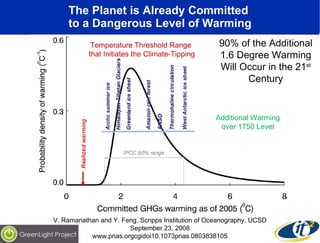
The Planet is Already Committed  to a Dangerous Level of Warming Temperature Threshold Range  that Initiates the Climate-Tipping V. Ramanathan and Y. Feng, Scripps Institution of Oceanography, UCSD September 23, 2008 www.pnas.orgcgidoi10.1073pnas.0803838105 Additional Warming over 1750 Level 90% of the Additional 1.6 Degree Warming Will Occur in the 21 st  Century
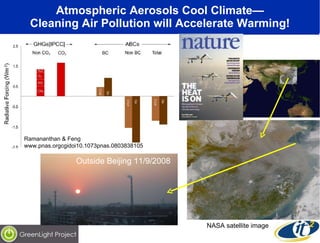
Atmospheric Aerosols Cool Climate— Cleaning Air Pollution will Accelerate Warming! NASA satellite image Ramananthan & Feng  www.pnas.orgcgidoi10.1073pnas.0803838105 Outside Beijing 11/9/2008
“ It Will Be the Biggest Single Peacetime Project Humankind Will Have Ever Undertaken”
The IPCC Recommends  a 25-40% Reduction Below 1990 Levels by 2020 On September 27, 2006, Governor Schwarzenegger signed California  the Global Warming Solutions Act  of 2006 Assembly Bill 32 (AB32) Requires Reduction of GHG by 2020 to 1990 Levels 10% Reduction from 2008 Levels; 30% from BAU 2020 Levels 4 Tons of CO 2 -equiv. Reduction for Every Person in California! The European Union Requires Reduction of GHG by 2020 to  20% Below  1990 Levels (12/12/2008) Australia has Pledged to Cut by 2020 its GHG Emissions 5% from 2000 Levels via the World's Broadest Cap &Trade Scheme (12/15/08)  [~5% Below 1990 Levels] Neither the U.S. or Canada has an Official Target Yet President Obama Has Endorsed the AB32 2020 Goal
ICT is a Critical Element in Achieving Countries Greenhouse Gas Emission Reduction Targets www.smart2020.org GeSI member companies:  Bell Canada,  British Telecomm.,  Plc,  Cisco Systems,  Deutsche Telekom AG,  Ericsson,  France Telecom,  Hewlett-Packard,  Intel,  Microsoft,  Nokia,  Nokia Siemens Networks,  Sun Microsystems,  T-Mobile,  Telefónica S.A.,  Telenor,  Verizon,  Vodafone Plc.  Additional support:  Dell, LG.
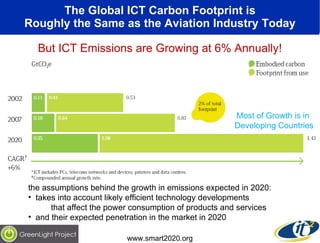
The Global ICT Carbon Footprint is Roughly the Same as the Aviation Industry Today www.smart2020.org But ICT Emissions are Growing at 6% Annually! the assumptions behind the growth in emissions expected in 2020:  takes into account likely efficient technology developments    that affect the power consumption of products and services and their expected penetration in the market in 2020 Most of Growth is in  Developing Countries
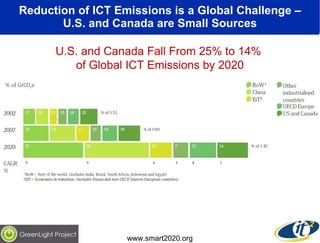
Reduction of ICT Emissions is a Global Challenge – U.S. and Canada are Small Sources U.S. and Canada Fall From 25% to 14%  of Global ICT Emissions by 2020 www.smart2020.org
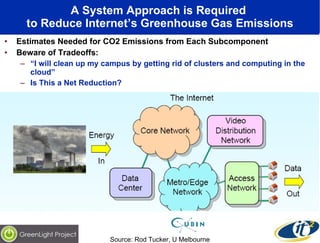
A System Approach is Required  to Reduce Internet’s Greenhouse Gas Emissions Estimates Needed for CO2 Emissions from Each Subcomponent Beware of Tradeoffs: “ I will clean up my campus by getting rid of clusters and computing in the cloud”  Is This a Net Reduction? Source: Rod Tucker, U Melbourne
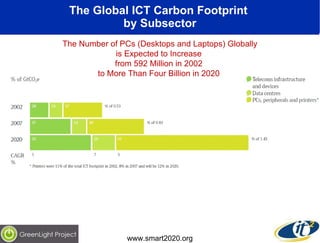
The Global ICT Carbon Footprint  by Subsector www.smart2020.org The Number of PCs (Desktops and Laptops) Globally is Expected to Increase  from 592 Million in 2002  to More Than Four Billion in 2020
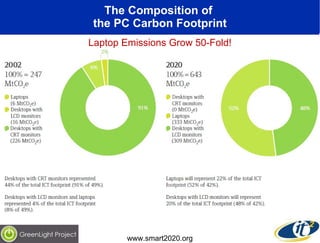
The Composition of  the PC Carbon Footprint Laptop Emissions Grow 50-Fold! www.smart2020.org
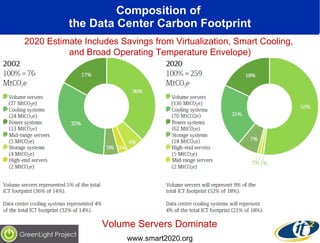
Composition of  the Data Center Carbon Footprint www.smart2020.org 2020 Estimate Includes Savings from Virtualization, Smart Cooling,  and Broad Operating Temperature Envelope) Volume Servers Dominate
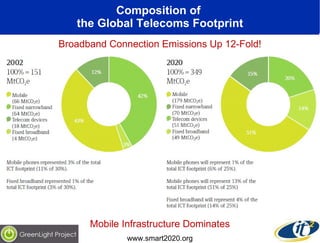
Composition of  the Global Telecoms Footprint www.smart2020.org Broadband Connection Emissions Up 12-Fold! Mobile Infrastructure Dominates
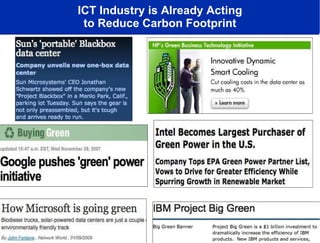
ICT Industry is Already Acting to Reduce Carbon Footprint
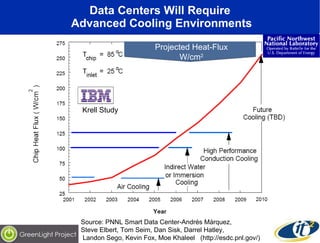
Data Centers Will Require  Advanced Cooling Environments Krell Study Source: PNNL Smart Data Center-Andrés Márquez,  Steve Elbert, Tom Seim, Dan Sisk, Darrel Hatley,  Landon Sego, Kevin Fox, Moe Khaleel  (http://esdc.pnl.gov/) Projected Heat-Flux W/cm 2
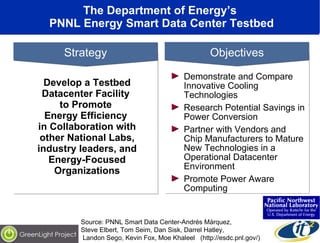
The Department of Energy’s  PNNL Energy Smart Data Center Testbed Develop a Testbed Datacenter Facility  to Promote  Energy Efficiency  in Collaboration with other National Labs, industry leaders, and Energy-Focused Organizations Strategy Objectives Demonstrate and Compare Innovative Cooling Technologies Research Potential Savings in Power Conversion Partner with Vendors and Chip Manufacturers to Mature New Technologies in a Operational Datacenter Environment Promote Power Aware Computing Source: PNNL Smart Data Center-Andrés Márquez,  Steve Elbert, Tom Seim, Dan Sisk, Darrel Hatley,  Landon Sego, Kevin Fox, Moe Khaleel  (http://esdc.pnl.gov/)
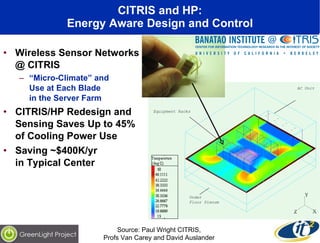
CITRIS and HP: Energy Aware Design and Control Wireless Sensor Networks @ CITRIS “ Micro-Climate” and  Use at Each Blade  in the Server Farm CITRIS/HP Redesign and Sensing Saves Up to 45%  of Cooling Power Use Saving ~$400K/yr  in Typical Center Source: Paul Wright CITRIS,  Profs Van Carey and David Auslander  Equipment Racks AC Unit Under  Floor Plenum  Power Dissipation: 300 W/sq ft
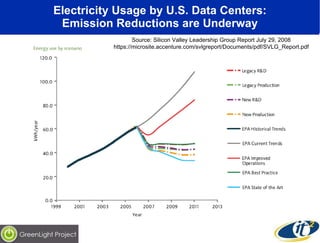
Electricity Usage by U.S. Data Centers: Emission Reductions are Underway Source: Silicon Valley Leadership Group Report July 29, 2008 https://microsite.accenture.com/svlgreport/Documents/pdf/SVLG_Report.pdf
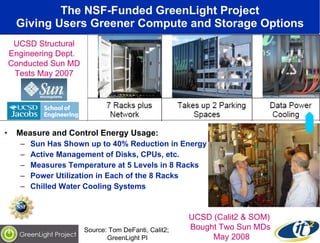
The NSF-Funded GreenLight Project Giving Users Greener Compute and Storage Options Measure and Control Energy Usage: Sun Has Shown up to 40% Reduction in Energy Active Management of Disks, CPUs, etc. Measures Temperature at 5 Levels in 8 Racks Power Utilization in Each of the 8 Racks Chilled Water Cooling Systems UCSD Structural Engineering Dept.  Conducted Sun MD Tests May 2007 UCSD (Calit2 & SOM)  Bought Two Sun MDs May 2008 Source: Tom DeFanti, Calit2;  GreenLight PI
The GreenLight Project:  Instrumenting  the Energy Cost  of Computational Science Focus on 5 Communities with At-Scale Computing Needs: Metagenomics Ocean Observing Microscopy  Bioinformatics Digital Media Measure, Monitor, & Web Publish  Real-Time Sensor Outputs Via Service-oriented Architectures Allow Researchers Anywhere To Study Computing Energy Cost Enable Scientists To Explore Tactics For Maximizing Work/Watt Develop Middleware that Automates Optimal Choice  of Compute/RAM Power Strategies for Desired Greenness Partnering With Minority-Serving Institutions Cyberinfrastructure Empowerment Coalition  Source: Tom DeFanti, Calit2; GreenLight PI
Research Needed  on How to Deploy a  Green  CI Computer Architecture  Rajesh Gupta/CSE Software Architecture  Amin Vahdat, Ingolf Kruger/CSE CineGrid Exchange  Tom DeFanti/Calit2 Visualization  Falko Kuster/Structural Engineering Power and Thermal Management  Tajana Rosing/CSE Analyzing Power Consumption Data  Jim Hollan/Cog Sci Direct DC Datacenters Tom Defanti, Greg Hidley http://greenlight.calit2.net MRI
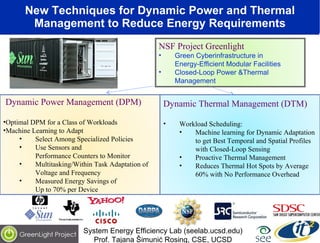
New Techniques for Dynamic Power and Thermal Management to Reduce Energy Requirements Dynamic Thermal Management (DTM) Workload Scheduling: Machine learning for Dynamic Adaptation to get Best Temporal and Spatial Profiles with Closed-Loop Sensing Proactive Thermal Management Reduces Thermal Hot Spots by Average 60% with No Performance Overhead Dynamic Power Management (DPM) Optimal DPM for a Class of Workloads Machine Learning to Adapt Select Among Specialized Policies Use Sensors and  Performance Counters to Monitor Multitasking/Within Task Adaptation of Voltage and Frequency Measured Energy Savings of  Up to 70% per Device System Energy Efficiency Lab (seelab.ucsd.edu) Prof. Tajana Šimunić Rosing, CSE, UCSD NSF Project Greenlight Green Cyberinfrastructure in  Energy-Efficient Modular Facilities  Closed-Loop Power &Thermal Management
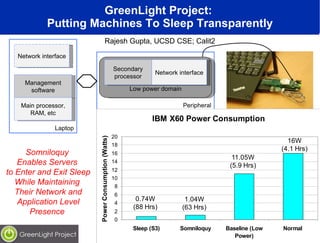
GreenLight Project:  Putting Machines To Sleep Transparently Somniloquy  Enables Servers  to Enter and Exit Sleep While Maintaining  Their Network and Application Level Presence  Rajesh Gupta, UCSD CSE; Calit2 Peripheral Laptop Low power domain Network interface Secondary processor Network interface Management software Main processor, RAM, etc
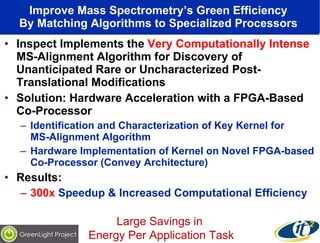
Improve Mass Spectrometry’s Green Efficiency  By Matching Algorithms to Specialized Processors  Inspect Implements the  Very Computationally Intense  MS-Alignment Algorithm for Discovery of Unanticipated Rare or Uncharacterized Post-Translational Modifications Solution: Hardware Acceleration with a FPGA-Based Co-Processor Identification and Characterization of Key Kernel for  MS-Alignment Algorithm Hardware Implementation of Kernel on Novel FPGA-based Co-Processor (Convey Architecture) Results:  300x  Speedup & Increased Computational Efficiency Large Savings in  Energy Per Application Task
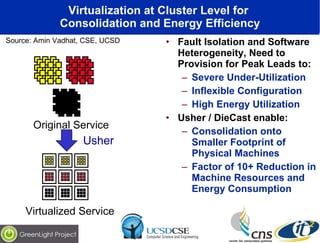
Virtualization at Cluster Level for  Consolidation and Energy Efficiency Fault Isolation and Software Heterogeneity, Need to Provision for Peak Leads to: Severe Under-Utilization Inflexible Configuration High Energy Utilization Usher / DieCast enable: Consolidation onto Smaller Footprint of Physical Machines Factor of 10+ Reduction in Machine Resources and Energy Consumption Original Service Virtualized Service Source: Amin Vadhat, CSE, UCSD Usher
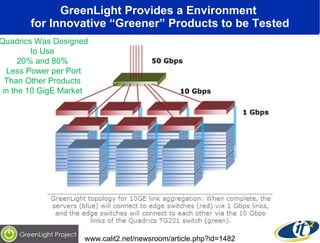
GreenLight Provides a Environment  for Innovative “Greener” Products to be Tested www.calit2.net/newsroom/article.php?id=1482 Quadrics Was Designed to Use  20% and 80%  Less Power per Port Than Other Products  in the 10 GigE Market
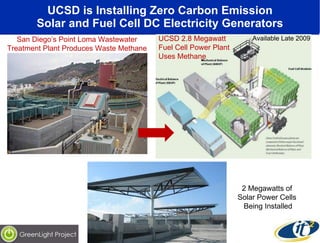
UCSD is Installing Zero Carbon Emission Solar and Fuel Cell DC Electricity Generators San Diego’s Point Loma Wastewater Treatment Plant Produces Waste Methane UCSD 2.8 Megawatt  Fuel Cell Power Plant  Uses Methane 2 Megawatts of  Solar Power Cells  Being Installed Available Late 2009
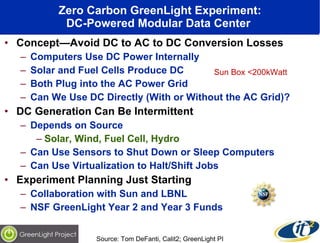
Zero Carbon GreenLight Experiment: DC-Powered Modular Data Center  Concept—Avoid DC to AC to DC Conversion Losses Computers Use DC Power Internally Solar and Fuel Cells Produce DC Both Plug into the AC Power Grid Can We Use DC Directly (With or Without the AC Grid)? DC Generation Can Be Intermittent  Depends on Source  Solar, Wind, Fuel Cell, Hydro Can Use Sensors to Shut Down or Sleep Computers Can Use Virtualization to Halt/Shift Jobs Experiment Planning Just Starting Collaboration with Sun and LBNL NSF GreenLight Year 2 and Year 3 Funds  Source: Tom DeFanti, Calit2; GreenLight PI Sun Box <200kWatt
Power Management in the Cellular Infrastructure: Calit2 Achieves 58% Power Amplifier Efficiency Power Transistor Tradeoffs: Si-LDMOS, GaN, & GaAs Price & Performance Power Amplifier Tradeoffs: WiMAX & 3.9GPP LTE Efficiency & Linearity Digital Signal Processing Tradeoffs: Pre-Distortion, Memory Effects  & Power Control MIPS & Memory STMicroelectronics Standard Commercial Base Station Power Amp is 10% Efficient Source: Don Kimball, Calit2 www.universityofcalifornia.edu/news/article/19058 Calit2  High-Power Amplifier Lab
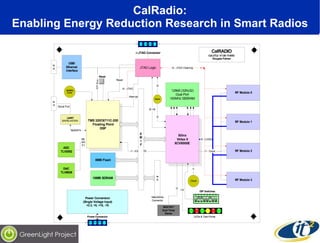
CalRadio: Enabling Energy Reduction Research in Smart Radios
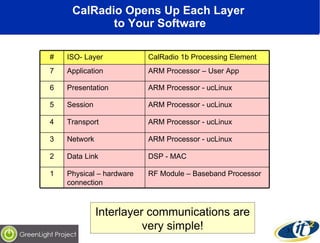
CalRadio Opens Up Each Layer  to Your Software Interlayer communications are very simple! # ISO- Layer CalRadio 1b Processing Element 7 Application ARM Processor – User App 6 Presentation ARM Processor - ucLinux 5 Session ARM Processor - ucLinux 4 Transport ARM Processor - ucLinux 3 Network ARM Processor - ucLinux  2 Data Link DSP - MAC 1 Physical – hardware connection RF Module – Baseband Processor
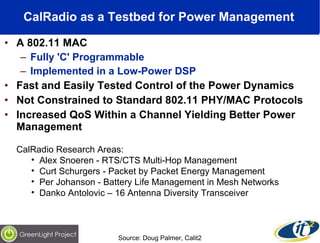
CalRadio as a Testbed for Power Management   A 802.11 MAC  Fully 'C' Programmable  Implemented in a Low-Power DSP  Fast and Easily Tested Control of the Power Dynamics  Not Constrained to Standard 802.11 PHY/MAC Protocols Increased QoS Within a Channel Yielding Better Power Management CalRadio Research Areas: Alex Snoeren - RTS/CTS Multi-Hop Management Curt Schurgers - Packet by Packet Energy Management Per Johanson - Battery Life Management in Mesh Networks Danko Antolovic – 16 Antenna Diversity Transceiver Source: Doug Palmer, Calit2
Application of ICT Can Lead to a  5-Fold Greater Decrease in GHGs Than its Own Carbon Footprint Major Opportunities for the United States* Smart Electrical Grids Smart Transportation Systems Smart Buildings Virtual Meetings * Smart 2020 United States Report Addendum www.smart2020.org While the sector plans to significantly step up  the energy efficiency of its products and services,  ICT’s largest influence  will be by enabling  energy efficiencies in other sectors, an opportunity  that could deliver  carbon savings five times larger  than  the total emissions from the entire ICT sector in 2020. --Smart 2020 Report
Use University Campuses  as Green IT Testbeds Campuses are Small Cities Consolidated Clusters over Dedicated Optical Channels Low Energy Mobile Infrastructure Sensors and Actuators in Intelligent Buildings Low Carbon Transportation System Smart Electricity Grid Ubiquitous Teleconferencing  Research on How to Change End User Behavior Calit2 is Partnering with UCSD and UCI “ Green Living Laboratories of the Future”

Digital Infrastructure in a Carbon-Constrained World

  • 1.
    Digital Infrastructure ina Carbon-Constrained World SciPM 2009 Workshop on the Science of Power Management Arlington, VA April 9, 2009 Dr. Larry Smarr Director, California Institute for Telecommunications and Information Technology Harry E. Gruber Professor, Dept. of Computer Science and Engineering Jacobs School of Engineering, UCSD
  • 2.
    The Planet isAlready Committed to a Dangerous Level of Warming Temperature Threshold Range that Initiates the Climate-Tipping V. Ramanathan and Y. Feng, Scripps Institution of Oceanography, UCSD September 23, 2008 www.pnas.orgcgidoi10.1073pnas.0803838105 Additional Warming over 1750 Level 90% of the Additional 1.6 Degree Warming Will Occur in the 21 st Century
  • 3.
    Atmospheric Aerosols CoolClimate— Cleaning Air Pollution will Accelerate Warming! NASA satellite image Ramananthan & Feng www.pnas.orgcgidoi10.1073pnas.0803838105 Outside Beijing 11/9/2008
  • 4.
    “ It WillBe the Biggest Single Peacetime Project Humankind Will Have Ever Undertaken”
  • 5.
    The IPCC Recommends a 25-40% Reduction Below 1990 Levels by 2020 On September 27, 2006, Governor Schwarzenegger signed California the Global Warming Solutions Act of 2006 Assembly Bill 32 (AB32) Requires Reduction of GHG by 2020 to 1990 Levels 10% Reduction from 2008 Levels; 30% from BAU 2020 Levels 4 Tons of CO 2 -equiv. Reduction for Every Person in California! The European Union Requires Reduction of GHG by 2020 to 20% Below 1990 Levels (12/12/2008) Australia has Pledged to Cut by 2020 its GHG Emissions 5% from 2000 Levels via the World's Broadest Cap &Trade Scheme (12/15/08) [~5% Below 1990 Levels] Neither the U.S. or Canada has an Official Target Yet President Obama Has Endorsed the AB32 2020 Goal
  • 6.
    ICT is aCritical Element in Achieving Countries Greenhouse Gas Emission Reduction Targets www.smart2020.org GeSI member companies: Bell Canada, British Telecomm., Plc, Cisco Systems, Deutsche Telekom AG, Ericsson, France Telecom, Hewlett-Packard, Intel, Microsoft, Nokia, Nokia Siemens Networks, Sun Microsystems, T-Mobile, Telefónica S.A., Telenor, Verizon, Vodafone Plc. Additional support: Dell, LG.
  • 7.
    The Global ICTCarbon Footprint is Roughly the Same as the Aviation Industry Today www.smart2020.org But ICT Emissions are Growing at 6% Annually! the assumptions behind the growth in emissions expected in 2020: takes into account likely efficient technology developments that affect the power consumption of products and services and their expected penetration in the market in 2020 Most of Growth is in Developing Countries
  • 8.
    Reduction of ICTEmissions is a Global Challenge – U.S. and Canada are Small Sources U.S. and Canada Fall From 25% to 14% of Global ICT Emissions by 2020 www.smart2020.org
  • 9.
    A System Approachis Required to Reduce Internet’s Greenhouse Gas Emissions Estimates Needed for CO2 Emissions from Each Subcomponent Beware of Tradeoffs: “ I will clean up my campus by getting rid of clusters and computing in the cloud” Is This a Net Reduction? Source: Rod Tucker, U Melbourne
  • 10.
    The Global ICTCarbon Footprint by Subsector www.smart2020.org The Number of PCs (Desktops and Laptops) Globally is Expected to Increase from 592 Million in 2002 to More Than Four Billion in 2020
  • 11.
    The Composition of the PC Carbon Footprint Laptop Emissions Grow 50-Fold! www.smart2020.org
  • 12.
    Composition of the Data Center Carbon Footprint www.smart2020.org 2020 Estimate Includes Savings from Virtualization, Smart Cooling, and Broad Operating Temperature Envelope) Volume Servers Dominate
  • 13.
    Composition of the Global Telecoms Footprint www.smart2020.org Broadband Connection Emissions Up 12-Fold! Mobile Infrastructure Dominates
  • 14.
    ICT Industry isAlready Acting to Reduce Carbon Footprint
  • 15.
    Data Centers WillRequire Advanced Cooling Environments Krell Study Source: PNNL Smart Data Center-Andrés Márquez, Steve Elbert, Tom Seim, Dan Sisk, Darrel Hatley, Landon Sego, Kevin Fox, Moe Khaleel (http://esdc.pnl.gov/) Projected Heat-Flux W/cm 2
  • 16.
    The Department ofEnergy’s PNNL Energy Smart Data Center Testbed Develop a Testbed Datacenter Facility to Promote Energy Efficiency in Collaboration with other National Labs, industry leaders, and Energy-Focused Organizations Strategy Objectives Demonstrate and Compare Innovative Cooling Technologies Research Potential Savings in Power Conversion Partner with Vendors and Chip Manufacturers to Mature New Technologies in a Operational Datacenter Environment Promote Power Aware Computing Source: PNNL Smart Data Center-Andrés Márquez, Steve Elbert, Tom Seim, Dan Sisk, Darrel Hatley, Landon Sego, Kevin Fox, Moe Khaleel (http://esdc.pnl.gov/)
  • 17.
    CITRIS and HP:Energy Aware Design and Control Wireless Sensor Networks @ CITRIS “ Micro-Climate” and Use at Each Blade in the Server Farm CITRIS/HP Redesign and Sensing Saves Up to 45% of Cooling Power Use Saving ~$400K/yr in Typical Center Source: Paul Wright CITRIS, Profs Van Carey and David Auslander Equipment Racks AC Unit Under Floor Plenum Power Dissipation: 300 W/sq ft
  • 18.
    Electricity Usage byU.S. Data Centers: Emission Reductions are Underway Source: Silicon Valley Leadership Group Report July 29, 2008 https://microsite.accenture.com/svlgreport/Documents/pdf/SVLG_Report.pdf
  • 19.
    The NSF-Funded GreenLightProject Giving Users Greener Compute and Storage Options Measure and Control Energy Usage: Sun Has Shown up to 40% Reduction in Energy Active Management of Disks, CPUs, etc. Measures Temperature at 5 Levels in 8 Racks Power Utilization in Each of the 8 Racks Chilled Water Cooling Systems UCSD Structural Engineering Dept. Conducted Sun MD Tests May 2007 UCSD (Calit2 & SOM) Bought Two Sun MDs May 2008 Source: Tom DeFanti, Calit2; GreenLight PI
  • 20.
    The GreenLight Project: Instrumenting the Energy Cost of Computational Science Focus on 5 Communities with At-Scale Computing Needs: Metagenomics Ocean Observing Microscopy Bioinformatics Digital Media Measure, Monitor, & Web Publish Real-Time Sensor Outputs Via Service-oriented Architectures Allow Researchers Anywhere To Study Computing Energy Cost Enable Scientists To Explore Tactics For Maximizing Work/Watt Develop Middleware that Automates Optimal Choice of Compute/RAM Power Strategies for Desired Greenness Partnering With Minority-Serving Institutions Cyberinfrastructure Empowerment Coalition Source: Tom DeFanti, Calit2; GreenLight PI
  • 21.
    Research Needed on How to Deploy a Green CI Computer Architecture Rajesh Gupta/CSE Software Architecture Amin Vahdat, Ingolf Kruger/CSE CineGrid Exchange Tom DeFanti/Calit2 Visualization Falko Kuster/Structural Engineering Power and Thermal Management Tajana Rosing/CSE Analyzing Power Consumption Data Jim Hollan/Cog Sci Direct DC Datacenters Tom Defanti, Greg Hidley http://greenlight.calit2.net MRI
  • 22.
    New Techniques forDynamic Power and Thermal Management to Reduce Energy Requirements Dynamic Thermal Management (DTM) Workload Scheduling: Machine learning for Dynamic Adaptation to get Best Temporal and Spatial Profiles with Closed-Loop Sensing Proactive Thermal Management Reduces Thermal Hot Spots by Average 60% with No Performance Overhead Dynamic Power Management (DPM) Optimal DPM for a Class of Workloads Machine Learning to Adapt Select Among Specialized Policies Use Sensors and Performance Counters to Monitor Multitasking/Within Task Adaptation of Voltage and Frequency Measured Energy Savings of Up to 70% per Device System Energy Efficiency Lab (seelab.ucsd.edu) Prof. Tajana Šimunić Rosing, CSE, UCSD NSF Project Greenlight Green Cyberinfrastructure in Energy-Efficient Modular Facilities Closed-Loop Power &Thermal Management
  • 23.
    GreenLight Project: Putting Machines To Sleep Transparently Somniloquy Enables Servers to Enter and Exit Sleep While Maintaining Their Network and Application Level Presence Rajesh Gupta, UCSD CSE; Calit2 Peripheral Laptop Low power domain Network interface Secondary processor Network interface Management software Main processor, RAM, etc
  • 24.
    Improve Mass Spectrometry’sGreen Efficiency By Matching Algorithms to Specialized Processors Inspect Implements the Very Computationally Intense MS-Alignment Algorithm for Discovery of Unanticipated Rare or Uncharacterized Post-Translational Modifications Solution: Hardware Acceleration with a FPGA-Based Co-Processor Identification and Characterization of Key Kernel for MS-Alignment Algorithm Hardware Implementation of Kernel on Novel FPGA-based Co-Processor (Convey Architecture) Results: 300x Speedup & Increased Computational Efficiency Large Savings in Energy Per Application Task
  • 25.
    Virtualization at ClusterLevel for Consolidation and Energy Efficiency Fault Isolation and Software Heterogeneity, Need to Provision for Peak Leads to: Severe Under-Utilization Inflexible Configuration High Energy Utilization Usher / DieCast enable: Consolidation onto Smaller Footprint of Physical Machines Factor of 10+ Reduction in Machine Resources and Energy Consumption Original Service Virtualized Service Source: Amin Vadhat, CSE, UCSD Usher
  • 26.
    GreenLight Provides aEnvironment for Innovative “Greener” Products to be Tested www.calit2.net/newsroom/article.php?id=1482 Quadrics Was Designed to Use 20% and 80% Less Power per Port Than Other Products in the 10 GigE Market
  • 27.
    UCSD is InstallingZero Carbon Emission Solar and Fuel Cell DC Electricity Generators San Diego’s Point Loma Wastewater Treatment Plant Produces Waste Methane UCSD 2.8 Megawatt Fuel Cell Power Plant Uses Methane 2 Megawatts of Solar Power Cells Being Installed Available Late 2009
  • 28.
    Zero Carbon GreenLightExperiment: DC-Powered Modular Data Center Concept—Avoid DC to AC to DC Conversion Losses Computers Use DC Power Internally Solar and Fuel Cells Produce DC Both Plug into the AC Power Grid Can We Use DC Directly (With or Without the AC Grid)? DC Generation Can Be Intermittent Depends on Source Solar, Wind, Fuel Cell, Hydro Can Use Sensors to Shut Down or Sleep Computers Can Use Virtualization to Halt/Shift Jobs Experiment Planning Just Starting Collaboration with Sun and LBNL NSF GreenLight Year 2 and Year 3 Funds Source: Tom DeFanti, Calit2; GreenLight PI Sun Box <200kWatt
  • 29.
    Power Management inthe Cellular Infrastructure: Calit2 Achieves 58% Power Amplifier Efficiency Power Transistor Tradeoffs: Si-LDMOS, GaN, & GaAs Price & Performance Power Amplifier Tradeoffs: WiMAX & 3.9GPP LTE Efficiency & Linearity Digital Signal Processing Tradeoffs: Pre-Distortion, Memory Effects & Power Control MIPS & Memory STMicroelectronics Standard Commercial Base Station Power Amp is 10% Efficient Source: Don Kimball, Calit2 www.universityofcalifornia.edu/news/article/19058 Calit2 High-Power Amplifier Lab
  • 30.
    CalRadio: Enabling EnergyReduction Research in Smart Radios
  • 31.
    CalRadio Opens UpEach Layer to Your Software Interlayer communications are very simple! # ISO- Layer CalRadio 1b Processing Element 7 Application ARM Processor – User App 6 Presentation ARM Processor - ucLinux 5 Session ARM Processor - ucLinux 4 Transport ARM Processor - ucLinux 3 Network ARM Processor - ucLinux 2 Data Link DSP - MAC 1 Physical – hardware connection RF Module – Baseband Processor
  • 32.
    CalRadio as aTestbed for Power Management A 802.11 MAC Fully 'C' Programmable Implemented in a Low-Power DSP Fast and Easily Tested Control of the Power Dynamics Not Constrained to Standard 802.11 PHY/MAC Protocols Increased QoS Within a Channel Yielding Better Power Management CalRadio Research Areas: Alex Snoeren - RTS/CTS Multi-Hop Management Curt Schurgers - Packet by Packet Energy Management Per Johanson - Battery Life Management in Mesh Networks Danko Antolovic – 16 Antenna Diversity Transceiver Source: Doug Palmer, Calit2
  • 33.
    Application of ICTCan Lead to a 5-Fold Greater Decrease in GHGs Than its Own Carbon Footprint Major Opportunities for the United States* Smart Electrical Grids Smart Transportation Systems Smart Buildings Virtual Meetings * Smart 2020 United States Report Addendum www.smart2020.org While the sector plans to significantly step up the energy efficiency of its products and services, ICT’s largest influence will be by enabling energy efficiencies in other sectors, an opportunity that could deliver carbon savings five times larger than the total emissions from the entire ICT sector in 2020. --Smart 2020 Report
  • 34.
    Use University Campuses as Green IT Testbeds Campuses are Small Cities Consolidated Clusters over Dedicated Optical Channels Low Energy Mobile Infrastructure Sensors and Actuators in Intelligent Buildings Low Carbon Transportation System Smart Electricity Grid Ubiquitous Teleconferencing Research on How to Change End User Behavior Calit2 is Partnering with UCSD and UCI “ Green Living Laboratories of the Future”

Editor's Notes

  • #17 Assess applicability of new cooling technologies Validate decision-making models for data centers Total Cost of Ownership CFD Identify metrics related to energy efficiency in data centers Develop methods of analysis in mixed use data centers
  • #33 Note: The key here is that energy utilization is optimized by the best channel utilization. This can be achieved by many means but the researcher must be able to have simple access to the PHY/MAC protocols to perform real-world testing. Only CalRadio gives this capability. Point out that the work done by Danko Antolovic (Advanced Network Management Lab, Indiana University) has shown the ability to cut power consumption for an access point by a factor of 16!